
Regulations & Permits · Vista, California
Vista ADU Laws in 2026: Rules, Fees, Permits & Lot-Fit Checklist
Vista ADU laws decoded: real permit fees, the 750 sq ft rule, fee waivers, 10 pre-approved plans, plus a free lot-fit check. Verified 2026.
Last verified: May 13, 2026 · Sources: City of Vista ADU FAQ, Vista Municipal Code Ch. 18.31, Vista July 2025 Fee Schedule, Ord. 2019-11 (Fee Waiver), Cal. Gov. Code §§ 66310–66342, HCD ADU Handbook 2026
Vista ADU laws at a glance — 2026
If you own residential property inside the City of Vista, California, the short version is this. Vista ADU laws are governed by Vista Municipal Code Chapter 18.31 and overlaid by California Government Code §§ 66310–66342, which together let most residential lots build at least one detached or attached ADU up to 1,200 square feet, plus a JADU up to 500 square feet carved out of the existing home. Setbacks are 4 feet from side and rear property lines, height is generally capped at 16 feet and one story, short-term rentals (under 30 days) are not allowed in any Vista ADU or JADU, and Vista has not adopted AB 1033 as of May 2026 — so ADUs cannot currently be sold separately inside city limits.
The most expensive single decision you will make is which side of 750 square feet your ADU lands on. Under Government Code § 66311.5, ADUs at or below 750 sq ft of interior livable area cannot be charged local impact fees. ADUs above 750 sq ft can be charged impact fees proportionally — that single threshold can swing your fee exposure by several thousand dollars up to roughly $19,000 or more, depending on size and waiver eligibility.
Vista also has one of North County’s most generous fee waiver programs: impact fees can be waived entirely for ADUs occupied by a low-income household or a caregiver/family member for 10 years. And Vista has no coastal zone — so no Coastal Development Permit is required for any Vista ADU project.
See What You Can Build at Your Vista Address — Free ADU Report
Answer six quick questions about your property and get a Vista-specific verdict before paying for plans.
Get My Free ADU ReportVista ADU quick-reference table — 2026
Every cell below traces to Vista’s official ADU FAQ, Vista Municipal Code Chapter 18.31, or the specific California Government Code section cited. Where state law gives you more rights than the local FAQ suggests, the state column governs.
| Question | Fast answer | Authority |
|---|---|---|
| What code governs ADUs in Vista? | Vista Municipal Code Chapter 18.31; California Gov. Code §§ 66310–66342 | VMC § 18.31; HCD |
| Which zones allow ADUs? | R-1-B, R-1, E-1, A-1, O-R, R-M, M-U, and specific-plan areas allowing residential use by right | Vista ADU FAQ |
| Max detached ADU size? | 1,200 sq ft | Vista ADU FAQ |
| Max attached ADU size? | 50% of primary dwelling, capped at 1,200 sq ft, with an 800 sq ft state-law floor | VMC § 18.31; Gov. Code § 66321 |
| Max JADU size? | 500 sq ft, within an existing single-family dwelling | Gov. Code § 66333 |
| Max bedrooms? | 2 BR for ADUs up to 850 sq ft; 3 BR for ADUs up to 1,200 sq ft | Vista ADU FAQ |
| Side/rear setback? | 4 ft minimum for new construction; conversions exempt | VMC § 18.31; Gov. Code § 66314 |
| Max height (Vista local)? | 16 ft / 1 story; ADU permitted on 2nd story of primary residence or detached structure with separate entrance; stacked ADUs not permitted | Vista ADU FAQ |
| Max height (state overlay)? | 16 ft floor; 18 ft within ½-mile walking distance of a major transit stop; +2 ft if roof pitch matches primary; 25 ft floor for attached ADUs | Gov. Code § 66321 |
| Parking required? | One space, with multiple exemptions (transit proximity, conversion, attached, historic district, car-share area) | Gov. Code § 66314 |
| Owner occupancy required? | Not required for standard ADUs (AB 976); for JADUs only if JADU shares sanitation with primary (AB 1154, eff. Jan 1, 2026) | Gov. Code § 66333 |
| Short-term rental (under 30 days)? | Prohibited in ADUs and JADUs | Vista STR ordinance; Vista ADU page |
| Sell ADU separately (AB 1033)? | Vista has not adopted AB 1033 as of May 2026 | City of Vista (editor verification) |
| Coastal Development Permit? | Not required — no part of Vista is in the coastal zone | California Coastal Commission |
| Pre-approved plans? | Yes — 10 plan options; plan-check fees waived when used; permit/inspection fees still apply | Vista ADU page |
| Fee waiver program? | Available for ADUs over 750 sq ft occupied by a low-income household (≤80% SD County AMI) or caregiver/family member for 10 years | Vista Ord. 2019-11; VMC Ch. 18.31 |
| Permit submittal? | In person, 3 paper sets at 24×36 in., Development Services counter | Vista ADU page |
| Permit timeline? | 15 business days to determine completeness, then 60 days to approve or deny | Gov. Code § 66317 |
Free tool: Vista ADU Lot-Fit + Fee-Threshold Checker
You can read the next 8,000 words of this guide, or you can answer six quick questions about your property and get a Vista-specific verdict. Inputs include your zone, lot size, intended ADU type, target square footage, transit proximity, and septic/sewer status. The tool returns a verdict — clear-path detached ADU, conversion-or-JADU only, borderline, or likely blocked — plus a short list of which Vista department to call first.
Free. Independent of any builder. No login wall.
What are the Vista ADU laws at a glance?
Vista ADU laws sit at the intersection of three layers: the city’s own Vista Municipal Code Chapter 18.31, California’s statewide ADU statutes in Government Code §§ 66310 through 66342, and recent state laws like AB 1154, SB 543, and SB 1211 that override or expand on what older local language describes. Vista’s public FAQ summarizes the local pieces clearly, but state law often gives a Vista homeowner more rights than the FAQ alone reveals — particularly around mandatory approval, JADU owner-occupancy, and the impact-fee threshold at 750 square feet.
Treat Vista’s local code as the floor for what is permitted, not the ceiling. If a local handout suggests a narrower path than state law allows, the state path usually wins.
The local rule
Vista’s ADU code is contained in Chapter 18.31 of the Vista Municipal Code, with the city’s plain-English summary published on vista.gov and a downloadable ADU FAQ document. The City of Vista regulates ADUs through its Planning Division (760-639-6100), Development Services counter (760-639-6108), and Engineering / Land Development Division (760-639-6111). All three departments touch most ADU projects.
The state-law overlay
California’s ADU statutes were renumbered in 2024 from Government Code § 65852.2 into a new chapter at §§ 66310–66342. The provisions a Vista homeowner needs most:
- § 66311.5 — Impact fees prohibited for ADUs of 750 sq ft or less of interior livable area; impact fees on larger ADUs must be calculated proportionally.
- § 66314 — 4-foot side/rear setback maximum. Cities cannot require correction of pre-existing nonconforming conditions as an ADU approval condition.
- § 66317 — The two-stage permit shot clock: 15 business days for completeness determination, 60 days from completeness to approve or deny.
- § 66321 — Statewide height minimums: 16 ft on a single-family lot; 18 ft within a half-mile walking distance of a major transit stop; up to 2 additional feet for roof-pitch match. Attached ADUs have a 25-foot state floor.
- § 66323 — Mandatory approval combinations local agencies must allow on residential or mixed-use lots.
- § 66333 — JADU specifics, including the AB 1154 narrowing of owner-occupancy requirements to JADUs that share sanitation facilities with the primary home.
What to verify before buying plans
The single most expensive mistake is paying an architect before confirming three things with Vista directly:
- Your zone is right. Most residential zones qualify, but specific-plan areas, hillside overlays, and certain mixed-use parcels have nuances. Call Planning at 760-639-6100 or email
planningquestions@vista.gov. - Grading and Land Development have no concerns. Contact Engineering at 760-639-6111 with your address, proposed square footage, and a preliminary site plan to see whether a grading permit will be required. This single conversation can save $5,000–$10,000 in surprise site work.
- Septic vs. sewer is settled. Confirm with Development Services (760-639-6108) whether your property is connected to a public sewer line. If on septic, you need San Diego County DEHQ clearance before plans can be accepted.
Which Vista zones allow ADUs and JADUs?
Vista’s own ADU FAQ explicitly lists the zones that allow ADUs and JADUs: R-1-B, R-1, E-1, A-1, O-R, R-M, M-U, and all specific-plan areas that allow residential use by right. That covers virtually every residential and mixed-use parcel in the city.
Single-family zones
The standard single-family zones — R-1 (single-family residential), R-1-B (single-family with smaller lot sizes), E-1 (estate residential), A-1 (agricultural with single-family residential allowed), and O-R (office residential) — are where most Vista ADU projects happen. If your property tax bill or the Vista zoning map shows one of these designations, you are almost certainly in a zone that allows at least one ADU and one JADU.
Multifamily and mixed-use zones
If your property is zoned R-M (multifamily residential) or one of Vista’s M-U mixed-use designations, the rules expand significantly. State law SB 1211 (effective January 1, 2025) lets you build up to eight detached ADUs on a multifamily lot, capped at the number of existing primary units. A four-unit apartment building can add up to four detached ADUs; a ten-unit building can add up to eight. You can also convert non-livable multifamily space — storage rooms, boiler rooms, basements, attached garages — into additional ADUs, up to 25% of existing primary units (minimum one).
Specific-plan areas
Parts of Vista governed by specific plans — for example, parcels in the Mar Vista Specific Plan area or the North Santa Fe Overlay — may have additional design or use overlays. The base ADU right still applies, but the specific plan can impose objective architectural standards. If your address falls in a specific-plan area, confirm directly with Vista Planning before you commit to a design.
How many ADUs can you build on a Vista property?
The short answer. On a single-family lot, Vista’s FAQ describes one attached or detached ADU plus one JADU under the standard local pathway. On a lot with an existing multifamily building, Vista allows up to eight detached ADUs, capped by the number of existing units, plus converted ADUs from non-livable space (up to 25% of existing primary units). JADUs are not permitted on multifamily properties.
Single-family property path
Under Vista’s ADU FAQ, a single-family lot can support either one attached ADU of up to 50% of the primary residence square footage (capped at 1,200 sq ft), or one detached ADU of up to 1,200 sq ft. Either path can be combined with one JADU — a unit of up to 500 sq ft carved out of the existing single-family home. In practice, a typical Vista single-family homeowner can plan for: primary house + one ADU (attached or detached) + one JADU = three units on the lot.
The state mandatory-approval pathway
Government Code § 66323 lays out specific ADU/JADU combinations that local agencies must approve on lots in residential or mixed-use zones, including pairings of conversion ADUs plus a detached ADU plus a JADU beyond what Vista’s local FAQ summarizes. If you think you might qualify for an additional unit, raise it with Planning or have a designer review § 66323 against your site plan.
Stacked detached ADUs?
No. Vista’s own ADU FAQ states that stacked ADUs are not permitted, and that ADUs are limited to one story / maximum 16 feet. The FAQ does allow an ADU on the second story of a primary residence or a detached structure (like above a detached garage) if it has a separate entrance — but a freestanding two-story ADU is a different question that Vista currently doesn’t permit.
How big can a Vista ADU be?
The short answer. Vista permits detached ADUs up to 1,200 square feet, attached ADUs up to 50% of the primary residence’s floor area capped at 1,200 sq ft (with an 800 sq ft state-law floor), and JADUs up to 500 sq ft. Bedroom counts are also capped by Vista’s FAQ: ADUs up to 850 sq ft may have up to two bedrooms, and ADUs up to 1,200 sq ft may have up to three bedrooms.
500 sq ft — the JADU ceiling
A JADU is created entirely within an existing single-family home, capped at 500 sq ft. It must include an efficiency kitchen (cooking facility, food prep counter, storage cabinets) and a recorded deed restriction. Under AB 1154 (effective January 1, 2026), Vista may only require the owner to live on the property if the JADU shares sanitation facilities with the primary residence. If the JADU has its own bathroom, owner-occupancy is not required.
750 sq ft — the impact-fee cliff (§ 66311.5)
No impact fee may be charged for an ADU with 750 sq ft of interior livable space or less. Cross 750 sq ft and impact fees apply proportionally based on the ADU’s square footage relative to the primary dwelling’s size. A 749-sq-ft ADU and an 800-sq-ft ADU can have a fee difference exceeding $10,000 in Vista-side impact fees alone. This is the single most important number in your ADU budget.
Garage and accessory-structure conversions
Conversion ADUs — ADUs created within an existing legal accessory structure like a detached garage, workshop, or pool house — are not subject to size and setback requirements that would otherwise apply to new construction, as long as the existing footprint is maintained. They also do not trigger replacement parking under SB 1211. If you have an unused detached garage in usable condition, conversion is usually the fastest and cheapest ADU path in Vista.
What are the setback, height, and design rules for Vista ADUs?
Vista ADUs must respect 4-foot minimum side and rear setbacks, 5-foot eave-to-eave separation between the ADU and other structures, and front setbacks that match the underlying zone (typically 20–25 feet in most R-1 areas). Vista’s own FAQ caps detached ADUs at 16 feet and one story, with state-law height overlays for transit-proximity lots and attached ADUs.
Side and rear setbacks
For new ADU construction, Vista requires a minimum of 4 feet from side and rear property lines, consistent with the maximum cities can require under Gov. Code § 66314. ADUs built above an existing detached garage may use a slightly wider 5-foot side and rear setback. Conversion ADUs within an existing structure are exempt from setback requirements as long as the existing footprint is maintained.
Height — Vista local rule
Per Vista’s ADU FAQ, detached ADUs are limited to one story and a maximum of 16 feet. The FAQ also allows an ADU on the second story of a primary residence or a detached structure if it has a separate entrance. Stacked ADUs — a freestanding two-story detached unit — are explicitly not permitted.
Height — state overlay (Gov. Code § 66321)
Several state-law provisions can override or expand on the 16-foot local rule:
- 18 feet for a detached ADU if the parcel is within a half-mile walking distance of a major transit stop or high-quality transit corridor (Vista has NCTD SPRINTER service running through the city).
- +2 feet (i.e., 18 or 20 feet total) if the ADU’s roof pitch matches the primary dwelling.
- 18 feet floor for detached ADUs on lots with existing multifamily housing.
- 25 feet floor for attached ADUs, not to exceed the local zone’s height limit for the primary dwelling, and not required to allow more than two stories.
Distance from main house
Vista requires a minimum of 5 feet of separation, measured eave-to-eave, between a detached ADU and any other structure on the property — including the primary residence, a detached garage, a pool, or another ADU. This is a real constraint on tight urban lots. A common workaround is to design the ADU corner-to-corner with the primary dwelling so the 5-foot eave separation is achievable.
Design compatibility
Vista encourages ADUs to incorporate the same architectural features, building materials, and color as the primary residence. Under Gov. Code § 66317, cities can impose objective design standards but cannot impose subjective aesthetic review on ministerial ADU approvals. In practice, matching siding, roofing, and trim colors avoids friction during plan check and is usually a cheap upgrade.
Do you need parking for a Vista ADU?
Most Vista ADU projects qualify for a parking exemption under either local rules or state law. The standard local rule is one off-street parking space per ADU, but exemptions apply for ADUs within a half-mile walking distance of public transit, conversion ADUs, ADUs in historic districts, ADUs in permit-only on-street parking areas, and ADUs within one block of a car-share area. Garage conversions and JADUs do not require replacement parking under SB 1211.
When parking is waived
State law lists the following exemptions, and Vista must honor each:
- The ADU is within a half-mile walking distance of public transit (NCTD SPRINTER stations and active Breeze bus stops can put many Vista parcels inside this exemption).
- The ADU is converted from existing space in the primary residence or an existing accessory structure.
- The ADU is attached to an existing or proposed primary residence.
- The property is in an architecturally and historically significant historic district.
- On-street parking permits are required in the area but not offered to the ADU occupant.
- The ADU is within one block of a designated car-share area.
Garage conversion and replacement parking
SB 1211 eliminated replacement parking requirements when a garage, carport, covered parking structure, or uncovered parking space is demolished or converted to create an ADU. Before SB 1211, many cities required homeowners to build a new covered parking spot somewhere else on the lot — often pushing project costs up by $15,000 or more. That requirement is gone.
Check Your Vista Parking Exemption — Free ADU Report
Knowing your parking status before you design saves money and avoids surprises during plan check.
Check My Parking ExemptionCan you rent out a Vista ADU or use it as an Airbnb?
Yes for long-term rentals; no for short-term rentals. Vista’s ADU page explicitly sets a minimum rental term of 30 consecutive days for both ADUs and JADUs. Vista’s short-term rental ordinance carves ADUs and JADUs out of any STR permit pathway. Long-term rentals are permitted with no owner-occupancy required for standard ADUs (AB 976), and only required for JADUs that share sanitation facilities with the primary home (AB 1154).
What’s the rent like in Vista?
To set realistic expectations, here are recent citywide Vista rental snapshots from independent data sources. These are citywide rental comps across all property types, not ADU-specific rent guarantees.
| Source | Studio | 1 BR | 2 BR | 3 BR | Reporting period |
|---|---|---|---|---|---|
| RentHop | $1,750 | $2,395 | $3,048 | $4,100 | May 2026 |
| Rentometer | $1,949 | $2,235 | $2,877 | $3,938 | Current at pull |
| RentCafe (citywide avg.) | $1,899 | $2,298 | $2,652 | — | April 2026 |
| Zumper (all bed types median) | $2,650 | — | — | — | May 2026 |
These are illustrative examples, not guarantees of returns. Actual results depend on local market conditions, construction costs, financing terms, and regulatory approvals.
Property management considerations
Affiliate disclosure: The Dwelling Index is reader-supported. When you use our links to explore property management software, we may earn a commission at no extra cost to you. Our editorial recommendations are based on independent research and are never influenced by compensation.
If you’re planning to rent the ADU long-term and don’t want to handle tenant screening, lease drafting, rent collection, and maintenance coordination yourself, property-management software like Buildium lets a small owner handle one or two units without hiring a property manager. Buildium covers applicant screening, online lease signing, rent collection, and maintenance request workflows. For a one-ADU rental, software is usually sufficient. For owners with multiple units, full-service property management in San Diego County typically runs 8–12% of monthly rent.
What does a Vista ADU permit actually cost, and where is the 750 sq ft fee cliff?
Vista permit and fee exposure scales with ADU size and falls into three bands. ADUs under 500 sq ft (typically JADUs) avoid most impact fees and school fees. ADUs of 500 to 750 sq ft are protected from impact fees under Gov. Code § 66311.5 but pay school fees. ADUs above 750 sq ft can be charged impact fees proportionally — which under Vista’s published 2025 fee-schedule rates can add several thousand dollars to roughly $19,000 in development impact fee exposure before considering fee-waiver eligibility and proportional reduction.
The 500 sq ft school-fee threshold
Vista Unified School District charges a residential developer fee currently published at $4.08 per square foot. The district applies it to new residential units, including ADUs, and to additions or remodels with a net increase of 500 square feet or more. ADUs under 500 sq ft are exempt.
- Under 500 sq ft — exempt from school fees.
- 500 sq ft or larger — pay school fees at $4.08/sq ft (verify current rate at
vistausd.org). - A 750 sq ft ADU pays roughly $3,060 in school fees; a 1,200 sq ft ADU pays roughly $4,896.
Vista building permit and plan-check fees
Vista’s permit fees are calculated based on construction valuation using the city’s published fee schedule. Per the July 2025 fee schedule (the most recent version we verified), for projects valued between $100,001 and $500,000:
- Building permit fee: $1,877.74 for the first $100,000 of valuation, plus $13.56 per additional $1,000 or fraction.
- Plan-check fee: $2,233.19 for the first $100,000 of valuation, plus $5.19 per additional $1,000 or fraction.
For a typical Vista detached ADU with a construction valuation of $300,000–$450,000, building permit + plan-check fees alone run approximately $6,500–$11,500 combined. Engineering, utility, soils review, stormwater, and grading fees stack on top.
Current published impact-fee exposure for an ADU over 750 sq ft
Vista’s published 2025 development impact fee components for single-family residential construction:
| Impact fee | 2025 published rate (single-family) |
|---|---|
| Fire Protection | $379 per dwelling unit |
| Park Fee | $9,933.06 per dwelling unit |
| Public Facilities | $1,218 per dwelling unit |
| Streets / Signal | $7,378.87 per dwelling unit |
| Subtotal (four DIFs at full residential rate) | $19,008.93 |
For ADUs over 750 sq ft, these four fees are charged proportionally based on ADU square footage relative to the primary dwelling — not at the full residential rate. The proportional calculation typically reduces the actual bill below the $19,008.93 ceiling. Other Vista fees and charges that may apply:
- Vista Sanitation District connection fee: ~$6,978.94 per EDU
- Buena Sanitation connection fee: ~$8,391.23 per EDU (if in Buena’s service area) plus $1,135.50 plan check
- Soils report review: $3,044.33
- Standard Water Quality Technical Report (WQTR) review: $1,908.81
- Priority WQTR review: $10,111.29
- Stormwater Hydrology & Hydraulics review: $4,436.31
- Single-family grading plan check: $3,813.71
- Single-family grading inspection: $4,875.18
- Minor grading plan check/inspection: $3,529.48
- General plan-check/inspection hourly rate: $208.84 per hour
Construction costs for a typical Vista detached ADU run $375–$600+ per square foot all-in, with an 800–1,200 sq ft ADU running $300,000–$450,000+. Garage conversions run $150,000–$250,000. Attached ADUs run $120,000–$250,000. (SnapADU publicly published San Diego County pricing guidance, March 2026.)
Avoid the Fee-Threshold Mistake — Get Your Free ADU Report
If the fee math has you reconsidering your project size, see the address-level check before you commit.
See My Fee Exposure →How does Vista’s ADU fee waiver program work?
Vista’s local fee waiver program, established under Ordinance No. 2019-11 and codified in Vista Municipal Code Chapter 18.31, can waive Fire Protection, Park, Public Facilities, and Streets/Signal Development Impact Fees (totaling up to $19,008.93 at the full residential rate in 2025 dollars) for ADUs over 750 sq ft. To qualify, the ADU must be occupied for 10 years following the certificate of occupancy by either a low-income household (gross income at or below 80% of the San Diego County median, adjusted by household size) or a family member/caregiver providing regular care to an owner or occupant of the primary unit. The property owner must execute and record a covenant agreement before fees are paid — the waiver cannot be applied retroactively.
This program is one of the most generous in North County, but it comes with real strings.
Who qualifies
Two eligibility paths:
- Income-restricted occupancy. The ADU is rented to a household with gross income at or below 80% of the San Diego County median income, adjusted by household size, for 10 years. Verify the current AMI figure with Vista Housing & Homeless Services before relying on a specific dollar amount.
- Caregiver / family-member occupancy. A family member or caregiver providing regular care to an owner or occupant of the primary unit lives in the ADU. There’s no income test for this path, but the caregiving relationship must be documented.
The 10-year occupancy and covenant requirement
The waiver requires you to record a Covenant Agreement Restricting Occupancy and Rents for an Accessory Dwelling Unit with the San Diego County Recorder. The covenant runs with the land for 10 years from the certificate of occupancy date. If you sell the property during that period, the covenant transfers to the new owner and the occupancy restriction continues. Failure to maintain eligible occupancy can trigger fee recapture.
Why the waiver cannot be retroactive
This catches homeowners off guard. The covenant must be executed and submitted to the city immediately after submitting plans — before fees are paid at permit issuance. If you pay your impact fees first and try to apply for the waiver later, you cannot recover the fees. Plan the waiver before plan check, not after.
When to call Building vs. Housing
- Building Division (760-639-6108) for fee schedule confirmation, plan-check status, and permit fees.
- Housing & Homeless Services (via the city’s main line, 760-639-6100) for fee waiver eligibility, the covenant template, and income verification.
The fee waiver alone can save you up to $19,000 at full residential rates. If you’d consider renting to a family member, a caregiver, or a moderate-income tenant for a decade, it’s worth a 30-minute conversation with Housing.
Does Vista have pre-approved ADU plans?
Yes. The City of Vista offers 10 pre-approved ADU plan options that have already been reviewed for code compliance, and plan-check fees are waived when these plans are used. Permit and inspection fees still apply. The plans are only usable on lots with existing single-family dwellings. As of mid-2026, the city’s ADU page notes that plans updated to the 2025 Building Codes are “coming soon,” so confirm current code-cycle status with Development Services before downloading.
What pre-approved plans save
- Plan-check fees waived — typically $2,000–$4,000 saved.
- Faster review — fewer correction cycles because architectural compliance is pre-reviewed.
- Lower architect costs — soft costs drop from $15,000–$25,000 down to $3,000–$6,000 (covering site plan, Title 24, and project-specific calculations).
What they do not save
- Building permit fees and inspection fees still apply.
- Impact fees still apply based on the ADU’s size and your waiver eligibility.
- Site work, grading, soils, drainage, and utility costs still apply.
- Site-specific documents are still required: site plan, Title 24 CF1R energy report, soils report or waiver, and grading clearance.
Required documents even with pre-approved plans
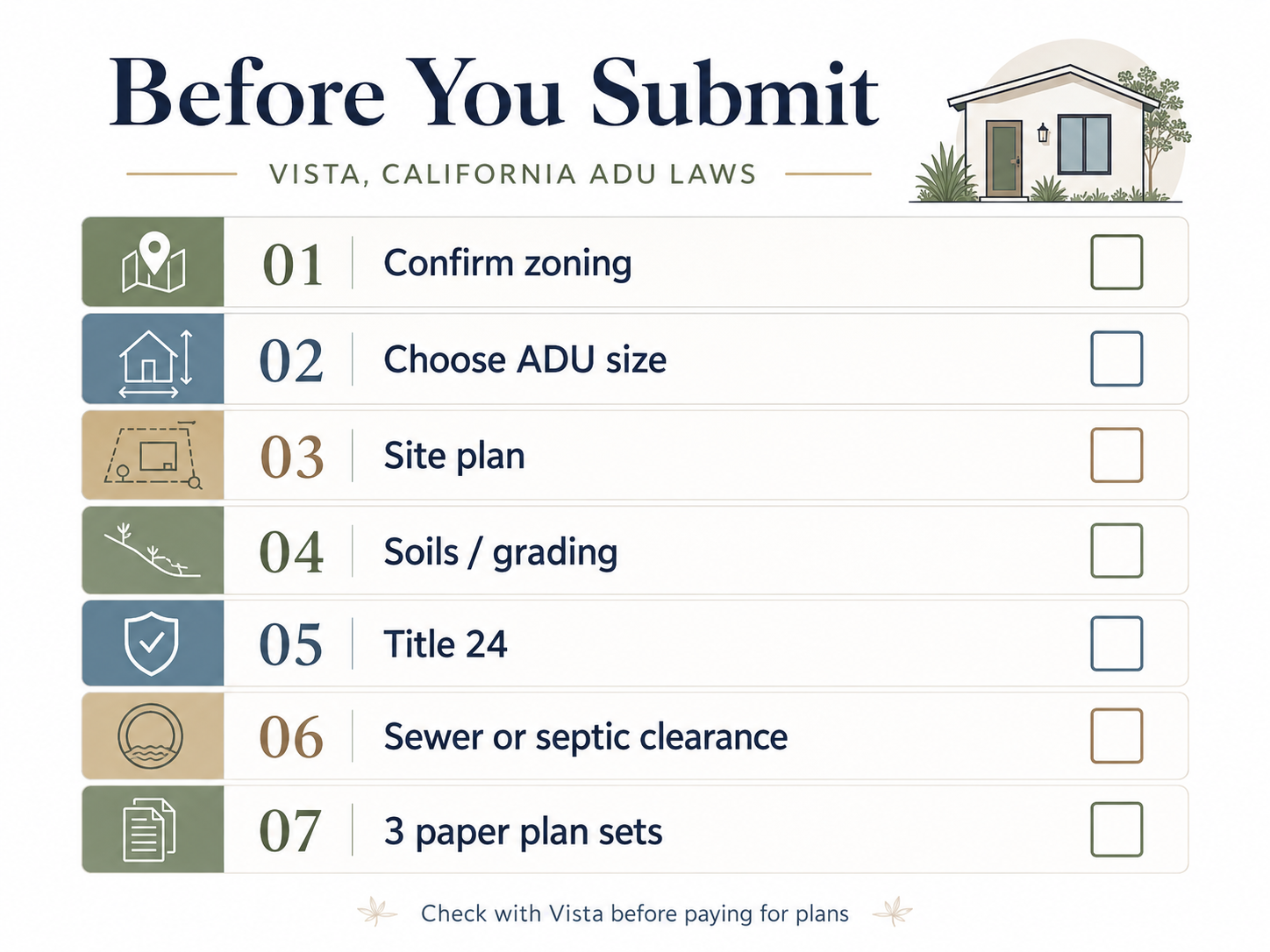
Vista’s published submittal checklist for pre-approved ADU plans requires:
- Building Permit Application (in-person, hand-completed)
- 3 sets of plans at 24×36 inches
- Soils report or soils waiver letter (footings placed 24 inches or more into competent soil)
- Site-specific Title 24 energy compliance report (CF1R)
- Sufficiently detailed and to-scale site plan
- Vista Land Development Engineering Division clearance (grading review) before plans are accepted
- San Diego County Health Department clearance for properties on septic systems
When a custom plan may be better
Pre-approved plans are designed for “typical” Vista lots — flat, rectangular, on sewer, with standard setbacks. Custom design is probably the better path if:
- Your lot is sloped, hillside, or has unusual geometry.
- You need a specific layout for caregiving, multigenerational living, or a home office.
- You want to build above a garage (which Vista allows when the ground floor remains a garage).
- You need a two-bedroom layout under 750 sq ft for the fee threshold — pre-approved plans may not have a configuration that hits both targets.
Download the Free ADU Starter Kit
Our Vista pre-approved-plan submittal checklist, the 750 sq ft fee-threshold worksheet, the fee waiver eligibility flowchart, and a list of questions to ask Vista Planning before paying for plans. Email-only delivery.
Download the Free ADU Starter Kit →What do you need before applying for a Vista ADU permit?
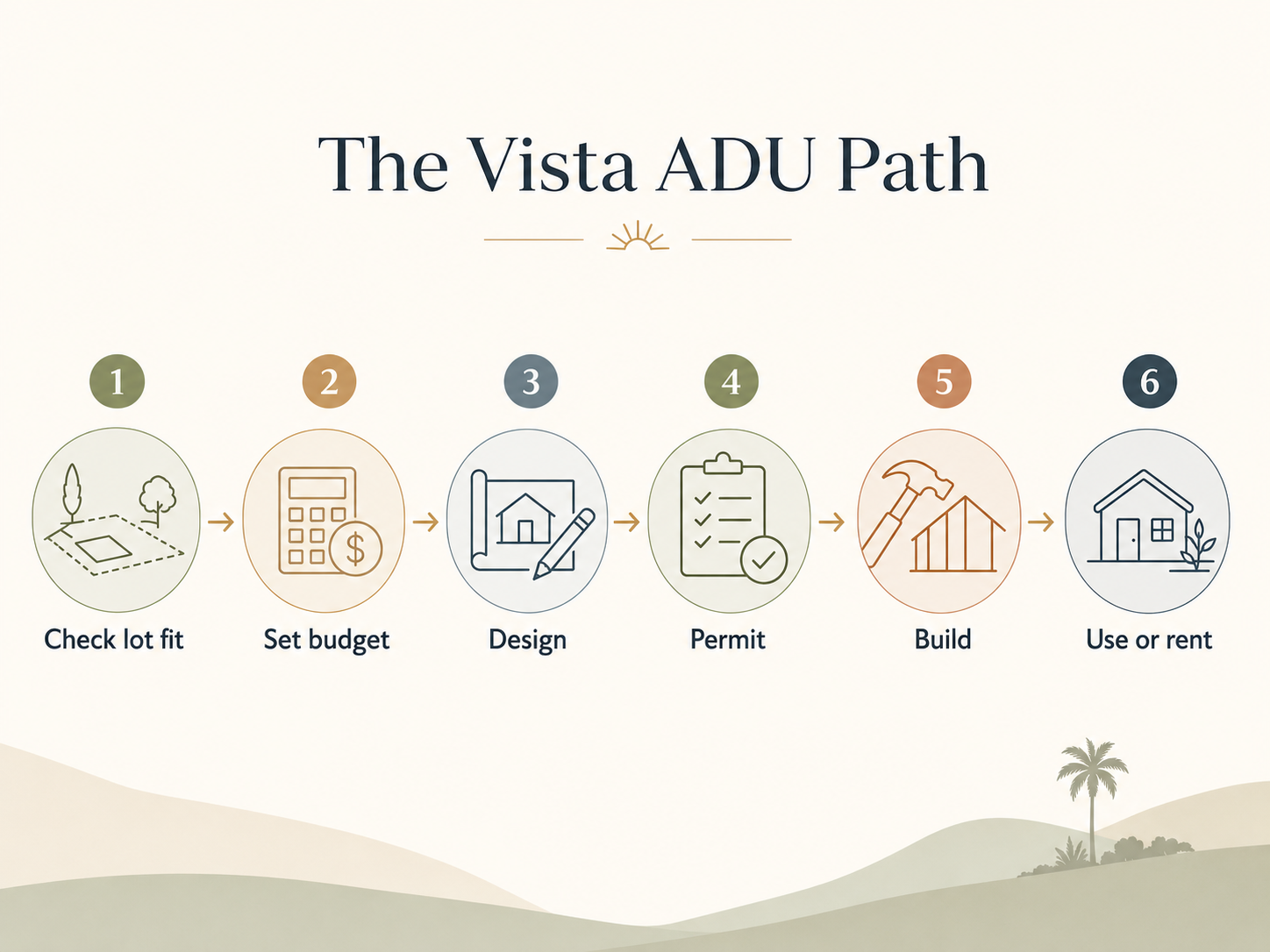
Before you submit, you need: (1) confirmed zoning eligibility for your specific parcel, (2) Land Development / grading clearance from Vista Engineering, (3) septic or sewer status confirmed, (4) a complete plan set at 24×36 inches in three paper copies, (5) a Title 24 energy compliance report (CF1R), (6) a soils report or waiver, (7) a Building Permit Application completed and signed, and (8) for contractor-built projects, a current City of Vista business license for the licensed contractor. Permit applications expire if work is not commenced within 180 days from the permit date, or if work is suspended or abandoned for 180 days after starting.
Step 1: Verify zoning
Confirm with Vista Planning that your zone allows the ADU type you’re proposing. Email planningquestions@vista.gov or call 760-639-6100 with your address and proposed ADU type. Five-minute task, saves weeks.
Step 2: Check grading and Land Development
Contact Engineering at 760-639-6111 with your address, proposed ADU square footage, and a preliminary site plan or aerial diagram. They will tell you whether a grading permit is required and whether your project triggers a stormwater mitigation requirement. Stormwater work for a Vista ADU typically runs $5,000–$10,000.
Step 3: Check septic/health clearance
Confirm with Development Services (760-639-6108) whether your property is connected to a public sewer line. If you’re on septic, you need San Diego County Department of Environmental Health and Quality (DEHQ) clearance — typically a site inspection and a determination that your septic system can support the additional load — before Vista will accept your building permit application.
Step 4: Prepare site plan, soils, Title 24, and plan set
Your designer or architect will prepare:
- Site plan showing all property lines, easements, setbacks, existing structures, proposed ADU footprint, parking, utility laterals, and drainage flow.
- Soils report unless footings will be placed 24 inches or more into competent soil (a soils waiver letter can be substituted — runs $1,000–$2,000 vs. $3,000–$8,000 for a full report).
- Title 24 energy compliance report (CF1R) specific to your ADU’s design, orientation, and mechanical systems.
- Plan set at 24×36 inches in three paper copies.
Step 5: Submit at the Development Services counter
Bring your plans, completed Building Permit Application, and any required clearance letters to the Development Services counter at 200 Civic Center Drive, 1st Floor, Vista, CA 92084. Counter hours are 8:30 a.m. to 5:30 p.m. Monday through Thursday and 8:30 a.m. to 4:30 p.m. every other Friday.
Step 6: Track corrections, fees, and issuance
Under Gov. Code § 66317, Vista must determine your application complete within 15 business days. If they miss that, the application is deemed complete — not deemed approved. Vista then has 60 days from completeness to approve or deny. If they miss the 60-day clock, the application is deemed approved as a matter of law. Most Vista ADU plan-check cycles complete in roughly 6–10 weeks total with one or two correction rounds.
Step 7: Inspections and permit expiration
After permit issuance, you have 180 days to commence work, and no period of suspension or abandonment can exceed 180 days. Standard inspections (foundation, framing, plumbing, electrical, mechanical, insulation, drywall, final) occur as the build progresses.
Vista ADU permit checklist (printable)
| Item | Where to get it | Status |
|---|---|---|
| Zoning confirmation | Vista Planning, 760-639-6100 | ☐ |
| Grading / Land Development clearance | Engineering, 760-639-6111 | ☐ |
| Septic clearance (if on septic) | San Diego County DEHQ | ☐ |
| Sewer connection confirmation (if on sewer) | Development Services, 760-639-6108 | ☐ |
| Site plan to scale, 24×36 | Designer / architect | ☐ |
| Soils report or soils waiver | Geotechnical engineer | ☐ |
| Title 24 CF1R energy report | Title 24 specialist or designer | ☐ |
| Building Permit Application (signed) | Vista Building Division | ☐ |
| Contractor's current City of Vista business license | Licensed contractor | ☐ |
| 3 sets of plans (24×36) | Designer / printer | ☐ |
| Pre-approved plan selection (optional) | Vista ADU page | ☐ |
| Fee waiver covenant (if using waiver) | Vista Housing & Homeless Services | ☐ |
What changed in 2025–2026 and what it means for Vista property owners
Six state laws passed in 2024 and 2025 have changed how Vista must process ADU applications. SB 543 and SB 9 (2025) strengthen the Gov. Code § 66317 shot clock and give HCD enforcement teeth. AB 1154 narrows when JADU owner-occupancy can be required. AB 462 streamlines coastal and disaster ADUs (limited Vista applicability — Vista has no coastal zone). AB 2533 creates a legalization pathway for unpermitted ADUs built before January 1, 2020. SB 1211 expanded multifamily ADUs to up to 8 detached units. The 2025 California Building Standards Code (Title 24) took effect January 1, 2026, so plans must be drawn to the current cycle, not the 2022 cycle.
SB 543 and SB 9 (2025): the shot clock has real teeth
Under the post-2026 framework, Vista must determine your application complete within 15 business days. Miss that, and the application is deemed complete. Vista then has 60 days from a completed application to approve or deny. Miss that, and the application is deemed approved as a matter of law. SB 9 of 2025 gives HCD the authority to declare non-compliant local ordinances null and void. If you’ve heard horror stories about Vista ADU permits taking 12 or 18 months, those stories are pre-2026.
AB 1154: JADU owner-occupancy rules narrowed
Effective January 1, 2026, AB 1154 (codified at Gov. Code § 66333) limits when Vista can impose owner-occupancy on a JADU:
- JADU shares sanitation facilities with the primary residence → Owner-occupancy may be required.
- JADU has its own separate sanitation facilities → Owner-occupancy may not be required.
Vista’s published JADU page may not yet reflect this update — confirm with Planning that they’re applying the post-AB 1154 interpretation to new applications.
AB 2533: Legalization pathway for unpermitted pre-2020 ADUs
Effective January 1, 2025, AB 2533 created the first comprehensive amnesty program for unpermitted ADUs built before January 1, 2020. Cities cannot deny a legalization permit unless there is a severe, immediate safety hazard — not a code technicality. This matters in Vista because the city has a stock of unpermitted backyard units and garage conversions built over the last 50 years. Typical legalization costs run $15,000–$50,000 depending on the electrical, plumbing, structural, and Title 24 work needed.
SB 1211: 8 detached ADUs on multifamily lots
Effective January 1, 2025, SB 1211 expanded multifamily ADU capacity from a maximum of 2 detached ADUs to up to 8 detached ADUs, capped at the number of existing primary units. SB 1211 also eliminated replacement parking requirements when a garage is demolished or converted to create an ADU.
AB 1033 in Vista: not adopted as of May 2026
AB 1033 (effective January 1, 2024) allows California cities and counties to opt in to a separate-sale program for ADUs through condominium conversion. As of May 2026: the City of San Diego adopted AB 1033 on August 22, 2025; San Diego County (unincorporated areas) adopted on March 4, 2026, effective April 4, 2026. The City of Vista has not adopted AB 1033. Until Vista’s City Council formally adopts a local ordinance, ADUs inside Vista city limits cannot be sold separately from the primary residence.
The CalHFA $40,000 ADU grant: paused since December 28, 2023
The California Housing Finance Agency’s ADU Grant Program — which offered up to $40,000 per eligible homeowner to reimburse pre-development costs — has been paused since December 28, 2023, when the last round of funding was fully allocated. As of May 2026, there is no confirmed relaunch date. CalHFA’s official page explicitly warns readers that anyone claiming they can secure the grant is running a scam. Several Vista builder pages still imply the grant is available, and Vista’s own fee-waiver FAQ still links to CalHFA — that link is not a current funding pathway.
Check Your Property’s Jurisdiction
If separate-sale optionality is a hard requirement for you, the address-level check can identify whether your property is inside Vista city limits or in unincorporated San Diego County.
Check My Property’s Jurisdiction →Vista vs. nearby North County cities — side-by-side
We assembled this comparison from each city’s published ADU page and current ordinances as of May 2026. Rules and adoption status change; re-verify any cell before relying on it for a specific project.
| Rule | Vista | Oceanside | Carlsbad | San Marcos | Escondido | Unincorp. SD County |
|---|---|---|---|---|---|---|
| Max detached ADU size | 1,200 sq ft | 1,200 sq ft | 1,200 sq ft | 1,200 sq ft | 1,200 sq ft | 1,200 sq ft |
| Max height (local standard) | 16 ft / 1 story | 16 ft | 16 ft | 16 ft | 16 ft | 16 ft |
| Stacked / 2-story detached ADU | Not permitted | Varies by config | Varies by config | Allowed | Allowed | Per state minimums |
| Pre-approved plans | Yes — 10 plans | Limited | Yes — Permit-Ready ADU Program | Yes (SnapADU-designed) | Limited | Yes — SD County plans |
| Coastal zone applies | No | Yes (parts) | Yes (parts) | No | No | Yes (parts) |
| AB 1033 separate sale adopted | Not as of May 2026 | Not as of May 2026 | Not as of May 2026 | Not as of May 2026 | Not as of May 2026 | Yes — eff. April 4, 2026 |
| Local fee waiver program | Yes — caregiver/low-income | Limited | Varies | Yes | Yes | Varies |
Key takeaway: Vista is competitive with surrounding North County cities on size rules, has the only North County ADU-specific fee waiver tied to caregiver and low-income use, and is the only nearby jurisdiction with no coastal zone (which simplifies permitting). The single biggest differentiator is separate-sale capability: if you specifically want the option to sell your ADU separately as a condominium, the unincorporated county areas are currently the only nearby jurisdiction where that’s possible.
Vista ADU laws by use case: which path fits why you’re building?
Most Vista homeowners build for one of five reasons: rental income, housing an aging parent, housing an adult child, multifamily investment, or future sale optionality. The optimal ADU path is different for each.
Use case 1: “I want rental income”
Recommended path: Detached ADU, 600–800 sq ft sweet spot, optimized to stay under or near the 750 sq ft fee threshold while still commanding two-bedroom rent.
Why: The 750 sq ft fee threshold protects you from local impact fees under Gov. Code § 66311.5. Pre-approved plans save another $2,000–$4,000 in plan-check fees. Two bedrooms in 749 sq ft is tight but achievable with a smart layout. Vista citywide rental comps for two-bedroom units run in the $2,650–$3,050 range (RentHop, Rentometer, RentCafe, April–May 2026).
These are illustrative examples, not guarantees of returns. Actual results depend on local market conditions, construction costs, financing terms, and regulatory approvals.
Use case 2: Aging parent / caregiver
Recommended path: Detached ADU using Vista’s caregiver fee waiver pathway, sized for accessibility (single-level, wider doors, roll-in shower, no thresholds). Fee waiver eligibility means you’re not penalized for going over 750 sq ft. Fee savings of up to $19,000 at full residential rates. Tradeoff: 10-year deed restriction — if the parent moves to memory care within the 10-year window, you may face fee recapture or have to qualify under the low-income path.
Use case 3: Adult child returning
Recommended path: Garage conversion or JADU, depending on whether you have a usable detached garage. Garage conversions in Vista typically run $150,000–$250,000 turnkey. JADUs (under 500 sq ft within the primary home) run $80,000–$150,000. Cheapest paths — no new foundation, no setback constraints, no impact fees triggered for the JADU path, no replacement parking required for garage conversion under SB 1211.
Use case 4: Multifamily investor
Recommended path: Up to 8 detached ADUs on a multifamily lot under SB 1211, capped at the existing unit count, plus converted ADUs in non-livable multifamily space (up to 25% of existing primary units). Even at favorable per-unit construction costs of $250,000–$350,000, adding four ADUs to a multifamily lot is a $1M–$1.4M project. Financing typically goes through commercial real estate channels.
Use case 5: Future sale optionality
Recommended path: Build to condo-conversion-ready specs now — separate utility meters, independent access, fire separation to condominium standards — so you have the option if Vista adopts AB 1033 later. Incremental cost is typically $5,000–$15,000 for substantial future optionality. Honest admission: if your only goal is to sell separately as fast as possible, look at unincorporated San Diego County instead.
What can still slow down a Vista ADU even if it is legal?
Even with clean zoning, the right pre-approved plan, and an eligible fee waiver, several Vista-specific friction points can extend your timeline or budget.
Grading and slope
Vista has significant topographic variation. Hillside lots often require a separate grading permit before the building permit can be issued. Vista’s published 2025 fees: single-family grading plan check at $3,813.71 and inspection at $4,875.18. The grading process can add 4–8 weeks and $5,000–$15,000 in engineering and review costs combined.
Soils report or soils waiver
Vista typically requires a soils report for all new construction. As of June 2025, the city allows a soils waiver for simple flat lots — a letter from a civil engineer certifying that the soils supporting the proposed footings are suitable after inspecting the excavation. Waivers run $1,000–$2,000 versus $3,000–$8,000 for a full soils report. Vista’s own soils review fee is $3,044.33.
Septic properties
If your Vista property is on a septic system (common in older Vista parcels), San Diego County DEHQ must clear your project before Vista will accept the building permit application. Plan for 4–8 weeks and $500–$2,000 in review fees and engineering.
Sewer district and utility fees
If your property is on sewer, the connection fee depends on which sewer district serves your address — Vista Sanitation District (~$6,978.94 per EDU) or Buena Sanitation District (~$8,391.23 per EDU plus a $1,135.50 plan check). Confirm with Development Services (760-639-6108) before your plans go in.
In-person paper submission
Vista’s ADU page requires 3 sets of plans at 24×36 inches in person at the Development Services counter. Each printed plan set runs $30–$80 at most reprographics shops, plus the time of dropping off and picking up. Multiple correction cycles compound this cost.
2025 building-code plan updates
The 2025 California Building Standards Code took effect January 1, 2026. If you obtained plans drawn to the 2022 code cycle during 2024 or 2025, those plans may require updates for current Title 24 compliance before Vista will accept them. Confirm code-cycle currency with your designer before submitting.
HOA restrictions
California state law (AB 670) prohibits HOAs from outright banning ADUs in single-family residential neighborhoods, but HOAs can still apply reasonable architectural review standards (color, materials, roof type) that don’t substantially block ADU construction. If your Vista property is in an HOA community, review your CC&Rs and submit to the architectural review committee in parallel with Vista’s review.
What should you do next if your Vista lot looks eligible?
Don’t pay a designer until you’ve completed three checks: zoning, grading/septic, and fee-waiver eligibility. If those three line up, the easiest legal path is usually a detached ADU under 750 sq ft using one of Vista’s 10 pre-approved plans. If you want the most rental yield or you qualify for the caregiver/low-income waiver, a 900–1,200 sq ft custom ADU works. If you have a usable garage, a conversion is the fastest path. Then — and only then — get one or two builder quotes and compare against the cost ranges in this guide.
If you’re comparing builders
Affiliate disclosure: The Dwelling Index is reader-supported. When you use our links to request a builder quote or financing information, we may earn a commission at no extra cost to you. Our editorial recommendations are based on independent research and are never influenced by compensation.
We’ve covered Vista ADU builder selection separately in our Best ADU Builders in Vista, CA guide. Among the local builders we’ve evaluated, SnapADU has the strongest documented Vista experience. SnapADU’s public materials note 100+ ADU projects completed in San Diego County since 2020, CSLB license #1075582, and Vista is explicitly inside their service area. They were also selected by both the City of Chula Vista and the City of San Marcos to design those cities’ pre-approved ADU plans.
Vista ADU FAQ
Can I build a 1,200 sq ft ADU in Vista?
Yes. Vista's ADU FAQ permits detached ADUs up to 1,200 square feet of interior livable area on single-family lots. Setback, height, lot coverage, fees, and design requirements still apply. Going over 750 sq ft triggers proportional impact fees unless you qualify for Vista's local fee waiver program.
Can I build both an ADU and a JADU on the same Vista property?
Yes, on a single-family lot. Vista's FAQ allows a JADU conversion up to 500 sq ft alongside an ADU path (attached or detached). State law under Gov. Code § 66323 mandates that local agencies allow specific combinations of ADUs and JADUs in residential zones, sometimes including more than the local FAQ summarizes.
Does the owner have to live on the property with a JADU?
Sometimes. Under AB 1154 (effective January 1, 2026, codified at Gov. Code § 66333), owner-occupancy may be required only when the JADU shares sanitation facilities with the primary residence. If your JADU has its own separate bathroom, Vista may not require you to occupy either unit. Vista's published JADU page may not yet reflect this update — confirm with Planning.
Can I Airbnb my Vista ADU?
No. Vista's ADU page sets a 30-day minimum rental term for all ADUs and JADUs, and Vista's short-term rental ordinance explicitly excludes ADUs from STR permitting. Stays under 30 days are not allowed, and the city's Code Enforcement office monitors listings.
Does Vista require parking for ADUs?
Sometimes, but most projects qualify for an exemption. Parking is exempt for ADUs within a half-mile walking distance of public transit (which can include NCTD SPRINTER stations and Breeze bus stops), conversion ADUs, attached ADUs, ADUs in historic districts, ADUs in areas with permit-only on-street parking not offered to the occupant, and ADUs within one block of a designated car-share area. If none of these apply, one off-street parking space is required — which can be located in tandem or in a setback area.
Are stacked or two-story ADUs allowed in Vista?
No. Vista's own ADU FAQ states that stacked ADUs are not permitted, and that detached ADUs are limited to one story / 16 feet. The FAQ does allow an ADU on the second story of a primary residence or a detached structure (such as above a detached garage) if it has a separate entrance.
Do Vista pre-approved ADU plans eliminate permit review?
No. Vista's 10 pre-approved plans waive plan-check fees, but you still pay permit and inspection fees, and you still submit a site-specific plan set including site plan, Title 24 energy compliance report, soils information or waiver, and grading clearance. Pre-approved plans save time and money on the architectural review side; they don't bypass the structural, energy, plumbing, and mechanical reviews.
Can I sell a Vista ADU separately from the main house?
Not as of May 2026. AB 1033 allows cities and counties to adopt local ordinances permitting separate ADU sale through condominium conversion, but it's an opt-in framework. The City of Vista has not adopted AB 1033 as of our last verification. The City of San Diego adopted on August 22, 2025; San Diego County (unincorporated areas) adopted on March 4, 2026. Re-confirm current Vista status with the City Clerk before relying on this for a sale strategy.
Does Vista offer a fee waiver program for ADUs?
Yes. Vista's local fee waiver program, established under Ord. 2019-11, can waive Fire Protection, Park, Public Facilities, and Streets/Signal Development Impact Fees (totaling up to $19,008.93 at the full residential rate in 2025 dollars) for ADUs over 750 sq ft occupied by a low-income household (at or below 80% San Diego County AMI) or by a family member/caregiver providing regular care, for 10 years from certificate of occupancy. A recorded covenant is required and must be executed before fees are paid — the waiver cannot be applied retroactively.
Where do I submit my Vista ADU plans?
At the Development Services counter, 200 Civic Center Drive, 1st Floor, Vista, CA 92084. Three paper sets of plans at 24×36 inches are required per the official city ADU page. Counter hours are 8:30 a.m. to 5:30 p.m. Monday–Thursday and 8:30 a.m. to 4:30 p.m. every other Friday.
How long do Vista ADU permits take?
Under Gov. Code § 66317, Vista must determine your application complete within 15 business days and approve or deny within 60 days of completeness. If they miss the 60-day clock, your project is deemed approved as a matter of law. In practice, Vista ADU plan-check cycles vary by complexity, with builder-reported timelines in the 6–10 week range for typical projects. From first conversation with a designer to certificate of occupancy, plan for 6–14 months total.
Is Vista in the coastal zone?
No. No portion of the City of Vista falls within the California coastal zone. Vista ADU projects do not require Coastal Development Permits and are not subject to California Coastal Commission appeal review. Neighboring Carlsbad and Oceanside have coastal-zone parcels; Vista does not.
Can I convert a garage or accessory structure to an ADU in Vista?
Yes. Vista's FAQ permits conversion of existing legal accessory structures, including detached garages, into ADUs. Conversion ADUs are exempt from size and setback requirements as long as the existing footprint is maintained. Under SB 1211, you also do not have to replace the parking displaced by a garage conversion. Conversions are typically the fastest and cheapest Vista ADU path if you have a usable garage in good structural condition.
What we verified
Verification date: May 13, 2026
Primary sources (city and state)
- City of Vista, “Accessory Dwelling Units,”
vista.gov/city-services/community-development/permits-forms/accessory-dwelling-units - City of Vista ADU FAQ document (downloadable PDF, current as of 2025)
- City of Vista, “Accessory Dwelling Unit Fee Waiver Program” pages,
vista.gov/departments/housing-homeless-services/adu-fee-waiver-program - City of Vista Short Term Rentals page and ordinance
- Vista Municipal Code Chapter 18.31, accessed via the city’s Laserfiche portal
- City of Vista July 2025 Fee Schedule, Building Division
- Vista Unified School District developer fees page,
vistausd.org/departments/businessservices/developer-fees - California Government Code §§ 66310–66342, accessed via leginfo.legislature.ca.gov
- California HCD ADU Handbook (2026 update)
- CalHFA ADU Grant Program page,
calhfa.ca.gov/adu(confirmed grant paused since December 28, 2023)
Market data
- Rentometer Vista rental data (current at pull, May 2026)
- RentHop Vista rental data (May 2026)
- Zumper Vista rental research (May 2026)
- RentCafe Vista rental market (April 2026)
- SnapADU public San Diego County ADU pricing (March 2026)
Next scheduled refresh: August 13, 2026
Methodology
We built this guide by separating three classes of source. Official legal and fee sources (Vista city pages, Vista Municipal Code, California Government Code, HCD handbook, Vista’s July 2025 fee schedule, Vista Unified’s developer fee schedule, CalHFA’s official page) are the only basis for legal and fee claims. Builder and competitor pages were used only to identify gaps in coverage and to verify that local interpretations cited had been heard from the city, not invented by the builder. Forum and social media phrasing was used only for voice-of-customer language so this guide answers questions the way Vista property owners actually ask them.
Fee exposure ranges reflect published Vista fee schedule rates before state-law exemptions, proportional rules, utility treatment, and city waiver eligibility apply. Real fee bills for specific projects can be significantly lower than the published rates. We deliberately do not publish a single “your fee will be $X” number because the math depends on at least six project-specific variables.
Cost data for construction reflects the most recent published pricing from SnapADU, the most transparent active San Diego County ADU builder serving Vista. We did not interview Vista city staff for this guide. We did not interview SnapADU or any builder. The Dwelling Index editorial team verified every code section and every fee figure against primary sources during May 1–13, 2026.
We are an independent research resource. We do not represent any builder, lender, designer, or city agency. Partners referenced on this page (SnapADU, Buildium) are included because their service category matches the page’s regulatory context — not because of payment arrangements.
Compliance note
This guide is for general educational purposes and is not legal, financial, construction, or tax advice. Vista and California ADU regulations change. Always verify your project’s specific requirements with the City of Vista Planning Division (planningquestions@vista.gov, 760-639-6100), the Development Services counter (760-639-6108), a qualified design professional, and where needed, legal or tax counsel before making project decisions.
Full affiliate disclosure
The Dwelling Index is an independent research resource covering ADU financing, costs, and regulations. We are reader-supported. When you use our links to explore financing options, request builder quotes, or purchase floor plans, we may earn a commission at no extra cost to you. Our editorial recommendations are based on independent research and are never influenced by compensation. Partners referenced on this page may include SnapADU (Greater San Diego design-build) and Buildium (property management) — each is included because their service category matches the page’s regulatory context, not because of any payment arrangement. Our full Partner Vetting Policy is published at /partner-vetting-policy/.
Related guides
Not sure where to start? See what’s possible at your address — get your free ADU report in 60 seconds.