
Regulations & Permits · Poway, California
Poway ADU Permit Process: 2026 Timeline, Fees and Checklist
Poway ADU permit process 2026 — online application steps, real review-cycle timing, fee-cliff math, and state-law rules that override Poway’s 2019 ordinance.
Last updated: May 13, 2026 · Last verified: May 13, 2026 against City of Poway, HCD, and California Government Code primary sources · Next scheduled review: August 13, 2026
Bottom line, in 60 seconds
The Poway ADU permit process is online, ministerial, and governed by both city rules and a stronger set of state-law protections that several builder pages on page one of Google still get wrong. We built this guide because several top-ranked Poway results still say you have to walk paper plans into the city counter. That’s been false for almost four years.
A Poway ADU permit is processed by the City of Poway Development Services Department and submitted electronically through services.poway.org. Electronic submittals have been required since June 1, 2022. A well-prepared single-family ADU typically reaches permit issuance in 4–7 months and final inspection / legal occupancy in 12–18 months. Permitting and soft costs run roughly $18,000–$58,000 depending on ADU size.
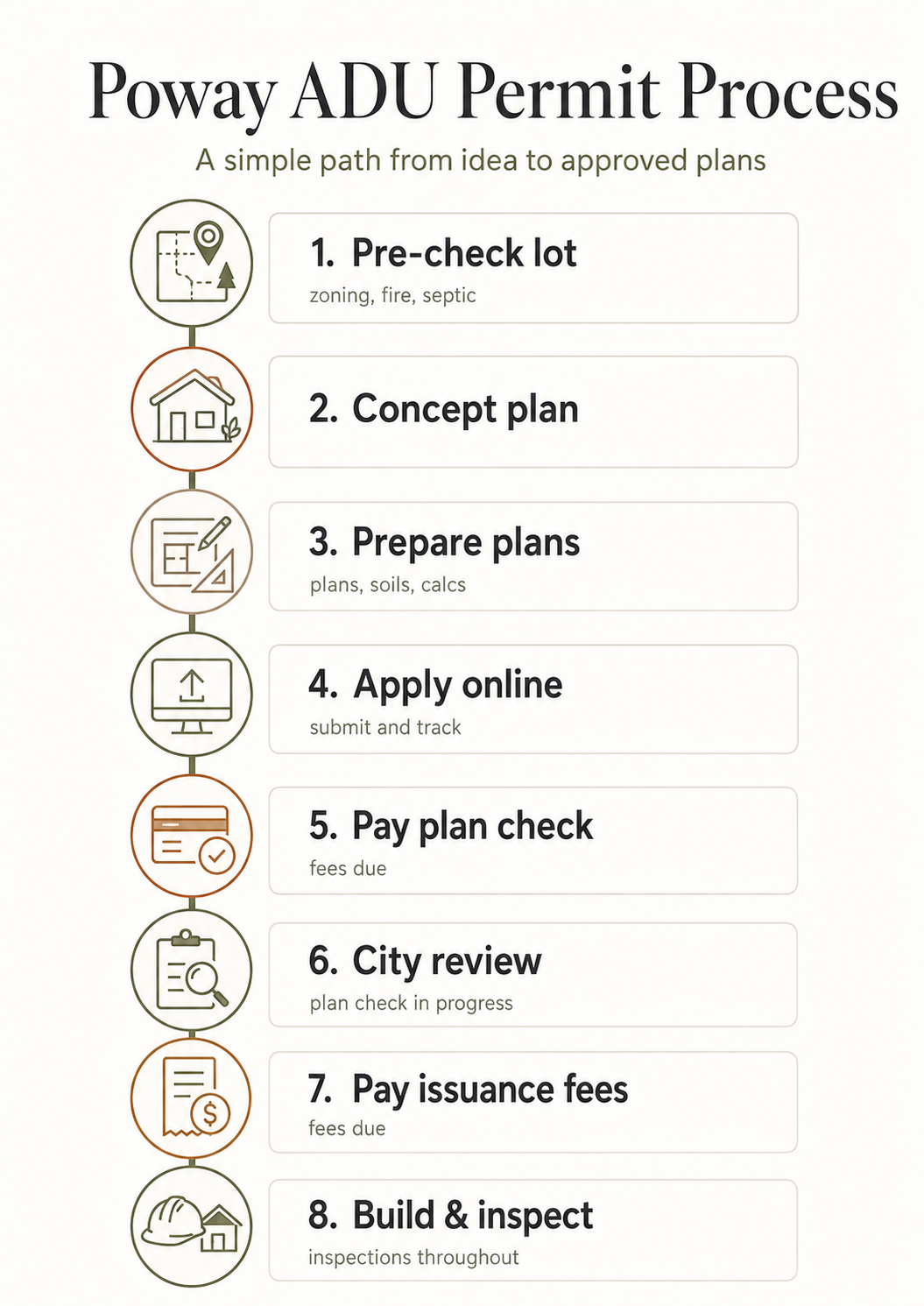
Poway ADU permit process at a glance
| Step | What happens | Biggest delay risk |
|---|---|---|
| 1. Pre-check the lot | Confirm ADU type, zoning, fire/septic/grading constraints in PowGIS | VHFHSZ, slope, HCP Mitigation Area, archeological-sensitive zones |
| 2. Concept plan (if constrained) | Send a footprint sketch to Planning for pre-submittal guidance | Skipping this on complex lots |
| 3. Prepare electronic plans | Designer or architect produces one electronic plan set plus calcs | Incomplete plans, missing soils report |
| 4. Apply online at services.poway.org | Find the “Accessory Dwelling Unit (ADU)/Junior ADU (JADU)” application | Wrong permit type or missing uploads |
| 5. Pay plan-check fee | Required before review begins | Late payment |
| 6. Plan review (Building + Planning + Engineering) | Up to 14 calendar days for building review and up to 28 calendar days for planning/engineering, per cycle | Multiple correction cycles |
| 7. Pay issuance + impact + school fees | School Certificate of Compliance must be in hand | Fee surprises at the counter |
| 8. Build and inspect | Permit valid 180 days; inspections must occur every 6 months to keep it active | Missed inspections, scope changes |
| 9. Front-of-property project sign | Required at building permit application | Skipping the posted sign |
See what’s possible at your address — free. Our Feasibility Engine checks your property and returns a personalized ADU report in about 60 seconds.
See What You Can Build → Get Your Free ADU Report
Is this guide for you?
If you own a single-family or small multifamily property inside the City of Poway (zip codes 92064 and 92074) and you’re trying to figure out the real permit path for an ADU, JADU, garage conversion, or attached ADU — yes, this is for you. If you’re in unincorporated San Diego County, your permits go through the County Planning & Development Services, which has its own rules; same with the City of San Diego, Carlsbad, Escondido, and other North County jurisdictions.
If you’re already deep into design and just want a sanity check on fees and timing, jump straight to the Fee-Cliff Matrix and the realistic timeline model.
Poway ADU permit process steps: from online application to issuance
Step 1 — Decide whether to send a concept plan first
For tight lots, sloped lots, lots in the Habitat Conservation Plan (HCP) Mitigation Area, or anything inside a Very High Fire Hazard Severity Zone (VHFHSZ), Poway specifically recommends sending a concept plan showing the proposed ADU footprint and driveway to the Planning Division before you pay a designer to prepare a full plan set. City staff will reply with a pre-submittal checklist tailored to your parcel. Skipping this step on a constrained lot is the single most expensive mistake we see on Poway projects.
To send a concept plan: call the Planning Division at 858-668-4610 and ask for the concept-review process, or submit through the portal as a Pre-Application inquiry.
Step 2 — Prepare electronic plans
Hire a designer, architect, or engineer to prepare one electronic plan set. Plans must include site plan, floor plans, building sections, foundation plan, roof plan, elevations, and the supporting calculations: structural, Title 24 energy (now under the 2025 California Building Standards Code, effective January 1, 2026), and truss calculations where applicable. For ADUs in Poway, plan check is contracted out to EsGil Corporation, a respected third-party plan-check firm that also serves much of San Diego County. A designer who has submitted to EsGil before understands their correction style and can dramatically cut your review cycles.
Title 24 note: The 2025 California Building Standards Code controls as of January 1, 2026. If your designer is still drafting to 2022 cycle standards, you will be redlined. Confirm in writing with your designer which code edition their energy report is built against.
Step 3 — Start the application in the portal
Sign in at services.poway.org, select Apply, and use the Application Assistant to locate the ADU/JADU application. Choose the correct permit subtype — detached ADU, attached ADU, JADU, conversion ADU, or multifamily ADU. Selecting the wrong subtype is a common source of week-one delays because the portal applies the wrong document checklist.
Step 4 — Upload all required documents before you submit
The portal will not let you advance past intake without the required uploads attached. Plan to have ready:
- Completed building permit application (with valuation matching your construction estimate)
- Complete electronic plan set
- Soils (geotechnical) report — required for all new structures per CBC/CRC and Poway Planning’s July 2022 guidance
- Structural calculations (if non-conventional or engineered)
- Title 24 energy compliance documents
- Truss calculations (if pre-engineered)
- For septic properties: County of San Diego Department of Environmental Health and Quality (DEHQ) approval letter — required before permit issuance
- For VHFHSZ properties: Fire Fuel Management Plan and Landscape Plan
- For sloped/graded lots in RR-A, RR-B, RR-C, or RS-1 zones: slope analysis by a licensed engineer
- For archeologically sensitive areas: archeological study by a qualified archeologist
Step 5 — Pay plan-check fees and respond to corrections
Once intake accepts your submittal, you’ll receive an invoice for plan-check fees. Pay it. Plan review starts after payment. If reviewers issue corrections, you’ll receive a written list — you have to address each item, mark the changes on revised plans, and resubmit. Each subsequent review cycle is governed by Poway’s same published cycle target: up to 14 calendar days for building review and up to 28 calendar days for planning and engineering review.
Once the plans are clean, you’ll pay issuance and impact fees, post a project sign at the front of the property as required at building-permit application, and your permit goes active for 180 days.
What’s the fastest way to get a Poway ADU permit?
What “ministerial approval” means in plain English
California ADU law requires ministerial approval — meaning there is no discretionary hearing, no Planning Commission vote, no neighbor comment period. If your application meets the objective standards, the city has to approve it. This is locked in by California Government Code § 66317, which says ADU permit applications are reviewed ministerially without discretionary review or hearing. Poway cannot reject your ADU because a neighbor complained, because staff didn’t like the design, or because the city would prefer you not build one.
The 15-business-day completeness rule
Under Gov. Code § 66317, the city must determine within 15 business days whether your application is complete. If they don’t issue a written incompleteness determination in that window, the application is deemed complete by operation of law. If it’s incomplete, they have to tell you what’s missing — not just “incomplete.” This rule, strengthened by SB 543 (2025), exists specifically to prevent agencies from sitting on applications indefinitely.
The 60-day approve-or-deny rule
Once your application is complete, the city has 60 days to approve or deny it on a lot with an existing single-family or multifamily dwelling (Gov. Code § 66317(a)). If they miss that deadline, your application is deemed approved by operation of law. This was strengthened by AB 2221 and again by SB 543 (2025) to ensure procedural compliance.
How long does the Poway ADU permit process actually take?
Most Poway single-family ADU permits issue in 4–7 months from initial submittal, and the full design-to-occupancy timeline runs 12–18 months. The controlling variable isn’t city speed — it’s how complete the first submittal is.
| Phase | Realistic range | What pushes it to the upper end |
|---|---|---|
| Concept plan + property feasibility | 1–3 weeks | HCP Mitigation Area, VHFHSZ, archeological-sensitive area, slope analysis |
| Schematic + construction drawings | 8–14 weeks | Designer/architect queue, Title 24 modeling, structural engineering |
| Soils report + survey | 3–5 weeks | Geotechnical engineer availability; near-setback projects often need a boundary survey |
| 1st plan check (Building + Planning + Engineering) | Up to 14 + 28 calendar days | Complex sites trigger longer planning review |
| Revision response + resubmittal | 2–4 weeks | Designer turnaround; how clean the revision package is |
| 2nd plan check cycle | Up to 14 + 28 calendar days | Same cycle target applies |
| (Optional 3rd cycle, common) | Same | Often required if first revision didn’t fully resolve corrections |
| Permit issuance + fee assembly | 1–2 weeks | PUSD School Certificate of Compliance must be in hand |
| Total permit-to-issuance (well-prepared application) | ∼4–7 months | Revision cycles, soils/survey timing, SDG&E coordination |
| Construction | 6–9 months | Site complexity, material lead times, weather |
| Design-to-occupancy total | ∼12–18 months | The real-world average for Poway |
Three nuances most pages skip
- State-law versus city cycle timing. The 15-business-day completeness check and 60-day approve-or-deny window are state-law deadlines. The 14-day and 28-day cycles are Poway’s own published process targets. When the two interact, the state-law deadlines control the outer envelope, the applicant can toll the 60-day window by requesting delays, and corrections lengthen the practical timeline.
- Building an ADU at the same time as a new primary home. Gov. Code § 66317 treats ADU applications submitted with a new single-family dwelling differently than ADUs added to an existing residence. If you’re building both at once, talk to the Planning Division before assuming the same timeline applies.
- SDG&E coordination runs in parallel, not after. If your ADU needs a new service, service relocation, upgrade, or separate meter, San Diego Gas & Electric Builder Services review and meter scheduling can add real time. Start that conversation the day you submit plans, not after permits issue.
How to check your Poway parcel in PowGIS (do this before you design)
- Zoning — Confirm whether your lot is RR-A, RR-B, RR-C, RS-1, RS-2, RS-7, or another residential zone. Slope analysis is required for RR-A, RR-B, RR-C, and RS-1 zones.
- HCP Mitigation Area — If your parcel sits inside the Habitat Conservation Plan Mitigation Area, vegetation clearing is restricted and a Biological Study by a qualified biologist may be required.
- VHFHSZ (Very High Fire Hazard Severity Zone) — Triggers a Fire Fuel Management Plan, Landscape Plan, and California Building Code Chapter 7A ignition-resistant construction.
- Archeologically Sensitive Area — Triggers an archeological study by a qualified archeologist and a possible Administrative Clearing Permit.
- Sewer vs. septic — Septic properties require County DEHQ approval running in parallel with city plan check. Confirm hookup status now, not after design.
- Right-of-way and utility constraints — Some lots trigger improvement requirements (utility extension, street widening, sidewalks, lighting). Visible from the parcel report.
Print the parcel summary, save the PDF, and bring it to your first designer meeting. If any of the six overlays apply, send a concept plan to the Planning Division before paying for full construction documents.
What documents do you need for a Poway ADU permit?
You need a building permit application, complete electronic plan set, soils report, supporting calculations, Title 24 energy documentation, and any site-specific approvals triggered by your lot (septic, fire, grading, cultural-resource, or right-of-way). Missing any of these will hold up the 15-business-day completeness determination.
Poway ADU permit document checklist
| Document | When required | Who usually prepares it | Why it matters |
|---|---|---|---|
| Building permit application (online) | Always | Owner, designer, or contractor | Required to start the portal application |
| Electronic plan set (site plan, floor plans, sections, foundation, roof, elevations) | Always | Designer, architect, or engineer | The core of plan check |
| Soils (geotechnical) report | New structures | Licensed geotechnical engineer | Required upload; foundation design |
| Structural calculations | When non-conventional or engineered | Structural engineer | Required if any element is outside prescriptive code |
| Title 24 energy compliance | Usually required for new construction | Energy consultant or designer | Required under the 2025 California Building Standards Code |
| Truss calculations | Pre-engineered trusses | Engineer or truss supplier | Required if trusses are used |
| County DEHQ septic approval | If on septic | Septic professional + County | Required before permit issuance |
| Grading plan / grading permit | Site-specific (most sloped lots) | Civil engineer | Earthwork, drainage, slope stability |
| Fire Fuel Management + Landscape Plan | VHFHSZ properties | Designer + fire/landscape consultant | Required in Very High Fire Hazard Severity Zones |
| Slope analysis | RR-A, RR-B, RR-C, RS-1 zones | Licensed engineer | Sets maximum allowable graded area |
| Archeological study | Archeologically sensitive areas | Qualified archeologist | Avoids late redesign and Administrative Clearing Permit denial |
| Boundary survey | When building within 2 feet of setback | Licensed surveyor | Some inspectors require this to confirm setback compliance |
| Owner-Builder Verification | If owner is pulling the permit (no contractor) | Owner | Required if no licensed contractor of record |
| Front-of-property project sign | At building-permit application | Owner or contractor | Required by Poway to notify neighbors |
The two documents that catch homeowners off guard most often are the soils report (required for all new structures, even small ADUs) and the County DEHQ septic clearance (its own multi-week process running in parallel with city review).
Poway ADU rules vs. California state law — the reality check
| Topic | Poway June 2024 handout | Current state ADU law | HCD 2026 Handbook clarifies | What you can rely on |
|---|---|---|---|---|
| Max detached ADU size | 50% of SFR or 1,500 sf, whichever is less; minimum 1,200 sf permitted | Local agencies cannot restrict an ADU below 800 sf (Gov. Code §66321); cannot impose max size below 850 sf, or 1,000 sf if more than one bedroom | Local agencies may allow larger; cannot restrict below state-floor minimums | Up to 1,500 sf if your primary is large enough; 800 sf protected floor regardless of any local rule |
| Side / rear setbacks | 4 ft minimum for ADU/JADU | 4 ft is the maximum local agencies can require for new-construction ADU/JADU (Gov. Code §66314(d)(7)) | No greater setback may be required for new ADUs | 4 feet, period. Conversions of legal existing structures are exempt from setback requirements |
| Owner-occupancy | "No occupancy requirement" for ADU; SFR or JADU owner-occupied if a JADU exists | Owner-occupancy on a standalone ADU is prohibited by Gov. Code §66315 | JADU owner-occupancy still allowed but with sanitation-facility carve-out (AB 1154 / Gov. Code §66333(b)) | No owner-occupancy required on a standalone ADU. JADUs may have owner-occupancy requirement unless JADU has separate sanitation facilities |
| Deed restriction | Required (“rental terms must exceed 30 days,” “must remain an ADU”) | Deed restrictions imposed as extra local standards on ADUs are not authorized by State ADU Law (Gov. Code §66315) | HCD 2025 update clarifies: deed restrictions imposed as additional standards on ADUs are prohibited | [NEEDS VERIFICATION] at submittal — ask the city in writing what they will require to record |
| HOA review | Not addressed in city handout | HOAs cannot influence approval; CC&Rs that effectively prohibit or unreasonably restrict an ADU/JADU are void (Civ. Code §4751) | HCD clarifies: third-party HOA reviews violate State ADU Law (Gov. Code §66315) | On a single-family lot, HOA can apply reasonable aesthetic guidelines only — and only if they don’t effectively prohibit or unreasonably restrict your ADU |
| Parking | 1 off-street space for ADU; many exemptions | No replacement parking required when garage/carport/uncovered space is demolished or converted for an ADU (Gov. Code §66314(d)(11), SB 1211); JADU parking cannot be required at all (Gov. Code §66334(a)) | HCD reinforces both rules | Strong exemptions: half-mile of public transit, historic district, conversion of existing space, on-street permit area, within one block of car-share |
| Fire sprinklers | Required if required for the SFR; required if ADU exceeds 1,200 sf | Sprinklers cannot be required for an ADU if not required for the SFR | HCD reinforces | If your existing house has no sprinklers, the city cannot require them on your ADU below the local code cutoff. Verify the 1,200 sf trigger with EsGil at plan check |
| Impact fees | "50% of Development Impact Fees" for ADUs ≥750 sf | ADUs ≤750 sf are exempt from impact fees; ADUs >750 sf must be charged proportionally (square foot) to the primary residence’s fees, not a flat 50% (Gov. Code §66311.5(c)(1)) | HCD 2026 Handbook confirms the proportionality rule | Under 750 sf: $0 in city impact fees. Over 750 sf: proportional, not flat. [NEEDS VERIFICATION] at exactly 750 sf — confirm in writing before paying fees |
| Plan submission method | Handout supports electronic submittal via services.poway.org | n/a | n/a | Online only since June 1, 2022. Do not show up with paper |
| Soils report | Required for new structures per Planning Division (July 2022 guidance) | State law doesn’t mandate | n/a | Expect to need one. Budget $2,500–$6,000 |
| AB 1033 (separate ADU condo conveyance) | Not addressed in handout | Allows local agencies to opt in to permit separate sale of ADU as a condo (Gov. Code §§66340–66342) | Cities must adopt an ordinance to allow it | As of May 2026, Poway has not adopted AB 1033. City of San Diego opted in (effective August 22, 2025 outside Coastal Zone). [NEEDS VERIFICATION at publication] |
| AB 2533 (legalizing pre-2020 unpermitted ADUs) | Not addressed in handout | A local agency may not deny a permit for a pre-January 1, 2020 unpermitted ADU for building code violations unless correction is needed to remove a substandard finding (Gov. Code §66311.7) | HCD provides a Substandard Structure Checklist | If you have an unpermitted Poway ADU built before 2020, you likely have a legalization path — talk to a permit consultant before assuming you need to demolish |
What the HCD October 8, 2025 letter actually says
HCD’s Housing Accountability Unit wrote to Poway’s Planning and Building Director, Kevin Parker, noting that the most recent ADU ordinance on file for Poway is from 2019 and listing the State ADU Law changes since then that may warrant an ordinance update. HCD requested a response by November 7, 2025, with either (1) a description of how Poway’s ordinance remains compliant despite the law changes, or (2) a plan and timeline to repeal or amend it.
“If an existing ADU ordinance fails to meet the requirements of State ADU Law, the ordinance is ‘null and void’ and the local jurisdiction must apply the standards set forth in State ADU Law until it adopts an ordinance that complies with state law.” — Gov. Code § 66316
Translation: where Poway’s 2024 handout conflicts with current state law, state law wins. You should still submit through Poway’s portal and follow Poway’s process; but when a planner cites the 2024 handout to reject something state law protects, you have the right to elevate the issue in writing and reference the relevant Gov. Code section.
Not sure how the Reality Check applies to your specific lot?
Our Feasibility Engine checks your property and returns a personalized ADU report against current state law in about 60 seconds.
See What You Can Build → Get Your Free ADU ReportHow much do Poway ADU permit fees cost in 2026?
We modeled the city’s portion from Poway’s published Master Fee Schedule using Poway’s own formula ($128.40/sf Type V wood-frame valuation, valuation-band building permit fee table, plan check at 75%, in-combination fees at 6% each, energy compliance at 15%, $45 issuance fee, $90 green-building plan-check hour, $83 green-building inspection hour). These are source-calculated planning estimates only — not official invoices. The city’s final billing controls at issuance.
The Poway ADU Fee-Cliff Matrix (planning estimates)
| ADU size | Modeled city building + plan-check baseline | PUSD school fee ($5.17/sf, assessable area >500 sf) | Local impact + stormwater fees | Reader takeaway |
|---|---|---|---|---|
| 499 sf | ~$1,970 | $0 (assessable area ≤500 sf) | $0 (under 750 sf, exempt) | Fee-minimized configuration. Often a JADU or studio. |
| 600 sf | ~$2,170 | ~$3,102 | $0 (under 750 sf, exempt) | School fee bigger than building fee. |
| 749 sf | ~$2,468 | ~$3,872 | $0 (under 750 sf, exempt) | The practical "just-under-750" planning point. |
| 750 sf | ~$2,468 | ~$3,878 | [NEEDS VERIFICATION] — state law exempts ≤750 sf; Poway handout says fees apply at 750+ sf. Confirm with city in writing. | The critical threshold conflict. Verify before designing exactly at 750 sf. |
| 800 sf | ~$2,601 | ~$4,136 | Impact + stormwater fee review (proportional per state law) | Common size; no longer fee-minimized |
| 1,200 sf | ~$3,263 | ~$6,204 | Proportional impact + stormwater fees + possible sprinkler trigger | Larger unit; check fire sprinkler triggers |
| 1,500 sf | ~$3,746 | ~$7,755 | Proportional impact + stormwater fees | Maximum detached ADU size in Poway |
The 750-sf cliff and why it matters
State law exempts ADUs of 750 sf or less of interior livable space from city impact fees (Gov. Code § 66311.5(c)(1)). Designing an ADU at 749 sf instead of 800 sf can save $4,000–$10,000 in impact and stormwater fees alone. Poway’s June 2024 handout uses the phrase “ADUs 750 sf or larger” when describing where impact fees kick in — these two phrasings disagree about which side of the line a unit exactly at 750 sf sits on. If your design is sitting on the line, ask Poway in writing.
Poway Unified School District fees
Poway Unified School District charges $5.17 per square foot for new residential construction and additions with assessable area greater than 500 square feet. ADUs with assessable area of 500 sf or less are exempt from PUSD fees. PUSD fees are paid separately from city fees. You receive a Certificate of Compliance from PUSD that you submit to the City of Poway before the city issues your final permit. The Certificate of Compliance is valid for 30 calendar days from issuance.
Soils report, survey, SDG&E, septic
| Line item | Typical range | Notes |
|---|---|---|
| Soils (geotechnical) report | $2,500–$6,000 | Required for all new structures per Poway Planning |
| Boundary or planimetric survey | $1,500–$3,500 | Often required if building within 2 feet of setback |
| SDG&E Builder Services coordination | $2,000–$5,000 | Application, plan review, meter set; trenching is extra |
| County DEHQ septic clearance | $400–$1,200 | Application + site visit if applicable |
| Energy / Title 24 modeling | $500–$1,500 | Often bundled with design fee |
| Designer / architect fees | 5–8% of total construction cost | Anchored to published Poway-area contractor benchmarks |
| Right-of-way permit (if utility extension needed) | $500–$2,500 | Required for work in public right-of-way |
| Grading permit (sloped lots) | $1,500–$5,000+ | RR-A, RR-B, RR-C, RS-1 zones require slope analysis |
Soft-cost ranges are based on published Poway-area contractor and builder budgets as of May 2026; these are illustrative planning ranges, not guaranteed prices. Quotes vary by site complexity, scope, and market conditions.
For all-in construction cost on a new detached Poway ADU, the working range is $220–$600 per square foot, with median custom builds landing $300–$425 per square foot once site work and finishes are factored in. A 1,000 sf ADU at $375/sf is $375,000 in hard construction cost, plus permits and soft costs — easily $420,000–$470,000 total before any site complications. These are illustrative examples, not guarantees. Actual results depend on local market conditions, construction costs, financing terms, and regulatory approvals.
Want to find your fee-cliff risk before finalizing plans?
Our Feasibility Engine flags the size thresholds — 500 sf for PUSD, 750 sf for impact fees, 1,200 sf for fire sprinklers — based on your parcel’s specifics.
Find Your Fee-Cliff Risk → Get Your Free ADU ReportWhich Poway site conditions can delay your ADU permit?
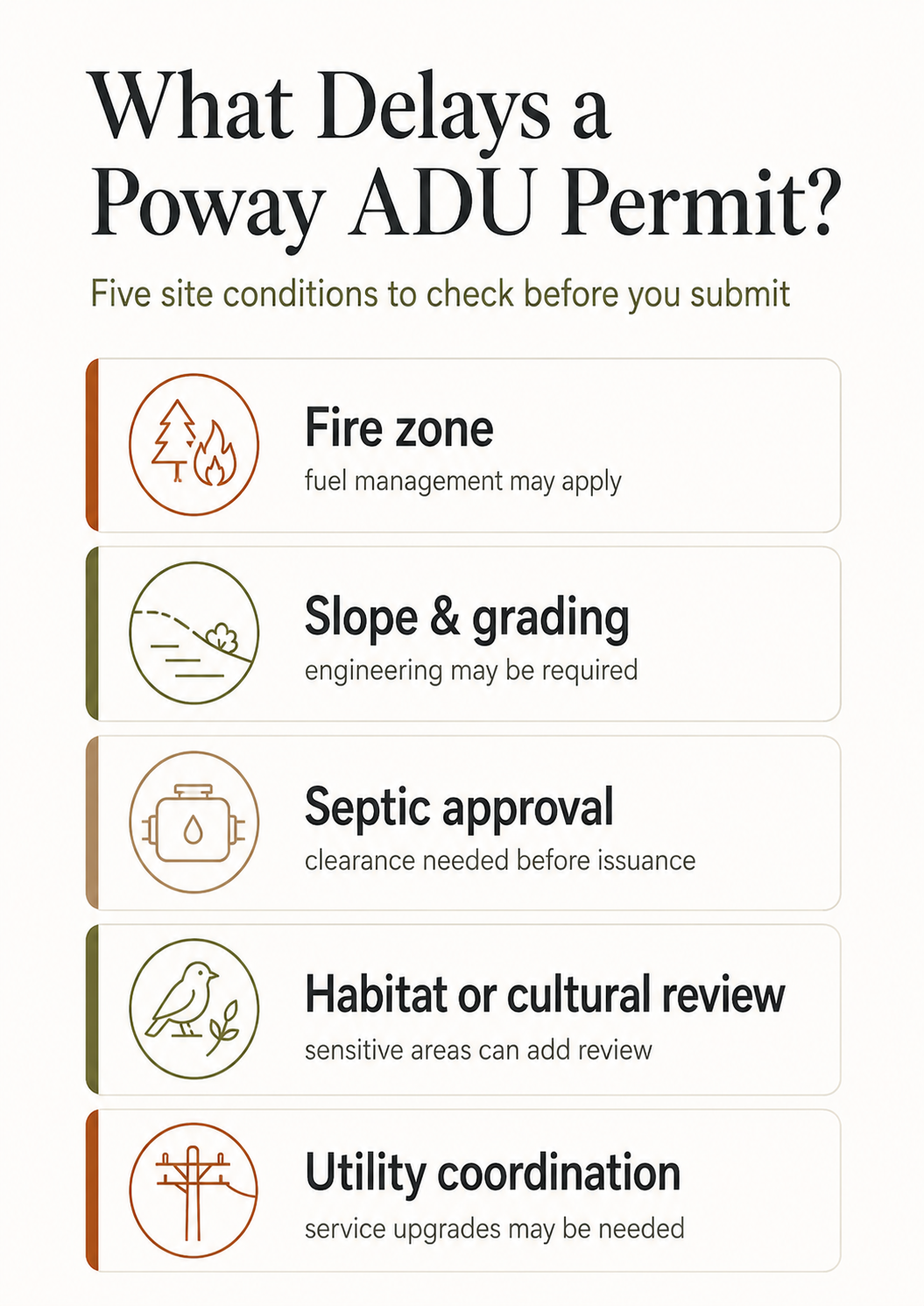
The biggest delays on Poway ADU projects usually aren’t the ADU law — they’re site constraints. Each of these five triggers adds 3–12 weeks if discovered late. Each is checkable before you pay for a designer.
Trigger 1: Septic and County Health
If your Poway property is on septic instead of sewer, your ADU permit requires approval from the County of San Diego Department of Environmental Health and Quality (DEHQ) before the city issues your building permit. This adds 3–6 weeks in parallel to city review. The septic system has to be sized for the additional bedrooms and bathrooms in the ADU; in some cases you’ll need a percolation test or an expansion of the leach field.
Common Poway-area septic costs when an ADU triggers system expansion: $8,000–$25,000+. If your existing tank is over 30 years old, plan for a tank replacement at the same time — older tanks often don’t meet current code when modified.
Trigger 2: Very High Fire Hazard Severity Zone (VHFHSZ)
If your lot sits in a VHFHSZ (verify on PowGIS), you’ll need a Fire Fuel Management Plan and a Landscape Plan. Fuel management zones extend 100 feet from each structure. Construction must also comply with California Building Code Chapter 7A (ignition-resistant construction), which can add $8,000–$20,000 for exterior fire-resistive cladding, ember-resistant venting, and similar.
Some Poway VHFHSZ lots require fire-fighting water tanks if hydrant flow is inadequate. This is uncommon but expensive ($10,000–$25,000+ installed). Confirm hydrant flow with the Poway Fire Department early.
Trigger 3: Grading and slope
Properties in the RR-A, RR-B, RR-C, or RS-1 zones require a slope analysis prepared by a licensed engineer, which sets the maximum allowable graded area for your project. Nearly all new homes — and many ADUs — require a grading permit prepared by a qualified civil engineer. Budget $3,000–$8,000 for a slope analysis and grading plan, plus the grading permit fee itself.
Trigger 4: Habitat Conservation Plan and archeological-sensitive areas
Poway has adopted a Habitat Conservation Plan (HCP) that limits how much native vegetation you can clear if your property is inside the HCP Mitigation Area boundary (visible on PowGIS). Projects clearing vegetation in the HCP Mitigation Area require a Biological Study prepared by a qualified biologist and may require an Administrative Clearing Permit. Separately, archeologically sensitive parcels require an archeological study before grading.
Trigger 5: Utility extensions and right-of-way work
Some Poway lots require public improvement work before permits can issue: utility extensions to the street, new sidewalks, driveway widening, or lighting. These are visible from the parcel report in PowGIS and can add $5,000–$25,000+ depending on what’s required. SDG&E service capacity is a separate but parallel concern — start your SDG&E Builder Services application on the day you submit to the City, not after your permit issues.
See what could delay your Poway ADU — free.
Our Feasibility Engine flags septic, VHFHSZ, slope, HCP, and right-of-way triggers for your specific parcel before you commit to a design.
See What Could Delay Your Poway ADU → Get Your Free ADU ReportHow Poway homeowners are paying for ADUs
Most Poway ADUs are funded through home equity products, cash-out refinances, renovation-specific loans, or construction-to-permanent loans — not grants. The California Housing Finance Agency (CalHFA) ADU Grant Program has been fully allocated since December 28, 2023 and has no confirmed relaunch date. We have a full California financing path overview at our ADU financing guide.
- HELOC (home equity line of credit) — revolving credit secured by your existing home’s equity. Variable rate, flexible draws.
- Cash-out refinance — replaces your existing mortgage with a larger one; you receive the difference in cash.
- Home equity loan (second mortgage) — fixed-rate lump sum secured by your home. Predictable payment, but takes a second lien.
- Construction-to-permanent loan — short-term construction financing that converts to a long-term mortgage at completion.
- Renovation HELOC products — borrow against your home’s after-renovation value rather than current value.
- Home equity investment (HEI) — a lump-sum payment in exchange for a share of your home’s future appreciation. State availability varies.
A small Poway-specific timing table
| Project stage | Financing document likely needed | Risk if you apply too early |
|---|---|---|
| Pre-design | Pre-qualification only | No risk; useful to confirm budget envelope |
| Design + concept plan | Pre-approval letter (HELOC, cash-out, construction) | None; lenders rarely close before permit issuance |
| Plan check submittal | Documented project budget, designer’s plan set | Some lenders require a permit-issued status; closing too early can mean re-underwriting |
| Permit issued | This is when construction loans typically close | Closing earlier wastes interest |
| Construction draws | Inspection reports per draw schedule | Missing inspections delay subsequent draws |
| Final inspection | Conversion to permanent financing (for construction-to-perm) | Late conversion locks in interim higher rates longer |
- Never sign a construction loan before your permit is in hand — lenders typically require an issued permit before final loan close.
- Never quote a builder’s “permit and fees” line as your total fee budget — that often excludes PUSD, soils, survey, SDG&E, and septic.
- Never assume an unpermitted addition counts toward your home’s appraised value for refinance — Freddie Mac’s 2026 ADU fact sheet states rental income from an illegal ADU may not be used to qualify.
Who should you talk to before submitting a Poway ADU permit?
Talk to the city first for official requirements; a qualified designer, architect, or engineer for plans; and a Poway-experienced ADU professional if your lot has slope, septic, VHFHSZ status, a custom exterior requirement, or a larger detached ADU.
Start with the Planning Division if your lot is constrained
For tight, sloped, fire-zone, or HCP-affected lots, call the Planning Division at 858-668-4610 before paying a designer. Ask for the concept-plan submittal process and any pre-submittal checklist for your zone. For permit and plan-check questions, the Building Division is reachable at 858-668-4644. For inspection scheduling, call Building Inspection at 858-668-4646. The Planning Division is open Monday–Thursday 7:30 AM–5:30 PM and Friday 8:00 AM–5:00 PM, closed every other Friday.
Engage a designer, architect, or engineer for plans
For the plan set itself, you need a qualified design professional. The California State License Board (CSLB) verifies contractor licenses. For architects, the California Architects Board verifies registration. If you’ve never permitted in Poway before, ask three questions when interviewing designers:
- How many Poway ADU projects have you permitted in the last 24 months?
- How many review cycles did your last Poway project go through before issuance?
- Can you share a sample EsGil correction list and how you responded to it?
The right designer’s first-submittal Poway plan set goes through 1–2 review cycles, not 3–5. The wrong one’s goes through 5+ and costs you 4–6 extra months.
When to bring in a Poway-experienced ADU design-build firm
For homeowners who want the design, permitting, and construction handled by a single firm — particularly on detached ADUs, larger Poway lots, or projects with custom exterior requirements — SnapADU lists Poway in its Greater San Diego service area and publishes completed Poway project examples. SnapADU publicly states it has permitted projects in the city and covers the same architectural-consistency rule and city processes we’ve outlined above.
Affiliate disclosure: The Dwelling Index is reader-supported and may earn a commission at no extra cost to you when you use this link. We’re independent and not influenced by compensation. SnapADU was selected because of geographic fit and publicly verifiable Poway project examples.
Ready to sanity-check your project with a Poway ADU specialist?
Best for: detached ADUs, larger Poway lots, garage conversions on properties with VHFHSZ or slope constraints, and Greater San Diego homeowners who want design-permit-build handled by a single team.
Talk Through Your Poway ADU Plan With SnapADU →The Poway ADU permit submittal checklist
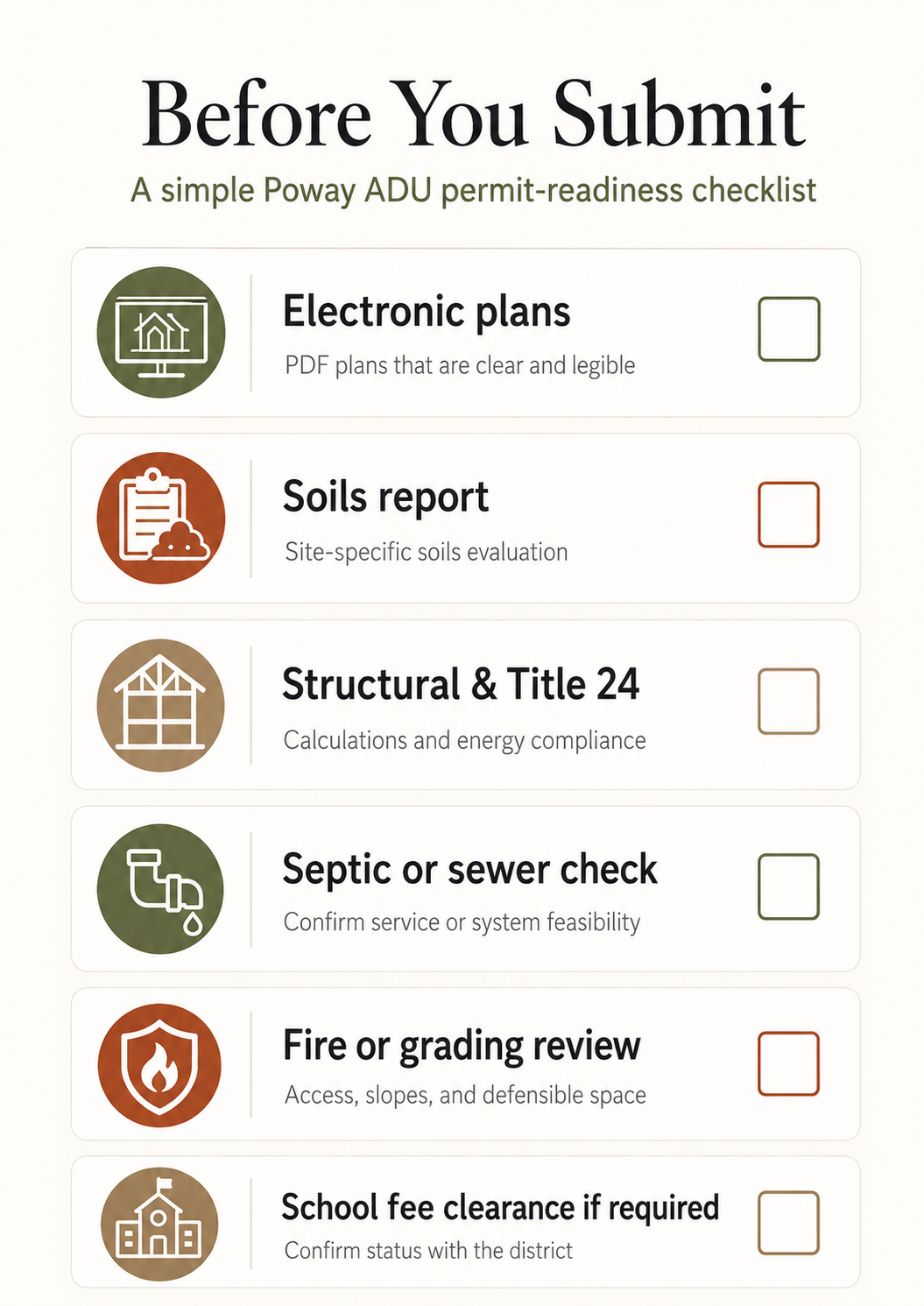
Use this as a final pre-submittal pass. Every item that applies to your lot must be confirmed before you submit.
- ADU type selected (detached / attached / conversion / JADU / multifamily)
- Size verified against Poway max (50% of SFR or 1,500 sf detached) and state-law floor (800 sf protected)
- Side and rear setbacks confirmed at 4 ft (or exempt for conversion)
- Height confirmed (16 ft default; up to SFR height if setbacks met; up to 18 ft if near major transit; +2 ft if roof pitch matches SFR)
- Parking exemption confirmed or one off-street space identified
- Rental term plan confirmed (must exceed 30 days)
- Electronic plan set complete: site plan, floor plans, sections, foundation, roof, elevations
- Soils report ordered and received
- Structural calculations prepared (if applicable)
- Title 24 energy compliance modeled against 2025 California Building Standards Code
- Truss calculations (if pre-engineered)
- Septic status checked on PowGIS; County DEHQ approval initiated (if applicable)
- VHFHSZ status checked on PowGIS; Fire Fuel Management Plan started (if applicable)
- Slope analysis ordered (if in RR-A, RR-B, RR-C, RS-1 zone)
- HCP Mitigation Area boundary checked; biological study ordered (if applicable)
- Archeological sensitivity checked; archeological study ordered (if applicable)
- PUSD school fee budgeted (assessable area >500 sf = $5.17/sf)
- Impact + stormwater fee threshold confirmed (≤750 sf = $0 under state law)
- SDG&E Builder Services application prepared
- City concept plan sent to Planning (if constrained lot)
- Front-of-property project sign prepared (required at building-permit application)
- Designer’s last Poway project verified (target: ≤2 review cycles to issuance)
Want this checklist as a printable PDF, plus a fee-worksheet and city-call script?
Includes the document list, the fee-threshold worksheet, and a script for your call to the Planning Division.
Download the Free Poway ADU Permit Checklist →Poway ADU permit process FAQ
Are Poway ADU permits submitted online or in person?
Online. The City of Poway has accepted electronic submittals only since June 1, 2022. Apply at services.poway.org through the Application Assistant.
How long does it take to get an ADU permit in Poway?
Approximately 4–7 months from first complete submittal to permit issuance, assuming 2 review cycles. Poway's published review-cycle target is up to 14 calendar days for building review and up to 28 calendar days for planning and engineering review per cycle. California state law separately requires a 15-business-day completeness determination and a 60-day approve-or-deny window for complete applications.
How much does an ADU permit cost in Poway?
$18,000–$58,000 in total permitting and soft costs, depending on ADU size. City building and plan-check fees alone for a typical 800–1,200 sf detached ADU range from approximately $2,500 to $3,300, plus PUSD school fees at $5.17/sf for assessable area greater than 500 sf, plus impact and stormwater fees if your ADU exceeds 750 sf, plus soils ($2,500–$6,000), survey, SDG&E coordination, and septic if applicable.
Does Poway require a soils report for an ADU?
Yes, for new structures. Per Poway Planning Division guidance from July 2022, soils reports are required for all new structures, including ADUs. Budget $2,500–$6,000.
What is the maximum ADU size in Poway?
1,500 sf for a detached ADU, or 50% of the primary residence's floor area, whichever is less, with a minimum 1,200 sf permitted regardless. Attached ADUs follow the same 50%/1,500 sf rule with a minimum 1,000 sf for 1-bedroom-plus units and 850 sf for studios. JADUs are capped at 500 sf. California state law also protects an 800 sf minimum permitted size against any local restriction.
Can I build an 800 sf ADU in Poway even if my lot coverage is tight?
Yes. California Government Code § 66321 protects at least an 800 sf ADU with 4-foot side and rear setbacks regardless of local lot-coverage rules. Poway's handout confirms ADUs up to 800 sf are exempt from lot coverage requirements.
Does Poway require parking for an ADU?
One off-street parking space by default, with broad exemptions: ADUs within a half-mile walking distance of public transit, within a historic district, converted from existing space, attached to the primary residence, in an area where on-street permits are required but not offered to the ADU occupant, or within one block of a car-share pickup location. SB 1211 also eliminated the requirement to replace parking when a garage, carport, or covered/uncovered space is demolished or converted for an ADU.
Can I rent my Poway ADU on Airbnb or short-term?
No. Poway requires rental terms exceeding 30 days, in alignment with state law. Short-term rentals (under 30 days) are not allowed.
Can my HOA stop me from building an ADU in Poway?
No, on a lot zoned for single-family residential use. California Civil Code § 4751 makes covenants, conditions, and restrictions that effectively prohibit or unreasonably restrict the construction or use of an ADU or JADU void and unenforceable on lots zoned for single-family residential use. Your HOA can apply reasonable aesthetic guidelines but cannot block you outright.
Can I sell my Poway ADU separately?
Not as of May 2026. Assembly Bill 1033 allows cities to opt in to permit the separate sale of ADUs as condos, but Poway has not adopted AB 1033. The City of San Diego opted in effective August 22, 2025 (outside the Coastal Zone); Poway has not followed yet.
Are ADUs of 750 sf or less really exempt from Poway impact fees?
Yes, under current state law. Gov. Code § 66311.5(c)(1) exempts ADUs of 750 sf of interior livable space or less from impact fees. Poway's 2024 handout uses the phrase "750 sf or larger" to describe where fees kick in — that phrasing disagrees with state law at exactly 750 sf. If your design sits on the line, request written confirmation from Poway before paying.
Does Poway have pre-approved ADU plans?
A policy exists, but the catalog is empty. Poway's Pre-Approved ADU Policy says that if architects submit plans for pre-approval, the city will post them on its website. As of the most recent version of the policy, no applications had been received.
Who should I contact at the City of Poway?
Planning Division at 858-668-4610 for concept-plan submittals and zoning questions; Building Division at 858-668-4644 for permit and plan-check questions; Building Inspection at 858-668-4646 to schedule inspections. The Planning Division is open Monday–Thursday 7:30 AM–5:30 PM and Friday 8:00 AM–5:00 PM (closed every other Friday).
Who reviews my plans in Poway?
The City of Poway contracts plan check to EsGil Corporation, a third-party plan-check firm that also serves much of San Diego County. EsGil's reviewers handle the building plan review while City of Poway Planning and Engineering staff handle the planning and engineering reviews.
Does Poway accept the County of San Diego's pre-approved ADU plans?
No. Poway is a separate incorporated city with its own ADU rules and architectural-consistency requirements. The County of San Diego's pre-approved plans are designed for use in unincorporated areas of the county only.
How long is a Poway building permit valid?
180 days after issuance. To keep it active, regularly scheduled inspections must be conducted every 6 months. If you let the permit expire, additional fees apply to reactivate it.
What if my existing ADU was built before 2020 without a permit?
Assembly Bill 2533 (2024) created a streamlined legalization pathway under Gov. Code § 66311.7. The city cannot deny your legalization permit for building code violations unless correction is necessary to remove a substandard finding. Typical cost: $15,000–$50,000 for assessment, remediation, and permitting.
What we verified on May 13, 2026
- City of Poway Building Services: Confirmed all permit applications received, processed, and issued through City of Poway Online Services at services.poway.org. Effective June 1, 2022, only electronic submittals are accepted. Plan check contracted to EsGil Corporation. Published review-cycle target: up to 14 calendar days for building review and up to 28 calendar days for planning and engineering review per cycle. Building permits valid 180 days; inspections required every 6 months. Source: poway.org/243/Building-Services
- City of Poway ADU Handout (June 2024 update): Confirmed detached ADU max 1,500 sf or 50% of SFR (1,200 sf minimum allowed); JADU max 500 sf; 4 ft side/rear setbacks; one off-street parking with exemptions; rental term must exceed 30 days; impact and stormwater fees required for ADUs ≥750 sf at 50% of standard DIF; soils report required. Source: poway.org/DocumentCenter/View/8712
- HCD Letter of Technical Assistance to City of Poway, October 8, 2025, signed by Jamie Candelaria, Section Chief, ADU Policy, Housing Accountability Unit. Confirmed Poway’s most recent ADU ordinance on file with HCD is from 2019 and may be out of compliance with State ADU Law. Requested response by November 7, 2025. Source: hcd.ca.gov
- California Government Code §§ 66311.5, 66311.7, 66313–66342 (ADU and JADU statutes), as renumbered and amended by SB 543 effective January 1, 2026. Confirmed: ministerial review (§ 66317); 15-business-day completeness and 60-day approve-or-deny window (§ 66317(a)); state-law size protections (§ 66321); impact-fee exemption for ADUs ≤750 sf (§ 66311.5(c)(1)); AB 2533 legalization (§ 66311.7); SB 1211 multifamily ADU expansion (§ 66323(a)(4)(A)(ii)). Source: leginfo.legislature.ca.gov
- HCD 2026 ADU Handbook (March 2026 edition): Confirmed state-law floor on ADU size; prohibition on owner-occupancy for standalone ADUs; deed-restriction clarification; HOA review prohibition; JADU sanitation-facility carve-out. Source: hcd.ca.gov/policy-research/accessorydwellingunits.shtml
- City of Poway Master Fee Schedule: Used to source-calculate the Fee-Cliff Matrix at $128.40/sf Type V wood-frame valuation, valuation-band building permit fees, plan check at 75%, in-combination fees at 6% each, energy compliance at 15%, $45 issuance fee. Source: poway.org/141/Master-Fee-Schedule
- Poway Unified School District Developer Fees: $5.17 per square foot for new residential construction and additions with assessable area greater than 500 sf; no fees for residential additions of 500 sf or less; Certificate of Compliance valid 30 calendar days from issuance. Level 2 fees suspended pending new School Facilities Needs Analysis. Source: powayusd.com
- 2025 California Building Standards Code (Title 24), published July 1, 2025 with effective date January 1, 2026, per California Building Standards Commission. Source: dgs.ca.gov/bsc
- CalHFA ADU Grant Program: Confirmed program fully allocated on December 28, 2023 with no confirmed relaunch date. Source: calhfa.ca.gov/adu
Items marked [NEEDS VERIFICATION] for editor spot-check at publication:
- Current Poway Municipal Code § 17.08.180 — confirm whether Poway has adopted a new ADU ordinance between October 8, 2025 and publication date.
- AB 1033 adoption — confirm Poway has not opted in as of publication.
- The exact-750-sf treatment for impact fees — request written confirmation from Poway Building Division.
- PUSD Certificate of Compliance current processing time — confirm with PUSD by phone before publication.
Methodology
We built this guide from primary and high-authority sources first: City of Poway ADU/JADU handouts and Building Services pages, Poway’s Master Fee Schedule, the Poway Unified School District developer-fee resource, California Government Code §§ 66311.5, 66311.7, 66313–66342, the HCD 2026 ADU Handbook, the HCD October 8, 2025 Letter of Technical Assistance to the City of Poway, and the 2025 California Building Standards Code. We used builder and forum content only to surface homeowner question patterns, stale competitor claims, and voice-of-customer wording — never as proof of legal, zoning, fee, or permit requirements.
For the Fee-Cliff Matrix, we modeled a detached Type V wood-frame ADU using Poway’s published valuation rate ($128.40 per square foot), the city’s valuation-band building permit fees, plan check at 75% of the building permit fee, in-combination plumbing/electrical/mechanical fees at 6% each, energy compliance at 15%, the $45 issuance fee, and one $90 green-building plan-check hour plus one $83 green-building inspection hour. Numbers are source-calculated planning estimates only — not official city invoices.
For the Realistic Timeline Model, we used Poway’s published cycle target (up to 14 calendar days for building review, up to 28 calendar days for planning and engineering review per cycle), plus realistic averages for 2 to 3 review cycles drawn from licensed-contractor and ADU-builder publications. The 4–7 month permit-to-issuance range assumes a well-prepared first submittal.
For the Reality Check Table, we cross-referenced Poway’s June 2024 ADU handout against current California Government Code sections and HCD’s 2025 and 2026 ADU Handbook clarifications. Where the handout and state law disagree, we cited the controlling statute. Where we could not verify a specific data point, we marked it [NEEDS VERIFICATION].
About this guide
Independent research by the Dwelling Index Research Team. The Dwelling Index is an independent research resource covering ADU financing, costs, and regulations. This guide was assembled from City of Poway permit documents, the California Government Code, HCD’s 2026 ADU Handbook and the October 8, 2025 Letter of Technical Assistance to Poway, Poway’s Master Fee Schedule, PUSD developer-fee data, and a competitor review of every page-one Poway ADU result as of May 13, 2026. We are not the City of Poway, not a licensed contractor, not a lender, and we do not guarantee permit approval, financing qualification, or specific construction outcomes. Independent professional advice from a licensed contractor, architect, engineer, attorney, or financial advisor is always recommended for project-specific decisions.
Last updated: May 13, 2026 · Last verified: May 13, 2026 · Next scheduled review: August 13, 2026
Related guides
- Poway ADU Laws 2026 — Size, Setbacks, Fees & State Rules Decoded
- Best ADU Builders in Poway, CA
- California ADU Laws 2026 — Complete State Law Guide
- Vista ADU Permit Process 2026
- San Diego County Pre-Approved ADU Plans Guide
- How Much Does an ADU Cost?
- ADU Financing Options Compared
- ADU Grants 2026: Verified Programs by State
Not sure where to start?
See what’s possible at your address — get your free ADU report in 60 seconds.
See What You Can Build → Get Your Free ADU Report