
By The Dwelling Index Editorial Team · Published · Updated
El Cajon ADU Laws: 2026 Rules, Setbacks, Fees & Permit Checklist
Bottom line up front. Yes, you can build an ADU on most residential lots inside the City of El Cajon. The rules are set by El Cajon Municipal Code Chapter 17.140, § 17.140.180 — most recently amended by Ordinance 5151 on May 13, 2025 — layered over California state ADU law in Government Code §§ 66310–66342. A single-family lot can typically add one ADU plus one Junior ADU (JADU), the ADU can be up to 1,200 square feet (with a state-protected right to at least 800 sq ft under § 66321), and the JADU is capped at 500 sq ft. The city has 15 business days to determine whether your application is complete and 60 days to approve or deny it once it is. Realistic all-in timeline: 6 to 14 months. Realistic all-in cost: $90,000 for a small garage conversion to $525,000 for a full 1,200 sq ft detached build.
The damaging admission up front: California ADU law is the most homeowner-friendly in the country, but “allowed” is not “permit-ready.” El Cajon can still review plans for building safety, fire separation, sewer-lateral condition, Title 24 energy compliance, utility capacity, and objective local design standards. That’s the gap most builder pages skip past. This guide walks it with you.
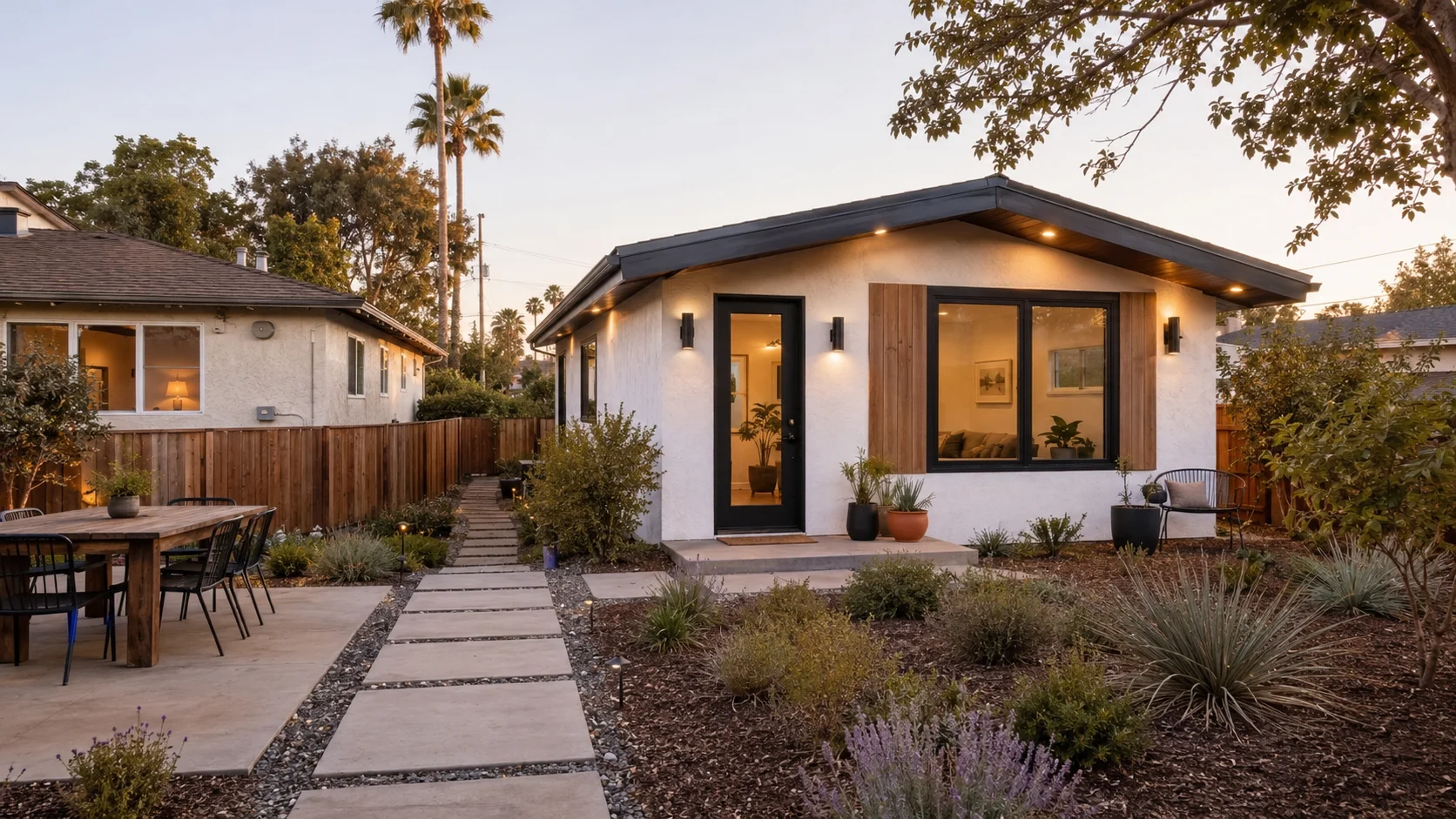
El Cajon ADU rules — the snapshot table
| Rule | Value | Source |
|---|---|---|
| Max detached/attached ADU size (local cap) | 1,200 sq ft, and ≤ primary dwelling | El Cajon §17.140.180(C)(2) |
| Max attached ADU size (state pathway) | Lesser of 1,200 sq ft or 50% of primary | Gov. Code §66314 |
| State-protected minimum ADU | 800 sq ft on qualifying lots | Gov. Code §66321 |
| Max JADU size | 500 sq ft | El Cajon §17.140.180(C)(4); Gov. Code §66333 |
| Default ADU parking | 1 paved off-street space | El Cajon §17.140.180(D) |
| Parking exception paths | 7 paths waive parking entirely | El Cajon §17.140.180(D)(1); Gov. Code §66322 |
| Detached ADU height/setback (outside primary envelope) | 12 ft / 3 ft, 16 ft / 4 ft, or 20 ft / 5 ft | El Cajon §17.140.180(E)(2) |
| State-protected detached ADU heights | 16 ft baseline; 18 ft if within ½-mile transit or on 2-story lot | Gov. Code §66314(d) |
| Building separation (detached ADU to primary) | 6 ft minimum | El Cajon §17.140.180(E)(2) |
| Permit completeness clock | 15 business days from submittal | Gov. Code §66317 |
| Approve-or-deny clock (complete app) | 60 days | Gov. Code §66317 |
| Minimum rental term | Longer than 30 days | Gov. Code §66315; §66333 |
| AB 1033 separate-sale opt-in (City of El Cajon) | Not adopted as of May 2026 | El Cajon City Council records reviewed through May 2026 |
Can I build this in El Cajon? — the 60-second eligibility table
Assembled from El Cajon Municipal Code § 17.140.180 and Government Code § 66323, which controls the statewide ADU combinations local agencies must honor.
| What you want to build | Usually allowed? | Maximum size | What to verify first |
|---|---|---|---|
| Detached ADU on a single-family lot | Yes | 1,200 sq ft (≤ primary); state-protected 800 sq ft floor under §66321 | Setbacks, height, sewer lateral condition, utility capacity |
| Attached ADU on a single-family lot | Yes | 1,200 sq ft local cap; or 50% of primary under state pathway, whichever applies | Wall-articulation question (§17.140.170); attached separation |
| Garage conversion ADU | Yes | Existing footprint | Existing structure must legalize to current building/fire code |
| Junior ADU (JADU) | Yes, single-family property only | 500 sq ft | El Cajon’s owner-occupancy rule and recorded restriction |
| Multifamily conversion ADUs (non-livable space) | Yes | At least 1, up to 25% of existing units | Areas must be non-livable today (storage, garage, attic, basement) |
| Multifamily detached ADUs | Yes | Up to 8 detached per lot, or one per existing unit (whichever is less) | SB 1211 expansion effective Jan 1, 2025 |
| Movable Tiny Home (MTH) | Yes, per §17.140 | 150–430 sq ft | DMV-registered, NFPA-certified, rear of primary, Administrative Zoning Permit |
| Short-term rental (under 30 days) | No | n/a | State law requires ADU/JADU rentals to be longer than 30 days |
| Selling ADU separately as a condo (AB 1033) | Not yet in City of El Cajon | n/a | Verify current City Council adoption status with the City Clerk |
See What You Can Build on Your Lot
Address-based feasibility check. Tells you the likely ADU type, size envelope, parking flags, and next permit step before you spend money on plans.
Get Your Free El Cajon ADU Report →Can I build an ADU on my El Cajon property?
First, confirm your jurisdiction
If your address shows up inside the City of El Cajon’s PACO portal (Project Assistance Center Online), you’re inside the city. The city itself warns: “If you cannot find an address in PACO, then it is likely not within the City of El Cajon. Many unincorporated San Diego County addresses have El Cajon listed as the city.”
| If your property is… | Rule set | Permit portal | Key practical difference |
|---|---|---|---|
| Inside City of El Cajon | El Cajon Municipal Code §17.140.180 + state law | PACO (digital submission) | 60-day decision clock, online tracking, City ADU Loan Program available |
| Inside unincorporated San Diego County | County of San Diego ADU ordinance + state law | County Planning & Development Services | Different fee schedule, AB 1033 condo-sale path adopted April 4, 2026 |
| In a different city (La Mesa, Santee, Lemon Grove) | That city’s ordinance + state law | That city’s portal | Different fees, timelines, design standards |
Single-family lots — what state law guarantees
State law forces El Cajon to allow certain ADU combinations on a single-family lot regardless of local zoning. Government Code § 66323 sets out the standard combinations: one standard ADU plus a JADU; or a conversion ADU plus a detached ADU; or other combinations spelled out in HCD’s 2026 ADU Handbook. Ministerial approval means the city reviews your plans against objective written standards only — no public hearing, no neighbor vote. If your plans meet the standards, the city must approve them.
Multifamily lots — what SB 1211 changed in 2025
Senate Bill 1211 took effect January 1, 2025, and dramatically expanded what multifamily property owners can build. Before SB 1211, El Cajon limited multifamily lots to two detached ADUs. Now, a multifamily property can add detached ADUs equal to the number of existing primary dwelling units on the lot, up to a maximum of eight detached ADUs. A four-unit building can now add four detached units; an eight-unit can add eight. State and local law also allow at least one — and up to 25% of existing dwelling units — to be created by converting currently non-habitable space: storage rooms, boiler rooms, attics, basements, passageways, and garages.
What can still slow or change your project
- Fire access and the 6-foot building separation between ADU and primary.
- Sewer-lateral capacity and condition (see the El Cajon-specific quirks section).
- Utility capacity, including whether the existing electrical panel supports the new load.
- Title 24 energy compliance and solar requirements for new detached construction.
- Existing unpermitted work on the property discovered during plan review.
- Front and exterior side-yard setbacks, which follow the underlying zone.
- Slope, drainage, and stormwater management on hillside or non-level lots.
- HOA covenants — AB 670 invalidates outright bans, but reasonable design standards still apply.
What changed in El Cajon ADU laws in 2025–2026
The ordinance trail
In May 2024, El Cajon adopted Ordinance 5142 to update its ADU rules. HCD reviewed it and on February 6, 2025 sent the city a findings letter identifying eight specific provisions that didn’t comply with state law — including the maximum-size language, parking exceptions list, and fire sprinkler rule. The city had 30 days to respond. El Cajon passed Ordinance 5148 in late January 2025 and Ordinance 5151 in May 2025. The net result: § 17.140.180 now incorporates the Government Code § 66323 ADU combinations by reference, parking exceptions match the full state list, and the attached-ADU height structure was clarified to a 25 ft / 16 ft / 12 ft tiered scheme.
Senate Bill 1211 (effective January 1, 2025)
SB 1211 expanded multifamily ADU capacity and eliminated replacement parking when a garage, carport, covered parking structure, or uncovered parking space is demolished or converted for an ADU. The “uncovered parking space” addition matters because many properties have only striped driveway parking. Both changes are now baked into El Cajon’s ordinance.
Assembly Bill 2533 (effective January 1, 2025)
AB 2533 created a streamlined legalization path for ADUs built without permits before January 1, 2020. The unit still has to meet health and safety standards, but the city’s review is much more constrained than a typical new permit application.
Assembly Bill 1033 (state law since 2023 — not yet adopted in El Cajon)
AB 1033 allows California cities to opt in to a program letting homeowners sell ADUs separately as condominium units. Based on our review of City Council ordinance records through May 2026, the City of El Cajon has not adopted AB 1033. Verify current adoption status with the City Clerk before relying on separate-sale availability. San Diego County’s Board of Supervisors did adopt AB 1033 on March 4, 2026, effective April 4, 2026 — but that applies only to unincorporated areas.
2025 California Building Standards Code
El Cajon Building Safety enforces the 2025 California Building Standards Code for all projects submitted on or after January 1, 2026. New energy, solar, structural, and accessibility provisions apply — not the 2022 cycle. If you’re at the design stage now, make sure your Title 24 calculations and structural details are run against the 2025 code.
How many ADUs can I build in El Cajon, and how big can they be?
The size and number rules at a glance
| Property type | Units allowed | Maximum size each | Local source | State backstop |
|---|---|---|---|---|
| Single-family — detached ADU | 1 | 1,200 sq ft (and ≤ primary) | El Cajon §17.140.180(C) | Gov. Code §66321 protects 800 sq ft |
| Single-family — attached ADU | 1 (same slot as above) | 1,200 sq ft local cap; or 50% of primary under state pathway | El Cajon §17.140.180(C) | Gov. Code §66314 |
| Single-family — JADU | 1 | 500 sq ft | El Cajon §17.140.180(C)(4) | Gov. Code §66333 |
| Multifamily — conversion ADUs | At least 1, up to 25% of existing units | Existing space footprint | El Cajon §17.140.180(B)(2)(a) | Gov. Code §66323 |
| Multifamily — detached ADUs | Up to 8 or # of existing units (whichever is less) | 1,200 sq ft each | El Cajon §17.140.180(B)(2) | Gov. Code §66323; SB 1211 (2025) |
| Movable Tiny Home (MTH) | Per §17.140 | 150–430 sq ft | El Cajon §17.140 (MTH section) | n/a |
The 800-square-foot state floor
Government Code § 66321 prevents local rules on lot coverage, FAR, open space, front-yard setbacks, or minimum lot size from blocking at least an 800-square-foot ADU on a qualifying lot. If El Cajon’s other standards would otherwise force a 600 sq ft unit because of lot-coverage limits, § 66321 cuts in your favor. The same section sets minimum height rights: 16 feet for a standard detached ADU, and 18 feet within a half-mile of a major transit stop or high-quality transit corridor.
The 1,200 sq ft ceiling and the 50% rule for attached ADUs
El Cajon’s local maximum for any ADU is 1,200 sq ft of habitable space, and the ADU cannot exceed the primary dwelling. For attached ADUs, Gov. Code § 66314 also limits the total floor area to 50% of the primary dwelling. If your primary house is 1,400 sq ft, the 50% rule says 700 sq ft — but § 66321’s 800 sq ft floor still applies on a qualifying lot. Practical effect: an attached ADU on a 1,150 sq ft primary is capped at 800 (the state floor); a detached ADU on the same lot is capped at 1,150 (the “not larger than primary” local rule).
JADUs — owner-occupancy rules
A Junior ADU is at most 500 sq ft, must be carved out of the existing walls of the primary home (or an attached garage), and must include an efficiency kitchen and an exterior entrance. El Cajon’s local ordinance § 17.140.180(F) applies the owner-occupancy requirement broadly and requires a recorded notice of restriction on title. If you’re planning a tenant-only JADU, verify with El Cajon Planning at 619-441-1742 before designing.
The 750 sq ft impact-fee threshold — do not confuse with “free”
State law and El Cajon § 17.140.180 both say ADUs and JADUs under 750 sq ft are not subject to impact fees. That is real money — typical impact fees in San Diego County run $5,000–$15,000. The catch: “no impact fees” is not “no fees.” You still pay building permit fees, plan check (65% of the building permit fee), issuance and technology fees, general plan maintenance fees, code enforcement surcharge, engineering review and stormwater fees, trade permits (electrical, plumbing, mechanical), school fees, and utility connection or capacity fees.
What setbacks and height limits apply to El Cajon ADUs?
The setback-to-height matrix — decoded from § 17.140.180(E)
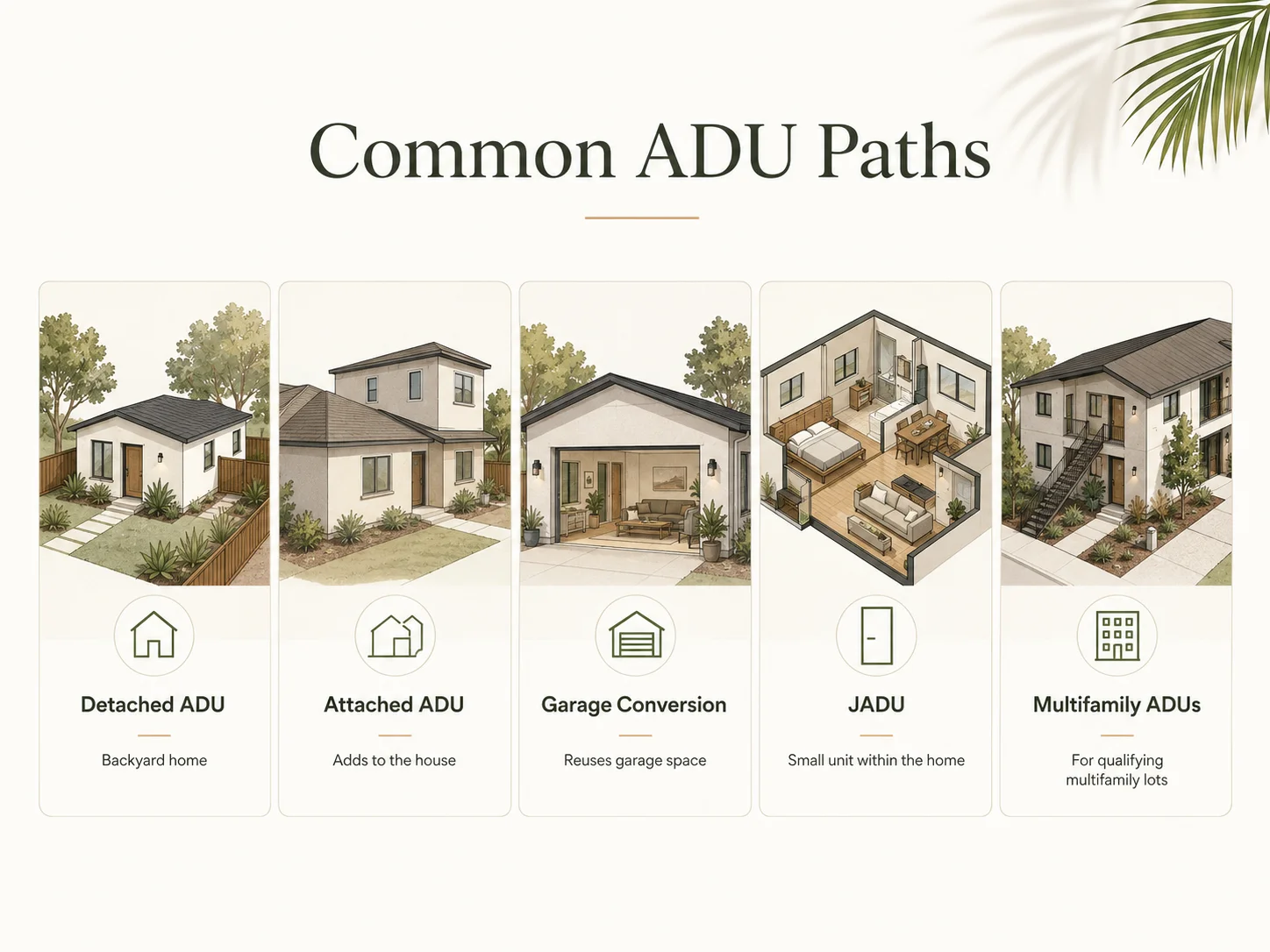
| Condition | Side/rear setback | Maximum height | Notes |
|---|---|---|---|
| Detached ADU outside primary setbacks — Path A | 3 ft | 12 ft | Lowest setback, lowest height |
| Detached ADU outside primary setbacks — Path B | 4 ft | 16 ft | The “standard” state-law path |
| Detached ADU outside primary setbacks — Path C | 5 ft | 20 ft | Most flexibility, more setback required |
| Detached ADU within ½ mile of major transit or high-quality transit corridor | 4 ft | 18 ft + up to 2 ft for roof pitch | Gov. Code §66314(d) |
| Detached ADU on lot with existing/proposed 2-story or multifamily primary | 4 ft | 18 ft | Gov. Code §66314(d); El Cajon §17.140.180(E) |
| Detached ADU within primary dwelling’s setback envelope | Underlying zone setbacks | Underlying zone height limit | Stacks under primary’s existing footprint allowance |
| Attached ADU — outside primary setbacks | 4 ft | 16 ft | Per ordinance update (Ord. 5151) |
| Attached ADU — outside primary setbacks (short path) | 3 ft | 12 ft | Per ordinance update |
| Attached ADU within primary’s existing setback envelope | Match primary | Up to 25 ft to match primary | Per ordinance update |
| Detached-to-primary building separation | n/a | n/a | Minimum 6 ft between buildings (regardless of path) |
Practical decision logic: If your lot is tight and you want a one-story unit, you can go right up to the property line at a 3-foot setback and stay under 12 feet. If you want a two-story unit to maximize bedroom count, you need a 5-foot setback for the 20-foot path — or you need to qualify for the transit or multistory exception that gets you 18 feet at the 4-foot setback.
Two-story ADUs in El Cajon
A two-story detached ADU is allowed in El Cajon in four scenarios:
- The 20-foot path: 5-foot side and rear setbacks, no height exceptions needed.
- The transit path: within a half-mile walking distance of a major transit stop or high-quality transit corridor, 4-foot setbacks, up to 18 feet (plus 2 feet for roof pitch to match the primary). State-protected under Gov. Code § 66314(d).
- The multistory-primary path: the lot has an existing or proposed multistory primary dwelling, 4-foot setbacks, up to 18 feet. State-protected under Gov. Code § 66314(d).
- The “within primary’s setback envelope” path: the ADU sits within the same setback area the primary dwelling uses, in which case the underlying zone height limit applies — which can mean 30 feet or more depending on the zone.
The most common gotcha is the half-mile-walking-distance test: it’s walking distance, not radial distance, and Building Safety can require you to document the walking path before accepting the height claim.
Architectural compatibility — an objective standard
Per § 17.140.180(E), an ADU must be constructed of similar building materials, colors, and architectural style as the primary dwelling. This is reviewed ministerially during plan check — not open-ended discretionary design review. Examples: stucco-and-tile primary → stucco-and-tile ADU passes easily; stucco-and-tile primary → flat-roof modern ADU with metal cladding will draw plan-check comments. If your dream ADU style doesn’t match the primary, you can match the ADU to the primary, or update the primary’s exterior at the same time to create a coherent property aesthetic.
Do I need extra parking for an El Cajon ADU?
The seven parking exceptions in El Cajon
| Exception path | Applies when | Source |
|---|---|---|
| Transit proximity | ADU is within ½ mile walking distance of public transit, including light rail and bus stations | §17.140.180(D)(1)(a) |
| Historic district | ADU is within an architecturally and historically significant historic district | §17.140.180(D)(1)(b) |
| Existing primary or accessory structure | ADU is part of the existing or proposed primary dwelling, or an existing accessory structure | §17.140.180(D)(1)(c) |
| Junior ADU | The unit is a JADU | §17.140.180(D)(1)(d) |
| On-street permit unavailable | On-street parking permits are required for residents but cannot be issued to the ADU occupant | §17.140.180(D)(1)(e) |
| Car-share program | A car-share vehicle is located within one block of the ADU | §17.140.180(D)(1)(f) |
| Submitted with new primary dwelling permit | ADU is submitted alongside a new single-family or multifamily dwelling permit application | El Cajon §17.140.180(D); Gov. Code §66322(a)(6) |
No replacement parking for garage conversions
Before SB 1211, if you demolished a garage to build an ADU — or converted a garage into an ADU — the city could require you to replace those parking spaces somewhere else on the lot. As of January 2025, replacement parking is no longer required when a garage, carport, covered parking structure, or uncovered parking space is removed or converted in connection with an ADU project. This makes garage conversions dramatically more viable on small lots that previously couldn’t fit both the converted ADU and replacement parking.
If a parking space is still required, El Cajon allows it to be located in tandem (one car behind another) on the driveway, or in the required front yard setback area as long as it meets paved- parking standards in § 17.140.160. This is more permissive than many other San Diego County cities.
What permits do I need, and how long does El Cajon take?
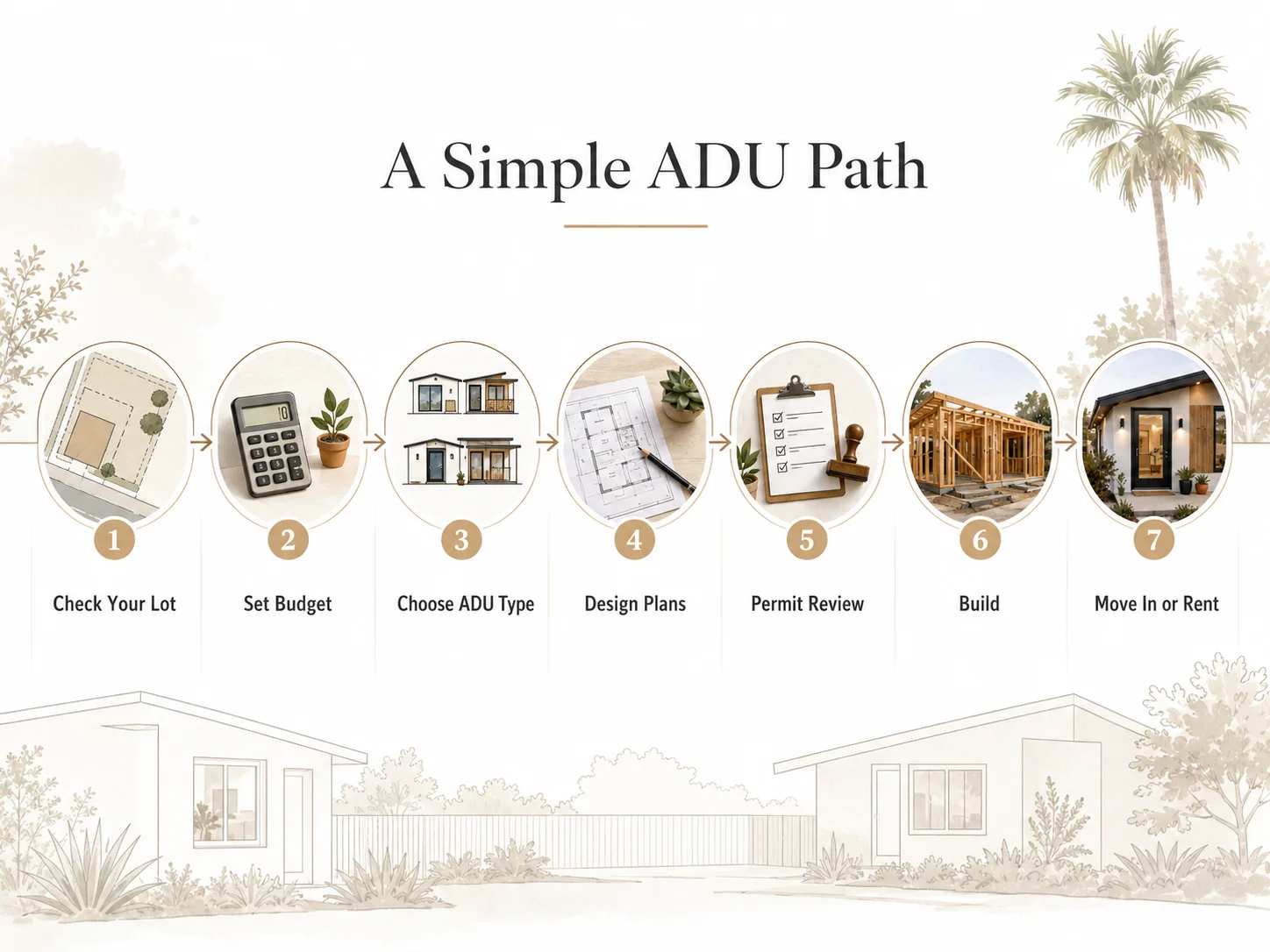
The PACO submission process — step by step
PACO (Project Assistance Center Online) is El Cajon’s digital permit portal. It handles ADUs end-to-end without an in-person visit. Here is the actual sequence:
- Confirm jurisdiction by entering the address into PACO. If the address resolves, you’re inside City of El Cajon.
- Register a PACO account as the property owner or your licensed contractor’s agent.
- Order a sewer lateral video if your builder confirms it applies to your project.
- Prepare your plans: site plan, floor plan, elevations, structural calculations, Title 24 energy documentation, sewer/utility coordination, and any required hazardous-materials questionnaire.
- Submit through PACO. Within 1–2 business days you’ll receive an invoice for the initial plan-check fees.
- Pay the initial invoice. Plan check begins.
- Wait 3–4 weeks for the first round of comments.
- Address corrections in PACO and resubmit. Re-check typically completes within 1–2 weeks per cycle.
- Receive plan approval. Pay remaining permit fees, school fees, and any utility/impact fees.
- Permit issuance. Schedule construction inspections through PACO.
- Inspections during construction at foundation, framing, rough trades, insulation, and final.
- Certificate of occupancy after final inspection passes.
The state-law clocks under Gov. Code § 66317
Two state-law clocks govern El Cajon’s timeline. The first is the 15-business-day completeness determination: the city must respond with either an acceptance or a written list of what’s missing. The second is the 60-day approve-or-deny window that starts running only once the application is complete. If the application comes back incomplete, you fix the listed items and resubmit; the city gets another 15 business days to confirm completeness on those items. Applicant-requested delays toll both clocks.
Realistic end-to-end timeline
| Phase | Realistic duration | What’s happening |
|---|---|---|
| Feasibility, jurisdiction check, sewer lateral video | 1–3 weeks | Confirm lot, check sewer, choose ADU type |
| Design and engineering | 1–3 months | Site plan, floor plan, elevations, structural, Title 24 |
| Plan check round 1 (city) | 3–4 weeks | Initial city review through PACO |
| Plan-check corrections — round 1 | 1–2 weeks (yours) + 1–2 weeks (city) | Address comments, resubmit |
| Plan-check corrections — round 2 (typical) | 1–2 weeks (yours) + 1–2 weeks (city) | One more correction cycle is common |
| Permit issuance | Same day after final fee payment | Schedule inspections |
| Construction — garage conversion | 3–5 months | Smaller scope, reusing existing structure |
| Construction — new detached (500–800 sq ft) | 4–6 months | Foundation, framing, MEP, finishes |
| Construction — new detached (800–1,200 sq ft) | 5–8 months | Larger scope, more trades |
| Final inspection and CO | 1–2 weeks | Walk-throughs, punch list, certificate of occupancy |
All-in realistic timeline: 6 months (small garage conversion with no corrections) to 14 months (full 1,200 sq ft detached new build). If a sales rep promises 90 days “start to finish,” they’re either talking about permit-only timing or selling you a product that hasn’t met California reality yet.
Download the Free ADU Starter Kit
Includes a PACO permit-document checklist, the questions to ask El Cajon Planning before paying for plans, and a sewer-lateral-video request template.
Get the Free Starter Kit →How much do El Cajon ADU permit fees cost, really?
What real El Cajon ADUs paid in city fees (May 2024 issuances)
These three permits were issued in May 2024 according to the City of El Cajon’s Permit Activity Report dated June 5, 2024 (published at elcajon.gov). The figures are public record.
| Permit # | Address | Type | Sq Ft | Project Valuation | City Fees Collected | Zone |
|---|---|---|---|---|---|---|
| BP-2023-0126 | 572 N First St, 92021 | New detached ADU + porch + laundry | 1,199 | $171,735.84 | $5,680.20 | RS-6 |
| BP-2023-0499 | 951 Crosby St, 92021 | Garage conversion (legalization) | 546 | $57,209.88 | $2,967.68 | — |
| BP-2023-0567 | 1402 Clarke Dr, 92021 | Garage conversion to ADU | 400 | $41,912.00 | $2,499.07 | RS-6 |
Source: City of El Cajon Building Permit Activity Report 05/01/2024–05/31/2024, published June 5, 2024. Retrieved May 14, 2026.
The Dwelling Index illustrative El Cajon fee model
| Filed valuation | Building permit fee | Plan check (65%) | Base adders | Base city subtotal |
|---|---|---|---|---|
| $80,000 (small garage conversion) | $992.49 | $645.12 | ~$315 | ~$1,952.61 |
| $150,000 (mid garage conversion) | $1,470.94 | $956.11 | ~$315 | ~$2,742.05 |
| $300,000 (medium new detached) | $2,418.94 | $1,572.31 | ~$315 | ~$4,306.25 |
| $450,000 (1,000 sq ft new detached) | $3,366.94 | $2,188.51 | ~$315 | ~$5,869.45 |
| $600,000 (1,200 sq ft luxé detached) | $4,225.34 | $2,746.47 | ~$315 | ~$7,286.81 |
The base model above excludes (must be added separately): code enforcement surcharge; engineering plan review and stormwater review fees; trade permits (electrical, plumbing, mechanical — each runs $200–$600); encroachment permit if sewer lateral repair touches the right-of-way; school fees (Cajon Valley Union School District for elementary/middle; Grossmont Union for high school — typically waived for ADUs under 500 sq ft); sewer capacity charge and water connection fees; impact fees if the ADU is over 750 sq ft; and fire department review if triggered.
Add roughly $2,000–$5,000 to the base subtotal to capture code-enforcement, engineering, stormwater, planning, and trade-permit line items. Then add school and utility fees on top. The full city-related fee picture on a new detached ADU over 750 sq ft typically lands between $8,000 and $14,000. Garage conversions under 750 sq ft typically land between $3,500 and $7,000.
Want a project-specific fee estimate for your address?
See what you can build and get a city-specific fee estimate before you spend money on plans.
Get Your Free El Cajon ADU Report →How much does it actually cost to build an ADU in El Cajon?
Realistic budget ranges by ADU type (2026)
| Project | All-in budget | Per-sq-ft range | Source |
|---|---|---|---|
| Garage conversion (400–600 sq ft, basic) | $90,000–$180,000 | $200–$350 | SnapADU 2026; Better Place Design & Build 2026; cross-checked vs. City of El Cajon filed valuations |
| Small detached new build (500–800 sq ft) | $200,000–$330,000 | $400–$600 | SnapADU 2026; YNK Construction 2026; ADU Pals 2026 |
| Mid-size detached (800–1,000 sq ft) | $300,000–$430,000 | $375–$500 | SnapADU 2026; Better Place Design & Build 2026 |
| Large detached (1,000–1,200 sq ft) | $400,000–$525,000 | $375–$475 | YNK Construction 2026; ADU Pals 2026 |
| Prefab/modular detached (with site work) | $180,000–$320,000 | varies | US Modular 2026; cross-checked against modular industry publications |
Why per-square-foot numbers mislead
A 500 sq ft ADU at $550/sq ft is $275,000. A 1,000 sq ft ADU at $400/sq ft is $400,000. The smaller unit looks cheaper, but the larger unit gives you a second bedroom that increases rent by $500–$800/month. The ROI math on the larger unit often beats the smaller one despite the higher absolute cost. Per-square-foot numbers are heavily influenced by fixed costs that don’t change much with unit size: design fees, plan check, kitchen appliances, bathroom fixtures, water heater, electrical panel, HVAC. Spreading those over more square feet lowers the per-foot price without making each square foot meaningfully cheaper to build.
The hidden costs most builder pages skip
- Sewer lateral repair or replacement — repair runs $4,000–$15,000; full replacement with encroachment permit runs $15,000–$35,000 (see the El Cajon quirks section).
- Electrical panel upgrade — older homes with 100-amp service often need a 200-amp panel to support the ADU load. $2,500–$5,000.
- Geotechnical/soils report — El Cajon does not normally require one, but hillside properties or properties with prior fill or expansive soils may trigger one. $2,500–$4,000.
- Site work — grading, drainage, retaining walls, tree removal. Highly variable; $5,000–$50,000 on difficult lots.
- Solar PV system — required for new detached ADUs under Title 24. $8,000–$15,000 for a small system on an ADU roof.
Build a 15–20% contingency into your budget. We’ve never seen an ADU project come in under budget; we’ve seen plenty come in on budget when the contingency was respected.
The El Cajon-specific cost advantage: El Cajon construction costs are among the lower in San Diego County. Coastal cities like Carlsbad, Encinitas, and Del Mar see ADU prices 15–25% higher because of land-related premiums on labor and materials staging. El Cajon contractors are generally accessible to inland and East County job sites without coastal traffic premiums. If you’ve gotten a quote that feels coastal, push back — or get a second quote from an East County-based builder.
How do El Cajon homeowners pay for an ADU?

Path 1: Cash-out refinance
You refinance your primary mortgage into a larger loan and pocket the difference. Works best when your current mortgage rate is at or above market. Works poorly when you have a rate below 4% locked in 2020–2021 — refinancing at today’s rates would mean giving up the low rate on your existing balance.
Path 2: Home Equity Line of Credit (HELOC)
A revolving line of credit secured by your home, drawn as needed during construction. Your first mortgage stays exactly where it is — same rate, same balance, same terms. The HELOC sits behind it as a second lien. Works best when you have a sub-4% first mortgage you want to preserve.
Path 3: Construction-to-permanent loan
A single loan that funds construction draws as the project progresses and then converts to a permanent mortgage at completion. Works best when you don’t have enough current home equity to fund the project with a HELOC, but the after-construction appraised value will be high enough.
Path 4: Renovation HELOC (after-renovation value)
A renovation-specific HELOC that underwrites against the after-renovation value of your home rather than the current value. Can be a meaningful amount of additional borrowing capacity for homeowners with thin current equity. Check current availability and lender terms directly before relying on any specific product.
Compare Construction Loan and Cash-Out Refi Options
Independent financing path education. Rates and terms change frequently — verify directly with the lender.
Explore Financing Options on Mortgage Research Center →Disclosure: The Dwelling Index is reader-supported. When you use our links to explore financing options, we may earn a commission at no extra cost to you. Our editorial recommendations are based on independent research and are never influenced by compensation. We present financing paths, not lender rankings.
Path 5 (El Cajon-specific): The City ADU Loan Program
El Cajon runs a city-funded ADU Loan Program — a low-interest, non-forgivable deferred loan, not a grant — for owner-occupied homeowners constructing an ADU inside city limits.
| Program detail | Value |
|---|---|
| Type | Deferred, non-forgivable loan |
| Use | Construction costs only |
| Loan amount | Up to $100,000 (verify current cap with City Housing) |
| Interest | 0%–5% simple, deferred 5–30 years depending on affordability tier |
| Affordability covenant | 5 years minimum |
| Eligibility | Owner-occupied properties; credit-qualified applicants |
| Tenant requirement | Affordable rent to income-qualified tenant |
| Priority | Properties in Environmental Justice Areas and Racially & Ethnically Concentrated Areas of Poverty |
| Application processing | First-come, first-served after April 1, 2024 |
| Contact | El Cajon Housing, 619-441-1710, housing@elcajon.gov |
Funding availability changes year to year — verify the current cycle status before counting on it. We won’t quote a rate, monthly payment, APR, or approval probability. Those depend on the lender, the property, your credit, and the day. This is educational information, not a loan recommendation.
What can you actually rent an El Cajon ADU for?
El Cajon rent comparables — Q1 2026
| Unit type | Monthly rent range (Q1 2026) | Annual gross | Source |
|---|---|---|---|
| Studio (~450 sq ft) | $1,450–$1,598 | $17,400–$19,176 | RentHop (Mar 2026); RentCafe (Jan 2026) |
| 1-bedroom (~600–700 sq ft) | $1,695–$1,912 | $20,340–$22,944 | RentHop (Mar 2026); RentCafe (Jan 2026) |
| 2-bedroom (~800–1,000 sq ft) | $2,098–$2,321 | $25,176–$27,852 | RentHop (Mar 2026); RentCafe (Jan 2026) |
| 3-bedroom (~1,100–1,200 sq ft) | $2,934–$3,095 | $35,208–$37,140 | RentHop (Mar 2026); RentCafe (Jan 2026) |
A worked ROI example
Assumptions: 800 sq ft detached 2-bedroom ADU on an El Cajon single-family lot. Build cost $310,000 all-in. Monthly rent $2,200. Annual gross $26,400.
| Year-1 economics | Amount |
|---|---|
| Gross annual rent | $26,400 |
| Property tax supplemental (on ADU value only — ~1.1% of $310k) | ($3,410) |
| Insurance addition | ($600) |
| Maintenance reserve (1% of build) | ($3,100) |
| Vacancy reserve (5%) | ($1,320) |
| Net operating income (Year 1) | $17,970 |
| Simple gross payback on $310k build | ~11.7 years |
| Net payback (no financing cost) | ~17 years |
Disclaimer: These are illustrative examples, not guarantees of returns. Actual results depend on local market conditions, construction costs, financing terms, tax assessment outcomes, appraisal results, insurance costs, vacancy rates, tenant performance, and regulatory approvals. Verify with a tax professional, appraiser, and lender for your specific property.
The 30-day minimum rental rule: State law requires ADU and JADU rental terms to be longer than 30 days. Short-term vacation rentals — Airbnb, Vrbo, and similar — are not a legal ADU rental strategy in California. Don’t underwrite your ADU project on Airbnb rates.
Property tax: Adding an ADU triggers a supplemental property tax assessment on the value of the new construction only. The county assessor does not reassess your entire property — your existing house keeps its existing taxable basis under Proposition 13. The supplemental assessment adds roughly 1.1% (San Diego County’s effective rate) of the ADU’s assessed value to your annual tax bill. For a $300,000 ADU build, expect roughly $3,300 in additional annual property tax. Verify with the San Diego County Assessor for your specific property.
Ready to rent your El Cajon ADU?
Tenant screening, lease management, and rental accounting for ADU owners.
Explore Landlord Tools on Buildium →Disclosure: The Dwelling Index is reader-supported. When you use our links to explore property management tools, we may earn a commission at no extra cost to you. Our editorial recommendations are based on independent research and are never influenced by compensation.
Can I sell my El Cajon ADU separately?
So the answer for an El Cajon city-limits property: today, your ADU is legally part of your primary residence and conveys with the main house at sale. You cannot independently sell it.
For an “El Cajon mailing address” property that is actually in unincorporated San Diego County: as of April 4, 2026, you may be able to convert the ADU to a condominium unit and sell it separately under the county’s AB 1033 implementation (Ordinance No. 10986). This requires going through a condominium conversion process, recording a condominium plan under the Davis-Stirling Act, and meeting lender and condominium requirements. JADUs are not eligible for separate sale under the county’s guidance. Verify current implementation details with County Planning & Development Services.
Watch El Cajon City Council agendas in 2026 for an AB 1033 opt-in vote — if the council adopts the ordinance, this answer changes for city-limits properties.
What if my ADU was built without permits before 2020?
The practical sequence for legalizing an existing unpermitted ADU:
- Confirm the structure was built before January 1, 2020 (photos, neighbor statements, prior aerial imagery, utility connection records).
- Order a confidential third-party code inspection from a licensed contractor — this gives you a punch list of safety issues to address before involving the city.
- Bring the unit up to minimum health and safety standards (smoke and CO detectors, GFCI outlets in wet areas, egress windows in bedrooms, proper electrical, sanitation, separated kitchen/bath).
- Submit the legalization application through PACO with documentation of pre-2020 construction and your work-completed sign-offs.
- Pay the legalization permit fee.
- Final inspection.
The most common reasons legalization fails: structural conditions the city deems unsafe (foundation cracks, severe roof issues, unpermitted structural modifications), serious sanitation problems (no working bathroom, mold), or fire code issues (no second egress on bedrooms, no proper separation from primary dwelling).
If your unpermitted ADU passes inspection, the upside is real: a legal ADU appraises and conveys with the property. An unpermitted one is essentially discounted to zero on appraisals and creates buyer-finance complications at sale.
The El Cajon-only quirks no other guide will tell you
The sewer lateral video
El Cajon Engineering processes sewer lateral video inspections as part of private development project review. Local ADU builders consistently report that sewer-lateral video review is required or strongly recommended during feasibility for an ADU permit because adding an ADU increases sewer flow to the city main. The El Cajon Public Works Wastewater Administration has stated that property owners are responsible for the entire private lateral, including the portion under the public right-of-way.
- Typical lateral video cost: $300–$600
- Typical lateral repair (slip-line / cured-in-place liner): $4,000–$15,000
- Typical full replacement with encroachment permit and traffic control: $15,000–$35,000
The wall articulation question (§ 17.140.170)
El Cajon § 17.140.170 requires architectural relief on building elevations longer than 30 feet — a projection or recess at least 18 inches deep and 4 feet wide. The code includes exemptions, and § 17.140.170(E) suggests certain ADUs created under § 17.140.180 may not be subject to that section. If your ADU is over 800 sq ft and has long uninterrupted exterior walls, ask Planning (619-441-1742) in writing whether § 17.140.170 applies to your specific project before finalizing elevations. Many prefab manufacturers’ larger floor plans have continuous walls longer than 30 feet without any jog. The fix is straightforward — set a kitchen or bath in a small bump-out to create the articulation naturally.
Architectural compatibility
Per § 17.140.180(E), an ADU must be constructed of similar building materials, colors, and architectural style as the primary dwelling. This is an objective code standard reviewed ministerially during plan check — California state law requires ADU review to be ministerial, not discretionary. Practical examples:
- Stucco-and-tile primary → stucco-and-tile ADU. Passes easily.
- Stucco-and-tile primary → flat-roof modern ADU with metal cladding. Plan check may require material/style adjustments.
- Wood-siding primary → wood-siding ADU. Passes.
If your dream ADU style doesn’t match the primary, you can match the ADU to the primary, or update the primary’s exterior at the same time to create a coherent property aesthetic.
The Movable Tiny Home (MTH) pathway
El Cajon § 17.140 includes a specific provision for Movable Tiny Homes — transportable dwelling units constructed to recreational vehicle standards, between 150 and 430 square feet, DMV-registered, and NFPA-certified. An MTH must be located behind the primary dwelling and meet ADU location standards. MTHs require an Administrative Zoning Permit and full compliance with the § 17.140 MTH standards. They are not exempt from permitting — they’re an alternative compliance path under § 17.140 that fits a narrow set of use cases: very small lots, or homeowners who want the option to remove or relocate the unit in the future without demolition.
Pre-approved ADU plans or custom — which is right?
When pre-approved makes sense vs. when custom does
| Pre-approved plan path | Custom design path |
|---|---|
| Your lot is rectangular and the plan footprint fits cleanly | Your lot has slope, easements, or shape constraints |
| You want a standard 1BR or 2BR layout | You want a specific feature (vaulted ceiling, separate entrance, ADU above garage) |
| You’re cost-sensitive and want to minimize design fees | You’re willing to invest $8K–$15K in design to optimize rental income |
| Using one of El Cajon’s three Standard Plans: 560, 649, or 802 sq ft | You want a unit that will photograph well, command top rent, and feel distinct |
| Speed matters; you want to break ground in 6 months | You’re willing to take 9–12 months for a perfectly tailored design |
The most important caveat: pre-approved plans solve only the architectural shell. You still need a site-specific plot plan, Title 24 energy compliance documentation, utility coordination (sewer connect, electrical service tie-in), and a sewer lateral video. Pre-approved plans are best for homeowners who want the building, not the design experience.
For a full breakdown of El Cajon’s Standard ADU Plans — fees, sizes, current-code status, and exactly what’s included — see our El Cajon Pre-Approved ADU Plans guide.
Want a local design-build partner that knows El Cajon plan check?
Greater San Diego design-build specialist with 100+ completed ADU projects. Handles the sewer-lateral-video step during feasibility.
See SnapADU’s El Cajon Service Area →Disclosure: The Dwelling Index is reader-supported. When you use our links to explore design-build providers, we may earn a commission at no extra cost to you. Our editorial recommendations are based on independent research and are never influenced by compensation.
When NOT to build an ADU on your El Cajon property
ADUs are wonderful tools for the right homeowner and the wrong tool for others. Here’s when to pause.
- Your sewer lateral is failing. A $20,000–$35,000 lateral replacement wipes out a meaningful chunk of your year-1 ROI. If the lateral video comes back with major issues and your math doesn’t pencil after factoring the repair, walk away or downscale to a JADU that uses existing fixtures.
- You only qualify for a JADU and you need tenant-only occupancy. El Cajon’s local rule means you usually can’t lawfully run a JADU as a passive rental with no one living in the main house. If you wanted to move out and rent everything, the JADU doesn’t fit — look at a smaller detached ADU instead.
- You’re planning to sell within 2–3 years. A new ADU adds significant value at appraisal but rarely recoups all of its build cost in market value alone. ADU value comes from the recurring rent stream over many years. If you’re selling in 24 months, the buyer pool that will pay a premium is narrower than you’d hope.
- You can’t comfortably absorb a 15–20% cost overrun. Construction is unpredictable. If a $300,000 build becoming a $360,000 build would create real financial stress, the project might not be the right time.
- El Cajon rent comps don’t pencil at the build cost. If a $400,000 build will rent for $2,000/month, your gross payback is 16+ years before any expenses. That math can still make sense for multigenerational housing or property-value plays — but pure rental investment numbers have to work.
For each of these, there’s an alternative. Failed lateral? Consider a garage conversion that doesn’t change the sewer load profile much. Want tenant-only? Build the ADU (not the JADU). Selling soon? Wait 3–4 years to capture the appreciation curve. Tight budget? Look at the City ADU Loan Program or a smaller unit footprint. Bad rent math? Run the multigenerational scenario instead.
Your 7-step El Cajon ADU action plan
Here is the practical sequence for someone who’s decided to move forward. Don’t reverse the order — the earlier steps prevent later mistakes.
- Confirm jurisdiction. Enter your address into PACO. If it resolves, you’re inside the City of El Cajon. If not, switch to County of San Diego ADU resources. Don’t skip this.
- Confirm the sewer lateral requirement and order the video if applicable. Call Engineering at 619-441-4945. The video costs $300–$600 and tells you whether you can build, repair, or walk away — before you spend on plans.
- Decide your ADU type. Detached, attached, garage conversion, or JADU. Use the eligibility table at the top of this page. Match the type to your lot constraints and your goal (rental vs. family vs. flex space).
- Get a feasibility report on your specific address. Either run our free Feasibility Engine for an automated read or commission a paid feasibility study from a local builder. Either way, get a written document confirming what the lot supports before committing to a designer.
- Decide pre-approved or custom. Use the matrix earlier in this guide. El Cajon’s three Standard Plans (560, 649, 802 sq ft) are faster and cheaper; custom is more flexible and longer.
- Submit through PACO and budget for two correction cycles. Aim for a complete first submission. Address corrections within a week of receiving them — every week you wait is dead time the city isn’t responsible for.
- Build under inspection and obtain certificate of occupancy. Schedule inspections through PACO at foundation, framing, rough trades, insulation, and final. The CO is what makes the ADU legal and rentable.
Start Step 4 right now
Get an address-specific feasibility report — free, in 2 minutes.
Get Your Free ADU Report →Frequently asked questions about El Cajon ADU laws
Does El Cajon allow ADUs?
Yes, on most eligible residential lots inside the City of El Cajon. Single-family lots can typically add one ADU plus one Junior ADU. Multifamily lots can add up to eight detached ADUs plus conversion ADUs equal to at least one and up to 25% of existing units. Rules are set by El Cajon Municipal Code §17.140.180 and California Government Code §§66310–66342.
How many ADUs can I build on my El Cajon lot?
A single-family lot can typically have one ADU plus one JADU. A multifamily lot can have detached ADUs equal to the number of existing units (up to eight), plus conversion ADUs equal to at least one and up to 25% of existing units.
What is the maximum ADU size in El Cajon?
1,200 square feet for attached or detached ADUs under the local cap, and the ADU cannot exceed the primary dwelling. Attached ADUs are also limited to 50% of the primary dwelling under Government Code §66314. 500 square feet for Junior ADUs. State law guarantees a minimum 800-square-foot ADU on qualifying lots regardless of local limits.
What are the setback requirements for an El Cajon ADU?
El Cajon uses a setback-to-height matrix: 3-foot side/rear setbacks allow 12 feet of height, 4-foot setbacks allow 16 feet, 5-foot setbacks allow 20 feet. Properties within a half-mile of major transit get 18 feet at 4-foot setbacks under state law. Detached ADUs must be at least 6 feet from the primary dwelling.
Can I build a two-story ADU in El Cajon?
Yes, in four scenarios: (1) 5-foot setbacks for up to 20 feet, (2) within a half-mile of major transit at 4-foot setbacks for up to 18 feet plus 2 feet for roof pitch, (3) on a lot with a multistory primary at 4-foot setbacks for up to 18 feet, or (4) within the primary’s setback envelope at the underlying zone height limit.
Do I need extra parking for an El Cajon ADU?
Often no. Seven exceptions waive the requirement: within ½ mile of public transit, in a historic district, ADU is part of existing structure, ADU is a JADU, on-street permit unavailable, car-share within one block, or ADU submitted alongside a new primary dwelling permit. Under SB 1211, replacement parking is not required when you demolish or convert a garage, carport, covered parking structure, or uncovered parking space for the ADU.
How long does an El Cajon ADU permit take?
State law requires completeness determination within 15 business days and approve-or-deny within 60 days of a complete application. In practice, plan check takes 3–4 weeks for round one, with one or two correction cycles of 1–2 weeks each. Realistic permit-issued timeline from a complete first submission: 60–90 days.
How much do El Cajon ADU permit fees cost?
Using El Cajon’s FY26 fee schedule formula, a base city permit + plan check subtotal runs from roughly $2,000 (small garage conversion) to $7,300 (top-of-range detached). Total city-related fees including engineering, stormwater, trade permits, school fees, and utility charges typically land in the $4,500–$12,000 range for a new detached ADU. Real permits issued in May 2024 show city fees of $5,680 (1,199 sq ft new detached) and $2,499–$2,968 (garage conversions).
Are ADUs under 750 square feet free to permit?
No. The 750-square-foot threshold waives impact fees only. You still pay plan check, building permit fees, trade permits, school fees, code-enforcement surcharge, engineering review, stormwater fees, and utility connection charges.
Do I have to live on the property to build an El Cajon ADU?
No for a standard ADU (state law since 2020). For a JADU, El Cajon’s local code requires the owner to occupy either the primary dwelling or the JADU and records a notice of restriction on title. Verify any tenant-only JADU scenario with Planning at 619-441-1742 before designing.
Can I Airbnb my El Cajon ADU?
No. California state law requires ADU and JADU rental terms to be longer than 30 days. Short-term vacation rentals are not a legal ADU rental strategy in California.
Can I sell my El Cajon ADU separately?
Not as of May 2026 inside the City of El Cajon. The city has not adopted AB 1033. San Diego County adopted AB 1033 for unincorporated areas effective April 4, 2026 — that path is available only to county-jurisdiction properties. Verify current status with the City Clerk.
What if my property has an “El Cajon” mailing address but is in unincorporated county?
Then this guide’s city-specific rules don’t apply to your project. Verify jurisdiction in PACO; if your address doesn’t resolve, you’re almost certainly in unincorporated San Diego County and should follow the County’s ADU rules instead.
Do El Cajon ADUs need fire sprinklers?
Generally no — fire sprinklers are not required for an ADU if they are not required for the primary residence. Adding sprinklers to a new ADU does not automatically trigger a sprinkler requirement for the primary dwelling.
Do I need a separate utility meter for an El Cajon ADU?
No, El Cajon does not require separate utility meters for ADUs.
Can I legalize an existing unpermitted ADU built before 2020?
Possibly yes, via AB 2533’s amnesty pathway effective January 1, 2025. The unit must meet minimum health and safety standards, but many discretionary denial paths are closed to the city. Get a third-party code inspection before submitting.
Are HOAs allowed to block my El Cajon ADU?
No — California Civil Code (AB 670) invalidates outright HOA bans on ADUs in single-family communities. HOAs can still impose reasonable design and development standards as long as they don’t excessively restrict construction or significantly increase cost.
Does the City of El Cajon offer ADU financial assistance?
Yes, through the ADU Loan Program — a non-forgivable deferred loan (not a grant) for owner-occupied properties willing to maintain at least 5 years of affordable rent. Loan amounts up to $100,000 with 0%–5% simple interest deferred 5–30 years depending on affordability tier. Contact Housing at 619-441-1710 or housing@elcajon.gov. Funding availability varies year to year.
Are there pre-approved ADU plans in El Cajon?
Yes. The city publishes three Standard ADU Plans through the Planning Division: 560 sq ft Studio, 649 sq ft One Bedroom, and 802 sq ft Two Bedroom, as a combined plan set. Pre-approved plans reduce design costs and timeline but do not bypass permitting — you still need a site plan, Title 24 documentation, and a sewer lateral video.
What we verified (and how)
We verified every claim in this guide on May 14, 2026 against primary sources:
| Item | Primary source |
|---|---|
| El Cajon Municipal Code §17.140.180 (ADU rules) | eCode360 codification (ecode360.com/44375151) |
| El Cajon §17.140.170 (design-review wall articulation) | eCode360 codification (ecode360.com/44375295) |
| El Cajon ordinance trail (5142, 5148, 5151) | El Cajon City Council records |
| HCD findings letter to El Cajon | California Department of Housing and Community Development, Feb 6, 2025 |
| California ADU statute (Gov. Code §§66310–66342) | leginfo.legislature.ca.gov |
| 15-business-day completeness clock and tolling | Gov. Code §66317 |
| 800-square-foot state floor and height baselines | Gov. Code §66321 |
| Multifamily ADU expansion (SB 1211) | Gov. Code §66323; SB 1211 enrolled text |
| AB 2533 amnesty pathway | AB 2533 enrolled text; Gov. Code §66311.7 |
| AB 1033 opt-in status for City of El Cajon | El Cajon City Council ordinance index reviewed through May 2026 |
| San Diego County AB 1033 adoption | County Ordinance No. 10986, March 4, 2026 |
| City of El Cajon ADU Loan Program | City of El Cajon Housing Division program guidelines |
| El Cajon Building Permit Activity Report (May 2024 issuances) | elcajon.gov/home/showpublisheddocument/28164/638532626338270000 |
| El Cajon FY26 fee schedule formula | City of El Cajon Building & Safety published fee schedule |
| El Cajon Standard ADU Plans (560, 649, 802 sq ft) | City of El Cajon Planning Division |
| El Cajon PACO portal jurisdiction FAQ | PACO portal (paco.elcajon.gov) |
| Sewer lateral responsibility statement | El Cajon Public Works Wastewater Administration |
| Rent comparables Q1 2026 | RentHop (Mar 2026); RentCafe (Jan 2026) |
| HCD ADU Handbook, March 2026 | hcd.ca.gov ADU Handbook update |
Spot-check before relying on these for a transaction:
Current codified § 17.140.180 text via City Clerk or eCode360; current school impact fee rates by district; current City permit backlog; Standard Plan current-code status; live AB 1033 status for the City of El Cajon; current ADU Loan Program funding availability. For any specific project, confirm with El Cajon Planning at 619-441-1742 or Building Safety at 619-441-1726 before paying for plans.
Why we wrote this guide
Most “El Cajon ADU laws” pages we read reprint the same handful of bullet points, contradict each other on details that matter (in-person vs. digital submission, the 1,200 sq ft cap, the JADU owner-occupancy rule), or skip the parts that actually trip homeowners up — like the sewer lateral video and the wall articulation question. We assembled this from primary sources. Where sources disagree, we tell you which we treated as authoritative.
This guide is educational. It is not legal, tax, lending, construction, or design advice. Before you sign a contract or pay for plans, verify with El Cajon Planning Division (619-441-1742) or your own licensed professional.