
County of San Diego ADU Laws 2026: Unincorporated Rules, Fees & Permit Checklist
· Last verified against County PDS and California Government Code sources: May 15, 2026
The bottom line, up front
County of San Diego ADU laws apply to property in the unincorporated areas of San Diego County — communities like Ramona, Lakeside, Fallbrook, Valley Center, Spring Valley, Bonita, Alpine, Rancho Santa Fe, Jamul, Julian, and Bonsall. If your parcel sits inside an incorporated city — San Diego, Chula Vista, Oceanside, Escondido, El Cajon, Poway, Vista, Carlsbad, Encinitas, San Marcos, La Mesa, Santee, Imperial Beach, Lemon Grove, Coronado, Del Mar, National City, or Solana Beach — that city's ordinance governs your project, not the County's.
On an eligible single-family lot in unincorporated County, you can build one detached or attached ADU plus one JADU under the general path. Under California Government Code §66323, a qualifying lot can host one ADU created from existing space, one JADU, and one newly constructed detached ADU up to 800 sq ft — site and lot conditions permitting. Detached ADUs are capped at 1,200 sq ft under County code.
Typical County building plan-review and permit fees, calculated from the County's published PDS-613 fee schedule, run $4,019.60 for a 600 sq ft ADU up to $4,578.20 for a 1,200 sq ft ADU on the standard plan-review path. School, impact, utility, septic, and fire-district fees stack on top.
The first move before you do anything else: confirm your parcel is actually in unincorporated County, not a city island. The map looks deceiving.
See what your specific lot can build →
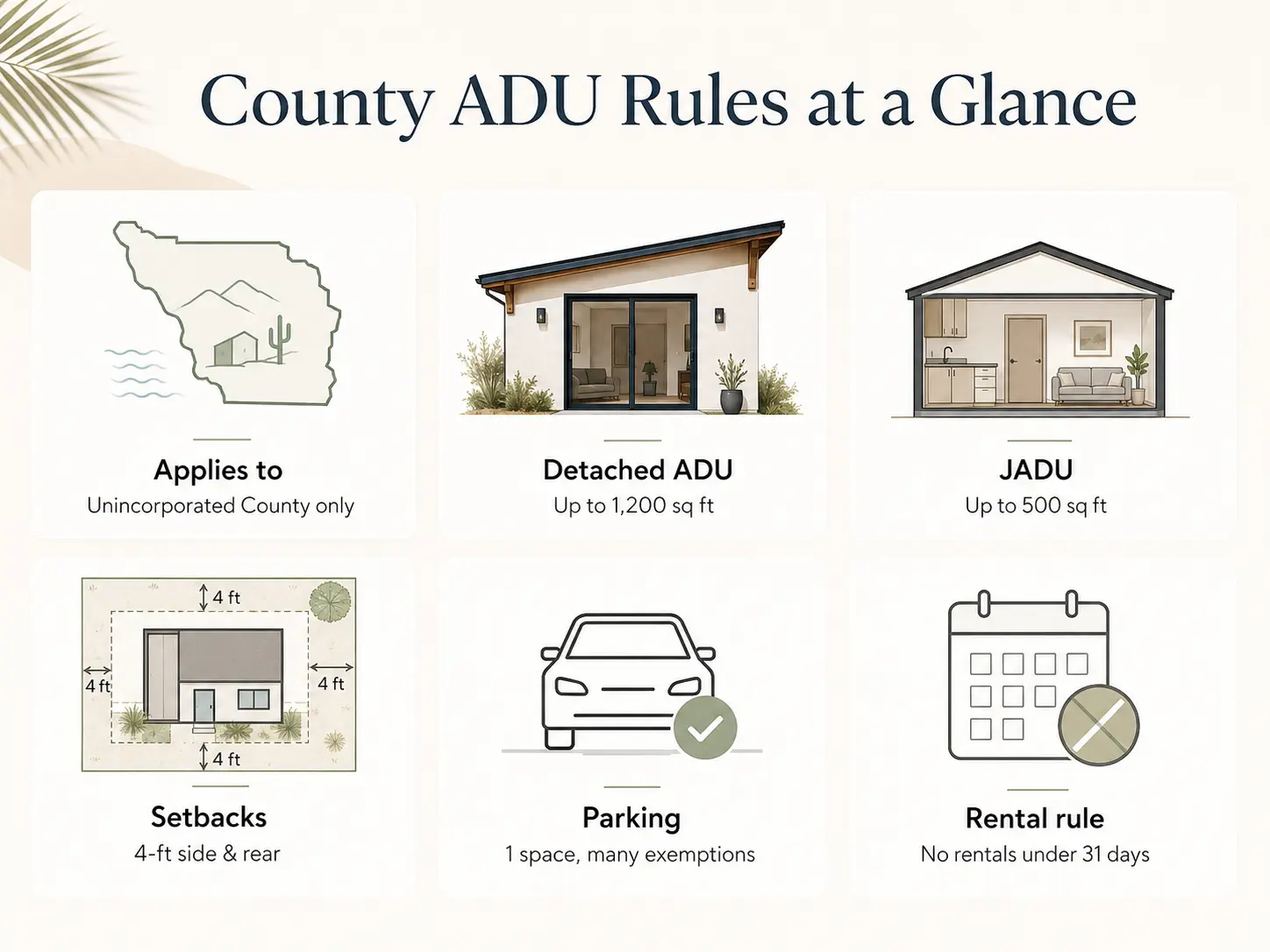
Run the Free 60-Second Property Eligibility CheckSan Diego County ADU rules at a glance
| Question | Fast answer | What to do next |
|---|---|---|
| Do County rules apply? | Only if your parcel is in unincorporated County (not an incorporated city). | Pull a Property Summary Report by APN. |
| Max detached ADU size? | 1,200 sq ft under County code. | The state-protected 800 sq ft path is a backup when local rules block the bigger build. |
| Max attached ADU size? | County allows up to 50% of primary or 1,200 sq ft, with state floors of 850 sq ft (studio/1-BR) or 1,000 sq ft (more than one bedroom). | Don't accept a '50% rule' answer before checking the state floor. |
| Max JADU size? | 500 sq ft, inside the existing or proposed primary residence. | Decide on shared vs. separate bathroom — it changes the owner-occupancy rule. |
| Side/rear setbacks? | 4 ft minimum for new ADUs. | Plus fire-zone setbacks, well/septic separation. |
| Detached height? | 25 ft under County code; County's ministerial 800 sq ft path capped at 18 ft. | The state-protected path is shorter; the local 1,200 sq ft path is taller. |
| Attached height? | 25 ft or the local zoning height that applies to the primary, whichever is lower. | Per Gov Code §66321(b)(4)(D). |
| Parking required? | One space generally — many exemptions. | ½-mile transit, historic district, ADU 'part of' the primary or accessory structure, and others. |
| Owner-occupancy? | No for ADUs. For JADUs, only if the JADU shares sanitation facilities. | AB 1154, effective Jan 1, 2026. |
| Short-term rental (Airbnb)? | No — rentals must exceed 30 days. | Applies to ADUs and (under AB 1154) JADUs. |
| Separate sale (AB 1033)? | ADUs: yes, via condo conversion, effective April 4, 2026. JADUs: not eligible. | Plan around a Tentative Parcel Map application. |
| County permit + plan-review fee (800 sq ft ADU)? | ~$4,205.80 source-calculated from PDS-613. | Add school, utility, septic, fire, grading separately. |
| Free County plans (A–F)? | Available, ~85% complete. | A starting point — not a finished permit. |
| Permit decision deadline? | 60 days by state law on a complete application. | Completeness determination required within 15 business days. |
Sources: County of San Diego PDS ADU page; County Zoning Ordinance §6156.x; County PDS-611; County PDS-613 (FY 25/26); March 4, 2026 Board of Supervisors action; County AB 1033 Condo Guidance & Checklist (April 3, 2026); California Government Code §§ 66311.5, 66313, 66314, 66317, 66321, 66323, 66333, 66342; AB 976, AB 1154, AB 2533, SB 543, SB 1211. Verified May 15, 2026.
What we verified for this guide
- County of San Diego ADU eligibility, types, and size language — sandiegocounty.gov/pds/bldg/adu — verified May 15, 2026.
- County Zoning Ordinance Section 6156.x (residential and agricultural use types, ADU subsection) — verified via the County's published code library — May 15, 2026.
- AB 1033 implementation in unincorporated County — Board of Supervisors adoption March 4, 2026; ordinance effective April 4, 2026; County PDS published AB 1033 Condo Guidance & Checklist dated April 3, 2026.
- County PDS-613 Fee Schedule (Guest House/ADU and ADU OTC Review fee formulas) — verified May 15, 2026.
- County Dwelling Unit Building Plans A–F sizes and "approximately 85% complete" status — verified May 15, 2026.
- Current California Government Code — verified May 15, 2026 for §§ 66311.5, 66313, 66314, 66317, 66321, 66323, 66333, 66342.
- AB 976, AB 2533, AB 1154, SB 543, SB 1211 — verified May 15, 2026.
- Tiny Homes on Wheels eligibility — County Director's Determination dated September 4, 2025; County News Center, October 1, 2025; County DEHQ THOW FAQ.
Do County of San Diego ADU laws apply to my property?
Answer capsule. County of San Diego ADU laws apply only to property in the unincorporated areas of San Diego County. If your parcel sits inside any incorporated city — including the City of San Diego, Chula Vista, Oceanside, Escondido, Carlsbad, El Cajon, Vista, Poway, Encinitas, San Marcos, Santee, La Mesa, Imperial Beach, National City, Lemon Grove, Coronado, Del Mar, or Solana Beach — that city's ADU ordinance governs your project, not the County's. Confirm jurisdiction via the County's Citizen Access portal before spending a dollar on design.
This is the single most expensive mistake we see when readers search "San Diego County ADU laws." San Diego County covers roughly 4,500 square miles, and the majority of its population lives inside one of 18 incorporated cities. The rest lives in unincorporated communities the County administers directly. From the air, the line between "the County" and "a city" is invisible.
Unincorporated communities where County rules apply
The following communities are wholly or substantially unincorporated: Alpine, Bonita, Bonsall, Borrego Springs, Boulevard, Campo, Crest, Dehesa, Descanso, Dulzura, Fairbanks Ranch, Fallbrook, Granite Hills, Hidden Meadows, Jacumba Hot Springs, Jamul, Julian, Lakeside, Mount Helix, Mt. Laguna, Pala, Pala Mesa, Palomar Mountain, Pauma Valley, Pine Valley, Potrero, Rainbow, Ramona, Ranchita, Rancho San Diego, Rancho Santa Fe, Spring Valley, Tecate, Valley Center, and Warner Springs. Beyond those, there are smaller county islands and boundary parcels where mistakes happen most often.
A parcel with a "San Diego, CA" mailing address is not necessarily inside the City of San Diego. A parcel taxed by San Diego County is not necessarily under County land-use authority. The mailing address tells you nothing useful about ADU jurisdiction.
The jurisdiction decoder
| Address or boundary clue | Do County ADU laws automatically apply? | Next step |
|---|---|---|
| "San Diego, CA" mailing address | Not necessarily | The mailing address says nothing definitive — confirm with a Property Summary Report. |
| Inside the City of San Diego boundary | No | Use City of San Diego ADU laws — the City's rules differ on bonus ADUs, setbacks, and AB 1033 timing. |
| Inside another incorporated city (Chula Vista, Poway, Escondido, etc.) | No | Use that city's ordinance. |
| Unincorporated community (Ramona, Lakeside, Fallbrook, etc.) | Yes, in nearly all cases | Proceed with this guide. |
| A county island inside a city | Yes — but verify | Pull the Property Summary Report; appearances deceive here. |
| Property tax bill says "San Diego County" | Not enough by itself | Tax authority does not equal land-use authority. |
| Parcel sits in the Coastal Zone | Yes plus Coastal | A small portion of unincorporated Rancho Santa Fe sits in the Local Coastal Program zone; an additional Coastal Development Permit pathway applies. |
How to confirm jurisdiction in five minutes
The County's Citizen Access portal lets you generate a Property Summary Report using your Assessor's Parcel Number (APN). The report tells you the parcel's jurisdiction, base zoning, General Plan land-use designation, and overlays (Coastal, Fire Hazard Severity Zone, MSCP biological resources, and others). If anything is ambiguous, call County PDS at (858) 694-2960 or email PDS.ADUQuestions@sdcounty.ca.gov before you spend a dollar on design.
Not sure your address is in unincorporated County? Our free Property Eligibility Check resolves jurisdiction in 60 seconds — and shows which ADU paths your specific lot can support before you commit to plans.
Run the Free Property Eligibility Check →Sources: County of San Diego Planning & Development Services ADU page; County Zoning Ordinance §6156.x. Verified May 15, 2026.
What you can legally build on a single-family lot in unincorporated San Diego County
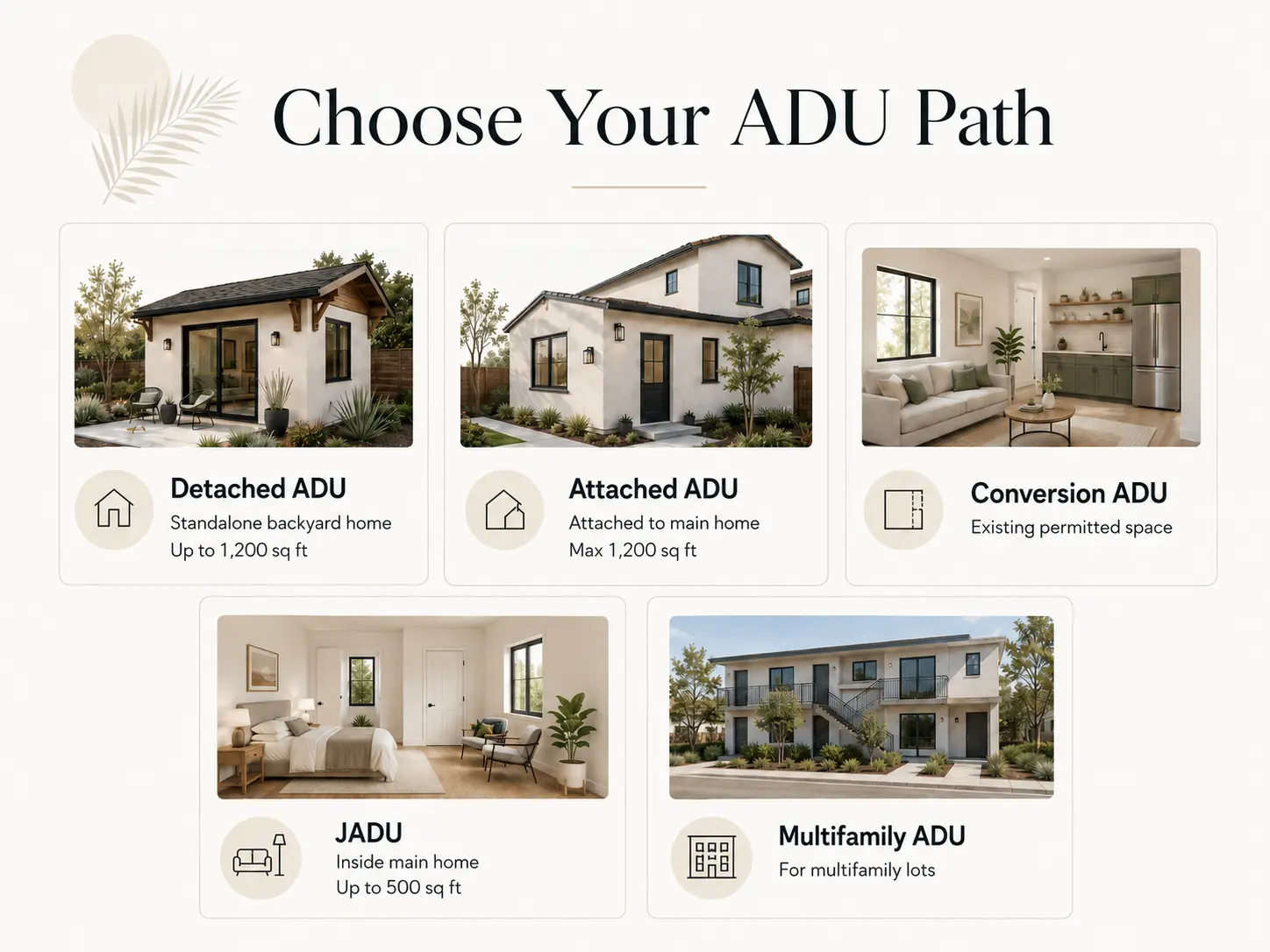
Answer capsule. On a qualifying single-family lot, state and County law together protect five core ADU paths plus two specialized configurations: a 1,200 sq ft detached ADU under County local rules; an 800 sq ft detached ADU under the state-protected ministerial standards in California Government Code §66323; an attached ADU up to 50% of the primary or 1,200 sq ft (with state floors guaranteeing 850/1,000 sq ft); a conversion ADU inside an existing permitted accessory structure; or a Junior ADU (JADU) up to 500 sq ft inside the primary. Multifamily lots have their own framework, and Tiny Homes on Wheels became eligible as ADUs in October 2025.
Path 1 — Detached ADU up to 1,200 sq ft (County local rules)
Best fit: larger rental income, multigenerational housing, two-to-three-bedroom layouts, properties with room to spare.
Under County Zoning Ordinance §6156.x, a detached ADU on a residentially zoned parcel with an existing or proposed single-family dwelling can be up to 1,200 square feet, 25 feet tall, with four-foot side and rear setbacks and front setbacks per the underlying zone. The size of the detached ADU does not depend on the size of the primary residence.
Path 2 — Detached ADU up to 800 sq ft (state-protected path, §66323)
Best fit: constrained lots where local rules would otherwise prevent any ADU.
California Government Code §66321 and §66323 establish a state-protected ADU path the County cannot override. On a parcel with an existing or proposed primary residence, the County must permit at least one detached ADU up to 800 sq ft with four-foot side and rear setbacks, regardless of what other local development standards say. The County applies an 18-foot height cap to this ministerial path. This is the "yes you can" path when the County would otherwise say "no."
Path 3 — Attached ADU
Best fit: smaller properties where utility connections are easier to share, or where a wall-shared addition is cheaper.
County code limits attached ADUs to 50% of the primary residence floor area or 1,200 sq ft, whichever is less. California state law (Gov Code §66321) sets minimum maximums that the County cannot reduce below: 850 sq ft for a studio or one-bedroom, 1,000 sq ft for an ADU with more than one bedroom. If your primary is small, the state floor will almost always win — don't leave size on the table. Height is governed by Gov Code §66321(b)(4)(D): 25 ft or the local zoning height limit applicable to the primary, whichever is lower.
Path 4 — Conversion ADU
Best fit: existing permitted garage, accessory building, or basement.
Conversion ADUs are not subject to standard size limits, height limits, lot coverage requirements, or setback requirements as long as the conversion stays within the existing footprint. The existing structure must be permitted and meet Building Code. The most cost-effective ADU path by a wide margin when the existing structure is sound.
Path 5 — Junior ADU (JADU)
Best fit: aging parent, adult child, caregiver, or small unit inside the existing home.
A JADU is a self-contained unit fully contained within the existing or proposed primary residence, up to 500 sq ft, with its own entrance and an efficiency kitchen. Three rules every JADU applicant must understand:
- Owner occupancy is required only if the JADU shares sanitation facilities with the primary. Under AB 1154 (effective January 1, 2026), a JADU with its own separate bathroom is not subject to owner occupancy — that single design choice changes the financial picture.
- JADUs cannot be sold separately from the primary residence.
- A JADU may be permitted in addition to an ADU on the same single-family lot.
Path 6 — Multifamily ADUs
Best fit: existing duplexes, triplexes, fourplexes, or larger apartment buildings.
State law and County §6156.x allow conversion of non-livable space into ADUs up to 25% of the existing units (minimum one), plus up to eight detached ADUs capped at the number of existing units. Detached ADU height on existing multifamily lots is capped at 18 feet; on proposed multifamily lots, 25 feet.
Path 7 — Tiny Homes on Wheels (added September–October 2025)
Best fit: owners who want a manufactured tiny-home product on an unincorporated lot.
Under the County's September 4, 2025 Director's Determination, Tiny Homes on Wheels (THOWs) may qualify as ADUs. Key conditions: maximum 430 sq ft measured from the inside face of walls; one story, maximum 16 feet; non-combustible exterior; dual-glazed windows; Class A roof; connection to electric, water, and sewer/septic utilities under a building permit; cannot move under its own power. DEHQ recommends obtaining wastewater layout approval before the building permit on septic properties.
Master path matrix
| Path | Best fit | Max size | Height | Setback | Owner-occupancy | Main risk |
|---|---|---|---|---|---|---|
| 1. Detached, County local rule | Larger rental/family unit | 1,200 sq ft | 25 ft | 4 ft | Not required | Fire/septic/site constraints |
| 2. Detached, state-protected (§66323) | Constrained lot | 800 sq ft interior livable | County 18 ft cap | 4 ft | Not required | Smaller footprint |
| 3. Attached | Expansion off main house | 50% of primary or 1,200 sq ft; state floors 850/1,000 sq ft | 25 ft or primary's zoning limit, lower | 4 ft | Not required | Fire separation, egress |
| 4. Conversion | Garage/accessory conversion | No code limit (existing envelope) | Existing structure | No change | Not required | Building-code upgrades |
| 5. JADU | Lower-cost internal unit | 500 sq ft | Inside primary envelope | N/A (interior) | Required only if shared sanitation | Deed restriction, no separate sale |
| 6. Multifamily | Existing apt/duplex/triplex | 25% conversion + up to 8 detached | 18 ft (existing) / 25 ft (proposed) | 4 ft | Not required | Fire access, parking |
| 7. Tiny Home on Wheels | Manufactured tiny home | 430 sq ft | 16 ft, one story | Per ADU rules | Not required | Septic, fire, access |
Sources: County Zoning Ordinance §6156.x; California Government Code §§ 66321, 66323, 66333; County PDS Director's Determination September 4, 2025; County News Center October 1, 2025; AB 1154 (effective January 1, 2026). Verified May 15, 2026.
Want to see which paths your specific lot can actually support? The Property Eligibility Check runs your address against zoning, setbacks, slope, transit overlay, fire severity, and septic flags in about a minute.
Run the Property Eligibility Check →How big can my ADU actually be?
Answer capsule. A detached ADU can be up to 1,200 sq ft under County local rules, or 800 sq ft under the state-protected path. An attached ADU is limited to 50% of the primary or 1,200 sq ft — but state law prevents the County from pushing you below 850 sq ft (studio/1-BR) or 1,000 sq ft (2+ BR). A JADU caps at 500 sq ft. A conversion ADU has no maximum beyond the existing permitted envelope. SB 543 (effective January 1, 2026) defines all size limits in terms of interior livable space.
Why 600, 800, 1,000, and 1,200 sq ft are the real decision points
The four sizes the County's own pre-approved Plans A–F land on are not arbitrary. They map to actual decision points:
- 600 sq ft (Plan F) — Under the 750 sq ft impact-fee threshold (Gov Code §66311.5), meaning no impact fees. At or under the 500 sq ft school-fee threshold, school fees generally do not apply.
- 800 sq ft (Plan E) — Hits the state-protected size path. Above both fee thresholds, so those fees may apply. Comfortable for a one-bedroom rental.
- 1,000 sq ft (Plan D) — Larger one-bedroom or compact two-bedroom. Stronger fee math, more utility review.
- 1,200 sq ft (Plans A, B, C) — Maximum under County local rules. Two- to three-bedroom layouts. Highest project complexity.
The pattern most homeowners miss: the cheapest path is rarely the smallest unit. A 600 sq ft ADU has the same fixed costs as a 900 sq ft ADU but yields less rentable space. Optimizing for "no impact fees" can end up with a worse cost-per-square-foot than building 850.
Attached ADU size — the state floor that overrides 50%
| Primary residence size | County 50% cap | State floor | Effective max attached ADU |
|---|---|---|---|
| 1,000 sq ft | 500 sq ft | 850 sq ft (studio/1-BR) or 1,000 sq ft (>1 BR) | 850 / 1,000 sq ft |
| 1,400 sq ft | 700 sq ft | 850 / 1,000 sq ft | 850 / 1,000 sq ft |
| 1,800 sq ft | 900 sq ft | 850 / 1,000 sq ft | 900 / 1,000 sq ft |
| 2,200 sq ft | 1,100 sq ft | 850 / 1,000 sq ft | 1,100 sq ft |
| 3,000 sq ft | 1,200 sq ft (cap) | 850 / 1,000 sq ft | 1,200 sq ft |
County Dwelling Unit Plans A–F
| Plan | Size | Bedrooms / Baths | Best use case |
|---|---|---|---|
| Plan A | 1,200 sq ft | 3 BR / 1 BA | Larger rental, family unit |
| Plan B | 1,200 sq ft | 2 BR / 1 BA | Larger rental, more living space |
| Plan C | 1,200 sq ft | 2 BR / 2 BA | Rental with two private bathrooms |
| Plan D | 1,000 sq ft | 1 BR / 1.5 BA | Compact two-person unit |
| Plan E | 800 sq ft | 1 BR / 1 BA | State-protected size; efficient rental |
| Plan F | 600 sq ft | 1 BR / 1 BA | Aging parent; lowest-cost path |
The County says these plans are approximately 85% complete. The remaining 15% is project-specific: site plan, foundation specs for your soils, utility connections, fire/septic/well requirements, Title 24 energy calculations, structural engineering, and grading. Using a free plan saves architectural design fees and typically drops permit review to one to two weeks via the County's OTC review path. See our San Diego County Pre-Approved ADU Plans deep-dive for the full Plan A–F walkthrough.
Sources: County of San Diego PDS ADU page; County Dwelling Unit Building Plans; California Government Code §§ 66311.5, 66313, 66321; SB 543 (effective January 1, 2026); California Education Code §17620. Verified May 15, 2026.
Can I build more than one ADU on a single-family lot?
Answer capsule. Under the general path, an unincorporated County single-family lot can host one ADU and one JADU. Under the state-protected combination in California Government Code §66323, a qualifying single-family lot may host: one ADU constructed from existing or proposed space inside the primary or an accessory structure, one JADU, and one newly constructed detached ADU up to 800 sq ft — site and lot conditions permitting. The County must approve the §66323 combination ministerially when the standards are met.
The HCD 2026 handbook is explicit: local agencies "must allow units created pursuant to subparagraphs (1) and (2) together," meaning a single-family lot is entitled to "at least one ADU constructed from existing space, one JADU, and one newly constructed detached ADU." The real-world catches:
- Site capacity. Your lot must physically support it. Septic, fire access, parking exemptions, defensible space, and utility capacity each have to work.
- §66323 ADUs are smaller. The new detached unit is capped at 800 sq ft with an 18-foot height cap.
- JADU rules still apply. 500 sq ft cap, contained inside primary, efficiency kitchen, AB 1154 owner-occupancy rules.
- Long-term rental only. All units must be rented for terms longer than 30 days.
Sources: California Government Code §§ 66321, 66323; County Zoning Ordinance §6156.x; HCD ADU Handbook (2026 update). Verified May 15, 2026.
What setbacks, height, and parking rules apply?
Answer capsule. New attached or detached ADUs must meet front-yard setbacks per the underlying zoning, plus at least four-foot side and rear setbacks. Detached ADUs can reach 25 feet under County local rules. Parking is generally one space per ADU, with extensive exemptions. Under SB 1211 (Gov Code §66314, effective January 1, 2025), replacement parking is not required when a garage, carport, covered parking structure, or uncovered parking space is demolished or converted for the ADU.
Height — different ceilings for different paths
| ADU type / path | Height limit |
|---|---|
| Detached ADU, single-family lot, County local rule | 25 ft |
| Detached ADU, existing multifamily complex (County) | 18 ft |
| Detached ADU, proposed multifamily lot (County) | 25 ft |
| Detached ADU, state-protected §66323 path (County §6156.x cap) | 18 ft |
| Attached ADU (Gov Code §66321(b)(4)(D)) | 25 ft or local primary zoning height limit, whichever is lower; statute does not require allowing more than two stories |
| Attached ADU above existing dwelling | Underlying zone limit |
| JADU | Inside primary envelope |
| Conversion ADU | Existing structure height (no change) |
Building separation — the six-foot rule
Detached ADUs must maintain a minimum six-foot separation from other structures (wall-to-wall), with a four-foot minimum eave-to-eave. If you're closer than five feet to a property line, building code requires fire-rated construction on that face — an added cost on most builds.
Parking — one space, with extensive exemptions
County code requires one parking space per ADU, but state law and County code carry a long list of exemptions:
- Within one-half mile walking distance of public transit, including bus stops.
- Within an architecturally and historically significant historic district.
- The ADU is part of the proposed or existing primary residence or an existing accessory structure.
- In an area where on-street parking permits are required but not offered to the ADU occupant.
- A car-share vehicle is located within one block of the parcel.
- The ADU is submitted with a new SFD/MFD application meeting specified criteria.
SB 1211 — the demolished-or-converted parking waiver
SB 1211 (effective January 1, 2025) eliminated the requirement to replace parking when a garage, carport, covered parking structure, or uncovered parking space is demolished or converted in conjunction with an ADU. If your project involves removing or converting any covered or uncovered parking space, you don't need to replace it.
Solar — required only on new detached, non-prefab ADUs
California Title 24 requires solar photovoltaic systems on newly constructed, non-manufactured, detached ADUs. Attached ADUs, conversion ADUs, JADUs, and prefabricated/manufactured ADUs are exempt.
Want to know whether your address is inside the ½-mile transit exemption or a historic district before you design parking into your site plan? The Property Eligibility Check surfaces the transit overlay automatically.
Run the Property Eligibility Check →Sources: County Zoning Ordinance §6156.x; California Government Code §§ 66314, 66321, 66323; SB 1211 (effective January 1, 2025); California Energy Commission, 2025 Energy Code ADU FAQs. Verified May 15, 2026.
Can I rent, Airbnb, owner-occupy, or sell my ADU separately?
Answer capsule. ADUs in unincorporated San Diego County may be rented as long-term housing only — rentals must exceed 30 days. Short-term rentals are prohibited. The County does not require owner occupancy for standard ADUs under AB 976. For JADUs, owner occupancy is required only when the JADU shares sanitation facilities under AB 1154. As of April 4, 2026, ADUs may be sold separately via AB 1033 condominium conversion — though JADUs are not eligible for separate sale.
Owner-occupancy — the corrected picture under AB 976 and AB 1154
AB 976 made the prohibition on owner-occupancy requirements permanent for standard ADUs. The County does not require owner occupancy for standard ADUs — you can build an ADU and rent both the primary and the ADU to different households.
For JADUs, under California Government Code §66333(b) as amended by AB 1154 (effective January 1, 2026):
- If the JADU has shared sanitation facilities with the primary, the County may require owner occupancy.
- If the JADU has separate sanitation facilities, owner occupancy cannot be required.
- If the owner is a governmental agency, land trust, or housing organization, owner occupancy cannot be required.
AB 1033 — the new separate-sale path, effective April 4, 2026
On March 4, 2026, the San Diego County Board of Supervisors unanimously adopted an amendment to County Zoning Ordinance §6156.x implementing AB 1033 for unincorporated communities. The ordinance took effect April 4, 2026. The mechanics: a property with a primary residence and an ADU may be subdivided into two condominium units through a Tentative Parcel Map or Tentative Map application under the Subdivision Map Act.
The County Board also directed staff to develop policy options around first-time-homebuyer support and tenant first-right-of-refusal. A follow-up Board hearing is expected in late summer 2026. Owners considering a build-to-sell strategy should pay attention to that timing.
Why "yes you can sell separately" is not the whole story
Several real-world frictions can block the AB 1033 conversion:
- Lienholder consent. Every lienholder on the parcel must consent to recording the condominium plan. Many lenders are still developing internal AB 1033 policies.
- Subdivision Map Act compliance. A Tentative Parcel Map is a discretionary subdivision approval — different timeline, review process, and fees than a ministerial ADU permit.
- Fire-district concurrence and WUI setbacks. Fire districts can require secondary access and WUI setbacks of 30–100 feet at their discretion.
- Septic and water capacity. DEHQ must approve the wastewater configuration; the existing OWTS must independently support two separately owned units.
- Utility separation. Separately owned units typically need separate metering. New meters trigger SDCWA capacity charges.
- HOA formation and CC&Rs. AB 1033 requires HOA formation to manage common areas. An existing HOA needs to approve the map and include both units.
Build-to-sell vs. build-to-rent is a different financial picture. Our ADU Financing Options guide walks through which paths fit each strategy, including which lenders are starting to underwrite AB 1033 conversions.
Sources: County Zoning Ordinance §6156.x; County AB 1033 Condo Guidance & Checklist (April 3, 2026); March 4, 2026 Board of Supervisors action; AB 976; AB 1154 (Gov Code §66333); California Government Code §66342. Verified May 15, 2026.
Are ADUs allowed on septic in unincorporated San Diego County?
Answer capsule. Yes — but every ADU project on a parcel using an on-site wastewater treatment system (OWTS) requires Department of Environmental Health & Quality (DEHQ) approval before the building permit is issued. Inadequate existing capacity may require system upgrades, an additional septic tank, or a reduction in bedroom count. Septic is the single largest source of friction on unincorporated County ADU projects.
How the DEHQ process actually works
- Find your existing OWTS records. Pull the as-built drawing from the DEHQ document library.
- Hire an OWTS Professional. A licensed OWTS designer prepares the layout submittal.
- Submit the OWTS Layout Application to DEHQ. This documents proposed loading, existing capacity, and required upgrades.
- DEHQ field inspection. A DEHQ inspector visits the site.
- DEHQ approval (or required corrections). If the existing system is adequate, you get the approval letter needed for the building permit.
The three outcomes to plan for
- Adequate system, no changes required — the least common scenario on older systems with new ADU loads.
- Minor upgrade required — most commonly an additional septic tank or replacement of failing components.
- Full system replacement required — worst case on aging systems on tight or difficult sites; can run into significant five-figure cost.
The practical septic-side cost range is roughly $1,500 for minor adjustments to $15,000 or more for full system replacement, with most projects between $4,000 and $9,000 when an upgrade is required. These are contractor costs that DEHQ inspects and approves, not County fees.
DEHQ contact: lwqduty.deh@sdcounty.ca.gov, (858) 694-2888. Engage DEHQ before finalizing your ADU design — not after.
Run a feasibility check before you talk to a designer. The Property Eligibility Check flags whether your parcel is on septic and the surface-level OWTS history.
Run the Property Eligibility Check →Sources: County of San Diego Department of Environmental Health & Quality OWTS guidance; County ADU Handbook (April 2024); DEHQ Tiny Homes on Wheels FAQ. Verified May 15, 2026.
What does the County permit really cost in 2026?
Answer capsule. Using the County's published FY 25/26 fee schedule (PDS-613), the building plan-review fee for a standard ADU is calculated as $1,865 + $0.394/sf, and the building permit fee is $1,596 + $0.537/sf. The OTC review path uses $1,084 + $0.304/sf for plan review. A typical 800 sq ft ADU generates about $4,205.80 in combined plan-review and permit fees on the standard path — before school fees, utility connection charges, septic review, fire-district review, grading, or plan revisions. The County's fee waiver ended January 9, 2024. Sustainable-design projects qualifying under County Policy F-50 receive a 7.5% reduction.
Source-calculated County PDS fee table
| County plan / ADU size | Bedrooms | Standard ADU plan review + permit | OTC review plan review + permit |
|---|---|---|---|
| Plan F — 600 sq ft | 1 BR / 1 BA | $4,019.60 | $3,184.60 |
| Plan E — 800 sq ft | 1 BR / 1 BA | $4,205.80 | $3,352.80 |
| Plan D — 1,000 sq ft | 1 BR / 1.5 BA | $4,392.00 | $3,521.00 |
| Plans A / B / C — 1,200 sq ft | 2–3 BR | $4,578.20 | $3,689.20 |
Computed by The Dwelling Index from County PDS-613 FY 25/26 fee formulas: standard ADU plan review = $1,865 + $0.394/sf; permit = $1,596 + $0.537/sf; ADU OTC review plan review = $1,084 + $0.304/sf; permit = $1,596 + $0.537/sf. Last verified May 15, 2026.
What these fee figures do not include
A realistic all-in agency cost is roughly $8,000 to $11,000 by the time the items below are paid, and easily $15,000 to $25,000 or more in cases with septic upgrades, WUI fire compliance, grading, or utility upsizing:
- School district fees — roughly $2–$4 per sq ft for ADUs over 500 sq ft; varies by district.
- Impact fees — exempt under Gov Code §66311.5 for ADUs at or under 750 sq ft interior livable space; proportional above that.
- Utility connection / capacity charges — SDCWA CY2026 lists a less-than-1-inch meter at $6,501 System Capacity + $182 Water Treatment Capacity.
- DEHQ / septic review — see range above.
- Fire-district review — typically $300–$1,500 per district.
- Grading, soils, stormwater — sloped or hillside lots require grading permits.
- Plan revisions — billed at the County's time-and-materials rate.
- Disabled accessibility plan review — adds 10% to plan-review fee.
The honest number nobody says out loud: the headline "$8K–$11K in County fees" assumes you're on public sewer, on a flat lot, outside a WUI overlay, and not upsizing your water meter. On a Ramona lot with septic, hillside retaining walls, and defensible space in a Very High Fire Hazard Severity Zone, fees plus prerequisites can quietly cross $25,000 before you've poured concrete. Ask for the itemized breakdown — in writing — before you sign.
Most homeowners don't pay these fees in cash. The common paths are a HELOC, a cash-out refinance, a construction-to-permanent loan, or renovation-specific products underwritten against post-build value. See our ADU Financing Options guide for a detailed comparison.
Want to see the real number on your specific lot? The Property Eligibility Check returns a parcel-specific feasibility report including which fee triggers apply to your size, your overlays, and your service area.
Run the Property Eligibility Check →Sources: County of San Diego PDS-613 Fee Schedule FY 25/26; County sustainability incentive Policy F-50; California Government Code §66311.5; California Education Code §17620; San Diego County Water Authority CY2026 capacity charge schedule. Verified May 15, 2026.
How long does the permit really take?
Answer capsule. California Government Code §66317 requires the County to approve or deny a complete ADU application within 60 days when there is an existing single-family or multifamily dwelling on the lot. The County must determine whether an application is complete and provide written notice within 15 business days of receipt. If the County fails to act within 60 days, the application is deemed approved by operation of law.
Permit timeline by ADU path
| Path | Statutory deadline | Typical real-world estimate |
|---|---|---|
| Conversion ADU (garage, accessory structure) | 60 days | 30–45 days first round |
| Detached, new construction | 60 days | 45–60 days first round; 4–10 weeks total with revisions |
| Attached, new construction | 60 days | 45–60 days first round |
| County Plan A–F (over-the-counter review) | 60 days | 1–2 weeks |
| AB 2533 substandard-structure legalization | Streamlined | Varies by scope of corrections |
| Project requiring discretionary approval | Outside §66317 ministerial path | Months — case-dependent |
How to shave weeks off your timeline
- Use a County Plan A–F when one fits your lot — plan review can drop to days.
- Submit a complete package the first time. The pre-intake meeting at County PDS is free.
- Engage DEHQ early if you're on septic, ideally before final design.
- Work with a designer who has permitted in unincorporated County before — corrections lists become predictable.
Sources: California Government Code §66317; County of San Diego PDS submittal documents (PDS-441A); County ADU Handbook (April 2024); AB 1154; SB 543. Verified May 15, 2026.
Can I use the County's free ADU plans?
Answer capsule. Yes — the County of San Diego offers six free pre-approved building plans (Plans A through F) for use as detached ADUs on residentially zoned property in unincorporated areas. The plans range from 600 to 1,200 sq ft and cover one- to three-bedroom layouts. The County explicitly states the plans are approximately 85% complete; the remaining 15% is the project-specific information you must supply. Used appropriately, the free plans cut design fees substantially and can compress plan review to one to two weeks via the County's OTC review path.
What "85% complete" actually means
The County's free plan includes architectural drawings — floor plan, elevations, sections, structural framing, energy compliance template. It does not include:
- Site plan for your specific parcel showing setbacks, easements, utilities, drainage.
- Foundation engineering sized for your soils.
- Utility connections — where water, sewer (or septic), gas, and electric tie in.
- Title 24 energy calculations specific to your orientation and climate zone.
- Fire / septic / well documentation specific to your site.
- Grading or retaining walls if the site is sloped.
For a flat, sewer-connected, low-fire-risk lot, the 15% gap is small. For a hillside septic lot in a Very High Fire Hazard Severity Zone, the gap can be material. We cover Plan A–F image-by-image in our San Diego County Pre-Approved ADU Plans deep-dive.
Sources: County of San Diego Dwelling Unit Building Plans page; County ADU Handbook (April 2024). Verified May 15, 2026.
What can delay or stop a County ADU even when state law is favorable?
Answer capsule. The most common blockers are not "ADUs are illegal." They are jurisdiction mistakes, incomplete plans, fire access in Wildland Urban Interface (WUI) areas, septic/OWTS capacity, water wells, easements, utility upgrades, school/impact fee surprises, lender consent for AB 1033 separate sale, and HOA or planned-development restrictions.
Wildland Urban Interface (WUI) and defensible space
A large share of unincorporated parcels — especially in eastern, northern, and back-country communities — sit within a WUI area or a Fire Hazard Severity Zone. WUI properties carry additional requirements:
- Ignition-resistant construction — Class A roof, fire-resistant exterior, dual-glazed windows, vent screening.
- Defensible space — typically a 100-foot fuel-modification zone around structures, with the inner 50 feet cleared.
- Fire-district concurrence on access, water supply, and (where required) fire-truck turnaround geometry.
- Possible water-tank requirements in areas without robust hydrant supply.
Fire sprinklers
State law and County §6156.x both provide: ADUs do not require sprinklers if sprinklers are not required for the primary residence, and the construction of an ADU does not trigger a sprinkler requirement for the existing primary dwelling. If your existing primary already has sprinklers, expect to provide sprinklers in a new detached ADU.
Coastal Zone
Most of San Diego County's coastline is inside incorporated cities. A small portion of unincorporated County — most notably parts of Rancho Santa Fe — sits within the Local Coastal Program Coastal Zone. ADUs in the Coastal Zone may require a Coastal Development Permit in addition to the standard ADU building permit, adding weeks to months.
HOA or planned-development authorization
If the parcel sits inside an HOA or a Planned Residential Development, the recorded CC&Rs and development plan may need to authorize the ADU. Many CC&Rs predate the modern ADU framework and are silent or restrictive.
Property tax — what's reassessed and what isn't
Adding an ADU triggers a partial property reassessment. The ADU itself is assessed at its current market value and added to the property's assessed value. The existing square footage of the primary residence is not reassessed unless work is performed on that existing space. For most homeowners, this means a meaningful but predictable increase in annual property tax — roughly the local tax rate (typically a little over 1%) applied to the ADU's added assessed value.
Sources: County Zoning Ordinance §6156.x; County ADU Handbook (April 2024); California Residential Code §R313.2; California Coastal Commission Local Coastal Program maps; Cal Fire Information Bulletin 21-005. Verified May 15, 2026.
What if my ADU is already built without a permit?
Answer capsule. If an unpermitted ADU or JADU was built on your property before January 1, 2020, AB 2533 — signed in 2024 — creates a streamlined legalization path through County PDS. The property owner may apply for a permit provided the unit meets specified health, safety, and building standards, which the County documents in its Substandard Structure Checklist (PDS-738). The County recommends obtaining a confidential third-party code inspection from a licensed contractor before submitting plans.
What AB 2533 covers
- ADUs and JADUs constructed before January 1, 2020 that are otherwise eligible in their current location.
- A streamlined permitting path requiring documented health, safety, and building standards as detailed in PDS-738.
- A property owner option to obtain a confidential third-party code inspection from a licensed contractor before submitting plans.
What AB 2533 does not cover
- Units built on or after January 1, 2020 — those follow current ADU code.
- Units that are not eligible as ADUs/JADUs by today's rules (wrong zoning, no primary residence, etc.).
The first action if you suspect a pre-2020 unpermitted ADU is not the County application. The first action is a confidential code review by a licensed contractor familiar with County PDS legalization work.
Sources: AB 2533 (California Legislature, 2024); County of San Diego PDS-738 Substandard Structure Checklist; County ADU page. Verified May 15, 2026.
Which ADU path should you choose?
Answer capsule. The right path depends on what the unit is for, who will live in it, and what your lot can physically support.
Housing an aging parent or caregiver
Best fits: a JADU with a separate bathroom (no owner-occupancy mandate under AB 1154) or a Plan F 600 sq ft detached. The JADU wins on cost; the detached Plan F wins on privacy and flexibility.
Long-term rental income
Best fits: Plan D (1,000 sq ft, 1 BR / 1.5 BA) or Plans A–C (1,200 sq ft, 2–3 BR). A 2-BR unit commands a meaningful rent premium. Fixed costs amortize across more space. These projections are illustrative examples, not guarantees of returns.
Constrained lot
Best fit: the 800 sq ft state-protected detached path (Plan E) under §66323. State law overrides local lot-coverage, FAR, setback, open-space, and minimum-lot-size restrictions for an ADU up to 800 sq ft with 4-ft setbacks and 18-ft height.
Existing permitted garage or accessory structure
Best fit: conversion ADU. No size, height, lot coverage, or setback requirements beyond the existing envelope. The most cost-effective ADU path by a wide margin when the existing structure is sound.
Build-to-sell under AB 1033
Best fits: a detached ADU sized for the local condo market with early engagement on lender consent, septic capacity, fire-district concurrence, and any HOA review. The construction is the easy part; the condominium conversion is where projects stall.
When the math doesn't work
Not every parcel can support an ADU economically. Honest signals the math may not pencil:
- The lot is in a Very High Fire Hazard Severity Zone with no nearby fire hydrant, no defensible-space room, and limited road access.
- The septic system is at capacity and the parcel cannot accommodate an expanded or replacement system.
- The slope is severe enough to require extensive grading and retaining walls before any vertical construction.
- Existing utility services cannot be upsized without major service-lateral work.
Want a parcel-specific path recommendation? The Property Eligibility Check returns a tailored ADU path recommendation based on your specific lot — including which of the seven paths is most likely to fit and which fee triggers apply.
Run the Property Eligibility Check →How do I get from interested to Certificate of Occupancy?
The distilled County process. The County's own ADU Handbook lists 14 steps; we've consolidated to 10 that map to the actual decisions a homeowner makes.
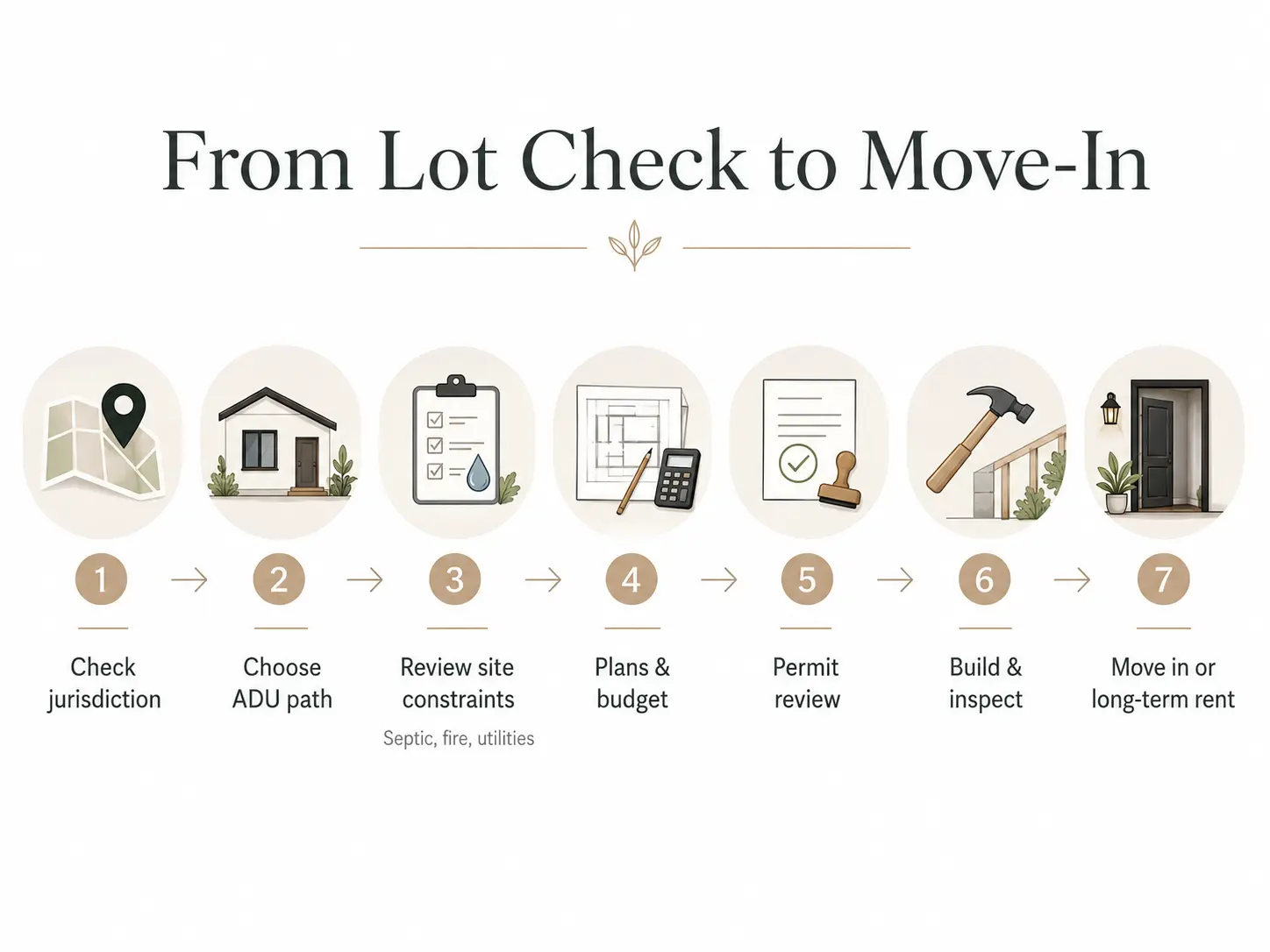
- 1Confirm your jurisdiction. Pull a Property Summary Report by APN. Confirm the parcel is in unincorporated County. Save the report.
- 2Confirm eligibility. The parcel must be residentially zoned and tied to an existing or proposed single-family dwelling. Verify zoning. Note any overlays — Fire Hazard Severity Zone, Coastal Zone, MSCP biological resources, Historic District.
- 3Choose your ADU path. Detached (local 1,200 sf), detached (state-protected 800 sf), attached, conversion, JADU, multifamily, or Tiny Home on Wheels. Match the path to your use case and your lot.
- 4Engage DEHQ early if on septic. Before you finalize design, contact DEHQ. Have an OWTS Professional run a feasibility review if there's any doubt.
- 5Decide custom vs. County Plan A–F. If a free plan fits your needs and your lot, the plan-review cycle drops dramatically. If it doesn't fit, engage a designer with County PDS experience.
- 6Develop construction documents. Site plan, architectural drawings, structural engineering, energy compliance (Title 24), fire/septic/utility documents, soils report if required, grading plan if required.
- 7Pre-intake meeting at County PDS. Schedule a free pre-intake or pre-application meeting at the County's permit center (5510 Overland Avenue). It identifies most submission gaps before formal submission.
- 8Submit the building permit application. Plan review begins. The County issues a corrections list if anything is missing. Respond to corrections. Cycle until approval.
- 9Pay fees and pull the permit. PDS-613 building plan-review and permit fees; school fees; impact fees (if applicable); utility capacity charges; fire-district fees; DEHQ fees. The permit expires after two years but can be extended.
- 10Construct and inspect. Hire a licensed contractor (verify standing with the California State Licensing Board) or proceed as owner-builder. Pass progress inspections at foundation, framing, MEP, insulation, and final stages. Pass the Certificate of Occupancy inspection.
Need a builder who's done this in unincorporated County? We curate the firms we've researched across Ramona, Fallbrook, Valley Center, Spring Valley, Bonita, Lakeside, and Rancho Santa Fe.
Best ADU Builders — San Diego County →Sources: County of San Diego ADU Handbook (April 2024); County PDS submittal documents; California Government Code §66317. Verified May 15, 2026.
How does the County compare to the City of San Diego and surrounding cities?
Each incorporated city in San Diego County operates its own ADU ordinance under the same California state-law floor. The City of San Diego, Escondido, Poway, Chula Vista, and others have meaningfully different fee schedules, design requirements, ADU bonus programs, and rules. This section routes you to city-specific guides — each built around the same level of source verification this page uses.
- City of San Diego ADU Laws — separate fee math, AB 1033 effective 2025, Bonus ADU Program.
- Escondido ADU Laws — different fee schedule and pre-approved plan program.
- Poway ADU Laws — 2019 ordinance with key sections preempted by state law.
- California ADU Laws 2026 — statewide overview and city directory covering Chula Vista, Oceanside, Vista, El Cajon, San Marcos, Santee, Carlsbad, Encinitas, and others.
Frequently Asked Questions
Can I build an ADU in unincorporated San Diego County?
Yes, in most cases, if your property is in the unincorporated area, is residentially zoned, and has an existing or planned primary single-family dwelling. County code permits at least one ADU plus one JADU on a single-family lot under the general path, and a larger combination under California Government Code §66323. Parcel-specific factors — fire severity zone, septic capacity, easements, slope, utility access — can affect feasibility. Confirm jurisdiction first via your Property Summary Report.
Can I build more than one ADU on a single-family lot in unincorporated San Diego County?
Yes. Under the general path used by most homeowners, a single-family lot can host one ADU and one JADU. Under the state-protected combination in Government Code §66323 and County §6156.x, a qualifying single-family lot may also host one ADU created from existing space, one JADU, and one newly constructed detached ADU up to 800 square feet — site and lot conditions permitting.
How big can a detached ADU be in unincorporated San Diego County?
A detached ADU can be up to 1,200 square feet under County local rules, with a 25-foot height limit and four-foot side and rear setbacks. California state law also guarantees a separate path for a detached ADU up to 800 square feet of interior livable space that the County cannot deny based on local development standards on a lot with an existing or proposed primary dwelling, capped at 18 feet under the County's local ministerial standard.
How big can a JADU be in unincorporated San Diego County?
A JADU is limited to 500 square feet of interior livable space and must be fully contained within an existing or proposed single-family residence. JADUs require an efficiency kitchen. Owner occupancy is required only if the JADU shares sanitation facilities with the primary residence (Gov Code §66333(b), as amended by AB 1154 effective January 1, 2026).
Is owner occupancy required for an ADU in unincorporated San Diego County?
No — not for standard ADUs. AB 976 made permanent the prohibition on local owner-occupancy requirements for ADUs. For JADUs, owner occupancy is required only when the JADU has shared sanitation facilities with the primary residence. A JADU with its own separate bathroom is not subject to owner occupancy under AB 1154.
Are ADUs allowed on septic in unincorporated San Diego County?
Yes, but every ADU project on a parcel using an on-site wastewater treatment system (OWTS) requires Department of Environmental Health & Quality (DEHQ) approval of an OWTS Layout Application. Inadequate existing capacity may require system upgrades, additional septic tanks, or reductions in bedroom count to bring projected wastewater flow within system limits.
Can I Airbnb my San Diego County ADU?
No. Under County Zoning Ordinance §6156.x and current state law, ADUs cannot be rented for periods of 30 days or fewer. Under AB 1154 (Gov Code §66333(g)), JADUs are also explicitly subject to the longer-than-30-day rental requirement. Short-term rentals on platforms like Airbnb and Vrbo are not a legal use for ADUs or JADUs in unincorporated County.
Can I sell my ADU separately in San Diego County?
In unincorporated areas, yes — effective April 4, 2026, after the County Board of Supervisors unanimously adopted an AB 1033 implementation ordinance on March 4, 2026. The separate sale takes place through a condominium conversion process involving a Tentative Parcel Map or Tentative Map application. JADUs are not eligible for separate sale and must remain part of the primary residence. Lienholder consent, fire-district concurrence, DEHQ approval, utility metering, and HOA authorization can each independently affect feasibility.
Are County of San Diego pre-approved ADU plans fully permit-ready?
No. The County publishes Plans A through F as free, pre-approved building plans for use in unincorporated areas. The County itself states these plans are approximately 85% complete. The remaining 15% — site plan, foundation specifications, utility connections, Title 24 energy calculations, fire/septic/well documentation, grading — must be supplied by the applicant.
How much are County ADU permit fees in 2026?
Using County PDS-613 FY 25/26 formulas, the building plan-review and permit fees for a standard ADU run approximately $4,019.60 for a 600 sq ft unit, $4,205.80 for 800 sq ft, $4,392.00 for 1,000 sq ft, and $4,578.20 for 1,200 sq ft. These figures exclude school fees, impact fees, utility connection/capacity charges, septic/DEHQ review, fire-district review, grading, and any plan revisions. Realistic total agency cost commonly runs in the $8,000–$11,000 range and higher in cases with septic upgrades, WUI fire compliance, or utility upsizing.
Do ADUs count toward density in unincorporated San Diego County?
No. County Zoning Ordinance §6156.x states that ADUs are classified as accessory use and are not counted toward allowable density under the County General Plan.
Are fire sprinklers required in unincorporated San Diego County ADUs?
Per state law and County code, ADUs are not required to provide fire sprinklers if they are not required for the primary residence, and the construction of an ADU does not trigger a sprinkler requirement for the existing primary dwelling.
Can I build a tiny home on wheels as an ADU in unincorporated County?
Yes, in many cases. Under the County's September 4, 2025 Director's Determination, Tiny Homes on Wheels (THOWs) may qualify as ADUs if they meet standard ADU requirements plus specific conditions: maximum 430 square feet from the inside face of walls, one story with a maximum height of 16 feet, non-combustible exterior, dual-glazed windows, Class A roof, utility connections under a building permit, and residential fire sprinklers (unless using the ADU exemption). DEHQ recommends obtaining wastewater layout approval before applying on septic parcels.
What if my ADU is already built without a permit?
If the unit was built before January 1, 2020, AB 2533 (signed in 2024) creates a streamlined legalization path. The County PDS Substandard Structure Checklist (PDS-738) documents the required corrections. The County recommends obtaining a confidential third-party code inspection from a licensed contractor before submitting plans.
How we researched this guide
This guide was researched and written by The Dwelling Index editorial team. We are an independent research resource covering ADU financing, costs, and regulations — not a lender, builder, designer, brokerage, or property-management company.
We built this page from primary public sources wherever possible: the County of San Diego ADU page; County Zoning Ordinance Section 6156.x; the County ADU Zoning Ordinance Amendment page and the March 4, 2026 Board of Supervisors action; the County AB 1033 Condo Guidance & Checklist dated April 3, 2026; County PDS-611; County PDS-613 (FY 25/26); the County Dwelling Unit Building Plans page; PDS-738 (Substandard Structure Checklist); the County ADU Handbook (April 2024 edition); the County's September 4, 2025 Director's Determination on Tiny Homes on Wheels; County DEHQ OWTS guidance; the HCD 2026 ADU Handbook update; the San Diego County Water Authority CY2026 capacity charge schedule; and current California Government Code §§ 66311.5, 66313, 66314, 66317, 66321, 66323, 66333, and 66342. Relevant statutes referenced include AB 976, AB 1033, AB 1154, AB 2533, SB 543, and SB 1211.
We used builder and provider pages — including SnapADU and others — only to understand homeowner questions and competing page formats, not as legal proof. All claims about County rules, fees, and timelines are anchored to the County's own published sources.
Disclaimer. This page is for educational research only and is not legal, tax, lending, engineering, or building-code advice. ADU approval depends on parcel-specific zoning, building, fire, utility, septic/well, environmental, title, lender, and HOA review. Verify your project with County of San Diego Planning & Development Services and qualified professionals before committing funds. Phone (858) 694-2960 or email PDS.ADUQuestions@sdcounty.ca.gov.
Get the Free ADU Starter Kit
The County ADU checklist, fee-trigger worksheet, and the 12 questions we recommend asking before you pay for plans — packaged into one printable PDF.
Download the Free ADU Starter Kit →Not sure where to start?
See what's possible at your address — get your free ADU report in 60 seconds.
Run the Property Eligibility Check →Free · 60 seconds · No account required