
ADU Cost in Solana Beach (2026): Real Prices, Fees & Coastal Math
By The Dwelling Index editorial team — Last updated · Last verified against City of Solana Beach sources: May 18, 2026
The short answer.
An all-in turnkey detached ADU in Solana Beach typically runs $330,000 to $550,000+ in 2026, or roughly $400 to $650 per square foot, depending on size, finish level, lot condition, and how cleanly the project moves through the city’s coastal-overlay permitting. Garage conversions start near $150,000 and a 1,000-square-foot, two-bedroom detached unit—the city’s local cap for 2+ bedroom ADUs—usually clears $500,000 at standard finishes.
For the permit rules and setbacks, see our Solana Beach ADU laws guide. For the coastal permit pathway in depth, see our Solana Beach Coastal Zone ADU guide.
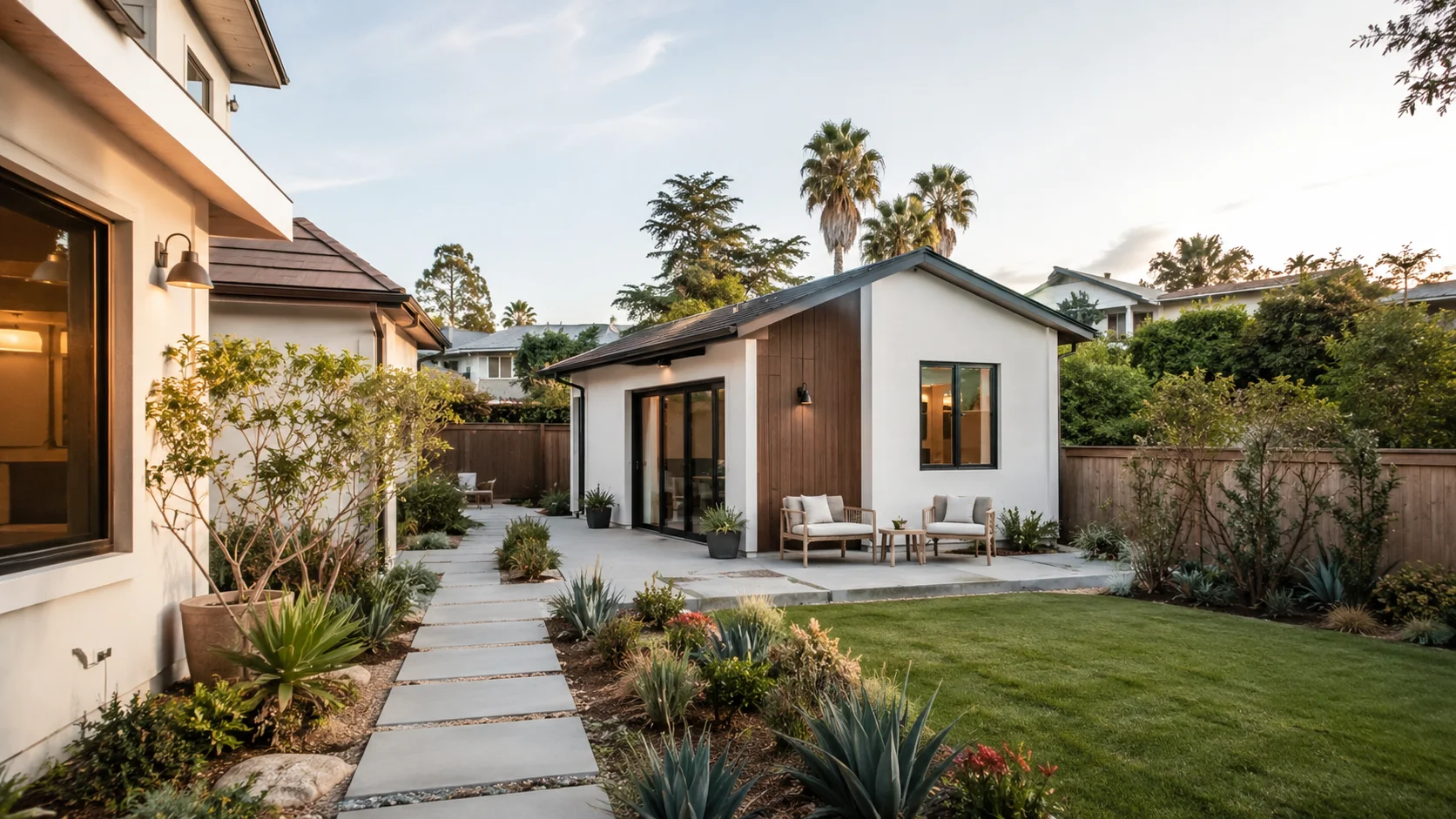
Solana Beach ADU cost by type — 2026 at a glance
| Project type | All-in cost range (2026) | Per sq ft | Typical permit timeline |
|---|---|---|---|
| Junior ADU (JADU, up to 500 sf inside existing home) | $80K – $180K | $200 – $360 | 2 – 4 months |
| Garage conversion (400 sf) | $150K – $230K | $375 – $575 | 3 – 5 months |
| Attached ADU, up to 850 – 1,000 sf | $300K – $500K | $350 – $500 | 4 – 6 months |
| Detached, 750 sf, 1-bedroom | $320K – $430K | $425 – $575 | 4 – 6 months |
| Detached, 1,000 sf (2+ bedroom local cap) | $400K – $600K | $400 – $600 | 5 – 7 months |
| Prefab/modular ADU installed | $250K – $450K+ | $320 – $500 | 4 – 6 months |
Cost ranges synthesized from SnapADU “Cost to Build an ADU in San Diego” (verified May 18, 2026); SnapADU Solana Beach project case study; Better Place Design & Build Solana Beach regulations page; California Construction Cost Index through December 2025; City of Solana Beach Master Fee Schedule effective 2026.
See What You Can Build → Get Your Free Solana Beach ADU Report
Enter your address and we’ll show you your likely ADU type, fee-cliff exposure, and an estimated cost range in about a minute.
Run the free 60-second Solana Beach ADU property check →How Much Does an ADU Cost in Solana Beach in 2026?
Answer capsule. In 2026, most detached ADUs in Solana Beach come in between $330,000 and $550,000 all-in, with vertical construction representing roughly 80 percent of the total and soft costs plus sitework making up the rest. The wide range reflects three variables that drive about 70 percent of any quote: square footage, finish level, and lot condition.
SnapADU—a San Diego-based design-build firm that has completed more than 100 ADUs across the county and explicitly serves Solana Beach—publishes turnkey 2026 cost benchmarks of $375 to $600+ per square foot for detached ADUs, with most homeowners landing between $300,000 and $450,000+ for a complete San Diego County build. Better Place Design & Build’s Solana Beach page brackets a wider range of $220 to $600 per square foot depending on size, design complexity, and lot condition.
Our Solana Beach top-end is higher than the San Diego County average because Solana Beach adds seven city-specific cost drivers that typically add $25,000 to $60,000 to a project that would have cost less in Escondido, Vista, or San Marcos.
The California Construction Cost Index, published quarterly by the state Department of General Services, rose 44 percent from January 2021 through December 2025. An ADU that penciled at $300,000 in early 2021 now requires about $430,000 at the same scope. If you read a page that quotes a Solana Beach ADU at $200,000 and the page is more than 18 months old, the number is obsolete.
What “all-in” actually includes
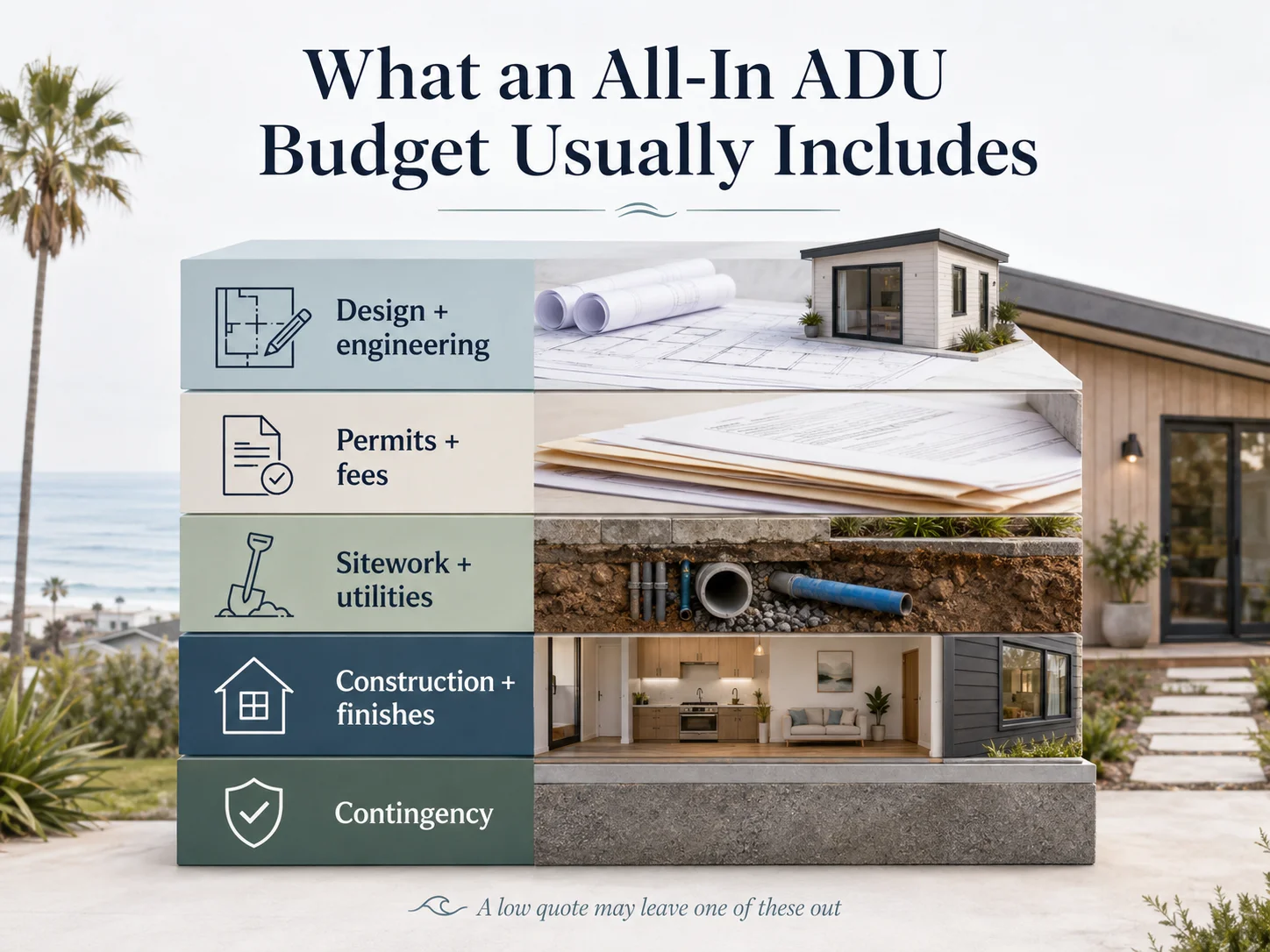
When we say all-in, we mean: design and engineering, surveys, site preparation, foundation, vertical construction including framing through finishes, electrical, plumbing, HVAC, fixtures and appliances at a standard package, exterior matching to the primary home, separate SDG&E electrical service where required, utility connections, plan check fees, building permit fees, applicable impact fees, energy and CalGreen compliance, inspections, and a working contingency of roughly 8 to 10 percent.
If a builder’s quote is materially below our range, your first question is what they excluded. A bid at $250,000 for a new detached Solana Beach ADU in 2026 either skipped meaningful scope, mispriced sitework, or got drawn before the latest cost-index run-up.
Which ADU Type Is Cheapest in Solana Beach? Five Paths Compared
Answer capsule. The cheapest legal ADU path in Solana Beach is typically a Junior ADU (JADU) carved out of existing interior space, followed by a garage conversion, then an attached ADU, then a detached ADU. Prefab can compete with stick-built detached on smaller, flatter, easier-access lots but rarely beats a well-executed conversion on price.
| Path | Best when | Gets expensive when | Typical all-in (2026) |
|---|---|---|---|
| JADU (Junior ADU, < 500 sf inside existing home) | You have a bedroom suite or layout that already works | New bathroom, kitchenette, separate entrance, or fire-rated wall additions required | $80K – $180K |
| Garage conversion (existing accessory structure) | Garage slab, walls, and roof are sound; utilities nearby | Slab cracking, roof rebuild, full electrical/plumbing run from main house, foundation upgrades | $150K – $230K |
| Attached ADU (addition on existing home) | Clean wall tie-in, shared utilities feasible, exterior match straightforward | Structural reframing, second-story tie-in, matching a complex roofline, MEP rework | $300K – $500K |
| Detached ADU (new freestanding structure) | Flat lot, good access, room for separate utility runs | Slope, bluff exposure, deep utility trenching, exotic finishes, multi-story | $320K – $600K |
| Prefab / modular | Wide rear access for crane delivery, simple foundation, flat lot | Tight access, complex foundation, custom exterior match required, coastal review of off-site-built unit | $250K – $450K+ installed |
Why JADUs and garage conversions get cheaper math
Two reasons. First, you reuse infrastructure: an existing foundation, often an existing roof and exterior walls, and proximity to existing utilities. Second, under California Government Code § 66311.5 (added by SB 543 effective January 1, 2026), ADUs and JADUs with less than 500 square feet of interior livable space are exempt from school impact fees statewide, and ADUs at or below 750 square feet are exempt from local development impact fees.
Where the math turns against conversions
A garage built in the 1960s on a Solana Beach lot may have a 4-inch unreinforced slab that fails today’s energy and structural code; it may have an unsupported roof; it may need a complete electrical service upgrade because the existing panel can’t support a new kitchen, HVAC, and a separate sub-meter. Each of those line items adds $5,000 to $25,000. The rule of thumb: if the existing structure needs more than two of the following—new slab, new roof, new electrical service, new plumbing risers, full re-framing—you’re approaching new-build economics anyway.
Solana Beach ADU Cost Per Square Foot in 2026
Answer capsule. Solana Beach detached ADUs cost between $400 and $650 per square foot turnkey in 2026, with smaller units at the high end because fixed costs—design, plan check, kitchen, bathroom, mobilization—do not scale down. A 500-square-foot detached ADU often comes in near $600/sf while a 1,000-square-foot detached unit can land closer to $425/sf.
We cap the table at 1,000 square feet because that is the local maximum for two-or-more-bedroom detached ADUs under Solana Beach Municipal Code § 17.20.040(D) / Ordinance 525.
| Detached size | Typical $/sf (turnkey) | Typical all-in cost |
|---|---|---|
| 400 – 499 sf | $475 – $650 | $200K – $310K |
| 500 – 749 sf | $410 – $600 | $230K – $430K |
| 750 – 850 sf (1-bedroom cap) | $400 – $575 | $310K – $490K |
| 851 – 1,000 sf (2+ bedroom cap) | $385 – $550 | $400K – $550K+ |
A second lever is the finish package. Upgrading from standard painted MDF cabinets and LVP flooring to wood cabinets, premium appliances, and engineered hardwood typically adds $40 to $80 per square foot. On an 850-square-foot unit, that’s another $34,000 to $68,000.
For a deeper national view by ADU type, see our ADU cost per square foot guide.
The Solana Beach Permit Fee Stack — Line by Line
Answer capsule. Solana Beach permit and plan-check fees alone run roughly $8 to $14 per square foot in 2026, plus impact fees that are waived for ADUs at or below 750 square feet and applied proportionally for larger units. Expect $9,000 to $20,000 in city fees for a typical 750- to 1,000-square-foot detached build, on top of construction.
The building permit formula
For projects valued between $100,000 and $500,000, Solana Beach’s 2026 schedule sets the base building permit fee at $1,796 for the first $100,000 of valuation, plus $10.13 for each additional $1,000 (or fraction) of valuation through $500,000.
| Permit valuation | Base building permit fee |
|---|---|
| $250,000 | $3,316 |
| $300,000 | $3,822 |
| $400,000 | $4,835 |
| $500,000 | $5,848 |
Source: City of Solana Beach Master Fee Schedule, effective 2026.
The percentage surcharges
| Surcharge | Rate | Applies to |
|---|---|---|
| Plan check | 85% of building permit fee | All projects |
| Mechanical permit | 7% of base building permit fee | All projects with HVAC |
| Plumbing permit | 7% of base building permit fee | All projects with plumbing |
| Electrical permit | 7% of base building permit fee | All projects with electrical |
| Energy compliance surcharge | 15% of base building permit fee | All projects subject to Title 24 |
| CalGreen surcharge | 3% of building permit plan check + 3% of building inspection fee | All projects subject to CalGreen |
For a $400,000-valuation detached ADU, the combined city plan-check and permit math (building permit + plan check + MEP + energy + CalGreen + issuance) typically comes to $10,500 to $11,500 before impact fees, sewer connection, school fees, or any coastal-permit consultant work.
The impact fees
Under California Government Code § 66311.5, ADUs at or below 750 square feet are exempt from these impact fees, and ADUs over 750 square feet face fees charged proportionally.
| Impact fee | 2026 ADU figure | Treatment |
|---|---|---|
| Transportation Impact Fee | $4,947 per residential ADU unit | Waived ≤ 750 sf; proportional > 750 sf |
| Fire Mitigation Impact Fee | $1,941 detached / $274 attached | Waived ≤ 750 sf; proportional > 750 sf |
| Park Development Impact Fee | $7,631 detached / $5,521 attached | Waived ≤ 750 sf; proportional > 750 sf |
| Public Use Facilities Impact Fee | $706 detached / $511 attached | Waived ≤ 750 sf; proportional > 750 sf |
A new detached ADU larger than 750 square feet can therefore see roughly $15,000+ in city impact fees layered on top of the building permit math. That is the difference between an 800-sf build and a 749-sf build for the same lot.
Sewer connection, school fees & SDG&E
The 2026 Master Fee Schedule lists a sewer connection fee at $4,500 per 1.0 Equivalent Dwelling Unit (EDU), subject to a sewer capacity study. San Dieguito Union High School District and the Solana Beach School District levy school facility fees at roughly $4 to $5 per square foot for units of 500 sf or more. SDG&E typically requires separate electrical service for new detached ADUs—budget $1,500 to $4,500 for meter and panel work, or $5,000 to $12,000 if a main service upgrade is triggered.
Illustrative city-fee totals
| Permit valuation | Approximate city plan-check + permit fees (excludes impact, school, SDG&E, sewer, coastal) |
|---|---|
| $250,000 | $7,000 – $8,000 |
| $300,000 | $8,200 – $9,200 |
| $400,000 | $10,500 – $11,800 |
| $500,000 | $12,800 – $14,200 |
A builder’s “permit allowance” of $5,000 is almost always low for a detached Solana Beach ADU. Ask explicitly what valuation they used, what surcharges they included, and whether sewer connection is itemized separately.
For the rules behind these fees, see our Solana Beach ADU laws guide.
The 750-Square-Foot Fee Cliff (and the New 500-Square-Foot Cliff Under SB 543)
Answer capsule. Designing an ADU at 749 square feet versus 751 square feet can change your city fee bill by $15,000 or more. SB 543, effective January 1, 2026, added a second cliff: ADUs with less than 500 square feet of interior livable space are now exempt from school impact fees as well. Together, these thresholds make 499 square feet and 750 square feet the two most consequential numbers in your design.
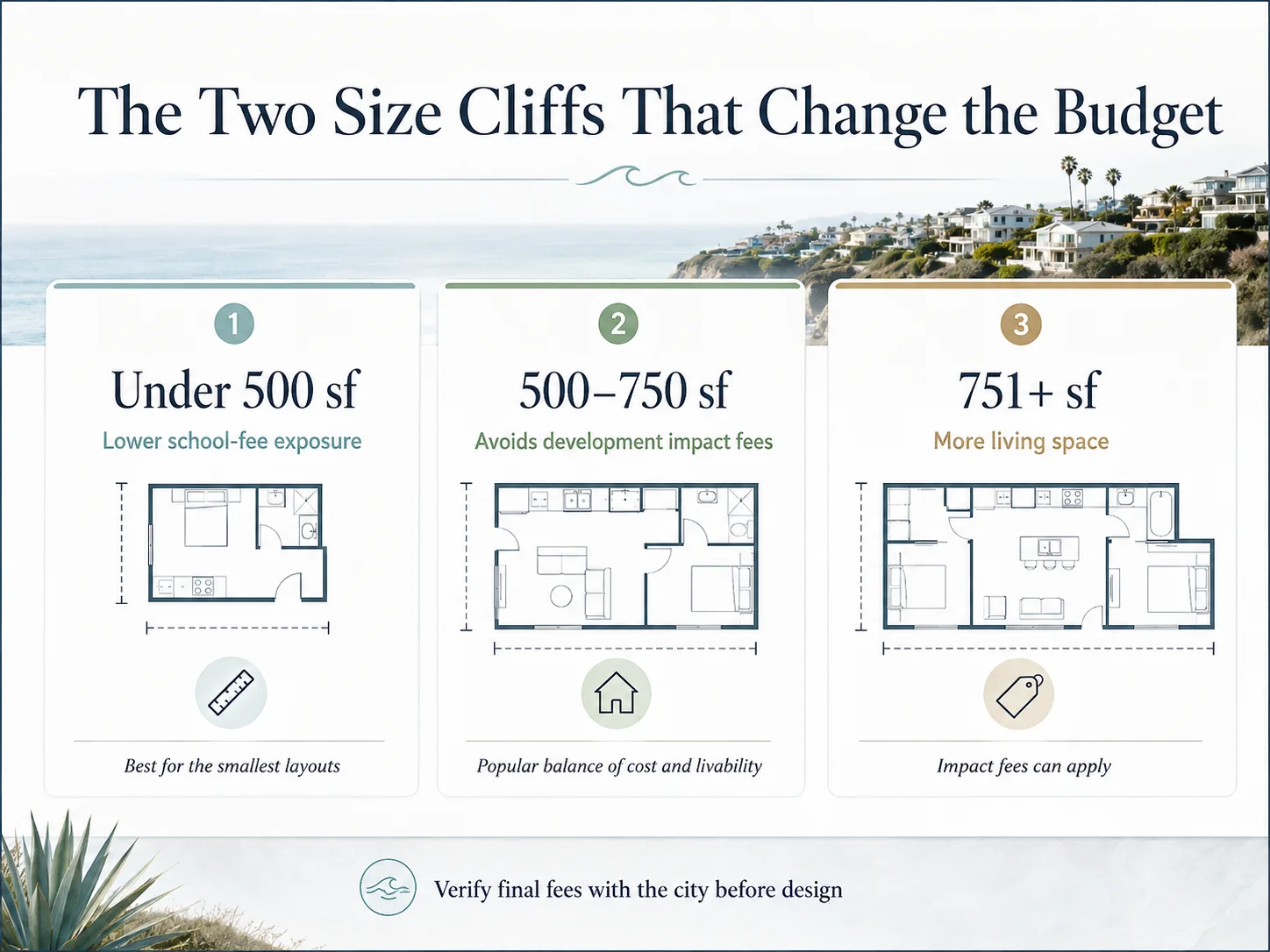
| Size (interior livable space) | What changes at this threshold | Fee impact |
|---|---|---|
| Less than 500 sf | Exempt from school impact fees under Gov. Code § 66311.5 (added by SB 543, effective Jan. 1, 2026) | Saves $2,000 – $4,000 in school fees vs. 500–749 sf units |
| 500 to 750 sf | Still exempt from development impact fees; subject to school fees | Pays school fees, skips impact fees |
| At or below 750 sf | Exempt from development impact fees (Transportation, Fire, Park, Public Use Facilities) under Gov. Code § 66311.5 | Saves $15,000+ in Solana Beach impact fees |
| 751 to 800 sf | Subject to proportional impact fees AND school fees | Most expensive size on a $/livable-sf basis once fees layer in |
| At or above 800 sf interior livable space | Cannot be denied by local development standards under Gov. Code §§ 66321(b)(2) and 66313(d), as amended by SB 543 | Maximum protection; full proportional impact fees apply |
The Solana Beach size caps
Solana Beach’s ADU ordinance (SBMC § 17.20.040(D) / Ordinance 525) caps detached and attached ADUs at:
- 850 square feet for studios and one-bedroom units
- 1,000 square feet for two-or-more-bedroom units
Under Government Code § 66321(b)(2), the city must permit at least an 800-square-foot ADU with four-foot side and rear setbacks regardless of other development standards. Solana Beach’s caps are higher than the state floor, so the city caps control.
When to design to 749 vs. 800 vs. 1,000 sf
Scenario A: rental income is the priority. Stretch to 800 square feet, accept the impact fees, and you get a one-bedroom with a real kitchen and workable living area. The $15,000+ in impact fees is recovered in five to seven months of incremental rent compared to a 500-square-foot studio.
Scenario B: housing an aging parent. Design to 749 square feet, skip the impact fees, and you still have a real one-bedroom with full kitchen and bath. The 51-square-foot difference between 749 and 800 is usually absorbed by a slightly tighter living area or hallway.
Scenario C: housing an adult child temporarily. A 499-square-foot studio JADU or efficiency carve-out captures both fee cliffs, lands in the $90,000 to $150,000 range, and works as a 2- to 5-year solution.
Check your 500-sf and 750-sf fee-cliff exposure before you pay for plans.
Our free 60-second property check shows you which fee thresholds apply to your specific address and a personalized cost range at each size.
Get Your Free ADU Property Report →Seven Solana-Beach-Only Cost Adders That Inflate the San Diego Number
Answer capsule. Solana Beach adds seven city-specific cost drivers to an ADU build that do not appear in a generic San Diego County quote. Together they typically add $25,000 to $60,000 to a project that would have cost less in inland cities like Escondido, Vista, or San Marcos.
1. Coastal Development Permit (CDP) review — citywide
The entire jurisdiction of Solana Beach sits inside the Coastal Zone, which means every building permit application for an ADU requires Coastal Commission review before the city can issue the building permit. Many compliant ADU projects qualify for a de minimis waiver under AB 462’s 60-day decision clock, but the process still adds time and consultant cost.
Estimated dollar impact: $1,500 to $5,000 in additional architect or consultant time, plus carrying cost on financing during the added wait.
2. SDG&E separate electrical service for detached ADUs
SDG&E generally requires separate electrical service for new detached ADUs in Solana Beach. Where the primary home’s service is older or undersized, this also forces a main panel upgrade.
Estimated dollar impact: $1,500 to $4,500 for the meter and panel work alone; $5,000 to $12,000 if a service upgrade is triggered.
3. Architectural matching requirement
Solana Beach Municipal Code § 17.20.040(D) requires that the exterior roofing, trim, walls, windows, and color palette of the ADU shall incorporate the same features as the primary or existing dwelling. Custom matching to an older or architecturally distinct primary home can require non-stock materials, custom window profiles, and bespoke trim work.
Estimated dollar impact: $3,000 to $15,000 in finish and material premiums, depending on the primary-home style.
4. Primary-entrance-not-visible-from-street rule
This one is unique to Solana Beach. The municipal code requires that “the primary entrance to the ADU shall not be visible from the street adjacent to the front yard setback.” On many lots, this forces either a redesigned floor plan to relocate the entrance, a fence and landscape screen, or a side-yard pathway.
Estimated dollar impact: $2,000 to $8,000 in plan revisions or screening hardscape and landscape.
5. 50-cubic-yard grading limit
Solana Beach’s ADU rules limit construction on sites requiring substantial grading. On a lot with even a modest slope—common east of I-5 and on bluff-edge parcels—this can force a redesigned foundation, a stepped pad, or significant retaining-wall work. On the steepest lots, this rule is a project killer.
Estimated dollar impact: $0 on a flat lot; $10,000 to $30,000 in redesign and engineered retaining walls on a moderate slope; infeasible on a steep slope without major redesign.
6. No roof decks on detached ADUs
Detached ADUs in Solana Beach cannot include roof decks. In a coastal city where a $30,000 roof-deck addition would otherwise increase rent by $300 to $500 per month, this is a real opportunity cost—not a direct cash outlay, but a constraint on design and ADU appraisal value.
7. Coastal-zone design and screening overlays
Beyond the citywide CDP requirement, Solana Beach’s coastal-zone status drives landscape buffers, view-corridor protection, and parking-screen vegetation requirements (42-inch maximum maturity height for setback screening). Lots near the lagoon, bluff edge, or public view corridors require additional architectural and landscape work.
Estimated dollar impact: $2,000 to $10,000 in additional landscape, screening, and architectural detail work.
See exactly which of these seven adders apply to your property.
Run your address through our free 60-second ADU property check. We’ll flag your coastal status, slope, and the cost drivers most likely to hit your project.
Get Your Free ADU Property Report →Solana Beach vs. Adjacent North County Coastal Cities — The Cost Stack
Answer capsule. Solana Beach lands in the middle-to-upper portion of North County Coastal ADU costs in 2026. Encinitas is cheapest on permits because the city waives most impact fees for ADUs over 750 square feet. Carlsbad is comparable to Solana Beach. Del Mar tends to be most expensive due to small lots and stricter overlay zones.
| City | Detached $/sf (2026) | Permit fee level | Coastal-permit pathway | Max detached size |
|---|---|---|---|---|
| Solana Beach | $400 – $650 | $8 – $14/sf | Coastal Commission review required for every ADU; many qualify for de minimis waiver; AB 462 60-day clock | 850 sf (1-bed) / 1,000 sf (2+ bed) |
| Del Mar | $425 – $700 | Higher; small-lot overlay | Multi-overlay CDP; AB 462 timing applies | 850 sf / 1,000 sf |
| Encinitas (incl. Cardiff) | $375 – $600 | $2 – $4/sf | Local CDP via city under certified LCP; AB 462 no-Commission-appeal path | 1,200 sf |
| Carlsbad | $375 – $625 | Mid-pack | Local CDP via city; LCP recently updated | 1,200 sf |
| City of San Diego (coastal) | $375 – $600 | $13 – $28/sf | Exemption available under LCP for non-bluff projects; ADU Bonus Program available | 1,200 sf |
Sources: SnapADU “All About ADU Permit Fees & Waivers”; SnapADU “Cost to Build an ADU in San Diego”; City of Solana Beach Master Fee Schedule effective 2026; The Dwelling Index city-specific guides. All sources verified May 18, 2026.
Solana Beach’s permit fee rate ($8–$14/sf) is lower than San Diego’s ($13–$28/sf) but its maximum detached size is smaller (1,000 sf max for a 2+ bedroom vs. 1,200 sf in San Diego, Encinitas, or Carlsbad). On a per-livable-bedroom basis, Solana Beach detached ADUs often cost more than Encinitas equivalents because you cannot build the same unit.
For city-specific deep-dives, see our pages on Encinitas ADU cost, Carlsbad ADU cost, and Oceanside ADU cost.
Three Modeled Cost Stacks for Solana Beach ADUs in 2026
Answer capsule. Three line-by-line cost stacks for the most common Solana Beach builds: a 400-square-foot garage conversion, a 750-square-foot detached one-bedroom, and a 1,000-square-foot detached two-bedroom (the city’s maximum). Each is a modeled budget based on published 2026 builder cost data and the city’s Master Fee Schedule. None of them is a quote.
Scenario 1: 400-square-foot garage conversion, one-bedroom
| Line item | Cost range | Notes |
|---|---|---|
| Demolition + structural retrofit | $25,000 – $40,000 | Existing slab and roof condition dependent |
| Vertical build (~80% of total) | $90,000 – $130,000 | $225 – $325/sf typical for conversion scope |
| Design + engineering | $5,000 – $9,000 | Stock vs. custom plan |
| City permit + plan check fees | $3,500 – $5,500 | Impact fees waived (< 500 sf school fee exempt; ≤ 750 sf impact fee exempt) |
| SDG&E separate panel/meter (where required) | $1,500 – $3,500 | Detached garage often requires it |
| Utility tie-in (sewer, water sub-meter) | $4,000 – $10,000 | Less than new detached |
| Solana Beach specific adders | $2,500 – $5,500 | Architectural match + CDP consultant time |
| Site work allowance | $5,000 – $10,000 | |
| Contingency at 8 – 10% | $12,000 – $20,000 | |
| Total | $150,000 – $230,000 |
Scenario 2: 750-square-foot detached, one-bedroom
| Line item | Cost range | Notes |
|---|---|---|
| Vertical build | $260,000 – $370,000 | $345 – $495/sf vertical only |
| Design + engineering | $15,000 – $25,000 | |
| City permit + plan check fees | $7,000 – $9,500 | $9 – $13/sf rate |
| Impact fees (Park, Trans, Fire, PUF) | $0 | Waived at ≤ 750 sf — this is the cliff |
| School fees | $0 – $3,750 | $5/sf if ≥ 500 sf interior livable space |
| SDG&E separate service | $2,000 – $4,500 | |
| Water/sewer connection | $5,000 – $14,000 | |
| Solana Beach specific adders | $8,000 – $20,000 | Coastal CDP + architectural match + entrance screening |
| Site work (flat lot) | $8,000 – $20,000 | Sloped lots: significantly more |
| Contingency at 8 – 10% | $25,000 – $40,000 | |
| Total | $320,000 – $430,000 |
Scenario 3: 1,000-square-foot detached, two-bedroom (city maximum)
| Line item | Cost range | Notes |
|---|---|---|
| Vertical build | $325,000 – $500,000 | $325 – $500/sf vertical only |
| Design + engineering | $18,000 – $30,000 | |
| City permit + plan check fees | $9,000 – $14,000 | |
| Impact fees (Park, Trans, Fire, PUF) | $5,000 – $15,000+ | Now applies — proportional to primary home size; >750 sf trigger |
| School fees | $4,500 – $5,000 | $5/sf at 1,000 sf |
| SDG&E separate service | $2,000 – $4,500 | |
| Water/sewer connection | $5,000 – $14,000 | |
| Solana Beach specific adders | $10,000 – $25,000 | |
| Site work | $8,000 – $25,000 | |
| Contingency at 8 – 10% | $35,000 – $55,000 | |
| Total | $400,000 – $600,000+ |
A bid at $325,000 for the 750-square-foot scenario above is plausible—at the low end of our range, with everything included. A bid at $245,000 for the same scope is not plausible; something is missing.
Does Solana Beach’s Coastal Review Add Cost or Time?
Answer capsule. Solana Beach’s citywide coastal-zone status adds time, not direct fees, for most ADU projects. Many compliant residential ADUs qualify for a “de minimis” waiver that lets the Coastal Commission approve the project on its consent calendar without a public hearing. AB 462, signed October 10, 2025, imposed a 60-day decision clock on coastal-permit applications for ADUs and JADUs.
For a typical ADU on a non-bluff lot, the Commission’s posture is generally accommodating. That said, three things actually do drive cost or kill projects.
- Bluff-edge proximity. If your lot is within 50 feet of the bluff edge, coastal review becomes substantive. Expect a geotechnical study (budget $5,000–$15,000), potentially a wave-runup analysis, and a public-hearing process that can stretch six months or more.
- Wetland, stream, or ESHA proximity. The San Elijo Lagoon corridor and certain canyon-bottom parcels can trigger ESHA review. Same posture as bluff: substantive review, additional studies, longer process.
- Inland-bluff or hillside-overlay parcels. Solana Beach’s May 6, 2026 ordinance update integrated state-law requirements that limit the city’s ability to blanket-prohibit ADUs in fire-hazard or hillside-overlay zones. If your property is in one of these zones, get a planning-department determination in writing before paying for plans.
The Coastal Development Permit (CDP) process in plain English
Solana Beach has a certified Local Coastal Program (LCP), but for ADUs specifically, the city’s planning page directs applicants: “The entire jurisdiction of Solana Beach is within the Coastal Zone so all building permit applications must be reviewed and approved by the California Coastal Commission prior to the issuance of the building permit. The City of Solana Beach does not process CCC approvals internally.”
For a typical ADU this means: city planning approval first, then a CDP application to the Commission’s San Diego Coast District office, then staff determines whether the project qualifies for a de minimis waiver, and (if no Commissioner objects) it becomes effective on the consent calendar.
For the full coastal-permit pathway including specific documents, see our Solana Beach Coastal Zone ADU guide.
How Long Does an ADU Take in Solana Beach — and What That Adds to the Bill
Answer capsule. Plan for 12 to 18 months from “I want to build” to “tenant moves in.” That is 4 to 6 months of pre-construction (feasibility, design, permits, including coastal review) and 5 to 8 months of construction. SB 543, effective January 1, 2026, requires permitting agencies to issue a written completeness determination within 15 business days.
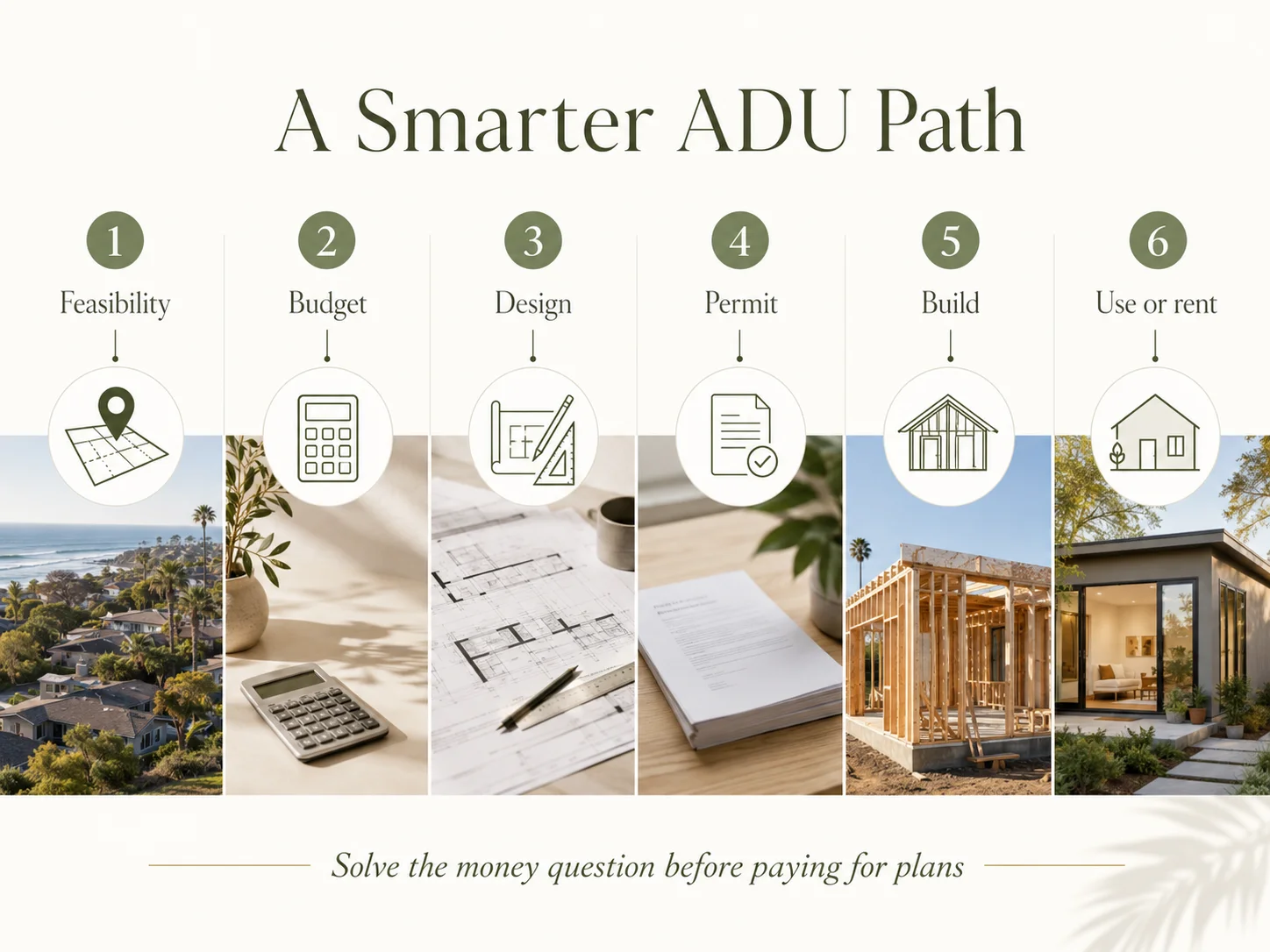
| Stage | Typical duration | What is happening |
|---|---|---|
| Feasibility + budgeting | 1 – 4 weeks | Lot review, zoning check, target size, cost-range estimation |
| Survey + design + engineering | 6 – 14 weeks | Floor plans, elevations, structural, MEP, Title 24 |
| City completeness determination | 15 business days (state law) | SB 543 codified clock |
| City plan review (full check) | 60 days (state law) | Ministerial approval clock for compliant ADU |
| Plan correction cycles | 2 – 8 weeks (variable) | Round 2 + 3 review responding to city comments |
| Coastal Commission review | 60 days (AB 462 clock) for waiver-eligible projects | Concurrent with city plan check where possible |
| Construction (vertical) | 5 – 8 months | Detached new build; faster for conversions |
| Final inspections + CofO | 2 – 4 weeks | Certificate of Occupancy |
What can actually accelerate your timeline
- Be ready before submittal. A pre-application consultation with Solana Beach’s Community Development Department is often the difference between a 60-day approval and a 120-day approval.
- Submit your CDP application concurrently with full plan check. Many homeowners sequence them sequentially and add a month they did not need to add.
- Use a builder who has permitted in Solana Beach before. See our best ADU builders Solana Beach guide for shortlisted firms with verified local experience.
If you are financing the build with a construction loan, every month of permit delay adds interest carrying cost. On a $400,000 construction loan, a few weeks of additional permitting delay can shift the project’s total cost by several thousand dollars. This is an illustrative example, not financial advice.
Can Pre-Approved Plans or Prefab Lower Solana Beach Costs?
Answer capsule. Solana Beach has a Pre-Approved ADU (PADU) Program, with the city’s own PADU Processing Guide describing a faster review cycle of approximately 15 days per cycle for pre-approved plans. Prefab can save 5 to 15 percent on the vertical-build portion but rarely changes the all-in cost dramatically because site work, foundation, utilities, and city fees remain identical.
The Solana Beach PADU program
Per the city’s PADU Processing Guide, licensed architects and designers can submit ADU plans for pre-approval. Once approved, plans go on the city’s website and homeowners using a pre-approved plan unmodified can pursue an expedited review path (approximately 15 days per review cycle vs. standard custom-plan timing). If you modify the plan in any meaningful way, the project reverts to standard plan-check review and you lose the time advantage.
For a detailed look at how pre-approved plan programs work across San Diego County, see our San Diego County pre-approved ADU plans guide.
Prefab and modular ADUs in Solana Beach
Three honest things about prefab in Solana Beach:
- It rarely saves what people expect. The factory portion of the cost is typically 5 to 15 percent cheaper than equivalent site-built construction. Foundation, utility trenching, crane access, permits, sitework, and finish work all still happen on-site at full price. The all-in delta versus stick-built is usually 5 to 10 percent, not 30 percent.
- Access matters more than you think. Solana Beach lots, particularly in older neighborhoods west of the railroad tracks, often have narrow side yards that do not support crane delivery of a modular unit. If a 60-ton crane cannot get into your backyard, prefab is off the table.
- Architectural matching is harder. A standard modular exterior with vinyl siding and shed roofing will not pass review on a lot with a tile-roof Spanish revival primary home.
For homeowners considering prefab specifically, see our SnapADU vs. Villa Homes comparison and our SnapADU vs. Crest Backyard Homes comparison.
What Makes Two Solana Beach ADU Bids Differ by $100,000? The Bid Normalization Checklist
Answer capsule. Two bids for the same Solana Beach ADU can differ by six figures because one is all-in and the other is construction-only. Cost-per-square-foot is the wrong comparison metric. Included scope is the right one.
The 14 bid normalization questions
| Question | Why it matters |
|---|---|
| 1. Is this all-in or construction-only? | Construction-only bids exclude design, permits, sitework, contingency. Often $40K–$100K of hidden scope. |
| 2. Are design, engineering, and survey included? | Architectural plans + structural + Title 24 + survey can run $15K–$25K alone. |
| 3. Are city plan check, building permit, MEP, energy, and CalGreen surcharges all included? | Solana Beach’s fee formula stacks. A $5,000 permit allowance is usually low. |
| 4. Are impact fees, school fees, and sewer connection itemized or included? | Size dependent. Get the size and the trigger thresholds in writing. |
| 5. Is Coastal Commission/CDP support included? | Critical in Solana Beach. Some builders charge separately for CCC document prep and resubmittals. |
| 6. Is SDG&E separate service and any required panel upgrade included? | Often a $1,500–$5,000 line that gets pushed to a change order. |
| 7. Are water and sewer trenching/connection included? | One of the largest hidden variables, particularly on deep lots. |
| 8. Is exterior architectural matching included? | Solana Beach’s matching requirement can drive $3,000–$15,000 in non-stock materials. |
| 9. Is the contingency line itemized at 8–10%? | If the contingency is 0% or 3%, the bid is unrealistically tight and change orders are coming. |
| 10. What is the assumed finish package, in writing? | “Standard finishes” means nothing. Get the cabinet, countertop, flooring, fixture, and appliance specs. |
| 11. Is the foundation type specified? | Slab on grade is cheaper. Pier-and-beam, stepped, or engineered foundations cost more. |
| 12. What is the price-lock policy? | Some builders fix price at contract signing. Others fix at permit submittal. Others not at all. |
| 13. What is the change-order process, and what triggers one? | Get the policy in writing before signing. Includes hourly rates for unscoped work. |
| 14. Who is the project manager, and what is the communication cadence? | A weekly walk-through with a named project manager is what you want. |
The $400/sf bid that excludes permits, sitework, and Coastal Commission support is actually more expensive than the $480/sf all-in bid. Cost-per-square-foot is a useful internal metric for one builder’s own pricing, not a useful comparison metric across builders with different scopes.
Want to compare your quote against our modeled stacks?
Run your address through our free 60-second ADU property check. We’ll show you the cost range we expect for your specific lot, so you can spot what is missing in any bid.
Get Your Free ADU Property Report →How Solana Beach Homeowners Are Actually Paying for ADUs
Answer capsule. Most Solana Beach ADU builds get financed through cash-out refinances, home equity lines of credit (HELOCs), construction loans, or ADU-specific renovation loans against the equity in the primary home. Solana Beach’s high median home values give most homeowners substantial equity to draw on.
1. Cash-out refinance
You refinance your existing mortgage into a new, larger mortgage and take the difference in cash. Best when current mortgage rates are at or below your existing rate and you have substantial equity. Worst when your existing mortgage rate is well below current rates.
2. Home equity line of credit (HELOC)
You open a second-position credit line secured by your home’s equity, typically with a 10-year draw period followed by a 10-to-20-year repayment. Best when your existing first mortgage has a favorable rate you want to preserve. Worst when you need a fixed-rate, fixed-payment structure.
3. Construction loan (one-close or two-close)
A loan structured specifically for new construction, with draws against milestones. Best for a substantial new-build detached ADU. Worst when the project is small (conversions often do not pencil for construction-loan underwriting).
4. ADU-specific renovation loans (HomeStyle, CHOICE, FHA 203(k))
Fannie Mae HomeStyle Renovation and Freddie Mac CHOICERenovation can fund both purchase and improvement, including ADU construction. Best when buying a home with the intent to add an ADU, or when you have modest existing equity.
5. Home equity investment (HEI)
A company gives you cash in exchange for a share of your home’s future appreciation. No monthly payments. Best when you cannot or do not want to take on additional debt service. Review terms carefully. This is general educational information, not financial advice.
Compare ADU financing options.
Compare common funding routes and their eligibility limits before contacting a lender.Compare ADU Financing OptionsFor deeper financing coverage, see our ADU financing options guide and our HELOC for ADU guide.
Can You Rent Out a Solana Beach ADU? The Rental Income Sanity Check
Answer capsule. Yes—Solana Beach ADUs can be rented on terms of 30 consecutive days or longer per local ordinance and state law. Short-term rentals under 30 days are not permitted. Realistic 2026 rent for a one-bedroom ADU runs $2,400 to $3,200 per month and a well-finished two-bedroom can reach $3,500.
What the ordinance actually says
Solana Beach Municipal Code § 17.20.040(D) / Ordinance 525 requires ADUs to be rented for terms of 30 consecutive days or longer. Under AB 1154, effective January 1, 2026, JADUs may not be rented for terms of 30 days or less. Airbnb, Vrbo, and similar short-stay platforms are not legal use cases for the unit.
There is no current owner-occupancy requirement for ADUs in Solana Beach (state law removed that requirement for ADUs permitted after January 1, 2020). Under AB 1154, owner-occupancy may be required for JADUs that share sanitation with the primary dwelling, but is not required when the JADU has separate sanitation.
Realistic rent ranges, with honest caveats
| Unit type | Conservative monthly rent (2026) | Notes |
|---|---|---|
| Studio (300 – 499 sf) | $1,800 – $2,400 | Limited demand at smallest sizes; competes with shared-housing listings |
| 1-bedroom ADU (500 – 749 sf) | $2,400 – $3,200 | Strongest demand segment |
| 2-bedroom ADU (750 – 1,000 sf) | $3,000 – $3,800 | Higher rent but smaller demand pool |
Rent ranges synthesized from Apartments.com Solana Beach (92075) listings, Zumper Solana Beach rent research, and Zillow Rental Manager 92075 data, verified May 18, 2026. Ranges filtered conservatively for likely-ADU comparables (unfurnished, long-term, multifamily/cottage stock).
The conservative cash-flow math
For an 800-square-foot detached ADU at all-in $400,000, rented at $3,000 per month, gross annual rent is $36,000. After 7 percent vacancy and 8 percent management/maintenance, net operating income before debt service is roughly $30,600. That is an unlevered NOI yield of about 7.6 percent before property tax, insurance, and any financing cost.
These are illustrative examples, not guarantees of returns. Actual results depend on local market conditions, construction costs, financing terms, vacancy, maintenance, insurance, taxes, and regulatory approvals. The Dwelling Index is not a financial advisor.
The honest takeaway: ADU rental income in Solana Beach is a long-term wealth play, not a short-term cash machine.
Is Building a Solana Beach ADU Worth It? The Decision Framework
Answer capsule. A Solana Beach ADU is most likely to be worth it when it solves a high-value housing problem—aging parents, adult children, long-term rental income, or property utility—in a market where existing home values are already high. It is least likely to be worth it when the project only pencils under optimistic rent assumptions or short-term rental income that is not legally available.
| Your primary goal | Decision logic | Likely verdict |
|---|---|---|
| Aging parent / family housing | Compare ADU cost ($300K–$500K) against assisted living, moving the family member into your main house, or buying them a nearby condo | Often worth it on cost basis alone, with strong family-care benefits |
| Adult child housing (temporary) | Compare 5-year carrying cost against alternative arrangements; factor in long-term resale value | Worth it if the unit converts to a real rental or family use after the child moves on |
| Long-term rental income | Conservative 7–8% unlevered NOI yield; debt-service dependent; long-term play | Worth it for homeowners with 15+ year horizon and equity to draw on |
| Property value and optionality | ADUs add livable square footage and rental optionality; appraised value gain varies by market | Worth it as part of a broader holding strategy |
| Pure investor cash flow | Coastal construction costs compress yield; rent comps are noisy | Often not worth it; alternative investments may yield better cash-on-cash |
| Home office or studio (no rental) | Lower-cost paths exist (no kitchen, no permitted ADU) | Probably not worth full ADU build; consider a non-ADU accessory structure |
Three signals it is worth building
- You have a specific person who needs the space.
- You have 15+ years of intent to hold the property.
- You have equity to deploy and a financing path that works.
Three honest signals it is not worth building
- You need the rental income to make the mortgage on your primary home.
- Your only goal is to “monetize the lot” without a specific use case.
- Your timeline is under three years.
When This Page Is Wrong for You
Three situations where the cost ranges on this page will not apply.
- 1. Your lot needs substantial grading. Solana Beach’s ordinance limits ADU construction on a site requiring extensive grading. If you are on a steep slope, a bluff parcel, or a canyon-rim lot, do not budget against our cost ranges. See our Solana Beach Coastal Zone ADU guide for the bluff-specific permit pathway.
- 2. Your HOA imposes restrictive design rules beyond city requirements. California state law (AB 670) limits HOAs from outright prohibiting ADUs, but HOAs can still enforce reasonable design and architectural standards. Get the HOA’s ADU policy in writing before estimating.
- 3. You want a manufactured (HUD-code) unit rather than a site-built or modular ADU. The cost math is structurally different—the unit itself is cheaper, the foundation can be simpler, but financing options are narrower. See our SnapADU vs. Villa Homes comparison for HUD-vs-site-built tradeoffs and financing notes.
What to Do Before You Pay for ADU Plans
Answer capsule. Before paying for full architectural plans, confirm seven things: ADU type, target square footage, lot zoning and feasibility, utility path, coastal and site-risk exposure, fee-cliff strategy, and financing path. Plans typically cost $5,000 to $25,000. Don’t pay for plans before you know the answers.
The seven-step pre-plan checklist
- 1. Confirm your lot’s zoning and ADU eligibility. Pull your zoning designation from the City of Solana Beach’s interactive zoning map or call Community Development. Verify lot size, overlay zones (hillside, fire hazard, ESHA), and zoning classification.
- 2. Decide the ADU’s primary use case. Family housing, rental income, or multi-purpose. The use case drives size, finish level, and location on the lot.
- 3. Pick a target ADU type. Match the type to your use case and lot. Resist the urge to “go big” if your goal does not require it—the fee-cliff math strongly favors smaller units.
- 4. Test 499 / 749 / 850 / 1,000 sf scenarios. Run the cost stack at each threshold size before committing. The break-points produce dramatic cost-per-livable-bedroom differences.
- 5. Verify the utility path. Where do sewer, water, electric, and gas tie in? Is the primary home’s electrical panel adequate, or does it need an upgrade? A 30-minute conversation with a utility-aware local builder surfaces these answers before you pay for plans.
- 6. Get a normalized quote or feasibility report. Use the 14-question bid normalization checklist above. A paid feasibility study (typically $1,000–$3,000) from a design-build firm that consults independently of bidding the work is often worth the cost.
- 7. Decide your financing path before final plans. Not your specific lender—just the financing structure. Refinance, HELOC, construction loan, or ADU-specific renovation loan. The structure affects what the lender will fund, which affects what plans you will need.
Frequently Asked Questions
How much does an ADU cost in Solana Beach in 2026?
An all-in turnkey detached ADU in Solana Beach typically costs $330,000 to $550,000 in 2026, or roughly $400 to $650 per square foot. Garage conversions start near $150,000 and JADUs can come in under $180,000. The wide range reflects size, finish level, lot condition, and Solana Beach’s seven city-specific cost adders.
Is Solana Beach more expensive than San Diego for an ADU?
On a per-square-foot basis, Solana Beach detached ADUs run roughly 5 to 10 percent higher than the broader San Diego County average due to coastal-zone permitting and the city’s seven local cost adders. On a permit-fee basis, Solana Beach is actually cheaper than the City of San Diego ($8 to $14 per square foot vs. $13 to $28 per square foot), but the city’s smaller maximum ADU size (1,000 sf vs. 1,200 sf in San Diego) often produces a higher cost per livable bedroom.
Do I need a Coastal Commission permit for my Solana Beach ADU?
Yes. The entire jurisdiction of Solana Beach sits inside the California Coastal Zone, so every building permit application requires Coastal Commission review. Many compliant residential ADUs qualify for a de minimis waiver and move through the Commission’s consent calendar without a public hearing. AB 462, signed October 10, 2025, imposed a 60-day decision clock on coastal permits for ADUs and JADUs.
Can I avoid Solana Beach impact fees by building under 750 square feet?
Yes — under California Government Code § 66311.5, ADUs at or below 750 square feet of interior livable space are exempt from development impact fees including Transportation, Fire Mitigation, Park Development, and Public Use Facilities fees. SB 543, effective January 1, 2026, also exempted ADUs and JADUs with less than 500 square feet from school impact fees. Designing at 749 square feet instead of 800 square feet can save approximately $15,000 or more in fees.
How long does an ADU permit take in Solana Beach?
California state law (codified by SB 543) requires the city to issue a written completeness determination within 15 business days of a complete application, and ministerial review must be completed within 60 days. In practice, total pre-construction time including design, plan check, and Coastal Commission review typically runs 4 to 6 months. Construction adds another 5 to 8 months for a new detached unit.
Can I rent out an ADU in Solana Beach? Long-term or short-term?
You can rent an ADU in Solana Beach for terms of 30 consecutive days or longer. Short-term rentals (under 30 days, including Airbnb and Vrbo) are not permitted under the city’s ADU ordinance. AB 1154, effective January 1, 2026, prohibits JADUs from being rented for terms of 30 days or less as well.
Is there a grant to help pay for an ADU in Solana Beach?
The California Housing Finance Agency’s ADU Grant Program previously offered up to $40,000 in pre-development cost reimbursement, but the most recent funding round is fully allocated and the program is not currently accepting new applications. Most Solana Beach homeowners finance their builds through cash-out refinances, HELOCs, construction loans, or ADU-specific renovation loans.
What is the maximum ADU size in Solana Beach?
Solana Beach’s municipal code caps detached and attached ADUs at 850 square feet for studio or one-bedroom units and 1,000 square feet for two-or-more-bedroom units. JADUs are capped at less than 500 square feet of interior livable space under state law (Government Code § 66313, as amended by SB 543).
Can I build a two-story ADU in Solana Beach?
Two-story detached ADUs are permitted up to 18 feet in height when the lot is within one-half mile of a major transit stop or high-quality transit corridor; otherwise, the standard maximum height for a detached ADU is 16 feet. Attached ADUs may match the primary residence height up to 25 feet. Setback requirements for two-story ADUs may revert to the underlying zoning standard rather than the 4-foot ADU minimum; confirm with the city’s planning department.
Are prefab or modular ADUs cheaper than site-built in Solana Beach?
Typically 5 to 10 percent cheaper all-in, not the 30 percent some marketing claims suggest. The factory portion of the cost is meaningfully lower, but foundation, utility trenching, crane access, sitework, permits, and exterior architectural matching all happen on-site at full price. Prefab works best on flat lots with wide access.
Want the deeper guide?
Download our free 28-page ADU Starter Kit — how to read a builder quote line-by-line, the 12 questions to ask any contractor before signing, and a printable feasibility checklist.
Download the free ADU Starter Kit →Email-gated. Unsubscribe anytime.
What We Verified
| Verified item | Source |
|---|---|
| Solana Beach ADU size, setback, parking, rental, and design rules | Solana Beach Municipal Code § 17.20.040(D) / Ordinance 525 |
| May 6, 2026 City Council action incorporating SB 543, AB 462, AB 1154, and others | The Coast News, May 2026 |
| Solana Beach 2026 fee schedule (building permit, plan check, MEP, energy, CalGreen, sewer connection, impact fees) | City of Solana Beach Master Fee Schedule, effective 2026 |
| Electronic plan submission to counter@cosb.org | City of Solana Beach ADU Submittal Process and Basic Requirements handout |
| Coastal Commission review pathway for Solana Beach ADUs | City Planning Permits page |
| San Diego-area 2026 detached ADU cost ranges | SnapADU “Cost to Build an ADU in San Diego” |
| Verified SnapADU Solana Beach project | SnapADU “Downsize to Custom 2 Bedroom ADU in Solana Beach” |
| Better Place Design & Build cost ranges and Solana Beach references | Better Place Design & Build Solana Beach regulations page |
| California Construction Cost Index | California Department of General Services, through December 2025 |
| Government Code § 66311.5 (added by SB 543) | California Government Code, effective January 1, 2026 |
| SB 543 provisions and fee thresholds | California Senate Bill 543 (McNerney), signed October 10, 2025 |
| AB 462 60-day coastal permit clock | California Assembly Bill 462, signed October 10, 2025 |
| AB 1154 JADU owner-occupancy and rental provisions | California Assembly Bill 1154, effective January 1, 2026 |
| CalHFA ADU Grant Program funding status | CalHFA ADU Grant Program page |
| Long-term rental market context (Solana Beach 92075) | Apartments.com, Zumper, Zillow Rental Manager |
All sources verified May 18, 2026. Refresh cadence: quarterly for cost data and rental comps; quarterly for state-law and city-ordinance changes; annually for the city’s Master Fee Schedule.
Methodology
We synthesized official city sources (City of Solana Beach Master Fee Schedule effective 2026, Municipal Code § 17.20.040(D) / Ordinance 525, City Planning Permits page, ADU Submittal Process handout, PADU Processing Guide), official state sources (California Government Code as amended by SB 543, AB 462, AB 1154, and AB 130), and current industry cost sources (SnapADU March 2026 update; Better Place Design & Build Solana Beach regulations page; SnapADU verified Solana Beach project case study) to assemble the cost stacks, fee math, and seven-adder framework on this page.
We did not collect private builder quotes. Cost ranges come from published industry data, adjusted editorially for Solana Beach’s seven city-specific cost adders. We are not licensed contractors, attorneys, or financial advisors. Every dollar figure on this page is editorial synthesis. Verify all material decisions with the City of Solana Beach Community Development Department at (858) 720-2440, a licensed California general contractor, and a qualified financial advisor before acting.
The Solana Beach coastal-zone premium we layer on the San Diego County baseline is the sum of the seven adders’ midpoints applied to a typical 750-square-foot detached scenario on a flat lot—approximately $25,000 to $40,000 above the baseline before site-condition-specific costs. Sloped, bluff-adjacent, or ESHA-adjacent lots see additional premiums.
Not sure where to start? See what’s possible at your address.
Run your address and we will show you your ADU type eligibility, max permittable size, fee-cliff exposure, and a personalized cost range based on your specific lot.
Get Your Free Solana Beach ADU Report →