
By The Dwelling Index Editorial Team · Published · Last updated · Last verified: May 14, 2026 · Next review: August 2026
Solana Beach ADU Laws 2026: Rules, Fees & Permits [Checklist]
Bottom line up front. Yes, you can build an ADU in Solana Beach — but every single project, on every lot in the city, requires a Coastal Development Permit from the California Coastal Commission before the city can issue a building permit. That one fact reshapes everything: your timeline (12–18 months), your cost stack ($300K–$550K all-in for a detached unit), and your builder choice (CDP experience matters more than office proximity). Three additional local rules trip up most first-time Solana Beach ADU owners: the 750 sq ft impact-fee cliff (above which you owe a $4,732 transportation impact fee plus other charges), the 50 cubic-yard grading limit (ADU projects requiring more grading are not permitted), and the primary entrance visibility rule (the ADU door cannot face the street). On top of all that, California’s HCD sent Solana Beach a formal findings letter in December 2025 flagging specific provisions of the local ordinance for revision — meaning the published local rules and state law do not perfectly align right now.
Quick vitals for 2026: Detached ADU max 850 sq ft (1-bed) / 1,000 sq ft (2+ bed) · JADU max 500 sq ft · 4-ft side/rear setbacks · 16-ft height cap · No short-term rentals · Architectural matching required · Solar required on new detached ADUs · AB 1033 separate sale not adopted.
Check My Property Free →
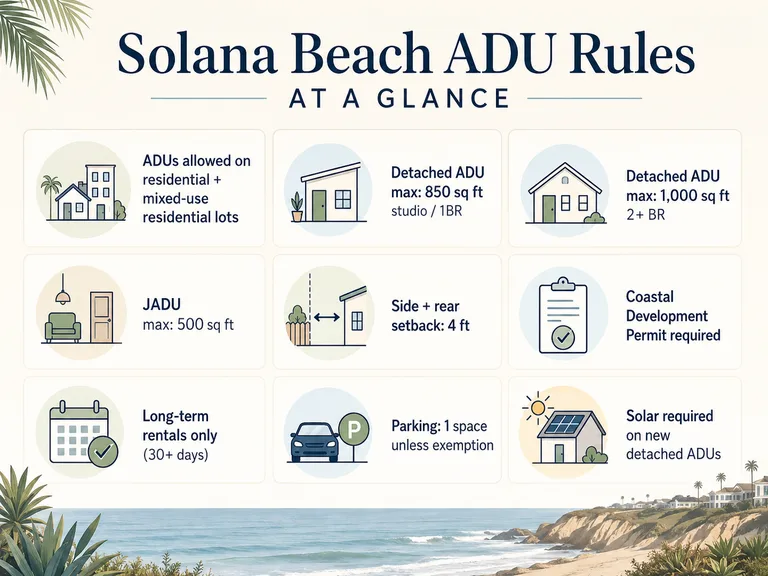
Solana Beach ADU rules at a glance (2026)
| Rule | What it means in 2026 | Source |
|---|---|---|
| Where allowed | All residential lots + mixed-use lots with residential use | SBMC §17.20.040; Gov. Code §66321 |
| ADU + JADU combination | One ADU + one JADU on a single-dwelling lot; multiple detached ADUs on multifamily per §66323 | Gov. Code §66323; SBMC §17.20.040 |
| Detached / attached ADU max size | 850 sq ft (studio / 1-bed); 1,000 sq ft (2+ bed) | SBMC §17.20.040; Gov. Code §66321 |
| State-law size floor | City must accommodate at least 800 sq ft if other objective standards are met | Gov. Code §66321(b) |
| JADU max size | 500 sq ft, inside walls of existing primary dwelling | SBMC §17.20.040; Gov. Code §66333 |
| Side and rear setbacks | 4 ft minimum for new construction; existing-space conversions exempt | SBMC §17.20.040; Gov. Code §66321 |
| Height — standard detached | 16 ft maximum above grade | SBMC §17.20.040 |
| Height — transit corridor (where qualifying) | 18 ft + 2 ft to match roof pitch; most Solana Beach lots do not qualify — confirm address | Gov. Code §66321; SBMC §17.20.040 |
| Building separation | 6 ft minimum eave-to-eave between detached ADU and any other building | SBMC §17.20.040 |
| Coastal Development Permit | Required for every ADU — Coastal Commission issues CDPs directly (no fully certified LCP) | Gov. Code §66329; California Coastal Act |
| CDP clock | 60 days concurrent with city review for a complete application; state law applies | Gov. Code §66329 |
| Parking | 1 space generally; exempt within ½ mile of transit, historic properties, near car share, and existing-space conversions | SBMC §17.20.040; Gov. Code §66321 |
| Primary entrance visibility | ADU entrance cannot be visible from the street adjacent to the front yard setback | SBMC §17.20.040 |
| Architectural conformity | Roofing, trim, walls, windows, and color palette must match the primary dwelling | SBMC §17.20.040 |
| Grading limit | ADU projects requiring more than 50 cubic yards of grading are not permitted | City June 2025 ADU handout |
| Solar | Required on newly constructed non-manufactured detached ADUs under California Energy Code | SBMC §17.20.040; Title 24 |
| Fire sprinklers | Required if the primary residence requires them; may also be triggered by major alterations | SBMC §17.20.040 |
| Impact fees | Zero for ADUs under 750 sq ft; proportional (incl. $4,732 Transportation Impact Fee) at or above 750 sq ft | Gov. Code §66311.5(c); Solana Beach 2025 Master Fee Schedule |
| School fees | Not on ADUs ≤500 sq ft; otherwise district-specific | Education Code §17620 |
| Rental term | 30 consecutive days minimum; no short-term rentals | Gov. Code §66315; SBMC §17.20.040 |
| Owner occupancy — ADU | State law prohibits local owner-occupancy requirements for standard ADUs | Gov. Code §66315 |
| Owner occupancy — JADU | Required only if JADU shares sanitation with primary dwelling | Gov. Code §66333(b); AB 1154 |
| Separate ADU sale (AB 1033) | Not adopted in Solana Beach as of May 2026 | City of Solana Beach; AB 1033 (2023) |
| PADU program | Pre-approved plans up to 800 sq ft / 16 ft; ~15-day city review per cycle when plans are clean | City June 2025 ADU handout; AB 1332 |
| Permit expiration | Building permit expires if no certificate of occupancy issued in 2 years | SBMC; Gov. Code §66328 |
Sources: Solana Beach Municipal Code §17.20.040; Ordinance 525; City of Solana Beach ADU Submittal Process and Basic Plan Requirements (June 18, 2025); California Government Code §§66311.5, 66315, 66321, 66323, 66329, 66333 (post-SB 477 numbering, amended through SB 543, AB 1154, AB 462); HCD Ordinance Findings Letter dated December 16, 2025.
What we verified for this guide
- ✓City of Solana Beach Community Development Department ADU information, reviewed May 2026
- ✓Solana Beach Municipal Code §17.20.040 (full text, Ordinance 525) — primary source for local rules
- ✓City of Solana Beach ADU Submittal Process and Basic Plan Requirements handout, June 18, 2025
- ✓HCD Ordinance Findings Letter dated December 16, 2025, signed by Jamie Candelaria (Section Chief, ADU Policy, HCD Housing Accountability Unit), addressed to Joseph Lim (Director of Community Development, City of Solana Beach) — 10 provisions flagged for revision
- ✓Solana Beach Master Fee Schedule effective March 17, 2025 — $4,732 Transportation Impact Fee for ADUs at or above 750 sq ft
- ✓California Government Code §§66310–66342 (post-SB 477 numbering), as amended through SB 543, AB 1154, AB 462, SB 1211, AB 2533, AB 1332, and AB 1033
- ✓California Coastal Commission LCP status for Solana Beach: certified LUP only (not fully certified LCP) — Commission issues CDPs directly
- ✓PADU program: AB 1332 codified at Gov. Code §65852.27 required pre-approved ADU plan programs by January 1, 2025; Solana Beach PADU processing guide confirmed
- ✓Construction-cost ranges cross-checked from SnapADU (2026), Green Room Design Build (Solana Beach office), and Better Place Design & Build published data
- ✓Rent data: Apartments.com Solana Beach 92075 market trends (May 2026); Zillow active listings; SnapADU citing Rentometer (March 2026)
- ✓CalHFA ADU Grant Program status verified at calhfa.ca.gov — most recent round fully allocated December 28, 2023
- ✓AB 1033 separate-sale adoption status: Solana Beach has not adopted as of May 2026
Can I build an ADU on my Solana Beach lot?
ADU combination allowances by lot type
| Lot / development type | What state law allows | Note |
|---|---|---|
| Single-family lot | 1 ADU + 1 JADU under local rules; state-law minimum guarantees 1 JADU + 1 converted ADU + 1 new detached ADU up to 800 sq ft (§66323 minimum combination) | Confirm current local-vs-state interpretation with Solana Beach Planning given HCD findings |
| Duplex / existing multifamily | Up to 1 detached ADU per existing unit, capped at 8 new detached ADUs; plus 25% conversion ADUs | Gov. Code §66323; state law overrides more restrictive local code |
| Mixed-use (residential component) | ADUs permitted; confirm residential unit count with city | Gov. Code §66321 |
| Hillside Overlay Zone lots | Standard ADU law applies in principle; city may have additional design and site constraints; verify with Planning | City Council signaled support for relaxing restrictions to align with state law; confirm current status |
| Lots in HOA communities | State law prohibits outright ADU bans by HOAs; HOAs may apply reasonable objective design standards | HOA architectural review approval may still be required before design is finalized |
Get a free, lot-specific read on your Solana Beach parcel — zoning, coastal exposure, setback footprint, allowable size, and fee estimate — before you spend a dollar on architects.
See What You Can Build on Your Solana Beach Lot →What changed in Solana Beach ADU law in 2025–2026
State law changes affecting Solana Beach ADU projects (2024–2026)
| Law | What it does | Effect on Solana Beach projects |
|---|---|---|
| SB 477 (2024) | Non-substantive reorganization: relocates and renumbers all California ADU law into the new Chapter 13 structure (§§66310–66342) | All code citations now use §66310+ numbering; legacy citations to §65852.2 still appear in many builder guides — confirm you're looking at current code |
| SB 543 (2025) | Clarifies and amends the current Chapter 13 ADU framework, including §66311.5 (impact-fee cliff) and §66333 (JADU owner-occupancy test) | Confirms the 750 sq ft impact-fee rule and the bathroom-based JADU owner-occupancy standard that supersedes older blanket owner-occupancy requirements |
| AB 1154 (effective Jan 1, 2026) | Amends Gov. Code §66333(b): JADU owner-occupancy required only if the JADU shares sanitation facilities with primary dwelling | Older Solana Beach ordinance language may still reference a blanket JADU owner-occupancy requirement; state law controls where they conflict |
| AB 462 (effective Oct 10, 2025) | Requires CDPs for ADUs to be processed in 60 days concurrent with city review; applies to both local-CDP and CCC-CDP jurisdictions; if agency fails to act, CDP is deemed approved by operation of law | Solana Beach's CDPs are issued by the Coastal Commission (not the city) — the 60-day concurrent-review clock still applies to CCC's processing |
| AB 1332 (codified at Gov. Code §65852.27, effective Jan 1, 2025) | Required all local jurisdictions to adopt a permit-ready ADU plan program (PADU/pre-approved plans) by January 1, 2025 | Solana Beach's PADU program is operational; ~15-day city review for clean submittals up to 800 sq ft / 16 ft |
| SB 1211 (2024) | Expanded multifamily ADU allowances — up to 1 detached ADU per existing unit, capped at 8 | Applies to Solana Beach multifamily lots |
| AB 2533 (2024) | Expanded amnesty pathways for older unpermitted units | Solana Beach homeowners with pre-existing unpermitted units should verify current local amnesty status with Planning |
| AB 1033 (2023) | Allows cities to opt in to permitting ADUs to be sold separately from the primary residence | Not adopted in Solana Beach as of May 2026 |
HCD-flagged conflicts to know before your plan-check submittal
| Provision flagged | Why it matters for your project | State law that controls |
|---|---|---|
| Front setback exception language | The local ordinance's handling of front-setback exemptions for ADUs may conflict with state-law minimums; some homeowners may qualify for an ADU in a location the local ordinance appears to restrict | Gov. Code §66321 — 4-ft side and rear setbacks apply; front setback per local zoning, but state law limits how strictly local rules can be applied to ADUs |
| Unit-allowance combination provisions | The local combination rules (ADU + JADU counts) may be narrower than what state law mandates — particularly for single-family lots under the §66323 minimum combination floor | Gov. Code §66323: any combination from categories (1)–(4), subject to the conditions in §66323 |
| JADU blanket owner-occupancy requirement | Local ordinance may still require owner occupancy for all JADUs; state law as amended by AB 1154 limits this to JADUs that share sanitation facilities | Gov. Code §66333(b): owner occupancy required only when JADU shares sanitation with primary dwelling |
| Multifamily ADU allowances | Local rules may not fully reflect SB 1211's expanded allowances (up to 1 detached ADU per existing unit, capped at 8) | Gov. Code §66323 as amended by SB 1211 |
| Primary entrance visibility rule | This rule (ADU door cannot be visible from the front street) is flagged for HCD review as potentially conflicting with objective design standard requirements under state ADU law | Gov. Code §66321 — design standards must be objective and not effectively preclude construction |
| Grading limit (50 cubic yards) | The 50-cubic-yard cap is flagged as a potential effective prohibition on ADU construction for sloped lots; state law restricts effectively prohibitory standards | Gov. Code §66321 — standards that effectively preclude construction of an ADU are prohibited |
| Architectural conformity requirements | The architectural matching rule (roofing, trim, walls, windows, color palette) must be objective; subjective-appearing interpretations are flagged | Gov. Code §66321(c) — design standards must be objective |
| Scenic Resource Overlay Zone (SROZ) restrictions | SROZ overlay rules may conflict with state ADU law's prohibition on overlay zones that effectively preclude ADU construction | Gov. Code §66321 — local overlay rules cannot effectively preclude ADU construction |
| Hillside Overlay Zone restrictions on ADUs | Historically restricted or excluded ADUs in hillside zones; City Council has signaled intent to amend but revisions are still pending | Gov. Code §66321 — state law applies to hillside lots as it does to all residential lots |
| State-law compliance of impact-fee structure | Local fee schedule must comply with §66311.5(c)'s prohibition on impact fees for ADUs under 750 sq ft | Gov. Code §66311.5(c) — no impact fees on ADUs under 750 sq ft of interior livable space |
Sources: HCD Ordinance Findings Letter dated December 16, 2025 (Jamie Candelaria, Section Chief, ADU Policy, HCD Housing Accountability Unit → Joseph Lim, Director of Community Development, City of Solana Beach); California Government Code §§66311.5, 66321, 66323, 66329, 66333; HCD ADU Handbook 2026.
Don’t want to interpret these conflicts yourself? Get a free, lot-specific read on which rules apply to your address and which state-law unlocks may benefit your project.
Get Your Free Solana Beach ADU Report →Solana Beach ADU size limits (2026)
| Unit type | Maximum size | Notes |
|---|---|---|
| JADU | 500 sq ft | Must be within the walls of an existing primary single-dwelling unit |
| Detached ADU, studio or 1-bedroom | 850 sq ft | Most common Solana Beach new-build category |
| Detached ADU, 2+ bedrooms | 1,000 sq ft | Cannot exceed 1,000 sq ft regardless of bedroom count |
| Attached ADU, studio or 1-bedroom | 850 sq ft | Note: the 50%/1,200 sq ft formula from other cities does not apply here — local cap is 850/1,000 sq ft |
| Attached ADU, 2+ bedrooms | 1,000 sq ft | Same caps as detached; confirm with city at time of application given HCD review |
| State-law floor (PADU / impact-fee threshold) | 800 sq ft — city must accommodate this regardless of local lot-coverage rules | Most PADU plans target 800 sq ft to use the state-law floor path |
Sources: SBMC §17.20.040; Gov. Code §66321; June 2025 ADU Submittal handout.
Height, setbacks, design standards & parking
Height — by condition
| Condition | Maximum height |
|---|---|
| Standard detached ADU | 16 ft above grade |
| Detached ADU within ½ mile of qualifying major transit stop or high-quality transit corridor | 18 ft — most Solana Beach lots do not qualify; confirm transit-corridor distance before assuming |
| Additional height to match a steeper primary-dwelling roof pitch | +2 ft (potential 18+2=20 ft envelope on qualifying lots) |
| Two-story detached ADU | Constrained by the 16-ft standard cap; narrow 18+2-ft path where transit corridor + roof-pitch conditions both apply; not 'no everywhere' but applies to most Solana Beach lots |
| Attached ADU — first story | 16 ft above grade |
| Attached ADU — second story | Up to the primary dwelling's height or zoning cap; confirm two-story path with city planning before designing |
Setbacks
| Condition | Setback rule |
|---|---|
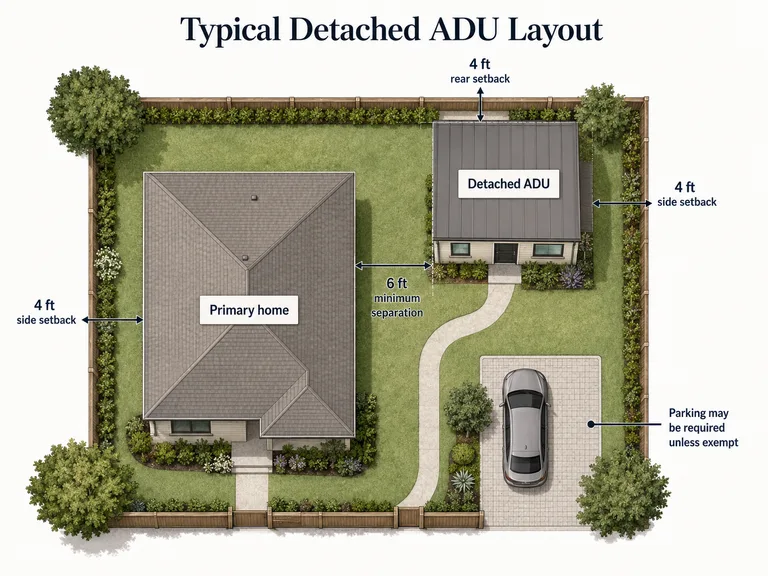
| New detached or attached ADU — side and rear | 4 ft minimum |
| Front yard | Per the underlying zoning district; state-law minimum setback rules limit how restrictive this can be |
| Conversion of existing legally non-conforming structure | May retain existing non-conforming setbacks; cannot worsen them |
| Detached ADU — separation from any other building on the lot (eave-to-eave) | 6 ft minimum |
| Coastal bluff setback (where applicable) | 40 ft from the bluff edge per LUP Policy 4.18; site-specific conditions may extend this |
| ESHA buffer (where applicable) | Site-specific; consult Coastal Commission guidance for the parcel |
Parking
| Condition | Parking implication |
|---|---|
| Baseline | 1 off-street space for new ADUs |
| ADU within ½ mile of public transit (where applicable) | Exempt |
| ADU in a historic district or on a historic-resource property | Exempt |
| Conversion of existing habitable space | Exempt |
| ADU within one block of car-share location | Exempt |
| Tandem parking in existing driveway | Permitted where parking is required |
| Replacement parking for converted/demolished covered parking | Required only if the loss has a significant effect on public coastal access |
Sources: SBMC §17.20.040; Gov. Code §66321; June 2025 ADU handout; LUP Policy 4.18.
Seven Solana Beach ADU catches most builder pages don’t mention
| # | The catch | Why it matters | How to protect yourself |
|---|---|---|---|
| 1 | 50-cubic-yard grading limit | ADU projects requiring more than 50 cubic yards of grading are not permitted under the standard ADU path; sloped lots are the primary risk | Get a topographic survey and preliminary grading estimate before committing to a design on any sloped parcel |
| 2 | Primary entrance visibility rule | The ADU's primary entrance cannot be visible from the street adjacent to the front yard setback; requires rear- or side-facing entrance design | Confirm your proposed entrance orientation in the schematic phase — not after construction documents are drawn |
| 3 | Architectural conformity | Roofing, trim, exterior walls, windows, and color palette must match the primary dwelling; limits off-the-shelf prefab options and generic designs | Select a builder whose bid explicitly includes architectural-matching analysis and whose portfolio shows Solana Beach completions |
| 4 | SROZ (Scenic Resource Overlay Zone) | Some Solana Beach parcels are in the Scenic Resource Overlay Zone, which adds design review for visibility impacts on public coastal views | Confirm SROZ status for your parcel at the City's planning counter before finalizing site plan orientation and massing |
| 5 | 30-day rental floor | ADU and JADU leases must be for 30 consecutive days or more; nightly and weekly vacation-rental platforms are not a viable path | If short-term rental income is central to your ROI model, Solana Beach is the wrong city — confirm with city planning before signing a build contract |
| 6 | Guest houses / prior non-conforming structures | The city does not permit new guest houses; older structures labeled as guest houses that were permitted before ADU law existed may have deed-restriction complications | Run a title search and confirm the permit status of any existing accessory structure before applying for an ADU on the same lot |
| 7 | Solar mandate on new detached ADUs | Newly constructed non-manufactured detached ADUs must comply with California Energy Code solar provisions; budget $8,000–$15,000 | Include the solar package line item explicitly in any bid comparison; a bid that excludes it is not a lower bid |
Sources: SBMC §17.20.040; Ordinance 525; City of Solana Beach ADU Submittal Process handout (June 18, 2025); California Energy Code Title 24; HCD Ordinance Findings Letter (December 16, 2025).
Why the California Coastal Commission is your primary permit authority in Solana Beach
LCP status comparison: Solana Beach vs. neighboring cities
| City | LCP status | Who issues CDPs for ADUs |
|---|---|---|
| Solana Beach | LUP certified; Implementation Plan NOT certified | California Coastal Commission issues CDPs directly |
| Del Mar | Fully certified LCP (June 12, 2025) | City of Del Mar issues Administrative CDPs locally; no CCC appeal for ADU CDPs under AB 462 |
| Encinitas | Certified LCP | City of Encinitas issues CDPs locally |
| Carlsbad | Certified LCP | City of Carlsbad issues CDPs locally |
| Cardiff-by-the-Sea (City of Encinitas) | Same as Encinitas — certified LCP | City of Encinitas |
Three practical effects of the CCC-as-CDP-issuer structure
- Concurrent review under state law, with realistic correction delays. Government Code §66329 requires CDP review to run concurrently with city ADU review on a 60-day clock for complete applications. In practice, “complete application” is the operative phrase. Design corrections, soils reports on sloped lots, drainage studies, sewer-lateral details, and architectural-conformity revisions can each restart the clock. Plan for the calendar, not the statute. Most Solana Beach projects reach building permit issuance 4–6 months after a clean first submittal.
- Sensitive sites get harder, not impossible. Bluff-top properties, ESHA-adjacent lots, and hillside-overlay parcels face additional CCC scrutiny. The June 2025 ADU handout lists the specific study types (topographic, drainage, soils, stormwater, sewer, waste management) that may be required. If your lot has any of these conditions, work with a builder who has documented Solana Beach CDP experience.
- AB 462 still applies. Even with the CCC as the CDP issuer, AB 462’s 60-day concurrent-review clock and deemed-approval remedy apply. The CCC must act within 60 days of a complete application or the CDP is deemed approved by operation of law. This is a meaningful protection against open-ended coastal review delays.
Not sure what your Solana Beach lot’s coastal exposure looks like? Check your address.
Check My Coastal Exposure →Solana Beach ADU permit process: the 8-step path
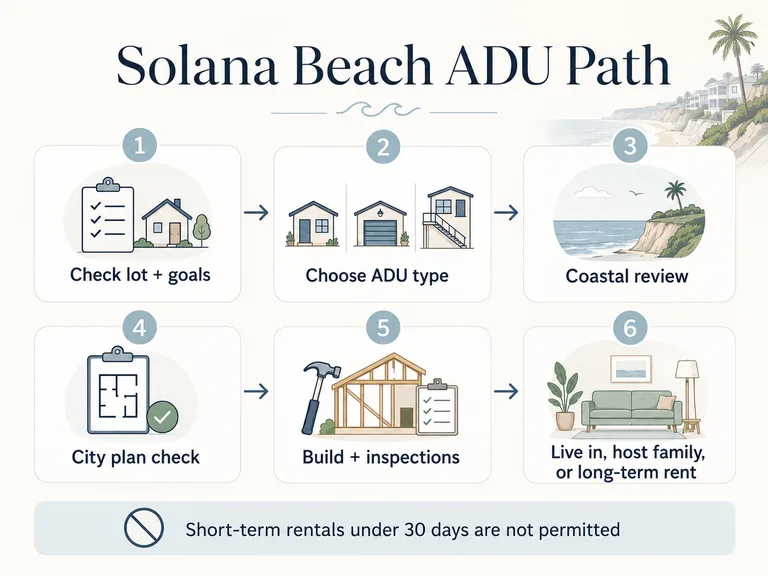
| Step | Typical duration | What happens | Where it can stretch |
|---|---|---|---|
| 1. Feasibility and site analysis | 2–4 weeks | Confirm overlay zones, grading, utility access, entrance rule, SROZ, setback footprint | Sloped or bluff-adjacent lots; HOA approval |
| 2. Design and engineering | 6–10 weeks | Construction drawings, site plan, topographic survey, Title 24, structural calcs, MEP schematics, drainage study, soils if required | Custom design revisions; soils on difficult lots |
| 3. Submittal to city + concurrent CCC CDP submittal | 1–2 weeks | Digital submission to City Planning, Building, Engineering, Fire; simultaneous CDP application to California Coastal Commission | Incomplete application packet restarts clocks |
| 4. Completeness determination | Up to 15 business days (city) | City confirms application is complete; CCC confirms CDP application is complete | Missing study or document |
| 5. City plan check (concurrent with CDP review) | Up to 60 days statutory; 2–4 months with corrections | Planning, Building, Engineering, Fire review; each correction cycle adds 2–4 weeks | Architectural conformity corrections; drainage study revisions; utility routing |
| 6. Coastal Commission CDP review (concurrent) | 60 days for complete application | CCC reviews for Coastal Act consistency; may require additional reports for sensitive sites | Sensitive sites (bluff, ESHA, hillside) may require resubmittals |
| 7. Building permit issuance | 1–2 weeks | After both city plan check and CCC CDP clear; coordination between agencies | Coordination delays are common; allow buffer |
| 8. Construction + final inspections | 5–8 months construction + 1–4 weeks final inspections | Foundation → framing → MEP rough-in → insulation → finishes → final inspection → certificate of occupancy | Material lead times; change orders; failed inspections |
Sources: City of Solana Beach ADU Submittal Process and Basic Plan Requirements (June 18, 2025); Government Code §66317 (completeness); Government Code §66329 (CDP concurrent review); California Coastal Commission CDP guidance.
Documents required at submittal (from the June 2025 ADU handout)
- Completed ADU application and permit application
- Site plan showing: property lines, existing buildings, proposed ADU location, setbacks, parking, easements
- Floor plans, elevations, and sections for the proposed ADU
- Topographic survey (required for all projects per city handout)
- Drainage and stormwater documentation
- Soils / geotechnical report (sloped lots, bluff-adjacent, hillside overlay)
- Sewer lateral detail and certification
- Title 24 energy compliance documentation
- Fire-sprinkler determination (referencing existing primary-residence sprinkler status)
- CDP application to California Coastal Commission (concurrent submittal)
- Waste management plan for construction debris
Free Solana Beach ADU Permit Checklist
Get the complete Solana Beach ADU submittal checklist, the nine-question builder vetting script, and the CDP process timeline in a single printable resource.
Download the Free Solana Beach ADU Checklist →Solana Beach ADU permit fees and the 750 sq ft impact-fee cliff (2026)
| Fee category | 2026 estimate / range | When it applies |
|---|---|---|
| City planning application fee | $500–$2,000 | Every ADU application; confirm current amount with City Planning |
| Building permit plan check fee | $1,500–$8,000+ | Scales with construction valuation per Attachments A & B of the 2026 Master Fee Schedule; confirm with city for your project valuation |
| Building permit issuance fee | $1,000–$5,000+ | Scales with construction valuation |
| Engineering review fee | $500–$2,000 | Drainage, grading, utility review |
| Coastal Development Permit processing (CCC) | $400–$1,500 estimated CCC filing fee | Every Solana Beach ADU; CCC filing fee separate from city fees |
| CDP consultant / coordinator time | $2,000–$8,000 | Builder or consultant time managing the CCC submittal; ask whether this is included in your bid or invoiced separately |
| Residential ADU Transportation Impact Fee | $4,732 (Solana Beach 2025 Master Fee Schedule) | ADUs at or above 750 sq ft of interior livable space; zero for ADUs under 750 sq ft (Gov. Code §66311.5(c)) |
| Other regional impact fees (transit, parks, public facilities) | Category-specific; confirm with city | ADUs at or above 750 sq ft; proportional to ADU-to-primary-unit ratio |
| School district fee | District-specific; not assessed on ADUs ≤500 sq ft | ADUs over 500 sq ft; contact Solana Beach School District or San Dieguito Union High School District |
| New water meter / SDCWA capacity charge | $5,000–$15,000+ | Triggered when ADU requires a separate water meter; SDCWA fees vary by meter size |
| Sewer connection / lateral extension | $2,000–$8,000 | When a new sewer connection is required; most Solana Beach ADUs connect to the existing primary-dwelling lateral |
| Stormwater / drainage plan review | $500–$1,500 | Most new construction triggers stormwater review |
| Soils / geotechnical report | $2,000–$5,000 | Required for sloped lots, bluff-adjacent, and hillside overlay parcels per city handout |
Sources: Solana Beach Master Fee Schedule effective March 17, 2025; California Government Code §66311.5(c); Education Code §17620; San Diego County Water Authority fee schedules. Building permit plan check and issuance fees follow project valuation per Attachments A and B of the fee schedule — confirm with city for your specific project valuation before budgeting. These are 2026 planning estimates, not guarantees.
750 sq ft cliff: two-scenario comparison
| Scenario | 749 sq ft ADU | 850 sq ft ADU |
|---|---|---|
| Transportation Impact Fee | $0 (exempt under §66311.5(c)) | $4,732 |
| Other proportional impact fees | $0 | Category-specific amounts apply |
| School fee | $0 (≤500 sq ft exempt; confirm if over 500 but under 750) | District-specific; verify |
| State-law size floor protection | Yes — within state floor | Yes — within state floor |
| Additional rentable area vs. 749 sq ft | — | +101 sq ft |
| Estimated impact-fee delta | — | $4,732+ more |
What does a Solana Beach ADU actually cost to build in 2026?
2026 Solana Beach ADU cost stack
| Cost component | Typical range | Note |
|---|---|---|
| Construction (vertical build) | $300K–$450K+ | SnapADU 2026 cost analysis; Realm 2026 ADU cost data; Green Room Design Build published coastal range |
| Design and engineering | $7,500–$25,000 | Standard San Diego County design-build pricing; lower for pre-approved PADU plans |
| City permits, plan check, CDP | $5,000–$15,000+ | Solana Beach Master Fee Schedule; scales with sq ft and project valuation — confirm with city |
| CDP consultant / coordinator time | $2,000–$8,000 | Ask your builder whether this is included in their bid or invoiced separately |
| Sitework (grading, drainage, retaining walls) | $10,000–$40,000 | 50-cubic-yard grading limit; retaining walls on sloped lots; varies sharply by lot |
| Utility hookups and capacity fees | $5,000–$15,000+ | New water meter triggers SDCWA capacity charges; sewer coordination |
| Geotechnical / soils report | $2,000–$5,000 | Required for sloped, bluff-adjacent, and hillside overlay lots per city handout |
| Solar package | $8,000–$15,000 | Required for newly constructed non-manufactured detached ADUs under California Energy Code |
| Impact fees (≥750 sq ft only) | $4,732 Transportation + other category fees | Zero for ADUs under 750 sq ft of interior livable space |
| Total realistic all-in | $300,000–$550,000+ | Coastal-bluff lots and high-end finishes push toward or beyond the top end |
Sources: SnapADU 2026 cost analysis (snapadu.com/adu-costs); Realm 2026 ADU cost data; Green Room Design Build published Solana Beach coastal range ($300K–$550K, 9–14 month timeline). These are illustrative planning estimates, not quotes or guarantees.
Why Solana Beach costs more than inland San Diego
- Architectural conformity — matching roofing, trim, walls, windows, and color palette to the primary dwelling limits the cost savings from generic or off-the-shelf designs.
- Site access constraints — Solana Beach’s narrow streets and small lots raise crane, delivery, and staging costs compared to inland projects with room to work.
- CDP carrying time — the additional Coastal Commission review extends the period during which you pay for design, financing interest, and project management.
Looking for a detached, site-built ADU in San Diego County?
Among the regional ADU builders we track, SnapADU (CSLB #1075582) lists Solana Beach in its served city roster, publishes plan-base pricing transparently, and has a documented Solana Beach project page in its portfolio. Their model is purpose-built for detached new construction. If your project is a JADU, interior conversion, or garage conversion, look elsewhere.
Editorial recommendation. SnapADU is an approved affiliate partner. We may earn a referral fee at no cost to you. We are not paid to rank any builder higher than fit warrants.
See SnapADU Pricing & Floor Plans →PADU vs. custom site-built vs. prefab: which path fits your Solana Beach lot?
| Path | Best for | Main advantage | Main limitation |
|---|---|---|---|
| PADU / pre-approved plan | Homeowners willing to accept an 800 sq ft layout the city has already reviewed | ~15-day city plan review per cycle; lower design fees; well-understood correction patterns | 800 sq ft / 16 ft cap; no two-story option; site conditions still trigger soils/drainage studies; CDP still required |
| Custom site-built ADU | Coastal and design-sensitive lots; larger programs up to 1,000 sq ft; architectural match requirements | Maximum flexibility; cleanest path to architectural matching; meets SROZ and overlay rules more reliably | Higher design fees; longer timeline; more change-order risk on coastal lots |
| Prefab / modular ADU | Flat, accessible lots with compatible architectural style | Potentially faster vertical build phase; catalog pricing is transparent | Architectural conformity rule typically requires custom exterior package; CDP still required; crane access on narrow streets is a real constraint |
Choosing and vetting a Solana Beach ADU builder
Nine questions to ask any Solana Beach ADU builder
- How many Coastal Development Permits have you taken to issuance in Solana Beach specifically in the past 24 months?
- Who on your team handles the CCC submittal directly — and is that included in your bid or invoiced separately?
- How do you screen for the 50-cubic-yard grading limit, primary entrance visibility rule, and SROZ overlay before design begins?
- What is your written exclusion list for this project? Name every item that is not included in your quoted price.
- What is your CSLB license number? (Verify the status yourself at cslb.ca.gov before signing.)
- Can you provide three references from Solana Beach projects completed within the past 36 months?
- How do you handle plan-check corrections — who pays, and what is the process?
- Is the solar package included, or is it an allowance, or is it excluded entirely?
- What is your change-order markup percentage, and how are change orders approved?
Red flags specific to Solana Beach ADU bids
- Claims “California allows ADUs up to 1,200 sq ft” without addressing the Solana Beach local cap and the December 2025 HCD compliance status
- Quotes a total project cost significantly below $300K without a written exclusion list
- Cannot describe the Coastal Commission submittal sequence on the phone
- Has never heard of the 50 cubic yard grading cap or the primary entrance visibility rule
- Does not ask about your existing utility connections or water meter sizing
- Does not include a solar package line item on a new detached build
- Promises permit approval or inspection pass as a guarantee — no builder can guarantee either
- Pushes prefab without first checking architectural conformity requirements and crane access on your specific street
- Demands a large upfront deposit. Per CSLB rules, residential home-improvement contracts cap the down payment at 10% of the contract price or $1,000, whichever is less
For a comparison of Solana Beach ADU builders by project type (detached, custom coastal, garage conversion), see our separate builder guide — the right builder for your lot is the one whose project portfolio, license status, and CDP experience match your specific situation.
Rental rules, income, and ROI for a Solana Beach ADU
2026 rent comps for 92075 (Solana Beach)
| Source | Studio | 1-bedroom | 2-bedroom | As of |
|---|---|---|---|---|
| Apartments.com 92075 market trend | ~$2,423 | ~$3,792 | ~$3,695 | May 2026 |
| Zillow active listings 92075 | — | $2,400–$5,895 | $5,000+ | May 2026 |
| SnapADU citing Rentometer 92075 | — | ~$2,555 | ~$4,505 | March 2026 |
Use these as planning bands, not exact comps. Most rental comps in 92075 are apartments, condos, or single-family homes — dedicated ADU comps are limited. For a serious rental projection, get a Solana Beach property manager to pull block-level comps.
Illustrative rental math — 2-bedroom, 1,000 sq ft detached ADU
| Line | Amount |
|---|---|
| All-in build cost (illustrative) | $475,000 |
| Monthly rent assumption | $4,500/month |
| Gross annual rent | $54,000 |
| Less: 5–8% vacancy reserve | ($2,700–$4,320) |
| Less: property tax increase on new construction (~1.1%) | ($5,225/year on $475K addition) |
| Less: insurance, maintenance reserve, management (~$500–$700/mo) | ($6,000–$8,400/year) |
| Estimated net operating income before debt service | ~$33,000–$40,000/year |
These are illustrative considerations only, not guarantees of returns. Actual results depend on local market conditions, construction costs, financing terms, vacancy, operating expenses, taxes, and regulatory approvals. Consult a licensed CPA and financial advisor before relying on any cash-flow projection.
The 30-day rule
ADU and JADU leases in Solana Beach must be for terms of 30 consecutive days or longer. Weekly and nightly vacation rentals are not permitted. If your business model relies on short-term rental income, Solana Beach is the wrong city — confirm any short-term rental scenario with city planning before signing a build contract.
Owner-occupancy requirements
| Unit type | Owner-occupancy requirement |
|---|---|
| Standard ADU (any new ADU permitted after Jan 1, 2020) | None — California state law prohibits local owner-occupancy requirements (Gov. Code §66315). Older local ordinance language may still reference owner occupancy; state law controls where they conflict. |
| JADU with its own bathroom (separate sanitation) | None — AB 1154 (effective Jan 1, 2026) amended Gov. Code §66333(b) to remove the owner-occupancy requirement for JADUs with separate sanitation facilities |
| JADU that shares sanitation with primary dwelling | Owner occupancy required in either the primary dwelling or the JADU (Gov. Code §66333(b) as amended) |
Free ADU Starter Kit
Not ready to run a feasibility check yet? Get the ADU Starter Kit by email — includes the Solana Beach permit checklist, the 9-question builder vetting script, the rental comp worksheet, and quarterly updates when Solana Beach ordinance or state ADU law changes.
Download the Free ADU Starter Kit →How Solana Beach homeowners are financing $300K–$550K ADU builds
| Lane | When it fits | Watch out for |
|---|---|---|
| Cash-out refinance | High existing equity; current market rate at or below your existing mortgage; want one consolidated payment | Resets the 30-year clock; closing costs; locks in today's rates |
| HELOC | Want to keep a low first-mortgage rate; need flexibility on draw timing during the 12–18-month project | Variable rate exposure; second-lien position |
| Construction loan / construction-to-permanent | Limited existing equity; want one closing; can manage inspection-driven draws | Conversion mechanics at project completion; draw discipline required |
| Renovation-specific products (RenoFi-style) | Smaller-equity homeowner who wants to borrow against the after-renovation value | Lender-specific eligibility; California availability varies |
| CalHFA ADU Grant Program | Not currently active — most recent round fully allocated December 28, 2023 | Verify current funding status at calhfa.ca.gov; watch for grant scams |
Sources: CalHFA ADU Grant Program page (calhfa.ca.gov/adu/) verified May 14, 2026; HCD 2026 ADU Handbook. Education only. We don’t rank lenders by payout, and we don’t quote rates as guarantees. Confirm current terms with a licensed lender.
Affiliate disclosure: our ADU financing options guide includes affiliate links. We may earn a commission at no extra cost to you.
Solana Beach ADU FAQ (15 questions)
Can you build an ADU anywhere in Solana Beach?
Yes, on any lot zoned for residential or mixed-use residential development. However, because the entire city sits inside the California Coastal Zone, every new ADU project requires a Coastal Development Permit from the California Coastal Commission before the city can issue a building permit. Lots in the SROZ, bluff overlay, hillside, or ESHA buffer face additional design constraints.
How big can a Solana Beach ADU be?
Detached and attached ADUs are capped at 850 sq ft (studio or one-bedroom) and 1,000 sq ft (two or more bedrooms). JADUs are capped at 500 sq ft. State law protects an 800 sq ft floor regardless of local lot-coverage rules.
Does every Solana Beach ADU need a Coastal Commission permit?
Yes. Because Solana Beach's LCP is only partially certified (LUP certified; Implementation Plan not), the California Coastal Commission issues CDPs directly. State law (Gov. Code §66329) requires CDP review to run concurrently with city review on a 60-day clock for complete applications.
What is the 750 sq ft fee cliff?
Under California Government Code §66311.5(c), impact fees are prohibited for ADUs under 750 sq ft. At or above 750 sq ft, Solana Beach's $4,732 Transportation Impact Fee plus other category-specific fees apply. Designing to 749 sq ft of interior livable space eliminates these fees entirely.
What is the minimum rental term for a Solana Beach ADU?
30 consecutive days or longer. Short-term rentals (fewer than 30 consecutive days) are not permitted for ADUs in residential zones. Nightly Airbnb-style rentals are not a viable use case for an ADU in Solana Beach.
What is the 50 cubic yard grading rule?
ADU projects requiring more than 50 cubic yards of grading are not permitted under Solana Beach's standard ADU path. This rule affects sloped lots and any site requiring significant leveling. Get a topographic survey and grading estimate before committing to a design on any sloped parcel.
What is the primary entrance visibility rule?
The ADU's primary entrance cannot be visible from the street adjacent to the front yard setback. This Solana Beach–specific rule means the entrance must typically face the side or rear yard. Many out-of-area builders miss this on a first design pass.
Does Solana Beach require solar on ADUs?
Yes, for newly constructed non-manufactured detached ADUs. California Energy Code solar provisions apply. Solar is not required for converted, attached, or manufactured ADUs. Budget $8,000–$15,000 for the solar package.
What is the architectural conformity rule?
The ADU's roofing, trim, walls, windows, and color palette must match the primary dwelling. This limits off-the-shelf prefab options and adds cost to custom designs. Any builder who doesn't ask about your primary dwelling's exterior on the first call is likely to trigger plan-check corrections.
What does the HCD December 2025 findings letter mean?
HCD identified 10 provisions of Solana Beach's ADU ordinance for revision. Permitting continues normally, but where local ordinance conflicts with state law, state law controls. Ask your builder or designer which specific approval path they're using and whether they've confirmed it with city planning.
Can I sell a Solana Beach ADU separately from my house?
No. AB 1033 (2023) allows cities to opt in to permitting separate ADU sales, but Solana Beach has not adopted this as of May 2026.
What is the PADU program?
Solana Beach's Pre-Approved Accessory Dwelling Unit program provides city-reviewed floor plans for detached ADUs up to 800 sq ft and 16 feet. City review is estimated at ~15 days per cycle when plans are clean. CDP from the Coastal Commission is still required.
What is the height limit for a Solana Beach ADU?
16 feet for standard detached ADUs. An 18-foot limit (plus 2 feet to match a steeper roof pitch) applies within one-half mile of a qualifying major transit stop — most Solana Beach lots will not qualify. Confirm transit-corridor distance for your address.
What does a Solana Beach ADU cost to build?
Realistic 2026 all-in costs run $300,000–$550,000 for a custom detached ADU, with construction at roughly $375–$600+ per sq ft. Garage conversions land lower at $150,000–$300,000 total. These are planning estimates — get written bids with exclusion lists.
How long does a Solana Beach ADU take from first call to move-in?
12–18 months for a typical interior-lot detached ADU. Bluff, ESHA, hillside, or heavily customized projects can run 18–24+ months. Any builder quoting a six-month total timeline is describing only the construction phase.
Sources
- City of Solana Beach, Community Development Department. cityofsolanabeach.org/community-development
- City of Solana Beach, Solana Beach Municipal Code §17.20.040 — Accessory Dwelling Units (Ordinance 525). cityofsolanabeach.org/building-zoning-code
- City of Solana Beach, ADU Submittal Process and Basic Plan Requirements (June 18, 2025). cityofsolanabeach.org/adu-submittal-process
- City of Solana Beach, Master Fee Schedule (effective March 17, 2025). cityofsolanabeach.org/fee-schedules
- California Department of Housing and Community Development, Ordinance Findings Letter to City of Solana Beach (December 16, 2025). Signed by Jamie Candelaria, Section Chief, ADU Policy, HCD Housing Accountability Unit; addressed to Joseph Lim, Director of Community Development. hcd.ca.gov/ordinance-findings
- California Department of Housing and Community Development, 2026 ADU Handbook. hcd.ca.gov
- California Legislature, Government Code §§66310–66342 (post-SB 477, as amended through SB 543, AB 1154, AB 462, SB 1211, AB 2533, AB 1332, AB 1033). leginfo.legislature.ca.gov
- California Coastal Commission, Local Coastal Program status for Solana Beach — certified LUP; Implementation Plan not certified; CCC issues CDPs directly. coastal.ca.gov/lcps
- California Coastal Commission, AB 1332 pre-approved ADU plan guidance. coastal.ca.gov
- California Housing Finance Agency, ADU Grant Program (most recent round fully allocated December 28, 2023). calhfa.ca.gov/adu
- Apartments.com, Solana Beach 92075 Rent Market Trends (May 2026). apartments.com/solana-beach
- SnapADU, Solana Beach ADU costs and served city information. snapadu.com (CSLB #1075582)
- Green Room Design Build, Solana Beach ADU range ($300K–$550K, 9–14 months). 136 N. Acacia Ave, Solana Beach. (CSLB #1043138)
- Better Place Design & Build, Solana Beach service area and permitting timeline. (CSLB #1031735)
- SB 1077 — California Coastal Commission ADU guidance. coastal.ca.gov/sb1077
Related guides
Last updated: · Last verified: May 14, 2026 · Next scheduled review: August 2026
Dwelling Index is an independent research resource covering ADU financing, costs, and regulations. We are not a builder, lender, broker, or city representative. Information in this guide reflects our independent review of primary city, state, and HCD source materials, provider-published data, and approved-affiliate-partner materials. We do not guarantee approval, qualification, returns, or specific outcomes.
Not sure where to start? See what’s possible at your Solana Beach address — get your free ADU eligibility report in 60 seconds.
Get My Free Solana Beach ADU Report →