
By The Dwelling Index Editorial Team · Published · Updated
Del Mar ADU Laws (2026): Coastal Permits, Sizes & Real Fees
Bottom line up front. Del Mar ADU laws in 2026 generally allow most property owners inside the incorporated City of Del Mar to build an accessory dwelling unit — and current California state law gives you more rights on a single-family lot than Del Mar’s own municipal code currently describes. Under Del Mar Municipal Code (DMMC) Chapter 30.91, certified by the California Coastal Commission on June 12, 2025, a Del Mar single-family lot can support an ADU capped at 850 sq ft (or 1,000 sq ft with more than one bedroom) and a junior ADU (JrADU) capped at 500 sq ft — but state Government Code § 66323 requires Del Mar to ministerially approve up to three units on a single-family lot in many combinations, which preempts the more restrictive local code. Almost every Del Mar parcel sits inside the California Coastal Zone, so new-construction ADUs typically need an Administrative Coastal Development Permit (CDP) — but as of October 10, 2025, state law AB 462 forces that coastal review to finish in 60 days, run concurrently with the building permit, and the local decision is no longer appealable to the California Coastal Commission in cities with a certified Local Coastal Program like Del Mar.
Who this applies to: Owners of property inside the incorporated City of Del Mar (approximately 2.2 square miles). Heads-up — large parts of ZIP 92014 sit outside the city limits under the City of San Diego or unincorporated San Diego County jurisdiction. Different rulebook entirely. Verify with the Del Mar Public Map Viewer before assuming.
One key number: California Government Code § 66321(b)(3) guarantees you a state-protected 800 sq ft “universal” ADU that Del Mar must accommodate even when local FAR or lot-coverage rules would otherwise block it. Del Mar’s local cap goes slightly higher (850/1,000 sq ft). The “1,200 sq ft ADU” allowed in some California cities does not apply in Del Mar.
Expect: $5,000–$12,000 in city planning + engineering fees · $375–$600 per sq ft all-in construction · roughly 4–6 months to a permit (despite the 60-day statutory clock) · then 6–10 months to build.
See What You Can Build → Get Your Free Del Mar ADU Report
Del Mar ADU rules at a glance (FY 2026)
| Rule | Bottom line | Source |
|---|---|---|
| Where allowed | All residential zones plus mixed-use lots with residential use; JrADUs only in listed R1 zones plus CVPP residential lots 3–9, 11–17, 20–29 | DMMC §30.91.020 |
| Single-family — Del Mar local path | 1 ADU + 1 JrADU | DMMC §30.91.040(B); §30.91.050 |
| Single-family — state-law minimum | 1 JrADU + 1 conversion ADU + 1 detached new ADU up to 800 sf — state law preempts more restrictive local code | Gov. Code §66323 (as amended through SB 543) |
| Multifamily | Up to 1 detached ADU per existing unit (max 8), plus 25% conversion ADUs | Gov. Code §66323; DMMC §30.91.060 |
| ADU size — detached or attached | 850 sq ft (1,000 sq ft if more than 1 bedroom), interior livable space | DMMC §30.91.040(G); Gov. Code §66321 |
| Attached ADU cap | 50% of primary dwelling habitable space — but 800 sq ft is always state-protected | DMMC §30.91.040(G)(2); Gov. Code §66321(b)(3) |
| JrADU size | 500 sq ft maximum, inside walls of primary dwelling | DMMC §30.91.050; Gov. Code §66333 |
| Side/rear setback | 4 ft minimum, plus overlay setbacks | DMMC §30.91.040(N) |
| Height — detached | 16 ft (18 ft within ½ mile of major transit) | DMMC §30.91.040(K) |
| Height — Bluff/Slope/Canyon Overlay | 14 ft maximum | DMMC §30.91.040(K)(5); §30.52 |
| Coastal Bluff Overlay setback | 40 ft from top edge of bluff | DMMC §30.55.080 |
| Coastal Development Permit | Administrative CDP required for most new construction; exempt for conversion of existing legally habitable space | DMMC §30.91.030(E) |
| Coastal permit clock | 60 days concurrent with ADU permit · no public hearing · no Coastal Commission appeal | Gov. Code §66329 (AB 462, eff. Oct 10, 2025) |
| Parking | None required for most ADUs; one space in narrow-street, shoreline-access, and Very High Fire Severity Zone cases | DMMC §30.91.040(O)(P) |
| Owner occupancy — regular ADU | State law prohibits local agencies from imposing an owner-occupancy requirement | Gov. Code §66315 |
| Owner occupancy — JrADU | Required only if JrADU shares sanitation with primary; not required if JrADU has its own bathroom | Gov. Code §66333 (AB 1154, eff. Jan 1, 2026) |
| Minimum rental term | Longer than 30 days (31+ days) — short-term rentals prohibited | Gov. Code §66315; DMMC §30.91.040(F) |
| Impact fees | Zero for ADUs ≤750 sq ft of interior livable space; proportional for ADUs >750 sq ft | Gov. Code §66311.5 |
| School fees | Not assessed on ADUs ≤500 sq ft of interior livable space; otherwise district-specific | Education Code §17620 |
| Solar (Title 24) | Required only on newly constructed, non-manufactured, detached ADUs | DMMC §30.91.040(D)(2) |
| Fire sprinklers | Not required if primary residence has none | DMMC §30.91.040(R) |
| Permit expiration | 2 years after issuance if no Certificate of Occupancy | DMMC §30.91.030(F) |
What we verified
- ✓City of Del Mar ADU page (delmar.ca.us/642), reviewed May 2026
- ✓Del Mar Municipal Code Chapter 30.91 — June 2025 version, full text
- ✓Ordinance No. 1002 — adopted Dec 18, 2023; CCC final certification June 12, 2025
- ✓City of Del Mar FY 2026 Planning Fee Schedule — Resolution 2025-19, effective July 1, 2025
- ✓ADU Application Packet (revised 2024)
- ✓City sample ADU floor plans (446, 793, and 955 sq ft concepts by Stephen Dalton Architects)
- ✓California Government Code §66310 et seq. as reorganized by AB 477 (urgency, 2024) and amended through SB 543, SB 9, AB 1154, AB 462 (effective Oct 10, 2025 / Jan 1, 2026)
- ✓California Coastal Commission certification action, June 12, 2025
- ✓HCD ADU Handbook (updated through 2026)
- ✓SnapADU service area (Del Mar listed at snapadu.com)
- ✓Current 92014 rental data (Zillow, Apartment Finder, Homes.com), May 2026
🗺️ See your specific lot’s overlay zones in 30 seconds.
Del Mar has seven separate overlay zones — Coastal Bluff, Beach, Bluff/Slope/Canyon, Floodplain, Lagoon, Open Space, and Wildland Urban Interface — and each one reshapes ADU rules differently on every parcel. Enter your Del Mar address to see which apply to yours, and the maximum ADU size your property can support under the state-protected 800 sq ft floor.
Run the Free Del Mar Feasibility Check →The honest part you need to hear first
We’ll say it plainly: Del Mar is harder than most California cities for an ADU. The Coastal Commission’s certified Local Coastal Program (LCP) overlay sits on top of every parcel. Public scenic view protections constrain massing. Del Mar’s local ADU cap (850/1,000 sq ft) is smaller than the 1,200 sq ft cap many homeowners assume from reading generic California ADU articles. Bluff lots have a 40-foot setback that can erase the entire backyard. The Beach Overlay can effectively prohibit a new structure.
The reframe: Del Mar must still follow state ADU law — and 2025–2026 state law moved sharply in the homeowner’s favor. AB 462 cut coastal permit timing from the old 6-to-18-month grind to a 60-day decision deadline with no public hearing and no appeal to the Coastal Commission. State law guarantees you the right to at least an 800 sq ft ADU even when Del Mar’s FAR or lot coverage rules would otherwise block it. Local agencies can no longer require you to live on the property. And state § 66323, as currently amended, lets you stack a JrADU plus a conversion ADU plus a detached new-construction ADU on a single-family lot — even though Del Mar’s local code still describes only the two-unit version.
For the majority of Del Mar parcels — those outside the Beach Overlay, the Coastal Bluff Overlay’s 40-ft setback, and the Open Space Overlay — a well-scoped 700–950 sq ft ADU is genuinely buildable in 2026. The real question isn’t “can I build one.” It’s “which path fits my specific lot — and what can shrink or stop it?” The rest of this guide answers that.
What do Del Mar ADU laws allow in 2026?
Del Mar ADU laws in 2026 are layered: Del Mar Municipal Code Chapter 30.91 (effective June 12, 2025) defines local zoning, size limits, setbacks, design standards, and the Administrative Coastal Development Permit process; California Government Code §§ 66310 through 66345 sets the state-law floor that preempts more restrictive local rules; and 2025–2026 legislation (AB 462, AB 1154, SB 543) layers in coastal permit timing, JrADU bathroom rules, and clarified size definitions. The combined effect is that Del Mar’s own published materials describe a more restrictive permit path than current state law actually requires — homeowners with sophisticated plans should ask Planning to process the project to the state-law minimum.
The three sources of law that govern your Del Mar ADU project, in order of which one wins when they conflict:
- California Coastal Act and Del Mar’s certified Local Coastal Program (LCP) — wins on coastal-resource issues (view protection, bluff setbacks, beach, ESHA). State ADU law does not supersede the Coastal Act per Gov. Code § 66329(a).
- California state ADU law (Gov. Code §§ 66310 et seq.) — wins over more-restrictive local code on size minimums, owner occupancy, impact fees, unit count, and permit timing.
- Del Mar Municipal Code Chapter 30.91 — wins on objective design standards (architectural matching, lighting, materials, fencing) and on overlay-specific implementation that doesn’t conflict with state law.
Where Del Mar’s June 2025 ordinance is currently lagging current state law:
| Topic | Del Mar local code says | Current state law says (2026) | What controls |
|---|---|---|---|
| Owner occupancy for ADUs | Required since Jan 1, 2025 | Local agencies prohibited from imposing it (Gov. Code §66315) | State law |
| Single-family unit count | 1 ADU + 1 JrADU | 1 JrADU + 1 within-existing-space ADU + 1 detached new ADU (Gov. Code §66323) | State law |
| JrADU owner occupancy | Required for all post-Jan-2025 JrADUs | Required only if shared sanitation (Gov. Code §66333 / AB 1154) | State law |
| Coastal Commission appeals | 10 working-day window described in DMMC §30.91.030(E)(4)(e) | No CCC appeal for local-government ADU CDP decisions in certified-LCP cities (Gov. Code §66329 / AB 462) | State law |
Del Mar Planning is generally processing applications consistent with current state law in practice; the formal code amendment to bring DMMC 30.91 into alignment is expected in 2026. For any plan that depends on a state-law right that Del Mar’s local code doesn’t reflect, request a written interpretation from Planning citing the relevant Government Code section before you sign a design contract.
Can I build an ADU in Del Mar?
ADUs are permitted on any Del Mar parcel zoned to allow residential or mixed-use development with at least one existing or proposed dwelling. Junior ADUs are permitted only on single-family-zoned lots within R1-40, R1-14, R1-10, R1-10B, R1-5, R1-5B, and Carmel Valley Precise Plan (CVPP) residential lots 3–9, 11–17, and 20–29. Eligibility on a specific parcel depends on jurisdiction, base zoning, and overlay constraints.
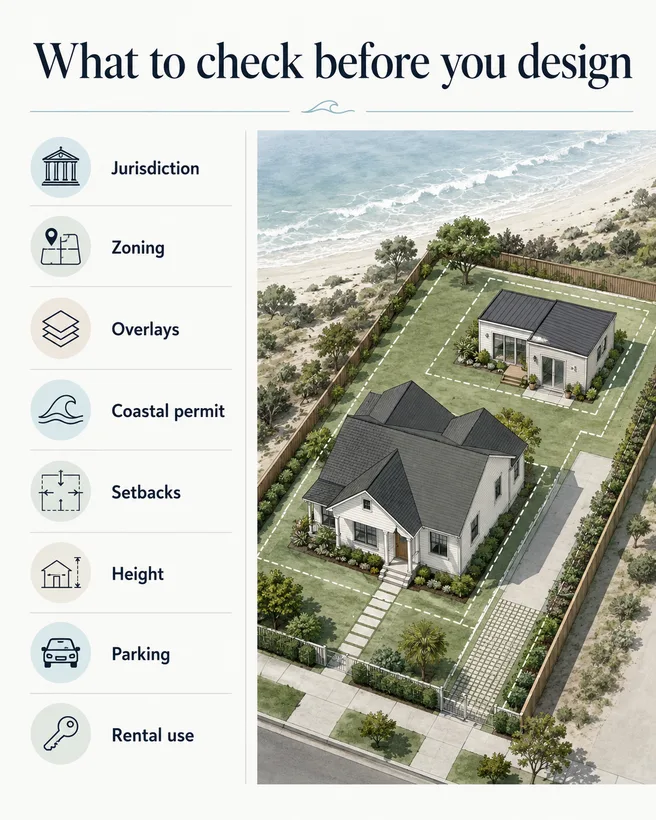
Step one: confirm jurisdiction (this is where many homeowners get tripped up)
Not every address with a Del Mar mailing label is inside the City of Del Mar. The incorporated city is small — approximately 2.2 square miles with about 4,200 residents — and runs roughly from the lagoon south to Torrey Pines and east to Crest Road. ZIP 92014 is much larger than the city itself (about 6.3 square miles, 13,200 residents), so a 92014 mailing address tells you nothing definitive about jurisdiction. Many “Del Mar” addresses sit inside the City of San Diego (especially areas east of the city line and the 92130 Carmel Valley sections) or in unincorporated San Diego County. Each has its own rulebook:
- City of San Diego allows detached ADUs up to 1,200 sq ft vs. Del Mar’s 850/1,000 sq ft
- City of San Diego has adopted AB 1033 separate-sale; Del Mar has not
- Permit fees, application packets, and timelines are different
If you have any doubt, check the Del Mar Public Map Viewer (GIS) at delmar.ca.us/170 or call Del Mar Planning at 858-755-9313 before paying anyone to draw plans.
Step two: confirm your base zone
Del Mar’s residential zones include R1-40, R1-14, R1-10, R1-10B, R1-5, R1-5B (single-family), RM, RM-South, R2 (multifamily), and RC (residential commercial). ADUs are allowed in all of these plus the Carmel Valley Precise Plan zones, subject to overlay rules. JrADUs are narrower — only the single-family R1 zones plus the listed CVPP residential lots.
Step three: identify your overlays
This is the step that decides whether an ADU is straightforward, complicated, or impossible. Del Mar layers seven overlay zones on top of its base zoning, and any one of them can reshape size, height, or location:
- Coastal Bluff Overlay (DMMC § 30.55) — 40 ft setback from top edge of bluff
- Beach Overlay — Beach Preservation Initiative setback; usually a blocker
- Bluff, Slope, and Canyon Overlay (DMMC § 30.52) — 14 ft height cap, 20 ft from top of steep slope
- Floodplain Overlay (DMMC § 30.56) — elevation requirements; FEMA certificate
- Lagoon Overlay — wetland habitat and ESHA buffers
- Open Space Overlay — generally prohibits new structures
- Wildland Urban Interface (WUI) Fire Hazard — two evacuation routes required
Until you know your overlays, every cost or timeline estimate is a guess. Our feasibility check helps identify which apply to your specific parcel and tells you whether the state-protected 800 sq ft ADU is still buildable on your lot.
See What You Can Build → Get Your Free Del Mar ADU ReportHow many ADUs can you build on a Del Mar lot?
Del Mar’s local code describes a single-family pathway of one ADU plus one JrADU, but current California state law (Gov. Code § 66323) requires Del Mar to ministerially approve up to three units on a single-family lot in various combinations. Multifamily lots are entitled to up to one detached ADU per existing unit (max 8) plus conversion ADUs at 25% of existing unit count under SB 1211. State law preempts the more restrictive local code on unit count.
Two answers — and which one to ask Planning for
| Property type | Del Mar local code pathway | Current state-law minimum (Gov. Code \u00a766323) |
|---|---|---|
| Single-family lot | 1 ADU + 1 JrADU | 1 JrADU + 1 within-existing-space ADU + 1 detached new ADU up to 800 sf |
| Duplex (two existing units) | 2 ADUs (one per existing unit) | Same — local code matches state minimum |
| Multifamily (3+ existing units) | 25% conversion ADUs + up to 2 detached ADUs | 1 detached ADU per existing unit up to 8 + conversion ADUs at 25% of existing units (min 1) |
What state-law unit stacking actually looks like on a Del Mar lot
If you have a single-family lot with an attached garage, current state law lets you ministerially permit all three of:
- A JrADU inside the primary house (up to 500 sq ft, separate entry, efficiency kitchen — counts as “within the proposed or existing space of a single-family dwelling”)
- A conversion ADU within existing space — converting the attached garage to a separate ADU (no size limit beyond the existing footprint plus 150 sq ft for ingress/egress; this is the § 66323(a)(2) within-existing-space ADU)
- A detached new-construction ADU up to 800 sq ft in the rear yard (the § 66323(a)(3) detached unit, subject to coastal-resource findings)
For this combination, you will likely need to ask Del Mar Planning for a written interpretation citing Gov. Code § 66323 specifically, because the city’s plan checkers may default to the local code unless directed otherwise.
The multifamily reality
If you own a triplex or larger in Del Mar (typically RM, RM-South, or R2 zones), SB 1211 dramatically expanded what you can do. Where Del Mar’s local code says “up to two detached ADUs,” state law now says “up to one per existing unit, capping at eight.” Del Mar’s planning staff is generally aware of this and will process the application against state minimums when correctly cited.
What size ADU can I actually build in Del Mar?
Del Mar’s local ADU size cap is 850 sq ft for an ADU with one bedroom or fewer and 1,000 sq ft for an ADU with more than one bedroom, measured as interior livable space (DMMC § 30.91.040(G); state-law usage of “interior livable space” clarified by SB 543, effective Jan 1, 2026). JrADUs are capped at 500 sq ft inside the primary dwelling’s existing walls.
| ADU type | Maximum interior livable space | Caveats |
|---|---|---|
| Detached ADU, 1 bedroom or studio | 850 sq ft | Subject to coastal/overlay constraints |
| Detached ADU, 2+ bedrooms | 1,000 sq ft | Subject to FAR/lot coverage above 800 sq ft |
| Attached ADU, any bedroom count | Lesser of 50% of primary dwelling habitable space or 1,000 sq ft | If primary dwelling is under 1,600 sq ft, the attached ADU can be up to 800 sq ft |
| JrADU | 500 sq ft | Inside walls of primary dwelling only; including attached garage |
| Conversion of existing accessory structure | Existing footprint + up to 150 sq ft for ingress/egress | Can exceed normal size limits if the existing structure is bigger |
| State-law protected floor (universal 800 sq ft) | 800 sq ft | Must be accommodated even if local FAR or lot coverage would otherwise prevent it |
Why “1,200 sq ft” is a Del Mar myth
You will see online guides claiming California ADUs can be up to 1,200 sq ft. That’s true in some cities (City of San Diego allows it; Los Angeles allows it under certain conditions) — but not in Del Mar. Del Mar’s certified LCP harmonizes the state’s ADU statutes with the Coastal Act by adopting the lower end of the state-allowed range (850/1,000 sq ft). Pages that quote 1,200 sq ft for Del Mar are either out of date or were never accurate.
The 800 sq ft state-law floor — and why it matters
California Government Code § 66321(b)(3) says local agencies cannot apply FAR limits, lot coverage limits, or other development standards in a way that would prevent an 800 sq ft ADU on a conforming residential lot. In practice:
- If you have a tight Del Mar lot where 850 sq ft would push you over FAR, you are still guaranteed 800 sq ft
- If lot coverage rules say you cannot add any more structure footprint, you are still guaranteed 800 sq ft — even if it means the primary house has to shrink on paper
- The only exception: if the project would damage coastal resources or block public access protected by the LCP, the city can require a smaller ADU (down to an “efficiency unit” of 150 sq ft per Gov. Code § 66313)
The 750 sq ft fee sweet spot
We consistently recommend targeting 750 sq ft of interior livable space for the highest cost-efficiency. At 750 sq ft, state law caps local impact fees at zero (Gov. Code § 66311.5) — saving roughly $3,000 in RTCIP fees. The state-protected 800 sq ft universal floor still applies for any FAR/lot-coverage challenge. A 750 sq ft one-bedroom design typically fits comfortably on most Del Mar lots after setbacks. Above 750 sq ft, impact fees apply proportionally; above 800 sq ft, the FAR and lot-coverage rules start to bite.
What are Del Mar’s setback, height, and design rules?
Del Mar requires a 4-foot minimum side and rear setback for new ADUs, with front setbacks matching the underlying zone (DMMC § 30.91.040(N)). Detached ADUs are capped at 16 feet in height, rising to 18 feet within ½ mile of a major transit stop or high-quality transit corridor, and dropping to 14 feet in the Bluff, Slope, and Canyon Overlay Zone (DMMC § 30.91.040(K)). A minimum of 6 feet must be maintained between buildings. Coastal Bluff lots have an additional 40-foot setback from the top edge of the bluff under DMMC § 30.55.080.
Setbacks decoded
The base setback rule is simple: 4 feet on the side, 4 feet on the rear, and the underlying zone’s setback on the front. Roof eaves, cantilevers, and overhangs cannot encroach into the 4-ft setbacks. Layered on top:
- Coastal Bluff Overlay (DMMC § 30.55): 40 ft from the top edge of the bluff. On a 60-foot-deep lot, that often leaves no buildable area for a detached ADU.
- Beach Overlay: Beach Preservation Initiative setback. Different beach lots have different setbacks; check with Planning.
- Bluff, Slope, Canyon Overlay (DMMC § 30.52): 20 ft from the top of any steep slope (≥25% gradient and ≥20 ft elevation differential), 10 ft from the bottom. ADUs cannot overhang the slope.
- Lagoon Overlay: Habitat buffers around the San Dieguito Lagoon plus any ESHA buffers.
Height in plain English
Del Mar’s default is 16 feet for a detached ADU. That number changes in specific cases:
- 18 feet if your lot is within ½ mile of a major transit stop or high-quality transit corridor per Public Resources Code § 21155
- 14 feet if your lot is inside the Bluff, Slope, and Canyon Overlay
- 25 feet maximum for an attached ADU built at the second-story level — only when first-story buildable area is exhausted and the LCP allows it (a rare combination in Del Mar)
Design rules nobody talks about
Del Mar’s LCP carries serious design requirements that other coastal cities relax:
- Architectural matching: If your detached ADU sits within 20 feet of the primary dwelling, it must match the primary’s architectural style, roof pitch, exterior materials, paint colors, and finishes (DMMC § 30.91.040(I)(6))
- Privacy windows: Glass walls (any wall with >75% glazed surface) visible from neighboring homes are prohibited. Windows must be staggered or use obscured/opaque glass.
- No rooftop decks (DMMC § 30.91.040(I)(3)), including any “second-story” ADU
- Dark-sky-compliant lighting — 2700K maximum, fully shielded, downcast, certified by the International Dark-Sky Association
- Earth-tone exterior colors only for retaining walls and fences in some overlays; “white” specifically prohibited as it contrasts with the natural hillside
- Protected trees: Monterey Cypress and Torrey Pine have a protected dripline area; building within it can require a Tree Removal Permit ($578) and mitigation
These design rules are objective standards under DMMC § 30.91.040(I) — meaning the Director must approve a compliant design ministerially, not subject to neighbor opposition or design review board hearings. The trick is designing to them on the front end.
Do Del Mar ADUs need a Coastal Development Permit?
Most new-construction ADUs in Del Mar require an Administrative Coastal Development Permit under DMMC § 30.91.030(E), processed concurrently with the building permit. ADUs created entirely from existing legally established habitable space within an existing primary residence are exempt. As of October 10, 2025, AB 462 amended Government Code § 66329 to require that the CDP review complete within 60 days of a complete application, run concurrently with the building permit, hold no public hearing, and — for cities with certified Local Coastal Programs — be no longer appealable to the California Coastal Commission.
Who needs a CDP, and who doesn’t
| ADU type | CDP required? | Notes |
|---|---|---|
| New detached ADU (new construction) | Yes — Administrative CDP | New coastal development |
| Conversion of existing legally habitable space within primary residence | Exempt | DMMC §30.91.030(E)(2)(a) — “habitable space” is the key qualifier |
| Attached ADU meeting CCC §13250 exemption | Exempt | DMMC §30.91.030(E)(2)(b) |
| Conversion of existing detached garage (non-habitable accessory structure) | Likely Admin CDP — verify with Planning | Garage is not “habitable space”; engineering review is exempted, but CDP exemption is not automatic |
| JrADU inside existing primary | Exempt | Inside existing walls of habitable structure |
| ADU with new water well, septic, or major fire-protection capacity | Discretionary CDP required | CCR §13250; PRC §30610(a) — may extend beyond 60-day window |
What AB 462 changed in 2025
Before October 10, 2025, Del Mar’s ADU process required a Notice of Application posted at the project site, a Notice of Final Action mailed to the Coastal Commission, and a 10-working-day appeal window during which the Coastal Commission could pull the project for further review. AB 462 changed all of that:
- Local agencies with certified Local Coastal Programs must approve or deny the CDP within 60 days of a complete application
- The CDP review must run concurrently with the ADU permit review, not sequentially
- No public hearing is required for ADU CDPs
- ADU CDPs issued by the local agency are no longer appealable to the California Coastal Commission under Public Resources Code § 30603
DMMC § 30.91.030(E)(4)(e), which still describes a 10-working-day appeal window, is technically out of sync with current state law. Del Mar’s planning staff has been processing ADU CDPs under AB 462 since the law took effect.
Public scenic view protections
There are no private scenic view protections from an ADU — your neighbor cannot block your ADU because it spoils their ocean view. But public scenic views (views from public vantage points like roads, parks, beach access) are protected under DMMC § 30.91.040(T) and can require a redesign that reduces height, shifts location, or shrinks size.
Check whether your lot likely needs a CDP → Run the Free Del Mar Feasibility CheckHow long does a Del Mar ADU actually take?
California state law (Gov. Code § 66317) requires Del Mar to determine application completeness within 15 business days and to approve or deny a complete ADU application within 60 days. AB 462 extends that 60-day clock to the Coastal Development Permit review. In practice, expect roughly 4–6 months from initial design start to permit issuance, then 6–10 months to build, for a total project timeline of 10–16 months from kickoff to certificate of occupancy.
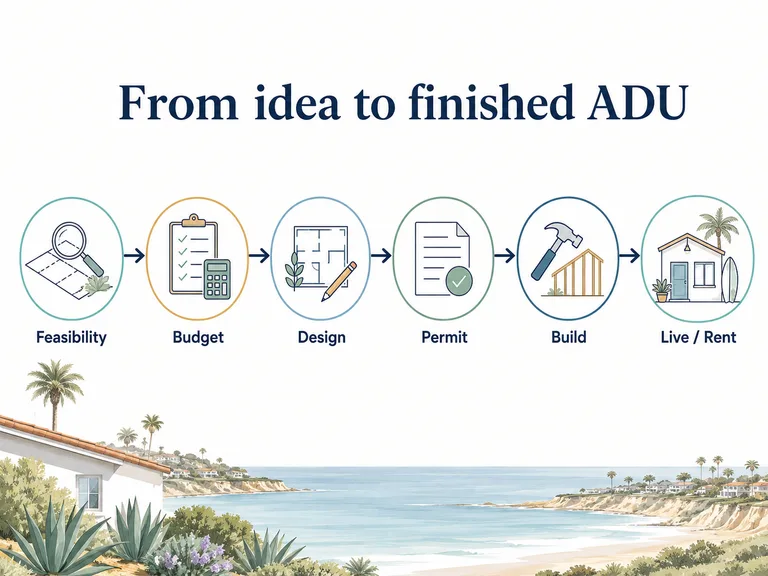
| Phase | Typical duration | What’s happening |
|---|---|---|
| Feasibility + survey + soils | 2–4 weeks | Property survey, soils report (required in Bluff/Slope/Canyon and Coastal Bluff overlays), preliminary site analysis |
| Architectural + structural + Title 24 energy | 6–10 weeks | Construction drawings, structural engineering, energy compliance |
| Pre-submittal review with Del Mar Planning | 1–2 weeks | Optional but recommended; catches issues before formal submittal |
| Application submittal + completeness determination | 15 business days (statutory) | The 60-day clock starts when the city deems the application complete |
| City review cycles + plan-check revisions | 8–12 weeks | First plan check, applicant revisions, second plan check, approval |
| Administrative CDP processing | Concurrent with above | Now required to fit inside the 60-day window |
| Building permit issuance | Immediate after approval | Plans stamped, permit issued |
| Construction | 6–10 months | Foundation, framing, MEP, finishes, inspections, certificate of occupancy |
| Total | 10–16 months | From design kickoff to keys |
Why “complete application” is the bottleneck
The 60-day clock only starts when your application is deemed complete. The most common cause of Del Mar project delays isn’t slow city review — it’s an incomplete submittal that triggers a “needs more information” response, restarting the clock. The DMMC § 30.91.030(A)(1) checklist includes:
- Fully dimensioned site plan including all setbacks, structures, and protected-tree dripline zones
- Building cross-sections in at least two directions with grading shown
- Floor plan demonstrating exterior entry, bathroom, and fully functioning kitchen
- Utility easement and connection information
- Standard notes on the plans about rental terms and sale restrictions
- Height/setback/square footage certification commitment before framing inspection
- Construction-phase parking and materials storage plan
- FEMA elevation certificate (if in Floodplain Overlay)
- For Coastal Bluff Overlay: geotechnical report under DMMC Chapter 30.55
Permits expire and become null and void 2 years after issuance if no Certificate of Occupancy has been issued (DMMC § 30.91.030(F)).
Does Del Mar require parking for an ADU?
No off-street parking is required for most Del Mar ADUs under DMMC §§ 30.91.040(O)–(P). The default is zero required spaces, with exceptions for properties along the shoreline within the Coastal Commission Appeals Jurisdiction, properties on streets with improved widths of 20 feet or less, and properties in Very High Fire Hazard Severity Zones.
The parking exemptions
Del Mar offers six paths to zero required parking (DMMC § 30.91.040(P)(1)):
- ADU located outside the Coastal Commission Appeals Jurisdiction (most inland Del Mar lots qualify)
- ADU is within the existing primary dwelling unit
- ADU is within an existing accessory building (such as a converted detached garage)
- ADU is within ½ mile walking distance of public transit
- ADU is in a designated historic district or on a property in a Register of Historic Resources
- ADU is on a property within one block of a designated car-share parking location
Where parking is required
DMMC § 30.91.040(P)(2) requires one off-street parking space for ADUs on lots along the shoreline where on-street parking has a significant effect on public shoreline access, on streets with improved widths of 20 ft or less, or in a Very High Fire Hazard Severity Zone. When parking is required, it can be covered or uncovered, in a driveway, in a yard setback, on improved surface, or in tandem with primary-dwelling parking.
What does a Del Mar ADU application actually require?
A complete Del Mar ADU application includes a fully dimensioned site plan, building cross-sections and elevations, a floor plan, utility connection information, a deed restriction acknowledgment, a construction-phase parking and storage plan, and an array of standard certifications (DMMC § 30.91.030(A)(1)). Engineering review is required for new detached ADUs and ADUs attached to the primary dwelling, but not required for ADUs created within an existing primary residence or for garage-conversion ADUs.
What you don’t need
Notably not required in Del Mar:
- A Design Review Board hearing (DMMC § 30.91.030(D) exempts ADUs)
- A Land Conservation Permit for grading inside the ADU footprint
- A Floodplain Development Permit if the ADU meets elevation/anchoring standards
- A Conditional Use Permit if the ADU meets Bluff/Slope/Canyon and Coastal Bluff setback standards
Deed restriction (required before permit)
Before Del Mar issues the building permit, the property owner must record a deed restriction with the San Diego County Recorder acknowledging that the ADU may be leased but may not be sold separately from the primary dwelling (with narrow exceptions), and that the minimum rental term is longer than 30 days. This deed restriction runs with the land and transfers with the property when you sell.
What does a Del Mar ADU cost in 2026?
Plan on $5,000–$12,000 in city planning and engineering fees, plus $375–$600 per square foot for vertical construction, plus $5,000–$25,000 for sitework, for a total all-in cost typically in the range of $300,000 to $475,000 for a 750-sq-ft detached ADU in 2026. Conversion ADUs run significantly less — often $150,000–$250,000 — because they reuse the existing foundation and envelope.
The FY 2026 Del Mar ADU fee stack (verified)
Actual fees from the Del Mar FY 2026 Planning Fee Schedule, Resolution 2025-19, effective July 1, 2025.
| Fee | FY 2026 amount | When it applies |
|---|---|---|
| ADU planning permit | $1,192 | Every ADU |
| Engineering ADU Review + Inspection | $748 | Every new detached or attached ADU |
| Additional Engineering ADU Review | $518 | If a second review cycle is needed |
| Plan Check & Inspection — Add >100 sf | $1,340 | Most attached / addition ADUs |
| Plan Check & Inspection — Single Family | $2,519 | When ADU is treated as new single-family work |
| Coastal Development Permit — staff level | $332 | Most new construction ADUs |
| Coastal Development Permit — with hearing | $3,355 | Only if discretionary review triggered (rare) |
| Water Efficient Landscape (WELO) | $824 | If landscape area triggers WELO requirements |
| Tree Removal Permit | $578 | Only if protected tree (Monterey Cypress, Torrey Pine) is impacted |
| Final SWMP (stormwater) | $1,002 | Stormwater management plan |
| Drainage Plan Review | $1,704–$2,948+ | Depends on affected area |
| RTCIP (regional transportation) | $3,047.57/unit | Zero for ADUs ≤750 sq ft (Gov. Code §66311.5); proportional for ADUs >750 sq ft |
| School fees (district-collected) | Verify with district | Not assessed for ADUs ≤500 sq ft; statewide Level I maximum $5.38/sf |
| Building permit (city) | Typically $4,000–$10,000 for 800 sf ADU | Valuation-based |
| Utility connection fees | Varies; conversion within existing structure: exempt | DMMC §30.91.040(S)(2) |
A typical Del Mar planning + engineering fee total runs about $5,500 to $9,000 for a new detached ADU between 500 and 800 sq ft, before building permit fees, school fees, and utility connection charges. The state-law impact-fee exemption for ADUs ≤750 sq ft saves about $3,000 on the RTCIP alone.
Construction cost: why Del Mar runs $375–$600 per sq ft
SnapADU, a Greater San Diego ADU specialist with 100+ completed builds across San Diego County (their service area explicitly includes Del Mar), publishes a range of $375–$600 per square foot all-in for a detached ADU. The drivers that put Del Mar at the higher end of that range: coastal labor premium (10–15% over inland San Diego), small-site logistics with constrained street access, architectural and structural design fees ($10,000–$25,000 depending on complexity), plan-check revision cycles, and soil and bluff conditions on older lots.
For a 750 sq ft 1-bedroom detached ADU at $475 per sq ft, the all-in vertical build is roughly $356,000. Add $15,000 for sitework, $7,500 for construction drawings, and $7,000 in fees — total approximately $385,000. A larger 1,000 sq ft 2-bedroom ADU at $450 per sq ft works out to roughly $475,000 all-in.
How conversion ADUs run cheaper
Converting an existing garage or interior space avoids most of these costs because you’re reusing the foundation, roof, and exterior walls. Realistic budget for a Del Mar garage conversion ADU:
- Plans + permits: $10,000–$15,000
- Conversion work (insulation, drywall, MEP, kitchen, bath, finishes): $130,000–$200,000
- Total: $140,000–$215,000
Note: the Coastal Development Permit may still apply to a detached garage conversion even when engineering review does not.
The rental income math for Del Mar (Zip 92014)
Based on current Zillow, Apartment Finder, and Homes.com listings reviewed in May 2026 for Zip 92014:
| ADU configuration | Realistic monthly rent | Annual gross | Annual net (after ~30% expenses) |
|---|---|---|---|
| 500 sf JrADU or studio conversion | $2,500–$3,500 | $30,000–$42,000 | $21,000–$29,400 |
| 750 sf 1BR detached ADU | $3,000–$4,500 | $36,000–$54,000 | $25,200–$37,800 |
| 1,000 sf 2BR detached ADU | $4,500–$7,000 | $54,000–$84,000 | $37,800–$58,800 |
These are illustrative examples, not guarantees of returns. Actual results depend on local market conditions, construction costs, financing terms, and regulatory approvals. Net-income figures assume 30% for property taxes, insurance, maintenance, and vacancy combined. Rental-payback period for a new detached ADU at Del Mar’s premium rents runs 8–13 years. The investment case more often relies on property value appreciation, multi-generational housing flexibility, and inflation-protected equity.
Disclosure: Dwelling Index may earn a commission if you start a project with SnapADU. Editorial recommendations are independent.
The Del Mar ADU Fit + Friction Matrix
Different ADU paths have very different friction profiles in Del Mar. Use this matrix to identify which path your property and goals point toward.
| ADU path | Target size | Del Mar fit | Coastal/permit friction | Best for | Main risk to verify |
|---|---|---|---|---|---|
| JrADU inside primary | ≤500 sf | Allowed only in single-family R1 zones + listed CVPP lots | CDP-exempt (inside habitable space) | Lowest-disruption family housing; compact rental | Owner-occupancy depends on shared vs. separate bathroom (AB 1154) |
| Interior conversion ADU | 800 sf protected; up to 1,000 sf | Allowed in any zone where ADUs are allowed | CDP-exempt under §30.91.030(E)(2)(a) | Reusing existing house space; fastest path | Whether the converted area meets ADU kitchen/bath requirements |
| Garage conversion ADU (detached) | Existing envelope + ≤150 sf ingress/egress | Allowed; engineering review exempt | Often needs Admin CDP — garage typically not habitable space | Lower cost than new detached | CDP status; existing garage’s legal status |
| City sample 446 sf studio plan | 446 sf | Pre-designed; well below all thresholds | New detached: needs Admin CDP | Compact rental or family suite | Site fit, utilities, parking/access |
| City sample 793 sf 1BR plan | 793 sf | Strong fit; below 800 sf state-protected floor | Needs Admin CDP; covered by 60-day AB 462 clock | The “protected-size” sweet spot | Coastal resource impacts, public view |
| 800 sf detached ADU | 800 sf | State-law universal protected size | Admin CDP; AB 462 timing applies | Default detached target | Overlay constraints, bluff/slope/flood |
| City sample 955 sf 2BR plan | 955 sf | Under Del Mar 1,000 sf cap | Admin CDP; FAR/lot coverage above 800 sf | Larger family or rental | FAR, lot coverage, height, public view |
| Attached ADU | Up to 850/1,000 sf or 50% rule | Useful where backyard siting is hard | Often CDP-exempt under §13250 | Aging-parent suite; tight lots | 50% cap, attachment rules, height, privacy |
| Multifamily detached ADUs (per SB 1211) | Per state-law formula | Up to 8 per multifamily lot under state law | Admin CDP for each | Investor multifamily | Local code is more restrictive; state preempts |
| Prefab or modular ADU | Same Del Mar caps | Treated as ADU, not a loophole | Same permit + CDP path | Speed and design certainty | Crane access, foundation, Title 24, deed restriction |
| Tiny home as ADU | Same Del Mar caps | Allowed in any ADU-eligible zone; also in non-residential zones if deed-restricted affordable for 30 years | Same permit + CDP path | Maximum design flexibility | Must meet ADU definition (kitchen, bath, separate entry); deed restriction |
Which ADU path fits your specific property?
The optimal Del Mar ADU path depends on three variables: which overlay zones touch your parcel, how you intend to use the unit (family housing, long-term rental, future flexibility), and your construction budget.
Path 1: The JrADU — lowest friction, lowest disruption
Best for: Multi-generational housing, lower-budget projects, owners who want minimal construction disruption. A JrADU at 500 sq ft maximum lives inside your existing house — CDP-exempt, no engineering review required. Lowest cost (typically $80,000–$140,000 for a quality conversion), fastest permit timeline (often 6–10 weeks). 2026 owner-occupancy: if the JrADU has its own separate bathroom, you do not need to occupy the property; if it shares a bathroom, owner occupancy is required (Gov. Code § 66333). Realistic Del Mar JrADU rents: $2,500–$3,500/month.
Path 2: The interior conversion ADU — fast and CDP-exempt
Best for: Owners with underused interior space (bonus room, finished basement, unused wing) who want a full ADU without a new structure. DMMC § 30.91.030(E)(2)(a) exempts conversion of existing legally established habitable space from the CDP — the lowest-friction “true ADU” path. Budget: $120,000–$200,000. Timeline: 2–4 month permit, 3–5 month construction.
Path 3: The detached garage conversion — fast but CDP usually still applies
Best for: Owners with an existing detached garage looking for a 1-bedroom unit at reasonable cost. Engineering review is exempt. However, the CDP exemption applies to conversion of existing legally established habitable space — and a detached garage is typically non-habitable. Most Del Mar detached garage conversions still need an Administrative CDP. With AB 462’s 60-day clock, the CDP no longer adds the 30+ days it used to. Budget: $130,000–$200,000. Timeline: 3–5 month permit, 3–5 month construction.
Path 4: The 750 sq ft detached ADU — the protected sweet spot
Best for: Owners who want flexibility (rental + future family use), maximum legal protection, and rental yield without FAR/lot-coverage friction. At 750 sq ft, state law caps impact fees at zero; the state-protected 800 sq ft universal floor gives legal armor against FAR/lot-coverage objections; realistic rent is $3,000–$4,200/month. Budget: $320,000–$425,000 all-in. Timeline: 4–6 month permit, 6–8 month construction.
Path 5: The 1,000 sq ft 2BR detached ADU — premium income, more friction
Best for: Owners with larger lots, strong financing, who want to maximize Del Mar’s premium rental market. Rents in the $5,000–$7,000/month range on the right lot. Above 800 sq ft, FAR and lot coverage rules apply; impact fees apply proportionally; more likely to draw public-view scrutiny during CDP review. Budget: $450,000–$500,000 all-in.
Path 6: Attached ADU — for tight lots
Best for: Owners whose lot doesn’t have backyard space for a detached structure. Faces the 50% rule (limited to 50% of the primary dwelling’s habitable space) but the 800 sq ft floor is protected regardless. Often CDP-exempt under § 13250. Architectural-matching rules (DMMC § 30.91.040(I)(6)) are strict — same roof pitch, same materials, same colors as the primary.
Path 7: The state-law triple stack (single-family lot)
Best for: Owners on a single-family lot with an attached garage who want to maximize density and rental income. On a single-family lot you can ministerially permit: (1) a JrADU inside the primary house (up to 500 sq ft), (2) a conversion ADU within the attached garage, and (3) a detached new-construction ADU up to 800 sq ft in the rear yard. Three rental units total. Budget: roughly $450,000–$650,000 combinedif all three are built. Rental potential: $8,000–$12,000/month at current Del Mar rates. Execution risk: Del Mar Planning may not be familiar with processing this stack ministerially under § 66323 — request a written interpretation before signing a design contract.
See What You Can Build → Get Your Free Del Mar ADU ReportCan you rent, Airbnb, sell, or owner-occupy a Del Mar ADU?
Del Mar ADUs must be rented for terms longer than 30 days only — short-term rentals (Airbnb, VRBO) are prohibited in residential zones under DMMC § 30.91.040(F) and Gov. Code § 66315. Current California Government Code § 66315 prohibits local agencies from imposing owner-occupancy requirements on regular ADUs. JrADU owner-occupancy rules changed January 1, 2026, under AB 1154: required if the JrADU shares a bathroom with the primary, not required if the JrADU has its own bathroom (Gov. Code § 66333). ADUs cannot be sold separately from the primary dwelling except through narrow nonprofit affordable-housing pathways under Gov. Code § 66341.
The short-term rental ban (it matters more than you think)
Del Mar has been firm on this since the LCP amendment took effect: ADUs cannot be used as short-term rentals. The minimum rental term is longer than 30 days — meaning 31 days minimum. The only exception is for ADUs located in zones that allow commercial land uses.
Important: If your project pencils out only on short-term rental income — using AirDNA or Airbnb projection tools to justify the build — your math is wrong for Del Mar. Underwrite to long-term rental rates only.
Owner occupancy — what state law actually requires now
Regular ADUs: No owner-occupancy requirement may be imposed by Del Mar or any other local agency. AB 976 (2023) made this prohibition permanent (Gov. Code § 66315). Del Mar’s DMMC § 30.91.030(A)(1)(e)(ii) still contains language about owner-occupancy for post-January 2025 ADUs, but this provision is preempted by § 66315 and is not enforceable.
JrADUs: Per Gov. Code § 66333 as amended by AB 1154, effective January 1, 2026:
- JrADU with its own separate bathroom: Owner occupancy is not required. You can rent both the primary and the JrADU and live elsewhere.
- JrADU sharing a bathroom with the primary: Owner occupancy is required in either the primary or the JrADU.
Separate sale — generally not allowed in Del Mar
DMMC § 30.91.040(E) prohibits separate sale of the ADU from the primary dwelling. AB 1033 (2023) authorized cities to opt in to separate condominium-style sale of ADUs. Del Mar has not opted in. City of San Diego has opted in under SDMC § 141.0302(f); unincorporated San Diego County also opted in on March 4, 2026. If your strategy depends on separate sale, that’s a meaningful jurisdictional difference.
What can stop or shrink a Del Mar ADU?
Six situations can legitimately make a Del Mar ADU unfeasible or sharply reduce its allowable size:
The honest dealbreaker list
- The Beach Overlay. ADUs are not permitted on a beach, seaward of the mean high tide line, or in highly scenic areas as defined by the LCP (DMMC § 30.91.040(V)). For lots in the Beach Overlay, the Beach Preservation Initiative setback usually consumes the entire buildable area for a new structure.
- The Coastal Bluff Overlay’s 40-ft setback. On bluff-front Del Mar lots, the required 40-foot setback from the top edge of the bluff (DMMC § 30.55.080) often eliminates the rear yard entirely. The 800 sq ft state-law floor doesn’t override this — the Coastal Act and LCP take precedence under Gov. Code § 66329.
- The Open Space Overlay. Generally prohibits new structures. ESHA buffers, wetland habitat, and lagoon habitat protected zones operate similarly.
- Very High Fire Hazard Severity Zone with single evacuation route. Under DMMC § 30.91.040(Z), proposed ADUs in mapped Very High Fire Hazard Severity Zones must demonstrate at least two emergency evacuation routes from the parcel, or provide equivalent measures.
- The 50% redevelopment trigger. DMMC § 30.91.040(M) requires that if an ADU project results in alteration of 50% or more of major structural components of the primary residence or a 50% increase in gross floor area, the entire nonconforming primary residence must be brought into compliance with current LCP standards. This can turn a “simple ADU” into a major reconstruction.
- You’re not actually in Del Mar. Many “Del Mar” addresses are inside the City of San Diego or unincorporated San Diego County. Wrong rulebook means wrong size limits, wrong fees, wrong timeline.
The redesign list (not killers, just reshapers)
- FAR or lot coverage above 800 sq ft — you may be capped at the state-protected 800 sq ft
- Public scenic view obstruction — may require height reduction, footprint shift, or different siting
- Narrow street or shoreline-access parking concerns — may require providing one off-street space
- Floodplain Overlay — adds $15,000–$40,000 to budget for elevated construction and FEMA certificate; rarely kills the project
- Protected trees (Monterey Cypress, Torrey Pine) — may require Tree Removal Permit ($578) and mitigation if dripline impact is unavoidable
- WUI Fire Hazard with two evac routes — adds California Building Code fire-resistive construction requirements
If your lot has one of the dealbreakers, the most useful next move is often a JrADU (inside the existing house, avoids most overlay rules), an interior conversion, or — if those don’t fit — a 1031 exchange to a property where an ADU is genuinely viable.
Del Mar ADU incentives, amnesty, and affordability concessions
Del Mar offers two ADU-specific programs: an Incentive Program (DMMC § 30.91.070) that grants a free bonus JrADU plus a 500 sq ft FAR bonus to property owners who deed-restrict an ADU as low-income housing, and an Amnesty Program (DMMC § 30.91.080) that covered unpermitted ADUs in existence as of April 15, 2021. The Amnesty Program was scheduled to run through December 4, 2025; treat it as expired unless Del Mar Planning confirms renewal.
The Incentive Program — when the math works
For single-family and duplex lots, deed-restricting an ADU as affordable for low-income households earns:
- One free 500 sq ft JrADU bonus unit (in addition to your normal ADU + JrADU allocation)
- A 500 sq ft FAR bonus for the property
For most owner-occupants, the math doesn’t work — the deed-restricted unit must be rented at the State’s annually adjusted low-income rental rates, which as of April 2025 cap roughly at $2,318/month for a one-person low-income household (Del Mar regional AMI: $130,800), compared to market-rate rent of $3,000–$4,500 for a typical 750 sq ft Del Mar ADU. For larger investors building multiple units, the FAR/lot-coverage bonus on bonus units can make it pencil.
The Amnesty Program — expired unless renewed
The Amnesty Program offered a pathway to legalize unpermitted ADUs in existence as of April 15, 2021 through an Administrative CDP. As of May 2026, treat the program as expired unless Del Mar Planning confirms renewal. Call 858-755-9313 before relying on it.
State-law backstop: AB 2533
Independent of Del Mar’s local Amnesty Program, AB 2533 created a state-law pathway for legalizing unpermitted pre-2020 ADUs. The state-law process can be slower and more involved than a local amnesty, but it’s available even if Del Mar’s program isn’t currently accepting applications.
How Del Mar ADU laws compare with nearby coastal cities
Del Mar has the smallest local ADU size cap (850/1,000 sq ft) among major San Diego County coastal jurisdictions, while City of San Diego (which surrounds Del Mar on three sides) allows detached ADUs up to 1,200 sq ft. All California cities now share the same 60-day permit clock and AB 462’s coastal permit streamlining.
| Standard | Del Mar | Solana Beach | Encinitas | City of San Diego | Unincorporated SD County |
|---|---|---|---|---|---|
| Max detached ADU size | 850/1,000 sf | 850/1,000 sf | 850/1,200 sf | 1,200 sf | 1,200 sf |
| Max detached height | 16 ft (18 transit, 14 slope OL) | 16 ft | 16 ft | 16 ft (25 attached) | 16 ft |
| State-protected universal size | 800 sf | 800 sf | 800 sf | 800 sf | 800 sf |
| Min setback (side/rear) | 4 ft | 4 ft | 4 ft | 4 ft | 4 ft |
| Statutory permit clock | 60 days | 60 days | 60 days | 60 days | 60 days |
| Coastal permit timing (post-AB 462) | 60 days concurrent | 60 days concurrent | 60 days concurrent | 60 days concurrent | 60 days concurrent |
| AB 1033 separate sale opted in? | No | No (verify) | No (verify) | Yes (SDMC §141.0302(f)) | Yes (Board action March 4, 2026) |
| Regular ADU owner occupancy | State law preempts | State law preempts | State law preempts | State law preempts | State law preempts |
| JrADU owner occupancy | Conditional on shared/separate sanitation | Conditional | Conditional | Conditional | Conditional |
| Pre-approved plans | Sample plans only (446/793/955 sf) | No (verify) | Yes | Yes | Yes |
| ADU planning fee (FY 2026 verified) | $1,192 | Verify with city | Verify with city | Verify with city | Verify with county |
| Notable difference | Smallest coastal ADU cap; strongest design rules; lagging on §66323 unit stacking | Similar size cap; smaller jurisdiction | Pre-approved plans cut design cost | 1,200 sf cap + AB 1033 opted in | County administers; AB 1033 opted in March 2026 |
Del Mar is the highest-friction, smallest-cap coastal jurisdiction in this group. The trade-off is that Del Mar’s rental rates are among the highest in San Diego County — a successful 750 sq ft Del Mar ADU commands rent that an Escondido 1,200 sq ft ADU cannot. If your strategy depends on a larger ADU, separate sale, or pre-approved plans, City of San Diego coastal areas (La Jolla, Pacific Beach, Ocean Beach) or unincorporated San Diego County are easier paths.
What to do next if your Del Mar lot looks eligible
Before you spend money on architectural drawings, work through this verification sequence. Most failed Del Mar ADU projects fail in steps 1–3 — and those steps can be done in a day, for free.
The 6-step pre-design checklist
- Confirm jurisdiction. Use the Del Mar Public Map Viewer at delmar.ca.us/170 or call Del Mar Planning at 858-755-9313. Don’t assume — the city line runs through some neighborhoods, and ZIP 92014 includes property outside the incorporated city.
- Identify overlays. Pull the GIS layer for Coastal Bluff, Beach, Bluff/Slope/Canyon, Floodplain, Lagoon, Open Space, and Wildland Urban Interface. Each one changes the design budget.
- Determine CDP requirement. If your project is a new detached structure, plan on an Administrative CDP (60-day clock under AB 462). If it’s a true conversion of existing legally habitable space, you likely qualify for a CDP exemption.
- Pick the path. JrADU, interior conversion, garage conversion, 750 sq ft detached, 1,000 sq ft detached, attached, or the § 66323 state-law triple stack. Use the Fit + Friction Matrix above to match path to goals.
- Request a pre-application meeting. Del Mar Planning offers informal pre-application review — the city is small enough that this is genuinely useful. Bring your overlay assessment and your draft path choice.
- Get a parcel-specific feasibility report. A detailed property analysis that consolidates jurisdiction, base zone, all seven overlays, allowable ADU size under both Del Mar code and current state law, CDP requirement, likely fee total, realistic timeline, and matched builder recommendations.
For builders, SnapADU is one of Greater San Diego’s specialist ADU design-build contractors with 100+ completed ADUs across San Diego County. Their published service area explicitly includes Del Mar, and their Feasibility SnapShot evaluates 75+ project variables to lock in your construction cost before permits are submitted.
Disclosure: Dwelling Index may earn a commission if you start a project through our referral link to SnapADU. Editorial recommendations are independent.
For financing, Del Mar property owners typically have three viable paths: cash-out refinance, a renovation loan tied to the as-completed property value, or a HELOC against the existing primary. Each has different rate, cost, and tax-treatment trade-offs.
Want the full Del Mar ADU project workbook? Our free Starter Kit includes the overlay zone checklist, the FY 2026 fee worksheet, the application document list, and the 4-month timeline template.
Download the Free Del Mar ADU Starter Kit →Frequently asked questions
How big can an ADU be in Del Mar?
The maximum interior livable space for an ADU in Del Mar is 850 sq ft for an ADU with one bedroom or fewer, or 1,000 sq ft for an ADU with more than one bedroom (DMMC §30.91.040(G)). JrADUs are capped at 500 sq ft. Attached ADUs are additionally capped at 50% of the primary dwelling’s habitable space, though state law protects an 800 sq ft minimum.
Can I build a 1,200 sq ft ADU in Del Mar?
No. Del Mar’s local ADU size cap is 850/1,000 sq ft. The 1,200 sq ft figure applies in the City of San Diego (which surrounds Del Mar on three sides) and some other California jurisdictions, but not in Del Mar. Pages quoting 1,200 sq ft for Del Mar are inaccurate.
Can I build a two-story ADU in Del Mar?
Detached ADUs are capped at 16 feet, which generally limits them to single-story construction. An attached ADU may be permitted at a second-story level (maximum 25 feet) only if the first-story buildable area is exhausted and the LCP allows it — a narrow combination. Rooftop decks are prohibited.
Do I need a Coastal Development Permit for a Del Mar ADU?
Most new-construction ADUs in Del Mar require an Administrative Coastal Development Permit, processed concurrently with the building permit under AB 462’s 60-day clock. ADUs created entirely from existing legally habitable space and certain attached ADUs are exempt under DMMC §30.91.030(E)(2). Detached garage conversions typically still need a CDP.
How long does Del Mar have to approve an ADU application?
California Government Code §66317 requires Del Mar to determine completeness within 15 business days and approve or deny a complete application within 60 days. Under AB 462 (effective October 10, 2025), the Coastal Development Permit decision must also fit within that 60-day window. Real-world total timing from design start to permit issuance is typically 4–6 months.
Does Del Mar require parking for an ADU?
Generally no. DMMC §30.91.040(O)–(P) exempts most ADUs from parking requirements. One off-street parking space is required for ADUs on lots along the shoreline (where on-street parking affects shoreline access) or on streets with improved widths of 20 feet or less.
Can I convert my garage into an ADU in Del Mar?
Yes. Garage conversions are exempt from engineering review under the city’s ADU Application Packet. However, detached garage conversions typically still need an Administrative CDP because a detached garage is not legally established habitable space. Existing legal garage setbacks are grandfathered during conversion.
Can I build both a JrADU and a detached ADU on the same Del Mar lot?
Yes. Del Mar’s local code (DMMC §30.91.040(B)) allows one JrADU plus one detached ADU. Current state law (Gov. Code §66323) goes further: a single-family lot is entitled to one JrADU plus one within-existing-space ADU plus one detached new-construction ADU up to 800 sq ft — three units total. State law preempts Del Mar’s more restrictive local code on unit count.
Do I have to live on my Del Mar property if I build an ADU?
For a regular ADU, no — California Government Code §66315 prohibits local agencies from imposing an owner-occupancy requirement, even though Del Mar’s local code still references one. For a JrADU, owner occupancy is required only if the JrADU shares a bathroom with the primary dwelling; not required if the JrADU has its own bathroom (Gov. Code §66333 / AB 1154, eff. Jan 1, 2026).
Can I rent my Del Mar ADU on Airbnb?
No. The minimum rental term for a Del Mar ADU is longer than 30 days (31+ days) under DMMC §30.91.040(F) and Government Code §66315. Short-term rentals (Airbnb, VRBO) are prohibited in residential zones.
Can I sell my Del Mar ADU separately from the main house?
Generally no. DMMC §30.91.040(E) prohibits separate sale, with a narrow exception under Government Code §66341 for qualified nonprofit affordable-housing organizations. Del Mar has not opted in to AB 1033 (separate condominium-style sale). The City of San Diego and unincorporated San Diego County have opted in.
Are tiny homes allowed as ADUs in Del Mar?
Yes, when they meet ADU requirements. DMMC §30.91.020(C) permits tiny homes on any lot that allows an ADU, and also in non-residential zones (except Beach Commercial and Visitor Commercial) if deed-restricted as affordable for low-income households for at least 30 years.
Does a new detached ADU in Del Mar need solar?
Yes, for newly constructed, non-manufactured detached ADUs (DMMC §30.91.040(D)(2)). Solar panels may be installed on the ADU or on the primary dwelling. Manufactured detached ADUs and conversion ADUs are not subject to the Title 24 solar requirement.
Does Del Mar require fire sprinklers for ADUs?
No, not if the primary dwelling unit does not have an automatic residential fire sprinkler system (DMMC §30.91.040(R)).
Does Del Mar have pre-approved ADU plans?
Del Mar publishes three sample floor plans (delmar.ca.us/815): a 446 sq ft studio, a 793 sq ft 1-bedroom, and a 955 sq ft 2-bedroom, designed by Stephen Dalton Architects. These are sample plans, not pre-approved plans — they require full construction drawings and the standard permit process.
Can I legalize an existing unpermitted ADU in Del Mar?
Possibly. Del Mar’s ADU Amnesty Program (DMMC §30.91.080) covered unpermitted ADUs in existence as of April 15, 2021 through an Administrative CDP. The program was scheduled to run through December 4, 2025; treat it as expired unless Del Mar Planning confirms renewal. State law AB 2533 provides an alternative legalization pathway.
Will building an ADU change my Del Mar property tax assessment?
Generally only the new ADU construction value is added to your assessed value — the primary home retains its existing Proposition 13 base. Confirm specific treatment with the San Diego County Assessor before relying on this.
Can I build an ADU on a Del Mar lot I’m buying but don’t yet own?
You can apply for an ADU permit with the existing owner’s consent, or include the ADU plan as part of a Coastal Development Permit application for the property. Most owners wait to close before submitting; some buyers negotiate contingency periods to confirm ADU feasibility before closing.
Methodology and what we verified
We built this guide from primary sources only. Builder pages and California ADU directories were used as voice-of-customer references for how homeowners describe the problem — they were not used as authority for any factual claim about Del Mar code, fees, or timelines.
Sources reviewed in full:
- •City of Del Mar ADU page: delmar.ca.us/642 (reviewed May 2026)
- •Del Mar Municipal Code Chapter 30.91 — June 2025 version (delmar.ca.us)
- •Del Mar Ordinance No. 1002 — adopted December 18, 2023; CCC final certification June 12, 2025
- •City of Del Mar FY 2026 Planning Fee Schedule — Resolution 2025-19, effective July 1, 2025
- •City of Del Mar ADU Application Packet (revised 2024)
- •City of Del Mar Sample ADU Floor Plans (Stephen Dalton Architects): delmar.ca.us/815
- •City of Del Mar “About Del Mar” page (2.2 sq mi / ~4,200 residents): delmar.ca.us/764
- •California Government Code §66310 et seq. — current through SB 543, SB 9, AB 1154, AB 462 (effective October 10, 2025 / January 1, 2026)
- •California Coastal Commission certification action, June 12, 2025
- •California HCD ADU Handbook (updated through 2026)
- •AB 477 (urgency reorganization, 2024); SB 1211 (multifamily, 2024); AB 1033 (separate sale, 2023); AB 2533 (amnesty, 2024); AB 976 (owner occupancy permanence, 2023)
- •City of San Diego Information Bulletin 400 (SDMC §141.0302(f) AB 1033 condominium subdivision)
- •San Diego County Board of Supervisors action on AB 1033, March 4, 2026
- •SnapADU published service area: snapadu.com/process/
- •Current rental data for ZIP 92014: Zillow, Apartment Finder, Homes.com (May 2026)
- •Current ADU construction cost ranges: SnapADU published estimates, independent builder review
What requires user verification before action:
- ⚠Comparison-table fee cells for Solana Beach, Encinitas, City of San Diego, and unincorporated SD County (each city’s current fee schedule)
- ⚠Current status of the Del Mar Amnesty Program after its scheduled December 4, 2025 expiration
- ⚠Specific overlay applicability on any individual parcel (requires GIS lookup or city consultation)
- ⚠Current school impact fee rates for Del Mar Union School District and San Dieguito Union High School District
Related resources
Not sure where to start?
See what’s possible at your address — get your free ADU report in 60 seconds.
See What You Can Build → Get Your Free Del Mar ADU ReportLast updated: · Last verified against primary sources: . Next scheduled review: August 14, 2026. Dwelling Index is an independent research resource covering ADU financing, costs, and regulations. This page is educational and is not legal, construction, tax, or lending advice. Verify rules with the City of Del Mar Department of Planning and Community Development (858-755-9313) before submitting any application or signing a design contract. Cost and rental figures throughout this guide are illustrative; actual project costs and rental income depend on local market conditions, construction costs, financing terms, vacancy, and regulatory approvals.