
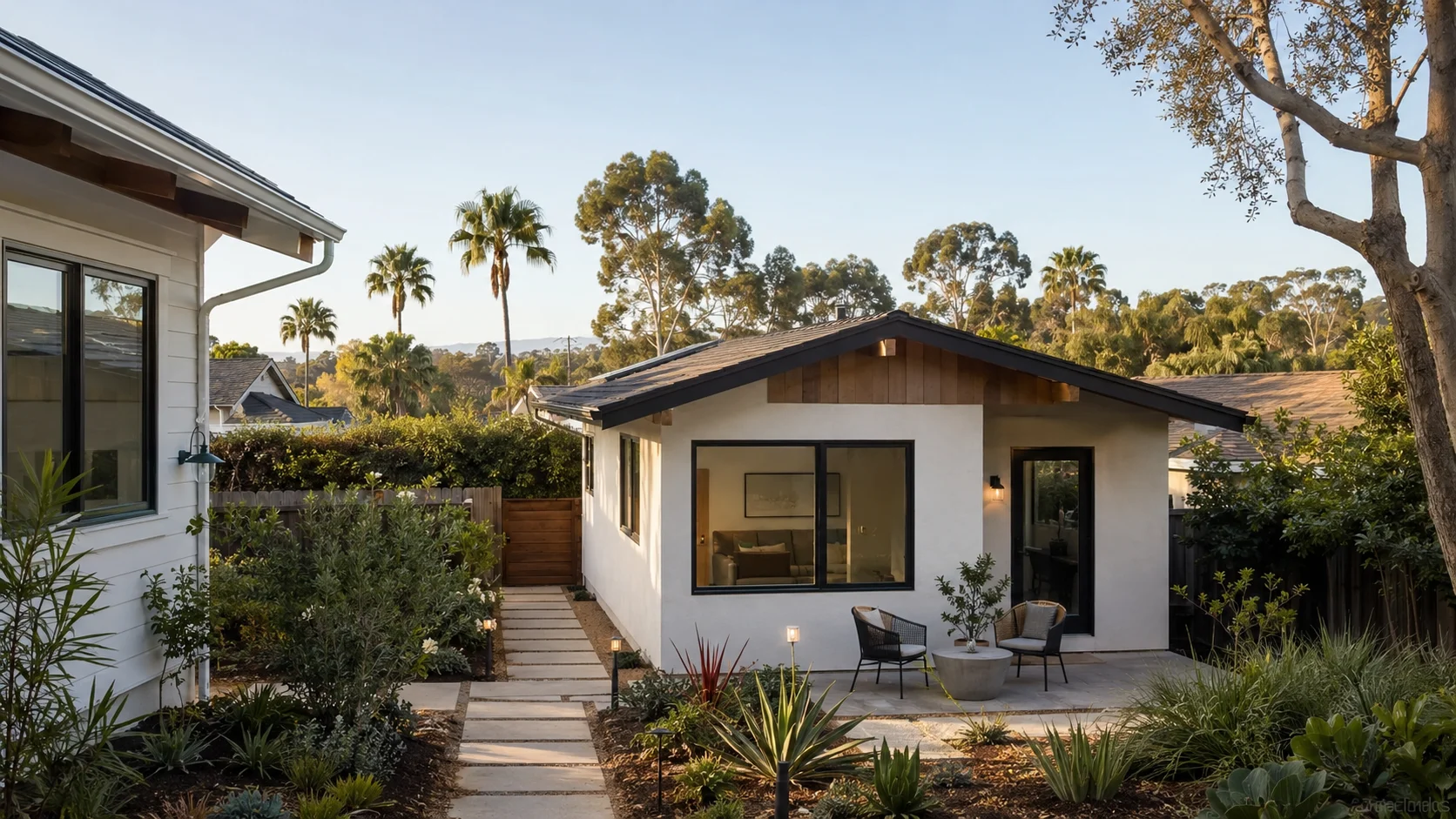
ADU Cost Encinitas (2026): The Real Number Behind the Quote
Last updated: May 15, 2026 · Last verified: May 15, 2026 · The Dwelling Index Editorial Team
The short answer. ADU cost in Encinitas typically runs $300,000 to $475,000 all-in for a new detached unit in 2026 — roughly $375 to $600 per square foot. Encinitas waives nearly all city plan-check and building-permit fees (averaging just $2–$4/sf, vs. $13–$28/sf in the City of San Diego), but homeowners still pay for soils reports, stormwater work, school impact fees for ADUs over 500 sq ft of interior livable space, sewer/water connection charges, SDG&E service work, and — on coastal-zone parcels — a no-fee Coastal Development Permit (CDPNF) that adds time more than dollars. The biggest cost drivers in 2026 aren’t the city’s fees. They’re sitework, utilities, and finish level. (Sources: City of Encinitas Development Services; SnapADU 2026 cost table; California Government Code §§66311.5, 66317, 66329, 66333; California DGS Construction Cost Index.)
Encinitas ADU Cost Snapshot (May 2026)
| ADU type | Typical size | Vertical build cost | All-in cost range | All-in $/sf |
|---|---|---|---|---|
| JADU (within primary home) | ≤ 500 sf | $50K–$120K | $60K–$150K | $120–$300 |
| Garage conversion | 300–500 sf | $90K–$180K | $120K–$220K | $300–$500 |
| Attached ADU | 800–1,200 sf | $250K–$350K | $325K–$475K | $325–$475 |
| Detached 1BR | 500 sf | ~$220K | ~$300K | ~$600 |
| Detached 2BR | 750 sf | ~$275K | ~$350K | ~$465 |
| Detached 2BR/2BA | 1,000 sf | ~$335K | ~$425K | ~$425 |
| Detached 3BR/2BA | 1,200 sf | ~$360K | ~$450K | ~$375 |
| Prefab / modular | Varies | $90K–$250K + sitework | $200K–$400K | $300–$500 |
Detached vertical-build benchmarks: SnapADU 2026 published cost table (updated March 2026), applicable to greater San Diego including Encinitas. Non-detached ranges are editorial composites informed by Better Place Design & Build’s San Diego cost guide and SnapADU sub-page data. SnapADU notes Encinitas all-in totals typically land $10K–$30K lower than equivalent City of San Diego projects because of Encinitas’s fee waivers. Verify with a feasibility study for your parcel.
See What You Can Build at Your Address
Encinitas costs swing hard on parcel-specific things — coastal overlay status, slope, sewer-vs-septic, school district, lot size, and whether your primary home limits ADU size. A generic range can’t answer “what’s my number.”
See What You Can Build → Get Your Free 60-Second ADU ReportReturns your coastal-zone status, likely permit path, and a parcel-specific cost range. Free, no signup.
How to use this guide
We wrote this for the homeowner who just received an ADU quote — or is about to ask for one — and isn’t sure whether the number is realistic. Every section answers a specific question we hear from Encinitas homeowners during early planning:
- “Is $400K really the floor here?”
- “What exactly is Encinitas waiving, and what’s still going to hit me?”
- “How much does coastal-zone status add?”
- “Why are two builder quotes $100,000 apart on the same lot?”
- “Will rent actually cover this?”
- “How do people pay for a $425K ADU at today’s rates?”
If you want adjacent rule, permit, or builder detail, those live on their own dedicated pages — linked at the relevant sections below.
How much does an ADU cost in Encinitas in 2026?
A new detached ADU in Encinitas typically lands in the $300,000–$475,000 all-in range for sizes between 500 and 1,200 sq ft, working out to roughly $375–$600 per square foot depending on size, finish level, and site conditions. JADUs and garage conversions can run well below $200K when feasible. Bluff-overlay or steep-slope parcels can push past $500K once geotechnical and structural requirements layer in.
“All-in” means the realistic cost of getting from “I want an ADU” to a finished unit with a certificate of occupancy — including feasibility, design, engineering, permits, sitework, utility connections, vertical construction, and standard finishes. It does not include the cost of land (you already own it), exotic finish upgrades, or major mid-project scope changes.
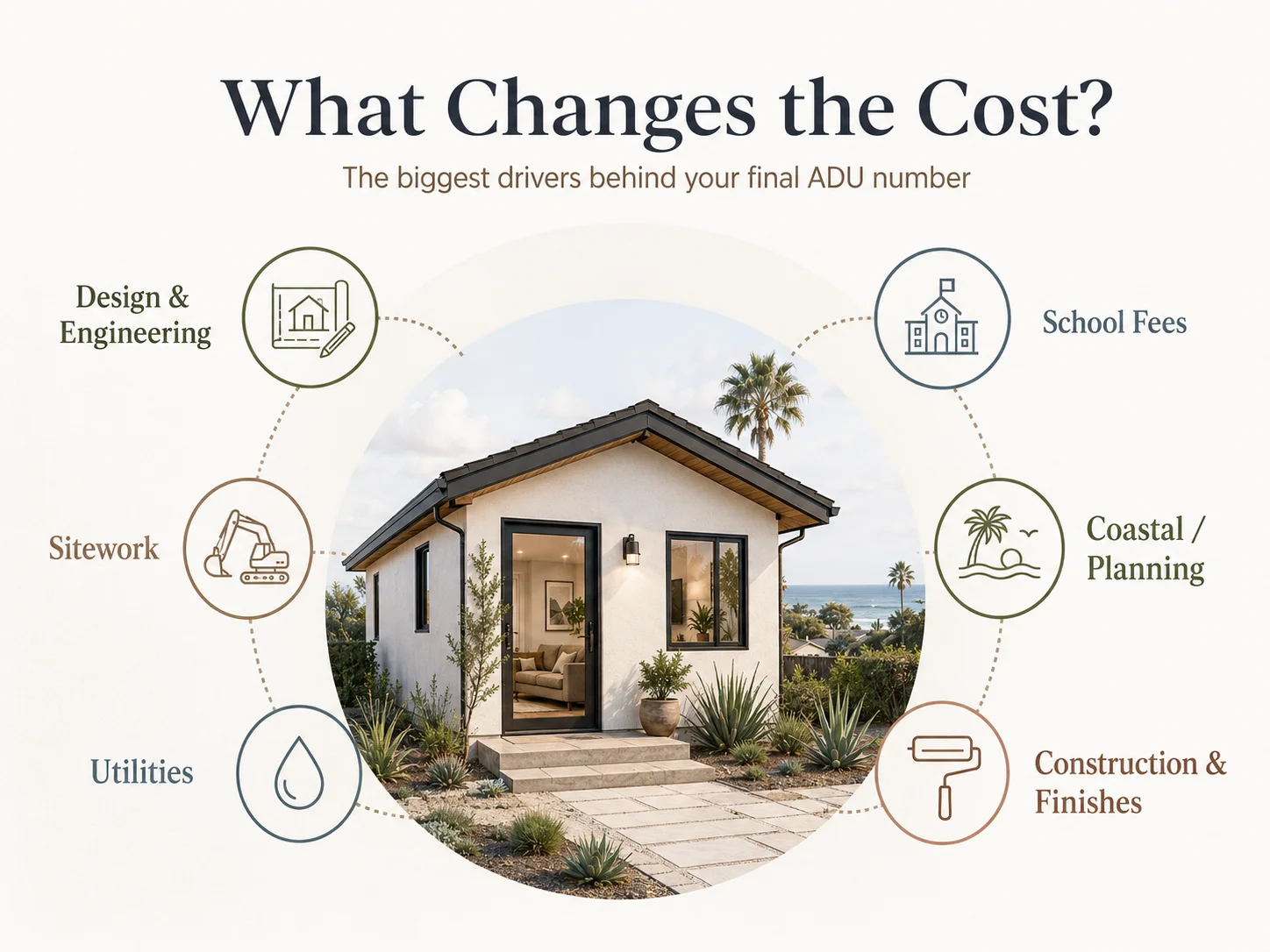
Key cost variables for an Encinitas ADU project in 2026. Source: The Dwelling Index editorial analysis.
Why per-square-foot is misleading for small ADUs
An ADU’s cost per square foot rises as the unit gets smaller. A 500 sq ft 1BR detached unit can land around $600/sf all-in, while a 1,200 sq ft 3BR comes in closer to $375/sf — because design, structural engineering, kitchen, bathroom, foundation, mobilization, and utility hookup are largely fixed costs that don’t shrink with floor area.
In SnapADU’s published 2026 cost model, a 1BR/1BA 500 sf detached unit prices around $220K vertical build / $300K all-in (~$600/sf), while a 3BR/2BA 1,200 sf detached unit prices around $360K vertical / $450K all-in (~$375/sf). Source: SnapADU cost table, last updated March 2026.
The takeaway. If your only goal is “lowest total project cost,” small wins. If your goal is “best per-square-foot value,” go bigger. These are different optimization problems and they pull you toward different ADU designs.
Construction-cost inflation since 2021
Encinitas isn’t immune to the statewide cost surge. SnapADU reports a roughly 44% increase in California construction costs from January 2021 through December 2025, based on the California Department of General Services Construction Cost Index (CCCI). That means an ADU that penciled at $300K in early 2021 underwriting now costs roughly $420K–$430K to build to the same spec.
If your search results show $250–$350/sf ADU figures, check the article’s date. Anything written before mid-2024 is structurally underpriced for 2026 Encinitas conditions.
A real Encinitas case study
Better Place Design & Build’s San Diego ADU cost guide cites an Encinitas example: a 1,000 sq ft ADU built for roughly $398,000, currently renting at $3,882/month. That single project lands inside our model’s 1,000 sf range and shows the rent comp is close to the Rentometer neighborhood median for 2BR units in 92024 (~$4,030/month).
Our own underwriting is more conservative than the source’s “positive cash flow almost immediately” framing — see the cash-on-cash section below. The point for now: the $300K–$475K all-in range isn’t a national estimate guessed at from a dashboard. It’s what Encinitas projects actually price at in 2026.
Next step if you’re sizing your project: Run your address through our free property feasibility check. It returns coastal overlay status, likely permit path, and a parcel-specific cost range in about 60 seconds.
What line items make up an Encinitas ADU cost?
An Encinitas ADU’s total cost decomposes into 12 line items. Three are mostly waived by the city. The other nine are where your money actually goes. Most builder quotes hide some of these inside other line items, which is how two bids on the same project can land $100,000 apart.
| Line item | Typical range | Who charges | Encinitas waives? |
|---|---|---|---|
| Feasibility study | $1,300–$2,400 | Builder / designer | No |
| Property reports (survey, topo, utility, soils) | $5,500+ | Third-party vendors | No — geotech required for new construction ≥500 sf |
| Construction drawings + Title 24 | $2,300–$8,500 | Designer | No |
| Permit management | $3,500+ | Builder / designer | Process — not a city charge |
| Plan-check & city building permit fees | Mostly waived | City of Encinitas | YES — net ~$2–4/sf |
| School impact fees | ~$5.17/sf over 500 sf | School districts | Triggers above 500 sf (SB 543) |
| Utility connection / capacity charges | Varies by provider | Water / wastewater districts | Impact fees waived ≤750 sf; connection charges apply |
| Coastal Development Permit (coastal zone) | ~$200 noticing + recording | City | CDPNF — no city fee; only postage and recording |
| Basic sitework & general conditions | ~$35,000 (level lot) | Builder | No |
| Vertical building construction | $200K–$400K+ | Builder | No |
| Additional sitework (grading, retaining, stormwater) | $5K–$50K+ | Builder | No |
| Utilities (SDG&E service, sewer/water tie-in, solar) | $15K–$30K+ | Utility + builder | No |
Sources: City of Encinitas ADU page; SnapADU 2026 cost stack; California Government Code §66311.5 (post-SB 543); SDG&E Apply for Service requirements. Verified May 15, 2026.
The honest admission. Encinitas waives more ADU fees than almost any other city in San Diego County, but that doesn’t make Encinitas cheap to build in. The fee savings — typically $8,000–$15,000 vs. the City of San Diego on an equivalent unit — are real but small compared to the $300K+ vertical build cost. Don’t pick Encinitas to save on permits; pick it because you already own there.
What sitework actually costs
The single biggest cost variability in any Encinitas ADU is sitework. The exact same unit can cost $30,000 more to build on a sloped Cardiff parcel than on a flat Olivenhain pad. Watch for:
- Demolition of existing flatwork, sheds, or trees: $5,000–$25,000.
- Grading and finish grading for the pad: $5,000–$30,000.
- Retaining walls on sloped lots: $10,000–$50,000+ depending on height and length.
- Stormwater mitigation (when applicable): roughly $5,000 for a bio-swale or drainage basin.
- Soils / geotechnical report (required for new construction ≥500 sf): $1,500–$3,500.
- Utility trenching if service is more than ~50 ft from the build site: $5,000–$20,000.
Bring a builder to the site early. The cheapest way to control sitework cost is design discipline — placing the ADU where the lot wants it, not where you want it.
What fees does Encinitas waive, and what fees still apply?
Encinitas has waived plan-check and most building-permit fees for ADUs since its 2018 ordinance and follow-on amendments. Net effective city permit cost in Encinitas runs about $2–$4 per square foot, vs. $13–$28/sf in the City of San Diego. That gap on a 1,000 sf ADU is roughly $10,000–$25,000 in pocket savings — before factoring school fees, utility connection charges, or any other non-city costs.
But “permit fees waived” is not the same as “no soft costs.” Here’s what still hits your budget.
What’s waived
- City plan-check fees for ADU review.
- City building-permit fees for ADU construction.
- Local development impact fees for any ADU (City of Encinitas).
- Statewide development impact fees for any ADU of 750 sq ft of interior livable space or less (Gov. Code §66311.5).
- Coastal Development Permit fees — Encinitas processes coastal ADU permits as no-fee CDPs (CDPNF).
What still applies
- State-mandated fees (small, fixed, included in the ~$2–$4/sf net figure).
- School impact fees if the ADU has more than 500 sq ft of interior livable space.
- Water and sewer connection / capacity charges (treated separately from impact fees under state law).
- Coastal noticing & recording fees if you’re in the coastal zone (~$200 postage + recording).
- Recording of the ADU covenant with the San Diego County Recorder.
- Geotechnical / soils report for new construction of 500 sf or greater.
- Stormwater mitigation when site impervious-area review triggers it.
- SDG&E service work for new electric (and sometimes gas) connections.
Who actually provides your water and wastewater service?
This trips up most homeowners and most early builder quotes. Encinitas parcels are served by different agencies for water and sewer, and which agency you’re under affects connection costs.
- Water provider is generally San Dieguito Water District or Olivenhain Municipal Water District (OMWD) by parcel.
- Wastewater/sewer provider varies — including Cardiff Sanitary Division, Encinitas Sanitary Division, Leucadia Wastewater District, or another agency depending on your parcel.
Identify your specific water and sewer providers in feasibility. Each has its own connection fee schedule.
The 500 / 750 sq ft fee-cliff matrix
Two size thresholds quietly drive thousands of dollars of fee difference. Both thresholds are now measured in interior livable space per SB 543 (effective Jan 1, 2026).
| ADU size (interior livable space) | Impact fees | School fees | Stormwater work | Soils / geotech |
|---|---|---|---|---|
| ≤ 500 sf | Waived (Gov. Code §66311.5) | Exempt (SB 543) | Triggered if impervious > 500 sf | Often not required under 500 sf |
| 501–749 sf | Waived (Gov. Code §66311.5) | Triggered (~$5.17/sf in EUSD + SDUHSD) | Triggered | Required for new construction ≥500 sf |
| 750+ sf | Statutory impact-fee waiver ends; connection/capacity charges apply | Triggered | Triggered | Required |
| The 750-sq-ft hinge | Material — proportional fees activate just above 750 sf | — | — | — |
The 750-sq-ft strategy. If your concept is at 760 sq ft of interior livable space, ask your builder whether dropping 11 sq ft to 750 changes your fee math. The answer is sometimes “no” and sometimes “yes — $3K–$8K of savings.” On larger detached builds, the same hinge between 750 and 800 sf can swing $10K–$20K once connection capacity and proportional charges engage. This is a 30-minute conversation with your builder during feasibility, not a $300K decision to be made by accident.
School fee math (verify with your district)
For parcels in the EUSD + SDUHSD combination — covering most of Old Encinitas, New Encinitas, and Leucadia — the combined developer fee was approximately $5.17 per square foot based on the most recent published fee studies.
| ADU size | Estimated school fees (EUSD + SDUHSD parcel) | Notes |
|---|---|---|
| 500 sf | $0 | Exempt under SB 543 |
| 750 sf | ~$3,878 | 750 × $5.17 |
| 1,000 sf | ~$5,170 | Verify district before paying |
| 1,200 sf | ~$6,204 | Cardiff and far-south parcels may use a different rate |
District fee rates current as of the most recently published San Dieguito Union High School District fee schedule and Encinitas Union School District fee study. Re-verify with your builder or directly with the relevant school district before relying on these figures for budgeting.
SDG&E service work — the line item nobody itemizes
If you’re building a new detached ADU, you almost certainly need new SDG&E service. This is a separate workflow from the city permit and runs on its own timeline. SDG&E’s published guidance directs ADU applicants to:
- Submit a Builder Services application via SDG&E Apply for Service with site plan, electrical load calculation, and proposed meter location.
- Allow roughly 10–15 business days for SDG&E review.
- Coordinate disconnect/reconnect of the existing main meter if the service entrance is being modified — adding another 1–2 weeks to the timeline.
Budget $3,000–$10,000 for an SDG&E-coordinated panel upgrade if needed, and another $5,000–$15,000 for trenching and conduit if the new meter location is more than ~50 ft from existing service.
The honest read: SDG&E work is the most commonly under-quoted line item we see in early ADU bids. Ask explicitly: “Does this quote include the SDG&E Builder Services application, panel upgrade if needed, and trenching to the new meter?” If the answer is vague, it’s not included.
How much does the coastal zone add to an Encinitas ADU?
Most of Encinitas — including all of Cardiff (92007), most of Leucadia, and the corridor west of Interstate 5 — sits inside California’s Coastal Zone. For ADUs that aren’t entirely contained within an existing primary structure, this means a Coastal Development Permit (CDP) is generally required. Encinitas issues these as no-fee CDPs (CDPNF), so the direct cost is modest: roughly $200 in noticing/postage fees plus recording costs. The real premium is time, not money.
What triggers a coastal permit in Encinitas
A CDPNF is generally required for ADUs and JADUs in the coastal overlay zone that:
- Are not completely contained within the existing primary structure.
- Include increases in habitable area.
- Convert non-habitable space.
- Are considered detached residential units.
A JADU created entirely within the existing home’s footprint, with no exterior changes, typically does not trigger a CDPNF.
AB 462 and the 60-day clock
California Government Code §66329, as amended by AB 462, took immediate effect on October 10, 2025 as an urgency measure. AB 462 requires local agencies to approve or deny an ADU coastal development permit within 60 days of a complete application and process it concurrently with the ADU building permit.
The wrinkle worth knowing. Gov. Code §66329(c) now states that a local agency’s ADU CDP decision is not subject to appeal under Public Resources Code §30603. The City of Encinitas’s January 2026 ADU/JADU guide still describes a 10-business-day California Coastal Commission appeal window. The state statute now overrides that older process for qualifying ADU CDPs. If your builder or city planner cites the older appeal-window language, ask whether they’re working from the current Gov. Code §66329(c).
The CDPNF process timeline
The Encinitas CDPNF process runs concurrent with the building permit:
- Your Land Development & Building reviewer opens the CDP record once the building permit application is routed.
- You upload a streamlined CDP set (title sheet, site plan, floor plans, elevations, roof plan) plus grant deed and preliminary title report.
- A bright-colored 11” × 17” sign is printed and posted on the property.
- The city mails legal notice to surrounding properties within a 500-square-foot radius (about $200 in postage).
- A 10-day public comment period opens.
- The city drafts a Notice of Decision; the Planning Manager reviews and signs.
- You return a notarized covenant and Hold Harmless agreement, with payment to the San Diego County Recorder.
- Notice of Final Action is filed.
The building permit can’t issue until the CDP issues and all department conditions are addressed. For the full coastal walkthrough including 2025 case examples and bluff-overlay specifics, see our dedicated Encinitas Coastal Zone ADU guide.
The Coastal Bluff Overlay — when geometry matters
Encinitas Municipal Code §30.34.020 establishes the Coastal Bluff Overlay Zone. Additions in the Coastal Bluff Overlay — including ADUs — are limited to 10% of the existing residence area or 250 sq ft, whichever is greater, and are subject to geotechnical setbacks.
If your parcel includes a bluff edge, confirm both the size limit and the geotechnical setback before paying for design. Some Cardiff and Leucadia lots have a usable backyard but the buildable area for an ADU collapses once these overlay constraints apply. A 30-minute call with a city planner using your APN can save you $10,000–$20,000 in plans you can’t use.
Hillside / Inland Bluff Overlay (HIBO)
Parts of Encinitas — particularly in Olivenhain and the inland edges — fall within the Special Study Overlay Zone, which can trigger the Hillside/Inland Bluff Overlay (HIBO) if slopes exceed 25 percent. On HIBO parcels, expect $20,000–$60,000+ in additional geotechnical, structural, retaining, and grading work compared to a flat pad of the same size.
Why can two Encinitas ADU quotes be $100,000 apart?
Two builder quotes on the same Encinitas project can land $80,000–$120,000 apart not because one is cheating you, but because they’re pricing different scopes. One quote often prices vertical construction and standard allowances. The other prices the actual all-in delivered project. Both can be technically truthful; only one matches the budget you’ll actually spend.
The biggest scope omissions we see in cheap bids:
1. Soft costs not included
Feasibility study, property reports (boundary, topo, utility, soils, title), construction drawings beyond a base template, Title 24 energy compliance documentation, and permit management labor. A “cheap” quote often quietly drops $15,000–$30,000 of soft costs.
2. Sitework allowance is artificially low
A bid that lists “sitework: $25,000” on a sloped Cardiff lot is either underpriced or doesn’t include the grading and retaining you’ll need. Real sitework on most Encinitas detached builds runs $35,000–$80,000 once stormwater, soils, demolition, and trenching are honestly priced.
3. Utilities not itemized
Watch for “utilities allowance: $10,000” with no breakdown. Real utility scope for a new detached ADU in Encinitas typically runs $20,000–$35,000.
4. Finish allowances are below market
If the cabinet allowance is $4,000 for a 750 sf 2BR ADU, you’ll exceed it on day one of selections. Industry-standard semi-custom cabinet packages in 2026 run $8,000–$15,000 for a small ADU kitchen.
5. Contingency is missing
Professional builders carry 5–10% contingency on a fixed-price ADU. A bid with zero contingency line is shifting your risk to your wallet via change orders.
Quote decoder — print this before your next bid review
Ask each builder these explicitly. Get answers in writing.
- Is the quote all-in (design + permits + sitework + construction + utilities + finishes), or construction-only?
- Are feasibility, surveys, soils report, and Title 24 included?
- What's the sitework allowance and what does it cover?
- Are SDG&E Builder Services application, panel upgrade (if needed), and trenching included?
- Are water/sewer tie-in and connection/capacity charges included?
- Are school fees (over 500 sf of interior livable space) included or excluded?
- Are coastal noticing fees and recording fees included?
- Is stormwater mitigation (if applicable) included?
- What are the finish allowances — and are they realistic for current cabinet/tile/appliance pricing?
- What's the contingency line and who controls it?
- What's the policy on change orders and price increases mid-build?
This 11-question script will eliminate 80% of the bid-comparison confusion homeowners we hear from struggle with.
Have a quote in hand? Run your address through our free 60-second feasibility check and compare what the quote includes against what your specific parcel will actually trigger.
Run Your Free Feasibility Check →Want a vetted Encinitas builder estimate?
Affiliate disclosure: SnapADU is a Dwelling Index partner. If you book through our link we may earn a commission at no extra cost to you. Our editorial recommendations are independent.
SnapADU is our verified Greater San Diego ADU builder partner — CSLB License #1075582, 100+ ADUs completed across San Diego County, with documented Encinitas projects in Cardiff, Leucadia, and Olivenhain. SnapADU offers a Price Lock during feasibility and design, which fixes construction cost before plans go to permit submittal.
Get a vetted Encinitas ADU quote with SnapADU →Use the quote decoder above when you compare any builder bid, including SnapADU’s.
When does a PRADU plan actually save money?
The City of Encinitas Permit-Ready Accessory Dwelling Unit (PRADU) program offers 8 city-approved ADU plans in sizes from 224 sf to 1,199 sf, from two architecture firms (Design Path Studio and DZN Partners). On paper, PRADU should be the cheapest, fastest path. In practice, PRADU saves design time and modest design fees, not construction cost — and the permit timeline isn’t materially faster than a custom plan.
What PRADU actually saves
- Design fees: $2,000–$5,000 saved vs. a custom set
- First plan-check round friction: reviewers know the plans
- Decision fatigue: 8 vetted options vs. blank canvas
What PRADU doesn’t save
- Construction cost (identical vertical build)
- Site adaptation (property-specific reports still required)
- Permitting time (not materially faster in practice)
When PRADU is the right call: your lot is clean (flat, sewer-served, not on a bluff, not in HIBO), one of the 8 plans genuinely fits your needs, and you’re working with a builder who has built that specific plan before.
When custom is the right call: none of the 8 plans fits your lot orientation or program, you want non-standard finishes requiring plan modifications, or you’re combining the ADU with a remodel of the primary home.
For the full PRADU plan-by-plan comparison with sizes, bedroom counts, and visual layouts, see our dedicated Encinitas Pre-Approved ADU Plans guide.
Does prefab actually save money in Encinitas?
Prefab and modular ADUs can save money on small units (typically under 600 sf) where the factory’s fixed-cost efficiency beats on-site mobilization. Once you cross roughly 800 sf, prefab and site-built often land within $10,000–$30,000 of each other in real Encinitas conditions, because the delivered prefab sticker price doesn’t include sitework, foundation, crane delivery, utility connections, and city fees. The bigger prefab advantage in Encinitas is usually time — 2–4 months faster to occupancy — not raw cost.
The sticker-vs-delivered gap
Prefab quotes you see online are almost always for the unit itself, sometimes including delivery and “set” but rarely including:
- Foundation (slab, footings, or piers)
- Sitework (grading, trenching, demolition)
- Utility connections (electric, water, sewer, gas)
- SDG&E Builder Services and panel work
- City fees, school fees, capacity charges
- Permit management
- Finish work left for the field
- Solar/Title 24 if required
A factory unit advertised at $89K–$178K typically delivers all-in at $200K–$400K once Encinitas sitework, utilities, and fees are layered in.
Three prefab construction methods, decoded
| Method | What it means | Best for | Watch for |
|---|---|---|---|
| HUD-code (manufactured) | Built to federal HUD-Code standards, set on a permanent foundation. Lower sticker. | Tight budget, simple lot | Some lenders won't finance as a standard mortgage; exterior compatibility rules can constrain options |
| Modular (California Building Code) | Built in factory to the same code as site-built; finished on site. | Speed + similar code basis to stick-built | More expensive than HUD-code; crane access may be needed |
| Panelized | Walls, roof, and floors built in panels; assembled on site. | Mid-tier cost; flexibility | Less time savings than modular; more on-site finish work |
Per the City of Encinitas, architectural building materials of the ADU must be compatible with the primary residential structure. This is a real constraint on some prefab brands. Confirm exterior compatibility with city planning before committing to a specific prefab provider. Also confirm crane access: if your driveway is under 12 ft wide or your alley is blocked by power lines, you may need a panelized or stick-built approach.
What is the cheapest way to build an ADU in Encinitas?
The three lowest-cost ADU paths in Encinitas are (1) a Junior ADU (JADU) inside the primary home, (2) a garage conversion, and (3) a new detached unit kept to 750 sq ft or less of interior livable space to capture the full statutory impact-fee waiver. Each has distinct tradeoffs in privacy, rental value, and lot utilization.
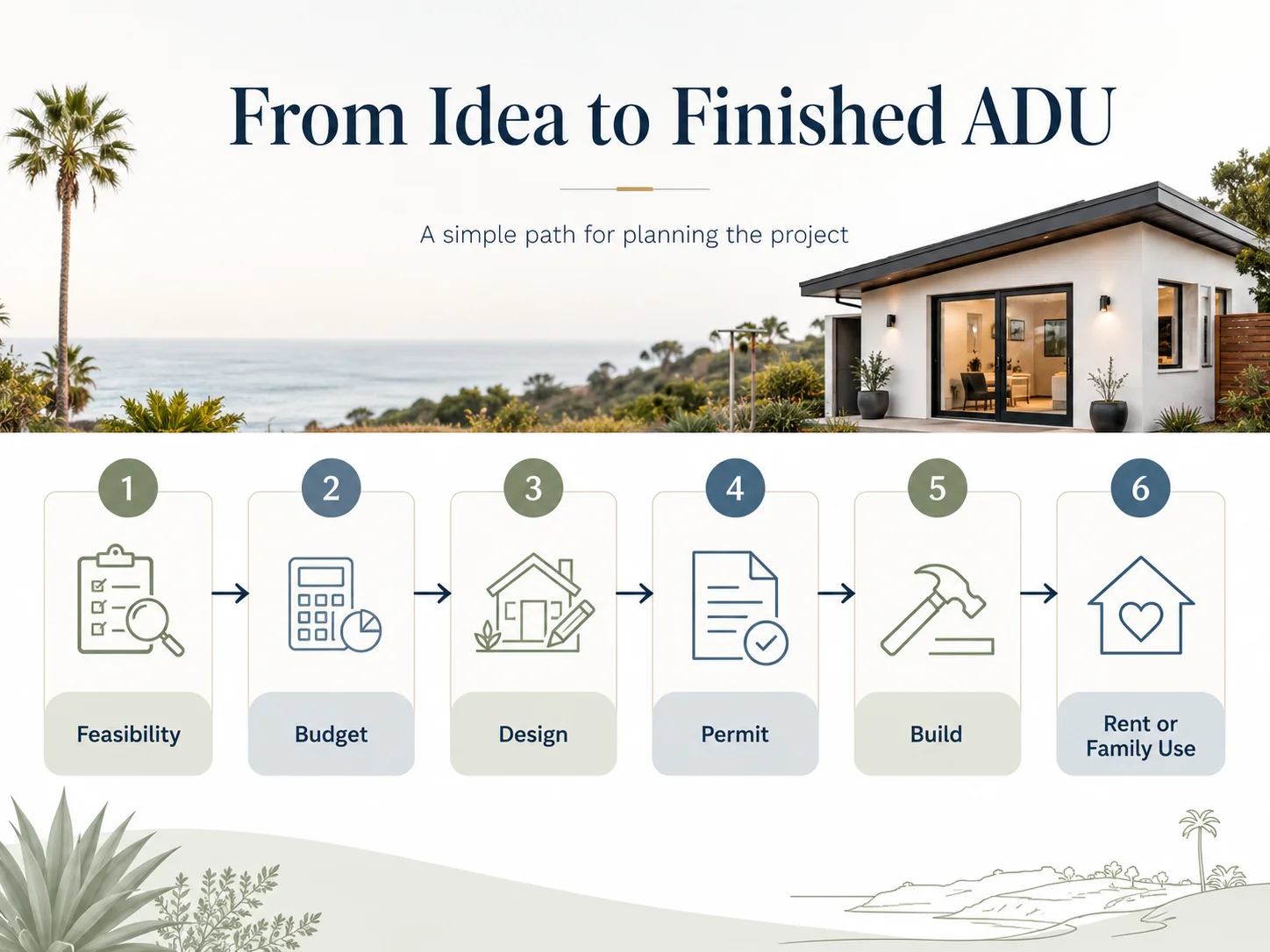
The stages of an Encinitas ADU project from first feasibility through occupancy. Source: The Dwelling Index editorial analysis.
Path 1: JADU — $50,000 to $150,000
A JADU is a junior accessory dwelling unit: up to 500 sq ft, built within the existing primary residence, with an efficiency kitchen. JADUs are the cheapest legal way to add a permitted second unit.
Pros
- Lowest construction cost — no new foundation or full plumbing run
- Faster permitting (typically under 60 days)
- No school fees (≤500 sf exempt under SB 543)
- Owner occupancy required only if sharing sanitation (AB 1154)
Cons
- Lower rent ceiling than standalone 1BR
- Less privacy (shared building)
- No short-term rental (minimum 30-day term)
- Cannot be sold separately
Path 2: Garage conversion — $120,000 to $220,000
Converting an existing detached garage to an ADU typically costs $120K–$220K all-in. The headline savings come from reusing the existing slab, walls, and roof. The real costs come from upgrading insulation, electrical, plumbing, egress windows, and bringing the structure to current California Building Code.
Path 3: Sub-750 sq ft detached — $300K to $375K
A new detached ADU at 750 sq ft or less of interior livable space captures the full statutory impact-fee waiver under Gov. Code §66311.5, avoids the city’s larger-ADU connection capacity scaling, and is small enough to fit on most Encinitas lots without setback or lot-coverage issues.
Fixed costs spread across a small footprint drive $/sf up to ~$465/sf all-in on a 750 sf unit, but total project cost is the lowest among new construction options.
Decision framework
| Your goal | Best path | Approx. all-in cost |
|---|---|---|
| Aging parent close but separate | JADU or garage conversion | $50K–$220K |
| Adult child returning, lowest cost | JADU | $50K–$150K |
| Rental income, optimize ROI | 750 sf detached 1BR or 1,000 sf 2BR/2BA | $300K–$425K |
| Future flexibility (sell or rent later) | Detached 1,000 sf 2BR/2BA | ~$425K |
| Maximum equity build | 1,200 sf 3BR/2BA detached when lot supports it | ~$450K |
| Lowest-disruption build process | JADU > garage conversion > new detached | Varies |
| Maximum privacy | New detached (largest you can build) | $400K–$475K+ |
How much can you rent an Encinitas ADU for by ZIP code?
Encinitas ADUs in Cardiff (92007) and Leucadia + Old/New Encinitas (92024) command some of the highest ADU rents in San Diego County. As of March 2026, median rents for ADU-comparable units are roughly $2,250–$2,410/month for a 1BR, $3,990–$4,030/month for a 2BR, and $5,100–$5,300/month for a 3BR. Encinitas prohibits short-term rentals from ADUs — minimum 30-day rental terms required, reinforced by AB 1154 (effective January 1, 2026).
| ZIP code | Neighborhood | 1BR median | 2BR median | 3BR median |
|---|---|---|---|---|
| 92007 | Cardiff-by-the-Sea | $2,245 | $3,990 | $5,300 |
| 92024 | Leucadia, Old Encinitas, New Encinitas, Olivenhain | $2,410 | $4,030 | $5,100 |
Source: SnapADU Encinitas regulations page, citing Rentometer March 2026 zip-code medians. Cross-check current Zillow Rent Index and Apartments.com listings for your specific bedroom count before pro forma’ing.
Rental compliance notes
- No short-term rentals. Encinitas requires a minimum 30-day rental term for ADUs and JADUs.
- No separate sale. ADUs in Encinitas cannot be sold separately from the primary residence as of May 2026.
- Owner-occupancy not required for ADUs under Gov. Code §66323.
- Owner-occupancy for JADUs is required only when the JADU shares sanitation facilities with the primary residence (Gov. Code §66333(b), as amended by AB 1154 effective January 1, 2026).
- Property tax reassessment triggers on the value of the new construction only, not on your existing home (per California Proposition 13).
Rental income projections are illustrative examples, not guarantees of returns. Actual results depend on local market conditions, construction costs, financing terms, vacancy, property management, and regulatory approvals.
Does it pencil? Cash-on-cash by ADU type
Whether an Encinitas ADU pencils as an investment depends on three numbers: all-in build cost, achievable rent, and financing rate. Below are two illustrative pro formas — one bullish (2BR in Leucadia), one tight (1BR in Cardiff). Financing assumption used below is illustrative, not a rate quote.
Example A — 1,000 sf 2BR/2BA detached in Leucadia (92024)
| Line | Value |
|---|---|
| All-in build cost | $425,000 |
| Gross monthly rent (2BR median 92024) | $4,030 |
| Annual gross rent | $48,360 |
| Less ~25% for vacancy, taxes on new construction, repairs, management | -$12,090 |
| Net operating income (illustrative) | $36,270 |
| Cap rate on build cost (NOI ÷ build) | ~8.5% |
That cap rate looks healthy. The honest catch: If you’re financing 100% of the $425K build at an illustrative 8% blended rate, interest alone runs roughly $34,000/year. Net cash flow after debt service: about $2,270/year, or $190/month. The deal pencils — barely — and you’re earning long-term equity in a new asset, plus appreciation.
Example B — 500 sf 1BR detached in Cardiff (92007)
| Line | Value |
|---|---|
| All-in build cost | $300,000 |
| Gross monthly rent (1BR median 92007) | $2,245 |
| Annual gross rent | $26,940 |
| Less ~25% | -$6,735 |
| Net operating income (illustrative) | $20,205 |
| Cap rate on build cost | ~6.7% |
At an illustrative 8% blended rate on $300K, interest runs $24,000/year. Net cash flow after debt service: negative ~$3,800/year. The 1BR Cardiff deal does not pencil on full financing at illustrative 2026 rates. It works as a partial-cash deal, as a family-housing project, or as a long-term appreciation play.
The honest read on ROI
The Encinitas ADU math in 2026 is most attractive when:
- You’re building 1,000+ sq ft in a 92024 zip code.
- You can finance with significant equity (50%+) rather than 100% debt.
- You’re optimizing for property value increase + family use as much as for cash flow.
- You’re comfortable with a 5–10 year hold to capture appreciation.
If the cash-on-cash doesn’t pencil for you, the ADU may still make sense — but as a family housing solution, an equity build, or a long-term real estate play, not as a current-yield investment.
These are illustrative examples, not guarantees of returns. Actual results depend on local market conditions, construction costs, financing terms, vacancy, property management, and regulatory approvals.
How do people finance an Encinitas ADU?
Encinitas homeowners typically finance ADUs through one of four lanes: cash-out refinance, HELOC (home equity line of credit), construction-to-perm loan, or a renovation-specific product like FHA 203(k), Fannie HomeStyle, or a renovation HELOC. The CalHFA ADU Grant — the famous $40,000 California predevelopment reimbursement grant — has been paused since December 28, 2023, with no relaunch date confirmed by CalHFA as of May 15, 2026.
CalHFA grant status (May 15, 2026): The CalHFA ADU page is the source of truth. CalHFA has explicitly stated funding was fully allocated and warned that anyone claiming to “help you access” current grant funds is running a scam. The City of Encinitas’s ADU page may still reference CalHFA — verify directly with CalHFA on your decision date.

Common financing paths for Encinitas ADU projects in 2026. Source: The Dwelling Index editorial analysis.
Financing lane decision matrix by project size
| Project all-in size | Most common financing path | Why |
|---|---|---|
| $50K–$150K (JADU or simple conversion) | Cash, small HELOC, or personal/family financing | Project size often below what a construction-to-perm makes sense for |
| $200K–$300K (garage conversion or sub-750 detached) | HELOC or cash-out refi | Sufficient equity available in most Encinitas homes |
| $300K–$475K (standard detached) | HELOC, cash-out refi, or construction-to-perm | All three viable; rate environment and existing mortgage determine the winner |
| $500K+ (coastal-complicated, bluff, or premium) | Construction-to-perm or large HELOC | Larger balances make single-closing worthwhile |
The four financing lanes
1. Cash-out refinance
Refinance your existing primary mortgage at today’s rate, taking equity out as cash for the ADU. Works well when current rates are at or below your existing rate. Hurts when current rates are materially higher — you give up a cheap legacy rate in exchange for liquidity.
2. HELOC (home equity line of credit)
Keep your existing primary mortgage. Borrow against equity as a revolving line, draw as the ADU is built, pay interest on what you’ve drawn. Variable-rate by default. The dominant choice for Encinitas homeowners who bought before 2022.
3. Construction-to-perm loan
Purpose-built loan that funds the build in stages then converts to a permanent mortgage on completion. Single closing, one set of fees. Often the cleanest path for homeowners with limited existing equity but strong income and credit.
4. Renovation loans
FHA 203(k), Fannie HomeStyle, RenoFi-style products. These let you borrow against after-renovation value, which can help when current equity is thin. Availability and product details vary by lender and state.
The City of Encinitas does not currently offer a homeowner ADU grant program comparable to the paused CalHFA grant. Encinitas’s incentive is structural — the fee waiver described earlier, which is functionally a $8K–$25K reduction in project cost depending on size.
Affiliate disclosure: Mortgage Research Center is a Dwelling Index partner. If you complete an application via our link we may earn a commission at no extra cost to you. Our editorial framing of financing paths is independent.
Explore current mortgage and refinance options: Compare cash-out refinance, HELOC, and construction-loan paths through Mortgage Research Center — a Dwelling Index partner for mortgage and refinance education.
Compare ADU Financing Options at Mortgage Research Center →The Dwelling Index is not a lender. We do not originate loans, set rates, or guarantee approval. Specific rate, payment, and qualification terms must come from a licensed lender.
For a full lane-by-lane comparison with what each is actually best for, see ADU Financing Options.
What changed in 2025–2026 California ADU law that affects Encinitas cost
Eight state law changes and code-reference updates since 2024 affect what an Encinitas ADU costs to permit and build. Most are favorable.
| Law | Effective | What it changes for Encinitas cost |
|---|---|---|
| AB 976 | Jan 1, 2024 | Permanently bans owner-occupancy requirements for standard ADUs. Improves rental flexibility — doesn't lower build cost but improves long-term yield. |
| AB 2533 (Gov. Code §66311.7) | Jan 1, 2025 | Prohibits cities from denying a permit for an unpermitted pre-Jan-2020 ADU unless a substandard condition is found. Creates a legalization path for existing structures. |
| SB 1211 | Jan 1, 2025 | Multifamily lots can build up to 8 detached ADUs. No replacement parking required when a garage is demolished/converted for ADU construction (subject to Encinitas's coastal exception). |
| AB 1332 | Jan 1, 2025 | Cities must accept third-party preapproved ADU plans and post them publicly. Cities must approve or deny pre-approved plan applications within 30 days. |
| SB 477 | 2024 | Relocated ADU code sections into a new Government Code chapter. Reference change — no cost impact, but most older articles use stale section numbers. |
| AB 462 (Gov. Code §66329) | Oct 10, 2025 (urgency measure) | Streamlines coastal-zone ADU permits. Local agencies must approve or deny an ADU coastal development permit within 60 days. Gov. Code §66329(c) removes Coastal Commission appeal pathway for qualifying ADU CDPs. |
| AB 1154 (Gov. Code §66333) | Jan 1, 2026 | Owner-occupancy for JADUs is now required only when the JADU shares sanitation facilities with the primary residence. JADUs with their own bathroom are exempt from owner-occupancy. Also prohibits JADUs from short-term rentals. |
| SB 543 (Gov. Code §§66311.5, 66317) | Jan 1, 2026 | ADU/JADU size thresholds are now measured in interior livable space. Impact-fee waiver applies to ADUs ≤750 sf of interior livable space; ADUs/JADUs ≤500 sf of interior livable space are exempt from school impact fees. |
Sources: California Legislative Information; Best Best & Krieger ADU legal alert, November 7, 2025; California HCD 2026 ADU Handbook; Justia Gov. Code §66329, §66317, §66311.5, §66333.
What Encinitas rules can change the cost?
Beyond the fee structure, several Encinitas-specific rules affect what’s physically possible — and therefore what your project costs. For the full legal walkthrough, see our Encinitas ADU Laws page.
Size limits
- Detached ADU: up to 1,200 sf, but no larger than the primary residence (with state-law minimums protecting at least 800 sf, or up to 1,000 sf with two or more bedrooms).
- Attached ADU: up to 50% of the primary dwelling’s floor area, or 1,200 sf, whichever is less.
- JADU: up to 500 sf of interior livable space, within the primary structure.
Setbacks
- Side and rear: minimum 4 feet for ADUs that don’t exceed 16 feet in height. Above 16 feet, comply with underlying zone setbacks.
- Two-story ADUs: generally require the underlying zone setbacks (not the reduced 4-foot ADU setback).
- Building separation: minimum 6 feet wall-to-wall between the primary residence and the ADU, with a minimum 4 feet eave-to-eave.
Parking
- No parking required if within ½ mile walking distance of public transit, in a historic district, or converted from existing space.
- No replacement parking required generally when a garage is demolished or converted (per SB 1211).
- Coastal exception: Properties west of Coast Highway 101, between Swami’s and La Costa Avenue, must replace removed parking.
Owner occupancy and rental rules
- Owner occupancy not required for standard ADUs (Gov. Code §66323).
- JADUs: owner occupancy required only if sharing sanitation facilities with the primary residence.
- Short-term rentals (under 30 days) are NOT allowed for ADUs or JADUs.
- Cannot sell the ADU separately from the primary residence.
How long does it take to build an ADU in Encinitas?
The realistic Encinitas ADU timeline from feasibility to certificate of occupancy is 8 to 12 months for a straightforward inland project, and 9 to 14 months for a coastal-zone project. SnapADU publishes a permitting-only timeline of 4–5 months for both standard and coastal Encinitas ADUs. Construction adds another 4–7 months depending on size and complexity.
| Stage | Typical duration | Notes |
|---|---|---|
| Feasibility & site review | 2–4 weeks | Builder site walk, initial budget, identification of cost flags |
| Property reports (survey, soils, utility) | 2–6 weeks | Often runs parallel with design |
| Construction drawings + Title 24 | 6–10 weeks | Custom is slower; PRADU adaptation faster |
| Permit application submittal | 1 week | Through the Encinitas CSS portal |
| Completeness review | Up to 15 business days | Per SB 543; if missed, application deemed complete |
| First plan-check round | ~15 working days | Per City of Encinitas published target |
| Revisions (typical 1–2 cycles) | 4–8 weeks | Depends on completeness of first submittal |
| CDPNF process (if coastal) | 4–8 weeks | Runs concurrent; 10-day public comment period |
| Building permit issuance | 1–2 weeks after final approval | Coordination with applicant on fees, forms, recording |
| SDG&E Builder Services application | 10–15 business days + install scheduling | Often the slowest external dependency |
| Vertical construction | 4–7 months | Varies by size and complexity |
| Final inspections & C of O | 2–4 weeks | Multiple inspections (rough, frame, MEP, final) |
Once your application is complete, California law requires the city to approve or deny within 60 days for ADU permits (Gov. Code §66317), and within 60 days for ADU coastal development permits (Gov. Code §66329, per AB 462).
For the full eight-step permit walkthrough with each fee invoice and document required, see our Encinitas ADU Permit Process guide.
Edge cases that change your number
Five lot conditions can swing your Encinitas ADU cost by $30,000–$100,000 or more. Identify these in feasibility, not in framing.
1. Septic instead of sewer
Most of Encinitas is on city sewer. A handful of older parcels, particularly in Olivenhain, are still on septic. Adding a second dwelling unit on a septic system typically triggers a capacity review and sometimes a full replacement. Add $15,000–$60,000+ for septic-system work if applicable.
2. Coastal Bluff Overlay (EMC §30.34.020)
Additions in the Coastal Bluff Overlay are limited to 10% of the existing residence area or 250 sf, whichever is greater, and are subject to geotechnical setbacks. On affected Cardiff and Leucadia parcels, the overlay can collapse the buildable area for an ADU below the minimum useful footprint. Verify before paying for design.
3. HIBO / 25% slope (Special Study Overlay)
The Hillside / Inland Bluff Overlay restricts encroachments into natural steep slopes of 25% or greater gradient. On affected parcels, add $20,000–$60,000+ in geotechnical, structural, retaining, and grading work.
4. HOA restrictions
California state law (AB 670, effective 2020) prohibits HOA bans on ADUs. But HOAs can still impose architectural compatibility standards that add finish cost. Read your CC&Rs. Add $10,000–$40,000 to finish budget if your HOA mandates premium siding, roof, or window packages.
5. Existing utilities far from build site
If your nearest water, sewer, or electric service is more than ~50 feet from the proposed ADU site, add $5,000–$20,000 for trenching, conduit, and connection work.
None of these are project-killers on their own (except the bluff offset on some parcels). All of them are project-budget-killers if you don’t identify them before design. This is the single highest-leverage use of an early feasibility study.
What should you verify before paying for ADU plans?
Before you pay any architect or design-build firm for custom plans, verify the following about your parcel. Each is a 30-minute task or less, and any of them can save you from paying $10,000–$30,000 in plans you can’t use.
You can do most of this in an afternoon with the City of Encinitas e-zoning tool, a quick assessor lookup, and a phone call to the relevant water and sewer agencies.
Or skip the checklist work entirely. Run your address through our free 60-second feasibility check and we’ll surface coastal-zone status, likely permit path, and parcel-specific cost flags before you pay for anything.
Get Your Free ADU Property Check →ADU Cost Encinitas: The Bottom Line in 30 Seconds
- •Budget $300,000 to $475,000 all-in for a new detached Encinitas ADU in 2026. JADUs and garage conversions can run below $200K. Bluff or steep-slope projects can push past $500K.
- •Encinitas waives the city’s plan-check and building-permit fees. That saves ~$10K–$25K vs. the City of San Diego on an equivalent unit.
- •What you’ll still pay: school fees over 500 sf interior livable space, water/sewer connection charges, SDG&E service work, geotech for new construction ≥500 sf, stormwater mitigation when triggered, coastal noticing if applicable, and recording fees.
- •The 750-sq-ft hinge triggers proportional fee increases. Designing at 750 sf or less of interior livable space captures the full impact-fee waiver under Gov. Code §66311.5.
- •Coastal Zone parcels need a no-fee Coastal Development Permit (CDPNF). AB 462 (effective October 10, 2025) imposes a 60-day clock and removes the Coastal Commission appeal pathway under Gov. Code §66329(c).
- •The biggest cost variability is sitework — septic, slope, retaining, stormwater, utility trenching. Identify these in feasibility, not in framing.
- •Two builder quotes can land $100K apart on the same project because they’re pricing different scopes. Use the quote decoder before signing anything.
- •The CalHFA $40K ADU Grant is paused as of May 15, 2026. Verify directly at calhfa.ca.gov/adu.
If this guide has been useful, the next step is to verify what your lot can support.
See What You Can Build at Your Address → Get Your Free ADU ReportWhat we verified for this guide
Verification box — current as of May 15, 2026
- Encinitas city ADU rules (sizes, setbacks, parking, owner-occupancy, rental, overlays): City of Encinitas Development Services Department official ADU page; ADU and JADU Guide (January 2026); Encinitas Municipal Code §§30.04.010, 30.16.010, 30.34.020, 30.48.040.T.
- City fee waiver scope: City of Encinitas ADU page; SnapADU Encinitas regulations page (April 2026 update).
- PRADU program: City of Encinitas PRADU page (May 2026).
- 2026 vertical build cost benchmarks: SnapADU published cost table, last updated March 2026 (CSLB License #1075582).
- Construction cost inflation context: California DGS Construction Cost Index (CCCI) through December 2025; SnapADU 44% inflation analysis.
- SDG&E Builder Services requirements: SDG&E Apply for Service page (May 2026).
- School developer fees: San Dieguito Union High School District Developer Fees page; Encinitas Union School District fee study; Cardiff School District fee schedule.
- State law (AB 976, AB 1154, AB 1332, AB 2533, AB 462, SB 13, SB 1211, SB 477, SB 543): California Legislative Information; California HCD 2026 ADU Handbook; Best Best & Krieger ADU legal alert, November 7, 2025.
- CalHFA ADU Grant status: CalHFA ADU page, verified May 15, 2026 — confirmed paused since December 28, 2023, with no relaunch announced.
- Rental rates: SnapADU Encinitas regulations page citing Rentometer March 2026 zip-code medians. Cross-referenced against current Zillow Rent Index for 92007 and 92024.
- Real Encinitas case study: Better Place Design & Build San Diego ADU cost guide, citing a 1,000 sf Encinitas ADU built for ~$398,000 renting at ~$3,882/month (accessed May 2026).
Next scheduled refresh: August 2026.
Frequently asked questions
How much does it cost to build an ADU in Encinitas in 2026?
A new detached ADU in Encinitas typically costs $300,000 to $475,000 all-in, or roughly $375 to $600 per square foot, for sizes between 500 and 1,200 sq ft. JADUs and garage conversions can run below $200K when feasible. Bluff, slope, or septic complications can push past $500K.
Does Encinitas really waive ADU permit fees?
Yes, mostly. The city waives plan-check, building-permit, and most local impact fees for ADUs. State-mandated fees, coastal noticing (~$200), recording fees, school fees above 500 sq ft of interior livable space, and water/sewer connection charges still apply. Net effective city permit cost is roughly $2–$4 per square foot vs. $13–$28/sf in the City of San Diego.
Does an Encinitas ADU need a Coastal Development Permit?
Often yes if your parcel is in the coastal zone — which covers most of Encinitas including all of Cardiff, most of Leucadia, and the I-5 corridor. Encinitas issues these as no-fee CDPs (CDPNFs). Direct cost is ~$200 in postage plus recording. AB 462 (effective October 10, 2025) requires the CDP to be processed within 60 days concurrent with the building permit and removes the Coastal Commission appeal pathway under Gov. Code §66329(c).
How much can you rent an Encinitas ADU for?
Median rents as of March 2026: roughly $2,245–$2,410/month for a 1BR, $3,990–$4,030/month for a 2BR, and $5,100–$5,300/month for a 3BR in Encinitas zip codes 92007 (Cardiff) and 92024 (Leucadia, Old Encinitas, New Encinitas, Olivenhain). Encinitas requires minimum 30-day rental terms — no Airbnb-style short-term rentals from ADUs.
Is the California ADU Grant still available?
No. The CalHFA $40,000 ADU Grant Program has been paused since December 28, 2023, with no confirmed relaunch. CalHFA has explicitly warned that anyone claiming to help you "access" current grant funds is running a scam. Verify directly at calhfa.ca.gov/adu before believing any contrary claim.
What's the cheapest ADU to build in Encinitas?
A JADU (junior accessory dwelling unit inside the primary home, up to 500 sq ft of interior livable space) is typically the cheapest at $50,000–$150,000. A garage conversion is next at $120,000–$220,000. A new sub-750 sq ft detached unit captures the full statutory impact-fee waiver at $300,000–$375,000.
How long does it take to permit and build an Encinitas ADU?
Realistic full-project timeline: 8–12 months for inland Encinitas, 9–14 months for coastal-zone projects. SnapADU's published permitting-only timeline is 4–5 months; construction adds another 4–7 months depending on size and complexity.
Can I Airbnb my Encinitas ADU?
No. The City of Encinitas prohibits short-term rentals (under 30 days) from ADUs and JADUs. Rental terms must be 30 days or more. AB 1154 (effective January 1, 2026) reinforced this statewide.
Do I have to live on the property to rent out an Encinitas ADU?
No for standard ADUs (Gov. Code §66323 — owner-occupancy permanently removed). For JADUs, owner occupancy is required only if the JADU shares sanitation facilities with the primary residence (Gov. Code §66333(b), as amended by AB 1154 effective January 1, 2026). A JADU with its own bathroom is exempt from owner-occupancy.
Does building an ADU raise my property tax in Encinitas?
Yes, but only on the value of the new construction. Your existing home's assessed value is unaffected under California Proposition 13. Confirm specifics with the San Diego County Assessor.
Are Encinitas PRADU plans worth using?
They can be — if your lot fits one of the 8 city-approved plans, you can accept the standard design, and your site is clean. PRADU saves design time and modest design fees but does not lower vertical construction cost. Modifications disqualify the PRADU status. In SnapADU's experience with multiple PRADU builds, the permit timeline has not been materially faster than for custom ADU plans.
Can I sell my Encinitas ADU separately from my house?
No. Encinitas has not adopted AB 1033 separate-conveyance provisions as of May 2026. ADUs cannot be sold as separate units from the primary residence.
What size ADU is best for ROI in Encinitas?
The best return on Encinitas rental ADUs in 2026 is typically a 1,000 sq ft 2BR/2BA detached unit in 92024 at roughly $425K all-in renting at $4,000+/month. The 1BR Cardiff math is tighter at current 2026 financing rates and rarely pencils on 100% debt-financed projects.
Methodology
We built this guide by separating four kinds of evidence and treating each appropriately.
- Regulatory facts — City of Encinitas ADU materials, City of Encinitas Municipal Code, California Government Code (post-SB 477 re-codification), California HCD 2026 ADU Handbook, San Diego County and water/wastewater district sources.
- Cost benchmarks — current San Diego-area ADU cost data from builder-published sources (SnapADU 2026 cost table, Better Place Design & Build’s San Diego ADU cost guide). Cost benchmarks are labeled as such — not guaranteed bids.
- Market and rent data — public rent sources (Rentometer March 2026 via SnapADU; Zillow Rent Index; Apartments.com) used only for illustrative underwriting.
- Editorial conclusions — Dwelling Index analysis connecting rules, fees, and cost triggers into a homeowner decision framework.
We do not accept payment for editorial coverage. Our partner roster (SnapADU for greater San Diego ADU building; Mortgage Research Center for mortgage/refinance education) is selected on independent criteria. Affiliate compensation does not influence our editorial recommendations. Read our Partner Vetting Policy.
The Dwelling Index is an independent research resource covering ADU financing, costs, and regulations. We are not a lender, broker, builder, architect, or city permitting office.
Get the free ADU Starter Kit
Want the Encinitas pre-design checklist, quote-comparison worksheet, and fee-trigger guide as a downloadable PDF you can take into your first builder meeting?
Download the Free ADU Starter Kit →Internal links and related guides
Encinitas deep-dives
- Encinitas ADU Laws 2026 — full rule set
- Encinitas ADU Permit Process 2026 — 8 steps, fees, document checklist
- Encinitas Coastal Zone ADU 2026 — CDPNF, AB 462, bluff overlay
- Encinitas Pre-Approved ADU Plans 2026 — all 8 PRADU options
- Best ADU Builders in Encinitas 2026 — independent shortlist
Regional context
- ADU Cost in Carlsbad 2026 — neighboring city cost comparison
- Best ADU Builders Cardiff by the Sea — 92007 specific
- Best ADU Builders Solana Beach — adjacent coastal city
National context
- How Much Does an ADU Cost? — national ranges
- ADU Cost Per Square Foot 2026 — by ADU type
- Prefab ADU Cost — installed-vs-sticker pricing
Financing & next steps
- ADU Financing Options — every lane explained
- ADU Financing Without Monthly Payments — HELOC-specific deep-dive
- California ADU Laws 2025 — statewide context
Not sure where to start? See what’s possible at your address — get your free ADU report in 60 seconds.
See What You Can Build → Get Your Free ADU ReportSources
- City of Encinitas Development Services Department, Accessory Dwelling Units page. encinitasca.gov/i-want-to/accessory-dwelling-unit. Verified May 15, 2026.
- City of Encinitas, ADU and JADU Guide (January 2026 version).
- City of Encinitas Municipal Code §§30.04.010, 30.16.010, 30.34.020, 30.48.040.T.
- City of Encinitas Utilities — San Dieguito Water District page. Verified May 2026.
- SnapADU, Cost to Build an ADU in San Diego (2026). snapadu.com/adu-costs. Last updated March 2026.
- SnapADU, Encinitas Accessory Dwelling Unit Regulations & Zoning. snapadu.com/california-adu-regulations-zoning/encinitas. Last updated April 2026.
- SnapADU, All About ADU Permit Fees & Waivers. snapadu.com/blog/adu-permit-fees-waivers. Updated 2026.
- SnapADU, ADU Electrical Requirements (Panels, Meters, Power). March 2026.
- Better Place Design & Build, ADU Cost in San Diego guide. Accessed May 2026.
- California Department of General Services, California Construction Cost Index (CCCI). Through December 2025.
- California Housing Finance Agency, ADU Grant Program. calhfa.ca.gov/adu. Status: paused since December 28, 2023; verified May 15, 2026.
- California Department of Housing and Community Development, ADU Handbook 2026.
- California Government Code §§66311.5, 66311.7, 66313, 66317, 66321, 66323, 66329, 66333 (post-SB 477 re-codification).
- California Legislative Information: AB 68, AB 881, AB 976, AB 1154, AB 1332, AB 1033, AB 2221, AB 2533, AB 462, SB 9, SB 13, SB 543, SB 477, SB 1211, SB 897.
- SDG&E, Apply for Service. sdge.com/apply-service. Verified May 2026.
- San Dieguito Union High School District, Developer Fees. sduhsd.net.
- Rentometer Encinitas median rents by zip code (92007, 92024), March 2026, via SnapADU.
- Justia California Codes — Government Code §§66311.5, 66317, 66329, 66333 (2025 versions).
- Best Best & Krieger LLP, “Governor Newsom Signs Four New Accessory Dwelling Unit Bills.” bbklaw.com, November 7, 2025.
- California State Fire Marshal Information Bulletin 25-004 (ADU/JADU). 2025.