
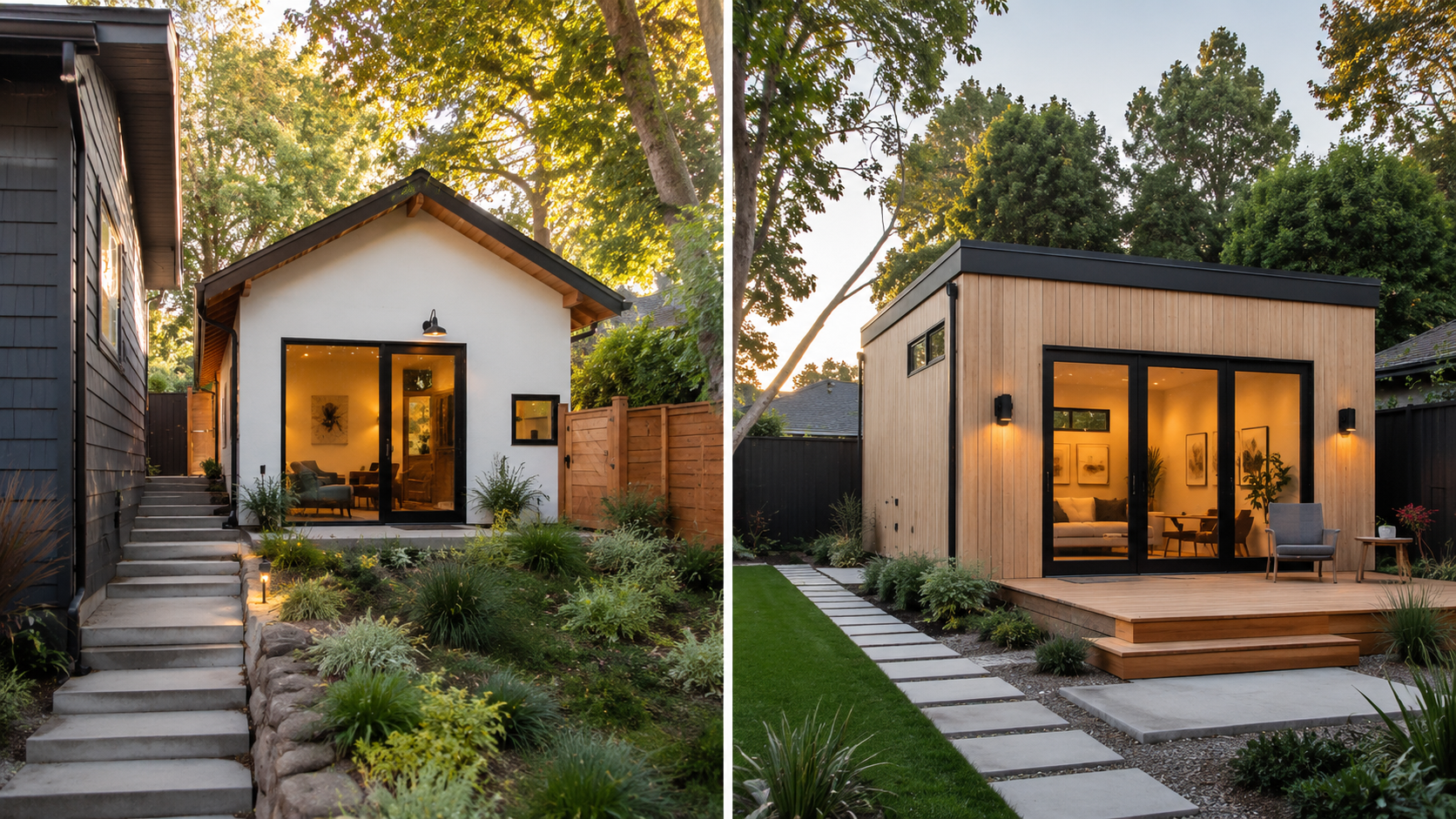
SnapADU vs Villa Homes (2026): Which ADU Builder Path Actually Fits Your Lot?
By The Dwelling Index Editorial Team · Last updated · Last verified May 8, 2026 · Next scheduled review: August 2026 · Independent editorial — referral relationships disclosed
The bottom line on SnapADU vs Villa Homes
SnapADU is a Greater San Diego site-built ADU contractor; Villa Homes is an offsite homebuilding platform delivering HUD-approved factory-built ADUs across California and Colorado from a standardized model catalog. They are not interchangeable, and the right call depends almost entirely on three things — your address, your lot, and how much customization you actually need.
If you’re inside Greater San Diego County, want a custom or semi-custom detached ADU, and have a tricky lot (sloped, tight access, coastal overlay, fire zone, HOA-sensitive design match), SnapADU is the cleaner first call. If you live anywhere else Villa serves (Sacramento, the greater Bay Area, greater Los Angeles, San Diego, or Colorado), have a flat accessible lot, and are comfortable picking from a standardized model catalog, Villa is the cleaner first call. If you want a garage conversion, neither company is your answer — SnapADU’s current FAQ states they no longer handle conversion work, and Villa builds detached new construction only.
One key number both companies will let you misread: SnapADU publishes turnkey detached ADU costs of $375–$600+ per square foot, with most projects landing $300,000–$450,000+ all-in (per snapadu.com/adu-costs, March 2026 update). Villa-related public model pricing shows much lower starting numbers — a Villa H450 at ~$105,500 (440 sq ft), an H800 starting at $147,000 with a third-party suggested all-in budget of $267,000–$347,000 (Dwellito), and an H1200A at $209,000. Those are unit/model price signals, not certificate-of-occupancy totals. The honest gap, after normalizing scope, is much smaller than it looks at first glance.
Next step. Before you book a sales call with either company, run the 60-second Feasibility Engine. It tells you which one (if either) actually serves your address, what your lot’s likely cost band is, and which alternative path to look at if neither fits.
See What You Can Build → Get Your Free ADU ReportSnapADU vs Villa Homes at a glance — the proprietary comparison
Assembled from each company’s currently published material, third-party model catalogs, BBB profiles, and California public records. Verification dates are noted; full sources in the What we verified section. Where a number appears with a date, that’s the date we sourced it from the company’s own page.
| Decision factor | SnapADU | Villa Homes |
|---|---|---|
| Construction method | Stick-built, wood-framed on-site | Offsite/prefab; current marketing describes designs as "HUD-approved" — verify code path per specific model |
| Code authority | California HCD administering the California Building Code / California Residential Code | HUD Manufactured Home Construction and Safety Standards (24 CFR Part 3280) for HUD-approved units |
| Service area | Greater San Diego County only — ~18 jurisdictions plus the County | California and Colorado (Sacramento, Bay Area, greater LA, San Diego) |
| Founded / leadership | Brand established 2020 in San Diego; CEO Whitney Hill, CFO Mike Moore | 2019 in San Francisco (formerly Habitat ADU); co-founded by James Connolly and Zephan McMinn; current CEO Sean Roberts |
| Floor plans | Pre-approved + semi-custom + fully custom; in-house design team | Standardized model catalog (440–1,200 sq ft); cosmetic personalization only |
| Two-story ADU | Yes — SnapADU publishes two-story floor plans | No — Villa's FAQ explicitly does not offer two-story layouts at this time |
| Garage conversion | No — no longer handles conversion work (per current FAQ) | No — detached new-construction prefab only |
| Published cost — vertical build | $220K (500 sq ft 1BR) → $360K (1,200 sq ft 3BR) per 2026 examples | Unit-only signals: ~$105K (H450) → ~$209K (H1200A) per Housing Innovation Collaborative |
| Published cost — all-in | $300,000–$450,000+ for most San Diego detached ADUs; $375–$600+/sq ft turnkey | Third-party suggested all-in: H800 at $267,000–$347,000 (Dwellito); direct Villa quote required |
| Total project timeline | 10–18 months (3–4 mo design + 3–6 mo permits + 6–9 mo build) | ~11 months average per Villa FAQ; ~1-day on-site install |
| On-site disruption | Months of active construction on your property | Several weeks prep + ~1-day install + several weeks finish |
| Warranty (verify at signing) | 1-yr workmanship, 2-yr MEP, 10-yr structural | Manufacturer warranty varies by model; verify in writing |
| License (verify at cslb.ca.gov) | CSLB Class B #1075582(B) per BBB; verify current status | CSLB Class B #1077688 + HCD dealer license #DL1564605; verify current status |
| BBB profile | A+ accredited (San Diego) | A+ accredited (San Francisco) |
| Industry recognition | "Best of Houzz" service award | #1 CA manufactured-home retailer on permanent foundations, 2024; 2024 Ivory Prize |
| Best fit homeowner | Custom design, tricky lot, hillside, coastal, two-story, design-match to main house | Flat accessible lot, standard floor plan acceptable, Villa-served region, faster install preferred |
| Worst fit homeowner | Outside Greater San Diego; garage-conversion buyers; buyers needing strict turnkey factory pricing | Sloped/tight lots; two-story or garage-conversion needs; full custom design; lender/HOA restrictions on manufactured housing |
We re-verify every line in this table quarterly. License status, prices, and service areas change — confirm anything material directly with the company before signing.
Run the address-specific check before either company sends you a quote you can’t easily compare.
What is the real difference between SnapADU and Villa Homes?
Stick-built means the home is wood-framed on a concrete slab or stem-wall foundation directly on your property. SnapADU is a design-build contractor with in-house design, permitting, and construction management, specializing in detached ADUs in Greater San Diego.
Prefab — Villa’s category — is a broader umbrella. Villa describes its homes as “HUD-approved, meaning they’re built to national building code,” and Villa was ranked the #1 retailer of manufactured homes installed on permanent foundations in California in 2024 by Sawtooth Research Group. The HUD reference is to the federal Manufactured Home Construction and Safety Standards (24 CFR Part 3280), which preempts state and local building codes for the structure itself when HUD-certified. Confirm code path per specific 2026 model before you sign.
Why the label matters more than most readers realize: it changes how the home is financed, how it is appraised, and what kinds of lots it can be installed on. We unpack all of those downstream consequences in the financing section below.
Where do SnapADU and Villa Homes actually build?
SnapADU’s verified San Diego service area
SnapADU’s published service-area page names the following San Diego County jurisdictions (verified May 2026): Carlsbad, Chula Vista, Coronado, Del Mar, El Cajon, Encinitas, Escondido, Imperial Beach, La Mesa, Lemon Grove, National City, Oceanside, Poway, San Diego, San Marcos, Santee, Solana Beach, Vista, plus most of the County of San Diego unincorporated jurisdictions. Properties in nearby cities including Bonsall, Cardiff By The Sea, La Costa, and Rancho Santa Fe may also be served — confirm directly with SnapADU.
Villa Homes’ verified service area
Villa’s current published language states: “We currently serve California and Colorado.” Villa’s California project locations in 2025–2026 include Cupertino, Santa Cruz, Altadena (greater LA, fire-rebuild context), and San Diego. Villa launched Colorado operations in 2025, the company’s second state, with infill development sites breaking ground per the April 2025 funding announcement.
| Region | SnapADU? | Villa Homes? | Practical recommendation |
|---|---|---|---|
| San Diego County (most cities) | Yes | Yes (verify zip with Villa) | True head-to-head — compare both with normalized scope |
| Greater LA / Orange County | No | Yes | Villa or LA-specific alternative |
| Bay Area (SF, Oakland, San Jose) | No | Yes | Villa or Bay Area site-built specialist |
| Sacramento metro | No | Yes | Villa or Sacramento prefab/site-built specialist |
| Central Coast (Monterey, Santa Cruz) | No | Yes (verify zip) | Villa or Framework First for Monterey-area modular |
| Colorado | No | Yes | Villa or Colorado-specific alternatives |
| Outside California and Colorado | No | No | See our prefab ADU companies guide |
We’ll confirm which builder actually serves your address before you spend an hour on a sales call.
Why does HUD vs HCD/IBC matter for ADU financing, resale, and HOAs?
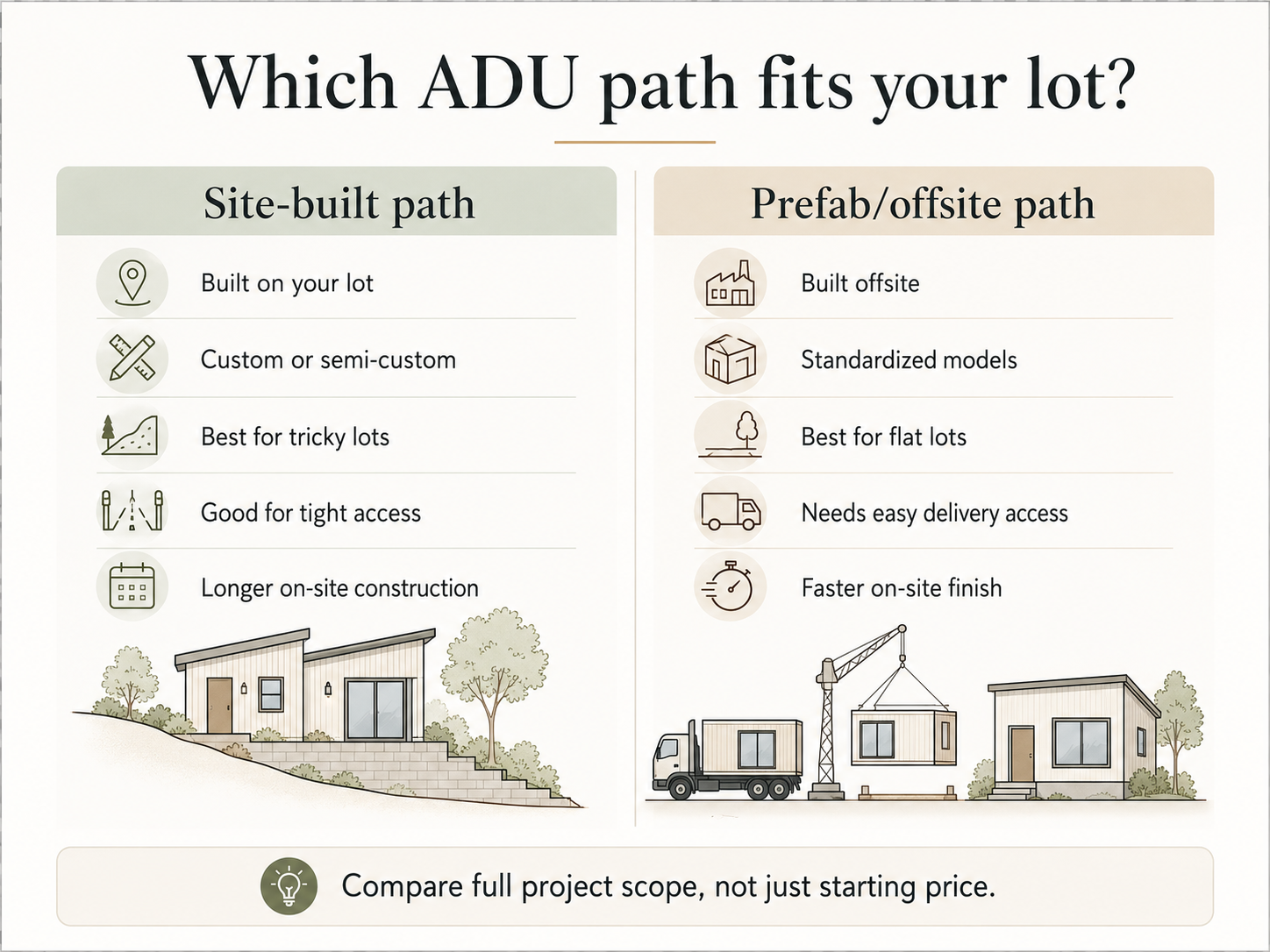
Site-built vs prefab/HUD-code construction path comparison.
What “stick-built under HCD/IBC” actually means
When SnapADU builds your ADU, your structure is engineered, plan-checked, inspected, and certified by your city’s building department under the California Residential Code. The same code path that built your existing home built your ADU. Your appraiser comps it against site-built construction. Your lender treats it as a permanent improvement to real property.
What “HUD-approved factory-built” actually means
When a HUD-code unit ships from Villa’s factory, it arrives with a HUD certification label. The structure was built to 24 CFR Part 3280 — the federal Manufactured Home Construction and Safety Standards — and inspected at the factory by a HUD-approved third-party agency, not your city. The home is permanently affixed to the foundation, and in California it can be classified as real property when the affixation paperwork is properly filed with the county recorder. Confirm certification path for any specific Villa 2026 model directly.
The four downstream consequences buyers don’t see coming
1. Financing. Fannie Mae’s MH Advantage and Freddie Mac’s CHOICEHome programs were designed specifically to expand financing for manufactured housing that meets specific design and construction standards. FHA Title II insures manufactured-home loans through approved lenders. Each program has specific eligibility and lender-overlay requirements. Confirm in writing with your lender before signing — don’t assume either path is automatically lendable.
| Financing program | Site-built ADU | HUD-code ADU |
|---|---|---|
| Conventional 30-year (Fannie/Freddie standard) | Generally available with standard appraisal | Often requires MH Advantage / CHOICEHome program |
| FHA-insured loan | Generally available | Generally available via FHA Title II for HUD-certified manufactured |
| Cash-out refinance / HELOC | Generally available subject to equity and appraisal | Generally available — confirm lender treats permanently-affixed as real property |
| Construction-to-permanent | Widely available | Available — fewer lenders offer it for manufactured |
| ADU-specific loans (CalHFA, SDHC) | Eligible when meeting program rules | Eligible when meeting program rules — verify each program |
Verify program details with each lender before signing. This is educational, not a loan offer or eligibility determination.
2. Appraisal. Both site-built and HUD-code structures appraise. The challenge with HUD-code is that comparable sales are easier to find for site-built in most California neighborhoods. An appraiser building a comp grid for a Villa unit may need to reach further, particularly in markets where manufactured housing is uncommon. Ask each company in writing for examples of recent appraisals on their projects.
3. HOA and CC&R covenants. Some HOAs include language restricting “manufactured” housing. California Civil Code §4751 limits HOA restrictions that effectively prohibit ADUs — but reasonable restrictions can still apply. Read your CC&Rs before signing with either company; if your HOA has aesthetic-control authority, get any HUD-code path pre-approved before paying for feasibility.
4. Resale. A site-built ADU disappears into the property — no buyer asks. A permanently-affixed HUD-code ADU may need to be disclosed and may narrow your buyer pool slightly, depending on local market norms. Whether that affects your resale price is a market question that varies by neighborhood and by buyer.
SnapADU vs Villa Homes cost comparison — what each company’s price actually covers
What SnapADU’s published price actually covers
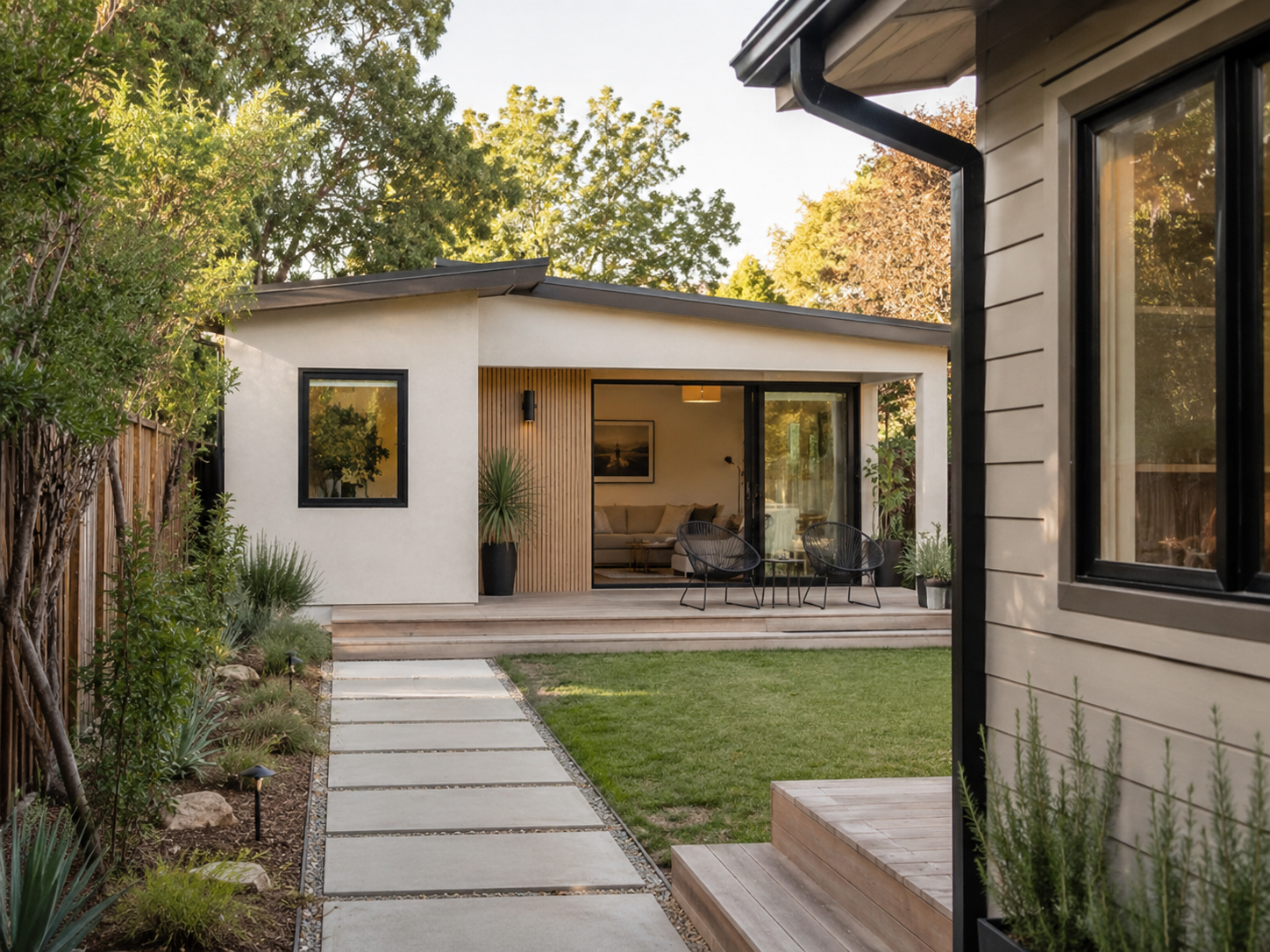
Example SnapADU completed detached ADU in San Diego County. Photography for illustrative purposes.
| SnapADU example (San Diego, 2026) | Vertical build cost | Estimated all-in | Cost per sq ft |
|---|---|---|---|
| 500 sq ft, 1BR/1BA | $220,000 | $300,000 | $600/sq ft |
| 750 sq ft, 2BR/1BA | $275,000 | $350,000 | $465/sq ft |
| 1,000 sq ft, 2BR/2BA | $335,000 | $425,000 | $425/sq ft |
| 1,200 sq ft, 3BR/2BA | $360,000 | $450,000 | $375/sq ft |
Source: snapadu.com/adu-costs, page updated March 2026. The “estimated all-in cost” adds design, permits, sitework, and utilities — but is still subject to property-specific variables. Not included by default: significant grading, retaining walls, fire-zone construction, sewer line replacement, panel upgrades, long utility trenching runs, and major HOA-required design changes.
What Villa Homes’ published price actually covers
Villa’s official pricing page describes a multi-step process: a free initial estimate, a paid Feasibility Study, an Agreement with a fine-tuned budget range, and then a final total project cost during permitting and sub-contracting. Public third-party catalogs (Dwellito, Housing Innovation Collaborative) provide model-level price signals:
| Villa model (third-party catalog) | Sq ft | Catalog price signal | Scope caution |
|---|---|---|---|
| Villa H450 | 440 | $105,500 | Unit/model signal per Housing Innovation Collaborative; sitework, foundation, delivery, install, permits extra |
| Villa H800 | 800 | $147,000 starting; $267,000–$347,000 suggested all-in | Per Dwellito; site evaluation, permits, delivery, install, and site work explicitly excluded from model price |
| Villa H1200A | 1,200 | $209,000 | Unit/model signal per Housing Innovation Collaborative; all-in scope must be verified directly with Villa |
Sources: housinginnovation.co, dwellito.com — accessed 2026. Verify current Villa pricing at request — these are third-party signals, not direct Villa quotes.
Apples-to-apples normalization
On a comparable flat-lot 800 sq ft project in San Diego County, the third-party Dwellito suggested all-in budget of $267,000–$347,000 implies roughly $334–$434/sq ft. A SnapADU 750 sq ft unit lands around $350,000 all-in, or about $465/sq ft. That is roughly a $0–$80,000 gap. Some of that is real factory savings. Some of it is scope Villa quotes separately that SnapADU bundles. The honest answer: the price gap is real but smaller than the website numbers imply, and lot-specific factors can reverse it entirely on a complicated site.
The hidden line items that hit either path
- Sewer slope and capacity. Adding an ADU may push an existing 4-inch sewer line past capacity. Replacing 80 feet of sewer line under hardscape can add tens of thousands of dollars.
- Electrical panel upgrade. If your main panel is 100A, an ADU often requires upgrading to 200A.
- Utility trenching. If the ADU is 100 feet from the main panel and water service, trenching alone can add five figures.
- California impact fees. California law eliminates impact fees for ADUs under 750 sq ft; ADUs of 750 sq ft or more are charged proportionally. San Diego County permit fees typically average $5,000–$12,000 (~$10/sq ft) per SnapADU’s FAQ.
- Fire-zone construction. WUI requirements for fire-rated assemblies, ember-resistant vents, and tempered glazing add five figures on fire-zone lots.
- Retaining walls / grading. Sloped lots add five figures and sometimes more.
- Crane delivery (Villa-specific where required). If your lot can’t accept a crane, a Villa unit may not work at all.
- Coastal Commission review. For lots in San Diego’s Coastal Overlay Zone, expect additional permitting time and possibly a Coastal Development Permit.
The exact checklist we use, formatted to compare two non-equivalent quotes line by line. Email-gated; no sales calls.
How long does each one take, from first call to move-in?
| Phase | SnapADU | Villa Homes | Main risk |
|---|---|---|---|
| Feasibility | Discovery / design-build qualification | Free initial estimate + paid Feasibility Study | Incomplete property data |
| Design / model selection | Custom or standard detached design | Standard model + cosmetic options | Scope changes |
| Permitting | Local plan check (15-business-day completeness + 60-day approval clock, SB 543 2026) | Local jurisdiction review (HUD certification may streamline structure review) | Completeness checks, resubmittals |
| Site prep | Built into construction sequence | Done before/around factory build to align with delivery | Utilities, foundation, trenching |
| Build / install | Site-built, 6–9 months on-site | Factory build + ~1-day on-site install | Factory queue + access |
| Final inspection | Local final by city inspector | Local final on foundation/utilities; HUD label on structure | Corrections, utility signoff |
Which builder fits which property — the lot-fit decision matrix
| Your situation | Better-fit builder | Why |
|---|---|---|
| Two-story ADU desired | SnapADU | Villa explicitly does not offer two-story layouts at this time |
| Garage conversion (existing structure) | Neither | SnapADU no longer handles conversions; Villa builds detached new-construction only |
| Junior ADU (JADU) inside existing home | Neither | This comparison is detached ADU specific |
| Sloped lot (>10% slope) | SnapADU likely | Site-built adapts to slope; prefab requires significant grading and possible re-engineering |
| Tight side-yard / no delivery access | SnapADU | Villa's unit delivery typically requires crane or large-vehicle access |
| Coastal Overlay Zone (CDP required) | SnapADU likely | Coastal Commission review is a known SnapADU strength |
| HOA with manufactured-housing restrictions | SnapADU | Site-built under HCD/IBC sidesteps the question; Villa's HUD-code may need pre-approval per CA Civil Code §4751 |
| Custom architectural match to main home | SnapADU | Villa's catalog is fixed; semi-custom modifications are limited |
| Multi-unit on multifamily property | Either | Villa explicitly markets to multifamily operators; SnapADU has multi-ADU experience |
| Budget under $250K all-in | Villa if lot is flat & accessible, otherwise Neither | SnapADU's smallest 500 sq ft 1BR comes in at ~$300K all-in |
| Live in primary residence; want minimal disruption | Villa | One-day install vs months of active construction |
| Need to be in within 9 months | Villa likely | Faster realistic move-in once permitting clears |
| Outside Greater San Diego, in California | Villa | SnapADU not available |
| Colorado | Villa | SnapADU not available; Villa launched Colorado in 2025 |
| Outside California and Colorado | Neither | See our nationwide prefab ADU companies guide |
When prefab/offsite wins, and when site-built wins
When prefab (Villa) is the right call
- Standard floor plan is acceptable — you can pick from Villa’s catalog
- Lot is flat and clear — crane can set up and swing the unit into place
- Primary residence is occupied during the build — one-day install
- Factory-controlled environment matters to you for consistency
- You’re in California (outside SD) or Colorado
When site-built (SnapADU) is the right call
- Tight access — no room for the truck and crane
- Sloped or irregular lot — site-built adapts foundation to topography
- Custom design — architectural match to your main home
- Coastal Zone, fire-overlay, or HOA design control
- Complex utility routing needing on-site management
- You want one team for everything (design-build model)
Are SnapADU and Villa Homes legit? License, BBB, and reputation checks
SnapADU’s verified credentials (May 2026)
- CSLB: Class B General Building license; BBB profile lists license #1075582(B). Verify current status at cslb.ca.gov before signing.
- BBB: A+ accredited (San Diego). Lists alternate business names including Moore Construction Inc. and Responsible Construction Inc.
- Brand established: 2020; CEO Whitney Hill and CFO Mike Moore publicly identified.
- Project count: 100+ completed ADUs in San Diego County (self-reported); 90%+ project completion rate vs ~30% city average (per snapadu.com).
- Awards: “Best of Houzz” service award (Houzz profile).
Villa Homes’ verified credentials (May 2026)
- CSLB: #1077688 (Class B General Building). Verify current status at cslb.ca.gov.
- HCD dealer license: #DL1564605 (manufactured-home dealer).
- BBB: A+ accredited (San Francisco); business start November 2019.
- Founded: 2019 by James Connolly and Zephan McMinn; current CEO Sean Roberts.
- Recognition: #1 retailer of manufactured homes installed on permanent foundations in California in 2024 (Sawtooth Research Group); 2024 Ivory Prize for Construction and Design.
- Funding: $40M announced April 2025 — $20M platform round led by Unless with Atomic and Tectonic Ventures, plus a $20M PropCo development JV.
What are the honest downsides of each — what we won’t pretend isn’t true
SnapADU’s honest downsides
- Service area is narrow. Outside Greater San Diego, they aren’t available.
- No more garage conversions. Per current FAQ: “We no longer handle conversion work.”
- Detached new-construction focus. JADUs and basement ADUs aren’t their specialty.
- Higher published per-square-foot than Villa’s catalog signals. Honest pricing — but the headline number can sticker-shock buyers comparing without normalizing.
- Site-built is slower on-site. Six to nine months of active backyard construction is a real cost.
Villa Homes’ honest downsides
- “Starting at” pricing creates expectation gaps. Model prices from third-party catalogs explicitly exclude sitework, permits, foundation, delivery, and installation.
- Standardized model catalog. Limited customization. Unusual footprints (long-and-narrow, hillside-stepped) may not fit their plans.
- Two-story and garage conversions are not available.
- Delivery/install access is required. A homeowner with a tight side-yard may not be able to use Villa at all.
- HUD-code classification carries lender, HOA, and resale considerations — see the financing section above.
- Reported delays at utility coordination phase (SF Chronicle, 2022 — PG&E delays affecting some Villa customers).
The 15-question Quote Normalizer — ask both companies the same questions
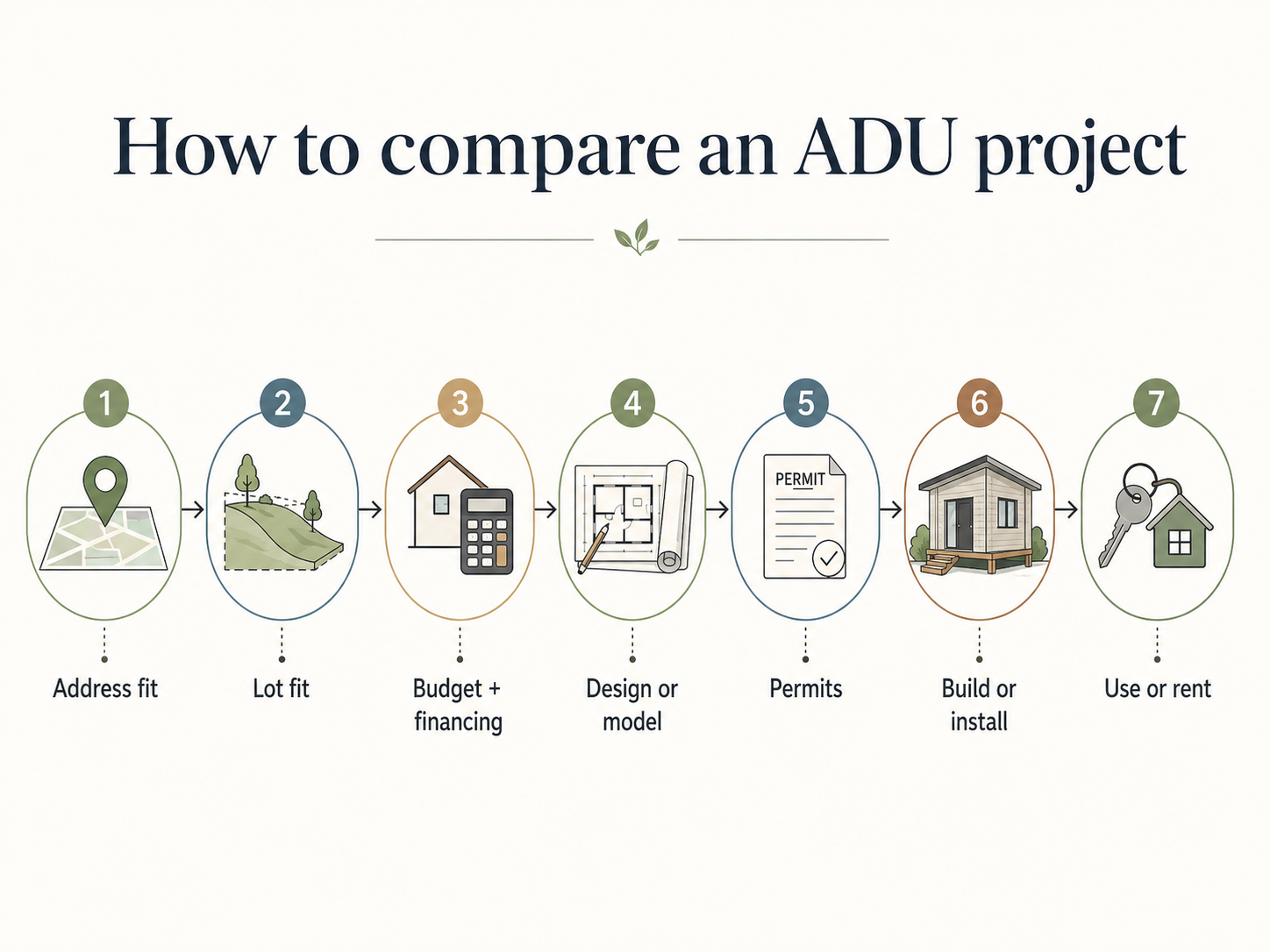
How to compare an ADU project quote — the 15-question normalizer in practice.
- Is this a total all-in estimate to certificate of occupancy, or a unit/base/build estimate?
- What is explicitly excluded? Provide the exclusion list.
- What sitework allowance is included? In dollars or in scope (e.g., “up to 60 feet of trenching”)?
- Is the foundation fully included? What type (slab vs stem-wall) and what allowance for soils-driven changes?
- Are delivery, crane, and installation included? (Villa-specific, but ask SnapADU about mobilization.)
- Are permits and city fees included or estimated separately? If estimated, on what basis?
- Are school fees, impact fees, and any city-specific fees included? (California prohibits impact fees for ADUs under 750 sq ft; ADUs 750 sq ft or more are charged proportionally.)
- Are utility trenching, hookups, and meter coordination included? What length is assumed?
- Is an electrical panel upgrade included or excluded?
- What happens if the city requires plan-check corrections — who pays for the redesign?
- What is the change-order process, markup, and typical change-order count on similar projects?
- What timeline assumptions are built into this proposal? (Permitting weeks, factory queue, build months.)
- What payment milestones apply? When is the deposit due, when do progress payments hit, when is the final balance?
- What cancellation/refund terms apply? What if you back out at design phase, permit phase, or construction phase?
- What warranty coverage is included, in writing, for what duration on each component?
A formatted version of these 15 questions plus a 27-line-item scope checker. Free; email-gated.
Which builder makes more sense if you’re building to rent?
We are not your investment advisor. The framework below is illustrative — actual results depend on local market conditions, construction costs, financing terms, and regulatory approvals.
Where Villa’s faster install wins
- Flat lot, standard 1BR or 2BR floor plan, near transit — tenant cash flow sooner
- Multifamily operator adding ADUs — Villa explicitly markets this use case
- Portfolio math: faster delivery compounds across multiple properties
Where SnapADU’s customization wins
- Premium San Diego ZIPs where architectural match commands rent premium
- Lots where prefab won’t physically fit — delivery vehicle and crane can’t access
- Long-term holds where the ADU may someday be sold separately under AB 1033
What if neither SnapADU nor Villa Homes fits?
If you want a garage conversion
Neither SnapADU (no longer handles conversions) nor Villa (detached new-construction only) is your builder. For San Diego County conversions, see our Best ADU Builders San Diego County guide for vetted local options. Outside San Diego, a licensed local GC with documented ADU conversion experience is the safer first call.
If you’re in Bay Area, LA, Sacramento, or Central Coast and want a non-Villa option
- Architect first, then licensed local GC. A custom path adapts to any lot at the cost of more decisions and a longer timeline.
- Other regional prefab providers. Studio Shed (national panelized kits), Abodu (Bay Area turnkey), Samara (premium California), and Crest Backyard Homes (modular) are the most-named alternatives. See our Best Prefab ADU Companies guide.
- Central Coast / Monterey-area. Framework First serves approximately 150 miles around Monterey County.
If you’re in San Diego County and these two aren’t right
- Garage conversion specialist. See our Best ADU Builders San Diego County guide.
- Compact / tiny-style ADU on a flat lot. Nest Tiny Homes serves San Diego and Imperial County.
- City-specific options at our city builder pages: Encinitas, Carlsbad, Chula Vista, Poway, El Cajon, Escondido, La Mesa, Vista, Oceanside, Coronado, Del Mar, Solana Beach, National City, San Marcos, Imperial Beach, Lemon Grove, Santee, Cardiff by the Sea, Bonsall, Rancho Santa Fe, and more.
How to decide in 60 seconds
| Your situation | Likely first call |
|---|---|
| Greater San Diego, detached new ADU, custom or design-matched to main home | SnapADU |
| Greater San Diego, detached new ADU, standardized prefab, flat lot | Villa Homes (compare both) |
| Greater San Diego, detached new ADU, sloped/coastal/HOA-restricted lot | SnapADU |
| Greater San Diego, two-story ADU | SnapADU |
| Anywhere — garage conversion | Neither — see the third-option section |
| Bay Area, LA, Sacramento, or other California region — flat lot, standard plan | Villa Homes |
| Bay Area, LA, Sacramento — sloped/tight/custom needs | Architect-first then local GC |
| Colorado | Villa Homes |
| Outside California and Colorado | Neither — see Best Prefab ADU Companies |
| Junior ADU, basement ADU, attached ADU | Neither as primary; use a generalist GC |
| Budget under $250K all-in | Verify scope; revisit ADU type or financing |
Address-specific verdict in 60 seconds.
What we verified
This comparison was built from primary sources. Major published claims are sourced below.
| Source category | What we checked | Verification date |
|---|---|---|
| SnapADU published materials | snapadu.com/adu-costs (updated March 2026), /service-area, /process, /faqs (current language including "no longer handle conversion work" and $5K–$12K permit-fee range), blog posts on prefab vs stick-built | January–May 2026 |
| Villa Homes published materials | villahomes.com (homepage), /products, /pricing, /featured-projects, /for-homeowners, /press, /feasibility-study, /process, /blog/hud-vs-hcd-adu-building-standards, FAQ page | April–May 2026 |
| Villa Homes third-party catalogs | dwellito.com/manufacturers/villa-homes, dwellito.com/plans/h800, housinginnovation.co/backyardhome/villa-h450, housinginnovation.co/backyardhome/villa-h1200a | 2025–2026 |
| Villa Homes industry recognition | Morningstar/AccessNewswire announcement of $40M April 2025 funding round, Sawtooth Research Group #1 CA ranking, 2024 Ivory Prize | April 29, 2025 |
| License records | CSLB online license search (cslb.ca.gov); BBB profiles for both; opengovus.com California contractor license dataset | May 2026 |
| Construction codes | HUD Office of Manufactured Housing Programs, 24 CFR Part 3280, California HCD Title 25, Fannie Mae MH Advantage, Freddie Mac CHOICEHome, FHA Title II | May 2026 |
| California ADU statutes | CA Government Code §66313, §66317 / SB 543 (15-business-day completeness + 60-day approval clock, effective 2026), §66317.5 (impact fee thresholds), AB 1033, CA Civil Code §4751 | May 2026 |
License status, prices, and service areas change. We re-verify every line in this article quarterly. The next scheduled review is August 2026.
Methodology
The Dwelling Index is an independent research resource covering ADU financing, costs, and regulations.
How we built this comparison. We started from each company’s official, currently-published material and verified the major claims against three independent sources where possible — third-party catalogs, public license records, and editorial coverage. We did not accept any sales-call statement as a verified fact.
Seven evaluation dimensions, identical for both companies: construction method, code path, service area, total project cost (all-in, not unit-only), timeline, lot fit, and warranty. We applied the same dimensions, in the same order, to each company.
Conflict of interest, fully disclosed. SnapADU is The Dwelling Index’s active referral partner for Greater San Diego. Villa Homes is not a partner of any kind. We earn nothing if you choose Villa, and our editorial conclusions are not influenced by compensation. The honest-weakness section above is identical in scope and tone for both companies.
Compensation does not determine which company appears first. SnapADU is named more prominently in the affiliate routing because it is the partner; Villa is named more prominently in the cost section because their model pricing is the starting point most readers benchmark against.
Frequently asked questions
Is SnapADU prefab or stick-built?
SnapADU is stick-built (site-built). All SnapADU ADUs are wood-framed on-site under California's HCD-administered building codes (CRC/CBC/IRC). They are not prefab, not modular, not panelized, and not manufactured housing.
Is Villa Homes a manufactured home or a modular home?
Villa Homes' published material describes their structures as "HUD-approved, meaning they're built to national building code." That language is consistent with HUD-code manufactured construction (built to 24 CFR Part 3280). Villa also holds an HCD manufactured-home dealer license (#DL1564605). HUD-code manufactured homes can be permanently affixed to a foundation and classified as real property in California. Verify each specific model's certification before signing.
Does SnapADU build outside San Diego County?
No. SnapADU's published service area is Greater San Diego only. If your property is outside San Diego County, SnapADU is not an option for you — see the alternatives section above.
Does Villa Homes serve San Diego?
Yes — Villa serves California and Colorado, with active California operations including San Diego, the Bay Area, greater LA, and Sacramento per their published service language. Verify your specific zip code with Villa directly at request.
Does Villa Homes serve Colorado?
Yes — Villa launched Colorado operations in 2025, the company's second state, per the April 29, 2025 funding announcement. Initial Colorado infill development sites have begun breaking ground.
How much does a Villa Homes ADU cost in 2026?
Villa's pricing is finalized through a multi-step process. Third-party catalogs show model price signals of approximately $105,500 (H450, 440 sq ft, Housing Innovation Collaborative), $147,000 starting (H800 plan, with $267,000–$347,000 third-party suggested all-in budget per Dwellito), and $209,000 (H1200A, 1,200 sq ft). The all-in cost depends heavily on your lot, your city's fees, and your finish selections. Request a Villa quote directly for an address-specific number.
How much does a SnapADU ADU cost in 2026?
SnapADU publishes turnkey San Diego detached ADU costs of $375–$600+ per square foot, with most projects landing $300,000–$450,000+ all-in. Their published examples range from $300,000 (500 sq ft 1BR/1BA) to $450,000 (1,200 sq ft 3BR/2BA). Source: snapadu.com/adu-costs, page updated March 2026.
Can you finance a Villa Homes ADU with a regular mortgage?
Often, yes — if the structure is permanently affixed to a foundation and classified as real property, several mortgage programs can lend on HUD-code manufactured homes, including Fannie Mae's MH Advantage, Freddie Mac's CHOICEHome, and FHA Title II manufactured-home loans. Each program has specific eligibility requirements. Confirm in writing with your lender before signing. This is educational information, not a loan offer or eligibility determination.
Who owns SnapADU? Who owns Villa Homes?
SnapADU's brand was established in 2020 in San Diego; CEO Whitney Hill and CFO Mike Moore are publicly identified leadership. Villa Homes was founded in 2019 by James Connolly and Zephan McMinn in San Francisco; Villa is currently led by CEO Sean Roberts. Villa is venture-backed (over $40M raised through April 2025), with investors including Atomic, Tectonic Ventures, and Unless. SnapADU is privately held.
How long does each one take?
SnapADU publishes a 10–18 month full process. Villa Homes' FAQ states an average of about 11 months. Both are subject to your city's plan-check queue (governed by California's 15-business-day completeness rule + 60-day approval clock under SB 543, effective 2026) and your utility provider's connection queue (which can add 60–90 days or more).
Does SnapADU offer a fixed price?
After their feasibility study, SnapADU contracts on a fixed-price model — meaning the price quoted in your written agreement is the price you pay, absent change orders and unforeseen site conditions explicitly carved out. Their feasibility process is designed to surface site-condition risks before contracting.
Can Villa Homes build a two-story ADU?
No. Villa's FAQ explicitly states: "Unfortunately, we are not able to offer these layouts at this time" with respect to two-story ADUs and ADUs on top of garages.
Can SnapADU do a garage conversion?
No. SnapADU's current FAQ says: "We no longer handle conversion work as we are focused on becoming extremely effective at building standalone ADUs." If you have an existing garage you want converted, look at conversion-specialist firms in San Diego County or a generalist GC with documented ADU conversion experience.
Is one cheaper than the other?
After normalizing scope (the same line items in both quotes), Villa's all-in cost is often lower than SnapADU's by $0–$80K on a comparable flat-lot project — mostly because of factory production efficiency. On a complicated lot (slope, tight access, fire zone, coastal overlay), SnapADU's number is the realistic comparison because Villa may not be physically possible. Don't pick based on the headline price; pick based on the certificate-of-occupancy-ready price for your specific lot.
Is one faster than the other?
Villa's on-site disruption is shorter (one-day install vs months of active construction). Total project time is roughly comparable when you include permitting. If on-site disruption matters to you, Villa wins. If total time matters and your city's plan-check is fast, both are similar.
What if neither company fits?
Use the third-option shortlist above. The right alternative depends on your region (Bay Area / LA / Sacramento / Colorado / outside California–Colorado), your project type (garage conversion, JADU, basement ADU), and your lot. The Feasibility Engine will route you.
Editorial standards & disclosures
The Dwelling Index is an independent research resource covering ADU financing, costs, and regulations. We separate verified commercial facts from regulatory and legal facts from editorial judgments, and we mark which is which.
We don’t fabricate authors, credentials, expert reviewers, ratings, or testimonials. We don’t accept paid placement or sponsored rankings. SnapADU is an active referral partner for Greater San Diego — that is fully disclosed every place it matters. Villa Homes is not a partner; we earn nothing from Villa choices.
If we got something wrong on this page, please tell us and we’ll fix it. We log every correction publicly. For more on how we evaluate builders, see our Methodology, Editorial Standards, Partner Vetting Policy, and Affiliate Disclosure.
Not sure where to start? See what’s possible at your address.
Get Your Free ADU Report → 60 seconds, address-specific, no sales calls.Tells you which (if any) of these two builders serves your address, your lot’s likely cost band, and the right alternative path if neither fits.
In Greater San Diego and planning a custom or design-matched detached ADU?
Talk to SnapADU about your project →SnapADU is our active referral partner for San Diego County — we’ll earn a commission if you contract, at no extra cost to you. Note: SnapADU does not handle garage conversions as of 2026. Serves Greater San Diego County only.
Includes the 27-line-item Quote Normalizer worksheet, builder interview questions, and a plain-English ADU planning workbook. No card required.