
Vermont regulations · 2026 guide
Vermont ADU Laws (2026): What 24 V.S.A. § 4412 Requires, What Act 179 Changed, and How VHIP Funding Works
By The Dwelling Index Editorial Team · Last updated: · Last verified:
Bottom line up front: Under Vermont ADU laws, no town bylaw can exclude, as a permitted use, one accessory dwelling unit (ADU) located within or appurtenant to a single-family home (24 V.S.A. § 4412(1)(E)). The house with an ADU must get the same review and dimensional rules as the house alone. Since July 1, 2026, Act 179 of 2026 (S.328) removed the old condition that the lot be owner-occupied. A Vermont ADU must be clearly subordinate to the house, can be up to 30% of the home's habitable floor area or 900 square feet, whichever is greater, and the property needs enough wastewater capacity (24 V.S.A. § 4303(38)). In areas with municipal sewer and water, a town can't require more than one parking space per unit. The only exception to the ADU rule is a flood hazard or fluvial erosion area bylaw.

Disclosure: This page has no affiliate links. The Dwelling Index is reader-supported.
| Rule | What Vermont law says (as of November 20, 2026) |
|---|---|
| ADUs that must be allowed | One ADU within or appurtenant to a single-family dwelling, as a permitted use |
| Where it applies | Every municipality, "notwithstanding any existing bylaw" |
| Exception | Flood hazard and fluvial erosion area bylaws under 24 V.S.A. § 4424 |
| Owner-occupancy | "On an owner-occupied lot" removed by Act 179 (S.328), effective July 1, 2026 |
| Review | House plus ADU gets the same review, dimensional and other controls as the house alone |
| Converting a barn, garage or other outbuilding | Criteria can't be stricter than for a single-family home without an ADU |
| Size | Up to 30% of the home's habitable floor area or 900 sq ft, whichever is greater |
| Wastewater | The property must have sufficient wastewater capacity |
| Parking | No more than 1 space per dwelling unit in areas served by municipal sewer and water |
| Short-term rentals | Towns may regulate them separately from long-term rentals |
| New deed restrictions | Restrictions added after March 1, 2021 that would block the ADU are not valid (27 V.S.A. § 545) |
| Permit timing | Zoning administrator must act within 30 days or the permit is deemed issued; 15-day appeal period before it takes effect |
| Funding | VHIP 2.0 forgivable loans of up to $50,000 for an ADU on an owner-occupied property; VHIP-ADU grants of up to $50,000 |
Each row comes from the current Vermont Statutes Online (24 V.S.A. §§ 4303, 4412, 4414, 4448, 4449 and 4465; 27 V.S.A. § 545), Act 179 of 2026 as enacted, and the Agency of Commerce and Community Development's ADU and VHIP pages, all read on November 20, 2026.
See What You Can Build → Get Your Free ADU Report
The Dwelling Index is an independent research resource covering ADU financing, costs, and regulations. We wrote this page because Vermont's ADU rule is one sentence long but sits inside a statute that has been amended almost every year since 2020, and the 2026 change to owner-occupancy isn't reflected in many town bylaws or older guides yet. We read the current statutes, Act 179 as enacted, and the state's own ADU and funding pages, and lay out what applies today.
Disclosure: The Dwelling Index is reader-supported. When you use our links to explore financing options, request prefab pricing, or purchase floor plans, we may earn a commission at no extra cost to you. Our editorial recommendations are based on independent research and are never influenced by compensation. This page has no affiliate links. It's educational, not legal advice. Confirm every rule with your town's zoning administrator before you design or pay for anything.
What are Vermont's ADU laws in 2026?
Answer capsule: Vermont's ADU law is 24 V.S.A. § 4412(1)(E), with the ADU definition in § 4303(38). Every town must allow one ADU within or appurtenant to a single-family home as a permitted use, under the same review and dimensional rules as the house. Act 179 of 2026 removed the owner-occupied lot condition on July 1, 2026.
The core sentence, as amended by Act 179, reads: "Except for flood hazard and fluvial erosion area bylaws adopted pursuant to section 4424 of this title, no bylaw shall have the effect of excluding as a permitted use one accessory dwelling unit that is located within or appurtenant to a single-family dwelling."
Three layers decide whether your project works:
- State law. 24 V.S.A. § 4412 and § 4303 for zoning, § 4414 for parking, plus state wastewater, fire safety, electrical, plumbing and energy rules.
- Your town's bylaw. Setbacks, height, lot coverage and the permit process for single-family homes in your district. More than 80% of Vermont municipalities regulate land use, according to the Department of Housing and Community Development's (DHCD) 2021 ADU checklist.
- Private rules and the site. Older deed restrictions and association covenants, septic and well capacity, flood zones, wetlands and shorelands.
The catch. "Permitted use" means the zoning administrator can approve the ADU without a hearing if it meets the bylaw's standards. It doesn't exempt you from state permits, which often take longer than the town permit.
What changed for Vermont ADUs in 2026?
Answer capsule: Act 179 of 2026 (S.328), effective July 1, 2026, struck the words "on an owner-occupied lot" from 24 V.S.A. § 4412(1)(E). Before that, the statewide ADU right applied only on owner-occupied lots, which gave towns room to keep owner-occupancy conditions. The same act bars towns from requiring a duplex to be built on an owner-occupied lot.
Disclosure: This page has no affiliate links. The Dwelling Index is reader-supported.
| Rule | Before July 1, 2026 | After Act 179 (current law) |
|---|---|---|
| Statewide ADU right | One ADU with a single-family dwelling "on an owner-occupied lot" | One ADU with a single-family dwelling, no owner-occupancy condition |
| Duplex owner-occupancy | Not addressed in § 4412 | "No bylaw shall require a duplex to be constructed on an owner occupied lot" |
What this means in practice. An investor or a landlord who doesn't live on the property now has the same state-law right to add an ADU as an owner-occupant. A town bylaw that still conditions the ADU on owner-occupancy conflicts with the current statute, which applies "notwithstanding any existing bylaw." Expect some town bylaws to lag. If yours still has the old language, ask the zoning administrator in writing how the town is applying § 4412 after July 1, 2026.
What's temporary. Act 179's summary says the new duplex owner-occupancy ban and a change to the four-unit density rule are repealed on January 1, 2028. The removal of "on an owner-occupied lot" from the ADU sentence is not in that list.
Earlier changes still in effect. The HOME Act (Act 47 of 2023) added the requirement that the house with an ADU face the same review and dimensional controls as the house alone, the rule for converting detached nonresidential buildings, and the 900 square foot size floor.
What can't a Vermont town require for an ADU?
Answer capsule: A Vermont town can't exclude the one ADU as a permitted use, can't add review or dimensional rules beyond what a single-family home faces, can't make barn or garage conversion criteria stricter than for the house, can't require more than one parking space per unit in sewer and water areas, and, since July 1, 2026, can't rely on the old owner-occupied lot condition.
- Exclusion. "No bylaw shall have the effect of excluding as a permitted use one accessory dwelling unit."
- Extra review. "A bylaw shall require a single-family dwelling with an accessory dwelling unit to be subject to the same review, dimensional, or other controls as required for a single-family dwelling without an accessory dwelling unit." So an ADU can't trigger conditional use review, a larger lot or bigger setbacks if the house alone wouldn't.
- Stricter conversion rules. "The criteria for conversion of an existing detached nonresidential building to habitable space for an accessory dwelling unit shall not be more restrictive than the criteria used for a single-family dwelling without an accessory dwelling unit."
- Excess parking. In districts served by municipal sewer and water that allow residential uses, "a municipality shall not require more than one parking space per dwelling unit" (§ 4414(4)).
- Undersized limits. The state definition lets an ADU reach 900 square feet even on a small house. The Vermont League of Cities and Towns' October 2025 presentation on Act 47 and Act 181 summarizes it as "ADUs must be allowed to be at least 900 square feet."
What can a Vermont town still regulate?
Answer capsule: Towns can apply the same setbacks, height, lot coverage and review they use for single-family homes, regulate short-term rentals separately, enforce flood hazard and fluvial erosion bylaws, and choose to be more permissive, for example by allowing larger or additional ADUs.
- Same standards as the house. The setbacks, height and lot coverage that apply to a single-family home in your district apply to the house-plus-ADU.
- Short-term rentals. Section 4412(1)(F) says the ADU rule doesn't prohibit "a bylaw that regulates short-term rental units distinctly from residential rental units."
- Flood hazard and river corridors. Flood hazard and fluvial erosion area bylaws under § 4424 are the stated exception to the ADU rule.
- More permissive bylaws. Section 4412(1)(F) also allows "a bylaw that is less restrictive of accessory dwelling units," so a town can allow larger ADUs or more than one.
- Parking outside sewer and water areas. The one-space cap applies in areas served by municipal sewer and water. Outside them, the town's own parking standards govern.
How big can an ADU be in Vermont?
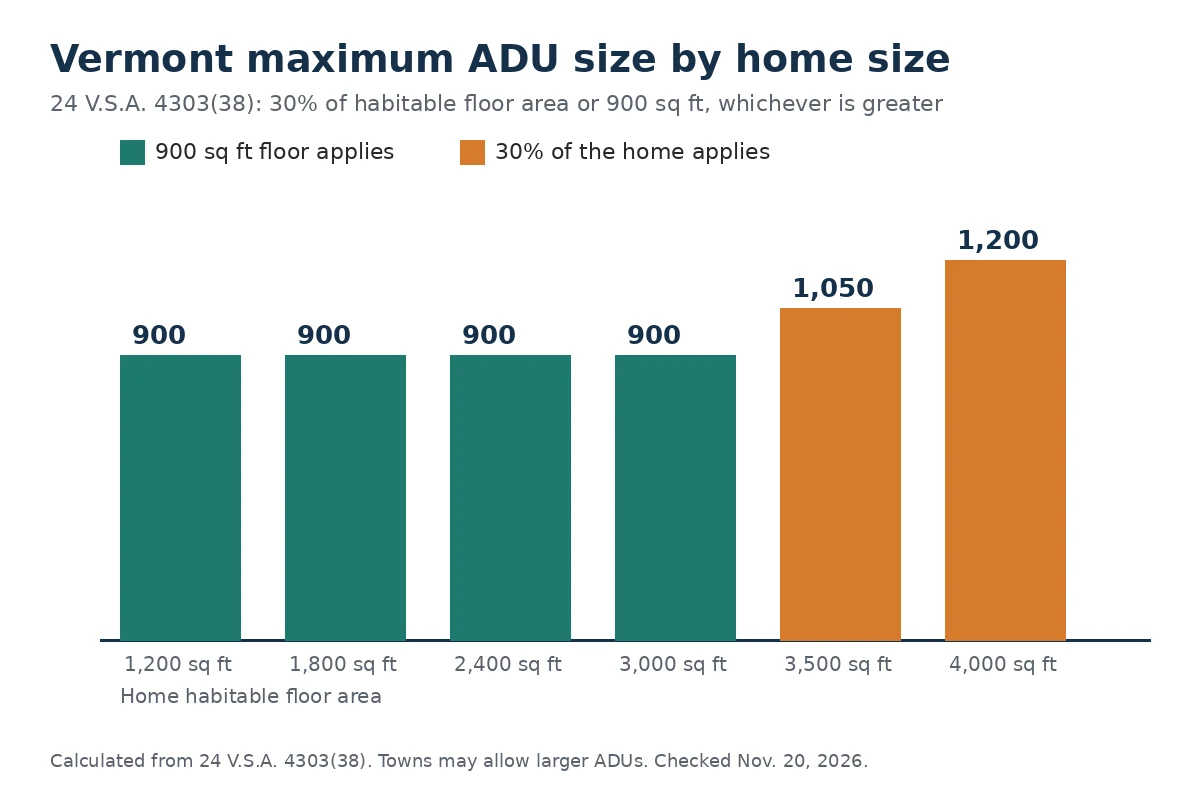
Answer capsule: A Vermont ADU must be clearly subordinate to the house and can't exceed 30% of the home's total habitable floor area or 900 square feet, whichever is greater. The size formula permits up to 900 square feet for homes up to 3,000 square feet and a larger unit for larger homes, subject to the separate subordinate-unit requirement and applicable site rules. A town may allow more.
Disclosure: This page has no affiliate links. The Dwelling Index is reader-supported.
| Home's habitable floor area | 30% of the home | Maximum ADU under § 4303(38) |
|---|---|---|
| 1,200 sq ft | 360 sq ft | 900 sq ft |
| 1,800 sq ft | 540 sq ft | 900 sq ft |
| 2,400 sq ft | 720 sq ft | 900 sq ft |
| 3,000 sq ft | 900 sq ft | 900 sq ft |
| 3,500 sq ft | 1,050 sq ft | 1,050 sq ft |
| 4,000 sq ft | 1,200 sq ft | 1,200 sq ft |
We calculated each row from the statute's "30 percent ... or 900 square feet, whichever is greater" formula. Your town may allow a larger ADU. Ask how it measures "habitable floor area," since basements, attics and garages are often treated differently.
Two other conditions in the definition. The unit must be "clearly subordinate to a single-family dwelling," and it must have "facilities and provisions for independent living, including sleeping, food preparation, and sanitation." A room without a kitchen isn't an ADU under this definition.
Estimate your Vermont ADU budget — run the free ADU cost calculator
Do you have to live on the property to have a Vermont ADU?
Answer capsule: Not under state law since July 1, 2026. Act 179 removed "on an owner-occupied lot" from the statewide ADU rule. Some town bylaws still contain owner-occupancy language, so ask how your town is applying the change. State funding is different: VHIP 2.0's ADU option is for owner-occupied properties.
Two things to keep separate:
- Zoning. The state ADU right no longer depends on owner-occupancy. A bylaw that adds an owner-occupancy condition only because there's an ADU is an extra control the house alone wouldn't face.
- Funding. The Agency of Commerce and Community Development (ACCD) describes the VHIP 2.0 ADU option as creating "an accessory dwelling unit on an owner-occupied property." If you plan to use VHIP money, owner-occupancy still matters.
Does a Vermont ADU need parking?
Answer capsule: In areas served by municipal sewer and water that allow residential uses, a town can't require more than one parking space per dwelling unit, so at most one space for the ADU. Outside those areas, the town's parking standards apply. A deed restriction added after July 1, 2023 can't require more than that either.
The parking cap is in 24 V.S.A. § 4414(4). The matching private-restriction rule is in 27 V.S.A. § 545(b): deed restrictions or covenants added after July 1, 2023 aren't valid if they require "more than one parking space per dwelling unit if the property is located in an area served by municipal sewer and water infrastructure."
Can an HOA or deed restriction stop a Vermont ADU?
Answer capsule: An older restriction or certain exempt interests may still apply. Under 27 V.S.A. § 545(a), deed restrictions, covenants or similar agreements added after March 1, 2021 that prohibit or effectively prohibit an ADU allowed under § 4412(1)(E) are not valid. Restrictions recorded before then may still apply, and conservation easements and housing subsidy covenants are carved out.
What § 545 covers:
- Added after March 1, 2021. Restrictions that "prohibit or have the effect of prohibiting" ADU development allowed under § 4412(1)(E) "shall not be valid."
- Added after July 1, 2023. Restrictions that require a minimum dwelling unit size, or more than one parking space per unit in sewer and water areas, aren't valid.
- Not affected. Property interests held by qualified organizations or state agencies, such as conservation easements and historic preservation interests, and housing subsidy covenants.
Check your deed and any association documents at the town clerk's office. DHCD's ADU how-to checklist also flags mortgage conditions, such as a USDA 502 loan, as a possible private limit.
What state permits does a Vermont ADU need?
Answer capsule: Beyond the town zoning permit, a Vermont ADU often needs a state wastewater and potable water permit, and depending on how the Division of Fire Safety classifies it, a construction permit plus electrical and plumbing permits. Residential energy code certification applies, and Act 250 can apply in permitted subdivisions.
DHCD's ADU how-to checklist (August 2021) lists the common state steps. Fees and rules may have changed since then, so confirm current requirements with the Agency of Natural Resources permit specialist for your region.
Disclosure: This page has no affiliate links. The Dwelling Index is reader-supported.
| Permit | When the 2021 DHCD checklist says it applies |
|---|---|
| State wastewater and potable water permit | A detached ADU generally needs one; an internal or attached ADU using existing water and sewer may qualify for an exemption if capacity allows |
| Division of Fire Safety construction permit | If the ADU is considered a "public building" and the town has no local code program |
| Electrical and plumbing permits | For ADUs the Division of Fire Safety treats as public buildings; plumbing also for homes on public water and sewer |
| Residential Building Energy Standards (RBES) certificate | ADU builders must complete and record the RBES compliance certificate |
| Act 250 amendment | If the home is in an Act 250-permitted subdivision and the ADU is a material change |
DHCD's checklist says town zoning permits must include a statement telling applicants that state permits may apply. Under 24 V.S.A. § 4448(c), the administrative officer should tell applicants to contact the regional permit specialist, but "the applicant retains the obligation to identify, apply for, and obtain relevant State permits."
How long does a Vermont ADU zoning permit take?
Answer capsule: The zoning administrator must act on a complete application within 30 days, or the permit is deemed issued on the 31st day. A permit doesn't take effect until the 15-day appeal period has passed, and the permit notice must be posted where it's visible from the road during that period.
- 30-day decision. "If the administrative officer fails to act with regard to a complete application for a permit within 30 days ... a permit shall be deemed issued on the 31st day" (24 V.S.A. § 4448(d)).
- 15-day appeal period. A permit doesn't take effect until the time for appeal under § 4465 has passed. Under § 4465, an appeal must be filed within 15 days of the decision.
- Posting. The permit notice must be posted within view of the nearest public right-of-way until the appeal period ends (§ 4449(b)).
How does VHIP funding work for a Vermont ADU?
Answer capsule: VHIP 2.0 offers 0% interest forgivable loans of up to $50,000 to create an ADU on an owner-occupied property, with a 20% owner match and rent at or below HUD Fair Market Rent for 5 or 10 years. ACCD also lists a VHIP-ADU program with grants of up to $50,000. Both run through regional Homeownership Centers.
VHIP 2.0 terms for ADUs, from ACCD's program and ADU pages, the VHIP 2.0 ADU FAQ and CornerStone's ADU application:
Disclosure: This page has no affiliate links. The Dwelling Index is reader-supported.
| Term | VHIP 2.0 ADU option |
|---|---|
| Amount | Up to $50,000 per ADU |
| Form | 0% interest forgivable loan |
| Owner match | At least 20% of the award |
| Rent limit | At or below HUD Fair Market Rent for the compliance period |
| 5-year option | Forgiven 20% per year; tenant placed through a homeless services or refugee organization |
| 10-year option | Forgiven 10% per year; no referral requirement |
| Payment timing | Reimbursement at project milestones, so you need upfront capital |
| Taxes | The FAQ says forgivable loans "may be taxable income" |
If you leave the program early, you repay the unforgiven share. The FAQ's example: renting at or below Fair Market Rent for 7 years of a 10-year loan means repaying 30%.
VHIP-ADU grants. ACCD's ADU page describes "the new VHIP-ADU program" as offering "grants of up to $50,000 that can be used for expenses related to creating an accessory dwelling unit," and directs homeowners to their regional Homeownership Center for details.
Application windows vary by center. The supplied research reports a CornerStone Housing Partners VHIP 2.0 application window of November 9 to December 14, 2026, closing at 5:00 p.m. on December 14, for Addison, Bennington and Rutland counties. We could not independently confirm these dates; contact CornerStone before relying on them. Check your own center:
- RuralEdge: Caledonia, Essex and Orleans counties
- Champlain Housing Trust: Chittenden, Franklin and Grand Isle counties
- CornerStone Housing Partners: Addison, Bennington and Rutland counties
- Downstreet Housing & Community Development: Lamoille, Orange and Washington counties
- Windham & Windsor Housing Trust: Windham and Windsor counties
For grants in other states, see our ADU grants guide.
Can you rent out a Vermont ADU, including short term?
Answer capsule: Yes for long-term rentals; that's the main purpose of the law. Towns may regulate short-term rentals differently from long-term rentals, so check your bylaw before listing a nightly rental. Any rental unit must meet the Vermont rental housing health code, and a VHIP-funded ADU must be rented at or below Fair Market Rent.
- Long-term. Allowed under the state ADU rule.
- Short-term. Your town can regulate it separately under § 4412(1)(F)(ii).
- Rental standards. DHCD's checklist notes a statewide rental housing health code administered by local health officers.
- Rent estimates. See our ADU rent guide and ADU rental income calculator.
What does a Vermont ADU project look like step by step?
Answer capsule: Confirm your lot has a single-family home and isn't limited by a flood hazard or river corridor bylaw, check wastewater capacity, read your bylaw's single-family standards, check old deed restrictions, size the ADU under the 30% or 900 square foot rule, apply for the zoning permit, then get the state permits.
- Confirm the basics. A single-family home on the lot, and whether any part of the lot is in a flood hazard or fluvial erosion area.
- Check wastewater capacity. Septic or municipal sewer, and whether a state wastewater permit is needed.
- Read your bylaw. Setbacks, height, lot coverage and review rules for a single-family home in your district, plus any short-term rental rules.
- Check private restrictions. Deed restrictions recorded before March 1, 2021, association documents and mortgage conditions.
- Size it. Up to 30% of the home's habitable floor area or 900 square feet, whichever is greater, unless your town allows more.
- Estimate costs and funding. Use our ADU cost calculator and ADU cost guide, and contact your Homeownership Center about VHIP.
- Apply for the zoning permit. Expect a decision within 30 days and a 15-day appeal period. See how to build an ADU and our ADU permit fees research.
- Get state permits and build. Wastewater, fire safety, electrical, plumbing and RBES as they apply.
Before step 3, use our property eligibility check for state-level planning context and broad cost ranges. It does not determine what can be built on your lot.
Check your lot's ADU options — get your free report
How do Vermont ADU laws compare with nearby states?
Answer capsule: Vermont treats one ADU as a permitted use with no owner-occupied lot condition since July 1, 2026, and adds a 30% or 900 square foot size rule. New Hampshire guarantees one attached or detached ADU by right but still lets towns require owner-occupancy. New York and Massachusetts follow their own frameworks.
Disclosure: This page has no affiliate links. The Dwelling Index is reader-supported.
| State | Statewide ADU right | Owner-occupancy | Where to read more |
|---|---|---|---|
| Vermont | One ADU within or appurtenant to a single-family home as a permitted use | Owner-occupied lot condition removed July 1, 2026 | This page |
| New Hampshire | One attached or detached ADU by right where single-family homes are allowed | Town may require it (either unit) | New Hampshire ADU laws |
| Massachusetts | ADU by right in single-family zones | See the Massachusetts page | Massachusetts ADU laws |
| New York | See the New York page | See the New York page | New York ADU laws |
For every state, see ADU laws by state.
What should you ask your zoning administrator before you pay for plans?
Answer capsule: Ask whether the town's bylaw has been updated for Act 179, how it measures habitable floor area, which setbacks and lot coverage apply to a single-family home in your district, whether your lot is in a flood hazard or river corridor area, what parking applies, and which state permits to expect.
- Has the town updated its bylaw for Act 179's owner-occupancy change? If not, how is it applying the statute now?
- How does the town measure "habitable floor area" for the 30% or 900 square foot rule?
- What setbacks, height and lot coverage apply to a single-family home in my district?
- Is any part of my lot in a flood hazard or fluvial erosion area?
- Is my lot served by municipal sewer and water, and what parking applies?
- Does the town regulate short-term rentals?
- Which state permits should I expect, and who is my regional permit specialist?
- What's the zoning permit fee?
Print the list, write the answers in the margin and date them. Then use our property eligibility check for a general planning overview; confirm parcel-specific rules with your town.
See what's possible at your address — get your free ADU report
What we verified
- Verified on November 20, 2026: 24 V.S.A. § 4412 (current text without "on an owner-occupied lot," history through 2025, No. 179 (Adj. Sess.)), § 4303(38), § 4414(4), § 4448(d), § 4449 and § 4465 on the Vermont Statutes Online.
- Verified: Act 179 of 2026 (S.328) as enacted, Sec. 9 and Sec. 14 (effective dates), and the official act summary.
- Verified: the Vermont League of Cities and Towns' 2026 legislative wrap-up and its October 2025 Act 47/Act 181 presentation.
- Verified: 27 V.S.A. § 545 (covenants, conditions and restrictions of substantial public interest).
- Verified: ACCD's ADU page and VHIP 2.0 page and the VHIP 2.0 ADU FAQ. The supplied research cites CornerStone Housing Partners' VHIP 2.0 page and ADU application, but we could not independently confirm its application window.
- Dated source: DHCD's ADU how-to checklist is from August 2021. We used it only for the list of state permit types, not for fees or timelines.
- Not verified: individual town bylaws. We list the questions to ask instead.
Methodology
We read each statute section in full on the Vermont Statutes Online, compared § 4412 with the Act 179 text to confirm which words were removed and when, and built the size table by applying the statute's formula. Funding terms come from the state's program pages and FAQ. Where a source is older, we say so. To report an error, use our corrections page.
Sources
- Vermont General Assembly, 24 V.S.A. § 4412, "Required provisions and prohibited effects," current text.
- Vermont General Assembly, 24 V.S.A. § 4303, "Definitions" (subdivision 38, accessory dwelling unit).
- Vermont General Assembly, 24 V.S.A. §§ 4414, 4448, 4449 and 4465.
- Vermont General Assembly, 27 V.S.A. § 545.
- Vermont General Assembly, Act 179 of 2026 (S.328), as enacted, and Act 179 summary.
- Vermont Agency of Commerce and Community Development, "Accessory Dwelling Units" and "Vermont Housing Improvement Program 2.0 (VHIP 2.0)" pages, and "VHIP 2.0 Accessory Dwelling Units (ADUs) Frequently Asked Questions."
- Vermont Department of Housing and Community Development, "Accessory Dwelling Unit How-To" checklist, August 2021.
- Vermont League of Cities and Towns, "2026 Legislative Wrap-Up."
- Vermont League of Cities and Towns, "HOME Act and Act 181: Local Perspectives," October 22, 2025.
- CornerStone Housing Partners, "Vermont Housing Improvement Program (VHIP) 2.0" page and VHIP 2.0 ADU application.
Frequently asked questions
What are the ADU laws in Vermont?
Under 24 V.S.A. § 4412(1)(E), no town bylaw can exclude one ADU located within or appurtenant to a single-family home as a permitted use, and the house with an ADU gets the same review and dimensional rules as the house alone. The only exception is a flood hazard or fluvial erosion area bylaw.
Does Vermont still require owner-occupancy for an ADU?
No, not under state zoning law. Act 179 of 2026 removed "on an owner-occupied lot" from the ADU rule on July 1, 2026. VHIP 2.0's ADU funding is still for owner-occupied properties.
How big can an ADU be in Vermont?
Up to 30% of the home's total habitable floor area or 900 square feet, whichever is greater, and it must be clearly subordinate to the house. A town may allow more.
Do Vermont ADUs need parking?
In areas served by municipal sewer and water, a town can't require more than one parking space per dwelling unit. Elsewhere, the town's parking standards apply.
Can I convert my barn or garage into an ADU in Vermont?
Yes. The criteria for converting an existing detached nonresidential building into an ADU can't be stricter than the criteria for a single-family home without an ADU.
How long does a Vermont ADU permit take?
The zoning administrator must act on a complete application within 30 days or the permit is deemed issued on the 31st day. The permit takes effect after the 15-day appeal period. State permits are separate.
Can my HOA ban an ADU in Vermont?
Deed restrictions and covenants added after March 1, 2021 that would block an ADU allowed by state law aren't valid. Older restrictions may still apply.
Is there money to build an ADU in Vermont?
VHIP 2.0 offers 0% forgivable loans of up to $50,000 for an ADU on an owner-occupied property, with a 20% match and Fair Market Rent limits for 5 or 10 years. ACCD also lists VHIP-ADU grants of up to $50,000.