
Massachusetts regulations · 2026 guide
Massachusetts ADU Laws (2026): What the 900-Square-Foot By-Right Rule Guarantees, What Towns Can Still Require, and How to Check Your Lot
By The Dwelling Index Editorial Team · Last updated: · Last verified:
Bottom line up front: Under Massachusetts ADU laws, since February 2, 2025, a city or town can't prohibit one accessory dwelling unit (ADU) in a single-family zoning district or require a special permit or other discretionary approval for it, as long as the ADU is no larger than 900 square feet or half the gross floor area of the main house, whichever is smaller (M.G.L. c. 40A, §§ 1A and 3, as amended by Chapter 150 of the Acts of 2024). The town can't require owner-occupancy or more than one extra parking space, and can't require any parking if the lot is within 0.5 mile of a transit station. It can still apply setbacks, height limits, site plan review, septic rules and short-term rental limits. The state reports 2,084 approved ADUs out of 2,824 applications in 2025 and the first half of 2026. Check your town's by-law first, then your lot.
Disclosure: This page has no affiliate links. The Dwelling Index is reader-supported.
| Question | What state law says | Who decides the rest |
|---|---|---|
| Can the town ban or require a special permit for one ADU? | No, in a single-family zoning district (c. 40A § 3; 760 CMR 71.03(1)) | Special permit is allowed for floodplain or aquifer overlays if required for the main house and based on objective criteria (71.03(6)) |
| How big can it be? | Up to the smaller of 900 sq ft or half the main house's gross floor area (c. 40A § 1A) | Towns can add size restrictions by by-law; towns can allow larger |
| Owner-occupancy? | Can't be required for the ADU or the main house | Nothing left to decide |
| Parking? | No more than 1 additional space; none if any part of the lot is within 0.5 mile of a commuter rail, subway, ferry or bus station | Town sets the rest of its parking rules |
| Setbacks, height, bulk? | Allowed as reasonable regulation, but not stricter than for the main house or a single-family home or accessory structure in the zone, whichever is more permissive | Town sets the numbers |
| Septic (Title 5)? | Town can apply Title 5 but not more strictly than it does for a single-family dwelling | Local board of health applies it |
| Short-term rental? | Town can restrict or prohibit short-term rental | Town decides |
| A second ADU on the lot? | Special permit required | Town decides whether to allow |
Every row comes from the statute text on the Massachusetts Legislature's site, the Executive Office of Housing and Livable Communities (HLC) regulation 760 CMR 71.00, or HLC's ADU page, read on November 17, 2026.
See What You Can Build → Get Your Free ADU Report
The Dwelling Index is an independent research resource covering ADU financing, costs, and regulations. We wrote this page because Massachusetts changed its ADU rules in 2025, and many town websites, builder blogs and older articles still describe the old system of special permits and owner-occupancy rules. We read the statute, the state's regulation, HLC's ADU page and Boston's ADU page. We also cover Massachusetts ADU loans and grants on separate pages. This page covers the law.
Disclosure: The Dwelling Index is reader-supported. When you use our links to explore financing options, request prefab pricing, or purchase floor plans, we may earn a commission at no extra cost to you. Our editorial recommendations are based on independent research and are never influenced by compensation. This page has no affiliate links. It's educational, not legal advice. If your town denies an ADU, talk to a Massachusetts land use attorney before you appeal or build.
What are the Massachusetts ADU laws in 2026?
Answer capsule: Massachusetts ADU law comes from Sections 7 and 8 of Chapter 150 of the Acts of 2024 (the Affordable Homes Act), which amended the Zoning Act, M.G.L. c. 40A. It protects one ADU per lot in a single-family zoning district from prohibition and from special-permit requirements, and bars owner-occupancy and excess parking requirements. HLC's regulation, 760 CMR 71.00, took effect January 31, 2025.
Governor Healey signed the Affordable Homes Act on August 6, 2024, and the ADU provisions applied to cities and towns starting Sunday, February 2, 2025. Three documents matter:
- M.G.L. c. 40A, § 1A. Defines an ADU: "a self-contained housing unit, inclusive of sleeping, cooking and sanitary facilities on the same lot as a principal dwelling," with a separate entrance, no larger than half the main house's gross floor area or 900 square feet, whichever is smaller.
- M.G.L. c. 40A, § 3 (the ADU paragraph). Says no zoning ordinance or by-law "shall prohibit, unreasonably restrict or require a special permit or other discretionary zoning approval" for a single ADU, or its rental, in a single-family zoning district.
- 760 CMR 71.00. HLC's regulation: definitions, a list of things towns can't do, and tests for what counts as an unreasonable local rule.
The catch. The law protects the use, not every detail of your design. Your town can still write reasonable rules on setbacks, height, site plan review and septic, and a draft revision to the regulation went out for public comment this fall. We cover both below.
Which properties qualify for the Massachusetts by-right ADU?
Answer capsule: A "Protected Use ADU" is an attached or detached ADU on a lot in a single-family residential zoning district, and only one ADU per lot qualifies. The regulation defines that district as any zoning district where single-family dwellings are permitted or allowable, including by special permit. An ADU that doesn't conform to zoning can still qualify.
Details from 760 CMR 71.02:
- Single-family zoning district. "Any Zoning District where Single-family Residential Dwellings are a permitted or an allowable use, including any Zoning District where Single family Residential Dwellings are allowed as-of-right or by Special Permit." A lot in a mixed-use or multi-family district may still qualify if single-family homes are allowed there. Confirm with your building department.
- One ADU per lot. "Only one ADU on a lot may qualify as a Protected Use ADU."
- Attached or detached. A town can't require that the ADU be attached to, or detached from, the main house (71.03(2)(e)).
- Nonconforming ADUs. "An ADU that is nonconforming to Zoning shall still qualify as a Protected Use ADU if it otherwise meets this definition."
- Separate entrance. The ADU needs its own entrance, directly from outside or through a shared entry hall or corridor sufficient to meet the state building code for safe egress.
- Modular units. A town can't regulate or restrict a modular dwelling unit used as an ADU more strictly than the state building code does (71.03(3)(b)7).
- Residents don't have to be family. HLC's FAQ notes that ADU residents can't be required to be related to the owner.
How big can a Massachusetts ADU be?
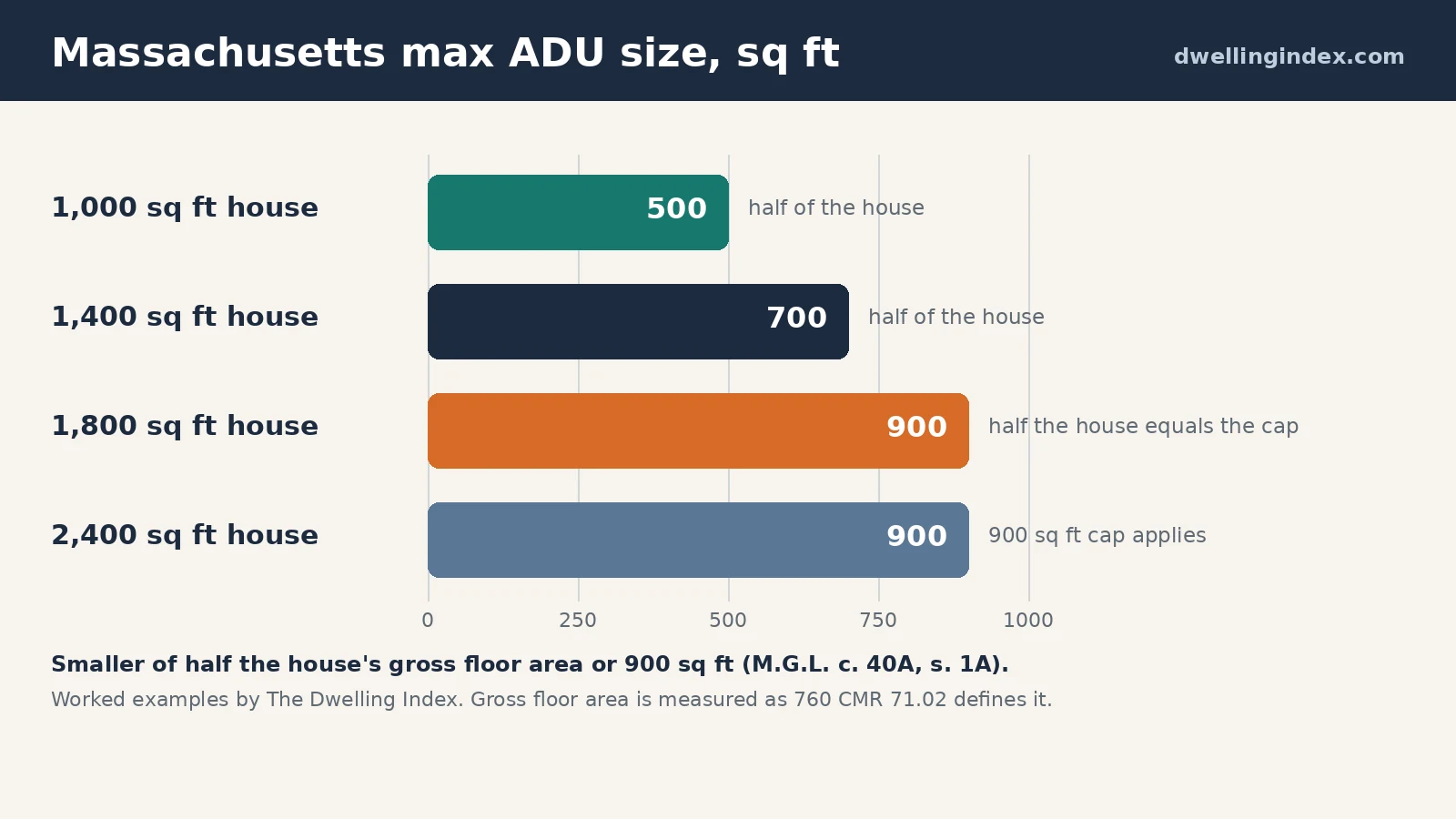
Answer capsule: A Protected Use ADU can be no larger than half the gross floor area (GFA) of the principal dwelling or 900 square feet, whichever is smaller. GFA counts every story of compliant ceiling height, including basements, lofts and intermediate floored tiers, and excludes crawl spaces, garage parking areas, attics and enclosed porches.
The regulation measures the main house's GFA "from the interior faces of exterior walls." Where a lot has more than one principal dwelling, the GFA of the largest one sets the limit.
Here is our arithmetic from that rule:
Disclosure: This page has no affiliate links. The Dwelling Index is reader-supported.
| Main house gross floor area | Half of that | Maximum ADU (smaller of half or 900 sq ft) |
|---|---|---|
| 1,000 sq ft | 500 sq ft | 500 sq ft |
| 1,400 sq ft | 700 sq ft | 700 sq ft |
| 1,800 sq ft | 900 sq ft | 900 sq ft |
| 2,400 sq ft | 1,200 sq ft | 900 sq ft |
The table is our worked example of the definition, not a town's figure. A small cape or ranch is the case where the half-of-the-house cap bites, so measure GFA the way the regulation does before you design. The definition also lets towns "impose additional size restrictions" and lets towns allow larger ADUs (760 CMR 71.03(7) says nothing prevents a town from adopting more permissive rules). If your town's by-law caps ADUs below what the state definition allows, ask the building commissioner to cite the by-law section and the legal basis.
What can't a Massachusetts town require for an ADU?
Answer capsule: Under 760 CMR 71.03(2), a town can't require owner-occupancy, more than one additional parking space (or any, near a transit station), use and occupancy restrictions such as income, age or family relationship, caps or quotas on the number of ADUs, or that the ADU be attached or detached. Protected ADUs don't count in density calculations.
The full list of prohibited regulations:
- Owner-occupancy. A requirement that "either the Protected Use ADU or the Principal Dwelling be owner-occupied."
- Excess parking. More than one additional on-street or off-street space if the lot is outside a 0.5-mile radius of a transit station, or any additional space if any part of the lot is within 0.5 mile of one.
- Use and occupancy restrictions. Limits on who can live in the ADU based on income, age, familial relationship, enrollment in an educational institution, or a cap on occupants beyond what the state code requires.
- Unit caps and density. "Any limit, quota or other restriction on the number of Protected Use ADUs that may be permitted, constructed, or leased within a Municipality or Zoning District."
- Attached or detached requirements.
The regulation also bars minimum lot sizes for a Protected Use ADU and bars a town from requiring a separate utility connection, though a utility, state law or a board can still require one.
What can Massachusetts towns still regulate?
Answer capsule: Towns can apply reasonable setbacks, bulk and height rules, site plan review, Title 5 septic rules, short-term rental limits, and design standards. The regulation says a rule is unreasonable if it nullifies the ADU, adds excessive cost without advancing a legitimate town interest, or is stricter than what applies to the main house or a single-family home.
Specific limits in 760 CMR 71.03(3)(b):
Disclosure: This page has no affiliate links. The Dwelling Index is reader-supported.
| Type of rule | What the regulation says a town can't do |
|---|---|
| Design standards | Apply a standard not applied to a single-family home in the district, or one so restrictive or arbitrary that it makes the ADU infeasible or raises its cost unreasonably |
| Dimensional standards (setbacks, lot coverage, open space, bulk, height, stories) | Be more restrictive than the main house or a single-family dwelling or accessory structure in the district, whichever is more permissive; require a minimum lot size |
| Utilities, safety, emergency access | Be stricter than state requirements, including the Fire Code; require a separate utility connection (unless a utility, state law, a board or a court requires it) |
| Environmental (Title 5, 310 CMR 15.000) | Be more restrictive than what applies to a single-family dwelling in the district |
| Site plan review | Be anything other than clear and objective, or impose unreasonable terms inconsistent with an as-of-right process |
| Impact analyses, studies and fees | Require any that wouldn't be required for a single-family dwelling in the district |
| Modular units | Restrict a modular ADU more than the Building Code does |
| Historic districts | Towns may set different, stricter design and dimensional standards in historic districts |
Two other town powers stand out. A town may require a special permit in a floodplain or aquifer protection overlay if one is required for the main house and the criteria are "clear, objective, and non-discretionary." And ADUs must be assigned an address consistent with MassGIS standards and reported.
The impact-fee line is the one most homeowners miss. A town can't charge an ADU an impact fee, or ask for a study, that it wouldn't charge or require for a single-family home in the same district.
How much parking does a Massachusetts ADU need?
Answer capsule: At most one additional parking space, and none if any part of your lot is within 0.5 mile of a commuter rail station, subway station, ferry terminal or bus station. The state's definitions limit which stations count: commuter rail and ferry service must run year-round at regular intervals, and a bus station is a point of embarkation for a bus operated by a transit authority.
From 760 CMR 71.02:
- Subway station: any stop on the MBTA's Red, Green, Orange, Silver or Blue Line, including extensions.
- Commuter rail station: one operated by a transit authority with year-round service at regular time intervals, "rather than intermittent, seasonal, or event-based service."
- Ferry terminal: year-round service at regular intervals.
- Bus station: a location serving as a point of embarkation for any bus operated by a transit authority, which includes the MBTA and regional transit authorities.
The test is about your lot, not your door: "if any portion of its Lot is located within a 0.5 mile radius." Measure from the nearest edge of the lot, not the house. The bus definition is broad, so ask your building department whether a nearby stop on a regional transit authority route counts before you assume you need a parking space.
Do septic rules (Title 5) change your ADU plans?
Answer capsule: Yes, if your lot isn't on public sewer. The statute explicitly lets towns apply 310 CMR 15.000 (Title 5, the state septic code) to ADUs, and the regulation says a town can't apply Title 5 more strictly than it does for a single-family dwelling. Your local board of health decides property-specific questions.
For an ADU on a septic system, the practical question is whether the existing system can handle the added bedrooms. The Massachusetts Department of Environmental Protection published guidance on Title 5 compliance for ADUs (updated September 11, 2025) and a Title 5 FAQ, which HLC links on its ADU page. HLC says property-specific septic questions go to your local board of health.
Before you design a detached ADU on septic, ask the board of health three things: whether the existing system can serve the added bedrooms, what upgrade or replacement the board would require, and what perc and design costs to expect. We don't publish septic cost figures because we haven't verified them.
Can a Massachusetts town restrict short-term rentals in an ADU?
Answer capsule: Yes. Chapter 40A § 3 says an ADU may be subject to "restrictions and prohibitions on short-term rental, as defined in section 1 of chapter 64G." A town can't unreasonably restrict the creation or rental of an ADU that isn't a short-term rental.
Long-term rental is protected: § 3 covers "a single accessory dwelling unit, or the rental thereof." If you plan to list the ADU on a short-stay platform, check your town's short-term rental by-law and any state or local registration requirements. For the broader picture, read our ADU for Airbnb guide. For a long-term rental estimate, see how much you can rent an ADU for. These are illustrative examples, not guarantees of returns. Actual results depend on local market conditions, construction costs, financing terms, and regulatory approvals.
Can you build more than one ADU on a Massachusetts lot?
Answer capsule: Only if your town allows it, and then with a special permit. Chapter 40A § 3 says that for more than one ADU in a single-family zoning district, "there shall be a special permit." Under 760 CMR 71.03(5), if a town chooses to allow additional ADUs on a lot, it must require a special permit for the additional units.
The state protection covers one ADU per lot. A second is a local decision, and a town can decline to allow it.
How is Boston different?
Answer capsule: Boston runs its own ADU program with its own page and guidebook. The city says homeowners of one-, two- and three-family homes may be able to build an ADU when they live on the same parcel, that building permits come from its Inspectional Services Department, and that some projects need Zoning Board of Appeal review.
From Boston's page, read November 17, 2026:
- Who: "homeowners of 1-, 2-, and 3-family homes may be able to build an ADU when they live on the same parcel where the ADU will be built."
- Types: internal ADUs (basement or attic conversions) and external ADUs (additions or detached structures).
- Permits: building permits from the Inspectional Services Department; "in some cases," Zoning Board of Appeal review first.
- Help: an ADU Guidebook, virtual design workshops on the first Thursday of each month and budget workshops on the first Wednesday, and a financial assistance program for income-eligible homeowners.
One conflict we can't resolve. Boston's page describes an on-site owner requirement, while the state rule bars towns from requiring owner-occupancy for a Protected Use ADU in a single-family zoning district. We couldn't tell from Boston's page how the two fit together. If you're in Boston, ask the Inspectional Services Department or ADU@boston.gov which rule applies to your lot and ask for the answer in writing.
What changed in 2026?
Answer capsule: HLC published proposed revisions to 760 CMR 71.00 for public comment from September 11 to October 9, 2026. The notice says the purpose is to clarify when local governments must issue permits for Protected Use ADUs and what regulatory powers they may use. The proposal isn't final as of our reading.
Two other 2026 items:
- The draft revisions. The Secretary of the Commonwealth's public notice describes the purpose in the sentence above and links the proposed text. We did not read the full proposed text, so we don't describe what it would change. Watch HLC's ADU page for the final version.
- State survey data. HLC's survey of 2025 and the first half of 2026 reports 2,084 approved ADUs and 2,824 ADU applications. HLC's page doesn't say how many applications are pending or denied, so we don't compute an approval rate.
HLC's Zoning Act toolkit also lists Acts of 2026, Chapter 137 (the FY27 budget) among recent changes to chapter 40A. We didn't review whether it touches ADUs.
What if your town says no?
Answer capsule: Ask for the by-law section and the reason in writing, compare it with 760 CMR 71.03, and talk to a Massachusetts land use attorney before you appeal or build. HLC says it can't answer questions about specific properties.
Steps in order:
- Ask the building commissioner or zoning enforcement officer which by-law section applies and whether your lot is in a single-family zoning district under 760 CMR 71.02.
- Check the specific requirement against the prohibited list in 71.03(2): owner-occupancy, extra parking, use restrictions, unit caps, attached or detached rules.
- Check it against the reasonableness test in 71.03(3): dimensional rules stricter than the main house, site plan review that isn't clear and objective, impact fees a single-family home wouldn't pay.
- Ask for a written determination. A written denial gives you something to appeal or have a lawyer review.
- Look at the Attorney General's Municipal Law Unit decision lookup, which HLC says will publish decisions on town ADU by-law reviews.
HLC's ADU coordinator and the state's model zoning (ADU Model Zoning v1.2, prepared with MAPC and the Massachusetts Housing Partnership) are resources for towns and owners. Contact details are on HLC's ADU page.
What does a Massachusetts ADU project look like step by step?
Answer capsule: Confirm zoning and lot status, measure the main house's gross floor area, check septic or sewer, check town design and dimensional rules, then apply for a building permit and get an address assigned. The state Building Code, Fire Code and Massachusetts Lead Law still apply, because 760 CMR 71.01(3) says the ADU rules don't supersede them.
- Confirm your zoning district. Is single-family use allowed there?
- Measure the main house's GFA the way 760 CMR 71.02 does.
- Check sewer or septic. Public sewer connection, or Title 5 with the board of health.
- Read your town's ADU by-law. Look for setbacks, height, site plan review and short-term rental limits.
- Check overlays. Floodplain, aquifer protection, historic district.
- Design the entrance and egress. A separate entrance that meets the state building code.
- Ask about insurance. The Division of Insurance published guidance for Protected Use ADUs on October 20, 2025.
- Apply and get an address. ADUs must be assigned an address consistent with MassGIS standards.
Check your lot's ADU options — get your free report
For the full build sequence, read our guide to building an ADU and our ADU permit process guide. To test a budget, use our ADU cost calculator.
Compare Massachusetts ADU costs with your own numbers — run the free ADU cost calculator
How can you pay for a Massachusetts ADU?
Answer capsule: Common ways homeowners pay for an ADU include cash, a home equity loan or line, and a renovation or construction loan. Which fits depends on your equity, your timeline and whether you plan to rent the unit. We cover the paths as education, not as rankings or offers.
We cover this on dedicated pages: Massachusetts ADU loan paths, Massachusetts ADU grants, and our ADU financing options guide. Boston also lists a financial assistance program for income-eligible homeowners. Check any program's current terms before you plan around it.
How do Massachusetts ADU laws compare with other states?
Answer capsule: Massachusetts protects one ADU per lot statewide from prohibition and special permits, up to a size ceiling of 900 square feet or half the main house. California works differently: its state law sets minimum sizes that local rules can't go below. Don't assume one state's number applies in the other.
For comparison, see our guides to California ADU laws, Washington ADU laws and Colorado ADU laws, and our 50-state ADU overview.
What should you ask the building department before you pay for plans?
Answer capsule: Ask whether your lot is in a single-family zoning district, how the town measures gross floor area, the setbacks and height limit for a detached ADU, whether site plan review applies, whether septic needs an upgrade, and how short-term rental is regulated. Write down the answers with the date.
- Is my lot in a single-family residential zoning district under 760 CMR 71.02?
- How does the town measure the main house's gross floor area?
- What are the setbacks, height and lot coverage limits for an attached and a detached ADU?
- Does the town require site plan review, and what are its criteria?
- Is my lot within 0.5 mile of a transit station, as the regulation defines it?
- Is my lot in a floodplain, aquifer protection or historic district?
- Is the lot on public sewer or septic? What does the board of health require?
- What impact fees apply, and are they the same as for a single-family home?
- Does the town restrict short-term rental of an ADU?
- How do I get an address assigned for the ADU?
Print the list, write the answers in the margin and date them. Then use our property eligibility check for a general planning overview; confirm parcel-specific rules with your building department.
See what's possible at your address — get your free ADU report
What we verified
- Verified on November 17, 2026: M.G.L. c. 40A, § 3 on malegislature.gov; Sections 7 and 8 of Chapter 150 of the Acts of 2024 on mass.gov; 760 CMR 71.00 (Mass. Register #1540, January 31, 2025) on mass.gov.
- Verified: HLC's "Accessory Dwelling Units" page, including the FAQ, the 2025-2026 ADU survey totals and the guidance table.
- Verified: the Secretary of the Commonwealth's public notice of proposed 760 CMR 71.00 amendments (comment period September 11 to October 9, 2026).
- Verified: City of Boston, "Accessory Dwelling Units (ADUs) in Boston."
- Not verified: the full text of the 2026 draft revisions; individual town by-laws; Title 5 requirements for any specific lot; impact fee schedules; the content of DEP's Title 5 guidance, the Division of Insurance guidance and MassGIS addressing guidance (we confirm they exist from HLC's page, but did not read them); whether Acts of 2026, Chapter 137 affects ADUs; and any amendment passed after the documents we read.
Methodology
We used the statute text and the state regulation, and HLC's own page for the FAQ and the survey numbers. We recorded the document name next to every rule. Where a document didn't address a topic, we say so. The size table is our arithmetic from the statutory definition, labeled as such. We don't publish cost figures or approval rates because we haven't verified them. If you find a number that is out of date, tell us on our corrections page.
Sources
- M.G.L. c. 40A, § 3 (ADU paragraph) and § 1A (definition of "accessory dwelling unit"): malegislature.gov
- St. 2024, c. 150, §§ 7 and 8 (Affordable Homes Act): mass.gov
- 760 CMR 71.00, Protected Use Accessory Dwelling Units (effective January 31, 2025): mass.gov
- Executive Office of Housing and Livable Communities (HLC), Accessory Dwelling Units, including FAQ, Impact and Outcomes survey and resources: mass.gov
- Secretary of the Commonwealth, Public Notice, proposed amendment of 760 CMR 71.00 (September 2026): public notice
- City of Boston, Accessory Dwelling Units (ADUs) in Boston: boston.gov
Frequently asked questions
What are the Massachusetts ADU laws?
Since February 2, 2025, M.G.L. c. 40A § 3 bars towns from prohibiting one ADU in a single-family zoning district or requiring a special permit for it. The ADU can be no larger than 900 square feet or half the main house's gross floor area, whichever is smaller. HLC's regulation is 760 CMR 71.00.
Do I need a special permit for an ADU in Massachusetts?
Not for one Protected Use ADU in a single-family zoning district. A town can require a special permit for a second ADU, and in a floodplain or aquifer protection overlay if one is required for the main house and the criteria are objective.
Do I have to live on the property to have an ADU in Massachusetts?
No. The statute says an ADU "shall not require owner occupancy of either the accessory dwelling unit or the principal dwelling." Boston's page describes an on-site owner rule for its program, so confirm how Boston applies the state rule to your lot.
How big can an ADU be in Massachusetts?
No larger than 900 square feet or half the gross floor area of the main house, whichever is smaller. Towns can allow larger units and can add size restrictions by by-law.
How much parking does a Massachusetts ADU need?
At most one additional space. None is required if any part of the lot is within 0.5 mile of a commuter rail station, subway station, ferry terminal or bus station as the regulation defines them.
Can a Massachusetts town ban short-term rentals in an ADU?
Yes. The statute lets towns restrict or prohibit short-term rental as defined in M.G.L. c. 64G § 1. Long-term rental of the ADU is protected.
Do Massachusetts ADUs need a septic upgrade?
Possibly. Towns can apply Title 5 (310 CMR 15.000) but not more strictly than for a single-family dwelling. Ask your board of health whether your system can serve the added bedrooms.
Did the Massachusetts ADU rules change in 2026?
HLC proposed revisions to 760 CMR 71.00 and took public comment from September 11 to October 9, 2026. We haven't seen a final version. HLC's survey reports 2,084 approved ADUs from 2,824 applications in 2025 and the first half of 2026.