
Massachusetts ADU Grant: What’s Actually Available in 2026
By the Dwelling Index Editorial Team — an independent research resource covering ADU financing, costs, and regulations.
·
We are not a lender, broker, builder, or government agency. This is research and education, not legal, tax, or financial advice.
The bottom line, up front
There is no single statewide Massachusetts ADU grant that pays for a full accessory dwelling unit. If you came here hoping for free money that covers your whole build, we’ll be straight with you: it doesn’t exist in Massachusetts as of May 2026. What does exist is a six-part funding ecosystem — and one piece (Boston’s program) behaves almost exactly like a grant for as long as you stay in your home.
Who this applies to: Massachusetts homeowners (owner-occupants) wanting government help to fund an ADU.
The real money, in one breath: Boston offers a $7,500 grant plus a $50,000 zero-interest deferred loan for income-eligible Boston owner-occupants. Statewide, MassHousing lends up to $250,000 (detached) or $150,000 (attached) through a two-part structure. The Pioneer Valley offers a $500 feasibility grant. HMLP lends up to $50,000 at 0% for accessibility-driven ADUs statewide. Cape Cod’s program is currently out of money.
Your next step: Find your lane in the comparison table below, then check what’s possible at your address before you spend a dollar on plans.
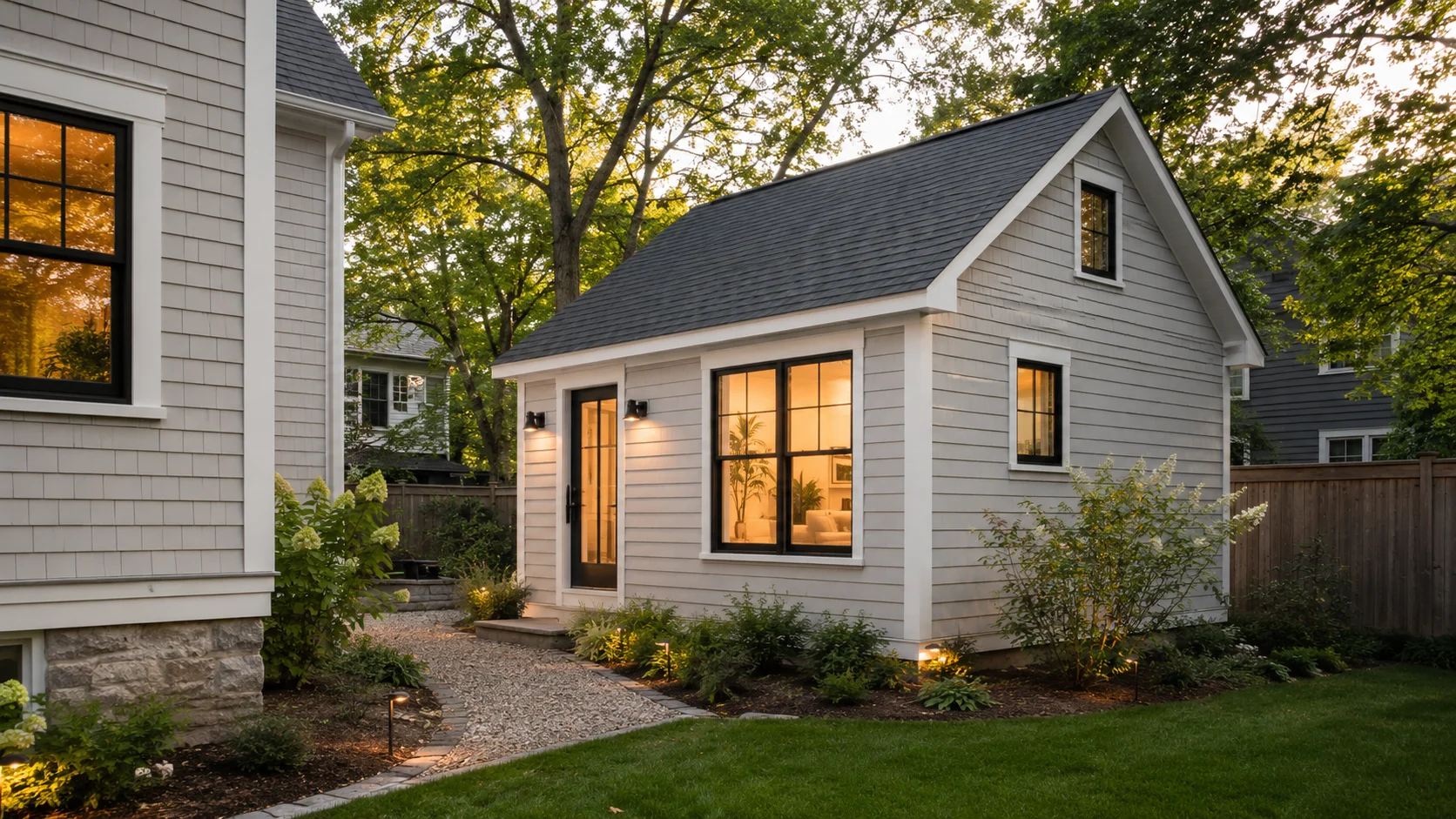
The word “grant” is doing a lot of heavy lifting in Massachusetts ADU headlines right now. Governor Healey’s housing campaign, MassHousing’s new loan, a statewide feasibility program, a design competition — it all blurs into a vague sense that the state will help pay for my backyard cottage. Some of that is true. Most of it is a loan. And the single most expensive mistake we see homeowners make is treating a loan like free money, then applying at the wrong stage and losing months.
This page exists to end that confusion. Every figure below comes directly from primary government and program sources — Mass.gov, MassHousing, Boston.gov, the Massachusetts Clean Energy Center, CEDAC, and Housing Assistance Corporation — verified on . Where something is genuinely uncertain or rate-sensitive, we say so plainly.
Massachusetts ADU Funding Fit Matrix (2026 verified snapshot)
This is the table you’d otherwise have to build yourself by opening seven government tabs and reconciling them. We did it once. Last verified May 26, 2026.
| Program | Free grant? | Max published help | Where it applies | Best for | Apply at what stage | Status (last checked May 26, 2026) |
|---|---|---|---|---|---|---|
| MHP ADU Incentive Program | No cash grant; feasibility-study support (cost-share TBD) | Feasibility-study support | Statewide | Early-stage homeowners needing feasibility clarity | Idea / feasibility | Phase One expected Spring 2026 |
| MassHousing ADU Loan (ADULP) | No — loan | Up to $250,000 detached / $150,000 attached, in two parts | Statewide (participating lenders) | Income-eligible, permit-ready owner-occupants | After plans + permits in hand | Live — open since 3/17/2026 |
| Boston ADU Technical Assistance Grant | Yes (reimbursement) | $7,500 for soft costs | City of Boston only | Boston owner-occupants in design/permitting | Design / permitting | Active |
| Boston Home Center ADU Loan | No — 0% deferred loan | $50,000 at 0%, no monthly payments | City of Boston only | Boston owners with a construction gap | Construction-ready | Active |
| Pioneer Valley ADU Accelerator | Partial feasibility grant | $500 toward a $1,000 study | Hampden, Hampshire, Franklin Counties | Detached all-electric modular/panelized projects | Early feasibility | Active |
| HMLP (Home Modification Loan Program) | No — 0% accessibility loan | $50,000 (owners) / $30,000 (mobile/manufactured) | Statewide | ADUs tied to disability or aging-in-place needs | Modification planning | Active |
| Cape Cod “My Home Plus One” | Incentive when funded | Currently $0 | Cape Cod | Year-round rental ADUs | Feasibility | Fully subscribed — no funds |
Sources: MHP ADU Incentive Program (mhp.net); MassHousing press release 3/17/2026 (mass.gov), Second Mortgage Product Matrix rev. 4/16/2026 and ADULP income-limit schedule effective 3/9/2026 (masshousing.com); Boston.gov ADU Financial Assistance Program (last updated 3/13/26); MassCEC Pioneer Valley ADU Accelerator (goclean.masscec.com); CEDAC HMLP (cedac.org); Housing Assistance Corporation My Home Plus One (haconcapecod.org). All verified May 26, 2026. Amounts above are program maximums, not guarantees of eligibility, funding, or approval.
See what\u2019s possible at your address
Enter your address and we\u2019ll show you what your specific lot can support before you spend money on plans, permits, or applications.
Get Your Free ADU Report →Is there a Massachusetts ADU grant in 2026?
Yes, but only in a narrow sense — and not the way most people mean. A true grant (money you never repay) exists only at the local level: Boston offers up to $7,500 in soft-cost reimbursement, and the Pioneer Valley offers a $500 feasibility-study grant. The largest dollar figures in Massachusetts — MassHousing’s $250,000 and Boston’s $50,000 — are loans, not grants. There is no statewide program that hands homeowners free construction money.
Here’s why the confusion is so common. In December 2025, Governor Maura Healey launched a publicized ADU campaign that bundled three different things under one announcement: a $10 million technical-assistance program through MHP, a new MassHousing loan, and an ADU Design Challenge backed by roughly $60,000–$70,000 in sponsor commitments for prizes and outreach (per MHP). The Design Challenge awards money to designers, who must release their winning plans to the public for free.
So when a headline says “Massachusetts is funding ADUs,” it’s technically true and practically misleading. The state is subsidizing the path — feasibility, design, and low-cost lending — not paying for the building.
So the real question isn’t “where’s the free money?” It’s “which funding lane fits my address, my stage, and my reason for building?” Answer that, and the whole process gets simpler.
The four-question filter that saves you months
- Where is the property? Boston has its own programs. The Pioneer Valley (Hampden, Hampshire, Franklin Counties) has its own. Everywhere else relies on the statewide options.
- What stage are you in? Just thinking about it? You need feasibility help. Have permits in hand? You’re ready for MassHousing.
- Why are you building? Rental income and family housing point to one set of programs; disability or aging-in-place access unlocks HMLP, which most homeowners never hear about.
- Do you have plans, permits, and contractor quotes yet? MassHousing and Boston both require readiness. Apply too early and you’ll be turned away.
We’ll route you through each lane below. The honest headline stays the same: plan around a loan, and treat any grant as a bonus on top.
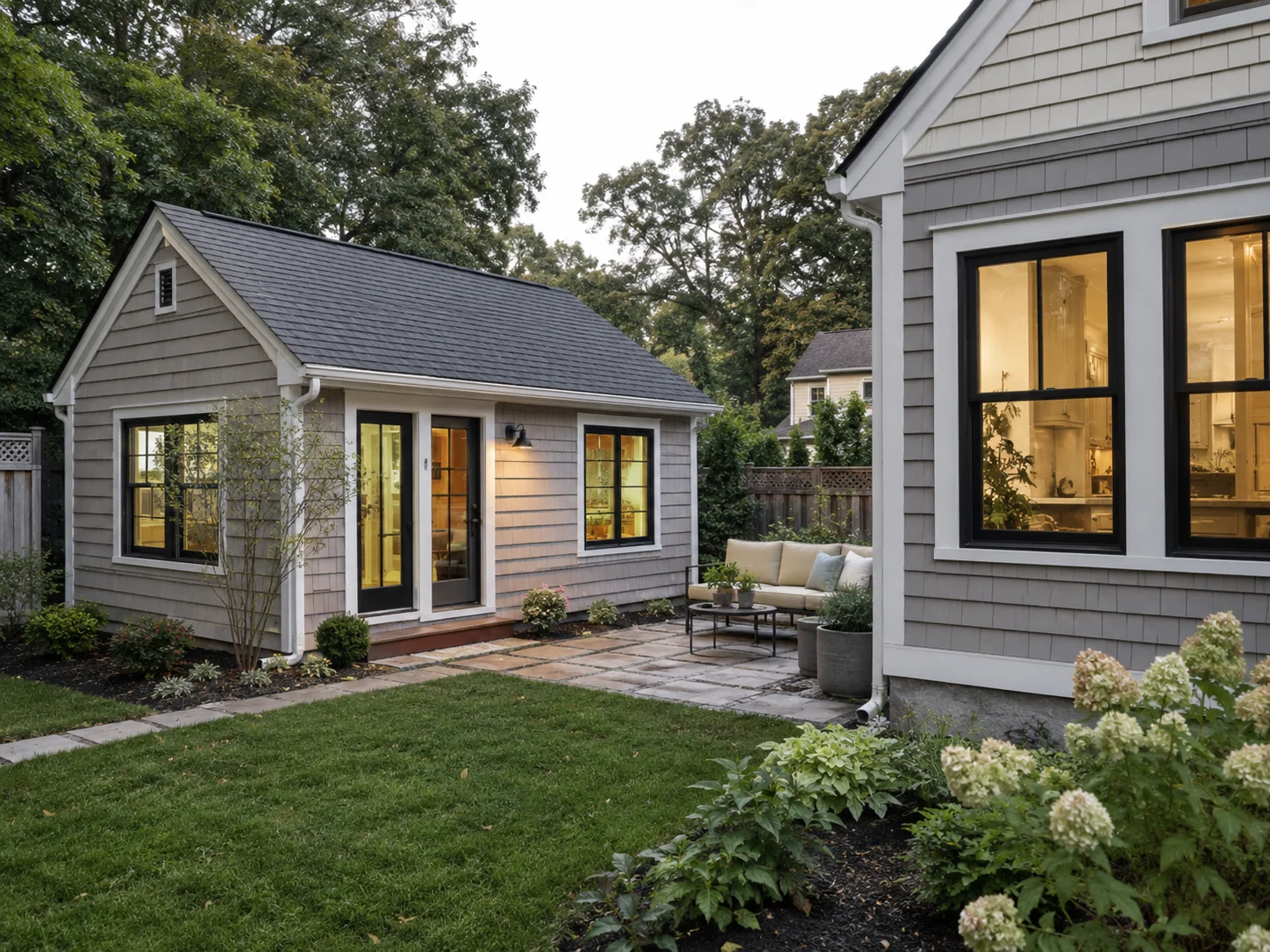
Which Massachusetts ADU programs are real, open, limited, or paused?
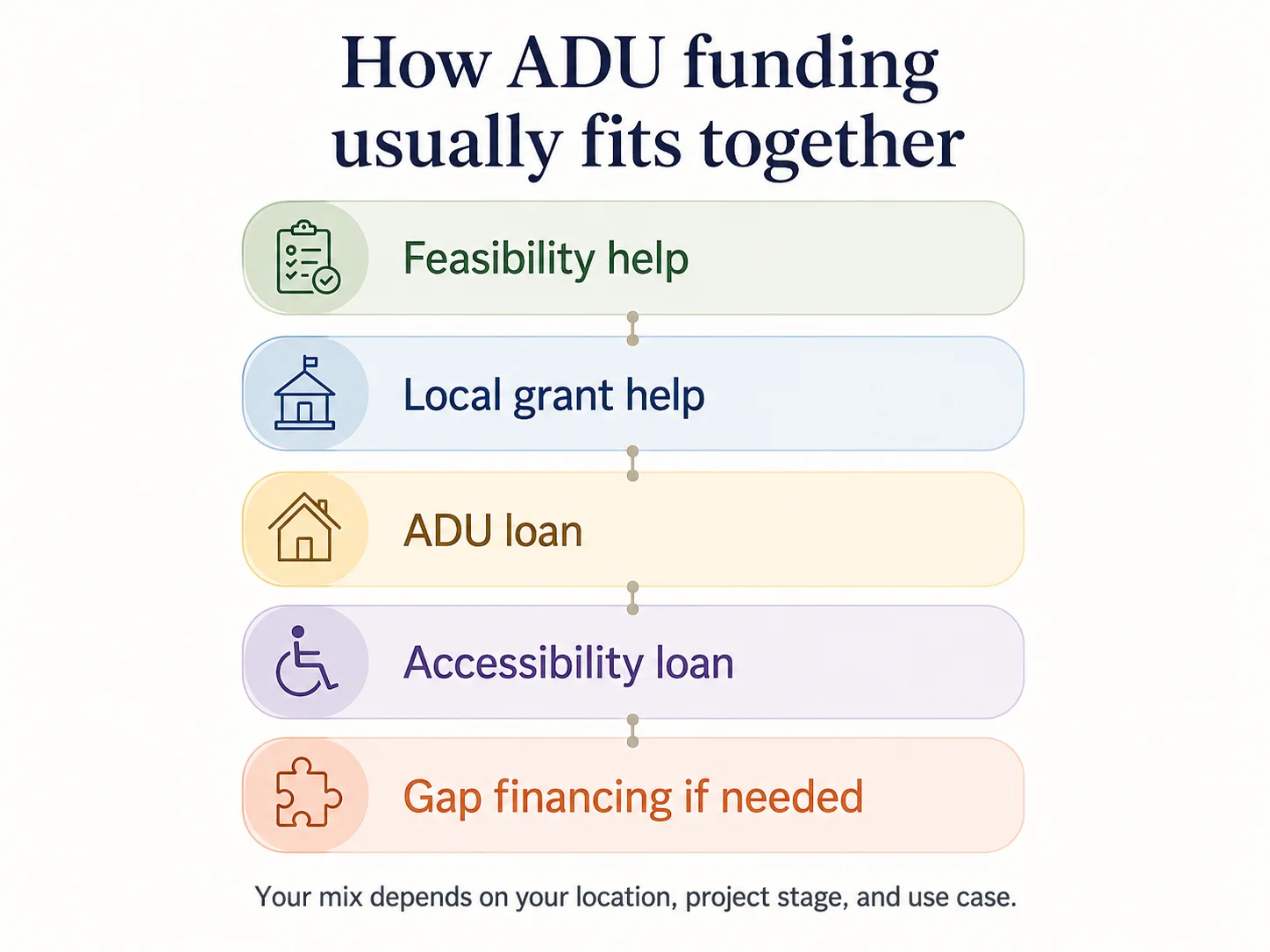
Massachusetts ADU funding falls into six distinct lanes: statewide feasibility support (MHP), statewide construction lending (MassHousing ADULP), Boston’s grant-plus-loan stack, the Pioneer Valley’s regional feasibility grant, accessibility-based lending (HMLP), and local programs that are currently paused — most notably Cape Cod’s fully subscribed “My Home Plus One.” Each has a different sponsor, geography, dollar amount, and required project stage.
MHP ADU Incentive Program — statewide feasibility, launching Spring 2026
The Massachusetts Housing Partnership (MHP) runs a statewide ADU Incentive Program whose Phase One focuses on professional feasibility studies, not construction cash. It operates with the Executive Office of Housing and Livable Communities (EOHLC). As of May 26, 2026, MHP’s page lists Phase One as expected to launch in Spring 2026 and says it is still procuring Feasibility Study Providers (FSPs); it does not yet publish a homeowner dollar amount or cost-share for the studies.
A feasibility study is the early diagnostic work that answers “can I build this here, and what will it cost?” — looking at zoning, setbacks, utilities, site access, and a high-level budget. MHP has said additional phases and incentives “may be introduced in the future,” which is government language for don’t count on construction money yet.
MassHousing ADU Loan (ADULP) — the biggest number, but it’s a loan in two parts
MassHousing’s Accessory Dwelling Unit Loan Program (ADULP) is the largest statewide dollar source — up to $250,000 for detached ADUs and $150,000 for attached ADUs — but it is financing, not a grant, and the total comes in two stacked pieces. It launched to consumers on March 17, 2026, and is offered through a statewide network of participating community lenders.
Here’s the structure that trips people up, straight from MassHousing’s product matrix (revised April 16, 2026):
- Detached ADU: up to $150,000 as an interest-bearing second mortgage amortized over 20 years, plus up to $100,000 as a 0% deferred “match” loan = $250,000 total.
- Attached ADU: up to $100,000 amortized over 20 years, plus up to $50,000 as a 0% deferred match = $150,000 total.
- The 0% deferred portion is due when the amortizing loan is paid off. Blending the two lowers your effective rate and lets you borrow more overall than a standard HELOC would allow.
On rate: MassHousing’s January and March 2026 launch materials listed the amortizing portion at 5.25%, but the official product matrix now directs borrowers to the current MassHousing rate sheet. Treat 5.25% as the launch figure and confirm the live rate with a participating lender before you plan around it.
- Income ceiling: households up to 135% of area median income (AMI) — see the county table below.
- Construction-to-permanent only: ADULP finances construction. You apply after you have designs and permits in hand. Per Mass.gov: “Homeowners should apply for MassHousing ADU financing after they have secured local permits and are ready to move forward with construction.”
- Owner-occupancy: the property must be your current primary residence. This is not an investor path, and only 1-unit properties qualify.
Boston ADU Financial Assistance — the closest thing to a real grant
The City of Boston offers the only program in Massachusetts that combines a true grant with a grant-like loan: a $7,500 technical-assistance grant for soft costs, plus a $50,000 zero-interest deferred loan for construction. Both are limited to income-eligible owner-occupants of 1-, 2-, or 3-unit homes in Boston, and both come with real prerequisites.
We read Boston’s program page line by line (last updated 3/13/26). Here’s what most summaries miss:
- The $7,500 grant is a reimbursement, paid after you’ve received an approved building permit and enrolled in the city’s ADU Loan. It covers soft costs: architect/surveyor/engineer fees, a contractor deposit, building-permit fees, and Zoning Board of Appeal fees. You front the money, then get reimbursed up to $7,500.
- The $50,000 loan is 0% interest and deferred — it becomes due only if you sell, transfer ownership, or do a cash-out refinance. There are no monthly payments. It can feel grant-like while you stay put, but it is still a lien that comes due on those triggers.
- Match rule: no owner match is required below 120% AMI. Between 120% and 135% AMI, you must match the city loan 1:1 with your own funds or a bank loan.
- The prerequisites are substantial. You must own and occupy the home; hold less than $100,000 in financial assets, excluding assets being used toward ADU construction, home equity, retirement funds, and college savings plans; be current on taxes, water, mortgage, and insurance; attend both the ADU Design Workshop and ADU Budget Workshop within three months before applying; work with a licensed architect; and submit at least two quotes from licensed, insured contractors. Boston also notes that any contractor quote below $100,000 “will be scrutinized” by its Construction Monitoring Team.
That last detail is a quiet gift: the city is telling you a credible Boston ADU costs six figures. Boston applies its own income-eligibility limits (by household size) rather than the MassHousing county figures — confirm the current limits on Boston.gov before you apply.
Pioneer Valley ADU Accelerator — a $500 feasibility grant for Western Mass
The Pioneer Valley ADU Accelerator offers eligible homeowners a $500 grant toward a $1,000 feasibility study, limited to detached, all-electric, modular or panelized ADUs in Hampden, Hampshire, and Franklin Counties. Run by the Massachusetts Clean Energy Center (MassCEC) with coordination by Backyard ADUs, it covers 69 specific municipalities — from Springfield and Northampton to Greenfield and dozens of small towns.
The grant is modest, but the program’s real value is the structured early path: a free address-lookup tool (the “ADU Wizard”), a financial-feasibility calculator, a phone screening with a program manager, and the subsidized full study. One useful planning anchor from their design listings: the program assumes a $40,000 baseline site-cost on top of the factory-built unit — exactly the number homeowners forget to budget.
Eligibility is narrow on purpose: you must be exploring a detached, all-electric, energy-efficient modular or panelized cottage. If you want a basement conversion or a gas-heated garage ADU, this isn’t your lane.
HMLP — the accessibility loan almost nobody mentions
The Home Modification Loan Program (HMLP) can finance an ADU or in-law apartment as a “necessary home modification” for a person with a disability or an older adult — up to $50,000 at 0% interest, statewide, with repayment deferred until the property is sold, transferred, or refinanced. It’s a loan, not a grant, but the terms are exceptional and the use case is one the higher-profile programs don’t cover.
Established by the Massachusetts Legislature in 1999 and administered through CEDAC, HMLP has helped over 3,000 households. Its eligible-improvements list explicitly includes “creation of additional living space, including accessory dwelling units or in-law apartments.” Its own case studies include real ADUs: a Plymouth family built an ADU for an adult son on the autism spectrum; a Haverhill family created a basement ADU for an adult daughter with multiple disabilities; a Cape Cod family built a detached ADU in 2020 for an adult son.
Key facts: up to $50,000 for property owners ($30,000 for manufactured/mobile homes), 0% interest, no monthly payments, repaid on sale/transfer/refinance. Small landlords (fewer than 10 units) may qualify for a 3% loan to modify a unit for a tenant. This is not a general ADU loan — the project must directly help someone living in the home function day to day, and the application requires a Documentation of Need form completed by a medical or relevant professional. CEDAC’s 2025 guidance also allows higher household incomes than the other programs (up to 200% AMI, with countable-asset rules), reflecting its accessibility mission. You apply through a regional provider agency assigned by your city or town.
Cape Cod “My Home Plus One” — currently out of money
Housing Assistance Corporation’s Cape Cod ADU program offers technical assistance plus a financial incentive for year-round rental ADUs — but as of May 2026 its page states plainly that no funds are available and the program is fully subscribed until more funding is received. Don’t build a plan around it unless its status changes.
It’s still worth knowing about. The technical-assistance side (feasibility guidance) may still help, and the Cape’s towns have made real ADU progress — Falmouth and Brewster alone approved 21 and 26 new ADU permits respectively under updated bylaws. On the Cape, your near-term funding realistically comes from MassHousing, HMLP (if accessibility-driven), or private financing — not from this program.
Who qualifies for each Massachusetts ADU grant or loan?
Eligibility comes down to four things: location, owner-occupancy, income, and project stage. Boston requires a 1–3 unit owner-occupied home and its own income limits; MassHousing requires a 1-unit owner-occupied primary residence under 135% AMI with permits in hand; HMLP requires a documented accessibility need; and the Pioneer Valley requires a detached all-electric modular/panelized project in one of three counties.
| Program | Must own & occupy? | Income gate | Property type | Key extra requirement |
|---|---|---|---|---|
| MassHousing ADULP | Yes — primary residence | ≤ 135% AMI (county table below) | 1-unit only | Plans + permits in hand; 640 credit; ≤50% DTI |
| Boston grant + loan | Yes — 1–3 unit Boston home | Boston’s own limits; <$100k liquid assets | 1–3 unit | Two workshops + architect + two contractor quotes |
| Pioneer Valley | Own a home in-region | Not the primary gate | Detached only | All-electric modular/panelized; 1 of 69 towns |
| HMLP | Owner or small landlord | Up to ~200% AMI (CEDAC 2025) | 1+ unit | Documentation of Need; accessibility purpose |
| MHP Incentive | Homeowner | TBD at launch | Statewide | Feasibility intake (Phase One) |
| Cape Cod | Owner | N/A | — | Currently unfunded |
MassHousing ADULP income limits by county (effective March 9, 2026)
This is the full verified schedule — the single most-requested number for this program, and one almost no competing page has transcribed. These are the 135% AMI ceilings; your household income must fall at or below the figure for your county.
| County | 135% AMI income limit | County | 135% AMI income limit |
|---|---|---|---|
| Barnstable | $167,535 | Suffolk (incl. Boston) | $205,335 |
| Berkshire | $137,565 | Middlesex | $205,335 |
| Bristol | $155,385 | Norfolk | $205,335 |
| Dukes | $206,955 | Plymouth | $205,335 |
| Essex | $205,335 | Nantucket | $220,725 |
| Franklin | $168,345 | Worcester | $165,645 |
| Hampden | $129,870 | Hampshire | $160,650 |
Source: MassHousing ADULP Income Limits schedule, effective March 9, 2026 (masshousing.com). Verified May 26, 2026. These update periodically — re-verify before relying on them.
In plain English: the limit sounds restrictive but is actually generous. In Middlesex, Norfolk, Suffolk, Essex, or Plymouth County, a household earning up to $205,335 still qualifies. Even in the lowest-limit county (Hampden, at $129,870), a typical dual-income family is often under the ceiling. The program was deliberately built to reach the middle, not just the lowest incomes.
The ADULP requirements most pages leave out
MassHousing’s product matrix spells out underwriting friction points that send homeowners back to search if they’re not stated up front. Know them now.
| Requirement | What it means |
|---|---|
| Credit score | Minimum 640 |
| Debt-to-income | Maximum 50% DTI |
| Loan-to-value | Maximum 95% LTV/CLTV, based on appraised “subject-to-completion” value |
| Appraisal | Full appraisal required (not a drive-by) |
| Contingency | 10% construction contingency required |
| Construction timeframe | Work must finish within six months of the note date |
| Property | 1-unit only, owner-occupied primary residence |
Source: MassHousing Second Mortgage Product Matrix, revised April 16, 2026 (masshousing.com). Verified May 26, 2026.
The Dwelling Index is reader-supported. When you use our links to explore financing options or request pricing, we may earn a commission at no extra cost to you. Our recommendations are based on independent research and are never influenced by compensation. Read our full disclosure.
If your income is above your county’s ceiling, or you need to bridge a gap ADULP doesn’t fully cover, the next problem becomes financing the rest — refinancing, construction loans, and home-equity options. It’s worth understanding those lanes before you commit.
Have a funding gap, or income above the limit?
Explore your ADU financing paths \u2014 cash-out refinance, construction loans, and home-equity options \u2014 as independent education, not lender rankings, through our financing partner Mortgage Research Center. We don\u2019t quote rates, payments, or approval odds; those depend on your lender, credit, and market conditions. This is path education, not a guarantee.
Explore ADU Financing Paths \u2192Will a grant or ADU loan cover the real project cost?
Usually not by itself. Massachusetts ADU grants cover feasibility or soft costs (Boston’s $7,500, Pioneer Valley’s $500); Boston’s deferred loan caps at $50,000; and MassHousing can fund a larger share but as debt you repay. Against real Massachusetts build costs — Boston uses $275 per square foot as a planning rule, and Pioneer Valley design estimates run $250,000–$280,000 for a 400-sq-ft unit up to $390,000–$405,000 for 900 sq ft — most “free money” closes only a slice of the gap.
This is the honest part most pages skip. Here’s the math, using published cost anchors.
| Project anchor | Published cost | What $7,500 grant covers | What $50,000 loan covers | What ADULP could cover |
|---|---|---|---|---|
| Boston 800 sq ft @ $275/sf | $220,000 | ~3.4% | ~22.7% | Up to full amount if detached & eligible — but as a loan |
| Pioneer Valley “Agua 400” (400 sf) | $250,000–$280,000 | ~2.7–3.0% | ~17.9–20.0% | Up to the $250,000 detached cap — as a loan |
| Pioneer Valley “Starling” (900 sf) | $390,000–$405,000 | ~1.9% | ~12.3–12.8% | $250,000 cap still leaves ~$140,000–$155,000 to finance |
Cost anchors: Boston.gov ($275/sf planning benchmark); MassCEC Pioneer Valley design listings. Verified May 26, 2026. These are illustrative examples, not guarantees of costs, financing, eligibility, or returns. Actual results depend on local market conditions, site work, utility connections, construction bids, financing terms, and regulatory approvals.
Why “free money” usually solves only one piece
An ADU budget has many parts, and grants tend to touch only the cheapest ones: feasibility (what MHP and Pioneer Valley subsidize, $500–$1,000), soft costs (design, surveys, permits — Boston’s $7,500 reimbursement), construction (the big number, where Boston’s $50,000 loan and MassHousing’s six-figure loan come in), site work (grading, foundation — the $40,000 baseline Pioneer Valley assumes), utility connections (water, sewer/septic, and the electrical panel upgrade an all-electric unit may need), and contingency (the 10% buffer MassHousing actually requires).
Here’s the reframe, though: a $50,000 zero-interest deferred loan you may never repay while you live there (Boston), or a six-figure loan whose blended structure was designed to undercut a HELOC (MassHousing), genuinely changes what’s affordable — even if no single program writes a check for the whole thing. The homeowners who succeed treat the public programs as the foundation of a stack, then fill the rest with conventional financing.
See the size of your gap before you apply anywhere
Get your free ADU feasibility report \u2014 it estimates a build cost for your specific lot and project type, so you know exactly how much you\u2019ll need to finance.
Get Your Free ADU Report →What changed under the Massachusetts ADU law?
The Affordable Homes Act (signed 2024) made one ADU “as of right” in single-family zoning districts statewide, and capped its size at the lesser of 900 square feet or half the principal dwelling’s gross floor area. “As of right” means a town can’t require a special permit or discretionary approval for that one protected ADU — but you still need a building permit and must satisfy code, septic/sewer, wetlands, setbacks, and utility rules.
This is the legal change that triggered the whole 2025–2026 funding wave. Here’s the statute decoded into plain English, with the facts homeowners most often get wrong.
| What the law says | Plain-English meaning | Source |
|---|---|---|
| ADU ≤ lesser of 900 sf or ½ the principal dwelling’s gross floor area | If your house is small, your by-right ADU is smaller than 900 sf. A 1,400-sf home → max ~700-sf ADU. | M.G.L. c. 40A §1A |
| One ADU allowed “as of right” in single-family zones | No special permit, variance, or discretionary zoning approval for that one ADU. | Affordable Homes Act §8 |
| No owner-occupancy requirement for the protected ADU | A town cannot force you to live in either unit to build the one by-right ADU. (Note: individual funding programs like Boston’s and MassHousing’s still require owner-occupancy — the zoning law and the loan terms are separate.) | Affordable Homes Act §8 |
| Parking: no more than one added space; zero required within ½ mile of transit | Near commuter rail, subway, ferry, or bus station, the town can’t make parking a dealbreaker. | Affordable Homes Act §8 |
| Short-term rental may be restricted | Towns can bar using the ADU as an Airbnb-style short-term rental. | M.G.L. c. 40A §1A |
| Building permit still required | “By right” zoning is not a building permit. You still need stamped plans and ISD/local approval. | — |
| Septic / Title 5 capacity still applies | An added bedroom can require a septic review or upgrade outside sewered areas. | — |
| Wetlands, setbacks, height, lot coverage still apply | Reasonable local dimensional rules survive. | — |
| HOA / deed covenants still apply | Private restrictions can still prohibit a second unit. | — |
Housing Assistance Corporation’s Cape Cod guidance flags the same silent project-killers — zoning, site constraints, wastewater capacity, deed covenants, and HOA bylaws — as the things that derail ADU projects after homeowners have already spent money. Septic is the big one outside sewered areas: if your system can’t support an additional bedroom, you’re either removing a bedroom from the main house or hiring a septic engineer.
You just learned that “as of right” doesn’t mean “buildable” — septic, setbacks, and HOA rules can still stop you cold. That’s exactly why a feasibility check belongs before a program application.
Check your lot before you chase a program
Get your free ADU report. Two minutes now can save months chasing funding for a project your site won\u2019t support.
Get Your Free ADU Report →Which Massachusetts ADU funding path fits your situation?
The right starting program is determined by where you live and why you’re building. Use the segmented paths below to skip straight to your lane.
“I’m in Boston”
- Confirm eligibility (own-occupy a 1–3 unit home, under $100k qualifying liquid assets, income-eligible, current on taxes/water/mortgage/insurance).
- Attend the ADU Design Workshop and ADU Budget Workshop (required, within 3 months of applying).
- Hire a licensed architect; get two licensed-contractor quotes.
- Apply for the $7,500 grant and the $50,000 deferred loan through the Boston Home Center.
- Fill any remaining gap with a participating bank loan or private financing.
“I’m in the Pioneer Valley”
- Use the MassCEC ADU Wizard to look up your address and screen feasibility.
- Confirm your town is one of the 69 eligible municipalities in Hampden, Hampshire, or Franklin County.
- Confirm your project is detached, all-electric, and modular or panelized.
- Apply for the $500 feasibility-study grant.
- Compare design pricing and financing (budget the $40,000 site-cost baseline).
“I’m building for an aging parent or for disability access”
- Check feasibility on your lot.
- Check HMLP eligibility through your regional provider agency — this is your best-terms option for this use case.
- Use MassHousing or private financing for any remaining gap.
- Design accessibility features (zero-step entry, roll-in shower, wider doorways) from the start.
“I’m outside Boston and not in the Pioneer Valley”
- Watch for MHP’s statewide feasibility-study rollout (Phase One, Spring 2026).
- If permit-ready and income-eligible, price the MassHousing ADULP loan.
- Check with your local housing or planning department for any town-level program.
- Use private financing only after screening the public programs.
“I’m on Cape Cod”
- Don’t count on “My Home Plus One” — it’s currently unfunded.
- Verify your town’s ADU bylaw, septic/wastewater capacity, and year-round-rental rules.
- Check MassHousing, HMLP (if accessibility-driven), and local agencies.
- Note Barnstable County’s 135% AMI limit for ADULP is $167,535.
What order should I do this in if I’m starting today?
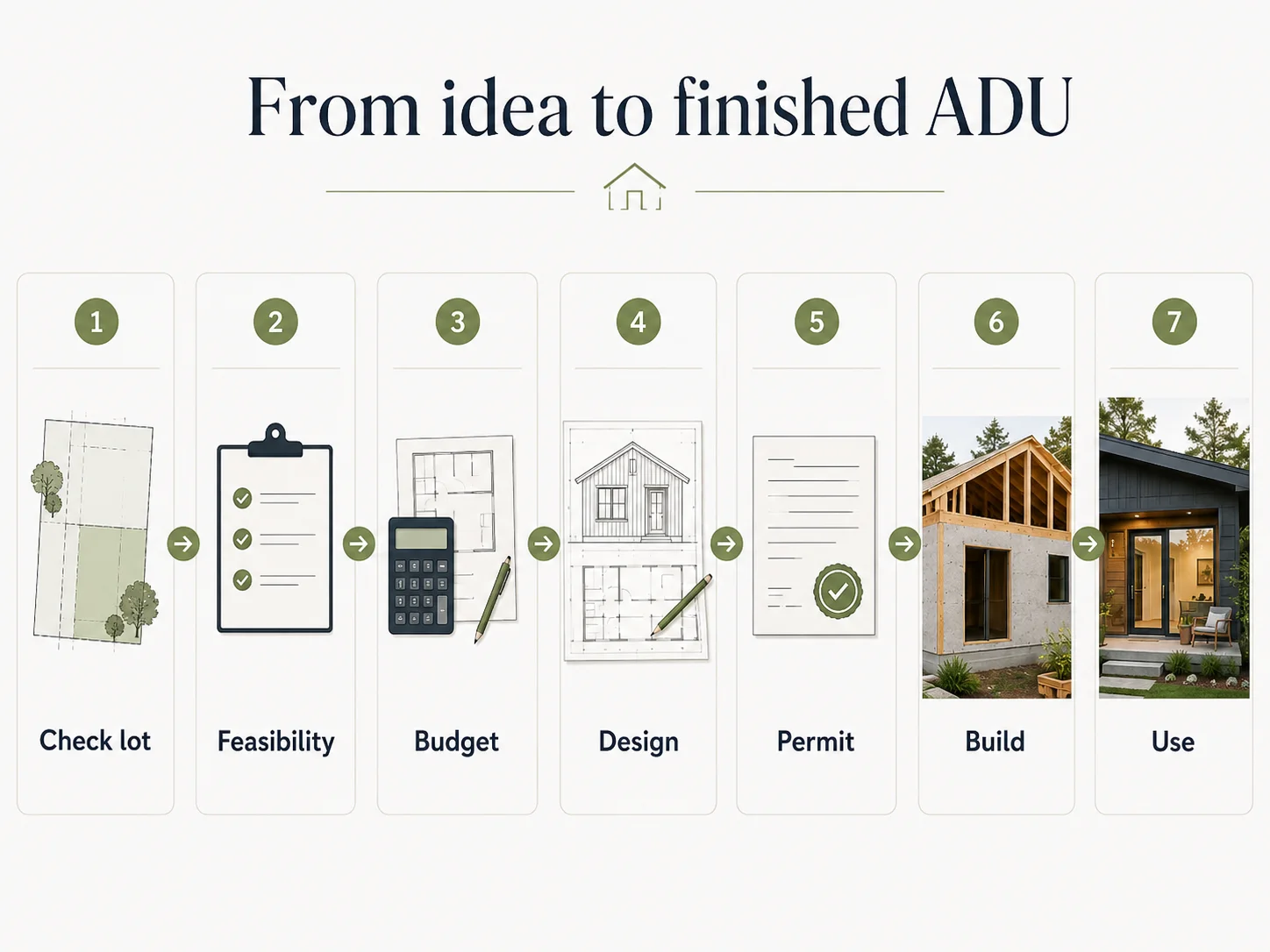
Do not start with a lender application unless you’re already permit-ready. The correct sequence is feasibility first, then program-fit, then plans and quotes, then funding — applying too early is the most common and most costly mistake, because MassHousing and Boston both require permits or near-permit readiness before they’ll process you.
- Check property feasibility. Confirm your lot can hold an ADU before spending on design.
- Identify your public-program lane. Use the matrix and eligibility table above.
- Estimate full project cost. Use the $275/sf Boston benchmark or Pioneer Valley design ranges as starting anchors — not guarantees.
- Get plans, quotes, and permits. Hire a licensed architect; collect at least two licensed-contractor bids. Remember MassHousing requires permits in hand.
- Apply to the right program at the right stage. Boston grant early (design/permitting); MassHousing after permits; HMLP if accessibility-driven.
- Fill the remaining gap. Only after screening public programs should you turn to conventional financing.
What documents each program wants before you apply
| Program | Have ready before applying |
|---|---|
| MHP Incentive | Interest-form / feasibility intake (Phase One); FSP list once published |
| MassHousing ADULP | Plans, local permits, predevelopment materials, then a participating-lender application |
| Boston | Both workshops completed, licensed architect, draft or permitted plans, two contractor quotes, ISD-approved permit before grant reimbursement |
| HMLP | Documentation of Need (medical/professional), contractor bid/scope, permits before disbursement |
Most homeowners burn the first month researching programs they don\u2019t qualify for
Skip that \u2192 Get your free ADU report and start at Step 1.
Get Your Free ADU Report →Common mistakes with Massachusetts ADU grants
The most expensive mistake is assuming “grant” means free construction money; the second is applying before you have plans and permits; the third is ignoring septic, utility, and HOA constraints that can sink a project after you’ve already spent on design. Each is avoidable if you know the rules going in.
Mistake 1 — Treating MassHousing ADULP as free money
It’s a loan: an amortizing portion (5.25% at launch — verify current) blended with a 0% deferred match. A good deal, but debt. Budget for repayment.
Mistake 2 — Applying before plans and permits
MassHousing is construction-to-permanent and wants permits in hand. Boston requires workshops, an architect, and two contractor quotes before you apply. Early applications get bounced.
Mistake 3 — Forgetting location limits
Boston ≠ statewide. Pioneer Valley ≠ statewide. Cape Cod’s program is unfunded. Match the program to your address before you invest time.
Mistake 4 — Ignoring septic, utilities, wetlands, and HOA rules
“As of right” zoning doesn’t override a septic system that can’t handle another bedroom (Title 5), or an HOA covenant that bans second units. Check these first — they’re the silent project-killers HAC’s own guidance warns about.
Mistake 5 — Believing a grant makes a $300,000 project “affordable” on its own
It doesn’t. A $7,500 grant against a $275,000 build is 2.7%. The programs help; they don’t pay for the house. Plan the full stack.
What we verified
Sources reviewed and verified on :
- MassHousing ADULP — total caps ($250k detached / $150k attached) and two-part structure ($150k+$100k detached; $100k+$50k attached), 20-year amortized term, 0% deferred match, 135% AMI ceiling, 640 credit / 50% DTI / 95% LTV / full appraisal / 10% contingency / 6-month timeframe, construction-to-permanent requirement. Source: Mass.gov press release 3/17/2026; MassHousing Second Mortgage Product Matrix rev. 4/16/2026. Launch rate (5.25%) per Jan/Mar 2026 MassHousing materials; current rate per MassHousing rate sheet.
- MassHousing ADULP county income limits — full 14-county schedule, effective March 9, 2026. Source: masshousing.com ADULP income-limit PDF.
- MHP ADU Incentive Program — statewide scope, Phase One feasibility-study focus, Spring 2026 expected launch, FSP procurement ongoing. Source: mhp.net.
- Boston ADU Financial Assistance — $7,500 grant (reimbursement structure), $50,000 0% deferred loan, <$100k qualifying-asset limit, workshop/architect/two-quote prerequisites, $275/sf benchmark, 120%/135% AMI match rule. Source: boston.gov, last updated 3/13/26.
- Pioneer Valley ADU Accelerator — $500 grant toward $1,000 study, 69 eligible municipalities, detached all-electric modular/panelized restriction, $40k site-cost baseline. Source: goclean.masscec.com.
- HMLP — $50,000 (owners) / $30,000 (mobile/manufactured), 0% interest, deferred repayment on sale/transfer/refinance, explicit ADU/in-law eligibility, Documentation of Need requirement, ~200% AMI gate, 3% landlord-for-tenant option. Source: cedac.org.
- Cape Cod “My Home Plus One” — fully subscribed, no funds available; Falmouth/Brewster permit counts. Source: haconcapecod.org.
- Massachusetts ADU law — size = lesser of 900 sf or ½ principal dwelling; one ADU as of right; no owner-occupancy and parking limits under the Affordable Homes Act §8. Source: M.G.L. c. 40A §1A (malegislature.gov); Affordable Homes Act §8.
Re-check before relying on it: the current MassHousing ADULP rate (rate-sheet driven); whether MHP Phase One has launched; any new municipal program; individual lender underwriting; your personal eligibility (each program decides that).
Methodology
We built this page by reviewing primary and program-administered sources only — state, city, and nonprofit pages, plus the Massachusetts General Laws — and classifying each ADU funding source by type (grant, loan, feasibility support, or paused), geography, dollar amount, and required project stage. We then compared published assistance amounts against published cost anchors to show homeowners both their eligibility and their likely funding gap.
Who made it: the Dwelling Index editorial and research team. How: official public pages, with source names and verification dates attached to every figure. Why: because the single most damaging thing a homeowner can do is mistake a loan for a grant, apply at the wrong stage, and lose months. We did not use unsourced builder claims, social-media figures, or reviews. This is a statewide funding and legal-starting-point guide, not a substitute for your building department, lender, or attorney; we are not a lender, law firm, or financial advisor, and nothing here is individualized advice. The Dwelling Index is an independent research resource covering ADU financing, costs, and regulations.
Frequently asked questions
- Is there a free ADU grant in Massachusetts?
- There is no statewide free construction grant that pays for a full ADU. True grants exist only locally and in limited amounts: Boston offers up to $7,500 in soft-cost reimbursement, and the Pioneer Valley offers a $500 feasibility-study grant. The larger statewide dollar amounts are loans.
- How much is the Boston ADU grant?
- Boston’s ADU Technical Assistance Grant reimburses eligible enrolled homeowners up to $7,500 for design and permitting (soft) costs. Separately, Boston offers a 0% deferred ADU loan of up to $50,000 for construction. Both require owner-occupancy of a 1–3 unit Boston home and income eligibility.
- Who qualifies for the MassHousing ADU loan?
- You must own and occupy a single-family (1-unit) home as your primary residence, meet your county’s 135% AMI income limit (from $129,870 in Hampden County to $220,725 in Nantucket County, effective March 9, 2026), have a 640+ credit score and ≤50% DTI, and have plans and permits ready before applying.
- Is the $250,000 MassHousing loan one loan at 5.25%?
- No. For a detached ADU it’s up to $150,000 as a 20-year amortizing second mortgage (5.25% at launch — verify the current rate) plus up to $100,000 as a 0% deferred match loan, totaling $250,000. For an attached ADU it’s up to $100,000 amortized plus up to $50,000 deferred, totaling $150,000.
- Can I apply for the MassHousing ADU loan before I have permits?
- No. ADULP is construction-to-permanent financing for homeowners who already have designs and permits in hand. State guidance directs homeowners to apply after securing local permits.
- Can HMLP pay for an ADU?
- Yes, in the right circumstances. The Home Modification Loan Program can finance an ADU or in-law apartment as a necessary home modification for a person with a disability or an older adult — up to $50,000 at 0% interest, repaid when the property is sold, transferred, or refinanced. It requires a Documentation of Need form and is not a general ADU loan.
- Are Cape Cod ADU incentives open?
- No. Housing Assistance Corporation’s “My Home Plus One” program page currently states that no funds are available and the program is fully subscribed until more funding is received.
- How big can an ADU be in Massachusetts?
- Under M.G.L. c. 40A §1A, a by-right ADU can be no larger than the lesser of 900 square feet or one-half the gross floor area of the principal dwelling. Larger ADUs may be possible but can require additional local approval.
- Will an ADU grant cover the full cost?
- Almost never. Boston’s planning benchmark is $275 per square foot, and Pioneer Valley design estimates range from $250,000–$280,000 for a 400-sq-ft unit to $390,000–$405,000 for 900 sq ft. A $7,500 grant covers roughly 2–3% of a typical build; the rest comes from loans and your own funds.
Related Dwelling Index resources
- Best ADU financing options — the financing lanes explained
- ADU financing calculator — model your monthly cost
- ADU financing for low-income homeowners — income-qualified paths
- How to finance an ADU with no equity — if you’ve tapped out your equity
- Massachusetts ADU loan guide — MassHousing ADULP in depth
Want it all in one place?
Download the free ADU Starter Kit \u2014 a Massachusetts grant-and-loan checklist, a program-readiness worksheet, a lender-document checklist, and the project-stage map from this page, in one printable file.
Download the Free ADU Starter Kit →First published: · Last updated: