
Massachusetts ADU Loan: 2026 Eligibility, Costs, and Financing Paths
By the Dwelling Index Editorial Team — an independent research resource covering ADU financing, costs, and regulations.
·
We are not a lender, broker, builder, or government agency. This is research and education, not legal, tax, or financial advice.
The bottom line, up front
The main Massachusetts ADU loan is the MassHousing Accessory Dwelling Unit Loan Program (ADULP), launched March 17, 2026. It finances up to $250,000 for a detached ADU and up to $150,000 for an attached ADU. Here’s the detail almost every other page misses: that headline number is two loans stacked. For a detached ADU, $150,000 is an amortizing loan you make monthly payments on, and up to $100,000 is a 0% deferred “match” with no monthly payment — but the match is still a loan you repay, due when the amortizing loan is paid off. So your monthly payment burden is based on $150,000, not $250,000. The announced launch rate on the amortizing portion was 5.25% (mass.gov press release, March 17, 2026 — confirm the current rate with a participating lender before relying on it).
Who it’s for: income-eligible homeowners (up to 135% of area median income) who own and live in a single-family home and already have plans and permits in hand. It is not a pre-design or pre-permit loan.
Your next step: if you’re permit-ready, find your county’s participating lender in the directory below. If you’re earlier than that, start with a feasibility check — most Massachusetts ADUs cost $150,000–$450,000+, so the first job is matching a path to your budget and your eligibility.
The 5 ways to finance an ADU in Massachusetts (start here)
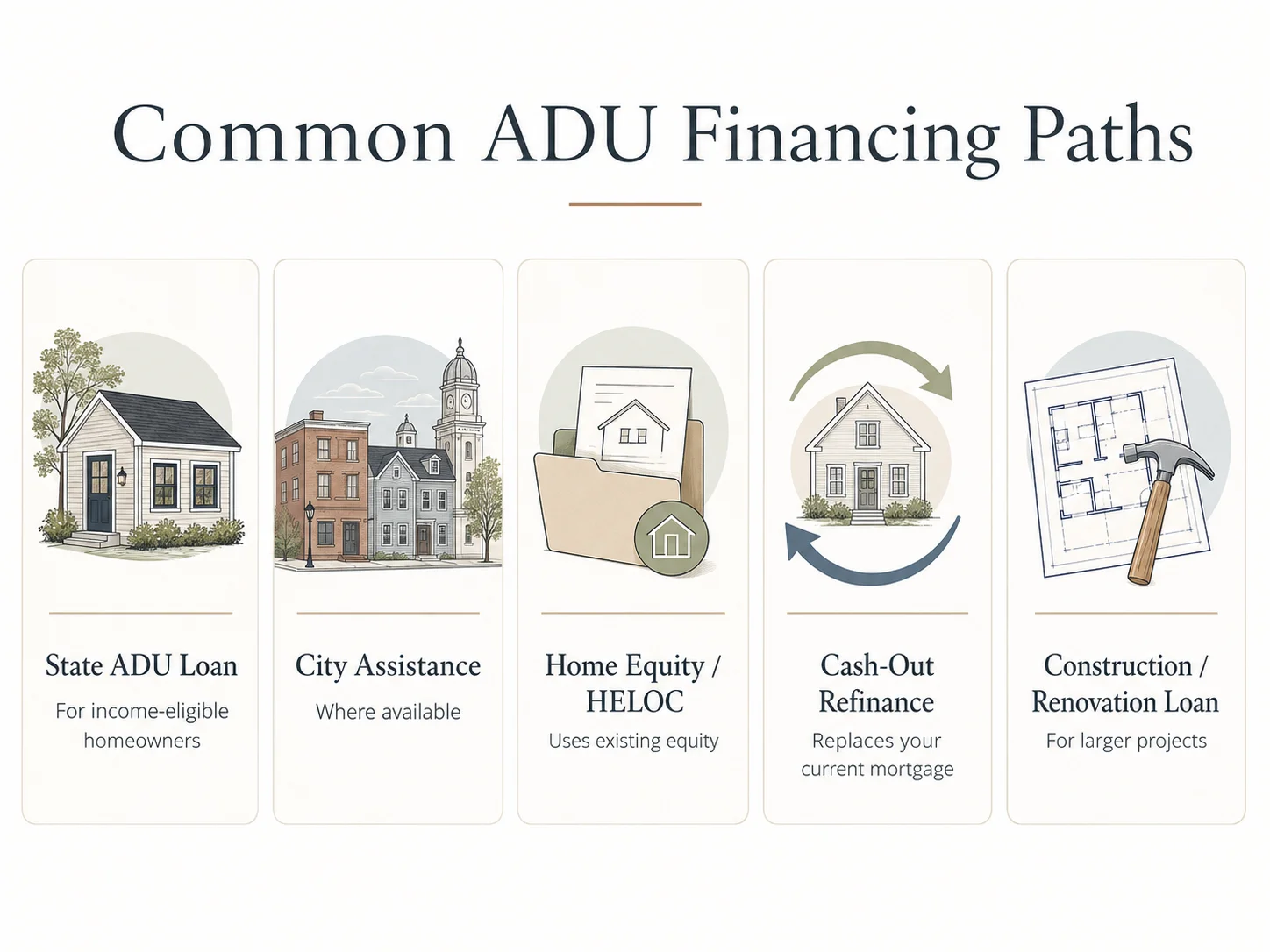
Financing a Massachusetts ADU comes down to five realistic paths, and the right one depends on three things: your income, your home equity, and how far along your project is. The newest and often most affordable option for moderate-income homeowners is the state-backed MassHousing ADU loan, but it isn’t the only route, and for a meaningful share of homeowners it won’t be the right one. The table below is your fast triage.
| If this describes you | Your likely first path | Why | Main blocker |
|---|---|---|---|
| You own and occupy a single-family home, meet income limits, and have plans + permits ready | MassHousing ADULP | Built for MA ADU construction; up to $250K, with payments based on the $150K amortized portion | Must already be permit-ready; one-unit only |
| You live in Boston (1–3 unit home) and are income-eligible | Boston Home Center stack first | City adds up to $7,500 grant + up to $50,000 deferred 0% loan, then you layer other financing | City asset limit, two workshops, two contractor quotes required |
| You’re early-stage (“can my lot even fit one?”) | Feasibility first, then a loan | Every loan path requires design and permits before funding | Spending design money before confirming the path |
| You’re over the income limit or own a 2–4 unit / condo / investment property | Private financing (HELOC, cash-out refi, construction loan) | ADULP caps income and limits the property to one unit | Equity, rate environment, appraisal, DTI |
| Your build quote is above the loan cap | A funding stack (state/city loan + private gap loan + cash) | Caps may not cover site work, utilities, contingency, soft costs | Planning the gap before you start |
We’ll map your likely path, ADU type, and funding gap before you call anyone.
What is the Massachusetts ADU loan program?
MassHousing — formally the Massachusetts Housing Finance Agency, an independent, self-sustaining state agency created in 1966 — built ADULP specifically to solve the problem the 2024 Affordable Homes Act created. The law made ADUs legal by right statewide, but legality didn’t make them affordable to build. As MassHousing’s VP of Homeownership Programs described it at launch, the program offers “a lower interest rate and higher combined loan-to-value limits than are currently available through traditional financing” — the defining feature being the blended structure that separates the amortizing from the deferred portion.
The structure nobody else explains: how $250K is actually built
Here’s the most important thing we verified, and it’s buried in MassHousing’s lender product matrix rather than the consumer page. The headline “up to $250,000” is a blended number made of two stacked loans (MassHousing Subordinate Mortgage Product Matrix, ADULP Product 5009, verified May 26, 2026):
| ADU type | Amortizing loan (monthly payments) | 0% deferred match (no monthly payment; due at payoff of the amortizing loan) | Blended maximum |
|---|---|---|---|
| Detached | $150,000 | up to $100,000 | $250,000 |
| Attached | $100,000 | up to $50,000 | $150,000 |
Why this matters more than any other fact on this page: your monthly payment is calculated only on the amortizing portion. A detached-ADU borrower who uses the full $250,000 makes payments on $150,000 — not $250,000 — because the $100,000 match sits in the background at 0% interest with no monthly payment until the amortizing loan is paid off. To be precise, because it matters: the deferred match is still a loan you repay — it just has no monthly payment and accrues no interest. It is due and payable when the amortizing loan is paid off. This structure meaningfully eases the monthly-payment burden compared with amortizing the full blended amount.
What ADULP is — and what it is not
It is not a grant. It’s debt secured by your home as a subordinate (second) mortgage — MassHousing typically takes a third lien position behind your first mortgage and any existing equity line. It is not a pre-planning loan — you can’t use it to pay an architect to find out whether your lot works. And it is not for every property — the matrix restricts it to one-unit, owner-occupied primary residences, excludes life estates, and subjects trusts to pre-review.
Wondering whether your property can support an ADU at all? See what’s possible at your address — get your free ADU report.
Who qualifies for the MassHousing ADU loan?
There are two layers of eligibility, and most pages only show you the first. The consumer-facing requirements (own it, live in it, meet income limits, be permit-ready) are the gate. But the lender’s underwriting matrix is where projects actually pass or fail, and we pulled those numbers directly from MassHousing’s product documentation so you can self-screen before you spend a dollar.
The full ADULP fit check
Source: MassHousing Subordinate Mortgage Product Matrix, ADULP Product 5009; and MassHousing ADULP consumer page. Verified May 26, 2026.
| Requirement | The verified rule | What it means for you |
|---|---|---|
| Occupancy | Owner-occupied; the property must be your current primary residence | You have to live there now — not a second home, not a flip |
| Property type | One unit only | A 2–4 unit home or condo isn't a standard fit; see your other options below |
| Income | Up to 135% of AMI | County-specific — Hampden's ceiling is $129,870; Nantucket's is $220,725 (full table below) |
| Credit score | 640 minimum | Below 640 and this program is likely off the table |
| Max DTI | 50% | Your total monthly debt (including the new loan) can't exceed half your gross income |
| Max LTV / CLTV | 95% / 95% | Based on appraised value "subject to completion" — what the home will be worth with the finished ADU |
| Appraisal | Full appraisal required | Budget time and a few hundred dollars for it |
| Contingency | 10% required | You must carry a reserve; the cap is not "the whole budget" |
| Construction timeline | 6 months from the note date | The build clock is tight — line up your contractor first |
| Fees | $300 MassHousing processing fee; lender origination up to 175 basis points (1.75%) | Real but modest; typically can be rolled in |
| Prepayment penalty | None | You can pay it off early without penalty |
Who is probably not a fit (and where to go instead)
We’d rather disqualify you honestly here than waste your time. ADULP likely isn’t your path if you don’t yet have permits (start with feasibility), if your household income exceeds the county ceiling (look at private financing), if you own a two- or three-family or a condo (Boston’s program serves 1–3 unit owners; statewide, you’re in private-financing territory), if your credit is below 640, or if your realistic construction schedule runs well past six months. None of those is the end of the road — it just means a different lane.
See whether you look ADULP-ready, feasibility-first, or better suited to another lane.
What are the 2026 ADULP income limits by county?
These are full-household income limits, and they’re the eligibility factor people most often get wrong because they assume “moderate income” means modest dollars. In eastern Massachusetts, a household earning over $200,000 can still qualify. We transcribed every county directly from the official MassHousing PDF so you don’t have to.
ADULP income limits, all 14 counties (effective March 9, 2026)
Source: MassHousing ADULP Income Limits by County PDF. Verified May 26, 2026.
| County | 135% AMI income limit |
|---|---|
| Barnstable | $167,535 |
| Berkshire | $137,565 |
| Bristol | $155,385 |
| Dukes | $206,955 |
| Essex | $205,335 |
| Franklin | $168,345 |
| Hampden | $129,870 |
| Hampshire | $160,650 |
| Middlesex | $205,335 |
| Nantucket | $220,725 |
| Norfolk | $205,335 |
| Plymouth | $205,335 |
| Suffolk | $205,335 |
| Worcester | $165,645 |
A practical tip: these figures are set at the county level, but your town determines which county column applies — and a few surprise people. Boston, Chelsea, Revere, and Winthrop make up the entire Suffolk County list. Springfield, Holyoke, and Chicopee fall under Hampden’s lower $129,870 ceiling. If your income is close to your county’s line, confirm it with a lender before assuming you’re out.
How much can you borrow — and will it cover your whole ADU?
This is the question that keeps people up at night, and it deserves real math rather than reassurance. Let’s combine the loan caps with actual Massachusetts cost data.
What Massachusetts ADUs actually cost in 2026
No single builder page gives you an honest range, so we compiled one from multiple Massachusetts sources. The spread is wide for a reason — the biggest variables are detached-versus-conversion, your site conditions, and septic. Here is the source-by-source evidence, with each provider’s published range and date, so you can see exactly where the numbers come from.
| Source (with date) | Published MA range | What it covers |
|---|---|---|
| McElhinney Construction (Nov 2025) | Attached/basement $150K–$275K; large detached $300K–$400K+ | Cape Cod, Vineyard, South Shore builds |
| D&G Exteriors (Mar 2026) | $150K–$450K+ overall | Statewide MA cost breakdown |
| ADUWizard (Apr 2026) | Conversions $145K–$360K; detached $230K–$575K | Planning-level MA budgeting guide |
| Dwelly (Mar 2026) | $220K–$400K typical; ~$275–$400/sq ft | MA ADU guide |
| City of Boston (updated Mar 13, 2026) | $275/sq ft preliminary benchmark; 800 sq ft ≈ $220,000 | Official city planning rule of thumb |
Pulling those together into planning ranges by type:
| ADU type | Typical MA planning range (2026) | Notes |
|---|---|---|
| Interior / basement conversion | ~$145,000–$275,000+ | Cheapest when the existing structure and utility runs are usable |
| Garage conversion | ~$145,000–$275,000 | Foundation and utilities can swing the number |
| Attached addition | ~$150,000–$300,000+ | Shares a wall with the main home |
| Detached new build (400–900 sq ft) | ~$230,000–$450,000+ | The most popular and most expensive path |
The numbers run higher than many homeowners expect. One Massachusetts homeowner researching a build described hoping to land “at $300k for everything” and feeling discouraged after quotes came back around $450k–$500k (homeowner forum discussion, used only as voice-of-customer context, not as a cost source). That gap between hope and quote is exactly why funding-gap planning matters.
The funding-gap math, worked through
Here’s where the loan caps meet reality. We ran the numbers using Boston’s $275/sq ft benchmark against the blended and amortizing loan limits. (Note on size: under Massachusetts law, the protected ADU can be no larger than half your principal dwelling’s gross floor area or 900 sq ft, whichever is smaller — so a 900 sq ft ADU is only “by right” if your main home is at least 1,800 sq ft. More on that below.)
| Your project | Loan cap to compare | Benchmark cost (×$275/sq ft) | What you should conclude |
|---|---|---|---|
| 600 sq ft attached/interior | $150,000 blended ($100K amortizing) | ~$165,000 | Likely a modest gap; soft costs and site work can widen it |
| 800 sq ft detached | $250,000 blended ($150K amortizing) | ~$220,000 | The cap likely fits a basic build, with room for contingency |
| 900 sq ft detached (where allowed by the half-floor-area rule) | $250,000 blended | ~$247,500 | At the benchmark, the cap is tight before contingency, utilities, and site work — plan a gap |
| 900 sq ft attached (where allowed) | $150,000 blended | ~$247,500 | The attached cap likely leaves a real gap — you'll need a second source |
The costs the cap doesn’t see
The benchmark price covers the building. It frequently does not fully cover: architectural design and engineering, a land survey, permit and Zoning Board of Appeals fees, utility connections (electric service upgrades, water, sewer), and the single biggest Massachusetts wildcard — septic. If your home runs on a private septic system, adding an ADU’s bedrooms can trigger Board of Health and Title 5 review and a possible system upgrade or replacement. (Title 5 is the Massachusetts state sanitary code governing private septic systems, administered through MassDEP and local Boards of Health.) Massachusetts builder sources put septic-related upgrades in the tens of thousands of dollars on some projects — confirm your specific situation with your local Board of Health before you budget (McElhinney Construction, 2025; CORE/MA builder sources).
And remember the matrix’s 10% contingency requirement — MassHousing won’t let you treat the cap as your entire budget. On a $200,000 build, that’s $20,000 of reserve you must demonstrate, which is a feature, not a bug: ADU projects that run out of contingency are the ones that stall.
Use your ADU type, square footage, and county to see whether one loan covers it or you need a second source.
What do you need before you apply?
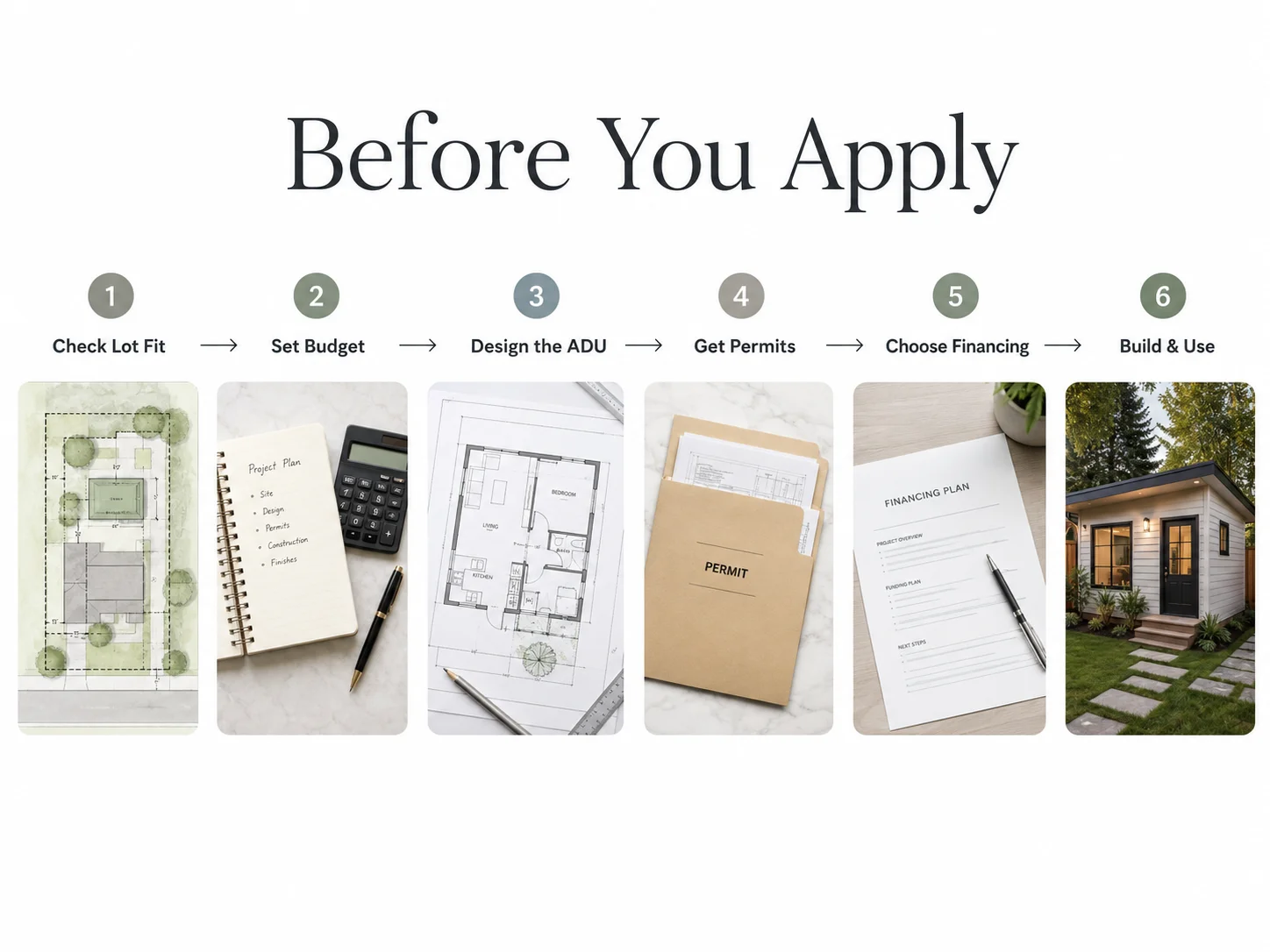
This sequence trips people up constantly, so let’s make it concrete. ADULP is construction-to-permanent financing — designed for the moment you’re ready to break ground, not the moment you first get curious. You front the design and permitting work; the loan funds the build.
Your application-readiness checklist
| Before you call a lender | Why it matters |
|---|---|
| ✓ Confirm an ADU is allowed on your specific lot | Avoid paying for a design that can't be permitted |
| ✓ Decide attached vs. interior vs. detached | The loan cap differs by type ($150K vs. $250K) |
| ✓ Get a preliminary design from a licensed architect | Lenders and city programs need a defined scope |
| ✓ Obtain permit-ready or permitted plans | This is MassHousing's core readiness requirement |
| ✓ Get at least one contractor bid | Needed to size your budget and the loan |
| ✓ Confirm you're under your county income limit | County-specific; see the table above |
| ✓ Estimate your appraisal and LTV | The matrix caps you at 95% CLTV "subject to completion" |
| ✓ Build a realistic schedule | The matrix gives you 6 months from the note date to finish |
If you’re not there yet: start with feasibility (capped at $500)
If that checklist feels overwhelming, you’re not behind — you’re just at an earlier, well-supported stage. The Massachusetts Housing Partnership (MHP) runs the ADU Incentive Program, a statewide initiative whose first phase provides access to professional feasibility studies that assess site conditions, local zoning and permitting, utilities, preliminary design, and high-level budget feasibility. The MHP page states plainly: “Out of pocket costs for homeowners using an MHP-approved feasibility study provider are capped at $500” (mhp.net ADU Incentive Program page, verified May 26, 2026).
This is the missing front-end step that makes the whole system work for lower-equity owners: you spend up to $500 to learn whether your project is real and what it’ll take, then you carry that into design, permitting, and finally the MassHousing construction loan — instead of gambling thousands on an architect before you know your lot works.
Not permit-ready yet? Start with feasibility — get your free ADU report to see what your lot can support before you spend on design.
Which lenders offer the Massachusetts ADU loan?
You don’t apply to MassHousing; you apply through one of its partner banks and credit unions, and which ones you can use depends on your county. We mapped the entire participating-lender list to the counties each serves, with phone numbers, from MassHousing’s lender table.
Participating ADULP lenders by service area
Source: MassHousing ADULP consumer page lender table. Verified May 26, 2026. Listed alphabetically — this is not a ranking, and Dwelling Index does not recommend any specific lender.
| Lender | Counties served | Phone |
|---|---|---|
| BankESB | Statewide (all 14 counties) | 413.779.2206 |
| BankFive | Statewide (all 14 counties) | 774.888.6136 |
| Baystate Bank | Worcester | 800.244.8161 |
| Bristol County Savings Bank | Bristol, Plymouth, and Barnstable (Bourne & Falmouth only) | 508.828.5339 |
| Cape Cod Five Cents Savings Bank | Barnstable, Dukes, Nantucket | 508.247.1894 |
| Fidelity Bank | Berkshire, Norfolk, Worcester | 800.581.5363 |
| Greylock Federal Credit Union | Berkshire, Hampden, Hampshire, Franklin | 413.344.1044 |
| Monson Savings Bank | Berkshire, Hampden, Hampshire | 413.267.4646 |
| StonehamBank | Essex, Middlesex | 888.402.2265 |
If you’re in a county served only by the two statewide lenders, BankESB and BankFive are your starting calls. If you’re in western Massachusetts, you have more local options — Greylock, Monson, and Fidelity all cover Berkshire and the Pioneer Valley.
The questions to ask before you choose a lender
Because every participating lender originates the same MassHousing product, you’re really choosing on service and process, not on rate. Ask each one:
- Are you currently originating ADULP loans, and what’s your typical timeline?
- Do you require a fully issued building permit, or will permit-ready plans suffice to start?
- How do you handle contractor bids and construction draws?
- How long does the full appraisal “subject to completion” take in this market?
- Can the $300 processing fee and origination costs be rolled into the loan?
- What happens if construction runs past the six-month window?
Before you call a lender, confirm you’re truly ready — check your permit-readiness and funding gap with your free Massachusetts ADU report.
Can Boston homeowners stack city assistance with ADU financing?
If you live in Boston, you have an extra layer most of the state doesn’t — but it comes with real prerequisites, and the sequence matters. We pulled the full details from boston.gov (Boston.gov ADU Financial Assistance Program; page last updated March 13, 2026; reverified by Dwelling Index May 26, 2026).
Boston’s three-part stack at a glance
| Boston program | Amount | Use | The catch |
|---|---|---|---|
| ADU Technical Assistance Grant | Up to $7,500 | Soft costs: architect/survey/engineer fees, permit fees, ZBA fees, contractor deposit | Reimbursed after you get an approved building permit and enroll in the city ADU Loan |
| Boston Home Center ADU Loan | Up to $50,000 | Construction gap funding | 0% deferred; due on sale, transfer, or cash-out refi; paid to contractor after inspections |
| ADU Bank Loan | Varies | Additional lender financing | You must first apply for and enroll in the Boston Home Center ADU Loan |
The eligibility details that disqualify people (and the ones that surprise them)
Boston’s program is stricter than the statewide loan in ways that catch applicants off guard. You must own and occupy a 1–3 unit home in Boston, meet HUD income limits, and — the one nobody expects — hold less than $100,000 in financial assets (excluding the funds you’re putting toward the ADU, home equity, retirement accounts, and college savings). You must be current on property taxes, water, mortgage, and insurance. You cannot have received City home-repair assistance in the past ten years (de-leading funds excepted).
The process gate is real, too. Before you can apply, you must attend both the ADU Design Workshop and the ADU Budget Workshop within the prior three months, be working with a licensed architect, and submit two quotes from licensed, insured contractors capturing the full scope. Boston notes that any contractor quote under $100,000 gets scrutinized by its Construction Monitoring Team.
There’s also an income-based match on the loan: no owner match is required below 120% of AMI, but households between 120% and 135% of AMI must match the city loan 1:1 with personal funds or a bank loan (boston.gov). The city loan is construction-only, paid directly to your contractor after inspections, and you pay your own portion of construction costs first — the city money is the gap filler, not the primary source.
How Boston and MassHousing fit together
For an eligible Boston homeowner, the realistic stack looks like: the Technical Assistance Grant covers up to $7,500 of design/permitting → the Boston Home Center ADU Loan fills up to $50,000 of the construction gap → a participating bank loan (potentially the MassHousing ADULP loan, if you also meet its one-unit, income, and underwriting rules) covers the bulk of construction. The pieces are designed to layer.
What are your other ADU financing options in Massachusetts?
The state loan is genuinely good, but it serves a specific borrower: moderate-income, single-family, permit-ready. If that’s not you, here are the private lanes, framed as paths rather than ranked products. None of these is “best” in the abstract — the right one depends on your equity, your existing mortgage rate, and your risk tolerance.
Private financing paths compared
| Path | Best fit | The watch-out |
|---|---|---|
| Home equity loan (HELOAN) | You have enough current equity and want a fixed lump sum and fixed payments | Sized on your home's current value, not its higher post-ADU value |
| HELOC | Flexible draw needs, smaller gaps, you want to borrow as costs come due | Typically variable-rate, so payments can rise |
| Cash-out refinance | You're willing to replace your first mortgage and rates make sense | Costly if you'd be giving up a low existing mortgage rate |
| Construction-to-permanent loan | Larger detached builds that need staged draws | More complex underwriting and contractor controls |
| Renovation mortgage | You're buying or refinancing and adding the ADU in one loan | Appraisal, scope, and lender overlays add friction |
| Local ADU bank product | Cape/Islands or specific local markets with purpose-built ADU loans | Geographic restrictions and product-specific rules |
A key distinction that affects how much you can borrow: most standard home equity products are sized on your home’s current value, while purpose-built ADU and construction loans are often sized on the “as-completed” value — what the property will be worth once the ADU exists. That difference can be tens of thousands of dollars of borrowing capacity, which is why some homeowners specifically seek out ADU-aware lenders.
Local lenders with ADU-specific products (named for context, not endorsement)
A few Massachusetts lenders publish ADU-specific programs worth knowing as you compare. BankFive lists multiple ADU financing options — home equity loans and lines, construction loans, FHA 203(k) renovation loans, and conventional and FHA loans — and notes borrowers need a town-issued permit and builder’s plans before closing (bankfive.com). Cape Cod Five publishes both ADU home-equity options and an ADU mortgage program; its mortgage program states that borrowers may use up to 75% of documented expected rental income to help qualify (capecodfive.com). These are product-availability notes from each lender’s own pages, not recommendations or rate quotes — confirm current terms directly.
Over the income limit, not permit-ready, or need a bigger stack? Explore your mortgage, refinance, and home-equity options with our research partner. Rates, terms, and approval depend on the lender, borrower, property, and project — this is education, not a guarantee of approval or financing.
Compare ADU financing options →What if you’re building for an aging parent or accessibility needs?
One of the most common ADU triggers in Massachusetts is housing an aging parent. If your project has a genuine accessibility dimension, there’s a program most ADU pages never mention. The Home Modification Loan Program (HMLP), administered through CEDAC, provides 0% interest loans up to $50,000 for accessibility-related home modifications for qualifying Massachusetts homeowners, and CEDAC notes ADUs can be relevant where a senior household member (typically age 60+) or a family member with a disability is involved (cedac.org).
This is a supplement, not a substitute. HMLP won’t fund a full market-rate ADU build on its own, and the accessibility tie has to be real. But layered with ADULP or private financing, a 0% $50,000 piece is meaningful — especially for the multigenerational households this whole wave of ADU policy was partly designed to serve.
Does Massachusetts ADU law actually make your project financeable?
It’s worth being precise here, because the law’s “by right” language creates false confidence. The definitions come straight from the statute (M.G.L. c. 40A §1A; regulations at 760 CMR 71):
- “As of right” means development that may proceed “without the need for a special permit, variance, zoning amendment, waiver or other discretionary zoning approval.” A municipality can’t simply say no to a compliant protected-use ADU.
- The size limit is the lesser of half your principal dwelling’s gross floor area or 900 square feet. So if your main home is 1,400 sq ft, your protected ADU maxes out around 700 sq ft — not 900. The 900 sq ft figure only applies once your home is at least 1,800 sq ft.
- What municipalities cannot do to a protected-use ADU (per 760 CMR 71): they cannot require owner-occupancy, impose extra parking beyond the regulatory limit, add family-relationship restrictions, or use density or unit caps to block it.
- What municipalities still can do: apply dimensional, site-plan, building-code, utility, and Title 5 septic requirements; regulate short-term-rental use; and require a special permit for additional ADUs beyond the one protected unit.
Here’s the part that surprises homeowners: zoning permission and loan approval are two separate doors.
| The law allows it | But your lender still scrutinizes |
|---|---|
| ✓ One ADU by right in single-family zones | Income (135% AMI ceiling for ADULP), credit (640), DTI (50%) |
| ✓ ADU up to ½ the home's floor area or 900 sq ft | Appraisal "subject to completion" — sets your max loan |
| ✓ No special permit for the protected unit | LTV/CLTV cap (95% for ADULP) and contractor scope |
| ✓ No owner-occupancy mandate (for zoning) | ADULP does require owner-occupancy as a loan condition |
We keep this section focused on financing on purpose — the full legal walkthrough lives on our dedicated Massachusetts ADU law page. The point here is simple: the law opened the door, but financing is a separate door with its own key.
Worked examples: which path fits which homeowner?
Abstract rules are hard to apply to your own situation, so here are four realistic Massachusetts homeowners and the path each would likely take.
Example 1 — Worcester County, detached ADU, permits in hand
A homeowner in Shrewsbury earns $140,000, owns and lives in a single-family home, and has permitted plans for a 750 sq ft detached ADU. They’re under Worcester County’s $165,645 limit, it’s a one-unit owner-occupied property, and they’re permit-ready. ADULP is likely their primary path — up to $250,000 blended, with payments based on the $150,000 amortizing portion. If their build quote comes in at $290,000, they’d plan a ~$40,000 gap from savings or a small home equity loan.
Example 2 — Boston, basement conversion, early design stage
A two-family owner-occupant in Dorchester earning under 120% of AMI wants to convert their basement. They’re early — no permits yet. Their path starts with Boston’s program: attend both required workshops, work with a licensed architect, gather two contractor quotes, then access the up-to-$7,500 grant and up-to-$50,000 deferred 0% city loan. As a two-family owner, statewide ADULP’s one-unit rule would exclude them — but Boston’s 1–3 unit program does not.
Example 3 — Cape Cod, detached ADU, planning to rent it
A Falmouth homeowner, income-eligible and owner-occupant of a single-family home, wants a detached ADU for rental income. ADULP may fit if they meet the underwriting, and they’d contact Bristol County Savings Bank or Cape Cod Five. They’d also want to compare a local ADU product like Cape Cod Five’s mortgage program, which may count up to 75% of documented expected rental income toward qualifying. They’ll need to confirm town approval, septic capacity, and the primary-residence requirement.
These are illustrative examples, not guarantees of returns. Actual rental results depend on local market conditions, construction costs, financing terms, and regulatory approvals.
Example 4 — Higher-income homeowner over the ADULP limit
A Newton couple earning $260,000 wants a detached ADU. They’re over Middlesex County’s $205,335 limit, so ADULP is off the table. Their lane is private financing — a home equity loan or HELOC if they have substantial equity, a cash-out refinance if their current mortgage rate allows it, or a construction-to-permanent loan for a larger build. This is where comparing ADU financing paths makes sense.
See which financing structure fits a build above the state income limits — explore your mortgage, refi, and home-equity options.
Explore mortgage and home-equity options →What we verified
Last verified (primary sources)
| Claim | Primary source |
|---|---|
| ADULP launched March 17, 2026; up to $250K detached / $150K attached; amortizing rate announced at 5.25% | mass.gov press release (3/17/2026); MassHousing ADULP page |
| The $250K/$150K caps are blended: $150K/$100K amortizing + a 0% deferred match (up to $100K/$50K) that is still repayable, due at payoff of the amortizing loan | MassHousing Subordinate Mortgage Product Matrix, ADULP Product 5009 |
| Underwriting: 640 credit, 50% max DTI, 95/95% LTV/CLTV, full appraisal, 10% contingency, 6-month timeline, one-unit owner-occupied | MassHousing Product Matrix |
| Income limits by county, effective March 9, 2026 ($129,870 Hampden to $220,725 Nantucket) | MassHousing ADULP Income Limits PDF |
| Participating lenders and the counties each serves | MassHousing ADULP consumer page |
| ADU statutory definition: ≤ ½ principal dwelling's gross floor area or 900 sq ft, whichever is smaller; "as of right"; municipal restriction limits | M.G.L. c. 40A §1A; 760 CMR 71 |
| Boston: up to $7,500 grant + up to $50,000 deferred 0% loan; <$100K asset limit; 1:1 match at 120–135% AMI; two-workshop and two-quote requirements | boston.gov ADU Financial Assistance Program (page updated 3/13/2026) |
| MHP feasibility studies; homeowner out-of-pocket capped at $500; Phase One expected Spring 2026; providers being procured via RFQ | mhp.net ADU Incentive Program |
| HMLP: 0% loans up to $50,000 for accessibility modifications | cedac.org |
| MA ADU cost ranges ($150K–$450K+) | Multiple independent MA builder/aggregator sources (2025–2026), cited inline in the cost section |
Refresh cadence: Rate and program status — monthly. Income limits and lender list — quarterly or on new PDF. Costs — semi-annually. We quote no private rates or payments because those change constantly and vary by borrower.
Methodology
This page was researched and written by the Dwelling Index editorial team, an independent research resource covering ADU financing, costs, and regulations. We are not a lender, broker, builder, government agency, or legal advisor.
We built this guide from official primary sources: the mass.gov program announcement, the MassHousing ADULP consumer page, the MassHousing Subordinate Mortgage Product Matrix, the MassHousing ADULP income-limits PDF, the Massachusetts General Laws (c. 40A §1A) and 760 CMR 71, the City of Boston ADU Financial Assistance Program page, the Massachusetts Housing Partnership ADU Incentive Program page, and CEDAC’s Home Modification Loan Program guidance. We used individual lender and builder pages only for product availability, documentation requirements, and market cost context — never as proof of law or program terms. We used homeowner forum language only to understand how people describe the problem, never as evidence for costs, zoning, or financing rules. Where a figure could go stale or wasn’t fully confirmable, we said so and dated it.
Frequently asked questions
Is the Massachusetts ADU loan a grant?
No. The MassHousing ADU Loan Program (ADULP) is a loan, not a grant. It combines a 20-year amortizing loan that you repay monthly with a zero-interest deferred-match portion that comes due when you pay off the main loan. The deferred match has no monthly payment, but it is still money you repay. The separate City of Boston program includes a grant component (up to $7,500), but the statewide MassHousing product is entirely a loan.
How much can I borrow through the Massachusetts ADU loan?
MassHousing finances up to $250,000 for a detached ADU and up to $150,000 for an attached ADU. For a detached unit, that's a $150,000 amortizing loan plus up to a $100,000 zero-interest deferred match; for an attached unit, it's a $100,000 amortizing loan plus up to a $50,000 match. Your monthly payment is based on the amortizing portion.
What is the interest rate on the MassHousing ADU loan?
MassHousing announced a 5.25% rate on the amortizing portion at the program's launch on March 17, 2026, with the matched portion at 0% interest and deferred (mass.gov, March 17, 2026). Rates can change — confirm the current rate with a participating lender before relying on it. We verified the 5.25% launch figure on May 26, 2026.
Do I need permits before applying?
Yes. MassHousing requires that you have plans, permits, and pre-development materials in hand and be ready to begin construction before you contact a lender. ADULP funds construction only — not design or permitting. If you're not permit-ready, start with the MHP feasibility program instead.
Can I use the loan for a garage conversion or basement ADU?
Potentially, yes. MassHousing describes eligible ADUs as units created within an existing home, attached as an addition, or built as a detached structure such as a converted garage or backyard cottage — as long as the unit has its own living, sleeping, cooking, and bathroom facilities and meets code. Note that a basement or garage conversion is typically an 'attached' or 'interior' unit, which caps the loan at $150,000 blended rather than $250,000.
What credit score do I need?
The MassHousing product matrix lists a minimum credit score of 640 for ADULP, along with a maximum debt-to-income ratio of 50% and a maximum loan-to-value of 95%.
Can I use future rental income to qualify?
Don't assume the MassHousing ADULP loan counts future rental income — its matrix doesn't advertise that, and it's an owner-occupied program. Some local lender products do consider it: Cape Cod Five, for example, states its ADU mortgage program may allow up to 75% of documented expected rental income to help you qualify. Confirm with the specific lender.
What if I own a two-family or three-family home?
The MassHousing ADULP matrix restricts the program to one-unit properties, so a two- to four-unit owner shouldn't assume it fits. In Boston, the City's ADU Financial Assistance Program does serve owner-occupants of 1–3 unit homes, so Boston multi-family owners have a city path that statewide borrowers don't.
How big can my ADU be in Massachusetts?
Under state law, a protected-use ADU can be no larger than half your principal dwelling's gross floor area or 900 square feet, whichever is smaller. So the 900 sq ft maximum only applies if your main home is at least 1,800 sq ft; for a smaller home, your ADU limit is half its floor area. Municipalities can apply additional dimensional rules on top of this.
How long do I have to finish construction?
The MassHousing matrix gives ADULP borrowers a maximum of six months from the note date to complete the work. Line up your contractor and schedule before closing so the clock doesn't work against you.
Does the statewide ADU law mean I automatically qualify for a loan?
No. The 2024 Affordable Homes Act makes one ADU legal by right in single-family zoning districts, which helps with zoning. But loan approval is separate and still depends on program eligibility, income, credit, DTI, LTV, appraisal, permit-readiness, and construction scope.
What if I'm not eligible for the MassHousing loan?
You have other lanes. Depending on why you don't qualify, your next step might be MHP feasibility assistance (if you're early-stage), the City of Boston program (if you're an eligible Boston 1–3 unit owner), the Home Modification Loan Program (if there's an accessibility need), or private financing — a home equity loan, HELOC, cash-out refinance, renovation mortgage, construction loan, or a local ADU-specific bank product.
Not sure where to start?
The Massachusetts ADU loan is powerful if you’re eligible and construction-ready. If you’re not, the answer isn’t to give up — it’s to move into the right lane: feasibility, Boston assistance, private financing, a local ADU lender, or accessibility support. Each one is a real path, and the first move is simply knowing which is yours.
Download the free Massachusetts ADU Funding Checklist — income limits by county, the document prep list, permit-readiness steps, and the exact questions to ask a lender, in one page.
Get the free Massachusetts ADU Starter Kit →Related guides
- Compare ADU financing pathsAll financing options, side by side
- MassHousing ADU Loan ProgramADU financing for lower-income households
- Massachusetts ADU financing pathsPersonal loan options for ADU projects
- MassHousing ADU loanRenoFi alternatives for ADU funding
- Home equity loan for an ADUHELOAN guide for ADU projects
- Construction-to-permanent loanStaged-draw financing for larger builds