
New Hampshire regulations · 2026 guide
New Hampshire ADU Laws (2026): What RSA 674:71-73 Requires Towns to Allow After HB 577 and HB 1079
By The Dwelling Index Editorial Team · Last updated: · Last verified:
Bottom line up front: Under New Hampshire ADU laws, every city and town with a zoning ordinance must allow one accessory dwelling unit (ADU), attached or detached, as a matter of right in every zoning district that allows single-family homes (RSA 674:72, I, as rewritten by HB 577 in 2025). Towns can no longer require a special exception or conditional use permit for that first ADU, and they can't add lot size, setback, frontage, design review or other controls beyond what the house alone would face. A town may cap the ADU at 950 square feet of living space but can't set a cap below 750 square feet. A town may still require that the owner live in one of the two units, and may require one extra parking space. Towns must also let you convert an existing garage or other structure into an ADU even if it breaks current setback or lot coverage rules, and since August 31, 2026 (HB 1079) that right covers structures that existed on or before July 1, 2025.

Disclosure: This page has no affiliate links. The Dwelling Index is reader-supported.
| Rule | What RSA 674:71-73 says (as of November 20, 2026) |
|---|---|
| Who must allow ADUs | Every municipality that has adopted a zoning ordinance |
| Where | All zoning districts that permit single-family dwellings |
| How many | One ADU per single-family dwelling, attached or detached, as a matter of right; more is optional |
| Special exception or conditional use permit | Not allowed for the one required ADU (removed by HB 577, effective July 1, 2025) |
| Extra lot size, setbacks, frontage, design review | Not allowed beyond what the house alone would need |
| Size | Town may cap living space at 950 sq ft (or allow more); can't cap below 750 sq ft |
| Bedrooms | Town can't limit the ADU to one bedroom |
| Owner-occupancy | Town may require the owner to live in one of the units, but can't say which one |
| Parking | If the house must have parking, the town may require up to one more space for the ADU |
| Family relationship | Town can't require occupants to be related |
| Septic | Approval under RSA 485-A is needed; separate systems can't be required, and the town can't be stricter than NHDES |
| Existing garages and outbuildings | Can be converted even if they break current setback or lot coverage rules (HB 577); "existing" means on or before July 1, 2025 (HB 1079, effective Aug. 31, 2026) |
| Separate electric service | Town can't deny a separate panel or service |
| Selling the ADU separately | Prohibited unless the town allows a condominium conveyance |
Each row comes from the current text of RSA 674:71, 674:72 and 674:73 on the New Hampshire General Court's website, which we read on November 20, 2026, including the amendments from 2025 Chapter 197 (HB 577) and 2026 Chapter 210 (HB 1079).
See What You Can Build → Get Your Free ADU Report
The Dwelling Index is an independent research resource covering ADU financing, costs, and regulations. We wrote this page because New Hampshire's ADU law changed twice in about 13 months, and a town ordinance that hasn't been amended may still read like the 2017 version, when a town could make a detached ADU optional or send an ADU to the zoning board for a special exception. We read the current statute, both chaptered bills, and the New Hampshire Municipal Association's guidance to towns, and we put the rules that apply today in one place.
Disclosure: The Dwelling Index is reader-supported. When you use our links to explore financing options, request prefab pricing, or purchase floor plans, we may earn a commission at no extra cost to you. Our editorial recommendations are based on independent research and are never influenced by compensation. This page has no affiliate links. It's educational, not legal advice. Confirm every rule with your town's planning or zoning office before you design or pay for anything.
What are New Hampshire's ADU laws in 2026?
Answer capsule: New Hampshire's ADU law is RSA 674:71 to 674:73. It requires every municipality with zoning to allow one attached or detached ADU by right wherever single-family homes are allowed, without extra lot size, setback, frontage, design or space controls. HB 577 (2025) made detached ADUs mandatory, ended special exceptions and opened existing garages to conversion; HB 1079 (2026) defined which structures qualify and added protection from later zoning changes.
Three layers decide whether your project works:
- State law. RSA 674:71-73 for zoning, RSA 485-A for water supply and septic approval, and the state building code.
- Your town's zoning ordinance. Owner-occupancy rules, the size cap (anywhere from 750 square feet up), parking, lot coverage, height and the permit steps. Each of these must stay inside the state limits.
- Private rules and the site. Deed covenants, condominium or homeowners association documents, well and septic capacity, wetlands and shoreland rules.
The catch. "As a matter of right" means you don't need a hearing before the zoning board of adjustment or the planning board for the one required ADU. You still need a building permit where your town requires one, and the house-plus-ADU combination must meet the zoning rules that apply to a single-family home in your district.
What changed with HB 577 in 2025?
Answer capsule: HB 577 (2025 Chapter 197), effective July 1, 2025, made one detached ADU mandatory, removed a town's option to require a conditional use permit or special exception, barred extra setback, aesthetic and design review controls, set a 950 square foot default size cap, limited extra parking to one space, allowed conversion of existing structures that break setback or lot coverage rules, and protected separate electric service.
Before HB 577, the 2017 law let a town allow ADUs by right, by special exception or by conditional use permit, and a town was "not required to but may permit" detached ADUs, with an option to demand a larger lot for them. The New Hampshire Business and Economic Affairs summary table of HB 577 lists these changes, and the current statute text confirms them:
Disclosure: This page has no affiliate links. The Dwelling Index is reader-supported.
| Topic | Before July 1, 2025 | After HB 577 (current law) |
|---|---|---|
| Approval path | By right, special exception or conditional use permit (town's choice) | By right for one ADU; no special exception or conditional use permit |
| Detached ADUs | Optional for the town; town could require a larger lot | One detached ADU must be permitted; no larger-lot option |
| Where ADUs sit | ADU had to be "within or attached to" the house | ADU is "located on a lot containing a single-family dwelling" |
| Extra controls | No added lot size, frontage or space limits | Also no added setbacks, aesthetic requirements or design review beyond the house's |
| Size | Town could set minimum and maximum sizes, but no cap below 750 sq ft | Cap of 950 sq ft living space unless the town allows more; still no cap below 750 sq ft |
| Parking | Town could require "adequate parking" | Up to one additional space, on-site or dedicated off-site at the owner's choice |
| Attached ADU entry | An interior door between the units was required | Own entrance or entry through a shared common space; town can't limit the choice |
| Septic | Approval under RSA 485-A; no separate systems | Same, plus the town can't be stricter than NHDES |
| Existing structures | Not addressed | Town must allow conversion even if the structure breaks current setback or lot coverage rules |
| Electric service | Not addressed | Town can't deny a separate electrical panel and service |
| Other exclusions | Town could bar ADUs with townhouses and with manufactured housing | Town can bar ADUs with townhouses and on rented or leased land |
Two rules readers often credit to HB 577 were already in the 2017 law: a town couldn't limit an ADU to one bedroom, and it couldn't require occupants to be related.
HB 577 was signed on July 15, 2025, though its effective date was July 1, 2025, according to the New Hampshire Municipal Association's November 17, 2025 guidance.
What changed with HB 1079 in 2026?
Answer capsule: HB 1079 (2026 Chapter 210), signed July 2, 2026 and effective August 31, 2026, defines an "existing structure" for the garage-conversion right as one that existed on or before July 1, 2025, lets towns ask for proof the structure is legally nonconforming or was previously approved, and protects ADUs approved and built after July 1, 2025 from later zoning changes.
HB 577 created the conversion right in RSA 674:72, XI. HB 1079 rewrote that paragraph, which now works in three parts:
- Conversion right. A municipality "shall allow accessory dwelling units to be converted from existing structures, including but not limited to detached garages, regardless of whether such structures violate current dimensional requirements for setbacks or lot coverage." An "existing structure" is one that existed on or before July 1, 2025.
- Proof the town may ask for. If the structure doesn't meet current setbacks or lot coverage, the town can ask you to show either that it's a legal preexisting nonconforming structure under RSA 674:19 or local rules, or that it received a prior zoning approval or exemption.
- No loss of status. Converting the structure to an ADU isn't a "change of use" that would cost it its nonconforming status.
HB 1079 also rewrote the definitions. An "attached unit" is now a unit "within or attached to" the house, and a "detached unit" is one "neither within nor physically connected to" it. The 2025 wording that counted an ADU inside a preexisting detached building as "attached" was struck.
Protection from later zoning changes. An ADU approved and built after July 1, 2025 "shall receive protection from future zoning changes" under RSA 674:39, II, if the project reaches active and substantial development and substantial completion within the RSA 674:39 time periods. The New Hampshire Municipal Association's 2026 land use update reads this as active and substantial development within three years of approval (extendable by the planning board) and completion within seven years.
Who this helps most. Owners of older lots where the garage or barn sits close to the lot line. The New Hampshire Municipal Association describes the result as letting legal preexisting structures that violate setback or lot coverage rules be converted to an ADU by right, and New Hampshire Public Radio reported that the bill's sponsor expects it to spare those owners a zoning variance.
What can't a New Hampshire town require for an ADU?
Answer capsule: A New Hampshire town can't require a special exception or conditional use permit for the one required ADU, extra lot size, setbacks, frontage, design review or space limits beyond the house's, a size cap below 750 square feet, a one-bedroom limit, related occupants, separate water or septic systems, stricter septic rules than NHDES, a choice of entrance, or denial of a separate electric service.
RSA 674:72 lists these limits on towns:
- Discretionary approval. The one ADU is allowed "as a matter of right."
- Extra controls. No added "lot size, except as described by this section, setbacks, aesthetic requirements, design review requirements, frontage, space limitations, or other controls beyond what would be required for a single-family dwelling without an accessory dwelling unit."
- Stricter septic rules. A town "may not impose greater requirements for a septic system for a single-family home with an accessory dwelling unit than is required by the department of environmental services."
- Separate utilities. "Separate systems shall not be required for the principal and accessory dwelling units."
- Entrance choice. An attached ADU needs its own entrance or entry through a shared common space, but "the municipality shall not limit the choice of ingress and egress."
- Aesthetic rules aimed only at ADUs. Aesthetic standards can apply to the ADU only if they also apply to the house.
- Small size caps. A town "may not restrict the total living space to less than 750 square feet."
- Family tests. A town "shall not require a familial relationship between the occupants."
- One-bedroom limits. A town "shall not limit an accessory dwelling unit to only one bedroom."
- Separate electric service. A town "shall not deny the establishment of a separate electrical panel and separate electrical service."
- Setback and coverage objections to existing structures. For conversions of structures that existed on or before July 1, 2025 (see HB 1079 above).
If your town's ordinance says nothing at all about ADUs, RSA 674:72, II makes one ADU "a permitted accessory use, as a matter of right, to any single-family dwelling," and "no municipal permits or conditions shall be required other than building permits, if required by statute."
What can a New Hampshire town still regulate?
Answer capsule: Towns can require the owner to live in one of the two units, cap living space at 950 square feet (or allow more), require one extra parking space if the house needs parking, apply the house's lot coverage and occupancy rules to the combined property, limit ADUs to one per house, and bar ADUs with townhouses or on leased land.
- Owner-occupancy. "A municipality may require owner occupancy of one of the dwelling units, but it shall not specify which unit the owner must occupy." The town can ask you to prove one unit is your principal residence and set reasonable enforcement rules.
- Size. "The total living space of the accessory dwelling unit shall not exceed 950 square feet unless otherwise authorized by the municipality." So 950 square feet is the default cap, a town may allow more, and a town may set a lower cap only down to 750 square feet.
- Parking. If the town requires parking for the house, "it may require up to one additional parking space for each accessory dwelling unit." You choose whether that space is on-site or at a legally dedicated off-site location.
- Combined rules. Rules for single-family homes, "including but not limited to lot coverage standards and standards for maximum occupancy per bedroom consistent with policy adopted by the United States Department of Housing and Urban Development," apply to the house and ADU together, but can't be stricter for ADUs than for any single-family use in the same district.
- Number. A town "is not required to allow more than one accessory dwelling unit for any single-family dwelling."
- Townhouses and leased land. A town "may prohibit accessory dwelling units associated with multiple single-family dwellings attached to each other, such as townhouses," and "associated with rented or leased land."
- Separate sale. Selling the ADU as a separate condominium unit is prohibited "unless allowed by the municipality."
- Codes. Building, fire, health and septic rules still apply.
How big can an ADU be in New Hampshire?
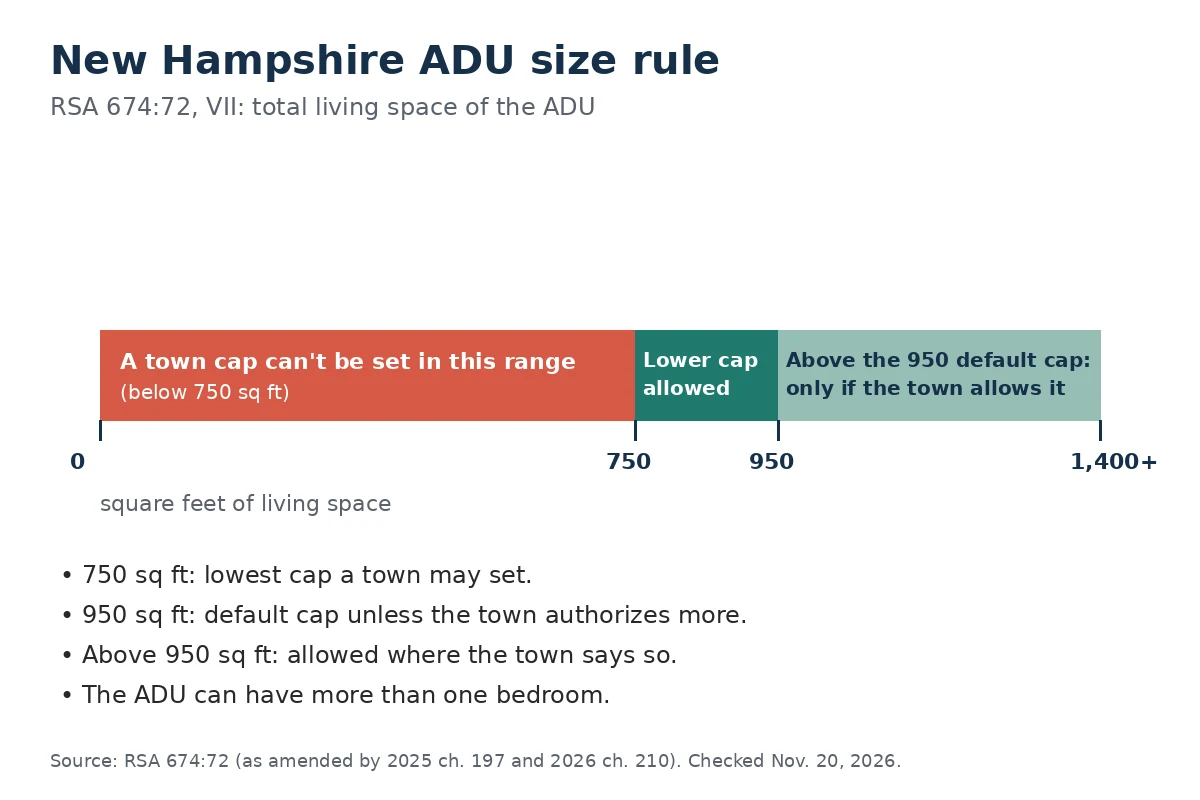
Answer capsule: By default, an ADU's total living space can't exceed 950 square feet unless your town allows more. A town may set a smaller cap, but not below 750 square feet. The house-plus-ADU combination must also meet your district's lot coverage rules, and the ADU can have more than one bedroom.
Disclosure: This page has no affiliate links. The Dwelling Index is reader-supported.
| Size question | Answer under RSA 674:72 |
|---|---|
| Default cap on living space | 950 sq ft "unless otherwise authorized by the municipality" |
| Lowest cap a town can set | 750 sq ft |
| Can a town allow more than 950 sq ft? | Yes |
| Bedroom limit | Town can't limit the ADU to one bedroom |
| Lot coverage | House and ADU together must meet the single-family lot coverage rule for the district |
| Occupancy | Town may apply per-bedroom occupancy standards consistent with HUD policy, no stricter than for single-family homes |
How to read your town's number. If your ordinance says "ADUs may not exceed 600 square feet," that cap is below the 750 square foot floor and conflicts with state law. If it says 750, 800 or 950, that's within the statute. If it says 1,200, the town has used its option to allow more. Ask how the town measures "living space," since the statute doesn't define it.
Estimate your New Hampshire ADU budget — run the free ADU cost calculator
Do you have to live on the property to have a New Hampshire ADU?
Answer capsule: Only if your town requires it. RSA 674:72, VI lets a town require the owner to occupy one of the two units, but the town can't say which one, so you can live in the ADU and rent the house. Because the statute still allows this rule, check your town's ordinance.
Owner-occupancy is the biggest rule that still varies from town to town in New Hampshire. Under the statute:
- The town may require that the owner live in either the house or the ADU.
- The town "shall not specify which unit the owner must occupy."
- The town may require the owner to show that one unit is their "principal place of residence," and may set "reasonable regulations to enforce such a requirement."
If you're buying a property to rent both units, read the ordinance's ADU section before you make an offer.
Does a New Hampshire ADU need parking?
Answer capsule: Only if your town already requires parking for the house. In that case the town may require up to one additional space per ADU. You decide whether the space is on your lot or at a legally dedicated off-site location. A town can't require more than one extra space for the ADU.
The statute ties ADU parking to the house's parking rule: "If a municipality has established regulations requiring parking for the principal dwelling unit, it may require up to one additional parking space for each accessory dwelling unit." The off-site option is "at the property owner's discretion."
Can you convert a garage into an ADU in New Hampshire?
Answer capsule: Yes. Towns must allow ADUs converted from existing structures, including detached garages, even if the structure violates current setback or lot coverage rules. Since August 31, 2026, "existing" means the structure existed on or before July 1, 2025, and the town can ask you to show it's legally nonconforming or was previously approved.
Steps for an older garage, barn or shed conversion:
- Confirm the structure's age. To qualify for the statutory protection from current setback and lot-coverage requirements, it must have existed on or before July 1, 2025. Tax cards, permits, aerial photos and survey plans help. Newer structures may still qualify if they meet applicable rules.
- Find its legal status. If it meets current setbacks and lot coverage, there's no issue. If it doesn't, gather proof that it's a legal preexisting nonconforming structure under RSA 674:19, or that it received a zoning approval or exemption earlier.
- Plan the septic and water. Submit a sewage disposal approval application under RSA 485-A before construction where applicable (see below).
- Meet building and fire codes. The conversion still has to meet the state building code for a dwelling unit, including egress, fire separation where required and insulation.
- Apply for the building permit. Converting the structure "shall not constitute a change of use" that would cost it nonconforming status.
The conversion right covers setbacks and lot coverage. It doesn't override other rules such as height, shoreland or wetlands protections, or the 950 square foot default size cap, so check those too.
What about septic systems and wells?
Answer capsule: Before building an ADU, submit a sewage disposal system approval application under RSA 485-A where applicable. You don't need a separate system for the ADU, and the town can't require more than NHDES does. If your existing system was never approved under current or earlier rules, or it fails, the approved system must be installed.
RSA 674:72, V says the applicant "shall make adequate provisions for water supply and sewage disposal for the accessory dwelling unit in accordance with RSA 485-A:38, but separate systems shall not be required." Before construction, "an application for approval for a sewage disposal system shall be submitted in accordance with RSA 485-A." The approved system must be installed "if the existing system has not received construction approval and approval to operate under current rules or predecessor rules, or the system fails or otherwise needs to be repaired or replaced."
On a septic lot, the septic review is often the step that decides the budget. A designer can tell you whether your current system's approved capacity covers the added bedrooms. Ask early.
Can an HOA or deed covenant stop an ADU in New Hampshire?
Answer capsule: Possibly. RSA 674:71-73 limits what towns can require, and it doesn't void private deed covenants or homeowners association rules. If your deed or association documents ban a second dwelling unit, that private restriction may still apply. Read your deed and any association documents before you pay for plans.
Some states, such as Vermont and Rhode Island, have statutes that void certain private restrictions on ADUs. We didn't find a similar provision in RSA 674:71-73. If a covenant seems to block your ADU, a New Hampshire real estate attorney can tell you whether it's enforceable on your lot.
Can you rent out a New Hampshire ADU?
Answer capsule: Yes, long-term renting is the main purpose of the law, and a town can't require that occupants be related to you. The ADU statute doesn't address short-term rentals, so your town's zoning and any short-term rental ordinance decide whether nightly rentals are allowed. If your town requires owner-occupancy, you must live in one unit.
- Long-term rentals. Allowed. The statute bars "a familial relationship" requirement, and an ADU that meets the workforce housing rental criteria in RSA 674:58, IV can count toward the town's workforce housing obligation under RSA 674:59.
- Short-term rentals. Not covered by RSA 674:71-73. Ask your town whether nightly rentals are allowed in your district and whether a permit or registration is required.
- Rent estimates. See our ADU rent guide and ADU rental income calculator.
What does a New Hampshire ADU project look like step by step?
Answer capsule: Confirm your district allows single-family homes, read your town's ADU section for owner-occupancy, size and parking, check your deed, plan septic and water, design within the 750 to 950 square foot range your town allows, then apply for a building permit and submit the required sewage disposal approval application where applicable before construction.
- Confirm zoning. Look up your lot's zoning district and confirm it allows single-family dwellings.
- Read the ADU section of your ordinance. Note the size cap, owner-occupancy rule, parking rule and any stated permit steps. If any part is stricter than state law, ask the zoning administrator how the town applies it now.
- Check private restrictions. Deed, covenants and association documents.
- Plan septic and water. Hire a septic designer if you're not on municipal sewer.
- Pick a type. Internal (in the house), attached (addition) or detached (new building or a converted structure).
- Design and estimate. Use our ADU cost calculator and ADU cost guide.
- Apply. Submit the building permit (and any zoning permit the town uses) with the septic approval application. See how to build an ADU and our ADU permit fees research.
- Build and inspect. Then get the certificate of occupancy if your town issues one.
Before step 2, use our property eligibility check for state-level planning context and broad cost ranges. It does not determine what can be built on your lot.
Check your lot's ADU options — get your free report
How do New Hampshire ADU laws compare with nearby states?
Answer capsule: New Hampshire guarantees one attached or detached ADU by right but still lets towns require owner-occupancy. Maine and Massachusetts have their own statewide ADU laws with different size and occupancy rules, and Vermont now requires towns to allow one ADU without an owner-occupied lot condition.
Disclosure: This page has no affiliate links. The Dwelling Index is reader-supported.
| State | Statewide ADU right | Owner-occupancy | Where to read more |
|---|---|---|---|
| New Hampshire | One attached or detached ADU by right where single-family homes are allowed | Town may require it (either unit) | This page |
| Vermont | One ADU within or appurtenant to a single-family home as a permitted use | "Owner-occupied lot" condition removed July 1, 2026 | Vermont ADU law (official statute) |
| Maine | One ADU on a lot with a single-family home, with changes due July 1, 2027 | See the Maine page | Maine ADU laws |
| Massachusetts | ADU by right in single-family zones | See the Massachusetts page | Massachusetts ADU laws |
For the national picture, see ADU laws by state.
What should you ask your town before you pay for plans?
Answer capsule: Ask whether owner-occupancy is required, what size cap applies and how living space is measured, whether one extra parking space is required, what permits the town uses for ADUs, how it handles older garages under HB 1079, and whether short-term rentals are allowed. Write down the answers with the date.
- Does the town require the owner to live in one of the units?
- What is the ADU size cap, and how does the town measure "living space"?
- Is an extra parking space required for the ADU?
- Which permits does the town require (building permit, zoning permit, certificate of occupancy)?
- Has the town updated its ordinance for HB 577 and HB 1079? If not, how is it applying the state law now?
- For an older garage or barn, what proof of nonconforming status does the town want?
- Are short-term rentals allowed in my district?
- What are the permit fees and the current review time?
Print the list, write the answers in the margin and date them. Then use our property eligibility check for a general planning overview; confirm parcel-specific rules with your town.
See what's possible at your address — get your free ADU report
What we verified
- Verified on November 20, 2026: RSA 674:71, 674:72 and 674:73 on the New Hampshire General Court's website, with source notes showing 2025, 197 (eff. July 1, 2025) and 2026, 210 (eff. Aug. 31, 2026).
- Verified: the final chaptered text of HB 1079 (2026 Chapter 210) and its docket, signed by Governor Ayotte on July 2, 2026, effective August 31, 2026.
- Verified: New Hampshire Public Radio's July 8, 2026 report on HB 1079.
- Verified: the New Hampshire Business and Economic Affairs HB 577 summary-of-changes table, and the New Hampshire Municipal Association's "The Revised Law on Accessory Dwelling Units – 2025 Edition" (updated November 17, 2025) and its 2026 land use update guide.
- Not verified: individual town ordinances. Many towns are still updating their ordinances, so we list the questions to ask instead of summarizing any town's rules.
Methodology
We read RSA 674:71-73 in full in the current online statutes, then checked each change against the chaptered bills and the state and municipal summaries listed below. Every rule in the tables quotes or closely paraphrases the statute. Where the statute is silent (short-term rentals, private covenants), we say so instead of guessing. To report an error, use our corrections page.
Sources
- New Hampshire General Court, RSA 674:71 (Definitions), 674:72 (Accessory Dwelling Units) and 674:73 (Detached Accessory Dwelling Units), current text.
- New Hampshire General Court, HB 1079 (2026), Chapter 210, final version and bill docket.
- New Hampshire Department of Business and Economic Affairs, "New Hampshire 2025 House Bill (HB) 577 Relative to Modifying the Definition of ADUs: Summary of Changes Table."
- New Hampshire Municipal Association, "The Revised Law on Accessory Dwelling Units – 2025 Edition," updated November 17, 2025.
- New Hampshire Municipal Association, "Changes to Land Use Statutes: A Guide for Municipalities" (2026).
- New Hampshire Public Radio, "New law aims to cut through zoning red tape for accessory dwelling units," July 8, 2026.
Frequently asked questions
What are the ADU laws in New Hampshire?
RSA 674:71-73 requires every New Hampshire municipality with zoning to allow one attached or detached ADU as a matter of right in every district that allows single-family homes, without extra lot size, setback, frontage, design review or space controls beyond the house's.
Can I build a detached ADU in New Hampshire?
Yes. Since July 1, 2025, RSA 674:73 says a municipality "shall permit one detached accessory dwelling unit." Towns can no longer make detached ADUs optional or require a larger lot for them.
How big can an ADU be in New Hampshire?
The default cap is 950 square feet of living space unless your town allows more. A town can't set a cap below 750 square feet, and it can't limit the ADU to one bedroom.
Do I have to live on the property to have an ADU in New Hampshire?
Only if your town requires it. A town may require the owner to live in one of the two units but can't specify which one.
Do New Hampshire ADUs need extra parking?
If your town requires parking for the house, it may require up to one additional space for the ADU, on-site or at a dedicated off-site location of your choice.
Can I turn my garage into an ADU in New Hampshire?
Yes. Towns must allow ADUs converted from existing structures, including detached garages, even if the structure violates current setback or lot coverage rules. Under HB 1079, effective August 31, 2026, that protection for nonconforming structures applies to structures existing on or before July 1, 2025. Newer compliant structures may still qualify.
Do I need a special exception for an ADU in New Hampshire?
No, not for the one ADU the law guarantees. HB 577 removed the option to require a special exception or conditional use permit. You still need a building permit where your town requires one.
Can I rent my New Hampshire ADU?
Yes. A town can't require tenants to be related to you. The ADU statute doesn't address short-term rentals, so check your town's rules before listing it for nightly stays.