
Maine regulations · 2026 guide
Maine ADU Laws (2026): What Every Town Must Allow Today, What Changes on July 1, 2027, and How Portland Applies It
By The Dwelling Index Editorial Team · Last updated: · Last verified:
Bottom line up front: Under Maine ADU laws, every town must allow at least one accessory dwelling unit (ADU) on a lot where a single-family home is the main building, in any area where homes are allowed, including as a conditional use (30-A M.R.S. § 4364-B, from LD 2003 of 2022). Towns had to comply by January 1 or July 1, 2024. An ADU can be inside the house, attached to it, or a new building. It can't face parking rules beyond the house's, must be at least 190 square feet (unless the state building codes board sets a different minimum), and is exempt from density limits. Towns may set a maximum size. On July 1, 2027, changes from LD 1829 and LD 2173 take effect: ADUs also on lots with 2- and 3-unit buildings, no owner-residency rule, and no planning board approval.
Disclosure: This page has no affiliate links. The Dwelling Index is reader-supported.
| Rule | What applies now (until June 30, 2027) | What applies from July 1, 2027 |
|---|---|---|
| Where an ADU must be allowed | Lots where a single-family home is the principal structure, in areas where residential uses are permitted, including as a conditional use | Lots with a single-family home or a 2-unit or 3-unit residential structure, same areas |
| How many | At least 1 per qualifying lot | At least 1 per qualifying lot |
| Owner living on site | State law doesn't bar a town rule; check your ordinance | Town must allow an ADU even if the owner doesn't live on the lot |
| Planning board approval | Depends on your town's ordinance | Not required for an ADU |
| Parking | No requirement beyond the house's | No requirement beyond the house's |
| Size | At least 190 sq ft; town may set a maximum | Same |
| Density | ADU exempt from density requirements | One ADU per lot exempt from density requirements |
| Coastal and flood areas | Shoreland rules apply; no categorical shoreland ban | Town may exempt coastal barriers, special flood hazard areas and coastal sand dunes by ordinance |
Sources: 30-A M.R.S. § 4364-B as published by the Maine Legislature (data extracted October 2026), the Legislature's Housing and Economic Development committee summary of Public Law 2025, chapter 733, and 30-A M.R.S. § 4364 for the 2024 implementation dates. We read them on November 19, 2026.
See What You Can Build → Get Your Free ADU Report
The Dwelling Index is an independent research resource covering ADU financing, costs, and regulations. We wrote this page because Maine's ADU law is in an awkward in-between period. The Legislature's statute pages already show wording from 2025 and 2026 laws, but most of those changes don't apply to towns until July 1, 2027. Many summaries mix the two. We read the current text of 30-A M.R.S. § 4364-B line by line, with its effective-date notes, and separate what applies now from what's coming.
Disclosure: The Dwelling Index is reader-supported. When you use our links to explore financing options, request prefab pricing, or purchase floor plans, we may earn a commission at no extra cost to you. Our editorial recommendations are based on independent research and are never influenced by compensation. This page has no affiliate links. It's educational, not legal advice. Confirm every rule with your town's code enforcement officer or planning office before you design or pay for anything.
What are Maine's ADU laws in 2026?
Answer capsule: Maine's ADU law is 30-A M.R.S. § 4364-B. It requires every municipality to allow at least one ADU on a lot where a single-family dwelling is the principal structure, in any area where residential uses are permitted. It sets a 190-square-foot minimum, bars extra parking requirements, exempts the ADU from density limits and requires proof of adequate water and wastewater before occupancy.
The law began as LD 2003 (Public Law 2021, chapter 672). Public Law 2023, chapter 192 set the implementation dates and added the rule for ADUs built without approval. Two later laws, LD 1829 (Public Law 2025, chapter 385) and LD 2173 (Public Law 2025, chapter 733, signed in April 2026), widen it, mostly starting July 1, 2027.
Three layers decide whether your project works:
- State law. Section 4364-B for ADUs, shoreland zoning rules under Title 38, the subsurface wastewater rules for septic systems, and the state's adopted building codes.
- Your town's ordinance. This is where maximum size, height, design, short-term rental rules and the review process live. Maine has hundreds of towns, and each writes its own ADU section within the state limits.
- Private rules and site limits. Deed covenants, homeowners association rules, septic capacity, well water and shoreland setbacks.
The catch. State law requires towns to allow one ADU on qualifying lots, subject to applicable rules, but leaves the maximum size to each town. Portland lets an ADU reach two-thirds of the main unit's floor area. Your town may set a fixed cap instead.
When did Maine towns have to allow ADUs?
Answer capsule: The "implementation date" in 30-A M.R.S. § 4364 was January 1, 2024 for towns whose municipal officers can enact ordinances without a vote of residents, and July 1, 2024 for all other towns. Section 4364-B says a town isn't required to apply the ADU rules until its implementation date. Both dates have passed, so every town is now covered.
Two dates matter going forward:
- Now. The rules from LD 2003 as amended in 2023 apply in every town.
- July 1, 2027. The committee summary of Public Law 2025, chapter 733 says it "pauses the application of Public Law 2025, chapters 288, 374 and 385 from the effective date of chapter 733 until July 1, 2027." Chapter 385 is LD 1829, which carries most of the new ADU rules.
Because the Legislature's website prints the newest wording, a quick read of § 4364-B can make the 2027 rules look current. Each amended paragraph carries a note citing chapter 385 or chapter 733 and an "AFF" (affected) section. Those notes are how you tell which version applies.
What must every Maine town allow now?
Answer capsule: Every town must allow at least one ADU on any lot where a single-family home is the principal structure, in any area where residential uses are allowed, including as a conditional use. The ADU can be within the existing home, attached to or sharing a wall with it, or a new structure built mainly to be the ADU.
The rules that apply now:
- Three ADU types. Section 4364-B(2) allows an ADU "within an existing dwelling unit on the lot," attached to or sharing a wall with the home, or "as a new structure on the lot for the primary purpose of creating an accessory dwelling unit."
- Nonconforming lots. An ADU "must be allowed on a lot that does not conform to the municipal zoning ordinance if the accessory dwelling unit does not further increase the nonconformity."
- Density exemption. The town must exempt the ADU from density requirements tied to the area where it's built.
- Setbacks for attached and internal ADUs. They get the same setback and dimensional requirements as the house. An ADU in an existing garage or accessory building keeps that structure's setbacks. A town may be more permissive.
- Parking. An ADU "may not be subject to any additional parking requirements beyond the parking requirements of the single-family dwelling unit on the lot."
- Unpermitted ADUs. An ADU "that was not built with municipal approval must be allowed if the accessory dwelling unit otherwise meets the requirements" of the town and state law.
- Growth caps. An ADU permit doesn't count toward a town's rate-of-growth ordinance.
What changes for Maine ADUs on July 1, 2027?
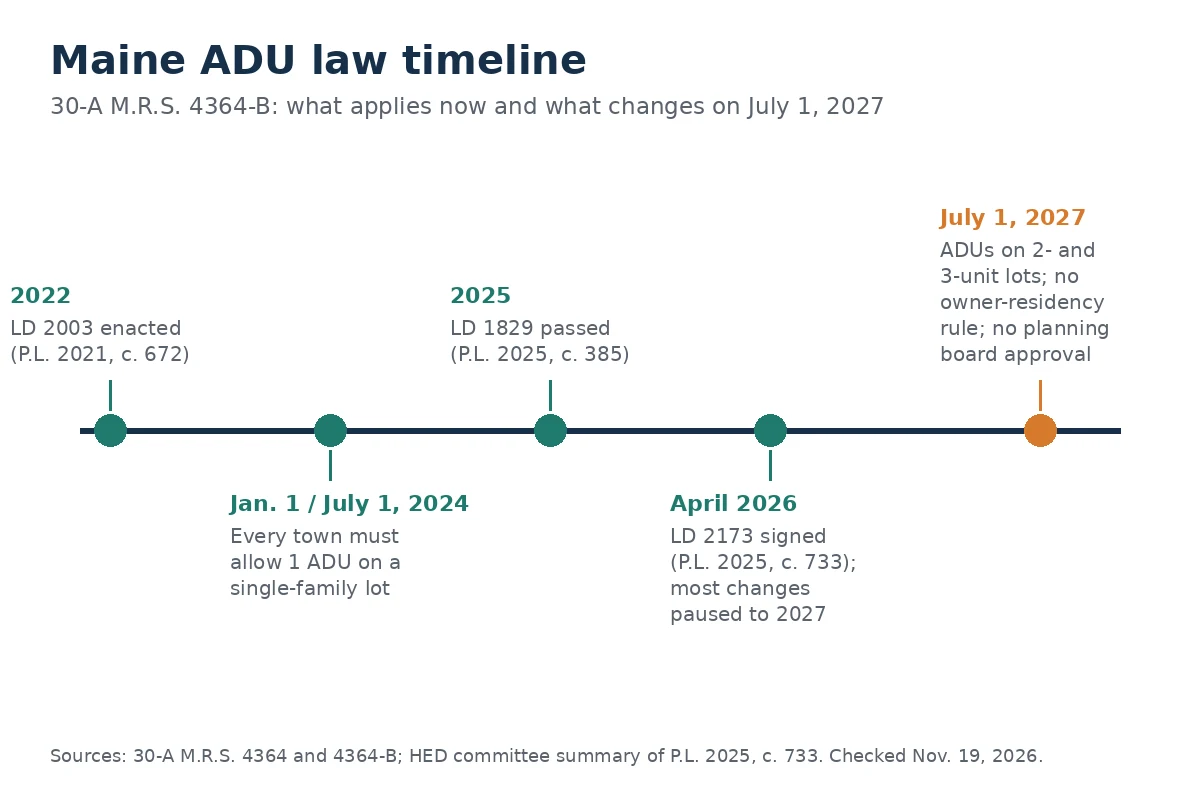
Answer capsule: From July 1, 2027, towns must allow an ADU on lots with a single-family home or a 2-unit or 3-unit building, must allow it even if the owner doesn't live on the lot, and can't require planning board approval. Towns may exempt coastal barrier, flood hazard and dune areas.
The changes, with the statute wording now printed in § 4364-B:
- More lots qualify. "At least one accessory dwelling unit must be allowed on any lot where the principal structure is a single-family dwelling unit or 2-unit or 3-unit residential structure."
- No owner-residency rule. "A municipality shall allow the construction or occupancy of an accessory dwelling unit on a lot even if the owner of the lot where the accessory dwelling unit is located does not reside in a dwelling unit on that lot."
- One ADU exempt from density. The exemption now reads "one accessory dwelling unit on a lot."
- No planning board. The committee summary says chapter 733 "clarifies that planning board approval is not required for accessory dwelling units." Code officer and staff review can still apply.
- Coastal and flood exemptions. A town may exempt a lot or part of a lot in a coastal barrier area, a special flood hazard area or a coastal sand dune system (§ 4364-B(8)(D)).
- Sewer and water terms. Chapter 733 replaces older phrases with "public sewer system" and water drawn from a public water source.
If you're planning a 2027 project that depends on these rules, such as an ADU behind a duplex or a rental with no owner on site, confirm with your town how and when it's updating its ordinance.
How big can an ADU be in Maine?
Answer capsule: State law sets a minimum of 190 square feet, unless the Technical Building Codes and Standards Board adopts a different minimum. There's no state maximum. Section 4364-B(6) says "a municipality may impose a maximum size for an accessory dwelling unit," so the cap comes from your town's ordinance.
Practical points:
- Ask which minimum applies. The statute lets the state building codes board replace the 190-square-foot figure. Your code enforcement officer can tell you which number the town is using.
- Read how the cap is measured. Towns use different measures, such as gross floor area, a share of the main house, or a footprint limit.
- Portland example. Portland's Land Use Code limits an ADU to two-thirds of the gross floor area of the largest principal unit on the lot, and caps the combined size of detached ADUs at the principal structure's floor area (details below).
Estimate your Maine ADU budget — run the free ADU cost calculator
What can Maine towns still regulate?
Answer capsule: Towns still set maximum size, height and design rules, short-term rental rules, fines for code violations, and shoreland zoning within state limits. Building codes, septic rules and water verification apply. Towns can adopt less restrictive criteria only where they could grant a variance.
- Maximum size and design. Left to the town, within the setback rule for attached and internal ADUs.
- Short-term rentals. Section 4364-B doesn't limit a town's power to regulate short-term rentals. Portland, for example, treats ADUs as non-owner-occupied units for its short-term rental rules.
- Fines. A town may "impose fines for violations of building, zoning and utility requirements for accessory dwelling units."
- Alternative criteria. A town may set criteria less restrictive than the state's water, size, setback and shoreland rules, but only where it could grant a variance under § 4353.
- Shoreland zone. An ADU must meet state and local shoreland zoning rules, but a town "may not categorically prohibit accessory dwelling units in the shoreland zone" that would otherwise meet them.
- Lewiston and Auburn watershed. The ADU law doesn't apply to lots within the watershed of a water source in Lewiston or Auburn that supplies drinking water under a federal filtration waiver.
- Subdivisions. Section 4364-B doesn't exempt a subdivider from subdivision review.
What water, septic and fire rules apply to a Maine ADU?
Answer capsule: Before a town can certify your ADU for occupancy, you must give written proof that it's connected to adequate water and wastewater service. On septic, the local plumbing inspector must verify the system, and plans must come from a licensed site evaluator. On a well, tests must show potable water.
Section 4364-B(7) lists what the verification must include:
Disclosure: This page has no affiliate links. The Dwelling Index is reader-supported.
| Service | What you must show |
|---|---|
| Public or district sewer | Proof of adequate service for the added flow and proof you paid for the connection |
| Septic system | Verification by the local plumbing inspector that the system is adequate; plans by a licensed site evaluator under the subsurface wastewater rules |
| Public or district water | Proof of adequate service for the added flow, proof of payment for the connection, and the volume and supply of water required |
| Private well | Proof of access to potable water; any test of an existing or proposed well must show it's potable and acceptable for domestic use |
Once the local plumbing inspector verifies the structure meets these requirements, the statute bars the town from requiring additional review or documentation on water and wastewater before issuing a certificate of occupancy.
Septic is usually the deciding factor in rural Maine. An ADU adds bedrooms and flow. If your system wasn't designed for the added load, plan on a site evaluator's assessment and possibly a new or expanded system before anything else.
Fire sprinklers. Under the 2027 amended wording of 25 M.R.S. § 2463-B, sprinklers "are not required for an accessory dwelling unit unless the accessory dwelling unit is within or attached to a structure that contains, or will contain upon completion of construction, more than 2 dwelling units, including accessory dwelling units." They can still be required in a mixed-use or nonresidential building or where fire codes call for them. The section was created by chapter 385 and amended by chapter 733, so ask your code office which version it's enforcing.
How does Portland, Maine apply the ADU law?
Answer capsule: Portland's Land Use Code allows up to two ADUs on any lot with a legal residential use, more than state law requires. Each ADU can be up to two-thirds of the largest principal unit's floor area. Detached ADUs are limited to 18 feet tall, or 25 feet over a garage, can't sit between the house and the front lot line, and need no parking.
The rules below are from Portland Land Use Code Sec. 6.6.2(A), as quoted in a third-party ordinance summary that cited the code checked on October 1, 2026. Confirm them with Portland Permitting and Inspections before you design.
Disclosure: This page has no affiliate links. The Dwelling Index is reader-supported.
| Portland rule | Requirement |
|---|---|
| Where allowed | "All lawfully conforming and nonconforming lots with legal residential uses" |
| Number | "Up to two ADUs shall be permitted per qualifying property" |
| Size | 2/3 of the gross floor area of the largest principal unit; detached ADUs combined can't exceed the principal structure's floor area |
| Height (detached) | 18 ft; 25 ft if built above a garage |
| Setbacks (detached, residential zones) | Side and rear setbacks for detached accessory structures under 250 sq ft, regardless of the ADU's size |
| Front yard | Detached ADUs not permitted between the principal structure and the front lot line |
| Lot coverage and lot area per unit | ADUs exempt |
| Parking | Off-street parking not required for any use citywide |
| Short-term rental | ADUs count as non-owner-occupied units for short-term rental rules |
Portland is a good example of a town going beyond the state floor. Smaller towns often set tighter size caps, so read your own ordinance.
Can you rent a Maine ADU or use it as a short-term rental?
Answer capsule: State law doesn't bar long-term rental of an ADU, and from July 1, 2027 towns must allow an ADU even if the owner doesn't live on the lot. Short-term rentals are a local decision: towns can regulate or limit them, and some count ADUs as non-owner-occupied for those rules.
If rental income is part of your plan:
- Check your town's owner-occupancy rule now. Until July 1, 2027, the state owner-residency ban doesn't apply, so a town ordinance may still require the owner to live in the house or the ADU.
- Check short-term rental rules separately. They're usually in a different chapter from the zoning code. Portland's are in its Buildings and Building Regulations chapter.
- Estimate rent before you build. Use our guide to how much you can rent an ADU for and the ADU rental income calculator.
Can a deed covenant or HOA stop an ADU in Maine?
Answer capsule: Yes. Section 4364-B(11) says the law doesn't "interfere with, abrogate or annul" any valid easement, covenant, deed restriction or private agreement that's stricter than the statute. A town must allow the ADU under zoning, but a private covenant can still prohibit it.
Read your deed and any subdivision or association documents for language on accessory structures, second units, guest houses or rentals. If you aren't sure whether an old covenant is still enforceable, a real estate attorney can review it.
What does a Maine ADU project look like step by step?
Answer capsule: Confirm your zoning and whether the lot qualifies, read your town's ADU section, check deed covenants, size the unit within the town's maximum and the 190-square-foot minimum, get a site evaluator and plumbing inspector involved on septic, check shoreland rules, and apply for building and plumbing permits.
- Find your zone. Use your town's zoning map or ask the code enforcement officer.
- Confirm the lot qualifies. A single-family home as the principal structure today, or a 2- or 3-unit building from July 1, 2027.
- Read the town's ADU section. Look for maximum size, height, design and review process.
- Check private restrictions. Deed covenants and association rules.
- Check the shoreland zone. Shoreland setbacks and expansion limits apply if your lot is near water.
- Plan water and wastewater. Get a licensed site evaluator for septic, test well water, or confirm sewer and water capacity.
- Choose a type. Internal, attached or detached. Attached and internal ADUs use the house's setbacks.
- Apply for permits. Building, plumbing and electrical permits, and any site plan or shoreland permit your town requires.
- Submit the water and wastewater verification before the town certifies the ADU for occupancy.
Check your lot's ADU options — get your free report
Our property eligibility check provides state-level context and broad cost ranges; it does not determine parcel eligibility. Ask your town office about your lot. For the full build sequence, read our guide to building an ADU, and for budget ranges see how much an ADU costs.
How do Maine ADU laws compare with nearby states?
Answer capsule: Maine's law reaches every town, which is broader than many states' laws, but it leaves maximum size to each town. Massachusetts, by comparison, makes one ADU of up to 900 square feet or half the house a by-right use in single-family zones, under rules that took effect in February 2025.
For comparison, see our state guides for Massachusetts and New York, and the 50-state overview at ADU laws by state.
What should you ask your town office before you pay for plans?
Answer capsule: Ask which ADU rules your town is applying today, the maximum size and how it's measured, whether an owner-occupancy rule applies until July 2027, whether planning board review is required, the shoreland and septic requirements for your lot, and what permits you need. Write down the answers with the date.
- Is my lot in an area where residential uses are permitted, and does it qualify for an ADU?
- What's the maximum ADU size, and how is it measured?
- Which minimum size is the town using: 190 square feet or a different state figure?
- Does the town have an owner-occupancy rule for ADUs, and will it change on July 1, 2027?
- Does an ADU need planning board review, site plan review or only a building permit?
- Is my lot in the shoreland zone, a flood hazard area or a watershed with special rules?
- What septic or sewer documentation do you need before occupancy?
- Are short-term rentals of ADUs allowed or capped?
Print the list, write the answers in the margin and date them. Then use our property eligibility check for a general planning overview; confirm parcel-specific rules with your town office.
See what's possible at your address — get your free ADU report
What we verified
- Verified on November 19, 2026: 30-A M.R.S. § 4364-B (Accessory dwelling units), 30-A M.R.S. § 4364 (implementation dates) and 25 M.R.S. § 2463-B (fire protection in ADUs) on the Maine Legislature's Revisor of Statutes pages, including the section history and applicability notes.
- Verified: the Joint Standing Committee on Housing and Economic Development's summary of Public Law 2025, chapter 733 (LD 2173), including the pause of chapters 288, 374 and 385 until July 1, 2027.
- Partly verified: Portland's ADU rules, from Land Use Code Sec. 6.6.2(A) as quoted in a third-party ordinance summary (code checked October 1, 2026). We did not read Portland's code directly.
- Not verified: the Maine Office of Community Affairs guidance documents (the state site blocked our download), any Technical Building Codes and Standards Board change to the 190-square-foot minimum, the ADU ordinances of towns other than Portland, and any amendment after the documents we read.
Methodology
We read the statute itself and its section history rather than relying on summaries, because Maine's online statute shows wording that won't apply to towns until 2027. We matched each amended paragraph to the public law that changed it and used the Legislature's own committee summary for the July 1, 2027 date. Where we relied on a secondary source, we say so. To report an error, use our corrections page.
Sources
- Maine Legislature, Office of the Revisor of Statutes, 30-A M.R.S. § 4364-B, "Accessory dwelling units."
- Maine Legislature, Office of the Revisor of Statutes, 30-A M.R.S. § 4364, "Affordable housing density" (implementation date definition).
- Maine Legislature, Office of the Revisor of Statutes, 25 M.R.S. § 2463-B, "Fire protection in accessory dwelling units."
- Maine Legislature, Joint Standing Committee on Housing and Economic Development, summary of enacted laws, including Public Law 2025, chapter 733 (LD 2173).
- Public Law 2021, chapter 672 (LD 2003); Public Law 2023, chapter 192; Public Law 2025, chapter 385 (LD 1829).
- City of Portland, Land Use Code Sec. 6.6.2(A) and Sec. 18.1.2, and Chapter 6 short-term rental provisions, as quoted by TownPermitGuide (checked October 1, 2026).
Frequently asked questions
What are Maine's ADU laws?
30-A M.R.S. § 4364-B requires every Maine town to allow at least one ADU on a lot where a single-family home is the principal structure, in any area where residential uses are permitted. It bars extra parking requirements, sets a 190-square-foot minimum and exempts the ADU from density limits.
Do all Maine towns have to allow ADUs?
Yes. The law applied from January 1, 2024 in towns whose officers can enact ordinances without a vote, and from July 1, 2024 everywhere else. One exception is the Lewiston and Auburn drinking-water watershed.
How big can an ADU be in Maine?
At least 190 square feet under state law, unless the state building codes board sets a different minimum. There's no state maximum. Your town may set one, and Portland uses two-thirds of the main unit's floor area.
Do I have to live on the property to have an ADU in Maine?
From July 1, 2027, no: towns must allow an ADU even if the owner doesn't live on the lot. Until then, check your town's ordinance, which may still have an owner-occupancy rule.
Do Maine ADUs need extra parking?
No. An ADU can't be subject to parking requirements beyond those for the single-family home on the lot.
Can I build an ADU next to a duplex in Maine?
From July 1, 2027, yes: towns must allow an ADU on lots with a 2-unit or 3-unit residential structure. Before then, state law requires it only on single-family lots, though some towns, such as Portland, already allow more.
Can I legalize an ADU that was built without a permit in Maine?
State law says an ADU built without municipal approval must be allowed if it otherwise meets the town's and state's ADU requirements. You'll still need the town's permits and water and wastewater verification.
Does a Maine ADU need fire sprinklers?
Under the 2027 amended wording of 25 M.R.S. § 2463-B, not unless it's within or attached to a structure with more than two dwelling units, counting ADUs, or in a mixed-use or nonresidential building, or fire codes otherwise require them. Ask your code office which version of the rule it's enforcing.