
SnapADU vs Crest Backyard Homes (2026): Which San Diego ADU Builder Fits Your Lot?
Stick-built vs HUD-manufactured: independent comparison of costs, timelines, lot fit, financing, and trust verification. Verified May 2026.
Bottom line before you read further
- Both builders serve Greater San Diego only. SnapADU does stick-built; Crest's primary lane is HUD-manufactured.
- The build-code gap is the whole comparison. IRC/Title 24 stick-built vs 24 CFR Part 3280 federal manufactured code — different financing, appraisal, insurance, and lot requirements downstream.
- Crest can look cheaper on headline price (Crestline 800 "under $300K" vs SnapADU's $300K–$450K+), but the total cost-of-ownership picture is closer once HCD 433A, financing friction, and lot constraints are factored in.
- Crest has a business-entity flag to verify. August 2025 FBN abandonment notices for "Crest Backyard Homes" and "Crest Homes" mean you must confirm the exact contracting entity and active license before signing.
- Neither fits garage conversions or JADUs. Both focus on detached new-construction ADUs.
See what's possible at your address — get your free ADU report.
We'll match your lot to a likely build category before you start booking builder calls.
Free eligibility check
See What You Can Build → Get Your Free ADU Report
Greater San Diego · Stick-built only
Planning a detached ADU in San Diego? Explore SnapADU's design-build process.
Not the first call if your project is a garage conversion, JADU, modular/manufactured ADU, or outside Greater San Diego County.
Quick verdict: SnapADU vs Crest Backyard Homes
Bottom line: SnapADU and Crest are the only two San Diego ADU builders in the region whose comparison makes structural sense — one builds stick-framed site-built units, the other builds (primarily) HUD-code manufactured units off-site. Choosing between them is really a choice between two different build codes with different trade-offs across financing, appraisal, lot fit, timeline, and design.
| Factor | SnapADU | Crest Backyard Homes |
|---|---|---|
| Service area | Greater San Diego County (~20 cities) | San Diego County (North County focus) |
| Primary build method | Stick-built on-site (IRC / Title 24) | HUD-manufactured off-site (24 CFR Part 3280); also modular/custom |
| Published cost range | ~$300K–$450K+ all-in; $375–$600+/sq ft | Crestline 800: "under $300K" all-in; other models not consistently published |
| Published timeline | 10–18 months total design-to-move-in | 4–6 months built and installed (build/install phase); full project timeline [verify in writing] |
| Business model | "One team, one contract" design-build GC | Manufactured-home dealer/installer; also modular and custom options |
| Solar required? | Yes (City of San Diego, detached new-construction) | No (HUD-manufactured exempt per IB 400) |
| CSLB license | #1075582 (B; A+ BBB-accredited) | C-47 #521400 (On The Level); verify active; FBN note (see trust section) |
| Dwelling Index partner? | Yes — active referral partner | No — editorial coverage only |
The one distinction that drives every other comparison
Answer capsule: SnapADU builds stick-framed, on-site under California's IRC and Title 24 energy code. Crest's primary product is a HUD-code manufactured ADU built off-site at Silvercrest Homes' Corona factory under the federal Manufactured Home Construction and Safety Standards (24 CFR Part 3280), then delivered and installed on-site. Every difference in cost, timeline, financing, appraisal, insurance, lot constraints, and design flexibility traces back to this build-code distinction.
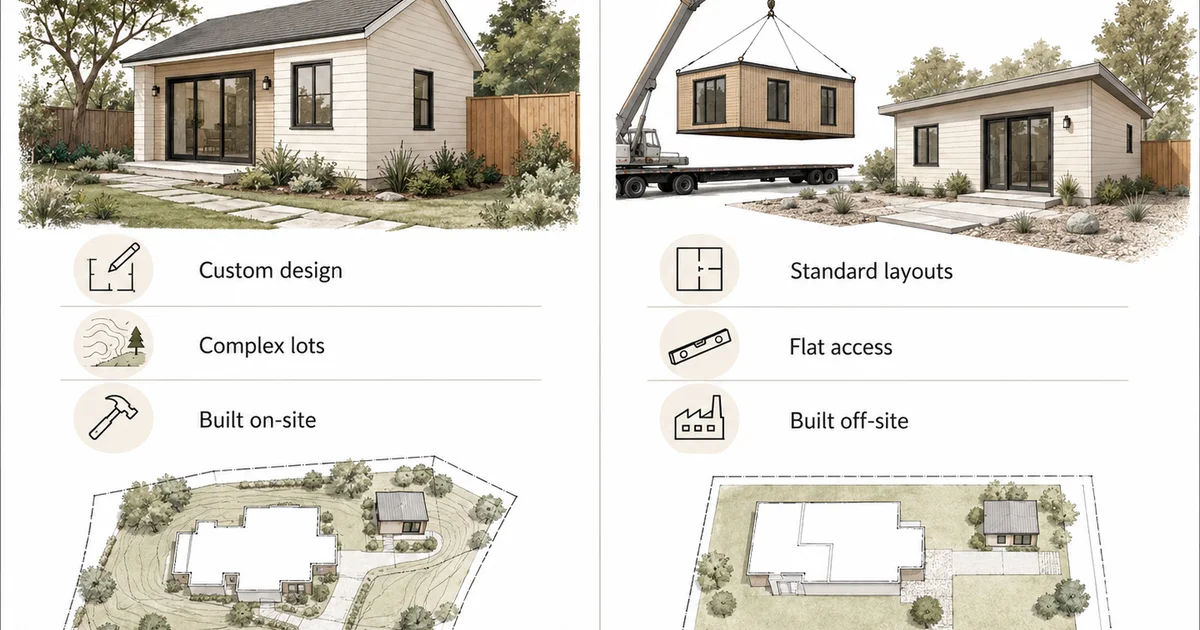
| Variable | Stick-built (SnapADU) | HUD-manufactured (Crest primary) |
|---|---|---|
| Governing code | California IRC + Title 24 energy | Federal 24 CFR Part 3280 (HUD code) |
| Where built | On-site at your property | Silvercrest factory (Corona, CA); delivered by truck |
| Where inspected | Local city/county inspector at each phase | HUD-approved inspection agency at factory; then local installation inspection |
| Solar requirement (City of San Diego) | Required for detached new-construction | Exempt for HUD-manufactured (IB 400) |
| Real-property title | Automatically part of real property | Requires HCD Form 433A to reclassify from personal property |
| Conventional financing | Standard — HELOC, cash-out, construction loan, renovation | Eligible per Fannie Mae, but requires HUD compliance verification + 433A |
| Design flexibility | Fully custom — every dimension can adapt | Fixed factory models (426, 507, 800, 1041 sq ft); custom secondary |
| Crane requirement | Not required | Sometimes required (tight access, slope) |
| Warranty structure | Builder's warranty (get terms in writing) | Silvercrest "Silvershield" 7-year structural; installation warranty — get both in writing |
Use-case decision matrix: which builder, for which project?
Answer capsule: Lot type and intended use usually predict the better first call before any other variable. Match your situation to the matrix below, then verify with a site assessment.
| Your situation | Better first call | Reason |
|---|---|---|
| Aging parent suite, long-term family use | SnapADU | Custom layout, accessibility, privacy, and same-as-house resale comparability. |
| Adult child returning home, semi-permanent | SnapADU or Crest | Both work; pick by budget and customization needs. |
| 2-bed rental on a flat, accessible lot | Compare both | SnapADU gives all-in design-build clarity; Crest can be cheaper if a model fits. |
| Smallest possible detached ADU under $200K | Crest (Crestline 426/507) — verify quote scope | HUD-manufactured small units can come in lowest, if financing works. |
| Coastal Overlay or Coastal Development Permit needed | SnapADU or architect-led | Coastal review favors a team experienced in DSD's coastal pathway. |
| Sloped, retaining-wall, or tight-access lot | SnapADU | HUD units have rigid dimensions and crane/access requirements. |
| HOA with strict architectural review | SnapADU | Stick-built matches main house easier; HOAs sometimes resist manufactured aesthetics. |
| Garage conversion ADU | Neither | Use a conversion specialist; both companies focus elsewhere. |
| Junior ADU (JADU) | Neither | JADUs are interior carve-outs ≤500 sq ft; specialty remodel scope. |
| You plan to refinance or cash-out after the build | SnapADU (simpler underwriting); Crest workable with verification | Both can finance; HUD-manufactured needs documented Fannie Mae criteria. |
| Outside San Diego County | Neither | Both companies' core service area is Greater San Diego. |
| You want the absolute fastest move-in once permits issue | Crest | Factory-built install is 4–6 months built and installed per Crest. |
| You want a custom 2-story carriage-house ADU | SnapADU | Verify multi-story feasibility with Crest before assuming HUD pathway works. |
| Multi-unit ADU project (2–4 detached) | SnapADU | Stick-built scales better for plan reuse and economies on a single site. |
How much does an ADU from SnapADU vs Crest Backyard Homes cost?
Answer capsule: SnapADU publishes detached, stick-built ADU all-in cost examples around $300,000 for 500 sq ft, $350,000 for 750 sq ft, $425,000 for 1,000 sq ft, and $450,000 for 1,200 sq ft, or roughly $375–$600+ per square foot (snapadu.com/adu-costs/). Crest publishes a Crestline 800 model at "under $300,000" with site-specific pricing and historically referenced a 432 sq ft Leucadian Casita "less than $100,000" in 2018 company materials. Other Crest size/price points circulating in third-party comparisons should be treated as estimates until Crest confirms them in writing.
| Builder | Build code | Approx. size | Price signal | Verification level | Notes |
|---|---|---|---|---|---|
| Crest (Leucadian Casita) | HUD manufactured | 432 sq ft (12×36), 1bd/1ba | <$100,000 all-in | Historical (2018 blog) — not a current 2026 quote | Verify current pricing in writing. |
| Crest (Crestline 426) | HUD manufactured | 426 sq ft, 1bd/1ba | [Needs verification] | Not consistently published | Confirm in quote. |
| Crest (Crestline 507) | HUD manufactured | 507 sq ft, 1bd | [Needs verification] | Not consistently published | Confirm in quote. |
| SnapADU (smallest example) | Stick-built | 500 sq ft | ~$300,000 all-in | Current company source | Includes SnapADU's typical all-in scope. |
| Crest (typical 750 sq ft 2bd/2ba) | HUD manufactured | 750 sq ft | ~$260,000 all-in | Competitor-reported estimate [needs verification from Crest] | Confirm directly with Crest. |
| SnapADU (mid example) | Stick-built | 750 sq ft | ~$350,000 all-in | Current company source | Standard all-in scope. |
| Crest (Crestline 800) | HUD manufactured | 800 sq ft, 2bd/2ba | "Under $300,000" site-specific | Current company source | Headline figure; site conditions can add. |
| SnapADU (1,000 sq ft example) | Stick-built | 1,000 sq ft | ~$425,000 all-in | Current company source | Standard all-in scope. |
| SnapADU (1,200 sq ft example) | Stick-built | 1,200 sq ft (state max) | ~$450,000 all-in | Current company source | Legal maximum for a detached ADU in CA. |
| SnapADU general | Stick-built | Any | $375–$600+ per sq ft | Current company source | Smaller units cost more per sq ft. |
Affiliate disclosure near pricing
Dwelling Index is reader-supported. SnapADU is an active referral partner for Greater San Diego ADU pages. Crest Backyard Homes is not a partner. Editorial ranking is not influenced by compensation.
Per-square-foot reality check: For an 800 sq ft 2-bed/2-bath unit, Crest's "under $300,000" works out to roughly $375/sq ft installed, while SnapADU's mid-range examples land closer to $425–$475/sq ft. The gap is real — but so is the build-code difference. The right comparison is not "$375 vs $475 per square foot." The right comparison is "what is each square foot legally, financially, and at resale?"
Affiliate disclosure: SnapADU is a Dwelling Index referral partner. We may earn a commission if you book a consult through this link, at no extra cost to you. Editorial ranking is not influenced by compensation.
Detached ADU in Greater San Diego? Explore a SnapADU design-build consult.
Skip this if your project is a garage conversion, JADU, modular/manufactured ADU, or outside Greater San Diego County.
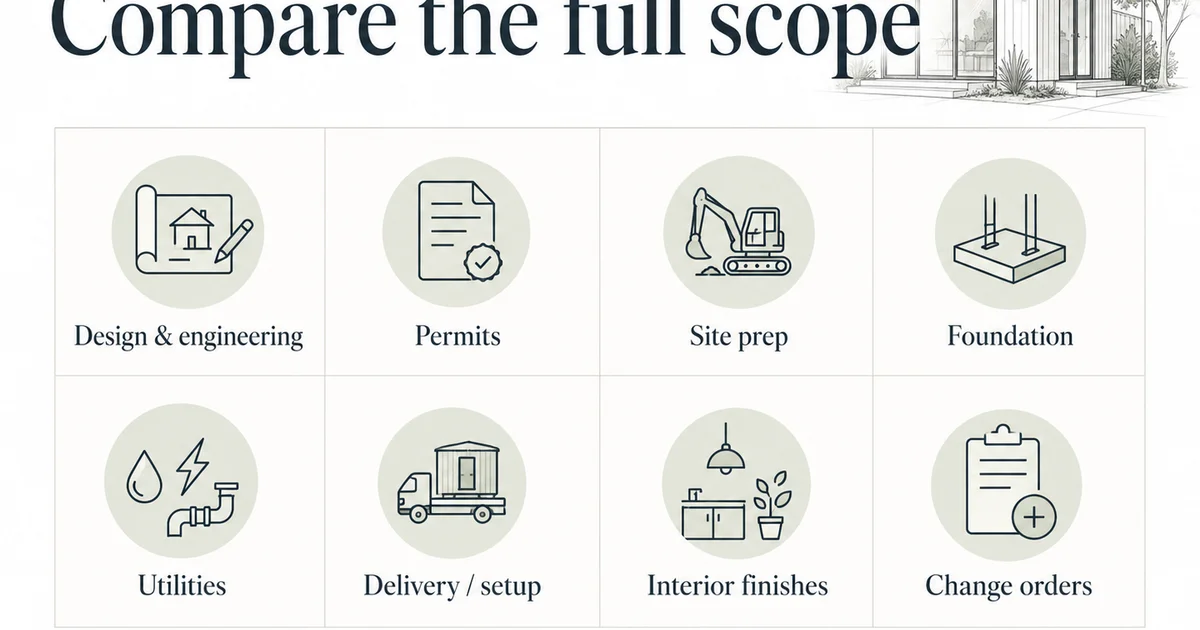
The all-in quote decoder: 25 line items to demand in writing
A defensible ADU quote — from SnapADU, Crest, or any San Diego builder — should explicitly state which of these 25 items are included, excluded, or sized as allowances. Anything missing becomes an out-of-pocket surprise mid-project, and California's CSLB requires written contracts with specific terms for residential work over $500.
| # | Quote line item | What to confirm | Why it matters |
|---|---|---|---|
| 1 | ADU type & build code | Stick-built (IRC/Title 24) or HUD manufactured (24 CFR 3280) | Drives every downstream decision. |
| 2 | Square footage & bed/bath count | Exact, not 'approximate' | Size affects fees, school fees, and impact-fee waiver thresholds. |
| 3 | Foundation type | Slab, raised, pier-and-beam, engineered | Major cost driver; required for HUD installations. |
| 4 | Site prep & grading | Cubic yards, retaining walls, drainage | Slope and soils can multiply this line. |
| 5 | Geotechnical / soils report | Included or excluded | Hillside lots typically require it. |
| 6 | Architectural & engineering plans | Included; revision count | 'Revisions extra' is a common surprise. |
| 7 | Title 24 energy compliance | Included | Mandatory in California; usually included. |
| 8 | Permit submission | Who pulls the permit | Whoever pulls it owns the corrections. |
| 9 | Plan-check correction rounds | Number assumed | San Diego DSD often issues 1–3 correction cycles. |
| 10 | City permit & plan check fees | Included or allowance with cap | DSD fees are non-trivial. |
| 11 | School impact fees | Included or allowance | Apply over 500 sq ft per district rates. |
| 12 | Construction & development impact fees | Included or allowance | Waived under 750 sq ft statewide. |
| 13 | SDG&E or utility connection fees | Included or allowance | New meters trigger capacity fees. |
| 14 | Sewer / water / capacity fees | Included or allowance | Can be $5,000–$15,000+ in market quotes. |
| 15 | Trenching length | Linear feet specified | Per-foot pricing for laterals. |
| 16 | Electrical panel upgrade | Included or allowance | Common surprise on older homes. |
| 17 | Sub-panel for ADU | Included or allowance | Always required. |
| 18 | HVAC system | Make, model, type (heat pump, etc.) | Required for Title 24 compliance. |
| 19 | Solar / energy storage | Included or excluded | Required for newly-constructed non-manufactured detached ADUs in San Diego. |
| 20 | Delivery & crane (HUD/modular only) | Crane required? Access plan? | Can add five figures unexpectedly. |
| 21 | Skirting / stairs / decks (HUD only) | Included | Often quoted separately. |
| 22 | Finishes & fixture allowances | Specific dollar amounts | Allowance-shopping is where budgets blow up. |
| 23 | Landscaping / hardscape repair | Included or excluded | Almost always excluded. |
| 24 | Change-order process | Written, with markup percentage | Verbal change orders are the #1 dispute source. |
| 25 | Warranty | Written, length, what's covered | Silvercrest publishes a 7-year structural warranty; SnapADU offers a builder's warranty — get both in writing. |
Want this 25-item decoder as a printable PDF?
Download the Free ADU Starter Kit — includes the quote-comparison checklist, permit questions, and builder-call script. Free, no spam.
Timeline reality: which builder actually finishes faster?
Answer capsule: Crest publicly compares a HUD manufactured ADU at 4–6 months built and installed against 12–18 months for site-built construction (crestbackyardhomes.com). SnapADU publishes a 10–18 month total design-to-move-in timeline (snapadu.com/process/). The honest comparison depends on where you start counting — Crest's 4–6 months is the build/install window, not the full project from first call.
| Phase | Stick-built (SnapADU) | HUD-manufactured (Crest) |
|---|---|---|
| Feasibility & design | 3–4 months | 1–2 months (model selection) |
| Engineering & plan completion | Within design phase | Mostly factory-stock plans |
| City permit submittal & review | 60-day statutory clock; 1–3 correction rounds typical | 60-day statutory clock; lighter scope review |
| Factory build queue | N/A | Slot-dependent [verify in writing] |
| Site prep & foundation | Within build phase | 1–2 months |
| Vertical construction / set & hook-up | 6–9 months total build | 4–6 months built and installed (Crest) |
| Final inspections & CO | Included | Included |
| Published total | 10–18 months (SnapADU) | 4–6 months built and installed (Crest); full design-to-move-in [verify in writing] |
For an apples-to-apples full-project comparison, ask both builders to put a dated schedule in writing — including the design phase, permit submittal, plan-check corrections, factory slot (if applicable), site prep, foundation, set/build, utility connection, and final inspection.
Which builder works on your specific lot?
Answer capsule: Lot type usually predicts the better first call before any other variable. Flat, accessible, standard-shape lots are the strongest scenario for Crest. Sloped, tight-access, coastal, irregularly shaped, or design-sensitive lots are usually a stronger scenario for SnapADU's site-built customization.
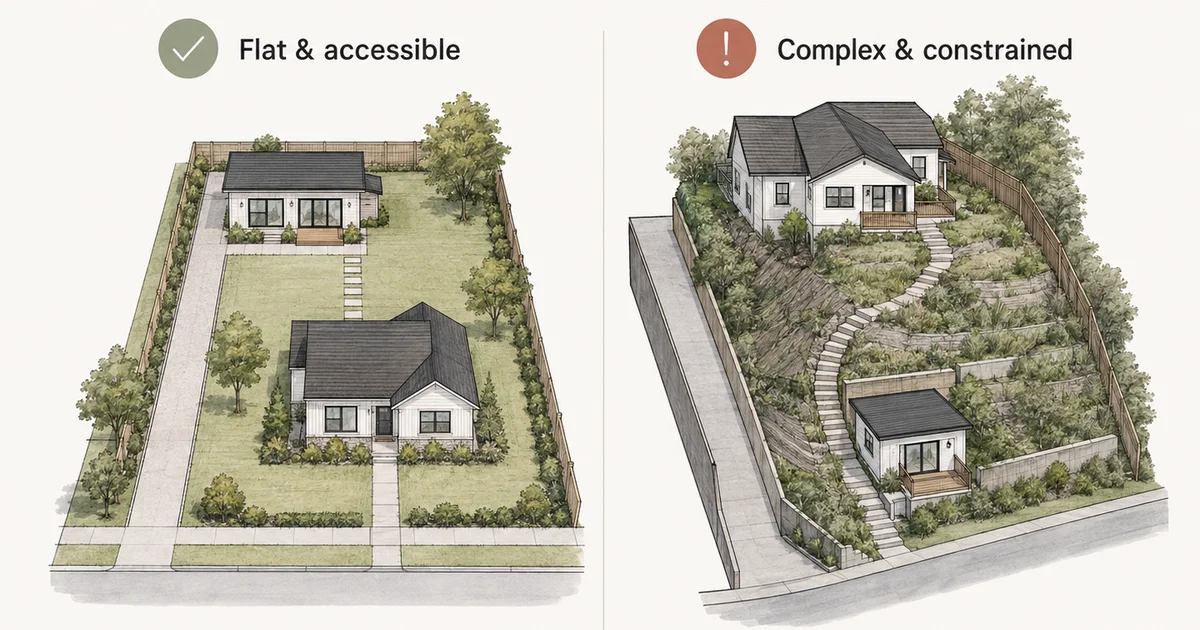
| Lot characteristic | Better first call | Reason |
|---|---|---|
| Flat, full-side-yard access, 6,000+ sq ft | Either; Crest if budget-driven | Both can build; HUD has cost edge in this best case. |
| Slope >10% | SnapADU | Foundation flexibility favors site-built. |
| Side-yard <12 ft or alley-only access | SnapADU | Module delivery often impossible. |
| Coastal Overlay (CDP triggered per IB 400) | SnapADU | Easier to adapt to coastal review feedback. |
| Strict HOA architectural review | SnapADU | Matching primary residence is easier. |
| WUI / very high fire severity zone | Either, with detailing | Both can comply; ask for fire-zone scope in quote. |
| Septic system | Either | Septic upgrade affects both equally; may be $30K–$60K+ surprise. |
| Lot <4,000 sq ft | Verify setback compliance first | State law allows up to 800 sq ft + 16 ft height by-right; both builders can fit. |
Get your lot pre-screened before you book builder calls.
A free ADU feasibility report tells you which build categories your lot supports — saving you from quoting the wrong builder for your site.
What does the City of San Diego require before either builder can build?
Answer capsule: Every ADU in the City of San Diego requires a building permit per Information Bulletin 400 (sandiego.gov). California Government Code §66317 requires the city to determine completeness within 15 business days and approve or deny a complete application within 60 days, with the application deemed approved if the city misses the 60-day window. The maximum size for a detached ADU is 1,200 sq ft, and detached ADUs may not exceed two stories.
| Project type | Plan check fee | Inspection fee |
|---|---|---|
| Detached ADU up to 500 sq ft (add/remodel category) | $3,512.92 | $2,228.29 |
| Detached ADU over 500 sq ft (Residential Single Dwelling Unit/Duplex detached ADU) | $8,085.26 | $8,401.90 |
| Manufactured/factory-built single dwelling unit | $5,776.62 | $3,310.82 |
Key rules from IB 400 that apply to both builders
- Building permit required. No exceptions — stick-built, HUD-manufactured, modular, garage conversions, and JADUs all require one.
- Maximum size: 1,200 sq ft for a detached ADU.
- Height: Detached ADUs may not exceed two stories. State law guarantees minimum 16-foot height.
- Setbacks: State law caps detached-ADU side and rear setbacks at 4 feet.
- Parking: Not required for ADUs outside the Coastal Overlay Zone.
- Solar: Required for newly-constructed, non-manufactured, detached ADUs. HUD-manufactured units are exempt.
School developer fees in San Diego Unified addresses: $5.17/sq ft through May 10, 2026 and $5.38/sq ft effective May 11, 2026 (sandiegounified.org). State law waives impact fees for ADUs under 750 sq ft. The 60-day approval clock starts only when the application is complete — missing structural calcs or Title 24 documentation means the clock has not started.
Financing and appraisal: what's actually true about HUD-manufactured ADUs
Answer capsule: Stick-built ADUs generally support standard mortgages, HELOCs, cash-out refinances, and renovation loans. HUD-manufactured ADUs are also eligible under Fannie Mae policy — provided specific verification requirements are met. Fannie Mae requires lenders to verify HUD compliance, permanent foundation, mortgage encumbrance with the primary dwelling, HUD labels/data plate, and 24 CFR Part 3280 requirements (singlefamily.fanniemae.com).
| Financing lane | Stick-built (SnapADU) | HUD-manufactured (Crest) |
|---|---|---|
| HELOC / home-equity loan | Works well | Works; borrow before the build |
| Cash-out refinance | Standard | Works; verify lender comfort with manufactured |
| Construction-to-permanent loan | Standard | Ask lender directly about HUD-manufactured eligibility |
| Renovation mortgage (HomeStyle, 203k) | Straightforward | More friction; ask lender |
| SDHC ADU Finance Program (City of San Diego) | Eligible (income-qualified) | Ask SDHC directly about build-method eligibility |
| CalHFA $40K ADU Grant | Fully allocated (Dec 28, 2023) — monitor for new rounds | Fully allocated — monitor for new rounds |
HCD Form 433A — the real-property step for HUD-manufactured ADUs
In California, if you intend to reclassify a manufactured home as real property — required for most conventional financing — the owner submits HCD Form 433A with the local building jurisdiction when applying for the permanent-foundation permit. Confirm the 433A process is part of Crest's installation scope before signing.
Trust, license, and proof: which company is easier to verify?
Answer capsule: SnapADU has more easily-verifiable third-party proof in our desk review. Crest's underlying corporate structure is verifiable through public records, but August 2025 fictitious-business-name abandonment notices for "Crest Backyard Homes" and "Crest Homes" make confirming the current contracting entity an essential pre-signing step.
SnapADU verification (checked May 7, 2026)
- CSLB license #1075582 — verify "active" at cslb.ca.gov
- BBB profile — A+ rating, BBB-accredited
- BuildZoom profile — public permit history
- Houzz portfolio — project photos with dates
- Co-founders publicly named: Whitney Hill (CEO); Michael Anthony Moore (CFO)
- 100+ ADUs claimed; operating since 2020
- Active Dwelling Index referral partner
Crest verification (checked May 7, 2026)
- Founder John Arendsen publicly named; industry tenure since 1986
- Four furnished display models in Leucadia
- On The Level General Contractors, Inc. — B-1 GC and C-47 license #521400
- BBB profile: A+ rating but not BBB-accredited
- Silvercrest factory partnership; 7-year structural warranty
- ⚠️ FBN abandonment notices (Aug 8, 2025) for "Crest Backyard Homes" and "Crest Homes" — confirm current contracting entity in writing before signing
Critical pre-sign verification for Crest
FBN abandonments often precede a new FBN filing or business-structure change. Before signing anything with Crest, confirm in writing:
- Current FBN filing for the entity that will sign your contract.
- Active CSLB license, classification, bond, and workers' comp.
- Current HCD manufactured-home dealer/installer status.
- Proof of insurance and warranty terms.
- Whether contracting goes through Crest Backyard Homes, On The Level General Contractors, COAT Design Remodel, or another entity.
Who should choose SnapADU?
SnapADU is the stronger first call for homeowners building a detached, stick-built, design-customized ADU in Greater San Diego, especially when long-term resale value, financing flexibility, complex lots, multi-story design, or matching the primary residence matter.
In SnapADU's sweet spot if you…
- Own a property in Greater San Diego County
- Want a detached, new-construction ADU
- Target 500–1,200 sq ft all-in budget $300K+
- Value a single accountable team for design → permitting → construction
- Have slope, tight access, coastal review, fire-zone, or HOA matching considerations
- Want a unit that finances and appraises like a house
- Plan to refinance or take cash-out after the build
- May sell within 5–10 years and want maximum buyer pool
- Want two-story, carriage-house, or over-garage flexibility
Outside SnapADU's sweet spot if you…
- ✕Project is primarily a garage conversion
- ✕Want a Junior ADU (JADU)
- ✕Shopping HUD-manufactured or modular as primary path
- ✕Hard ceiling is under $250K all-in for detached new construction
- ✕Want to be your own owner-builder
- ✕Property is outside Greater San Diego County
Affiliate disclosure: SnapADU is a Dwelling Index referral partner. We may earn a commission if you book a consult through this link, at no extra cost to you. Editorial ranking is not influenced by compensation.
Detached ADU in Greater San Diego? Explore a SnapADU design-build consult.
Skip this if your project is a garage conversion, JADU, modular/manufactured ADU, or outside Greater San Diego County.
Who should choose Crest Backyard Homes?
Crest Backyard Homes is the stronger first call for homeowners specifically comparing HUD-manufactured, modular, or model-based "backyard home" options in San Diego County, particularly on flat, accessible lots. Verify the contracting entity, license, financing pathway, all-in scope, and warranty in writing before signing.
In Crest's sweet spot if you…
- Explicitly evaluating HUD-manufactured or modular ADUs
- Lot is flat, with full driveway/side-yard access
- One of the Crestline models (426, 507, 800, 1041) or Leucadian Casita fits your use
- Priority is lower upfront cost and faster on-site disruption
- Stress-tested financing with a lender comfortable with HUD-manufactured Fannie Mae requirements
- Plan to hold the property long-term (10+ years)
- HOA (if any) doesn't restrict manufactured aesthetics
- Have toured one of Crest's four furnished Leucadia models in person
Outside Crest's sweet spot if you…
- ✕Lot is sloped, tight, or alley-only access
- ✕Need two-story or carriage-house designs
- ✕Need to closely match a custom primary residence
- ✕Want a wide pool of conventional financing options without additional verification
- ✕Outside San Diego County
- ✕Project is a garage conversion or JADU
15 questions to ask Crest specifically before signing
- Which legal entity will sign my contract — Crest Backyard Homes, On The Level General Contractors, COAT Design Remodel, or a different entity?
- Show me the current FBN filing for that entity.
- What is the active CSLB license number, classification, and bond status?
- What is the HCD manufactured-home dealer/installer status?
- Is my unit HUD-manufactured (24 CFR 3280), modular, or stick-built?
- Will the unit be installed on a permanent foundation with HCD Form 433A reclassification?
- Who prepares my plans?
- Who pulls the city building permit and handles plan-check corrections?
- What exactly is included in the all-in price, line-by-line against the 25-item decoder above?
- What delivery, crane, staging, foundation, stairs, skirting, and utility assumptions are baked in?
- What is the payment schedule, and does it comply with CSLB's $1,000 / 10% home-improvement down-payment cap?
- What warranty applies — Silvercrest's 7-year structural, an installation warranty, both?
- Can I have 3 recent permitted San Diego project addresses with owner permission to view?
- What is the realistic full design-to-move-in timeline, not just the 4–6 month build-and-install window?
- What is your change-order process and markup percentage?
Crest Backyard Homes is not currently a Dwelling Index referral partner. We receive nothing if you choose Crest. The questions above are the same we'd ask of any HUD-manufactured ADU dealer in California.
When neither SnapADU nor Crest is the right answer
A meaningful share of "choosing between SnapADU and Crest" searches actually mask a different project — a garage conversion, a JADU, an ultra-low-budget detached ADU, an ultra-custom architectural project, or a multi-unit investor build. In those cases, neither company is the right starting point.
| Your situation | Better path | Why |
|---|---|---|
| Garage conversion | Conversion-focused remodeler | Interior remodel scope; not detached new-build expertise. |
| JADU (≤500 sq ft inside the existing house) | Interior remodeler / JADU specialist | Different scope, often a different general license. |
| Ultra-low budget (sub-$200K all-in detached) | Garage conversion, JADU, or phased scope | Detached new-build economics rarely cooperate. |
| Highly custom architectural ADU (>$700K target) | Architect + competitively bid GCs | Design-build cost ceilings limit experimentation. |
| Multi-unit (2–4 detached ADUs on one lot) | Stick-built specialist or developer-style GC | Plan reuse and lot economics favor stick-built scaling. |
| Outside San Diego County | Local ADU builder guide | Both companies' core service area is San Diego County. |
| Rural / unincorporated with septic | Local rural-experienced GC | Septic upgrades can be $30K–$60K+ and dwarf most ADU surprises. |
| Pure rental-investor analysis first | Run cash-flow analysis before builder shopping | Match builder to investment thesis, not the other way. |
How to compare quotes without getting fooled
A defensible side-by-side requires both companies to quote the same ADU size, the same finish allowances, the same foundation type, the same permit assumptions, the same utility distances, the same fee assumptions, and the same exclusions list. A lower quote that omits foundation, sitework, or city fees is not actually lower — it's incomplete. Apply the 25-item decoder above to each quote line by line.
Five red flags that should stop the deal
- No license number on the contract. A California home improvement contract over $500 must list the contractor's license. No license, no signature.
- Down payment over $1,000 or 10% of contract (home-improvement category). This violates CSLB rules.
- "All-in" with no exclusions list. Real all-in pricing has a written exclusions section. No exclusions list means surprises live in change orders.
- Verbal change-order process. Every change must be priced, documented, and signed by both parties before the work happens.
- No site visit before the quote. A serious quote requires a site walk to assess access, utilities, and slope.
Not sure where to start? See what's possible at your address — get your free ADU report.
Free, no obligation. We'll match your lot to a likely ADU path before you book any consult.
Frequently asked questions
Is SnapADU better than Crest Backyard Homes?
Neither is universally "better." SnapADU is the stronger first call for detached, stick-built ADUs in Greater San Diego where customization, complex lots, financing flexibility, and resale value matter. Crest Backyard Homes is the stronger first call for HUD-manufactured or modular ADU shoppers on flat, accessible lots where lower upfront cost and faster on-site work matter more than design flexibility. The right answer depends on lot, build code, financing path, and timeline goals.
Is Crest Backyard Homes cheaper than SnapADU?
On headline price for some models, yes — Crest's published Crestline 800 model is "under $300,000" all-in, and SnapADU's stick-built examples run from about $300,000 for 500 sq ft to $450,000 for 1,200 sq ft. But the prices aren't directly comparable: Crest's primary lane is HUD-manufactured housing under federal 24 CFR Part 3280, which trades upfront savings for additional Fannie Mae verification requirements, the HCD Form 433A real-property step, and a different appraisal/insurance treatment. The total cost-of-ownership picture is closer than the headline gap suggests.
Does SnapADU build prefab or modular ADUs?
No. SnapADU explicitly builds traditionally wood-framed, on-site stick-built ADUs under California's IRC and Title 24 codes. Their public positioning is exclusively for detached, new-construction ADUs in Greater San Diego County.
Does Crest Backyard Homes build site-built ADUs?
Crest's primary lane is HUD-code manufactured ADUs built off-site at Silvercrest's Corona factory and installed in San Diego County. They also publish modular and custom ADU options, with custom work sometimes routed through COAT Design Remodel. Confirm in writing whether your specific Crest proposal is HUD-manufactured, modular, or site-built — the build code drives everything that follows.
Which is faster, SnapADU or Crest?
Crest publicly compares a HUD manufactured ADU at 4–6 months built and installed against 12–18 months for a site-built option. SnapADU publishes a 10–18 month total design-to-move-in timeline. Crest's full design-to-move-in timeline (including design, permits, factory slot, sitework, and final inspections) should be confirmed in writing per project.
Do ADUs need building permits in San Diego?
Yes. Every ADU in the City of San Diego — stick-built, HUD-manufactured, modular, garage conversion, or JADU — requires a building permit per Information Bulletin 400. Coastal Overlay properties may also require a Coastal Development Permit unless the ADU is contained within an existing primary or accessory structure or constructed in an area currently used for parking.
What is the maximum size of a detached ADU in San Diego?
1,200 square feet for a detached ADU per California state law and the City of San Diego's IB 400. Detached ADUs may not exceed two stories. State law guarantees a minimum 16-foot detached-ADU height, with 18-foot and 25-foot minimums in certain transit, multifamily, and attached-ADU scenarios. JADUs are capped at 500 square feet and must be inside the existing primary dwelling.
Can I build a HUD-manufactured ADU on any lot in San Diego County?
Not on any lot. HUD-manufactured units have fixed dimensions and require delivery access, often including driveway clearance and sometimes crane access. Sloped lots, tight side-yard access, alley-only properties, and certain HOA-restricted communities can rule out HUD-manufactured installation. A site assessment from the dealer is the only reliable answer.
Can I finance a HUD-manufactured Crest ADU with a conventional mortgage?
Yes, per Fannie Mae policy, when specific verification requirements are met. Fannie Mae permits ADUs that are site-built or factory-built, including HUD Code manufactured homes legally classified as real property — provided the lender verifies HUD compliance, permanent foundation, mortgage encumbrance with the primary dwelling, HUD labels/data plate, and 24 CFR Part 3280 requirements. In California, the real-property reclassification is done through HCD Form 433A. Talk to your lender before signing the build contract.
Will building an ADU pay for itself?
It depends on financing terms, rental rates, vacancy, maintenance, and your hold period. These are illustrative considerations, not guarantees of returns. Actual results depend on local market conditions, construction costs, financing terms, rental demand, and regulatory approvals.
What is the CSLB down payment limit on an ADU contract?
For California home improvement contracts (work over $500 on existing real property), the down payment cannot exceed $1,000 or 10% of the total contract price, whichever is less, per CSLB consumer guidance. Different rules can apply to certain new-construction contracts — ask in writing which category your contract falls under.
What is a JADU and is it different from an ADU?
A Junior ADU (JADU) is a separately permitted dwelling unit of 500 square feet or less that exists inside the existing single-family dwelling. It must have its own entry and may share sanitation facilities with the main house. Per California Government Code §66333, a local ordinance may require owner-occupancy when the JADU shares sanitation; owner-occupancy is not required if the JADU has separate sanitation or if the owner is a governmental agency, land trust, or housing organization.
Can I build both an ADU and a JADU?
Yes. California state law allows one ADU plus one JADU per single-family lot in most jurisdictions, and the City of San Diego allows additional ADUs in certain Transit Priority Areas under the ADU Bonus Program when affordability deed restrictions are recorded. Verify your specific lot's allowance with DSD or your contractor.
What if my lot is in a Coastal Overlay zone?
Per IB 400, a Coastal Development Permit (CDP) is required for creation of all ADUs and JADUs within the Coastal Overlay Zone unless the ADU or JADU is contained within an existing primary structure, contained within an existing accessory structure, or constructed in an area currently used for parking. Eligible ADUs in the non-appealable Coastal Overlay area may use Process Two, and the City's decision is not appealable to the California Coastal Commission. Site-built construction generally has more flexibility to respond to coastal review feedback than fixed-dimension factory units.
Are there grants available for building an ADU in 2026?
The CalHFA $40,000 ADU Grant Program is fully allocated as of December 28, 2023. Monitor for new rounds. The City of San Diego's SDHC ADU Finance Program offers construction-to-permanent loans up to $250,000 with below-market terms (1% during construction, 4% fixed amortized over 30 years with a 15-year term, balance due in 15 years) for income-qualified homeowners with a 7-year affordability covenant on the rented ADU.
Does the 60-day permit review apply to my ADU?
Yes, in covered scenarios. California Government Code §66317 requires local agencies to determine completeness within 15 business days, approve or deny a complete ADU application within 60 days when an existing single-family or multifamily dwelling is on the lot, and treat the application as deemed approved if the agency does not approve or deny it within 60 days. The clock starts when the application is complete — incomplete plans don't start the clock. AB 1332 further requires 30-day review for qualifying preapproved-plan submissions.
Does the City of San Diego require solar on an ADU?
Per IB 400, solar panels are required for newly-constructed, non-manufactured, detached ADUs. Solar is not required for ADUs created within existing space, additions to existing homes or accessory structures, or conversions of existing structures. This is one of the practical line-item differences between stick-built and HUD-manufactured ADUs in the City of San Diego.
Do I have to live on the property to build an ADU in California?
Per California Government Code §66315, a local agency cannot require owner-occupancy as a condition of permitting an ADU. Local rules may require rentals to be for terms of 30 days or longer. JADU owner-occupancy rules are different — see the JADU FAQ above.
How do I verify a contractor's CSLB license?
Visit cslb.ca.gov, click "Check a License," and search by license number or business name. Confirm the status is active, the classification covers your work (B for general building; C-47 for manufactured housing installation), the bond is current, and workers' compensation is in place. Take a screenshot for your records before signing any contract.
What is HCD Form 433A and do I need it for a Crest manufactured ADU?
HCD Form 433A is the California form used to reclassify a manufactured home from personal property (titled through HCD) to real property (titled through county records). Most conventional financing for a HUD-manufactured ADU requires recorded 433A status. If you're building a Crest HUD-manufactured ADU, confirm in writing that the 433A process is part of the installation scope before signing.
Methodology: how we built this comparison
This guide was assembled from primary regulatory sources (City of San Diego Information Bulletin 400, IB 501 fee schedule updated April 28, 2026, California Government Code §66315/§66317/§66333, AB 1332, the California HCD ADU Handbook with December 2025 addendum, federal HUD Code at 24 CFR Part 3280, CSLB consumer protection guidance, and Fannie Mae's published ADU policy in the Selling Guide), company-published materials (snapadu.com, crestbackyardhomes.com), third-party trust profiles (BBB, BuildZoom, Houzz, The Coast News legal notices), and Dwelling Index editorial coverage.
Items we could not verify in a desk review are flagged [NEEDS VERIFICATION] and should be confirmed directly before signing any contract. We avoided fake testimonials, fake star ratings, and any schema for content not visible on the page.
Source references
- City of San Diego DSD, Information Bulletin 400 — ADU/JADU: sandiego.gov/development-services/forms-publications/information-bulletins/400
- City of San Diego DSD, Information Bulletin 501 — Construction Permit Fee Schedule (updated April 28, 2026): sandiego.gov/development-services/forms-publications/information-bulletins/501
- California Government Code §66315 (owner-occupancy preemption): leginfo.legislature.ca.gov
- California Government Code §66317 (15-day completeness, 60-day approval, deemed approved): leginfo.legislature.ca.gov
- California Government Code §66333 (JADU owner-occupancy rules): leginfo.legislature.ca.gov
- California AB 1332 (preapproved ADU plan program with 30-day review, effective January 1, 2024)
- California HCD ADU Handbook with December 2025 addendum: hcd.ca.gov/building-standards/adu/handbook
- Federal HUD Manufactured Home Construction and Safety Standards, 24 CFR Part 3280: ecfr.gov
- HCD Form 433A — manufactured-home real-property reclassification
- California Contractors State License Board, home improvement contract requirements: cslb.ca.gov
- Fannie Mae Selling Guide — Accessory Dwelling Units policy: singlefamily.fanniemae.com/originating-underwriting/mortgage-products/accessory-dwelling-units
- San Diego Housing Commission ADU Finance Program: sdhc.org/housing-opportunities/adu/
- CalHFA ADU Grant Program: calhfa.ca.gov/adu/
- San Diego Unified School District developer fees: sandiegounified.org/departments/real_estate_and_rentals/developer_fees
- SnapADU cost page, process page, homepage: snapadu.com/adu-costs/, snapadu.com/process/, snapadu.com
- SnapADU BBB profile: bbb.org/us/ca/san-diego/profile/general-contractor/snapadu-1126-1000081121
- Crest Backyard Homes homepage and model pages: crestbackyardhomes.com, crestbackyardhomes.com/crestline-adu-models/, crestbackyardhomes.com/model/crestline-800/
- Crest HUD Manufactured ADU page: crestbackyardhomes.com/hud-manufactured-adu/
- On The Level General Contractors Inc.: onthelevelcontractors.com/about-us/
- On The Level BBB profile: bbb.org/us/ca/vista/profile/foundation-contractors/on-the-level-general-contractors-inc-1126-10011620
- The Coast News legal notices (August 8, 2025) — FBN abandonment notices for "Crest Backyard Homes" and "Crest Homes"
- Silvercrest Homes (Corona, California) — factory partner of Crest Backyard Homes; "Silvershield" 7-year structural warranty
Related guides
Not sure where to start?
See what's possible at your address — get your free ADU report. We'll match your lot to a likely ADU path (stick-built, HUD-manufactured, modular, garage conversion, JADU) before you book any consult.
See What You Can Build → Get Your Free ADU ReportFree, no obligation.