
Builder Comparison · California ADUs
SnapADU vs Acton ADU (2026): Honest Costs, Service Areas & Fit Guide
By Dwelling Index Editorial — last verified
SnapADU vs Acton ADU: which California ADU builder fits your property?
The bottom line. SnapADU and Acton ADU are both excellent California ADU specialists. Neither is “better” in the abstract — they cover different geographies. SnapADU works only in Greater San Diego (19 cities and unincorporated San Diego County, per their official service area page). Acton ADU works in 80+ jurisdictions across the San Francisco Bay Area, Peninsula, East Bay, Silicon Valley, Santa Cruz, and Marin — and, since April 23, 2026, parts of Los Angeles County. Both build only on-site stick-framed ADUs and have publicly rejected prefab. Pick by service area first. If neither serves your address, the right next step is a property-level feasibility check — not more builder shopping.
The 30-second decision capsule. If you’re in San Diego County, SnapADU is your starting point. If you’re in the Bay Area, the East Bay, the Peninsula, Silicon Valley, Santa Cruz, or Marin, Acton ADU is your starting point. If you’re in LA County, Acton ADU is now an option — but treat the LA expansion as new and verify references in your specific submarket before signing. If you’re anywhere else, neither serves you, and the right move is a free property feasibility report.
Works at any California address. No builder commitment.
Above-the-fold quick comparison
| If your property is in… | Start here | Why |
|---|---|---|
| Greater San Diego / San Diego County | SnapADU | Detached ADU specialist with published San Diego cost data, in-house design-build, and 100+ completed ADUs since 2020. |
| Bay Area / Peninsula / East Bay / Silicon Valley / Santa Cruz / Marin (80+ listed jurisdictions) | Acton ADU | 35+ years of California residential design-build, the largest published library of pre-approved Bay Area plans, and Build Ready + Custom ADU lines with verified per-model pricing. |
| LA County: Westside, Central LA, San Gabriel Valley, San Fernando Valley | Acton ADU — but verify | New as of April 23, 2026. Ask for current LA references and confirm sub-city coverage. |
| Anywhere outside those areas | Neither, first | Use a feasibility report to find a builder that actually serves you. |
| You specifically want factory-built prefab/modular | Neither, first | Both companies are stick-built only and explicitly do not build prefab, modular, factory-assembled, or mobile units. |
The verdict in 30 seconds — why this comparison is mostly geographic
Answer capsule.
Most “SnapADU vs Acton ADU” content online treats them as direct rivals competing for the same customer. They aren’t. SnapADU operates only in Greater San Diego. Acton ADU operates in 80+ Bay Area jurisdictions and, as of April 2026, parts of Los Angeles County. Their service areas don’t overlap. So the comparison most homeowners actually need is not “which is better” but “which one (if either) serves my address?”
Both companies have arrived at remarkably similar conclusions about how California ADUs should be built — site-built construction only, in-house design and permitting, feasibility-first pricing reviews, and explicit rejection of factory-built prefab. For now: the honest first filter is your zip code. Get that right and the brand question mostly answers itself.
Service Area Decoder: does either company serve your address?
Answer capsule.
SnapADU’s official service area lists 19 cities and jurisdictions across Greater San Diego. Acton ADU’s official service area lists 80+ jurisdictions across the Bay Area, Peninsula, East Bay, Silicon Valley, Santa Cruz, and Marin, plus a new April 2026 LA County footprint. The two service areas don’t overlap. Together they cover only a fraction of California.
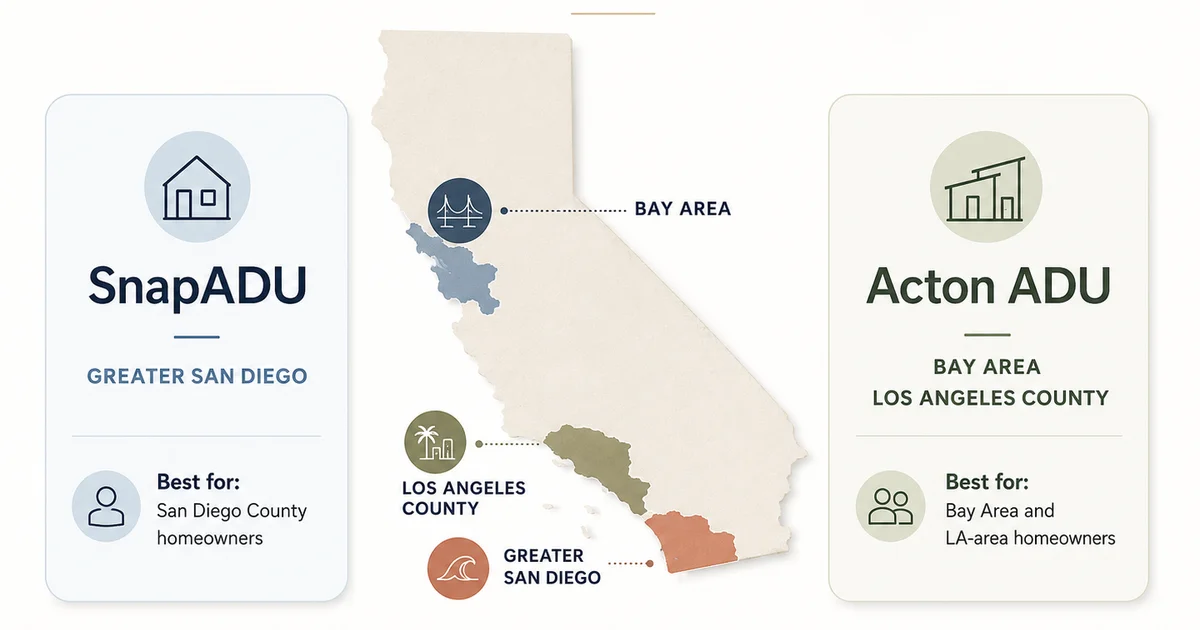
Cities served by SnapADU (Greater San Diego only)
Per SnapADU’s official service-area page (snapadu.com/service-area/). Last verified May 8, 2026.
Carlsbad, Chula Vista, Coronado, County of San Diego, Del Mar, El Cajon, Encinitas, Escondido, Imperial Beach, La Mesa, Lemon Grove, National City, Oceanside, Poway, San Diego, San Marcos, Santee, Solana Beach, Vista.
That’s 19 cities and jurisdictions total. If you’re inside the shaded service-area map but don’t see your specific community on the list, SnapADU’s page invites homeowners to reach out and the team confirms feasibility within one business day.
Cities served by Acton ADU (Bay Area + new LA County footprint)
Per Acton ADU’s official service-area page (actonadu.com/learn-more/service-area). Last verified May 8, 2026.
Alameda, Albany, Antioch, Aptos, Belmont, Belvedere, Benicia, Berkeley, Blackhawk, Brentwood, Burlingame, Campbell, Capitola, Castro Valley, Clayton, Concord, Corte Madera, Cupertino, Danville, Dublin, East Palo Alto, El Cerrito, El Sobrante, Emeryville, Fairfax, Foster City, Fremont, Gilroy, Greenbrae, Hayward, Hercules, Hillsborough, Lafayette, Livermore, Los Altos, Los Altos Hills, Los Gatos, Martinez, Menlo Park, Millbrae, Mill Valley, Milpitas, Moraga, Morgan Hill, Mountain View, Newark, Novato, Oakland, Oakley, Orinda, Pacifica, Palo Alto, Pasatiempo, Pinole, Pittsburg, Pleasanton, Portola Valley, Redwood City, Richmond, Rio Del Mar, San Anselmo, San Bruno, San Carlos, San Jose, San Leandro, San Lorenzo, San Mateo, San Pablo, San Ramon, Santa Clara City, Santa Clara County, Santa Cruz, Saratoga, Sausalito, Scotts Valley, Seacliff, Soquel, Stanford, Sunnyvale, Sunol, Union City, Vallejo, Walnut Creek, Woodside.
That’s 80+ jurisdictions covering the Bay Area, Peninsula, East Bay, Silicon Valley, Santa Cruz County, and Marin County. As of April 23, 2026, Acton also serves parts of Los Angeles County: Westside, Central LA, San Gabriel Valley, and San Fernando Valley. Specific city-level coverage inside those LA submarkets should be confirmed during the discovery call, since the expansion is fresh.
Don’t see your city on either list?
You’re not alone — most California addresses are outside both service areas. If you’re in Sacramento, Fresno, Bakersfield, the Inland Empire, San Luis Obispo, Orange County, or anywhere else, the right next step is a property feasibility check first.
SnapADU at a glance
Answer capsule.
SnapADU is a woman-owned, design-build ADU specialist focused 100% on Greater San Diego. Founded in 2020 by Whitney Hill and Mike Moore, they have completed more than 100 ADUs, build only stick-built (no prefab), use a fixed-price contract with a 6-month price lock, and publish an all-in cost range of $375–$600+ per square foot for turnkey detached ADUs in San Diego. Most projects land between $300,000 and $450,000+ all-in including design, permits, sitework, and utilities.
The basics
Co-founders Whitney Hill (Co-Founder & CEO) and Mike Moore (Co-Founder; operated Moore Construction in Oceanside since 2013) started SnapADU in 2020 to focus exclusively on detached new ADUs in San Diego County. The company is woman-owned, BBB A+ accredited, and operates from San Diego with an in-house team handling design, permitting, project management, and construction supervision.
CSLB License #1075582 (Class B General Building Contractor). Always verify current license status at cslb.ca.gov before signing any construction contract.
Pricing — what they actually charge
Source: snapadu.com/adu-costs/, updated March 2026. “Vertical build” is the structure plus standard finishes; “all-in” includes design, permits, sitework, and utilities. Last verified May 8, 2026.
| Approximate ADU size | Configuration | Vertical build cost | Typical all-in cost |
|---|---|---|---|
| 500 sq ft | 1 bed / 1 bath | ~$220,000 | ~$300,000 |
| 750 sq ft | 2 bed / 1 bath | ~$275,000 | ~$350,000 |
| 1,000 sq ft | 2 bed / 2 bath | ~$335,000 | ~$425,000 |
| 1,200 sq ft | 3 bed / 2 bath | ~$360,000 | ~$450,000 |
Published per-square-foot range: $375–$600+ per square foot turnkey for detached units between 500 and 1,200 square feet. Permit fees vary dramatically — Encinitas runs roughly $2–$4/sf, the City of San Diego runs $13–$28/sf.
The 6-month Price Lock Guarantee
SnapADU contracts include a 6-month Price Lock on the agreed scope, applied after the Construction Estimate Agreement. Their published claim is that initial estimates fall within 3–5% of the final contract price, because they conduct a Feasibility SnapShot reviewing 75+ project variables before pricing. The price lock is a contractual commitment most California ADU contractors do not offer.
Source: snapadu.com/blog/adu-pricing-san-diego/. Last verified May 8, 2026.
City partnerships and pre-approved plans
The City of Chula Vista’s official ADU page documents that “SnapADU prepared the City Standard ADU Plans” for Chula Vista. SnapADU separately reports being selected by the City of San Marcos through competitive bid to design the city’s Permit-Ready ADU plans. Pre-approved or city-ready plans cover: Carlsbad, El Cajon, Encinitas, Escondido, Imperial Beach, La Mesa, Poway, City of San Diego, and Vista.
The acceleration is real. Chula Vista’s official page documents that City Standard ADU Plan applications receive a 14-business-day plan review versus 21 business days for non-standard applications, with approximately $1,000 less in plan review fees.
Affiliate link. No additional cost to you.
Acton ADU at a glance
Answer capsule.
Acton ADU is a California design-build firm headquartered in Campbell, founded by Stan Acton and built on the 35+ year legacy of Acton Construction (established 1990). They serve 80+ Bay Area, Peninsula, East Bay, Silicon Valley, Santa Cruz, and Marin jurisdictions, and as of April 23, 2026 they have expanded into Los Angeles County. Every Acton ADU is built on-site to California’s residential building code — they explicitly do not build prefab, modular, factory-built, or mobile units. The lineup includes Custom ADUs and the Build Ready series: Investor Series for cost-efficient layouts (5 models, 448–998 sqft, $316,000–$523,000 starting base prices) and Signature Series for elevated finishes (4 models, 498–1,198 sqft, $383,000–$650,000 starting base prices).
The basics
Stan Acton founded Acton Construction in spring 1990, and the company spent its first three decades doing high-end residential design-build in Silicon Valley. Around 2017, Stan refocused the operation on ADUs. The company is headquartered at 1257 Dell Ave in Campbell, with an in-house design and permitting team plus dedicated construction crews.
CSLB License #638333, confirmed in Acton’s footer on every page of actonadu.com. Always verify current CSLB license status at cslb.ca.gov before signing any construction contract.
Investor Series — cost-efficient layouts for rental returns
All prices are starting base prices that require location-specific adjustment for taxes and fees. Verified directly from actonadu.com/services/series/investor-series, May 8, 2026.
| Model | Sq ft | Beds / Baths | Starting base price | Calculated $/sf at base |
|---|---|---|---|---|
| Manzanita i448 A1 | 448 | 1 / 1 | $316,000 | ~$705 |
| Juniper i628 A1 | 628 | 2 / 1 | $387,550 | ~$617 |
| Buckeye i748 A1 | 748 | 2 / 2 | $444,500 | ~$594 |
| Ironwood i888 B1 | 888 | 3 / 2 | $494,000 | ~$556 |
| Bristlecone i998 A1 | 998 | 3 / 2 | $523,000 | ~$524 |
Calculated $/sf is Dwelling Index’s starting-price-divided-by-square-footage. These are not final project prices and exclude location-specific taxes and fees.
Signature Series — elevated finishes for premium rental and family use
Verified directly from actonadu.com/services/series/signature-series, May 8, 2026.
| Model | Sq ft | Beds / Baths | Starting base price | Calculated $/sf at base |
|---|---|---|---|---|
| Nutmeg s498 A1 | 498 | 1 / 1 | $383,000 | ~$769 |
| Santa Lucia s658 A1 | 658 | 1 / 1 | $434,300 | ~$660 |
| Cypress s748 B1 | 748 | 2 / 2 | $475,000 | ~$635 |
| Redwood s1198 A1 | 1,198 | 3 / 2 | $650,000 | ~$543 |
Calculated $/sf is Dwelling Index’s starting-price-divided-by-square-footage. These are not final project prices and exclude location-specific taxes and fees.
Pre-approval note: Each Build Ready model page lists pre-approval cities including San Jose, Palo Alto, and a third entry labeled “Cloud City.” “Cloud City” appears to be a placeholder or test entry on the Acton site. Treat the verified pre-approval cities as San Jose and Palo Alto, and confirm any other claimed pre-approval directly with Acton during the consultation.
Acton LA market cost benchmark (2026)
Source: actonadu.com/blog/how-much-does-an-adu-cost-in-los-angeles. Last verified May 8, 2026.
| Cost reference (LA market, 2026) | Range |
|---|---|
| Typical all-in project budget (LA) | $180,000 – $400,000+ |
| Per-square-foot, new construction (LA) | $250 – $400 / sq ft |
| Premium / Westside / hillside builds | $500+ / sq ft |
| Garage conversion (LA) | $100,000 – $225,000 |
| Architectural design | $8,000 – $20,000 |
| Permits and fees (LA) | $5,000 – $25,000 |
Direct link, no commission.
SnapADU vs Acton ADU comparison matrix
SnapADU and Acton ADU are surprisingly aligned in philosophy and surprisingly different in scope. Both are stick-built design-build firms that explicitly reject prefab, both keep design and permitting in-house, and both have invested in pre-approved plan libraries. They differ in geography (San Diego vs Bay Area / LA), tenure (5 years ADU-only vs 35+ years residential), product packaging (plan library + custom vs Build Ready Investor/Signature + Custom), and headline pricing structure.
All matrix figures verified May 8, 2026 from each company’s own published materials.
| Attribute | SnapADU | Acton ADU |
|---|---|---|
| Service area | Greater San Diego only — 19 cities and jurisdictions | 80+ jurisdictions across Bay Area / Peninsula / East Bay / Silicon Valley / Santa Cruz / Marin; LA County since April 2026 |
| Founded | 2020 (5 years specializing in ADUs); Mike Moore’s prior Moore Construction work since 2013 | 1990 as Acton Construction; ADU-focused since ~2017 (~9 years ADU-only, 35+ years residential) |
| Headquarters | San Diego, CA | Campbell, CA (1257 Dell Ave) |
| Ownership | Woman-owned (Co-founders Whitney Hill, CEO; Mike Moore) | Founder-led (Stan Acton) |
| CSLB License | #1075582 (Class B) — verify current status at cslb.ca.gov | #638333 — verify current status at cslb.ca.gov |
| ADU project count (public) | 100+ completed | ADU-specific count not publicly published; decades of residential builds across the Bay Area |
| Build method | Stick-built only — wood-framed, slab-on-grade, on-site | Stick-built only — explicitly not prefab, modular, factory-built, or mobile |
| Pricing model | Fixed price with 6-month Price Lock after Construction Estimate Agreement; initial estimate within ~3–5% of final contract | Fixed, transparent scope; published Build Ready model base prices that adjust by location for taxes and fees |
| Published headline range | $375–$600+/sf turnkey detached; $300K–$450K+ all-in typical (San Diego) | LA: $180K–$400K+ all-in, $250–$400/sf new construction; Bay Area: $316K–$650K starting base prices per model |
| Published timeline | 10–18 months total: design 3–4 mo, permitting 3–6 mo, construction 6–9 mo | Pre-approved plans can be permitted in as little as 21–30 days per Acton’s LA cost article. Verify city-specific timeline directly. |
| Trust signal | BBB A+ accredited; ADU Coalition design awards | 35+ year residential track record; founder-led; published warranty; Buildertrend client portal |
| Affiliate status with Dwelling Index | Active partner (Greater San Diego only) | Not a partner — no commission earned on Acton links |
Pricing: what each company actually charges, and what each price includes
Answer capsule.
SnapADU and Acton ADU’s published headline numbers describe different pricing objects, so they aren’t directly comparable. SnapADU publishes turnkey ranges that include design, permits, sitework, and utilities for a detached unit in San Diego ($375–$600+ per sq ft, $300K–$450K+ all-in). Acton publishes per-model starting base prices for Build Ready units that require location-specific adjustment ($316K–$650K base, depending on series and model), plus a separate LA-market benchmark of $250–$400 per sq ft. Headline numbers are screening tools, not contracts.
Why per-square-foot is misleading for small homes
Both companies converge on the same point: per-square-foot ADU pricing is misleading because the kitchen, bathroom, mechanicals, and utility connections are largely fixed costs. A 500-square-foot ADU still needs a full kitchen and bathroom. Spread that fixed cost across 500 square feet and you get a high $/sf. Spread it across 1,200 and you get a much lower one. You can see this directly in the verified Investor Series table above — the Manzanita i448 at $316,000 base posts ~$705/sf, while the Bristlecone i998 at $523,000 base posts ~$524/sf.
The Quote Scope Normalizer — what every quote must include before you compare
This is the single most useful checklist on this page. If a builder’s quote omits a row, the “lower” quote isn’t actually lower — it’s incomplete.
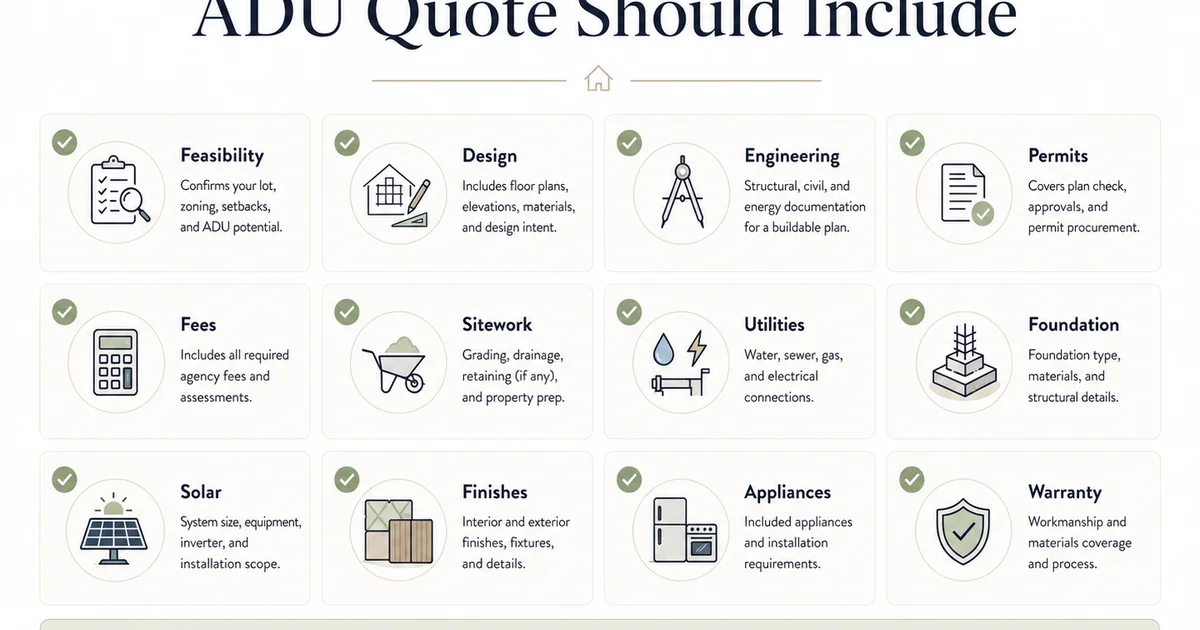
| Quote line item | Should be in the quote? |
|---|---|
| Feasibility study / site review | Yes |
| Architectural design | Yes |
| Construction drawings | Yes |
| Survey and utility mapping | Yes |
| Structural engineering | Yes |
| Title 24 energy compliance | Yes |
| Permit management labor | Yes |
| City / county permit and impact fees | Yes — call them out as a separate line item; they vary 7x within San Diego County alone |
| School fees, if applicable | Yes |
| Sitework and grading | Yes |
| Utility trenching (electrical, water, sewer, gas) | Yes |
| Solar PV, if required by Title 24 for new construction | Yes — confirm separately |
| Fire-rated construction or sprinklers, if triggered | Yes — confirm by zone |
| Soils / geotech report, if required | Yes |
| Foundation and slab | Yes |
| Standard finish package | Yes |
| Appliances | Yes — confirm scope (range, fridge, dishwasher, washer/dryer) |
| Landscaping repair / fence reinstatement | Yes — often forgotten |
| Punch list and final inspections | Yes |
| Builder warranty | Yes — confirm duration in years |
Includes the builder interview checklist, the Quote Scope Normalizer above as a printable worksheet, and the property-readiness questions to ask before any sales call.
The damaging admission — neither will quote you online, and that’s the right answer
Neither SnapADU nor Acton ADU will give you a binding all-in price without first running a feasibility review on your specific property. That can feel slow if you’re shopping online and want a number to compare. Every California ADU contractor who hands you a binding flat-rate without seeing your lot is hiding exclusions, building in a fat contingency, or genuinely unaware of the soils, utility, fire, or coastal conditions on your lot. The diligent builder protects you by refusing to quote blind.
Are SnapADU and Acton ADU prefab, modular, or site-built?
Answer capsule.
Both companies are stick-built only and have publicly stated positions against prefab. SnapADU describes its construction as traditional wood-framed on slab-on-grade foundations, built on-site. Acton ADU explicitly states that every Build Ready unit is traditionally site-built to California’s residential building code, not prefabricated, factory-built, or mobile. If you specifically want a factory-built modular or prefab ADU, neither is the right starting point.
This is a fact-check we have to make explicit because at least one widely-circulated California ADU listicle has miscategorized Acton ADU as a prefab builder. That’s wrong. Acton’s homepage states it directly: site-built, on local permits, on local inspections, to the same standards as a primary home. Both companies briefly considered prefab early in their ADU specialization and walked away for the same reason: California’s lot conditions are too variable to standardize at the factory.
Prefab can still be the right answer for some lots: easy crane access, flat lot with utilities at the property line, compact footprint, and willingness to accept a standard layout. For those readers, we route you to prefab ADU specialists as a separate category.
How long does each builder take, from feasibility to move-in?
Answer capsule.
SnapADU publishes a 10–18 month total project timeline for new-construction detached ADUs in San Diego, broken into 3–4 months of design, 3–6 months of permitting, and 6–9 months of construction. Acton ADU publishes that pre-approved ADU plans can be permitted in as little as 21–30 days under California’s pre-approved plan framework (AB 1332). California Government Code § 66317 requires the local agency to determine application completeness within 15 business days, and to approve or deny a complete ADU application within 60 days.
SnapADU compresses the timeline through (a) the Feasibility SnapShot that catches plan-killers before construction documents are drawn, (b) pre-approved plan eligibility in 12 San Diego County jurisdictions, and (c) in-house permitting staff who know each city’s checklist.
Acton compresses the timeline through (a) the Build Ready Configurator that lets homeowners pre-finalize design choices online, (b) Build Ready models pre-approved in San Jose and Palo Alto, and (c) the AB 1332 pre-approved plan acceleration in cities with formal pre-approved programs. Acton’s published 21–30 day permit approval is best-case, not typical.
Use case decision matrix — which builder for which project
Answer capsule.
The right fit depends less on the use case and more on the property — lot complexity, soils, slope, coastal zone, fire zone, HOA, and utility access all push the comparison harder than rental-vs-family.
| Your situation | Better starting fit | Why |
|---|---|---|
| Long-term rental in San Diego County | SnapADU | Local detached new-construction specialty; published San Diego cost data; pre-approved plans in 12 jurisdictions speed time-to-rent. |
| Long-term rental in a Bay Area city Acton lists | Acton ADU (Investor Series) | Investor Series layouts are explicitly cost-optimized for rental returns; per-model base prices from $316K (Manzanita i448) to $523K (Bristlecone i998). |
| Aging parent / accessible family housing | Either, but evaluate finishes | Compare zero-step entries, walk-in showers, wider doorways, and bathroom layouts before brand. Both companies will accommodate accessibility. |
| Premium owner-occupied or top-of-market rental in Acton's footprint | Acton ADU (Signature Series) | Signature Series is built around elevated finishes, vaulted ceilings, and designer-curated packages; per-model base prices from $383K (Nutmeg s498) to $650K (Redwood s1198). |
| Complex slope / coastal / fire / HOA lot | Whichever has the strongest recent local proof | Ask each builder for completed projects in your specific zone. Don't accept regional proof for a coastal or hillside lot. |
| Garage conversion as a budget play | Acton (LA garage conversions $100K–$225K) or local SD specialist | SnapADU's primary focus is detached new construction. A specialist garage-conversion firm in San Diego may be a better budget match. |
| Factory-built prefab buyer | Neither | Compare prefab specialists separately. |
| You're outside both service areas | Neither | Use the feasibility-first path described below. |
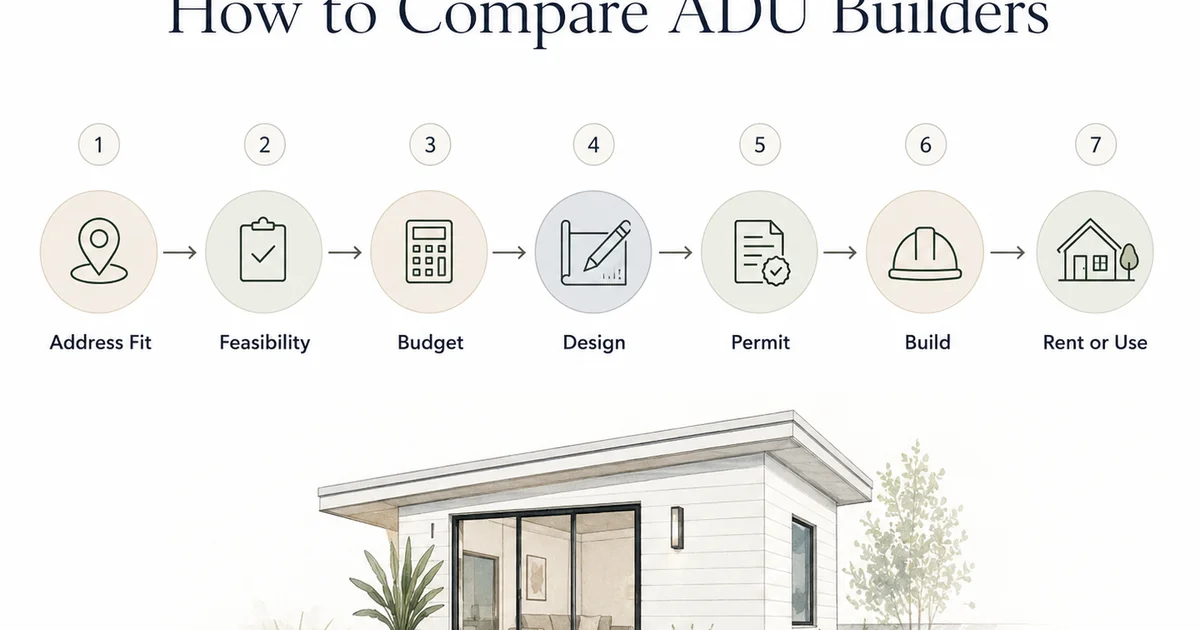
How to compare ADU builders: what to verify before signing with either builder
Answer capsule.
Five categories of verification, in order: license and insurance, city-specific project history, complete quote scope, lot-specific triggers (soils, slope, fire, coastal, utility, HOA), and warranty terms. The most expensive ADU mistake is not picking the wrong brand — it’s signing a contract that excludes the trigger you didn’t know would apply to your property.
- 1
Verify the license and insurance, today, for this project
Look up the contractor’s CSLB license number on cslb.ca.gov. Confirm it is current, that the classification matches the work scope (Class B General Building Contractor for a full ADU build), and that the bond and worker’s compensation coverage are active. SnapADU publishes License #1075582 (Class B); Acton publishes License #638333. Verify both the day you sign.
- 2
Verify city-specific project history
Ask for completed or permitted projects in your specific city, not just the county or region. Every California city has a different planner, different inspector, and different unwritten rules. Ask for two recent client references in your city, and call both.
- 3
Verify the quote scope using the normalizer table above
Walk every line of the Quote Scope Normalizer with the builder’s contract in hand. If a line is missing, ask why. If the answer is “we’ll add it later as a change order,” walk away.
- 4
Verify the lot-specific triggers
Six conditions trigger major cost adders: coastal zone (additional review time and fees in Encinitas, Carlsbad, Del Mar, Solana Beach, and parts of San Diego City); fire hazard severity zone (fire-rated construction, defensible space, possibly sprinklers — common in much of the East Bay, Peninsula hills, and parts of LA County); hillside / slope (grading, retaining wall, geotech review); utility lateral upgrades (undersized service for added ADU load); soils and geotech conditions (expansive soils, fill, or proximity to a fault); and HOA restrictions (California Civil Code § 4751 voids unreasonable HOA prohibitions, but reasonable restrictions still apply — pull your CC&Rs before design).
- 5
Verify the warranty terms
Get the warranty in writing, with duration in years for structural, mechanical, and finish components. Both companies publish that they back their builds with a warranty; the specific duration can vary, so ask for the document.
Reviews, license verification, and what reviews can — and can’t — tell you
Answer capsule.
Reviews are useful for evaluating communication, project management, and trust. They are not useful for verifying cost claims, code compliance, or whether your specific city will approve your specific project. For both SnapADU and Acton ADU, the most reliable trust-building steps are CSLB license verification, public BBB profile review, and asking each company for two recent client references in your specific city.
| Verification source | SnapADU | Acton ADU |
|---|---|---|
| CSLB license lookup | License #1075582 (Class B) → look up at cslb.ca.gov | License #638333 → look up at cslb.ca.gov |
| BBB profile | A+ accredited (per SnapADU’s own publication) — confirm at bbb.org | Verify at bbb.org |
| Public review platforms | Houzz, Yelp, Google, BBB | Houzz, Yelp, Google, BBB, Trustindex |
| Public city/program documentation | City of Chula Vista ADU page documents SnapADU as preparer of City Standard ADU Plans | LA County expansion documented in April 23, 2026 PRNewswire press release |
What reviews are good for
Communication style, project management discipline, responsiveness, finish quality, on-time completion, change-order handling, warranty service, contractor courtesy, sub-contractor coordination.
What reviews can’t prove
Whether your specific quote is complete. Whether your lot will hit fire, soils, or utility triggers. Whether the published timeline will hold for your jurisdiction. Whether the contract exclusions match what you think you’re buying.
Common ground — what SnapADU and Acton ADU actually agree on
Answer capsule.
Both build only stick-built and explicitly reject prefab. Both keep design, permitting, and construction in-house. Both run feasibility-first processes that front-load the unknowns. Both have invested in pre-approved plan libraries to speed permitting. Both publicly resist quoting per-square-foot as a primary metric. Both publish fixed-scope contracts. This convergence isn’t marketing — it’s what hundreds of completed ADUs taught two independent firms.
Anyone vetting California ADU builders outside both service areas can use these shared positions as a baseline checklist. They aren’t slogans — they are conclusions that two experienced specialists with very different histories arrived at after hundreds of projects. If a builder you’re considering disagrees with three or more of these positions, examine that disagreement closely. Specifically: a builder telling you prefab is just as good as site-built, a builder willing to give you a binding flat-rate without seeing your lot, a builder who outsources permits to a third-party service, or a builder insisting per-square-foot pricing is reliable for an ADU — those are signals worth slowing down on.
Honest tradeoffs — where SnapADU or Acton ADU isn’t right for everyone
Answer capsule.
No builder is right for every project. SnapADU is not the right starting point if you’re outside Greater San Diego, want prefab, want a sub-$200K all-in budget in San Diego, or want a builder with a 30+ year residential history under one banner. Acton ADU is not the right starting point if you’re outside their listed Bay Area or LA footprint, want a tiny home, want to self-manage trades, or are hesitant about a fresh market expansion. Neither builder will quote you a binding price without a feasibility review.
When SnapADU might not be the right fit
- You're outside Greater San Diego — they don't operate beyond the listed cities
- You want a prefab or modular unit — they don't build them
- You want a sub-$200K all-in budget — their published floor sits around $300K all-in
- You want a builder with multi-decade residential history under one banner
- Your project is primarily a garage conversion as a low-cost play
When Acton ADU might not be the right fit
- You're outside the listed Bay Area or LA County footprint
- You want a tiny home — Acton explicitly does not build them
- You want a prefab or factory-built unit — they don't build them
- You want a sub-$300K all-in starting point — Build Ready base prices start at $316,000
- You're hesitant about a newly-expanded LA County market — fair; the expansion is real but new (April 2026)
What to do if neither builder serves your property
Answer capsule.
If your property is outside SnapADU’s San Diego County footprint and outside Acton’s Bay Area / LA County footprint, neither company is your starting point. The right next step is not to keep searching for the next national ADU brand. It’s to find out what your specific property can actually build, then match that to a builder that genuinely serves your address. Most California addresses fall into this category.
- 1
Run a property feasibility check, independent of any builder
A free property feasibility report tells you what your specific lot can support given current California ADU rules, your local zoning, lot coverage, setbacks, and parking constraints. California Government Code § 66314 sets size standards (1,200 sq ft ceiling for the local-ordinance pathway); § 66317 sets the 60-day permit decision clock; § 66323 covers the state-exempt detached ADU pathway (800 sq ft maximum). That feasibility check happens before you contact any builder.
Sources: California Government Code §§ 66314, 66317, 66323; California Department of Housing and Community Development ADU Handbook. Last verified May 8, 2026.
- 2
Match to a builder that actually serves your address
California Central Coast / Monterey-adjacent markets open to modular construction: Framework First serves California modular ADU projects approximately within 150 miles of Monterey County. National prefab / modular interest: Modular Home Direct covers broad national modular and prefab intent. Elsewhere in California: use a state-by-state ADU builder hub and apply the verification checklist above.
- 3
Lock down financing in parallel
Don’t wait until the design is done to figure out how you’re paying for the ADU. Pre-qualifying through a path that fits your situation — cash, HELOC, cash-out refi, construction loan, renovation loan, or shared-equity product — narrows your real budget before the builder shows you what fits inside it.
What we verified
What we verified on May 8, 2026.
- SnapADU service area: 19 cities and jurisdictions across Greater San Diego per SnapADU's official service-area page (snapadu.com/service-area/).
- SnapADU pricing: $375–$600+/sf turnkey for detached ADUs in San Diego; typical all-in $300K–$450K+; size-based examples on snapadu.com/adu-costs/, updated March 2026.
- SnapADU CSLB License: #1075582 (Class B) per SnapADU's footer and service-area page. Verify current status at cslb.ca.gov.
- SnapADU process and timeline: 10–18 months total per snapadu.com/process/.
- SnapADU 6-month Price Lock: Published on snapadu.com/blog/adu-pricing-san-diego/.
- Chula Vista City Standard ADU Plans: Officially documented by the City of Chula Vista Development Services ADU page as prepared by SnapADU; 14-business-day plan review for City Standard Plans vs 21 business days for non-standard, with approximately $1,000 less in plan review fees.
- Acton ADU service area: 80+ jurisdictions per actonadu.com/learn-more/service-area, plus April 2026 LA County expansion (Westside, Central LA, San Gabriel Valley, San Fernando Valley) per the April 23, 2026 PRNewswire press release.
- Acton ADU CSLB License: #638333 per actonadu.com footer. Verify current status at cslb.ca.gov.
- Acton Investor Series prices: Manzanita i448 A1 ($316,000), Juniper i628 A1 ($387,550), Buckeye i748 A1 ($444,500), Ironwood i888 B1 ($494,000), Bristlecone i998 A1 ($523,000) — verified directly from actonadu.com/services/series/investor-series.
- Acton Signature Series prices: Nutmeg s498 A1 ($383,000), Santa Lucia s658 A1 ($434,300), Cypress s748 B1 ($475,000), Redwood s1198 A1 ($650,000) — verified directly from actonadu.com/services/series/signature-series.
- Acton's 'Cloud City' pre-approval entry: Flagged as an apparent placeholder on Acton's Build Ready pages — treat verified pre-approval cities as San Jose and Palo Alto until corrected.
- Acton LA cost benchmark: $180K–$400K+ typical all-in; $250–$400/sf new construction; $500+/sf premium; $100K–$225K garage conversions; per actonadu.com/blog/how-much-does-an-adu-cost-in-los-angeles.
- California ADU statutory framework: Government Code §§ 66314, 66317, 66323; Civil Code § 4751. All verified at leginfo.legislature.ca.gov.
What still needs direct verification before any major decision.
Current CSLB license status for both companies (always verify the day you sign). Current BBB profile for Acton ADU. Acton’s specific city-by-city LA County coverage within the four submarkets (the expansion is fresh). Acton’s “Cloud City” pre-approval entry (we believe this is a placeholder; awaiting site update). Both companies’ exact warranty durations in years (request the contract document during the consultation). Any city-specific permit timeline should be re-verified with the city directly before relying on it for a specific project schedule.
Methodology — how we wrote this comparison
Dwelling Index is an independent research resource covering ADU financing, costs, and regulations. We’re not a builder, broker, or lender. This comparison was assembled from each company’s own published materials, dated press releases, City of Chula Vista official program documentation, public business listings on Houzz / Yelp / BBB, and the relevant California Government Code and Civil Code sections. Where a claim is one company’s report about its own performance, we say so. We have an affiliate relationship with SnapADU; we do not have one with Acton ADU. The geographic verdict on this page was set by service-area reality, not by compensation.
Why this page exists. Most “SnapADU vs Acton ADU” content online treats them as direct competitors and writes a generic head-to-head. That framing was actively misleading homeowners — sending Bay Area readers down a SnapADU sales path that would never close, and sending San Diego readers down an Acton path that would never close. The honest geographic reality was the missing answer in the search results.
How we update. Service areas, project counts, pricing ranges, and product lineups: quarterly verification. Cited California statutes: annually plus on legislative news triggers. Material announcements (expansion, new product, change of ownership): on-demand updates within 30 days. Build Ready model pricing: re-verified directly from each company’s pages on the visible “Last verified” date.
Frequently asked questions
- Are SnapADU and Acton ADU the same company?
- No. They are two separate, independently owned California ADU builders with no corporate connection. They operate in non-overlapping service areas — SnapADU in Greater San Diego, Acton ADU in the Bay Area and (since April 2026) parts of LA County.
- Is SnapADU only in San Diego?
- Yes. SnapADU's official service area lists 19 cities and jurisdictions across Greater San Diego: Carlsbad, Chula Vista, Coronado, County of San Diego, Del Mar, El Cajon, Encinitas, Escondido, Imperial Beach, La Mesa, Lemon Grove, National City, Oceanside, Poway, San Diego, San Marcos, Santee, Solana Beach, and Vista. They do not currently serve Los Angeles, the Inland Empire, the Bay Area, or anywhere outside San Diego County. SnapADU's page invites homeowners inside the shaded service-area map to confirm feasibility directly.
- Does Acton ADU serve Los Angeles?
- Yes — as of April 23, 2026. Acton ADU launched LA County service in April 2026 covering the Westside, Central LA, San Gabriel Valley, and San Fernando Valley. Their primary footprint remains the Bay Area, Peninsula, East Bay, Silicon Valley, Santa Cruz, and Marin (80+ jurisdictions per Acton's official service-area page).
- Does Acton ADU serve San Diego?
- No. Acton ADU's published service area is the Bay Area and parts of LA County. They do not serve San Diego.
- Does SnapADU serve the Bay Area?
- No. SnapADU is San Diego County only.
- Are SnapADU or Acton ADU prefab builders?
- Neither. Both companies build only on-site stick-framed ADUs. SnapADU uses traditional wood-framed construction on slab-on-grade foundations. Acton ADU explicitly states that every Build Ready unit is traditionally site-built — not prefabricated, factory-built, or mobile. If you specifically want prefab, neither is the right starting point.
- Which is cheaper, SnapADU or Acton ADU?
- You can't honestly answer that from headline numbers because the two companies operate in different markets and publish different price objects. SnapADU publishes $375–$600+/sf turnkey for San Diego with $300K–$450K+ all-in typical. Acton publishes per-model starting base prices ($316K–$650K depending on series and size) plus an LA-market benchmark of $250–$400/sf new construction. For a real comparison, you need a feasibility review and a normalized quote scope from each — and they don't both serve the same lot anyway.
- How much does an ADU cost in California overall?
- Typical 2026 all-in costs in the markets these two builders cover run $180,000 to $650,000+ depending on location, ADU type, size, finish level, and site conditions. San Diego (per SnapADU): $300,000–$450,000+ all-in for typical detached new construction. Los Angeles (per Acton): $180,000–$400,000+ all-in. Bay Area (per Acton's verified per-model base prices): $316,000–$650,000 starting base, requiring location-specific adjustment for taxes and fees. Garage conversions are usually the lowest entry point ($100,000–$225,000 in LA per Acton's published range).
- How long has each company been in business?
- Acton ADU was founded as Acton Construction in 1990 (35+ years of residential construction) and refocused on ADUs around 2017. SnapADU was founded in 2020 (5 years), though co-founder Mike Moore has held a general contractor's license under Moore Construction in Oceanside since 2013.
- Is one better for rental ADUs vs family use?
- Both build for both. Acton ADU has explicitly named product lines for the distinction — the Investor Series (5 models, $316K–$523K starting base) for rental-optimized layouts and the Signature Series (4 models, $383K–$650K starting base) for higher-finish family or premium-rental use. SnapADU offers comparable flexibility through its plan library and customization options. The right product line matters more than the brand.
- How big can a California ADU be?
- Under California Government Code § 66314, the local-ordinance pathway allows a detached ADU up to 1,200 square feet of total floor area. Under § 66323's state-exempt pathway for a qualifying detached new-construction ADU on a lot with an existing or proposed single-family dwelling, a local agency may impose a maximum of not more than 800 square feet of livable space, along with the statute's height and 4-foot side/rear setback framework. Local jurisdictions can be more permissive than the state minimums.
- How fast must my city act on my ADU permit application?
- Per California Government Code § 66317, the permitting agency must determine application completeness within 15 business days of submission; if it doesn't, the application is deemed complete by operation of the statute. Once your application is complete, the agency must approve or deny it within 60 days for an ADU on a lot with an existing single-family or multifamily dwelling. Pre-approved plan paths can run shorter — Acton's LA cost article cites a 21–30 day approval window in cities with formal pre-approved programs, and Chula Vista publishes 14 business days for City Standard ADU Plans.
- Do pre-approved plans skip the permit?
- No. Pre-approved or 'City Standard' plans cut down the plan review portion, but every project still requires site-specific submissions — site plan, utility connections, soils or geotech if applicable, energy compliance, and structural engineering tied to your specific lot. Chula Vista's documentation is the clearest public example: City Standard ADU Plans get a 14-business-day plan review, but applicants must still submit site-specific documents.
- Can my HOA prevent me from building an ADU?
- Generally no — California Civil Code § 4751 makes HOA covenants void and unenforceable to the extent they effectively prohibit or unreasonably restrict the construction or use of an ADU or JADU on a lot zoned for single-family residential use. However, reasonable restrictions are still allowed if they don't unreasonably increase the cost, effectively prohibit, or extinguish the ability to build. Pull your CC&Rs before the design phase, not after.
- Do either of them offer financing?
- Neither company is a lender. Both can introduce homeowners to financing relationships, but financing is a separate decision that benefits from independent pre-qualification.
- What if I'm in California but neither serves my address?
- You're in the majority. Most California addresses are outside both service areas. The right next step is a property feasibility report (works at any California address), then a builder match by region.
- Do they work in Riverside, Orange County, the Inland Empire, or Imperial County?
- No. SnapADU stops at the boundary of San Diego County (and invites confirmation for properties inside the shaded service-area map). Acton ADU's April 2026 LA County expansion covers Westside, Central LA, San Gabriel Valley, and San Fernando Valley only — not Riverside, San Bernardino, Imperial, or Orange Counties.
- Do they work outside California?
- No. Both companies are California-only. Outside California, see our state-by-state ADU builder hub for active specialists in your region.
Bottom line
SnapADU and Acton ADU are both excellent at what they do, but they don’t compete — they cover different parts of California and have arrived at remarkably similar conclusions about how California ADUs should be built. If you’re in San Diego County, SnapADU is the answer. If you’re in the Bay Area, Peninsula, East Bay, Silicon Valley, Santa Cruz, Marin, or — since April 2026 — LA County, Acton ADU is the answer. If you’re anywhere else, neither will serve you, and the right next step is a free property feasibility check. That answer is faster, more honest, and more useful than any 4,000-word brand head-to-head.
Whatever you decide, do these three things before signing any contract: verify the contractor’s CSLB license is current, verify the quote scope against the Quote Scope Normalizer in this guide, and verify city-specific project history for your jurisdiction.
Independent of any builder. Works at any California address. We earn a commission if you connect with SnapADU through our link, at no extra cost to you. No commission on Acton ADU links.
Full FTC affiliate disclosure
Dwelling Index is an independent research resource covering ADU financing, costs, and regulations. We are reader-supported. When you use our links to explore financing options, request prefab pricing, or purchase floor plans, we may earn a commission at no extra cost to you. We have an affiliate relationship with SnapADU but not with Acton ADU. Our editorial recommendations are based on independent research and are never influenced by compensation. Pricing, service areas, and program details cited on this page were current as of May 8, 2026 — always verify directly with each company before making any commitment. Cost figures shown throughout this guide are illustrative ranges based on each company’s own published materials, and Acton’s per-model prices are starting base prices that exclude location-specific taxes and fees. Actual project costs depend on lot conditions, design choices, finish levels, permit fees, soils, fire and coastal triggers, and local labor markets. None of the numbers in this guide are guarantees of pricing, returns, or outcomes.