
Rancho Santa Fe ADU Laws 2026: County + Covenant Rules [Checklist]
Rancho Santa Fe ADU laws operate on four stacked layers — California state law, San Diego County zoning, the RSF Protective Covenant and Art Jury, and any sub-HOA. Most ADU guides cover one layer. This guide covers all four, with primary sources, verified fees, and the AB 1033 separate-sale rule now in effect for unincorporated San Diego County.
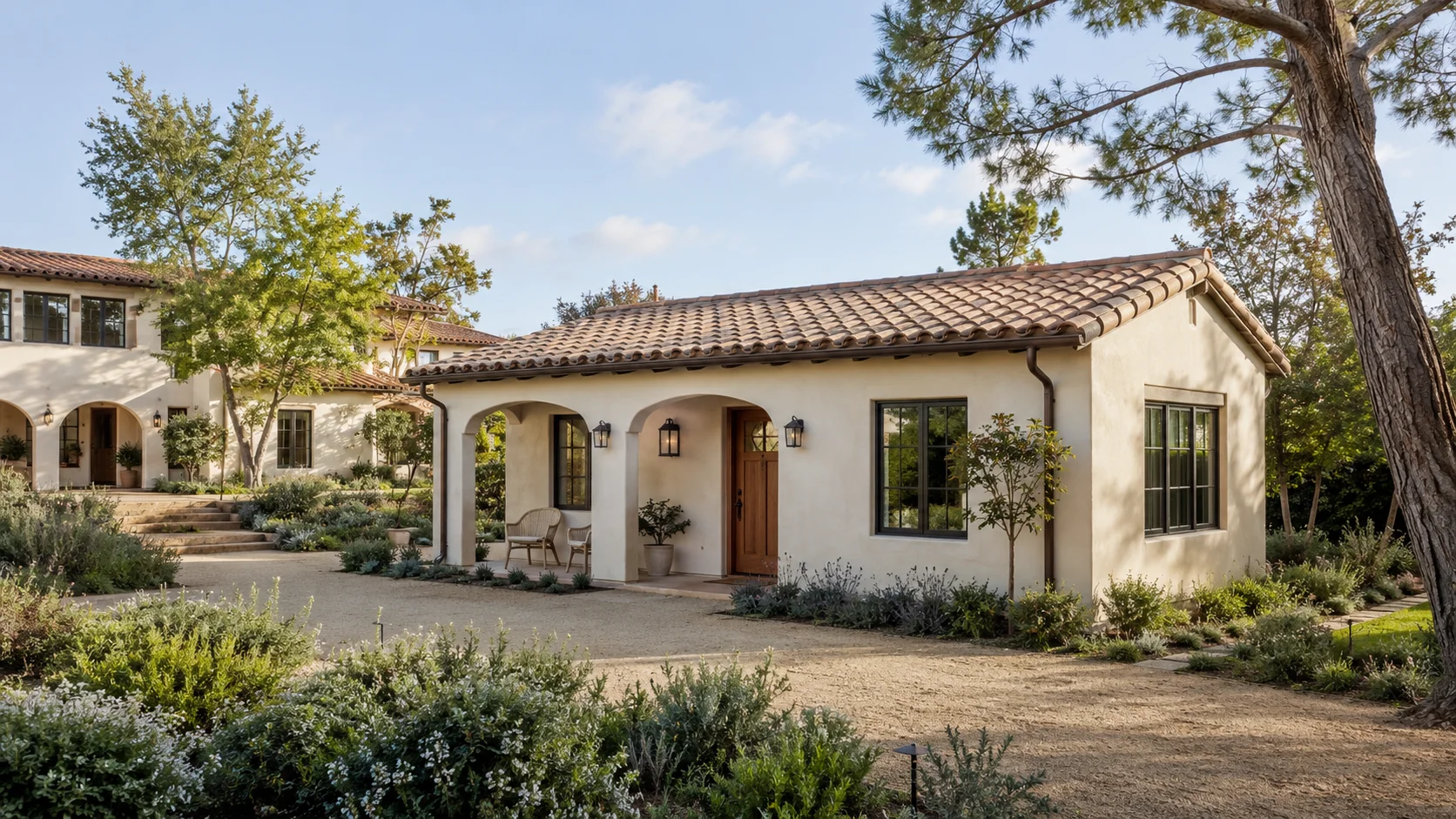
Bottom line up front
Rancho Santa Fe is unincorporated San Diego County — your ADU permit comes from County PDS, not any city. If your parcel sits inside the Rancho Santa Fe Protective Covenant, add the Art Jury review process on top of the County permit. California Civil Code § 4751 (AB 670) prevents the Covenant from blocking a qualifying ADU outright, but the Art Jury retains broad authority to regulate materials, massing, height, lighting, and siting. Plan for 9–18 months and $400,000–$900,000+ all-in for a Covenant build. San Diego County has opted in to AB 1033 separate-sale (Ordinance No. 10986, effective April 4, 2026), so qualifying ADUs can now be sold separately as condominiums.
See what you can build at your address
Get your free Rancho Santa Fe ADU feasibility report — pre-filled to San Diego County.
See What You Can Build → Get Your Free Rancho Santa Fe ADU Feasibility ReportRancho Santa Fe ADU rules at a glance (2026)
This table summarizes the most common standards. Every cell has caveats — read the sections below before relying on any single number.
🧭 Run the free Rancho Santa Fe ADU Parcel Decoder →
Answer 4 questions to see which rule layer applies to your specific parcel before reading further.
| Standard | Value / Rule | Source |
|---|---|---|
| Jurisdiction for ADU permits | San Diego County PDS (unincorporated) | County PDS-611 |
| Max detached ADU size | 1,200 sq ft (County ordinance); 800 sq ft state-protected floor | SD County ZO § 6156.x; Gov. Code § 66323 |
| Max JADU size | 500 sq ft inside existing/proposed primary residence | Gov. Code § 66333 |
| Minimum side/rear setback (new construction) | 4 ft | Gov. Code § 66321 |
| Max height — detached ADU (state floor) | 16 ft baseline; 18 ft within ½ mile of transit or HQTC | Gov. Code § 66321 |
| Max height — County standard | 25 ft generally; 18 ft for 800 sq ft ministerial category | SD County ZO § 6156.x |
| Owner-occupancy required? | No for standard ADUs (AB 976, perm.); JADU: only if shared bathroom (AB 1154, eff. Jan 1, 2026) | AB 976; AB 1154; Gov. Code § 66333 |
| Parking required? | 1 space per ADU with exemptions; none for JADU | Gov. Code § 66322 |
| Short-term rental allowed? | No (30-day minimum for ADUs; JADUs prohibited by AB 1154) | Gov. Code § 66314; AB 1154 |
| Permit shot clock | 60 days from complete application; 15 business-day completeness check (SB 543) | Gov. Code § 66317; SB 543 |
| Impact fees | Exempt for first 750 sq ft statewide; County fee waiver ended Jan 9, 2024 | Gov. Code § 66311.5; SD County PDS |
| Separate sale (AB 1033) | Yes — County opted in (Ordinance No. 10986, eff. April 4, 2026); JADU not eligible | SD County Ordinance No. 10986 |
| Art Jury review required? | Yes if parcel is inside RSF Protective Covenant | RSFA Architectural Review Process |
| Art Jury fee (≤1,500 sq ft project) | $1,325 new application + $2/sq ft refundable deposit | RSFA Schedule of Fees (May 2026) |
| Fire/WUI requirements | Chapter 7A (Cal. Bldg. Code) where parcel is in VHFHSZ; RSFFPD review | CBC Chapter 7A; RSFFPD Plan Check Form |
| Septic review | County DEHQ reviews OWTS capacity; very common in RSF (most parcels on private septic) | SD County DEHQ |
| Unpermitted ADU amnesty | Contact County Zoning Counter; AB 2533 amnesty pathway for pre-2020 builds | SD County PDS-611; AB 2533 |
Primary sources: Cal. Gov. Code §§ 66314–66333; San Diego County PDS-611 (rev. Jan. 7, 2026); SD County Zoning Ordinance § 6156.x; Ordinance No. 10986 (eff. April 4, 2026); RSFA Schedule of Fees and Deposits (May 2026); AB 976; AB 1033; AB 1154; SB 543.
First: figure out which parcel category you are in
The most common planning mistake Rancho Santa Fe homeowners make is designing to one layer of rules without checking the others. Before you hire an architect, pull your APN, call the RSF Association at (858) 756-1174, and identify your starting category. The four possible rule stacks are:
| Parcel Category | Rule Layers | Art Jury? | Sub-HOA? |
|---|---|---|---|
| Inside RSF Covenant only | CA state law + SD County + Covenant/Art Jury | Yes | No |
| Inside Covenant + sub-HOA (e.g., The Bridges, Covenant Ranch) | CA state law + SD County + Covenant/Art Jury + sub-HOA | Yes | Yes |
| Inside RSF zip code, outside Covenant (e.g., Fairbanks Ranch) | CA state law + SD County + sub-HOA (own ARC) | No (RSF) | Yes |
| Unincorporated San Diego County, outside all HOAs | CA state law + SD County only | No | No |
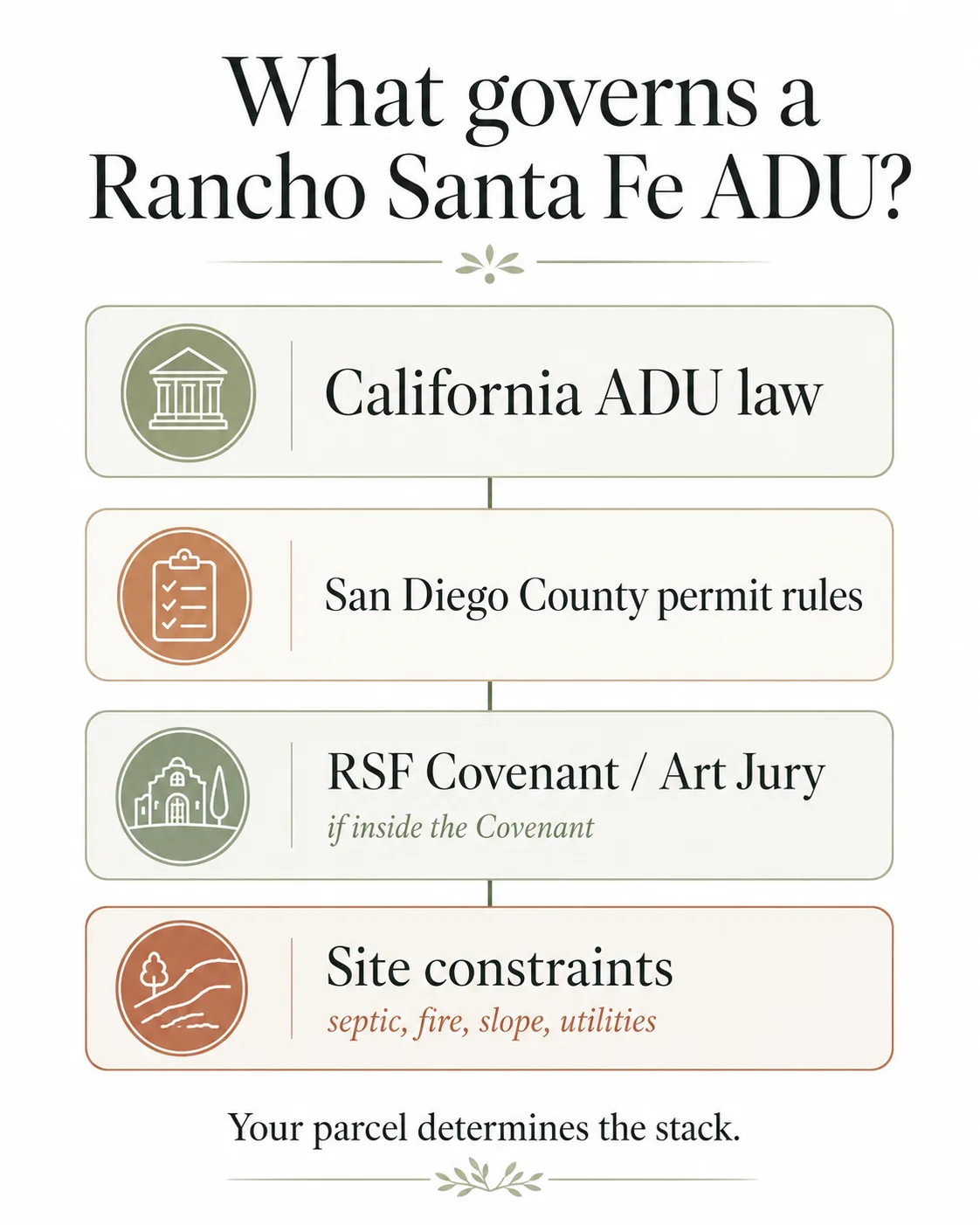
The four-layer governance stack for ADUs in Rancho Santa Fe. Confirm your layers before any design spend.
Get the Free ADU Starter Kit →
Includes the Rancho Santa Fe parcel decoder, the Covenant submittal checklist, and a cost-tracker template.
Get the Free Starter Kit →What does California ADU law let you build in Rancho Santa Fe?
Answer capsule. California state ADU law (Cal. Gov. Code §§ 66314–66333) is the floor that no county, city, or covenant can drop below. State law protects at least one ministerial detached ADU up to 800 sq ft with 4-foot side and rear setbacks on eligible single-family lots, plus a Junior ADU up to 500 sq ft inside the primary residence. The County of San Diego separately allows detached ADUs up to 1,200 sq ft under its local ordinance. There is no owner-occupancy requirement for standard ADUs (AB 976, made permanent), and JADUs require owner-occupancy only when they share a bathroom with the primary residence (AB 1154, effective Jan 1, 2026).
The 2026 California state-law floor
| Standard | Detached ADU | Attached ADU | Junior ADU (JADU) |
|---|---|---|---|
| State-protected minimum size | 800 sq ft (ministerial floor under Gov. Code § 66323); local ordinances may allow larger | 50% of primary residence; state-protected minimums: 850 sq ft for studio/1-bed, 1,000 sq ft for 2+ bed (Gov. Code § 66321) | 500 sq ft inside the existing or proposed primary residence (Gov. Code § 66333) |
| Local maximum (San Diego County) | 1,200 sq ft under County Zoning Ordinance § 6156.x | 50% of primary residence, capped at 1,200 sq ft | 500 sq ft |
| Minimum side/rear setback | 4 ft for new construction (Gov. Code § 66321); conversions exempt | 4 ft; conversions exempt | Not applicable |
| Maximum height (state floor) | 16 ft baseline; 18 ft within ½ mile of major transit stop or HQTC, with up to 2 additional feet for roof-pitch match; 18 ft on multifamily multistory lot | 25 ft or local primary-dwelling height limit, whichever lower | Not applicable |
| County detached standard | 25 ft generally; 18 ft cap for 800 sq ft ministerial category | Up to primary residence's height | Not applicable |
| Owner-occupancy required? | No (AB 976, eff. Jan 1, 2024 — made permanent) | No (AB 976) | Required only if JADU shares sanitation facilities with primary residence (AB 1154, eff. Jan 1, 2026) |
| Parking required? | One space per ADU, with exemptions for: within ½ mile of public transit, historic district, interior conversion, on-street permit area, car-share within one block (Gov. Code § 66322) | Same exemptions | None |
| Replacement parking when converting garage? | No (Gov. Code § 66322) | No | Not applicable |
| Short-term rental allowed? | No. Rentals must be longer than 30 days | No | No. AB 1154 prohibits JADU short-term rentals |
| Ministerial permit shot clock | 60 days after a complete application; 15 business days for completeness review (Gov. Code § 66317) | Same | Same |
| Impact-fee exemption | First 750 sq ft exempt statewide | First 750 sq ft exempt | Exempt |
| Separate sale allowed? | Yes, if local jurisdiction opted in under AB 1033 and ADU meets condo-conversion requirements | Yes (same conditions) | No. JADUs cannot be sold separately |
Primary sources: Cal. Gov. Code §§ 66314–66333; AB 976 (signed Oct. 11, 2023, eff. Jan 1, 2024); AB 1033 (eff. Jan 1, 2024); AB 1154 (chaptered Oct. 10, 2025, eff. Jan 1, 2026); AB 462 (urgency, eff. Oct. 10, 2025); SB 543 (eff. Jan 1, 2026); SB 1211 (eff. Jan 1, 2025).
The four 2024–2026 state-law changes that most matter for Rancho Santa Fe homeowners
1. AB 976 — owner-occupancy ban for standard ADUs made permanent.
The temporary ban on local owner-occupancy requirements for detached and attached ADUs was made permanent by AB 976 effective January 1, 2024. You can rent both the primary residence and the ADU and live elsewhere. JADUs still require owner-occupancy if they share a bathroom with the primary residence — that's the AB 1154 carve-out.
2. AB 1154 (effective Jan 1, 2026) — JADU bathroom rule.
If your JADU has its own private bathroom (separate sanitation facilities), owner-occupancy is not required and you can rent both units. If the JADU shares a bathroom with the primary residence, owner-occupancy still applies under Gov. Code § 66333. This is a single design decision that controls your ongoing rental flexibility — resolve it before construction documents are drawn. County caution: the County's PDS-611 handout (revised January 7, 2026) may still contain older JADU owner-occupancy language; verify the current County deed-restriction form at submittal.
3. SB 1211 (effective Jan 1, 2025) — multifamily and parking.
Multifamily lots can now build up to eight detached ADUs (capped at the number of existing units on the lot), and no replacement parking is required when a garage, carport, or covered parking structure is demolished or converted. Most Rancho Santa Fe parcels are single-family, so the multifamily provision rarely applies — but the parking change matters anywhere you're converting a garage.
4. SB 543 (effective Jan 1, 2026) — 15-business-day completeness check.
Local agencies must determine whether an ADU application is complete within 15 business days of submittal. If they don't, the application is deemed complete as submitted, which starts the 60-day approval clock under Gov. Code § 66317. This closes a loophole some counties had been using to delay applications indefinitely by claiming submissions were incomplete.
What state law does not control
State law sets the floor — it doesn't override every local concern. In Rancho Santa Fe specifically, four things still affect your project regardless of state-law preemption: Health and safety codes (Title 24 energy compliance, Cal. Bldg. Code Chapter 7A for WUI construction, fire access standards); Septic capacity for OWTS-served parcels (most of the Covenant); County permit completeness — incomplete plans trigger a written list of corrections, not automatic approval; and Reasonable HOA aesthetic restrictions under Civ. Code § 4751.
How does San Diego County permit ADUs in unincorporated Rancho Santa Fe?
Answer capsule. Because Rancho Santa Fe is unincorporated, every ADU permit in the area is issued by the County of San Diego Planning & Development Services (PDS), not by any city. The County's ADU rules live in San Diego County Zoning Ordinance Section 6156.x and PDS-611 (revised January 7, 2026), and generally mirror state law with a few procedural quirks — septic/well review through DEHQ, fire-zone hardening through the Rancho Santa Fe Fire Protection District, and an AB 1033 separate-sale framework now in effect.
What's specific to County-permitted RSF ADUs
| Topic | State minimum | San Diego County (unincorporated RSF) |
|---|---|---|
| Permit submission format | Ministerial review required | Confirm current submittal format with County PDS at intake; the County is transitioning between in-person submittal and the Accela portal |
| Soils report | Not required by state law | Not generally required for routine ADUs |
| Front-setback encroachment | Allowed in limited circumstances | Allowed for ADUs up to 800 sq ft if no rear-yard option exists |
| Septic/well review | State-neutral | County DEHQ must approve OWTS capacity when applicable; very common in RSF since most parcels are on private septic |
| Fire access | Defers to local fire authority | Rancho Santa Fe Fire Protection District (RSFFPD) reviews driveway access width, turnaround, hydrant proximity, and defensible space; ADU sprinklers required only if primary residence is required to be sprinklered (Gov. Code §§ 66314, 66323) |
| WUI construction (Cal. Bldg. Code Chapter 7A) | Applies in Very High Fire Hazard Severity Zones (VHFHSZ) | Class A roof, ember-resistant venting, exterior wall noncombustibility, defensible space requirements. RSFFPD Residential Plan Check Form (2024) lists full Chapter 7A submittal items |
| Coastal Development Permit | Applies in Coastal Zone | Where applicable, AB 462 imposes a 60-day CDP shot clock; verify parcel's Coastal Zone status via County GIS before designing |
| Director's Determination on state preemption | N/A | County PDS has issued a public Director's Determination Letter confirming that when County zoning conflicts with state ADU law, state law controls |
| AB 1033 separate sale | Local opt-in required | County has opted in. Board of Supervisors adopted Ordinance No. 10986 on March 4, 2026, effective April 4, 2026. Separate ADU sale now available through condominium conversion under § 6156.x.D |
Primary sources: San Diego County PDS-611 (revised Jan. 7, 2026); San Diego County Zoning Ordinance § 6156.x; SD County AB 1033 ADU Zoning Ordinance Amendment, Ordinance No. 10986 (eff. April 4, 2026); RSFFPD Residential Plan Check Form (2024); Cal. Bldg. Code Chapter 7A; AB 462 (eff. Oct. 10, 2025).
Two County items that catch Rancho Santa Fe homeowners off-guard
1. Septic capacity through DEHQ.
The vast majority of unincorporated Rancho Santa Fe parcels are on private septic, not connected to sewer through the RSF Community Services District. Adding a bedroom — and an ADU typically adds at least one — frequently pushes the existing OWTS out of its permitted capacity. The County's Department of Environmental Health and Quality reviews capacity before issuing the ADU permit. Plan septic capacity verification before architectural design, not after.
2. Fire-zone construction under Chapter 7A.
Much of the unincorporated Covenant area sits in a Very High Fire Hazard Severity Zone under CAL FIRE's 2024–2025 mapping. The RSFFPD requires its Residential Plan Check Form for Chapter 7A items: Class A roof assemblies, ember-resistant exterior venting, noncombustible exterior wall coverings, window/door specifications, and decking/accessory-building material requirements. Check the current RSFFPD/OSFM Fire Hazard Severity Zone map for your specific parcel before designing.
County fee waiver has ended
San Diego County's trial impact-fee waiver for ADUs went into effect January 9, 2019, and ended January 9, 2024. Projects not issued permits by that date now pay all standard fees. State law continues to exempt ADUs of 750 square feet or less from impact fees independently of any local waiver.
Unpermitted ADU amnesty
If you have an unpermitted ADU built before 2020, County PDS-611 directs property owners to contact the Zoning Counter for amnesty review under AB 2533. Don't tear it out before you check.
How do the Rancho Santa Fe Covenant and Art Jury affect an ADU?
Answer capsule. If your parcel is inside the Rancho Santa Fe Protective Covenant, the Rancho Santa Fe Association — acting through the Art Jury — reviews every exterior change to your property, including new ADUs. California Civil Code § 4751 prevents the Association from enforcing restrictions that effectively prohibit or unreasonably restrict a qualifying ADU, but the Association retains broad authority to regulate materials, colors, height, massing, siting, lighting, grading, and reflectivity through its three governing documents and the Art Jury process.
The Art Jury is the single most consequential reason building an ADU inside the Covenant is harder, slower, and more expensive than building one anywhere else in San Diego County. It is also the layer most outside contractors, generic ADU pages, and online forums get wrong.
How the Art Jury actually works
Meeting cadence.
The Art Jury meets every three weeks on Tuesdays at 8:30 a.m. (Verified at rsfassociation.org, May 2026.) The annual submittal schedule is published in December and lists each Art Jury meeting date and the corresponding application deadline.
Submittal mechanics.
Applications and resubmittals are uploaded to the RSFA Accela portal by 4:00 p.m. on the published deadline date. A submission isn't complete without a signed application and the corresponding fee. The day before the meeting, Art Jury members and staff conduct on-site reviews — including examining story-pole installations, material samples, and landscaping.
The three governing documents stacked behind every decision.
- The Protective Covenant — the original 1928 master agreement, amended over the decades, recorded with San Diego County.
- The Association Regulations — numeric "backstops" that translate Covenant intent into measurable standards (lot-coverage caps, height limits, accessory-structure rules).
- The Residential Design Guidelines (RDG) — the illustrated, "this not that" pictorial standards the Art Jury uses to evaluate massing, materials, fenestration, color palettes, roof pitches, and site relationship.
Story-pole review.
For new structures including ADUs, story-pole installation is covered under the construction permit application fee. Story poles — wooden poles with flagging or netting at the proposed building corners and roof ridge — let the Art Jury and neighbors visualize the proposed massing in three dimensions before voting.
Community noticing.
New construction triggers neighbor notification by mail. Neighbors can submit written comments and attend the meeting to speak.
The discretion doctrine.
The Art Jury has broad legal discretion to deny applications even when they technically meet the published numbers, based on the design principles in the RDG. The California Court of Appeal addressed RSFA aesthetic-review discretion generally in Dolan-King v. Rancho Santa Fe Association (2000) 81 Cal.App.4th 965 — but that decision predates AB 670 / Civ. Code § 4751 by nearly two decades, so its general aesthetic-discretion holding is now bounded by § 4751's protection of qualifying ADUs/JADUs.
Current RSFA fees and deposits
| Item | Amount |
|---|---|
| Residential construction permit application — project greater than 1,500 sq ft | $1,920 new application; $540 subsequent application |
| Residential construction permit application — project 1,500 sq ft or less | $1,325 new application; $380 subsequent application |
| Residential construction permit refundable deposit | $2 per square foot |
| Special inspection fee | $550 |
| Nonconformance inspection charge (if not corrected by deadline) | $350 per week |
Source: Rancho Santa Fe Association Schedule of Fees and Deposits, verified May 2026. The deposit is refundable at project closeout if no nonconformance fees are charged. On a 1,000 sq ft ADU, that's a $2,000 deposit; on a 1,200 sq ft ADU, $2,400.
A real Rancho Santa Fe Covenant ADU we can point to
In a 2025 Rancho Santa Fe Association staff-report record we reviewed, the Association considered an 800-square-foot ADU sited four feet from the side property line at 11 feet 8 inches in height. The Art Jury imposed conditions including: lowering the ADU so it remained visually subordinate to the primary residence, matching exterior colors and materials, conditions on landscaping for critical view preservation, and lighting review. The project narrative referenced County DPLU, RSF Fire Protection District, SDG&E, and septic review as parallel agency reviews. Source: RSFA staff-report case file (verified May 2026).
Separately, SnapADU's Via de Maya project — a completed 980-square-foot Spanish-style ADU inside the Rancho Santa Fe Covenant — illustrates a successful Covenant build. The project was specifically designed to comply with Covenant architectural standards: stucco finish, arched porch openings matching the primary residence, clay tile roof, copper gutters, and a new septic system. Source: snapadu.com Via de Maya project page.
The realistic Art Jury process, week by week
Combining the verified Art Jury cadence (meetings every three weeks) with County completeness/permit clocks and standard parallel-agency review, a Covenant ADU typically tracks the following sequence. Real timelines vary by Art Jury composition, project complexity, and revision cycles.
Pre-application meeting with RSFA Building Department
Call (858) 756-1174 to schedule. Optional but, in our editorial view, the single highest-leverage step on the entire timeline. You learn which Regulations and RDG provisions are likely to be flagged before you spend on plans.
Design development
By an architect familiar with the Covenant. Architects without RSF-specific experience tend to design what would be approved in any other San Diego community and then face heavy revision in Art Jury review.
Intermediate Plan Review (Style Check) submittal
The Art Jury votes on whether the design direction is consistent with Covenant standards. Approval expires after six months if you don't file for Final Plan Review (one six-month extension is available).
Final Plan Review submittal
Story poles erected, on-site Art Jury review the day before the meeting, community noticing, and the Art Jury vote. Revision cycles vary; Style Check is the leverage point that reduces them.
County permit submittal to PDS
State law's 60-day ministerial shot clock under Gov. Code § 66317 starts when the application is deemed complete (within 15 business days per SB 543).
Parallel agency review
RSF Fire Protection District for fire access and Chapter 7A compliance, County DEHQ for septic, and SDG&E for utility service. On rural parcels with long utility runs, this is often the schedule limiter.
Construction, inspections, and certificate of occupancy
Final Plan Review approval expires after one year if a construction permit hasn't been issued.
The "this won't fly with the Art Jury" list
Based on the Residential Design Guidelines and the Association's public design philosophy, the following ADU design moves consistently struggle in Art Jury review:
- Flat-roof modernist boxes. The RDG strongly favors low-pitched tile or shake roofs.
- Off-the-shelf prefab or modular units that don't match the primary residence's architecture, materials, and roof pitch.
- Glossy or highly reflective exterior materials. The Covenant explicitly limits reflectivity to preserve rural character.
- Two-story ADUs on visible ridgelines or anywhere the massing would dominate the natural landform.
- Mass-produced plan-set floor plans without site-specific adaptation.
- Significant grading that alters natural landforms. The RDG explicitly favors "site design which preserves natural landforms and reduces the obtrusiveness of new construction."
- Lighting visible from neighboring parcels or from the public right-of-way.
- Sliding glass-wall systems and other features that create night-time "fishbowl" effect from adjacent lots.
The practical translation.
Don't pick a fight with the Art Jury. Design with it from day one. The cost of "winning" a fight — months of delay, legal fees, neighbor friction, possible litigation — almost always exceeds the cost of designing to the RDG from the start.
Working with a builder who has actually finished a Rancho Santa Fe Covenant ADU changes the math on this entire process.
SnapADU has completed projects inside the Covenant — their Via de Maya Spanish-style ADU is documented on their site with photographs. They serve all of Greater San Diego County including Rancho Santa Fe.
Schedule a discovery call with SnapADU →SnapADU is a Dwelling Index partner. Our editorial relationship is disclosed at the top of this page; our recommendation is based on geographic fit, documented Covenant project experience, and product alignment with Covenant aesthetic requirements.
How does California state law interact with the RSF Covenant?
Answer capsule. California Civil Code § 4751 — the codified form of AB 670, effective January 1, 2020 — voids any covenant, restriction, or governing-document provision that "effectively prohibits or unreasonably restricts" the construction or use of an ADU or JADU on a lot zoned for single-family residential use. The Association may impose "reasonable restrictions" that do not unreasonably increase the cost to construct, effectively prohibit construction, or extinguish the ability to otherwise construct the ADU.
What the Covenant can and cannot do post-AB 670
| Covenant or Art Jury action | Permitted under Civ. Code § 4751? | Notes |
|---|---|---|
| Prohibit ADUs outright in governing documents | No | Void and unenforceable under § 4751(a) |
| Require ADU to match primary residence's roof pitch, materials, and color palette | Yes | "Reasonable restriction" under § 4751(b) |
| Require story-pole installation and on-site Art Jury review | Likely yes | Procedural review; doesn't on its own unreasonably increase cost |
| Require an architectural style consistent with the Residential Design Guidelines | Likely yes | Aesthetic; doesn't prohibit |
| Cap ADU height below 16 feet (the state floor) | No | Restrictive of state minimum standards under Gov. Code § 66321 |
| Apply 20% lot-coverage cap to block a state-conforming ADU | Likely no | A lot-coverage cap used to "effectively prohibit" a state-conforming ADU likely falls under § 4751(a) — though not yet litigated for RSF specifically |
| Charge a refundable Art Jury deposit | Yes if reasonable | Excessive or punitive fees could be challenged under § 4751(b) as unreasonably increasing cost |
| Deny project on aesthetic grounds under general aesthetic discretion | Yes within limits | Aesthetic discretion is bounded by § 4751's protection of qualifying ADUs/JADUs |
| Refuse to allow any prefab or modular ADU | Depends | A categorical refusal could be a "reasonable" aesthetic restriction or could effectively prohibit ADUs for some homeowners; fact-specific |
Honest assessment of the unresolved line
The line between "reasonable aesthetic restriction" and "effectively prohibits" has not been litigated to a published California decision specifically for the Rancho Santa Fe Covenant in the ADU context. Dolan-King v. Rancho Santa Fe Association (2000) supports general Art Jury aesthetic-review authority, but it predates AB 670 by 19 years and is not an ADU-specific decision. § 4751 superimposes a substantive limit on how Association discretion can be exercised when ADUs are involved. How those two doctrines reconcile on a borderline case is a live legal question.
The practical pattern: homeowners design to the RDG, engage a Covenant-experienced architect, accept the aesthetic premium as part of the cost of building inside the Covenant, and avoid fighting. Homeowners who push hard against the Art Jury on a borderline case end up in litigation — typically more expensive and slower than the design accommodation would have been.
This is editorial judgment, not legal advice. The legal terrain around § 4751 and HOA aesthetic discretion is still developing, and your specific facts matter. Consult a California-licensed attorney before any adversarial step.
What about sub-HOAs inside Rancho Santa Fe?
Answer capsule. Several gated communities inside the Rancho Santa Fe postal area operate their own architectural review committees independent of (or layered on top of) the RSF Covenant. If your parcel is in one, you may face a fourth review layer. The same Civ. Code § 4751 framework applies — no HOA in California can effectively prohibit a qualifying ADU — but reasonable design restrictions are enforceable.
Named sub-communities to verify before you spend a dollar
Each of these communities has its own management company and its own current CC&Rs. Some are inside the Covenant (creating a stacked review), some are outside it. Verify your specific membership and current architectural standards by title report or by calling the management company:
- Fairbanks Ranch — Gated; its own architectural standards apply.
- The Bridges at Rancho Santa Fe — Gated; own architectural standards apply.
- Cielo — Hillside gated community; verify Covenant membership and sub-HOA CC&Rs.
- The Crosby at Rancho Santa Fe — Private golf club community; own DRC applies.
- Covenant Ranch — Sub-community within the RSF Covenant; verify stacked-review status.
- Other unspecified communities within the Rancho Santa Fe postal area — confirm by title report.
What every sub-HOA situation has in common: California Civ. Code § 4751 applies to all of them. No private CC&R provision can effectively prohibit a qualifying ADU or JADU. Reasonable design restrictions — matching materials, architectural style consistency, story-pole review, design-review committee fees — generally remain enforceable. Fees that would make ADU construction economically impossible could be challengeable as "unreasonably increasing cost" under § 4751(b).
What does a Rancho Santa Fe Covenant ADU actually cost?
| ADU Type | Typical All-In Range (Covenant) | Per Sq Ft | Notes |
|---|---|---|---|
| Detached new construction (800–1,000 sq ft) | $400,000–$700,000+ | $550–$750/sq ft | Septic, fire-zone hardening, long utility runs, Covenant fees |
| Detached new construction (1,000–1,200 sq ft) | $600,000–$900,000+ | $600–$800/sq ft | Larger Art Jury fee base, higher septic and WUI cost |
| Garage conversion (existing structure) | $150,000–$350,000+ | Varies | Septic still required; Art Jury reviews exterior changes |
| Generic California ADU (for comparison) | $200,000–$400,000+ | $200–$400/sq ft | Non-Covenant; no Art Jury; often sewer-connected |
Ranges from: SnapADU published plan pricing; SF Construction Group; Freeman's Construction; San Diego County PDS-611; RSFA Schedule of Fees and Deposits. Figures are illustrative ranges from multiple builder sources and dated industry data, not quotes.
The real tradeoffs, stated plainly
The hope.
Every one of these is solvable up-front with the right team and the right sequence: pre-application meeting with RSFA, a Covenant-experienced architect, a builder with completed Covenant projects, a parcel-level feasibility check before any plan spend, septic and fire inspections done early, and realistic timeline and cost expectations from day one.
Start with a free feasibility check
Know what you can build before committing to plans, septic inspections, or architect fees.
See What You Can Build →What should you check before paying for full plans?
Answer capsule. Before paying for full architectural plans on a Rancho Santa Fe ADU, confirm your APN and jurisdiction, identify your private-review layer (RSF Covenant, sub-HOA, both, or neither), choose your ADU path (detached, attached, garage conversion, JADU, or separate-sale-eligible), pre-check septic and well capacity, confirm fire and WUI requirements, identify slope and grading issues, map utility service paths, and clarify whether you're building for family use, long-term rental, or future separate sale. State law gives ADU applications ministerial 60-day review under Gov. Code § 66317, but incomplete plans and outside-agency issues can extend the real timeline.
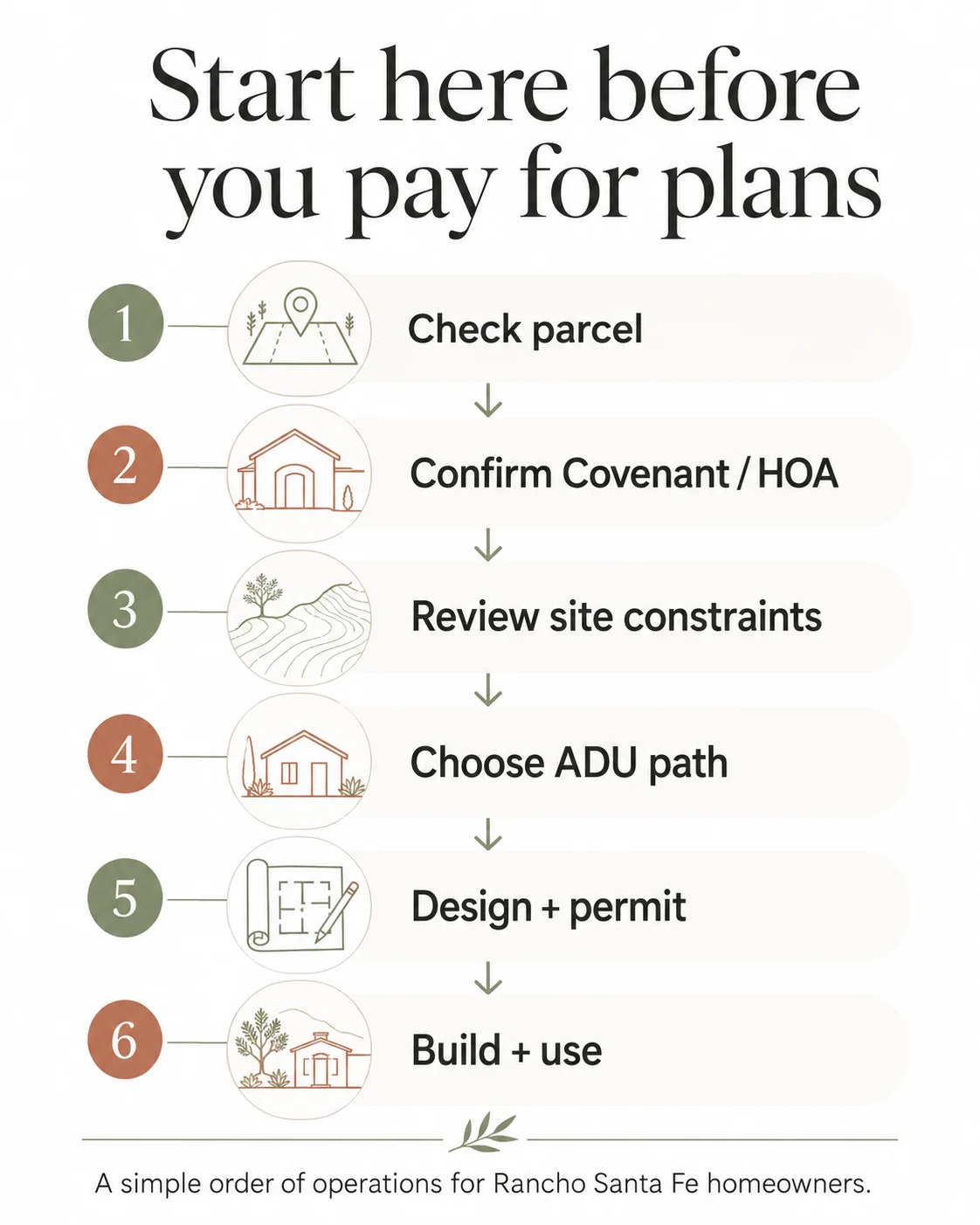
The six-step pre-design sequence for a Rancho Santa Fe ADU. Start here before you pay for plans.
A six-step pre-design checklist
Check APN, jurisdiction, and zoning.
Pull your parcel's Property Summary Report from the County PDS portal. Confirm residential zoning and any overlay designations. Verify whether your parcel sits in a Very High Fire Hazard Severity Zone via the CAL FIRE OSFM viewer.
Identify your private-review layer.
Call the RSF Association at (858) 756-1174 to confirm Covenant status. Pull your CC&Rs from your closing packet or order a preliminary title report. Identify any sub-HOA membership and obtain their current architectural standards.
Choose your ADU path before drawing.
Detached, attached, garage conversion, JADU, prefab/modular (rare for Covenant lots), or a separate-sale-eligible ADU under AB 1033. Each path has different cost, timeline, and review-layer implications.
Pre-check septic, well, fire, slope, and utilities.
Get septic capacity, well records if applicable, fire access input from RSFFPD, topographic survey or grading assessment for sloped lots, and utility service path before plans are drawn. This sequence prevents large revision rounds.
Build the plan package.
Architectural drawings, site plan, grading and drainage plans where applicable, stormwater management plan, Title 24 energy compliance forms, and any WUI documentation. Use San Diego County's Minimum Essential Plan Submittal Items checklist (PDS-658) as a reference.
Submit, respond to corrections, and revise.
State law's 60-day ministerial shot clock under Gov. Code § 66317 starts when the application is deemed complete. SB 543's 15-business-day completeness review means incomplete applications can't sit forever. Rancho Santa Fe Covenant ADUs commonly go through County correction cycles and Art Jury revision cycles — plan for both.
What to gather (one-page worksheet)
| Document or piece of information | Why it matters |
|---|---|
| APN | Jurisdiction and zoning lookup |
| Property Summary Report | Confirms zoning and any overlay designations |
| Survey or current site plan | Shows setbacks, easements, slopes, existing structures |
| Preliminary title report | Identifies recorded easements and CC&Rs |
| HOA / Covenant documents | Determines private review and design constraints |
| Septic records and design flow | Tests wastewater feasibility |
| Well records (if applicable) | County DEHQ review |
| Fire access info | Driveway dimensions, vegetation conditions |
| Existing primary-residence floor plans | Required for attached ADU, JADU, and conversion paths |
| Electrical panel info | Identifies electrical upgrade risk |
| Separate-sale intent | Determines whether AB 1033 condo conversion planning is needed from the start |
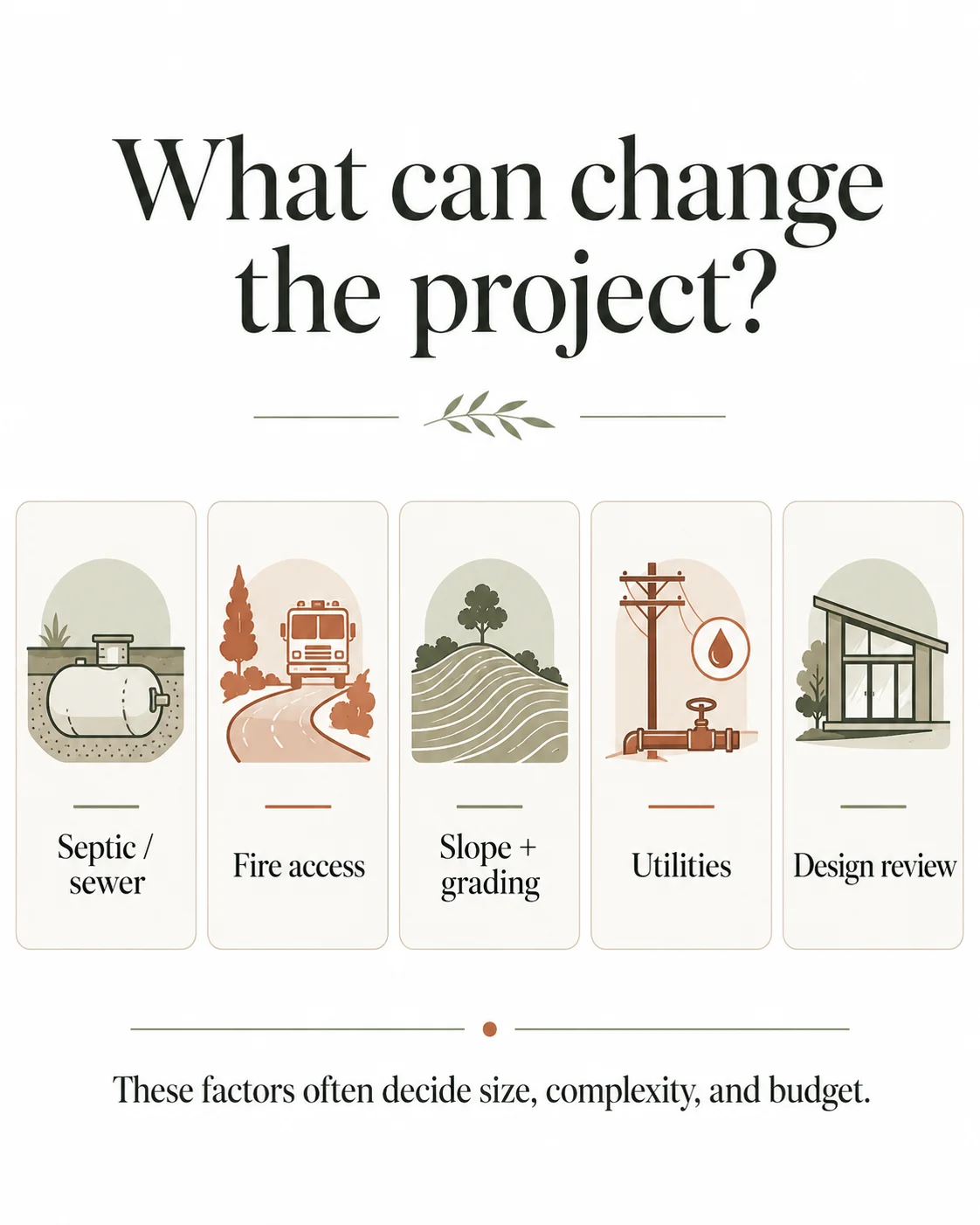
Five site factors that can change your project scope, cost, and timeline — all before you draw a line.
Know your site before you commit
A free feasibility check covers jurisdiction, septic risk, fire-zone status, and what's buildable at your address.
See What You Can Build →Want this as a printable worksheet?
The free Dwelling Index ADU Starter Kit includes the Rancho Santa Fe parcel decoder, the Covenant submittal checklist, and a cost-tracker template.
Get the Free Starter Kit →Rancho Santa Fe ADU laws FAQ
Are ADUs legal in Rancho Santa Fe?▼
Yes, on eligible single-family residential parcels with an existing or proposed primary dwelling. California Civil Code § 4751 prevents covenants and HOAs from prohibiting qualifying ADUs, so properties inside the Rancho Santa Fe Protective Covenant retain the right to build, subject to reasonable design restrictions. (Cal. Civ. Code § 4751; Cal. Gov. Code §§ 66314–66333; San Diego County PDS-611.)
Is Rancho Santa Fe under the City of San Diego or San Diego County for ADU permits?▼
San Diego County. Rancho Santa Fe is unincorporated, so the building permit is issued by San Diego County Planning & Development Services (PDS), not by any city. Verify your specific parcel's jurisdiction by APN. (sandiegocounty.gov/pds.)
How large can a detached ADU be in Rancho Santa Fe?▼
Up to 1,200 square feet under San Diego County Zoning Ordinance § 6156.x. State law protects at least 800 square feet as a ministerial floor under Gov. Code § 66323. Site conditions, Art Jury design review, sub-HOA standards, septic capacity, fire access, and slope can each affect whether the legal maximum is practical on your specific parcel. (San Diego County Zoning Ordinance § 6156.x; Cal. Gov. Code § 66323.)
How large can a Junior ADU (JADU) be?▼
Up to 500 square feet, and the JADU must be entirely within the existing or proposed primary residence. JADUs require a recorded deed restriction limiting their use. (Cal. Gov. Code § 66333; San Diego County Zoning Ordinance § 6156.x.)
Do I need Rancho Santa Fe Association or Art Jury approval for an ADU?▼
Yes, if your parcel is inside the Rancho Santa Fe Protective Covenant. The Art Jury reviews all exterior changes including new ADUs. The Association cannot enforce restrictions that effectively prohibit or unreasonably restrict a qualifying ADU under Cal. Civ. Code § 4751, but it can impose reasonable design restrictions on materials, colors, height, massing, lighting, and siting. (RSFA Building Department; Cal. Civ. Code § 4751.)
How much does Art Jury review cost?▼
The RSFA Schedule of Fees and Deposits sets a $1,325 application fee for residential construction permits on projects 1,500 square feet or less ($1,920 for larger projects), plus a refundable construction-permit deposit of $2 per square foot. The application fee covers up to three applications and includes plan checking, community-wide noticing, story-pole review, Art Jury on-site review, and required inspections. (RSFA Schedule of Fees and Deposits, verified May 2026.)
Can an HOA block an ADU in California?▼
No. California Civil Code § 4751 voids any covenant or governing-document provision that effectively prohibits or unreasonably restricts a qualifying ADU or JADU on a single-family residential lot. Reasonable design restrictions remain enforceable. (Cal. Civ. Code § 4751.)
Can I rent my Rancho Santa Fe ADU on Airbnb?▼
No. State law and County rules prohibit short-term rentals of ADUs. San Diego County Zoning Ordinance § 6156.x sets a 31-day minimum; Gov. Code § 66314 requires more than 30 days. AB 1154 added an explicit short-term-rental prohibition for JADUs effective January 1, 2026. (Cal. Gov. Code § 66314; San Diego County Zoning Ordinance § 6156.x; AB 1154.)
Do I have to live on the property to build an ADU in Rancho Santa Fe?▼
No for standard ADUs. AB 976 made the ban on local owner-occupancy requirements permanent effective January 1, 2024. For JADUs, AB 1154 (effective January 1, 2026) removed owner-occupancy when the JADU has its own separate bathroom; if the JADU shares a bathroom with the primary residence, owner-occupancy is still required. Verify the current County deed-restriction form at submittal. (AB 976; AB 1154; Cal. Gov. Code § 66333.)
How long does Art Jury approval take?▼
Plan for several months from Style Check submittal through Final Plan Review approval. The Art Jury meets every three weeks on Tuesdays at 8:30 a.m., and applications are submitted via the RSFA Accela portal by 4:00 p.m. on the published deadline. Story-pole installation and on-site Art Jury review the day before the meeting are required for most ADU projects. (rsfassociation.org Submittal Schedule and Architectural Review Process.)
How long does the County permit take after Art Jury approval?▼
California Government Code § 66317 requires ministerial ADU permit review within 60 days of a completed application. SB 543 (effective January 1, 2026) requires a completeness determination within 15 business days. Plan check corrections, septic review, fire review, and utility coordination can extend the real-world timeline. (Cal. Gov. Code § 66317; SB 543.)
How much does an ADU cost in Rancho Santa Fe?▼
A Covenant-grade detached ADU typically runs $400,000 to $900,000+ all-in for 1,000–1,200 square feet, well above the generic California range. The premium comes from Covenant aesthetic standards, septic capacity work, fire-zone construction (Chapter 7A WUI), long utility runs on estate lots, and Art Jury / Association fees. (SnapADU published plan pricing; SF Construction Group; Freeman's Construction; San Diego County PDS-611; RSFA Schedule of Fees and Deposits.)
How do I know if my parcel is in the Covenant?▼
Call the Rancho Santa Fe Association Building Department at (858) 756-1174 with your assessor's parcel number (APN). They confirm Covenant status routinely. Your preliminary title report and CC&Rs will also list the Covenant as a recorded encumbrance if it applies. (rsfassociation.org.)
What's the difference between Rancho Santa Fe and Fairbanks Ranch ADU rules?▼
Fairbanks Ranch is a gated community inside the Rancho Santa Fe postal area. Fairbanks Ranch ADU projects follow California state law, San Diego County rules, and the Fairbanks Ranch Association's own architectural standards — they don't go through the RSF Art Jury unless the specific lot also sits inside the Covenant. Verify each by title report. (Cal. Civ. Code § 4751; Fairbanks Ranch Association CC&Rs.)
Can I convert my garage into an ADU in the Covenant?▼
Yes, in principle. State law treats garage conversions as ADUs and exempts them from many setback requirements. Inside the Covenant, the Art Jury will still review exterior changes — door and window placement, exterior materials, lighting, and how the converted structure reads from neighboring parcels. Garage conversions to ADUs also exempt the parcel from replacement-parking requirements under Gov. Code § 66322. (Cal. Gov. Code §§ 66314, 66322.)
What happens if I built an ADU without a permit?▼
San Diego County PDS-611 directs property owners with unpermitted ADUs built before 2020 to contact the Zoning Counter for amnesty review under AB 2533. For unpermitted work built after 2020, the County's standard enforcement process applies — and inside the Covenant, the RSFA has separate enforcement authority including liens and fines for unauthorized exterior work. (San Diego County PDS-611; AB 2533.)
Will building an ADU trigger a full property tax reassessment?▼
No. Under California's Proposition 13, adding an ADU triggers reassessment of the ADU portion only, not the parent parcel. The County Assessor adds the ADU's assessed construction value to the existing parcel's tax bill at the standard ad valorem rate. (Cal. Const. Art. XIII A; San Diego County Assessor.)
Are story poles required for every Art Jury submittal?▼
Story-pole review is covered under the construction permit application fee and is standard for new construction including new ADUs. Interior conversions and minor exterior changes may not require them. Confirm with the RSFA Building Department before final plan preparation. (rsfassociation.org Architectural Review Process; RSFA Schedule of Fees and Deposits.)
Can I sell my Rancho Santa Fe ADU separately from my house?▼
Yes, for qualifying ADUs. The San Diego County Board of Supervisors adopted the AB 1033 implementation ordinance (Ordinance No. 10986) on March 4, 2026, effective April 4, 2026. Separate ADU sale in unincorporated areas including Rancho Santa Fe is now handled through condominium conversion under County Zoning Ordinance § 6156.x.D. JADUs are not eligible. (San Diego County AB 1033 ADU Zoning Ordinance Amendment, Ordinance No. 10986; AB 1033.)
Will my Rancho Santa Fe ADU need fire sprinklers?▼
Only if the primary residence is required to be sprinklered. State law's parity rule under Gov. Code §§ 66314 and 66323 prevents local agencies from requiring sprinklers in an ADU when the primary residence isn't required to have them. (Cal. Gov. Code §§ 66314, 66323.)
Do I need an architect or can I use pre-approved plans?▼
For Covenant parcels, an architect with Rancho Santa Fe experience is effectively required. The County offers some pre-approved ADU plan templates, but very few are Covenant-compatible without significant adaptation for materials, roof pitch, fenestration, and site relationship. Outside the Covenant, pre-approved plans work for many parcels. (San Diego County PDS pre-approved plans page; rsfassociation.org Residential Design Guidelines.)
What we verified for this guide
Last verified: May 15, 2026. This guide was built from primary and high-authority sources first, then supplemented with verified builder data. We do not rely on forum posts, builder marketing, or AI summaries for legal or regulatory claims.
May 2026 update notes: San Diego County AB 1033 separate-sale implementation is now in effect (Ordinance No. 10986, effective April 4, 2026); RSFA fee schedule verified directly with the Association; County PDS-611 ADU/JADU Handout revised January 7, 2026; AB 1154 effective January 1, 2026 changes JADU owner-occupancy when separate bathroom is present.
Primary sources reviewed:
- California Government Code §§ 66314–66333 (ADU statute, current Chapter 13 reorganization) — leginfo.legislature.ca.gov
- California Government Code § 66317 (ministerial permit and 60-day shot clock)
- California Civil Code § 4751 (HOA preemption / AB 670 codification)
- AB 976 (signed Oct. 11, 2023, eff. Jan 1, 2024 — owner-occupancy ban made permanent)
- AB 1033 (eff. Jan 1, 2024 — local opt-in framework for separate ADU sale)
- AB 1154 (chaptered Oct. 10, 2025, eff. Jan 1, 2026 — JADU bathroom rule)
- AB 462 (urgency, signed Oct. 10, 2025 — coastal ADU CDP 60-day shot clock)
- AB 2533 (unpermitted ADU amnesty)
- SB 543 (eff. Jan 1, 2026 — 15-business-day completeness rule)
- SB 1211 (eff. Jan 1, 2025 — multifamily and parking)
- Dolan-King v. Rancho Santa Fe Association (2000) 81 Cal.App.4th 965
- San Diego County Zoning Ordinance § 6156.x — codelibrary.amlegal.com
- San Diego County PDS-611 (ADU/JADU Handout, revised Jan. 7, 2026) — sandiegocounty.gov/pds
- San Diego County PDS-658 (Minimum Essential Plan Submittal Items) — sandiegocounty.gov/pds
- San Diego County AB 1033 ADU Zoning Ordinance Amendment, Ordinance No. 10986 (eff. April 4, 2026) — sandiegocounty.gov/pds
- Rancho Santa Fe Association Protective Covenant (Map No. 2057, Declarations 2 and 3) — rsfassociation.org
- Rancho Santa Fe Association Schedule of Fees and Deposits (verified May 2026) — rsfassociation.org
- Rancho Santa Fe Association Architectural Review Process and Submittal Schedule — rsfassociation.org
- Rancho Santa Fe Fire Protection District Residential Plan Check Form (2024) — rsf-fire.org
- CAL FIRE Office of the State Fire Marshal Fire Hazard Severity Zone Viewer — osfm.fire.ca.gov/fhsz
- California Building Code Chapter 7A (Wildland-Urban Interface materials and construction)
- SnapADU Via de Maya project documentation — snapadu.com
How we researched this
Dwelling Index is an independent research resource covering ADU financing, costs, and regulations. To build this guide, our editorial team reviewed the current California ADU statutes (Chapter 13 of the Government Code), the San Diego County ADU ordinance, the Rancho Santa Fe Association's Protective Covenant and Architectural Review Process materials, the controlling California Court of Appeal opinion in Dolan-King v. Rancho Santa Fe Association (2000), County PDS plan-submittal guidance, the County's AB 1033 implementation ordinance and accompanying guidance, RSFFPD's Residential Plan Check Form, and contractor-published Rancho Santa Fe ADU project data. Cost ranges are synthesized from multiple builder sources cited inline and dated; figures are illustrative ranges, not quotes.
We don't accept payment for editorial placement. Where a builder is named as a featured partner, the affiliate relationship is disclosed openly at the top of the page and our editorial assessment is independent.
Related guides
Not sure where to start?
See what's possible at your address — get your free ADU report in 60 seconds.
See What You Can Build →