
National City ADU Laws (2026): Rules, Setbacks, Permits, and the December 2025 HCD Letter Most Pages Missed
The National City ADU laws that control your project sit on top of California state law. On most single-family lots you can build one ADU up to 1,200 sq ft plus one JADU up to 500 sq ft — but the city's 2021 ordinance may be null and void in places per HCD's December 5, 2025 letter. Where local rules are more restrictive than state law, state law controls. This guide decodes every gap.
Independent editorial — referral relationships disclosed · No paid placement · Reader-supported; we may earn a commission from affiliate links at no cost to you. Read our full disclosure.
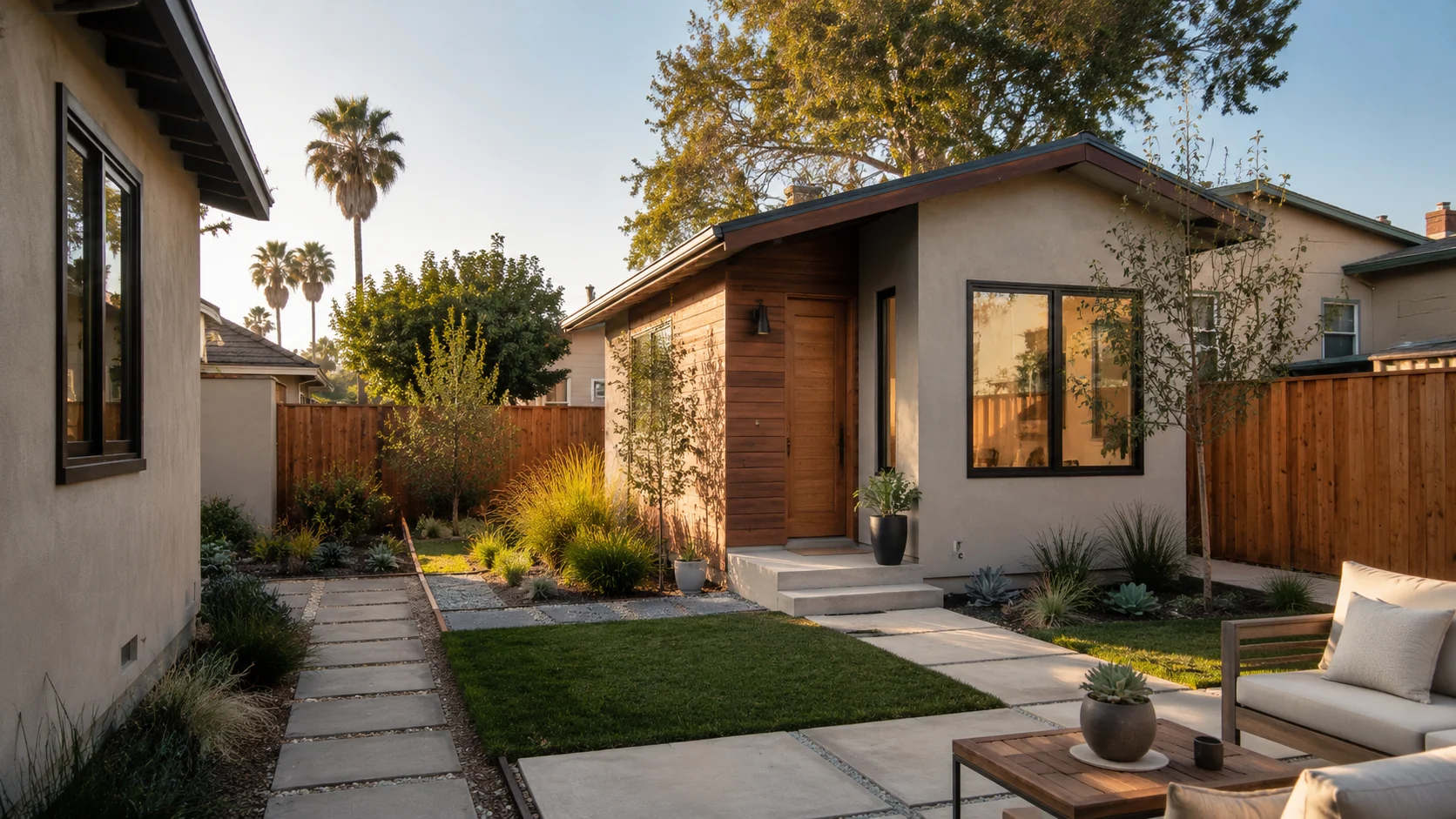
A typical detached ADU in a South Bay San Diego residential setting.
The catch most pages haven't updated: on December 5, 2025, the California Department of Housing and Community Development (HCD) sent National City a Letter of Technical Assistance flagging that the city's 2021 ADU ordinance may no longer comply with current state law and may, under Gov. Code §66316, be null and void in places. Where the city's local ordinance is more restrictive than state law, state law controls. That's almost always good news for the homeowner — multifamily ADU counts expanded, JADU owner-occupancy got narrower, fee structures got friendlier on units over 750 sq ft, and the completeness review now has a hard 15-business-day clock.
National City ADU rules at a glance
The table below reflects what applies under current state law and NCMC §18.30.380 as of May 2026. Items marked * have a known local-vs-state conflict — see the conflict matrix below before relying on a city source.
| Rule | Quick answer |
|---|---|
| ADUs allowed? | Yes, on most residentially zoned lots — verify your parcel's zoning with Planning |
| Detached ADU max size | 1,200 sq ft |
| JADU max size | 500 sq ft of interior livable space (+ up to 150 sq ft for ingress/egress) |
| Attached ADU sizing * | City's own handbook contains a conflict — verify in writing before final design |
| Front setback | 15 ft |
| Side / rear setback | 4 ft (state-law floor) |
| Building separation | 5 ft |
| Detached height | 16 ft minimum; 18 ft near major transit; +2 ft for matching roof pitch |
| Parking | Not required; no replacement parking when garage/carport converted |
| Owner-occupancy (standard ADU) | Not required |
| Owner-occupancy (JADU) | Required only when JADU shares sanitation with the primary |
| Short-term vacation rental | Prohibited; long-term rental (>30 days) allowed |
| Separate sale (AB 1033) | Not adopted by National City as of May 2026 |
| Solar | Required on new detached ADUs |
| Fire hose pull | Max 150 ft from curb to farthest point of ADU |
| Tree | One 24-inch box tree in front-yard setback or parkway |
| Impact fees | Waived for ADUs ≤ 750 sq ft and JADUs ≤ 500 sq ft |
| School fees | Apply at 500 sq ft and up |
| Permit clock | 15 business days (completeness) + 60 days (decision) |
| Multifamily lot * | Up to 8 detached ADUs under SB 1211, capped by existing unit count |
| Submission | Email packet to building@nationalcityca.gov or in person at the Building Division Counter |
See what your specific National City lot allows in 60 seconds: Run your free ADU Feasibility check →
What we verified for this page
We split this into three buckets so you can see what's primary-source, what's third-party, and what's editorial estimation built from public data.
Officially verified (city, state, or government source)
- Detached ADU maximum size of 1,200 sq ft; JADU 500 sq ft of interior livable space (+ up to 150 sq ft for ingress/egress); minimum 4-ft side and rear setbacks; 15-ft front setback; 5-ft separation between the ADU and existing structures — NCMC §18.30.380; National City ADU Handbook (March 2024); Cal. Gov. Code §§66310–66342.
- HCD Letter of Technical Assistance to National City, dated December 5, 2025, identifying more than 30 provisions of state ADU law adopted since 2019 that the city's 2021 ordinance does not reflect — HCD Housing Accountability Unit; direct PDF on hcd.ca.gov.
- 15 business days to determine completeness; 60 days to approve or deny a complete ADU application — Cal. Gov. Code §66317.
- State-law size protections under §66321: local maximum cannot be set below 850 sq ft (or 1,000 sq ft for an ADU with more than one bedroom); separately, local FAR/lot-coverage/percentage/front-setback/minimum-lot-size standards cannot block at least an 800 sq ft ADU with 4-ft side and rear setbacks.
- Attached ADU size cap under state law: if there's an existing primary dwelling, an attached ADU shall not exceed 50% of the existing primary — Cal. Gov. Code §66314.
- Impact-fee exemption: ADUs ≤ 750 sq ft and JADUs ≤ 500 sq ft are exempt from local impact fees; above the threshold, fees must be charged in proportion to the primary dwelling's square footage — Cal. Gov. Code §66311.5(c).
- School developer fees: less than 500 sq ft of interior livable space is exempt; 500 sq ft or more triggers district fees — Cal. Gov. Code §66311.5; Cal. Education Code §17620.
- Multifamily ADU expansion: up to 8 detached ADUs on existing multifamily lots, capped by the number of existing units; plus interior conversions of up to 25% of existing unit count, with at least one always allowed — Cal. Gov. Code §66323 as amended by SB 1211 (effective January 1, 2025).
- JADUs are limited to lots with a single-family residence — NC ADU Handbook; Cal. Gov. Code §66333.
- No state-level owner-occupancy requirement on standard ADUs. For JADUs, owner-occupancy may be imposed where the JADU has shared sanitation; cannot be imposed where it has separate sanitation — Cal. Gov. Code §66315; §66333(b).
- Long-term rental (terms longer than 30 days) is allowed; short-term vacation rental is prohibited — NC ADU Handbook; Cal. Gov. Code §66323.
- Property-tax treatment: ADUs/JADUs will be assessed by the San Diego County Assessor at current valuation for the new construction; existing square footage that wasn't touched by the project is not reassessed — NC ADU Handbook.
- New detached ADUs in National City are required to include a solar PV system — NC ADU Handbook; Title 24 Part 6.
- Fire hose pull from the curb to the farthest point of the ADU may not exceed 150 feet — NC ADU Handbook.
- AB 462 (signed October 10, 2025; codified at Cal. Gov. Code §66329 as amended) caps local ADU Coastal Development Permit review at 60 days from a complete application and removes appeal of a local government ADU CDP decision under Public Resources Code §30603.
Third-party (provider, builder, or industry source)
- Standard permit timeline of approximately 3–4 months in National City and permit-related costs of roughly $10–$12 per square foot — published by SnapADU on its National City regulations page, summary last updated April 2026, with a visible planner-verification note dated November 2022. These are builder-published planning estimates; verify directly with National City Building Division at (619) 336-4210.
- Soils/geotechnical report commonly required around the 500 sq ft mark for detached ADUs in National City — SnapADU's National City page. The city's handbook does not publish a numeric square-foot threshold but flags drainage, slopes, foundation type, right-of-way work, and new sewer connections as engineering review triggers.
- 2026 rental comps for ZIP 91950: 1-BR roughly $1,675–$2,345/month, 2-BR roughly $2,144–$2,790/month — aggregated from ApartmentFinder, Apartments.com, Rent.com, RentCafe, Zumper, and RentHop, pulled February–April 2026.
Market data and editorial estimates
- California Construction Cost Index (CCCI): 7,090 in January 2021 to 10,258 in December 2025 — roughly 44.7% cumulative increase — California Department of General Services.
- CalHFA ADU Grant Program: funding fully allocated as of December 28, 2023; CalHFA has warned about scams. No confirmed relaunch date as of our verification.
- National City ADU Loan Program: listed as "Coming Soon" on the city's official ADU page as of our verification. Treat as not yet active.
Citations on this page are starting points for your own verification, not legal advice.
Can I build an ADU on my National City property?
Answer capsule. ADUs are allowed on most residentially zoned lots in National City — single-family, multifamily (including duplexes), and residentially designated areas of mixed-use zones — subject to NCMC §18.30.380 and current California state law. The first three questions are not "What's allowed?" but "Is my parcel actually in the City of National City?", "What zoning district applies?", and "Does anything site-specific (coastal, septic, slope, fire access) change the math?"
First: confirm you're actually in National City
This sounds basic, and it's the most common mistake we see. The South Bay area of San Diego County is a patchwork of incorporated cities — Chula Vista, National City, Imperial Beach, Coronado, Lemon Grove — and pockets of unincorporated San Diego County. A National City mailing address and being inside the City of National City are not the same thing.
How to confirm: pull your property's address on the National City Interactive Zoning Map, or run your address through our free property eligibility check. If your parcel turns out to be in unincorporated San Diego County, you're working from County rules — they differ in important ways, including in-person submittal requirements and soils-report practice.
Then: identify the zoning district and property type
National City zoning districts allow ADUs in single-family and multifamily residential zones, and in mixed-use zones where residential use is permitted. The practical implications:
- Single-family lot:one standard ADU + one JADU under the city's current ordinance. Under current state-law interpretation, additional combinations may be protected.
- Duplex (treated as multifamily for ADU law):under HCD's current handbook, a structure with two or more attached dwelling units on a single lot is a multifamily dwelling structure. A duplex lot may pursue the multifamily ADU path. JADUs are not available on duplex or multifamily lots.
- Multifamily (3+ units):up to 8 detached ADUs under current Gov. Code §66323, capped by existing unit count, plus interior conversions of up to 25% of existing units.
- Mixed-use:ADUs allowed where residential use is permitted.
Three questions to ask Planning before you pay for plans
- 1"Can you confirm my parcel's zoning district and that the ADU type I'm proposing is permitted there?" This avoids the most expensive design mistake — paying an architect to draw something the underlying zone doesn't actually allow.
- 2"Does any overlay apply to my parcel — coastal, hazard, historic, or transit-priority?" Overlays change setback, height, parking, and CDP requirements without changing the underlying zone.
- 3"Are there site-specific items I should pre-check with Building, Engineering, Fire, Sweetwater Authority, or San Diego County DEHQ before submitting?" This is where the city flags the fire hose pull, the sewer lateral inspection, the slope-drainage trigger, or the septic-system review.
National City Planning Division: (619) 336-4310 · planning@nationalcityca.gov
National City Building Division: (619) 336-4210 · building@nationalcityca.gov
Not sure which jurisdiction you're in or what your zone allows? Get a free 60-second feasibility check for your address.
National City ADU laws in plain English
Answer capsule. National City's ADU rules live in NCMC §18.30.380 (ADUs) and §18.30.390 (JADUs). The city publishes an ADU Handbook (March 2024) that explains how the rules apply in practice. Where the handbook and the municipal code conflict, the handbook says the municipal code controls. Where state law has updated since 2024, state law controls.
National City ADU rules — the master reference
| Rule | What it says | Controlling source |
|---|---|---|
| Where ADUs are allowed | Residential zones (single-family, multifamily) and residentially designated areas of mixed-use zones | NCMC §18.30.380; Cal. Gov. Code §66313 |
| Maximum size, detached ADU | 1,200 sq ft (no maximum when within an existing dwelling or accessory-structure footprint) | NCMC §18.30.380; NC ADU Handbook |
| Maximum size, attached ADU * | City handbook contains conflicting language — one section reads "50% of main dwelling or 1,200 sq ft, whichever is greater"; the FAQ summary reads "whichever is less." Get written confirmation from Planning before final design. | NC ADU Handbook (conflicting); Cal. Gov. Code §66314, §66321 |
| Maximum size, JADU | 500 sq ft of interior livable space, plus up to 150 sq ft for ingress/egress only | NCMC §18.30.390; Cal. Gov. Code §66313(d) |
| Minimum size | 150 sq ft (efficiency unit) | NC ADU Handbook |
| State-law size protections | Local maximum cannot be below 850 sq ft, or 1,000 sq ft for ADUs with more than one bedroom; separately, local FAR/lot-coverage/percentage/front-setback/minimum-lot-size rules cannot block at least an 800 sq ft ADU with 4-ft side and rear setbacks | Cal. Gov. Code §66321 |
| Front setback | 15 ft | NC ADU Handbook |
| Side setbacks | 4 ft (state-law floor) | NCMC §18.30.380; Cal. Gov. Code §66323 |
| Rear setback | 4 ft (state-law floor) | NCMC §18.30.380; Cal. Gov. Code §66323 |
| Building separation | 5 ft between the ADU and any existing structure on the lot | NCMC §18.30.380 |
| Detached ADU height | At least 16 ft must be allowed; up to 18 ft within ½ mile of a major transit stop or high-quality transit corridor; +2 ft additional if the ADU's roof pitch matches the primary | Cal. Gov. Code §66321; NCMC §18.30.380 |
| Above-garage / sub-5,000 sq ft lot height | Up to 25 ft per the city's handbook for ADUs above a garage or on lots smaller than 5,000 sq ft | NC ADU Handbook |
| Attached ADU height | Up to 25 ft or the zone's height limit, whichever is lower | Cal. Gov. Code §66321 |
| Parking | Not required for ADUs the handbook summarizes; replacement parking not required where a garage/carport/covered or uncovered parking is demolished or converted to build an ADU (SB 1211) | NCMC §18.30.380; Cal. Gov. Code §66314; SB 1211 |
| Fire hose pull | Maximum 150 ft from the curb to the farthest point of the ADU | NC ADU Handbook |
| Fire sprinklers | Not required if the primary residence isn't required to have them | NC ADU Handbook; Cal. Residential Code R313.2 |
| Solar PV | Required on new detached ADUs | NC ADU Handbook; Title 24 Part 6 |
| Required tree | One 24-inch box tree in the 15-ft front-yard setback or abutting parkway; existing trees ≥15 ft high and ≥15 ft wide qualify | NC ADU Handbook |
| Owner-occupancy, standard ADU | Not required | Cal. Gov. Code §66315 |
| Owner-occupancy, JADU | Required only where JADU shares sanitation with the primary; cannot be required where JADU has separate sanitation | Cal. Gov. Code §66333(b) |
| Number of ADUs, single-family | 1 ADU + 1 JADU (city handbook); state law's protected combinations may permit additional units under specified circumstances | NC ADU Handbook; Cal. Gov. Code §66323 |
| Number of ADUs, duplex / multifamily * | Up to 8 detached ADUs (capped by existing unit count) + interior conversions of up to 25% of existing units (rounded down, at least one allowed). A duplex caps at 2 detached. NC's 2024 handbook still references "up to two detached" for multifamily; state code controls. | Cal. Gov. Code §66323 (SB 1211); NC ADU Handbook |
| Impact-fee waiver | ADUs ≤ 750 sq ft and JADUs ≤ 500 sq ft of interior livable space are exempt from local impact fees; over the threshold, fees are charged proportionally | Cal. Gov. Code §66311.5(c); NC ADU Handbook |
| School developer fees | Less than 500 sq ft of interior livable space is exempt; 500 sq ft or more triggers district fees | Cal. Gov. Code §66311.5; Cal. Education Code §17620 |
| Rental — long-term | Allowed | NC ADU Handbook |
| Rental — short-term vacation | Prohibited. Handbook FAQ requires terms exceeding 31 days; Cal. Gov. Code §66323 uses "longer than 30 days." | NC ADU Handbook; Cal. Gov. Code §66323 |
| Separate sale (AB 1033) | Not yet adopted by National City (as of May 2026). City of San Diego adopted August 22, 2025; County of San Diego adopted effective April 4, 2026. | Cal. Gov. Code §66342 (requires local opt-in) |
| Permit clock | 15 business days completeness review; 60 days to approve or deny a complete application | Cal. Gov. Code §66317 |
| Submission | Email packet to building@nationalcityca.gov or in person at Building Division Counter, 7:00 a.m.–4:30 p.m. M–Th | City of National City ADU page |
Definitions worth pinning down
ADU (Accessory Dwelling Unit)
A self-contained residential unit on the same lot as a primary dwelling, with independent kitchen, bathroom, and sleeping area. ADUs can be detached (a separate building), attached (sharing a wall with the primary), or a conversion of existing space (typically a garage).
JADU (Junior Accessory Dwelling Unit)
A smaller unit, no larger than 500 sq ft of interior livable space (plus up to 150 sq ft for ingress/egress), contained entirely within an existing or proposed single-family residence. JADUs require at least an efficiency kitchen. JADUs are not available on duplex or multifamily lots. Owner-occupancy applies only when the JADU shares sanitation with the primary.
Conversion ADU
An ADU created by repurposing the existing footprint of a primary dwelling or detached accessory structure (a garage, workshop, or barn). The 1,200 sq ft cap does not apply to conversions within an existing footprint — a 1,500 sq ft existing structure can become a 1,500 sq ft ADU. National City's handbook flags conversion ADUs as the most cost-effective ADU type because they reuse existing foundation, framing, roof, plumbing, and electrical.
Three more technical terms
A setback is the minimum distance from a property line to a building. Ministerial approval means the application is reviewed against objective criteria only, without a hearing or discretionary judgment — by state law, ADU permits must be processed ministerially. A plan check is the city's review of construction drawings to confirm they meet building code, energy standards, and zoning requirements before a permit is issued.
The 2026 update most pages missed — what HCD's December 5, 2025 letter to National City means for your project
Key finding: National City's 2024 handbook may be out of compliance with state law in several areas.
On December 5, 2025, the California Department of Housing and Community Development's Housing Accountability Unit sent National City a Letter of Technical Assistance flagging that the city's 2021 ADU ordinance is likely out of compliance with current state ADU law. Under Cal. Gov. Code §66316, an ADU ordinance that fails to meet state-law requirements is "null and void" and the local jurisdiction must apply state law until a compliant ordinance is adopted.
HCD's December 5, 2025 letter to National City listed more than 30 specific provisions of state ADU law adopted since 2019 that the city's 2021 ordinance may not reflect. The letter requested a response by January 4, 2026. As of our verification date, the city has not posted an adopted replacement ordinance to HCD's ADU Portal. The most consequential items for a homeowner planning a project today:
Multifamily detached ADU expansion — up to 8 detached ADUs
Under SB 1211 (effective January 1, 2025), local agencies must permit up to 8 detached ADUs on existing multifamily lots, capped by the number of existing units. National City's 2024 ADU Handbook still describes "up to two detached ADUs" for multifamily properties. The state-law rule controls. (Note: a duplex caps at 2 detached because there are only 2 existing units; an 8-unit building can reach the full 8.)
Impact-fee proportionality threshold tightened
Cal. Gov. Code §66311.5 now exempts ADUs up to 750 sq ft from local impact fees and requires that any impact fee on a larger ADU be charged in proportion to the primary dwelling's square footage. The proportionality rule is sharper than older summaries.
Completeness review now has a 15-business-day clock
Cal. Gov. Code §66317 requires the permitting agency to determine whether an application is complete within 15 business days of receipt and to provide a written list of any missing items. The 60-day total review period applies to the complete application. A partial submittal doesn't start the 60-day clock, but the 15-business-day completeness review is its own deadline.
JADU owner-occupancy is now tied to sanitation, not deeded property-wide
Under current Cal. Gov. Code §66333(b), owner-occupancy applies to a JADU only where the JADU shares sanitation facilities with the primary dwelling. A JADU with separate sanitation is not subject to an owner-occupancy requirement. National City's 2024 handbook still references a general owner-occupancy requirement for JADUs; the state-law nuance controls.
Parking exemptions broadened by SB 1211
When a garage, carport, covered parking structure, or uncovered parking space is demolished or converted to build an ADU, replacement parking is not required. National City's 2024 handbook reflects this directionally, but earlier city summaries may not.
Owner-occupancy sunset removed
What was a temporary prohibition on local owner-occupancy requirements for standard ADUs is now a permanent prohibition under Cal. Gov. Code §66315. No National City ordinance language requiring you to live in your primary dwelling can be enforced against a standard ADU.
Deemed-approved provisions
If the city has not approved or denied a complete ADU application within 60 days, the application is deemed approved by operation of state law. This is a real consequence, not a guideline.
Unpermitted ADU amnesty window extended
Cal. Gov. Code §66332 prohibits the city from denying a permit for an unpermitted ADU constructed before January 1, 2020 on the basis of building code violations or noncompliance with state ADU law, unless correcting the violation is necessary to meet substandard-building conditions. The old amnesty cutoff was January 1, 2018; SB 477 (2024) moved it to January 1, 2020.
CDP (Coastal Development Permit) review window capped at 60 days
Under AB 462 (signed October 10, 2025; codified at Cal. Gov. Code §66329 as amended), a local government decision on a coastal development permit application for an ADU must be made within 60 days of receiving a complete application, and a local government's ADU CDP decision is not subject to Coastal Commission appeal under Public Resources Code §30603.
Coastal 'deemed certified' rules and emergency provisions
Cal. Gov. Code §66328 allows a local agency to issue a certificate of occupancy for an ADU in counties under a Governor's emergency proclamation even where the primary dwelling has not yet been issued a certificate of occupancy, if specified conditions are met.
What this means practically for a homeowner today
If you're applying for a permit in National City right now and the city quotes you a rule from the 2024 handbook that's more restrictive than the state-law standard above, you have a real, source-cited basis to ask for the state-law standard. The right framing:
"I understand the city's handbook references this. The HCD Letter of Technical Assistance to National City dated December 5, 2025 indicates the ordinance may not currently comply with [Cal. Gov. Code section X]. Under Gov. Code §66316, where a local ordinance is null and void for noncompliance, the local jurisdiction applies state law. Can we apply [the state-law standard] for this provision?"
Be polite and prepared. Bring printed citations. The HCD letter is a public document with the city's director's name on it.
Want to know which of these changes actually applies to your address? Run a free Feasibility check — we flag the state-law-vs-local-rule deltas specific to your parcel.
The Local-vs-State Rule Conflict Matrix
Answer capsule. Where National City's 2024 handbook language and current California Government Code differ, state law controls under Gov. Code §66316 if the local ordinance is null and void for noncompliance. The matrix below lists every conflict we identified during our review, what each source says, and the practical conclusion. Verify any specific item with Planning Division before final design.
| Issue | What National City source says | What current California law says | Practical conclusion |
|---|---|---|---|
| Detached ADU size cap | Up to 1,200 sq ft for new detached ADUs (NCMC §18.30.380) | Local maximum cannot be below 850 sq ft, or 1,000 sq ft for ADUs with more than one bedroom (§66321) | Use 1,200 sq ft as the local cap; the 850/1,000 sq ft state floors are protections, not targets |
| Attached ADU size | Handbook section: "50% of main dwelling or 1,200 sq ft, whichever is greater." FAQ summary: "50% of the existing house or 1,200 sq ft, whichever is less." | §66314: an attached ADU shall not exceed 50% of the existing primary. §66321: local max cannot be below 850/1,000 sq ft. Separate §66321 backstop: percentage/FAR/lot-coverage rules cannot block at least an 800 sq ft ADU with 4-ft side/rear setbacks. | Verify in writing with Planning before final design. Do not design to the edge of either threshold without written confirmation. |
| Duplex classification | Handbook describes ADUs by ADU type without explicit duplex treatment | HCD Handbook: a structure with two or more attached dwelling units on a single lot is a multifamily dwelling structure (§66313) | A duplex pursues the multifamily ADU path — up to 2 detached ADUs (capped by existing unit count) + interior conversions. JADUs are not available on duplex lots. |
| Multifamily detached ADUs | 2024 handbook: up to 2 detached ADUs plus interior conversions | Up to 8 detached ADUs (capped by existing unit count) plus interior conversions up to 25% of existing units (§66323; SB 1211) | State law controls. Meaningful expansion for small-apartment owners. |
| JADU owner-occupancy | Handbook references a general owner-occupancy requirement for JADUs | Owner-occupancy applies only where the JADU has shared sanitation; cannot be required where JADU has separate sanitation (§66333(b)) | State law controls. A separately-plumbed JADU has no owner-occupancy requirement. |
| Short-term rental terminology | Handbook FAQ requires "exceeding 31 days"; other sections reference "less than 30 days" | Cal. Gov. Code §66323 uses "longer than 30 days" | Long-term rental (terms longer than 30 days) is the safe framing. Confirm the minimum lease term in writing if your lease is near the threshold. |
| Permit clock | Handbook describes review rounds, comments, fees, and inspections | 15 business days completeness; 60 days to approve or deny a complete application (§66317) | Both apply. Treat the §66317 clocks as the legal deadlines; treat resubmittals and utility coordination as additional time. |
| Impact fees on units over 750 sq ft | Handbook: impact fees not required for ADUs under 750 sq ft | §66311.5(c): fees prohibited on ADUs ≤ 750 sq ft and JADUs ≤ 500 sq ft; any fee above the threshold must be proportional to the primary dwelling | State law controls. Above 750 sq ft, fees must be charged proportionally — not at a flat rate. |
| Parking near transit / replacement parking | 2024 handbook reflects no replacement parking when garage demolished/converted | SB 1211: no replacement parking required for any demolished or converted parking when an ADU is constructed — garages, carports, covered or uncovered parking | State law controls; broader than some older summaries. |
| Separate conveyance (AB 1033) | Handbook: ADUs may not be sold separately from the primary residence | Cal. Gov. Code §66342 permits local agencies to adopt an ordinance allowing separate sale of ADUs as condominiums | National City has not adopted AB 1033 as of May 2026. ADUs in National City cannot be sold separately. The City of San Diego (adopted August 22, 2025) and County of San Diego (effective April 4, 2026) have. |
| Unpermitted ADU amnesty | Handbook does not address | §66332: city is prohibited from denying a permit for an unpermitted ADU built before January 1, 2020 for state-law or building-code violations (with substandard-building exceptions) | State law controls. If you have an unpermitted ADU from before 1/1/2020, you have a permitting path. |
| Owner-occupancy sunset | Some older summaries reference a temporary prohibition on requiring owner-occupancy for standard ADUs | The prohibition is now permanent under Cal. Gov. Code §66315 — no sunset date | State law controls. No local ordinance can require you to live on the property to rent a standard ADU. |
If you find an item we missed or one that's been resolved since our verification date, email us at corrections@dwellingindex.com and we'll update.
Curious which of these conflicts apply to your specific lot? Get a free address-level feasibility report — we surface the state-law/local-rule deltas before you spend money on plans.
How big can my ADU be, and where can it sit on the lot?
Answer capsule. For most National City single-family lots, a detached ADU can be up to 1,200 sq ft. A JADU is 150–500 sq ft of interior livable space (+ up to 150 sq ft for ingress/egress) within an existing or proposed single-family residence. A conversion within an existing footprint has no maximum size beyond the footprint. Attached ADU sizing is governed by an unresolved conflict in the city's handbook and should be confirmed in writing with Planning. Setbacks are 15 ft front, 4 ft sides, 4 ft rear, with a 5-ft building separation from existing structures.
Detached ADU — 1,200 sq ft max, with multiple state-law protections
A new detached ADU on a National City lot is capped at 1,200 sq ft by NCMC §18.30.380. State law (Cal. Gov. Code §66321) layers in two separate protections:
- Maximum-size protection. A local agency cannot set a maximum ADU size below 850 sq ft of interior livable space, or below 1,000 sq ft for an ADU with more than one bedroom. National City's 1,200 sq ft cap is generous against these floors.
- Percentage / lot-coverage backstop. Separately, local FAR, lot-coverage, percentage-based, front-setback, and minimum-lot-size rules cannot block at least an 800 sq ft ADU with 4-ft side and rear setbacks. This is the protection that matters on small or constrained lots.
Attached ADU — the conflict to verify before final design
Warning: National City's own handbook contains conflicting language on attached ADU size.
One section reads "50% of main dwelling or 1,200 sq ft, whichever is greater." The city's FAQ summary reads "50% of the existing house or 1,200 sq ft, whichever is less." On a 1,400 sq ft primary, these two rules produce ADU caps of 1,200 sq ft vs. 700 sq ft — a 500 sq ft difference. Get written confirmation from Planning before paying for full construction documents.
State law (Cal. Gov. Code §66314) says an attached ADU attached to an existing primary shall not exceed 50% of the existing primary. The state-law size protections in §66321 still apply on top of that. The path forward: get written confirmation from Planning (planning@nationalcityca.gov) before paying for full construction documents.
JADU — 500 sq ft within the primary, single-family lots only
A JADU is capped at 500 sq ft of interior livable space, plus up to 150 sq ft for ingress and egress only. It must be contained within an existing or proposed single-family residence and must include at least an efficiency kitchen. JADUs are not available on duplex or multifamily lots. Owner-occupancy for a JADU: required only where shared sanitation; not required where separate sanitation (Cal. Gov. Code §66333(b)).
Conversion ADU — the footprint is the cap
An ADU created within the existing footprint of a primary dwelling or an existing accessory structure is not subject to the 1,200 sq ft maximum. If you have a 1,500 sq ft barn or detached workshop, you can convert the entire thing. This is the highest-square-foot, lowest-cost ADU path for property owners with existing structures in good condition. The trade: you're stuck with the existing footprint, wall locations, roof line, and utility connections. If the existing structure isn't permitted or is structurally marginal, a conversion can morph into a partial demolition and rebuild — and the cost converges with new detached construction.
Setbacks: 15 / 4 / 4 / 5 / and one 24-inch tree
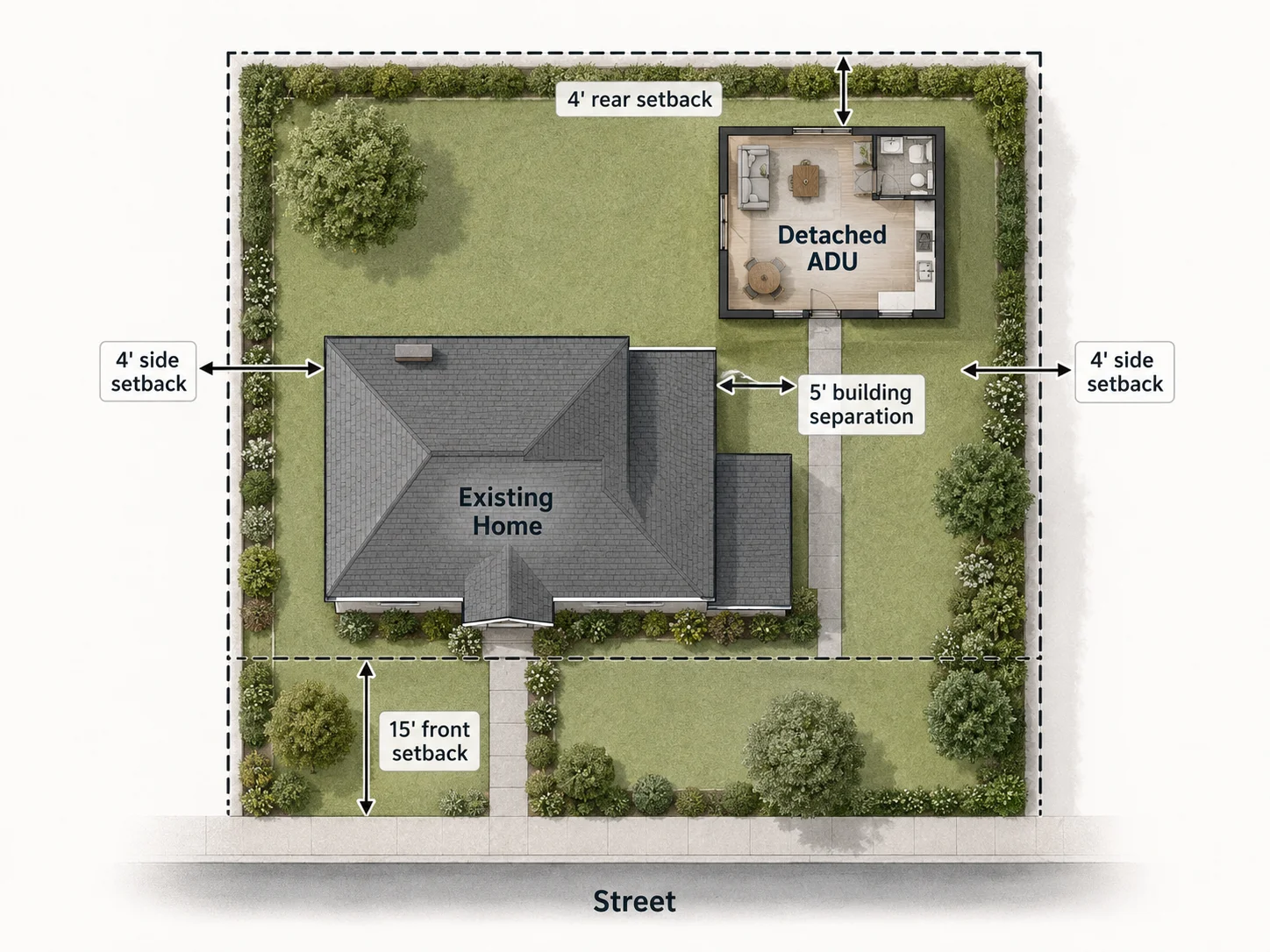
National City ADU setbacks: 15 ft front, 4 ft side and rear, 5 ft building separation from any existing structure.
| Setback | Minimum required | Source |
|---|---|---|
| Front yard | 15 ft | NCMC §18.30.380 |
| Side yard | 4 ft | Cal. Gov. Code §66323 (state-law floor) |
| Rear yard | 4 ft | Cal. Gov. Code §66323 (state-law floor) |
| Building separation (ADU to existing structure) | 5 ft | NC ADU Handbook |
| Front-yard landscaping | One 24-inch box tree required in front setback area or abutting parkway; existing trees ≥15 ft high and ≥15 ft wide qualify | NC ADU Handbook |
A 4-ft side/rear setback is consistent with state law's protection for detached ADUs. Building separation of 5 ft is a city-specific provision; San Diego County uses 6 ft, the City of San Diego allows 0 ft in some zones. If your ADU sits closer than 5 ft to any property line or existing structure, fire-rated assemblies are typically required.
What sits where on the lot — a decision sequence
- 1Pull the parcel boundary lines accurately. A surveyor isn't always required, but the city's plans may not show your boundary precisely. If you're designing within 2 ft of a setback, a boundary survey is worth it.
- 2Locate the fire hose pull endpoint first. The farthest point of the ADU may not exceed 150 ft from the curb edge. On a deep lot, this is the constraint that controls placement — not the setback.
- 3Mark utility lines and the existing sewer lateral. A new ADU often requires a new lateral or a capacity-confirmed reuse of the existing.
- 4Confirm slope, drainage, and grade. Slopes greater than a few percent often trigger engineering review and a soils report.
- 5Identify the closest existing structure to the proposed ADU. Verify 5 ft of building separation, and budget for fire-rated assemblies if you can't achieve it.
- 6Confirm a viable spot for the required 24-inch box tree. Existing mature trees in the front yard or parkway often satisfy this requirement.
Want a site-by-site placement analysis? The free Feasibility check returns the setback envelope, fire-pull distance, and likely placement zone for your parcel.
How many ADUs can I build on my National City property?
Answer capsule. On a single-family lot, the city's current ordinance allows one ADU + one JADU. On a duplex or multifamily lot, current Cal. Gov. Code §66323 (as amended by SB 1211) requires the city to permit up to 8 detached ADUs, capped by the number of existing units, plus interior conversions equal to 25% of the existing unit count, with at least one always permitted. JADUs are not available on duplex or multifamily lots.
| Property type | Max ADUs under current state law | Notes |
|---|---|---|
| Single-family lot | 1 ADU + 1 JADU | JADU available on single-family lots only; ADU can be detached or attached |
| Duplex (2 existing units) | 2 detached ADUs + conversions (min. 1 always permitted) | Detached count capped at existing unit count; JADUs not available on duplex lots |
| Triplex (3 existing units) | 3 detached ADUs + 1 conversion (25% of 3 = 0.75, rounds up to 1 minimum) | SB 1211 controls |
| Multifamily 4–8 units | Up to 4–8 detached (matching existing unit count) + conversions equal to 25% of units | SB 1211 controls; NC handbook predates this law |
| Multifamily 9–32+ units | Up to 8 detached ADUs (state cap) + conversions equal to 25% of units | 8-unit cap in Cal. Gov. Code §66323 |
The SB 1211 expansion for small-apartment owners: National City's 2024 ADU Handbook still describes the multifamily pathway as "up to two detached ADUs plus interior conversions." That's the pre-SB 1211 rule for buildings of 3+ units. The current state-law cap of 8 controls until the city updates its ordinance. HCD's December 5, 2025 letter specifically flagged Gov. Code §66323(a)(4)(A)(ii) as one of the items the city's 2021 ordinance does not reflect. A 6-unit building on a lot with room for 6 detached ADUs can potentially double its residential unit count under the current state-law rules.
Own a duplex or small multifamily in National City? Get a Feasibility report tailored to multifamily ADU counts under current state law.
National City vs. neighboring San Diego County cities
Answer capsule. For a homeowner deciding whether to buy or build on a specific parcel, the rules that differ across South Bay cities matter. National City's setbacks and size caps are similar to San Diego County peers, but the city has at least three distinctive provisions: a published 5-ft building separation, builder-published commentary that soils reports are commonly required around 500 sq ft, and a permit-cost-per-square-foot estimate higher than Chula Vista's.
| Rule | National City | San Diego (City) | Chula Vista | Lemon Grove | Imperial Beach | County of SD (uninc.) |
|---|---|---|---|---|---|---|
| Detached ADU max | 1,200 sq ft | 1,200 sq ft (regular path) | 1,200 sq ft | 1,200 sq ft | 1,200 sq ft | 1,200 sq ft |
| Front setback | 15 ft | Per zone | 15 ft | Per zone | Per zone | Per zone |
| Side/rear setback | 4 ft | 0 ft in many zones | 4 ft | 4 ft | 4 ft | 4 ft |
| Building separation | 5 ft | 6 ft (10 ft eave-to-eave for fire ratings) | Varies | Varies | Varies | 6 ft (4 ft eave-to-eave) |
| Two-story | Yes (up to 25 ft above garage/sub-5k sq ft lot) | Yes | Yes | Yes | Yes | Yes |
| Soils/geotech | Commonly required ~500 sq ft (builder-published) | Generally not required | Varies | Varies | Varies | Generally not required |
| Digital permit submission | Yes (email) | Yes | Yes | Yes | Yes | No — in-person required |
| Coastal applicability | Bayfront/western portions only | Yes — much of city | Coastal portions only | No | Yes — almost entirely coastal | Coastal portions only |
| Preapproved plan program | Not visible on city's public ADU page; verify with Building | Yes (SDHC pilot) | Yes | Not verified in published form | Not verified in published form | Yes (PDS-published) |
| AB 1033 (separate sale) | No (as of May 2026) | Yes (effective Aug. 22, 2025) | Not adopted (verified) | Not adopted (verified) | Not adopted (verified) | Yes (effective Apr. 4, 2026) |
| Permit cost per sq ft | $10–$12/sf — builder-published (SnapADU, Apr. 2026) | ~$6,500 to ~$21,000 total — third-party (Streamline, Dec. 2025) | $3,951 standard / $4,963 non-standard — city-published (Fee Bulletin 10-400, Sep. 2024) | Not published in standardized form | Not published in standardized form | $8,000–$11,000 avg post-waiver — third-party (Streamline, Dec. 2025) |
| Typical permit timeline | 3–4 months (builder-published) | 4–7 months | 3–5 months | 3–5 months | 4–6 months | 4–6 months |
Sources: NCMC §18.30.380 + NC ADU Handbook (March 2024); San Diego Municipal Code Ch. 14 + City of San Diego ADU Information Bulletin; Chula Vista Municipal Code §19.58.022 + Fee Bulletin 10-400; Lemon Grove Municipal Code; Imperial Beach Municipal Code; County of San Diego Zoning Ordinance + PDS-611. Builder-published figures cite SnapADU's regulations pages (April 2026). Third-party analysis cites Streamline Design Group (December 2025). All rows verified May 14, 2026.
Four practical takeaways from this matrix
- Chula Vista's city-published permit fee is materially lower than National City's builder-published per-sf estimate.
- The 5-ft building separation in National City matters for tight lots. Older neighborhoods often have existing structures close to property lines.
- AB 1033 timing matters for resale or condo conversion. You can sell an ADU separately in the City of San Diego (since August 22, 2025) and County of San Diego (since April 4, 2026). You cannot in National City yet.
- Permit submission method differs. National City allows email. County of San Diego unincorporated requires in-person submission.
Considering buying a lot in South Bay for an ADU play? Run the Feasibility check on the specific parcel before you offer.
Setbacks, height, and the transit bonus decoded
Answer capsule. Detached ADU height starts at 16 ft minimum (state-law floor); 18 ft within ½ mile of a major transit stop or high-quality transit corridor; an additional 2 ft on top of either base if the ADU's roof pitch matches the primary dwelling's roof pitch. Attached ADUs may reach 25 ft or the zone's height limit, whichever is lower. ADUs above a garage or on lots smaller than 5,000 sq ft may reach 25 ft per the city's handbook.
Height — the four pathways
| Pathway | Height ceiling | When it applies |
|---|---|---|
| Standard detached, anywhere | Greater of 16 ft or the primary's height | Default rule for new detached ADUs |
| Detached within ½ mile of major transit or HQTC | 18 ft (+2 ft if roof pitch matches primary — up to 20 ft total) | Detached ADU on a lot within ½-mile walking distance of a major transit stop or high-quality transit corridor (Cal. Gov. Code §66321(b)(4)) |
| Detached on multifamily lot with multi-story primary | 18 ft | Detached ADU on a lot with an existing multi-story multifamily dwelling |
| Above-garage / sub-5,000 sq ft lot | Up to 25 ft per city handbook | ADU constructed above a garage or on a lot smaller than 5,000 sq ft |
The attached ADU pathway is separate: up to 25 ft, or the underlying zone's height limit, whichever is lower (Cal. Gov. Code §66321(b)(2)(B)).
The roof pitch match trick most homeowners miss
That extra 2 ft of allowed height when the ADU's roof pitch matches the primary's is a real lever. On a near-transit lot, you can go from 18 ft (about 1.5 stories practical) to 20 ft (a comfortable two-story design). That's the difference between a 600 sq ft single-story and a 1,200 sq ft two-story on the same footprint. Get this confirmed in writing from Planning before designing to it.
The "high-quality transit corridor" definition is a state-law term of art. National City has Metropolitan Transit System (MTS) bus routes along several arterials. Don't assume your lot qualifies — check the SANDAG transit map or ask Planning whether your parcel qualifies for the 18 ft pathway.
The National City ADU permit process: state-law clock vs. real-world timeline
Answer capsule. California state law gives the city 15 business days to determine whether an ADU application is complete and 60 days to approve or deny a complete application (Cal. Gov. Code §66317). In practice, the standard National City permit timeline is approximately 3–4 months from a complete submittal per SnapADU's published city-page average (builder-published planning estimate, page updated April 2026). The total kickoff-to-certificate-of-occupancy timeline is typically 9–14 months. Most schedule risk lives in pre-permit design and Sweetwater Authority coordination.
The §66317 timelines are real legal deadlines, not guidelines. If the city does not approve or deny a complete application within 60 days, the application is deemed approved by operation of state law. The way to compress real-world time is to submit a complete application the first time.
The four phases — feasibility, design, permit, construct
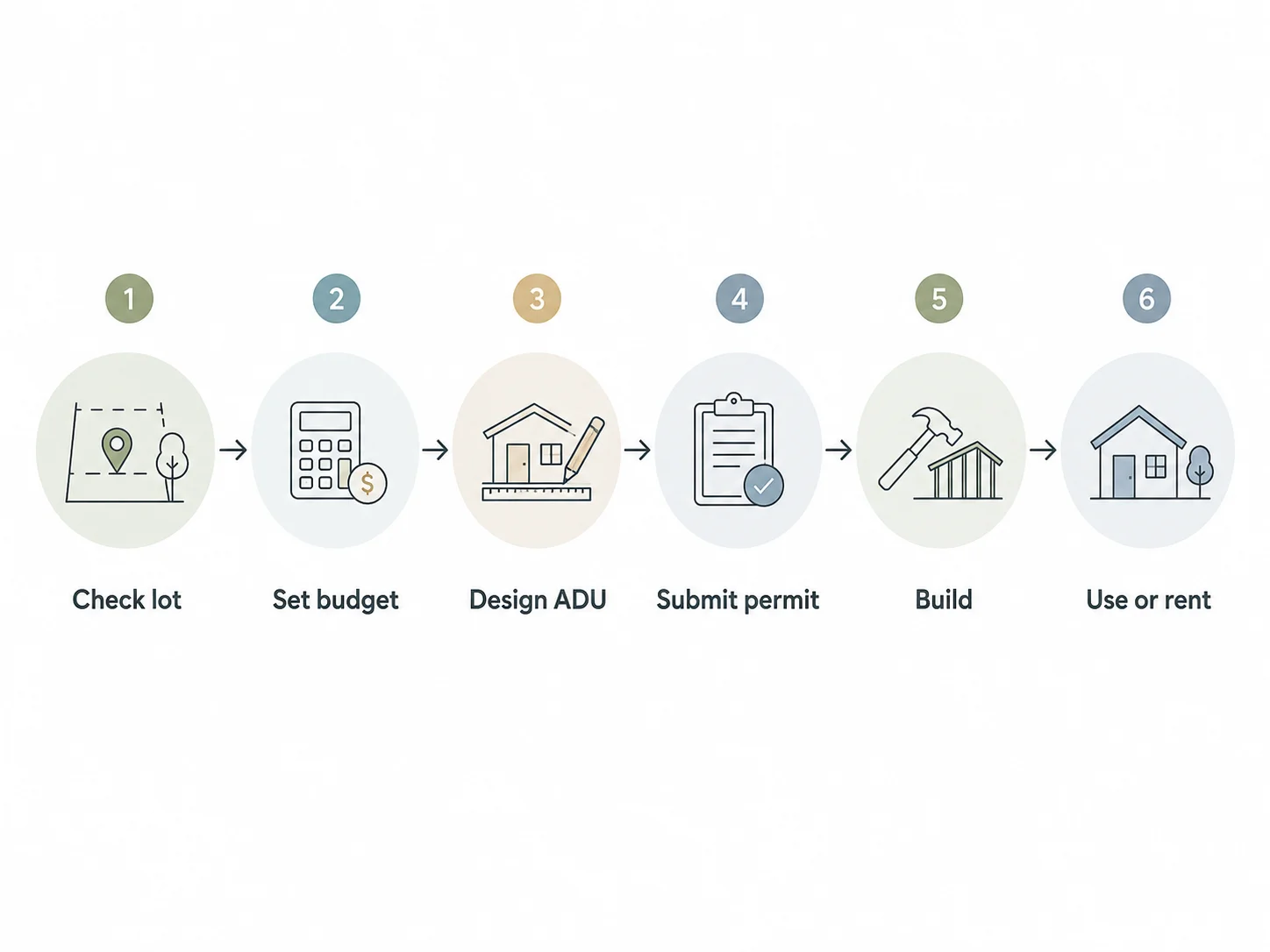
National City ADU permit process: from feasibility to certificate of occupancy.
| Phase | Typical duration | What's happening | Most common delay |
|---|---|---|---|
| Pre-application / feasibility | 1–4 weeks | Zoning confirmation, site walk, fire-pull measurement, utility-lateral check, soils/coastal screening | Wrong jurisdiction assumption; misread zoning |
| Design | 4–12 weeks | Schematic drawings, structural engineering, Title 24 energy compliance, soils report (if triggered), solar plan | Soils report at 500 sq ft trigger; structural redesign for two-story |
| Permitting | 6–14 weeks | NC Building plan check (1–2 rounds), Sweetwater concurrent review (~6 weeks if triggered), SDG&E coordination, payment of fees, permit issuance | Sweetwater started late; SDG&E lead time for new service |
| Construct & occupy | 5–9 months | Foundation, framing, MEP rough-ins, drywall, finishes, solar, final inspections, certificate of occupancy | Material lead times; inspection slot availability |
National City ADU permit requirements checklist
A complete National City ADU permit application packet typically includes:
- Site plan showing lot dimensions, existing structures, proposed ADU location, setbacks, fire hose pull distance from curb, utility locations, sewer lateral location, and proposed 24-inch box tree placement
- Architectural drawings — floor plan, elevations, sections, and roof plan, dimensioned and to scale
- Cover sheet listing the current applicable codes (2022 California Building Code cycle as of our verification — confirm current cycle at submission)
- Project data with accurate square footage of the proposed ADU
- New address designation for the new ADU shown on the plans
- Structural engineering calculations where applicable (two-story, raised foundations, conversions of marginal structures)
- Title 24 energy compliance documentation and required solar PV plan for new detached ADUs
- Soils / geotechnical report where triggered by size, slope, drainage, or new sewer connection
- Utility plans — water, sewer, electrical
- Concurrent Sweetwater Authority application where new water service or meter upgrade is triggered (allow approximately 6 weeks)
- Completed Credit Card Authorization Form for fee payment
- Owner-builder declaration if applicable, or licensed contractor information with National City Business License
Submit the packet by email to building@nationalcityca.gov or in person at the Building Division Counter at City Hall, 7:00 a.m.–4:30 p.m. Monday through Thursday. Inspection scheduling: call (619) 336-4363. The permit, the inspection record card, and the approved plans must be kept on the job site.
AB 253 expedited plan check: This pathway may apply to eligible ministerial residential permits covering 1–10 total units with no floors more than 40 feet above ground, after the application is deemed complete and required fees are paid, where the city's review exceeds the statutory trigger. Confirm with your builder and the city before invoking AB 253.
Fees you'll actually pay — the impact-fee waiver and what's above it
Answer capsule. ADUs of 750 sq ft or less are exempt from local impact fees under Cal. Gov. Code §66311.5(c). Above that threshold, impact fees must be charged proportionally to the primary dwelling. School developer fees kick in at 500 sq ft. The single most consequential fee decision is whether to design at or under 750 sq ft to stay inside the impact-fee waiver — the differential between 749 sq ft and 800 sq ft can run thousands of dollars across the typical local fee bundle.
The 500 / 750 sq ft fee thresholds
500 sq ft threshold
Below 500 sq ft of interior livable space — exempt from school developer fees (Cal. Gov. Code §66311.5; Cal. Education Code §17620). This is a school-fee rule only, not a property-tax rule.
750 sq ft threshold
At or below 750 sq ft — exempt from all local impact fees (transportation, parks, drainage, fire, library, etc.) under Cal. Gov. Code §66311.5(c). Above this: impact fees charged proportionally to the primary dwelling.
Plan check and permit cost estimate
National City's Fee Schedule page posts a Master Fee Schedule through June 30, 2026 and one effective July 1, 2026. No city-posted schedule publishes a single per-square-foot ADU permit rate — fees are calculated per project. SnapADU's National City regulations page (page updated April 2026) publishes a builder-published blended estimate of approximately $10–$12 per square foot in permit-related costs — covering plan check, permit issuance, school fees where they apply, and related charges. This is a builder's practitioner estimate, not a posted city number. Verify directly with National City Building Division at (619) 336-4210 before finalizing a budget.
For a typical 749 sq ft ADU (at the impact-fee waiver line), that's roughly $7,500–$9,000 in permit-related costs. For a 1,200 sq ft ADU, roughly $12,000–$14,400. Above the 750 sq ft threshold, proportional impact fees add to the bill depending on the primary dwelling's size.
School developer fees by district
| District | Published rate (residential, per sq ft) | Verified |
|---|---|---|
| National School District (elementary) | $1.80/sf | NSD developer-fee schedule |
| Sweetwater Union High School District (high) | $2.90/sf through June 21, 2026; $3.01/sf beginning June 22, 2026 | Sweetwater UHSD schedule |
| San Diego Unified School District (some NC addresses) | $5.17/sf through May 10, 2026; $5.38/sf beginning May 11, 2026 | SDUSD schedule |
A typical National City elementary + high school combination is NSD + Sweetwater = $4.70/sf. On a 1,000 sq ft ADU, that's $4,700 in school fees. SDUSD addresses pay materially more. Confirm which districts serve your specific parcel before quoting.
Utility and connection costs
Beyond city plan check, three utilities typically add meaningful cost. The dollar ranges below are builder/contractor planning estimates aggregated from San Diego County market sources — they are not city- or utility-published fee schedules. Verify directly with each utility before finalizing a budget.
- Sweetwater Authority (water). If a new water service or meter upgrade is triggered, the submittal typically takes about 6 weeks. Builder planning estimate: roughly $2,000–$8,000 in service-related costs.
- San Diego Gas & Electric (SDG&E). Builder planning estimate for new electrical service or upgrades: $1,500–$10,000+ depending on whether overhead-to-underground, panel upgrade, or new service is required.
- Sewer. Builder planning estimate for sewer lateral inspection or capacity fees: $500–$5,000. If your property is on septic, San Diego County DEHQ review is required before a permit can be issued.
Compare common funding routes and their eligibility limits before contacting a lender.Compare ADU Financing Options
Renting, owner-occupancy, and selling — what National City law actually says
Answer capsule. Long-term rentals (terms longer than 30 days) are allowed in National City. Short-term vacation rentals are not. Owner-occupancy is not required for a standard ADU; for a JADU under current state law, owner-occupancy applies only where the JADU has shared sanitation facilities with the primary. National City has not adopted AB 1033 as of May 2026, so an ADU cannot be sold separately from the primary residence.
Long-term rental is the only rental path
National City's ADU Handbook prohibits short-term vacation rentals from ADUs. The handbook FAQ states that ADUs/JADUs must be rented for a period exceeding 31 days; Cal. Gov. Code §66323 uses "longer than 30 days" as the protected rental term for ADUs. If you're modeling a 27-day or 29-day stay strategy to dodge the rule, you're outside the safe-harbor. National City's separate short-term rental rules — see Chapter 6.30 of the Municipal Code — explicitly do not authorize ADU short-term rental.
Setting rent: the ZIP 91950 market in 2026
| Unit size | Range (monthly) | Source |
|---|---|---|
| 1-bedroom | $1,675–$2,345/month | ApartmentFinder, Apartments.com, Rent.com, RentCafe, Zumper, RentHop — Feb.–Apr. 2026 |
| 2-bedroom | $2,144–$2,790/month | Same sources, same period |
| 3-bedroom (tighter pool) | $3,135/month median | SnapADU median for area via Rentometer, March 2026 |
These are illustrative examples, not guarantees of returns. Actual results depend on local market conditions, construction costs, financing terms, and regulatory approvals.
Owner-occupancy — the rules that actually apply
Separate sale (AB 1033) — not yet available in National City
AB 1033 (codified at Cal. Gov. Code §66342) permits — but does not require — local agencies to adopt an ordinance allowing separate sale of an ADU from the primary dwelling, structured as a condominium conveyance. The City of San Diego adopted its AB 1033 ordinance effective August 22, 2025. The County of San Diego adopted its AB 1033 ordinance with implementation effective April 4, 2026.
National City has not adopted AB 1033 as of May 2026.
- You cannot sell your National City ADU separately from your primary residence today.
- A buyer financing your property cannot finance the ADU as a separate unit.
- You retain whatever upside the property has as a combined parcel.
If separate-sale capability is core to your investment thesis, your city matters. We'll update this page when National City posts an adopted AB 1033 ordinance.
Property tax — only the new construction is reassessed
Adding an ADU triggers a reassessment of the new construction only, not the entire property. Per the city's ADU Handbook, the San Diego County Assessor assesses the new ADU at its current valuation; existing square footage that wasn't touched by the project is not reassessed. At San Diego County's effective property-tax rate (approximately 1.16% absent Mello-Roos overlays), a $280K detached ADU build adds roughly $3,250/year in new property tax. Verify the current effective rate and Mello-Roos applicability for your specific parcel. Note: the state-law rule that ADUs/JADUs under 500 sq ft do not increase assessable space applies to school developer fees, not property tax. Don't conflate the two.
Edge cases that change the project: coastal, slope, septic, fire pull
Answer capsule. Five conditions can change a National City ADU project's timeline, cost, or feasibility before you draw a plan: the Coastal Zone overlay (bayfront/western portions), slope and drainage, septic vs. sewer, the 150-ft fire-hose-pull rule, and the existing-structure separation requirement. Run all five before you spend on architectural plans.
Coastal Zone — bayfront properties only
A small portion of National City sits inside the California Coastal Zone, primarily near the bayfront on the western edge. Most residential lots are inland and unaffected. The Coastal Zone overlay adds a Coastal Development Permit (CDP) requirement. Under AB 462 (signed October 10, 2025; Cal. Gov. Code §66329 as amended), a local government decision on an ADU CDP must be made within 60 days of a complete application, and a local government's ADU CDP decision is not subject to Coastal Commission appeal under PRC §30603. Check your address against the California Coastal Commission's coastal zone boundary map (coastal.ca.gov) or call National City Planning at (619) 336-4310. Don't guess from the street name — the boundary follows topography.
Slope and drainage
Lots with meaningful slope trigger engineering review. Common triggers per the city's handbook: floor elevations, drainage, slopes and grading, foundation type (slab on grade vs. raised footing), work in the right-of-way, and new sewer connections. Sloped lots can add tens of thousands of dollars to a project. A flat lot is one of the strongest project advantages in National City.
Septic vs. sewer
Most National City properties are on municipal sewer. A small number are on septic (OWTS). If you're on septic, the San Diego County Department of Environmental Health & Quality (DEHQ) reviews the system's capacity before any new ADU permit can be issued. Get DEHQ approval before investing in final architectural plans. DEHQ contact: (858) 565-5173 · sandiegocounty.gov/deh/
The 150-foot fire hose pull
National City's Fire Department measures from the curb edge to the farthest point of the ADU. That measurement cannot exceed 150 feet. On a deep lot, this controls where the ADU can sit — not the setback, not the building separation. Measure this first. A 100-ft-deep lot with a 30-ft primary footprint and a 20-ft front setback can comfortably place an ADU within 150 ft of the curb. A 175-ft-deep lot with an existing primary 60 ft back can quickly run into trouble.
Existing-structure separation and fire-rated assemblies
The 5-ft minimum building separation protects fire safety. If you place an ADU closer than 5 ft to any property line or existing structure, the building code generally requires fire-rated wall assemblies (1-hour rated typical). This adds several thousand dollars to the construction cost on the affected walls. Plan for at least 5 ft of separation as a default.
Solar PV on new detached ADUs
New detached ADUs in National City require solar (city handbook; Title 24). Budget roughly $6,000–$15,000 (builder planning estimate, San Diego County market) for the PV system and Title 24 documentation.
Right-of-way work
Any new sidewalk, driveway, or curb-cut modification triggers Engineering Division review and possibly an encroachment permit. Engineering: (619) 336-4380.
Which ADU type fits your situation? A decision matrix
Answer capsule. The right ADU type isn't a brand or a builder — it's a match between your constraint and the path that resolves it.
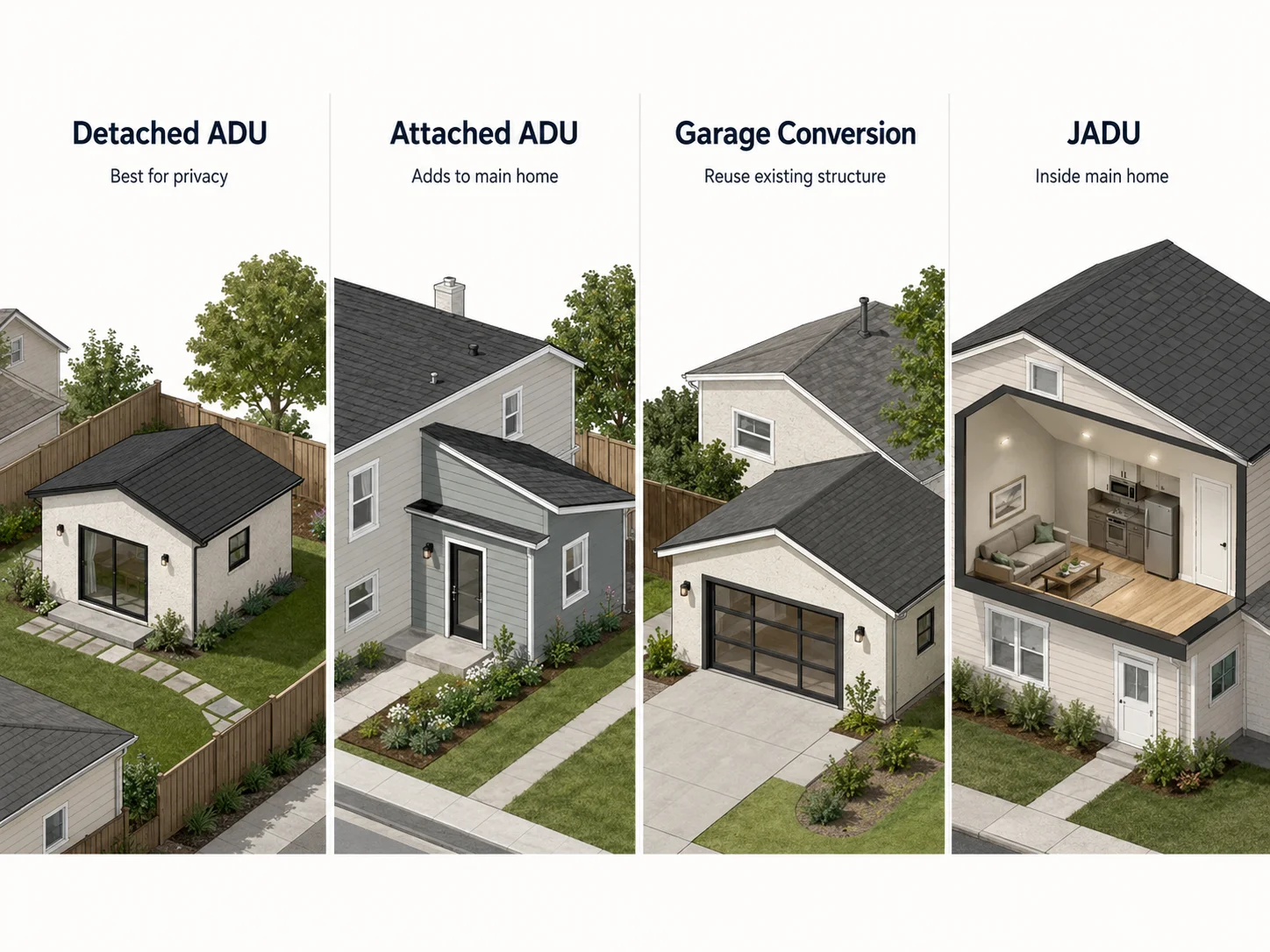
ADU types available in National City: detached, attached, garage conversion, and JADU.
| If your goal is… | Start with this path | Why | Watch out for |
|---|---|---|---|
| Lowest cost, fastest start | Garage conversion or other accessory-structure conversion | Reuses existing foundation, framing, roof, plumbing, electrical; permitting is typically simpler | Existing structure must be permitted and structurally sound; otherwise costs converge with new construction |
| House an aging parent or returning adult child | JADU within the primary (single-family lots only), or a small detached ADU | JADU is cheapest; separate-entrance detached gives more privacy | JADU owner-occupancy rule when shared sanitation; detached costs more |
| Long-term rental income, market-rate | Detached new construction at or under 750 sq ft | Stays inside the impact-fee waiver; clear separation; rentable as 1–2 BR | Per-sf cost is highest of any path; site work and utilities add up |
| Maximum interior square footage | Detached new construction up to 1,200 sq ft | Highest cap allowed; full design flexibility | Above 750 sq ft, proportional impact fees; school fees on the full size |
| Tight lot, can't fit a freestanding building | Attached ADU or above-garage ADU | Attached uses primary's walls; above-garage uses existing footprint | Attached ADU size conflict in NC handbook — verify in writing |
| Duplex expansion | Multifamily ADU path — up to 2 detached ADUs | A duplex caps at 2 detached because that's the existing unit count | JADUs not available on duplex lots; NC's 2024 handbook predates SB 1211 |
| Small multifamily (3+ units) expansion | Multifamily detached ADUs (up to 8 under SB 1211) | Highest unit-count leverage under current state law | NC's 2024 handbook hasn't caught up; expect city to verify against state law directly |
| Sub-5,000 sq ft lot needing two stories | Above-garage ADU at 25 ft, or detached with transit bonus | City handbook allows 25 ft above-garage; near transit can reach 20 ft with roof-pitch match | Structural engineering for two-story adds cost |
Ready to talk through builder options once you've nailed the rules? See our verified National City ADU builder shortlist — segmented by project type with CSLB license documentation.
How people actually pay for ADUs in National City in 2026
Answer capsule. The most-searched financing answer — "the $40,000 California ADU grant" — is not currently available. CalHFA's ADU Grant Program was reported fully allocated as of December 28, 2023 with no confirmed relaunch. CalHFA has posted warnings about scams claiming to help homeowners "access" grant funds — treat any such approach as a financial scam. National City's own ADU Loan Program is listed as "Coming Soon" on the city's official ADU page. The San Diego Housing Commission (SDHC) ADU Finance Program is for eligible properties in the City of San Diego only — National City properties are not eligible. Most National City ADU projects in 2026 are funded through one of five lanes:
| Lane | When it fits | What it preserves | Watch out for |
|---|---|---|---|
| HELOC | Meaningful equity; existing mortgage rate is below current rates; want flexibility | Your existing low-rate first mortgage | Variable rate during construction; balloon or amortization triggers later |
| Home equity loan | Meaningful equity; want a fixed rate and a single draw | Your existing low-rate first mortgage | Rate fixed at origination; no flexibility to redraw |
| Cash-out refinance | Higher-rate existing mortgage and substantial equity; want one consolidated payment | Simplicity, single payment | If you have a low-rate existing mortgage, you give it up on the whole balance — usually the wrong trade |
| Renovation loan (HomeStyle / 203(k)) | Don't have enough current equity; the project's value will substantially exceed cost | Ability to fund a project larger than your current equity | More paperwork; appraisal-on-completion risk; some programs require contractor approval |
| ARV product | Renovation loan won't work and you need ARV-based underwriting | Similar to renovation loan | Higher interest rate; less consumer-protection oversight |
Specific loan terms, LTV ratios, and qualification rules vary by product and lender. Do not assume projected ADU rental income will count toward your loan qualification unless your loan officer confirms it in writing for your specific product.
Compare common funding routes and their eligibility limits before contacting a lender.Compare ADU Financing Options
For a deeper comparison of these paths, see our full guide to ADU financing options.
Your 10-minute National City ADU pre-call checklist
Before you call National City Planning, National City Building, or any builder, gather these 11 facts. Having them in hand turns a 30-minute "we'll have to look into it" conversation into a 10-minute "yes, here's what applies."
- 1Address and APN (Assessor's Parcel Number). Pull the APN from the San Diego County Assessor's parcel lookup. Planning will ask.
- 2Property type. Single-family, duplex, triplex, multifamily? (Treated differently for ADU count and JADU eligibility.)
- 3Lot dimensions. Width × depth in feet. Sub-5,000 sq ft lots have additional pathways.
- 4Proposed ADU type. Detached new construction, attached, garage conversion, JADU, or above-garage?
- 5Target size. A specific number — 600, 749, 800, 1,000, 1,200 sq ft. The fee thresholds at 500 and 750 sq ft matter.
- 6Existing structure to convert (if applicable). Square footage, permitted/unpermitted, structural condition (rough).
- 7Rough proposed location on the lot. Backyard, side yard, replacing existing structure.
- 8Distance from the curb to the farthest proposed point of the ADU. Stay under 150 ft.
- 9Sewer or septic. Most NC properties are sewer; if septic, you have a DEHQ review step.
- 10Water provider. Most NC is Sweetwater Authority. If your water service needs review, plan a ~6-week submittal cycle.
- 11Coastal flag. Is the parcel inside the California Coastal Zone? (Western/bayfront yes; rest of city no.)
Call script for Planning Division — (619) 336-4310
Call script for Building Division — (619) 336-4210
Want the call scripts as a printable PDF along with the bid-vetting questions, fee-threshold table, and lot-fit checklist? Download the Free ADU Starter Kit — formatted for printing or saving to your phone.
What changed for 2026 — verification checklist before you submit
The most consequential 2025–2026 updates to California ADU law materially affect what National City must permit, regardless of what the city's 2024 handbook still describes. Run through this checklist before you finalize a design.
| Item to verify | Why it matters | Where to verify |
|---|---|---|
| HCD 2025/2026 ADU Handbook | Statewide interpretation reflecting recent legislation (SB 477, SB 1211, AB 1033, AB 462, etc.) | hcd.ca.gov/policy-and-research/accessory-dwelling-units |
| HCD's December 5, 2025 letter to National City | Indicates which ordinance provisions may be null and void; state law controls those | Direct PDF on hcd.ca.gov (linked in the HCD letter section above) |
| Multifamily detached ADU count (SB 1211 — 8, not 2) | National City's handbook still references 2 | Cal. Gov. Code §66323; HCD handbook |
| Attached ADU size — conflicting handbook language | Handbook conflicts within itself; verify in writing | NC Planning Division (619) 336-4310 |
| JADU owner-occupancy nuance | Tied to sanitation, not blanket | Cal. Gov. Code §66333(b); HCD handbook |
| AB 1033 separate-sale status | NC has not adopted; if relevant to your plan, monitor | NC ADU page; HCD Portal |
| Current city fee schedule | Master Fee Schedule documents posted through June 30, 2026 and effective July 1, 2026 | NC Fee Schedule page; Building Division (619) 336-4210 |
| Sweetwater Authority current process | Service upgrade lead time | sweetwater.org / city handbook |
| National City ADU Loan Program | Listed "Coming Soon" | NC ADU page (monthly check) |
| Coastal applicability for your parcel | Western/bayfront properties only | California Coastal Commission boundary map |
| CalHFA grant status | Funding fully allocated as of December 28, 2023; no confirmed relaunch | calhfa.ca.gov/adu |
| Preapproved ADU plan program | Not visible on the city's public ADU page as of our verification; verify with Building | NC ADU page; Building Division (619) 336-4210 |
| Builder service area and licensure | CSLB status changes; verify at signing | CSLB consumer license lookup |
For an address-specific cross-check against all 13 items, run our free 60-second feasibility report.
Frequently asked questions
Are ADUs allowed in National City?
Yes, on most residentially zoned lots — single-family, duplex/multifamily, and residentially designated areas of mixed-use zones — subject to NCMC §18.30.380 and current California state law. Confirm your parcel's zoning with Planning Division at (619) 336-4310 before relying on a design.
What is the maximum ADU size in National City?
A detached ADU is capped at 1,200 sq ft under NCMC §18.30.380. A JADU is capped at 500 sq ft of interior livable space (plus up to 150 sq ft for ingress/egress). Attached ADU size has conflicting wording in the city's 2024 handbook — verify with Planning before final design. ADUs within an existing footprint (a conversion) have no size cap beyond the footprint.
What are the setback requirements for an ADU in National City?
Front 15 ft; side 4 ft; rear 4 ft (state-law floor under Cal. Gov. Code §66323). Building separation: 5 ft between the ADU and any existing structure on the lot. Plus one 24-inch box tree in the front-yard setback area or abutting parkway.
Do I need parking for an ADU in National City?
No. The city's handbook reflects that parking is not required for the ADU types summarized. Under SB 1211, replacement parking is not required when a garage, carport, covered parking, or uncovered parking is demolished or converted for ADU construction.
Can I build a two-story ADU in National City?
Yes. Detached ADUs must be allowed at least 16 ft, up to 18 ft within ½ mile of major transit or HQTC, plus 2 ft additional for matching roof pitch. Attached ADUs may reach 25 ft or the zone's limit (whichever is lower). ADUs above a garage or on sub-5,000 sq ft lots may reach 25 ft per the city's handbook.
Can I convert my garage into an ADU?
Yes, if the existing garage is permitted and structurally sound. The 1,200 sq ft cap does not apply to a conversion within an existing footprint. The city's handbook flags conversions as the most cost-effective ADU type.
How long does the National City ADU permit process take?
California state law (Cal. Gov. Code §66317) requires the city to determine completeness within 15 business days and to approve or deny a complete application within 60 days. Real-world National City permit timeline averages 3–4 months from complete submittal per SnapADU's published builder estimate (page updated April 2026). Total kickoff-to-occupancy is typically 9–14 months.
How much does it cost to build an ADU in National City?
Detached new construction in National City typically runs $300,000–$450,000+ all-in in 2026, or roughly $300–$600 per square foot. Garage conversions run $100,000–$200,000. Permit-related costs alone add roughly $10–$12 per sq ft per SnapADU's builder-published estimate.
Do new detached ADUs in National City need solar?
Yes. National City's ADU Handbook requires new detached ADUs to include a solar PV system, consistent with California Title 24 requirements.
Do I need to live on the property to build an ADU in National City?
No for a standard ADU — Cal. Gov. Code §66315 prohibits a local owner-occupancy requirement on standard ADUs. For a JADU under current Cal. Gov. Code §66333, owner-occupancy may be required where the JADU has shared sanitation facilities and cannot be required where it has separate sanitation.
Can I rent out my National City ADU on Airbnb?
No for short-term vacation rentals. National City's ADU Handbook prohibits short-term vacation rental use of an ADU. Long-term rentals (terms longer than 30 days) are allowed.
Can I sell my ADU separately in National City?
Not as of May 2026. National City has not adopted AB 1033 (Cal. Gov. Code §66342), which would permit separate conveyance of ADUs as condominiums. The City of San Diego (August 22, 2025) and County of San Diego (April 4, 2026) have adopted; National City has not.
Is a soils report required for an ADU in National City?
SnapADU's National City regulations page (page updated April 2026) publishes that the city commonly requires a soils/geotechnical report around the 500 sq ft mark for detached ADUs. The city's handbook lists drainage, slopes, foundation type, right-of-way work, and new sewer connections as engineering-review triggers. Confirm with Building at (619) 336-4210 for your specific project.
Are impact fees waived for ADUs in National City?
For ADUs of 750 sq ft of interior livable space or less, yes — exempt from local impact fees under Cal. Gov. Code §66311.5(c). For JADUs of 500 sq ft or less, also exempt. Above those thresholds, impact fees must be charged proportionally to the primary dwelling.
Will building an ADU raise my property taxes?
Only the new construction is reassessed, not the entire property. Per the city's ADU Handbook, the San Diego County Assessor assesses the new ADU at current valuation; existing square footage that wasn't touched by the project is not reassessed.
Do I need a Coastal Development Permit for an ADU in National City?
Only if your parcel is inside the California Coastal Zone — generally the bayfront/western portions of the city. Most National City residential lots are inland and unaffected. Check the California Coastal Commission's coastal zone map or call Planning at (619) 336-4310. AB 462 (signed October 10, 2025) caps a local government's ADU CDP review at 60 days.
How many ADUs can I build on a duplex or multifamily lot in National City?
Up to 8 detached ADUs, capped by the number of existing units on the lot, plus interior conversions equal to 25% of the existing unit count (with at least one always permitted). A duplex caps at 2 detached because there are only 2 existing units. This is under current Cal. Gov. Code §66323 as amended by SB 1211. National City's 2024 handbook still references "up to two detached" for multifamily; current state code controls.
Where do I submit my ADU permit application?
Email a complete packet (including the city's Credit Card Authorization Form) to building@nationalcityca.gov, or drop it off in person at the Building Division Counter at City Hall, 1243 National City Boulevard, 7:00 a.m.–4:30 p.m. Monday through Thursday. For zoning and design questions, call Planning at (619) 336-4310. For permit and fee questions, call Building at (619) 336-4210.
What if my city tells me a rule that contradicts the state law I just read?
Cite the specific state code section and the HCD letter dated December 5, 2025. The relevant framing: "Under Cal. Gov. Code §66316, where a local ordinance is null and void for noncompliance with state ADU law, the local jurisdiction must apply state law until a compliant ordinance is adopted." Be polite, prepared, and bring documentation.
Can I qualify for AB 253 expedited plan check in National City?
AB 253 may apply to eligible ADU permits — generally ministerial residential permits covering 1–10 total units, 100% residential, no floors more than 40 feet above ground, after the application is deemed complete, required fees are paid, and the city's review exceeds the statutory trigger. Confirm with your builder and the city whether your project qualifies before invoking AB 253.
Methodology
This guide was researched and written by the Dwelling Index Editorial Team. Dwelling Index is an independent research resource covering ADU financing, costs, and regulations.
For regulatory and code citations, we reviewed: the City of National City's official ADU page; the National City ADU Handbook (March 2024); National City Municipal Code §18.30.380 and §18.30.390 via Municode; California Government Code §§66310–66342 via California LegInfo; HCD's 2025/2026 ADU Handbook update; HCD's Letter of Technical Assistance to National City dated December 5, 2025; and SB 1211, SB 477, SB 543, AB 1033, AB 462, and related California legislation.
For cross-city comparisons, we reviewed the ADU pages and ordinances of the City of San Diego, Chula Vista, Lemon Grove, Imperial Beach, and the County of San Diego Planning & Development Services.
For builder-published estimates, we relied on SnapADU's National City regulations page (page updated April 2026, visible planner-verification note dated November 2022), BNC Builders' 2026 cost guide, ADU Geeks' 2025 San Diego County guide, and Streamline Design Group's December 2025 San Diego permit-cost analysis. Builder-published figures are labeled as such. Utility cost ranges are aggregated builder/contractor planning estimates; they are not city- or utility-published fee schedules.
For rental comps, we aggregated ZIP 91950 comps from ApartmentFinder, Apartments.com, Rent.com, RentCafe, Zumper, and RentHop, pulled February–April 2026.
We did not rank lenders, builders, or providers by payout, commission, or affiliate compensation. SnapADU and Mortgage Research Center are disclosed affiliate partners on this page; affiliate status determined CTA presence and link routing, not the editorial conclusions, table contents, or rule interpretations.
This content is informational and is not legal, financial, tax, lending, or construction advice. Before signing a contract, paying a deposit, or relying on any specific cost figure or rule interpretation, verify directly with the contractor, the City of National City, the relevant state agency, or a licensed professional in California. If you find an error, email corrections@dwellingindex.com.
Direct verification links
- City of National City ADU page
- City of National City Fee Schedule page
- HCD's December 5, 2025 letter to National City (PDF)
- California Government Code §§66310–66342 (LegInfo)
- HCD ADU page — state agency overview
- California Coastal Commission coastal zone boundary map
- CSLB consumer license lookup
- CalHFA ADU Grant Program page
- National City Planning Division: (619) 336-4310 · planning@nationalcityca.gov
- National City Building Division: (619) 336-4210 · building@nationalcityca.gov
- National City Engineering Division: (619) 336-4380
- National City Fire Prevention: (619) 336-4550
- Sweetwater Authority: (619) 420-1413
- San Diego County DEHQ: (858) 565-5173
Related guides
Not sure where to start? See what's possible at your address.
See What You Can Build in National City
Get your free ADU feasibility report in 60 seconds — setback envelope, fee thresholds, and the state-law-vs-local-rule deltas for your specific parcel.
Get Your Free ADU Report →