
Best ADU Builders National City (2026): The Verified Shortlist, Real Permit Math, and What to Confirm Before You Sign
The best ADU builders National City homeowners can hire aren't ranked by stars or marketing spend — they're matched to project type. For a custom detached ADU (accessory dwelling unit), the strongest National City–experienced design-build firms are SnapADU, Better Place Design & Build, and Organic ADU. For a garage conversion or attached addition, you'll usually do better with a remodeler-GC like Kanna Construction or YNK Construction. For prefab or modular, US Modular has a published National City page and posted licenses, but require an all-in installed quote — never a factory shell price. Two anchors set every conversation that follows: National City Municipal Code §18.30.380 caps detached ADUs at 1,200 square feet, and builder-published permit-cost estimates run roughly $10–$12 per square foot in National City — about 2–3× what neighboring Chula Vista charges (figure published by SnapADU April 2026; this is a builder estimate, not a posted city fee schedule — verify directly with National City Building Division at (619) 336-4210). One detail most generic builder lists skip: National City commonly requires a soils/geotechnical report on detached ADUs around the 500 sq ft mark — that single requirement adds $2,000–$5,000 and 2–4 weeks to your timeline, and it's why so many National City quotes come in higher than homeowners expect.
We're Dwelling Index, an independent research resource covering ADU financing, costs, and regulations. We don't own any of the builders on this page. Where we have a partnership, we say so. Every regulatory and fee figure here is sourced to the City of National City, the California Government Code, the California Department of Housing and Community Development (HCD), or the builder's own published material — and labeled accordingly. Anything we couldn't verify, we mark.
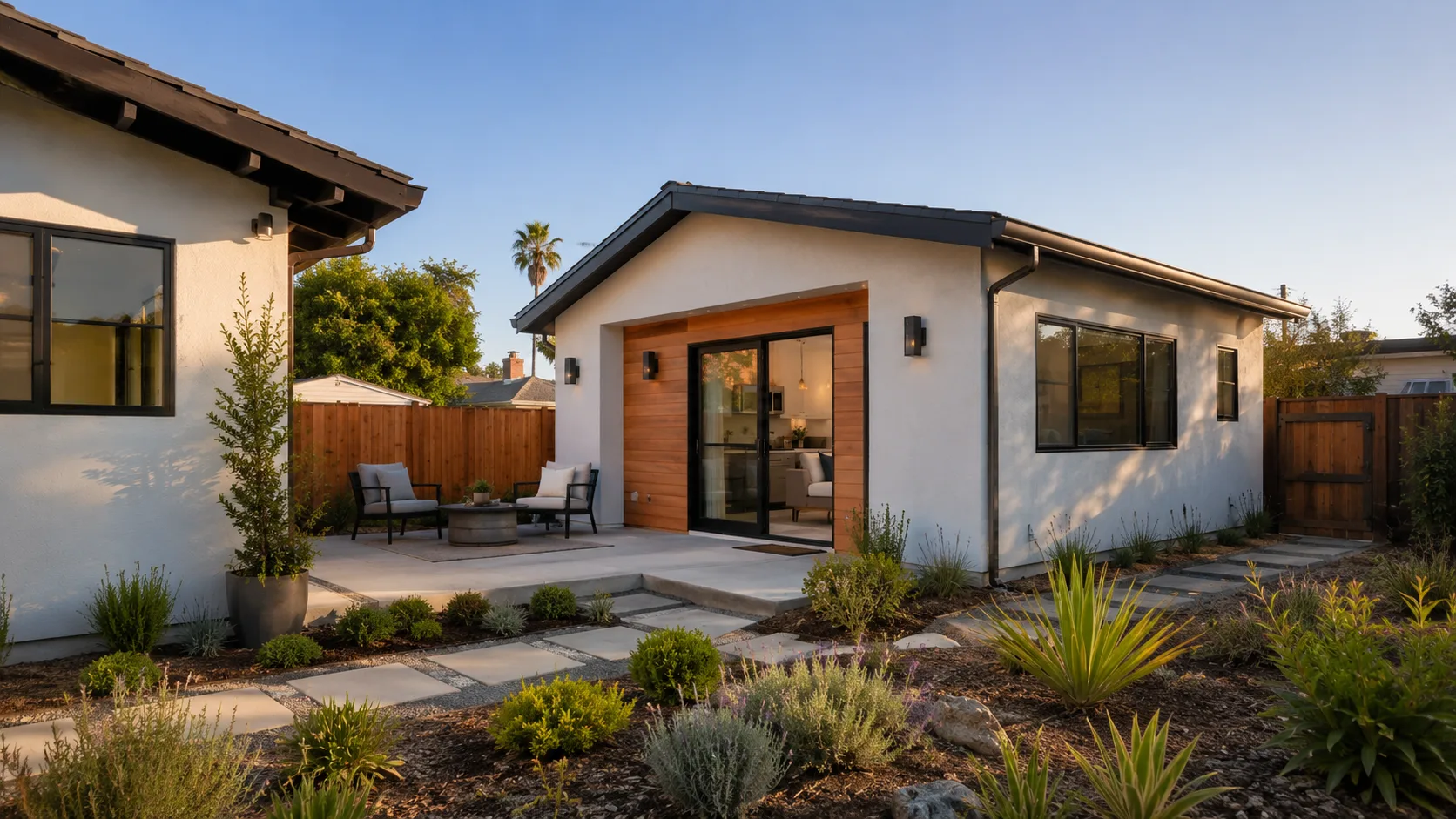
See What You Can Build in National City → Get Your Free ADU Report
Address-specific feasibility check: National City Municipal Code eligibility, coastal-zone flag, soils-report likelihood, all-in cost band, indicative rent. No phone call required.
Run my free Feasibility checkWhat we verified for this page
We split this into three categories so you can tell what came from the city, what came from a provider, and what's an editorial estimate built from public data.
Officially verified (city, state, or government source)
- Detached ADU size cap 1,200 sq ft; JADU 500 sq ft of interior livable space; minimum 4-ft side and rear setbacks; 15-ft front setback; 5-ft separation between the ADU and any existing structure — NCMC §18.30.380; Cal. Gov. Code §§66310–66342; HCD ADU Handbook.
- The fire hose pull from the curb to the farthest point of the ADU may not exceed 150 feet — National City ADU Handbook (March 2024).
- New detached ADUs in National City are required to include a solar system — National City ADU Handbook.
- If Sweetwater Authority review is triggered, approximately a 6-week submittal cycle — National City ADU Handbook.
- Local impact fees are not required for ADUs of 750 sq ft of interior livable space or less and JADUs of 500 sq ft or less; over those thresholds, fees are charged proportional to the primary dwelling — Cal. Gov. Code §66311.5(c) as amended by SB 543; National City ADU Handbook.
- Less than 500 sq ft of interior livable space is exempt from school developer fees; 500 sq ft or more triggers district fees — Cal. Gov. Code §66311.5; Cal. Education Code §17620.
- Long-term rental is allowed; short-term vacation rental use is prohibited — National City ADU Handbook.
- No state-level owner-occupancy requirement applies to standard ADUs — Cal. Gov. Code §66315. For JADUs: may be imposed where shared sanitation, cannot be imposed where separate sanitation — Cal. Gov. Code §66333.
- 15 business days to determine completeness; 60 days to approve or deny a complete application — Cal. Gov. Code §66317.
- AB 462 (signed October 10, 2025) caps CDP review for an ADU at 60 days and removes Coastal Commission appeal jurisdiction — Cal. Gov. Code §66329(c) as amended.
- California Construction Cost Index moved from 7,090 (January 2021) to 10,258 (December 2025) — a roughly 44.7% increase — California Department of General Services.
- CSLB caps home improvement contract down payments at the lesser of $1,000 or 10% of the contract price — CSLB consumer materials.
- CalHFA ADU Grant Program funding was reported fully allocated as of December 28, 2023 — check CalHFA directly before counting on this program.
- National City ADU Loan Program is listed as “Coming Soon” on the city's official ADU page as of our verification date.
- Application submission: email to building@nationalcityca.gov or in person at Building Division Counter, City Hall, 7:00 a.m.–4:30 p.m. Monday through Thursday — City of National City ADU page.
Provider-reported (named builder claim, not city-confirmed)
- Permit-related costs of approximately $10–$12 per square foot in National City, with a 3–4 month standard permitting timeline and a soils/geotechnical report commonly required around the 500 sq ft threshold — published by SnapADU on its National City regulations page, last refreshed April 2026. These are builder-published estimates; confirm with National City Building Division.
- A completed 749 sq ft, 2BR/2BA rental ADU on East Plaza Boulevard in National City with a published build cost of $284,000 — SnapADU project page (use as a single partner-published example, not a universal price).
- Better Place Design & Build (CSLB License #1031735, company-published) lists a National City service-area page — Better Place website (March 2026). Live CSLB status not confirmed by Dwelling Index.
- YNK Construction (CSLB License #1104373, company-published) lists National City in its San Diego service area. Live CSLB status not confirmed by Dwelling Index.
- SL United Construction (CSLB License #1021808, company-published) publishes turnkey ADU services across San Diego County. Live CSLB status not confirmed by Dwelling Index.
- Troia Construction (CSLB License #1151054, company-published) publishes GC and ADU services across San Diego County. Live CSLB status not confirmed by Dwelling Index.
- US Modular (HCD Dealer License #DL1241679; CSLB General Contractor License #943047, company-published) publishes a National City ADU page. The published starting price (~$78,000 for a 398 sq ft unit) is from 2020 — index forward ~44.7% for 2026 conditions.
- Organic ADU publishes a National City project gallery; license documentation and permit history should be verified before contract.
We strongly recommend verifying any contractor's CSLB license status at the moment you sign via the CSLB consumer license lookup.
Market data and editorial estimates
- 2026 rental comps for ZIP 91950: 1-BR ~$1,675–$2,345/month; 2-BR ~$2,144–$2,790/month — aggregated from ApartmentFinder, Apartments.com, Rent.com, RentCafe, Zumper, and RentHop, pulled February–April 2026.
- 2026 all-in detached ADU project cost ranges for National City are editorial estimates derived from SnapADU's published San Diego–region benchmarks, BNC Builders' 2026 cost guide, and Better Place's published per-square-foot range, indexed against the 44.7% CCCI increase. Labeled as estimates, not quotes.
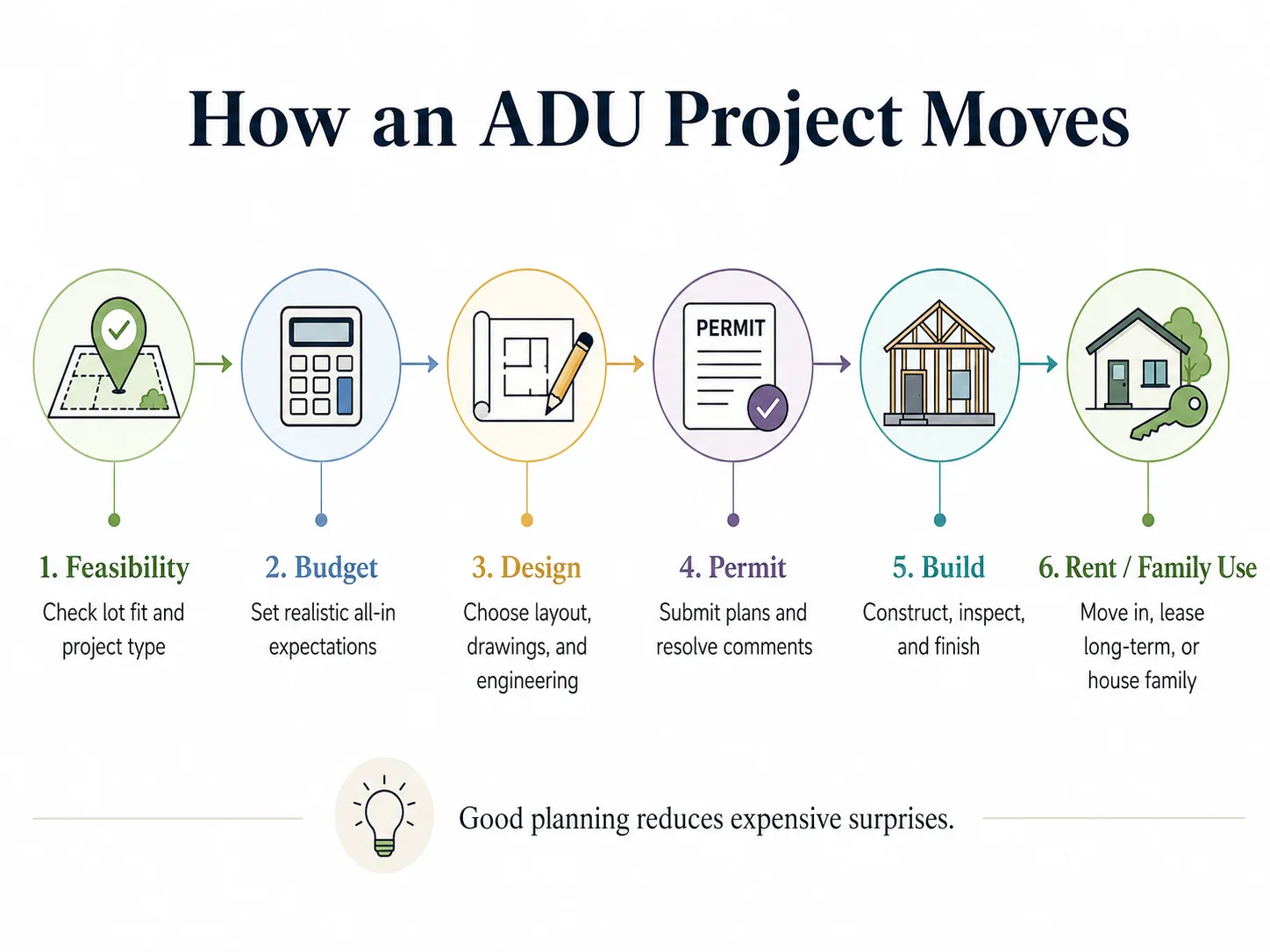
Which ADU builder type fits your National City project?
The fastest filter isn't the brand — it's the lane. A custom-detached design-build firm is the wrong first call for a 400 sq ft garage conversion. A remodeler-GC is the wrong first call for a 1,200 sq ft two-story detached ADU. Use this matrix to find your lane first.
| Your situation | Best first-call builder lane | National City–capable providers |
|---|---|---|
| Custom detached ADU, full design–permit–build | ADU-only design-build specialist | SnapADU, Better Place Design & Build, Organic ADU |
| Two-story or above-garage detached ADU | Specialist with structural / two-story experience | SnapADU, Better Place Design & Build |
| Garage conversion or attached ADU | Remodeler-GC with conversion-specific work | Kanna Construction, Better Place Design & Build, YNK Construction |
| Prefab or modular ADU | Factory-built specialist (verify all-in installed price) | US Modular (publishes a National City page) |
| Budget-sensitive (sub-$300K target) | Compare three paths simultaneously | Sub-750 sq ft detached, garage conversion, or prefab on a flat lot |
| Investor / rental-income focus | Layout- and operating-cost-optimized builder | Any of the above, with rental layout and post-build management plan |
See What You Can Build in National City → Get Your Free ADU Report
Free, address-specific starting point. We'll show the likely ADU type, builder lane, and permit-risk questions before you pay for plans.
Run my free Feasibility checkThe 9 ADU builders that actually serve National City in 2026
Most “best ADU builder” lists either rank generalist contractors with one ADU under their belt or push a single firm's marketing. The shortlist below is segmented by project type, with publicly verifiable proof for each entry: their published National City service area, their CSLB license number where the firm publishes one, and their best-fit lane.
We verified every entry by pulling the firm's own service-area page in March or April 2026. We did not include firms that say “all of San Diego County” without National City–specific service or project proof.
National City ADU builder fit matrix
Affiliate disclosure: The Dwelling Index is reader-supported. Some links on this page are affiliate links. If you click one and take a qualifying action, we may earn a commission at no extra cost to you. Affiliate relationships do not influence our editorial rankings or conclusions. Read our full disclosure.
| Builder | Serves National City | Method | ADU specialization | Conversion / JADU focus? | Notes |
|---|---|---|---|---|---|
| SnapADU | Yes (National City in named service area + published project) | Site-built detached ADUs | ADU-only since 2020 | Limited (focus is detached) | Approved Dwelling Index partner. Publishes East Plaza Blvd completed project ($284K / 749 sq ft). Verify CSLB before signing. |
| Better Place Design & Build | Yes (dedicated National City page) | Design-build (site-built) | Strong ADU presence; remodels and additions | Yes — covers garage conversion and attached | CSLB #1031735 (company-published). Published $375–$600/sf range. Confirm recent NC permit history. |
| Organic ADU | Yes (National City project gallery) | Design-build (site-built) | Custom detached and conversions | Partial | Project imagery published; verify CSLB, insurance, and permit history before contract. |
| Kanna Construction | Yes (National City listed in service area) | Remodel-GC with ADU capability | ADU + home additions | Yes — conversion-led | Remodel-first positioning. Verify ADU-specific permit history; ask for two recent NC ADU permits. |
| YNK Construction | Yes (National City in SD service area) | Custom remodel and ADU | Mid-size detached, attached, remodel-ADU | Yes | CSLB #1104373 (company-published). Ask for ADU-only references and at least one NC permit number. |
| SL United Construction | Yes (SD County turnkey ADU services) | Turnkey GC | Design-permit-build | Partial | CSLB #1021808 (company-published). Published cost range $200K–$400K+; confirm NC-specific items are in scope. |
| Troia Construction | Yes (SD County GC and ADU services) | Owner-run GC | Garage conversion, smaller detached | Yes | CSLB #1151054 (company-published). Verify recent NC permit history and utility-coordination capability. |
| YesADU | Yes (plans, designs, permits, builds in SD County incl. NC) | Plan-driven design-build | Standardized plan path | Partial | Surface website is light on license number and itemized cost. Verify CSLB, who builds (in-house vs sub), and ask for two recent references. |
| US Modular | Yes (dedicated National City ADU page) | Prefab / manufactured ADU | Factory-built units | No | HCD #DL1241679; CSLB #943047 (company-published). Published 2020 base price; 2026 all-in cost higher. Compare installed price vs stick-built before deciding. |
How we ordered this list
ADU-only specialists with verified National City work first; full-service design-build firms with a published National City service page next; remodeler-GCs and conversion-focused contractors after; prefab/modular as its own lane. Order is not based on referral payout.
Talk to a National City–experienced ADU specialist
Request a SnapADU project consultation.
Request a SnapADU consultation →Affiliate link. SnapADU is one option, not the only option. Verify license status, scope, exclusions, insurance, and references before signing.
Other research leads worth knowing
CRS Builders Inc., Creative Design & Build Inc., and San Diego Building & Renovation all publish National City as part of their service area. Use them as additional bid comparisons rather than first calls; verify CSLB status, ADU-specific permit history, and request two recent project references each.
What to do with Yelp and Google reviews
The local search results for “ADU builders National City” surface 30+ contractors. Use Yelp and Google reviews to pressure-test communication style, schedule slip, and post-handoff responsiveness. Don't use them to evaluate code competency or National City permitting fluency — that comes from the 14 vetting questions further down this page.
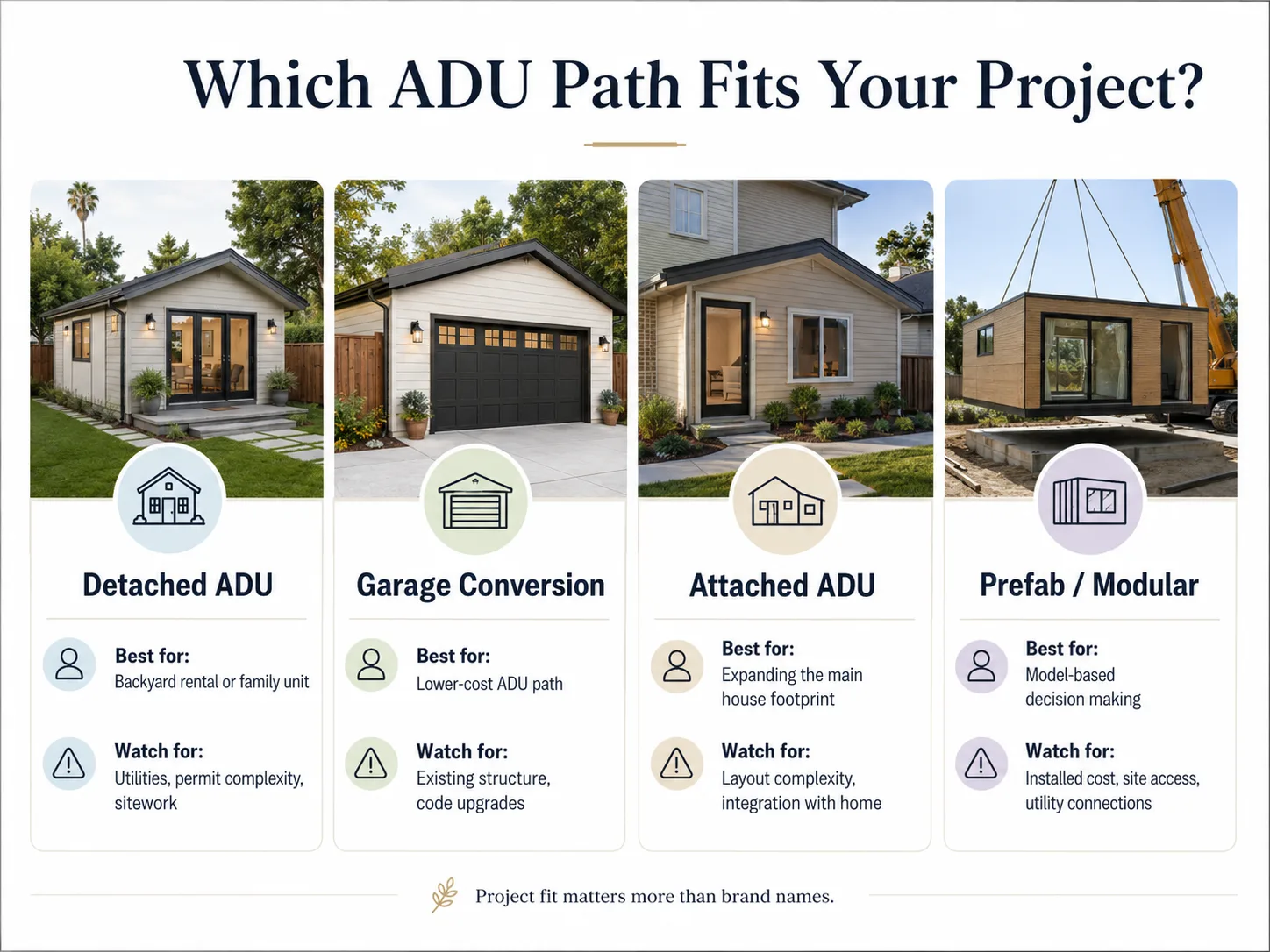
How much does an ADU actually cost in National City in 2026?
A typical detached ADU in National City costs roughly $300,000–$450,000+ all-in in 2026 — about $300–$600 per square foot depending on size and finish. Garage conversions run roughly $100,000–$200,000. Prefab base prices look lower on the sticker but converge with stick-built once site work, foundation, utility connections, crane, and city permit fees are added. National City's permit math is a meaningful piece of the all-in number: SnapADU's published estimate of $10–$12 per square foot in permit-related costs (April 2026, builder-published) means a 1,000 sq ft unit pays roughly $10,000–$12,000 just to the city before the first hammer swings.
The National City permit cost-by-size table (builder-published planning estimates)
SnapADU's $10–$12/sf figure is a builder-published practitioner estimate of total permit-related costs — building plan check, permit issuance, school fees where they apply, and related charges. It's not a single line on the city's posted fee schedule; it's the blended number based on actual recent submittals. Verify with National City Building Division at (619) 336-4210 before you commit.
| ADU size | Permit cost (low) | Permit cost (high) | Soils report add-on | School fees trigger | Subtotal (mid) |
|---|---|---|---|---|---|
| 400 sq ft | $4,000 | $4,800 | None typically | None — under threshold | ~$4,400 |
| 600 sq ft | $6,000 | $7,200 | $2,000–$5,000 | Yes — see district rates | ~$10,000–$13,000 |
| 750 sq ft (impact-fee waiver line) | $7,500 | $9,000 | $2,000–$5,000 | Yes — see district rates | ~$11,000–$14,500 |
| 1,000 sq ft | $10,000 | $12,000 | $2,000–$5,000 | Yes — see district rates | ~$13,500–$17,000 |
| 1,200 sq ft (NC detached max) | $12,000 | $14,400 | $2,000–$5,000 | Yes — see district rates | ~$15,500–$19,400 |
Sources: $/sf permit estimate from SnapADU's National City regulations page, builder-published, last refreshed April 2026 (verify with National City Building Division). Soils-report cost band from BNC Builders 2026 cost guide and Streamline Design Group's San Diego permit-cost analysis (December 2025). All figures are planning estimates, not quotes.
The single most actionable insight in this table
ADUs of 750 sq ft of interior livable space or less are exempt from local impact fees under California Government Code §66311.5(c) (as amended by SB 543) and confirmed in National City's handbook. Above 750 sq ft, fees are charged proportionally. The fee differential between 749 sq ft and 800 sq ft can run $8,000–$15,000 across the typical local fee bundle. If you're on the line, sharpen your pencil.
National City school developer fees — published rates by district (2026)
For school developer fees, the threshold is: less than 500 sq ft of interior livable space is exempt; 500 sq ft or more triggers fees. Confirm which school districts serve your specific parcel before quoting — National City addresses fall across multiple districts.
| District | Published rate (residential, per sq ft) | Verification date |
|---|---|---|
| National School District (elementary) | $1.80/sf | NSD developer-fee page, current as of last verification |
| Sweetwater Union High School District (high school) | $2.90/sf through June 21, 2026 / $3.01/sf beginning June 22, 2026 | Sweetwater UHSD developer-fee schedule |
| San Diego Unified School District (some NC addresses) | $5.17/sf through May 10, 2026 / $5.38/sf beginning May 11, 2026 | SDUSD developer-fee notice |
Most National City elementary/high school combinations result in a combined district rate of around $4.70/sf — roughly $4,700 in school fees on a 1,000 sq ft ADU. If your address falls under SDUSD instead, the number is materially higher.
Why permits cost more here than in Chula Vista
| City | Permit cost (750 sq ft) | Source type | Verification date |
|---|---|---|---|
| National City | $7,500–$9,000 (at $10–$12/sf) | Builder-published blended estimate (SnapADU) | April 2026 |
| Chula Vista | $3,951 (City Standard plan) / $4,963 (nonstandard) | Official city fee bulletin (Chula Vista Fee Bulletin 10-400) | September 2024 |
| City of San Diego | ~$6,500 (small unit) – ~$21,000 (1,200 sf) | Third-party permit analysis (Streamline Design Group) | December 2025 |
| Unincorporated SD County | $8,000–$11,000 average (post-waiver) | Third-party analysis (Streamline Design Group) | December 2025 |
A real National City project: $284K for 749 sq ft
SnapADU publishes a completed project on East Plaza Boulevard in National City: a 749 sq ft, 2-bedroom / 2-bathroom rental ADU with a stated build cost of $284,000. That's $379 per square foot. Use this as one builder-published data point, not a universal price — it sits at the top of the impact-fee waiver line, was built by a specialist, and the actual price for your lot will depend heavily on site access, utilities, finishes, and current material costs. But it's one of the only city-specific completed-project price points any San Diego ADU builder publishes openly, and it gives you a defensible reference to ask other bidders to explain.
The soft costs everyone forgets
A budget that lists only “construction” understates a National City project by 15–25%. The line items that consistently show up after the construction quote: design and architectural fees ($8,000–$25,000), structural engineering ($2,500–$7,500), Title 24 energy compliance documentation ($800–$2,500), soils report around 500 sq ft ($2,000–$5,000), utility upgrades and trenching ($3,000–$15,000), Sweetwater Authority water service or meter upgrade ($2,000–$8,000 plus ~6-week processing), SDG&E coordination for new electrical service ($1,500–$10,000+), sewer lateral inspection or capacity fees ($500–$5,000), school developer fees on units of 500 sq ft or more, the required solar PV system on new detached ADUs ($6,000–$15,000), and a 10–15% project contingency. A mid-size 800 sq ft unit can carry $25,000–$45,000 in soft costs on top of construction. A bid that doesn't separate these is not a bid you can compare.
California Construction Cost Index — why old quotes mislead
The California Construction Cost Index (CCCI), published by the California Department of General Services, moved from 7,090 in January 2021 to 10,258 in December 2025 — a roughly 44.7% increase. A 2021 quote of $200,000 for the same scope is worth roughly $290,000 today. If you're holding an old comparable from a friend who built in 2020 or 2021, index it forward before you decide whether your 2026 quote is reasonable.
Want a lot-specific cost band? See What You Can Build → Get Your Free ADU Report
Address-specific feasibility, soils-report likelihood, all-in cost band, and indicative rent — without a phone call.
Run my free Feasibility checkWhat are National City's ADU rules in plain English?
National City's ADU rules sit on top of California state law (Government Code §§66310–66342). The local ordinance is NCMC §18.30.380 for ADUs and §18.30.390 for JADUs. The City of National City also publishes an ADU Handbook that explains how the city interprets and applies these rules in practice. Where the handbook and the municipal code conflict, the handbook says the municipal code controls. And where state law has updated since the city's 2024 handbook, state law controls.
| Rule | What it says | Source |
|---|---|---|
| Maximum size, detached ADU | 1,200 sq ft (with conversion exceptions for ADUs within an existing dwelling or accessory structure footprint) | NCMC §18.30.380; NC ADU Handbook |
| Minimum size | 150 sq ft (efficiency unit minimum) | NC ADU Handbook |
| Maximum size, attached ADU | National City's handbook contains conflicting wording. One section reads “50% of main dwelling or 1,200 sq ft, whichever is greater”; another reads “50% of the existing house or 1,200 sq ft, whichever is less.” Cal. Gov. Code §66321 prevents local rules from precluding at least 800 sq ft. Confirm with Planning Division before final design. | NC ADU Handbook (conflicting); Cal. Gov. Code §66321 |
| Front setback | 15 ft | NC ADU Handbook |
| Side and rear setbacks | 4 ft minimum (state-law floor) | NCMC §18.30.380; Cal. Gov. Code §66323 |
| Building separation | 5 ft between the ADU and any existing structure on the property | NCMC §18.30.380; SnapADU summary |
| Detached ADU height | At least 16 ft must be allowed (state floor); 18 ft on lots within ½ mile of major transit or with multifamily; +2 ft if matching primary roof pitch | Cal. Gov. Code §66321; NCMC §18.30.380 |
| Attached ADU height | Up to 25 ft, or the underlying zone's height limit, whichever is lower | Cal. Gov. Code §66321 |
| Above-garage / sub-5,000 sq ft lot pathway | Up to 25 ft per the city's handbook for ADUs above a garage on lots smaller than 5,000 sq ft | NCMC §18.30.380; NC ADU Handbook |
| Fire access | Fire hose pull from the curb to the farthest point of the ADU may not exceed 150 feet | NC ADU Handbook |
| Solar (PV) | New detached ADUs require a solar system | NC ADU Handbook |
| Soils / geotechnical report | Commonly required around the 500 sq ft mark per builder publishing; the city handbook does not publish a numeric threshold — engineering review may be triggered by drainage, slopes, foundation type, right-of-way work, or new sewer connections. Confirm with NC Building Division for your site. | SnapADU NC page; NC ADU Handbook; NC Building Division (619) 336-4210 |
| Number of ADUs (multifamily lot) | Up to eight detached ADUs (capped by existing unit count) under SB 1211 / Cal. Gov. Code §66323, plus interior conversions of up to 25% of existing units. National City's 2024 handbook still references up to two detached ADUs for multifamily lots; current state code controls. | Cal. Gov. Code §66323 (SB 1211); NC ADU Handbook (predates SB 1211) |
| Owner-occupancy (standard ADU) | Not required under current state law | Cal. Gov. Code §66315 |
| Owner-occupancy (JADU) | May be required where the JADU has shared sanitation; cannot be required where the JADU has separate sanitation. National City's 2024 handbook references a general owner-occupancy requirement — confirm current city interpretation with Planning. | Cal. Gov. Code §66333; NC ADU Handbook |
| Impact-fee waiver | ADUs of 750 sq ft or less and JADUs of 500 sq ft or less are exempt from local impact fees; over those thresholds, fees are proportional to primary dwelling size | Cal. Gov. Code §66311.5(c) (SB 543); NC ADU Handbook |
| School developer fees | Less than 500 sq ft is exempt; 500 sq ft or more triggers district fees | Cal. Gov. Code §66311.5; Cal. Education Code §17620 |
| Long-term rental | Allowed | NC ADU Handbook |
| Short-term vacation rental | Prohibited. Handbook references both “less than 30 days” and “exceeding 31 days” framing; Cal. Gov. Code §66323 uses “longer than 30 days.” Confirm exact minimum lease term with Planning if your lease is near the threshold. | NC ADU Handbook; Cal. Gov. Code §66323 |
| Application submission | Email to building@nationalcityca.gov or in person at City Hall Building Division Counter, 7:00 a.m.–4:30 p.m. M–Th | City of National City ADU page |
Two definitions worth pinning down
A JADU (Junior Accessory Dwelling Unit) is a unit no larger than 500 sq ft, contained entirely within an existing or proposed single-family residence, with at least an efficiency kitchen. Whether owner-occupancy applies depends on shared vs. separate sanitation — see the rules table above. JADUs are cheaper to build than a full ADU, but more limited.
A conversion ADU is created within the existing footprint of a primary dwelling or accessory structure (like a garage). National City's handbook flags conversion ADUs as the most cost-effective ADU type because they reuse existing foundation, framing, roof, plumbing, and electrical. The 1,200 sq ft cap doesn't apply to a conversion — if you have a 1,500 sq ft barn, you can convert the whole thing.
How long does a National City ADU permit take?
Realistic National City all-in timeline is 9–14 months from “I'm starting” to certificate of occupancy. Permitting alone is 3–4 months in the typical case (per SnapADU's published National City average), once you have a complete plan set submitted. Most of the schedule risk lives in two places: pre-permit (design + soils) and mid-construction (utility and fire-separation surprises).
| Stage | Typical duration | What's actually happening |
|---|---|---|
| Feasibility & site walk | 1–2 weeks | Lot geometry, setbacks, fire hose pull, utility locations, coastal flag |
| Schematic design | 3–6 weeks | Floor plan, elevations, owner sign-off |
| Construction documents + Title 24 | 4–8 weeks | Engineered drawings, energy compliance, soils report (if site triggers), solar plan |
| Sweetwater Authority water review (if triggered) | ~6 weeks | Concurrent with city plan check; can be the long pole if late to start |
| NC Building Division plan check (first round) | 4–8 weeks | Comments returned, corrections cycle |
| Resubmit, fee payment, permit issuance | 2–4 weeks | Final corrections, final fees, permit in hand |
| Construction | 5–9 months | Foundation, framing, MEP rough-ins, drywall, finishes, solar, final inspections |
| Final inspections & certificate of occupancy | 1–3 weeks | Building, fire, utility finals, occupancy granted |
| Total (typical range) | 9–14 months | From kickoff to keys |
Two state-law levers worth knowing
California Government Code §66317 requires the city to determine completeness within 15 business days and to approve or deny a complete application within 60 days. That clock applies to a complete application. A partial submittal doesn't start the clock.
AB 253 allows a homeowner to engage a certified private plan-check professional under specified conditions related to a city's review timeframe on ADU building permits. Confirm with your builder whether your project meets the trigger before invoking the option.
The 14 questions to ask any National City ADU builder before you sign
Most builder lists assume the question is who. The harder question is how do I tell if this firm actually knows my city? The 14 questions below will reveal that in one phone call. The right answer to most of them is a specific number, citation, or recent example — not a reassurance.
1. "Have you submitted a plan to National City Building Division in the last 12 months? Roughly how many?"
Strong: "Yes, [n] in the last year" — willing to name an address you can drive past.
Weak: "We work all over San Diego County."
2. "How do you handle the soils-report question on a unit at the 500 sq ft line in National City?"
Strong: "We've seen the city require soils reports around the 500 sq ft mark. We'll either keep the design under, or budget $2,000–$5,000 and add 2–4 weeks. Either way it's an itemized line in the bid."
Weak: "Yeah we usually need one of those."
3. "Does my lot need a Coastal Development Permit?"
Strong: They check the California Coastal Zone Boundary Map for your address rather than guessing. They know AB 462 caps ADU CDP review at 60 days.
Weak: "National City isn't coastal."
4. "What's the fire hose pull distance from the curb on my proposed ADU location, and is it under 150 feet?"
Strong: They actually measure it from a site plan before quoting and explain why it matters.
Weak: They've never heard of it.
5. "Will my detached ADU need solar, and is the PV system priced into the bid?"
Strong: "Yes, new detached ADUs in National City require solar per the city's handbook. Here's the line item: [$X], including [size] system and Title 24 documentation."
Weak: "Solar is extra."
6. "Will Sweetwater Authority review be triggered, and when do you submit to them?"
Strong: "If water service needs review, we plan a 6-week submittal in parallel with city plan check — we don't wait for permit issuance to start it."
Weak: "We'll cross that bridge when we get to it."
7. "Will you submit a complete application or a partial one to start the 60-day clock?"
Strong: "Always complete. A partial submittal doesn't start the §66317 clock and just costs you weeks."
Weak: "We submit when we have enough to submit."
8. "What's your fixed-price or price-lock policy, and at what stage is the price locked?"
Strong: "Locked when plans go to the city. After that, the only price changes are owner-driven changes or genuinely unknown subgrade conditions."
Weak: "Once we know more, we can update."
9. "Can you show me an itemized bid that breaks out design, engineering, permits, soils, school fees, utility upgrades, solar, sitework, finish allowances, and contingency?"
Strong: They have a template and will populate it for your project.
Weak: "Our bid is comprehensive."
10. "Are you CSLB-licensed, and which classification — B, B-2, or C-?"
Strong: They give you the license number on the call. ADU general work usually needs a B (general building) license. C-classifications are specialty.
Weak: "We're licensed."
11. "What's the down-payment structure, and does it comply with CSLB's $1,000-or-10% cap on home improvement contracts?"
Strong: Yes, by design. CSLB caps the down payment at the lesser of $1,000 or 10% of the contract price. A bigger ask up front is a red flag and often illegal.
Weak: "We need a third up front."
12. "How do you handle change orders — written, signed, priced before work starts?"
Strong: "Always written and signed before the work begins. Verbal change orders are how budgets blow up."
Weak: "We figure it out as we go."
13. "What's your typical permit-to-occupancy timeline in National City specifically — not San Diego County?"
Strong: They give you a range with a recent project example.
Weak: "Around 6 months."
14. "What warranty do I get in writing, and what's covered?"
Strong: California's standard contractor warranty plus a written 1-year workmanship and 10-year structural warranty. Written and transferable.
Weak: "We stand behind our work."
Want this as a printable PDF? Download the Free ADU Starter Kit
Includes the National City Bid-Comparison Worksheet, the 14-Question Builder Vetting Sheet, and the Permit-Risk Checklist — formatted for printing or saving to your phone.
Download the Free Starter Kit →What every National City ADU bid must include before you sign
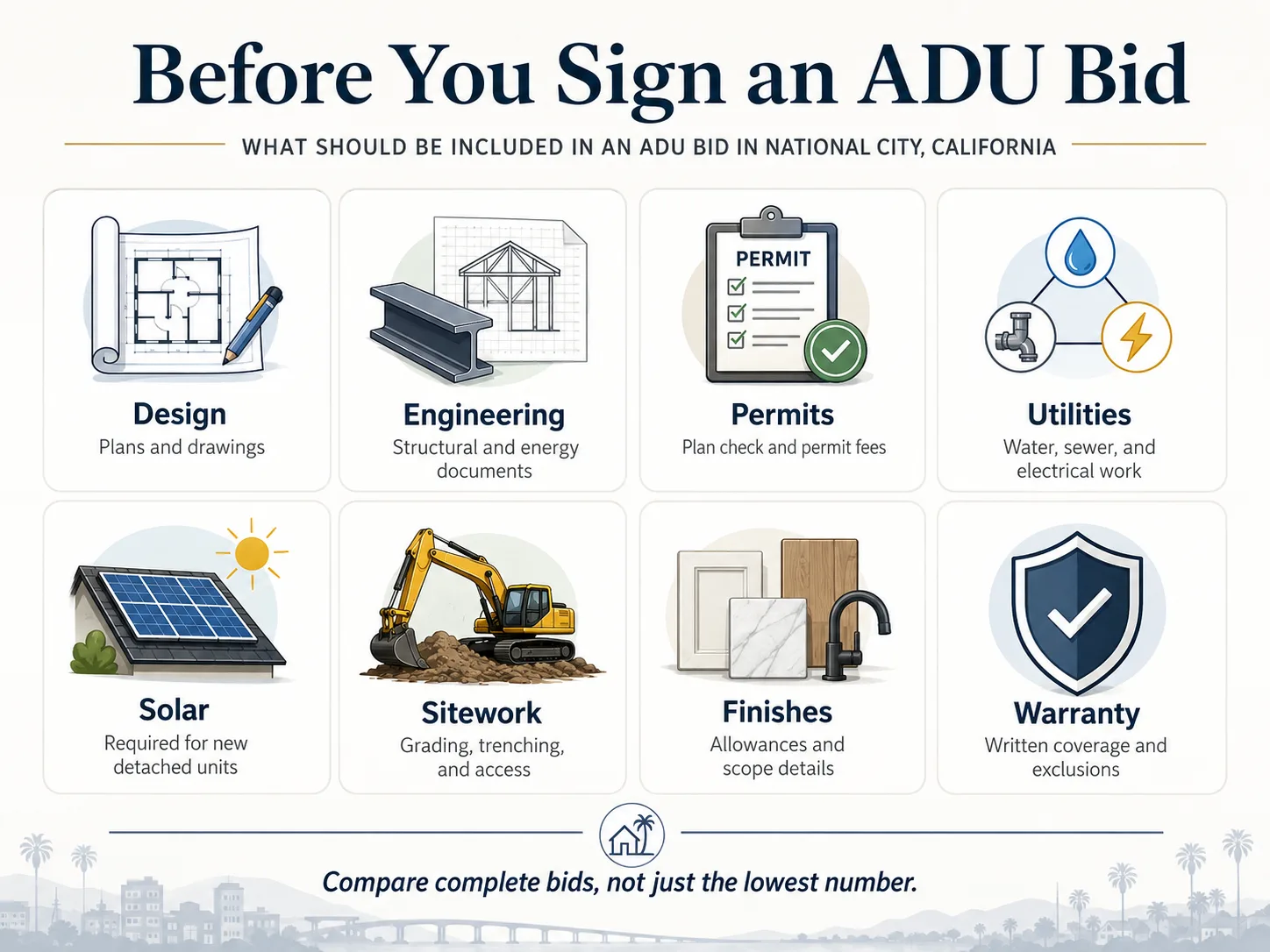
A low bid isn't automatically bad. An incomplete bid is dangerous, because in National City the items most often missing from a low bid are exactly the items the city will require: utility upgrades, solar, the soils report, fire access, and the soft-cost stack around design and engineering. Your job is not to pick the lowest number. Your job is to make every bid comparable. That's done with a bid-normalization worksheet.
Hand the worksheet below to every bidder. Ask them to mark each line as included, excluded, or allowance — and to give a dollar figure where applicable.
| Line item | Must be in scope? | Why it matters in National City |
|---|---|---|
| Feasibility & site plan | Yes | Setbacks, height, fire hose pull, sewer, utility locations, coastal flag |
| Architectural / design drawings | Yes | City plan check requires accurate floor plan, elevations, sections, code-cycle-current details |
| Title 24 energy compliance documentation | Yes | Required statewide; commonly $800–$2,500 |
| Structural engineering | Usually | Required for conversions, slopes, raised foundations, two-story / above-garage ADUs |
| Soils / geotechnical report | If site triggers | $2,000–$5,000; adds 2–4 weeks |
| City plan check & permit fees | Yes | Builder-published $10–$12/sf blended estimate — itemize |
| Impact fees | If >750 sq ft | Waived at 750 sq ft of interior livable space or less; proportional above |
| School developer fees | If 500 sq ft or more | Per-sf rate by district (NSD $1.80, Sweetwater UHSD $2.90/$3.01, SDUSD $5.17/$5.38) |
| Sweetwater Authority water service / meter | If triggered | ~6-week submittal cycle per city handbook |
| SDG&E electrical service / coordination | Often | New service or upgrade can be $1,500–$10,000+ |
| Sewer lateral inspection / capacity fees | Often | National City requires lateral review on many ADU projects |
| Solar PV system | Yes (new detached) | Required by NC handbook on new detached ADUs |
| Sitework, grading, trenching | Yes | Highly site-dependent; flat lots cheaper |
| Foundation | Yes | Stem wall vs. slab affects cost materially |
| Construction (framing, MEP, drywall, finishes) | Yes | Itemized by trade |
| Allowances (cabinets, flooring, fixtures, appliances) | Yes | Allowance level is the #1 source of "change orders later" |
| Contingency | 10–15% | A bid without contingency is a bid that will run over |
| Final inspections & certificate of occupancy | Yes | Building, fire, utility finals |
| Warranty | Yes | Written, dated, transferable |
| Exclusions list | Yes | What's not in the bid is more important than what is |
| Payment schedule | Yes | Tied to milestones; first payment ≤ lesser of $1,000 or 10% per CSLB |
| Change-order process | Yes | Written, signed, priced before work begins |
A bid that comes back at $250,000 with half these lines marked “owner responsibility” is not a $250,000 bid. It's a $300,000+ bid you haven't read yet.
Financing your National City ADU
Common ADU financing paths fall into five lanes: a home equity line of credit (HELOC), a fixed-rate home equity loan, a cash-out refinance, a renovation loan (Fannie Mae HomeStyle or FHA 203(k)), or an after-renovation-value (ARV) product like RenoFi's. The right path depends on three things: how much equity you have today, the rate on your current mortgage, and how much of your build cost you actually need to borrow. We're presenting paths here, not ranking lenders. Specific loan terms, LTV ratios, and qualification rules vary by product and lender — verify directly with a licensed loan officer for your specific situation.
A note worth getting clear up front: do not assume projected ADU rental income will count toward qualification unless your loan officer confirms it in writing for your specific product. Some renovation loan variants allow a portion of projected rent; many conventional cash-out and HELOC products underwrite to your current income only.
HELOCs and home equity loans — the most common ADU path
A HELOC (home equity line of credit) is a revolving credit line secured by your home, drawn down as you spend, with interest only on the balance you've used. A home equity loan is a fixed lump sum at a fixed rate, drawn at closing and amortized over a set term. Both keep your existing first mortgage intact — which matters a lot if you locked in a low rate in 2020 or 2021 and don't want to lose it.
According to the Terner Center for Housing Innovation, equity-based products (HELOCs, home equity loans, and cash-out refinances combined) are the most common funding source for California ADUs. The trade is variable rate (HELOC) versus rate certainty (home equity loan).
When this path fits: You have meaningful equity, your existing mortgage rate is below current rates, and you don't want to refinance the whole thing.
Cash-out refinance
A cash-out refinance replaces your existing first mortgage with a larger one and gives you the difference at closing. One loan, one payment. The math works when current rates are at or below your existing rate. The math hurts when you're sitting on a 3% mortgage and current rates are higher — you'd be giving up the low rate on the entire balance to fund a six-figure project.
When this path fits: You have a higher-rate existing mortgage, substantial equity, and you'd value a single fixed payment over flexibility.
Need to compare ways to pay for your ADU?
Explore current cash-out refinance and construction-loan options through Mortgage Research Center.
Compare options →Affiliate link. Educational comparison only — not a guarantee of approval, rates, payments, or savings. Final terms depend on your credit, income, equity, and the property.
Working through a National City scenario
If you're planning a $284K detached project like SnapADU's published East Plaza Boulevard reference, and you have $300K+ in tappable home equity, a HELOC or home equity loan is typically simpler than a cash-out refinance — it preserves your low-rate first mortgage. If you're planning a $300K–$450K detached project but you bought your home recently and have only $100K–$150K in equity, a renovation loan (HomeStyle or 203(k)) or an after-renovation-value product gets you closer to fully funded because it underwrites against the home's post-construction value rather than its current value. None of these scenarios is loan advice; run your specific numbers with a licensed officer.
California-specific programs (verify status before relying on them)
- CalHFA ADU Grant Program — provided up to $40,000 toward predevelopment costs for income-eligible homeowners. The most recent funding round was reported fully allocated as of CalHFA's December 28, 2023 program update. Check CalHFA directly before counting on this program.
- San Diego Housing Commission (SDHC) ADU Finance Program — this program is for eligible properties in the City of San Diego. National City properties are not eligible. We mention it here only to prevent confusion — National City homeowners researching San Diego ADU financing will encounter SDHC content and should understand it does not apply to a National City address.
- National City ADU Loan Program — the City of National City's official ADU page lists a loan program as “Coming Soon!” Treat as not active until the city confirms launch.
Disclaimer: Cost scenarios and rental break-even examples on this page are illustrative. They are not guarantees of returns. Actual results depend on local market conditions, construction costs, financing terms, and regulatory approvals.
For a deeper comparison of financing paths and how to think about each one for an ADU specifically, see our full guide on ADU financing options.
What we'd warn a friend about: the National City catches most quotes don't itemize
Five things consistently surprise National City homeowners after they've signed. Three are National City–specific. Two are state-law-specific. Read these before you sign anything.
The soils-report question around 500 square feet
The soils-report threshold is the single most common avoidable surprise on a National City quote. SnapADU's National City regulations page publishes that the city commonly requires geotechnical work around the 500 sq ft mark; the city handbook itself doesn't print a specific square-foot threshold but does flag drainage, slopes, foundation type, and new sewer connections as engineering-review triggers. The practical implication: if your design is comfortably above 500 sq ft, budget the report ($2,000–$5,000) and 2–4 weeks of schedule. If your design is right at the line, ask your designer whether keeping it under 500 sq ft is worth saving the cost and time.
Permit-related costs at builder-published $10–$12 per square foot
Builder-published permit-cost estimates in National City run materially higher per square foot than in adjacent Chula Vista. The strategy is straightforward: stay at or under 750 sq ft of interior livable space if you're cost-sensitive. That keeps you inside the impact-fee waiver under California Government Code §66311.5(c) (as amended by SB 543), which alone commonly saves $8,000–$15,000 across the local fee bundle. Verify the exact city fee math directly with National City Building Division before you finalize a budget.
School developer fees on units 500 square feet or more
National City elementary is served by National School District (NSD) at $1.80/sf. High schools are served by Sweetwater Union High School District at $2.90/sf through June 21, 2026, then $3.01/sf. Some National City addresses fall under San Diego Unified (SDUSD) at $5.17/sf through May 10, 2026, then $5.38/sf. A 1,000 sq ft unit can carry roughly $4,700 in school fees on the typical NSD + Sweetwater combination, materially more under SDUSD. Ask your builder to pull the correct district for your specific parcel before quoting a number.
Coastal zone near the bayfront
Most National City residential lots are inland and unaffected by the California Coastal Zone. Properties closer to the bayfront or in the western portion of the city may sit inside the Coastal Zone and require a Coastal Development Permit (CDP) under the city's Local Coastal Program. The boundary follows topography, not a single street — check your address against the California Coastal Commission's coastal zone map or call National City Planning at (619) 336-4310. AB 462, signed October 10, 2025, caps CDP review for an ADU at 60 days and removes Coastal Commission appeal jurisdiction for ADU CDPs — but it's still an extra review step.
The “two-story” promise nobody verifies
National City allows two-story ADUs, but the height ceilings differ between detached and attached pathways under California Government Code §66321. If your builder is selling a two-story design, confirm in writing which rule path they're using and that your lot qualifies. This is one of the most common reasons projects come back from plan check with a redesign — and a redesign costs both money and weeks.
There's also a damaging admission worth being honest about: permitting is not instant, and a great quote on a hard lot will still come in higher than a mediocre quote on an easy one. That's not a reason to delay; it's a reason to (a) start with the Feasibility check before paying for plans, (b) interview at least three builders, and (c) make sure each bid includes everything in the worksheet above.
Already past the research phase? See What You Can Build → Get Your Free ADU Report
If you've absorbed the rules and the catches and you're ready to move, the Feasibility check is the next step. Lot-specific findings on eligibility, soils risk, coastal flag, all-in cost band, and indicative rent.
Run my free Feasibility checkEdge cases — coastal, slope, multifamily, JADU, garage conversion
Most National City lots are flat, mid-block, single-family-residential, and unremarkable. The edge cases below come up often enough that we're calling them out directly.
Sloped lots and drainage
If your lot has any meaningful slope, expect engineered drainage, possibly a retaining wall, and possibly a deeper foundation. National City Engineering may trigger additional review for grading or drainage, and a soils report is far more likely to be required. Sloped lots can add $15,000–$50,000 to a project that would have been straightforward on flat ground. A builder who's done multiple sloped sites will price this in up front; a builder who hasn't will discover it during construction.
Multifamily lots — duplexes, triplexes, and small apartments
Under SB 1211 (effective January 2025) and California Government Code §66323, multifamily property owners in National City may build up to eight detached ADUs on a multifamily lot, capped by the existing number of units on the property. National City's 2024 handbook predates this expansion and still references up to two detached ADUs for multifamily lots; current state code controls. Additionally, interior conversions of up to 25% of existing unit count (rounded down, with at least one always allowed) can be added. For a small apartment owner, this is often the highest-leverage ADU path in the city.
JADUs — when 500 sq ft is the right answer
A JADU (Junior ADU) is no more than 500 sq ft, contained within an existing or proposed single-family residence, with at least an efficiency kitchen. JADUs are typically the cheapest ADU to build because you're using existing walls, foundation, and roof. Not the right fit for a market-rate detached rental, but very strong for an aging-parent unit, a returning-adult-child unit, or a primary suite carved from a current bedroom.
Garage conversion vs. detached new build
National City's handbook explicitly flags garage conversions as the most cost-effective ADU type because they reuse existing foundation, framing, roof, plumbing, and electrical. The flip side: if the existing garage was built without a permit, on a slab that's not thick enough for habitable use, with framing that doesn't meet current code, or without adequate ceiling height, your “conversion” turns into a partial demolition and rebuild — and the cost converges with detached new construction. Have a contractor assess the existing structure before committing. Don't assume “conversion = cheap.”
The western coastal portion of the city
A small portion of National City sits inside the California Coastal Zone, primarily near the bayfront frontage on the western edge of the city. Most of the residential body of the city is inland and unaffected. Don't guess from a street name — check the California Coastal Zone Boundary Map or call National City Planning at (619) 336-4310 to confirm whether your parcel triggers a CDP.
Realistic break-even for a National City rental ADU (illustrative)
ZIP 91950 is one of the more affordable housing markets in coastal San Diego County. Recent comps put 1-bedroom rents around $1,675–$2,345 per month and 2-bedroom rents around $2,144–$2,790 per month in 2026 (aggregated from ApartmentFinder, Apartments.com, Rent.com, RentCafe, Zumper, and RentHop, pulled February–April 2026). The number that matters is not “ROI” — it's the spread between your monthly carrying cost and the achievable rent.
| Scenario | All-in build cost (low–high) | Mid-market monthly rent | Simple payback (years, before financing costs) |
|---|---|---|---|
| Studio / 1-BR, ~600 sf | $250,000–$340,000 | ~$1,750 | 12–16 |
| 2-BR, ~750 sf (impact-fee waiver) | $280,000–$380,000 | ~$2,400 | 10–13 |
| 2-BR, ~1,000 sf | $340,000–$450,000 | ~$2,600 | 11–14 |
Important caveats: this table shows simple payback assuming you bank 100% of gross rent. In reality, you'll have property tax increase on the new construction, increased insurance, vacancy (typically 5–8% annual), maintenance reserve (typically 5–10% of rent), and either financing carrying cost or an opportunity cost on cash deployed. A more honest break-even adjusted for those items is typically 14–22 years. The case for an ADU isn't usually pure rental ROI — it's a combination of the rental income, the property-value lift from adding a permitted second unit, and the use-case flexibility (multigenerational housing, work-from-home space, eventual primary downsizing).
Disclaimer: These are illustrative examples, not guarantees of returns. Actual results depend on local market conditions, construction costs, financing terms, and regulatory approvals.
Frequently asked questions
- Who is the best ADU builder in National City?
- There is no single "best" ADU builder for every National City property — the right answer depends on project type. For a custom detached ADU, the strongest National City–experienced design-build firms are SnapADU, Better Place Design & Build, and Organic ADU. For a garage conversion or attached addition, a remodeler-GC like Kanna Construction or YNK Construction is often a better fit than a custom-detached specialist. For prefab/modular, US Modular has a published National City page. Match the lane to the project.
- How much does it cost to build an ADU in National City in 2026?
- Most detached ADU projects in National City run $300,000–$450,000+ all-in in 2026, or roughly $300–$600 per square foot depending on size, finish, and site. Garage conversions are typically $100,000–$200,000. SnapADU publishes a completed 749 sq ft, 2BR/2BA rental ADU on East Plaza Boulevard at $284,000 ($379/sf) as one builder-published reference point. Permit-related costs alone add roughly $10–$12 per square foot per SnapADU's builder-published estimate.
- How long does the National City permit process take?
- The standard permit timeline is 3–4 months from a complete submittal, per SnapADU's published National City average. California Government Code §66317 requires the city to determine completeness within 15 business days and to approve or deny a complete application within 60 days. Total project timeline from kickoff to certificate of occupancy is typically 9–14 months.
- What is the maximum size for an ADU in National City?
- A detached ADU in National City is capped at 1,200 square feet under NCMC §18.30.380. A JADU is capped at 500 square feet of interior livable space. Attached ADU sizing has conflicting language in the city's handbook — confirm with Planning Division. ADUs created within the existing footprint of a primary dwelling or accessory structure (a conversion) are not subject to the 1,200 sq ft cap.
- Do I need to live in my house to build an ADU in National City?
- For a standard ADU, no — California Government Code §66315 prohibits a local owner-occupancy requirement on standard ADUs. For a JADU under current Cal. Gov. Code §66333, owner-occupancy may be required when the JADU has shared sanitation facilities and cannot be required when it has separate sanitation facilities. National City's 2024 handbook references a general owner-occupancy requirement for JADUs; verify the city's current interpretation with Planning Division.
- Can I build a two-story ADU in National City?
- Yes. Detached and attached ADUs follow different state-law height pathways under California Government Code §66321. Detached must be allowed at least 16 ft (18 ft within ½ mile of major transit or with multifamily, plus 2 ft for matching roof pitch). Attached must be allowed up to 25 ft or the zone's limit, whichever is lower. The city's handbook addresses a 25-ft pathway for ADUs above a garage on lots under 5,000 sq ft. Confirm which rule path applies to your lot before final design.
- What are the setback requirements for a National City ADU?
- Front: 15 feet. Side and rear: 4 feet minimum (state-law floor). Building separation between the ADU and any existing structure: 5 feet.
- How much rent can a National City ADU generate?
- ZIP 91950 1-bedroom rents averaged roughly $1,675–$2,345 per month in 2026, and 2-bedroom rents averaged roughly $2,144–$2,790 per month, across ApartmentFinder, Apartments.com, Rent.com, RentCafe, Zumper, and RentHop comps. Your specific rent depends on layout, finish, separation from the primary, parking, and outdoor space.
- Are impact fees waived for ADUs in National City?
- Yes, for ADUs of 750 square feet of interior livable space or less and JADUs of 500 square feet of interior livable space or less, under California Government Code §66311.5(c) as amended by SB 543. Above those thresholds, fees are charged proportionally to the primary dwelling.
- What about school developer fees?
- ADUs/JADUs containing less than 500 sq ft of interior livable space are exempt from school developer fees under California Government Code §66311.5 and California Education Code §17620. At 500 sq ft or more, district fees apply. National City addresses fall under different combinations of National School District ($1.80/sf), Sweetwater Union HSD ($2.90/sf rising to $3.01/sf in late June 2026), and SDUSD ($5.17/sf rising to $5.38/sf in May 2026). Confirm the parcel's districts before quoting.
- Do I need a Coastal Development Permit for an ADU in National City?
- Most National City lots are inland and don't require a CDP. Properties near the bayfront or in the western portion of the city may fall in the California Coastal Zone and require a CDP under the city's Local Coastal Program. Check the California Coastal Commission's coastal zone map for your address. AB 462 (signed October 10, 2025) caps ADU CDP review at 60 days and removes Coastal Commission appeal jurisdiction for ADU CDPs.
- Can I rent out my National City ADU on Airbnb?
- No for short-term vacation rentals — National City's ADU Handbook prohibits short-term vacation rental use of an ADU. The handbook references both "less than 30 days" and "exceeding 31 days" framing in different sections; California Government Code §66323 uses "longer than 30 days." Confirm the exact minimum lease term with Planning if your lease is near the threshold.
- Do new detached ADUs in National City require solar?
- Yes. National City's ADU Handbook requires new detached ADUs to include a solar PV system, consistent with California's Title 24 energy standards and statewide solar requirements for new residential construction.
- How do I submit an ADU application to National City?
- Email a complete packet (including a completed Credit Card Authorization Form for fees) to building@nationalcityca.gov, or drop it off in person at the Building Division Counter at City Hall, 7:00 a.m.–4:30 p.m. Monday through Thursday. For zoning and design questions, call Planning at (619) 336-4310. For permit and fee questions, call Building at (619) 336-4210.
- Is an ADU a good investment in National City?
- It depends on your goal. As a pure rental investment, simple payback in National City typically runs 10–14 years before financing costs and 14–22 years after honest operating-expense and financing costs. As a combination of rental income, property-value lift from a permitted second unit, and flexibility for family use, the case is much stronger than the rental math alone. We don't think anyone should build an ADU based purely on projected rent — the value comes from the combined uses.
Methodology and sources
This guide was researched by the Dwelling Index Editorial Team. Dwelling Index is an independent research resource covering ADU financing, costs, and regulations.
We reviewed the City of National City's official ADU page, the National City ADU Handbook (March 2024), National City Municipal Code §18.30.380 and §18.30.390 via Municode, and the California Government Code sections governing accessory dwelling units (§§66310–66342). State-law verification leaned on California LegInfo, the California HCD ADU Handbook, and direct review of the relevant code sections.
For builder coverage, we audited the public service-area pages of every firm we list in March or April 2026: SnapADU, Better Place Design & Build, Organic ADU, Kanna Construction, YNK Construction, SL United Construction, Troia Construction, YesADU, US Modular, CRS Builders, Creative Design & Build, and San Diego Building & Renovation. CSLB license numbers are taken from each firm's own published material; live CSLB status verification is the homeowner's responsibility at the moment of contract via the CSLB consumer license lookup.
For cost data, we triangulated SnapADU's published San Diego–region cost benchmarks, Better Place Design & Build's published per-square-foot range, BNC Builders' 2026 cost guide, ADU Geeks' 2025 San Diego County guide, and Streamline Design Group's 2025 San Diego permit-cost analysis. National City permit-fee figures were drawn from SnapADU's National City regulations page (last refreshed April 2026); these are builder-published estimates and should be confirmed with NC Building Division.
Rental comps for ZIP 91950 were aggregated from ApartmentFinder, Apartments.com, Rent.com, RentCafe, Zumper, and RentHop, pulled February–April 2026.
We did not rank builders by referral payout. The order in our shortlist is based on (1) ADU specialization depth, (2) verified National City service or project proof, (3) license documentation, and (4) public process transparency. SnapADU and Mortgage Research Center are disclosed affiliate partners on this page; affiliate status determines CTA placement, not editorial inclusion or order.
This content is informational and is not legal, financial, tax, lending, or construction advice. Before signing a contract, paying a deposit, or relying on any specific cost figure, verify directly with the contractor, the City of National City, the relevant state agency, or a licensed professional in California.
Verify before you sign — direct links
- CSLB consumer license lookup — verify any contractor's license status
- California Coastal Commission coastal zone boundary map — check whether your parcel is in the Coastal Zone
- City of National City ADU page — official city resources
- California Government Code §§66310–66342 (LegInfo) — state ADU statutes
- National City Building Division: (619) 336-4210
- National City Planning Division: (619) 336-4310
Related guides
- Best ADU Builders San Diego County — parent overview
- Best ADU Builders Chula Vista — sibling South Bay city
- California ADU Laws — state-law context
- How Much Does an ADU Cost — cost methodology
- ADU Cost Per Square Foot — per-sf deep dive
- ADU Financing Options — financing deep dive
- Detached ADU Floor Plans — floor plan inspiration
Not sure where to start?
See what's possible at your address — get your free ADU report in 60 seconds.
See What You Can Build in National City →