
Pre-Approved ADU Plans: What They Save, What They Don’t, and Where to Find Them in 2026
Last updated: May 31, 2026 · Last verified: May 31, 2026 · By the Dwelling Index editorial team
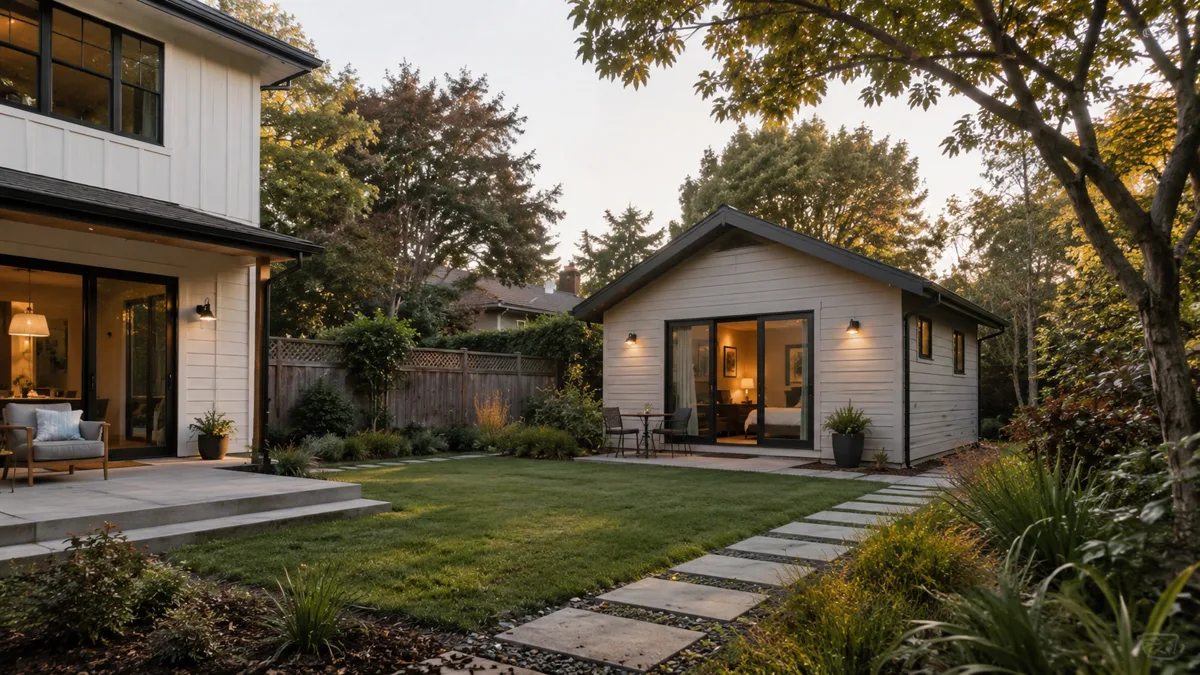
Pre approved ADU plans are accessory dwelling unit designs that a city or county has already reviewed for building-code compliance, so you can skip the slowest part of permitting — but they are not a building permit, and they do not approve your lot. This applies to homeowners building a detached ADU (a separate backyard structure, not a garage conversion or an attached unit) on a standard lot. One number frames the whole decision: a free city plan can erase most of an $8,000–$18,000 custom-design fee, and in California a complete permit application that uses a current-code pre-approved plan must be approved or denied within 30 days (Government Code § 65852.27). Your next step: confirm whether your city runs a program, and whether your specific lot can actually use the plan, before you spend a dollar.
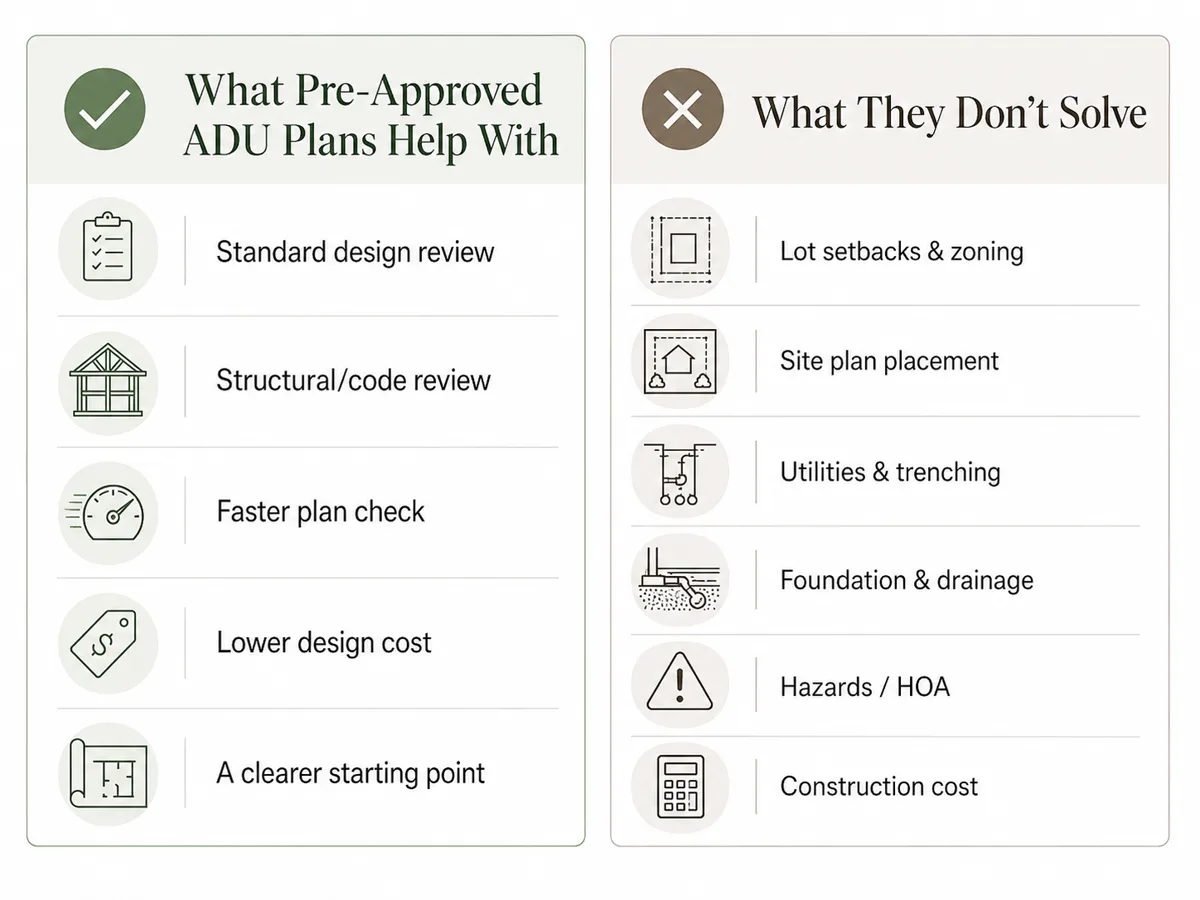
| Pre-approved plans usually help with | They usually do NOT solve |
|---|---|
| Standard design and structural review for a repeatable plan | Your setbacks, lot coverage, and zoning |
| Faster plan check in many cities | Your site plan (where the unit sits on the lot) |
| Lower design and engineering cost (free in many programs) | Utility trenching, sewer, electrical service, meter upgrades |
| A clearer, faster first step | Foundation and site engineering (soil, slope, drainage) |
| Less code-change risk in California through 2031 (AB 130) | Fire, flood, slope, wildfire, coastal, or HOA constraints |
| Easier apples-to-apples comparison of plan sizes | Permit fees, trade permits, and system development charges |
| Builder pricing and construction cost |
Get your free ADU report. See whether your lot can use a pre-approved plan — and exactly what's possible at your address. It's free, takes a few minutes, and there's no obligation.
See What You Can Build →We built this guide because the honest answer to “where do I find pre-approved ADU plans” is scattered across dozens of city websites, and most articles sell the upside without drawing the boundary. The Dwelling Index is an independent research resource covering ADU financing, costs, and regulations, and the single most useful thing we can tell you up front is this: “pre-approved” describes the building, not your property. Get that right and the rest of the decision gets simple fast.
What are pre approved ADU plans?
Pre approved ADU plans are complete building designs — floor plans, elevations, and structural details — that a local government has already checked against the building, residential, and energy codes and cleared for repeated use before any individual homeowner applies. Choosing one removes the design-and-structural plan-check step that normally slows permitting, but you still file a building permit application with site-specific documents for your lot. Cities use different names for the same idea, which is half the confusion.
A quick vocabulary check, because these terms get thrown around loosely:
- ADU (accessory dwelling unit): a self-contained second home on a lot that already has a primary residence, with its own kitchen, bath, and sleeping area.
- DADU (detached ADU): an ADU in a separate structure — a backyard cottage. Most pre-approved programs cover only detached units.
- JADU (junior ADU): a smaller unit (typically up to 500 square feet) carved out of an existing house, often sharing some facilities. Pre-approved programs generally do not cover these.
- Plan check: the government's review of your construction drawings for code compliance. This is the step pre-approved plans shortcut.
- Ministerial approval: approval based on objective standards with no public hearing or subjective design review. Pre-approved-plan permits are typically ministerial.
- Setback: the required distance between a structure and your property lines.
- FAR (floor area ratio): the ratio of building floor area to lot size, one way cities cap how much you can build.
- Site work: everything done to your specific lot — grading, foundation, trenching, utility connections.
- Utility lateral: the pipe or line connecting your building to the public water, sewer, or electrical main.
- Title 24: California's building energy-efficiency standards, part of the California Building Standards Code.
- System development charges (SDCs): one-time fees some jurisdictions (common in Oregon) charge new construction to fund infrastructure.
What your city calls them (naming crosswalk)
The same idea goes by different names depending on the jurisdiction. “Standard plan,” “master plan,” and “pre-approved DADU” all describe a pre-reviewed, repeatable design.
| Jurisdiction | What they call it |
|---|---|
| City of Los Angeles | Standard Plan Program |
| City of San José | ADU / Single-Family Master Plan Program |
| Seattle | Pre-Approved DADU plans |
| Portland, OR | Free pre-approved detached ADU plans |
| County of San Diego / Los Angeles County | Standard ADU plans |
| California statewide (the law) | ADU plan preapproval program (AB 1332) |
Pre-approved vs. permit-ready vs. prefab vs. custom
A pre-approved plan has been reviewed by your local agency; a “permit-ready” plan may be a complete drawing set but is not necessarily pre-cleared by your city; a prefab or modular ADU is a factory-built product that still needs local site approval; and a custom plan is designed specifically for your lot. The right choice depends on how standard your lot is and how much you want to change the design.
| Path | What it means | Best for | Main risk |
|---|---|---|---|
| Pre-approved city plan | Local agency has already reviewed a standard, repeatable design | A simple detached ADU on a compliant, flat lot | Lot conditions can still delay approval; usually no customization |
| Permit-ready / stock plan | A complete drawing set you can buy, but not locally pre-cleared | Homeowners who want a head start and some flexibility | “Permit-ready” is sometimes marketing language; review can surface changes |
| Prefab / modular ADU | A factory-built or partly factory-built unit | Speed, predictable product cost, less on-site labor | Delivery, crane access, foundation, utility, and local approval constraints |
| Custom design | Drawn for your specific lot and goals | Narrow, sloped, coastal, wildfire, historic, or accessibility-driven projects | Highest design cost and longest design timeline |
The distinction is concrete. California attaches its 30-day decision window only to applications that use a pre-approved plan (or a plan identical to one approved in the current code cycle), not to ordinary plans (Government Code § 65852.27). Seattle's program reviews the pre-approved DADU structure for Land Use, Residential, and Energy Codes while the designer keeps ownership of the plan. Portland's free plans skip life-safety and structural review under the Oregon Residential Specialty Code — but nothing else. In every case, the city pre-cleared the building, not your backyard. If you're weighing a factory-built unit instead, our prefab and modular ADU guide covers that path in depth.
Are pre approved ADU plans already approved for my property?
No. A pre-approved plan may already be reviewed as a building design, but your property still needs site-specific review. Cities typically still check setbacks, lot coverage, utilities, easements, foundation conditions, fire access, drainage, and flood, slope, coastal, or wildfire hazards before issuing a permit. This is the single most common — and most expensive — misunderstanding about pre-approved ADU plans.
Here's the honest version, stated plainly because it changes who should use this path: a pre-approved plan can be the wrong choice if your lot has slope, flood, coastal, wildfire (WUI — the Wildland-Urban Interface fire-risk overlay), utility, easement, or access constraints, or if you need meaningful layout changes. In those situations, a custom design or a prefab unit matched to your site is often more realistic.
That is not a reason to abandon the idea — it's a reason to check your lot before you commit to a specific plan. Standard, flat suburban lots are exactly what these programs are built for, and most homeowners who qualify save real time and money. The point is simply to find out which kind of lot you have first, so you pick the right path the first time.
What still gets reviewed on your lot
Even with a pre-approved plan, the city reviews how your specific project sits on your specific parcel. The site plan, utilities, hazard zones, and any design change are all evaluated separately from the pre-approved building. These examples come straight from official program pages.
| Site-specific item | Why it matters | Verified example |
|---|---|---|
| Site plan | Shows where the ADU sits relative to property lines and the main house | Orange County still requires site-specific documents (including a site plan) even with a pre-approved plan |
| Utilities | Water, sewer, electrical service, trenching, and meter upgrades can drive cost | Portland still requires zoning, utility, and trade-permit review with its free plans |
| Hazard zones | Wildfire, hillside, geology, flood, and environmental areas can disqualify or slow a project | San Rafael excludes certain hazard-area parcels; Seattle limits its path to under 750 sq ft of ground disturbance with no environmentally critical areas |
| Design changes | Modifying a pre-approved plan usually removes the fast-track advantage | Concord allows orientation/flipping only; other changes require separate review |
Get your free ADU report. Before you fall for a specific plan, find out what your lot actually allows — hazards, setbacks, utilities, and whether your city runs a program. Free, no obligation.
See What You Can Build →The law in plain English: AB 1332, AB 130, and Arizona's SB 1529
California requires every city and county to run an ADU plan pre-approval program — the deadline to develop it was January 1, 2025 — and to decide a complete permit application that uses a current-code pre-approved detached-ADU plan within 30 days. Arizona's SB 1529 requires its cities to begin offering at least three pre-approved ADU plans at 200, 600, and 1,000 square feet on July 1, 2026. Neither law guarantees free plans or discounted fees — both explicitly let agencies charge their normal fee. This section corrects a claim we saw repeated on several builder blogs, because getting it wrong could cost you.
AB 1332 (California Government Code § 65852.27), decoded
AB 1332 was authored by Assemblymember Juan Carrillo and signed in October 2023 (Chapter 759, Statutes of 2023); it added Government Code § 65852.27 and set a January 1, 2025 deadline for every local agency to develop its preapproval program.
| What AB 1332 requires | What AB 1332 does NOT do |
|---|---|
| Every California local agency must run a program to pre-approve ADU plans | It does not require the agency to own plans or give them away — many free plans exist, but free is a local choice, not a state rule |
| The agency must accept plan submissions from anyone and cannot restrict who submits | It does not mandate a fee discount. The statute lets the agency charge the same permitting fee as a normal same-size ADU. The widely repeated claim that “AB 1332 cuts plan-check fees by 50%” is not in the law. Any fee reduction is a city-by-city policy — verify it locally |
| For a detached ADU, the agency must approve or deny a complete permit application that uses a qualifying pre-approved plan within 30 days, ministerially, with no discretionary review | It does not extend that same 30-day shortcut to attached ADUs, garage conversions, or JADUs, unless a local program separately supports them |
| The agency must post pre-approved plans and the plan applicant’s contact information online, and may also post plans pre-approved by other agencies | It does not waive site-specific review — your zoning, Title 24 energy calculations, and site plan still apply |
The practical translation: AB 1332 buys you a guaranteed 30-day decision, not a guaranteed discount. Treat “free plans” and “lower fees” as facts you confirm for your own city, not statewide promises. Some California cities do reduce fees voluntarily — Antioch, for example, states its reduced plan-check fees save more than $1,000 on a typical detached ADU — but that's Antioch's policy, not a statewide entitlement.
AB 130: a building-code freeze that works in your favor through 2031
There's a quietly important piece of good news for anyone pulling a plan now. AB 130, signed June 30, 2025, bars California's Building Standards Commission and local agencies from adopting most new or more-restrictive residential building standards from October 1, 2025 through June 1, 2031, with limited health-and-safety exceptions (AB 130 bill text; see also ABAG's AB 130 / SB 131 summary). The 2025 California Building Code still took effect January 1, 2026 as scheduled, but the usual 2028 update cycle is skipped, so the next residential code change would land around January 1, 2032.
For you, that means far less risk that a new code cycle forces a redesign mid-project — one of the real anxieties about building. Two honest caveats keep this from being a blanket guarantee: AB 130 freezes building standards, not your local zoning or site rules, and it does not promise that a specific pre-approved plan stays on your city's accepted list. So still confirm the plan you choose is current and locally accepted. With that done, you can lock in design and pricing decisions with more confidence than buyers had a year ago.
Arizona SB 1529: pre-approved ADU plans head east
California isn't alone anymore. Arizona's SB 1529, signed July 1, 2025 (Chapter 259, adding A.R.S. § 9-461.19), requires municipalities to establish standard pre-approved housing design plans — and for ADUs, at least three plans sized 200, 600, and 1,000 square feet, beginning July 1, 2026, in single-family zones that allow ADUs. Each plan class must include at least three elevation options, cities can't restrict who submits plans, and — echoing California — the law authorizes municipalities to charge the same fee they would for a comparable plan (Arizona SB 1529, chaptered text). Single-family and ADU plan classes start in mid-2026; duplex and triplex classes follow in 2027.
Because the ADU requirement is a future rollout, expect the statewide library to fill in over 2026 — early-adopter cities such as Queen Creek are already standing up programs, while others are still building theirs. The bigger signal: pre-approved ADU plans are no longer a California novelty. According to the Pew Charitable Trusts, four states have now passed legislation related to pre-approved building plans, three of them in 2025 (Pew Charitable Trusts).
Where can I find pre approved ADU plans in 2026?
Pre-approved ADU plan programs are most established in California (which mandates them statewide), Washington, and Oregon, with Arizona programs arriving in 2026. As of 2026, roughly 40 U.S. jurisdictions run some form of pre-approved building-plan program, but details vary sharply by city — some plans are free, others carry a designer fee, and all still require site-specific work. Below is our 2026 program matrix, followed by the honest national picture.
The 2026 Pre-Approved ADU Plans Program Matrix
Sorted by state, then jurisdiction. Last verified May 31, 2026. Plan sizes, fees, and timelines change, and some plan libraries are mid-update for the 2025 building code — always confirm on the official page before you rely on a specific number. We reverify top programs monthly and the long tail quarterly.
| State | Jurisdiction / program | Plan sizes & cost | Published timeline | Key caveat (incl. code-cycle) | Official source |
|---|---|---|---|---|---|
| CA | Statewide — AB 1332 | Program required of every agency; detached focus; plans free or paid by local choice | Complete application using a qualifying pre-approved detached plan: 30-day approve/deny | Same fees allowed; site review still applies | Gov. Code § 65852.27 |
| AZ | Statewide — SB 1529 | ≥3 ADU plans at 200 / 600 / 1,000 sq ft, 3 elevations each | Rolls out beginning July 1, 2026 | Future rollout; same fees allowed | A.R.S. § 9-461.19 |
| CA | City of Los Angeles — Standard Plan Program (LADBS) | Multiple detached plans, including the free "You-ADU" (455 sq ft, 1-bed); others purchased from the design firm | Faster plan check | No revisions; confirm current code-cycle | dbs.lacity.gov |
| CA | Los Angeles County (unincorporated) | County-owned, free: Plan A 1,200 sq ft/3-bed, Plan B 1,200 sq ft/2-bed, Plan C 800 sq ft/1-bed | Faster plan check | Some designer-catalog plans being updated for 2025 code — confirm current status | pw.lacounty.gov |
| CA | County of San Diego (unincorporated) | Free standard plans (~85% complete), offered since 2019 | Streamlined | Unincorporated areas only; use unmodified; confirm code-cycle | sandiegocounty.gov |
| CA | Chula Vista — SnapADU-designed plans | Free city plan; you pay the designer for site-specific work | Faster review and lower plan-review fees than a standard ADU (per the city) | Contract with the plan designer; confirm the public plan library is current under the 2025 code | chulavistaca.gov |
| CA | San Marcos — SnapADU-designed plans | Free city plan; designer fees apply | Complete application: 30-day approve/deny | No alterations; confirm code-cycle readiness | san-marcos.net |
| CA | City of San José — Master Plan Program | Rotating list of compact detached plans (recent examples ~475–750 sq ft); vendor-owned (you pay the firm) | Same-day permit possible when site-specific plans and documents are complete and accurate | Any change voids the expedited path; plans listed “under review” are not yet eligible | sanjoseca.gov |
| CA | Santa Clara County (unincorporated) | Free: 800 sq ft, 2-bed/1-bath (Standard or Contemporary) | Reduced time and cost | Site plan, Title 24 calcs, and a roof-truss design still required | plandev.santaclaracounty.gov |
| CA | Concord | 6 free plans: 205, 394, 627, 650, 709, 874 sq ft | Permit possible within 5 working days (complete application) | Orientation/flip only; other changes → standard review | cityofconcord.org |
| CA | Antioch | Plan gallery; pay the designer a "Plan Access Fee" | 30-day approve/deny; reduced plan-check fees save $1,000+ | No modifications allowed | antiochca.gov |
| CA | Orange County (unincorporated) | 6 detached plans: 393, 558, 748, 800, 972, 1,200 sq ft | Improved permit efficiency | Plans reflect 2022 code and are being updated to 2025 code; site plan and solar-plan materials required | pwds.oc.gov |
| CA | Sacramento County — "shelf-ready" plans | Model sizes ~460, 870, 1,000, 1,184 sq ft | Streamlined | Designed to 2022 codes — confirm current code-cycle | development.saccounty.gov |
| CA | Martinez | Free city-sponsored: ~300 sq ft studio, ~430 and ~496 sq ft 1-bed; 3 styles | Streamlined | Site plan, soils/grading, flood review, and fees remain | cityofmartinez.org |
| CA | Whittier | One-story detached: ~311, 495, 757, 800 sq ft; 3 exterior styles | Streamlined | No modifications; solar, sprinkler, geotechnical review may apply | cityofwhittier.org |
| CA | San Rafael | Detached plans, updated each new code cycle | Expedited building-permit review | Hazard-area parcels (hillside, WUI, geology, tsunami) may be excluded; no alterations | cityofsanrafael.org |
| CA | Monrovia | Currently lists one active plan (~476 sq ft, 1-bed) | Streamlined | City doesn’t own the plan; site-specific designer work required | monroviaca.gov |
| WA | Seattle — Pre-Approved DADU | Multiple detached designs; designer-owned (you pay a royalty) | Most permits issued in 2–6 weeks (per the city) | NR zones only, no environmentally critical areas, under 750 sq ft of ground disturbance; confirm current designer fees | seattle.gov |
| WA | Kitsap County / Bainbridge Island / Bremerton | Free model plans, commonly ~480, 600, 800, an 800 two-story, 1,000 sq ft, plus a garage option | Streamlined | Land-use, environmental, and utility fees apply; Kitsap lists approximate permit fees by model | bainbridgewa.gov |
| WA | Tacoma | Four base detached models | Pre-application support and a city site visit | Models may not suit every site (critical areas, utilities, stormwater, historic) | tacomapermits.org |
| OR | Portland | Four free detached options (varying roof/foundation), adapted from Eugene | Skips life-safety and structural review under the Oregon Residential Specialty Code | Optional; zoning, utilities, trade permits, flood rules, and SDCs still apply | portland.gov |
| OR | Salem | "Ready-build" detached plans under 600 sq ft | Can expedite the permit process | No additional charge; zoning, utility, site plan, and fees remain | cityofsalem.net |
Beyond the West Coast: the honest national picture
Other California jurisdictions — including Encinitas (its PRADU program), Carlsbad, Hawthorne, Rancho Cucamonga, Union City, Lincoln, Colma, and Lake and Solano counties — also publish AB 1332 programs of varying maturity. In Washington, the Washington State Department of Commerce maintains a hub of recognized pre-approved ADU plans contributed by cities including Kirkland, Lacey, Leavenworth, Renton, and Seattle.
Here's the context no single competitor page gives you. According to the Pew Charitable Trusts (May 2026), about 40 U.S. jurisdictions run some form of pre-approved building-plan program, and outside California — which has required pre-approved ADU plans since the 2025 program deadline — fewer than 50 cities and counties had published anything related to pre-approved plans that researchers could find. The most successful programs Pew identified aren't all coastal: they include South Bend, Indiana; Jackson, Michigan; Hawaii County, Hawaii; Seattle; and Claremore, Oklahoma (Pew Charitable Trusts).
The takeaway for most of the country: if your city isn't in the matrix, there's a good chance it doesn't yet offer a government pre-approved ADU plan menu. That doesn't strand you — private “pre-designed” plans and prefab ADUs can still cut your timeline. It just means the free, city-vetted shortcut may not be in your zip code yet. The fastest way to know is to check your specific jurisdiction.
Get your free ADU report. Local rules change block by block. See exactly what's possible at your address — whether your city runs a program, and what your lot can support.
See What You Can Build →Are pre approved ADU plans free?
Some are free, especially city-owned plans, but others require a designer, architect, licensing, or plan-access fee. Free programs include the County of San Diego, Los Angeles County, Santa Clara County, Concord, Martinez, Portland, and Salem; programs where you pay a designer or buy the plan include the City of Los Angeles, San José, and Antioch. “Pre-approved” never means “free build” — even with a free plan, you still pay for the site-specific work covered below.
A quick way to think about it: when a government owns the plan (most California counties, Portland, Salem), it's usually free to download. When a private designer owns the plan and the city merely pre-approves it (San José, Seattle, parts of Los Angeles, Antioch), you pay that designer a plan-access, licensing, or royalty fee, plus the cost of adapting the plan to your lot. Either way, the savings is on design — not on permits, utilities, or construction.
How much time can pre approved ADU plans save?
The time you save depends on the city and your lot, and the gains are concentrated in plan check. California sets a 30-day approve/deny window for complete detached-ADU applications using current-code pre-approved plans; Concord says complete applications using its standardized plans may be issued within five working days; and Seattle says most pre-approved DADU permits are issued in two to six weeks. Site corrections, utility work, hazard review, or any plan modification can erase the advantage. Pew found that pre-approved plans can shorten preconstruction timelines by months in places that have streamlined permitting (Pew Charitable Trusts).
| Jurisdiction | Published timeline or advantage | Important caveat |
|---|---|---|
| California (statewide) | 30-day approve/deny for a qualifying detached-ADU application using a current-code pre-approved plan | Requires a complete application and an unmodified, qualifying plan |
| Concord, CA | Permit possible within 5 working days | Only when site-specific plans and required documents are accurate and complete |
| Seattle, WA | Most pre-approved DADU permits issued in 2–6 weeks | Zone and site eligibility limits apply |
| Portland, OR | Skips life-safety and structural review under the Oregon Residential Specialty Code | Zoning, utilities, trade permits, flood rules, and SDCs still apply |
Why the savings is real but bounded: the design-and-structural plan check is often the most unpredictable part of the timeline, full of back-and-forth corrections. Pre-clearing it removes that uncertainty. It does nothing to speed the parts that depend on your lot — and that's where surprises live.
How much money can pre approved ADU plans save?
Pre-approved ADU plans save money on design, engineering, and plan-check friction — not on the full project. Some city plans are free, others carry a designer or plan-access fee, and site work, utilities, permit fees, and construction still drive the budget. Realistic savings range from city-confirmed figures like Antioch's “$1,000+” in reduced plan-check fees to avoiding most of an $8,000–$18,000 custom-design fee.
| Cost component | Typical figure (sourced) | Does a pre-approved plan save it? |
|---|---|---|
| Custom architectural plans + construction drawings | ~$8,000–$13,000 (RenoFi); ~$10,000–$18,000 in the San Diego market (SnapADU) | Yes — a free city plan avoids most of this base fee |
| Plan-access / licensing fee (when a designer owns the plan) | Varies; set by the designer (e.g., Antioch’s “Plan Access Fee”) | Partly — you may still pay the designer |
| Reduced plan-check fees (where a city offers them) | Antioch: $1,000+ saved on a typical detached ADU | Yes, where the city offers it (not required by AB 1332) |
| Site plan, Title 24 energy calcs, soils/foundation, truss design | Site-specific; varies by lot | No — still your responsibility |
| Utility connections, trenching, meter upgrades, trade permits | Site-specific; varies | No |
| Permit and system development charges | Varies by jurisdiction | No |
| Construction (the build itself) — see our ADU cost guide | Commonly $150–$300+ per square foot (see our ADU cost guide) | No |
For broader context, the Pew Charitable Trusts estimates pre-approved plans cut builders' overall development costs by about 1%–2%, which it pegs at $5,000–$10,000 on a $500,000 single-family home (Pew Charitable Trusts). That's a single-family-home benchmark, not an ADU-specific guarantee — we cite it for direction, not as a promise about your project.
The realistic framing: expect to save most of the base design fee — often several thousand dollars — plus meaningful permitting time. Don't expect the program to zero out your soft costs. A homeowner who reads “free plan” as “cheap ADU” gets surprised by the site bill. A homeowner who reads it as “free design head start” gets exactly what the program promises.
These are illustrative examples, not guarantees of returns or savings. Actual results depend on local market conditions, construction costs, financing terms, and regulatory approvals.
Once your plan and budget are set, the next question is how to pay for the build. We cover financing as paths, not lender rankings. The common lanes are a cash-out refinance, a renovation loan, a construction loan, and home-equity products. To compare mortgage, refinance, cash-out refinance, and construction-loan options from one independent starting point — with no rate promises — explore your financing options. (We don't quote rates, payments, or approval odds; those depend on your lender, credit, and market.)
Can I change or customize a pre approved ADU plan?
Usually only a little. Many programs allow limited orientation, mirroring, exterior-material, or non-structural choices, but major changes to the floor plan, structure, windows, roof, or footprint typically remove the fast-track benefit and send the project through standard plan review. If a custom look matters to you, a pre-approved plan probably isn't your shortcut — and that's worth knowing before you start.
| Jurisdiction | Customization rule (verified) |
|---|---|
| Concord, CA | Designs can’t be revised except for orientation/flipping; other changes require separate, non-expedited review |
| Los Angeles County, CA | Plans can’t be revised and must be permitted as designed; they may be mirrored (flipped) or oriented in any direction |
| Antioch, CA | Modifications aren’t allowed and will disqualify the application from the streamlined process |
| City of San José, CA | Any change to the master plan disqualifies it from expedited review |
| Seattle, WA | The pre-approved structure is reviewed as designed; you add site-specific elements, but the building itself is fixed |
The logic is simple: the city pre-approved a specific building. Change the building and it's no longer the thing they pre-approved, so it goes back in the normal line. Materials and orientation are usually fair game; moving walls and windows usually isn't. If you need accessibility features, an unusual layout, or a specific rental configuration, price out a custom design or a carefully chosen prefab plan instead — our detached ADU floor plans page is a good place to compare layouts.
Should I use a pre approved plan, prefab ADU, garage conversion, or custom design?
Use a pre-approved plan when you want a detached ADU, your lot is straightforward, you like an available design, and your city has a current-code plan library. Choose custom design when your lot or goals are unusual. Choose prefab or modular when the product, delivery path, and local approval route fit your property. Choose a garage conversion when an existing structure is the better asset. This is the core decision, so we built a framework for it.
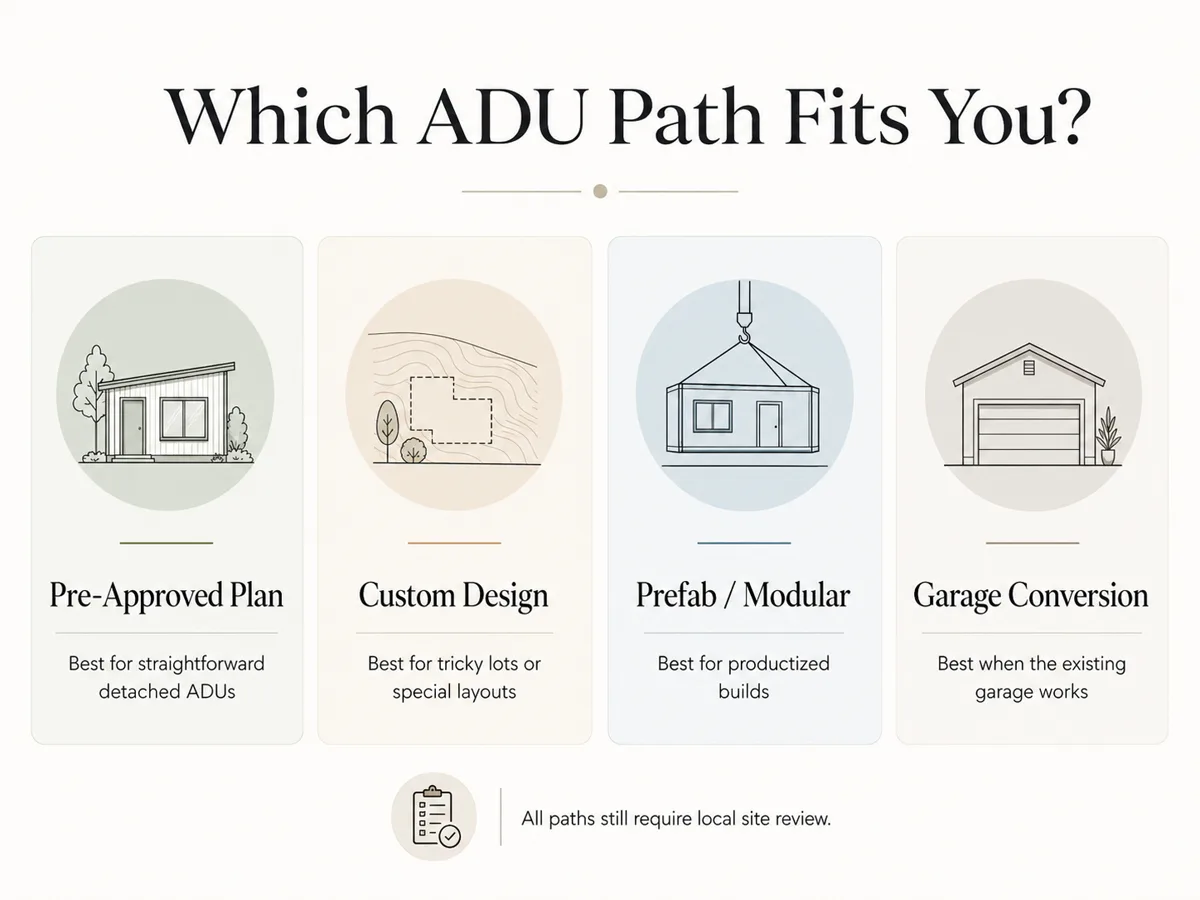
| Your situation | Better path | Why |
|---|---|---|
| Simple backyard, detached ADU, plan fits your setbacks, no major customization | Pre-approved plan | Highest chance of saving design and review friction |
| Narrow, sloped, coastal, wildfire (WUI), flood, historic, or easement-heavy lot | Custom design | Site constraints matter more than plan-library speed |
| You want a repeatable product and less on-site construction | Prefab / modular ADU | Productized path with predictable cost; some cities (San José, Colma) accept prefab into their pre-approved menus |
| You have a usable, legally convertible existing garage | Garage conversion | The existing shell can reduce footprint and site-placement issues (most pre-approved programs exclude conversions) |
| You need aging-in-place accessibility or an exact rental layout | Custom, or a carefully chosen prefab | Pre-approved plans rarely support specific layout changes |
A note on prefab and pre-approval, since they overlap: a prefab or modular ADU may carry factory or state-level structural approvals, but your site, foundation, utilities, zoning, and local permit path still need review — “prefab” no more means “pre-permitted” than “pre-approved” does. Some jurisdictions, including San José and Colma, do accept certain prefab designs into their pre-approved programs, which can combine the speed of both. Our guides to prefab ADU permits, ADU kit homes, and turnkey prefab ADUs go deeper on that route.
If your lot or goals point toward a factory-built unit, compare options that actually serve your area. Compare ADU Builders Check current service areas, pricing, and local approval paths directly with each builder.
Step-by-step: how to use a pre approved ADU plan without wasting money
Don't start by buying or downloading a plan. Start by confirming the plan is current, listed by your jurisdiction, usable on your lot, and compatible with your budget, utilities, and customization needs. The most expensive mistakes happen when homeowners commit to a design before screening their property. Here's the order we recommend.
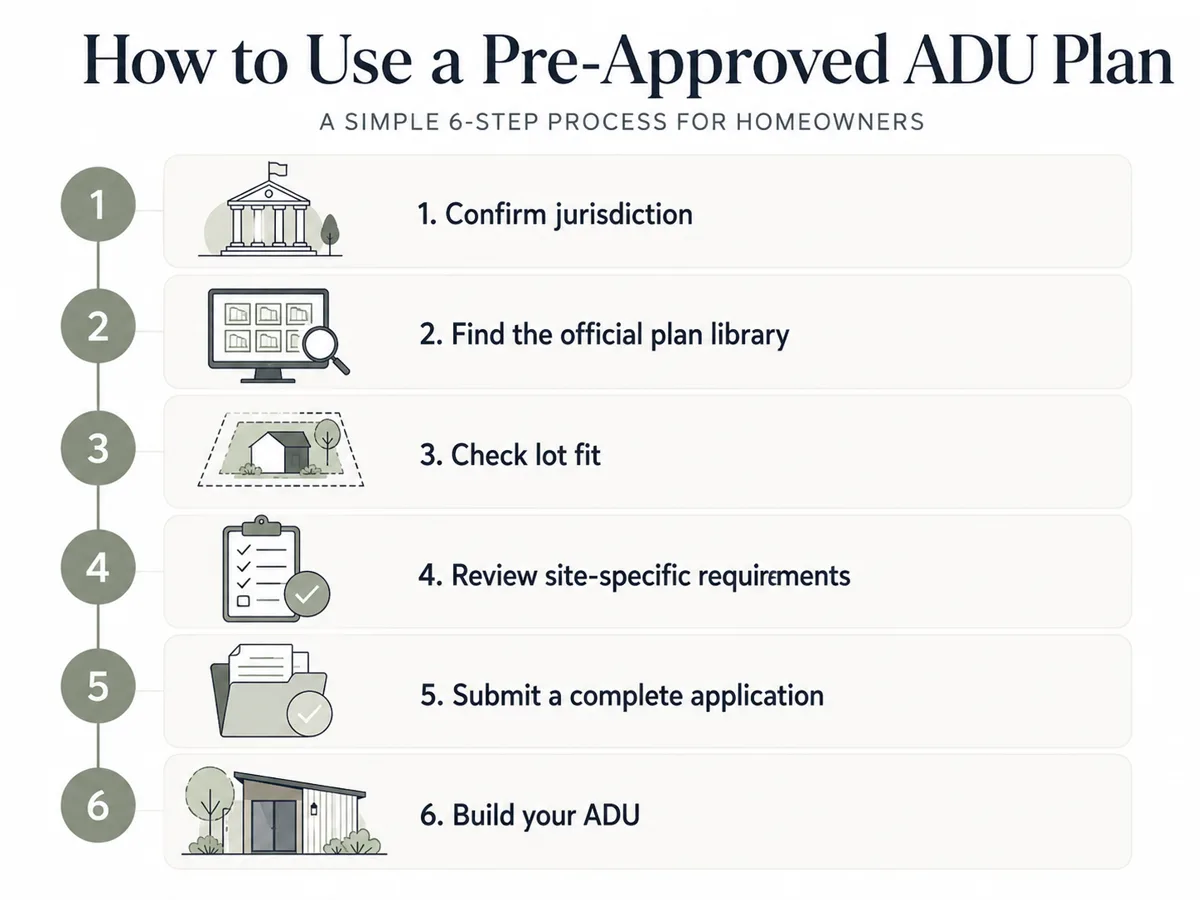
- 1Confirm your jurisdiction. City and county rules differ, and your address decides which applies. An unincorporated-county parcel follows county rules, not the nearest city’s.
- 2Find the official plan library. Use your city or county’s own page (start from the matrix above), not a screenshot or an old PDF from a third-party site.
- 3Check the code cycle. A plan approved under an older building code may need updating. California’s AB 130 froze residential code updates through mid-2031, which reduces this risk — but still confirm the plan is current and accepted locally. Several California libraries (Orange County, Sacramento County) were mid-update for the 2025 code in 2026.
- 4Confirm the plan is actually approved, not "under review." San José, for instance, notes that plans still under review are not yet eligible for the expedited path.
- 5Screen your lot before you commit. Setbacks, easements, slope, flood, wildfire (WUI), coastal rules, and utility capacity all matter. This step decides whether a pre-approved plan is even the right path.
- 6Ask who owns the plans. Some cities provide free, city-owned plans; others list private designers who own the plans and charge a plan-access or licensing fee (Antioch and parts of Los Angeles work this way).
- 7Ask what the site-specific work costs. City plan access can be free while the site plan, energy calcs, and engineering are not.
- 8Confirm the modification limits. A small change — moving a window, resizing a room — can turn a fast-track project into a standard plan check.
- 9Budget for fees and site work. Permit, trade, utility, and (in some states) system development charges can remain even with a free plan.
- 10Submit a complete application. Faster timelines — California’s 30 days, Concord’s five working days — apply only to complete, accurate submittals. An incomplete package resets the clock.
Want this as a printable checklist plus our step-by-step ADU planning guide? Download the free ADU Starter Kit — no cost, and it's yours to keep.
What questions should I ask before choosing a pre approved ADU plan?
Ask questions that reveal whether the plan is current, local, buildable on your lot, legally usable, and still eligible for the fast track after any changes. These separate a smooth project from an expensive surprise.
| Question | Why it matters |
|---|---|
| Is this plan officially listed by my city or county? | Avoids relying on outdated or non-local plans |
| Is it approved under the current code cycle? | Older approvals may not qualify for the fast track |
| Is the plan free, licensed, or paid? | “Pre-approved” doesn’t always mean free |
| Who owns the plan? | The city may not own privately designed plans; you may pay the designer |
| What site-specific drawings are required? | Site plan, utilities, foundation, and energy documents may remain your responsibility |
| Can I mirror or rotate the plan? | Many cities allow orientation changes only |
| Can I change windows, rooms, roof, or footprint? | Structural or floor-plan changes usually remove fast-track status |
| What local conditions disqualify the plan? | Slope, wildfire, flood, coastal, easements, and historic districts can all matter |
| Who pulls the permit? | Some designers or vendors don’t handle permitting — clarify early |
| What fees remain? | Permit, trade, utility, and system fees can survive even a free plan |
What we verified
Verification date: May 31, 2026
- Primary law, read directly: California AB 1332 / Government Code § 65852.27 (January 1, 2025 program deadline; 30-day decision for detached-ADU applications; same-fee provision), California AB 130 (residential building-code freeze, October 1, 2025–June 1, 2031, with exceptions), and Arizona SB 1529 (three ADU plan sizes — 200, 600, 1,000 sq ft — beginning July 1, 2026; same-fee provision). Corroborated with the California HCD Accessory Dwelling Unit Handbook and ABAG's AB 130 / SB 131 summary.
- National scope and savings: the Pew Charitable Trusts report (May 2026) for the ~40-jurisdiction figure, the 1%–2% / $5,000–$10,000 development-savings estimate, and the list of successful programs.
- City programs confirmed against official pages this week: Concord (six free plans, 205–874 sq ft, five-working-day issuance), Antioch ($1,000+ fee savings, 30-day window), and Orange County (six detached plans, 2022→2025 code update, site-specific work required), plus program details for Los Angeles, Los Angeles County, San Diego County, San José, Santa Clara County, Seattle, and Portland.
- Cost ranges: synthesized from current builder and architect sources (RenoFi, SnapADU) and presented as ranges, not quotes.
- What we flagged rather than asserted: some California plan libraries (including parts of the San Diego region, Orange County, and Sacramento County) were being updated for the 2025 building code in 2026 — confirm a plan's current status before relying on it.
How we researched this page
The Dwelling Index is an independent research resource covering ADU financing, costs, and regulations. For this guide, we prioritized official state, city, county, and permitting-department sources; we read the governing statutes against primary legislative text rather than secondary summaries; and we recorded plan sizes, program status, review timelines, free-or-paid access, and site-specific caveats with verification dates. Cost figures carry a source and a date, and we flagged anything we couldn't independently confirm. We refresh high-traffic program details monthly and the long tail quarterly, and after any California building-code-cycle change. Our conclusions about which path fits which homeowner are editorial judgments based on the verified facts above — not guarantees about your project.
Frequently asked questions
- Are pre approved ADU plans free?
- Some are free, especially city-owned plans, but others require a designer, architect, licensing, or plan-access fee. The County of San Diego, Los Angeles County, Santa Clara County, Concord, Martinez, Portland, and Salem publish free plan options, while the City of Los Angeles, San José, and Antioch include privately owned plans you pay the designer to use. California’s AB 1332 does not require plans to be free.
- Do pre approved ADU plans guarantee permit approval?
- No. They can speed up review of the standard building design, but site-specific approval — setbacks, utilities, hazards, and your site plan — is still required. A pre-approved plan clears the building, not your property.
- Can I use a pre approved ADU plan from another city?
- Sometimes, but only if your local agency accepts it and the plan meets local and current-code requirements. California law allows a local agency to also post plans pre-approved by other agencies, and some cities accept select neighboring-jurisdiction plans — but that never overrides your city’s site-specific review.
- Are prefab ADUs pre approved?
- Not automatically. A prefab or modular ADU may carry product-level or state structural approvals, but your site, foundation, utilities, zoning, and local permit path still need review. Some cities, including San José and Colma, do accept certain prefab designs into their pre-approved programs.
- Can I customize a pre approved ADU plan?
- Usually only in limited ways. Many programs allow mirroring, orientation, or non-structural material choices, but major changes to the floor plan, structure, windows, roof, or footprint typically remove the expedited status and trigger standard review.
- Do pre approved ADU plans include the foundation?
- Sometimes they include standard foundation options, but the final foundation often still depends on your soil, slope, drainage, and local engineering requirements — which is why a soils report or site-specific foundation design may be required.
- Do pre approved ADU plans include utilities?
- Usually no. Utility connections, trenching, meter upgrades, sewer, electrical service, and the related trade permits are site-specific and remain your responsibility.
- Are pre approved ADU plans good for rental income?
- They can help if they speed up a buildable detached ADU, but rental returns depend on local rent, construction cost, financing terms, vacancy, property-management costs, and local rental rules. These are illustrative factors, not guarantees of returns; actual results depend on local market conditions, construction costs, financing terms, and regulatory approvals.
- What if my city says it has a program but no plans are listed?
- Treat that as a verification issue, not a dead end. The program may be new, awaiting code-cycle updates, or accepting designer submissions without yet publishing homeowner-ready plans. In California, every jurisdiction is required to have a program under AB 1332, so contact the building department directly or run a feasibility check.
- Should I choose pre approved or custom?
- Choose pre-approved if your lot is straightforward and an available design fits your needs — it’s the faster, cheaper path. Choose custom if your site, layout, accessibility, aesthetics, or rental strategy needs more control than a fixed, unmodifiable plan allows.
Not sure where to start?
See what's possible at your address — get your free ADU report in about 60 seconds.
See What You Can Build →