
Portable ADU: The 4 Real Types, What They Cost, and Where They're Legal in 2026
Last updated: May 28, 2026 · Last verified: May 28, 2026 · By The Dwelling Index Editorial Team
Bottom line.
A “portable ADU” is not one thing — it’s a marketing umbrella covering four very different products with four very different legal outcomes. A foldable BOXABL Casita, a modular cottage delivered whole by Samara or Abodu, a HUD-code manufactured home on a permanent foundation, and a tiny house on wheels are all sold as “portable ADUs” — but only some of them count as a legal accessory dwelling unit on your property, only some can be financed with a mortgage, and only some can be legally rented full-time. The honest answer to “can I put a portable ADU in my backyard?” is that it depends on which of the four you mean, the city you live in, and whether the unit is anchored to a permanent foundation. We decoded all four below with verified May 2026 prices, the exact code each is built to, and the specific cities where each one qualifies.
Quick verdict — can your portable unit legally work as an ADU?
| Unit type | Legal-ADU odds | What proves it | Biggest risk |
|---|---|---|---|
| Modular / factory-built delivered whole | Often possible | State or local modular approval; stamped plans; local permit | Site access; crane set; local acceptance |
| HUD-code manufactured home | Possible where local rules allow | HUD Certification Label + HUD Data Plate; permanent foundation; real-property classification | Local zoning; foundation/title path |
| Tiny home on permanent foundation | Often possible where detached ADUs are allowed | Residential building code path; permit; final inspection | Small size still must meet dwelling code |
| Tiny home on wheels / Movable Tiny House | Only in specific cities | Local THOW/MTH ordinance; DMV registration; ANSI A119.5 or NFPA 1192 label | Treated as RV in most jurisdictions |
| Park-model RV | Usually not a standard ADU | RV/ANSI documentation plus a specific local occupied-RV path | Temporary/recreational classification |
| Imported foldable container kit | High risk until proven | US-licensed engineer’s stamped plans; local building department acceptance | Listing is not dwelling approval |
See what your property allows in 60 seconds. Get your free ADU report →
Detailed reports available in CA, UT, TX, CO, and NY. Generic guidance everywhere else. No personal information required to start.
What we verified
| Claim | Source | Verified |
|---|---|---|
| Fannie Mae ADU eligibility for factory-built and HUD-code units; primary-residence rule | Fannie Mae Selling Guide B2-3-04 (10/08/2025) | May 2026 |
| Fannie Mae factory-built housing permanent-foundation rule | Fannie Mae Selling Guide B2-3-02 (02/04/2026) | May 2026 |
| HUD Code / 24 CFR Part 3280; red HUD Certification Label requirement | HUD Manufactured Housing Homeowner Resources | May 2026 |
| California ADU statute | California Government Code §66313–§66326 (renumbered 2024) | May 2026 |
| California HOA restriction on ADU prohibitions | California Civil Code §4751 | May 2026 |
| California HCD position on movable tiny homes as ADUs | California HCD letter to Santa Clara County, 6/24/2025 | May 2026 |
| Los Angeles Moveable Tiny House (MTH) rules | LADBS ADU page | May 2026 |
| San José Tiny Home on Wheels as a type of ADU | San José ADU page; Bulletin 291 | May 2026 |
| Port Townsend, WA THOWs as ADUs (Ordinance 3306, PTMC 17.58) | City of Port Townsend THOW page | May 2026 |
| Portland occupied RV/THOW program | Portland.gov occupied RVs and THOWs | May 2026 |
| Seattle THOW treatment as camper trailer | Seattle SDCI ADU page | May 2026 |
| Washington HB 1337 (2023) — statewide ADU legalization | Washington State Legislature | May 2026 |
| Washington HB 1443 / SB 5332 — not enacted as of 5/27/2026 | Washington State Legislature bill summaries | May 2026 |
| Virginia SB531 chaptered 4/13/2026; ADU provisions effective 7/1/2027 | LegiScan VA SB531 | May 2026 |
| NYC ADU acceptance start date (9/30/2025) | NYC DOB ADU rules announcement | May 2026 |
| Fresno tiny home / ADU rules (1 per lot; 100–440 sq ft) | City of Fresno Tiny Homes handout | May 2026 |
| Samara Backyard Studio current pricing | Samara Backyard Studio page | May 2026 |
| Abodu published all-in pricing | Abodu pricing page | May 2026 |
| BOXABL Casita turnkey pricing tiers | BOXABL Investor Relations page; BOXABL Casita page | May 2026 |
| ADU cost benchmarks | HomeGuide 2026; Angi 2026 | May 2026 |
We update this page quarterly. Pricing and city-level ordinances change faster than statutes — verify with the linked sources before signing a contract.
What is a portable ADU?
A portable ADU is a marketing phrase — not a legal building category — used to describe any small dwelling unit that arrives at your property either flat-packed, on wheels, or built whole in a factory. Building departments, lenders, and appraisers do not have a “portable ADU” classification. They have ADUs, modular homes, HUD-code manufactured homes, park-model RVs, and tiny houses on wheels, each governed by a different building code and treated differently for permits, financing, occupancy, and resale.
This is the core confusion for most shoppers. When someone calls a unit a “portable ADU,” they’re describing how the product moves, not whether your city will let you live in it. Those are different questions, and getting them confused is how people lose deposits, take delivery of units they can’t permit, and discover after the fact that the mortgage they planned to use isn’t available.
We built this guide because the term has become a trap. Six major builders and dozens of marketplace sellers use “portable ADU” to describe products as different as a $22,000 expandable steel container from Walmart and a $278,800 modular cottage from Abodu. The first is generally sold as a backyard office in most jurisdictions; the second is permitted as a full ADU statewide in California. They’re not interchangeable, and treating them as the same product is the single most expensive mistake in this category.
The good news: once you understand which of the four real categories you’re actually shopping in, the decision becomes straightforward. Modular and HUD-code manufactured units have clearly recognized legal-dwelling pathways in most US states. Foldable and expandable products are a legal ADU path only when they carry a recognized code certification or engineering package accepted by your local building department. Movable units on wheels are legally ADUs only in specific cities.
The 4 real types of “portable ADU,” decoded
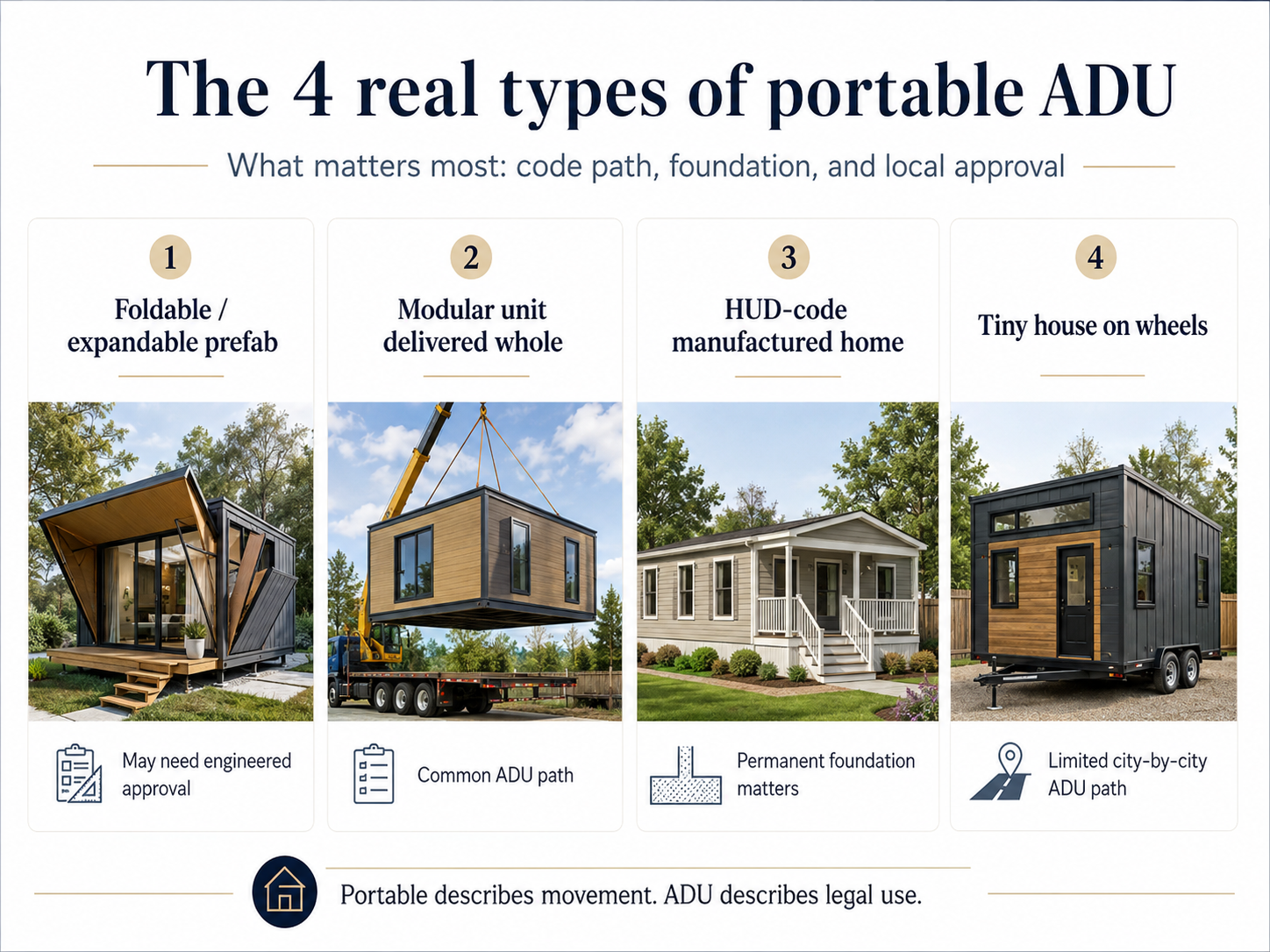
1. Foldable / expandable prefab ADU
Examples: the BOXABL Casita (361 sq ft), the DuraYu series sold through Walmart at $18,180–$27,200 base, the MiniOffice “Station” pod ($57,500–$72,500 base depending on configuration), and the Chery Industrial Bastone 19×20 expandable home listed on Walmart at $21,999.99 as of May 2026.
How it works. The unit ships flat or compact, then unfolds, expands, or assembles on site. The BOXABL Casita arrives folded to roughly 20 feet long and 8.5 feet wide, then unfolds in about an hour into a 19.5 ft × 19.5 ft studio with a kitchen, bathroom, and sleeping area. Expandable container kits work similarly — steel frame, EPS-panel walls, telescoping sections.
What it’s built to. Varies widely. BOXABL works through state modular and local building-code paths and provides state-stamped drawings for ADU placement; some products are certified to ANSI A119.5 (the park-model standard) and titled as recreational vehicles; many imported kits sold through Walmart, Amazon, and Alibaba carry no US building-code certification at all.
Becomes a legal ADU when. The unit is anchored to a permanent foundation and the product carries a recognized code certification — state modular insignia, HUD Certification Label, or a US-licensed engineer’s stamped plan set accepted by your local building department. Without one of those, it’s typically permitted only as a non-habitable accessory structure (office, studio, shed).
Typical all-in cost. $60,000–$210,000 depending on whether you buy turnkey or self-install.
Deeper dive: Expandable Prefab ADU →
2. Modular / container ADU delivered whole
Examples: Samara Backyard Studio ($152,000 + installation, California-only as of May 2026), Abodu One/Two/Studio (from $278,800 all-in), Home Depot Modern Prefab ADU MH-ADU420 ($105,000 base), Plant Prefab LightHouse LivingHome series ($265,000–$533,000+).
How it works. The entire unit is built in a factory under state modular code or the International Residential Code (IRC), then trucked to your property in one or more sections and set on a prepared foundation by crane or shed mule. Site time is short — Abodu publishes one-day installation; most builders complete final hookup in one to four weeks after delivery.
What it’s built to. State modular code in the destination state. In California, the California Department of Housing and Community Development (HCD) oversees modular approvals; outside California, the destination state’s modular program. These units carry a state modular insignia rather than a HUD label.
Becomes a legal ADU when. Placed on a code-compliant foundation in a jurisdiction that allows ADUs and accepts the unit under the state or local modular pathway — which is most US jurisdictions for properly approved modular units. Modular units are generally treated like site-built homes for permits, financing, appraisal, and resale.
Typical all-in cost. $90,000–$280,000+, depending on size, finishes, and site work.
This is generally the cleanest legal path. Fannie Mae’s Selling Guide explicitly states that ADU construction “can be site- or factory-built, including modular, and single- or multi-width HUD Code manufactured homes that are legally classified as real property” (B2-3-04, 10/08/2025).
3. HUD-code manufactured home as ADU
Examples: any factory-built home carrying a red HUD Certification Label affixed to the exterior and a HUD Data Plate inside (typically near the electrical panel). Common ADU-sized models from manufacturers like Champion, Clayton, Skyline, and Cavco run 600–1,200 sq ft.
How it works. The home is built to the federal HUD Code — the National Manufactured Home Construction and Safety Standards Act of 1974, codified at 24 CFR Part 3280. It arrives on its own non-removable steel chassis, then is set on a permanent foundation that complies with HUD’s Permanent Foundations Guide for Manufactured Housing (PFGMH).
Becomes a legal ADU when. Three things must be true: your jurisdiction allows manufactured homes as ADUs (most do); the unit is set on a PFGMH-compliant foundation; and the unit is legally classified as real property under your state’s law. The appraisal must include photos of the HUD Data Plate and Certification Label, per Fannie Mae B2-3-04.
Typical all-in cost. $80,000–$160,000 including PFGMH-compliant foundation, site work, and utility hookups. This is generally the cheapest legal path with full mortgage financeability through FHA Title II, VA, Fannie Mae, and Freddie Mac.
Deeper dive: Manufactured Home ADU →
4. Movable Tiny House / Tiny House on Wheels (MTH / THOW)
Examples: any unit built to ANSI A119.5 (the Park Model RV standard) or NFPA 1192 (the RV standard), DMV-registered, on a permanent chassis with axles and wheels. Builders include Wolf Industries (Pacific Northwest), Magic Box Tiny House (California), and many small custom shops.
How it works. The unit is built to RV standards rather than residential building codes, transported on its own wheels, and either parked on a pad or anchored with the wheels left on (depending on local rules).
Becomes a legal ADU when. A specific city or county ordinance explicitly authorizes movable units as ADUs. As of May 2026, confirmed cities include:
- City of Los Angeles: DMV-registered, ANSI A119.5 or NFPA 1192 certified, 150–430 sq ft, one per parcel, hidden undercarriage skirting, permanent utility connections. (LADBS ADU page.)
- City of San José (Bulletin 291, effective May 29, 2020): THOWs recognized as a type of detached ADU, allowed only on single-family properties. (San José ADU page.)
- City of Fresno (Fresno Municipal Code §15-2754): tiny home as backyard cottage / ADU, 100–440 sq ft, one per lot, not allowed as primary dwelling.
- City of West Sacramento (Ordinance 24-9, May 2025): THOWs allowed as primary dwellings or ADUs in RE, RRA, R-1, R-2, and R-2.5 zones.
- Mendocino County and inland Humboldt County, California: movable tiny homes permitted as ADUs subject to setbacks.
- City of Riverside, CA: allows ADUs, JADUs, and Moveable Accessory Dwelling Units (MADUs).
- City of Ojai, CA: Moveable Tiny House ADU path with zoning clearance and building permit.
- Port Townsend, Washington (PTMC 17.58, Ordinance 3306, effective July 1, 2023): up to two THOWs per lot, no larger than 400 sq ft excluding loft, no taller than 16 ft, Washington L&I certification required. (City of Port Townsend THOW page.)
- City of Portland, Oregon: not technically an ADU path, but Portland’s zoning code allows one occupied RV or THOW on most residential lots with an existing primary dwelling — wheels must remain, short-term rentals are not allowed. (Portland.gov.)
Outside cities with explicit ordinances like these, a THOW on your property is almost always classified as an RV. Seattle’s policy is explicit: “Tiny houses on wheels are treated like camper trailers. You cannot live in a tiny house on wheels (or similar equipment such as RVs and boats) on lots in Seattle city limits.” (Seattle SDCI.)
Typical all-in cost. $30,000–$120,000 for the unit, plus $10,000–$15,000 for utility hookups in cities where you can legally connect to water, sewer, and power.
Portable ADU comparison matrix
Assembled from federal lending guidance (Fannie Mae B2-3-02 and B2-3-04, current as of February and October 2025), HUD’s PFGMH, RVIA park-model guidance, and current builder pricing as of May 2026.
| Feature | Foldable / Expandable Prefab | Modular Delivered Whole | HUD-Code Manufactured ADU | Movable Tiny House (MTH/THOW) |
|---|---|---|---|---|
| Built to which code | IRC/IBC + state modular code; some kits to ANSI A119.5 | State modular code; IRC | Federal HUD Code (24 CFR Part 3280) | ANSI A119.5 or NFPA 1192 |
| Has a red HUD Certification Label? | No | No | Yes (required) | No |
| Sits on permanent foundation? | Yes (required for ADU status) | Yes (required) | Yes (per PFGMH) | No — stays on chassis |
| Counts as a legal ADU? | Yes if certified and anchored | Yes where ADUs are allowed and the modular path is accepted locally | Yes where local rules allow manufactured ADUs | Only in specific cities |
| Typical base price (May 2026) | $18K–$80K | $105K–$200K+ | $40K–$120K | $30K–$100K |
| Typical all-in | $60K–$210K | $130K–$280K+ | $80K–$160K | $50K–$135K |
| Install time on site | 1 day–2 weeks | 1 day–4 weeks | 1–3 days delivery + foundation prep | Hours (drive in) |
| FHA / VA financeable on the unit? | Yes if classified as modular or HUD-code on PFGMH foundation | Yes (real property) | Yes via FHA Title II if on PFGMH foundation | No (treated as RV / personal property) |
| Fannie Mae mortgage eligible? | Yes if modular and on foundation (B2-3-02) | Yes (B2-3-02) | Yes per B2-3-04, but primary residence must be site-built or modular | No |
| Freddie Mac mortgage eligible? | Yes if modular and on foundation | Yes | Yes per Freddie Mac Selling Guide §5601 with HUD label documentation | No |
| HELOC / cash-out refi eligible? | Yes — borrowing against existing house | Yes | Yes | Yes — but unit itself isn't collateral |
| Can be rented as full residence? | Yes if permitted ADU | Yes if permitted ADU | Yes if permitted ADU | Only in cities that allow MTH as ADU |
| Likely added appraised value? | Yes — comparable to detached ADU when permitted | Yes — comparable to detached ADU | Yes — appraises as manufactured home | Minimal — personal property |
| Can move it later? | Difficult once anchored | Difficult once anchored | Difficult (HUD relocation rules) | Yes — that's the design |
Sources: HUD Code / 24 CFR Part 3280 / PFGMH; Fannie Mae Selling Guide B2-3-02 (02/04/2026) and B2-3-04 (10/08/2025); Freddie Mac Single-Family Seller/Servicer Guide; California HCD policy guidance; LADBS Moveable Tiny House rules; San José Bulletin 291; City of Port Townsend THOW page; Portland.gov zoning code; Seattle SDCI ADU page. All verified May 2026.
Ready to see which categories your city actually allows? Check your address →
Where each type is legal — and where it isn’t
Why California is more complicated than “California allows it”
California’s statewide ADU law (Government Code §66313–§66326, renumbered effective 2024) requires every city to permit at least one ADU on residential lots with a single-family home. The state’s definition of an ADU includes manufactured homes that meet HUD standards. That part is settled.
The contested part is movable tiny houses. The state law defines an ADU as a structure that complies with “local building code requirements that apply to detached dwellings.” On its face, that doesn’t sound like it includes a unit built to RV standards.
Several California cities — Los Angeles, San José, Fresno, West Sacramento, Riverside, Ojai, Mendocino County, inland Humboldt County — have adopted local ordinances treating Moveable Tiny Houses (MTH) or Tiny Homes on Wheels (THOW) as ADUs. Then on June 24, 2025, California HCD wrote to Santa Clara County stating that movable tiny homes “may not meet the statutory definition of an ADU” and “may be more akin to recreational vehicles.”
The practical takeaway. California cities that have adopted MTH/THOW ordinances are operating in a space where the state’s own housing agency has expressed doubt about statutory fit. If you’re buying a THOW expecting it to be a permanent legal ADU in California, verify with your specific city’s current ordinance and watch for HCD updates. Don’t rely on a builder’s national marketing claim that “ADUs on wheels are legal in California.”
Washington and Oregon
Washington passed HB 1337 in 2023, legalizing ADUs statewide and requiring cities to allow at least two ADUs on residential lots. But statewide ADU legalization does not automatically include THOWs. Seattle’s current ADU policy explicitly states tiny houses on wheels are treated like camper trailers and cannot be lived in on Seattle lots.
The Washington city with a clear THOW-as-ADU path is Port Townsend (PTMC 17.58, Ordinance 3306, effective July 1, 2023). Up to two THOWs may be placed on a lot with an existing single-family residence, subject to size limits (no larger than 400 sq ft excluding loft, no taller than 16 ft), Washington State L&I certification, ANSI standards, and appearance requirements designed to make the unit look residential rather than recreational.
Two bills introduced in Washington’s 2026 session — HB 1443 and SB 5332 — would legalize Mobile Dwelling Units (MDUs) statewide on urban residential lots with permanent utility hookups. As of May 27, 2026, neither is enacted. Treat these as policy direction, not law.
Oregon’s framework. Permanent tiny homes in Oregon must be built either as site-built dwellings under the Oregon Residential Specialty Code or as HUD-code manufactured homes — those are the two recognized residential dwelling paths per Lane County’s official guidance. Portland operates a separate occupied-RV / THOW program allowing one occupied RV or THOW on most residential lots with an existing primary home, but these don’t count toward residential density and are not appraised as ADUs. Tigard takes the opposite position: “Tiny homes on wheels are recreational vehicles, and living in an RV is not legal in most residential zones.”
Texas, Florida, and the rest of the country
- Texas: no statewide ADU law. Austin requires verifying ADU eligibility, getting a new address from the city, and applying for a building permit. Dallas does not allow ADUs by right in most cases.
- Florida: Pasco County explicitly distinguishes mobile homes (not permitted as ADUs) from manufactured homes (permitted as detached ADUs). State DBPR regulates manufactured housing.
- Colorado: HB 24-1152 (2024) requires subject jurisdictions to allow one ADU beginning June 30, 2025.
- New York: NYC began accepting ADU applications September 30, 2025. Acceptable types include basement apartments, attic apartments, and backyard cottages. No allowance for THOWs.
- Massachusetts: statewide ADU legislation now allows ADUs by right on most residential lots.
- Virginia: SB531 was chaptered as Chapter 895 on April 13, 2026; ADU provisions take effect July 1, 2027 and cap permit fees at $500.
- Idaho: House Bill 166 protects attached ADUs from outright bans, but Idaho Falls and other cities prohibit RV / ANSI-A119.5 units as ADUs.
The general rule everywhere outside the specific California, Oregon, and Washington cities listed above: if the unit is built to a residential code, set on a permanent foundation, and meets local zoning, it can be an ADU where ADUs are allowed. If it has wheels, it’s an RV.
Can I put a portable ADU in my backyard?
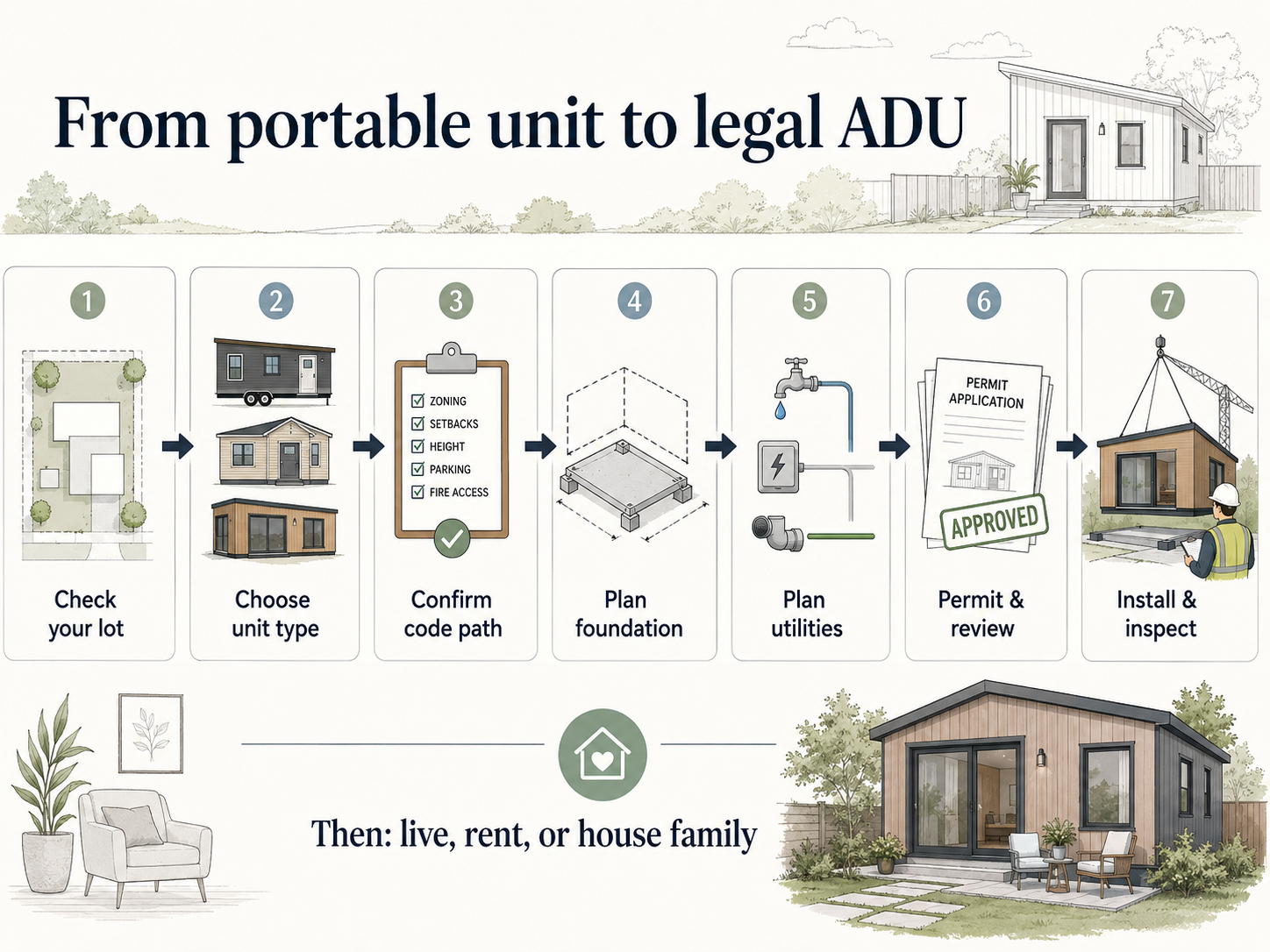
Here’s the order of operations that prevents the most expensive mistakes:
- Check whether your lot is zoned to allow an ADU at all. In most US cities with ADU programs, that means single-family or multi-family residential zoning. Some cities require minimum lot sizes; California and Oregon explicitly prohibit lot-size minimums for ADUs on most residential lots, but most other states still allow them.
- Confirm with your building department, in writing, which legal categories of unit they accept as ADUs at your address. This is the single most important step. It costs nothing and prevents nearly every disaster.
- Verify setback, height, and lot-coverage rules. Setbacks are the minimum required distances between a structure and your property lines; these vary by city and zone.
- Confirm utility capacity. If you’re on a septic system, your county health department may need to verify septic capacity before a new dwelling unit can be permitted.
- Pull your HOA’s CC&Rs if your property is in an HOA. California Civil Code §4751 voids HOA provisions that prohibit or unreasonably restrict ADUs on single-family lots; in most other states, HOAs retain authority through CC&Rs.
Only after those five checks should you pay any deposit on a specific unit.
Can an ADU be on wheels?
The reason wheels matter: a vehicle has a chassis, axles, and a registered title with the DMV; a building has a foundation and a real-property recording with the county. Lenders, appraisers, insurers, and zoning officials all draw the line there.
A few cities have explicitly bridged the gap. Los Angeles, San José, Port Townsend, and the others listed above created ordinances that say “yes, this specific kind of wheeled unit, meeting these specific conditions, counts as an ADU.” But these are local exceptions, not a national rule, and they typically come with detailed conditions — DMV registration, specific certification labels (ANSI A119.5 or NFPA 1192), undercarriage skirting, residential appearance, permanent utility connections, and one or two unit limits per lot.
The damaging admission worth sitting with: the same feature that makes a wheeled unit attractive — portability and lower upfront cost — is often exactly why it isn’t treated as a permanent ADU. Wheels avoid the foundation, plan-review, and inspection regime that creates ADU value for lenders and appraisers in the first place. If you want both the price and the property value, you usually have to pick one path or the other.
How much does a portable ADU really cost?
The hidden cost stack most listings leave out
A “portable ADU” listed at $60,000 is almost never a $60,000 project. Here’s everything that typically lands on your final invoice that isn’t in the headline number.
| Cost component | What it covers | Foldable / Expandable | Modular Delivered Whole | HUD-Code Manufactured | THOW (where legal) |
|---|---|---|---|---|---|
| Base unit (factory) | The structure itself | $18K–$80K | $105K–$200K+ | $40K–$120K | $30K–$100K |
| Shipping to site | Truck transport, escorts, permits | $2K–$8K (kit); $5K–$15K (prebuilt) | $5K–$20K | $3K–$10K | DIY tow or hauler |
| Foundation | Slab, piers, or PFGMH-compliant system | $8K–$25K | $10K–$30K | $12K–$28K | Not required |
| Site prep | Grading, drainage, access for crane/truck | $3K–$15K | $3K–$15K | $5K–$20K | $1K–$5K (pad/gravel) |
| Utility hookups | Water, sewer, electric, sometimes gas | $5K–$20K | $5K–$20K | $5K–$25K | $10K–$15K |
| Permits & fees | Building permit, impact fees, plan review | $1.3K–$9K | $1.3K–$9K | $1.3K–$9K | $0–$3K (where legal) |
| Assembly / install | Crane, set, block, secure, weatherproof | $2K–$17K (kit assembly) | Often included in turnkey | $3K–$10K (set & block) | DIY / minimal |
| Finish-out | Interior items not in base, appliances, flooring | $0–$10K | $0–$15K | $0–$10K | $5K–$15K |
| Realistic all-in | $60K–$210K | $130K–$280K+ | $80K–$160K | $50K–$135K |
Sources: HomeGuide ADU Cost Guide 2026; Angi ADU Cost 2026; Abodu published pricing (May 2026); Samara Backyard Studio pricing; BOXABL Investor Relations turnkey tiers; Home Depot MH-ADU420 listing; Chery Industrial Walmart listing; DuraYu Walmart listings; MiniOffice.co “Station” pricing; Tiny Hookups Portland utility hookup cost ($10K–$15K), cited by Kol Peterson in 2026 KUOW interview. All verified May 2026.
Manufacturer-by-manufacturer pricing snapshot
| Brand | Model | Type | Base price (May 2026) | Realistic all-in | Service area |
|---|---|---|---|---|---|
| BOXABL | Casita Studio turnkey | Foldable | $150,000 turnkey | $150K–$180K | California turnkey; nationwide non-turnkey from ~$60K base unit only |
| BOXABL | Casita 1-bedroom turnkey | Foldable | $195,000 turnkey | $195K–$220K | California turnkey focus |
| BOXABL | Casita 2-bedroom turnkey | Foldable | $210,000 turnkey | $210K–$240K | California turnkey focus |
| Samara | Backyard Studio (420 sq ft) | Modular delivered | $152,000 + installation | $190K+ | California only |
| Samara | Backyard One/Two Bedroom | Modular delivered | Configure for quote | Higher | California only |
| Abodu | One, Two, Studio | Modular delivered | From $278,800 (includes foundation, permits, installation) | From $278,800 | California only |
| Home Depot | Modern Prefab ADU MH-ADU420 | Modular | $105,000 base | $130K–$180K | Nationwide; delivery quoted separately. Note: verify actual sq footage before ordering. |
| Plant Prefab | LightHouse LivingHome series | Modular | $265K–$533K+ | Higher | West Coast focus |
| MiniOffice.co | The Station (with 3/4 bath) | Prebuilt or flat-pack | $72,500 prebuilt / $68,500 flat-pack | $90K–$110K w/ assembly & shipping | Nationwide |
| Chery Industrial | Bastone 19×20 (380 sq ft) | Expandable | $21,999.99 | Not typically permittable as habitable; ~$50K–$100K if engineered into compliance | Online retail; buyer responsible for unloading |
| DuraYu (Walmart) | 13×20, 15×20, 16.5×20, 19×20 | Foldable kit | $18,180–$27,200 | Not typically permittable as habitable | Online retail |
All prices verified May 2026 from manufacturer websites or major-retailer listings. These change frequently; check live pricing before budgeting.
Why $21,999.99 isn’t actually $21,999.99
The Chery Industrial Bastone — a 19×20-foot expandable prefab home, listed on Walmart at $21,999.99 for 380 square feet, one bedroom, one bathroom as of May 2026 — looks like an incredible deal. The listing photos look like a finished home. The price looks unbeatable. So what’s the catch?
The listing sells a structure. It does not sell a permittable dwelling. To turn that $21,999.99 product into a legal ADU on your lot, you would still need to add most or all of:
- A foundation that meets your local code: typically $8,000–$25,000.
- Engineering review and stamped plans from a US-licensed engineer: $2,000–$10,000.
- Building permit and plan check fees: $1,300–$9,000.
- Site work and access for delivery (unloading is the buyer’s responsibility per Walmart’s listing): $3,000–$15,000.
- Utility laterals — buried lines for water, sewer, and electric service: $5,000–$20,000.
- Code upgrades to bring the imported product into US dwelling code compliance: highly variable; sometimes not possible without rebuilding key systems.
- Inspections and a Certificate of Occupancy.
Realistic total to get this product to legal habitable status: somewhere between $50,000 and $100,000, if your building department will accept it at all. Most won’t accept imported steel-panel kits without a US building-code certification path.
This isn’t a knock on Chery, DuraYu, or the broader category. Their products may be perfectly fine as backyard offices, art studios, gym pods, or other non-habitable uses where habitation certification isn’t required. Just don’t pay your deposit expecting an ADU.
For shoppers who want a portable or expandable unit from a vetted source, browse portable and expandable models through Home Seller USA →. Note: portability does not guarantee legal ADU status. Verify with your jurisdiction before installation.
For California buyers specifically interested in the BOXABL Casita, see current BOXABL Casita configurations and turnkey pricing →.
For a broader look at vetted modular and prefab providers nationwide, browse providers through Modular Home Direct →.
Want a realistic all-in estimate tied to your specific address? Get your free ADU report →
Do portable ADUs need permits, utilities, and inspections?
The standard permit sequence
- Confirm zoning eligibility. Verify your lot is zoned for ADUs. Cities verify lot-size minimums, setback compliance, height limits, and parking provisions.
- Confirm category acceptance. Ask your building department, in writing, whether the specific category (foldable, modular, HUD-code manufactured, MTH/THOW) is accepted as an ADU at your address.
- Submit plans for plan review. Modular and manufactured units come with state-approved or HUD-certified plans, which speeds review. Custom or imported units require engineered plan sets.
- Site work and foundation. Pad or footings poured, utility laterals trenched and inspected.
- Delivery and set. The unit arrives and is placed.
- Utility connection inspections. Water, sewer, and electric tied in and inspected; sometimes gas, low-voltage, fire sprinklers, and stormwater.
- Final building inspection and Certificate of Occupancy.
The whole process typically runs three to nine months for modular and manufactured ADUs in cities with established ADU programs. Faster in cities with pre-approved plan libraries; slower in cities without ADU experience.
Utility hookup reality
- Portland, OR: $10,000–$15,000 typical, per Kol Peterson of Tiny Hookups in a 2026 KUOW interview.
- California: utility connection costs in the same range, sometimes higher for properties with septic systems or long lateral runs to the main.
- Properties with septic instead of sewer: add $5,000–$25,000 for septic capacity review and possible system expansion.
- Properties needing electric service upgrade: add $3,000–$10,000 if your main panel needs to be upgraded to handle the ADU load.
Why “no permit” is a long-term liability
- Insurance: standard homeowners insurance typically doesn’t cover unpermitted dwellings, and many policies have grounds to deny claims.
- Lender recognition: Freddie Mac’s Selling Guide states that rental income from an illegal ADU cannot be used to qualify for a mortgage.
- Resale: any buyer doing standard due diligence will discover an unpermitted unit. Most lender-financed buyers will require the unit to be permitted or removed before close.
- Retroactive enforcement: if a neighbor complains, your city’s code enforcement can require removal, fines, or remediation.
- Tenant safety liability: if you rent the unit and a tenant is injured, the unpermitted status complicates your defense in any lawsuit.
Financing: how portable ADUs actually get paid for
The foundation trap that kills mortgages
The single biggest financing trap in this category is the permanent-foundation requirement. Federal lending guidance is consistent: a factory-built unit must be permanently attached to a foundation that meets specific standards before it can be insured by FHA, purchased by Fannie Mae or Freddie Mac, or financed as real property.
- Fannie Mae Selling Guide B2-3-02 (02/04/2026) requires all factory-built units to be “permanently attached to a foundation that meets the standards for local building codes.”
- Fannie Mae Selling Guide B2-3-04 (10/08/2025) confirms that an ADU’s construction method “can be site- or factory-built, including modular, and single- or multi-width HUD Code manufactured homes that are legally classified as real property.”
- FHA Title II for manufactured homes requires the home to be set on a permanent foundation that complies with HUD’s Permanent Foundations Guide for Manufactured Housing (PFGMH).
Translation: if the unit can roll off your property, it isn’t real estate, and lenders treat it the way they treat a boat or an RV.
The five financing paths that actually work
- Cash-out refinance on your existing home. Works for any of the four portable ADU types because you’re borrowing against your existing house, not the new unit. You replace your existing mortgage with a larger one and pocket the difference in cash, then use it to pay for the unit, foundation, site work, and hookups. This is the most common path because it works regardless of how the ADU is classified.
- Home equity loan or HELOC. Same logic as cash-out refi — you’re borrowing against your existing home’s equity. Generally lower closing costs than a full refinance, with a variable rate on a HELOC.
- Construction or renovation loans. Fannie Mae’s HomeStyle Renovation loan and Freddie Mac’s CHOICERenovation loan can fund ADU construction including modular and HUD-code units. Both require the renovation total to stay within their loan limits and the project to be appraised at completed value.
- FHA Title II on a HUD-code manufactured ADU. FHA Title II will finance a HUD-code manufactured home on a permanent PFGMH-compliant foundation, with utilities permanently connected, and a licensed engineer’s foundation certification. Down payment can be as low as 3.5% for primary residences.
- Manufacturer financing. Several builders offer in-house financing. Samara launched Samara Finance LLC in June 2024 specifically for its Backyard product. Terms and disclosures vary; these aren’t regulated identically to traditional bank mortgages. Read every term sheet carefully.
Why you can’t get a mortgage on a unit that stays on wheels
A unit that remains on its chassis — a THOW, a park-model RV, or any “movable” unit not anchored to a permanent foundation — is personal property under almost every state’s law. Personal property is financed with personal-property loans: RV loans, personal loans, or unsecured credit. These typically carry higher interest rates than mortgages, shorter amortization (usually 7–20 years instead of 30), and either secure the loan with the unit itself (which can be repossessed) or leave the loan unsecured.
Disclaimer. This page provides general education, not individual financial advice. Loan eligibility, rates, terms, and availability depend on your specific situation, lender, state, credit profile, and the unit’s legal classification. Consult a licensed lender for your specific situation.
What to ask the seller before you pay a deposit
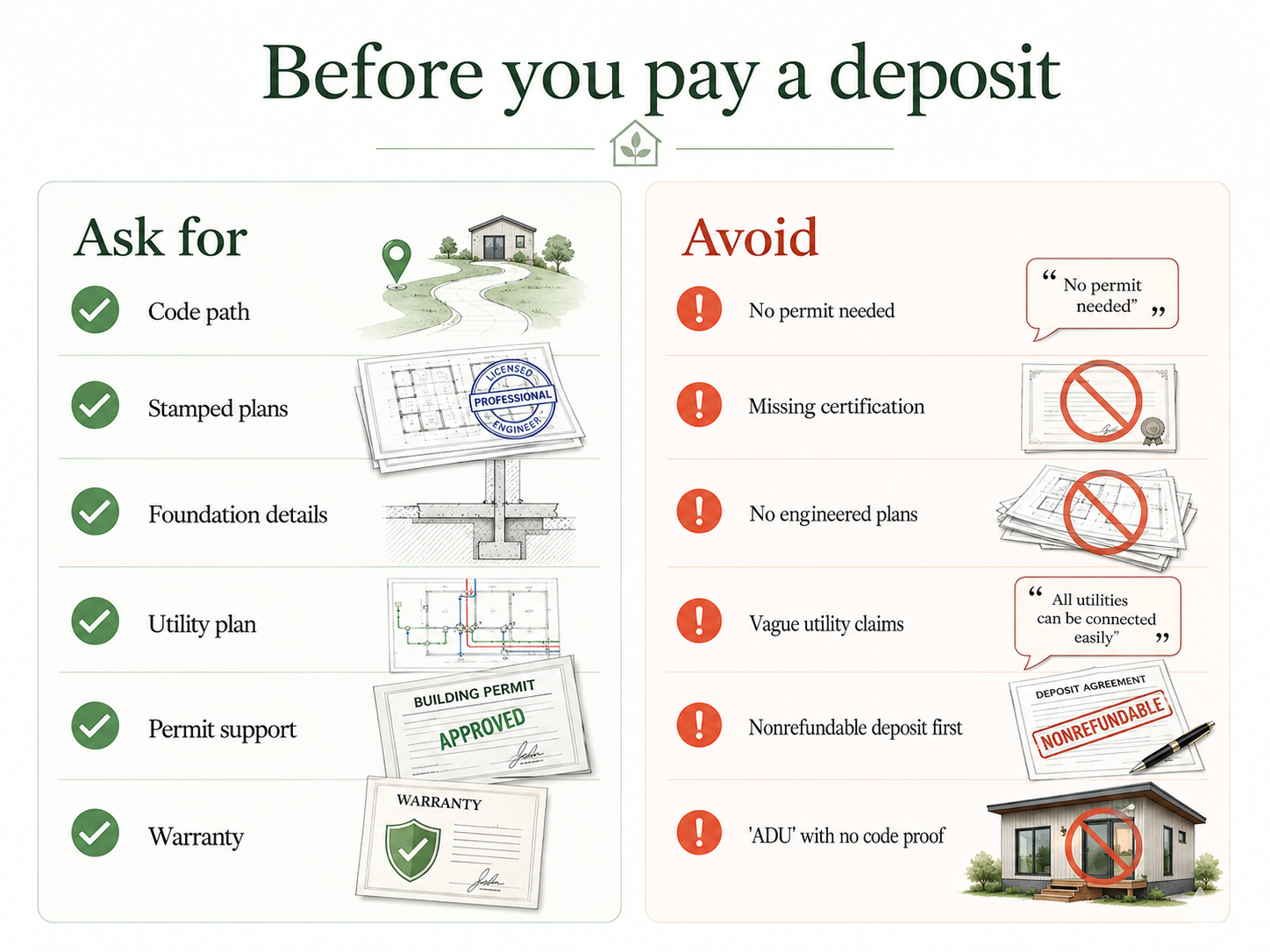
These are the eleven documents we think you should always request. Walk away if the seller can’t or won’t provide them.
| Document | Why it matters | Green flag | Red flag |
|---|---|---|---|
| Code path statement | Tells you which building code the unit is built to | Names a specific code: IRC, state modular code, HUD Code (24 CFR Part 3280), ANSI A119.5, or NFPA 1192 | "No permit needed anywhere" or vague claims |
| HUD Certification Label & Data Plate (if claimed HUD-code) | Federal requirement for manufactured homes | Photo of the red HUD label on exterior plus Data Plate near electrical panel | Seller says "manufactured" but has no HUD documentation |
| State modular insignia (if claimed modular) | State's certification that the unit meets state modular code | Insignia number or copy of state approval letter | "Prefab" without certification |
| ANSI A119.5 or NFPA 1192 label (if RV/park model/MTH) | Documents the RV certification | Visible label on unit, certificate of compliance | Verbal claims only |
| Stamped engineered plans | Required for plan review in most jurisdictions | Plans signed and sealed by a licensed engineer or architect | Renderings or brochure only |
| Foundation specification | Determines whether unit can be real property and permitted | PFGMH-compliant detail (for HUD-code) or approved foundation drawing | "Just set it on blocks" |
| Utility connection plan | Documents how the unit will connect to water, sewer, electric | Specific load calculations, connection points, fixtures | No utility details, off-grid claims with no local approval |
| Wind / snow / seismic engineering | Confirms structural design for your climate zone | Site-specific calculations or accepted design criteria | No engineering data |
| Manufacturer warranty | Protects against defects | Written warranty with explicit terms and duration | Vague "satisfaction guarantee" |
| Return / cancellation policy | Lets you exit if feasibility fails | Refundable deposit until plan approval; clear cancellation terms | Nonrefundable deposit before feasibility |
| Local permit support | Some builders help with the permit process | Builder names exactly what they provide | "Permitting is your problem" |
Want a printable version of this checklist plus our full ADU permitting guide? Download the free Dwelling Index ADU Starter Kit →
Can you live in a portable ADU full-time?
The cities that explicitly authorize full-time MTH/THOW occupancy as an ADU as of May 2026: Los Angeles, San José, Fresno, West Sacramento, Riverside, Ojai, Mendocino County (CA), inland Humboldt County (CA), and Port Townsend (WA). Portland (OR) allows occupied RVs and THOWs on residential lots but not as appraised ADUs. Outside these specific cities, a full-time residence on wheels is generally not legal.
California ADU law also prohibits owner-occupancy requirements on most newly built ADUs under Government Code §66315, which means you can build an ADU and rent it out without living in your main home. Most other states have no equivalent statewide protection — local rules apply.
HOAs are a separate question. California Civil Code §4751 voids CC&R provisions that effectively prohibit or unreasonably restrict ADUs and JADUs on single-family lots; reasonable restrictions can still apply. In most other states, HOAs retain the right to restrict ADU construction through CC&Rs.
Will a portable ADU add value to my property?
For appraisers to count an ADU toward your property’s value, three things generally need to be true:
- A building permit was issued and finaled. The Certificate of Occupancy is the document an appraiser will look for.
- The unit is on a permanent foundation. Required for FHA, VA, Fannie Mae, and Freddie Mac. Required for the unit to be legally classified as real property under most states’ law.
- Your city’s zoning code recognizes the unit as an ADU. This is why MTH/THOW value-add is questionable even in cities that legally permit them — appraisers still treat personal property differently from real property.
Rental income reality. Freddie Mac’s Single-Family Seller/Servicer Guide is explicit that rental income from an illegal ADU can’t be used to qualify a borrower. If you’re counting on ADU rental income to qualify for a mortgage or refinance, the unit must be permitted and legal.
These are illustrative examples, not guarantees of returns. Actual results depend on local market conditions, construction costs, financing terms, and regulatory approvals.
If you plan to rent your ADU, Buildium handles leases, rent collection, and maintenance for small landlord portfolios →.
What’s the cheapest legal portable ADU path?
We rank by neutral criteria: lowest total all-in cost that produces a permitted, mortgage-financeable, rentable, appraisal-recognized dwelling.
| Rank | Path | Realistic all-in | Notes |
|---|---|---|---|
| 1 | HUD-code manufactured ADU | $80K–$160K | FHA Title II / VA / Fannie Mae / Freddie Mac eligible. Cheapest with full mortgage availability. |
| 2 | Garage conversion (not technically 'portable' but worth mentioning) | $80K–$150K | Often beats portable paths if you have an existing garage. |
| 3 | BOXABL Casita non-turnkey (self-install) | $90K–$150K | $60K base unit; buyer arranges site work. Real US manufacturer with state-stamped drawings. |
| 4 | Home Depot Modern Prefab ADU MH-ADU420 | $130K–$180K | Nationwide modular with $105K base listing (verify actual square footage with seller). |
| 5 | BOXABL Casita Studio turnkey | $150K–$180K | Turnkey includes installation in BOXABL's California service area. |
| 6 | Samara Backyard Studio | $190K+ | $152K base + installation, California only. |
| 7 | Premium modular (Abodu, Plant Prefab) | $278K+ | Highest quality and fastest install but California-focused and price-heavy. |
| 8 | MTH/THOW in a city that legally allows it | $50K–$135K | Cheap, but only legal in specific cities and can't be mortgage-financed. |
| 9 | Imported expandable kit (DuraYu, Bastone) | $20K base + $30K–$70K to make permittable | Cheapest sticker; usually not permittable as habitable. Buy as office/studio only. |
The Walmart, Amazon, and Alibaba reality check
These products are not scams. The units do arrive, they do assemble, they are functional structures. Companies like DuraYu (sold through Walmart) and Chery Industrial ship real product to real customers — the Walmart product listing for the Chery 19×20 expandable home explicitly notes that marketplace product information is provided by the supplier and that the buyer is responsible for unloading.
The problem is documentation. US residential building codes require structures intended for human habitation to be designed, engineered, and inspected to specific standards — IRC for site-built, state modular code for modular, the HUD Code at 24 CFR Part 3280 for manufactured, ANSI A119.5 or NFPA 1192 for park models and RVs. An imported steel-panel kit produced overseas typically isn’t run through any of those code paths. The factory doesn’t produce a HUD Data Plate. There’s no state modular insignia. There’s no ANSI label.
Without one of those documentation paths, the kit lands in your jurisdiction with no recognized code certification. Some building departments will accept an engineered plan set produced by a US-licensed engineer — but that engineering work alone usually costs $2,000–$10,000 and isn’t always successful. Many kits use materials, wiring methods, or assemblies that don’t comply with US code.
Where they make sense: as a backyard office, art studio, gym pod, gardening shed, or other non-habitable use where habitation certification isn’t required. In those uses, the $20K price point is genuinely compelling.
Where they don’t: as a legal ADU that can be lived in full-time, rented, or recognized as part of your property’s appraised value.
If a builder or seller tells you a $22,000 expandable container “qualifies as an ADU,” ask which code it’s certified to. If they can’t name one, walk away from the dwelling claim. The product might still be worth buying for the right use, but it isn’t an ADU.
Selected state and city examples
Assembled from each state’s ADU statute (where one exists), the state housing agency’s official guidance, and the city ordinances we directly verified. This is not a complete 50-state legal matrix — many states have no statewide ADU law and the entire question is municipal. Use this as a starting point and verify with your specific jurisdiction.
| State | Prefab / Modular / HUD as ADU | THOW / Movable as ADU | Notable rule |
|---|---|---|---|
| California | Yes statewide (Govt Code §66313–§66326) | Specific cities only (LA, San José, Fresno, West Sacramento, Riverside, Ojai, Mendocino, Humboldt inland). HCD questioned MTH/ADU statutory fit in 6/24/2025 letter. | AB 68, AB 881, SB 13, AB 2221, SB 9, AB 1033 |
| Washington | Yes statewide (HB 1337, 2023) | Port Townsend (PTMC 17.58, Ord. 3306, eff. 7/1/2023). Seattle treats THOWs as camper trailers. HB 1443 / SB 5332 (2026 session) not enacted. | HB 1337 |
| Oregon | Yes statewide; permanent tiny homes must be site-built (ORSC) or HUD-code manufactured | Portland allows 1 occupied THOW/RV per residential lot — wheels must remain; not appraised as ADU. Tigard treats as RV. | ORSC; Portland Chapter 33.260 |
| Colorado | Generally yes (HB 24-1152, eff. 6/30/2025 for subject jurisdictions) | Generally no | HB 24-1152 |
| Texas | Municipal — no statewide law | Generally no | Austin requires building permit; Dallas requires city action; HUD-code widely permitted in unincorporated areas |
| Florida | Municipal; DBPR oversees manufactured housing | Generally no | Pasco County distinguishes mobile (not allowed) from manufactured (allowed) homes |
| New York | Municipal; NYC began accepting ADU applications 9/30/2025 (basement, attic, backyard cottages) | NYC prohibits | NYC DOB ADU rules |
| Massachusetts | Yes — statewide ADU law allows by right | Towns vary | Statewide ADU rights now in effect |
| Virginia | Statewide ADU framework arriving | Generally no | SB531 chaptered 4/13/2026; ADU provisions effective 7/1/2027; $500 permit-fee cap |
| Utah | Municipal | Generally no | Utah County and Salt Lake more permissive |
| Idaho | Municipal; HB 166 protects attached ADUs from outright bans | Idaho Falls prohibits RV as ADU; ANSI A119.5 = RV classification | HB 166 |
| Pennsylvania | Municipal | Bucks County requires foundation | No statewide rule; Lancaster more open, York stricter |
| Arizona | Municipal | Generally no | Phoenix, Tucson have ADU programs |
| Nevada | Municipal | Generally no | |
| All other states | Municipal — verify locally | Generally no | Check your specific city/county |
Sources cited directly in linked rows; remaining rows compiled from state housing department pages and major city ordinances. Verified May 2026. We update this table quarterly.
Want the exact local rule for your city? Check your address →
Common portable ADU mistakes — and how to avoid them
- Buying the unit before the property check. Pay your deposit after you’ve confirmed zoning, foundation feasibility, and utility access. Never before.
- Treating “portable” as “permit-exempt.” Portability describes how the product moves. Permits describe whether you can legally live in it. These are independent.
- Skipping the utility hookup estimate. Five to twenty-five thousand dollars, usually not in the unit price.
- Assuming your HOA can’t stop you. In California, Civil Code §4751 voids unreasonable HOA prohibitions on ADUs. In most other states, HOAs still have authority through CC&Rs.
- Buying a unit on wheels because it’s cheaper. Then discovering you can’t get a mortgage on it, can’t legally rent it long-term, and can’t add it to property value.
- Trusting “turnkey” pricing that excludes foundation, site work, and permits. Abodu and BOXABL turnkey pricing includes installation in their service areas; many others publish base unit price only. Always ask what’s included.
- Assuming California rules apply nationwide. California has the most permissive ADU laws in the country. What’s legal in Los Angeles often isn’t legal in Houston, Phoenix, or Atlanta.
- Assuming rural land has no rules. Rural counties typically still require building permits for habitable structures, even if enforcement is light.
- Confusing “manufactured” with “mobile.” Pasco County, FL, treats them differently. So does Fannie Mae. So do most appraisers.
- Believing a seller’s “qualifies as an ADU” claim without documentation. The product listing is marketing copy. The building department’s written confirmation is legal status.
Your next step — what to do before you spend a dollar
- Save the product listing and spec sheet — every photo, every PDF, every claim.
- Ask the seller in writing: “What legal code path is this unit built to, and which jurisdictions have permitted it as an ADU?”
- Request the document list above — code path statement, HUD label or modular insignia, stamped plans, foundation spec, utility plan, engineering, warranty, return policy.
- Check your property’s eligibility. This is what our free Feasibility Engine does — it cross-references your address with local zoning, setback, height, and ADU rules in 60 seconds.
- Ask your building department: “Can this exact category of unit be permitted as an ADU at this address?” Get it in writing.
- Estimate site and utility costs. Plan for foundation, grading, utility laterals, permit fees, and finish-out.
- Confirm your financing path with a licensed lender.
- Only then pay your deposit, sign your contract, or sign your loan.
Check your property in 60 seconds. Get your free ADU report →
Portable ADU FAQ
Is a portable ADU the same as a prefab ADU?
No. “Prefab” describes how a unit is manufactured — in a factory rather than on site. “Portable” describes how it moves or is delivered. “ADU” describes legal occupancy status. A prefab unit can be portable (BOXABL Casita), permanently anchored modular (Abodu), or HUD-code manufactured. A portable unit may or may not be a legal ADU depending on jurisdiction.
Is a park-model RV an ADU?
Usually not. RVIA describes park-model RVs as temporary, recreational, seasonal-use vehicles, not permanent residences. PMRVs are typically capped at 400 sq ft and built to ANSI A119.5. A few cities create special paths for park models to be used as ADUs (notably Mendocino County, CA, and Port Townsend, WA), but most don’t.
Is a manufactured home a portable ADU?
A HUD-code manufactured home can be used as an ADU in most US states, but it isn’t a generic “portable home.” HUD-code manufactured homes are built to the federal HUD Code at 24 CFR Part 3280, carry a red HUD Certification Label and Data Plate, and must be set on a permanent foundation that meets HUD’s PFGMH to be financeable as real property. Fannie Mae and FHA recognize HUD-code manufactured ADUs; they don’t recognize generic mobile homes without HUD certification.
Can I finance a portable ADU?
Depends on the category. Modular, HUD-code manufactured (on PFGMH foundation), and foldable prefab on a permanent foundation can be mortgage-financed through cash-out refi, HELOC, construction loans, or FHA Title II. Tiny houses on wheels that remain mobile are personal property and require RV loans, personal loans, or cash from a HELOC on your existing home.
Can I rent out a portable ADU?
Only if it’s legally permitted for occupancy. Freddie Mac will not allow rental income from an illegal ADU to qualify a borrower for a mortgage. Local rental rules also apply — many cities require ADU rentals to be 30 days or longer (short-term rental and Airbnb restrictions vary by city).
Does a portable ADU add property value?
A permitted, foundation-anchored portable ADU generally adds appraised value comparable to a traditional detached ADU. Unpermitted units, THOWs that remain personal property, and uncertified imported kits typically add minimal appraised value.
What is the cheapest legal ADU?
In most US markets, a garage conversion is the cheapest legal ADU overall, at roughly $80,000–$150,000. Among portable categories, a HUD-code manufactured ADU on a PFGMH-compliant foundation is generally the cheapest fully-financeable path, at roughly $80,000–$160,000 all-in.
Can I buy an ADU on Amazon, Walmart, or Alibaba?
You can buy a structure. The listing does not prove the structure qualifies as a legal ADU. Imported steel-panel kits typically lack US building-code certification (no HUD label, no state modular insignia, no ANSI label). They can usually be permitted as non-habitable accessory structures (office, studio, shed) but not as habitable dwellings.
How long does it take to install a portable ADU?
Foldable units (BOXABL): hours to a few days for the unit, after foundation prep. Modular delivered whole (Samara, Abodu): often one day for set, with one to four weeks of additional site work and hookup. HUD-code manufactured: one to three days for delivery and set, with foundation work scheduled before delivery. THOW: hours to drive in and connect, where legal. The full permit cycle (zoning, plan review, inspections) typically adds three to nine months on top of physical install time.
Is BOXABL legitimate?
Yes. BOXABL is a real Las Vegas-based manufacturer with delivered, occupied units; the company reports 700+ Casitas built as of May 2026, and has filed for a NASDAQ merger. The company’s Casita is permitted as an ADU in some California jurisdictions and provides state-stamped drawings to support the permit process. Permitting paths vary by city; BOXABL’s turnkey program is focused on California as of May 2026.
What’s the difference between a portable ADU and a tiny home?
“Tiny home” generally refers to any small dwelling under 400–600 square feet. “Portable ADU” is a marketing umbrella covering tiny homes that are factory-built, modular, or wheeled, when sold for ADU use. Most tiny homes can be portable ADUs; not all portable ADUs are tiny homes.
Glossary
- ADU (Accessory Dwelling Unit)
- A self-contained second dwelling on the same lot as a primary residence, with kitchen, bathroom, and sleeping area, accessible without going through the main house.
- ANSI A119.5
- American National Standards Institute standard for Park Model Recreational Vehicles. Used for some movable tiny houses.
- CC&Rs
- Covenants, Conditions, and Restrictions — the recorded legal document governing HOAs.
- DADU
- Detached Accessory Dwelling Unit. A standalone ADU separate from the main home.
- FHA Title II
- The federal mortgage insurance program for manufactured homes attached to permanent foundations.
- HCD
- California Department of Housing and Community Development. State agency overseeing modular housing, manufactured housing, and ADU policy.
- HELOC
- Home Equity Line of Credit. Revolving credit secured by your existing home's equity.
- HUD Code
- Federal Manufactured Home Construction and Safety Standards at 24 CFR Part 3280. Manufactured homes built since June 15, 1976 must carry a red HUD Certification Label.
- HUD Data Plate
- Paper plate inside a manufactured home (usually near the electrical panel) listing manufacturer, date built, model, and HUD certification details.
- JADU (Junior ADU)
- A small ADU under 500 sq ft, typically converted within the main home; California-specific category.
- LADBS
- Los Angeles Department of Building and Safety.
- MADU (Moveable ADU)
- Riverside, CA term for a movable accessory dwelling unit.
- MDU (Mobile Dwelling Unit)
- Term proposed in Washington HB 1443/SB 5332 for legalized movable backyard housing.
- Ministerial approval
- A permit granted as a matter of right when the application meets objective standards, with no public hearing or discretionary review.
- MTH (Moveable Tiny House)
- California term, particularly in Los Angeles, for a small DMV-registered movable dwelling permitted as an ADU.
- NFPA 1192
- National Fire Protection Association standard for Recreational Vehicles.
- PFGMH
- Permanent Foundations Guide for Manufactured Housing. HUD document defining acceptable permanent foundations.
- PMRV
- Park Model Recreational Vehicle. Built to ANSI A119.5; capped at 400 sq ft.
- RVIA
- Recreation Vehicle Industry Association. Trade group whose certification appears on many RV-classified tiny homes.
- Setback
- The minimum required distance between a structure and a property line.
- Site work
- Grading, drainage, foundation prep, utility laterals, and access — everything required to prepare a lot to receive a building.
- THOW
- Tiny House on Wheels. Generic term for a small dwelling built on a trailer chassis.
- Utility lateral
- The buried line connecting a unit's water, sewer, or electric service to the property's main service line.
Methodology
This guide separates each claim into four buckets: legal and regulatory facts, financing and appraisal facts, product and cost examples, and voice-of-customer language.
Legal and regulatory facts are verified from primary sources where possible — state statutes (California Government Code §66313–§66326; Washington HB 1337; Oregon ORSC; Colorado HB 24-1152; Virginia SB531), federal lending guidance (Fannie Mae Selling Guide B2-3-02 and B2-3-04; Freddie Mac Single-Family Seller/Servicer Guide), HUD guidance (Permanent Foundations Guide for Manufactured Housing; 24 CFR Part 3280), and official city ordinances and pages (LADBS Moveable Tiny House rules; San José Bulletin 291; City of Port Townsend PTMC 17.58; Portland zoning code; Seattle SDCI ADU page; Fresno Tiny Homes handout; West Sacramento Ordinance 24-9). We cite the document title and verification date for every regulatory claim.
Financing and appraisal facts come from current Fannie Mae and Freddie Mac selling guides, FHA single-family handbook references, and HUD’s PFGMH. Loan eligibility and qualification depend on individual borrower circumstances; this page doesn’t provide individual financial advice.
Product and cost examples are pulled from manufacturer pricing pages, retailer listings (Home Depot, Walmart), and third-party cost databases (HomeGuide, Angi) verified the month of publication. Pricing changes frequently — we update quarterly.
We did not treat seller marketing language as proof that a product is a legal ADU. We did not rank partners by commission. We did not use fake reviews, fake credentials, or unsupported testimonials.
Not sure where to start? See what’s possible at your address.
Get your free ADU report in 60 seconds →