
Florida regulations · 2026 guide
Florida ADU Laws (2026): What the State Statute Says, Why the 2026 Bill Failed, and How Orlando, Tampa, Jacksonville and Miami-Dade Compare
By The Dwelling Index Editorial Team · Last updated: · Last verified:
Bottom line up front: Florida ADU laws don't give homeowners a right to build an accessory dwelling unit. Florida Statutes § 163.31771 says a local government "may adopt an ordinance to allow accessory dwelling units" in single-family zones. It doesn't have to. A 2026 bill that would have forced every local government to adopt one (Senate Bill 48) passed the Senate 38 to 0 and then died in the House on March 13, 2026. So your answer depends on your city or county. Orlando allows ADUs of up to 500 or 1,000 square feet depending on lot size, Tampa up to 950 square feet with the owner living on site, Jacksonville a footprint of up to 750 square feet on homestead property, and unincorporated Miami-Dade 400 to 800 square feet in RU-1 districts.
Disclosure: This page has no affiliate links. The Dwelling Index is reader-supported.
| Place (document we read) | Max ADU size | Parking | Owner on site? | Rent or sell separately? |
|---|---|---|---|---|
| Orlando (City step-by-step guide; Code ch. 58) | Up to 500 sq ft or up to 1,000 sq ft, depending on zone and lot size; also limited by a 0.50 floor area ratio | None extra up to 500 sq ft; one extra space above 500 sq ft | No; either unit can be owner-occupied or rented | Long-term rental yes; short-term rental needs separate registration; both units must have the same owner and can't be sold separately |
| Tampa (ADU General Standards handout, 2025) | 950 sq ft | 1 space per unit | Yes, the owner must reside on the property | Maximum of two unrelated adults; the handout doesn't address sale |
| Jacksonville (Ordinance 2022-448-E, Code § 656.403(g)) | Footprint of 25% of the main house's gross floor area or 750 sq ft, whichever is less | None specified in the ordinance | Property must have a homestead exemption or qualify for one | Unit must be accessory to a single-family home; the ordinance doesn't address sale |
| Unincorporated Miami-Dade (County ADU page; Code § 33-22) | 400 to 800 sq ft in RU-1 districts; lot of at least 7,500 sq ft | Maximum of one additional space | No, but the owner can't live in the ADU | Can be rented; can't be sold independently of the house; vacation rental only for the entire property |
Every cell comes from the city's or county's own published document, read on November 17, 2026. Florida cities differ so much that no single row describes "Florida."
See What You Can Build → Get Your Free ADU Report
The Dwelling Index is an independent research resource covering ADU financing, costs, and regulations. We wrote this page because most Florida ADU content blurs two things: what the state requires (almost nothing) and what individual cities allow (a lot, with very different terms). A 2026 bill raised hopes of a statewide rule, then died. We read the current statute and the bill histories on the Florida Senate's site and the city and county documents named above.
Disclosure: The Dwelling Index is reader-supported. When you use our links to explore financing options, request prefab pricing, or purchase floor plans, we may earn a commission at no extra cost to you. Our editorial recommendations are based on independent research and are never influenced by compensation. This page has no affiliate links. It's educational, not legal advice. Confirm every rule with your city or county before you design or pay for anything.
What are Florida's ADU laws in 2026?
Answer capsule: Florida's statewide ADU-specific statute is § 163.31771, Florida Statutes. It lets a local government adopt an ordinance allowing ADUs in single-family zones, requires an application for an ADU building permit to include an affidavit that the unit will be rented at an affordable rate, and counts each ADU toward the local affordable housing element. It doesn't require any local government to allow ADUs.
In Florida, the state doesn't guarantee the right to build one. Compare California, where state law gives you a size floor, a setback ceiling and a 60-day decision clock, or Massachusetts, where a 2024 law made a 900-square-foot ADU a by-right use. In Florida, the question is whether your city or county has chosen to allow one.
Three layers decide your project:
- The state statute. § 163.31771 permits local ADU ordinances and attaches an affordable-rental affidavit requirement to the building permit application.
- Your local code. Size, location, parking, owner rules, utilities and rental limits all come from your city or county.
- Private and utility rules. Homeowners association (HOA) covenants, deed restrictions, and your electric and water utility's metering and easement rules.
The catch. The statute's own text points to a rule most owners have never heard of: the affordable-rental affidavit. We explain below what the statute says and why the cities we read handle it differently.
What does Florida Statute 163.31771 actually say?
Answer capsule: Section 163.31771 defines an ADU as "an ancillary or secondary living unit, that has a separate kitchen, bathroom, and sleeping area, existing either within the same structure, or on the same lot, as the primary dwelling unit." Subsection (3) says a local government "may adopt an ordinance to allow accessory dwelling units in any area zoned for single-family residential use." Subsection (4) requires an affordable-rental affidavit with the permit application.
Here is the statute in plain English, subsection by subsection:
- (1) Findings. The Legislature finds that home prices and rents have outpaced incomes, and that encouraging ADUs in single-family areas serves "an important public purpose" by increasing affordable rentals.
- (2) Definitions. An ADU needs its own kitchen, bathroom and sleeping area, inside the same structure as the house or on the same lot. "Affordable rental" means, in the statute's words, monthly rent and utilities do not exceed 30 percent of the amount representing the applicable percentage of median adjusted gross annual income for extremely-low, very-low, low or moderate-income persons. Ask the permit office how to calculate the applicable limit.
- (3) Local option. A local government "may adopt an ordinance." That's permission, not a mandate.
- (4) The affidavit. "An application for a building permit to construct an accessory dwelling unit must include an affidavit from the applicant which attests that the unit will be rented at an affordable rate to an extremely-low-income, very-low-income, low-income, or moderate-income person or persons."
- (5) Housing element credit. Each ADU allowed under such an ordinance counts toward the affordable housing component of the local government's comprehensive plan.
The statute's history line shows its last amendment was in 2020 (chapter 2020-27). The 2026 Florida Statutes site, which we read on November 17, 2026, shows the same text.
What the affidavit means in practice. By its words, subsection (4) applies to a permit for an ADU. We didn't find an affidavit step in Orlando's step-by-step guide, and Miami-Dade's county page asks instead for an "ADU owner disclosure statement." We can't tell you how each city applies subsection (4). Ask the permit counter whether an affordable-rent affidavit is part of your application, and if so, which income categories and rent limits the city uses.
Did Florida pass a statewide ADU law in 2026?
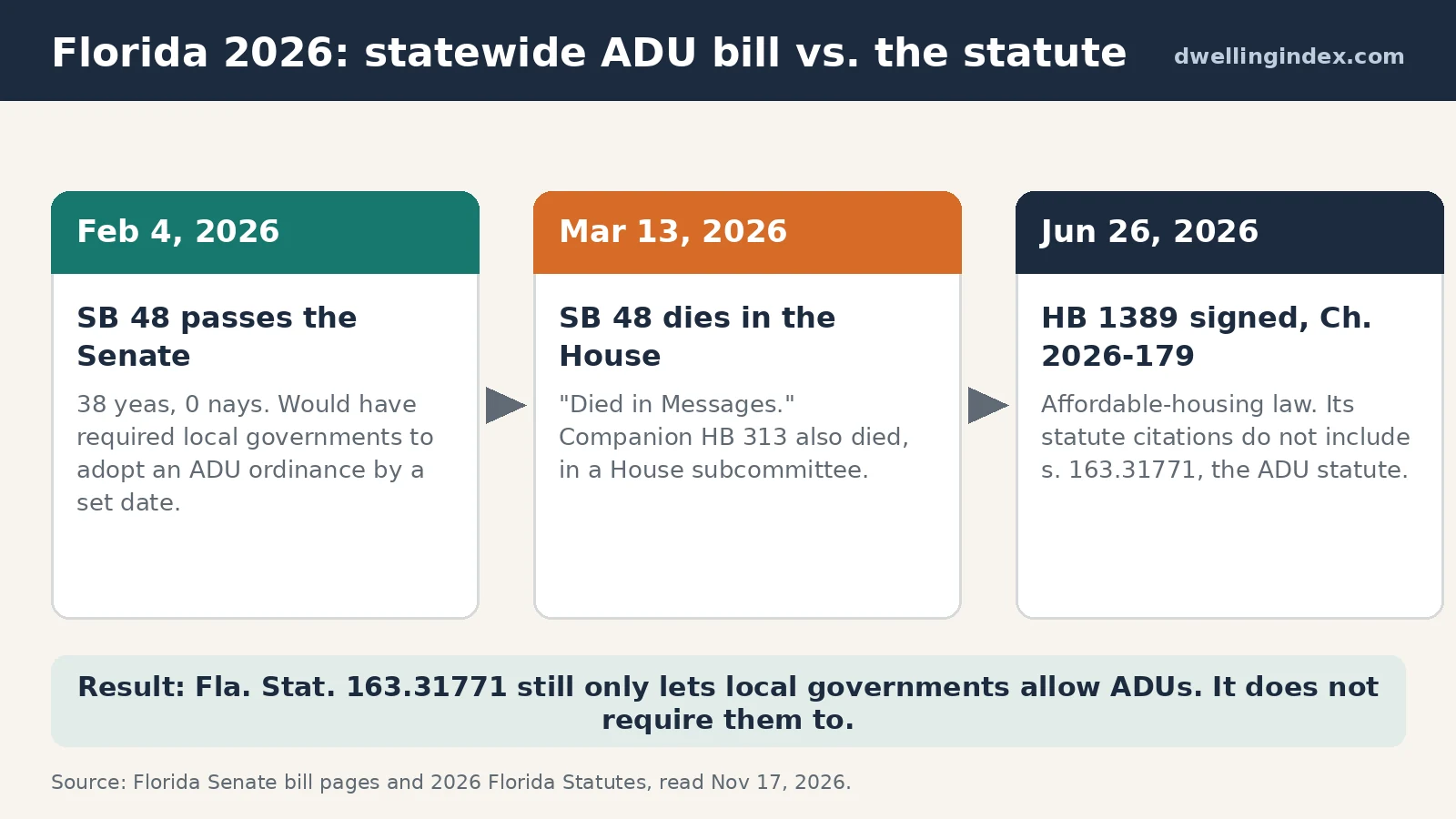
Answer capsule: No. Senate Bill 48 (2026), which would have required local governments to adopt an ADU ordinance by a specified date, passed the Senate 38 to 0 on February 4, 2026 and "Died in Messages" in the House on March 13, 2026. Its House companion, HB 313, died in the Intergovernmental Affairs Subcommittee. HB 1389, which became Chapter 2026-179, doesn't amend § 163.31771.
Disclosure: This page has no affiliate links. The Dwelling Index is reader-supported.
| Bill | What it was | What happened (Florida Senate bill pages) |
|---|---|---|
| SB 48 (2026), "Housing" | Defined "primary dwelling unit" and required local governments to adopt, "by a specified date," an ordinance allowing ADUs in certain areas | Passed the Senate 38 to 0 on 2/4/2026; died in House messages on 3/13/2026 |
| HB 313 (2026), "Housing" | House bill similar to SB 48 | Died in the House Intergovernmental Affairs Subcommittee on 3/13/2026 |
| HB 1389 (2026), "Affordable Housing" | Requires counties and municipalities to authorize multifamily and mixed-use residential uses on specified property, plus other affordable-housing provisions | Approved by the Governor 6/26/2026; Chapter No. 2026-179; effective 7/1/2026. The statutes it cites include 125.01055, 166.04151, 196.1978, 333.03, 420.615, 760.22, 760.26 and 760.35; § 163.31771 isn't among them |
Two things follow. First, anything you read saying Florida "now requires" cities to allow ADUs is wrong as of today. Second, the Senate passed the mandate unanimously, so a similar bill may return. A bill would have to be filed and passed in a future session, and we'll update this page if § 163.31771 changes.
Does your Florida city or county allow ADUs?
Answer capsule: Look up your property's jurisdiction and zoning district, then read that government's ADU ordinance. Some Florida cities and counties allow ADUs, but the zoning districts, lot sizes, size caps, owner rules and parking rules differ, and an address with a city mailing name can sit in the county's jurisdiction.
How to check, in order:
- Find your jurisdiction. Orlando's guide tells you to use its Orlando Information Locator and confirm that "Jurisdiction" reads "City of Orlando." Other places have similar tools.
- Find your zoning district. Orlando's ADU guide lists R-1, R-2, R-3, MXD, O-1, O-2 and PD districts as potentially eligible. Miami-Dade lists AU, EU and RU districts inside the Urban Development Boundary. Jacksonville's ordinance allows ADUs as an accessory use in residential land use categories subject to its criteria.
- Read the ADU section. Orlando Code Chapter 58 Part 3A, Jacksonville Code § 656.403(g), Miami-Dade Code § 33-22, or your own city's code.
- Check private rules. HOA and deed restrictions can add limits the city doesn't enforce.
- Call or book the planner. Orlando lists a Planner on Call, and Miami-Dade runs consults through its MeetQ system.
Our property eligibility check offers state-level context and broad cost ranges; it does not check zoning or parcel eligibility. Confirm your local rules with the planning office.
How do Orlando, Tampa, Jacksonville and Miami-Dade ADU rules compare?
Answer capsule: Orlando and Miami-Dade don't require the owner to live on site, Tampa does, and Jacksonville requires a homestead exemption, which in practice means the owner lives there. Size caps range from a 750-square-foot footprint in Jacksonville to 950 square feet in Tampa and up to 1,000 square feet in Orlando. Parking ranges from none to one space per unit.
Disclosure: This page has no affiliate links. The Dwelling Index is reader-supported.
| What you're checking | Orlando | Tampa | Jacksonville | Unincorporated Miami-Dade |
|---|---|---|---|---|
| Where the rule lives | Code ch. 58 Part 3A; ch. 14 §§ 14.10 and 14.11 | ADU General Standards (city handout) | Ord. Code § 656.403(g) via Ordinance 2022-448-E | County Code § 33-22 |
| Max size | 500 or 1,000 sq ft by zone and lot size; floor area ratio of 0.50 for house plus ADU; 700 sq ft maximum in a historic district | 950 sq ft | Footprint: 25% of the main house's gross floor area or 750 sq ft, whichever is less | 400 to 800 sq ft in RU-1 |
| Minimum lot | By zone, e.g., R-1 6,000 sq ft for up to 500 sq ft and 9,000 sq ft for up to 1,000 sq ft | Setbacks vary by zoning district | Not specified in the ordinance | 7,500 sq ft |
| Height | Zone rules; a detached ADU on a waterfront lot must be at least 15 ft from the water and no taller than 12 ft | 22.5 ft, two stories | Per § 656.403 | Can't exceed the main house's height |
| Location | Attached, or detached behind the main house | Inside the main structure with a separate entrance, or a separate structure | Behind the main house; not in a required yard | Attached or detached; detached can't be in front of the main house |
| Parking | Main house keeps 1 space; ADU over 500 sq ft needs one more | 1 space per unit | Not specified | Maximum of one additional space |
| Owner on site | Not required | Required | Homestead exemption required (or applied for) | Not required; owner can't live in the ADU |
| Utilities | Separate electric and water meters | Utility meter permitted | Not specified | Separate address, entrance or utilities permitted |
| Permit path | Building permit plus planning standards | Not stated in the handout | Building permit; applicant certifies HOA status | Certificate of Use (renewable), plus building permit |
| Pre-approved plans | Not found on the page we read | Not found | Not found | Pre-approved ADU Blueprint program |
Compare Florida ADU costs with your own numbers — run the free ADU cost calculator
We read four places. Florida has 67 counties and hundreds of municipalities. We did not read St. Petersburg, Sarasota, Gainesville, Fort Lauderdale or any other jurisdiction, so use the table as a range of what's allowed, not as your rule.
How do Orlando's ADU rules work?
Answer capsule: Orlando allows an ADU in R-1, R-2, R-3, MXD, O-1, O-2 and some PD zones when the lot meets the zone's minimum size: for example, 6,000 square feet in R-1 for an ADU of up to 500 square feet, or 9,000 square feet for up to 1,000 square feet. The house plus the ADU can't exceed half the lot area.
We cover Orlando's incentives and pre-approved plans on separate pages, so here are the state-law-relevant points.
- Size tiers. The two tiers are up to 500 and up to 1,000 square feet. The Lake Nona planned development allows one 1,000-square-foot ADU on any residential lot. Historic districts cap the ADU at 700 square feet and require review by the Historic Preservation Board.
- Floor area ratio. House plus ADU can't exceed 50% of the lot's square footage. The city's example is a 2,300-square-foot house on a 5,500-square-foot lot in R-2A: 2,750 minus 2,300 leaves 450 square feet for the ADU.
- Ownership. The same person or entity must own the main house and the ADU. The ADU can't be sold to a separate owner. A lot can be split into two lots only if the resulting lots meet the city's Tandem Single Family Development rules.
- Utilities. An ADU needs its own individual electric and water meters. The city cites Florida Administrative Code Rule 25-6.049(5), which requires individual electric metering for each separate occupancy unit of new residential buildings.
- Building standards. The ADU must be a permanent structure on a permanent foundation. An RV or mobile home can't be an ADU. It needs a kitchen with a sink, stove and refrigerator (a microwave or hot plate doesn't count), heating, and a bathroom of at least 30 square feet.
- Impact fees. New ADUs are exempt from school impact fees under the Orange County code. They pay transportation, park and sewer impact fees. The city lists a general sewer impact fee of $1,319.50 for a new ADU and says recent changes reduced how the other fees are calculated.
For Orlando-specific money and plans, see our Orlando ADU incentive program guide and our Orlando pre-approved ADU plans guide.
How do Tampa's ADU rules work?
Answer capsule: Tampa's ADU General Standards allow an ADU of up to 950 square feet, with a height of 22.5 feet and two stories, one parking space per unit, a maximum of two unrelated adults, and a requirement that the owner reside on the property. The ADU can be inside the principal structure with a separate entrance or in a separate structure.
Setbacks depend on the lot's zoning. In RS-75, RS-100 and RS-150 districts, the handout lists 60 feet from the street, 10 feet from the principal structure, 15 feet on a corner lot's street side, and 3 feet from a rear or interior side lot line. In all other districts, it lists 60 feet from the street, 5 feet from the principal structure, 7 feet on a corner lot's street side, and 3 feet from the rear and side. Two notes: an ADU that exceeds 15% of the lot size needs at least 20 feet from the rear lot line and 7 feet from the side lot line. A separate utility meter is permitted.
The key trade-off. Tampa's handout states the owner-residency rule outright, and Jacksonville's homestead requirement works in a similar way, since a homestead exemption generally goes to an owner who lives in the home. In both places, an investor who doesn't live on the lot may not be able to use the ADU path.
How do Jacksonville's ADU rules work?
Answer capsule: Jacksonville's Ordinance 2022-448-E, which added Zoning Code § 656.403(g), allows an ADU as an accessory use in residential land use categories when it sits behind the main house, outside required yards, with a footprint of 25% of the main house's gross floor area or 750 square feet, whichever is less. The property must have a homestead exemption or qualify for one.
The ordinance lists these criteria:
- The ADU must be located behind the primary structure and outside required yards.
- It needs "a visual relationship to the main house," shown through roof shape, porches and paint color for new buildings.
- The ADU can be attached or detached. An attached ADU must be physically separated so there is no direct internal access to the main house.
- The permit application must have the applicant certify whether the property is in a deed-restricted community or subject to an HOA, and if so, that the applicant confirmed an ADU is allowed under those rules.
We read the ordinance as adopted. The current Ordinance Code may have been amended since, so check the code and the city's permit office before you rely on a figure.
How do Miami-Dade County's ADU rules work?
Answer capsule: In unincorporated Miami-Dade, one ADU per lot is allowed in AU, EU and RU zoning districts inside the Urban Development Boundary on lots of at least 7,500 square feet. In RU-1 the ADU must be 400 to 800 square feet. Only the owner can obtain the required Certificate of Use, which must be renewed whether or not the unit is rented.
From the county's ADU page:
- Occupants. The occupant doesn't have to be related to the owner, and the ADU can be rented for a fee.
- Owner residence. The owner isn't required to live on site, but if they do, they must live in the main house, not the ADU.
- Height and location. A detached ADU can't be taller than the main house and can't sit in front of it. Setbacks still apply.
- Parking. A maximum of one additional space and not more than two vehicles, on the property or in the adjacent swale.
- Vacation rentals. The ADU can't be used as a vacation rental on its own. The vacation rental has to be for the entire property.
- HOA. Homes in a community association need proof of notification to the association.
- Sale. "An ADU is not a duplex and cannot be sold independently of the principal building."
- Pre-approved designs. The county runs an ADU Blueprint program for pre-approved designs.
- Unpermitted ADUs. The county says legalizing one follows the same process as a new project: scaled plans and review by all required disciplines.
This applies to unincorporated Miami-Dade only. Cities inside the county, such as Miami, Coral Gables and Hialeah, have their own codes.
Can you rent your Florida ADU, and does the affordable-rent affidavit apply?
Answer capsule: Orlando and Miami-Dade say an ADU can be rented, Tampa's handout limits occupancy to two unrelated adults with the owner on site, and a Jacksonville ADU sits on homestead property. Short-term rental is restricted: Orlando requires separate registration, and Miami-Dade bars ADU-only vacation rentals. The state affidavit in § 163.31771(4) says the unit will be rented at an affordable rate, so ask your permit office whether it's part of your application.
Here is what each place says:
- Orlando: The ADU may be rented via a standard residential lease. Short-term rentals of less than 30 days "require a separate registration," and the city says special rules apply and short-term rental "is not allowed in all situations."
- Tampa: The handout limits occupancy to two unrelated adults and requires the owner to reside on the property. It doesn't discuss rental terms.
- Jacksonville: The ordinance's homestead requirement ties the ADU to an owner-occupied home. It doesn't address rental terms.
- Miami-Dade: Rental for a fee is allowed. Short-term use must cover the entire property.
For a rental-income estimate, see how much you can rent an ADU for and our ADU rental income guide. These are illustrative examples, not guarantees of returns. Actual results depend on local market conditions, construction costs, financing terms, and regulatory approvals. For short-stay use, read our ADU for Airbnb guide.
Can you sell a Florida ADU separately from the house?
Answer capsule: Orlando and Miami-Dade prohibit selling an ADU separately in the documents we read; the Tampa and Jacksonville documents did not address sale. Orlando requires the same owner for the house and the ADU and says the ADU can't be sold to a separate owner, though a lot can be split if both resulting lots meet the Tandem Single Family Development rules. Miami-Dade says an ADU "cannot be sold independently of the principal building." Section 163.31771 says nothing about ownership.
The Orlando lot-split route is the only path we found in these documents, and it requires each resulting lot to meet the city's standards. If separate ownership is part of your plan, ask your city whether a lot split or condominium is possible before you design.
Do property taxes change when you add a Florida ADU?
Answer capsule: They can. Miami-Dade's ADU page says an ADU "may affect the property taxes as a result of an increase to the property's assessed value and may change the homestead exemption status," and that rent from the ADU counts as income when determining eligibility for the low-income senior and long-term low-income senior exemptions.
Check this before you rent. The county says the owner is responsible for contacting the Office of the Property Appraiser before renting the ADU or changing the property's use. This is Miami-Dade's statement. Other counties' property appraisers may treat ADUs differently, so call yours. For appraisal effects of an ADU, see our guide to ADU appraisal value.
Do HOAs and deed restrictions block ADUs in Florida?
Answer capsule: They can. Jacksonville asks every ADU applicant to certify whether the property is in a deed-restricted community or HOA and, if so, that an ADU is allowed. Miami-Dade requires proof of notification to the community association. Section 163.31771 doesn't address HOAs, so private covenants still apply.
A city permit doesn't override a covenant. If your community has an HOA, ask for the declaration and architectural rules before you pay for plans, and ask in writing whether detached or attached accessory dwellings are allowed.
What do Florida ADUs need for utilities and building code?
Answer capsule: Orlando's guide says an ADU must be on a permanent foundation, meet residential building code, connect to public water and sewer if the main house does, have its own electric and water meters, and include a kitchen, bathroom and heating. Septic lots can trigger health-code rules, and some utilities set their own easement and metering requirements.
Points from Orlando's guide that apply as a checklist elsewhere:
- Water and sewer. If the main house is on public water or sewer, the ADU must connect to the public utility. If the house is on a well or septic, "it is possible you will be required to connect to public utilities or replace the septic tank."
- Metering. Ask your electric and water providers for their easement and metering rules before you finalize the site plan.
- Heat and cooling. The ADU needs heating. Air conditioning isn't required in Orlando, but if there isn't any, the windows must be operable and screened.
- Appearance. The ADU must match the main house's exterior finish and include similar architectural details unless the city approves an alternative design.
- Waterfront lots. Detached ADUs must sit at least 15 feet from the normal high-water elevation or wetland boundary and can't exceed 12 feet in height.
Florida-specific site checks, such as flood zone and coastal construction rules, are decided by your local building department. We didn't verify flood-zone rules for this page, so ask the permit counter.
What does a Florida ADU project look like step by step?
Answer capsule: Confirm that your jurisdiction allows ADUs and your zone and lot qualify, check HOA and deed rules, design to the local size, setback and parking standards, ask about the affordable-rent affidavit and any certificate of use, and then apply for the building permit.
- Find out if you qualify. Jurisdiction, zoning district, minimum lot size.
- Choose the type. Conversion, attached addition or detached unit. Orlando and Miami-Dade treat them differently on setbacks and size.
- Check the owner rule. Tampa requires the owner on site, and Jacksonville requires homestead.
- Check private rules. Read the HOA declaration.
- Confirm utility paths. Meters, easements, sewer or septic.
- Ask about the affidavit and certificates. § 163.31771(4), Miami-Dade's Certificate of Use and disclosure statement.
- Apply and track. Orlando's Digital Permitting Portal walks you through permits and preliminary costs.
Check your lot's ADU options — get your free report
For the full build sequence, read our guide to building an ADU and our ADU permit process guide.
How can you pay for a Florida ADU?
Answer capsule: Common ways homeowners pay for an ADU include cash, a home equity loan or line, and a renovation or construction loan. Which fits depends on your equity, your timeline and whether you plan to rent the unit. We cover the paths as education, not as rankings or offers.
Our ADU financing options guide compares the main paths side by side. Orlando's incentive program has its own page, our Orlando ADU incentive program guide. Check any program's current status before you plan around it.
What should you ask the planning counter before you pay for plans?
Answer capsule: Ask whether your city or county allows ADUs on your lot, the current size and parking rules, whether the owner must live on site, whether the affordable-rent affidavit applies, how rental and utilities work, and what the permit path is. Write down the answers with the date.
- Does my jurisdiction have an ADU ordinance, and which zoning districts does it cover?
- What's the maximum size, and how is it measured (floor area, footprint or lot-based tiers)?
- Does my lot meet the minimum lot size for the ADU I want?
- What are the setbacks and height limits for a detached unit?
- How much parking is required for the ADU and the main house?
- Must I live on the property? Is a homestead exemption required?
- Is the affordable-rent affidavit under § 163.31771(4) part of the application? What are the rent limits?
- Do I need a Certificate of Use, registration for short-term rental, or an owner disclosure?
- What impact fees apply, and which are reduced or exempt for ADUs?
- What does my electric or water utility require for separate meters?
Print the list, write the answers in the margin and date them. Then use our property eligibility check for a general planning overview; confirm parcel-specific rules with the planning office.
See what's possible at your address — get your free ADU report
What we verified
- Verified on November 17, 2026: Fla. Stat. § 163.31771 (2026) on the Florida Senate's statutes site; Florida Senate bill pages for CS/CS/SB 48 (2026) and CS/CS/HB 1389 (2026), including bill histories and statute citation lists.
- Verified: City of Orlando, "Accessory Dwelling Units: Step-by-Step Guide."
- Verified: City of Tampa, "Accessory Dwelling Unit (ADU) General Standards" (2025 handout).
- Verified: City of Jacksonville Ordinance 2022-448-E, which amended Ordinance Code § 656.403.
- Verified: Miami-Dade County, "Accessory Dwelling Unit (ADU)" page.
- Not verified: the current text of Jacksonville's Ordinance Code after 2022, Tampa's and Jacksonville's pre-approved plan offerings, impact fee schedules other than Orlando's sewer figure, how any city applies the § 163.31771(4) affidavit, flood-zone rules, and any change passed after the documents we read. We did not read HB 313's text; its status comes from the bill pages.
Methodology
We used each government's own published document, not a third-party summary, and recorded the document name next to every number. The statute and bill histories came from the Florida Senate's site. Where a document didn't address a topic, we say so instead of filling the cell. We don't state permit or impact fee amounts beyond Orlando's published sewer figure, because fee schedules change and we didn't verify them. If you find a number that is out of date, tell us on our corrections page.
Sources
- Fla. Stat. § 163.31771, Accessory dwelling units (2026): flsenate.gov
- Florida Senate, CS/CS/SB 48 (2026), Housing, bill page and history: flsenate.gov
- Florida Senate, CS/CS/HB 1389 (2026), Affordable Housing, bill page and history (Chapter 2026-179): flsenate.gov
- City of Orlando, Accessory Dwelling Units: Step-by-Step Guide: orlando.gov
- City of Tampa, Accessory Dwelling Unit (ADU) General Standards: tampa.gov
- City of Jacksonville, Ordinance 2022-448-E (amending Ordinance Code §§ 656.305 and 656.403): city ordinance library
- Miami-Dade County, Accessory Dwelling Unit (ADU) page and Code § 33-22: miamidade.gov
Frequently asked questions
Are ADUs legal in Florida?
It depends on your city or county. Florida Statute § 163.31771 lets a local government adopt an ordinance allowing ADUs in single-family zones, but doesn't require it. Orlando, Tampa, Jacksonville and unincorporated Miami-Dade each allow ADUs under their own rules.
Did Florida pass a new ADU law in 2026?
No. Senate Bill 48 would have required local governments to adopt an ADU ordinance. It passed the Senate 38 to 0 and died in the House on March 13, 2026. HB 1389 became law but doesn't change § 163.31771.
How big can an ADU be in Florida?
There is no statewide cap. Tampa allows 950 square feet. Orlando allows up to 500 or 1,000 square feet depending on zone and lot size. Jacksonville limits the footprint to 25% of the house's gross floor area or 750 square feet. Unincorporated Miami-Dade requires 400 to 800 square feet in RU-1.
Do I have to live on the property to have an ADU in Florida?
It depends on the place. Tampa requires the owner to reside on the property. Jacksonville requires a homestead exemption. Orlando and Miami-Dade don't require the owner to live on site, though in Miami-Dade the owner can't live in the ADU.
Do Florida ADUs need extra parking?
Sometimes. Tampa requires 1 space per unit. Orlando requires one more space only for an ADU larger than 500 square feet. Miami-Dade allows a maximum of one additional space.
What is the Florida ADU affordable-rent affidavit?
Section 163.31771(4) says an ADU building permit application must include an affidavit that the unit will be rented at an affordable rate to an extremely-low, very-low, low or moderate-income person. Ask your permit office whether it's part of your application.
Can I sell my Florida ADU separately?
Orlando says the ADU can't be sold to a separate owner, and Miami-Dade says it can't be sold independently of the principal building. The Tampa and Jacksonville documents we read did not address sale.
Can I use my Florida ADU as an Airbnb?
It depends. Orlando requires separate registration for rentals under 30 days and says they aren't allowed in all situations. In unincorporated Miami-Dade, an ADU can't be a vacation rental on its own; the whole property must be included.