
Orlando ADU Incentive Program 2026: $10K Rebate, Real Rules & the Catch
· · Last verified: May 26, 2026
At a glance: the Orlando ADU incentive in seven questions
This is the fast-scan version. Every row is expanded and sourced further down.
| Question | Fast answer | Why it matters |
|---|---|---|
| How much can you get? | Up to $10,000 build-out rebate + 100% of building permit fees ($450–$1,050) + 100% of eligible impact fees ($1,300–$3,100). Realistic total: ~$11,800–$14,200. | A meaningful discount, not a full construction budget. |
| Is it upfront money? | No. The application is accepted only after certificate of occupancy and must include an executed lease. | You need a way to fund the build before reimbursement. |
| Who qualifies? | Owners of property inside City of Orlando limits with a code-compliant ADU and a qualifying tenant. | An “Orlando” mailing address is not the same as being in city limits. |
| What’s the tenant rule? | Tenant at or below 120% AMI for 12 of the first 24 months after CO. The lease requirement may be waived if the resident is 62+. | Limits who you can rent to during the compliance window — unless you house an aging parent. |
| Size/site gate? | The incentive site checklist caps the ADU — including new driveways, patios, and walkways — at 500 total square feet, with total impervious surface ≤ 55%. | Bigger ADUs may be legal under city code but may fall outside this incentive. |
| Survey required? | Yes — a topographic survey by a licensed surveyor is required for all ADU applications. Its cost may be rebate-eligible if program conditions are met. | A real upfront cost most homeowners don’t budget for. |
| First step? | Confirm city limits, zoning, lot size, flood, easements, ISR, and utility metering before paying for design. | Prevents spending money on a project that can’t qualify. |
Sources: City of Orlando ADU Incentive Program page; ADU Incentive Program Application (PDF); ADU Pre-Application Checklist (PDF, May 2026); ADU Step-by-Step Guide; ADU Impact Fee Worksheet. Verified May 26, 2026.
Check your Orlando ADU incentive fit before you spend
See what your address can actually build — and what the incentive is worth on your home. Answer a few questions about your property, planned ADU size, tenant plan, and funding status. You’ll get a preliminary city-limit and site-checklist screen, an estimated rebate-offset range for your home size, and the exact questions to ask the city before paying for plans.
See What You Can Build → Get Your Free ADU Report in 60 SecondsWhat we verified
Is the Orlando ADU Incentive Program open, and how much can you actually get?
The City of Orlando’s ADU Incentive Program offers a build-out rebate of up to $10,000 for ADU construction costs, a 100% rebate on eligible building permit fees, and a 100% rebate on eligible park, transportation, and sewer impact fees. The city publishes average ranges of $1,300–$3,100 for impact fees and $450–$1,050 for permit fees, which puts the realistic combined value at roughly $11,800 to $14,200 depending on your home’s size.
Here’s the part worth slowing down on. “Up to $10,000” is not the same as a guaranteed $10,000 — the build-out rebate reimburses documented construction cost, so a smaller or cheaper project can draw a smaller rebate. The fee rebates aren’t flat either; they depend on the actual fees your specific project is assessed, which is why the total swings by several thousand dollars depending on your existing home size. We work that math out below in a way the city’s page doesn’t.
What the incentive reimburses
- Up to $10,000 toward documented build-out (construction) costs.
- 100% of eligible park impact fees.
- 100% of eligible transportation impact fees.
- 100% of eligible sewer impact (benefit) fees.
- 100% of eligible building permit fees.
Two terms worth defining, because they drive the dollar figures. An impact fee is a one-time charge a local government levies on new construction to help pay for the public infrastructure the new unit will use — roads, parks, sewer capacity. A building permit fee is what you pay the city to review your plans and authorize construction. Orlando’s incentive wipes out 100% of both categories for a qualifying ADU, which is genuinely unusual and is the quiet workhorse of the program’s value.
The one thing most news stories bury
We’ll say it plainly because it’s the single most important sentence on this page: the Orlando incentive is reimbursement, not financing. The City of Orlando’s ADU Incentive Program application states that applications “will only be accepted after issuance of Certificate of Occupancy and must be submitted with an executed lease agreement.” A certificate of occupancy (CO) is the document a city issues confirming a finished building is safe and legal to live in — it comes at the end of construction. So the sequence is: you pay for design, survey, permitting, site work, and the full build out of pocket or with financing; you get the CO; you sign a qualifying lease; and then you apply to be paid back up to your rebate amount.
That doesn’t make the program a bad deal. It makes it a back-end deal. Treat the rebate as a discount you collect at the finish line, not as seed money for the start — and plan your funding accordingly. We cover the financing paths people use further down.
Who qualifies for the Orlando ADU incentive?
To qualify, the property must be inside City of Orlando limits, the ADU must meet the program’s site and construction requirements, and the homeowner must rent the ADU to a tenant earning at or below 120% of area median income for 12 of the first 24 months after the certificate of occupancy. The City of Orlando states the lease requirement may be waived if the ADU resident is age 62 or older. Site, documentation, and property-status conditions also apply.
The eligibility gates, in plain English
| Gate | Pass condition | Why it matters | Source |
|---|---|---|---|
| City location | Property is inside City of Orlando limits | The program is city-specific; unincorporated Orange County does not qualify | City incentive page |
| Ownership | The same person/entity owns both the main house and the ADU; the ADU can’t be sold separately | A structural rule that rules out "sell the backyard unit" plans | Step-by-Step Guide |
| Tenant income | Tenant earns ≤ 120% AMI | Core affordability requirement | City incentive page |
| Lease duration | Rented to a qualifying tenant for 12 of first 24 months after CO | Required compliance window | City incentive page |
| Senior provision | The lease requirement may be waived if the resident is 62+ | A cleaner path for the aging-parent use case | City incentive page |
| Topographic survey | Licensed surveyor’s topographic survey completed before application | Required for every ADU application; a real upfront cost | Pre-Application Checklist |
| Application timing | Apply after CO, with executed lease | Confirms it’s reimbursement, not upfront | Application PDF |
| Site checklist | Size, ISR, flood, easement, utility, drainage all clear | This is where most projects get blocked | Pre-Application Checklist |
The Dwelling Index is reader-supported. The clearly marked affiliate links on this page help fund our independent research, at no extra cost to you. See our full disclosure above.
Run your address against these gates → get your free ADU report.
What does 120% AMI mean in real dollars?
Area Median Income (AMI) is the midpoint household income for a region, published annually by the U.S. Department of Housing and Urban Development (HUD). “120% AMI” means 120% of that midpoint, adjusted for household size — it’s a moderate-income ceiling, not a poverty line, which is why this program is aimed at “workforce” housing like teachers, nurses, and service workers.
These are the most recent published Orange County limits. The City of Orlando’s incentive page states the 120% AMI rule but does not print the specific table it applies, so confirm the exact figures the program uses at the time you apply.
| Household size | Orange County 120% AMI income limit |
|---|---|
| 1 person | $88,560 |
| 2 people | $101,160 |
| 3 people | $113,880 |
| 4 people | $126,480 |
Source: Florida Housing Finance Corporation 2025 Combined Income & Rent Limits (Orange County), via the Shimberg Center / Florida Housing Data Clearinghouse. Most recent published table as of May 26, 2026; confirm the program-applied table with the city before applying.
The practical takeaway: a 120% AMI ceiling near six figures for a single tenant is high enough that a wide range of working renters will qualify — but you can’t simply rent to the highest bidder during the compliance window.
Is there a separate rent cap on top of the income limit?
The city’s published incentive materials state a tenant income requirement (≤120% AMI) but do not, in the materials we reviewed, state a separate maximum rent you may charge. Income limits and rent limits are different tools, and we won’t publish a rent cap as a program rule unless the city confirms one applies. If you’re modeling returns, confirm this point with the program manager before you assume either way.
Property-status flags on the application
The program application asks whether the property has unpaid taxes, unpaid insurance, a pending judgment or foreclosure, code-enforcement liens of $5,000 or more, or special-assessment liens of $2,500 or more. Treat these as application flags to clean up before applying, and confirm with the city whether any is an automatic disqualifier.
Can your Orlando property pass the ADU site checklist?
Before you think about the rebate, confirm your lot can legally support the ADU at all. Orlando’s incentive checklist requires a topographic survey, the property to be inside city limits, the ADU (including any new driveways, patios, and walkways) to stay at or under 500 total square feet, total impervious surface to stay at or under 55%, and the project to clear flood-zone, easement, water/wetland setback, drainage, and separate-utility-meter requirements. Failing any one of these can stop the project before design even begins.
This is the most valuable section on the page, for one reason: it’s where money gets wasted. People fall in love with a floor plan, pay a designer, and only then discover an easement runs through the buildable area. Run these gates first.
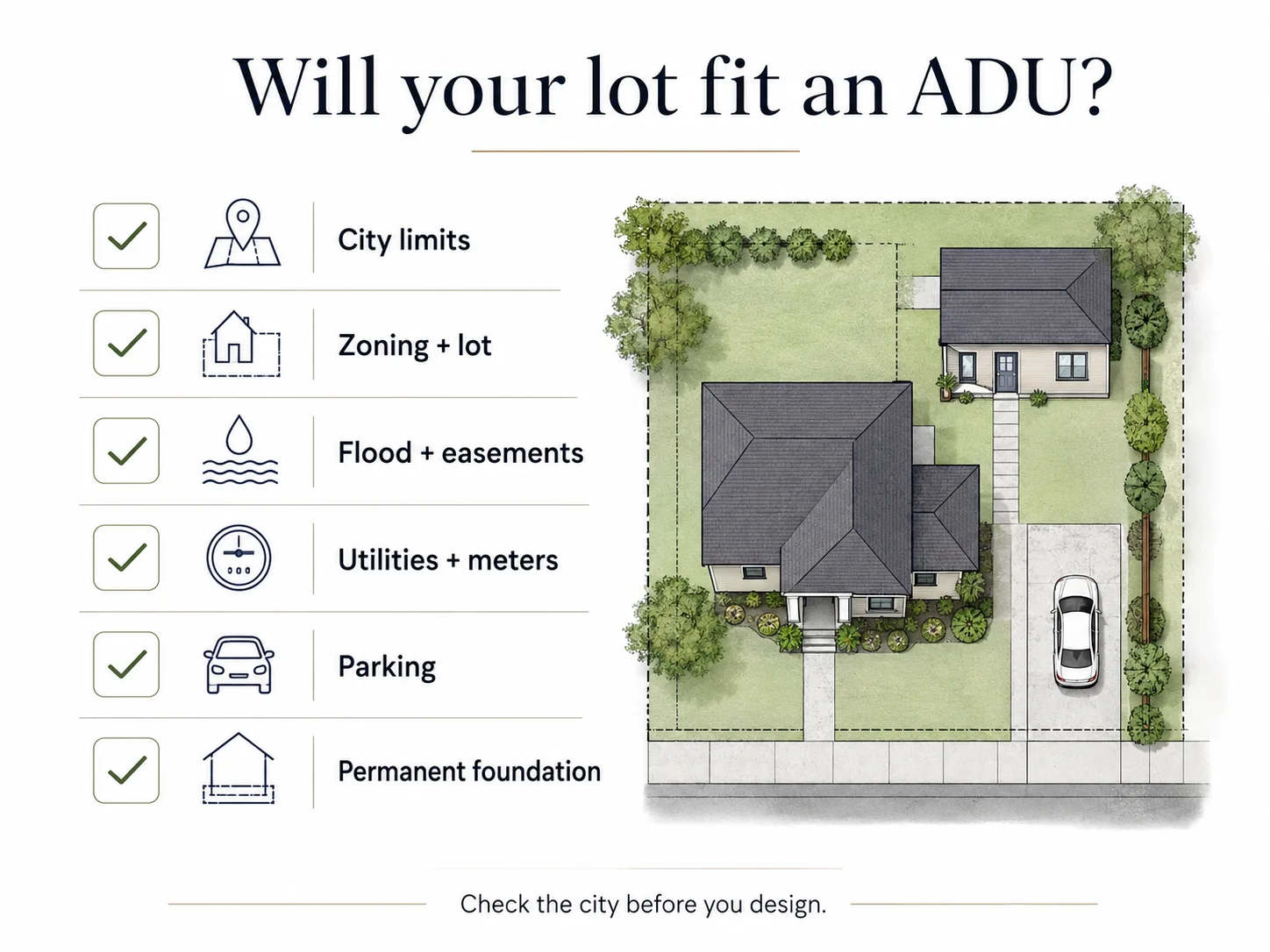
Gate 0: The topographic survey you’ll need before anything else
The city’s ADU Pre-Application Checklist opens with this in bold: a topographic survey is required for all ADU applications, and you must hire a licensed surveyor before submitting. A topographic survey maps your lot’s exact boundaries, elevations, structures, and features — it’s what the city uses to confirm setbacks, drainage, and impervious surface. The good news: the city says this cost may be rebate-eligible if all program conditions are met. Budget for it early; it’s a real line item homeowners routinely forget.
Gate 1: City limits come first
The incentive applies only to property inside City of Orlando jurisdiction. A Florida address that says “Orlando” can sit in unincorporated Orange County and not qualify. The city directs homeowners to the Orlando Information Locator — enter your address, and if the “Jurisdiction” field reads “City of Orlando,” you’re in. If it doesn’t, this specific incentive isn’t available to you (see the “outside city limits” section below).
Gate 2: Zoning districts that allow ADUs
Per the city’s Step-by-Step Guide, properties zoned R-1, R-2, R-3, MXD, O-1, O-2, or PD may be eligible for an ADU, subject to lot size. (PD stands for Planned Development — a custom zoning category where you must contact the Planning Division to confirm an ADU is permitted.) Standards are governed by City Code Chapter 58, Part 3A.
Gate 3: Lot-size minimums by zoning district
This table is straight from the city’s ADU Step-by-Step Guide. Your lot must meet the minimum for the ADU size you want.
| Zoning district | Min lot for ADU up to 500 sq ft | Min lot for ADU up to 1,000 sq ft |
|---|---|---|
| R-1AA | 10,000 sq ft | 15,000 sq ft |
| R-1A | 7,700 sq ft | 11,550 sq ft |
| R-1 | 6,000 sq ft | 9,000 sq ft |
| R-1N | 5,500 sq ft | 8,250 sq ft |
| R-2A | 5,500 sq ft | See tandem standards |
| R-2B | 5,000 sq ft | See tandem standards |
| R-3A | 5,500 sq ft | See tandem standards |
| R-3B | 5,000 sq ft | See tandem standards |
| R-3C | 4,500 sq ft | See tandem standards |
| R-3D | 4,500 sq ft | See tandem standards |
| MXD-1 | 5,000 sq ft | See tandem standards |
| MXD-2 | 4,500 sq ft | See tandem standards |
| O-1 | 5,500 sq ft | See tandem standards |
| O-2 | 4,500 sq ft | See tandem standards |
Source: City of Orlando ADU Step-by-Step Guide, verified May 26, 2026.
Three city-confirmed special cases worth knowing:
- Every ADU must be smaller than the main house. If your lot is below the minimum, the city says to check whether it’s a “legally non-conforming lot of record,” which may qualify for a variance.
- Historic Districts: if your property is in a Historic Preservation district, the ADU maximum drops to 700 square feet and you must obtain a Certificate of Appropriateness through a Major Review before applying for building permits.
- Lake Nona PD: all residential properties in the Lake Nona Planned Development are eligible for one 1,000-square-foot ADU regardless of lot size, and are not bound by the FAR cap below.
Gate 4: The 0.50 Floor Area Ratio cap
Floor Area Ratio (FAR) is the ratio of total building floor area to lot size. Orlando caps the house plus the ADU at 50% of the lot’s square footage (0.50 FAR). The city’s own worked example: a 2,300-sq-ft house on a 5,500-sq-ft lot in R-2A gets 5,500 × 0.50 = 2,750 sq ft of allowed building; subtract the 2,300-sq-ft house and only 450 sq ft remains for the ADU. On a tight lot, FAR — not the incentive’s 500-sq-ft cap — can be your real ceiling.
Gate 5: The 500-total-square-foot incentive trap
Here’s a distinction that catches people. Orlando’s general ADU code allows units up to 500 or 1,000 square feet depending on zoning and lot size. But the incentive’s Pre-Application Checklist (dated May 2026) caps the ADU including new driveways, patios, and walkways at 500 total square feet, and requires total impervious surface to stay at or below 55%.
Impervious Surface Ratio (ISR) is the share of your lot covered by surfaces water can’t pass through — roof, concrete, pavers, even artificial turf. Add a 500-sq-ft ADU plus a new driveway and you can blow past 55% fast on a small lot.
So you can have a perfectly legal 800-sq-ft Orlando ADU that simply doesn’t fit this incentive’s checklist. If your project is larger, confirm with the city before assuming the rebate applies.
Gate 6: Flood zones, easements, setbacks, and drainage
The checklist requires your ADU to be:
- Outside a flood zone (check the city’s FEMA flood-zone maps).
- Clear of any dedicated easement — an easement is a strip of your land legally reserved for utilities like power lines or sewer pipes; you own it but can’t build on it.
- Set back the required distance from property lines. The city confirms that detached ADUs must sit at least 15 feet from a wetland or normal high-water line with a maximum height of 12 feet, while attached ADUs must meet the principal-structure setback (50 feet from water).
- Drainage-neutral — your project can’t change how stormwater flows or push runoff onto a neighbor.
Gate 7: Separate utility meters
The city requires each ADU to have its own individual electric and water meters. The electric-meter requirement is also backed by state law: Florida Administrative Code Rule 25-6.049(5) requires individual electric metering by the utility for each separate occupancy unit in new residential buildings. Plan-decoded: budget for a second meter set and confirm easement, metering, and water-meter details with your electric and water providers early, because retrofitting meters is expensive.
Stop before paying for plans if:
- Your property is outside City of Orlando limits
- The ADU would sit in a flood zone
- The design crosses an easement
- New hardscape pushes ISR above 55%
- The unit can’t get separate utility meters
- Your HOA or deed restrictions prohibit a second unit
Any one of these can end the project.
Want a pass/fail screen before you hire a designer?
Your lot decides more than the headline rebate does. Before you commit to design or a survey, see whether your address looks ADU-feasible.
See What You Can Build → Get Your Free ADU ReportHow much can the rebate actually offset on your home?
The headline $10,000 is only part of the value. Eligible homeowners also recover building permit fees and impact fees, and the impact-fee portion varies with your existing home’s size because Orlando charges transportation and park impact fees in tiers tied to total conditioned square footage. Using the city’s published fee worksheet, the realistic total incentive on a 500-sq-ft ADU ranges from about $11,770 to $14,230 depending on your starting home size. This is the calculation the city’s page leaves you to do yourself.
Why the fee rebate moves around
Orlando assesses the sewer impact (benefit) fee as a roughly fixed amount for an added ADU — $1,319.50 per the city worksheet. But the transportation and park impact fees only apply if your new combined conditioned square footage (house + ADU) crosses into a higher fee tier. Conditioned square footage means the heated/cooled living area. If adding 500 square feet doesn’t bump you into the next bracket, that fee can be $0; if it does, the fee delta can run well over $1,000. One more piece of good news the city confirms: new ADUs are exempt from Orange County school impact fees, so those never enter the math.
The Dwelling Index Orlando ADU Rebate Value Matrix
We modeled a 500-square-foot ADU added to five common existing-home sizes, using the City of Orlando’s published transportation tiers (Chapter 56 Part 1), park tiers (Chapter 56 Part 2), and the fixed sewer fee from the city’s ADU impact-fee worksheet. We then added the city’s published permit-fee range ($450–$1,050) and the maximum $10,000 build-out rebate. We reproduced the city’s own two worked examples exactly (the 1,400-sq-ft home triggers no transportation/park fee; the 1,800-sq-ft home triggers a $1,424 transportation fee), which validates the method.
| Existing home (conditioned sq ft) | New total with 500-sq-ft ADU | Transportation fee Δ | Park fee Δ | Sewer fee | Eligible impact-fee rebate | Total incentive (with $10K + permit-fee rebate) |
|---|---|---|---|---|---|---|
| 1,400 | 1,900 | $0 | $0 | $1,319.50 | $1,319.50 | $11,769.50–$12,369.50 |
| 1,800 | 2,300 | $1,424.00 | $440.00 | $1,319.50 | $3,183.50 | $13,633.50–$14,233.50 |
| 2,300 | 2,800 | $0 | $315.00 | $1,319.50 | $1,634.50 | $12,084.50–$12,684.50 |
| 2,800 | 3,300 | $0 | $287.00 | $1,319.50 | $1,606.50 | $12,056.50–$12,656.50 |
| 3,200 | 3,700 | $328.00 | $382.00 | $1,319.50 | $2,029.50 | $12,479.50–$13,079.50 |
Methodology: transportation tiers — ≤1,200 sq ft $3,898; 1,201–2,000 $5,645; 2,001–3,500 $7,069; 3,501+ $7,397. Park tiers — ≤1,200 $1,633; 1,201–2,000 $2,225; 2,001–2,499 $2,665; 2,500–2,999 $2,980; 3,000–3,499 $3,267; 3,500+ $3,649. Sewer fee fixed at $1,319.50 (two-multifamily-unit assessment less single-family credit). Deltas assume the listed starting size sits in its tier; properties near a tier boundary may differ. School impact fees excluded (ADUs are exempt). Source: City of Orlando ADU Impact Fee Worksheet, verified May 26, 2026.
What the table means in plain English
For most homeowners, the real incentive lands around $10,000 plus a few thousand dollars in fee relief — meaningful, but nowhere near a full construction subsidy. Notice the pattern: the biggest total ($14,233) goes to the 1,800-sq-ft home, because adding 500 square feet pushes it across both a transportation and a park tier. A larger home already deep inside the top tiers may see a smaller fee delta. The lesson: your existing square footage, not just your ADU size, determines what you collect.
What to confirm before you trust any estimate
- • Your final ADU square footage and the existing conditioned square footage the city uses.
- • Your transportation and park impact-fee tiers, and the current sewer fee.
- • Your permit-fee estimate and whether your survey cost qualifies for rebate.
- • Whether program funds are still available.
- • Whether your project stays inside the incentive checklist.
Fund the build before reimbursement
Because the city pays you back after the certificate of occupancy, the real question for most owners is how to cover construction in the meantime. The primary options are savings, home equity financing (HELOC or cash-out refinance), renovation loans, and construction loans. These paths vary in how much equity you need, how rates are structured, and how lenders treat ADU projects. The goal is to understand the landscape, not to pick a lender.
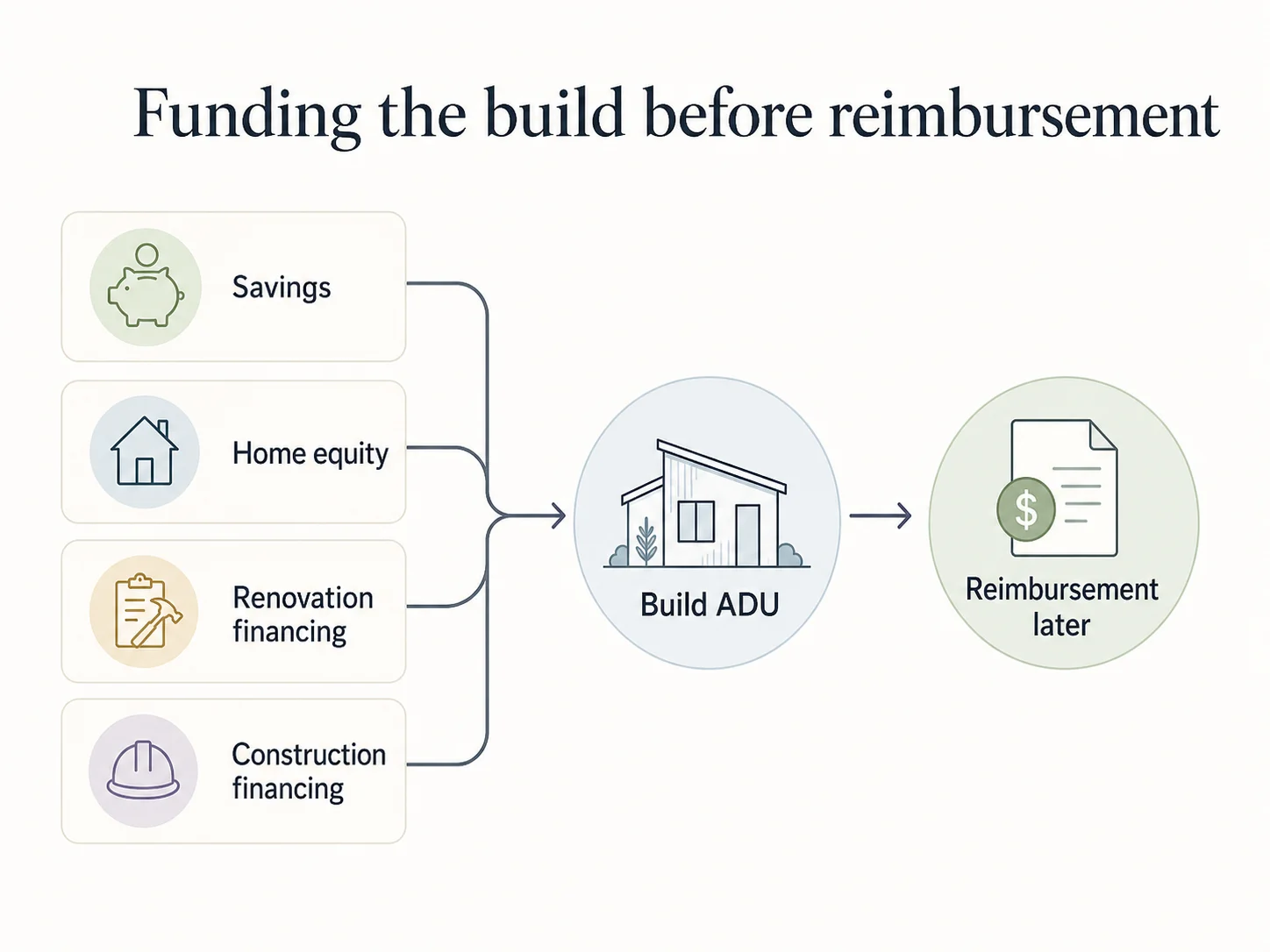
Savings / cash: No financing cost. Requires liquidity you may not have. Works best when the ADU cost is well within reach.
Home equity (HELOC or cash-out refinance): Draws on the equity you’ve built. A HELOC is a revolving line of credit at a variable rate; a cash-out refinance replaces your current mortgage and returns cash at closing. Both typically require solid equity and good credit, and your existing home is the collateral.
Renovation or construction loans: Lenders who specialize in ADU projects can lend against the future appraised value including the ADU — useful if your current equity is limited. These products have more moving parts than a simple home equity line.
Affiliate disclosure: The Dwelling Index is reader-supported. The clearly marked affiliate link below helps fund our independent research, at no extra cost to you. Our editorial recommendations are based on independent research and are never influenced by compensation.
The rebate helps at the finish line. You still have to fund the build.
Because the city pays you back after the certificate of occupancy, the real question for most owners is how to cover construction in the meantime. Explore the financing lanes homeowners use — construction loans, renovation loans, and cash-out refinancing — as independent education, not a lender ranking.
Compare ADU Financing OptionsCompare common funding routes and their eligibility limits before contacting a lender.
The Dwelling Index is reader-supported; we may earn a commission when you use this link, at no extra cost to you. Our recommendations are based on independent research and are never influenced by compensation.
When do you apply, and what documents do you need?
The City of Orlando accepts ADU Incentive Program applications only after the certificate of occupancy is issued, and the application must be submitted with an executed lease agreement. Required documentation includes the certificate of occupancy, completed permits, invoices for construction, site work, and design, a copy of the lease, tenant income documentation (such as a prior-year W-2), and age documentation if you’re using the 62+ resident provision. You submit the application to the city’s housing initiative manager for review.
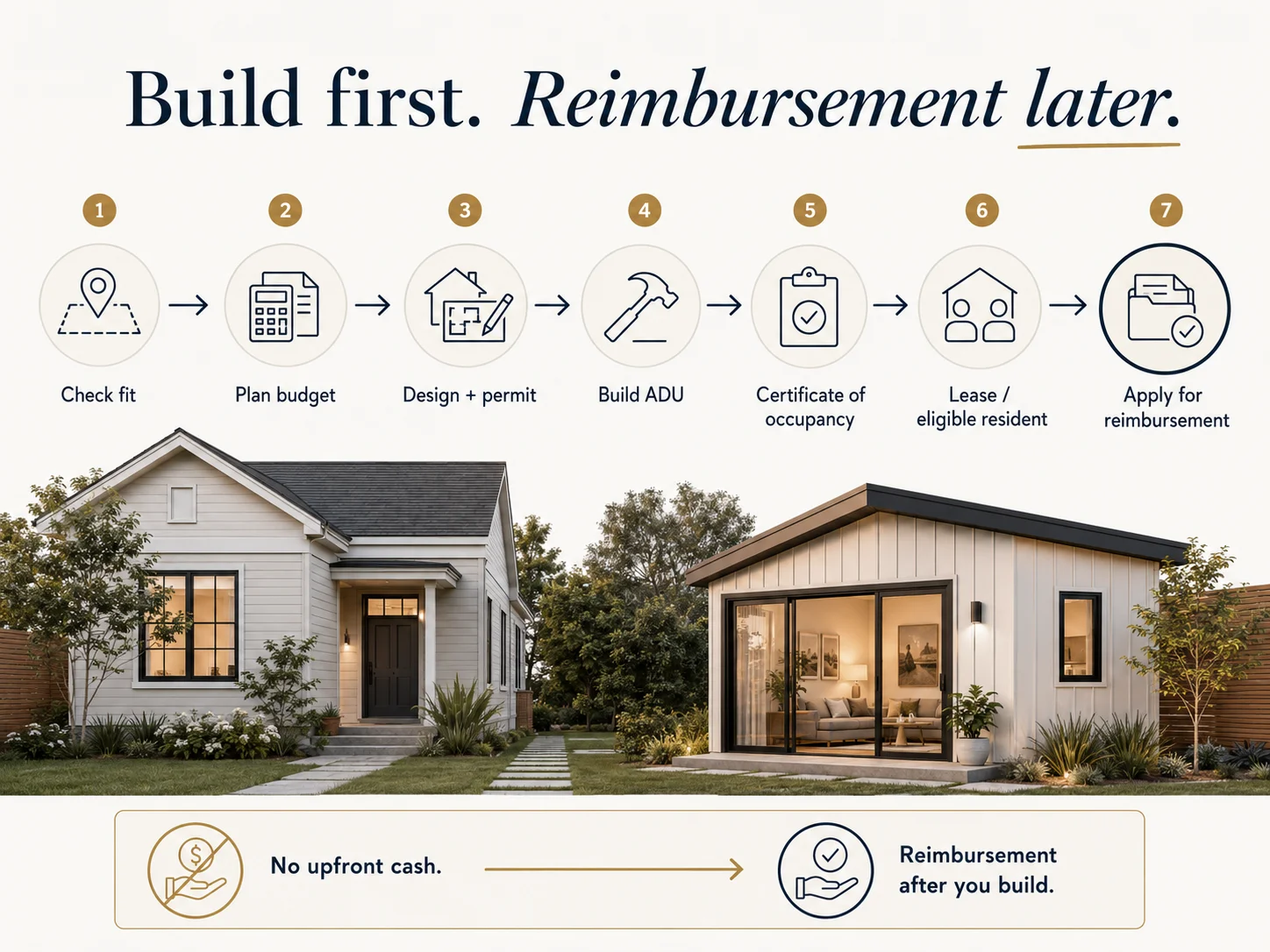
The application timeline
| Stage | What to do | Why it matters |
|---|---|---|
| Before design | Confirm city limits, zoning, lot size, FAR, ISR, flood, easements, utilities, HOA/deed restrictions; commission the topographic survey | Prevents expensive dead ends |
| Before permit | Confirm incentive fit, lock a funding plan, set up a document-saving system | The rebate is not upfront cash |
| During build | Save every invoice for construction, site work, design, and survey | The application requires cost documentation |
| At completion | Obtain the certificate of occupancy and completed permit records | Application timing depends on CO |
| Lease stage | Execute a lease with a qualifying tenant, or document the 62+ resident pathway | Required for compliance |
| Application | Submit the full package to the city program contact | Missing documents delay review |
The exact document checklist
Straight from the city application:
- ✓Certificate of occupancy
- ✓Completed permits
- ✓Invoice(s) for construction costs
- ✓Invoice(s) for site improvements
- ✓Invoice(s) for design/architectural work
- ✓Copy of the executed lease
- ✓Tenant income documentation (W-2 from the previous year)
- ✓Age documentation for a senior tenant (if using the 62+ provision)
The application also collects your parcel ID, total lot size, ADU square footage, zoning, whether the ADU is attached or detached, your construction company name, whether you used the city’s pre-designed plans, and the specific permit and impact-fee amounts you’re seeking to recover.
Who to contact
The city directs applicants to complete the application and email it to its housing initiative manager, with a phone line published for questions. We’re intentionally not hard-coding the staffer’s name and direct line here, because program contacts change — find the current contact on the City of Orlando ADU Incentive Program page, which we re-verify monthly.
Keep every rule straight while you plan.
Download our free ADU Starter Kit: the Orlando Incentive Checklist edition — the eligibility gates, the full document list, the survey reminder, and the exact questions to ask the city — so nothing slips between design and reimbursement.
Download the Free ADU Starter Kit ↓Is this an Orlando ADU grant or a rebate?
It’s a rebate, not a grant. The City of Orlando’s own application calls it a “rebate program,” and the defining feature is that you’re reimbursed for documented costs after the work is done and the certificate of occupancy is issued — you are not given money upfront to start building. If you searched for an “Orlando ADU grant,” this is the program you found; just go in understanding it pays you back rather than funding you forward.
The distinction matters for planning. A grant might cover costs before you incur them; this rebate requires you to incur and document the costs first, then recover them. That’s why the financing question — how you bridge the build before reimbursement — is the real hinge for most homeowners.
What can disqualify or delay you?
The most common ways homeowners lose money or time are: assuming the incentive is upfront funding, building on property outside City of Orlando limits, missing the 120% AMI tenant requirement, exceeding the incentive’s 500-total-sq-ft checklist, hitting flood/easement/drainage problems, lacking separate utility meters, skipping the required topographic survey, missing application documents, or discovering HOA or deed restrictions after paying for design. Most of these are avoidable with a 30-minute check before you spend.
You’re outside City of Orlando
An Orlando mailing address can sit in unincorporated Orange County. The city incentive is not countywide. If you’re outside city limits, start with county or Florida ADU rules instead — see the next section.
Your ADU is bigger than the incentive checklist allows
Orlando’s general ADU rules allow up to 500 or 1,000 square feet depending on zoning and lot size, but the incentive’s checklist uses a 500-total-square-foot cap including new hardscape. A legal larger ADU may simply fall outside the incentive. Confirm before designing.
You can’t meet the tenant rule
Tenant income must be ≤120% AMI for 12 of the first 24 months after CO, unless the 62+ lease waiver applies. If your plan is short-term rental income (think nightly stays), this incentive likely doesn’t fit — and Orlando restricts rentals under 30 days through a separate home-sharing registration that isn’t allowed in every situation.
Your HOA or deed restrictions block it
City permission does not override private restrictions. A homeowners association (HOA) or recorded deed restriction can prohibit a second unit even where the city would allow it. We’re not your attorney — but the practical rule is: read your HOA covenants and deed restrictions before spending money, and get legal advice if they’re ambiguous.
Property has liens, unpaid taxes, or other flags
The application asks about unpaid taxes, unpaid insurance, foreclosure or judgment status, code-enforcement liens of $5,000+, and special-assessment liens of $2,500+. Clear these up before applying, and confirm with the city whether any is a hard stop.
If this incentive doesn’t fit your situation, you still have good options. Plenty of Orlando-area homeowners build ADUs without this specific rebate. See how people fund and plan ADUs more broadly → ADU financing options.
What if you’re outside Orlando city limits?
The ADU Incentive Program is strictly a City of Orlando program, so homeowners outside city limits do not qualify for this rebate. If your property is in unincorporated Orange County, Seminole County, Osceola County, or another nearby jurisdiction, you’ll need to check that jurisdiction’s own ADU rules and any local incentives separately. This is one of the highest-risk misunderstandings in the whole topic.
Confirm jurisdiction with the Orlando Information Locator first. If you’re in unincorporated Orange County, the county runs a separate Ready, Set, Orange program offering pre-designed, pre-reviewed plans to simplify permitting — it is not the same as the city’s cash rebate, and the two should not be confused. Reported figures from August 2025 showed Orange County’s program had drawn more than 400 applications in its first year, with only a handful of units completed at that point — a useful reality check on how long ADU projects actually take.
The expensive mistake to avoid: following the City of Orlando incentive checklist, paying for plans and a survey, and only then learning your address is in the county and the rebate never applied.
See also: Florida ADU laws • Orange County FL ADU rules
Are Orlando’s pre-packaged ADU plans part of the incentive?
Separately from the rebate, the City of Orlando has been working to offer pre-packaged ADU plans — construction-ready designs from architecture firms at fixed prices, pre-reviewed by city staff — with availability indicated for summer 2026. Using a pre-reviewed plan is a permitting convenience, not a guarantee of approval, and it does not change the incentive’s eligibility rules. Confirm current availability directly with the city, since the timeline is a moving target.
Pre-reviewed plans can simplify design selection and make plan review more predictable. What they can’t solve: your site constraints, flood zones, easements, utility routing, HOA or deed restrictions, construction financing, or tenant eligibility for the incentive. They’re a head start, not a free pass.
Is it worth building an ADU just for the incentive?
Usually, no — the incentive should improve the economics of an ADU you already have good reasons to build, not be the sole reason you build one. The math works when your property qualifies cleanly, your intended use is durable, your construction budget holds up before reimbursement, and your tenant or family-use plan fits the program. It works poorly when you’re treating a back-end rebate as front-end funding.
Good-fit situations
- • Housing an aging parent, especially since the 62+ provision can waive the lease requirement.
- • Long-term rental housing for a tenant who comfortably falls under 120% AMI.
- • Flexible family housing — an adult child, a returning student, a caregiver.
- • Adding a legal second unit where zoning, lot size, and site conditions are genuinely favorable.
Poor-fit situations
- • Relying on the rebate as construction money (it isn’t).
- • Planning primarily for short-term / nightly rental income.
- • Building on property outside City of Orlando.
- • Ignoring HOA or deed restrictions.
- • Trying to use an RV, mobile home, or any non-permanent structure.
- • Proceeding without the topographic survey, or without utility, flood, drainage, or easement review.
Our rule of thumb: treat the incentive as a post-build offset, not the project’s financial foundation.
These are illustrative examples, not guarantees of returns. Actual results depend on local market conditions, construction costs, financing terms, and regulatory approvals.
See whether the rules and the numbers line up — before you commit.
The fastest way to know if your address fits is to run it. Get a preliminary eligibility screen and a rebate-offset estimate for your home size.
Get Your Free ADU Report →How Orlando’s incentive compares to building without it
Without the incentive, an Orlando homeowner pays full impact fees, full permit fees, and 100% of construction cost. With it, an eligible owner recovers up to ~$11,800–$14,200 after the certificate of occupancy — but accepts a 120% AMI tenant restriction for up to a year and the cash-flow burden of fronting the entire build. The trade is real money for real conditions; whether it’s worth it depends on your use case.
| Factor | Build without incentive | Build with the incentive |
|---|---|---|
| Construction cost | Paid in full by owner | Up to $10,000 reimbursed after CO |
| Permit fees | Paid in full | 100% reimbursed |
| Impact fees | Paid in full ($1,300–$3,100) | 100% reimbursed |
| Survey cost | Paid in full | May be rebate-eligible |
| Tenant freedom | Rent to anyone, any term* | ≤120% AMI for 12 of 24 months (lease waiver if 62+) |
| Cash flow | Same out-of-pocket build | Same out-of-pocket build, money back later |
| Best for | Owner-use, short-term rental, market-rate rental | Aging parents, workforce long-term rental |
*Subject to Orlando’s general ADU and home-sharing rules; short-term rentals under 30 days require separate registration.
Methodology and sources
This guide was built from official City of Orlando program materials first, then cross-checked against the city’s fee worksheet, ADU guidance, city code, Florida Administrative Code, and Orange County / Florida Housing income data. We used homeowner comments and forum discussions only to understand common questions — cost uncertainty, jurisdiction confusion, utility surprises, HOA worry, and skepticism that $10,000 changes the project economics — never as authority for program rules.
To build the rebate-value matrix, we modeled a 500-square-foot ADU added to five existing-home-size scenarios using Orlando’s published transportation, park, and sewer impact-fee worksheet, then added the city’s published permit-fee range and the maximum $10,000 build-out rebate. We confirmed our model reproduces the city’s two published worked examples exactly. These figures are planning estimates, not city quotes.
Primary sources (verified May 26, 2026):
- • City of Orlando — Accessory Dwelling Unit Incentive Program (program page)
- • City of Orlando — ADU Incentive Program Application (PDF)
- • City of Orlando — ADU Pre-Application Checklist (PDF, May 2026)
- • City of Orlando — Accessory Dwelling Units: Step-by-Step Guide
- • City of Orlando — Impact Fees for Accessory Dwelling Units (worksheet PDF)
- • City of Orlando City Code, Chapter 58 Part 3A; Chapter 56 Parts 1–2
- • Florida Administrative Code Rule 25-6.049(5)
- • Florida Housing Finance Corporation 2025 Income & Rent Limits (Orange County), via the Shimberg Center / Florida Housing Data Clearinghouse
Limitations: Program funds can change; the city can update forms, fees, and eligibility; final fees depend on project-specific review; income limits update periodically; HOA/deed restrictions require separate review; financing content is educational only.
Affiliate disclosure: The Dwelling Index is reader-supported. When you use our links to explore financing options, request prefab pricing, or purchase floor plans, we may earn a commission at no extra cost to you. Our editorial recommendations are based on independent research and are never influenced by compensation.
Orlando ADU Incentive Program FAQ
- Is Orlando really giving homeowners $10,000 to build an ADU?
- Yes. The City of Orlando offers a build-out rebate of up to $10,000 for eligible ADU projects, plus 100% rebates on eligible building permit and impact fees. It’s not automatic — it depends on meeting program requirements and city review, and it’s paid as a reimbursement after construction.
- Is the Orlando ADU incentive upfront money?
- No. The city’s application states applications are accepted only after the certificate of occupancy is issued and must include an executed lease. You fund the build first and are reimbursed afterward.
- Is this an Orlando ADU grant or a rebate?
- A rebate. The city’s application calls it a rebate program, meaning you’re reimbursed for documented costs after the certificate of occupancy — not given money upfront.
- Who qualifies for the Orlando ADU incentive?
- City of Orlando property owners with a code-compliant ADU who rent it to a tenant earning at or below 120% AMI for 12 of the first 24 months after CO. The city says the lease requirement may be waived if the resident is 62 or older. Site, survey, and documentation requirements also apply.
- What is the 120% AMI requirement?
- The ADU must be rented to a tenant earning at or below 120% of area median income for 12 of the first 24 months after the certificate of occupancy. The most recent published Orange County 120% limits are $88,560 (1 person) to $126,480 (4 people); confirm the exact table the city applies before relying on specific figures.
- Does an aging parent qualify?
- Yes — favorably. The city says the lease requirement may be waived if the ADU resident is 62 or older. Confirm documentation requirements first.
- Can I use the incentive for a garage conversion?
- Potentially, if the converted garage becomes a legal ADU meeting all program requirements. Orlando recognizes attached, detached, and garage-conversion ADUs, but the finished project must comply with city rules.
- Can I use a tiny home, RV, or mobile home as the ADU?
- No to RVs and mobile homes. The city requires the ADU to be on a permanent foundation; anything meeting the city’s definition of a recreational vehicle or mobile home cannot be used. A prefab or modular unit still has to meet Orlando’s permanent-structure, permanent-foundation, Florida Building Code, utility, and site requirements — confirm the specific product path with the city before relying on the rebate.
- Can I Airbnb the ADU?
- Don’t assume so. The incentive is tied to a qualifying long-term lease, and Orlando restricts rentals under 30 days through a separate home-sharing registration that isn’t permitted in all situations.
- How big can an Orlando ADU be?
- Orlando’s general ADU rules allow up to 500 or 1,000 square feet depending on zoning and lot size, subject to a 0.50 FAR cap. But the incentive checklist uses a 500-total-square-foot cap including new driveways, patios, and walkways — so incentive applicants should confirm size eligibility specifically.
- Do I need a survey?
- Yes. The city requires a topographic survey by a licensed surveyor for all ADU applications, completed before you apply. The cost may be rebate-eligible if program conditions are met.
- Do I need extra parking?
- The city requires the main house to keep one parking space behind the front-yard setback, and an ADU larger than 500 square feet to add another parking space.
- What documents do I need to apply?
- Certificate of occupancy, completed permits, invoices for construction/site/design work, a copy of the executed lease, tenant income documentation (prior-year W-2), and age documentation if using the 62+ provision.
- What if I’m in Orange County but outside City of Orlando?
- The city incentive doesn’t apply. Confirm your jurisdiction with the Orlando Information Locator, then check the relevant county or municipality’s ADU rules — Orange County’s separate “Ready, Set, Orange” pre-approved-plan program is the closest county-level resource.
- How long does Orlando ADU permitting take?
- We won’t promise a specific timeline without current city confirmation. Total project timelines run many months once design, survey, permitting, and construction are combined.
Related guides on The Dwelling Index
Not sure where to start?
See what’s possible at your address — get your free ADU report in 60 seconds.
See What You Can Build → Get Your Free ADU Report