
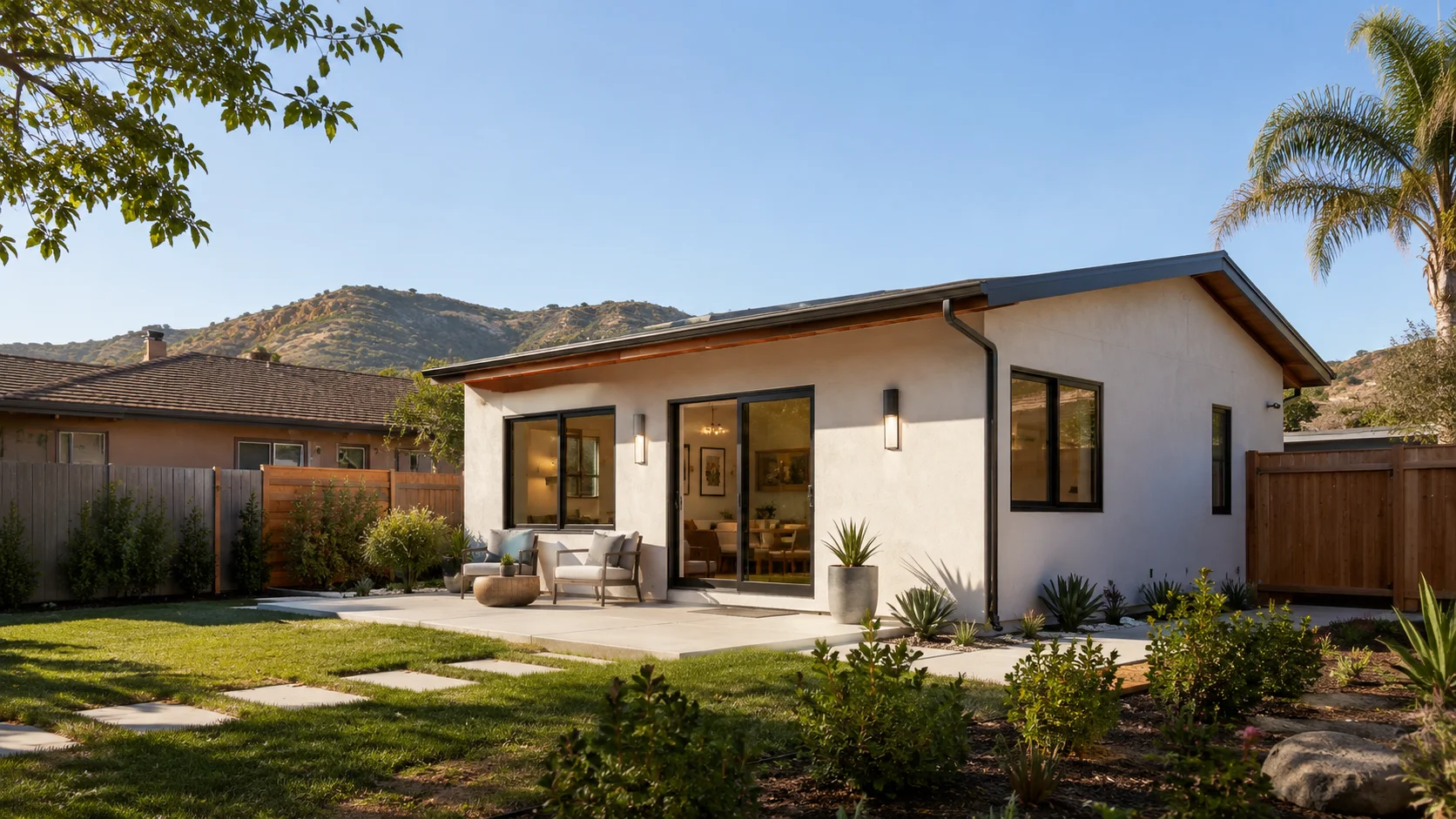
Bottom line — Santee ADU laws, 2026
On a qualifying City of Santee single-family lot, you can build one new-construction ADU up to 1,200 sq ft under Santee Municipal Code § 13.10.045, or pursue a multi-unit combination under California Government Code § 66323 — but the protected state-law combination of a new-construction ADU plus a converted ADU plus a Junior ADU (JADU) can be subject to an 800 sq ft floor-area cap on the new-construction unit when stacked that way. A JADU is capped at 500 sq ft by Cal. Gov. Code § 66333.
Side and rear setbacks are 4 ft. The maximum detached height is 16 ft on single-family lots; 18 ft on lots with an existing or proposed multi-story multifamily dwelling or within ½ mile walking distance of a major transit stop or high-quality transit corridor — with an additional 2 ft allowed to align roof pitch. Attached ADUs can reach up to 25 ft or the underlying zone limit, whichever is lower.
No off-street parking is required for most Santee ADUs under Cal. Gov. Code § 66322. Short-term rentals under 30 days are not permitted; long-term leases of 30 days or longer are allowed. California’s state-law clock requires a completeness determination within 15 business days of submittal (SB 543, effective January 1, 2026) and approval or denial within 60 days of a complete application.
Santee ADU rules at a glance
| Rule | Santee standard | State-law floor |
|---|---|---|
| Max size — stand-alone detached ADU | 1,200 sq ft | 800 sq ft (city cannot go below) |
| Max size — JADU | 500 sq ft | 500 sq ft (§ 66333) |
| Side and rear setbacks | 4 ft | 4 ft (§ 66321) |
| Max height — detached, SF lot | 16 ft | 16 ft (§ 66321) |
| Max height — near transit / MF lot | 18 ft (+2 ft roof-pitch allowance) | 18 ft (§ 66321) |
| Max height — attached ADU | 25 ft or zone limit | 25 ft (§ 66321) |
| Front setback (≤800 sq ft) | Exempt (no min. imposed) | Protected under § 66321 |
| Front setback (801–1,200 sq ft) | Underlying zone applies | Zone controls |
| Parking replacement on garage conversion | Not required | Not required (§ 66322) |
| Min. short-term rental term | 30 days (no STR) | State permits local restrictions |
| Owner-occupancy — standard ADU | Not required | Not required (AB 976, § 66315) |
| Owner-occupancy — JADU | Required only if sharing bathroom with primary | AB 1154 narrowing (§ 66333) |
| Completeness clock | 15 business days (SB 543) | 15 business days (§ 66317) |
| Approval clock | 60 days from complete application | 60 days (§ 66317) |
| AB 1033 separate sale | Not adopted (as of May 14, 2026) | Opt-in only (§ 66342) |
| Impact fees (≤750 sq ft) | Waived (SB 13) | Waived (§ 66311.5) |
| School fees (<500 sq ft) | Exempt | State cap $5.38/sf (Jan 2026) |
| Permit submittal method | Santee Portal (online only; no paper) | — |
| Governing code | SMC § 13.10.045, Chapter 13.10 | Cal. Gov. Code §§ 66310–66342 |
See what you can build on your Santee lot
Answer 7 quick questions about your property. Get a parcel-aware feasibility summary in about 60 seconds. Built to inform, not to sell you.
→ Get Your Free Santee ADU ReportWhat we verified for this guide
- Santee Municipal Code § 13.10.045 and Chapter 13.10 (Residential Districts)
- City’s ADU/JADU Guidelines PDF (current version)
- California Government Code §§ 66310–66342 (full statewide ADU framework)
- SB 543 (15-business-day completeness clock, effective January 1, 2026)
- AB 1154 (JADU owner-occupancy narrowing, effective January 1, 2026)
- AB 1033 City of Santee adoption status (confirmed: not adopted as of May 14, 2026)
- County of San Diego Ordinance No. 10986 (AB 1033 adoption, effective April 4, 2026)
- State Allocation Board fee resolution of January 28, 2026 ($5.38/sf school fee ceiling)
- Padre Dam Municipal Water District Capacity & Installation Fee schedule
- San Diego County Water Authority Ordinance 2025-02 (CY 2026 system capacity charges)
- Santee ADU Fee Waiver Program end date: September 27, 2024
Are you actually in the City of Santee? (Read this first.)
A “Santee, CA 92071” mailing address does not automatically mean City of Santee jurisdiction. Mailing addresses follow USPS routes; jurisdiction follows city boundaries. Some parcels with Santee addresses sit in unincorporated San Diego County, which runs its own ADU program with different fees, a different review office, and — as of April 4, 2026 — a different AB 1033 separate-sale answer. Confirm your jurisdiction by APN before spending a dollar on plans.
How to confirm jurisdiction in 60 seconds
- Find your APN. Printed on your property tax bill, your deed, or the San Diego County Assessor’s parcel lookup tool.
- Run your APN through the City of Santee’s GIS map. If the parcel is shaded as inside city limits, you are under City rules.
- If not, run it through SanGIS. Unincorporated parcels are under County rules.
- When in doubt, call. Santee Planning & Building: (619) 258-4100, ext. 167. County PDS: (858) 565-5920.
Inside the City of Santee, this governs you
- Santee Municipal Code § 13.10.045 and Chapter 13.10
- The City’s ADU/JADU Guidelines PDF
- Santee Portal for permit submittal (no paper plans accepted)
- City fee schedule (request an estimate via the AB 2234 process)
- Padre Dam Municipal Water District for water and sewer
- SDG&E for electrical service
- Santee School District (K–8) and Grossmont Union HSD (9–12) for school developer fees
The three layers of Santee ADU law
Three rule sets stack on every Santee ADU project. California state law (Cal. Gov. Code §§ 66310–66342) sets the floor no local ordinance can fall below. Santee Municipal Code § 13.10.045 implements the state framework locally. Your specific property — lot dimensions, zone, easements, utilities, Airport Influence Area overlay, fire-zone overlay, historical-resource proximity, HOA covenants — finishes the picture. Where local rules conflict with state law on size, setback, parking, height, or review timelines, state law generally controls.
Layer 1 — California state law (the floor)
Cal. Gov. Code §§ 66310 through 66342 is the statewide ADU framework. Key provisions for Santee homeowners:
- § 66311.5 — waives all impact fees on ADUs of 750 sq ft or less; proportional impact fees above 750 sq ft.
- § 66314 — requires every California local agency to allow at least one ADU on every qualifying residential lot.
- § 66315 — AB 976 (effective January 1, 2024) permanently eliminated owner-occupancy requirements for standard ADUs.
- § 66317 — requires a decision within 60 days of a complete application; SB 543 added a 15-business-day completeness deadline effective January 1, 2026.
- § 66321 — protects an 800 sq ft / 16 ft / 4 ft setback envelope; protects 18 ft near major transit; allows up to 25 ft for attached ADUs.
- § 66322 — lists state-law parking exemptions (transit proximity, architectural historic district, existing-structure ADU, car-share proximity, new primary dwelling permit).
- § 66323 — authorizes the protected single-family combination of one new-construction ADU + one conversion ADU + one JADU, with a possible 800 sq ft cap on the new-construction unit.
- § 66333 — sets the 500 sq ft JADU maximum and the conditional owner-occupancy rule (narrowed by AB 1154 effective January 1, 2026).
- § 66342 — AB 1033 opt-in statute authorizing separate condominium-style sale of ADUs (not adopted by City of Santee as of May 14, 2026).
Layer 2 — Santee Municipal Code § 13.10.045 (the implementation)
Santee’s local ADU ordinance is codified at SMC § 13.10.045, inside Chapter 13.10 (Residential Districts). The codified text most recently included Ordinance No. 631, adopted January 14, 2026. The ordinance addresses unit counts by property category, the 800 and 1,200 sq ft size thresholds, setbacks, height, parking, architectural compatibility, historical resources, fire safety, and the city’s acceptance of preapproved plans from neighboring jurisdictions. The codified ordinance in eCode360 legally controls; where it diverges from the City’s ADU/JADU Guidelines PDF, the codified ordinance wins.
Layer 3 — Your specific property
A buildable lot on paper can still have:
- An Airport Influence Area (AIA) overlay near Gillespie Field, triggering FAA / ALUC review and sound attenuation requirements.
- A historical resource within 600 ft, triggering objective ministerial architectural-treatment requirements.
- A utility easement running across the preferred ADU footprint.
- A slope or soils condition requiring grading, retaining walls, or a geotechnical report.
- An HOA covenant with additional design rules (state law limits how restrictive HOA rules can be, but does not eliminate them).
How many ADUs can you build in Santee?
On a qualifying City of Santee single-family lot, state law (§ 66323) authorizes a protected combination including one new-construction ADU (attached or detached), one ADU created by converting existing space, and one JADU — but the new-construction ADU in that stacked combination can be subject to an 800 sq ft floor-area cap. A single new-construction ADU built alone can reach the full 1,200 sq ft Santee maximum. Get the specific combination for your parcel confirmed in writing by Santee Planning before paying for plans.
Single-family lots — two practical paths
Path A — One ADU only (the most common path).
A single detached or attached new-construction ADU, up to 1,200 sq ft under SMC § 13.10.045, with 4 ft side and rear setbacks. This is the typical Santee design and the path most homeowners pursue.
Path B — The § 66323 protected combination.
A new-construction ADU + an ADU created by converting existing space (garage, basement, or similar) + a JADU of up to 500 sq ft inside the primary residence. The local agency can impose an 800 sq ft floor-area limit on the new-construction unit in this stacking scenario. Plan to the conservative read unless you have written Santee Planning confirmation that a larger new-construction unit is approved alongside the combination.
Existing multifamily lots — SB 1211
Senate Bill 1211 (effective January 1, 2025) substantially expanded what is allowed on existing multifamily structures in Santee:
- Interior conversions of existing non-livable space — minimum of one ADU, up to 25% of existing primary units, whichever is greater.
- Detached ADUs — up to eight per lot, capped by the number of existing primary units on the property.
- No replacement parking required when uncovered parking areas are converted to ADUs.
Where Santee’s guide is more restrictive than current state law, state law generally controls. Confirm the specific allowed count for your parcel in writing with Santee Planning before paying for design.
Unit-count decision matrix
| Your property | What state and Santee law allow | What to verify before plans |
|---|---|---|
| Single-family, one detached ADU only | 1 detached ADU up to 1,200 sq ft, 4 ft side/rear setbacks | Setbacks, fire separation, utilities, AIA |
| Single-family, ADU + JADU | 1 ADU + 1 JADU | Owner-occupancy applies if JADU shares sanitation |
| Single-family, § 66323 combination (detached + conversion + JADU) | Up to 3 units under § 66323, with possible 800 sq ft cap on the new-construction component | Get written Planning confirmation before plans |
| Existing duplex (2 units) | Up to 2 detached ADUs + at least 1 interior conversion (up to 25%) | Lot circulation, fire access, utility separation |
| Existing 4-plex | Up to 4 detached ADUs + interior conversions | Site layout, parking analysis under § 66322 exemptions |
| Existing 10+ unit multifamily | Up to 8 detached ADUs + interior conversions | Cap is existing unit count |
| Proposed multifamily | 2 detached ADUs (may be attached to each other) | Concurrent permitting strategy |
| “Santee” mailing address, parcel in unincorporated County | County rules apply (including AB 1033 adoption) | Confirm jurisdiction by APN first |
What size ADU can you build in Santee? The 500 / 750 / 800 / 1,200 sq ft breakpoints
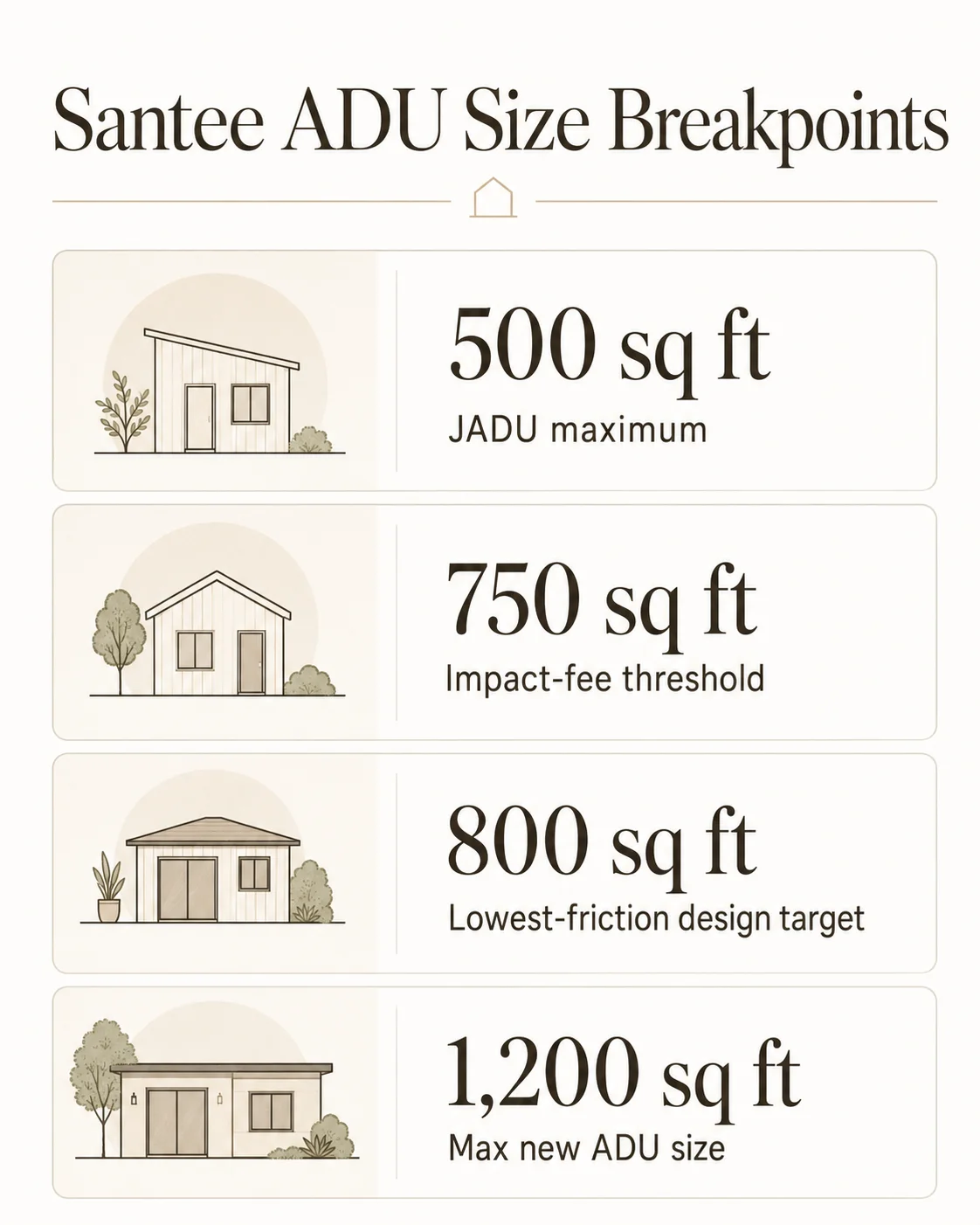
Four size thresholds change the fee math, the design friction, and the rules that apply to a Santee ADU. Less than 500 sq ft is exempt from school developer fees. 750 sq ft or less is exempt from impact fees under state law (SB 13). Up to 800 sq ft is the lowest-friction Santee envelope and the floor no city can deny under Cal. Gov. Code § 66321. 1,200 sq ft is Santee’s maximum for a stand-alone new-construction ADU; above 800 sq ft, the underlying zone’s front setback and lot-coverage rules apply.
Why size breakpoints matter more than maximums
| Size threshold | What changes at this size | Why it matters |
|---|---|---|
| < 500 sq ft | JADU maximum size; school developer fees do not apply | Best for compact in-home JADUs, narrow garage conversions, or budget-driven detached units |
| ≤ 750 sq ft | Impact fees waived statewide under SB 13 (§ 66311.5) | Hard fee cliff — crossing it can add $5,000–$15,000+ in proportional impact fees |
| ≤ 800 sq ft | Exempt from front-yard setback and lot-coverage limits; state law (§ 66321) protects this envelope | The single best size to start a design at if your lot has constraints |
| 801–1,200 sq ft | Underlying zone’s front setback, lot coverage, and private open-space rules apply | More space, more friction; the zone matters |
Less than 500 sq ft — JADU maximum and school-fee exemption
A JADU is a Junior ADU: a small unit of up to 500 sq ft created entirely inside an existing or proposed single-family residence, with an efficiency kitchen, and optionally sharing sanitation facilities with the main home. Created under Cal. Gov. Code § 66333. ADUs (and JADUs) under 500 sq ft are exempt from school developer fees in California, saving up to approximately $2,690 on a 499 sq ft unit at the January 2026 state maximum of $5.38/sf.
The fee cliffs
- At 500 sq ft: school fees turn on. A 499 sq ft ADU pays $0 in school fees; a 500 sq ft ADU starts owing the assessable-space rate. Worth designing around if the program supports it.
- At 750 sq ft: state-law impact-fee waiver under SB 13 turns off. Impact fees are then charged proportionally to the size of the primary dwelling. Worth designing around if the program supports it.
2026 representative build-cost ranges by size
Per SnapADU’s published 2026 cost data and the California Construction Cost Index (which increased a total of 44% from January 2021 to December 2025):
- 500 sq ft: ~$300,000
- 750 sq ft: ~$350,000
- 1,000 sq ft: ~$425,000
- 1,200 sq ft: ~$450,000+
Smaller units carry higher per-square-foot costs because fixed costs (kitchen, bathroom, mobilization, design, permits) spread across less area. JADUs and garage conversions typically run lower because the shell, foundation, and roof already exist.
Realistic Santee ADU fees
Santee’s fee stack splits sharply depending on whether your ADU connects to an existing water meter and sewer lateral or requires new utility service from Padre Dam Municipal Water District. Two scenarios:
Scenario A — Existing-service connection (typical case)
| Fee bucket | ≤ 500 sq ft | 501–749 sq ft | 750–1,000 sq ft | 1,001–1,200 sq ft |
|---|---|---|---|---|
| City of Santee plan check fee | [Request via AB 2234] | same | same | same |
| Development impact fees (DIF) | $0 (SB 13 waiver) | $0 (SB 13 waiver) | Proportional to primary home | Proportional to primary home |
| School developer fee (Santee SD + Grossmont Union HSD, combined ceiling) | $0 (< 500 sq ft exempt) | sf × adopted district rate (max $5.38/sf) | same | same |
| Existing utility minor adjustments | Variable, typically modest | same | same | same |
| Indicative all-in fee total | ~$7,500–$10,000 | ~$10,000–$15,000 | ~$15,000–$20,000 | ~$18,000–$22,000+ |
Scenario B — New utility service (new meter, sewer lateral, or major SDG&E service upgrade)
When a new dedicated water meter and sewer lateral are required, capacity and installation charges apply. Per Padre Dam Municipal Water District’s published schedule, typical water/sewer grand totals for a new single-family service in Padre Dam’s territory run approximately $40,000–$55,000 depending on lateral installation method, meter size, and recycled-water credit. The San Diego County Water Authority adds a system capacity charge per SDCWA Ordinance 2025-02 for CY 2026: the under-1-inch system capacity charge is $6,501 with a separate water-treatment capacity charge of $182.
Cal. Gov. Code § 66311.5 limits when utility connection or capacity charges can be required on an ADU. For ADUs created by converting space within an existing primary dwelling or accessory structure, a new or separate utility connection and related connection or capacity fee cannot be required unless the unit is constructed with a new single-family dwelling or separately conveyed under § 66342.
The $5.38 explained — two-district school fee
The State Allocation Board increased the maximum statutory Level 1 residential developer fee from $5.17 to $5.38 per sq ft on January 28, 2026, a 4.06% increase tied to the RS Means Class B construction cost index. In Santee, two districts assess this fee:
- Santee School District serves grades K–8.
- Grossmont Union High School District serves grades 9–12.
The two districts share the $5.38 maximum under a fee-sharing agreement governed by Government Code § 65995. For an 800 sq ft Santee ADU, the combined ceiling is approximately $4,304 in school fees. For a 1,200 sq ft Santee ADU, approximately $6,456. Verify with both districts at permit issuance.
Affiliate note: When you book a consult with SnapADU through our links, Dwelling Index may earn a referral fee at no extra cost to you. This does not influence our editorial coverage. Read our full disclosure.
Want a Santee-specific build quote that itemizes every fee?
SnapADU explicitly serves Santee as part of its Greater San Diego service area. Per SnapADU’s published materials, the firm has focused on designing, permitting, and building over 100 ADUs in San Diego County since 2020. Their fee math is unusually transparent and their floor-plan catalog maps to each of the size breakpoints discussed above.
When SnapADU may not be the right fit: HUD-manufactured / prefab-only buyers, sub-$200K total budgets, or deep gut-conversion projects. See SnapADU Alternatives for verified competitors.
Realistic Santee ADU permit timeline
California state law (Cal. Gov. Code § 66317, as amended by SB 543 effective January 1, 2026) requires Santee to determine completeness within 15 business days of submittal and to issue an approval or denial within 60 days of a complete application. Preapproved-plan paths under AB 1332 carry a 30-day ministerial clock. In practice, a realistic total Santee plan-review timeline for a custom ADU runs 2 to 4 months through correction cycles, and construction adds 4 to 7 months for a detached unit.
The statutory clock
- 15 business days from receipt for Santee to determine completeness and issue written notice. If Santee misses this deadline, the application is automatically deemed complete and the 60-day clock starts immediately. This is the SB 543 change, effective January 1, 2026.
- 60 days from a complete application for Santee to approve or deny.
- 30 days for preapproved-plan paths under AB 1332.
Santee’s own ADU/JADU Guidelines still reference a 30-day completeness timeline in some places, which predates SB 543. Where the Santee guide is more lenient than current state law, current state law controls. Confirm the current completeness deadline at submittal — and if Santee misses the 15-business-day window, you have grounds to insist that the 60-day approval clock has started.
Preapproved-plan paths Santee accepts
- County of San Diego Standard ADU Plans (600, 800, 1,000, and 1,200 sq ft options)
- Chula Vista Standard ADU Plans (12 City Standard options, 498–1,199 sq ft)
- Encinitas Permit-Ready ADU Plans (8 PRADU options)
Modifications to a preapproved plan are not permitted. A project-specific site plan and foundation plan are still required. See the San Diego County preapproved ADU plans guide for catalog options.
Realistic full-project calendar
| Phase | Realistic duration | What happens |
|---|---|---|
| Feasibility, lot check, AIA verification, utility check | 1–2 weeks | Site visit, APN review, Planning consult, Padre Dam and SDG&E inquiry |
| Design and engineering (custom) | 6–10 weeks | Architectural, structural, MEP, Title 24 energy, CalGreen |
| Site plan + foundation plan (preapproved path) | 2–4 weeks | Project-specific site plan, soils analysis |
| First plan-check submittal to permit issuance | 8–16 weeks | 15-day completeness clock, 60-day decision clock, plus 1–3 correction cycles |
| Construction (turnkey detached) | 16–32 weeks | Foundation, framing, MEP rough-in, finishes, inspections |
| Final inspection and occupancy | 2–4 weeks | Final walk-through, certificate of occupancy |
Total project: typically 8–14 months from first phone call to handing over keys.
What to do if Santee misses a clock: file a complaint with California HCD at hcd.ca.gov. HCD’s enforcement authority on ADU compliance has strengthened across recent legislative cycles.
Check your Santee parcel before you pay for plans
Run the Feasibility Engine and find out whether your lot favors a JADU, a garage conversion, an 800 sq ft detached unit, or a full 1,200 sq ft build — before you hire a designer.
→ Get Your Free Santee ADU ReportAB 1033 in Santee — can you sell the ADU separately?
No — not on a City of Santee parcel, as of May 14, 2026. The City of Santee has not adopted an AB 1033 ordinance. AB 1033 (codified at Cal. Gov. Code § 66342) is an opt-in law: it lets cities and counties authorize the separate condominium-style sale of an ADU from the primary residence, but each local jurisdiction must affirmatively adopt the authorization.
Unincorporated San Diego County did adopt AB 1033 (Ordinance No. 10986) effective April 4, 2026. County staff published draft policy options for public review May 1–31, 2026, with additional Board action expected in late summer 2026. This is relevant for any “Santee” mailing-address parcel that turns out to be in County jurisdiction.
What separate sale actually requires
Even on a County parcel where AB 1033 has been adopted, separate sale is not a simple administrative filing. County guidance confirms the path requires a condominium conversion and involves:
- Lender consent if the primary residence is mortgaged.
- A Condominium Plan and Condominium Map filed with the County Recorder.
- Separate utility connections established.
- A Homeowners’ Association or Maintenance Agreement formed per the Davis-Stirling Act.
- Compliance with the Subdivision Map Act.
For City of Santee parcels, the answer remains: not adopted, no separate-sale path. This could change if a future Santee City Council takes up AB 1033 implementation. We monitor adoption status and update this page when it changes.
What changed in 2026 for Santee ADU owners
Five California state actions changed the practical rules for Santee ADUs in 2026: SB 543, AB 1154, AB 462, AB 1061, AB 818, and the SAB’s January 28, 2026 school developer fee increase.
SB 543 — the 15-business-day completeness clock
The most operationally important change for 2026. Before January 1, 2026, California set a 60-day approval deadline but no specific deadline for cities to confirm submittal completeness. SB 543 closes the gap with a 15-business-day completeness clock. If Santee misses the deadline, the application is automatically deemed complete and the 60-day clock starts immediately. Track your submittal date and the city’s response.
AB 1154 — JADU owner-occupancy narrowed
Before January 1, 2026, all Santee JADUs required owner-occupancy. AB 1154 narrowed the requirement: it now applies only when the JADU shares sanitation facilities (a bathroom) with the primary dwelling. If the JADU has its own separate bathroom, owner-occupancy is not required, and the unit can be operated as a long-term rental. Adding a private bathroom to a JADU now toggles the unit’s regulatory category.
AB 462 — Coastal Act streamlining (not applicable to Santee)
AB 462 streamlines Coastal Development Permit requirements for certain ADUs. Because Santee lies inland in East County San Diego and is outside the California Coastal Zone, this bill does not change anything for Santee parcels.
AB 1061 — historic-overlay narrowing
AB 1061 narrows when cities can deny ministerial ADU approval based on historic-resource concerns. Cities can only deny ministerial processing if the actual property is individually listed as a historic resource or landmark — being inside a historic district alone is no longer enough. Santee’s guide notes that ADUs on or within 600 ft of a lot with an identified California Register historical resource must comply with objective ministerial architectural-treatment requirements. AB 1061 narrows but does not eliminate that rule.
AB 818 — 10-business-day emergency permit clock
In a declared local emergency under the California Emergency Services Act, AB 818 (effective January 1, 2026) requires cities and counties to approve or deny a complete application within 10 business days for state- or federally-approved modular homes, prefabricated homes, or detached ADUs intended to house a person until their damaged property is rebuilt. For most Santee homeowners this clock will not apply under normal conditions.
SAB Level 1 fee increase — $5.17 to $5.38
On January 28, 2026, the State Allocation Board approved a 4.06% increase to the maximum residential Level 1 developer fee, from $5.17 to $5.38 per sq ft. The increase is tied to the RS Means Class B construction cost index over January 2024 to January 2026. For Santee, this means the combined Santee SD + Grossmont Union HSD school developer fee on ADUs of 500 sq ft or more is now subject to a maximum statutory ceiling of $5.38/sf of assessable space. The next SAB adjustment is scheduled for January 2028.
Preapproved plans, prefab/modular, garage conversion, or custom?
Four design paths produce a Santee ADU. The right path depends on your lot, your timeline, your budget, and how much you value design control vs. speed.
Preapproved plans — when they help and when they don’t
Santee accepts three sources:
- County of San Diego Standard ADU Plans (600, 800, 1,000, and 1,200 sq ft)
- Chula Vista Standard ADU Plans (12 City Standard options, 498–1,199 sq ft)
- Encinitas Permit-Ready ADU Plans (8 PRADU options)
Best when: lowest design cost and shortest design phase; lot fits a standard plan footprint without modification; buyer comfortable with a locked design (no modifications permitted per Santee’s guidance).
Not appropriate when: lot has slope, awkward shape, or utility constraints; you want a two-story ADU or an ADU over a garage; you need a layout not represented in the catalog.
Even with a preapproved plan, you still need a project-specific site plan, foundation plan, and likely a soils analysis. The preapproved plan is the design, not the permit.
Prefab / modular — faster, but not a permit shortcut
Modular and pre-manufactured ADUs are explicitly allowed in Santee, subject to applicable new-construction ADU standards under SMC § 13.10.045. On-site construction time is dramatically shorter (often 4–8 weeks after delivery vs. 16–32 weeks for stick-built), but you still need a Santee site plan, foundation plan, utility plan, and building permit. Per-square-foot pricing is sometimes higher than custom stick-built once site work is included.
Garage conversion — often the lowest-cost path
Santee’s older neighborhoods (Carlton Hills, Mast Park East, Riverview, Sky Ranch) have many single-family homes with detached one- and two-car garages. Converting that garage into a 300–500 sq ft ADU is often the lowest-cost path:
- Existing foundation, walls, and roof are reused.
- Replacement parking is not required when the garage is converted (state law).
- The conversion qualifies as an “existing space” ADU under state-law setback and size protections.
- Total all-in cost typically lands well below new detached construction depending on existing condition.
Friction points: fire-rating upgrades, electrical service upgrades, insulation, weatherization to Title 24 compliance (Climate Zone 10), plumbing routing for bathroom and kitchen. See two-story ADU rules in the San Diego region and building an ADU over a garage if those designs interest you.
Custom design — when the lot requires it
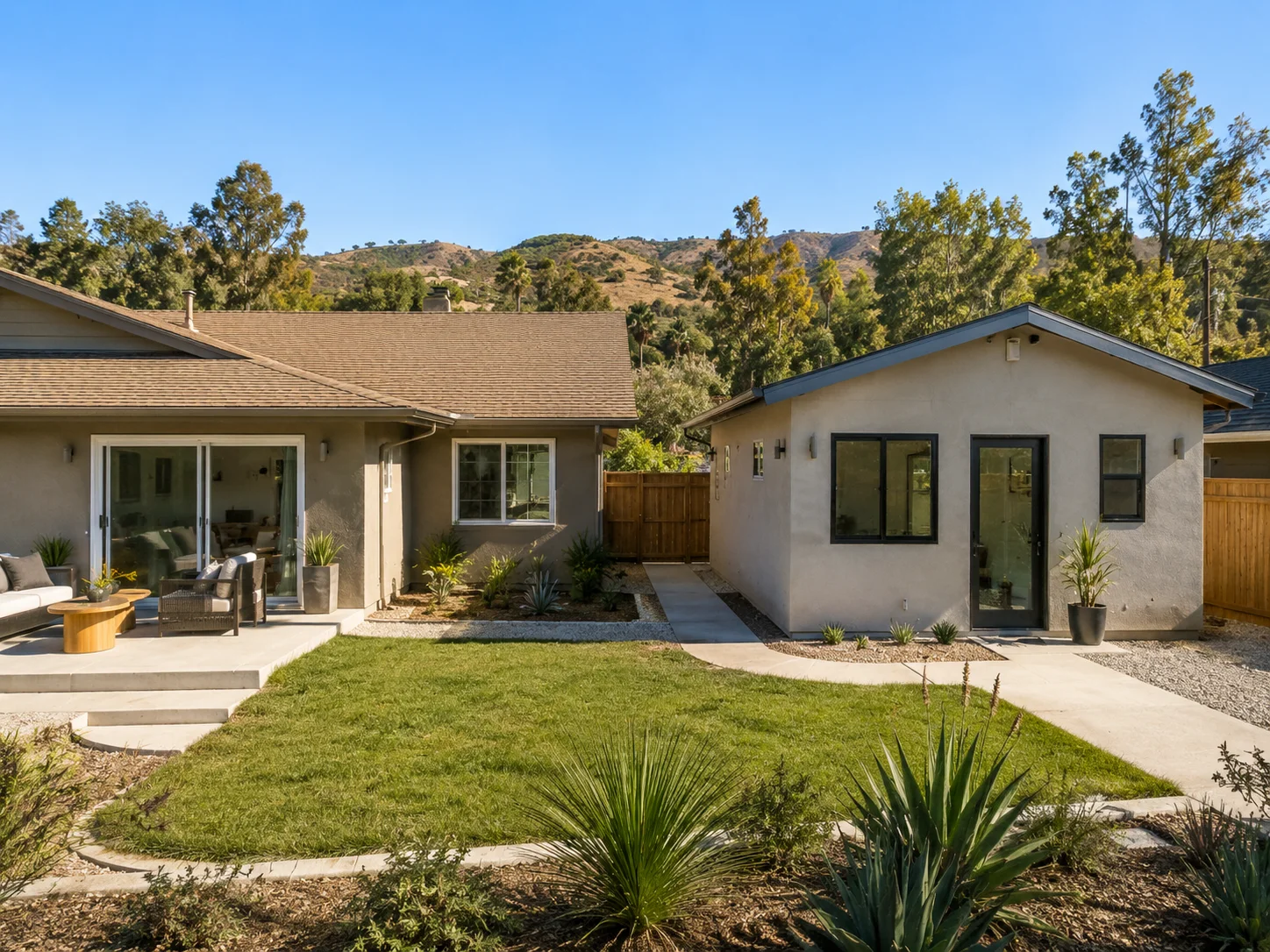
Custom architectural design is the right answer when the lot has slope, an unusual shape, or significant utility/easement constraints; you want a two-story ADU; you want an ADU over a garage; you want a 1,001–1,200 sq ft unit that fits the zone friction table; or you want a specific architectural language that integrates with the primary dwelling. Custom design adds material preconstruction cost and 6–12 weeks of design time.
Path comparison
| Path | Best for | Typical all-in cost (2026) | Design time | Construction time |
|---|---|---|---|---|
| JADU (inside primary) | Family suite, lowest budget | Materially less than new construction | 2–6 weeks | 8–16 weeks |
| Garage conversion | Existing detached garage, rental income | Below new detached cost | 4–8 weeks | 12–20 weeks |
| Preapproved plan (≤ 1,000 sq ft) | Simpler detached design, faster permit | ~$300K–$425K range | 2–4 weeks | 16–24 weeks |
| Prefab / modular | Faster build, predictable pricing | Comparable to custom range | 4–8 weeks (planning) | 4–8 weeks on-site after delivery |
| Custom design (800–1,200 sq ft) | Constrained lots, two-story, specific needs | ~$325K–$550K+ | 8–14 weeks | 20–32 weeks |
How to start a Santee ADU project
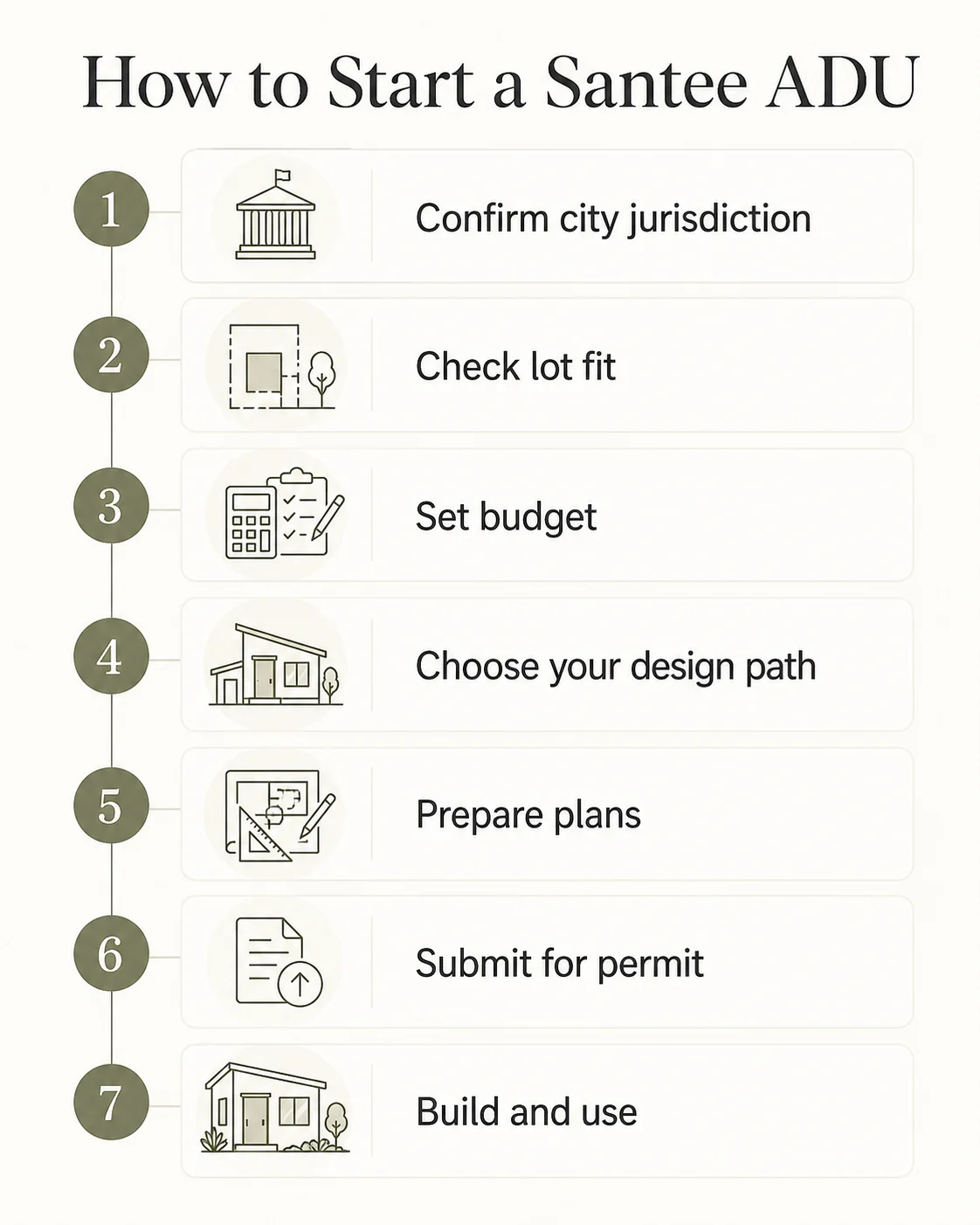
Seven steps to take before committing to a design or paying for plans:
- Confirm City of Santee jurisdiction. Look up your APN on the County Assessor site and run it through the City of Santee GIS map to confirm the parcel is inside City limits, not unincorporated San Diego County.
- Check lot fit and constraints. Review zone designation, lot coverage, front setback, Airport Influence Area overlay status, and any utility easements crossing the preferred ADU footprint.
- Set your budget and size target. Decide whether you’re targeting under 500 sq ft (school-fee exempt), under 750 sq ft (impact-fee exempt under SB 13), 800 sq ft (lowest-friction Santee envelope), or up to 1,200 sq ft.
- Choose your design path. Select from a JADU inside the existing home, a garage conversion, a preapproved plan (County, Chula Vista, or Encinitas catalog), a prefab or modular unit, or a fully custom design.
- Verify utilities. Contact Padre Dam Municipal Water District to determine if a new water meter or sewer lateral is required, and SDG&E about electrical service capacity. Utility costs vary dramatically between existing-service and new-service scenarios.
- Submit through the Santee Portal. Santee accepts ADU applications through its online portal only — no paper plans. Include site plan, foundation plan, architectural drawings, Title 24 energy compliance, and CalGreen checklist. Track your submittal date for the 15-business-day completeness clock.
- Manage corrections and get your permit. Respond promptly to correction cycles (typically 1–3 rounds for a custom design). Once permit is issued, construction for a detached ADU typically runs 16–32 weeks, followed by final inspection and certificate of occupancy.
Not sure whether your lot favors a JADU, a garage conversion, or a new detached build? The Feasibility Engine runs a parcel-aware check in about 60 seconds.
→ Get Your Free Santee ADU ReportWill a Santee ADU rent cover the cost?
Maybe — depending on your build cost, your financing structure, and your operating expenses. The long-term rental case is the only legitimate option, since short-term rentals are not permitted for Santee ADUs. Current Santee long-term rent benchmarks show one-bedroom apartments leasing for approximately $1,737–$2,171 per month and two-bedroom apartments for approximately $2,395–$2,539 per month across multiple sources, as of May 2026.
A simple sanity-check framework
Estimated monthly rent − financing payment − tax/insurance/maintenance/vacancy allowance − utilities = rough monthly cash-flow estimate
For a Santee homeowner considering a 750 sq ft, 1-bedroom detached ADU at an illustrative all-in cost of $350,000 (per SnapADU’s 2026 cost data), and estimated monthly long-term rent in the $2,200–$2,500 range (illustrative — confirm with local active comps):
- Operating expense allowance: property tax delta, insurance increment, maintenance reserve, vacancy allowance, utilities not in rent. A realistic budget: ~$550–$650/month for a unit in this size class.
- Net operating income before debt service: rent − operating expenses ≈ $1,550–$1,950/month.
- Debt service: depends entirely on your specific rate, term, and principal financed.
These rental scenarios are illustrative examples for budgeting, not guarantees of returns. Actual results depend on local market conditions, construction costs, financing terms, and regulatory approvals.
The family-use case is often the better case
A meaningful share of Santee ADUs are built for aging parents, returning adult children, caregivers, or multigenerational households — not for rental income. For those use cases, the ROI question is the wrong question, and the answer is usually higher than a spreadsheet would predict.
Financing your Santee ADU — paths, not products
Most California ADU projects are financed with a HELOC, a cash-out refinance, a renovation refinance (FHA 203(k) or Fannie HomeStyle), a dedicated ADU construction loan, or some combination. The path that fits depends on your existing mortgage rate, your equity position, your timeline, your debt-to-income ratio, and whether you plan to refinance after the ADU is built and reappraised. For broader guidance, see our ADU Financing Options guide and HELOC for ADU guide.
| Project | Common financing fit |
|---|---|
| JADU ($50K–$150K project) | HELOC (small draw), home improvement loan, or cash |
| Garage conversion ($100K–$200K) | HELOC, home improvement loan |
| ≤ 750 sq ft detached ADU (impact-fee-waived) | HELOC, cash-out refi, or construction loan |
| 800 sq ft detached ADU | HELOC, cash-out refi, or construction loan |
| 1,200 sq ft detached ADU | Cash-out refi, construction loan, or renovation refi (203(k) / HomeStyle) |
| Family-use project (no rental income plan) | Same paths as above; lender DTI underwriting won’t include projected rent |
| Rental-income project | Construction loan + refi after appraisal with rental income |
These are illustrative paths, not guarantees of qualification or specific outcomes. Actual loan availability, rates, and terms depend on your credit, equity, debt-to-income, lender underwriting, and the appraised value of your completed ADU.
Common Santee ADU mistakes (and how to avoid them)
Five mistakes cost Santee homeowners the most: assuming a Santee mailing address means City jurisdiction; over-sizing past the 500 and 750 sq ft fee cliffs; treating “California state law” and “Santee Municipal Code” as a single rule set; paying for plans before verifying utility, easement, or AIA constraints; and structuring a project around AB 1033 separate-sale exit that hasn’t been adopted by the City.
Mistake 1 — Wrong jurisdiction
You see “Santee, CA 92071” on the deed. You read the City’s ADU PDF. You design to City rules. Then you submit, and Building tells you the parcel is unincorporated County — different rules, different fees, different review office. Run the APN through the City GIS before paying for plans.
Mistake 2 — Over-sizing past the fee cliffs
A 750 sq ft ADU avoids impact fees that a 751 sq ft ADU does not. A 499 sq ft ADU avoids school fees that a 500 sq ft ADU does not. Design intentionally around the fee thresholds if the program supports it.
Mistake 3 — Confusing state law with local code
State law sets the floor; Santee’s Municipal Code sets Santee-specific standards within that floor; your specific property finishes the picture. All three layers stack. A builder who quotes only one layer is giving you an incomplete answer. Verify which rule actually controls your specific project element.
Mistake 4 — Paying for plans before verifying constraints
Airport Influence Area overlays, utility easements crossing the preferred footprint, slope and soils conditions, and fire-rating overlays at the eastern edge of the city can all materially change your design — or eliminate a proposed footprint entirely. Contact Santee Planning, Padre Dam, and SDG&E before paying an architect.
Mistake 5 — Counting on AB 1033 separate-sale in City of Santee
Some homeowners are underwriting their ADU project around the ability to sell the ADU as a separate condominium. The City of Santee has not adopted AB 1033 as of May 14, 2026. If AB 1033 separate-sale exit is a key part of your financial underwriting, you must verify adoption status before committing to the project.
Frequently asked questions: Santee ADU laws
Can I build a 1,200 sq ft ADU in Santee?▼
Possibly. Santee Municipal Code § 13.10.045 allows a stand-alone new-construction ADU up to 1,200 sq ft. Above 800 sq ft, the underlying zone’s front setback, lot coverage, and (in higher-density zones) private open-space rules apply. Whether 1,200 sq ft fits on your lot depends on your zone designation (HL through R-30) and your specific lot dimensions. Check zone-friction rules with Santee Planning before committing to a design at this size.
Are garage conversions allowed in Santee?▼
Yes. Existing-space conversions (garages, basements, accessory structures) are a recognized ADU path. They retain the existing footprint without requiring 4 ft setbacks, and replacement parking is not required when a garage is converted. They qualify under state-law setback and size protections as “existing space” ADUs.
Do I need to replace parking if I convert my Santee garage into an ADU?▼
No. Santee follows the state-law rule under Cal. Gov. Code § 66322: replacement parking is not required when a garage, carport, or covered parking structure is demolished or converted as part of an ADU project.
Can I build a two-story ADU in Santee?▼
Sometimes. The 18 ft height path applies on lots with an existing or proposed multi-story multifamily dwelling, or for detached ADUs within ½ mile walking distance of a major transit stop or high-quality transit corridor — with up to 2 additional feet to align roof pitch. Attached ADUs may reach up to 25 ft or the underlying zone limit. Most two-story detached Santee ADUs require one of the specific § 66321 conditions.
Does Santee require ADU parking?▼
Generally no. Cal. Gov. Code § 66322 lists the parking exemptions, and most Santee single-family parcels qualify under at least one — typically the ½-mile public-transit exemption. For an ADU over 800 sq ft that doesn’t qualify for any exemption, one off-street parking space may be required, with tandem parking allowed in an existing driveway. Not sure whether Santee will require ADU parking on your lot? → Get Your Free Santee ADU Report.
Can I Airbnb my Santee ADU?▼
No. ADUs and JADUs in Santee cannot be rented for terms shorter than 30 days. Long-term leases of 30 days or longer are allowed.
Does Santee require owner-occupancy for ADUs?▼
No for standard ADUs (AB 976, effective January 1, 2024). For JADUs, owner-occupancy is required only when the JADU shares sanitation facilities (a bathroom) with the primary dwelling (AB 1154, effective January 1, 2026). A JADU with its own private bathroom does not require owner-occupancy and can be operated as a long-term rental. See San Diego JADU rules and the AB 1154 owner-occupancy change.
Are prefab or modular ADUs allowed in Santee?▼
Yes. Modular and pre-manufactured ADUs are allowed and subject to applicable new-construction ADU standards under SMC § 13.10.045. They still require a Santee site plan, foundation plan, utility plan, and building permit. HCD-approved modular construction can simplify some review steps but does not eliminate the local permit process.
Does Santee accept preapproved ADU plans?▼
Yes. Santee accepts County of San Diego Standard ADU Plans, Chula Vista Standard ADU Plans (12 options from 498–1,199 sq ft), and Encinitas Permit-Ready ADU Plans (8 PRADU options). Modifications to preapproved plans are not permitted; a project-specific site plan and foundation plan are still required. Under AB 1332, the state-law approval clock for preapproved plans is 30 days.
How long does Santee have to approve an ADU permit?▼
Per Cal. Gov. Code § 66317 (as amended by SB 543, effective January 1, 2026), Santee must determine completeness within 15 business days of submittal and approve or deny within 60 days of a complete application. Preapproved-plan paths carry a 30-day clock under AB 1332. Realistic total plan review including correction cycles typically runs 2–4 months for a custom design. If Santee misses the 15-business-day completeness window, file a complaint with California HCD at hcd.ca.gov.
Can I sell my Santee ADU separately as a condo under AB 1033?▼
Not on a City of Santee parcel as of May 14, 2026. The City has not adopted AB 1033 implementing language. Unincorporated San Diego County did adopt AB 1033 (Ordinance No. 10986) effective April 4, 2026, which may apply if your “Santee” parcel is actually in County jurisdiction. Verify jurisdiction by APN first.
What school district fees apply to a Santee ADU?▼
Santee School District (K–8) and Grossmont Union HSD (9–12) share the California Level 1 statutory school developer fee. As of January 28, 2026, the combined maximum is $5.38 per sq ft of assessable space, charged only on ADUs of 500 sq ft or more. Each district’s actual adopted rate is set by its board’s Fee Justification Study; verify with both districts at permit issuance.
Are there ADU grants in Santee?▼
The CalHFA ADU Grant Program (historically up to $40,000 for pre-development costs) was fully reserved as of December 28, 2023. The San Diego County impact-fee waiver pilot ended January 2024. Santee’s local ADU Fee Waiver Program ended September 27, 2024. Verify whether any new funding round has opened at calhfa.ca.gov before counting on grant funds.
Who do I contact at the City of Santee about ADUs?▼
City of Santee Planning & Building Department, 10601 Magnolia Avenue, Santee, CA 92071. Phone (619) 258-4100, ext. 167. Submit ADU applications through the Santee Portal online; paper plans are not accepted.
Free ADU Starter Kit
The 14-page Dwelling Index ADU Starter Kit — site checklist, document list, fee-stack worksheet, and a one-page state-law summary. No spam, unsubscribe anytime.
→ Download the Free ADU Starter KitHow we researched this Santee ADU guide
The Dwelling Index is an independent research resource covering ADU financing, costs, and regulations. We built this guide from primary sources — Santee Municipal Code § 13.10.045, the City’s ADU/JADU Guidelines, California Government Code §§ 66310 through 66342, the State Allocation Board’s January 28, 2026 fee resolution, Padre Dam Municipal Water District’s published capacity-fee schedule, San Diego County Water Authority Ordinance 2025-02, Santee SD and Grossmont Union HSD developer-fee program materials, and the County of San Diego PDS AB 1033 ordinance action.
Where Santee’s own documents conflict with one another or with current state law, we identify the conflict and explain which we treat as controlling. Where a number changes too often to publish honestly, we flag it and present a defensible range plus the Santee Planning phone number so you can re-quote before plans.
Builder pages (including SnapADU, Better Place Design & Build, GatherADU, Abodu, USModular, and others) were used for competitor analysis, builder-published cost data, and market context. We cite SnapADU’s published cost analysis for 2026 build-cost ranges and CCCI movement, and we cite local rent platforms (Apartments.com, Zumper, RentCafe, RentHop) for rent benchmarks.
We refresh this page on a quarterly schedule and trigger an off-schedule update for any HCD addendum, applicable new state law, AB 1033 Santee adoption, or change to the Santee fee schedule we can confirm. We do not publish AI-generated content without editorial review. For any specific Santee project, verify with the City of Santee Planning & Building Department, your own licensed professionals, and the relevant utility districts before committing to a design or financing path. See our methodology and editorial team.
Related guides
- Compare Santee ADU builders after you confirm your lot fit
- California ADU laws overview
- San Diego JADU rules and the AB 1154 owner-occupancy change
- San Diego County preapproved ADU plans
- If your Santee-address parcel is in unincorporated County jurisdiction
- National ADU cost ranges by type and size
- ADU Financing Options guide
- Two-story ADU rules in the San Diego region
- Building an ADU over a garage
- SnapADU review
- SnapADU alternatives
Not sure where to start? See what’s possible at your address — get your free ADU report in 60 seconds.
→ Get Your Free Santee ADU Report