
San Diego JADU: Real 2026 Costs, the AB 1154 Rule Change & What Actually Qualifies
Last updated May 12, 2026 · Last verified May 12, 2026 · By The Dwelling Index Editorial Team · 22 sources cited
Bottom Line Up Front
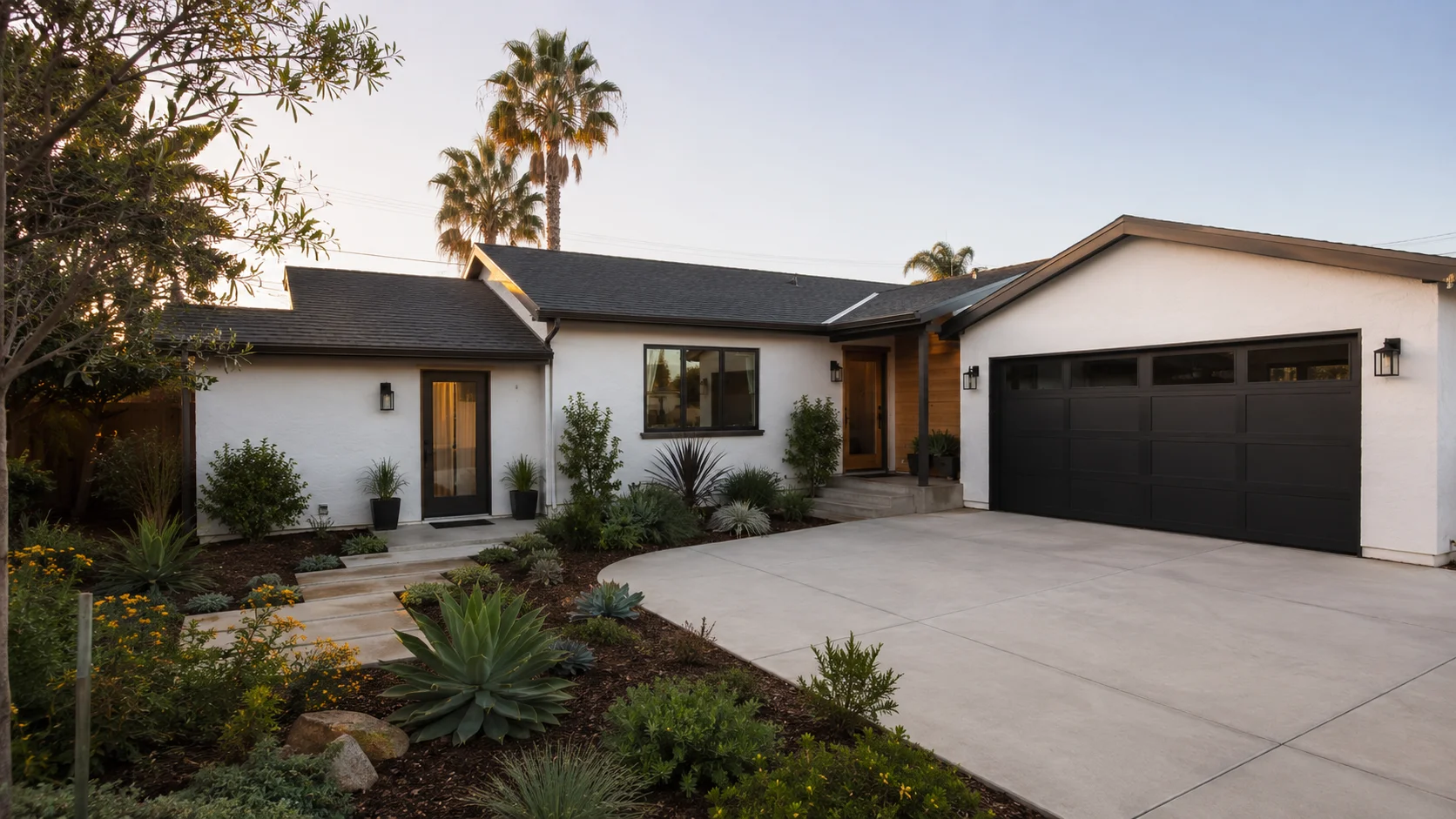
A San Diego JADU (Junior Accessory Dwelling Unit) is a unit of 150–500 sq ft built inside an existing or proposed single-family home or its attached garage. It needs a building permit, an efficiency kitchen, and either a separate or shared bathroom — but no extra parking, no solar, no impact fees, and no separate utility connection. Realistic 2026 all-in cost runs $50,000 to $150,000 depending on the bathroom configuration and conversion type. Effective January 1, 2026 under AB 1154 and SB 543, owner-occupancy is only required when the JADU shares sanitation with the main home. JADUs cannot be rented for periods of 30 days or fewer.
→ Get your free ADU report in 60 seconds — JADU, garage-conversion ADU, or detached ADUReturns your legal path, SDMC and Gov. Code citations, and a realistic cost band.
San Diego JADU at a Glance (2026)
| Rule | 2026 Answer | Source |
|---|---|---|
| Minimum / maximum size | 150–500 sq ft | SDMC Ch. 14 Art. 1 Div. 3; IB-400 |
| Where it can go | Inside an existing or proposed single-family home, or an attached garage | Cal. Gov. Code §66333; IB-400 |
| Detached structures allowed? | No — a detached unit is an ADU, not a JADU | Cal. Gov. Code §66333 |
| Efficiency kitchen | Required | IB-400 |
| Bathroom | Shared or separate (each has consequences — see below) | Cal. Gov. Code §66333(b) |
| Owner-occupancy | Only required when sanitation is shared (effective Jan 1, 2026) | AB 1154; SB 543; Cal. Gov. Code §66333(b); DS-202A |
| Additional parking | Not required | IB-400; Cal. Gov. Code §66334 |
| Solar PV | Not required for JADUs | IB-400 |
| Local impact fees | Exempt for JADUs up to 500 sq ft | SB 13; SB 543 |
| School fees | Generally exempt at 500 sq ft or less — verify with district | Cal. Education Code §17620; IB-146 |
| Utility connection fee | None — JADU is not a separate dwelling unit for connection fees | SB 543; Cal. Gov. Code §66311.5 |
| Building permit | Required (no exemption) | IB-400 |
| Junior Unit Agreement (DS-202A) | Required before permit issuance | IB-400 |
| Short-term rental (30 days or fewer) | Prohibited | Cal. Gov. Code §66333(g); IB-400 |
| Separate sale from main home | Not allowed (AB 1033 condo conversion excludes JADUs) | Cal. Gov. Code §66333; DS-202A |
| Bonus ADU Density Program | JADUs are not part of the Bonus ADU program | IB-400 |
| Permit timing (state floor) | Approve/deny within 60 days of complete application | Cal. Gov. Code §66335 |
Free Tool — ~60 Seconds
See What You Can Build at Your Address
Get your free ADU report in 60 seconds. We'll show you which path fits your property — JADU, garage-conversion ADU, or detached ADU.
Get Your Free ADU Report →Best for homeowners deciding between a JADU, a garage-conversion ADU, or a detached ADU.
What are the San Diego JADU requirements?
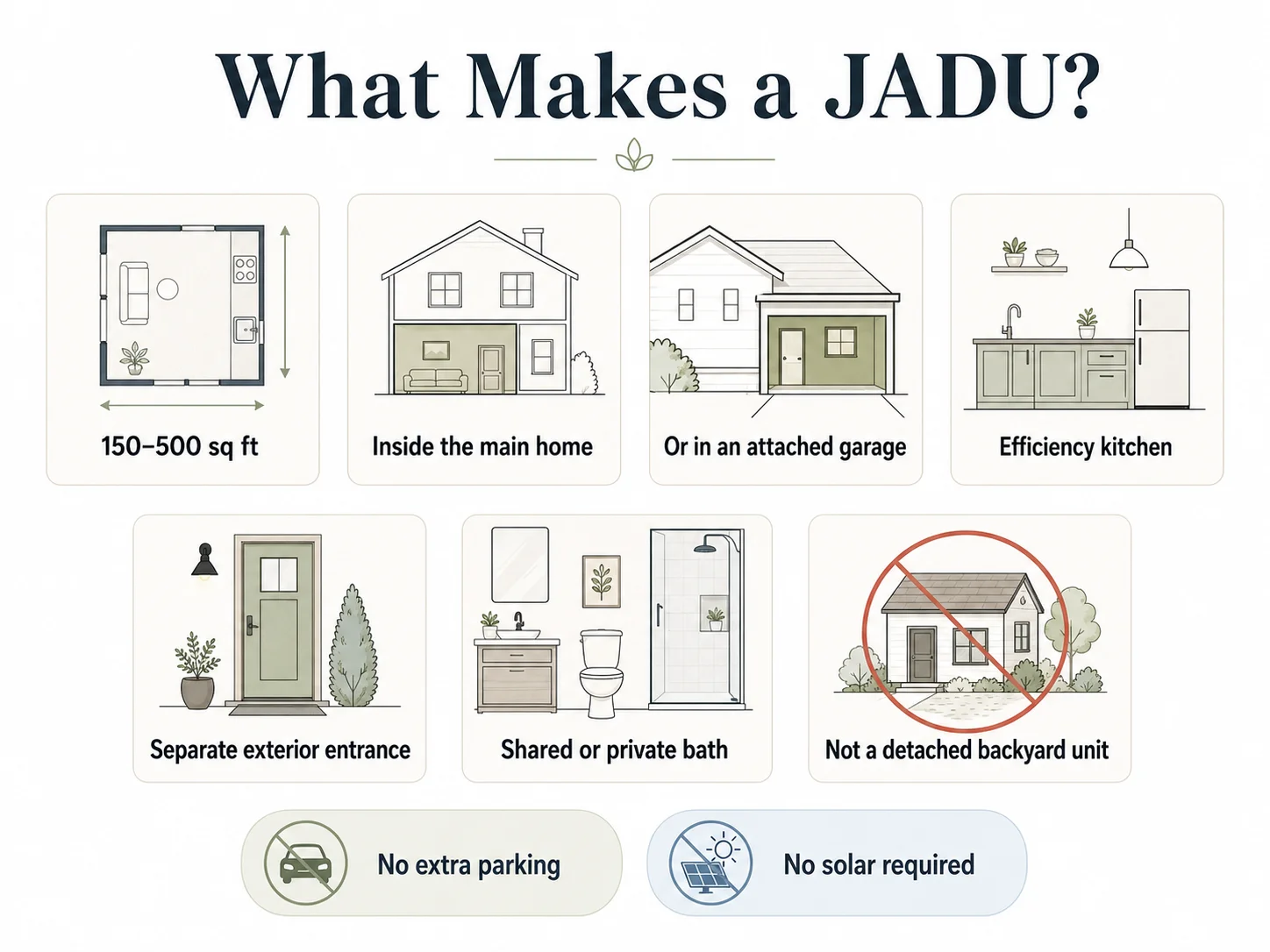
Beyond size and location, the City and state law layer in specific design requirements. Here’s the full list:
- One JADU per single-family lot. You can also have one converted ADU and one detached or attached ADU on the same lot — three units total on a typical single-family parcel.
- Inside the existing envelope. A JADU must be within the proposed or existing single-family residence or attached garage. A detached structure is not a JADU.
- 150–500 sq ft. State law uses “interior livable space.” The difference matters for the 499 sq ft fee target (see below).
- Efficiency kitchen required. Counter, storage, and cooking facilities — 240-volt outlets permitted, so a plug-in induction cooktop counts.
- Bathroom: shared or separate. Each has different consequences for owner-occupancy under AB 1154 / SB 543.
- Separate exterior entrance required. If sanitation is shared with the main home, interior access is also required so the tenant can reach the shared bathroom without going outside.
- Building permit required. No exemptions, per IB-400.
- Junior Unit Agreement recorded against title before permit issuance. Form DS-202A, from DSD.
- No short-term rental. Rental terms must be longer than 30 days (Cal. Gov. Code §66333(g)).
- No separate sale. JADUs cannot be sold separately from the primary dwelling, and they aren’t eligible for the AB 1033 condo-conversion program.
- Zoning. JADUs are permitted where the Use Regulation Tables identify them as allowable Limited Uses — generally in Single Dwelling Unit Zones. Verify in ZAPP.
The four-question eligibility test
If you answer “yes” to all four, you almost certainly have a viable JADU path:
- Is your lot zoned for single-family residential use?
- Do you have an existing single-family home on the lot?
- Do you have a convertible interior space (bedroom, study, den, basement, attached garage) within the home’s footprint, at least 150 sq ft, with a path to an exterior entrance?
- Are you the owner of record, or do you have written authority from the owner of record?
What counts as a legal JADU in San Diego?
JADU vs garage-conversion ADU vs detached ADU
| Attribute | JADU | Garage-Conv. ADU | Detached ADU |
|---|---|---|---|
| Size | 150–500 sq ft | Up to existing structure size, typically 250–1,200 sq ft | Up to 1,200 sq ft (state floor 800 sq ft) |
| Where it sits | Inside the main home or attached garage | A converted detached garage or accessory structure | A new or existing detached structure in yard |
| Kitchen | Efficiency kitchen | Full kitchen | Full kitchen |
| Bathroom | Shared or separate | Separate | Separate |
| Independent utilities required | No — shares with main home | Often yes | Yes |
| Solar PV | Not required | Not required | Required for newly constructed detached ADUs |
| Local impact fees | Exempt up to 500 sf (SB 13/SB 543) | Exempt up to 750 sf | Exempt up to 750 sf |
| School fees | Generally exempt at ≤500 sf — verify | Apply over 500 sf | Apply over 500 sf |
| Replacement parking on garage conversion | Not required for JADU | Not required (state preemption) | N/A |
| Owner-occupancy | Required only when bath is shared | Not required | Not required |
| Short-term rental | Prohibited (30 days or fewer) | Prohibited | Prohibited |
| Separate sale possible | No (AB 1033 excludes JADUs) | Yes via AB 1033 condo program | Yes via AB 1033 |
| Typical 2026 all-in cost | $50,000–$150,000 | $100,000–$200,000 | $300,000–$450,000+ |
| Typical permit timeline | 4–9 months | 5–10 months | 8–18 months |
Sources: SDMC Ch. 14 Art. 1 Div. 3; IB-400; Cal. Gov. Code §§66323, 66333, 66334; SB 13; SB 543; AB 1033; Education Code §17620; verified May 12, 2026.
Can an attached garage become a JADU?
Yes. California Gov. Code §66333 and IB-400 both include attached garages within the JADU envelope. This is the most common JADU configuration in San Diego, because attached garages typically already share walls, slab, and electrical service with the main house, and they often have a door or window on the exterior side wall that becomes the JADU’s required separate entrance. The garage door itself is usually replaced with a wall and window — California Building Code requires the JADU’s exterior wall to meet thermal, weatherproofing, and egress standards.
Can a detached garage become a JADU?
No. A detached garage isn’t part of the single-family dwelling envelope. Converting it creates a converted ADU, not a JADU. Some rules are similar (no impact fees under 750 sf, no parking replacement under state law), but you lose the JADU-specific advantages: shared utilities, school-fee exemption at 500 sf, and the simpler permit pathway under SDMC.
The JADU Path Picker
| Conversion source | Bath plan | Context | Owner intent | Most likely path |
|---|---|---|---|---|
| Spare bedroom inside main home | Shared with main home | None | Owner-occupy main home | JADU (shared bath) — $50K–$75K |
| Spare bedroom inside main home | New separate ¾-bath | None | Investor or rental | JADU (separate bath) — $75K–$110K |
| Attached garage | New separate ¾-bath | None | Rental or family | JADU (attached garage) — $80K–$125K |
| Attached garage | New separate ¾-bath | Beach Impact Parking Overlay, outside TPA | Rental | JADU + replacement parking — $100K–$150K |
| Detached garage at rear | Separate bath | None | Rental | Converted (garage) ADU, not JADU — $100K–$200K |
| New backyard structure | Separate bath | None | Maximum rental return | Detached ADU — $300K–$450K+ |
| Coastal Overlay property | Any | Coastal Overlay Zone | Any | Verify CDP requirement first before committing |
| Maximizing units on lot | Mixed | Single-family lot, ≥6,000 sf typical | Maximum yield | JADU + detached ADU stack — $360K–$560K total |
Free Tool — ~60 Seconds
Find Your JADU Path
Get the personalized version of this matrix run against your address, zone, and overlays in 60 seconds.
Get Your Free 60-Second Property Check →Returns your legal path, the SDMC and Gov. Code citations that apply, and a realistic cost band.
Does a San Diego JADU need its own bathroom?
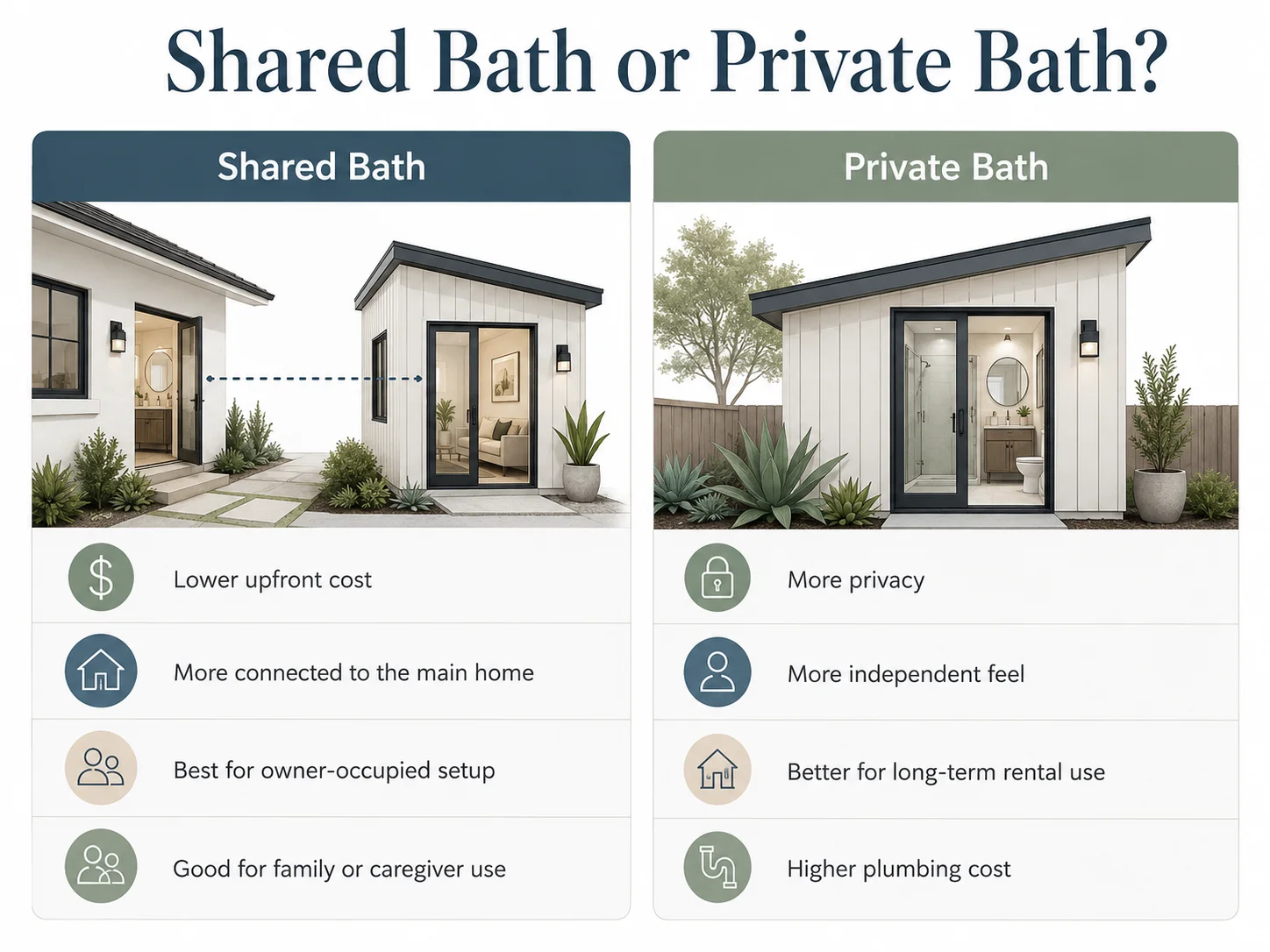
Shared bath vs separate bath — the full tradeoff
| Decision factor | Shared bathroom JADU | Separate bathroom JADU |
|---|---|---|
| Upfront cost added vs base | $0 incremental | $15,000–$35,000 (plumbing, fixtures, framing, finishes) |
| Bathroom privacy | Tenant uses main-home bathroom or shares plumbing | Fully independent |
| Owner-occupancy required? | Yes under Cal. Gov. Code §66333(b) | No under Cal. Gov. Code §66333(b) (AB 1154/SB 543) |
| Rental-market positioning | Reads more like a room rental; lower demand from independent tenants | Reads like a small studio; higher demand and rent |
| Realistic rent range (San Diego, 2026) | $1,200–$1,800/month | $1,500–$2,500/month |
| Permitting complexity | Slightly simpler — no new plumbing branch | Requires new plumbing branch from main service line |
| Long-term flexibility | If you later want to rent without owner-occupancy, you'll need to convert to separate bath | More flexible — sanitation rule is already met |
| Best for | Family caregiving, adult-child semi-independent space, short-term-need conversions | Long-term rental, multigenerational privacy, investor-friendly setups |
| The honest watchout | The owner-occupancy obligation is real and recorded as a covenant against your title | The added cost can erase the JADU's 'cheapest path' advantage |
Source: Cal. Gov. Code §66333(b); IB-400; AB 1154; SB 543; DS-202A; verified May 12, 2026.
The interior-access wrinkle
Under California law, a JADU that shares a bathroom must also have interior access between the JADU and the main residence (so the tenant can reach the shared bathroom without going outside). This works fine for a family member or a roommate-style arrangement — it’s awkward for a stranger tenant, because the JADU isn’t fully separable. If you build a separate bathroom, the interior-access requirement falls away. The JADU can have an entirely separate exterior entrance with no interior connection to the main home.
A note on the kitchenette
The JADU needs an “efficiency kitchen.” Under SDMC and HCD guidance, this means a food-preparation counter and storage of reasonable size, a cooking facility (240-volt outlets are permitted, so a plug-in induction cooktop counts), and a refrigerator or refrigeration arrangement. You don’t need a full apartment-grade kitchen — but you do need real cooking facilities, not a microwave on a shelf.
Free Tool — ~60 Seconds
Check Your JADU Layout
Choose shared bath, private bath, attached garage, or interior suite — and see which path fits your property and your goal.
Get Your Free ADU Report →Do I have to live on the property if I rent the JADU?
This is the single most-misunderstood rule in San Diego JADU content, because the change is recent and many builder pages haven’t caught up.
What changed on January 1, 2026
Before 2026, California’s JADU statute generally required owner-occupancy regardless of bathroom configuration. AB 1154 narrowed that requirement so it applies only when the JADU shares sanitation with the main home. SB 543 made parallel updates and added other JADU clarifications (sprinkler trigger limits, the explicit 500 sq ft cap, the short-term rental prohibition under §66333(g), and renumbering of related fee provisions).
The practical effect: an investor who builds a JADU with a separate bathroom inside their San Diego rental property no longer has to live on site. A homeowner who builds a shared-bath JADU still does.
The Junior Unit Agreement (DS-202A)
The City of San Diego requires every JADU applicant to record a Junior Unit Agreement (form DS-202A) before permit issuance. The current version states clearly:
- The owner may not sell separately either the primary dwelling unit or the Junior Unit.
- The owner shall reside on the premises if the Junior Unit has shared sanitation facilities with the primary dwelling unit.
- The owner shall not rent the Junior Unit for periods of 30 days or fewer.
- The agreement runs with the land.
Sale restrictions — and why AB 1033 doesn’t help
A San Diego JADU cannot be sold separately from the primary dwelling. Cal. Gov. Code §66333 prohibits separate sale. AB 1033 — the 2023 law that allows ADUs to be converted to condominiums and sold separately — applies to ADUs only, not JADUs. The County of San Diego adopted AB 1033 implementation effective April 4, 2026. Neither program lets you sell a JADU.
If your goal is to build a unit you can later sell as a separate condo, a JADU isn’t the path. See our San Diego Detached ADU Cost guide for that path.
Short-term rentals — the 30-day rule
Per Cal. Gov. Code §66333(g) and Information Bulletin 400, a JADU may not be rented for periods of 30 days or fewer. The current DS-202A agreement contains the same restriction. Airbnb-style short-term rentals are not a legal use for a San Diego JADU.
What does a San Diego JADU cost in 2026?
Scenario A — Shared-bath bedroom conversion (~ $50,000–$75,000)
You have a spare bedroom of about 200 sq ft, already on an exterior wall, with a window that becomes an egress window and an existing exterior door. Bathroom is shared with the main house. You’re adding a small efficiency kitchen, insulation, and a separate exterior entrance.
| Line item | Range |
|---|---|
| Design + permit drawings | $5,000–$8,000 |
| Permit & City fees | $5,500–$7,500 |
| Demo + framing for new entrance | $4,000–$8,000 |
| Insulation, drywall, finishes | $8,000–$14,000 |
| Electrical (separate circuit, lighting, outlets) | $5,000–$8,000 |
| Efficiency kitchen (sink, counter, induction cooktop, mini-fridge) | $6,000–$11,000 |
| Flooring | $3,000–$5,000 |
| Egress window or door upgrade | $3,000–$5,500 |
| Contingency (10%) | $5,000–$8,000 |
| Total range | $50,000–$75,000 |
This is the cheapest legitimate JADU path. Owner-occupancy applies. Rent range is at the lower end ($1,200–$1,800/month) because the unit reads more like a roommate situation than an independent studio.
Scenario B — Separate-bath bedroom conversion (~ $75,000–$110,000)
Same starting point, but you add a new ¾-bathroom (shower, toilet, vanity) by extending plumbing from an existing branch. This is the version where AB 1154’s owner-occupancy exemption kicks in, and rental income jumps.
| Line item | Range |
|---|---|
| Design + permit drawings | $6,000–$9,000 |
| Permit & City fees | $5,500–$7,500 |
| Demo + framing | $5,000–$9,000 |
| New plumbing branch from main service | $7,500–$13,000 |
| New bathroom buildout (shower, toilet, vanity, exhaust) | $11,000–$18,000 |
| Insulation, drywall, finishes | $9,000–$15,000 |
| Electrical (separate circuit, GFCI in bath, lighting) | $6,000–$9,000 |
| Efficiency kitchen | $7,000–$12,000 |
| Flooring | $3,500–$6,000 |
| Egress upgrade | $3,000–$5,500 |
| Contingency (10%) | $7,500–$10,000 |
| Total range | $75,000–$110,000 |
The most popular JADU configuration in 2026 budget conversations. The $20K–$35K bathroom premium typically pays back in 18–30 months of higher rent.
Scenario C — Attached-garage JADU, no parking replacement required (~ $80,000–$125,000)
You’re converting an attached two-car garage. The slab is there. The walls are there. But you’re converting space that was previously unconditioned, so insulation, drywall, ceiling, flooring, HVAC, and a new exterior wall (where the garage door was) all need to happen. Under California Gov. Code §66334, replacement parking is not required for a garage converted to a JADU. The City’s narrow exception per IB-400 applies if the property is in the Coastal Overlay Zone, within the Beach Impact Area of the Parking Impact Overlay Zone, and outside a Transit Priority Area. Most San Diego JADU sites get the exemption.
| Line item | Range |
|---|---|
| Design + permit drawings | $7,000–$10,000 |
| Permit & City fees | $5,500–$7,500 |
| Demo (existing garage door, slab evaluation) | $3,500–$6,000 |
| New exterior wall where garage door was (framing, sheathing, exterior finish) | $8,000–$14,000 |
| Insulation (uninsulated garage now habitable) | $5,000–$8,000 |
| Drywall + ceiling | $7,000–$11,000 |
| HVAC mini-split | $4,500–$7,500 |
| Plumbing branch + new ¾-bath | $14,000–$22,000 |
| Electrical (rewire to habitable standards) | $7,000–$11,000 |
| Efficiency kitchen | $7,000–$12,000 |
| Flooring (slab prep + finish) | $5,500–$8,500 |
| Windows | $3,500–$6,000 |
| Side door for separate entrance | $1,800–$3,500 |
| Contingency (10%) | $8,000–$11,000 |
| Total range | $80,000–$125,000 |
Scenario D — Attached-garage JADU, replacement parking required (~ $100,000–$150,000)
Same garage conversion, but your property sits in the Beach Impact Area of the Parking Impact Overlay Zone (much of Mission Beach, Pacific Beach, Ocean Beach, and parts of La Jolla), outside a Transit Priority Area. IB-400 then requires one replacement parking space. That adds $10,000–$25,000 on top of Scenario C.
| Add-on | Range |
|---|---|
| Replacement parking (asphalt strip to permitted carport) | $10,000–$25,000 |
| Total range | $100,000–$150,000 |
Hidden costs nobody itemizes
| Hidden cost | When it hits | Typical range |
|---|---|---|
| Electrical panel upgrade | Older homes with 100A panels that can't take the JADU load | $2,500–$5,000 |
| Soils/geotechnical report | Hillside or graded properties | $2,000–$5,000 |
| Asbestos or lead-paint abatement | Pre-1978 homes (City charges $58 Lead Hazard Prevention Fee) | $3,000–$15,000 |
| Sewer lateral inspection / repair | Older homes where the lateral has roots | $1,500–$8,000 |
| Fire sprinklers (if main home has them) | Per IB-400, JADU triggers sprinkler protection when main is sprinklered | $5,000–$12,000 |
| Address-assignment fee | If JADU needs its own address ($493.90 per IB-501) | $493.90 |
| HOA architectural review | If your home is in an HOA with a review committee | $250–$1,500 |
| Title insurance / escrow on recorded JUA | If your lender requires it | $200–$800 |
Source: Information Bulletin 501 (December 2025) for City fees; verified May 12, 2026.
Compare Your Financing Options
See how HELOC, cash-out refi, home equity loan, and construction-loan paths line up against your equity, timeline, and project budget.
Explore ADU Financing Paths →Educational comparison only. We don’t quote rates or guarantee approval.
What does a San Diego JADU permit actually cost in 2026?
The verified IB-501 fee math
| Fee item | 2026 amount | Notes |
|---|---|---|
| Plan check (base) | $3,275.45 | Covers JADUs up to 500 sq ft; +$6.51/sq ft over 500 sf |
| Inspection (base) | $2,077.66 | Covers JADUs up to 500 sq ft; +$4.16/sq ft over 500 sf |
| General Plan Maintenance Fee | $737.00 | One-time, non-refundable |
| Mapping Fee | $11.34 | One-time |
| Fee Collection — Other Agencies | $15.95 | One-time, at permit issuance |
| Lead Hazard Prevention Fee | $58.00 | If pre-1978 home |
| State/Seismic Fee | $0.13 per $1,000 valuation | One- or two-story SFD/JADU |
| Building Standards Fee | $1.00 per $25,000 valuation | Minimum $1 |
| Addressing Fee (if new address needed) | $493.90 | Often not needed since JADU shares address |
| Water/Sewer plan check (SDU, no meter change) | $164.63 | Sometimes waived for JADU sharing primary's service |
| Typical total permit-only cost for a 500 sq ft JADU | $6,000–$7,500 | |
Source: Information Bulletin 501, December 2025 version, sandiego.gov; verified May 12, 2026.
The 499 vs 500 sq ft fee-risk checkpoint
Our conservative editorial recommendation: target 499 sq ft of interior livable area in your floor plan to leave a cushion against assessable-space adjustments. Confirm school-fee treatment with DSD and your local school district in writing before plan final.
What JADUs uniquely don’t pay
| Fee | JADU treatment | Source |
|---|---|---|
| Development Impact Fee (DIF) | Exempt for JADUs ≤500 sf | SB 13; SB 543 |
| RTCIP transportation fee | Exempt for JADUs ≤500 sf | SB 13; SB 543 |
| Park impact fee | Exempt for JADUs ≤500 sf | SB 13; SB 543 |
| Public utility connection (water/sewer capacity) | Exempt — JADU is not considered a separate dwelling unit for connection-fee purposes | SB 543; Cal. Gov. Code §66311.5 |
| Utility connection fee | Exempt — no separate connection | SB 543 |
| School developer fee | Generally exempt at 500 sf or less — verify with district | Cal. Education Code §17620 |
| Replacement parking on garage conversion | Not required for JADU | Cal. Gov. Code §66334 |
| Solar PV requirement | Not required | Cal. Energy Code; IB-400 |
| Inclusionary Housing in-lieu (small projects) | Generally not triggered for single JADU | SDMC Ch. 14 Art. 2 Div. 13 |
The combined fee-waiver value typically runs $10,000–$25,000 vs an equivalent detached ADU. All exemptions verified against current statute on May 12, 2026.
Are San Diego JADUs really exempt from parking, solar, and impact fees?
Parking
No additional parking is required for a JADU. If you’re converting an attached garage that previously held a parking space, replacement parking is not required under California Gov. Code §66334 — state law preempts the City’s old parking-replacement rule. The narrow exception per IB-400: if your site is in the Coastal Overlay Zone, within the Beach Impact Area of the Parking Impact Overlay Zone, and outside a Transit Priority Area, then one replacement space is required. For most San Diego JADU sites, that exception doesn’t apply. For Mission Beach, Pacific Beach, and parts of Ocean Beach, it can. Check with DSD via ZAPP.
Solar PV
JADUs do not require solar panels. IB-400 is explicit. The California Energy Code solar requirement applies to newly constructed, non-manufactured, detached ADUs only — JADUs are inside the existing home envelope and are exempt. This saves $8,000–$15,000 vs a detached ADU build.
Impact fees
SB 543 and SB 13 prohibit local impact fees on JADUs of 500 sq ft or less. No DIF, no RTCIP, no park fees.
Utility connection fees
Under SB 543, a JADU is not considered a separate or new dwelling unit for purposes of utility connection fees and capacity charges. The JADU uses the primary residence’s water, sewer, and electrical service. SDG&E doesn’t install a new meter. For a 500 sq ft detached ADU, those connection charges easily run $5,000–$15,000.
Sprinklers
This is the one exception where JADUs can cost more than expected. Per IB-400: a JADU requires sprinkler protection when the primary dwelling is sprinkler-protected. If your home was built after 2011, it likely has sprinklers, and your JADU will need them too. Retrofitting sprinklers in a JADU runs $5,000–$12,000.
Critical: if your home was built before 2011 and isn’t sprinklered, state law explicitly prohibits a JADU from triggering a new sprinkler requirement for the main home. The JADU doesn’t make sprinklers mandatory where they weren’t before.
How long does a San Diego JADU permit take?
- Design and drawings take 4–8 weeks before you can submit a complete application.
- Completeness review takes 15 business days from submittal.
- Plan check is the 60-day window — but the clock pauses during correction cycles.
- Permit issuance happens after all fees are paid.
- Construction is its own timeline, typically 8–16 weeks for a JADU.
- Final inspections + Certificate of Occupancy can take 2–4 weeks at the end.
Where projects get stuck
Common correction notices from DSD on JADU applications:
- Egress windows below required dimensions — California Residential Code requires a clear opening of 5.7 sq ft (or 5.0 sq ft at grade level), minimum 24″ height, 20″ width, and not more than 44″ sill height from the floor.
- Smoke and carbon-monoxide alarm placement — required throughout both the JADU and the main residence, on each level, and outside each sleeping area.
- Insulation values below CalGreen — the JADU is new conditioned space; wall and ceiling assemblies must meet current Title 24 envelope requirements.
- Kitchen ventilation — code requires mechanical ventilation in cooking areas.
- Inadequate exterior entrance — the JADU’s separate entrance must meet egress and weatherproofing requirements; a former garage side door rarely passes without upgrades.
- Missing Junior Unit Agreement — DS-202A must be recorded before permit issuance, not at final inspection.
How to compress the timeline
- Use a designer who’s permitted 10+ San Diego JADUs. They know which corrections DSD routinely issues and pre-empt them.
- Pull the DS-202A template from DSD early so it’s signed, notarized, and ready to record when you reach permit issuance.
- Get an early pre-application meeting (PSC) with DSD if anything about the project is unusual — coastal status, fire zone, historic, septic, prior unpermitted work, lot non-conformity.
What JADU layouts work best in San Diego homes?
The 150–220 sq ft micro-studio JADU
A converted small bedroom or a portion of a primary suite. Cheapest to build ($45K–$70K). Owner-occupancy applies. Best for caregiving, an adult child returning home short-term, or a tight-budget Plan B.
The 250–350 sq ft bedroom-suite JADU
A larger bedroom that already has an attached ¾-bath, or a primary-suite split where you carve off the existing primary bath for the JADU. This unlocks the separate-bathroom path (no owner-occupancy under AB 1154/SB 543) at a reasonable cost ($65K–$95K). Best balance of cost, privacy, and rental flexibility.
The 350–499 sq ft attached-garage JADU
The flagship JADU configuration for rental income. A two-car attached garage converts into a 380–480 sq ft studio with full separation, a new exterior wall where the garage door was, and either a new bathroom or shared sanitation. Higher cost ($90K–$130K typical) but the strongest rent profile. Owner-occupancy depends on bathroom configuration.
The 499 sq ft private-bath JADU
The maximum-yield design. Pushes right up against the size cap, includes a fully separate bathroom, full efficiency kitchen, and either an interior bedroom and living area or an open studio plan. We intentionally write “499” — see the 499/500 sq ft school-fee checkpoint above. Owner-occupancy not required. Strongest rental version.
The JADU + detached ADU stack
For homeowners on larger lots who want maximum unit count, San Diego permits one JADU plus one converted ADU plus one detached ADU on a single-family lot (subject to lot size). The JADU adds about $60K–$110K to the project; the detached ADU adds $300K–$450K. Total ~$360K–$560K for effectively three rentable units on one property. The economics work in San Diego rental zones where the second and third units rent for $1,800–$3,000+ each.
Should I build a JADU, a garage-conversion ADU, or a detached ADU?
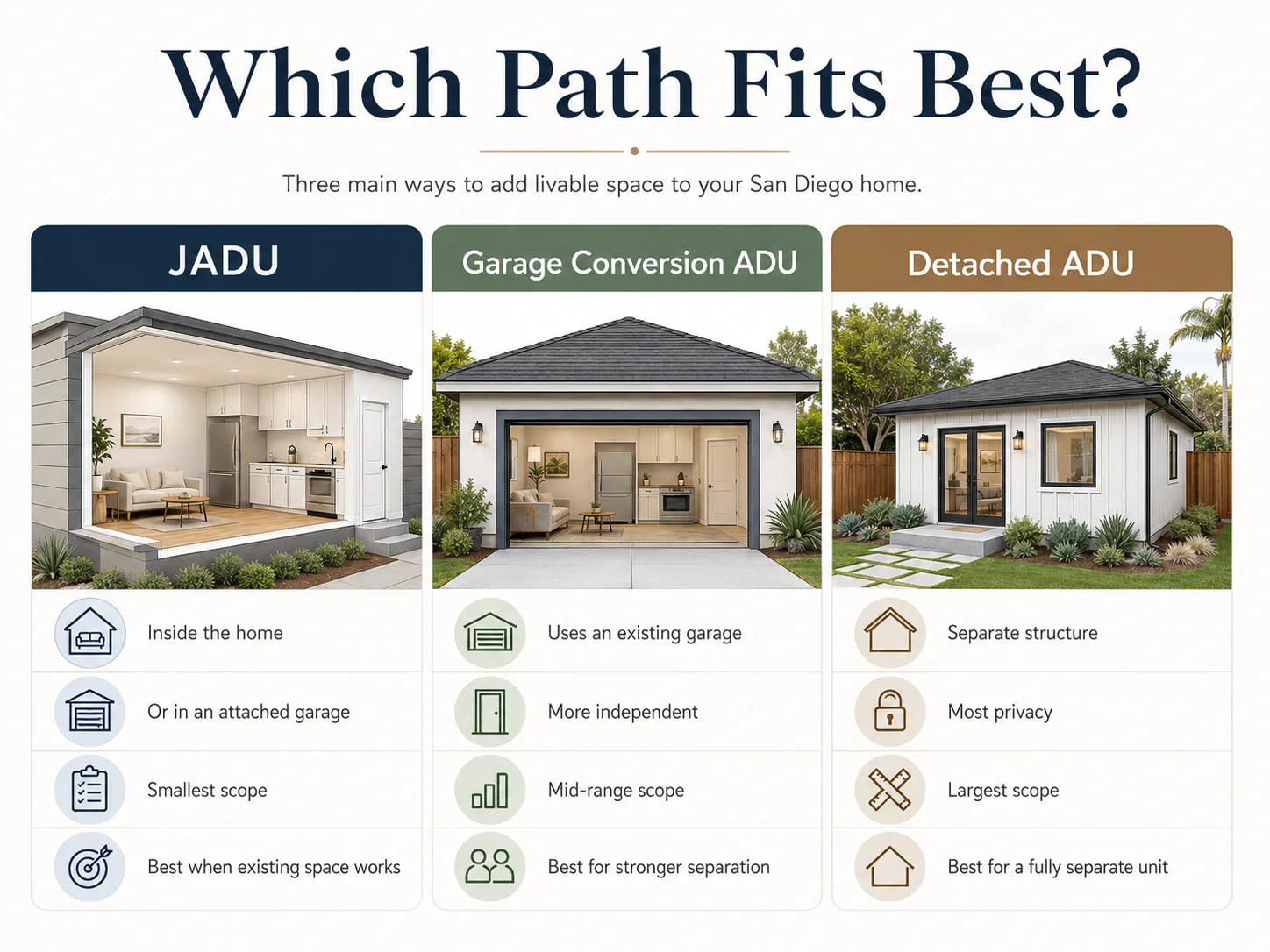
| Your situation | Best first path | Why |
|---|---|---|
| Spare room near exterior wall and existing bath | JADU (shared or separate bath) | Lowest cost, fastest permit |
| Attached garage, plumbing nearby, no parking issue | JADU (attached garage) | Strong cost-to-rent ratio |
| Detached garage at rear of lot | Garage-conversion ADU | Cleaner separation from main house |
| Need a fully independent rental, no shared walls | Detached ADU | Best privacy and rent |
| Need to house aging parent with shared meals/care | Shared-bath JADU | Family-care fit, lowest cost |
| Want maximum rental income | 499 sq ft separate-bath JADU + future detached ADU | Stack the two units for ~$400K–$560K total |
| Want to sell the unit later as a condo | Detached ADU (eligible for AB 1033) | JADUs can't be sold separately |
| Coastal Overlay Zone property, no extra space | JADU if fully inside existing structure | Coastal CDP often required for new detached |
| Very High Fire Hazard Severity Zone property | JADU may be simpler than new detached | Avoids new-structure fire-defensible space costs |
| Property in HOA with strict architectural rules | JADU | Less visible, fewer exterior changes |
Verified May 12, 2026.
When the JADU is the wrong answer
A JADU loses to a detached ADU when any of the following is true:
- You want to sell the unit separately later (AB 1033 excludes JADUs).
- You need a unit larger than 500 sq ft.
- You have backyard space, a real budget ($300K+), and a long-term rental plan with 7–12 year ROI horizons.
- You don’t want owner-occupancy or any covenant on title.
- You’re an investor whose model requires renting both unit and main home to strangers without sharing infrastructure.
Free Tool — ~60 Seconds
Find Your Best ADU Path
If a JADU isn't right for your property, we'll show you the detached ADU or garage-conversion ADU path that is. Same free 60-second check.
Get Your Free ADU Report →What can stop a San Diego JADU project?
Coastal Overlay Zone
If your property is in the Coastal Overlay Zone, a Coastal Development Permit (CDP) is required for any JADU that is not completely contained within the existing primary structure, includes increases in habitable area, or includes conversion of non-habitable space. Per IB-400. CDPs add 3–6 months to the timeline and $5,000–$15,000 to soft costs. Many JADU projects in La Jolla, Mission Beach, Pacific Beach, Ocean Beach, Sunset Cliffs, Point Loma, Bird Rock, and Mission Hills (coastal-adjacent) fall in this overlay.
As of May 2026, most updated ADU/JADU regulations under Housing Action Package 1.0 are in effect outside the Coastal Overlay Zone, but the regulations will only become effective inside the Coastal Overlay Zone once the California Coastal Commission certifies the relevant ordinances. Verify the current rule set with DSD before design.
Very High Fire Hazard Severity Zone
In the Very High Fire Hazard Severity Zone, additional fire-material, defensible-space, and ember-resistant exterior requirements apply per the California Residential Code Chapter 7A. The fire-zone overlay typically adds $5,000–$20,000 in upgraded materials. Large parts of Rancho Peñasquitos, Scripps Ranch, Tierrasanta, and wildland-adjacent Carmel Valley — plus County areas like Bonsall, Ramona, and Valley Center — sit in this overlay.
HOA covenants
Per California Civil Code §4751, HOAs cannot prohibit JADUs that comply with state law. HOAs can apply reasonable architectural standards — exterior paint, window style, materials, landscaping. Architectural Review Committee approval is typically required and can add 2–8 weeks.
Prior unpermitted work
If your home includes prior unpermitted work — a converted garage, an enclosed patio, a finished basement — the JADU permit application may trigger legalization of the prior work. AB 2533 (effective 2025) created a statewide amnesty for unpermitted ADUs/JADUs constructed before January 1, 2020. Pre-2020 unpermitted units can often be legalized through the City’s ADU/JADU Amnesty Program. Never assume legalization is automatic — verify with DSD on your specific situation.
Historic designation
If your property is on the City’s Historical Register or in a historic district, JADU projects trigger Historic Resource Review. Hourly review fees apply ($177.76/hour per IB-501). Exterior modifications visible from public view may be restricted. Review typically adds 4–8 weeks and $2,000–$8,000.
Septic systems (County, not City)
In unincorporated San Diego County, properties on septic require a septic capacity letter from the County Department of Environmental Health before JADU approval. Older systems may need upgrade or replacement, which can run $20,000–$50,000.
How to apply for a San Diego JADU permit (step-by-step)
Step 1 — Confirm City of San Diego jurisdiction and zone
Use ZAPP at sandiego.gov to confirm your address is inside the City and to capture your base zone. ZAPP also returns overlays (Coastal, Very High Fire, Transit Priority, Sustainable Development Area, Beach Impact Parking) and historic designation. Screenshot the ZAPP report for your file.
Step 2 — Check overlays and additional reviews
In ZAPP, confirm whether your property is in any overlay that affects JADU rules. If in Coastal Overlay, plan for CDP timing. If in VHFHSZ, plan for fire-zone material upgrades. If historic, plan for HRB review.
Step 3 — Make the JADU design decisions
Three big choices, in this order:
- Conversion source: spare bedroom, basement, primary suite split, attached garage.
- Bathroom plan: shared or separate. Drives owner-occupancy and rental flexibility.
- Size target: 150–499 sq ft is the safe range (avoids the 500 sq ft school-fee edge case).
Step 4 — Prepare permit documents
Required drawings per IB-400:
- Site plan showing setbacks, building footprint, environmentally sensitive lands.
- Existing and proposed floor plans of the entire single-family residence including the JADU.
- Kitchen and bathroom details (efficiency kitchen layout, plumbing, fixture schedule).
- MEP (mechanical, electrical, plumbing) plans showing how the JADU ties into existing systems.
- Fire and life-safety details (smoke and CO alarms, egress dimensions, sprinklers if applicable).
- Junior Unit Agreement (form DS-202A from DSD; sign and notarize, but record only when permit-ready).
Hire a designer or architect with documented San Diego JADU experience. Expect to pay $5,000–$10,000 for permit-ready drawings on a typical JADU.
Step 5 — Submit through the City’s online portal
The City accepts ADU/JADU applications online at sandiego.gov/development-services. Plan check fees are due at submittal. The 15-business-day completeness review starts when you submit a complete package.
Step 6 — Record the Junior Unit Agreement (DS-202A)
The DS-202A must be recorded with the County Recorder’s office before the City issues your building permit. Recording fee: typically $20–$50 with the San Diego County Recorder.
Step 7 — Pay fees, build, inspect, finalize
After permit issuance, construction can begin. Schedule inspections at the milestones DSD requires — typically rough framing, rough MEP, insulation, drywall, and final. Pass the final inspection and request your Certificate of Occupancy. The JADU is now a legal, rentable unit.
How are San Diego homeowners paying for a JADU?
Path 1 — Home Equity Line of Credit (HELOC)
Best for: Homeowners with $100K+ of available equity who want flexible draws during construction and the option to repay as cash flow allows. A HELOC is a revolving credit line secured by the home’s equity. You draw funds as needed, pay interest only on the drawn balance during the draw period (typically 10 years), and repay over the next 20 years. Rates are variable. Fit for JADU: Strong. Project size matches HELOC limits, draws match construction phasing, and you don’t need to refinance your primary mortgage. Watchout: Variable rate; lender may cap combined loan-to-value at 80–90% CLTV.
Path 2 — Home Equity Loan (HEL)
Best for: Homeowners who prefer predictable fixed payments and want to lock the rate. A second mortgage in a fixed amount at a fixed rate, amortized over 15–20 years. Fit for JADU: Strong if you have a precise budget. Less flexible than a HELOC if costs change.
Path 3 — Cash-Out Refinance
Best for: Homeowners whose current first-mortgage rate is at or above current market rates. Refinance the existing first mortgage for a larger amount and take the difference as cash. Fit for JADU: Excellent for homeowners with high first-mortgage rates. Generally a poor fit if your existing rate is below current market.
Path 4 — Construction-to-Permanent Loan
Best for: Homeowners without significant equity, or projects requiring strict draw schedules tied to inspections. Loan funds released in draws as construction milestones are inspected; after construction, the loan converts to a permanent mortgage. Fit for JADU: Workable but often overkill at JADU scale; closing costs can eat the value of a small loan amount.
Path 5 — SDHC ADU Finance Program
Best for: Moderate-income homeowners on a detached single-family property in the City of San Diego, building an ADU and willing to commit the rented unit to affordable rent (≤80% AMI) for seven years. Per SDHC’s published program terms:
- Construction-to-permanent loan up to $250,000
- Construction interest rate: 1% fixed
- Permanent interest rate: 4% fixed, amortizing monthly payments
- Term: 15 years (30 years due in 15 years)
- Maximum 75% loan-to-value ratio
- Income up to $236,600 (150% of San Diego’s AMI)
- Property must be a detached single-family residence in the City of San Diego
- Main home must be owner-occupied
- Minimum credit score: 680
- Application fee: $2,500 due after SDHC approval at construction-loan closing
- Rent restricted to ≤80% AMI for seven years
- Owner cannot rent to a family member during the seven-year period
Editorial conclusion on JADU fit: The SDHC program is built around ADU construction at the upper end of its loan limit. At typical $50K–$150K JADU budgets, the structure can be heavy for the loan size. For many JADU homeowners, a simpler HELOC or home equity loan often makes more economic sense. Where SDHC shines: homeowners building a JADU plus a detached ADU as a combined project.
Explore ADU Financing Options
See how HELOC, cash-out refi, home equity loan, and construction-loan paths line up against your equity, timeline, and project budget.
Compare Financing Paths →Educational comparison only. We don’t quote rates or guarantee approval.
Who actually builds JADUs in San Diego?
The “JADU-only” general contractor profile
The ideal JADU builder typically:
- Holds a CSLB B (General Building) license — verify at cslb.ca.gov.
- Has built at least 5 JADUs or similar small-unit conversions in San Diego in the past 24 months.
- Carries general liability and workers’ comp insurance.
- Provides written, line-item bids — not flat lump sums.
- Has a portfolio of bedroom-conversion, basement-conversion, or garage-conversion JADUs.
- Communicates timelines in calendar weeks, not “a few months.”
The JADU + detached ADU combo path
If you’re building both a JADU and a detached ADU as a combined project, design-build firms become a stronger fit for the detached portion. SnapADU is a San Diego County ADU design-build firm covering City of San Diego and across the county. SnapADU’s stated limit: they no longer handle garage-conversion projects. So for a standalone JADU, look elsewhere. For a JADU + detached ADU stack, they’re a valid path for the detached portion.
The 60-second CSLB license verification
- Go to cslb.ca.gov.
- Search by license number or company name.
- Verify license is active, in the B classification (General Building), with no disciplinary actions.
- Check workers’ comp status — if “exempt,” ask why and request proof of insurance.
- Confirm bond status — current CSLB bond should be $25,000 or higher.
10 questions to ask before signing a JADU contract
- How many JADUs (specifically — not detached ADUs) have you permitted in San Diego in the past 24 months?
- What’s your typical timeline from permit issuance to certificate of occupancy?
- Can I see line-item pricing for design, permit, framing, plumbing, electrical, kitchen, bath, and finishes separately?
- What’s your contingency policy — who pays for unforeseen conditions like outdated electrical panels or rotten subfloor?
- Do you carry $2M+ general liability insurance? May I see a current COI?
- Will you provide a fixed-price contract or a cost-plus contract? (Fixed-price favors the homeowner; cost-plus favors the builder.)
- How are change orders priced and approved?
- Will your subs hold their own licenses and bonds, or are they working under yours?
- What’s your payment schedule — and what’s the final retainage percentage you hold until final inspection?
- Will you record the Junior Unit Agreement on my behalf or do I handle that with title?
Red flags
| Sign | Why it matters |
|---|---|
| Verbal-only quotes | No contract enforceability |
| Lump-sum pricing without line items | You can't compare bids or catch overruns |
| "Cash discount" pressure | Often signals unlicensed work or tax avoidance |
| Reluctance to provide license or insurance proof | Major red flag |
| Vague timeline ("a few months") | Builder doesn't track their own project velocity |
| 50%+ deposit | California limits to 10% or $1,000 (whichever is less) for licensed contractors on home improvement |
| No CSLB B license | Cannot legally pull building permits |
A worked example: “Mom’s coming home”
We’re including this as an illustrative composite — not a fake testimonial — because abstract scenario tables only get a homeowner halfway there. Here’s what an actual JADU project looks like on paper.
The setup. University Heights, San Diego (City). 1942 Craftsman bungalow, 1,650 sq ft, 3-bedroom 2-bath, on a 5,200 sq ft single-family-zoned lot. Attached single-car garage, 220 sq ft, currently used for storage. Homeowner is 58, mortgage paid off, no equity loan. Mom (84) is moving in within 12 months. The family wants Mom to have private space — bedroom, bathroom, small kitchenette, separate side entrance — while still being part of the household.
The decision. A JADU rather than a detached ADU because the garage is already attached, the family wants Mom close (no walk across the yard at night), and budget is constrained to about $100K.
The design. Convert the 220 sq ft attached garage into a 380 sq ft JADU by also borrowing 160 sq ft from an adjacent oversized hallway/laundry area. Add a new ¾-bath. Install an efficiency kitchen along the back wall. New exterior wall and side door where the garage door was. New windows on the side and front walls.
| Line item | Cost |
|---|---|
| Designer for permit drawings | $7,500 |
| City of San Diego permit fees (verified IB-501 base + add-ons) | $6,800 |
| School fees | $0 (under 500 sq ft) |
| Impact fees | $0 (under 500 sq ft per SB 13/SB 543) |
| Utility connection fees | $0 (shares with main home per SB 543) |
| Junior Unit Agreement (DS-202A) recording | $35 |
| Demo (garage door, finished wall) | $4,800 |
| New exterior wall (framing, sheathing, stucco, paint) | $11,200 |
| New side door + windows | $5,900 |
| Slab prep + waterproofing | $3,200 |
| Insulation (walls + ceiling) | $5,400 |
| Drywall + ceiling | $9,800 |
| Plumbing branch + new ¾-bath | $16,500 |
| Electrical (rewire to habitable, GFCI in bath, new circuits) | $8,200 |
| HVAC mini-split (5,000 BTU) | $4,800 |
| Efficiency kitchen | $9,400 |
| LVP flooring (luxury vinyl plank) | $4,100 |
| Paint + finishes | $3,300 |
| Contingency (used: panel upgrade discovered) | $7,500 |
| Total | $98,435 |
The timeline. Concept to occupancy: 7 months. Design: 6 weeks. Plan check + correction cycle: 9 weeks. Construction: 12 weeks. Final inspection + CO: 2 weeks.
The owner-occupancy outcome. Bathroom is separate. Under AB 1154 / SB 543 and the current DS-202A, no owner-occupancy required. Mom moves in. The unit stays in the family.
What the family wishes they’d known. The electrical panel upgrade ($4,200 of the contingency line) wasn’t discovered until rough electrical inspection. Their 100-amp panel from 1989 couldn’t handle the JADU load. A pre-construction electrical assessment would have flagged this.
This is a composite illustration based on the four scenario bands above, not a single homeowner’s transcribed experience. The cost ranges, code requirements, and decision logic match real San Diego JADU projects in 2026.
San Diego JADU FAQ
What are the San Diego JADU requirements?
A San Diego JADU must be 150–500 sq ft, located entirely within an existing or proposed single-family home or its attached garage, include an efficiency kitchen, have a separate exterior entrance, and meet either shared or separate sanitation rules. A building permit is required, and a Junior Unit Agreement (DS-202A) must be recorded before permit issuance. Sources: SDMC Ch. 14 Art. 1 Div. 3; Information Bulletin 400; Cal. Gov. Code §66333.
What is the maximum size of a JADU in San Diego?
A JADU must be at least 150 sq ft and no more than 500 sq ft. The 500 sq ft cap is set by California Government Code §66333 and the City of San Diego Information Bulletin 400 — local agencies cannot allow larger JADUs. Anything over 500 sq ft is an ADU, with different rules.
Can I build both an ADU and a JADU in San Diego?
Yes. On a single-family lot in the City of San Diego, you may build one JADU plus one converted ADU plus one detached or attached ADU, subject to lot size, zone, and overlays. This is one of the strongest pieces of San Diego's ADU framework.
Can a San Diego JADU be detached?
No. Under California Gov. Code §66333, a JADU must be located within an existing or proposed single-family residence or its attached garage. A detached structure is an ADU, not a JADU.
Does a JADU need parking?
No additional parking is required for a JADU. If converting an attached garage that previously held a parking space, replacement parking is not required under California Gov. Code §66334 — with a narrow exception for the Beach Impact Area of the Parking Impact Overlay Zone outside a Transit Priority Area.
Does a JADU need solar?
No. Per Information Bulletin 400, JADUs do not require solar PV. The California Energy Code solar requirement applies to newly constructed, non-manufactured, detached ADUs only.
Can I rent a San Diego JADU as a short-term rental (Airbnb)?
No. Per Cal. Gov. Code §66333(g) and Information Bulletin 400, JADU rental terms must be longer than 30 days. Short-term rentals (30 days or fewer) are prohibited. The current Junior Unit Agreement (DS-202A) contains the same restriction.
Does a JADU need a private bathroom?
No. A JADU may share sanitation with the primary home or have its own bathroom. But the choice affects owner-occupancy: under Cal. Gov. Code §66333(b), as amended by AB 1154 effective January 1, 2026, owner-occupancy is required only when sanitation is shared. The current DS-202A reflects this rule directly.
Is a JADU part of San Diego's Bonus ADU Density Program?
No. The ADU Home Density Bonus Program applies to standard ADUs that are deed-restricted as affordable. JADUs are not part of the Bonus ADU Program per IB-400.
How long does it take to get a JADU permit in San Diego?
California Gov. Code §66335 requires the City to approve or deny a complete JADU application within 60 days. Realistic total project timeline from concept to certificate of occupancy is 4–9 months, including design (4–8 weeks), plan check (6–10 weeks), and construction (8–16 weeks).
Can I build a JADU in the Coastal Zone in San Diego?
Yes, but with constraints. JADUs not completely contained within the existing primary structure, increasing habitable area, or converting non-habitable space require a Coastal Development Permit (CDP). CDPs add 3–6 months and $5,000–$15,000 to the project.
Can I sell my JADU separately from my house?
No. Per Cal. Gov. Code §66333 and the recorded Junior Unit Agreement (DS-202A), a JADU cannot be sold separately from the primary dwelling. AB 1033 — which allows separate sale of ADUs as condominiums — explicitly excludes JADUs.
How much does a San Diego JADU cost in 2026?
All-in cost ranges from approximately $50,000 for a shared-bath bedroom conversion to $150,000 for an attached-garage JADU with a new separate bathroom and replacement parking. Permit-only costs typically run $6,000–$7,500 for a 500 sq ft JADU under the City's December 2025 fee schedule.
Is a JADU exempt from school fees in San Diego?
Generally yes when sized at 500 sq ft or less, per California Education Code §17620, City Information Bulletin 146, and SB 543's JADU-specific assessable-space language. Verify exact 500 sq ft treatment with DSD and your local school district before plan final. We recommend targeting 499 sq ft of interior livable area as a conservative cushion.
Do I need a Junior Unit Agreement?
Yes. Per Information Bulletin 400, the City of San Diego requires a Junior Unit Agreement (form DS-202A) recorded against title before building permit issuance. The current DS-202A specifies: no separate sale of primary or junior unit; owner must reside on the premises if the JADU has shared sanitation; no rental for periods of 30 days or fewer; agreement runs with the land.
What we verified for this San Diego JADU guide
This guide was last verified on May 12, 2026 against primary sources.
| Topic | Source | Verified |
|---|---|---|
| JADU definition, size, permit, parking, solar, owner occupancy, JUA | City of San Diego Information Bulletin 400 (January 2026) | May 12, 2026 |
| Junior Unit Agreement form | City of San Diego DS-202A | May 12, 2026 |
| Building permit fees | City of San Diego Information Bulletin 501 (December 2025) | May 12, 2026 |
| California JADU statute | Cal. Gov. Code §§66333, 66334, 66335 | May 12, 2026 |
| Short-term rental prohibition | Cal. Gov. Code §66333(g); IB-400; DS-202A | May 12, 2026 |
| AB 1154 effective date and provisions | California Legislative Information | May 12, 2026 |
| SB 543 effective date and provisions | California Legislative Information | May 12, 2026 |
| Impact fee exemption for ADUs/JADUs | SB 13; SB 543; Cal. Gov. Code §66311.5 | May 12, 2026 |
| School fee exemption for 500 sf or less | Cal. Education Code §17620; City IB-146; SB 543 | May 12, 2026 |
| Coastal Overlay Zone certification status | City of San Diego DSD; California Coastal Commission docket | May 12, 2026 |
| AB 1033 separate sale (excludes JADUs) | Cal. Gov. Code §66333 | May 12, 2026 |
| County AB 1033 implementation | County of San Diego PDS — adopted March 4, 2026, effective April 4, 2026 | May 12, 2026 |
| SDHC ADU Finance Program terms | sdhc.org/housing-opportunities/adu/ | May 12, 2026 |
| SnapADU service area and conversion policy | snapadu.com FAQs and project pages | May 12, 2026 |
| Cost scenario triangulation sources | Streamline Design Group, BNC Builders, GreatBuildz, Realm, SoHo Construction, Better Place Design & Build | May 12, 2026 |
Final word — and your next step
A JADU isn’t the right answer for every homeowner. It’s the right answer for the homeowner who has usable interior space, a clear goal (family or long-term rental), and a budget around $50K–$150K. For that homeowner, a San Diego JADU is the cheapest legal way to add a rentable unit to your property — and the AB 1154 / SB 543 changes make it more flexible than at any prior point.
Free Tool — ~60 Seconds
Not sure where to start? See what’s possible at your address.
Get your free ADU report in 60 seconds. No phone number required.
Get Your Free ADU Report →Free Resource
Download the Free San Diego JADU Permit Checklist + AB 1154 Cheat Sheet
One email, no spam. We update it whenever DSD updates IB-400.
Get the Free Starter Kit →Author: The Dwelling Index Editorial Team · Publisher: The Dwelling Index — an independent research resource covering ADU financing, costs, and regulations. · Last updated: May 12, 2026 · Last verified against primary sources: May 12, 2026
Corrections policy · Editorial standards · Partner vetting policy · Affiliate disclosure
Content is for informational purposes only and does not constitute financial, legal, tax, construction, or lending advice. Verify all information with qualified local professionals before making decisions.