
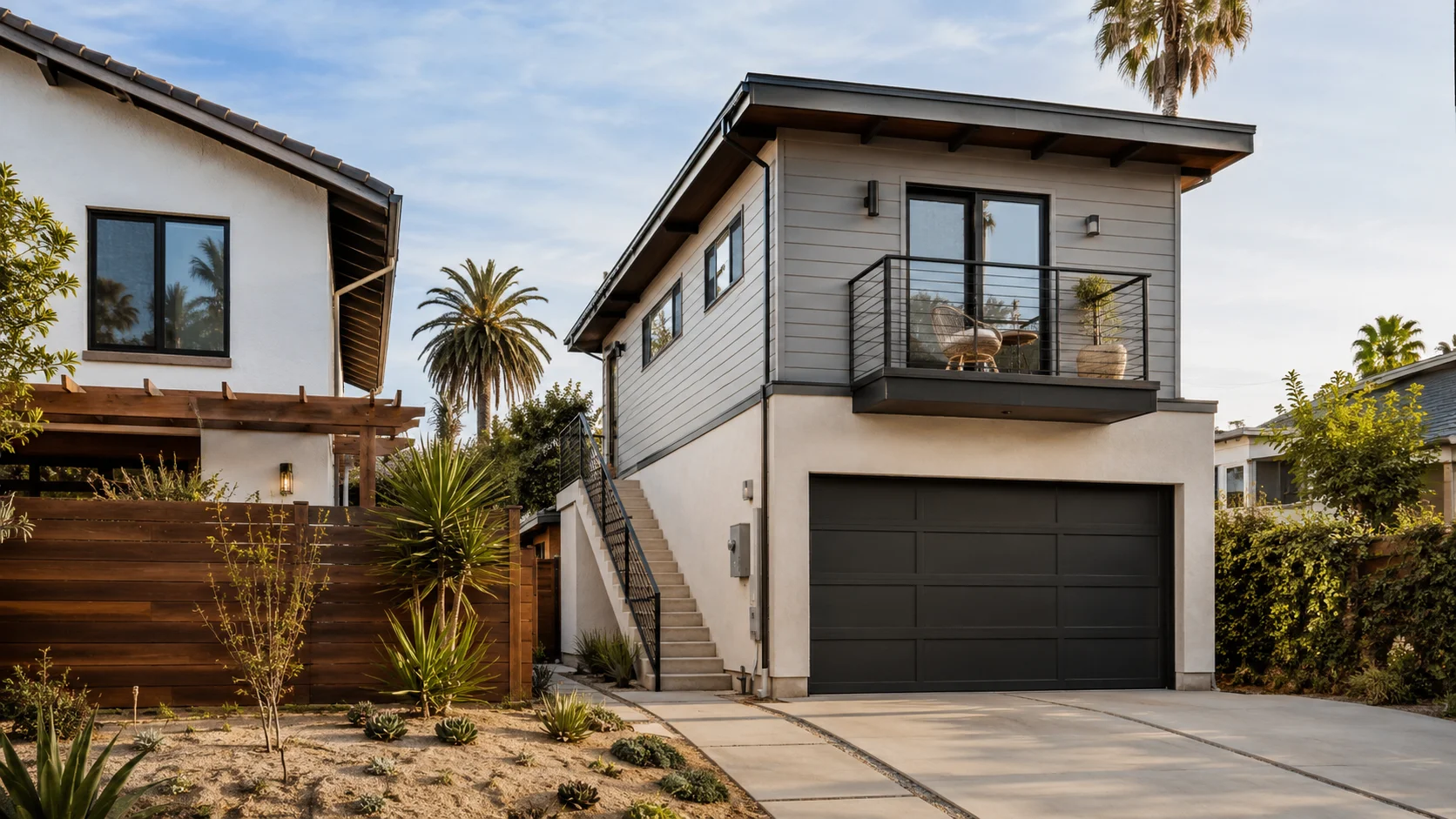
San Diego Above Garage ADU: 2026 Costs, the 500-Square-Foot Fee Cliff, and Whether to Build Above, Rebuild, or Convert
By The Dwelling Index Editorial Team · Last updated May 12, 2026 · Last verified May 12, 2026 · Next scheduled review: August 12, 2026 · Independent editorial — referral relationships disclosed.
The bottom line
A San Diego above garage ADU — sometimes called a carriage house — is legal on most residential lots in the City of San Diego. Real 2026 project costs typically fall between $160,000 and $350,000 to add an ADU on top of an existing detached garage and $350,000 to $550,000+ to demolish the garage and build a new garage with the ADU above it.
The single most expensive design mistake we see San Diego homeowners make has nothing to do with finishes or builders — it's drifting from 499 square feet to 501 square feet without realizing that for a detached ADU, crossing the 500-square-foot threshold can move the City's base plan-check-plus-inspection fee category from approximately $5,741 to approximately $16,487, per City of San Diego Information Bulletin 501 (May 2026). For projects classified as an attached ADU addition or remodel, the same fee table uses a higher 1,100-square-foot threshold instead — meaning the "fee cliff" depends entirely on how Development Services Department (DSD) classifies your project. Combined with SDUSD school fees, the impact can exceed $13,000 before any other fees apply.
The second-most-expensive mistake is paying for architectural plans before a structural engineer has confirmed the existing garage can carry a second story. Older San Diego garages frequently cannot, without reinforcement.
Free 60-second address check. Identifies overlay zones, setback issues, fee triggers, and feasibility flags before you request a quote.
Fast-answer table
| Question | Fast answer | Why it matters |
|---|---|---|
| Is an above-garage ADU legal in the City of San Diego? | Usually yes, when ADU, zoning, setback, height, fire, and building-code requirements are met. | Legal approval is the first filter, not the last. |
| What is the maximum ADU size? | City IB 400 sets the maximum gross floor area for attached or detached ADUs at 1,200 sq ft. | Size drives cost, fees, and feasibility. |
| Does the garage below count toward the 1,200 sq ft cap? | No — per the City's ADU FAQ, the garage below an ADU is not counted toward the ADU's 1,200 sq ft maximum. | Lets you have a full garage and full-sized ADU. |
| Do I need to provide parking? | Usually no outside the Coastal Overlay Zone; specific rules apply inside the Beach Impact Area outside a Transit Priority Area. | Preserves garage parking by default. |
| Can I rent it on Airbnb? | No. San Diego ADUs and JADUs cannot be rented for less than 31 consecutive days. | Plan for long-term rental or family use only. |
| Is solar required? | Newly constructed non-manufactured detached ADUs are subject to California Energy Code solar requirements; panels may be on the ADU or the primary dwelling. | Budget and design item. |
| Typical retrofit cost range (2026)? | $160,000–$350,000 (Streamline Design & Permitting, based on 2024–2025 completed projects). | Real, not theoretical. |
| Typical new-build carriage house cost range (2026)? | $350,000–$550,000+; SnapADU's 498-sq-ft over-garage plan publishes at $299,000 (vertical build + finishes), before plans, permits, and sitework. | Knowing the spread protects you from low-ball quotes. |
| First action? | Run a parcel-level feasibility check, then get a structural preflight before paying for full plans. | Avoids the two most expensive mistakes. |
Sources: City of San Diego Information Bulletin 400 (Jan 2026 revision); Information Bulletin 501 (May 2026 fee schedule); Information Bulletin 146; San Diego Unified School District developer fee schedule (effective May 11, 2026); SnapADU 2026 published plan pricing; Streamline Design & Permitting 2024–2025 published project data. Verified May 12, 2026.
1. Can you build an ADU above a garage in San Diego?
Answer capsule
Yes — the City of San Diego allows ADUs above garages on most residentially zoned lots, per City of San Diego Information Bulletin 400 (January 2026 revision). The City reviews qualifying ADU applications ministerially, meaning no public hearing and no discretionary review. State law requires a completeness determination within 15 business days (SB 543) and approval or denial within 60 days (Government Code §66317). As of the August 22, 2025 City Council reform package, ADUs on single-dwelling-unit lots are limited to a maximum of two stories.
What "above-garage ADU" actually means
An above-garage ADU in San Diego refers to one of three configurations:
- A second story added on top of an existing detached garage. Sometimes called a top-up or carriage-house retrofit. The existing slab and walls become the foundation for the new living unit. Almost always requires structural reinforcement.
- A new-build carriage house. The existing garage is demolished (or there is no existing garage) and a new two-story structure goes up: garage on the ground floor, ADU above. Cleaner engineering, higher absolute cost.
- A second story added above an attached garage. Common with houses whose garage is integrated with the main residence. DSD classification matters here — this configuration is sometimes treated as an attached ADU addition rather than a detached ADU, with different fee thresholds, height rules, and solar treatment.
What stops it
Consistent reasons above-garage projects do not get approved fall into five categories:
- Coastal Overlay Zone restrictions. Additional Coastal Development Permit processing and noticing apply. The 2025 ADU/JADU amendments (Ordinance O-21989) are still not yet approved within the Coastal Zone at the time of publication.
- Very High Fire Hazard Severity Zone (VHFHSZ) constraints. Fire setbacks, defensible-space requirements, and stricter access standards (a four-foot side and rear setback is required in High or Very High Fire Hazard Severity Zones).
- Structural failure of the existing garage. Old foundations, undersized framing, large door openings without adequate shear walls.
- Setback or height conflicts. Particularly on alley-loaded lots where the existing garage already sits at or near the property line.
- HOA or private covenants. Under California Civil Code §4751, an HOA cannot prohibit or unreasonably restrict a state-compliant ADU, but HOAs can still impose reasonable design and height standards that may complicate an above-garage project. Review your CC&Rs before design, and pursue an ADU-protection analysis with counsel if an HOA rule appears to cross into prohibition.
2. What San Diego rules matter most for an above-garage ADU?
Answer capsule
The seven rules that drive almost every above-garage ADU decision in the City of San Diego: size (maximum 1,200 sq ft, with the 500-square-foot threshold creating the fee cliff for detached projects), height (single-family-zone ADUs limited to two stories as of August 2025), setbacks (4 feet side and rear for ADU structures over 16 feet), parking (no parking required outside the Coastal Overlay Zone), Coastal Overlay Zone rules, rental term (minimum 31 consecutive days), and solar.
Size rules
Per City of San Diego Information Bulletin 400 (January 2026 revision):
- Minimum ADU size: 150 square feet.
- Maximum gross floor area for attached or detached ADUs: 1,200 square feet. City IB 400 sets this maximum without applying a 50%-of-primary-dwelling cap.
- The garage below the ADU is not counted toward the ADU's 1,200-sq-ft maximum, per the City's ADU FAQ. It may count toward overall site gross floor area.
Height and two-story rules
The City of San Diego allows two-story ADUs in single-dwelling-unit zones, capped at two stories as of the August 22, 2025 City Council reform package. Detached ADUs more than 16 feet tall must maintain at least a four-foot side and rear setback when adjacent to a residentially used or zoned property.
Multiple San Diego ADU specialists cite a builder-published interpretation that above-garage ADU structures are limited to a maximum structure height of 21 feet for flat-roof designs and 30 feet for sloped-roof designs, citing SDMC §141.0307(f). We have not independently verified the exact current SDMC §141.0307(f) language with City DSD for this publication. Before any roof-pitch or attic-story decision, confirm the current code section directly.
The state-law floor under SB 897 (2022) is independent of the City's interpretation. Detached ADUs anywhere in California must be allowed up to: 16 feet as a baseline; 18 feet within one-half mile of a major transit stop; +2 feet if the ADU's roof pitch matches the primary dwelling; 25 feet for attached ADUs.
Setbacks
- ADUs up to 16 feet in height: No minimum side or rear setback, though Fire Code may require more.
- ADUs greater than 16 feet in height adjacent to residential uses: Minimum 4 feet side and rear setback.
- Alley-loaded lots: Garages must maintain a 6-foot setback from the rear alley right-of-way when the garage takes access from an alley.
- Conversions and rebuilds within the same footprint: The ADU may continue to observe the setbacks of the original structure.
- Exterior staircases, balconies, decks: These exterior features may not encroach and must conform to applicable side and rear setbacks.
Coastal Overlay Zone
Above-garage ADUs in the Coastal Overlay Zone (La Jolla, Pacific Beach, Ocean Beach, Mission Beach, parts of Point Loma, and others) require a Coastal Development Permit (CDP). Per City IB 400, a CDP is required when the project is not completely within the existing primary structure, includes an increase in habitable area, or converts non-habitable space to habitable space. Above-garage ADUs almost always trigger CDP review. A coastal-zone project should add 1 to 3 months to the permit timeline and budget $5,000 to $15,000 in additional CDP-related soft costs.
Why above-garage is the coastal parking workaround
Outside the Coastal Overlay Zone, no replacement parking is required when a garage or carport is converted or demolished for an ADU (California Government Code §§66310–66342; SB 1211, effective January 2025). Inside the Coastal Overlay Zone — specifically the Beach Impact Area of the Parking Impact Overlay Zone (PIOZ), outside a Transit Priority Area — one off-street space can be required for a new detached ADU or a garage-conversion ADU. Because an above-garage build preserves the garage entirely, no parking is removed and no replacement is triggered, which makes the configuration uniquely useful in beach communities (Mission Beach, Pacific Beach, Ocean Beach, La Jolla Shores).
| Question | Above-garage ADU | Garage conversion |
|---|---|---|
| Keeps garage and parking? | Yes | No |
| Beach Impact Area replacement parking required? | Not triggered (parking preserved) | May be required outside a Transit Priority Area |
| Triggers PIOZ analysis in plan check? | Minimal | Yes |
| Fit for coastal lots with scarce on-street parking? | Strong fit | Weak fit |
| Cost impact of the parking question | Minimal | Can add $10,000–$30,000 of site work |
Rental, owner-occupancy, and solar rules
- Rental term: An ADU or JADU cannot be rented for less than 31 consecutive days. Short-term rentals are not permitted for ADUs.
- Solar: Newly constructed non-manufactured detached ADUs are subject to California Energy Code solar requirements. Panels may be on the ADU or the primary dwelling.
- Fire sprinklers: Where the primary dwelling has fire sprinklers, the ADU is typically also required to have them.
- AB 1033 condominium sale: As of August 2025, the City of San Diego adopted AB 1033, allowing ADUs to be subdivided and sold separately from the primary residence. Bonus ADUs are not eligible. Verify current procedures with DSD.
Free 60-second address check. We surface Coastal Overlay Zone, fire-hazard zone, transit proximity, and base-zone constraints before you draft plans.
3. What is the 499 vs. 501 square-foot fee cliff?
Answer capsule
For a detached ADU, City of San Diego IB 501 (May 2026) places a unit up to 500 square feet in a lower base fee category at approximately $5,741 ($3,512.92 plan check + $2,228.29 inspection), and a detached Group R-3 ADU over 500 square feet in a higher category at approximately $16,487 ($8,085.26 plan check + $8,401.90 inspection). For projects DSD classifies as an attached ADU addition or remodel, the fee table uses a 1,100-square-foot threshold instead. The "fee cliff" is real, but the threshold that applies to your project depends on DSD classification.
Two thresholds, not one — the classification fork
This is the single most important rule on the page, and it's the one most San Diego ADU pages get wrong. IB 501 distinguishes ADU work by classification:
| Project classification | IB 501 lower-fee threshold | Lower-category base fee | Higher-category base fee |
|---|---|---|---|
| Detached ADU (new construction, new-build carriage house, ADU above a detached garage classified as detached) | Up to 500 sq ft | ~$5,741 | ~$16,487 (over 500 sq ft) |
| Attached ADU addition or remodel (including JADU) | Up to 1,100 sq ft | ~$5,741 base | Higher category above 1,100 sq ft |
| Conversion within an existing accessory structure | Confirm with DSD | Varies | Varies |
Source: City of San Diego Information Bulletin 501 (May 2026 fee schedule). Confirm DSD's project classification before applying these thresholds to your specific design.
The math, with the right comparison
For a detached ADU classified under the 500-sq-ft fee cliff, the rough comparison between a 499-sq-ft and 501-sq-ft design:
| Cost line | 499-sq-ft detached ADU | 501-sq-ft detached ADU | Delta |
|---|---|---|---|
| City base plan check + inspection (IB 501) | ~$5,741 | ~$16,487 | +$10,746 |
| SDUSD developer fee ($5.38/sq ft × 501 sq ft, if applicable) | $0 (under 500-sq-ft IB 146 exemption) | ~$2,695 | +$2,695 |
| Combined illustrative base-fee impact | ~$5,741 | ~$19,182 | +~$13,441 |
These are base categories from published City and district fee sources. They are not total permit quotes. Other agency fees apply on top. Verified May 12, 2026.
Three practical implications
- 499 square feet is not arbitrary. It's a specific design target that — for projects classified as detached ADUs — keeps your project in the lower City fee category and (for new units) inside the SDUSD school-fee exemption. SnapADU's published one-bedroom over-garage plan is 498 square feet for exactly this reason — published at $299,000 ($270,000 vertical build + $29,000 standard finish materials) before plans, permits, and sitework.
- If you need more than 500 sq ft on a detached project, design for the size that actually serves the use case — not 510 sq ft. Once you've crossed the threshold, you've already paid the step up. A 750-square-foot two-bedroom rents for considerably more than a 525-square-foot one-bedroom in nearly every San Diego neighborhood.
- The 499-square-foot design must be 499 livable square feet. The City and school district care about livable, assessable space — not exterior staircases, decks, or the garage below. Confirm assessable-space measurement with DSD.
The free report flags whether your target size triggers a fee step, which school district your property is in, and which other agency fees apply.
4. What does a San Diego above garage ADU cost in 2026?
Answer capsule
Real all-in costs reconcile across five published builder sources as follows: $160,000 to $350,000 to add an ADU on top of an existing detached garage (Streamline Design & Permitting's 2024–2025 project range); $250,000 to $400,000 for the same retrofit per Better Place Design & Build; and $350,000 to $550,000+ for a new-build carriage house. The vertical-build premium over a comparable single-story detached ADU runs roughly 15% to 25%.
Published builder cost evidence
We pulled real published numbers from five active San Diego ADU specialists. None of these are speculative ranges or quote averages from third-party aggregators.
Disclosure: SnapADU is a referral partner of The Dwelling Index. Our editorial analysis is independent of that relationship. See full disclosure at the top of this page.
| Source | Published range or price | Project scope as described |
|---|---|---|
| SnapADU — 1-bedroom over-garage plan (498 sf) | $299,000 ($270K vertical + $29K finishes) | Vertical build + standard finishes for the 498-sq-ft above-garage unit; plans, permits, and sitework separate or lot-dependent. |
| SnapADU — 2-bedroom carriage house (750 sf) | $389,000 base ($354K vertical + $35K finishes) | Vertical build + standard finishes for the 750-sq-ft above-garage unit; plans, permits, and sitework separate or lot-dependent. |
| Streamline Design & Permitting — above-garage range | $160,000–$350,000 | Above-garage ADU projects in San Diego, based on stated 2024–2025 completed projects. Includes professional services, vertical construction, fire-rated assemblies. |
| Better Place Design & Build — above-existing-garage | $250,000–$400,000 | Range cited for adding an ADU above an existing garage. |
| GreatBuildz — Southern California above-garage range | $200,000–$350,000 | Smaller above-garage ADUs, Southern California-wide. |
The reconciled all-in cost stack
Use this as a planning band, not a quote. Water and sewer capacity charges and other agency fees are determined during City review and may vary by project.
Configuration A — Retrofit: ADU on top of an existing detached 2-car garage (~750 sq ft above)
| Line item | Typical range |
|---|---|
| Foundation reinforcement / load-path upgrade | $35,000–$60,000 |
| Vertical construction ($300–$350/sq ft × 750 sf) | $225,000–$262,500 |
| Structural engineering | $3,000–$8,000 |
| Architectural plans | $8,000–$15,000 |
| Title 24 / energy compliance | $1,500–$2,500 |
| Exterior staircase | $8,000–$15,000 |
| Fire-rated floor / ceiling assembly ($15–$25/sq ft) | $11,250–$18,750 |
| City building permit + plan check (detached Group R-3 over 500 sf) | ~$16,487 base |
| Water and sewer capacity charges | $3,000–$8,000 combined |
| SDUSD school fee (if applicable, at $5.38/sq ft) | ~$4,035 |
| Electrical panel / service upgrade (typical 200A) | $3,000–$5,000 |
| Solar PV system (or compliance via primary dwelling) | $8,000–$15,000 |
| Contingency (10–15%) | $35,000–$55,000 |
| Typical all-in (this configuration) | $220,000–$350,000 |
Configuration B — New-build carriage house: demolish existing garage, build new 2-car garage with 750-sq-ft ADU above
| Line item | Typical range |
|---|---|
| Demolition of existing garage | $8,000–$15,000 |
| New garage foundation + slab | $25,000–$45,000 |
| Vertical construction (~$375–$425/sq ft × ~1,400 gross sf incl. garage) | $300,000–$425,000 |
| Structural engineering | $5,000–$12,000 |
| Architectural plans | $10,000–$18,000 |
| Title 24 / energy compliance | $1,500–$2,500 |
| Exterior staircase | $8,000–$15,000 |
| Fire-rated floor / ceiling assembly ($15–$25/sq ft × 750 sf) | $11,250–$18,750 |
| City building permit + plan check (detached Group R-3 over 500 sf) | ~$16,487 base |
| Water and sewer capacity charges | $3,000–$8,000 combined |
| SDUSD school fee (if applicable, at $5.38/sq ft) | ~$4,035 |
| Electrical panel / service upgrade | $3,000–$5,000 |
| Solar PV system | $8,000–$15,000 |
| Contingency (10–15%) | $50,000–$80,000 |
| Typical all-in (this configuration) | $425,000–$550,000+ |
Why above-garage costs more per square foot than detached
A standalone 750-square-foot single-story detached ADU on a flat City of San Diego inland lot typically prices at $275,000 to $345,000 all-in (per our reconciliation on the San Diego Detached ADU Cost page). The same 750 square feet above an existing or new garage runs $220,000 to $550,000 depending on configuration — the comparable size above a garage almost always runs 15% to 25% more than the detached equivalent.
The premium comes from real engineering and labor cost, not builder markup: foundation reinforcement, structural engineering for vertical loads and seismic, an exterior staircase, fire-rated separation between the garage and the unit above, scaffolding for work at height, larger air handling units, and more complex utility routing.
What quotes typically exclude (the comparison checklist)
A 2026 San Diego above-garage quote that comes in low is almost always missing line items. Use this checklist to compare bids:
- Site plan and survey
- Architectural design and construction documents
- Structural engineering
- Title 24 energy compliance
- City permit and plan check fees
- School district fees
- Water and sewer capacity charges
- Electrical service or panel upgrade
- Solar PV system
- Fire sprinklers (where required)
- Driveway or curb work
- Coastal Development Permit (where applicable)
- Demolition of existing garage
- Foundation reinforcement
- Exterior staircase and landing
- Standard vs. upgraded finish allowances
- Appliances (range, refrigerator, washer/dryer)
- Landscaping and hardscape repair
- Project management and warranty
- Contingency line
The hidden costs that turn a $250K project into a $400K project
These are the line items that most low-ball above-garage quotes leave out — each one is a documented cost driver, not a contingency:
- A bathroom directly above the open garage bay adds roughly 30% to plumbing cost versus placing it above a side wall. Streamline Design & Permitting's project data attributes the premium to the long vertical drain drop through the garage ceiling, added floor reinforcement around the drain, longer vent runs, and a soffit or exposed plumbing chase — easily $5,000 to $10,000 on a single bathroom.
- Interior stairs cost $15,000 to $25,000 more than exterior stairs. Exterior stairs need $3,000 to $5,000 of weatherproofing, lighting, privacy screening, and (in fire zones) ignition-resistant materials, but they free up 60 to 80 square feet of upstairs floor area and create cleaner tenant separation.
- Temporary parking and storage during construction: the garage is unusable for 4 to 6 months on a retrofit. Budget $200 to $500 per month.
- Existing-garage demolition if footings fail inspection: $10,000 to $25,000 to demolish, which converts a retrofit into a rebuild mid-project.
- Asbestos or lead-paint abatement on pre-1978 garages: $5,000 to $15,000 if the material is disturbed.
- Story poles before permit submittal: $1,500 to $3,000 to install temporary frames showing actual height and massing. Not a code requirement, but they defuse neighbor opposition on two-story projects.
- Constructible access: a garage at the back of a deep lot reachable only by a narrow side gate can add $10,000 to $25,000 because materials get hand-carried instead of craned. Tight alleys, low tree canopies, and side yards under 8 feet wide are the red flags.
- Construction-cost inflation: the California Construction Cost Index (CCCI) rose roughly 44% from January 2021 to December 2025, so budget assumptions carried over from older quotes are no longer accurate.
Sources: Streamline Design & Permitting 2024–2025 project data; California Construction Cost Index (Jan 2021–Dec 2025). Verified May 12, 2026.
Where to put the bathroom and stairs — the two design decisions that move the budget most
Bathroom placement. Best practice is to place the bathroom along the side wall of the upper floor, aligned with the side wall of the garage below, so the plumbing stack drops through the garage wall and ties into the main house with a short horizontal run. Avoid a bathroom in the middle of the upper floor directly above the open garage bay — that forces the ~30% plumbing premium above.
Stair configuration. Most San Diego carriage houses are designed with exterior stairs along a side or rear elevation: the $15,000 to $25,000 savings and the recovered upstairs floor area usually outweigh the weatherproofing cost, and the climate cooperates with outdoor stair use. Reserve interior stairs for designs where weather protection or architectural unity matters more than cost — but remember that any stair, landing, deck, or balcony that extends beyond the original garage footprint must meet current setbacks, and stair encroachment is one of the most common reasons an above-garage concept fails plan check.
Disclosure: SnapADU is a referral partner of The Dwelling Index. See full disclosure at the top of this page.
If you want a published fixed-price option from a Greater San Diego carriage-house specialist, SnapADU is the most transparent option on the City of San Diego market. Their published plan-by-plan pricing for the 1-bedroom (498 sq ft) and 2-bedroom (750 sq ft) carriage houses gives you a clean baseline to compare other quotes against.
Useful if you want to see real published plan pricing from a San Diego carriage-house specialist before you request a quote.
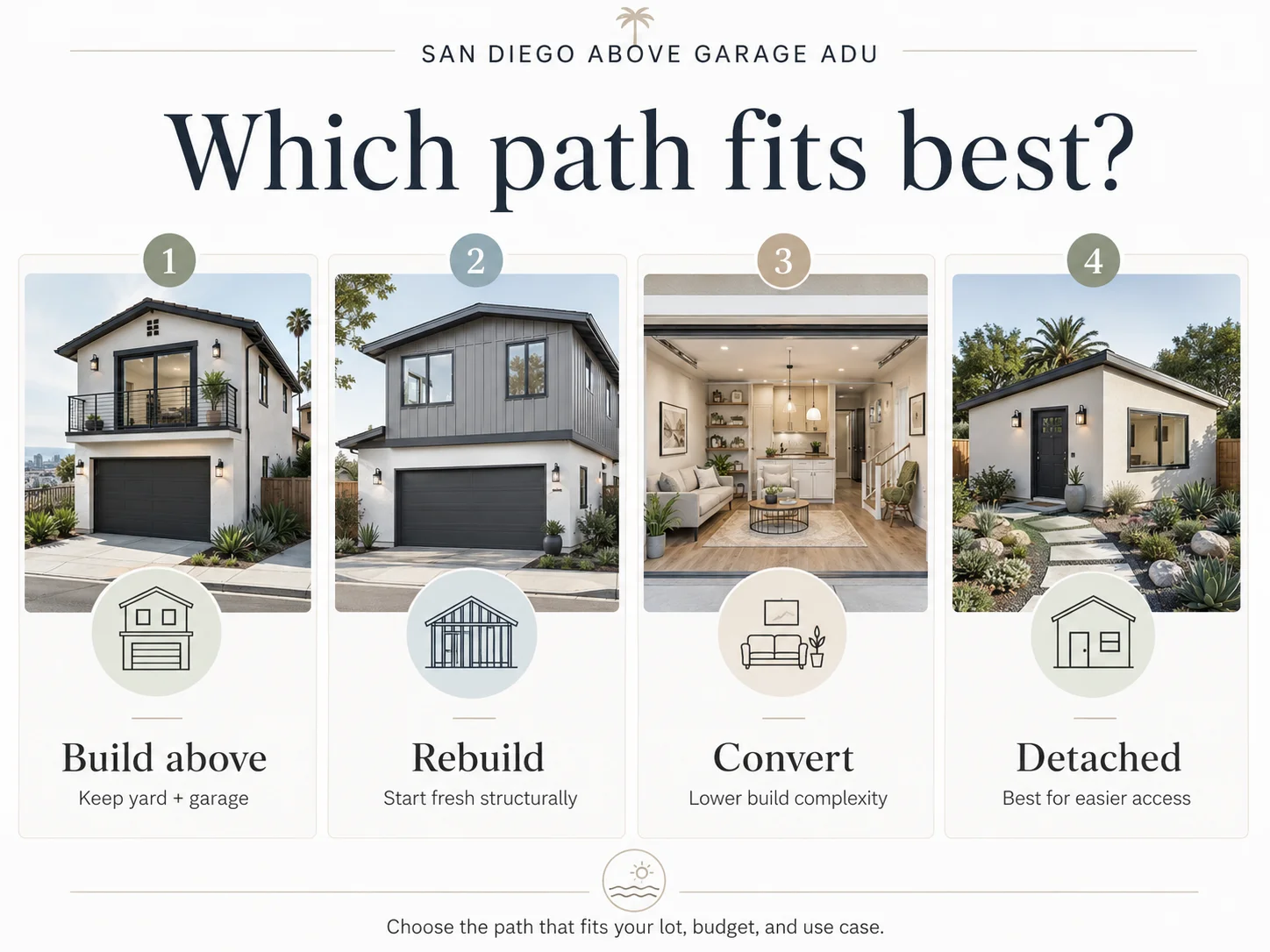
5. Should you build above, rebuild, convert, or build detached?
Answer capsule
Build above the existing garage when the structure is sound, your goal is to preserve yard and parking, and the lot is alley-loaded or otherwise constrained. Demolish and rebuild when the existing garage is older, the foundation is slab-only, or you want full design flexibility. Convert the garage at ground level when accessibility, cost, and speed matter and you don't need to keep the garage parking. Build a detached ADU elsewhere when yard space allows or when you want a single-story for aging-in-place.
Decision matrix
| Reader situation | Best first path | Why |
|---|---|---|
| “I need to keep my garage and yard.” | Above-garage ADU (retrofit or rebuild) | The only option that preserves both. |
| “My garage is older and the foundation looks rough.” | New-build carriage house | Retrofit math rarely beats a clean rebuild on aging structures. |
| “This is for an aging parent or someone with mobility limits.” | Ground-level detached ADU | An exterior staircase to a second-floor unit is a usability dealbreaker for many aging-in-place scenarios. |
| “I want the cheapest legal unit.” | Garage conversion or JADU | Lowest vertical-construction cost; least structural complexity. |
| “I'm in the Coastal Overlay Zone.” | Feasibility check before any path | Parking and CDP rules can flip the answer. |
| “I want to stay under 500 sf to save fees on a detached project.” | 498-sq-ft above-garage 1BR | Stays below the detached fee cliff. |
| “I want maximum rent.” | 750–1,000 sf above-garage 2BR | Crosses the fee cliff but rent supports the math. |
| “I'm comparing budget to a full rebuild.” | Get both numbers from the same builder | Many San Diego firms quote both paths on the same property. |
Option 1 — Build above existing garage (retrofit)
Best for: Lots with a structurally sound existing garage, continuous-footing foundation. Alley-loaded lots. Homeowners whose yard is small.
Typical cost: $160,000 to $350,000 all-in for 500 to 750 sq ft.
Avoid if: The existing garage has a slab-only foundation or visible structural distress. Accessibility is a primary use case.
Option 2 — Demolish and rebuild as new-build carriage house
Best for: Older garages, slab-only foundations, garages with large door openings. Properties where you want full envelope flexibility.
Typical cost: $350,000 to $550,000+ all-in for a new garage plus 500 to 1,200 sq ft above.
Avoid if: Your existing garage is recent and structurally sound and your budget is tight.
Option 3 — Garage conversion (ground-floor ADU)
Best for: Homeowners willing to give up the garage entirely. Tight budgets and short timelines. Ground-level accessibility needs.
Typical cost: $80,000 to $200,000 all-in for a 350 to 500 sq ft conversion.
Avoid if: Coastal Overlay Zone Beach Impact Area and outside Transit Priority Area. You actively need the garage for parking or storage.
Option 4 — Detached ADU elsewhere on the lot
Best for: Yard space exists. Aging-in-place use case. Multi-generational housing where a separate ground-level unit is more functional.
Typical cost: $275,000 to $500,000 all-in for 500 to 1,200 sq ft of detached new construction.
Avoid if: Yard is small or rear setback would prevent a detached structure of the size you need.
This is the decision-resolution moment. Run the address check before you call builders — it surfaces the constraints that determine which of these four paths fits your property.
6. What if you're outside the City of San Diego?
Answer capsule
This guide is written for the City of San Diego specifically. Other cities in Greater San Diego have their own ADU rules, fee schedules, and above-garage allowances that differ in meaningful ways. Before you commit to an above-garage design in any city outside the City of San Diego, verify the table below against that jurisdiction's current ADU bulletin or municipal code directly.
| Jurisdiction | Above-Garage Allowed? | Max Height | Setback at >16 ft |
|---|---|---|---|
| City of San Diego | Yes | 21' flat / 30' sloped (builder-published; confirm with DSD) | 4' side & rear adjacent to residential |
| County of San Diego (unincorporated) | Yes | 24' | 4' side & rear; +fire setbacks in VHFHSZ |
| Carlsbad | Yes | Per zone + underlying setbacks | Per zone |
| Chula Vista | Restrictive | State 18'+2' only (transit / multifamily) | Per state law |
| Del Mar | Restrictive | State 18'+2' only | Per state law |
| El Cajon | Yes | Per zone | Per zone |
| Encinitas | Yes | Per primary residence's height limit | Per zone |
| Escondido | Yes | Per zone | Per zone |
| Imperial Beach | Above-garage yes; two-story restrictive | Per zone | Per zone |
| La Mesa | Yes | Per zone (measured to plate height) | Per zone |
| Lemon Grove | Yes | Per zone | Per zone |
| National City | Yes | Per zone | Per zone |
| Oceanside | Yes | Per zone | Per zone |
| Poway | Yes only if no taller than the SFR | Per primary residence | Per zone |
| San Marcos | Yes (with setbacks) | State 18'+2' for two-story | Per zone |
| Santee | State 18'+2' only | 18'+2' max | Per state law |
| Solana Beach | State 18'+2' only | 18'+2' max | Per state law |
| Vista | Yes if setbacks met | State 18'+2' for two-story | Per zone |
Sources: SnapADU two-story ADU regulations summary (verified May 2026); City of San Diego Information Bulletin 400 (Jan 2026); County of San Diego PDS-611. Pull each jurisdiction's current ADU bulletin before relying on the row for a specific design.
For city-specific builder fits, our existing city guides cover Carlsbad, Chula Vista, Del Mar, El Cajon, Encinitas, Escondido, Imperial Beach, La Mesa, Lemon Grove, National City, Oceanside, Poway, San Marcos, Santee, Solana Beach, and Vista.
7. Can your existing garage actually support a second story?
Answer capsule
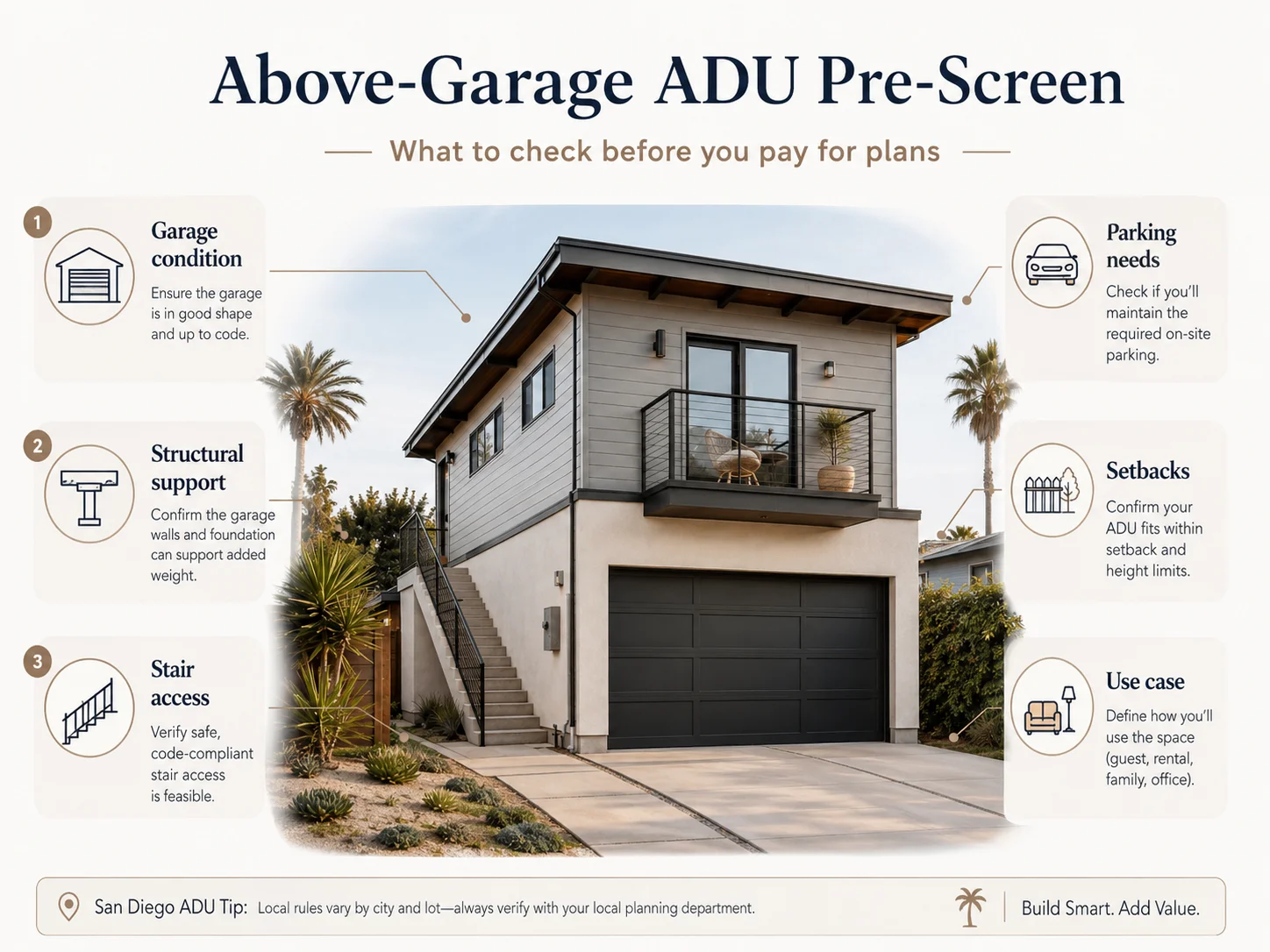
Older San Diego garages often require structural reinforcement before they can carry a second story. A structural preflight inspection ($3,000 to $8,000) should be treated as non-negotiable before you commission full architectural plans on an above-garage retrofit. City permit submittals require structural plans, structural calculations, and truss calculations as applicable.
The six-question pre-screen
Walk through these questions about your existing garage. This pre-screen is not a substitute for an engineer's review — it is a planning shortcut to tell you which direction to expect before you spend money.
What the combinations mean
Post-2010 garage, continuous footing, 2x6 stud walls, single-story flat roof, 4-foot or greater setback. You still need structural engineering and foundation work, but the existing structure is a real asset.
1980–2010 garage, continuous footing, 2x4 walls, pitched roof. Run both numbers from your builder. The retrofit may save $50,000 to $100,000, or it may not — the answer depends on details a structural engineer must verify.
Pre-1980 garage, slab-only foundation, or any combination of unknown structural conditions. Get a quote on a new-build carriage house. The retrofit math rarely comes out ahead in this scenario.
Special case — existing unpermitted apartment above garage
California's AB 2533 (passed 2024) provides a streamlined permit path for unpermitted ADUs built before January 1, 2020. The City cannot deny a permit solely because the unit was previously unpermitted, unless correction is necessary to address a substandard condition. If your property has an existing illegal unit above the garage, the AB 2533 path may let you legalize it as an ADU at lower cost. Verify eligibility through the City's Information Bulletin 242.
Our free address-level check identifies overlay zones, setback constraints, and feasibility flags. For the structural-engineer step, ask your shortlist builders for their licensed engineer's contact.
8. How does the City of San Diego permit process work for an above-garage ADU?
Answer capsule
A City of San Diego above-garage ADU is reviewed ministerially — no public hearing, no discretionary review. State law requires a completeness determination within 15 business days (SB 543) and approval or denial within 60 days (Government Code §66317). In practice, total permit time runs 3 to 6 months from a complete submittal, with coastal-zone projects adding 1 to 3 months.
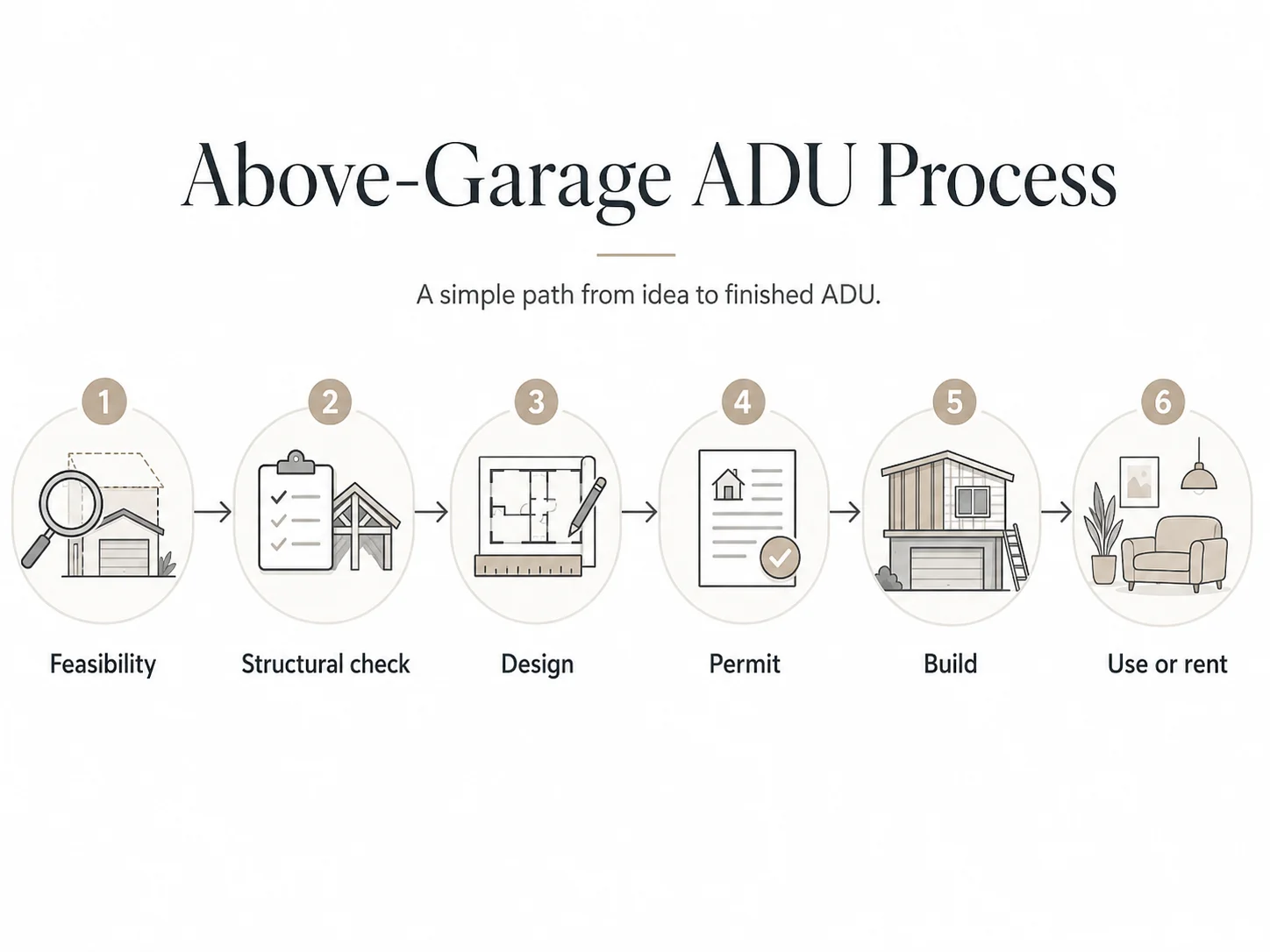
The five phases
Minimum permit submittal items
- Site plan and vicinity plan
- Floor plans and roof plans
- Exterior elevations and building sections
- Structural plans and calculations
- Truss calculations (where applicable)
- Title 24 energy compliance documentation
- Required City forms and disclosures
- Photographs of the existing garage (retrofit)
- Demolition plan (rebuild projects)
- Coastal Development Permit docs (coastal zone)
- Fire department review docs (VHFHSZ)
- Assessor Building Record + photographic survey (buildings over 45 years old)
Pre-approved plans (AB 1332)
The City of San Diego maintains a library of pre-approved ADU plans designed to expedite review. Per AB 1332 (effective 2025), pre-approved plan applications are subject to a 30-day review window. Pre-approved status removes some plan-review work but does not exempt the project from site-specific structural engineering, Title 24, or utility-upgrade plans. Our San Diego Pre-Approved ADU Plans guide breaks down which libraries are currently accepted by the City.
Realistic end-to-end timeline
9. How much rental income and ROI can a San Diego above-garage ADU produce?
Answer capsule
In 2026, a 1-bedroom above-garage ADU in a typical City of San Diego inland neighborhood rents in the range of $2,400 to $3,300 per month; a 2-bedroom carriage house typically rents from $2,800 to $3,900. At a $325,000 all-in retrofit cost and $3,000 per month gross rent, gross yield runs roughly 11% per year; netted for property tax, insurance, maintenance, vacancy, and management, real cash-on-cash typically lands at 5% to 9%. San Diego ADUs cannot be rented for less than 31 consecutive days — the financial model must assume long-term tenancy.
These rental and ROI figures are illustrative examples, not guarantees of returns. Actual results depend on local market conditions, construction costs, financing terms, tax treatment, vacancy, operating expenses, and regulatory approvals.
Rent benchmarks by configuration
| Configuration | Monthly rent — City of SD inland | Monthly rent — coastal-adjacent / premium |
|---|---|---|
| Studio above garage (350–450 sf) | $1,900–$2,400 | $2,300–$2,900 |
| 1BR above garage (499–600 sf) | $2,400–$3,000 | $2,800–$3,500 |
| 1BR above garage (650–750 sf) | $2,600–$3,300 | $3,000–$3,800 |
| 2BR above garage (750–1,000 sf) | $2,800–$3,500 | $3,300–$4,200 |
| 2BR carriage house (1,000–1,200 sf) | $3,200–$3,900 | $3,700–$4,800 |
Methodology: Reconciled from RentCafe San Diego (April 2026), Rentometer Q1 2026 1BR/2BR comps at ADU-typical sizes by ZIP, and SnapADU March 2026 ZIP-level rent tables. Premium tier reflects Pacific Beach, North Park, Hillcrest, La Jolla–adjacent, and Encinitas-adjacent neighborhoods. Run address-specific comps before underwriting.
Worked ROI example
Configuration: 750-sq-ft 2-bedroom above-garage retrofit in a typical inland City of San Diego neighborhood.
| Item | Amount |
|---|---|
| All-in project cost | $325,000 |
| Monthly rent (mid-range) | $3,000 |
| Gross annual rent | $36,000 |
| Vacancy (5%) | –$1,800 |
| Property management (8%, optional) | –$2,736 |
| Insurance (estimated) | –$1,200 |
| Maintenance/reserves (5% of rent) | –$1,800 |
| Property tax reassessment on added value (illustrative; verify with County Assessor) | –$3,250 |
| Net operating income | ~$25,214 |
| Cash-on-cash yield (unleveraged) | ~7.8% |
This is unleveraged. Once you add the financing layer, the cash-on-cash math changes based on interest rate and loan structure. Always run your own scenario against current loan terms.
Short-term rental — not on the table
The City of San Diego ADU and JADU rules prohibit rental terms shorter than 31 consecutive days. The City does not issue short-term rental licenses for accessory dwelling units. If your underwriting assumes Airbnb, vacation rental, or sub-30-day stays, the math is illegal under City rules. Build the financial model around long-term tenancy or family use.
The above-garage ADUs that perform best on rent are designed with tenants in mind from day one: separate entrance, in-unit washer/dryer, full kitchen, private outdoor space if possible, and durable finishes. Many of our readers use Buildium to systematize property management once the unit is rented — useful even for one-unit landlords because it standardizes lease, application, screening, rent collection, and maintenance workflows.
Disclosure: Buildium is a referral partner of The Dwelling Index. See full disclosure at the top of this page.
10. How do San Diego homeowners actually pay for an above-garage ADU?
Answer capsule
The four most common financing paths for a $200,000 to $550,000 above-garage ADU are home equity (HELOC or fixed home equity loan), cash-out refinance, construction-to-permanent loan, and a renovation-focused HELOC. The San Diego Housing Commission's ADU Finance Program offers construction-to-permanent loans up to $250,000 plus free technical assistance for income-qualified City of San Diego homeowners, with a 7-year affordability commitment on the ADU rent. We are an independent research resource — not a lender, broker, or financial advisor.
Financing paths, not lender rankings
Lane 1 — Home equity (HELOC or fixed second)
Best when the borrower has substantial equity in the primary home and current first mortgage is at a favorable rate. A HELOC offers draw flexibility for staged construction payments. A fixed home equity loan locks in a rate for the full project amount. Both leave the first mortgage untouched.
Lane 2 — Cash-out refinance
Best when current first mortgage is at a rate that does not need protecting, or when the borrower wants to consolidate the ADU project and primary mortgage into a single payment. Mortgage Research Center is one neutral starting point for cash-out refinance education and lender comparison.
Disclosure: Mortgage Research Center is a referral partner of The Dwelling Index. We do not rank lenders by payout, and we do not quote specific rates, APRs, or payment amounts as guarantees. See full disclosure at the top of this page.
Lane 3 — Construction-to-permanent loan
Originated as a construction loan that converts to a permanent mortgage upon completion. Best for higher-cost projects where the borrower doesn't have enough equity for a HELOC. Requires more documentation (build budget, contractor agreement, draw schedule).
Lane 4 — Renovation HELOC or specialty ADU loan
Renovation HELOCs underwrite to the projected after-renovation value rather than current home value. Useful when the existing home value won't support the project on its own. RenoFi is one renovation-focused HELOC provider available in California. Verify current availability and terms directly with the provider.
San Diego Housing Commission ADU Finance Program
| Term | SDHC ADU Finance Program (as published) |
|---|---|
| Geographic eligibility | City of San Diego only |
| Property type | Detached single-family residence |
| Owner occupancy | Main home must be owner-occupied |
| Income eligibility | Moderate-income; published cap up to $236,600 |
| Minimum credit score | 680 |
| Application fee | $2,500, due after approval at closing |
| Loan structure | Construction-to-permanent |
| Maximum loan amount | $250,000 per ADU |
| Affordability requirement | ADU rent must remain affordable for 7 years |
| Rental restrictions | No renting to a family member during the 7-year affordability period |
| ADUs funded per property | One |
| Technical assistance | Free, included |
Program funding levels, current availability, and program details change. Verify current eligibility and capacity directly with SDHC at adu@sdhc.org or via their ADU program page before relying on the program for budgeting purposes.
The financing-options page walks through each lane with current 2026 terms and questions to ask any lender. No application, no obligation.
11. What are the seven most common above-garage ADU mistakes?
Answer capsule
The seven most expensive above-garage ADU mistakes: (1) paying for plans before structural feasibility; (2) misreading the 500 vs. 1,100 fee threshold; (3) assuming pre-approved plans skip site review; (4) ignoring Coastal Overlay Zone constraints; (5) underwriting around short-term rental income; (6) comparing builder quotes without aligning exclusion lists; (7) skipping the contingency line. Each of these can add $15,000 to $80,000 to a project that was supposed to be priced.
Homeowners get architectural drawings ($10,000 to $18,000) showing a beautiful 2-bedroom unit above their detached garage, then discover during structural engineering that the existing foundation cannot carry the design. The plans are usually not salvageable as drawn.
The fix: Pay a structural engineer for a preflight inspection ($3,000 to $8,000) before commissioning full architectural drawings.
The 500-square-foot fee cliff applies to detached ADU projects. For projects DSD classifies as an attached ADU addition or remodel, the IB 501 threshold for the lower fee category is 1,100 square feet. We see two versions: (a) a homeowner over an attached garage builds tiny when they could have gone larger; (b) a homeowner over a detached garage drifts to 510 sf and absorbs ~$10,700 in additional base fees.
The fix: Confirm DSD's project classification before sizing the design. Ask explicitly: "Is this work classified as a detached ADU or as an attached ADU addition for IB 501 fee purposes?"
Pre-approved plans accelerate plan check by removing the architectural plan-review portion. They do not exempt the project from site-specific structural engineering, Title 24, utility connection plans, or overlay-zone reviews. On an above-garage project, the pre-approved plan does not eliminate the structural engineering for connection to the existing garage.
The fix: Treat the pre-approved plan as a head start on architectural review, not as a complete permit package. Expect to spend $5,000 to $15,000 on site-specific documents even with a pre-approved plan.
A Coastal Development Permit (CDP) adds noticing, review time, and cost. Above-garage projects in the Coastal Zone almost always trigger a CDP because the project includes new habitable area outside the existing primary structure.
The fix: Check the Coastal Overlay Zone first using the City's ZAPP portal. If your property is coastal, add 1 to 3 months to the timeline and budget another $5,000 to $15,000 in CDP-related soft costs.
San Diego's ADU rules prohibit rental terms under 31 consecutive days. If your project's pro forma assumes nightly or weekly Airbnb income, the underwriting is illegal under City rules — and the City does enforce.
The fix: Build the model around long-term tenancy. The 2026 long-term rent ranges in Section 9 are realistic and supportable.
Builder A quotes $295,000 for a 750-square-foot above-garage retrofit. Builder B quotes $385,000 for what looks like the same scope. Builder A may exclude plans, structural engineering, permits, school fees, solar, electrical panel upgrade, and demolition. Builder B may include all of those. Apples-to-apples, Builder B may be cheaper.
The fix: Ask each builder to confirm in writing whether every line item in the Section 4 checklist is included or excluded. Reconcile the totals only after the inclusions match.
A $325,000 retrofit budget that does not have a $35,000 to $50,000 contingency line is not a $325,000 budget. Above-garage projects have more unknowns than single-story detached ADUs: existing foundation conditions, existing framing conditions, hidden utility routing, structural surprises during demolition.
The fix: Add 10% to 15% contingency to every budget. Treat it as committed funds. If the project comes in clean, you keep the contingency.
Damaging admission, stated plainly: Above-garage ADUs in San Diego are not the cheapest path to a new dwelling unit on your property. A garage conversion is usually cheaper. A small detached single-story is sometimes cheaper. What above-garage projects do is preserve parking, preserve yard, and produce a high-quality rentable second-floor unit with strong aesthetic character — at a cost premium of 15% to 25% over the single-story-detached alternative. If you conclude that a detached ADU or a garage conversion fits your property better, that is a successful outcome. The San Diego Detached ADU Cost guide walks the alternative path in detail.
12. What should you do in the next seven days?
Answer capsule
Do not start with a contractor quote. Start with a parcel-level feasibility check, choose a target size intentionally (after confirming DSD classification), confirm overlay constraints, get a structural preflight, and only then compare build paths and request quotes. Seven days is a realistic window for the pre-design work that determines whether your project will pencil.
| Day | Task | Why |
|---|---|---|
| Day 1 | Confirm jurisdiction (City of San Diego vs. unincorporated County vs. another city). Pull your property's parcel summary report. | Rules differ by jurisdiction; verify before you spend. |
| Day 2 | Check overlays: Coastal Overlay Zone, Beach Impact Area, Transit Priority Area, VHFHSZ, Brush Management Zone, historic district. The City's ZAPP portal handles this. | Overlays change permit timeline and fees. |
| Day 3 | Measure existing garage. Photograph foundation, walls, framing where visible, roof, doors, and surrounding property. | Engineer and builder will both need these photos. |
| Day 4 | Decide target ADU size and 499-vs-501 strategy after confirming DSD classification. Sketch a one-paragraph use case (who lives there, what they need). | Forces clarity before money is spent. |
| Day 5 | Run our free property feasibility check. Flag any feasibility concerns surfaced by the report. | Catches issues before they cost you. |
| Day 6 | Contact a licensed structural engineer for a preflight inspection on the existing garage. Quote: $3,000–$8,000. Schedule for the following week. | The single most important pre-design step. |
| Day 7 | Request fixed-price plan information from two or three San Diego carriage-house specialists. Compare against the checklist in Section 4. | At this point you have enough data to make a real comparison. |
13. Frequently asked questions
Can you build an ADU over an attached garage in San Diego?▾
Does the 500-square-foot fee cliff apply if my ADU is above an attached garage?▾
How tall can an above-garage ADU be in the City of San Diego?▾
Does the garage below count toward the 1,200-square-foot ADU limit?▾
Is a 499-square-foot ADU better than a 501-square-foot ADU?▾
Do I need to provide parking for an above-garage ADU?▾
Can I convert the garage instead of building above it?▾
Can I rent my above-garage ADU as an Airbnb?▾
Do above-garage ADUs need solar panels?▾
Do I need fire sprinklers in an above-garage ADU?▾
Can I sell my above-garage ADU as a condominium under AB 1033?▾
How long does it take to permit a two-story ADU in San Diego?▾
What is the difference between a carriage house and a stacked ADU?▾
Does my above-garage ADU need its own electrical meter?▾
What happens if my existing garage is unpermitted?▾
Can I have both an above-garage ADU and a JADU in the main house?▾
What we verified on May 12, 2026
- City of San Diego ADU and JADU rules in Information Bulletin 400 (January 2026 revision), accessed via sandiego.gov.
- City of San Diego permit fee categories and base amounts in Information Bulletin 501 (May 2026 fee schedule), including the detached-ADU 500-sq-ft threshold and the attached-ADU/JADU 1,100-sq-ft threshold.
- School fee exemption rules in City Information Bulletin 146.
- Current San Diego Unified School District residential developer fee of $5.38 per square foot effective May 11, 2026, per the SDUSD developer-fee page.
- California state ADU laws: SB 897, AB 68, AB 881, AB 1033, AB 1154, AB 462, AB 1332, AB 2533, SB 543, SB 1211, SB 9 — verified via leginfo.legislature.ca.gov.
- August 22, 2025 City of San Diego ADU reform package, including the two-story cap and AB 1033 adoption.
- Coastal Overlay Zone certification status: Housing Action Package 1.0 (O-21439) certified September 2024; Housing Action Package 2.0 (O-21758) effective in Coastal March 11, 2026; 2025 ADU/JADU amendments (O-21989) not yet approved in Coastal at the time of publication.
- SnapADU 2026 published carriage-house plan pricing ($299,000 for the 498-sq-ft 1BR plan; $389,000 base for the 750-sq-ft 2BR plan) via snapadu.com, verified May 2026.
- Streamline Design & Permitting 2024–2025 above-garage project range ($160,000–$350,000) via streamlinedesigngroup.com, verified May 2026.
- Better Place Design & Build above-existing-garage range ($250,000–$400,000) via betterplacedesignbuild.com, verified May 2026.
- GreatBuildz Southern California above-garage range ($200,000–$350,000) via greatbuildz.com, verified May 2026.
- Rental rate benchmarks reconciled from RentCafe San Diego (April 2026), Rentometer Q1 2026 1BR/2BR comps at ADU-typical sizes by ZIP, and SnapADU March 2026 ZIP-level rent tables.
- San Diego Housing Commission ADU Finance Program details (construction-to-permanent loans up to $250,000; 7-year affordability requirement; $236,600 income cap; 680 credit minimum; $2,500 application fee) via sdhc.org, verified May 2026.
Items relying on builder summaries rather than primary verification
- The 21-foot flat / 30-foot sloped above-garage height interpretation cited to SDMC §141.0307(f) — currently sourced to SnapADU's San Diego regulations page and Better Place Design & Build's San Diego ADU regulations page.
- The Greater San Diego jurisdiction table rows for cities other than the City of San Diego and the County of San Diego — currently sourced to SnapADU's two-story ADU regulations summary.
Methodology
The Dwelling Index is an independent research resource covering ADU financing, costs, and regulations. This guide was built by reconciling official rules from City of San Diego Development Services Department publications, fee schedules from City Information Bulletins 400, 501, and 146, school fees from San Diego Unified School District publications, cost data from five active San Diego ADU design-build firms, rental benchmarks reconciled from RentCafe and Rentometer with SnapADU ZIP-level rent tables, and voice-of-customer research from public homeowner discussion forums.
We separate three categories of claim throughout the page:
- Verified facts. Codes, ordinances, fee schedules, and published builder pricing — sourced inline and dated in the "What we verified" box above.
- Reconciled planning bands. Cost and rent ranges that combine multiple published sources into editorial central tendencies. These are planning estimates, not bids.
- Editorial recommendations. Where to start, what to ask, how to compare — based on the verified facts and the reconciled ranges. Framed as judgments, not guarantees.
Our editorial recommendations are independent of any affiliate or referral relationship. SnapADU, Mortgage Research Center, and Buildium are referral partners disclosed at the top of this page and inline at each relevant section. Affiliate commissions are paid only on conversions through tracked links, and they do not influence which partners we recommend in our editorial content.
Where rules are amended between our reviews — and San Diego ADU rules have been amended substantially in 2024 and 2025 — we update the page on our quarterly review cycle (next scheduled review: August 12, 2026). For real-time confirmation of any specific permit, fee, or code reference, contact City of San Diego DSD directly or check the City's current Information Bulletins.
Final next steps
Free 60-second address check. See what's possible at your address before you call any builders.
See published fixed-price plan pricing from a Greater San Diego carriage-house specialist who builds above-garage ADUs as part of their core product line.
Printable bid-comparison worksheet, financing-path decision tree, and the questions to ask any San Diego ADU contractor.