
Imperial Beach ADU Laws (2026): Coastal Permits, Real Fees, and What You Can Actually Build
By the Dwelling Index Editorial Team
Last updated: May 15, 2026 · Last verified: May 15, 2026
Imperial Beach ADU laws in 2026 permit detached ADUs up to 1,200 square feet on virtually any residential lot, with 4-foot side and rear setbacks and a 16-foot base height limit (18 feet near transit). The catch: approximately 87 percent of Imperial Beach sits inside the California Coastal Zone, so most homeowners will need an Administrative Coastal Development Permit before the building permit. The City’s Coastal Trigger Handout dated April 15, 2026 lists that fee at $1,050. The City’s separate CDP Submittal Checklist lists it at $1,000. Most non-official websites still quote $600 — stale. Under AB 462, signed October 10, 2025, the City must approve or deny that Coastal Permit within 60 days of receiving a completed application, and Coastal Commission appeals for local ADU permit decisions are barred under Gov. Code §66329(a)–(c). ADUs of 750 square feet or less are protected from development impact fees under state law.
Applies to: Imperial Beach homeowners and small multifamily owners considering a new detached ADU, attached ADU, conversion ADU, Junior ADU (JADU), or garage conversion. Primary sources: City of Imperial Beach Accessory Dwelling Units page; Coastal Permit Trigger Handout (last updated 04/15/2026); CDP Submittal Checklist; Building Permit and Development Impact Fees handout (last updated 02/19/2026); California Government Code §§66311.5, 66311.7, 66317, 66321, 66322, 66323, 66329, 66333; AB 462 (Chap. 2025); SB 543 (Chap. 2025).
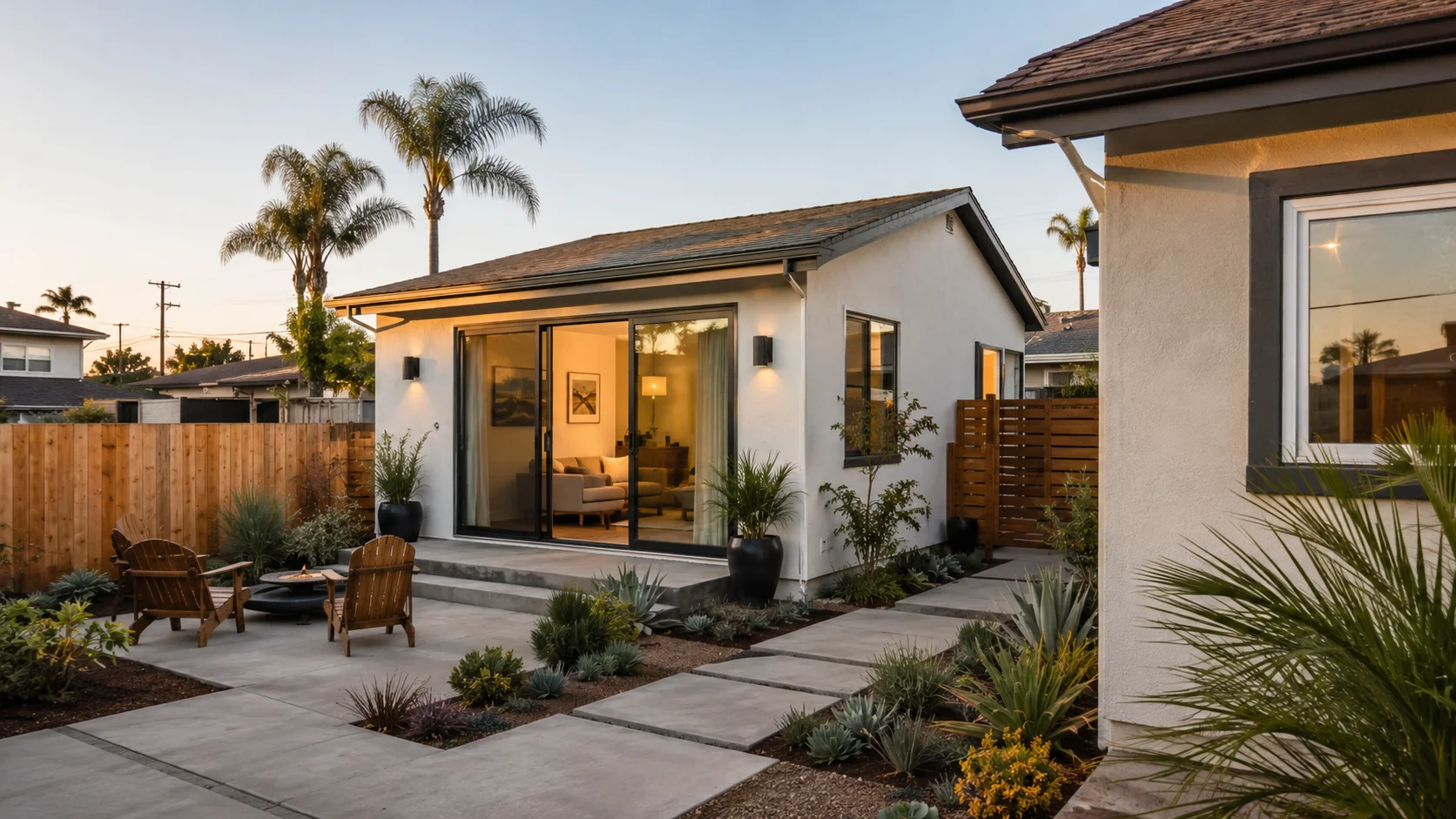
Imperial Beach ADU rules at a glance (2026)
Every figure below was pulled directly from a primary City source or the California Government Code. Where two official sources conflict, we flag both numbers.
| Question | Fast answer | Source / Verified |
|---|---|---|
| Are ADUs allowed? | Yes — every residential zone (R-1-6000, R-1-3800, R-3000-D, R-3000, R-2000, R-1500) and mixed-use zones with residential use. | City ADU page — May 14, 2026 |
| Max detached ADU size? | 1,200 sq ft. | City ADU page |
| Max attached ADU size? | City page: 50% of primary or 800 sq ft. State protected-size floor: 850 sq ft (or 1,000 sq ft for an ADU with more than one bedroom) per Gov. Code §66321. Verify which applies. | City ADU page + Gov. Code §66321 |
| JADU max size? | 500 sq ft. | City ADU page |
| Setbacks? | 4 ft side and rear; front per underlying zone. | IBMC Ch. 19.66; Gov. Code §66323 |
| Height limit? | 16 ft detached; 18 ft within ½ mile of transit; 25 ft or underlying zone limit for attached. | Gov. Code §66321 |
| Coastal Permit triggered? | Yes for new attached, new detached, conversion of permitted uninhabitable space, and garage-to-JADU — when in the Coastal Zone and the project fits one of those four categories. | City Coastal Trigger Handout 04/15/2026 |
| Coastal Permit fee? | $1,050 (Coastal Trigger Handout) or $1,000 (CDP Submittal Checklist). Many third-party guides still cite $600 — outdated. Confirm before payment. | Both City PDFs |
| Coastal review time? | 30 calendar days from payment per City handout; 60-day outside limit per AB 462 (from completed application). | City handout + Gov. Code §66329 |
| Impact fees on small ADUs? | Not applicable to ADUs of 750 sq ft or less (state-law protected size). | Gov. Code §66311.5; City fee handout |
| Pre-approved plans? | Yes — 600 sq ft plan set under AB 1332. | City Pre-Approved ADU Plans page |
| Short-term rentals (Airbnb)? | Prohibited for ADUs and JADUs. | IB Ord. 2021-1204; Gov. Code §66314 |
| Owner-occupancy required? | Not for ADUs permitted after Jan 1, 2020. JADU rule narrowed by AB 1154 — required only when the JADU shares sanitation with the primary (Gov. Code §66333, effective Jan 1, 2026). | Gov. Code §§66315, 66333 |
See what you can build at your address →
Run our free Imperial Beach ADU Feasibility Report. Enter your address; we’ll return your zone, your Coastal Zone color tier (Green, Red, or Blue), and a realistic permit-fee estimate for the size you’re considering — before you spend a dollar on plans.
Get Your Free ADU Report →What we verified for this guide
Every fee, code section, and timeline below was pulled directly from a primary source: the City of Imperial Beach Community Development Department, the Imperial Beach Municipal Code (Chapter 19.66), the California Government Code, the City’s Coastal Permit Trigger Handout last updated April 15, 2026, the City’s Building Permit and Development Impact Fees schedule last updated February 19, 2026, the City’s CDP Submittal Checklist, the City’s Pre-Approved ADU Plans page, the South Bay Union School District developer fee page, the Sweetwater Union High School District developer fee page, and current California legislation through AB 462, AB 1154, AB 2533, AB 1033, SB 1211, SB 1077, AB 1332, and SB 543. Construction cost ranges are cross-checked against current published 2026 San Diego ADU cost analyses. Rental rate data was pulled from Apartments.com, Zumper, and Zillow in May 2026. Where two sources disagree, we cite the most current City source and flag the conflict so you can verify before spending money.
Most Imperial Beach ADU pages get one critical thing wrong. They treat the Coastal Zone as a footnote and quote a $600 Coastal Permit fee from a fee schedule the City updated years ago. We built this guide to end the confusion in one read.
Dwelling Index is an independent research resource covering ADU financing, costs, and regulations. We don’t build ADUs, design them, or finance them. We compile and verify the rules so you can hold any builder, lender, or planner accountable to the same information.
Can I build an ADU on my Imperial Beach property?
Answer capsule: Imperial Beach permits ADUs on virtually every residential and mixed-use lot with an existing or proposed dwelling unit. The permit path depends on three variables: your zoning designation, your property type (single-family, two-family, or multifamily), and whether your parcel sits inside the California Coastal Zone. Approximately 87 percent of Imperial Beach lies inside the Coastal Zone, so most homeowners will need both a Coastal Development Permit and a building permit.
The City of Imperial Beach permits ADUs across six residential zoning designations: R-1-6000 and R-1-3800 (single-family residential), R-3000-D (two-family detached), R-3000 (two-family), R-2000 (medium density), and R-1500 (high density). Many mixed-use zones that allow residential use also permit ADUs. There is no minimum lot size for an ADU under California law (Gov. Code §66321), and Imperial Beach does not impose one.
The thing most national ADU guides miss about Imperial Beach is the Coastal Zone factor. Imperial Beach’s Local Coastal Program was certified by the California Coastal Commission in 1984, and per the City’s own Urban Lot Split ordinance, 87 percent of the city sits inside the Coastal Zone. That single fact reshapes the permit path for almost every homeowner — not just the ones with ocean views.
What property type means in the IB ADU rules
The City’s published ADU allowance table distinguishes between four scenarios:
- Single-family lot. One detached ADU, plus one attached or conversion ADU (not both), plus one JADU converted from existing space inside the single-family home. The JADU is capped at 500 sq ft and triggers different owner-occupancy rules under AB 1154.
- Two-family residential zones (R-3000-D, R-3000). One detached ADU and one attached or conversion ADU per lot.
- Existing multifamily property (a duplex, triplex, or apartment building already on the lot). Under SB 1211 (effective January 1, 2025), you may build up to eight detached ADUs, capped by the number of existing primary units. You may also convert non-livable space — storage rooms, boiler rooms, passageways, attics, basements, garages — into at least one ADU, or up to 25 percent of existing units (Gov. Code §66323 as amended).
- Proposed multifamily (you’re building the multifamily from scratch). Up to two detached ADUs.
This matters because Imperial Beach has a meaningful stock of duplexes and small apartment buildings, especially in the R-2000 and R-1500 zones. SB 1211’s expansion from two to eight detached ADUs on existing multifamily lots is one of the biggest economic shifts in IB ADU law in the past decade — and most builder pages haven’t updated to reflect it.
Imperial Beach ADU allowances by zone
| Zone | Single-family path | Multifamily-specific rule |
|---|---|---|
| R-1-6000 (single-family residential) | 1 detached ADU + 1 attached or conversion ADU + 1 JADU | N/A |
| R-1-3800 (single-family residential) | 1 detached ADU + 1 attached or conversion ADU + 1 JADU | N/A |
| R-3000-D (two-family detached) | 1 detached ADU + 1 attached or conversion ADU | N/A |
| R-3000 (two-family residential) | 1 detached ADU + 1 attached or conversion ADU | Up to 8 detached ADUs on existing multifamily (capped by existing units); 2 on proposed multifamily; internal conversions up to 25% of units |
| R-2000 (medium density) | 1 detached ADU + 1 attached or conversion ADU | Same multifamily rule as R-3000 |
| R-1500 (high density) | 1 detached ADU + 1 attached or conversion ADU | Same multifamily rule as R-3000 |
Source: City of Imperial Beach Accessory Dwelling Units page; IBMC Chapter 19.66; Gov. Code §66323 as amended by SB 1211.
The most useful thing you can do right now, before paying for a feasibility study or talking to a builder, is two minutes of homework: pull up the City of Imperial Beach Parcel Viewer at imperialbeachca.mapgeo.io/datasets/public-access, enter your address, and confirm both your zone and your Coastal Zone tier.
How many ADUs and JADUs can one Imperial Beach property have?
Answer capsule: A single-family lot in Imperial Beach can typically host a detached ADU, an attached or conversion ADU, and a Junior ADU carved out of the existing house — three units in total beyond the primary dwelling, though the JADU is capped at 500 square feet and must sit inside the primary’s footprint. Existing multifamily properties can build up to eight detached ADUs (capped by the number of existing units) plus internal conversions of non-livable space.
The single-family stack: how three units can coexist
Here’s the legal stack a single-family Imperial Beach lot can support:
- Primary dwelling (your existing house).
- One detached ADU — up to 1,200 sq ft, separate structure in the backyard.
- One attached ADU OR one conversion ADU (not both) — attached shares a wall with the primary; conversion repurposes existing permitted space like a basement or attic.
- One JADU — up to 500 sq ft, must be inside the primary dwelling, must have its own entrance, and must have efficiency kitchen facilities. If it shares a bathroom with the primary house, owner-occupancy applies (Gov. Code §66333 as amended by AB 1154). If it has its own bathroom, owner-occupancy does not apply.
Practically, very few IB lots can fit all of this. The more common configurations are: primary + detached ADU, primary + JADU, or primary + garage conversion to ADU. The “three units stacked” path exists but is rare.
Why SB 1211 changed multifamily ADU economics in Imperial Beach
Senate Bill 1211, effective January 1, 2025, increased the detached ADU cap on existing multifamily lots from two to as many as eight, provided the total does not exceed the number of existing primary units. SB 1211 also defined “livable space” for the first time in state ADU law as “a space in a dwelling intended for human habitation, including living, sleeping, eating, cooking, or sanitation” (Gov. Code §66313(e) as amended). That definition constrains how cities interpret what counts as convertible non-livable space.
For Imperial Beach, where the housing mix leans toward smaller multifamily buildings, this is a structural change. A six-unit apartment building in R-2000 can, in principle, add six detached ADUs. A duplex can add up to two. If you own a multifamily property in IB and looked at the ADU math more than a year ago, the math has changed. It’s worth a fresh feasibility review.
What are the Imperial Beach ADU size, height, and setback limits?
Answer capsule: Detached and conversion ADUs in Imperial Beach can be up to 1,200 square feet, JADUs up to 500 square feet, with side and rear setbacks of 4 feet. Height is generally 16 feet, with a bump to 18 feet for detached units within one-half mile walking distance of a major transit stop or on lots with an existing multistory multifamily building; attached ADUs can match the primary dwelling height up to 25 feet.
Size limits, with the state-law backstop spelled out
The City of Imperial Beach ADU page publishes the following size limits:
- New construction detached ADU: up to 1,200 sq ft.
- New construction attached ADU: 50 percent of the main residence or up to 800 sq ft (whichever is less).
- Conversion of existing space ADU: up to 1,200 sq ft.
- Conversion of existing space JADU: up to 500 sq ft.
That 800-square-foot cap on a new construction attached ADU is the number to flag. California Government Code §66321 establishes a state protected-size floor that local agencies must allow: 850 sq ft of interior livable space generally, or 1,000 sq ft for an ADU with more than one bedroom, regardless of more restrictive local rules. We recommend confirming the City’s current interpretation with Planning before committing to a design — Ryan Pua, Associate Planner, at (619) 628-1356.
The 150-square-foot conversion expansion rule
If you’re converting an existing accessory structure into an ADU — a permitted detached garage, a workshop, or a similar structure — Imperial Beach’s ordinance allows you to expand up to 150 square feet beyond the structure’s existing physical footprint, but only to accommodate ingress and egress (doors, hallways, code-required entries). You cannot use that 150 sq ft to bump out the kitchen or add a bathroom; it has to serve access. This tracks Gov. Code §66323.
Heights, broken out by configuration
| Configuration | Maximum height |
|---|---|
| Detached ADU on a single-family or multifamily lot | 16 ft |
| Detached ADU within ½ mile walking distance of a major transit stop or high-quality transit corridor (per Public Resources Code §21155) | 18 ft (plus 2 ft additional to match the primary’s roof pitch) |
| Detached ADU on a lot with an existing or proposed multistory multifamily building | 18 ft |
| Attached ADU | 25 ft or the underlying zone height limit, whichever is lower; no requirement to allow more than two stories |
For Imperial Beach specifically, the transit-corridor bonus matters. The 906 MTS bus route along Palm Avenue and the Iris Avenue Trolley station (Blue Line, San Diego MTS) bring significant chunks of the city inside the half-mile transit radius. Many IB lots qualify for 18-ft detached ADUs, not just 16-ft.
Setbacks: 4 feet, with a coastal twist
Side and rear setbacks for an ADU are 4 feet in Imperial Beach, consistent with state law (Gov. Code §66323). Front setbacks follow the underlying zone, with one carve-out: state law permits an encroachment into the front yard setback if necessary to fit a minimum 800 sq ft unit. Building-to-building separation on the same lot is 10 feet for most zones (IBMC §19.54.080).
In the Coastal Zone, the standard 4-foot setback still applies for the ADU itself, but additional siting constraints apply for properties within 100 feet of a wetland, estuary, or stream — a real constraint in the Tijuana River Valley and along the bayfront. These are reviewed during the Coastal Permit process.
Two-story ADUs in Imperial Beach
Two-story ADUs are permitted, most cleanly when they’re built above an existing garage. A detached two-story ADU is allowed when the height limits above are satisfied — meaning a 16- or 18-foot envelope. For IB lots within the transit-corridor radius, an 18-foot envelope with a roof-pitch bonus gives enough vertical room for a small two-story footprint; for lots outside that radius, two stories under 16 feet is achievable but design-tight.
Design review
Imperial Beach requires that ADUs use “the same or complementary architectural style, exterior materials, and colors as the existing or proposed primary dwelling, and the quality of the materials shall be the same or exceed that of the primary dwelling” (IB Ord. 2021-1204). This is design review, not zoning; it can be addressed during plan check and typically does not require a separate hearing. Fire sprinklers are not required for an ADU or JADU unless they were required for the primary dwelling (IBMC §19.66).
Do I need a Coastal Development Permit for an Imperial Beach ADU?
Answer capsule: Yes for most Imperial Beach homeowners. The City’s Coastal Trigger Handout, last updated April 15, 2026, identifies four ADU project categories that trigger an Administrative Coastal Development Permit when located in the Coastal Zone: new construction attached ADUs, new construction detached ADUs, conversions of existing permitted uninhabitable space (garages, storage rooms, patio covers) into ADUs, and garage-to-JADU conversions. The Coastal Permit must be approved before the building permit can issue. Concurrent processing of planning and building applications is available on request.
The Coastal Permit is the single rule most likely to surprise an Imperial Beach homeowner. It doesn’t kill projects, but it adds a separate permit path, separate fee, separate document package, and a separate review window before the building permit can proceed.
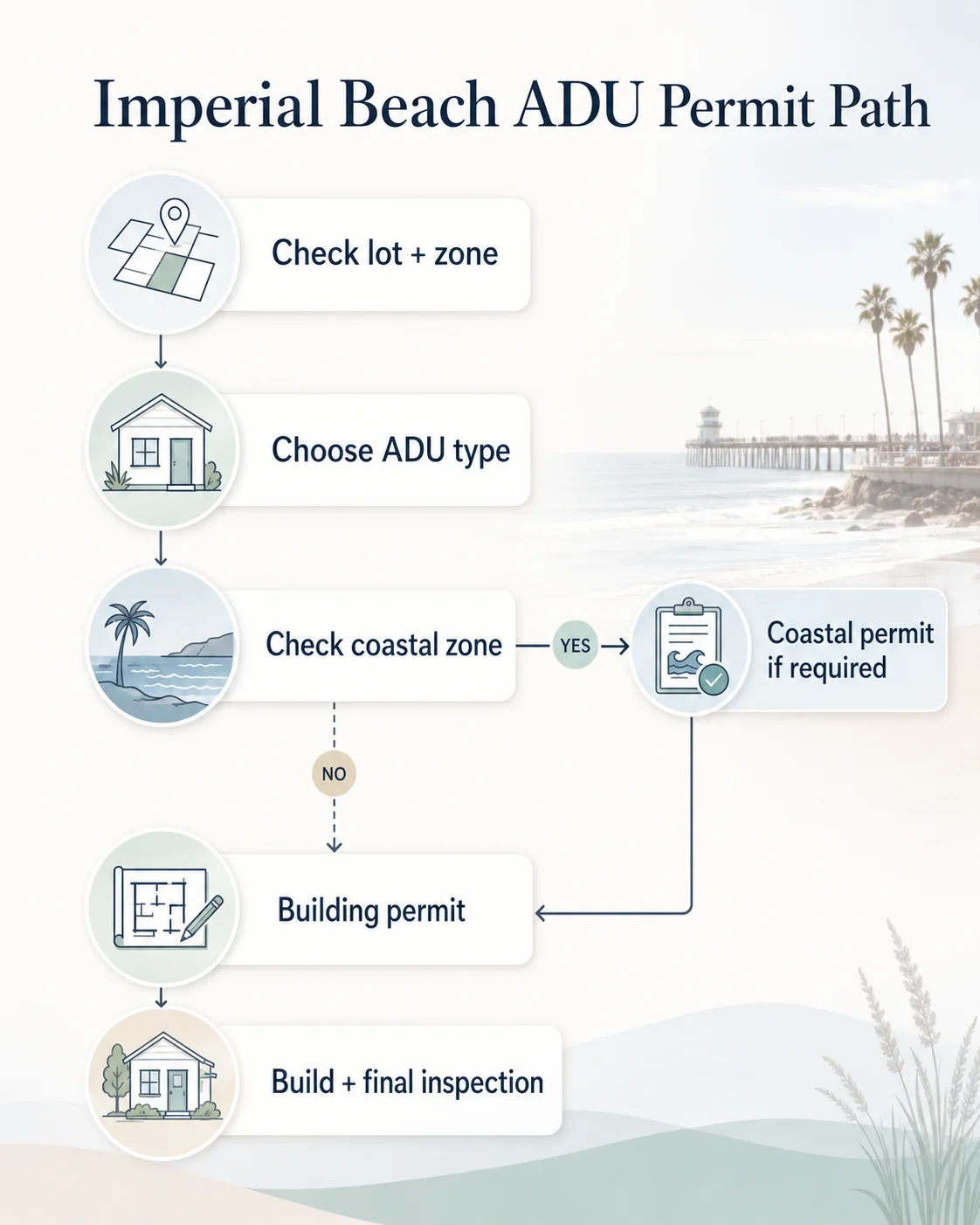
The honest version
A Coastal Permit is real friction. It’s a 30-calendar-day review window from the City after payment (longer in practice when plans need revision), a $1,000–$1,050 fee on top of everything else, and a discretionary process that may require public-notice mailing.
That’s the bad news. The good news is twofold:
- The City of Imperial Beach has a certified Local Coastal Program, which means the City — not the California Coastal Commission directly — handles approval for most ADUs. The process is administrative; no public hearing is required for the typical ADU permit.
- AB 462, signed October 10, 2025 as urgency legislation, mandated that local agencies with a certified LCP must approve or deny a Coastal Permit application for an ADU within 60 days of receiving a completed application. The same bill, codified in Gov. Code §66329(c), bars appeals to the California Coastal Commission for local-government ADU permit decisions in certified-LCP jurisdictions like Imperial Beach. Blue-zone projects, where the Commission is the direct reviewer, are a separate path under Gov. Code §66329(b).
The Green / Red / Blue zone framework, decoded
The City’s Coastal Trigger Handout instructs homeowners to use the Imperial Beach Parcel Viewer at imperialbeachca.mapgeo.io/datasets/public-access and toggle on the “Coastal Zone Jurisdiction” theme. Your parcel will fall into one of three color zones:
| Zone color | Permit issued by | Appeal rights |
|---|---|---|
| Green | City of Imperial Beach (Administrative Coastal Permit) | Not appealable to the Coastal Commission under Gov. Code §66329(c) |
| Red | City of Imperial Beach (Administrative Coastal Permit) | Per City handout (04/15/2026), the Coastal Commission “can appeal the city’s decision.” However, Gov. Code §66329(c) bars Commission appeals of local decisions for ADUs. The handout has not been updated to reflect AB 462. Verify directly with IB Planning. |
| Blue | California Coastal Commission directly | Commission is the primary reviewer (Gov. Code §66329(b)); subject to its own 60-day shot clock with limited exceptions |
Sources: City of Imperial Beach Coastal Trigger Handout (last updated 04/15/2026); California Government Code §66329 as amended by AB 462 (signed 10/10/2025); BBK Law ADU legal alert dated November 7, 2025.
How to check your Coastal Zone tier (the two-minute version)
- Open the Imperial Beach Parcel Viewer at imperialbeachca.mapgeo.io/datasets/public-access.
- Click THEMES in the toolbar.
- Toggle Coastal Zone Jurisdiction on.
- Use the search bar in the top-right corner to enter your project address or Assessor’s Parcel Number.
- Note the color of your parcel: Green, Red, or Blue. If your parcel is not colored, the parcel may be outside the Coastal Zone — but confirm with Planning before assuming.
What gets submitted with a Coastal Permit application
Per the CDP Submittal Checklist:
- A completed Discretionary Permit Application.
- A completed Ownership Disclosure Form.
- A completed Environmental Information Form.
- One electronic plan set (site plan, elevations, floor plans, landscape plans where applicable).
- A completed Form 7-B Storm Water Management Plan.
- A completed Public Notice Package (instructions inside the Discretionary Permit Application).
- A grant deed (typically from the San Diego County Assessor’s Office or your records).
- A preliminary title report dated within 90 days.
- For oceanfront properties: a coastal engineering study for shoreline protection plus a starting deposit of $1,200.
- The fee (see fee conflict below).
Applications are submitted through the City’s Tyler EnerGov portal at imperialbeachcaenergovpub.tylerhost.net. After applying online, a paper Public Notice Package must be dropped off at the City Community Development counter (Monday–Thursday, 7:30–9:00 a.m. and 3:30–5:00 p.m.).
Concurrent processing — the timeline shortcut nobody mentions
The City’s handout explicitly notes that concurrent processing of the Coastal Permit and the building permit is available on request. Without it, the typical homeowner submits the Coastal Permit, waits 30+ days for approval, then submits the building permit and waits another 60 days. With concurrent processing, both applications move through plan check in parallel. Ask for it by name when you call to discuss your project.
See what permit path applies to your address →
Get your free Imperial Beach ADU Feasibility Report. We’ll look up your parcel’s Coastal Zone tier and tell you which permit route applies, what documents you need, and roughly what to expect for total permit cost.
Get Your Free ADU Report →How much do Imperial Beach ADU permits and fees actually cost in 2026?
Answer capsule: Imperial Beach ADU fees stack across several categories: a valuation-based building permit fee with a plan check fee equal to 65 percent of the permit fee, a Coastal Permit of $1,000 or $1,050 depending on which official City document you reference, sewer impact fees of $5,943 for a single-family residence or $4,457.25 per multifamily unit, a $3,047.57 Trans-Net traffic impact fee, a residential construction (park) fee of $800 plus $100 per bedroom, school impact fees from the South Bay Union School District ($2.27 per square foot) and Sweetwater Union High School District (current rates $2.90/sq ft for grades 7–12 and $2.02/sq ft in San Ysidro HS boundaries; rates increase to $3.01 and $2.10 respectively on June 22, 2026), and various small state and archiving fees. ADUs of 750 sq ft or less are protected from development impact fees under Gov. Code §66311.5.
This is the section we built the whole guide around. Multiple different official and semi-official numbers exist for the Coastal Permit alone, and school fees are governed by different threshold interpretations across the City handout and the two school districts. We’ll walk you through every fee category, cite the source for each, and flag every place we found a conflict.
The Imperial Beach ADU fee stack (2026)
| Fee category | What triggers it | 2026 amount | Source / Last verified |
|---|---|---|---|
| Building permit | Required for every ADU | Valuation-based (City’s Building Valuation Multiplier Table) | City Building Permit & Development Impact Fees handout (02/19/2026) |
| Plan check | When plans must be submitted | 65% of building permit fee | Same handout |
| Mechanical / electrical / plumbing | If MEP work is part of the project | Flat rates per Master Fee Schedule | Same handout |
| Coastal Permit (ADU, Administrative) | Coastal Zone ADU project | $1,050 per Coastal Trigger Handout or $1,000 per CDP Submittal Checklist — verify before payment | Both City PDFs |
| Coastal Permit (non-ADU, Administrative) | Non-ADU coastal projects | $2,323 | CDP Submittal Checklist |
| Oceanfront coastal engineering deposit | Properties at the shoreline | $1,200 starting deposit | CDP Submittal Checklist |
| Trans-Net traffic impact fee | ADUs over 750 sq ft | $3,047.57 per dwelling unit | City fee handout (02/19/2026); IBMC §15.48 |
| Sewer impact fee — SFR | ADUs over 750 sq ft | $5,943 per single-family residence | Same handout; IBMC §13.06 |
| Sewer impact fee — Multifamily | ADUs over 750 sq ft on multifamily | $4,457.25 per multifamily unit | Same handout |
| Residential construction (park) fee | ADUs over 750 sq ft | $800 per dwelling unit + $100 per bedroom | Same handout; IBMC §3.20 |
| Public improvements | Projects with valuation over $100,000 | Required; coordinate with Public Works at (619) 423-8311 | City fee handout |
| State Building Commission fee | All projects | $1 per $25,000 of valuation (or fraction thereof) | Same handout |
| Archiving fee | All permit applications | $4 flat | Same handout |
| Strong Motion Instrumentation Program (SMIP) | Residential structures | Valuation × 0.00013 ($0.50 minimum) | Same handout |
| School fee — South Bay Union School District | Per district page: exempt for ADUs less than 750 sq ft | $2.27 per sq ft above threshold | South Bay Union builder fee page |
| School fee — Sweetwater Union HSD (current) | ADUs over 499 sq ft per City handout | $2.90/sq ft grades 7–12; $2.02/sq ft San Ysidro HS boundaries | Sweetwater Developer Fees page |
| School fee — Sweetwater Union HSD (effective June 22, 2026) | Same trigger | $3.01/sq ft grades 7–12; $2.10/sq ft San Ysidro HS boundaries | Sweetwater Developer Fees page |
Last verified: May 14, 2026.
Conflict #1: The $1,050 vs $1,000 vs $600 Coastal Permit fee
This is the most cited stale number on the entire Imperial Beach ADU internet. Most third-party guides — including some prominent San Diego builders — still quote the Coastal Permit at $600. The City has published two more current numbers:
- City Coastal Trigger Handout, last updated April 15, 2026: “Cost of an Imperial Beach Coastal Permit for ADUs = $1,050.00 Developer Fee.”
- City CDP Submittal Checklist: “$1,000.00 for an Accessory Dwelling Unit (ADU) requiring Administrative Approval.”
Both documents are official, both are on the City’s website, and they disagree by $50. Neither is the $600 figure that propagates across the third-party web. Call the City’s Community Development counter at (619) 423-8312 or email Ryan Pua at rpua@imperialbeachca.gov for a fee quote on your specific project type before you submit. If a contractor quotes you a $600 Coastal Permit fee, ask them to show you the source. If their source is dated before April 15, 2026, it’s stale.
Conflict #2: The school-fee threshold (less than 500 vs 750 sq ft)
California’s school-fee treatment for ADUs is governed by Gov. Code §66311.5(c)(3) (renumbered by SB 543 in 2025) and Education Code §17620. State law provides that an ADU or JADU with less than 500 sq ft of interior livable space is effectively exempt from school district developer fees.
The City of Imperial Beach’s school-fee handout uses the practical phrasing that ADUs greater than 499 sq ft trigger school district fees. But the South Bay Union School District’s current builder-fee page indicates no school fee for ADUs less than 750 sq ft — a more homeowner-friendly threshold. The Sweetwater Union HSD publishes straightforward per-square-foot rates.
Verify with each district’s developer-fee office for your specific project: South Bay Union School District at (619) 628-1600, Sweetwater Union High School District at (619) 585-6081 or developer.fees@sweetwaterschools.org.
Conflict #3: The Sweetwater rate change on June 22, 2026
The Sweetwater Union High School District has a published developer-fee rate change scheduled for June 22, 2026:
- Grades 7–12 rate: $2.90/sq ft → $3.01/sq ft.
- San Ysidro High School boundary rate: $2.02/sq ft → $2.10/sq ft.
Projects with permits issued before June 22, 2026 pay the current rate; projects with permits issued on or after that date pay the new rate. If your IB ADU permit will be issued in the June–July 2026 window, ask Sweetwater specifically which rate will apply.
The 750-sq-ft threshold: the single most valuable budgeting tool
The Trans-Net + sewer + residential construction protection for ADUs of 750 sq ft or less under Gov. Code §66311.5 is worth roughly $9,790 in saved fees on a single-family lot ($3,047.57 + $5,943 + $800 minimum). Building a 750 sq ft ADU instead of an 850 sq ft ADU could save you almost $10,000 in City fees alone — and the difference in livable space is small for many use cases.
Worked example: estimated total City permit cost for a 749 sq ft detached ADU
Illustrative calculation based on the 2026 fee schedule, applied to a typical detached ADU with construction valuation of $250,000.
| Fee | Calculation / assumption | Estimated amount |
|---|---|---|
| Building permit fee | Valuation-based, $250,000 valuation | ~$3,000–$4,000 (run Fee Estimator for exact) |
| Plan check | 65% of permit fee | ~$2,000–$2,600 |
| Coastal Permit (ADU, Admin) | Per City document — verify on invoice | $1,000–$1,050 |
| State Building Commission | $1 per $25,000 valuation | $10 |
| SMIP (residential) | $250,000 × 0.00013 | $32.50 |
| Archiving | Flat | $4 |
| Trans-Net | PROTECTED (750 sq ft or less, Gov. Code §66311.5) | $0 |
| Sewer impact | PROTECTED (750 sq ft or less) | $0 |
| Residential construction | PROTECTED (750 sq ft or less) | $0 |
| School fee (per South Bay Union page) | No fee under 750 sq ft per district page | $0 |
| Estimated total City permit cost | ~$6,000–$8,000 |
Methodology note: This is an illustrative estimate based on the City’s published 2026 fee schedule, a hypothetical $250,000 construction valuation, and a project size of 749 sq ft. Final invoice amount controls. Run the City’s Building Permit Fee Estimator with your project’s actual valuation and inputs before budgeting.
For the same ADU at 850 sq ft (over the impact-fee threshold), add roughly $9,800 in newly applicable Trans-Net, sewer, and residential construction fees, plus school fees of $1,929.50 ($2.27 × 850) from South Bay Union, bringing total City permit cost to roughly $17,000–$20,000. That’s the 750-sq-ft cliff in dollar terms.
Not sure whether to design at 749 or 850 sq ft?
Run our free Imperial Beach ADU Feasibility Report. Enter your address and target size; we’ll show you the realistic fee delta between a sub-750 design and an over-750 design for your specific lot — before you sign a design contract.
Get Your Free ADU Report →Permit fees aren’t the biggest line — construction is. A 749 sq ft Imperial Beach ADU costs roughly $6,000–$8,000 in City fees and $200,000–$320,000 in actual construction (illustrative range, verify with builder quotes). If you’re thinking about how to pay for it, explore your Imperial Beach ADU financing path options → Most Imperial Beach homeowners use cash-out refinances, HELOCs, construction loans, or renovation HELOCs.
What does an Imperial Beach ADU actually cost to build in 2026?
Answer capsule: Current published 2026 San Diego cost analyses place detached ADUs at $375 to $600 per square foot all-in, with most complete builds landing between $300,000 and $450,000 for a turnkey one- or two-bedroom unit. Garage conversions are typically $150 to $350 per square foot, totaling $100,000 to $210,000 for a complete project. Attached ADUs sit between the two: roughly $200 to $350 per square foot, $160,000 to $280,000 total.
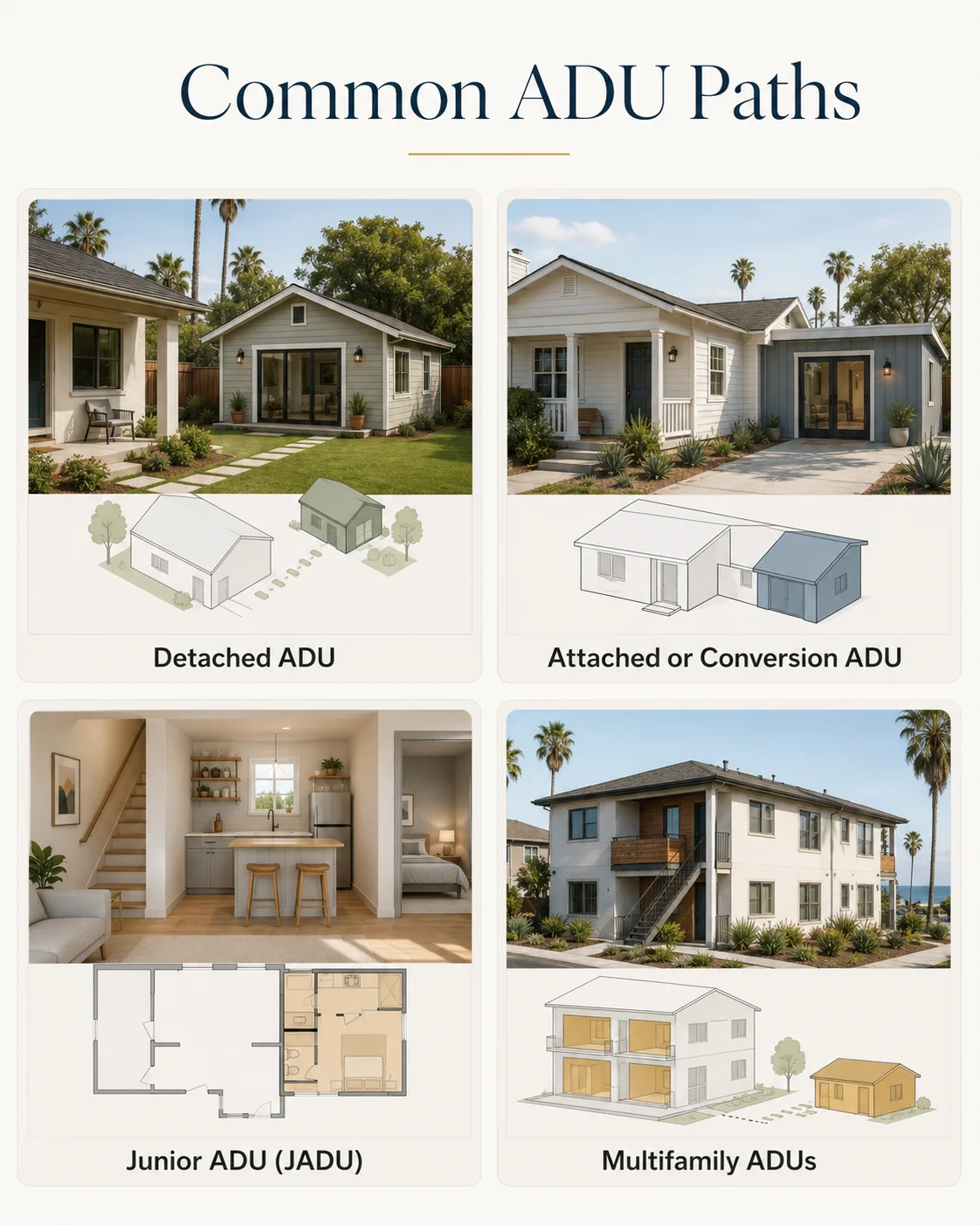
| ADU type | Per-sq-ft range | Typical total project | Source |
|---|---|---|---|
| Detached new construction (1-bed, 600–800 sq ft) | $375–$500+ | $225,000–$400,000 | SnapADU 2026 cost analysis; Realm SD cost guide |
| Detached new construction (2-bed, 900–1,200 sq ft) | $375–$450 | $315,000–$540,000 | Same |
| Attached ADU | $200–$350 | $160,000–$280,000 | Realm SD cost guide |
| Garage conversion | $150–$350 | $100,000–$210,000 | Realm SD cost guide |
| Junior ADU (interior conversion) | $100–$250 | $50,000–$125,000 | Industry analyses |
Source aggregation, May 2026. Final pricing depends on your specific lot, design, and builder selection. Verify cost estimates with builder quotes before budgeting.
Why ADUs cost more per square foot than full-size homes
An ADU still needs a complete kitchen and a complete bathroom — the two most expensive rooms in a house — and those fixed costs don’t shrink with floor area. A 500 sq ft ADU spreads kitchen and bath costs over 500 sq ft; a 2,500 sq ft house spreads similar costs over five times more area. Smaller ADUs cost more per square foot. That’s not a contractor markup — it’s geometry.
Where the budget actually goes
- Foundation and structure (15–20%). Concrete, framing, sheathing.
- MEP rough-in (15–20%). Electrical, plumbing, HVAC, including the utility lateral.
- Exterior envelope (15%). Roofing, siding, windows, doors.
- Interior finishes (25–30%). Drywall, flooring, paint, cabinetry, countertops, fixtures.
- Site work (5–15%). Grading, drainage, walkways, utility trenching. Sloped IB hillside lots can add $30,000–$60,000 over a flat lot.
- Permits, fees, and soft costs (5–10%). The fee stack items above plus design, engineering, and Title 24 energy calculations.
- General contractor overhead and profit (10–15%).
What’s NOT in those numbers
Typical published cost ranges exclude: utility upgrades (panel upgrades, sewer main extensions if needed), substantial site work for difficult lots, premium finishes beyond standard builder-grade, custom architectural design beyond stock plans, and soft costs for landscape design. For Imperial Beach lots within 100 feet of the Tijuana River Valley wetlands, expect additional environmental review costs in the $2,000–$8,000 range.
How long does an Imperial Beach ADU permit take?
Answer capsule: A complete Imperial Beach ADU project typically runs 8 to 14 months from initial design to certificate of occupancy in 2026. State law mandates two 60-day decision windows — a 60-day Coastal Permit shot clock under AB 462 / Gov. Code §66329 and a 60-day ministerial building-permit decision under Gov. Code §66317, both measured from receipt of a complete application — but the practical long pole is still construction, which runs 4 to 8 months once permits are issued.
| Stage | Minimum | Typical | Maximum | Notes |
|---|---|---|---|---|
| Pre-application research & site analysis | 2 weeks | 4 weeks | 8 weeks | Parcel viewer check, zoning confirmation, builder consultations |
| Schematic design | 3 weeks | 6 weeks | 12 weeks | Custom design; pre-approved plans skip most of this |
| Construction documents | 6 weeks | 10 weeks | 16 weeks | Title 24, structural, MEP, civil if needed |
| Coastal Permit submittal & review | 30 days from payment | 45–60 days | 60-day limit per AB 462 | Concurrent processing with building permit available |
| Building permit submittal & plan check | 30 days | 60 days | 60-day limit per Gov. Code §66317 | Plan check comments may extend; resubmittal can restart portions |
| Construction | 16 weeks | 24 weeks | 32 weeks | Varies with weather, finish complexity, lot conditions |
| Final inspection & certificate of occupancy | 1 week | 2 weeks | 4 weeks | Inspections in IB are Monday–Thursday only |
The legal shot clocks (what state law actually says)
California Government Code §66317 sets the ministerial approval timeline for ADU applications: a local agency has 60 days from receipt of a complete application to approve or deny. SB 543 (signed October 2025) clarified that local agencies cannot extend this timeline by repeatedly requesting additional information; the completeness review must conclude within 15 business days.
AB 462 added a parallel 60-day shot clock for Coastal Development Permits for ADUs in cities with certified Local Coastal Programs. Imperial Beach has had a certified LCP since 1984.
Both shot clocks apply to complete applications. Most permit timelines blow out not because the City is slow, but because applications come in incomplete and rounds of revision-and-resubmittal extend the process. This is the single best argument for using either pre-approved plans or a builder experienced with Imperial Beach’s specific submittal requirements.
A practical note on inspection scheduling
Imperial Beach Building Division inspections operate Monday through Thursday. There are no Friday inspections. On a tight construction schedule — particularly during framing or rough-in when an inspection failure can hold up a week of trades — the four-day inspection week is something to plan around. Schedule inspections early in the week to leave room for re-inspection if needed.
Does Imperial Beach have pre-approved ADU plans?
Answer capsule: Yes. Imperial Beach adopted a 600 square foot pre-approved ADU plan set under AB 1332 (effective January 1, 2025), available for download from the City’s Pre-Approved ADU Plans page. Using pre-approved plans can compress the design phase and shorten plan check review, but “pre-approved” does not mean “permit-free” — site-specific documents, Title 24 energy calculations, stormwater management plans, soils information, and any required deferred solar PV submittals still apply.
The pre-approved plan handles the building portion of plan check: structural framing, code compliance for the building envelope, fixture layout. It does not handle: where the plan sits on your specific lot, your specific setback math, your specific utility connection paths, your specific Title 24 energy compliance calculations, your specific stormwater management plan (Form 7-B), or your specific Coastal Permit if the lot is in the Coastal Zone.
The 600 sq ft size also sits comfortably under the 750 sq ft state-protected size threshold under Gov. Code §66311.5, which means homeowners using the pre-approved plan get the schedule compression and the impact-fee protection stacked together. For a homeowner whose use case fits the envelope, this is one of the most efficient paths through the IB ADU process.
Do Imperial Beach ADUs require parking?
Answer capsule: Under Gov. Code §66322, an Imperial Beach ADU does not require off-street parking when the property is within one-half mile walking distance of public transit, within an architecturally and historically significant historic district, when the ADU is part of a permitted conversion of an existing primary residence or accessory structure, when on-street parking permits are required but not offered to the ADU occupant, or when there is a car-share vehicle within one block. State law also bars cities from requiring replacement parking when a garage, carport, or covered parking structure is demolished or converted to an ADU. SB 1211 (effective January 1, 2025) extended this bar to uncovered parking spaces as well.
When parking is not required for an Imperial Beach ADU
- Within one-half mile walking distance of public transit (includes the Iris Avenue Trolley station and the 906 MTS bus stops along Palm Avenue and Imperial Beach Boulevard).
- Within an architecturally and historically significant historic district.
- When the ADU is part of a permitted conversion of an existing primary residence or accessory structure.
- When on-street parking permits are required but not offered to the ADU occupant.
- When there is a car-share vehicle located within one block of the ADU.
For most Imperial Beach single-family lots, at least one of these exemptions applies. Confirm with IB Planning for your specific address.
Can I rent out my Imperial Beach ADU?
Answer capsule: You can rent an Imperial Beach ADU as a long-term rental (lease terms of 30 days or longer). Short-term rentals — Airbnb, VRBO, and similar — are prohibited for ADUs and JADUs per Imperial Beach Ordinance No. 2021-1204 and consistent with Gov. Code §66314’s long-term rental requirement. For ADUs permitted after January 1, 2020, the City cannot require owner-occupancy under Gov. Code §66315. JADUs are different: AB 1154 amended Gov. Code §66333 effective January 1, 2026 to require owner-occupancy for a JADU only when the JADU shares sanitation facilities with the primary residence.
Imperial Beach rental income ranges (May 2026)
Rental data pulled from Apartments.com, Zumper, and Zillow in May 2026:
- Studio: $1,450–$1,750/month
- One-bedroom: $1,650–$2,100/month
- Two-bedroom: $2,100–$2,700/month
These are asking-rent figures and vary by unit condition, proximity to transit, and specific location within Imperial Beach. For conservative underwriting, use the lower end of the range. The Tijuana River situation — addressed in detail below — has not collapsed rental rates but does add uncertainty for beach-adjacent properties.
I already have an unpermitted ADU. Can I legalize it?
Answer capsule: If your unpermitted Imperial Beach ADU or JADU was built before January 1, 2020, AB 2533 (effective January 1, 2025) provides a clear path to legalize it. The relevant code section is now Gov. Code §66311.7 (renumbered by SB 543 in 2025). The City cannot deny your legalization permit unless the unit fails the safety standards in Health and Safety Code §17920.3 — substandard housing criteria focused on actual habitability threats, not technical zoning or building-code issues. No impact fees apply unless new utility connections are required. You can hire a licensed contractor for a confidential pre-inspection before submitting an application.
What AB 2533 changed
- Extended the construction cutoff from January 1, 2018 to January 1, 2020.
- Extended coverage to JADUs (previously only ADUs were protected).
- Replaced the prior exception with a tighter rule: cities can only require corrections to address conditions that actually qualify as substandard housing under Health and Safety Code §17920.3.
- Required cities to provide public notification about substandard-building criteria and pre-application inspection options.
- Allowed homeowners to hire a licensed contractor for a confidential pre-inspection before submitting any city application — a major protection against accidentally triggering enforcement.
Cost and timeline for legalization (industry estimates)
Industry data through 2026 suggests typical AB 2533 legalization costs commonly run $15,000 to $50,000 depending on:
- How much electrical and plumbing work needs to be brought to current code.
- Whether structural repairs are needed.
- Whether utility connections need to be added or upgraded.
- The condition of existing finishes (preserve or replace).
Permit processing for AB 2533 legalization typically runs 60 to 90 days under the state-mandated ministerial review. These are industry-reported ranges, not Imperial Beach-published figures. Confirm specifics with IB Planning for your project. Contact: Ryan Pua, IB Planning, (619) 628-1356.
Can I sell my Imperial Beach ADU separately as a condo?
Answer capsule: California’s AB 1033 (effective January 1, 2024) authorizes cities and counties to opt in to allowing ADUs to be sold separately from the primary residence as condominium units. Verified opt-in jurisdictions in San Diego County include San Diego County (effective April 4, 2026, in unincorporated areas). Imperial Beach has not adopted a separate-conveyance ordinance as of our last verification (May 14, 2026). Homeowners interested in this path should contact IB Planning directly before designing around it.
When a local agency does adopt an AB 1033 ordinance, separate sale of an ADU requires: condominium plan recordation under the Davis-Stirling Common Interest Development Act; compliance with all building, fire, and life-safety standards; independent utility metering (water, sewer, electric, gas) or HOA responsibility for shared utilities; and compliance with the California Department of Real Estate’s subdivision public-report process. For the current IB status, contact Ryan Pua at (619) 628-1356 or check imperialbeachca.gov/543/Current-PlanningDevelopment.
The Tijuana River question (honest answer)
Answer capsule: Imperial Beach has been at the center of a transboundary sewage crisis since the late 2010s, with periods of over 1,300 consecutive days of beach closures and continuing intermittent closures into 2025–2026. Recent peer-reviewed air-quality research from UC San Diego (published in Science, August 2025) links the river pollution directly to airborne contaminants in nearby neighborhoods. Despite the situation, Imperial Beach long-term rental rates have been stable to modestly rising in 2025–2026. We include this section because most ADU pages pretend the situation doesn’t exist; you deserve the honest read before deciding to invest.
What’s actually happening
Sewage and industrial wastewater from the Tijuana River watershed has been crossing the border into the Tijuana River Valley and out to the Pacific Ocean off Imperial Beach for years. The contamination is real, ongoing, and well-documented by the U.S. EPA, California State Lands Commission, San Diego Coastkeeper, and the City of Imperial Beach itself. The City declared a state of emergency. Beaches have been closed for over 1,300 consecutive days in some stretches. UC San Diego published peer-reviewed research in Science in August 2025 linking the river pollution directly to airborne contaminants and resident health concerns in nearby neighborhoods.
What it does to ADU economics
- Asking rents have not collapsed. Multiple data sources for May 2026 show modest year-over-year rental growth in Imperial Beach. Apartments.com reports apartment rents up 0.3 percent year over year. Zumper reports the all-bedroom median up 5 percent year over year. Zillow reports the average rent up roughly $105 year over year. The market has absorbed the sewage situation without a rental-rate collapse.
- Beach-economy tourism revenue is down. This affects short-term rental economics — but short-term rentals are prohibited for ADUs anyway, so the direct ADU implication is limited.
- Long-term rental tenant demand remains real. The kind of tenant who rents long-term in IB — typically people working in South Bay, military households connected to Naval Base Coronado, families looking for proximity to the trolley line — is largely making decisions based on commute, school district, and affordability rather than beach access.
What’s being done
Federal funding through the USMCA implementation appropriated $300 million to the EPA for South Bay International Wastewater Treatment Plant (SBIWTP) rehabilitation and expansion. The EPA reports that an interim 10 MGD expansion of the SBIWTP was completed in 2025, and a full 50 MGD expansion under Treaty Minute 328 remains in planning. Mexico has committed to diverting 10 MGD of treated effluent upstream of the Rodríguez Dam and to rehabilitating multiple wastewater facilities. The San Antonio de los Buenos Wastewater Treatment Plant on the Mexican side came partially online in 2025 after delays.
Honest read for an ADU investor
- Underwrite long-term rental rates at the conservative end of current data. Use $1,650–$1,900 for a one-bedroom in your pro forma, not the upper end of $2,000+.
- Don’t bank on short-term rental income. Even setting aside legality, the beach economy itself is fragile.
- Track the SBIWTP expansion progress. Future improvements in beach conditions could shift rental demand upward.
- Lots farther from the river valley are less affected. Eastern IB neighborhoods near the trolley line and away from the bay and estuary tend to see less direct impact than properties on Seacoast Drive.
How do I actually apply for an Imperial Beach ADU permit?
Answer capsule: The Imperial Beach ADU application process has six practical steps: confirm your zone and Coastal Zone tier on the City Parcel Viewer; select your ADU type and design path; apply for the Administrative Coastal Permit through the City’s Tyler EnerGov portal if your project is in the Coastal Zone and matches a trigger category; submit the building permit application package; respond to plan check comments; and proceed to construction and inspection. Concurrent processing of the Coastal Permit and building permit is available on request and shortens total timeline.
Step 1
Confirm zone and Coastal Zone tier
Open the Parcel Viewer at imperialbeachca.mapgeo.io/datasets/public-access. Toggle the Coastal Zone Jurisdiction theme. Note your zone (R-1-6000, R-1-3800, etc.) and your Coastal Zone color (Green, Red, or Blue, if any). This is free, takes two minutes, and tells you 80 percent of what you need to know about your project's permit path.
Step 2
Select your ADU type and design path
Decide between the City's pre-approved 600 sq ft plan (fastest), a builder stock plan (more flexibility, moderate speed), or custom design with an architect (most flexible, slowest, most expensive). Right answer if your lot is unusual, your envelope is larger, or you have specific design priorities.
Step 3
Apply for the Coastal Permit (if in the Coastal Zone)
Create an account at the City's Tyler EnerGov portal: imperialbeachcaenergovpub.tylerhost.net. Navigate Apply → Plans → Land Use - Administrative Level → Apply. Submit required documents per the CDP Submittal Checklist. After applying online, drop off the paper Public Notice Package at the Community Development counter (Monday–Thursday, 7:30–9:00 a.m. or 3:30–5:00 p.m.). CRITICAL: Request concurrent processing of the Coastal Permit and the building permit at submission. This is the single largest schedule-saver in the IB ADU process.
Step 4
Submit the building permit application
The package typically includes: construction documents (architectural, structural, MEP, civil if applicable), Title 24 energy compliance calculations, structural calculations, truss calculations if applicable, soils report or waiver documentation, Storm Water Management Plan, deferred solar PV submittal documents (California Title 24 generally requires solar PV on new residential ADUs), and school fee certificates from South Bay Union and Sweetwater Union if your ADU is over the applicable school-fee threshold.
Step 5
Respond to plan check comments
Plan check generates a comments list — items the City reviewer wants clarified, fixed, or supplemented. Respond promptly. Each round of revisions extends the review period, and the 60-day ministerial shot clock under Gov. Code §66317 measures from when the application is deemed complete.
Step 6
Construction, inspection, certificate of occupancy
Once permits are issued, construction can begin. Inspection requests in Imperial Beach are scheduled Monday through Thursday. Final inspection generates the Certificate of Occupancy. Per Gov. Code §66328 (as amended by AB 462), the City cannot issue a Certificate of Occupancy for an ADU before one is issued for the primary dwelling, with a narrow exception for state-of-emergency disaster scenarios.
What should I do before hiring an Imperial Beach ADU builder?
Answer capsule: Before hiring an Imperial Beach ADU builder, complete the pre-builder checklist: confirm your zone and Coastal Zone tier, decide on ADU type and target size, run the City’s building permit fee estimator, get clarity on which school-fee threshold each district applies to your size, and consider whether the City’s 600 sq ft pre-approved plan fits your needs. Then compare builders specifically on whether they have completed projects in Imperial Beach — not just whether they build ADUs somewhere in San Diego County. The Coastal Permit process is operationally different from a non-coastal ADU permit, and the wrong builder can cost you 60–90 extra days.
The seven-step pre-builder checklist
- Pull your zone and Coastal Zone tier from the Parcel Viewer. You now know whether you need a Coastal Permit.
- Decide on ADU type and target size. Detached, attached, conversion, JADU, or garage conversion. Stay at or under 750 sq ft if the impact-fee protection matters to your budget.
- Run the City’s online Building Permit Fee Estimator at imperialbeachca-energovpub.tylerhost.net/Apps/SelfService#/estimate/permit. Enter your project type, square footage, valuation, and MEP work. You’ll get a real fee estimate to compare against builder quotes.
- Verify the school-fee treatment for your size. Call South Bay Union (619-628-1600) and Sweetwater Union HSD developer fees (619-585-6081 or developer.fees@sweetwaterschools.org) if your ADU is over 499 sq ft.
- Check whether the City’s 600 sq ft pre-approved plan fits your needs. If yes, you’ve saved meaningful time on the schedule.
- Get the Title 24 climate-zone factors for your address. Imperial Beach falls in California Title 24 Climate Zone 7. This affects insulation, glazing, and HVAC sizing in your construction documents.
- Compare builders on Imperial Beach-specific experience. Ask each builder: “How many projects have you permitted through Imperial Beach’s Coastal Permit process in the past 24 months?” If the answer is zero, expect their first IB project to take longer than expected.
Ready to talk to a builder who actively works in Imperial Beach? SnapADU is our verified Imperial Beach build partner serving Greater San Diego, including Imperial Beach, Coronado, Chula Vista, National City, and surrounding South Bay cities. SnapADU’s company materials state they have designed, permitted, and built more than 100 ADUs in San Diego County since 2020.
See Imperial Beach ADU Options →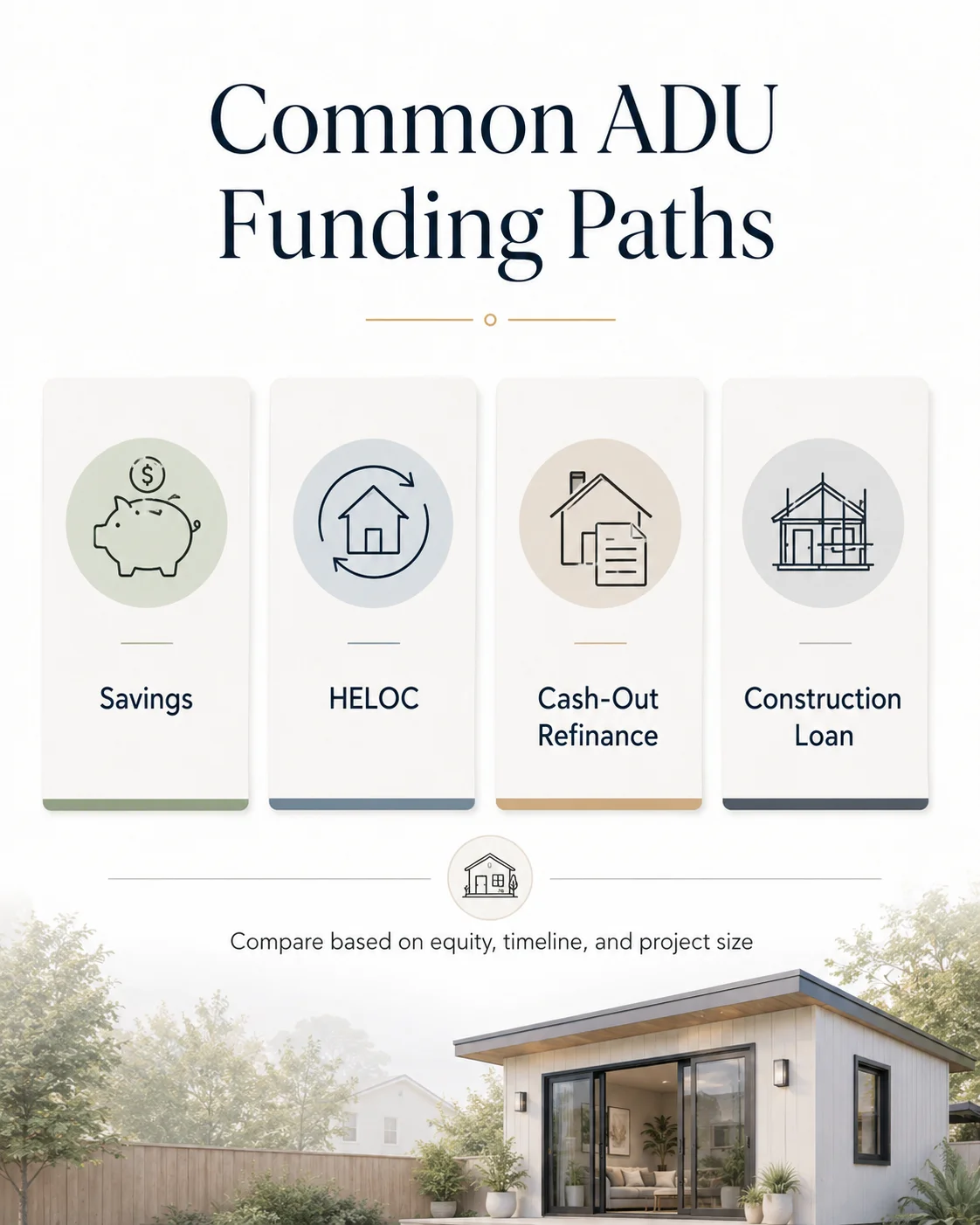
Frequently asked questions about Imperial Beach ADU laws
Can I build an ADU in Imperial Beach?
Yes. The City of Imperial Beach permits ADUs across every residential zone (R-1-6000, R-1-3800, R-3000-D, R-3000, R-2000, R-1500) and on mixed-use lots with residential use. Approximately 87 percent of the city is within the California Coastal Zone, so most homeowners will need an Administrative Coastal Development Permit alongside the building permit.
Do I need a Coastal Permit for an ADU in Imperial Beach?
You need a Coastal Development Permit if your property is in the Coastal Zone and your project is a new attached ADU, a new detached ADU, a conversion of permitted uninhabitable space (garage, storage, patio cover) into an ADU, or a garage-to-JADU conversion. The City's parcel viewer at imperialbeachca.mapgeo.io/datasets/public-access shows whether your property is in the Coastal Zone and which tier (Green, Red, or Blue) applies.
How much does an Imperial Beach Coastal Permit cost in 2026?
The City has two published amounts that conflict. The Coastal Trigger Handout (updated April 15, 2026) lists $1,050. The CDP Submittal Checklist lists $1,000 for an ADU requiring administrative approval. Most third-party websites still quote $600, which is outdated. Verify the actual fee with the City's Community Development counter before payment. For oceanfront properties, add a $1,200 starting deposit for the required coastal engineering study.
How big can an Imperial Beach ADU be?
Detached ADUs can be up to 1,200 sq ft. Conversion ADUs can be up to 1,200 sq ft. JADUs are capped at 500 sq ft. New construction attached ADUs are capped by the City's published page at 50 percent of the main residence or 800 sq ft, whichever is less — but state law (Gov. Code §66321) sets a protected-size floor of 850 sq ft (or 1,000 sq ft for an ADU with more than one bedroom), which preempts more restrictive local rules. Verify with IB Planning if your attached ADU design exceeds 800 sq ft.
What are the setback requirements for an Imperial Beach ADU?
Four feet on side and rear property lines. Front setbacks follow the underlying zone, with state law permitting encroachment into the front yard setback if necessary to fit a minimum 800 sq ft unit. Building-to-building separation on the same lot is 10 feet. Source: IBMC Chapter 19.66; Gov. Code §66323.
How tall can an Imperial Beach ADU be?
A detached ADU is generally capped at 16 feet, with a bump to 18 feet for ADUs within one-half mile walking distance of a major transit stop (per Public Resources Code §21155) or on lots with an existing multistory multifamily structure. Attached ADUs can be up to 25 feet or the underlying zone's height limit, whichever is lower, with no requirement to allow more than two stories. Source: Gov. Code §66321.
Does my Imperial Beach ADU need parking?
Typically no. Under Gov. Code §66322, ADUs are exempt from parking when within ½ mile of public transit, in a historic district, part of a conversion of the existing primary or accessory structure, or within one block of a car-share. Most IB lots qualify for at least one exemption. State law also bars cities from requiring replacement parking when existing parking is demolished or converted to make room for an ADU.
How long does an Imperial Beach ADU permit take?
The legal shot clocks are 60 days each for the Coastal Permit (under AB 462) and the building permit (under Gov. Code §66317), measured from receipt of a complete application. The City's Coastal Trigger Handout lists 30 calendar days from payment as the typical Coastal review window. Total project timeline from initial design to certificate of occupancy is typically 8 to 14 months in 2026, with construction (4 to 8 months) usually being the longest stage.
Can I rent my Imperial Beach ADU on Airbnb?
No. Imperial Beach Ordinance No. 2021-1204 prohibits short-term rental use of ADUs and JADUs, consistent with Gov. Code §66314's 30-day minimum rental term requirement. Long-term rentals (30 days or longer) are permitted.
Do I have to live on the property to build an Imperial Beach ADU?
For standard ADUs permitted after January 1, 2020, no — the City cannot require owner-occupancy under Gov. Code §66315. For Junior ADUs (JADUs), AB 1154 amended Gov. Code §66333 effective January 1, 2026 to require owner-occupancy only when the JADU shares a bathroom with the primary dwelling. A JADU with its own bathroom no longer triggers owner-occupancy.
Can I sell my Imperial Beach ADU as a separate condo?
California's AB 1033 allows cities and counties to opt in to separate-conveyance ordinances. Verified opt-in jurisdictions nearby include San Diego County (effective April 4, 2026 in unincorporated areas). Imperial Beach has not, to our knowledge, adopted a separate-conveyance ordinance — verify with IB Planning directly before designing around this exit strategy.
What if I already have an unpermitted ADU?
AB 2533 (effective January 1, 2025, codified at Gov. Code §66311.7 after SB 543's renumbering) provides a legalization path for unpermitted ADUs and JADUs built before January 1, 2020. The City cannot deny your legalization permit unless the unit fails actual habitability standards under Health and Safety Code §17920.3. You can hire a licensed contractor for a confidential pre-inspection before applying. Industry-reported legalization costs commonly run $15,000 to $50,000; processing usually takes 60 to 90 days.
Related guides
Get the Imperial Beach ADU Starter Kit
Our free checklist covers Coastal Zone check, fee estimator steps, pre-approved plan download, school-fee verification, and builder comparison questions — everything you need before your first City call.
Get Your Free ADU Report →Ready to see what you can build?
Enter your Imperial Beach address and get your zone, your Coastal Zone tier, and a realistic permit-fee estimate in 60 seconds — free, no signup required.
See What You Can Build → Get Your Free ADU Report