
By The Dwelling Index Editorial Team · Published · Updated
Coronado Coastal Zone ADU Rules, Fees & Permits: The Complete 2026 Guide
Bottom line: Yes, you can build a Coronado coastal zone ADU. Every property in Coronado sits inside the California Coastal Zone, but Coronado’s Local Coastal Program has been certified by the California Coastal Commission since December 1983 — which means you do not file a separate Coastal Development Permit (CDP) for a qualifying ADU. Coastal review is integrated into the standard ministerial ADU permit. Under AB 462 (effective October 10, 2025) and California Government Code § 66329, that combined review must be approved or denied within 60 days of a complete application, runs concurrently with the city’s land-use review, requires no public hearing, and the local coastal permit decision is not appealable to the Coastal Commission under Public Resources Code § 30603. Coronado is one of the most favorable coastal-zone cities in California for an ADU. The friction is in the local details — Coronado’s one-parking-space-per-ADU rule (unusual statewide), the Beach Overlay Zone, the Coastal Bluff Overlay, and the architectural-compatibility requirement under Coronado Municipal Code § 86.56.105.B.13. We decode all of it below.
Quick numbers for a typical Coronado ADU in 2026: 850 sq ft maximum for a studio or 1-bedroom, 1,000 sq ft for 2+ bedrooms, 4-foot side and rear setbacks, 16-foot height (18 ft within ½ mile of qualifying transit), one parking space required, six-month minimum rental term, no short-term rentals, all-in cost roughly $280,000 to $620,000 depending on size and type, and permit fees in the $1,346 to $9,702 range based on real issued-permit records the city published between January 2025 and April 2026.
See What Your Coronado Lot Can Support → Get Your Free ADU ReportNo credit card. No email required to see your result.
This guide is the coastal-permit and state-law feasibility companion to our Best ADU Builders in Coronado comparison. If you already know the rules and you’re choosing a builder, that’s the page you want. If you’re trying to figure out whether your specific lot supports an ADU and what the permit path looks like, you’re in the right place.
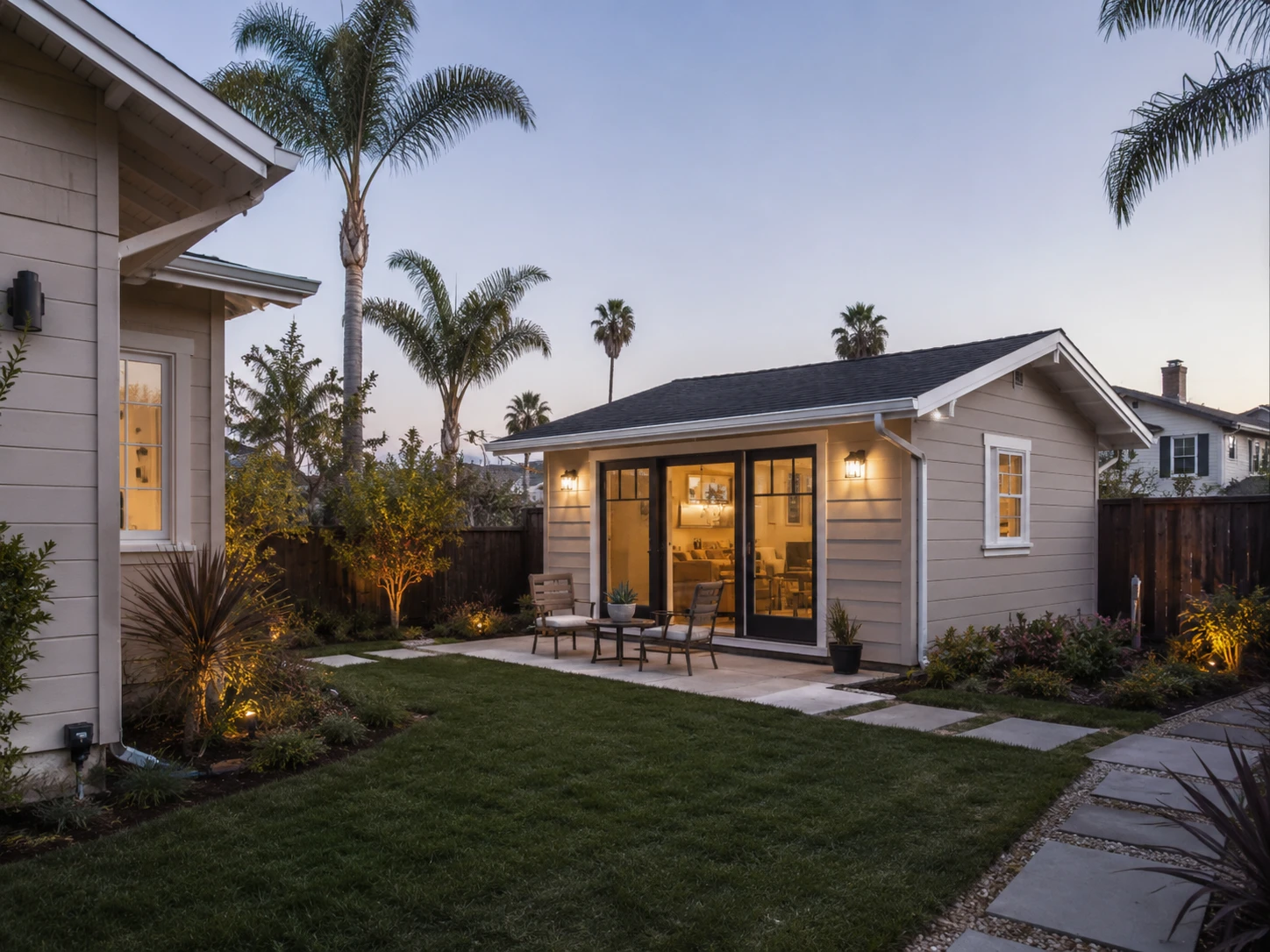
Coronado coastal ADU rules at a glance
This first-scroll table gives you the entire decision in 60 seconds. Every row cites the controlling code, statute, or city document. Scroll past it for the plain-English decoding.
| Question | Fast answer | Controlling source | What you should do |
|---|---|---|---|
| Is Coronado in the California Coastal Zone? | Yes — all of it. | CMC 86.56.105.A.2 | Assume coastal-zone status for every Coronado parcel |
| Are ADUs allowed? | Yes, on qualifying residential lots | Cal. Gov. Code §§66310–66342 | Check your zone and overlay status first |
| Does coastal review apply? | Yes, integrated into the regular ADU permit because Coronado has a certified LCP | CMC 86.56.105.A.2; CCC LCP certification (Dec 1983) | No separate CDP filing for qualifying ADUs |
| Public hearing for the ADU coastal permit? | No | Cal. Gov. Code §66329 | Skip Planning Commission anxiety |
| Decision timeline? | 15 business days to confirm completeness, then 60 days to approve or deny a complete application | Cal. Gov. Code §§66317, 66329 | Plan submittal date with this in mind |
| Coastal Commission appeal of the ADU permit? | No — local coastal permit decision is nonappealable under PRC §30603 for qualifying ADUs | AB 462 (Ch. 491, Stats. 2025); Cal. Gov. Code §66329 | Decision is final at the city level |
| Maximum ADU size | 850 sq ft studio/1BR; 1,000 sq ft for 2+BR; state law guarantees an 800 sq ft baseline ADU | CMC 86.56.105.B.7; Cal. Gov. Code §66321 | Use the state-protected 800 sq ft floor if local cap blocks your plan |
| Minimum setbacks | 4 ft side and rear, or zone standard, whichever is less | CMC 86.56.105 | Plus overlays (Beach, Bluff) if applicable |
| Height | 16 ft (4-ft setback path); 18 ft within ½ mile of qualifying transit; attached can match primary | Cal. Gov. Code §66321 | – |
| Parking | 1 space per ADU under Coronado’s LCP. 0 for JADUs. 0 for affordable deed-restricted ADUs | CMC 86.56.105.B.12 | Plan space early; consider the deed-restriction exemption |
| Short-term rentals? | Not allowed. Minimum 6-month tenancy locally; state law requires terms longer than 30 days | CMC 86.56.105; Cal. Gov. Code §§66323, 66333 | Plan for long-term tenant only |
| Sell the ADU separately? | Not yet. Coronado has not opted in to AB 1033 | AB 1033 (Ch. 752, Stats. 2023) | Stay tuned; monitor council agendas |
| Coastal Permit fee (separate, when triggered for non-ADU work) | $4,301 standard; $1,479 with other permits; $875 exemption | City of Coronado Planning Fee Schedule, effective July 1, 2025 | Recheck on or after July 1, 2026 |
| Realistic permit-issued cost (real records) | $1,346 to $9,702 across 7 ADUs in 2025–2026 | City of Coronado issued-permit reports | See the permit data table below |
| All-in build cost (2026, stick-built) | $375–$600 per sq ft | SnapADU 2026 pricing; CCCI Jan 2021–Dec 2025 | Get a fixed-price quote before submittal |
| Typical applied-to-issued span | 57 to 240 days across issued records | City of Coronado issued-permit reports | The 60-day clock is statutory; the calendar is real-world |
What we verified. This guide pulls from primary sources only: Coronado Municipal Code § 86.56.105 (current through Ordinance 2025-10, passed Nov 18, 2025); Coronado’s Planning Fee Schedule, effective July 1, 2025; Coronado’s monthly issued-permit reports (January 2025 through April 2026); California Government Code §§ 66310–66342; California Civil Code § 4751; California Coastal Commission LCP certification (Coronado, December 1983); AB 462 (Ch. 491, Stats. 2025), SB 1077 (Ch. 454, Stats. 2024), SB 1211 (Ch. 770, Stats. 2024), SB 543 (Ch. 520, Stats. 2025), AB 1154 (Ch. 519, Stats. 2025), SB 9 (Arreguín, 2025), AB 1033 (Ch. 752, Stats. 2023), AB 976 (Ch. 751, Stats. 2023); HCD findings letter to City of Coronado dated December 10, 2025; HCD ADU Handbook (March 2026 update); the California Coastal Commission’s SB 1077 Draft Guidance (released April 13, 2026; public workshop held May 13, 2026; final guidance due no later than July 1, 2026); CalHFA ADU Grant Program page; and Rentometer 92118 (data as of May 4, 2026). Items we could not verify in a primary source on the verification date are flagged [NEEDS VERIFICATION] in the text. We re-verify quarterly and after any signed bill or ordinance change. Send corrections to editor@dwellingindex.com.
Last verified by source type. State statutes: May 14, 2026. Coronado Municipal Code: May 14, 2026 (current through Ord. 2025-10, Nov 18, 2025). Coronado Planning Fee Schedule: May 14, 2026 (next scheduled annual adjustment: July 1, 2026). HCD findings status: May 14, 2026 [NEEDS VERIFICATION]. Issued-permit records: April 2026 (latest monthly report). SB 1077 guidance: May 14, 2026 (final guidance pending; due no later than July 1, 2026). Rental comps: May 4, 2026.
See what your specific Coronado lot can support — in 60 seconds.
We check your address against zoning, the Beach Overlay, the Coastal Bluff Overlay, and the latest 2026 state-law standards, and return a max-size estimate, expected timeline, and realistic cost band.
Get Your Free Coronado ADU Feasibility Report →No credit card. No email required to see your result. Parcel-specific.
Is every Coronado property a coastal-zone ADU project?
What “coastal zone” actually means matters more than the label. It does not mean ADUs are banned, slow, or contested. It means three legal frameworks attach to your project simultaneously: the California Coastal Act of 1976, the City of Coronado’s certified Local Coastal Program (LCP) — first approved by the Coastal Commission in December 1983 — and California’s statewide ADU statutes (Government Code Chapter 13, §§ 66310–66342).
Coronado’s coastal status is, paradoxically, good news. Cities without a certified LCP must process Coastal Development Permits separately, sometimes through the California Coastal Commission directly, with public hearings and the possibility of appeals that have historically added six to eighteen months to coastal ADU timelines. Coronado certified its LCP 42 years ago and has held local coastal permit authority since 1984. The city handles its own coastal review, and that review is now woven directly into the standard ministerial ADU permit.
The neighborhood reality
Coronado is comprised of four distinct residential areas, and each interacts with coastal rules differently:
- The Village — the main residential and commercial core, predominantly R-1A and R-1A subzones. Most parcels are not subject to Beach Overlay or Coastal Bluff Overlay constraints. ADU-friendly in most cases.
- The Cays — the planned community south of the Village along the Silver Strand, governed by R-PCD zoning and the Coronado Cays Homeowners Association plus several sub-association rulebooks. State ADU law preempts HOA bans under Civil Code § 4751, but reasonable design review applies.
- The Shores — the high-rise oceanfront condominium complexes near Hotel del Coronado. Structurally condominiums on common-area land, not single-family lots; most Shores units do not have a practical ADU pathway.
- Bayfront and Uptown — bay-adjacent and near Orange Avenue, predominantly R-1A(BF), R-1A subzones, and some R-3/R-4 along Orange Avenue Corridor Specific Plan parcels. The Ferry Landing area is part of Uptown/Bayside.
If you own a typical Village R-1A home not on an oceanfront block, your project will most likely process under standard Coronado ADU rules with no Beach Overlay or Coastal Bluff Overlay impact.
Do Coronado coastal zone ADUs need a Coastal Development Permit?
This is one of the most misunderstood rules in California ADU law. Many older online sources, generic “California coastal zone ADU” articles, and even some local builder pages still describe a multi-month, multi-hearing CDP process. That process exists for some non-ADU coastal work, but it has not applied to ADUs in Coronado in practice for years, and AB 462 closed the door on it definitively in October 2025.
What changed on October 10, 2025
AB 462 (Ch. 491, Stats. 2025) was signed by Governor Newsom on October 10, 2025 and took immediate effect as an urgency statute. Three changes matter most for Coronado homeowners:
- Concurrent review. Local agencies cannot run the coastal review after the land-use review. The two clocks tick together.
- 60-day decision requirement. From a complete application, the city has 60 days to approve or deny the local coastal permit for the ADU. Government Code § 66317 contains the 60-day deemed-approved framework for complete ADU applications — these two clocks now run together rather than sequentially.
- No Coastal Commission appeal of the local decision. Before AB 462, third parties could appeal a city’s coastal ADU approval to the Commission, sometimes adding six to twelve months. AB 462 made the local coastal permit decision for a qualifying ADU nonappealable to the Commission under PRC § 30603.
Old generic coastal handout vs current ADU-specific state law
Coronado publishes a general Coastal Permit handout (Handout 710) that describes the traditional CDP process for non-ADU coastal projects. That handout is not the rulebook for your ADU. Here’s the reconciliation:
| Issue | Coronado’s general coastal handout (Handout 710) | What actually applies to an ADU in 2026 |
|---|---|---|
| Decision body | Planning Commission may review and decide | No public hearing required for ADU coastal permits (Gov. Code §66329) |
| Completeness review | 30 days for general coastal permits | 15 business days for ADUs (Gov. Code §66317) |
| Total review timeline | About 3 months for a standard coastal permit | 60 days from complete application for the integrated ADU coastal permit (Gov. Code §66329) |
| Appeal | General coastal decisions may be appealable to the Coastal Commission | No appeal to the Coastal Commission for the qualifying ADU permit decision (AB 462; PRC §30603) |
| Application type | Standalone Coastal Permit application | Integrated into the standard ADU permit application — no separate filing |
When a separate CDP could still come up
There are narrow scenarios where a separate CDP becomes relevant. None of them apply to most ADU projects. Examples:
- The ADU project includes non-ADU coastal work such as a new seawall, retaining wall on a coastal bluff, significant vegetation removal near the bluff, or grading that exceeds the ADU footprint.
- The lot is on or near an active coastal bluff and the project triggers the Coastal Bluff Overlay’s geotechnical requirements (separate from the ADU permit itself).
- The lot is between the ocean and the first public roadway and the proposed ADU placement would impede a designated public-view corridor (the Beach Overlay rule).
In each of these scenarios, the ADU itself still follows the integrated path — the ancillary work is what triggers a separate review. If you’re not sure whether your project triggers one of these, Coronado Planning will tell you in pre-application screening.
Now that the coastal-permit anxiety is resolved, the next question is what your specific lot can hold.
Run the Free Coronado ADU Feasibility Check →Five minutes, parcel-specific, no commitment.
The three-overlay decision tree: which Coronado coastal rules apply to your lot?
Your decision tree, in one table
| Your scenario | Base zone? | Beach Overlay? | Bluff Overlay? | Net effect on your ADU |
|---|---|---|---|---|
| Inland Village lot, not near ocean or bluff | Yes (R-1A typical) | No | No | Standard 4-ft setbacks; LCP-integrated permit; most common Coronado case |
| Lot between the ocean and the first public roadway | Yes | Yes | Maybe | Beach Overlay imposes street-yard setback to protect public ocean view (CMC 86.56.105) |
| Lot on or near an identified coastal bluff | Yes | Maybe | Yes | Bluff-edge setback applies; geotechnical report typically required |
| Coronado Cays (R-PCD) | Yes (R-PCD) | No (bay-side, not ocean-fronting) | No | HOA architectural review applies on top of city permit |
| Coronado Shores (R-5 high-rise condos) | Yes (R-5) | Likely | No (flat shore) | Structurally condos; most Shores units do not have a practical ADU pathway |
| Silver Strand bayside / Bayfront R-1A(BF) lot | Yes (R-1A(BF), 7,500 sf MLS) | No (bay-side) | No | Standard ADU process; design-compatibility scrutiny higher because of bay views |
| Carriage-house or existing accessory structure conversion | Yes (any zone) | Per parcel | Per parcel | Conversion ADUs follow §66323 ministerial path; reduced sitework |
Source: City of Coronado Zoning Map; CMC 86.56.105 references to the Beach Overlay and Coastal Bluff Overlay; Cal. Gov. Code § 66323. Verified May 14, 2026. Confirm overlay status for your specific parcel with Coronado Planning before designing.
Base zoning: what your zone designation tells you
Coronado has eight residential zone families. Most ADUs are built in R-1A and its subzones. Minimum lot size (MLS) does not bar you from building an ADU — Cal. Gov. Code § 66322 prohibits cities from imposing minimum lot size as a barrier to ADUs. Your zone tells you what your neighborhood looks like and what FAR (floor-area ratio) constraints apply to additions beyond the baseline ADU.
| Zone | Density | Minimum lot size | Where you’ll find it |
|---|---|---|---|
| R-1A | 8 DU/AC | 5,500 sf | Most of the Village |
| R-1A(E) | 8 DU/AC | 5,250 sf | Specific Village blocks |
| R-1A(BF) | 6 DU/AC | 7,500 sf | Bayfront lots |
| R-1A(CC-1) | 6 DU/AC | 7,500 sf | Country Club area |
| R-1A(CC-2) | 6.5 DU/AC | 6,600 sf | Country Club area |
| R-1A(CC-3) | 7 DU/AC | 6,000 sf | Country Club area |
| R-1B | 12 DU/AC | 3,500 sf | “Long-tall-narrow” lots in the Village |
| R-3 | 28 DU/AC | 3,500 sf | Apartment / townhome zones |
| R-4 | 40 DU/AC | 3,500 sf | Orange Avenue Corridor Specific Plan |
| R-5 | 47 DU/AC | n/a | Coronado Shores |
| R-PCD | Per plan | n/a | Coronado Cays |
Source: City of Coronado Zoning Map; CMC 86.08.100; verified May 14, 2026.
The Beach Overlay Zone, decoded
CMC 86.56.105 references a Beach Overlay (sometimes called the “Beach reservation” or “Initiative setback”) that affects properties between the Pacific Ocean and the first public roadway running parallel to the coast. The rule’s purpose is to preserve public scenic views of the ocean. Properties subject to it must comply with the street-yard setback of the applicable zone where necessary to protect public views.
In practical terms, if you live on the ocean side of Ocean Boulevard between the dunes and the first cross-street, the Beach Overlay can determine where your ADU can sit. Owners in this category should expect their detached-ADU placement to be evaluated against view-corridor preservation. Pre-application consultation with Coronado Planning is essentially required for these parcels.
The Coastal Bluff Overlay Zone, decoded
The Coastal Bluff Overlay applies to lots on or near an identified coastal bluff. Coronado is largely flat, so this affects a relatively small number of parcels. When it does apply, the rules are serious: a bluff-edge setback is required regardless of the 4-foot baseline, a site-specific geotechnical report is typically required, and bluff stability factors of safety (commonly 1.5 static / 1.1 seismic in California coastal practice) must be demonstrated for the economic life of the structure. If you suspect your property is in or near the Coastal Bluff Overlay, do not commit to a detached-ADU concept until a geotechnical assessment confirms placement is feasible.
Lot-size minimums don’t bar your ADU
Coronado’s zone-specific minimum lot sizes (5,500 sf in R-1A, 3,500 sf in R-1B, etc.) do not gate ADU eligibility. Cal. Gov. Code § 66322 prohibits cities from using minimum lot size as a barrier to ADUs. The minimums in the zoning table above describe what your lot is, not whether you can build an ADU on it.
How big and tall can a Coronado ADU be?
Size rules, decoded
| Path | What it means | Where it comes from |
|---|---|---|
| 800 sq ft state-protected ADU | Coronado cannot use lot coverage, FAR, open space, front setbacks, or size to prevent an 800 sq ft ADU at 16 ft tall with 4-ft side/rear setbacks. This is the floor — every Coronado lot must allow at least this. | Cal. Gov. Code §66321; CMC 86.56.105.B.3.c |
| 850 sq ft minimum cap floor | If Coronado sets a maximum size, it cannot be less than 850 sq ft for a studio or 1BR. | Cal. Gov. Code §66321 |
| 1,000 sq ft minimum cap floor for multi-bedroom | The cap cannot be less than 1,000 sq ft for an ADU with two or more bedrooms. | Cal. Gov. Code §66321 |
| 1,200 sq ft regular local maximum | State law allows cities to allow ADUs up to 1,200 sq ft. Coronado currently caps at 850/1,000 sq ft. | Cal. Gov. Code §66314 |
The HCD findings letter and the size-cap caveat
On December 10, 2025, the California Department of Housing and Community Development (HCD) sent the City of Coronado a written findings letter on Ordinance 2024-02 (the most recent amendment to CMC 86.56.105). HCD found that Coronado’s ordinance does not comply with state ADU law in 20+ specific provisions. One of HCD’s findings: the 850/1,000 sq ft maximum cap cannot lawfully apply to three of the four ADU categories defined in Government Code § 66323(a) — the statutorily mandatory ministerial ADU categories that include certain conversions and multifamily-conversion ADUs.
Under Government Code § 66326, Coronado had up to 30 days to respond to HCD’s findings; Coronado’s response deadline was January 9, 2026. The current status of Coronado’s response and any amended ordinance is [NEEDS VERIFICATION] — confirm via the HCD Technical Assistance and Enforcement Letters Dashboard and Coronado City Council agendas before relying on a particular outcome. CMC 86.56.105.G contains an explicit conflict-with-state-law override: “To the extent that any provision of this section is in conflict with State law, the applicable provision of State law shall control, but all other provisions of this section shall remain in full force and effect.”
Height rules
| ADU configuration | State-law height baseline |
|---|---|
| Detached ADU (4-ft setback path) | 16 ft |
| Detached ADU within ½ mile of major transit / high-quality transit corridor | 18 ft (with up to 2 additional ft to match roof pitch) |
| Attached ADU | Up to 25 ft or the local primary-dwelling height limit, whichever is lower; not exceeding two stories |
| ADU in Coastal Bluff Overlay | Subject to bluff setback regardless; height generally still capped at 16 ft for the baseline path |
| ADU in Beach Overlay (oceanfront) | Subject to view-corridor preservation; height generally still capped |
Source: Cal. Gov. Code § 66321 (as amended).
Junior ADUs (JADUs)
A JADU is a small accessory dwelling built within the walls of an existing or proposed single-family home (or its attached garage). JADUs are capped at 500 sq ft, must have their own exterior entrance, and must contain an “efficiency kitchen.” Under AB 1154, effective January 1, 2026 (codified at Cal. Gov. Code § 66333), owner-occupancy may be required only if the JADU shares a sanitation facility with the primary dwelling. You can pair a JADU with a detached ADU on the same single-family lot.
Coronado ADU rules in detail: setbacks, parking, design, and rentals
Coronado ADU rules in one table
| Rule | Coronado standard | Code section | 2026 status |
|---|---|---|---|
| Where allowed | R-1A, R-1A subzones, R-1B, R-3, R-4, R-5, R-PCD residential zones; must be accessory to existing or proposed primary residence | CMC 86.56.105.B.1; 86.06 | Cannot build on vacant lot |
| ADU count per single-family lot | Per Cal. Gov. Code §66323 statutorily mandatory categories; combinations of detached ADU + JADU + converted-space ADU may be available depending on which §66323 category each unit qualifies under | CMC 86.56.105.B.5; HCD Handbook 2026 | Coronado’s prior interpretation was narrower; HCD flagged this in Dec 2025 letter |
| Maximum ADU size | 850 sf studio/1BR; 1,000 sf 2+BR | CMC 86.56.105.B.7 | HCD found this cap cannot apply to three of four Gov. Code §66323(a) categories |
| Maximum JADU size | 500 sf | CMC 86.56.105; Gov. Code §66333 | – |
| Baseline-ADU exception | At least 800 sf detached or attached, 16 ft tall, 4-ft side/rear must always be allowed even if it busts lot coverage / FAR / open space / front setback | CMC 86.56.105.B.3.c | “No feasible alternative” test in CMC was flagged by HCD as potentially over-restrictive |
| Side/rear setback | 4 ft minimum or zone standard, whichever is less | CMC 86.56.105 | Plus coastal bluff setback if in Bluff Overlay |
| Front setback | No setback for ADUs (per Sept 2022 state law) | – | Beach Overlay applies street-yard setback if between ocean and 1st public roadway |
| Height | 16 ft on 4-ft setback path; 18 ft if within ½ mile of major transit; matches primary dwelling for attached | CMC 86.56.105; Cal. Gov. Code §66321 | – |
| Parking | 1 space per ADU; 0 for JADU; 0 for affordable deed-restricted ADU | CMC 86.56.105.B.12 | State law bars replacement parking when a garage or covered parking is demolished or converted for an ADU |
| Architectural compatibility | ADU must match primary dwelling’s style, materials, colors, equal or superior quality | CMC 86.56.105.B.13 | HCD flagged subjective standards as unenforceable on Gov. Code §66323 ADUs |
| Rental term | Minimum 6 consecutive months under city rules | CMC 86.56.105 | State law requires terms longer than 30 days under §§66323 and 66333; Coronado’s six-month rule has been flagged by HCD |
| Short-term rental | Prohibited for both ADU and JADU | CMC 86.56.105 + city STR ordinance | – |
| Separate sale of ADU | Not permitted (Coronado has not opted in to AB 1033) | – | AB 1033 (2023) is opt-in; Coronado has not opted in |
| Application submittal | In-person at Community Development Department | City Handout 721 | No digital application portal as of May 2026 |
| Owner occupancy (ADU) | Not required for any ADU permitted after Jan 1, 2020 | Cal. Gov. Code §66315; AB 976 | Permanent |
| Owner occupancy (JADU) | Required only if JADU shares sanitation with primary dwelling; not required for separate-bath JADUs or for lots owned by a governmental agency, land trust, or housing organization | Cal. Gov. Code §66333; AB 1154 | Effective Jan 1, 2026 |
| Multifamily ADU stacking | Up to 8 detached ADUs on a lot with an existing multifamily dwelling, capped at the number of existing dwelling units on the lot | Cal. Gov. Code §66323; SB 1211 | Effective Jan 1, 2025 |
The parking exception that nobody talks about
CMC 86.56.105.B.12.a contains a quiet but powerful provision: no parking is required for an ADU “deed restricted to be affordable to low, very low, and extremely low income households.” If you’re willing to record a deed restriction making the ADU affordable for a defined term (typically 15+ years), Coronado’s one-parking-space rule goes away entirely. This matters on tight Village lots where finding space for one car is what’s killing the project.
Separately, state law (Cal. Gov. Code § 66314) prohibits replacement parking requirements when a garage, carport, or covered parking is demolished or converted to construct an ADU. Cal. Gov. Code § 66322 lists specific circumstances where ADU parking standards may not be imposed at all — proximity to public transit, location in a historic district, and certain conversion scenarios among them.
Why prefab is hard in Coronado
The architectural-compatibility requirement in CMC 86.56.105.B.13 — “the same architectural style, exterior materials, and colors as the existing or proposed primary dwelling, ensuring materials used are of equal or superior quality” — is the rule that makes prefab and modular ADUs impractical in most Coronado scenarios. A modern shipping-container ADU or a generic prefab cottage placed behind a 1920s Spanish Revival house will not pass design review. Stick-built design-build is the practical default.
Beyond the design rule, Coronado’s logistics compound the problem. The entire city is reached via a single bridge (the Coronado Bay Bridge) or a single isthmus road (State Route 75 / Silver Strand). Crane and oversize-load access for a fully-built modular module is constrained in ways that inland California cities don’t experience. Modular delivery is doable but adds permitting and traffic-control coordination cost on top of the design-compatibility hurdle.
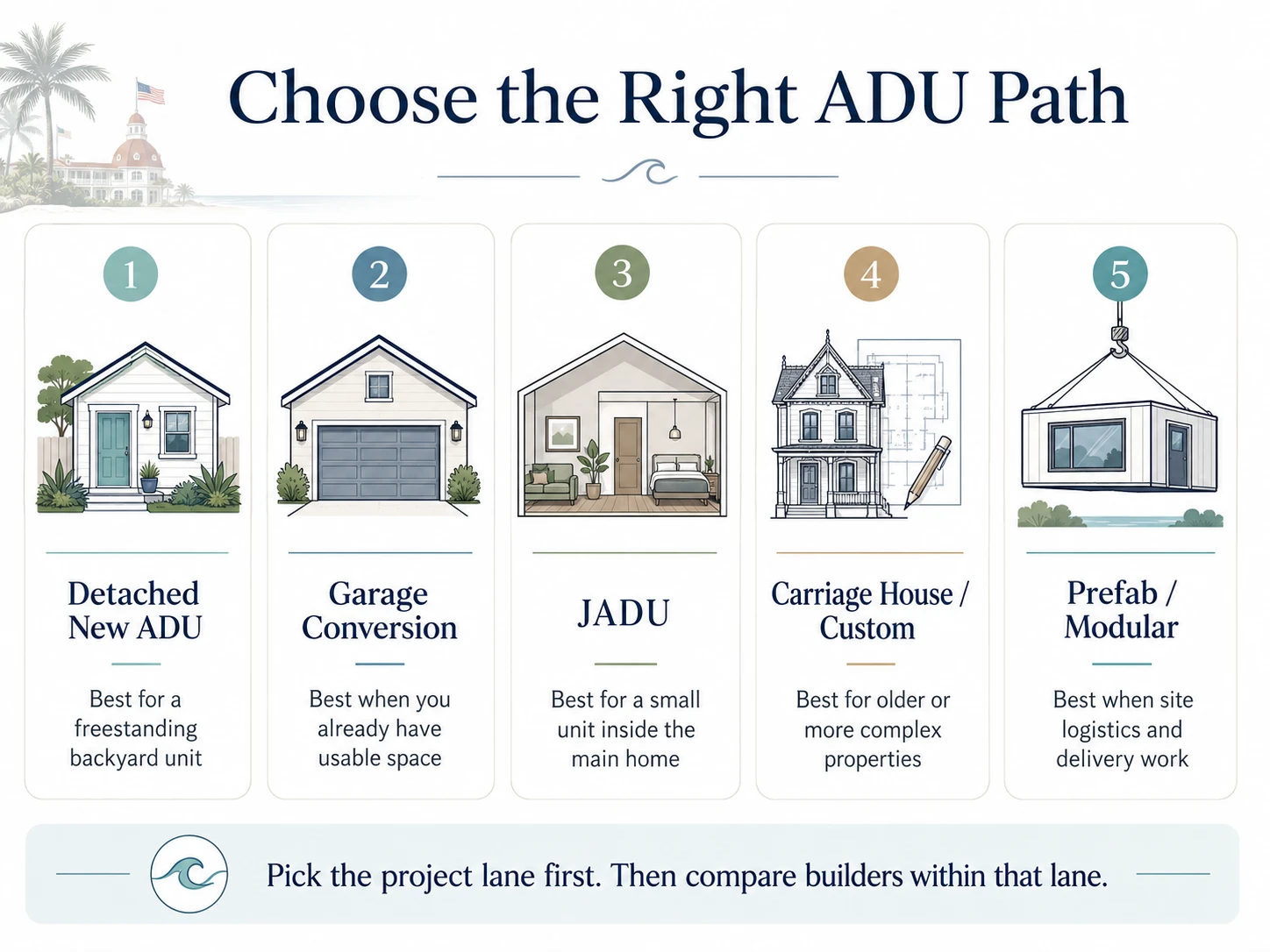
Which ADU type is easiest to build in Coronado?
ADU type comparison, Coronado-specific
| ADU type | Best fit | Cost range (2026) | Coronado-specific friction | Controlling source |
|---|---|---|---|---|
| JADU (≤500 sf, inside primary home) | Lower-cost family housing or modest rental | $50K–$120K | Owner-occupancy if shared sanitation; kitchen layout in older Coronado homes | CMC 86.56.105; Gov. Code §66333 |
| Garage conversion | Existing useful structure with separate access | $140K–$220K | Replacement parking for primary, structural upgrades, sometimes alley access in Village R-1B lots | CMC 86.56.105.B.12; Gov. Code §66323 |
| Detached new construction | Privacy, rental flexibility, full bedroom count | $280K–$620K | Sitework, utility trenching, design compatibility (CMC 86.56.105.B.13), FAR | Most of the issued-permit records |
| Attached new construction | Larger primary-home lots; better integration | $250K–$520K | Fire separation, height/massing match, FAR | CMC 86.56.105 |
| Carriage-house conversion | Older Coronado lots with existing carriage structures (common in pre-1940s Village blocks) | $180K–$350K | Legal existing status, habitability, historic considerations | CMC 86.56.105.B.12.e |
| Multifamily ADU (R-3/R-4/R-5 lots) | Apartment/condo property owners; up to 8 per SB 1211 | Per-unit similar to detached | Common-area constraints, HOA, §66323 category fit | Gov. Code §66323; SB 1211 |
The conversion ADU advantage in Coronado
Conversion ADUs — taking existing space (a garage, a basement, a storage room) and converting it to a dwelling — have several Coronado-specific advantages:
- No design-compatibility issue because you’re working within the existing envelope.
- No sitework or utility-trenching expense if utilities are already in place.
- Faster permit path because there’s less to review.
- No replacement parking for the ADU itself under SB 1211 (Jan 2025); only displaced primary-home parking has to be replaced under Coronado’s LCP rule.
- Gov. Code § 66323 mandates ministerial approval for several conversion categories without local agencies imposing additional discretionary standards.
Carriage-house conversions: a Coronado specialty
Pre-1940 Coronado Village blocks often have detached “carriage houses” — separate accessory structures originally used for horses and carriages, then for cars and storage. CMC 86.56.105.B.12.e references carriage-house conversions explicitly. If your primary home has a legally permitted existing carriage-house structure, converting it to an ADU is often the lowest-friction path: existing footprint, no design-compatibility argument, and no sitework. Verify the structure’s permit history before designing.
Why multifamily owners should look hard at SB 1211
If you own an R-3, R-4, or R-5 property in Coronado (typical of apartment buildings along Orange Avenue or near the Bayfront), SB 1211 (effective January 2025) lets you add up to 8 detached ADUs on a lot with an existing multifamily dwelling — capped at the number of existing dwelling units on the lot — plus convert up to 25% of your non-livable interior space into additional ADUs. For a six-unit Coronado apartment building, that’s potentially six new detached ADUs and one or two interior conversions. The math can be transformative.
Comparing detached vs conversion vs JADU for your specific lot?
Our partner SnapADU has completed 100+ ADUs across San Diego County and publishes a dedicated Coronado regulations page. They quote design + permitting + construction together so you can lock pricing before submitting to the city.
Get Matched with a Vetted Greater San Diego Design-Build Firm →Disclosure: This is an affiliate link; we may earn a commission if you book a consultation. Our editorial recommendations are based on independent research and are never influenced by compensation.
What if you’re in Coronado Cays, Coronado Shores, or the Village?
Coronado Cays
The Cays sit south of the Village along the Silver Strand, on a series of man-made islands surrounded by the Bay. Most Cays properties are zoned R-PCD, with development governed by the original planned-community standards plus the Coronado Cays Homeowners Association CC&Rs. Under Civ. Code § 4751, the HOA cannot prohibit an ADU and cannot impose restrictions that would make construction unreasonably expensive, but the HOA can apply reasonable design standards and architectural review. Expect the Cays architectural review process to add 4 to 12 weeks to your timeline. Garage conversions are usually easier than new detached construction in the Cays because of lot constraints and dock-side orientations. Check both the master HOA rules and any sub-association rules — the Cays has multiple sub-associations with their own architectural review.
Coronado Shores
The Shores comprises ten high-rise condominium towers near Hotel del Coronado, generally zoned R-5. True condominium structures — where unit owners do not own the land, only the airspace and an undivided interest in the common area — do not have a practical ADU pathway. The common-area constraints alone usually defeat the project before zoning gets involved. If you own a Shores condo and are exploring an ADU concept, the realistic answer is that the law doesn’t help you here.
Coronado Village and Ferry Landing
The Village is the most ADU-friendly Coronado neighborhood by a wide margin. Most blocks are R-1A or R-1A subzones with no HOA layer. The Beach Overlay applies only to lots between the ocean and the first parallel public roadway. The Coastal Bluff Overlay applies to very few properties. For a Village R-1A owner not on the immediate oceanfront, the typical ADU process looks like: feasibility check → designer/builder retention → 6-to-12-week design phase → in-person submittal → 15-day completeness check → 60-day plan-check window → construction → certificate of occupancy. Six to nine months end-to-end is normal.
Silver Strand and Bayfront
Silver Strand lots and Bayfront R-1A(BF) parcels run along the south end of the city. Beach Overlay considerations may apply to ocean-side Silver Strand parcels. R-1A(BF) bayfront parcels face no Beach Overlay (the Beach Overlay protects Pacific Ocean views, not San Diego Bay views) but design review for bay-view aesthetics tends to be tighter.
Uptown and the Orange Avenue Corridor
Uptown and parcels along the Orange Avenue Corridor Specific Plan are mixed R-3/R-4 plus R-1A. R-3/R-4 owners with multiple units can stack ADUs under SB 1211. R-1A owners face standard rules. The Civic Use Overlay applies to some parcels and may add review.
What changed for Coronado coastal zone ADUs in 2025–2026
Every 2024–2026 change that matters, in one table
| Law / action | Effective | What it does | What it means for Coronado |
|---|---|---|---|
| AB 462 (Lowenthal, Ch. 491, Stats. 2025) | Oct 10, 2025 (urgency statute) | Local coastal permits for ADUs must be approved/denied in 60 days; review runs concurrently with ministerial review; no public hearing; local decision nonappealable to Coastal Commission under PRC §30603 | Locks Coronado’s already-integrated process into state law. Caps timeline. Eliminates appeal risk. |
| SB 1211 (Ch. 770, Stats. 2024) | Jan 1, 2025 | Up to 8 detached ADUs on a lot with an existing multifamily dwelling, capped at the number of existing dwelling units; no replacement parking when converting any parking space | Multifamily R-3/R-4/R-5 owners in Coronado can scale; garage-conversion path is friction-free for primary-home parking displacement |
| AB 1332 (Ch. 759, Stats. 2023) | Jan 1, 2025 | Cal. Gov. Code §65852.27 requires every local agency to develop a preapproved ADU plan program by Jan 1, 2025 and approve applications using a qualifying preapproved plan within 30 days | Coronado must have a program; whether Coronado has actually published a usable preapproved plan library is [NEEDS VERIFICATION] |
| SB 1077 (Ch. 454, Stats. 2024) | Effective Jan 1, 2025; guidance due no later than July 1, 2026 | Requires Coastal Commission + HCD to issue LCP-amendment guidance simplifying coastal ADU permitting. Draft Guidance released April 13, 2026; final guidance due no later than July 1, 2026 | Coronado already has the streamlining most other coastal cities lack; the forthcoming guidance may further refine LCP language statewide |
| SB 543 (Ch. 520, Stats. 2025) | Jan 1, 2026 | “Interior livable space” definition; 15-business-day completeness determinations; appeals process required; refined ADU-count rules; impact-fee clarifications | Coronado must amend ordinance to match — pending |
| AB 1154 (Ch. 519, Stats. 2025) | Jan 1, 2026 | JADU owner-occupancy required only if sharing sanitation with primary; not required for separate-bath JADUs or lots owned by gov agency, land trust, or housing organization | Owners with own-bathroom JADUs no longer need to live on-site |
| SB 9 (Arreguín, 2025) | Jan 1, 2026 | If a city fails to respond to HCD findings in 30 days, the ordinance is null and void → state default ADU law applies | This is what makes the Coronado HCD findings letter consequential |
| HCD findings letter to Coronado | Dec 10, 2025 | HCD found Ord. 2024-02 (CMC 86.56.105) does not comply with State ADU Law in 20+ ways. Coronado had 30 days to respond — deadline Jan 9, 2026 | Whether Coronado responded within 30 days and whether HCD has accepted/rejected/escalated that response is [NEEDS VERIFICATION] via the HCD Technical Assistance and Enforcement Letters Dashboard |
| AB 1033 (Ch. 752, Stats. 2023) | Jan 1, 2024 | Cities may opt in to allow ADUs to be sold separately as condominiums | Coronado has not opted in as of May 14, 2026 |
| AB 976 (Ch. 751, Stats. 2023) | Jan 1, 2024 | Permanently eliminated owner-occupancy requirements for standard ADUs | Coronado cannot require you to live on-site to build a standard ADU |
| HCD 2026 Handbook addendum | March 2026 | Consolidated guidance on all the above; clarified ADU/JADU stacking interpretation | Cities (including Coronado) must follow updated HCD interpretation |
What to do if you’re worried CMC 86.56.105 is partially null and void
HCD non-compliance does not automatically void Coronado’s entire ordinance. It voids the specific non-compliant provisions if Coronado failed to respond properly within the statutory window. State default ADU law (Cal. Gov. Code §§ 66310–66342) fills the gap on those provisions. CMC 86.56.105.G already builds in this override: “To the extent that any provision of this section is in conflict with State law, the applicable provision of State law shall control, but all other provisions of this section shall remain in full force and effect.” Practically: if a Coronado plan reviewer applies a rule that contradicts state ADU law (the 850 sq ft cap on a § 66323 ADU, for example), you can document the conflict, ask the reviewer to escalate, and if necessary file a complaint through HCD’s accountability process.
Want the full regulatory snapshot delivered to your inbox?
The rules, the citations, the 2026 law changes, the verification dates, and a printable pre-design checklist. We re-issue it every quarter when laws change.
Download the Free Coronado ADU Owner’s Toolkit (PDF) →What does an ADU actually cost in Coronado in 2026?
Coronado all-in cost panel for 2026
| Cost category | 400 sf garage conversion | 750 sf 1BR detached | 1,000 sf 2BR detached |
|---|---|---|---|
| Construction (vertical) | $120K–$180K | $230K–$370K | $310K–$520K |
| Design & engineering | $8K–$15K | $10K–$15K | $12K–$20K |
| Permits & plan check | $4K–$8K | $7K–$13K | $10K–$16K |
| Sitework & utilities | $5K–$15K | $20K–$40K | $25K–$50K |
| School fees (units >500 sf) | $0 | ~$3,900 (750 × $5.17/sf San Diego Unified 2025 rate) | ~$5,170 (1,000 × $5.17/sf) |
| Impact fees | $0 (≤750 sf, SB 13 + SB 543) | $0 (≤750 sf) | Proportional to primary home |
| All-in total | $140K–$220K | $280K–$450K | $370K–$620K |
Construction-cost basis: SnapADU 2026 pricing range $375–$600/sf all-in for stick-built detached ADUs in Greater San Diego (verified May 2026). The California Construction Cost Index (CCCI) rose 44% from January 2021 to December 2025, so 2020-era cost estimates are no longer reliable. Permit-fee basis: City of Coronado issued-permit reports January 2025 through April 2026. School fees: San Diego Unified School District 2025 ADU rate of $5.17 per sq ft for ADUs over 500 sq ft.
Coronado-specific cost drivers (upper end)
- Tight lots. Material staging is harder; cranes may not fit; small site access raises labor cost.
- Single-bridge access. The entire city is reached via the Coronado Bay Bridge or the Silver Strand isthmus. Material delivery costs more than equivalent inland delivery, and oversize-load delivery requires coordination with city right-of-way permits.
- Architectural compatibility scrutiny. Cannot use value-engineered modern boxes; finishes have to match an often-older primary home.
- Older homes with non-conforming utilities. Sewer laterals and electrical panels in 1920s–1960s Coronado homes are often undersized for adding a second unit. Utility upgrades alone can add $15,000–$40,000.
Coronado coastal permit fees (published fee schedule)
For standard ADUs in Coronado, you generally won’t pay a separate Coastal Permit fee because the coastal review is integrated into the ADU permit and there’s no separate filing. But for projects that include non-ADU coastal work, these are the numbers you’d see on the schedule:
| Fee item | Listed fee | Estimated processing time |
|---|---|---|
| Coastal Permit (standard) | $4,301 | 3 months |
| Coastal Permit with other permits | $1,479 | Concurrent |
| Coastal Permit Exemption | $875 | 2 weeks |
| Coastal Permit Amendment | $3,581 | Per schedule |
| Coastal Permit Appeal | $705 | 2 months |
Source: City of Coronado Planning Fee Schedule, effective July 1, 2025. The schedule is adjusted annually beginning July 1; recheck on or after July 1, 2026 before submitting your application.
Before you spend $10,000 on plans, see exactly what you can build on your lot.
Five minutes. A clear estimate of max-size ADU, overlay status, expected timeline, and realistic cost band — anchored to your actual address.
Run the Free Coronado ADU Feasibility Check →No email required to see the result.
Real Coronado ADU permit records: what actually happens
Real Coronado ADU permit records, 2025–2026
| Permit no. | Issue date | Valuation listed | Total fees listed | App to issue span | What we read into it |
|---|---|---|---|---|---|
| B2510-011 | Apr 8, 2026 | $600,000 | $9,702.68 | ~180 days | High-valuation new detached ADU; fees scale with valuation; long span reflects revision cycles, not statutory delay |
| B2507-014 | Mar 2, 2026 | $200,000 | $2,004.10 | ~228 days | Lower listed fees do not mean fast issuance — design revisions extend the calendar |
| B2506-011 | Feb 12, 2026 | $200,000 | $6,000.20 | ~240 days | Fees vary widely at similar valuations; scope-dependent |
| B2508-009 | Dec 15, 2025 | $0 listed | $4,306.45 | ~115 days | $0 valuation suggests an amendment or revision; outlier |
| B2508-005 | Aug 19, 2025 | $6,075 | $1,346.29 | Same day | Narrow/admin-style permit — likely a conversion or revision, not a full detached ADU |
| B2410-003 | Jan 2025 | $30,000 | $7,502.70 | ~95 days | Lower-valuation conversion-style project |
| B2411-009 | Jan 2025 | $276,800 | $3,790.04 | ~57 days | Hits the 60-day statutory window |
Summary statistics across these seven records: Application-to-issue span ranges from same-day to 240 days. Median: approximately 180 days. The fastest issuance hit the 60-day statutory window; the slowest reflect long revision cycles, not city delay. Listed fees ranged $1,346 to $9,702.
Source: City of Coronado monthly Permits Issued with Fees, Values and Addresses reports — January 2025 through April 2026. Records verified May 14, 2026. We anonymized addresses, contractor names, and applicant contact details; the permit numbers above are the city’s own identifiers.
Methodology and important caveat
California Government Code § 66317 requires Coronado to make a completeness determination within 15 business days of submittal and to approve or deny a complete application within 60 days. If an applicant submits incomplete plans, the 60-day clock doesn’t start until the application is complete. The 180+ day spans in our table almost certainly reflect normal back-and-forth design revisions, not the city sitting on a complete application. What this data tells you: even with a good permit, you should budget calendar time generously. Plan on 4 to 6 months from a complete, well-prepared application to a certificate of occupancy.
How long does a Coronado coastal zone ADU permit actually take?
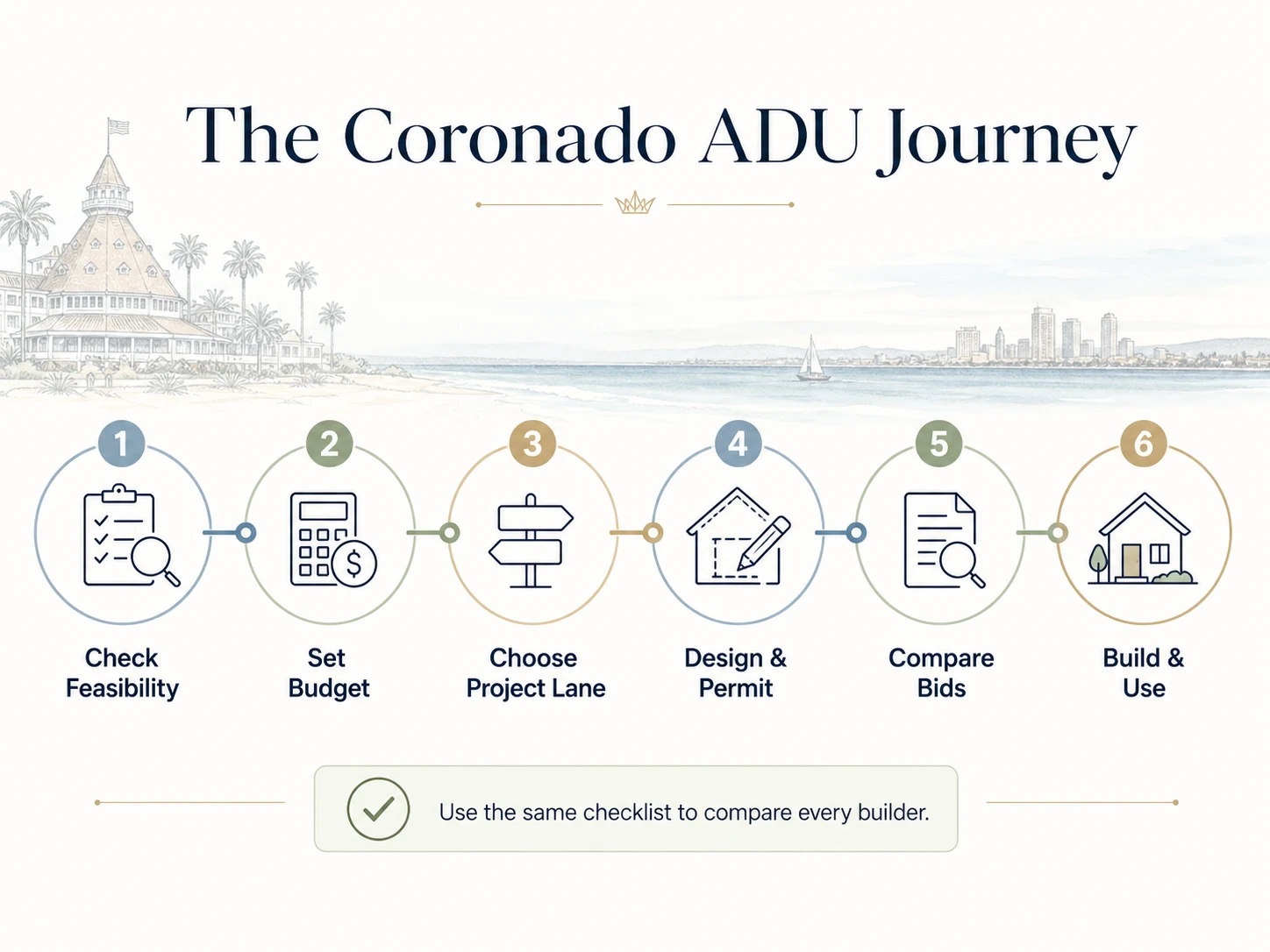
The realistic project timeline
| Phase | Typical duration |
|---|---|
| Pre-application: feasibility, survey, site investigation | 4–10 weeks |
| Design & construction documents (architecture + structural + MEP engineering) | 4–8 weeks |
| Application submittal (in-person at Coronado Community Development) | Same day |
| Completeness determination (Gov. Code §66317) | ≤15 business days |
| Plan check + corrections cycles (AB 462 caps city decision at 60 days for integrated review on a complete application) | 4–9 weeks |
| Construction | 8–20 weeks (16 weeks typical for stick-built detached) |
| Final inspection + certificate of occupancy | 1–2 weeks |
| Total project: first design call to occupancy | 6–9 months typical |
Why your specific project may take longer
- Incomplete or inconsistent application — triggers a new completeness review.
- Design revisions based on plan check comments.
- Existing unpermitted work that has to be cleared before the ADU is approved.
- Sewer lateral or electrical service upgrade required by Building or Public Works.
- Beach Overlay scrutiny on oceanfront parcels for view-corridor protection.
- Coastal Bluff Overlay geotechnical review on bluff-adjacent parcels.
- HOA architectural review in Coronado Cays — typically 4 to 12 additional weeks.
- Architectural compatibility revisions if the initial design didn’t match the primary home’s materials/style.
The “deemed approved” provision
If Coronado misses the statutory 60-day clock on a complete application, Cal. Gov. Code § 66317 provides that the application is deemed approved by operation of law. This is a real provision, but it should not be a planning strategy. The realistic expectation is that the city will act within the timeline; the “deemed approved” backstop is a legal safety valve, not a tool you bake into your project plan.
Can you rent it out — and can you sell it separately?
Long-term rental rules
CMC 86.56.105 requires Coronado ADU rentals to be for terms of six consecutive months or more. State law (§§ 66323 and 66333) sets a floor of longer than 30 days for both ADUs and JADUs. HCD has reportedly flagged Coronado’s six-month minimum as more restrictive than state law allows; whether Coronado has amended that provision is [NEEDS VERIFICATION]. Either way, vacation-rental-style use is not on the table.
Mid-term and military rentals
Coronado’s location adjacent to Naval Base Coronado creates a steady demand for furnished mid-term rentals to military personnel on temporary assignment. As long as the lease is longer than 30 days (and meets the city’s minimum-tenancy requirement), this is fully compliant. Furnished mid-term rentals typically yield 15–30% above standard long-term rates in Coronado but require higher upfront furnishing investment.
Separate sale (AB 1033 status)
AB 1033 (Chapter 752, Statutes of 2023) gave California cities the option to adopt local ordinances permitting ADUs to be sold separately from the primary residence. Coronado has not opted in as of May 14, 2026. Even when cities do opt in, separate sale comes with practical complications (condominium-style governance, separate utility metering, lender-treatment uncertainty), and the secondary mortgage market is still adapting to standalone-ADU financing.
The investment-property framing
The realistic Coronado ADU rental scenario is long-term housing for a single tenant or a small family, generating $3,000–$6,000 per month depending on size and finish. It’s not a vacation rental, it’s not a flip, and you cannot sell it separately to recoup capital quickly. These are illustrative examples, not guarantees of returns. Actual results depend on local market conditions, construction costs, financing terms, and regulatory approvals.
How are people financing ADUs in Coronado?
The three realistic financing lanes
This is path education, not a lender ranking. We never sort lenders by anything other than neutral documented criteria, and we never quote specific rates, APRs, or payments as guarantees.
1. Cash-out refinance
You refinance your primary mortgage at a new (typically higher) loan amount and take the difference in cash to fund the ADU. Single new mortgage payment. Best when your existing mortgage rate is no longer materially below current market rates and you have substantial equity. With Coronado’s median home value, even a 60% loan-to-value cash-out leaves room for $200K–$400K of construction funding for most owners.
2. HELOC or home equity loan
You leave your primary mortgage in place and borrow against equity through a second-position line of credit (HELOC) or fixed-rate second mortgage (HELOAN). Best when you have a low-rate first mortgage you don’t want to disturb. Lines typically max out at 80–90% combined loan-to-value.
3. Construction-to-permanent loan
A single closing for a construction loan that converts to a permanent mortgage at completion. Disbursements happen in draws as construction progresses. Best for new detached construction with predictable draw schedules. More paperwork than cash-out refi or HELOC but designed for new construction specifically.
CalHFA ADU Grant status (May 2026)
The California Housing Finance Agency’s ADU Grant Program offered up to $40,000 in reimbursable pre-development costs for income-qualified homeowners. Per CalHFA’s official ADU Grant page, the latest round of ADU funding has been fully allocated as of our verification date. Do not budget around this grant unless and until CalHFA announces a new funded round. Verify directly at calhfa.ca.gov before relying on it.
The information here describes financing categories, not specific loan products. Actual eligibility, rates, terms, and approval depend on your individual financial profile, the lender’s underwriting criteria, the property, and market conditions on the day you apply. We do not guarantee qualification or specific outcomes.
Want to compare specific financing options without committing?
Compare cash-out refinance, HELOC, and construction-loan options from licensed California lenders. No sales-call pressure; you control the conversation.
Explore Your ADU Financing Options through Mortgage Research Center →Disclosure: This is an affiliate link; we may earn a commission if you use it. Our recommendations are based on independent research and aren’t influenced by compensation.
Rental income realism for Coronado ADUs
Coronado rental comps (May 2026)
| Bedroom type | Rent comp range (apartment-style) | Rent comp range (house-style) |
|---|---|---|
| Studio | ~$2,500–$3,000 | n/a |
| 1BR | ~$2,800–$3,170 | ~$4,000 |
| 2BR | ~$4,000 | ~$6,000 |
| 3BR | n/a | ~$10,000 |
Source: Rentometer 92118, data as of May 4, 2026. Detached ADUs with full kitchens and private outdoor space typically rent in the house-comp range; attached or conversion ADUs in apartment-style configurations rent in the apartment-comp range. Verify directly with current Rentometer or Zillow Rental Manager data before underwriting your specific project.
Illustrative 5-year analysis on a 750 sf 1BR detached ADU
This is an illustrative example using mid-range assumptions, not a guarantee of returns.
- Build cost: $350,000 all-in (mid-range)
- Achievable rent (1BR detached, conservative house-comp): $3,400/month → $40,800/year gross
- Operating costs (utilities, maintenance reserves, vacancy at 5%, light property management at 8%): ~$8,000/year
- Net rental income: ~$32,800/year
- 5-year cumulative net rent: ~$164,000
- Property-value uplift: Comparable San Diego County data shows ADU-equipped homes selling 25–35% more than non-ADU equivalents; even a conservative 10% uplift on a $2.5M Coronado home adds $250,000 in estimated equity
These are illustrative examples, not guarantees of returns. Actual results depend on local market conditions, construction costs, financing terms, vacancy, and regulatory approvals. Property-value uplift is highly site-specific and not realized until sale.
The realistic Coronado rental yield
On a $350K build, $32,800 net rental income is roughly a 9% cash-on-cash return — solid for residential real estate, comparable to or exceeding typical San Diego rental property yields. The bigger driver of Coronado ADU ROI, however, is the property-value uplift on an already-expensive primary home, which is realized at sale rather than annually.
If your goal is rental income management at scale (multiple units, dedicated bookkeeping, tenant screening), property-management software like Buildium is built for landlords and small portfolios. (Disclosure: Buildium is one of our affiliate partners; we may earn a commission if you subscribe through our links. Editorial recommendations are based on independent research and aren’t influenced by compensation.)
The four real downsides of building an ADU in Coronado
We include this section because the most damaging thing a guide like this can do is hide friction. Honest negative handling builds trust.
1. One parking space per ADU is non-negotiable in most cases
Most California coastal cities waived ADU parking requirements between 2021 and 2024 as state law evolved. Coronado kept the one-parking-space rule under its certified Local Coastal Program because Coronado has 2 million+ annual visitors and limited on-street parking is a coastal-access concern. On a tight Village lot, finding space for one car can constrain your design or eliminate the project entirely.
The way out: CMC 86.56.105.B.12.a exempts ADUs deed-restricted as affordable to low, very-low, or extremely-low income households from the parking requirement entirely. If you’re willing to deed-restrict (typically a 15+ year affordability covenant), the parking rule disappears. Separately, Cal. Gov. Code § 66322 prohibits ADU parking requirements when the property is within ½ mile walking distance of public transit, in a historic district, or in certain conversion scenarios — those state-law exemptions apply in Coronado too.
2. In-person submittal
As of May 2026, Coronado does not accept digital ADU permit applications. You file in person at the Community Development Department. This adds at least one in-person trip — typically several, when you account for revisions. If you’re an out-of-area owner buying Coronado property specifically to add an ADU, plan for multiple visits or engage a local designer/contractor who handles submittal on your behalf.
3. Architectural-compatibility scrutiny
CMC 86.56.105.B.13 requires ADUs to match the primary dwelling in architectural style, exterior materials, colors, and quality. HCD has flagged the subjective elements of this rule as potentially unenforceable on statutory ministerial ADU categories (Cal. Gov. Code § 66323), but in practice the city still applies it.
What this means in practice: prefab and modular ADUs that look distinct from the primary home — modern boxes, container-style units, generic cottages — face design-review pushback. Custom stick-built ADUs designed to match the primary home’s style sail through. Coronado is one of the few California markets where the design-compatibility cost of a custom build is justified by the design-review friction that prefab would create.
4. The Cays and Shores HOA layer
If you own in Coronado Cays, plan for HOA architectural review on top of city review (4 to 12 weeks added). If you own in Coronado Shores, the structural reality of high-rise condos generally means no practical ADU pathway. Cays owners can absolutely build — the HOA cannot ban ADUs under Civ. Code § 4751 — but expect the timeline and material costs to run higher than a Village R-1A project. None of these is fatal. All are knowable in week one. The mistake is to discover them in month four when you’ve already paid $15,000 for plans.
Coronado vs nearby coastal cities for ADU permitting
| Factor | Coronado | City of San Diego (Pacific Beach, La Jolla) | Imperial Beach | Carlsbad | Encinitas |
|---|---|---|---|---|---|
| Entire city in coastal zone | Yes | Coastal Overlay only in designated areas | Yes | Most | Most |
| Certified LCP? | Yes (1983) | Yes (Housing Action Package 1.0 certified Sept 2024) | Yes | Yes | Yes |
| Separate CDP for ADUs? | No (integrated) | Ministerial if exemption criteria met (50 ft from bluff, 300 ft from MHTL, etc.) | Largely no | Largely no | Largely no |
| 60-day timer (AB 462) | Yes | Yes | Yes | Yes | Yes |
| Coastal Commission appeal of local ADU decision | No | No | No | No | No |
| Parking for ADU | 1 space required (LCP-protected) | Generally no (except Beach Impact Area outside transit) | No | No | No |
| Local max size | 850/1,000 sf (under HCD review) | 1,200 sf | 1,200 sf | 1,200 sf | 1,200 sf |
| Short-term rentals | Prohibited | Limited (varies) | Limited | Permitted with permit | Limited |
| Net ADU-friendliness | High (except parking) | High | High | High | High |
Source: City municipal codes; California Coastal Commission LCP certifications; AB 462; verified May 14, 2026.
Editorial take
Coronado is better than most California coastal cities for ADU permitting on every dimension except parking. The one-space rule is the price Coronado pays for being a small city with 2 million+ annual visitors and finite coastal access. If you can absorb or design around the parking constraint — or qualify for the affordable-deed-restriction exception — Coronado is one of the smoothest coastal-zone cities in California to build an ADU in.
Our companion guide on San Diego coastal-zone ADU rules covers the City of San Diego’s separate process for Pacific Beach, La Jolla, Mission Beach, and similar neighborhoods. Different LCP, different rules; do not assume Coronado answers apply to San Diego properties.
Seven steps to take before paying for ADU plans in Coronado
The pre-design checklist
- Confirm your zoning and base property status. Pull your zoning designation from the City of Coronado Zoning Map (R-1A and which subzone; or R-1B, R-3, R-4, R-5, R-PCD). Confirm whether your lot is in the Beach Overlay Zone (between ocean and first public roadway) or the Coastal Bluff Overlay. Identify whether you’re in Coronado Cays (HOA review applies) or the Village (typically no HOA).
- Choose your ADU category. JADU (≤500 sf inside the primary home)? Conversion (existing garage or accessory structure)? Detached new construction? Attached new construction? Carriage-house conversion? Multifamily ADU (if R-3/R-4/R-5)?
- Test the 800 sq ft state-protected baseline. Under Cal. Gov. Code § 66321, every Coronado lot must allow at least an 800 sq ft ADU at 16 ft tall with 4-ft side/rear setbacks. This is the floor. If your goal is bigger, you have to fit within Coronado’s local cap (850/1,000 sf) and the FAR/lot coverage rules — but the 800 sf baseline is your absolute fallback.
- Check whether the larger local-path size is realistic. Run rough numbers on your lot: existing FAR usage, current lot coverage, and how much room you have. If you’re already near FAR or lot coverage limits with the primary home, you’re likely in the 800 sf baseline-only zone unless you reduce primary-home footprint.
- Ask Coronado Planning which coastal review track applies. A 15-minute pre-application phone call with Coronado Planning will confirm whether your project is purely ministerial integrated review, whether the Beach Overlay or Coastal Bluff Overlay adds any setback, and whether any other review (historic resource, etc.) attaches. Confirm whether Coronado has published a preapproved ADU plan library under AB 1332 — if yes, plans from that library qualify for a 30-day decision window.
- Estimate your fee exposure. For most ADUs, you’ll be looking at building permit and plan-check fees totaling roughly $1,500–$10,000 based on recent issued-permit records, school fees if the ADU is over 500 sf, and utility connection or capacity fees. Coronado’s Planning Fee Schedule is published at coronado.ca.us and is updated annually beginning July 1.
- Screen utilities, parking, HOA, historic, and rental considerations. A Coronado-specific utility checklist:
- Sewer lateral. Does your existing sewer lateral have capacity for a second unit? In older Coronado homes, the answer is often no — and the city will require an upgrade.
- Water service. Coronado’s water is provided through the city; meter sizing and capacity fees may apply for larger ADUs.
- Electrical panel. Most Coronado homes from before the 1970s have 100A or 125A service; a second dwelling unit typically pushes you toward a 200A panel upgrade ($3,000–$8,000).
- Gas service. If your ADU uses gas, verify SDG&E service capacity to your property.
- Stormwater and drainage. Coronado’s flat topography and proximity to the bay/ocean create drainage considerations on most lots.
- Fire access. Confirm fire-truck access to the ADU location; some Village alley parcels need turnaround analysis.
- Right-of-way permits. Equipment staging in the street, sidewalk closures, or oversize delivery require city right-of-way permits.
If you discover a problem during the checklist — say, your lot is in the Coastal Bluff Overlay and a geotechnical report will run $8,000–$15,000 — the answer isn’t to abandon the project. It’s to redesign upstream before paying for full architectural plans. A garage conversion may suddenly look more attractive than a detached unit. A smaller 800 sf baseline ADU may be the realistic ceiling. The whole point of the checklist is to make those decisions before $15,000 of design work commits you to a path that won’t work.
If you want a parcel-specific feasibility check before doing anything else:
We check your address against zoning, the Beach Overlay, the Coastal Bluff Overlay, FAR and lot coverage, and the latest 2026 state-law standards. The result is a one-page assessment: max ADU size, overlay status, fee estimate, expected timeline, and the next three steps. Five minutes. No credit card. No email required to see the result.
Get Your Free Coronado ADU Feasibility Report →Frequently asked questions
Can I build an ADU in Coronado?
Yes, on qualifying residential properties (R-1A and subzones, R-1B, R-3, R-4, R-5, R-PCD), subject to CMC 86.56.105 and California state ADU law. The most common scenarios — single-family Village R-1A lots — generally allow detached or attached ADU plus JADU combinations under Cal. Gov. Code §66323’s statutorily mandatory ministerial categories.
Is all of Coronado in the coastal zone?
Yes. The California Coastal Commission has confirmed that the entire City of Coronado lies within the California Coastal Zone, and CMC 86.56.105.A.2 explicitly states the city is located entirely within the Coastal Zone with its Local Coastal Program certified in December 1983.
Does a Coronado ADU need a separate Coastal Development Permit?
No, in most cases. Because Coronado has a certified LCP, coastal review is integrated into the standard ministerial ADU permit. AB 462 (effective October 10, 2025) formalized that this combined review must run concurrently, requires no public hearing under Cal. Gov. Code §66329, must be decided within 60 days of a complete application, and is not appealable to the Coastal Commission for qualifying ADUs.
How long does Coronado have to approve my ADU?
15 business days for the completeness determination (Cal. Gov. Code §66317), then 60 days from a complete application to approve or deny (Cal. Gov. Code §§66317 and 66329 for the integrated coastal review). If Coronado misses the 60-day deadline on a complete application, the application is deemed approved by operation of law.
How big can an ADU be in Coronado?
Local cap: 850 sq ft for studios and 1-bedroom units; 1,000 sq ft for 2+ bedroom units (CMC 86.56.105.B.7). State-protected baseline: at least 800 sq ft, 16 ft tall, with 4-ft side/rear setbacks must be allowed regardless of FAR or lot coverage limits (Cal. Gov. Code §66321). HCD flagged Coronado’s blanket cap as unenforceable on three of four Gov. Code §66323(a) statutory categories; the conflict-with-state-law override in CMC 86.56.105.G applies.
How tall can an ADU be?
16 ft on the 4-ft setback path; 18 ft within ½ mile of major transit or a high-quality transit corridor; attached ADUs may match the primary home’s height up to 25 ft. These are state-law baselines under Cal. Gov. Code §66321.
Do I need parking for my ADU?
Yes, one parking space per ADU under CMC 86.56.105.B.12. No parking required for a JADU. No parking required for ADUs deed-restricted as affordable to low, very-low, or extremely-low income households. State law also exempts ADUs within ½ mile walking distance of public transit, in historic districts, and certain conversions from parking requirements (Cal. Gov. Code §66322). SB 1211 eliminated the requirement to replace parking spaces displaced by converting a garage for an ADU.
Can I rent my Coronado ADU short-term?
No. Coronado prohibits short-term rentals of ADUs and JADUs. Minimum tenancy under city rules is six consecutive months. State law (§§66323 and 66333) sets the floor at longer than 30 days for both ADUs and JADUs.
Can I sell my ADU separately from the main house?
Not yet. AB 1033 (2023) lets cities opt in to allow separate sale; Coronado has not opted in as of May 14, 2026.
Do I have to live on the property to build or rent an ADU?
For a standard ADU, no — California permanently eliminated owner-occupancy requirements via AB 976 (effective January 2024). For a JADU, owner-occupancy is required only if the JADU shares sanitation with the primary dwelling; it is not required when the JADU has separate sanitation facilities or when the lot is owned by a governmental agency, land trust, or housing organization (Cal. Gov. Code §66333; AB 1154, effective January 2026).
Can my HOA stop my ADU?
No. Under California Civil Code §4751, HOA CC¦Rs that prohibit or unreasonably restrict ADUs or JADUs on qualifying single-family lots are void and unenforceable. HOAs can apply reasonable design standards but cannot effectively ban ADUs.
What about the Coastal Bluff Overlay and Beach Overlay?
The Beach Overlay applies to properties between the ocean and the first public roadway, imposing a street-yard setback to protect public ocean views. The Coastal Bluff Overlay applies to lots on or near identified coastal bluffs, imposing a bluff-edge setback and typically requiring a geotechnical report. Both overlays add to the 4-ft baseline setback rather than replacing it. Confirm overlay status for your specific parcel with Coronado Planning before designing.
Does Coronado have any pre-approved ADU plans?
Cal. Gov. Code §65852.27 (AB 1332, effective January 1, 2025) requires every local agency to develop a preapproved ADU plan program. Whether Coronado has actually published a usable public plan library is [NEEDS VERIFICATION] — check the City Planning page directly. If Coronado has published plans, using one is the fastest permit path available (30-day decision window).
Can I convert my existing garage into an ADU?
Yes, garage conversion is a permitted ADU pathway in Coronado and is generally the lowest-cost option. Under Cal. Gov. Code §66323, conversion of an existing accessory structure into an ADU is a statutorily mandatory ministerial approval. SB 1211 (2025) eliminated the requirement to replace parking spaces displaced by an ADU conversion (although Coronado’s LCP still requires replacement of parking spaces required for the primary dwelling separately).
What if my Coronado plan reviewer applies a rule that contradicts state law?
CMC 86.56.105.G expressly provides: “To the extent that any provision of this section is in conflict with State law, the applicable provision of State law shall control.” Document the conflict, request escalation within the city, and if necessary file a complaint through HCD’s accountability process. The December 10, 2025 HCD findings letter to Coronado identified 20+ specific provisions where state law controls.
Methodology and sources
Source hierarchy
- California Government Code and Civil Code — controlling state statutes (Cal. Gov. Code §§ 66310–66342; Civ. Code § 4751).
- Coronado Municipal Code — local ordinance (CMC § 86.56.105 and related zoning chapters).
- City of Coronado fee schedule and permit handouts — Handout 710 (Coastal Permit), Handout 721 (ADU application), Planning Fee Schedule (effective July 1, 2025).
- City of Coronado monthly issued-permit reports — Permits Issued with Fees, Values and Addresses, January 2025 through April 2026.
- California Coastal Commission materials — Coronado LCP certification (December 1983); SB 1077 Draft Guidance (April 13, 2026); related staff reports.
- California Department of Housing and Community Development— ADU Handbook (March 2026 update); HCD findings letter to City of Coronado dated December 10, 2025; HCD Technical Assistance and Enforcement Letters Dashboard.
- CalHFA ADU Grant Program page — for current grant availability status.
- Authoritative secondary sources — SnapADU’s Coronado regulations page; Rentometer 92118 data; Realtytrac Coronado market trends; California Construction Cost Index.
Items flagged [NEEDS VERIFICATION]
- Current status of Coronado’s response to the December 10, 2025 HCD findings letter and any subsequent ordinance amendment
- Final SB 1077 implementation guidance (final guidance due no later than July 1, 2026)
- Latest Coronado fee schedule (next annual adjustment July 1, 2026)
- Whether Coronado has published a preapproved ADU plan library under AB 1332
- San Diego Housing Commission ADU Finance Program status
- Coronado’s six-month minimum rental term — HCD-flagged provision; whether amended
- Current month’s Coronado issued-permit reports for the most recent data
Editorial standards
Dwelling Index is an independent research resource covering ADU financing, costs, and regulations. We do not represent the City of Coronado, the California Coastal Commission, HCD, any ADU builder, or any lender. Affiliate partnerships are disclosed where relevant. Editorial recommendations are based on independent research and are not influenced by compensation. We do not use fake expert reviewers, fabricated credentials, undisclosed sponsored content, or fake reviews. Corrections: editor@dwellingindex.com.
Disclosure: The Dwelling Index is reader-supported. When you use our links to explore financing options, request prefab pricing, or purchase floor plans, we may earn a commission at no extra cost to you. Our editorial recommendations are based on independent research and are never influenced by compensation.
Your next step
Coronado is one of the more favorable coastal-zone cities in California for building an ADU — the certified Local Coastal Program from 1983 collapsed the Coastal Development Permit into the regular ministerial ADU permit decades before AB 462 mandated it statewide. The friction is in the local details: the parking rule, the architectural-compatibility requirement, the Beach Overlay on oceanfront blocks, the Cays HOA layer.
If you’ve read this far, you know more about Coronado coastal ADU rules than most builders walking into a pre-application meeting. The remaining work is parcel-specific. Here’s the cleanest path forward, ordered by what you actually need next:
If you want a parcel-specific feasibility check before doing anything else:
We check your address against zoning, the Beach Overlay, the Coastal Bluff Overlay, FAR and lot coverage, and the latest 2026 state-law standards. The result is a one-page assessment: max ADU size, overlay status, fee estimate, expected timeline, and the next three steps.
Get Your Free Coronado ADU Feasibility Report →Five minutes. No credit card. No email required to see the result.
If you’re ready to talk to a builder who works the Coronado process repeatedly:
Get Matched with a Vetted San Diego County ADU Design-Build Firm →Affiliate link; we may earn a commission. Editorial recommendations are based on independent research and aren’t influenced by compensation.
If you’d rather understand financing first:
Explore ADU Financing Options through Mortgage Research Center →Affiliate link; we may earn a commission. Editorial recommendations are based on independent research and aren’t influenced by compensation.
Dwelling Index is an independent research resource covering ADU financing, costs, and regulations. This guide is educational only and does not constitute legal, financial, architectural, or permitting advice. Consult qualified professionals for advice specific to your situation. Last updated and last verified: May 14, 2026.