
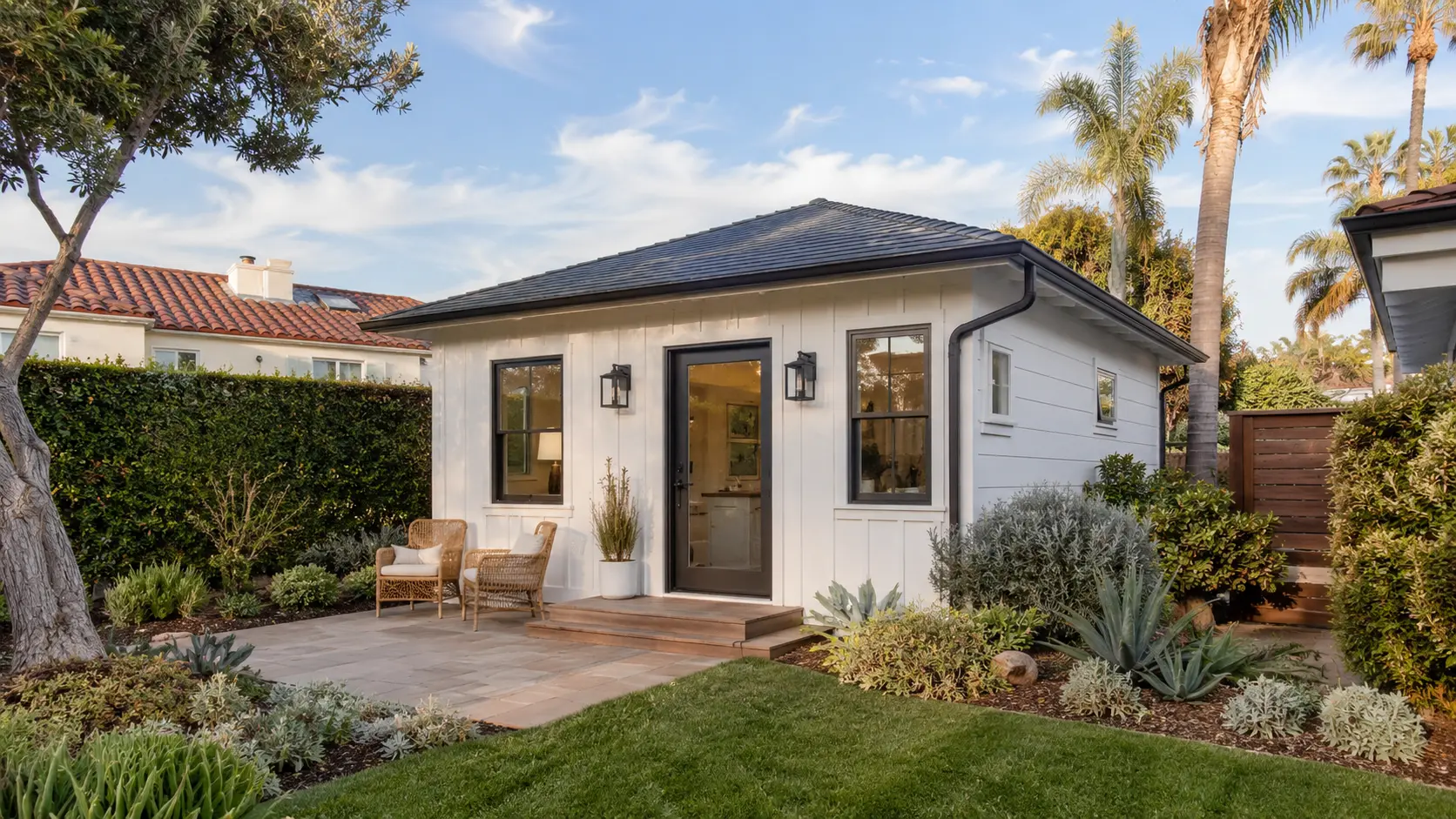
Coronado ADU Laws (2026): What’s Allowed, What State Law Overrides, and Real Permit Timelines
Last updated: May 14, 2026 · Last verified against primary sources: May 14, 2026
Coronado ADU laws in 2026 let most residential lots add an accessory dwelling unit, but the legal path depends on whether your project is a local-code ADU, a state-protected detached ADU, a conversion ADU, a junior ADU (JADU), a carriage-house conversion, or a multifamily ADU. The city caps detached ADUs at 850 square feet (studio or one-bedroom) or 1,000 square feet (two or more bedrooms), with four-foot side and rear setbacks and a 16-foot detached height limit. California state law overrides several of these. ADUs on lots within ½-mile walking distance of the Coronado Ferry Terminal are entitled to 18-foot heights — plus up to two additional feet when needed to align the ADU roof pitch with the primary dwelling’s roof pitch. The City must decide a complete application within 60 days, though our review of public Coronado permit records from January 2025 through April 2026 shows real-world spans from same-day issuance to 412 calendar days. Identify your legal path before you pay for plans.
What are the Coronado ADU laws at a glance in 2026?
We assembled this snapshot from Coronado Municipal Code §86.56.105, the California Government Code, and the December 10, 2025 HCD findings letter on Coronado’s ordinance. Sources are linked under each section.
| Question | Bottom line | Source |
|---|---|---|
| Can I build an ADU in Coronado? | Usually yes on residential or mixed-use lots with an existing or proposed primary dwelling. The path depends on property type and project type. | CMC §86.56.105.B.1; Gov. Code §66314 |
| Max ADU size? | Local cap: 850 sq ft for studio or one-bedroom, 1,000 sq ft for two or more bedrooms. State law independently protects at least an 800-sq-ft path on most lots. The local cap does not apply to single-family conversion ADUs, multifamily conversion ADUs, or ADUs detached from a multifamily dwelling. | CMC §86.56.105.B.7; Gov. Code §§66321(b), 66323(a)(1)/(3)/(4) |
| Detached ADU height? | Local: 16 feet. State law requires 18 feet, plus up to two additional feet to match a primary-dwelling roof pitch, for ADUs within ½-mile walking distance of a major transit stop. The Coronado Ferry Terminal qualifies under HCD’s December 10, 2025 letter (footnote 36). | Gov. Code §66321(b)(4) |
| Side/rear setbacks? | Four feet for new detached ADUs. Zero setback for qualifying conversions of existing structures and same-location replacements. | CMC §86.56.105.B.3; Gov. Code §66321(b)(3) |
| Number of ADUs allowed? | Single-family baseline: one ADU or one JADU per local code, except for the subsection (C)(2) state-protected combinations. Multifamily lots: state law allows up to eight detached ADUs (capped at the number of existing units) plus conversion ADUs. | CMC §86.56.105.B.5 and C; Gov. Code §66323 |
| Parking? | One off-street space per ADU under the city’s Local Coastal Program. JADUs: no parking required. State law independently bars replacement parking when a garage or carport is converted to an ADU under most general state-law conditions. | CMC §86.56.105.B.12; Gov. Code §66314(d)(11) |
| Short-term rental? | Not allowed. Coronado’s local code uses a six-month minimum. State law caps the rental-term minimum a city can impose at 30 days or longer for §66314 ADUs and longer than 30 days for §66323 ADUs and JADUs. | Gov. Code §§66315, 66323(e), 66333(g) |
| Coastal permit needed? | Coronado is entirely in the Coastal Zone, so coastal review is part of the ADU permitting analysis. AB 462 (effective Oct. 10, 2025) requires concurrent processing on a 60-day clock and eliminates Coastal Commission appeals for ADU-only approvals. | Gov. Code §66329 (as amended by AB 462) |
| Permit decision clock | 15 business days for the city’s completeness determination; 60 days after a complete application is on file to approve or deny. | Gov. Code §66317 as amended by SB 543 |
| Real-world permit time | Public records show a median 129 calendar days from applied to issued (Jan 2025–April 2026), with same-day issuance possible and one 412-day mixed-scope outlier. | Coronado Building Services monthly issued-permit PDFs (see methodology) |
What we verified
We built this guide from primary sources, not summaries.
- Coronado Municipal Code §86.56.105 (ADUs and JADUs) and §86.56.110 (carriage houses), pulled directly from the city’s published municipal code.
- California Government Code §§ 66310–66342 (state ADU law), with attention to SB 543, SB 9, AB 1154, and AB 462 (all Statutes of 2025).
- HCD’s December 10, 2025 findings letter on Coronado ADU Ordinance No. 2024-02 — 31 separate findings of non-compliance — downloaded directly from hcd.ca.gov.
- Coronado Planning Fee Schedule effective July 1, 2025, adopted by City Council Resolution 2025-10.
- Coronado Unified School District statutory school-fee notice ($5.17 per square foot of assessable space for new residential construction).
- Coronado Building Services monthly issued-permit PDFs, January 2025 through April 2026, for the public permit-timeline dataset.
- City application materials: Handout 721 (ADU/JADU application), Handout 303 (building plan set requirements), Handout 723 (pre-application meeting).
- HCD ADU Handbook (2026 update, including the December 2025 addendum).
Verified commercial facts, regulatory facts, and editorial conclusions are separated throughout this guide. Items framed as editorial conclusion are our analytical reading of the facts above; verify with City staff or counsel before relying on any of them.
See what you can build on your Coronado lot → Check My Property — a free 60-second feasibility report that flags your zoning, your size and height path, your ferry-terminal walking-distance status, and the questions to ask the City before you pay for plans.
Can you build an ADU on a Coronado property?
A Coronado property is a candidate for an ADU if it sits in a residential or mixed-use zone and has — or will have — a primary dwelling. The next question is rarely “is it allowed?” It is “which ADU path fits this lot?” Coronado’s ordinance recognizes six distinct paths.
Single-family lots: one ADU or one JADU, plus state-law combinations
Coronado’s local ordinance, at CMC §86.56.105.B.5, says no more than one JADU or one ADU per single-family lot, “except as permitted in subsection (C)(2)” — language the city added in 2024 to acknowledge California’s Government Code §66323 protected combinations. Read together with state law, most single-family lots in Coronado have these viable paths:
- One ADU under local development standards (the 850/1,000-sq-ft path), or
- One detached ADU up to 800 sq ft, 16 ft tall, with four-foot side/rear setbacks under §66323(a)(2), plus a JADU on the same lot when site conditions allow.
State law (§66323) also supports a conversion ADU plus a JADU, and in some cases a §66323-protected detached ADU plus a conversion ADU plus a JADU when site conditions and unit criteria are met.
Multifamily lots: the state-law expansion to eight detached ADUs
Coronado’s local text has historically referenced “up to two detached ADUs” on multifamily lots. State law has gone much further. Under §66323(a)(4), a lot with an existing multifamily dwelling is entitled to up to eight detached ADUs, capped at the number of existing units on the lot. A four-unit existing building can add four detached ADUs; an eight-unit building can add eight. Owners may also convert non-livable space into ADUs up to 25 percent of the existing unit count, with a minimum of one conversion ADU regardless.
HCD’s December 10, 2025 letter flagged Coronado’s “two detached ADUs” language as non-compliant with state law (Finding 25). We treat the eight-ADU formula as the controlling rule until the city’s ordinance amendment is on record.
New primary dwelling + ADU at the same time
Under Government Code §66317, an owner may submit ADU and primary-dwelling applications concurrently. The city may delay approving or denying the ADU until it acts on the primary dwelling, but it cannot refuse to accept the application. Bring §66317 to your pre-application meeting if you intend to build a primary home and ADU together.
Coronado Cays, Coronado Shores, and properties with HOAs
City approval and private CC&R or HOA compliance are separate questions. Under California’s AB 670 (2019), an HOA cannot outright prohibit an ADU on a single-family lot. AB 130 (Statutes of 2025) further clarifies that HOAs may not impose fees or financial requirements tied to ADU development. HOAs can impose reasonable, objective design and aesthetic standards.
The Coronado Cays HOA member handbook contains specific ADU restrictions worth knowing before you design: the handbook documents that ADUs and JADUs (and garage conversions) are prohibited in the Cays’ condominium villages, and that City-permitted ADUs/JADUs require prior written Association approval in other villages. Treat this as a private-restriction issue to verify against the current handbook, your specific village, and counsel.
Get your free Coronado ADU report → Check My Property — see your likely legal path, ferry-terminal walking-distance status, and HOA flags before you pay for design.
Where does California state law override Coronado’s ADU ordinance?
Answer capsule: On December 10, 2025, the California Department of Housing and Community Development (HCD) issued written findings that Coronado’s ADU ordinance (No. 2024-02, adopted April 16, 2024) fails to comply with state law on 31 separate points. Government Code §66326 gave the city up to 30 days to respond. Until Coronado either amends the ordinance to comply or adopts findings explaining why it complies despite HCD’s view, the practical reading for homeowners is that state law controls on the 31 flagged points.
This single document is the most important read for any Coronado homeowner considering an ADU in 2026. We pulled the full findings letter and decoded each finding below into homeowner-level impact.
The 31 HCD findings, decoded
The table below condenses HCD’s letter into the practical question every homeowner should ask: does this Coronado rule actually bind me? We paraphrase each finding rather than quoting at length.
Source for all rows below: HCD letter to Richard Grunow, Director of Community Development, dated December 10, 2025.
| # | What Coronado’s ordinance says | What state law actually requires | Practical impact for homeowners |
|---|---|---|---|
| 1 | References repealed Gov. Code §§ 65852.2 and 65852.22 throughout. | Renumbered to §§ 66310–66342 by SB 477 (eff. March 25, 2024). | Technical; signals the ordinance hasn't been brought current. |
| 2 | Requires a "detached primary single-family dwelling" or existing multifamily as prerequisite. | An ADU is allowed with an existing or proposed single-family or multifamily primary dwelling. | The city must accept ADU applications alongside proposed multifamily construction, not just existing. |
| 3 | Allows ADUs only within or attached to a primary residence, or detached. | State law also permits ADUs attached to an accessory structure, including detached garages. | Owners with detached garages can attach an ADU directly to the garage. |
| 4 | Requires conformance with "all property development regulations" subject to limited exceptions. | The city cannot deny an ADU because of unrelated nonconforming zoning conditions, building-code violations, or unpermitted structures that don't threaten public safety. | An older nonconforming setback or unpermitted shed unrelated to the ADU is not grounds for denial. |
| 5 | Requires pre- and post-construction surveys by a licensed land surveyor for conversions and same-location rebuilds. | Gov. Code §66315 bars development standards beyond §66314. The city should rely on its own permit records. | Owners converting a legally permitted existing structure should not be required to pay for two land surveys. |
| 6 | Conditions waivers on a subjective "no feasible alternative" test and a 16-foot height cap. | Waivers must be objective; height limits up to 18–20 feet apply near major transit stops; size based on percentage of primary dwelling cannot be required. | The "feasibility" gatekeeping test is unenforceable. The 16-foot cap does not apply within ½-mile walking distance of the Coronado Ferry Terminal. |
| 7 | Applies floor area ratio (FAR) and other zoning standards to new SFD + ADU projects. | The city cannot impose FAR or other development standards on a §66323 ADU. | An 800-sq-ft detached ADU on a lot with a proposed new home is not subject to FAR. |
| 8 | Allows "no more than one ADU or one JADU" per single-family lot with one narrow exception. | State law mandates approval of the full §66323 combination — multiple ADU types plus a JADU. | The local "one or the other" framing is more restrictive than state law allows. |
| 9 | Caps ADU floor area at 850 sq ft (studio/1BR) / 1,000 sq ft (2+ BR). | The local caps do not apply to §66323(a)(1) single-family conversion ADUs, §66323(a)(3) multifamily conversion ADUs, or §66323(a)(4) ADUs detached from a multifamily dwelling. | Conversion ADUs and multifamily-detached ADUs are not bound by the 850/1,000 limit. |
| 10 | Prohibits separate sale or conveyance of an ADU. | Under §66341, an ADU developed by a qualified nonprofit and sold to a qualified buyer at affordable cost must be allowed to be sold separately. | The blanket "no separate sale" rule is unenforceable for qualifying affordable transactions. |
| 11 | Requires rental terms of six consecutive months or more. | Under §66315, the city can require 30 days or longer for §66314 ADUs. For §66323 protected ADUs and JADUs, statute requires terms longer than 30 days. | The six-month minimum is unenforceable in either category. |
| 12 | Missing several mandatory JADU provisions from §66333. | Ordinance must include the SFD-zoning requirement, the JADU-must-be-within-the-SFD requirement, and the entrance requirements. | Technical, signals incomplete drafting. |
| 13 | Requires JADU efficiency kitchen with specific appliances: "stove, oven, and microwave." | State law only requires "a cooking facility with appliances" — choice belongs to applicant. | You don't have to install a microwave to meet the JADU kitchen rule. |
| 14 | Requires JADU owner-occupancy in all cases. | AB 1154 (eff. Jan. 1, 2026) removes owner-occupancy when the JADU has its own bathroom, and exempts governmental/land-trust/housing-org owners entirely. | If your JADU has separate sanitation facilities, you can rent both units. |
| 15 | JADU deed restriction requires six-month minimum rental. | Statute requires rental terms longer than 30 days for JADUs. | The six-month JADU rental term is unenforceable. |
| 16 | JADU deed restriction requires owner-occupancy. | Same as Finding 14. | The deed restriction must be updated. |
| 17 | Requires one parking space per ADU under the city's LCP, with limited exceptions. | State law contains additional parking exceptions that the ordinance doesn't acknowledge. The city must specifically cite Coastal Act provisions justifying each restriction. | Parking is the rule most likely to remain enforceable under §66329, but the city must justify it on the record. |
| 18 | Requires replacement parking when an ADU replaces an existing garage. | Under general state ADU law, no replacement parking can be required when a garage, carport, covered parking, or uncovered space is demolished or converted for an ADU. | Garage-conversion ADUs are not required to replace lost parking under general state law. Coronado argues Coastal Act exceptions apply; HCD asked the city to consider less restrictive alternatives. |
| 19 | Imposes parking on carriage-house conversions. | Same as Finding 17. | Same impact: the city must justify the parking requirement on the record. |
| 20 | Requires ADUs to match the "same architectural style, exterior materials, and colors" as the primary dwelling. | State law requires development standards to be objective. "Same style" is a subjective standard and unenforceable on §66323 ADUs and JADUs. | The city cannot reject your detached ADU because the planner doesn't think the style matches. |
| 21 | Internal reference error to subsection (B)(16) for utility connections. | Clerical correction needed. | Technical. |
| 22 | Impact-fee exemption text is missing "interior livable space" specificity. | SB 543 clarifies: no impact fees on ADUs ≤750 sq ft of interior livable space, or JADUs ≤500 sq ft of interior livable space. | The exemption applies based on interior livable space, not total floor area. |
| 23 | Misplaced reference in JADU section. | Clerical correction. | Technical. |
| 24 | Allows only 800 sq ft / 16-foot height for §66323 single-family detached ADUs. | State law allows heights of 18 feet, plus up to two additional feet to align with the primary dwelling's roof pitch, for lots within ½-mile walking distance of a major transit stop. HCD's letter (footnote 36) explicitly names the Coronado Ferry Terminal. | This is the single most impactful finding for many Coronado lots. If your lot is within ½-mile walking distance of the ferry terminal, your detached ADU can be 18 feet — plus up to two more feet only when needed for roof-pitch alignment. |
| 25 | Limits multifamily detached ADUs to two. | State law allows up to eight, capped at the number of existing units. | Multifamily owners are entitled to significantly more units than the local code states. |
| 26 | Subjects carriage-house conversions to all standards in CMC §86.56.110 (except one). | A carriage-house conversion is an ADU once it becomes one, and must be processed as an ADU under state law. | Owners converting a carriage house should not be subject to the full §86.56.110 carriage-house standards. |
| 27 | Allows a 60-day delay on ADU applications when submitted with a new SFD application. | State law permits delay only on the approve-or-deny decision, not on accepting or processing the application. | The city must accept and process your ADU application from day one. |
| 28 | Requires replacement parking for demolished garages. | See Finding 18. | Garage-conversion replacement parking generally not required under general state law. |
| 29 | Requires the primary dwelling's certificate of occupancy before the ADU can be occupied. | AB 462 (eff. Oct. 10, 2025) creates an exception during gubernatorial emergency proclamations when the primary dwelling is substantially damaged. | Limited application, but important for disaster-affected lots. |
| 30 | Requires recording a covenant for both ADUs and JADUs. | Gov. Code §66315 does not permit deed restrictions on ADUs. Covenants are only valid for JADUs. | Coronado cannot require a recorded covenant for a standalone ADU. |
| 31 | Coastal permit and construction permit reviews not run concurrently. | Under §66329, the two reviews must run concurrently unless the applicant requests otherwise. | The city must process both at the same time. |
Find out which findings affect your lot → See What You Can Build — our free report flags the size, height, parking, and rental overrides that apply to your specific address.
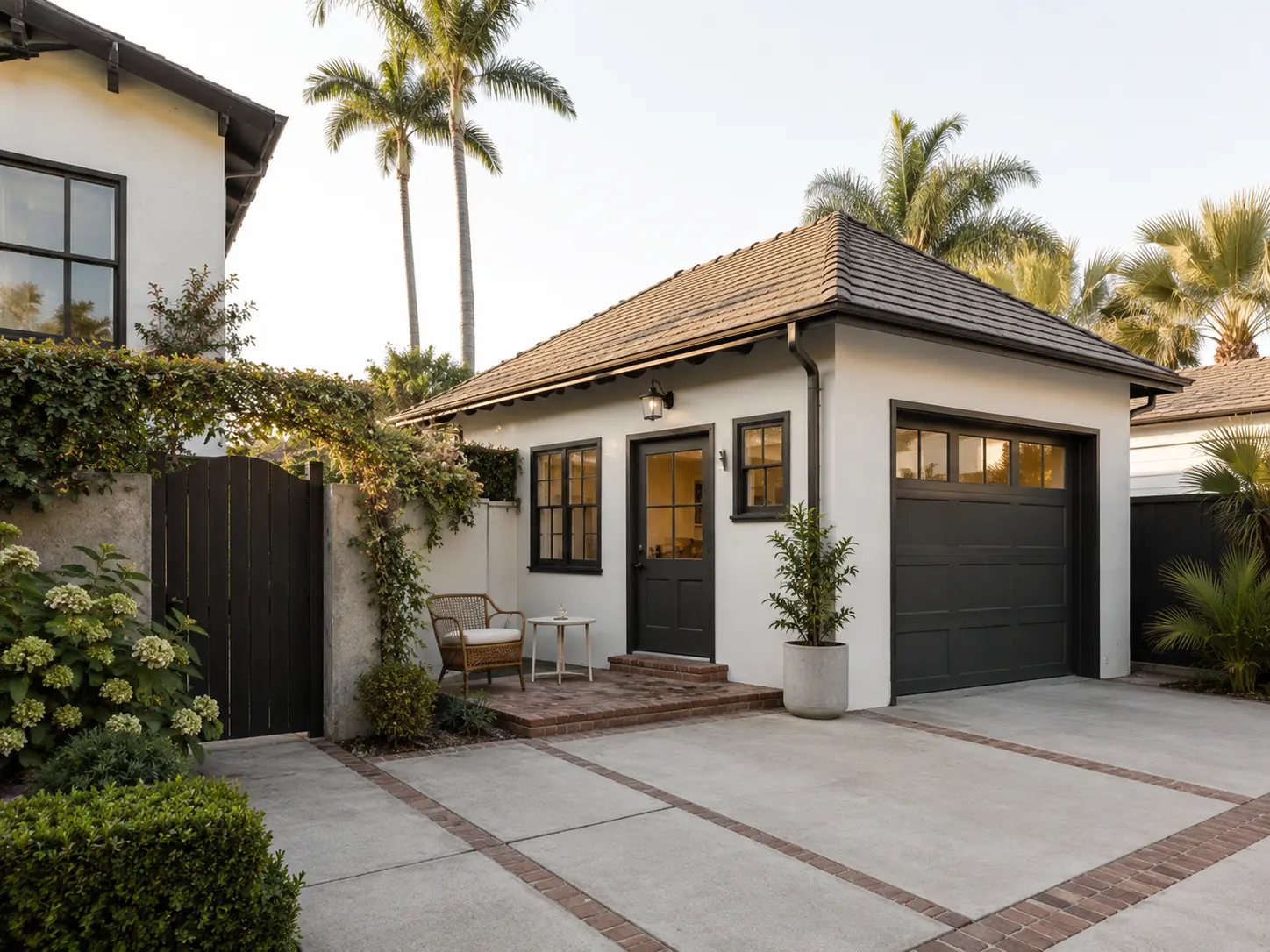
Coronado ADU size and height limits compared to California state law.
How big and tall can a Coronado ADU be?
Answer capsule: Coronado caps ADUs at 850 square feet for studio or one-bedroom units and 1,000 square feet for units with two or more bedrooms. Detached ADU height is locally capped at 16 feet, but state law requires the city to allow 18 feet, plus up to two additional feet to align the ADU roof pitch with the primary dwelling’s roof pitch, for any ADU on a lot within ½-mile walking distance of a major transit stop. The Coronado Ferry Terminal is the major transit stop in this analysis. Walking distance — not radius — is the legal standard.
The local size caps: 850 / 1,000 / 500
Coronado’s plain rule under CMC §86.56.105.B.7:
- Studio or one-bedroom ADU: up to 850 sq ft of floor area.
- Two-or-more-bedroom ADU: up to 1,000 sq ft of floor area.
- JADU: up to 500 sq ft (now defined as “interior livable space” under SB 543).
These caps are enforceable on a single-family detached ADU built under the city’s standard development standards. They are not enforceable on three of the four §66323 ADU types:
- §66323(a)(1) single-family conversion ADUs
- §66323(a)(3) multifamily conversion ADUs
- §66323(a)(4) ADUs detached from a multifamily dwelling
The 800-sq-ft state-protected baseline
Under Government Code §66321(b)(3), Coronado must permit at least an 800-sq-ft attached or detached ADU on any qualifying single-family lot, with four-foot side and rear setbacks, even if the city’s other development standards (lot coverage, floor area ratio, open space, front setbacks) would otherwise preclude it. The 800-sq-ft baseline is your fallback when standard zoning would otherwise block construction.
Detached height: the Coronado Ferry Terminal walking-distance bonus
The local rule (CMC §86.56.105.B.3.c) caps detached ADU height at 16 feet. Government Code §66321(b)(4) requires the city to allow:
- 16 feet as the floor on lots without transit adjacency.
- 18 feet on lots within ½-mile walking distance of a major transit stop or high-quality transit corridor — and up to two additional feet (so 20 feet total) only when needed to align the ADU roof pitch with an existing single-family primary dwelling’s roof pitch. The extra two feet is conditional on roof-pitch alignment, not automatic.
- 25 feet for attached ADUs that match the primary dwelling’s height limit, subject to other state-law conditions.
The statute is clear that the measurement is walking distance, not a straight-line radius. HCD’s findings letter, in footnote 36, names the Coronado Ferry Terminal at 1201 First Street as a qualifying major transit stop under Public Resources Code §21155(b).
Roof decks, balconies, and design review
A practical Coronado wrinkle most generic ADU pages miss: the city has explicit roof-deck and balcony standards in its zoning code. Walking surfaces 14 feet or higher on residential property typically require Design Review Commission approval. If your ADU concept includes a roof deck or a second-story balcony, factor in design review time and the Major Design Review fee ($846 per the FY26 fee schedule).
Is my Coronado lot within ½-mile walking distance of the Ferry Terminal?
Answer capsule: State law uses walking distance, not radius. A straight half-mile radius around the Coronado Ferry Terminal (1201 First Street) is a rough indicator only. The legal test under Public Resources Code §21155 is the network walking distance along publicly accessible pedestrian routes. Confirm your specific address with a walking-distance analysis (ArcGIS network service area, Google Maps walking directions, or our free property check) before assuming you qualify for the state-law height bonus.
Walking-distance routes within half a mile of the Coronado Ferry Terminal at 1201 First Street — the legal standard, not a straight-line radius.
Why walking distance matters
Coronado’s bridge, Naval Base, golf course, and parks all create breaks in the pedestrian network. A lot 2,400 linear feet away from the ferry terminal in a straight line might be 3,400 feet by foot — outside the ½-mile (2,640-foot) walking-distance threshold. Conversely, a lot a bit farther in straight-line distance might be inside the walking-distance threshold via a continuous sidewalk route.
The Coronado Village area immediately surrounding the ferry terminal (the streets around First, Orange, and B Avenues) is most likely to fall within the walking-distance limit. The Coronado Cays, Silver Strand homes south of the Hotel del Coronado, and parts of Coronado Shores are most likely outside it. The neighborhoods in between require an address-by-address check.
How to check your specific lot
- Plug your address into Google Maps walking directions from 1201 First Street. If the walking distance returns less than 0.5 miles (or 0.50 mi), you likely qualify for the state-law height bonus.
- Document the result. Take a screenshot. Bring it to your pre-application meeting.
- Verify with planning staff before committing to a design that depends on the bonus height.
Check whether your lot qualifies for the ferry-terminal height bonus → Free property check — the report includes walking-distance status and flags the rules that apply to your address.
What setbacks and lot rules apply to Coronado ADUs?
Answer capsule: The key setback rule is four feet from side and rear property lines for many new detached ADUs, with no additional setback required for qualifying conversions of existing structures or same-location replacements. Lot coverage, floor-area ratio, open-space, and similar standards cannot be applied in a way that blocks the protected 800-sq-ft ADU path under Government Code §66321(b)(3).
Four-foot side and rear setbacks
For new detached ADUs and JADUs not contained within the primary dwelling, Coronado requires:
- Four feet from the side property line
- Four feet from the rear property line
- Front setback as required by the underlying zone, with the §66321(b)(3) override that allows an 800-sq-ft ADU in the front yard when no other location supports it
Zero setback for conversions and same-location replacements
A meaningful Coronado-specific rule: if you convert existing living area or an existing accessory structure into an ADU, no setback is required. The same applies to a new ADU built in the same location and dimensions as a legally approved existing structure. The zero-setback path is the cleanest legal route on a tight Coronado lot.
Beach Overlay Zone
Properties located between the ocean and the first public roadway in the Beach Overlay Zone must comply with street-yard setbacks intended to protect public ocean views. If your property sits in the Beach Overlay, factor in the additional view-protection setback standards.
Carriage houses: Coronado’s distinct conversion path
Coronado’s municipal code defines a “carriage house” as a two-story accessory building containing a garage on the first story and a habitable unit on the second story, detached from the main building. The city’s housing-element analysis identified roughly 117 existing carriage houses in Coronado at the start of the 6th-cycle planning period, and the ordinance permits their conversion to ADUs under CMC §86.56.105.D.
The carriage-house path is unique to Coronado among San Diego County cities. HCD flagged the layered-standards requirement as too restrictive in Finding 26: once converted, the structure is an ADU and should be permitted as an ADU, not under the full carriage-house standards.
How many ADUs can you build on a Coronado lot?
Answer capsule: Coronado’s local code says no more than one JADU or one ADU per single-family lot, with a state-law-protected combination exception under subsection (C)(2). Under Government Code §66323, an owner can also pair a state-protected ADU with a JADU on the same lot ministerially. On a multifamily lot with an existing multifamily dwelling, state law allows up to eight detached ADUs (capped at the number of existing units) plus interior conversion ADUs up to 25 percent of the existing unit count.
Single-family lot scenarios
| Project mix | Allowed? | Source |
|---|---|---|
| One detached ADU (up to local size caps, no JADU) | Yes | CMC §86.56.105.B.5 |
| One JADU (no other ADU) | Yes | CMC §86.56.105.B.5 |
| One detached ADU (up to 800 sq ft, 16 ft tall, 4-ft setbacks) + one JADU | Yes — §66323 protected combination | Gov. Code §66323(a)(2) |
| One conversion ADU + one JADU | Yes — both qualify under §66323 | Gov. Code §66323(a)(1) |
| One conversion ADU + one §66323 detached ADU + one JADU | Yes — when site conditions and unit criteria are met | Gov. Code §66323(a); HCD ADU Handbook 2026 |
| Two detached ADUs | No on a single-family lot | CMC §86.56.105 |
Multifamily lot scenarios
State law as updated by SB 1211 (Statutes of 2024) and §66323 allows:
- Conversion ADUs within an existing multifamily building: up to 25 percent of existing unit count (rounded down), minimum of one.
- Detached ADUs on a lot with existing multifamily: up to eight, capped at the number of existing units on the lot. A four-unit building → 4 detached ADUs; an eight-unit building → 8.
Coronado’s local code still references “up to two detached ADUs” on multifamily lots — language HCD flagged as non-compliant.
What are the parking rules for Coronado ADUs?
Answer capsule: Coronado requires one off-street parking space per ADU under its Local Coastal Program and the Coastal Act of 1976; no additional parking is required for JADUs. State law independently allows several parking exceptions that Coronado’s ordinance doesn’t acknowledge, and bars replacement parking when a garage or carport is converted to an ADU under most general state-law conditions. Parking is the area where Coronado’s coastal carve-out most often meets state ADU law head-on.
Why Coronado can require parking when most California cities cannot
Most California cities cannot require parking for an ADU located within ½-mile walking distance of public transit, in a historic district, or where on-street parking permits are required but not offered to the ADU occupant. Coronado argues — and the Coastal Act of 1976 generally supports — that the entire city sits within the coastal zone, parking is essential to maintaining public coastal access, and the city’s certified Local Coastal Program may impose parking standards that the general state ADU exceptions otherwise eliminate.
The legal hook is Government Code §66329, which preserves the Coastal Act’s authority over coastal-access policy.
How does the coastal permit work for Coronado ADUs?
Answer capsule: Because Coronado has a certified Local Coastal Program (LCP, certified December 1983), most ADU permits are processed through the integrated coastal review, not a standalone Coastal Development Permit from the Coastal Commission. AB 462 (effective October 10, 2025) formalized concurrent processing: the two reviews run simultaneously, the combined decision is made within 60 days of a complete application, and the result is not appealable to the Coastal Commission for qualifying ADUs.
From Coronado’s Planning Fee Schedule effective July 1, 2025:
| Fee type | Cost | Typical timeline |
|---|---|---|
| Coastal Permit (standalone) | $4,301 | 3 months |
| Coastal Permit with other permits (concurrent) | $1,479 | Concurrent |
| Coastal Permit Amendment | $3,581 | 3 months |
| Emergency Coastal Permit Waiver | $1,042 | 1 week |
| Coastal Permit Exemption | $875 | 2 weeks |
For most Coronado ADU projects, the concurrent coastal permit fee of $1,479 is the line item that applies. Verify the current fee at intake before submittal.
Does Coronado have pre-approved ADU plans?
Answer capsule: Per the City’s adopted Housing Element fact sheet, Coronado is developing a pre-approved ADU plan program that homeowners can use at no cost beyond standard permitting fees. As of our most recent verification, the pre-approved plans are described as in development, not as a published catalog. Verify current status with Coronado Community Development before factoring pre-approved plans into your timeline.
In other San Diego County cities — Encinitas, Chula Vista, San Marcos, El Cajon, and elsewhere — pre-approved ADU plans (sometimes called PAADU or PRADU) accelerate review by trading custom design for a faster permitting clock. State law (AB 1332, AB 434) requires cities to make pre-approved plans publicly available and to issue a permit on a pre-approved plan within 30 calendar days of a complete application.
How does the Coronado ADU permit process work?
Answer capsule: Coronado processes ADU applications ministerially under CMC §86.56.105. The city has 15 business days to determine completeness, and 60 days after a complete application is on file to approve or deny. Real-world permit timelines from public records range from same-day issuance to 412 days, with a median around 129 calendar days in the January 2025–April 2026 window.
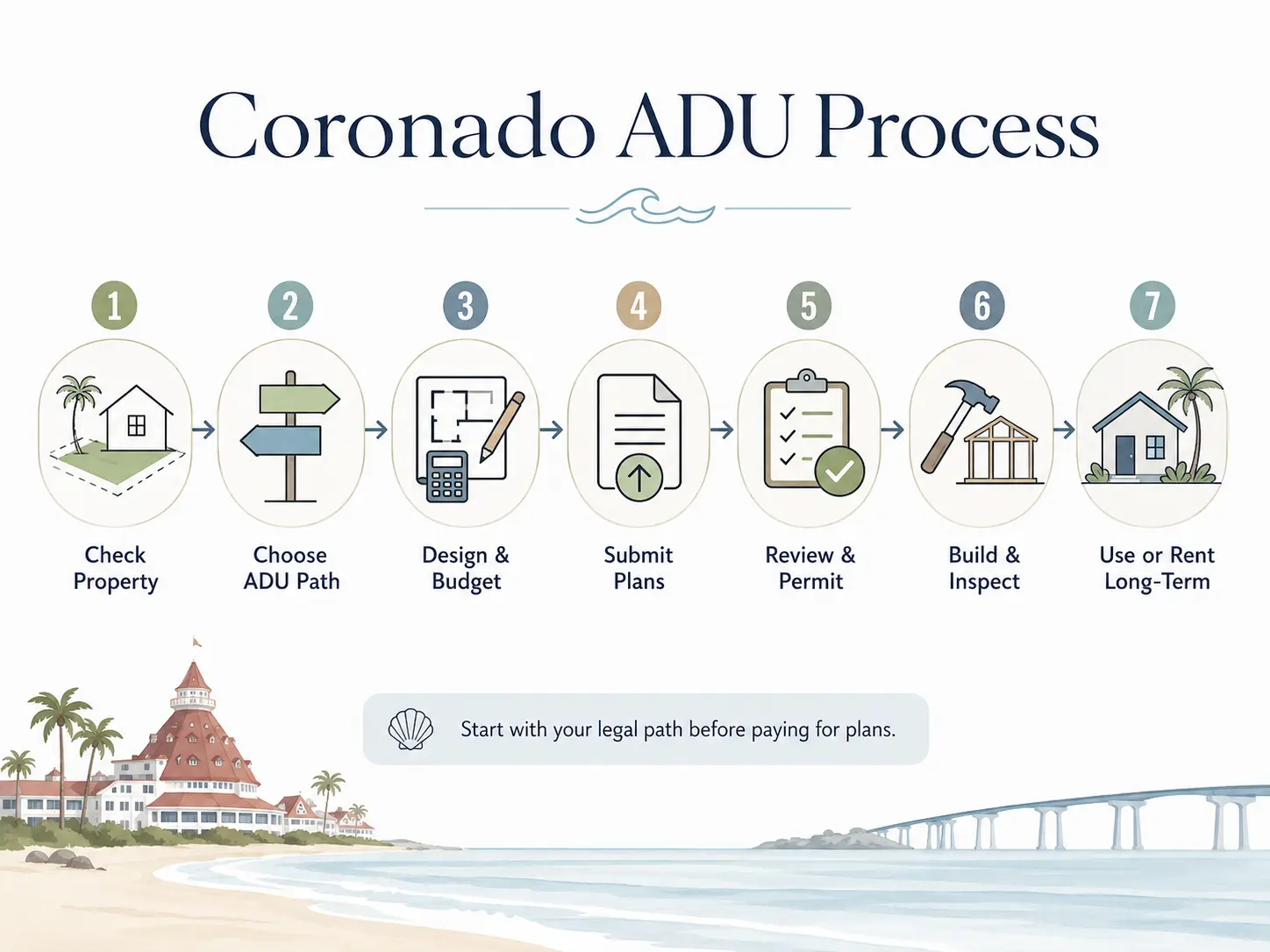
The 7-step Coronado ADU permit process — from initial zoning check to certificate of occupancy.
Step 1
Confirm your zoning and ADU path
Pull your property’s zoning, lot dimensions, and HOA/historic-district status. Use the City’s Property Zoning Lookup (or our free Feasibility Check) to confirm your zone (typically R-1A, R-1B, R-3, or R-4 for residential parcels) and whether your lot is within ½-mile walking distance of the Coronado Ferry Terminal for the height-bonus analysis.
Step 2
Optional pre-application meeting
Coronado offers a pre-application meeting via Handout 723. It’s not required, but for owners doing anything beyond a straightforward detached ADU, it’s the fastest way to identify path-specific issues (coastal documentation, design review, parking, HOA referrals) before paying for full plans.
Step 3
Hire designer / architect / draftsperson
Coronado plan-set requirements are spelled out in Handout 303. The plan set must include architectural drawings (site plan, floor plans, elevations, sections), structural drawings, Title 24 energy calculations, and supporting documents. Coronado does not require fire sprinklers on an ADU when the primary dwelling does not have them — a meaningful savings of $10,000–$15,000 on many projects.
Step 4
Submit your application package
Handout 721 directs applicants to file ADU/JADU permit packages with the Community Development Department and confirms faxed applications are not accepted. Confirm current submission options with Community Development (619-522-7326) and Building Services (619-522-7331) before submittal.
Step 5
Completeness determination (15 business days)
Under SB 543 (Statutes of 2025, eff. Jan. 1, 2026), the city has 15 business days from submittal to issue a written completeness determination. If the city flags deficiencies, you address them and resubmit. The 60-day clock starts when the application is deemed complete. If the city fails to issue a completeness determination within 15 business days, state law deems the application complete by default.
Step 6
Plan check and ministerial approval (60-day state clock)
Once complete, the city has 60 days to approve or deny. Coronado’s ADU review is ministerial under both local and state law — meaning the planner is checking against objective standards, not making discretionary judgments. HCD findings 6 and 20 protect homeowners from subjective architectural-style or feasibility tests.
Step 7
Construction, inspections, and certificate of occupancy
After permit issuance, construction begins. Coronado conducts inspections through its Building Services division. Once construction is complete and final inspection passes, the city issues a certificate of occupancy.
What do real Coronado ADU permit timelines look like (2025–2026)?
Answer capsule: We reviewed public Coronado Building Services monthly issued-permit records from January 2025 through April 2026 and identified nine permits labeled as ADU or ADU/JADU. The applied-to-issued spans ranged from same-day issuance to 412 calendar days. The median across all nine records was 129 calendar days. Excluding the mixed-scope outlier, the median was 122 days. These are illustrative public-record observations, not guarantees of approval timing for new applications.
| Project address | Applied → Issued | Calendar days | Permit fee shown | Notes |
|---|---|---|---|---|
| 1215 3rd St | 10/3/2024 → 1/6/2025 | 95 | $7,502.70 | ADU permit |
| 1760 Avenida del Mundo #202 | 11/18/2024 → 1/14/2025 | 57 | $3,790.04 | ADU permit |
| 939 Olive Ave | 10/22/2024 → 2/28/2025 | 129 | $2,461.21 | ADU permit |
| 4 Buccaneer Way | 6/5/2024 → 7/22/2025 | 412 | (mixed-scope) | ADU/JADU + remodel; flagged outlier |
| 1099 1st St #102 | 8/19/2025 → 8/19/2025 | 0 | $1,346.29 | Same-day issued; public record does not state cause |
| 731 Adella Ave | 8/22/2025 → 12/15/2025 | 115 | $4,306.45 | ADU permit |
| 1425 7th St | 6/17/2025 → 2/12/2026 | 240 | $6,000.20 | ADU permit |
| 866 H Ave | 7/17/2025 → 3/2/2026 | 228 | $2,004.10 | ADU permit |
| 521 Marina Ave | 10/10/2025 → 4/8/2026 | 180 | $9,702.68 | ADU permit |
Source: City of Coronado Building Services monthly issued-permit PDFs, January 2025 through April 2026, pulled from coronado.ca.us.
Median (all 9)
129 days
Median (ex-outlier)
122 days
Fastest
Same-day
Slowest (standalone)
240 days
What does a Coronado ADU permit actually cost?
Answer capsule: A typical Coronado ADU project pays planning fees, building permit fees, school fees, utility connection fees, and (where applicable) coastal-permit fees. Based on publicly issued permits from 2025 and 2026, total city permit fees on Coronado ADU records have ranged from about $1,300 to $9,700+, depending on project size and scope. ADUs 750 sq ft or smaller of interior livable space are exempt from impact fees under state law.
Planning fees that may apply
From the Coronado Planning Fee Schedule effective July 1, 2025:
| Planning fee | Cost |
|---|---|
| Coastal Permit with other permits (concurrent) | $1,479 |
| Minor Design Review Application | $282 (subsidized) |
| Major Design Review Application | $846 (subsidized) |
| Preliminary Proposal Review | $747 |
| Discretionary Compliance Review | $831 |
| Major Zoning Plan Check | $593 |
| Minor Zoning Plan Check | $99 |
| Historic Resource Alteration Permit (where applicable) | $140 (subsidized) |
School fees (Coronado Unified School District)
CUSD’s posted statutory school fee is $5.17 per square foot of assessable space for new residential construction. Under Government Code §66311.5 (as amended by SB 543, eff. Jan. 1, 2026), an ADU or JADU with less than 500 square feet of interior livable space does not increase assessable space and may avoid this fee. A 1,000-sq-ft detached ADU at $5.17/sq ft = $5,170 in school fees alone. Verify CUSD’s adopted rate at intake.
Impact fees (state-law exemption for smaller ADUs)
- ADUs with 750 sq ft or less of interior livable space: no impact fees from local agencies, special districts, or water corporations.
- JADUs with 500 sq ft or less of interior livable space: no impact fees.
- ADUs over 750 sq ft: impact fees are charged proportionately in relation to the square footage of the primary dwelling.
Putting it together
| Fee category | Typical range |
|---|---|
| Planning + coastal | $1,500–$3,000 |
| Building permit + plan check | $3,000–$10,000+ (scales with size) |
| School fees (CUSD) | $0 to $5,170+ (depends on size) |
| Utility connections | $2,000–$10,000+ |
| Impact fees (>750 sq ft only) | Variable; proportional to primary dwelling |
| Total | ~$6,500–$25,000+ |
What does it actually cost to build an ADU in Coronado?
Answer capsule: Detached ADU construction in San Diego County turnkey runs $375–$600+ per square foot for vertical build, with most homeowners investing roughly $300,000–$450,000+ for a complete build including design, permits, sitework, and utilities, per SnapADU’s March 2026 market data. Coronado-specific projects tend to land at the higher end of that range. Garage conversions typically land at $150,000–$250,000.
| ADU type | Typical all-in cost (San Diego County benchmark, March 2026) |
|---|---|
| JADU (interior conversion only) | $50,000–$150,000 |
| Garage conversion (existing footprint) | $150,000–$250,000 |
| Attached ADU / home addition | $300,000–$500,000 |
| Detached ADU, 500 sq ft | $200,000–$350,000 |
| Detached ADU, 800 sq ft (state-protected baseline) | $300,000–$480,000 |
| Detached ADU, 1,000 sq ft (local maximum) | $375,000–$600,000+ |
| Carriage house conversion | $200,000–$400,000 |
Source basis: SnapADU’s March 2026 San Diego ADU cost data supports the $375–$600+/sq ft range. The California Construction Cost Index shows a 44 percent increase from January 2021 through December 2025, providing context for the 2026 cost levels. Coronado-specific premiums above the mainland San Diego benchmark are our editorial conclusion; verify with local builder bids.
Why Coronado costs run higher (editorial conclusion)
- Bridge logistics. Material delivery, dumpster service, and contractor commute times all factor in.
- Tight site access. Many Coronado lots are 50–75 feet wide with limited side-yard space; staging is harder than typical suburban San Diego.
- Smaller local contractor pool. Fewer contractors carry deep familiarity with Coronado’s certified LCP and historic-overlay considerations.
- Higher-end finish expectations. Coronado homes in the 92118 ZIP code average well into seven figures; ADU finishes that match the primary residence cost more.
- In-person submittal friction. Designer and architect time spent on physical submittal trips adds to soft costs.
Get a free Coronado ADU report on your specific lot → Check My Property — we’ll flag which size path is most cost-efficient given your zoning, your walking-distance status, and your project goals.
How do you finance a Coronado ADU?
Answer capsule: Most Coronado ADU projects are financed through cash-out refinance, home equity line of credit (HELOC), construction-to-permanent loans, or renovation refinance products. Coronado’s median home values (well into seven figures) typically give homeowners enough equity to fund $300,000–$500,000+ projects.
We present financing as paths, not ranked lenders. None of the following is “best” in the abstract — each fits different equity positions, project sizes, and timing needs.
The four financing paths most Coronado owners consider
Cash-out refinance
Replace your existing mortgage with a larger loan, pulling out equity in cash. Best when current rates are at or below your existing mortgage rate, or when you have substantial equity built up. Highest absolute borrowing capacity for most owners.
Home equity line of credit (HELOC)
A revolving credit line secured by your home equity. Lower closing costs than cash-out refi, draws available as construction progresses, only pay interest on amounts drawn. Best when current rates make a full refinance uneconomic.
Construction-to-permanent loan
A single loan that funds construction in draws and converts to a long-term mortgage at completion. Best for owners without enough liquid funds to bridge construction draws.
Renovation refinance / 203(k) product
Combines purchase or refinance with renovation funding. Less common for standalone ADU additions but can apply for owners financing an ADU as part of a primary home addition project.
Explore your Coronado ADU financing options → Compare cash-out refinance and construction-loan paths through Mortgage Research Center (verify rates and terms directly with lenders before signing). For a broader financing primer, including HELOCs and renovation-loan options, see our ADU Financing Options guide.
Grants and special programs
CalHFA ADU Grant Program. Per CalHFA’s official ADU Grant page, the latest round of ADU funding has been fully allocated. Do not factor the grant into your budget unless CalHFA posts a new funding round.
San Diego Housing Commission ADU Finance Program. Per the SDHC ADU page, this is a currently active program offering construction-to-permanent loans up to $250,000 plus technical assistance to moderate-income homeowners — but eligibility is limited to residential property in the City of San Diego. Coronado homeowners are not eligible.
Do Coronado HOAs, historic districts, or the Coronado Cays restrict ADUs?
Answer capsule: California’s AB 670 (2019) prohibits HOAs from outright banning ADUs that comply with state law. AB 130 (Statutes of 2025) further bars HOAs from imposing fees or financial requirements tied to ADU development. HOAs may impose objective, reasonable design and aesthetic standards. The Coronado Cays HOA, the Coronado Shores Association, and Coronado’s historic-preservation rules each apply different layers of private or city-level review beyond the standard ADU permit.
Coronado Cays
The Coronado Cays community at the southern end of the Silver Strand operates under a Master Association with sub-association overlays for each village (Trinidad, Antigua, Mardi Gras, Bahama, and others). The Coronado Cays HOA member handbook documents specific ADU/JADU restrictions worth verifying before design: ADUs and JADUs (and garage conversions) are recorded as prohibited in the Cays’ condominium villages, and City-permitted ADUs/JADUs require prior written Association approval in other villages.
Treat this as a private-restriction issue to verify against the current handbook, your specific village, and counsel. State HOA law constrains what private associations can require — AB 670 and AB 130 prevent outright prohibition and tied financial requirements — but enforcement happens through civil disputes between the association and the homeowner, not at the city permit counter.
Coronado Shores
The Coronado Shores Association governs the high-rise condominium complex south of the Hotel del Coronado. ADUs are not generally feasible in high-rise condominium units, and the Association’s CC&Rs typically address remodeling rather than ADU construction.
Historic district considerations
Coronado’s historic preservation rules can apply to properties individually listed on the Coronado Historic Register, properties contributing to recognized historic districts, and carriage houses with documented historic significance. The Historic Resource Alteration Permit (HAP) fee is $140 (subsidized). HAP with Demolition is $4,030. If your property has a Mills Act agreement, additional compliance applies.
What can stop or delay a Coronado ADU?
Answer capsule: The biggest delays in Coronado ADU permitting are rarely outright denials. They are usually incomplete applications, design-review triggers, coastal documentation gaps, HOA/CC&R conflicts, building-code upgrades on conversions, utility-connection complications, and disputes over parking or rental term where state law and local code diverge.
- Incomplete application. Missing Title 24 calcs, missing parking diagrams, unclear coastal documentation, or unresolved HOA referrals are the most common reasons a Coronado ADU application gets returned. Address all items on Handout 721 before submittal.
- Path confusion. Applying for a “standard” ADU when a §66323 path provides more flexibility — or vice versa — adds review cycles.
- Coastal documentation. Even with AB 462’s concurrent review, applicants who don’t submit complete coastal documentation up front face resubmittal cycles.
- HOA conflict. Cays village restrictions, CC&R conflicts, and HOA-required pre-approvals can delay plans before you even reach the city counter.
- Building-code upgrades. Converting an older detached garage often triggers electrical, plumbing, and insulation upgrades beyond simple ADU permitting.
- Utility-connection complications. Separate meters, capacity upgrades, and SDG&E service-extension timelines can add weeks to months.
- Parking and rental-term disputes. Owners who cite state law on replacement parking or the six-month rental minimum should come prepared with the HCD findings letter and the relevant statute.
Which Coronado ADU path is right for your situation?
Answer capsule: The fastest legal path is usually a conversion ADU (interior or garage conversion) or a JADU, because both qualify for state-protected ministerial approval with the cleanest setback rules. The right path depends on your goals, not on a generic ranking.
| Your situation | Start with | Key watch-out |
|---|---|---|
| Existing detached garage you can convert | Garage conversion ADU | Replacement-parking dispute; building-code upgrades |
| Existing carriage house | Carriage-house conversion (CMC §86.56.105.D) | Layered standards (until HCD Finding 26 is resolved) |
| Aging parent moving in | JADU or detached ADU | Privacy, owner-occupancy rules under AB 1154 |
| Long-term rental income | Detached ADU (800–1,000 sq ft) | Rental-term minimum; school fees over 500 sq ft |
| Multigenerational household | Attached ADU or detached ADU + JADU combination | Shared utilities and meter configuration |
| Multifamily property owner | §66323 multifamily formula | State vs. local conflict on count; parking |
| Tight Coronado lot | 800-sq-ft state-protected baseline + 4-ft setbacks | Lot coverage exemption applies up to baseline; verify |
| Historic property | Historic Resource Alteration Permit + ADU permit | Design review for exterior modifications |
| Property within ½-mile walking distance of ferry terminal | Detached ADU with state-law height bonus | Document the walking-distance proximity in submittal |
What should you do before paying for Coronado ADU plans?
Answer capsule: Before spending money on architectural plans, confirm your zoning, identify your legal ADU path, check HOA/CC&Rs, verify the controlling parking and rental rules for your situation, estimate fees and school fees, and ask the City the specific questions tied to your path.
A 7-step pre-design checklist:
- Confirm property type, zone, and HOA status. Use the City’s Property Zoning Lookup, your CC&Rs, and a survey if you don’t already have one.
- Pick the ADU type. Detached, attached, conversion, JADU, or carriage-house conversion — each has different rules and cost profiles.
- Check the size, height, and setback path that applies. If you may be within ½-mile walking distance of the ferry terminal, run a walking-distance check and document the result for the height bonus.
- Resolve parking and rental term up front. If a garage conversion is in scope, prepare your state-law reference. If you intend to do 31-day-or-longer rentals, ensure your covenant reflects current state law by category.
- Check coastal, HOA, historic, and private restrictions. Each adds documentation, not necessarily denial.
- Estimate fees and school fees. Use the city’s 2025 fee schedule plus CUSD’s $5.17/sq ft for new residential construction over 500 sq ft of interior livable space.
- Decide your next step. Feasibility check first, then designer or builder consultation, then financing path discussion.
Run a Coronado feasibility check → Get your free ADU report — the report covers your zoning, size path, walking-distance status, and the specific city follow-up questions to ask before plans.
Want the full Coronado pre-design checklist? Download the Free ADU Starter Kit — a homeowner’s checklist with pre-design questions, plan-set requirements, fee benchmarks, and the rules to confirm with the City. No spam.
Coronado ADU laws — FAQ
Can I build an ADU in Coronado?
Usually yes. Coronado allows ADUs on most residential and mixed-use lots that have or will have a primary dwelling. The legal path — local-code ADU, state-protected §66323 ADU, conversion, JADU, carriage-house conversion, or multifamily ADU — depends on your property type and project type.
What is the maximum ADU size in Coronado?
Coronado’s local cap is 850 sq ft for studio or one-bedroom ADUs and 1,000 sq ft for two-or-more-bedroom ADUs. State law independently protects an 800-sq-ft buildable baseline even when other local rules would otherwise preclude it. The 850/1,000 caps do not apply to single-family conversion ADUs, multifamily conversion ADUs, or ADUs detached from a multifamily dwelling.
Can I build a two-story ADU in Coronado?
Generally no for new detached ADUs, which are locally capped at 16 feet. State law requires the city to allow 18 feet — plus up to two additional feet only when needed to align the ADU roof pitch with the primary dwelling’s roof pitch — for lots within ½-mile walking distance of a major transit stop, including the Coronado Ferry Terminal. Attached ADUs may match the primary dwelling’s allowed height, which can exceed 16 feet in most zones.
Can I convert my garage into an ADU in Coronado?
Yes, if the existing structure qualifies and meets building-code standards. Coronado’s local rule requires replacement parking when a garage is converted, but general state law (Government Code §66314(d)(11)) bars this requirement for ADU conversions, and HCD has formally flagged the city’s replacement-parking provision as non-compliant in its December 10, 2025 findings letter (Finding 18).
Does Coronado require one parking space for an ADU?
Yes, generally. Coronado’s local code, justified under the city’s Local Coastal Program and the California Coastal Act of 1976, requires one off-street parking space per ADU. JADUs require no additional parking. State law’s broader parking exceptions may be limited within the Coastal Zone under §66329, though HCD has asked the city to consider less-restrictive alternatives.
Can I Airbnb my Coronado ADU?
No. Both Coronado’s local ordinance and California state law prohibit ADUs and JADUs from being used as short-term vacation rentals. State law as amended by AB 1154 (effective January 1, 2026) bars JADU short-term rental statewide.
Can I rent a Coronado ADU month-to-month?
This is a category-specific question with a verified state-vs-local conflict. Coronado’s local code says rentals must be for six consecutive months or more. State law caps the minimum rental term a city can impose at 30 days or longer for §66314 ADUs (under §66315), and longer than 30 days for §66323 ADUs and JADUs (under §66323(e) and §66333(g)). In either category, Coronado’s six-month minimum exceeds what state law permits, and HCD has formally flagged it.
Do I need a coastal permit for a Coronado ADU?
Coronado is entirely in the Coastal Zone, so coastal review is part of every ADU permitting analysis. Depending on the project, the city’s fee schedule contemplates a full Coastal Permit, a concurrent Coastal Permit with other permits, or a Coastal Permit Exemption. Because Coronado has a certified Local Coastal Program, AB 462 requires concurrent processing on a 60-day clock and eliminates Coastal Commission appeals for ADU-only approvals.
How long does a Coronado ADU permit take?
State law requires a completeness determination within 15 business days and approval or denial within 60 days of a complete application. Public Coronado permit records from January 2025 through April 2026 show real-world applied-to-issued spans from same-day issuance to 412 days, with a median of 129 calendar days across nine ADU-labeled permits.
How many ADUs can I build on a Coronado single-family lot?
Coronado’s local baseline allows one ADU or one JADU per single-family lot, subject to a state-law-protected combination exception. Government Code §66323 protected combinations may allow additional configurations — a conversion ADU plus a §66323 detached ADU plus a JADU on the same lot when site conditions and unit criteria are met. Multifamily lots are entitled to substantially more under state law: up to eight detached ADUs (capped at the number of existing units) plus conversion ADUs.
Can I sell my Coronado ADU separately from the primary home?
Generally no. Coronado has not adopted an AB 1033 ordinance allowing condominium subdivision of ADUs as of the most recent verification. Independently, an ADU developed by a qualified nonprofit corporation and sold to a qualified buyer at an affordable housing cost may be sold separately under Government Code §66341. Most market-rate ADUs cannot.
Do I have to live in the property to build an ADU in Coronado?
For ADUs permitted after January 1, 2020, no. California state law bars cities from requiring owner-occupancy on ADUs. JADUs are different: under AB 1154 (effective January 1, 2026), owner-occupancy is required only when the JADU has shared sanitation facilities with the primary residence. JADUs with their own bathrooms do not trigger owner-occupancy.
Does my Coronado HOA have any say?
Yes, but limited. Under AB 670 (2019), HOAs cannot outright prohibit ADUs that comply with state law. Under AB 130 (Statutes of 2025), HOAs cannot impose fees or financial requirements on ADU development. HOAs can impose reasonable, objective design and aesthetic standards. Coronado Cays homeowners should specifically review the current Cays HOA member handbook for documented village-specific ADU restrictions.
What is a Coronado carriage house and can it be converted?
A Coronado carriage house is a two-story accessory building containing an enclosed garage on the first story and a habitable unit on the second story, detached from the main building. The city has roughly 117 existing carriage houses and recognizes their conversion to ADUs under CMC §86.56.105.D. The conversion path is unique to Coronado among San Diego County cities.
Does Coronado have pre-approved ADU plans?
Per the city’s Housing Element fact sheet, Coronado is developing a pre-approved ADU plan program. As of the most recent verification, the program is described as in development, not as a published catalog. Verify current status with Coronado Community Development before factoring pre-approved plans into your timeline.
Where do I submit my Coronado ADU application?
Handout 721 directs applicants to file ADU/JADU permit packages with the Community Development Department at City Hall, 1825 Strand Way, Coronado, CA 92118, and notes faxed applications are not accepted. Confirm current submission options with Community Development (619-522-7326) and Building Services (619-522-7331) before submittal.
What if Coronado denies my ADU application?
State law provides specific recourse. If you believe the denial is based on rules that conflict with state ADU law, you can file a complaint with the California Department of Housing and Community Development at hcd.ca.gov. Under SB 9 (Statutes of 2025), HCD has authority to refer non-compliant cities to the Attorney General. Coronado’s December 10, 2025 findings letter provides written documentation of where the city’s ordinance exceeds state-law authority.
How we researched this Coronado ADU guide
The Dwelling Index is an independent research resource covering ADU financing, costs, and regulations. We are not a builder, lender, broker, or city contractor.
To build this guide, we reviewed:
- Coronado Municipal Code §86.56.105 and §86.56.110 (ADUs, JADUs, and carriage houses), pulled directly from the city’s published code.
- California Government Code §§ 66310–66342 (state ADU law), with attention to SB 543, SB 9, AB 1154, and AB 462 (all Statutes of 2025, with effective dates in 2025 and 2026).
- California Department of Housing and Community Development findings letter to the City of Coronado dated December 10, 2025, identifying 31 separate findings of non-compliance with state ADU law. HCD’s ADU Ordinance Review Letters tracking spreadsheet records response-letter status for each reviewed jurisdiction, including Coronado.
- City of Coronado Planning Fee Schedule effective July 1, 2025, adopted by City Council Resolution 2025-10.
- City of Coronado Building Services monthly issued-permit PDFs from January 2025 through April 2026, for the public permit-timeline dataset (9 ADU-labeled records identified, including one mixed-scope outlier).
- Coronado Unified School District statutory school-fee notice ($5.17 per square foot of assessable space for new residential construction).
- City application materials: Handout 721 (ADU/JADU application), Handout 303 (building plan set requirements), Handout 723 (pre-application meeting).
- HCD ADU Handbook (2026 update, including the December 2025 addendum summarizing 2025 legislative changes).
- Construction cost data: SnapADU’s March 2026 San Diego market data ($375–$600+/sq ft, $300K–$450K+ complete-build), with the California Construction Cost Index (December 2025, 44 percent increase from January 2021) providing context.
- Coronado Cays HOA member handbook for the documented Cays-specific ADU/JADU restrictions.
- Voice-of-customer signals: Reddit, Houzz, Pacific Legal Foundation case documentation — used only to inform homeowner-language framing, never as proof for legal or cost claims.
We separated verified commercial facts (program availability, eligibility, fee schedules), regulatory facts (state and local code citations), and editorial conclusions (our analytical reading of the facts). Editorial conclusions are explicitly framed as such throughout this guide.
This page is general legal and zoning education, not legal advice. Verify your address-specific path with the City of Coronado Community Development Department (619-522-7326) or a qualified professional before relying on any of the rules described here.
Related Dwelling Index guides
- Coronado Coastal Zone ADU 2026: Rules, Fees & Timeline Guide — The companion guide focused on coastal permitting and CDP timing
- California ADU Laws 2026 — Statewide rules primer
- San Diego Coastal Zone ADU — Adjacent coastal-zone context for City of San Diego properties
- San Diego County Pre-Approved ADU Plans (2026) — Pre-approved plan options across the region
- How Much Does an ADU Cost? Real 2026 Prices by Type — National cost benchmarks
- ADU Financing Options — Cash-out refi, HELOC, construction-to-perm, and renovation refinance compared
- Detached ADU Floor Plans — Layout inspiration for studio through two-bedroom units
Not sure where to start? See what’s possible at your address — get your free ADU report in 60 seconds.
Check My Property →