
Unpermitted ADU California Guide (2026): How to Legalize a Pre-2020 Unit Without Penalties or Impact Fees
By The Dwelling Index Editorial Team · Published · Last updated · Last verified
Bottom line up front: Under current unpermitted ADU California law, if you have an unpermitted ADU that was built before January 1, 2020, state law says your city or county can't deny a permit for it only because it breaks today's building code or the local ADU rules. It can deny only if a fix is needed to clear a “substandard” health-and-safety condition under Health and Safety Code § 17920.3. You also can't be charged impact fees or utility connection or capacity charges in most cases, and the city can't penalize you for having had the unit. The rule came from AB 2533 and, since January 1, 2026, sits at Government Code § 66311.7 (it used to be § 66332). You still pay ordinary plan check and permit fees, and you still fix real safety problems. Your next step: gather proof of the construction date, get an optional confidential inspection, and file with your city using its AB 2533 wording.
| Your situation | Which path applies | What to do first |
|---|---|---|
| ADU or JADU built before Jan 1, 2020 | Pre-2020 legalization: no denial for code or ADU-ordinance noncompliance unless a substandard condition needs fixing (Gov. Code § 66311.7) | Collect date evidence; get a confidential pre-inspection |
| Built on or after Jan 1, 2020, in a city whose ADU ordinance didn't comply with state law at the time but complies now | After an eligible notice to correct, you can ask to delay enforcement for 5 years if the fix isn't needed for health and safety (Gov. Code § 66331; H&S Code § 17980.12) | Request the delay before 2030 using the agency's process |
| Built on or after Jan 1, 2020, any other city | Permit it like a new ADU, with as-built plans and today's code | Check whether it fits today's ADU size, height and setback rules |
| A room or unit without a kitchen (or not a full dwelling) | Not an ADU or JADU under state law, so § 66311.7 doesn't apply | Talk to the building department about a remodel or addition permit |
The Dwelling Index is an independent research resource covering ADU financing, costs, and regulations. We wrote this guide because most people with an unpermitted unit find out at the worst moment: a buyer's inspector flags it, an appraiser won't count it, or a code enforcement letter shows up. California changed the rules for these units in 2025, then renumbered the law on January 1, 2026. Several city handouts and many builder blogs still cite the old section number, and a few still describe the pre-2025 rules. We read the current statutes on the California Legislature's site and six local programs on November 11, 2026.
Disclosure: The Dwelling Index is reader-supported. When you use our links to explore financing options, request prefab pricing, or purchase floor plans, we may earn a commission at no extra cost to you. Our editorial recommendations are based on independent research and are never influenced by compensation. This page has no affiliate links. It's educational, not legal advice. If you have an open code enforcement case, a tenant in the unit, or a sale in escrow, talk to a California real estate attorney before you file.
Can you legalize an unpermitted ADU in California?
Answer capsule: Yes. Under California Government Code § 66311.7, a city or county can't deny a permit for an unpermitted ADU or junior ADU built before January 1, 2020 because it violates building standards or local ADU rules. It may deny only when correcting a violation is needed to meet the substandard-housing standards in Health and Safety Code § 17920.3.
That's a big shift from how legalization used to work. Before 2025, many cities treated an unpermitted unit like a brand-new project. You had to bring it up to current code, meet current setbacks, and pay the same impact fees as new construction. For a 1970s garage conversion, that could mean new foundations, new energy-code upgrades, and fees that made tearing it out the cheaper option.
AB 2533 (Statutes of 2024, chapter 834) changed the default for pre-2020 units. It took effect January 1, 2025, as Government Code § 66332. On January 1, 2026, SB 543 (Statutes of 2025, chapter 520) moved the same text to § 66311.7. The words didn't change in that move, only the number. If your city's handout says § 66332, it's describing the same rule.
Here's what the law gives you, in plain English:
- No denial for being out of code or out of the ADU ordinance. A pre-2020 unit with old wiring methods, a non-standard ceiling height, or a setback that today's rules wouldn't allow can still be permitted, as long as it isn't substandard.
- No penalty for having the unit. If the inspector finds health and safety problems, the city “shall not penalize” you and must approve the permits needed to fix them (§ 66311.7(f)).
- No impact fees or connection or capacity charges, with one narrow exception for utility work that is itself needed to fix a substandard condition (§ 66311.7(e)).
- A confidential pre-check. Cities must tell you that you can hire a licensed contractor for a private inspection before you apply (§ 66311.7(d)(2)). Los Angeles says those results don't have to be submitted to the city.
What the law doesn't do: it doesn't make the unit legal the day you apply, it doesn't waive plan check and permit fees, and it doesn't protect a building that is substandard.
Unpermitted ADU California rules: what does AB 2533 actually say?
Answer capsule: Government Code § 66311.7 has six parts. It bars denial of pre-2020 ADU and JADU permits for code and ordinance noncompliance, allows denial only for substandard conditions under Health and Safety Code § 17920.3, requires cities to publish a substandard checklist, bans most impact and utility capacity fees, and prohibits penalties when an inspector finds problems.
We decoded each subdivision against the current statute text (read on leginfo.legislature.ca.gov, November 11, 2026):
| Gov. Code § 66311.7 | What it says | What it means for you |
|---|---|---|
| (a) | A local agency “shall not deny a permit” for an unpermitted ADU or JADU built before Jan 1, 2020 because it violates building standards or doesn't comply with state or local ADU rules | Old code and old zoning problems alone can't sink your application |
| (b) | The agency may deny if it finds that correcting a violation is necessary to meet H&S Code § 17920.3 | Real health and safety hazards still have to be fixed |
| (c) | The section doesn't apply to a building deemed substandard under § 17920.3 | A unit that is dangerous as a whole isn't protected until it's corrected |
| (d) | Cities must post a § 17920.3 checklist and tell homeowners about the confidential third-party inspection option | Your city's website should have a checklist; if it doesn't, ask for it |
| (e) | No impact fees or connection or capacity charges, except when utility infrastructure is needed to meet § 17920.3 and the fee is allowed under § 66311.5(e) | Expect plan check and permit fees, not the big development fees |
| (f) | An inspector may inspect and recommend fixes; if there's noncompliance, the agency “shall not penalize” the applicant and “shall approve necessary permits” | Coming forward doesn't trigger fines for the unit itself |
Two other laws work alongside it. Health and Safety Code § 17958.12 (SB 1226, 2018) confirms that when no permit exists, a building official may decide when a unit was built and apply the building standards in effect at that time. And Government Code § 66331 plus Health and Safety Code § 17980.12 let some owners delay enforcement for five years (more on that below).
One more wrinkle we found: the County of Orange's legalization page, read November 11, 2026, still defines ADU by reference to Government Code § 65852.2, a section that SB 477 repealed when it reorganized ADU law in March 2024. That doesn't change your rights. It does show why you should read the current statute rather than an old handout.
Does your unit qualify for legalization?
Answer capsule: A unit qualifies under § 66311.7 if it was built before January 1, 2020, and it meets California's definition of an ADU or JADU. An ADU must have permanent provisions for living, sleeping, eating, cooking, and sanitation. A JADU is up to 500 square feet, inside a single-family home, with an efficiency kitchen.
Run your unit through these three tests.
1. Was it built before January 1, 2020? The date that matters is when the unit was built or converted, not when you bought the house. A garage converted in 2016 qualifies. A garage converted in 2021 doesn't, even if the garage itself is from 1960. Orange County's page says the unit can have been created either by adding new square footage or by converting a garage or part of the house, as long as that happened before January 1, 2020.
2. Is it an ADU or a JADU under state law? Government Code § 66313 defines an ADU as an attached or detached unit with “complete independent living facilities” and “permanent provisions for living, sleeping, eating, cooking, and sanitation.” A JADU is no more than 500 square feet of interior livable space, entirely within a single-family residence, and (under § 66333) has an efficiency kitchen with a cooking appliance, a prep counter, and storage. A bedroom with a bathroom and a hot plate on a dresser isn't an ADU. A garage with a bed and no bathroom isn't either.
3. Is it on a residential lot with a primary home? Los Angeles checks that the lot is zoned for residential use. Most programs also ask for the permit history of the main house.
Some units qualify for the law but not for a city's streamlined process. Those units can still be legalized; they need a fuller plan set. Los Angeles and San Diego both publish these lists:
| Feature | Los Angeles (IB P/BC 2026-161) | City of San Diego (IB-242) |
|---|---|---|
| Basement unit | Not streamlined | Not streamlined if created by excavating under the floor |
| More than one story | Not streamlined | — |
| Fault, landslide, or liquefaction zone | Not streamlined | Not streamlined |
| Attached to an apartment or commercial building | Not streamlined | Not streamlined |
| Non-standard materials | Not streamlined (materials other than light-frame construction) | Not streamlined (materials not permitted by the Building Code) |
| On top of an easement | — | Not streamlined |
| Slope steeper than 5:1 | Not streamlined | — |
| Less than 3 ft (sprinklered) or 5 ft (not sprinklered) from another building | Not streamlined | — |
| Coastal Act area | — | Bulletin doesn't apply; coastal development rules apply |
Sources: LADBS Information Bulletin P/BC 2026-161 (effective July 15, 2026; the supplied research cited the August 5 revision, and LADBS now also lists a September 2, 2026 revision); City of San Diego Information Bulletin 242 (May 2026). Confirm current requirements with each city. “—” means the cited bulletin doesn't list that item.
Not sure your unit fits the ADU definition, or whether it would fit today's ADU envelope if you had to permit it as new? Our free report gives you state-level ADU rules and estimates to start that conversation; your building department makes the final call on your unit.
What proof of the construction date works?
Answer capsule: You must prove the unit existed before January 1, 2020. Los Angeles and San Diego list contractor bills or material receipts, utility or insurance documents, code enforcement records, signed and dated leases, and real estate documents such as appraisals or MLS listings. San Diego and Riverside also list dated photos; Riverside lists utility bills, aerial photos and assessor records.
If you can't prove the date, the unit doesn't get the pre-2020 protections, and the city reviews it like any other ADU application under today's rules. So the evidence step is the one to take seriously. We lined up three official lists:
| Evidence type | Los Angeles | City of San Diego | City of Riverside |
|---|---|---|---|
| Contractor bills or building material receipts | Yes | Yes | — |
| Utility bills or insurance documents for the unit | Yes | Yes | Utility bills |
| Code enforcement records | Yes (e.g., Orders to Comply) | Yes | — |
| Signed, dated lease | Yes | Yes | — |
| Real estate documents (loan papers, appraisal, MLS listing) | Yes | Yes | — |
| Rent registration | Yes (RSO Rent Registration Certificate) | — | — |
| Dated photographs | — | Yes | Yes (date-stamped, unaltered) |
| Aerial photos | — | — | Yes |
| County assessor records | — | — | Yes |
| “Other documents acceptable to the department” | Yes | Yes | “Examples include, but are not limited to” |
Sources: LADBS IB P/BC 2026-161 § III.C; San Diego IB-242 § V.1; City of Riverside Safety-First Amnesty Program page. Read November 11, 2026.
Practical tips that come straight from these lists:
- Old MLS listings help most. If the listing when you bought the house mentioned a “guest unit,” “granny flat,” or “income unit,” print it. LA and San Diego both name MLS listings and appraisals.
- Leases and rent records count. A signed lease from 2018 is one of the strongest pieces of evidence. In Los Angeles, an RSO registration certificate for the unit is listed first.
- Utility history helps. A separate meter, a utility bill addressed to “Unit B,” or an insurance policy that names the unit all work in LA and San Diego.
- Stack more than one. LA asks for “at least one.” Two independent documents make the date hard to question.
What can the city still make you fix?
Answer capsule: The city can still require fixes for “substandard” conditions listed in Health and Safety Code § 17920.3. In practice, inspectors focus on working smoke and carbon monoxide alarms, emergency escape openings, safe wiring and plumbing, heat, hot and cold water, a proper kitchen sink, structural soundness, and adequate exits.
Section 17920.3 is a long list. A condition counts only if it exists “to an extent that endangers the life, limb, health, property, safety, or welfare” of occupants or the public. Here are its main groups, translated:
| § 17920.3 category | Examples in the statute | What that usually means in a converted garage or backyard unit |
|---|---|---|
| (a) Inadequate sanitation | Missing or improper toilet, sink, tub or shower; no kitchen sink; no hot and cold running water; no adequate heat; poor ventilation; too little natural light; rooms too small; dampness; visible mold; no sewer connection | A permanent heat source, a working bathroom fan, a real kitchen sink, a sewer connection that isn't a DIY tie-in |
| (b) Structural hazards | Deteriorated foundations, sagging or split floor, wall, ceiling or roof members, unsafe chimneys | A garage slab or framing that's failing |
| (d)–(f) Wiring, plumbing, mechanical | Wiring and plumbing that weren't legal when installed or aren't safe now | Extension-cord wiring, overloaded subpanels, unvented gas appliances |
| (g) Weather protection | Failed waterproofing, broken windows or doors, rotted siding or roofing | Leaks, rot, broken glazing |
| (h), (m) Fire hazards and fire protection | Conditions that could cause or spread fire; missing required fire-resistive construction | Fire separation from an attached garage, combustible storage next to a heater |
| (l) Exits | Not enough exits for the occupant load | A sleeping room without a way out |
| (n) Wrong use | Space used for living or sleeping that wasn't designed for it | An unconverted garage used as a bedroom |
Source: California Health and Safety Code § 17920.3 (amended by SB 1465, effective January 1, 2025), read November 11, 2026.
Two details in the statute help owners. First, wiring, plumbing, and mechanical equipment that complied with the law when installed and is still safe isn't substandard only because today's code is different. Second, a ceiling or room that's a little short isn't substandard by itself if fixing it would mean moving sound walls or ceilings, unless it was built in violation of the rules in effect at the time.
Cities translate this into their own checklists. San Diego's IB-242 says required improvements “include, but are not limited to, the installation of smoke alarms, carbon monoxide alarms, emergency escape and rescue openings and light and ventilation openings.” Los Angeles uses its own Substandard Checklist (Form AB2533-01), which starts with smoke and CO detectors and says the ADU needs fire sprinklers only if the main house has them. LA also says fire and life safety items may meet either current code or the code in effect when the unit was built.
One caution. Legalization isn't free and it isn't instant. The safety fixes are real construction work, and they're usually the biggest cost. An LA inspector can also ask you to open up covered work so they can see it. If your unit has a failing slab or a mess of wiring behind the drywall, that's what you'll be paying for. The good news is the scope stops at safety. You're not being asked to rebuild a 1985 conversion to the 2025 energy code, and you're not paying the development fees a new unit would.
What happens at the inspection, and can you be penalized?
Answer capsule: After the permit is issued, a city inspector checks the unit against the substandard checklist and writes up corrections. Under § 66311.7(f), the city can't penalize you for having the unpermitted unit and must approve the permits needed to fix the problems. Once corrections pass final inspection, the city signs off or issues a Certificate of Occupancy.
The sequence is similar everywhere we looked:
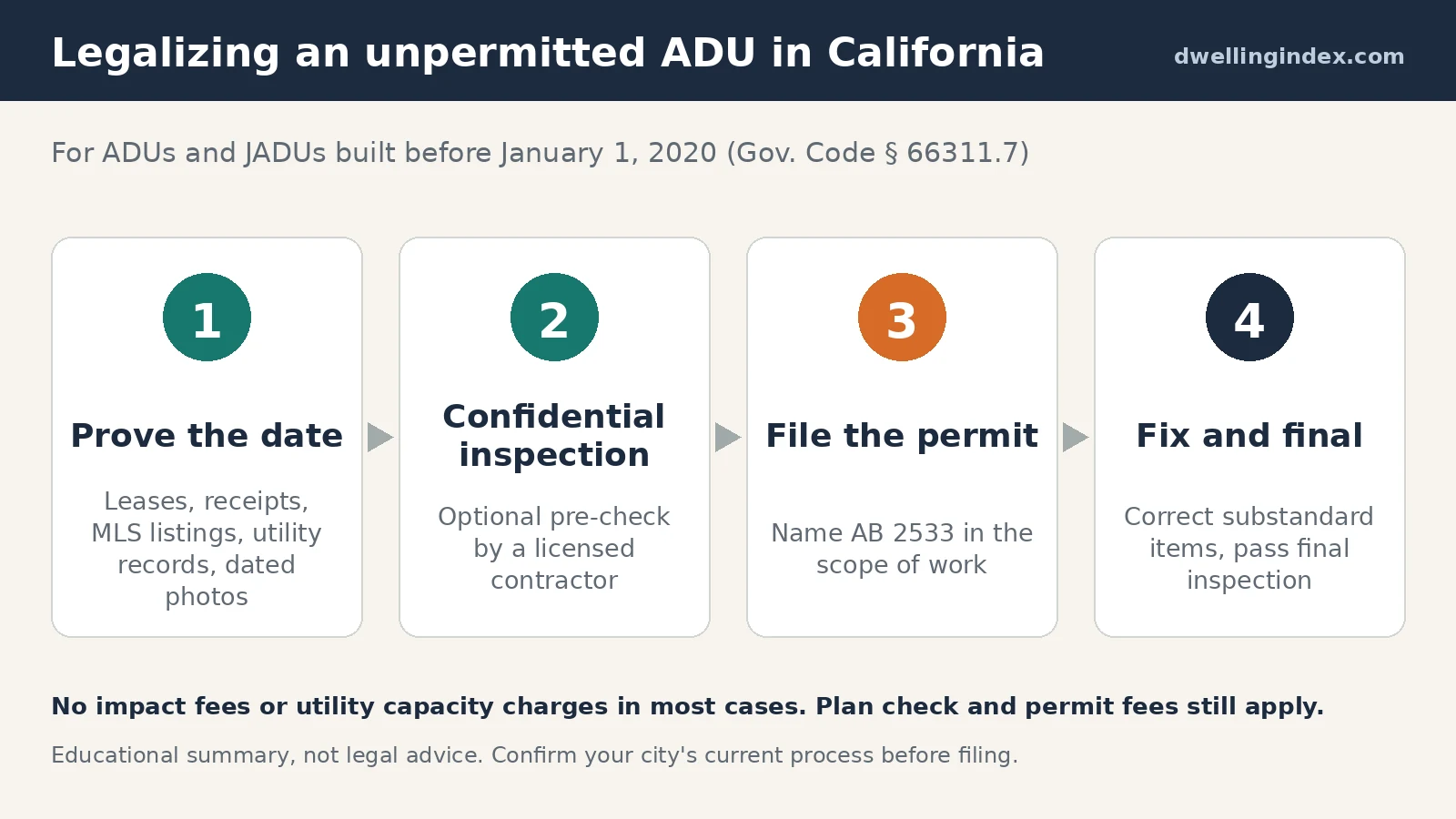
- Optional confidential pre-inspection. You hire a licensed contractor or design professional to walk the unit against your city's checklist. In Los Angeles, the results are for you only and don't have to be submitted.
- Application. You file a building permit application and name AB 2533 in the scope of work. LA's example wording is “Permit previously unpermitted conversion of existing 1-story garage to an ADU per AB 2533.” Orange County asks for “AB 2533 legalization of ADU” or “AB 2533 legalization of JADU.”
- Plan check. You submit date evidence and a site plan (and in many cities a floor plan). LA collects a plan check fee at submission.
- Permit issued. In LA, Riverside, and Orange County, the permit is issued first, then the city inspects.
- Inspection and corrections. The inspector lists what's substandard. You fix it under the permit.
- Final. LA issues a Certificate of Occupancy after final inspection and other departments' clearances. Orange County also says it issues a Certificate of Occupancy on final.
A few cities may let you back out. The supplied research cites a Riverside FAQ saying you can withdraw “up until the Safety Inspection” and complete the inspection report afterward. Riverside's current program page did not state that withdrawal deadline when checked; confirm it with the city. A confidential pre-inspection can help you understand the repair scope before applying.
What about an existing code case? If you're filing in response to a notice, San Diego asks you to put the enforcement case number in the scope of work. The protections in § 66311.7 apply to the permit, but an open case may include other issues on the property. Ask the enforcement officer what closes when the ADU permit finals.
How much does it cost to legalize an unpermitted ADU?
Answer capsule: For a pre-2020 unit, state law removes impact fees and utility connection and capacity charges in most cases, but you still pay plan check and building permit fees, any program fees, design costs, and the cost of the safety repairs. Berkeley lists a $590 application fee. The supplied research cited a $40 application and $210 inspection fee in Riverside, but those amounts were not listed on its current program page when checked; confirm them before budgeting.
Here's what's waived and what isn't, decoded from § 66311.7(e) and what cities publish:
| Cost item | Pre-2020 unit under § 66311.7 | Source |
|---|---|---|
| Impact fees (parks, traffic, and similar development fees) | Not charged | Gov. Code § 66311.7(e) |
| Water and sewer connection or capacity charges | Not charged, unless new utility work is needed to fix a substandard condition and the fee is allowed under § 66311.5(e) | Gov. Code § 66311.7(e); San Diego IB-242 says no water and sewer capacity fees apply |
| Plan check and building permit fees | Charged at the city's normal rates | LADBS, San Diego, Riverside, Orange County pages |
| Program or application fees | Some cities charge them | Supplied research cited Riverside $40 application + $210 inspection (not confirmed on its current page); Berkeley $590 application, $250 address assignment |
| School fees | Can apply to larger units | LADBS says LAUSD fees apply to ADUs over 500 sq ft |
| Design and drafting (as-built plans) | Your cost | Required by most cities |
| Safety repairs | Your cost, usually the largest item | Depends on the inspector's list |
Berkeley's listed fees were checked November 11, 2026. The Riverside fee figures in the supplied research could not be confirmed on its current program page. Check each city's current fee schedule before you budget.
A note on Riverside: its page says it won't impose impact fees unless the ADU exceeds 749 square feet. Section 66311.7(e) itself doesn't contain a size limit for pre-2020 legalizations. If your unit is larger than 749 square feet and you're in Riverside, ask the city in writing which rule it's applying.
We didn't publish a single “average cost to legalize,” because none of the official sources give one, and the repair scope drives the total. A unit that needs smoke alarms, a CO alarm, and a new egress window is a very different job from one that needs a new slab and a full rewire. Get a written scope from the confidential pre-inspection before you file.
If the repair list looks long enough that rebuilding might be cheaper, compare it against a new build. Our cost calculator gives you a ballpark for a new ADU at your size.
Paying for the repairs is often the real hurdle. Many owners use a HELOC, a cash-out refinance, or savings. Our guide to ADU financing options explains each path in plain terms.
How long does legalization take?
Answer capsule: No statewide deadline is set specifically for legalization permits. Timelines depend on your city's plan check queue, other departments' clearances, and how long your repairs take. The supplied research cited a one-year Riverside deadline and an extension requested 30 days before it; those details were not confirmed on the city's current program page. Berkeley may use a waiting list.
The steps that add time:
- Collecting evidence and drawing as-built plans. This is on you, before you file.
- Other departments. In Los Angeles, the Bureau of Engineering must clear sewer availability and assign an address, and the Fire Department reviews hydrants and access. LADWP review is needed if the unit is in or within 10 feet of a public utility easement.
- Repairs. Corrections happen under the permit after it's issued.
- Demand. Berkeley's page says the city “may place some Amnesty Program applicants on a waiting list.”
If you're selling, start early. The supplied research cited this Riverside advice: “Finish the program before listing or disclose any open permits.” Confirm current requirements with the city and your real estate adviser.
How do the biggest California cities handle unpermitted ADUs?
Answer capsule: Large California jurisdictions have published their own AB 2533 processes. Los Angeles uses Information Bulletin P/BC 2026-161, San Diego uses Information Bulletin 242, San José routes applicants to its ADU Ally team, the County of Orange runs a Safe ADU/JADU Legalization Program, Riverside runs a Safety-First Amnesty Program, and Berkeley runs a pilot through 2028.
We read each program's official page on November 11, 2026. This table shows how to file and what's different:
| Jurisdiction | Program | How to file | Local detail worth knowing |
|---|---|---|---|
| City of Los Angeles | LADBS IB P/BC 2026-161, “Streamlined Permitting of Unpermitted Dwelling Unit as ADU/JADU Under AB 2533” (effective July 15, 2026; supplied research cited Aug 5; LADBS now lists a Sept 2 revision) | ePlanLA online or in person by appointment; cite AB 2533 in the work description | Form AB2533-03 standard notes and AB2533-01 substandard checklist; existing non-conforming setbacks may stay; plan check fee at submittal; LAUSD fees over 500 sq ft |
| City of San Diego | Information Bulletin 242, “How to Obtain a Permit to Legalize Unpermitted Accessory Dwelling Units” (May 2026) | Online building permit application; scope of work says the project uses AB 2533 | Floor plan must show alarms, exits, egress windows, GFCI outlets; no water/sewer capacity fees; not for Coastal Act areas |
| City of San José | AB 2533 legalization through the ADU Ally team; Building Bulletin #214, “ADU and JADU Amnesty and Legalization” | Email ADU.Ally@sanjoseca.gov to see if you qualify | The city's ADU process page routes all AB 2533 questions to ADU Ally |
| County of Orange (unincorporated) | AB 2533 Safe ADU/JADU Legalization Program | Residential building permit on myOCeServices; description “AB 2533 legalization of ADU/JADU”; pay a permit deposit | Uses the County's Substandard Housing Inspection Checklist; Certificate of Occupancy on final |
| City of Riverside | Safety-First Amnesty Program | Public permit portal; description “AB 2533 – Legalization of Unpermitted ADU or JADU” | Supplied research cited $40 application, $210 inspection, withdrawal before safety inspection and one year to finish; confirm these details with the city |
| City of Berkeley | Pilot Amnesty Program for Unpermitted Dwelling Units (Jan 1, 2025–Dec 31, 2028) | Free confidential consultations, then application | Two paths: Certificate of Occupancy or Housing Certificate of Compliance; $590 application fee |
Each row comes from the jurisdiction's own web page or bulletin, read November 11, 2026. Programs change; confirm before you file.
If your city isn't listed, the statute still applies. Section 66311.7(d) requires every city and county to post the substandard checklist and the confidential-inspection notice, so start with your building department's ADU page. San Diego County homeowners outside the City of San Diego can also start with our San Diego ADU permit process guide, and Inland Empire owners can see how San Bernardino County handles AB 2533 in our San Bernardino County ADU builders guide.
What if your ADU was built after January 1, 2020?
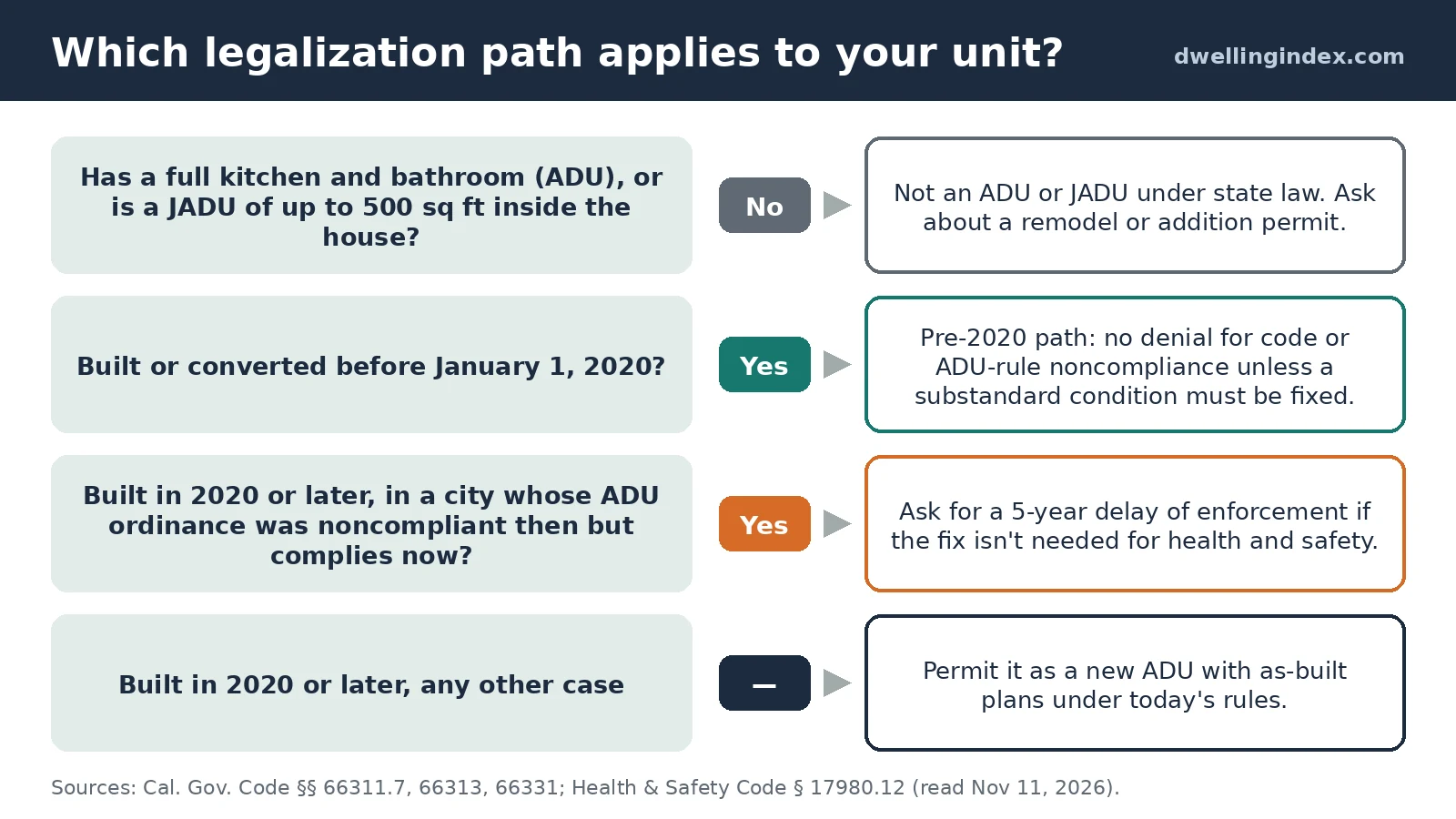
Answer capsule: Units built on or after January 1, 2020, don't get § 66311.7's no-denial protection. After an eligible notice to correct, if your city's ADU ordinance didn't comply with state law when the unit was built but does now, you can request a five-year delay of building-code enforcement under Gov. Code § 66331 and H&S Code § 17980.12, if the correction isn't necessary for health and safety. No new delays can be approved on or after January 1, 2030. Otherwise, permit it as a new ADU.
There are two routes.
Route 1: Delay enforcement for five years. Health and Safety Code § 17980.12 says that until January 1, 2030, a notice to correct an ADU violation must tell the owner about the right to request a delay if (A) the ADU was built before January 1, 2020, or (B) it was built on or after January 1, 2020, in a city whose ADU ordinance was noncompliant at the time but is compliant when you ask. The agency “shall grant” the five-year delay if correcting the violation isn't necessary to protect health and safety, after consulting the agency that enforces the State Fire Marshal's regulations. No new delays can be approved on or after January 1, 2030, but delays approved before then run their full term. Berkeley offers a form for this request.
Route 2: Permit it as a new ADU. You submit as-built plans and the unit has to meet today's ADU and building rules. State law still helps:
- Converted existing structures keep their setbacks. No setback can be required for an existing structure converted to an ADU, or one rebuilt in the same place and size (Gov. Code § 66314(d)(7)).
- No replacement parking when a garage is converted (§ 66314(d)(11)).
- No forced cleanup of the rest of the lot. A city can't deny an ADU permit because of nonconforming zoning conditions or unpermitted structures that don't threaten health and safety and aren't affected by the ADU (§ 66322(b)), and it can't require the correction of nonconforming zoning conditions as a condition of ministerial approval (§ 66323(c)).
- Older code may be allowed. Under H&S Code § 17958.12, a building official may apply the building standards in effect when the unit was built.
- Size and fee limits. Detached ADUs can be up to 1,200 square feet (§ 66314(d)(5)), and units of 750 square feet or less pay no impact fees (§ 66311.5(c)).
If you're on Route 2, the first question is whether the unit fits today's ADU envelope at your address. Our California ADU laws guide covers the size, height, and setback rules in detail.
Can you keep renting an unpermitted ADU?
Answer capsule: Legalization does not necessarily require you to stop renting, but local rules, safety conditions, and required repairs can affect occupancy. Renting an unpermitted unit carries risk. Berkeley's program page lists tenant nonpayment, tenant reports, and insurance gaps among the reasons to legalize. After legalization, a city may require rentals of 30 days or longer, and units created through the state conversion path must be rented for more than 30 days.
What the official sources say:
- Why legalize if you rent. Berkeley lists reasons including avoiding “problems with tenants not paying rent because the unit is illegal,” lowering “the chance of tenants reporting unpermitted work,” and the fact that “home insurance may not cover unpermitted units.”
- Rental terms after legalization. Gov. Code § 66315 lets a city require rentals of 30 days or longer, and § 66323(e) requires rentals longer than 30 days for units created through the state conversion path. If you've been running a nightly rental, plan for long-term tenants.
- Leases double as evidence. A pre-2020 lease is on the LA and San Diego evidence lists.
Tenant protection and rent-control laws vary by city, and some apply to unpermitted units. If someone lives in the unit, talk to your local rent board or a landlord-tenant attorney before you file, especially if repairs will require the tenant to move out temporarily. For general landlord setup after you're legal, see our ADU property management guide and ADU rent guide.
Can you sell a house with an unpermitted ADU in California?
Answer capsule: Yes, but you must disclose it. California's Real Estate Transfer Disclosure Statement (Civil Code § 1102.6) asks sellers whether they're aware of room additions, structural modifications, or other alterations made without necessary permits. The supplied research cites advice to finish legalization before listing or disclose open permits; confirm your obligations with your real estate adviser.
Selling with an unpermitted unit usually means one of three things for buyers: the appraiser gives it little or no value, the lender won't count its rent, or the buyer asks for a price cut to cover legalization. Legalizing first turns a disclosure problem into a selling point.
Buyers have options too. Because § 66311.7 runs with the unit's construction date, not the owner, a buyer who closes on a house with a pre-2020 unpermitted unit can apply after closing. Ask the seller for the evidence that proves the date (old leases, MLS listings, receipts) before you close. That paperwork is hard to recreate later.
Will an unpermitted ADU affect insurance, appraisal, or refinancing?
Answer capsule: Often, yes. Berkeley's city program warns that home insurance may not cover unpermitted units. Appraisers and lenders treat unpermitted ADUs differently from permitted ones, which can limit the value they give the unit and whether its rent counts toward qualifying. Legalizing generally removes those limits.
We cover the lending side in detail elsewhere, so we won't repeat it here:
- ADU appraisal requirements by loan type explains how permitted, legal nonconforming, and unpermitted units are treated.
- ADU appraisal value covers what an appraiser can and can't give credit for.
For insurance, call your carrier before and after legalization. Ask whether the unit is covered today, and what they need (usually the final permit or Certificate of Occupancy) to cover it once it's legal.
Step by step: how to legalize an unpermitted ADU in California
Answer capsule: Confirm the unit was built before January 1, 2020 and meets the ADU or JADU definition, gather two or more pieces of date evidence, get a confidential pre-inspection, draw as-built plans, file a building permit that cites AB 2533, fix what the inspector lists, and pass final inspection.
- Find your jurisdiction. Your mailing city may not be your permit authority. Unincorporated areas go to the county.
- Confirm the date. Find when the unit was built or converted. If it was on or after January 1, 2020, jump to the post-2020 routes above.
- Confirm it's an ADU or JADU. Full kitchen and bathroom for an ADU; efficiency kitchen and up to 500 sq ft inside the house for a JADU.
- Gather evidence. Leases, MLS listings, receipts, utility or insurance records, dated photos. Aim for two.
- Get the confidential pre-inspection. Use your city's substandard checklist. Get a written repair scope and price.
- Decide: legalize, convert back, or rebuild. Compare the repair scope with the cost of a new build.
- Draw as-built plans. At minimum a site plan; many cities want a floor plan showing alarms, exits, and egress windows.
- File. Name AB 2533 in the scope of work, exactly as your city asks.
- Pay plan check and permit fees. Not impact or capacity fees, for a pre-2020 unit.
- Fix and final. Make the inspector's corrections and pass final inspection. Keep the final permit or Certificate of Occupancy with your house records.
What are the most common mistakes?
Answer capsule: The most common mistakes are filing without proof of the construction date, skipping the confidential pre-inspection, citing the wrong process (a new-ADU permit instead of the AB 2533 path), adding new work before legalization, and listing a house for sale before the permit is finaled or disclosed.
- Filing without date proof. Without it, the unit can be treated as new construction.
- Skipping the pre-inspection. It's the only look at your repair bill that the city doesn't see.
- Not naming AB 2533. Every program we read asks for that wording in the scope of work.
- Adding on before legalizing. San Diego and Riverside both say new alterations, remodeling, or additions must meet current code.
- Listing first. Buyers, appraisers, and lenders will find it.
- Trusting an old handout. If it says § 66332 or § 65852.2, check the current statute at § 66311.7 and § 66313.
Want a checklist you can keep next to this page while you gather paperwork?
What we verified
Editorial note: the items below are the research notes supplied by The Dwelling Index editorial team for this page, dated November 11, 2026. They describe the team's source review and are reproduced as provided.
The core state provisions and several city program pages were checked against their current official text. Riverside's current page did not list the fee amounts, withdrawal deadline, or one-year completion period cited in the supplied research; verify those directly with the city. LADBS now publishes a September 2, 2026 revision of its bulletin.
- Checked on November 11, 2026: California Government Code §§ 66311.5, 66311.7, 66313, 66314, 66315, 66317, 66322, 66323, 66331, and 66333 (current text and history lines on leginfo.legislature.ca.gov, including the SB 543 renumbering effective January 1, 2026); Health and Safety Code §§ 17920.3, 17958.12, and 17980.12; Civil Code § 1102.6 (TDS form reference); LADBS Information Bulletin P/BC 2026-161 (effective July 15, 2026, revised August 5, 2026); City of San Diego Information Bulletin 242 (May 2026); City of San José ADU process page and Building Bulletins list (#214); County of Orange AB 2533 Safe ADU/JADU Legalization Program page; City of Riverside Safety-First Amnesty Program page; City of Berkeley Amnesty Program for Unpermitted Dwelling Units page.
- Also checked: SB 477's March 25, 2024 repeal of Gov. Code §§ 65852.2 and 65852.22.
- Our work: the four-path table, the streamlined-exclusion comparison, the evidence matrix, the § 66311.7 decode, the § 17920.3 translation, and the fee table were assembled by us from those sources.
- Not verified: your city's current fee amounts; typical repair costs (no official source publishes one); San José's processing time (not stated on the official pages we read).
Methodology
We read the statutes directly instead of relying on summaries, and noted each section's effective date and history line. We then read the official AB 2533 pages for six jurisdictions chosen for size and for having a published process. Each table cell is tied to a named source. Where a city page conflicts with the statute (Riverside's 749-square-foot impact-fee line) or uses an outdated citation (Orange County's reference to § 65852.2), we say so rather than pick one. We didn't contact cities for this version. We'll re-check quarterly, after each January 1 when new ADU laws take effect, and whenever LADBS or San Diego revises its bulletin.
Sources
- California Government Code, Title 7, Division 1, Chapter 13 (§§ 66310–66342), as amended through SB 543 (Stats. 2025, ch. 520), effective January 1, 2026: leginfo.legislature.ca.gov (opens in a new tab)
- AB 2533 (Stats. 2024, ch. 834): leginfo.legislature.ca.gov (opens in a new tab)
- California Health and Safety Code §§ 17920.3, 17958.12, 17980.12: leginfo.legislature.ca.gov (opens in a new tab)
- California Civil Code § 1102.6: leginfo.legislature.ca.gov (opens in a new tab)
- California Department of Housing and Community Development, Accessory Dwelling Unit Handbook (March 2026): hcd.ca.gov (opens in a new tab)
- Los Angeles Department of Building and Safety, Information Bulletin P/BC 2026-161: dbs.lacity.gov (opens in a new tab)
- City of San Diego Development Services, Information Bulletin 242: sandiego.gov (opens in a new tab)
- City of San José, ADU Project Process and Building Bulletins & Forms: sanjoseca.gov (opens in a new tab)
- County of Orange, AB 2533 Safe ADU/JADU Legalization Program: pwds.oc.gov (opens in a new tab)
- City of Riverside, Safety-First Amnesty Program: riversideca.gov (opens in a new tab)
- City of Berkeley, Amnesty Program for Unpermitted Dwelling Units: berkeleyca.gov (opens in a new tab)
Legal disclaimer: This guide is general educational information about California law and local programs as read on November 11, 2026. It is not legal advice, and statutes, bulletins, and fees change. Confirm current rules with your city or county building department, and consult a California real estate attorney if you have an open code case, a tenant in the unit, or a pending sale.
Frequently asked questions
Can I legalize an unpermitted ADU in California?
Yes, if it was built before January 1, 2020, and meets the state definition of an ADU or JADU. Under Government Code § 66311.7, your city can't deny the permit for code or ADU-ordinance noncompliance unless a fix is needed to clear a substandard condition under Health and Safety Code § 17920.3.
What is California's ADU amnesty law?
It's AB 2533, which took effect January 1, 2025, as Government Code § 66332 and was renumbered to § 66311.7 on January 1, 2026. It limits denials, bans most impact and capacity fees, and bars penalties for pre-2020 unpermitted ADUs and JADUs.
Do I have to pay fees to legalize an unpermitted ADU?
You pay plan check and building permit fees and any city program fees. For a pre-2020 unit, you don't pay impact fees or utility connection or capacity charges, except for utility work needed to fix a substandard condition. School fees can apply to larger units.
Will I be fined if I apply to legalize my ADU?
Not for having the unit. Section 66311.7(f) says that if the inspector finds health and safety problems, the city shall not penalize the applicant and shall approve the permits needed to fix them.
Can the city make me tear out an unpermitted ADU?
For a qualifying pre-2020 unit, the city can't deny legalization only because the unit breaks current code or ADU rules. It can require you to fix substandard conditions, and the protection doesn't cover a building that is substandard as a whole until it's corrected.
What if my ADU was built after 2020?
It doesn't get the pre-2020 protections. After an eligible notice to correct, you can request a five-year enforcement delay if your city's ordinance was noncompliant when the unit was built but is compliant when you request it, and correcting the violation is not necessary for health and safety. Otherwise, permit it as a new ADU with as-built plans.
Can I sell a house with an unpermitted ADU?
Yes, with disclosure. The California Transfer Disclosure Statement asks about alterations made without permits. Legalizing before you list usually helps value and financing.
Do I need a contractor to legalize an unpermitted ADU?
Not always. The supplied research cited Riverside as saying a contractor is not always required but electrical, plumbing, mechanical, and framing work usually needs licensed professionals. Confirm current requirements with the city. Berkeley requires applicants to hire licensed professionals.