
San Mateo County ADU Resource Center: What It Does, Who Qualifies & What to Verify First
· · Last verified: May 26, 2026 · By the Dwelling Index Editorial Team
Dwelling Index is an independent research resource covering ADU financing, costs, and regulations. We are not the San Mateo County ADU Resource Center and are not affiliated with it. The official Center is a nonprofit at smcadu.org, and we link to it throughout so you can use the real thing. This page exists to do what the Center’s own site doesn’t package in one place: route you to the right rules for your specific address, set honest cost and timeline expectations, and flag the 2026 issues (like the Midcoast permit cap) that can derail a project if you don’t know about them.
(This is a public, non-commercial resource. We don’t earn anything when you use it — we just think you should.)
Quick answers before you scroll
| Your question | Fast answer | What to do next |
|---|---|---|
| Is the Resource Center real, official, and free? | Yes — a nonprofit funded by county jurisdictions and foundations. Core tools and consults are free. | Check whether your jurisdiction is a member (table below). |
| Does it serve every city in the county? | No. Consults and the Plans Gallery are member-jurisdiction only. | Confirm your jurisdiction before assuming you qualify. |
| Are my ADU rules set by the Center? | No. Rules come from your city ordinance or unincorporated county ordinance, within California state law. | Find out if your address is in a city or unincorporated county. |
| What should I budget? | Planning range: $450–$600/sq ft (the Bay Area runs high). An 800 sq ft unit ≈ $360K–$480K before site surprises. | Run a feasibility check before requesting builder bids. |
| How long does it take? | Often 12–24 months; plan review runs on a state-mandated 60-day clock once your application is complete. | Identify your slowdown risks early — especially if you’re coastside. |
What is the San Mateo County ADU Resource Center?
The San Mateo County ADU Resource Center is a free, nonprofit accessory dwelling unit (ADU) help service that launched in 2024 at smcadu.org to make it easier and less expensive for local homeowners to build ADUs. It offers a step-by-step guidebook, a localized cost calculator, a plans gallery, a glossary, and — for residents of its member jurisdictions — a free one-hour feasibility consult delivered through its partner, Hello Housing.
An ADU (“accessory dwelling unit,” also called a granny flat, in-law unit, or backyard cottage) is a fully independent second home on the same lot as your main house — its own kitchen, bathroom, and entrance. The Resource Center is not a builder, not a city department, and not a permit office. Think of it as a neutral on-ramp: a place to learn what’s possible and pressure-test your plan before money changes hands.
The Center has real lineage. San Mateo County’s Home for All collaborative founded the original “Second Unit Center” in 2017 — one of the first ADU one-stop-shops in the United States. In 2022, county jurisdictions decided they wanted a staffed center combining those tools with the hands-on technical support pioneered by the Napa Sonoma ADU Center. The staffed San Mateo County ADU Resource Center launched publicly on October 16, 2024.
What does the Resource Center actually give you?
- ✓A free ADU guidebook that walks the full journey from inspiration through construction and becoming a landlord or moving in.
- ✓A localized ADU calculator for rough cost and rental-income budgeting using local assumptions.
- ✓A plans gallery to browse ADU floor plans and connect with designers — member jurisdictions only.
- ✓A free one-hour virtual feasibility consult with an ADU specialist — member jurisdictions only — delivered by partner Hello Housing.
- ✓Local rules links, exercises, and a glossary to prep for that consult and your eventual planning-department conversation.
Is it a sales funnel in disguise?
No — and that matters. The Center is nonprofit-supported and does not earn a commission steering you toward a particular builder, designer, or lender. That independence is exactly why we tell readers to start there. We’re an independent research resource ourselves, and we have no problem saying a free public service beats a paid one when it does.
Who can use the free San Mateo County ADU consult?
The free one-hour feasibility consult and the Plans Gallery are available only to residents of the Center’s member jurisdictions — the city and county governments that fund it. Everyone else can still use the Center’s free public guidebook, calculator, and rules links; they just can’t book the personalized consult.
This is where we add value the Center’s own site doesn’t make obvious. The Center’s About page states plainly that “the Plans Gallery and ADU Consults are only available to residents of Member Jurisdictions, who fund the Center.” But which jurisdictions count isn’t perfectly consistent across the Center’s own pages. Here’s the current picture, checked across the Center’s contact page, About page, and October 2024 launch materials:
Membership discrepancy matrix (checked May 26, 2026)
| Where it’s listed | Jurisdictions | What it means for you |
|---|---|---|
| Current Contact-page member list | Atherton, Belmont, Brisbane, Burlingame, East Palo Alto, Hillsborough, Menlo Park, Pacifica, Redwood City, San Bruno, San Carlos, City of San Mateo, unincorporated San Mateo County, South San Francisco, Woodside | Most likely consult-eligible — the contact page controls sign-up. |
| Also listed on the About page | Foster City (appears on About, not on the current contact-page member list) | Confirm Foster City eligibility directly before booking. |
| Named at Oct 2024 launch only | Foster City, Portola Valley (in launch materials; not on the current contact-page list) | Don’t assume the free consult applies — verify with the Center first. |
Why we flag this: the membership roster changes, and the Center’s contact page is the one that actually controls consult sign-up. If you’re in Menlo Park, you appear to be covered. If you’re in Foster City or Portola Valley, you may be — but confirm it directly before you build a plan around the free consult. Source: smcadu.org/contact/ and about pages. Verified May 26, 2026.
Get a general ADU planning overview before your consult
The tool provides state-level rules, broad cost ranges, and an illustrative equity estimate. It does not determine San Mateo County jurisdiction, parcel eligibility, lot constraints, or the ADU type your site supports; confirm those with the Resource Center or local planning office.
Get My ADU Planning OverviewAm I under city rules, county rules, or California ADU law?
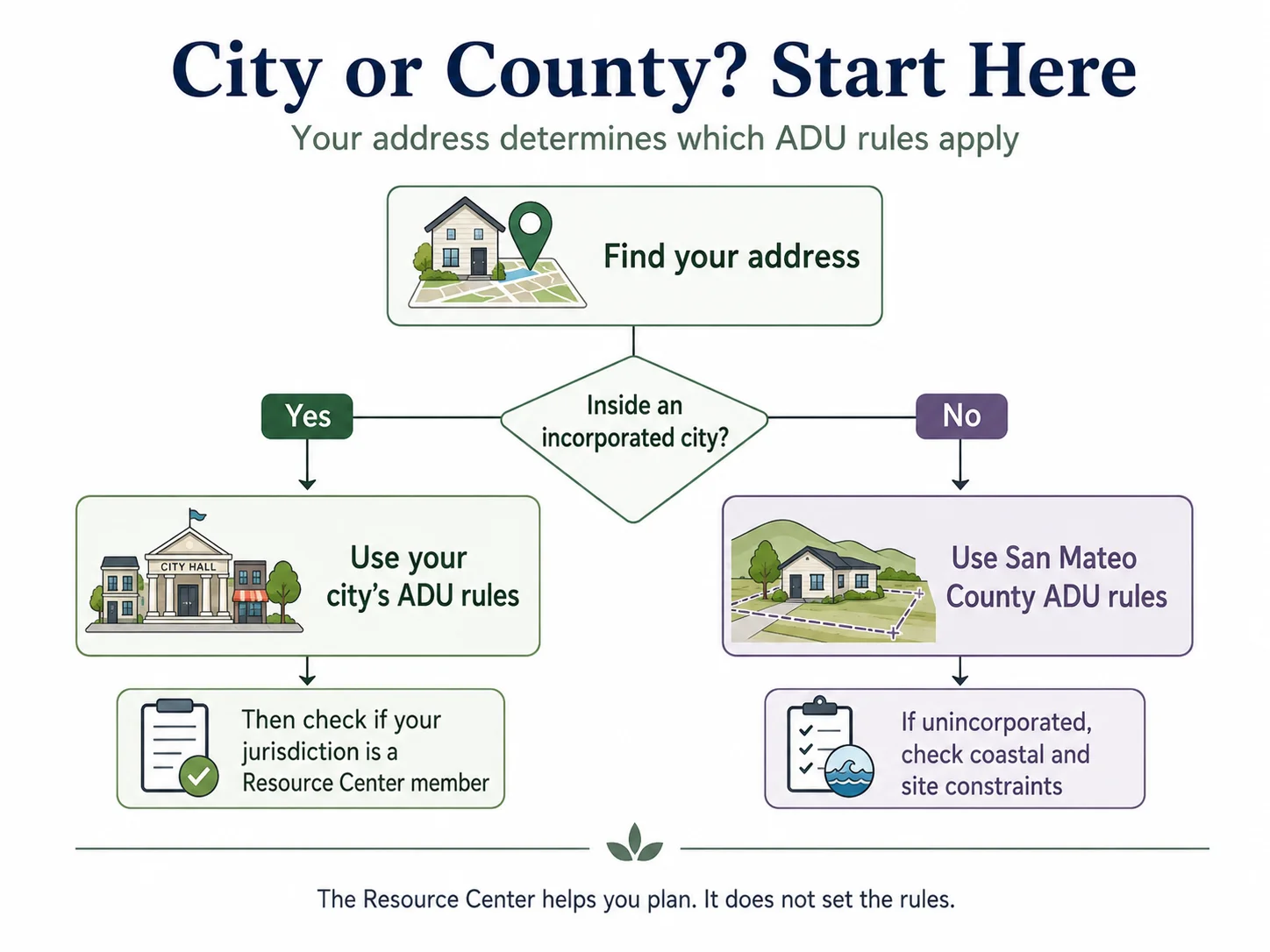
If your home is inside an incorporated city, that city’s ADU ordinance governs your project; if it’s in unincorporated San Mateo County, the County ordinance governs — and in both cases, local rules operate within California’s statewide ADU law. San Mateo County’s planning department regulates ADUs only in unincorporated areas, not inside the 20 incorporated cities.
The mental model: three layers stacked on top of each other.
- 1.California state law sets the floor — the protections no city or county can strip away.
- 2.Your local ordinance — city or county — fills in the objective specifics: exact setbacks, height, parking, design standards, and fees, all within the state floor.
- 3.The Resource Center helps you understand layers 1 and 2 and prep your application — but it doesn’t make the rules.
One load-bearing definition: “ministerial approval” means a qualifying ADU is reviewed by staff against objective written standards with no public hearing and no neighbor-notification process. Meet the standards, and staff approve it. The City of San Mateo confirms that compliant ADU and JADU applications are handled ministerially through building-permit review — no planning hearing required.
Jurisdiction routing table
| Your address is… | Start with this official rule source | Why |
|---|---|---|
| City of San Mateo | City ADU ordinance (Zoning Code Ch. 27.19) + building permit | The city has its own ordinance and runs compliant ADUs ministerially. |
| Any other incorporated city (Redwood City, Burlingame, Pacifica, San Bruno, etc.) | That city’s ADU ordinance + planning/building dept. | Each city has its own objective standards and fee schedule. |
| Unincorporated San Mateo County — inland (non-coastal) | County ADU ordinance, Chapter 8.392 | The County governs unincorporated areas only. |
| Unincorporated San Mateo County — coastal | County coastal ADU ordinance (Chapter 8.396) + Coastal Development Permit review | Coastal parcels trigger added review and, in the urban Midcoast, a hard permit cap (see below). |
What can I build under California ADU law? (The state rules, decoded)
California state law guarantees a baseline every San Mateo County city and the unincorporated county must honor: a qualifying single-family property can pursue protected pathways for a JADU, an internal-conversion or attached ADU, and a detached ADU, and cities must preserve a path for an 800 sq ft ADU with 4-foot side and rear setbacks. These protections live in California Government Code sections 66314–66342, and they override conflicting local restrictions. This is the floor; your city can be more generous, not less.
A few definitions before the table:
- JADU (Junior ADU): a unit of 500 sq ft or less carved out of the existing walls of a single-family home, with its own entrance and at least an efficiency kitchen. It may share a bathroom with the main house.
- Setback: the required distance between your structure and the property line.
- Title 24: California’s building energy-efficiency code that ADUs must meet.
| State-law protection (2026) | What it means in plain English | Primary source |
|---|---|---|
| Protected single-family pathways | A qualifying single-family lot can pursue a JADU, an internal/conversion or attached ADU, and a detached new-construction ADU — subject to the statutory conditions for each. | Gov. Code §66323 |
| The 800 sq ft “safety” path | Cities must preserve a path for an 800 sq ft ADU with 4-ft side/rear setbacks, even if lot-coverage or FAR rules would otherwise block it. | Gov. Code §66321 |
| Owner-occupancy NOT required for ADUs | The prohibition on owner-occupancy requirements for standard ADUs is indefinite. You can build one and rent it without living on-site. | Gov. Code §66315 |
| JADU owner-occupancy nuance (2026) | Under Gov. Code §66333 as amended by AB 1154 (effective Jan 1, 2026), a JADU owner-occupancy restriction applies only when the JADU shares sanitation facilities with the main house. Give it its own bathroom and the requirement drops. | Gov. Code §66333 |
| JADUs capped at 500 sq ft, 30-day+ rentals only | JADUs are fixed at 500 sq ft of interior livable space and can’t be used as short-term (sub-30-day) rentals. | Gov. Code §66333 |
| 15-day completeness, 60-day decision | Jurisdictions must check your application for completeness within 15 business days and decide within 60 days of a complete submission. | Gov. Code §66317 |
| Parking exemptions | State law limits when parking can be required — including proximity to transit and certain conversions. | Gov. Code §66322 |
| Separate sale possible — if your city opts in | A local agency may (not must) adopt an ordinance letting you sell an ADU separately as a condo. It’s optional, and most cities haven’t. | Gov. Code §66342 |
Sources: California Government Code §§66314–66342; California HCD 2025 ADU Handbook. Verified May 26, 2026. Legal specifics change — verify the current statute before relying on any single point.
Rental-income disclaimer: Any rental figures in this guide are illustrative examples, not guarantees of returns. Actual results depend on local market conditions, construction costs, financing terms, and regulatory approvals.
What do San Mateo County rules add for unincorporated properties?
For non-coastal unincorporated San Mateo County, the County ADU ordinance (Chapter 8.392) layers local specifics on top of state law — and it applies only outside incorporated city limits. It exempts ADUs from minimum-lot-size requirements, uses a 4-foot side/rear setback baseline, allows front-setback relief when needed to fit a compliant 800 sq ft unit, and addresses height and parking within the state framework.
| Topic | County rule highlight (non-coastal, Ch. 8.392) |
|---|---|
| Where ADUs are allowed | Permitted across multiple residential and mixed-use districts where residential uses are allowed. |
| Minimum lot size | ADUs are exempt from minimum lot-area requirements — small lots still qualify. |
| Side/rear setbacks | 4-foot baseline, with stepback rules for taller structures. |
| Front setback | Relief allowed if the standard front setback would block a compliant 800 sq ft ADU. |
| Parking | One space may be required unless an exemption applies (transit proximity, conversions, etc.). |
Source: San Mateo County ADU ordinance (Ch. 8.392 non-coastal; Ch. 8.396 coastal); County Local Coastal Program. Verified May 26, 2026.
Coastal unincorporated parcels are a different animal.
All development in the Coastal Zone requires a Coastal Development Permit (or a documented exemption), and the rules live in the County’s coastal ADU ordinance and Local Coastal Program. If you’re coastside, read the next section before you do anything else — there’s a current building-permit cap that can stop your project cold.
What if my property is in the urban Midcoast coastal zone?
Here’s what the County’s own announcement (March 20, 2026) lays out. LCP Policy 1.23 caps new dwelling units in the urban Midcoast at an average of 40 per calendar year — and that cap explicitly includes ADUs. In 2025, building permits were issued for 102 units there (mostly affordable housing). Because the LCP requires the three-year average to stay at or below 40, the total number of new-housing building permits allowed across 2026 and 2027 combined is just 18. New building-permit applications for urban Midcoast housing projects cannot be accepted until 2028 unless and until the County amends its LCP — a change that requires California Coastal Commission approval and could take a year or more.
What this means for you, practically:
- ✓Planning permits: still accepted and processed. The County actively encourages coastside applicants to file planning permits now to start the entitlement clock.
- ×Building permits: capped and effectively unavailable for new urban Midcoast housing until 2028, barring an LCP amendment.
- ✓Active building permits already in process: continue to be processed and issued.
If you’re coastside, this changes your sequence entirely — there’s little point rushing to a builder quote when the building permit itself is gated. Confirm your parcel’s status with County planning first.
Confirm coastside jurisdiction before spending on design
The planning tool does not identify a parcel’s jurisdiction or capped-zone status. Use the county and city resources linked in this guide to verify those requirements before requesting quotes.
Get My ADU Planning OverviewSource: San Mateo County Planning & Building — Midcoast Building Permit Cap (press release March 20, 2026). Verified May 26, 2026. This is a moving situation tied to a pending LCP amendment — confirm current status with the County.
How much does an ADU cost in San Mateo County?
For early planning, the San Mateo County ADU Resource Center uses a rough $450–$600 per square foot range — meaningfully higher than the $200–$450/sq ft you’ll see in statewide California guides, because the Bay Area carries some of the highest labor and material costs in the country. That puts a state-protected 800 sq ft ADU in roughly the $360,000–$480,000 band before site-specific surprises, while a small JADU conversion can land far lower.
Cost by ADU type (San Mateo County, 2026)
| ADU type | Typical total cost range | Why it lands here |
|---|---|---|
| JADU (≤500 sq ft, internal conversion) | $50,000–$120,000 | Reuses existing walls; cheapest path, but capped at 500 sq ft and may need habitability upgrades. |
| Garage conversion | $100,000–$280,000 | Reuses a structure, but Title 24, panel upgrade, plumbing, HVAC, and hidden slab/moisture issues add up fast. |
| Attached ADU (addition) | $220,000–$350,000 | Structural engineering, shared-wall fire/insulation upgrades, often separate metering. |
| New detached ADU | $300,000–$450,000+ | New foundation, full new construction; most flexible and most expensive. Longest permitting. |
Sources: smcadu.org/budgeting/ ($450–$600/sq ft); Genuine Kitchen & Bath “ADU Cost Guide for San Mateo County 2026” (Apr 2026); GatherADU San Mateo County ranges (Feb 2026); Kellow Construction and BFPM 2026 California guides. These are planning ranges, not bids. Verified May 26, 2026.
Planning budget by size (at the Center’s $450–$600/sq ft)
| ADU size | At $450/sq ft | At $600/sq ft | Good for |
|---|---|---|---|
| 500 sq ft | $225,000 | $300,000 | JADU / small detached comparison |
| 750 sq ft | $337,500 | $450,000 | Compact 1-bedroom |
| 800 sq ft | $360,000 | $480,000 | The state-protected benchmark |
| 1,000 sq ft | $450,000 | $600,000 | Larger detached/attached |
| 1,200 sq ft | $540,000 | $720,000 | Where local rules allow |
Illustrative-estimate disclaimer: These are planning examples, not guarantees of price, approval, rental income, or return. Actual cost depends on ADU type, site conditions, utilities, design, permitting, financing, and construction conditions.
Why budgets swing — and the fees most people never see
The single biggest reason two identical-looking ADUs cost $150K apart is site work and soft costs — the stuff calculators ignore. Utility upgrades can add considerable time and cost, and septic properties may require Health Department involvement that adds months.
Verified permit fees
| Jurisdiction | Verified permit fee (flat, per unit) | Source |
|---|---|---|
| City of San Mateo — new ADU | $2,831.57 | cityofsanmateo.org |
| City of San Mateo — remodeled ADU | $2,031.12 | cityofsanmateo.org |
| City of San Mateo — JADU | $1,454.02 | cityofsanmateo.org |
| Unincorporated San Mateo County | Fees may include building, plumbing, electrical, mechanical, filing, microfilm, fire, geotechnical, plan check, and possibly Planning fees | smcgov.org |
City of San Mateo numbers are flat permit fees only — trade permits and any required reviews are on top. Build a 10–30% contingency into your total. Source: cityofsanmateo.org. Verified May 26, 2026.
Affiliate disclosure: The Dwelling Index is reader-supported. When you use our links to explore financing options, request prefab pricing, or purchase floor plans, we may earn a commission at no extra cost to you. Our editorial recommendations are based on independent research and are never influenced by compensation.
Explore your ADU financing paths before you request bids
A contractor’s quote shouldn’t set your budget — your financing capacity should. See how cash-out refinance, construction loans, and HELOCs compare for an ADU. No financing option is right for everyone; this is education, not a recommendation.
Compare ADU Financing OptionsCompare common funding routes and their eligibility limits before contacting a lender.
How long does a San Mateo County ADU take, idea to move-in?
Most San Mateo County ADU projects take 12–24 months from early planning to move-in, with permitting often running 1–6 months and construction 6–12 months — and a state-mandated 60-day clock applies to plan review once your application is complete. The 60-day figure is real but routinely misunderstood: it’s the review window for a complete application, not the time from “I have an idea” to “the unit is finished.”
| Phase | Typical range | What’s happening |
|---|---|---|
| Get started / assemble team | 1–3 months | Goals, budget, site constraints, choosing your designer/builder path. |
| Develop plans / pre-app / submit | 1–6 months | Site plan, architectural and structural plans, Title 24 calcs, deed restriction if required. |
| Plan review (the 60-day clock) | 1–6 months | Staff complete review and provide comments; corrections can add rounds. |
| Construction | 6–12 months | Site prep, foundation, framing/module placement, utilities, inspections, finishes. |
| Total | Often 12–24 months | Faster for simple conversions; slower for coastal, septic, utility-heavy, or correction-heavy sites. |
Why the “60-day permit” promise can still leave you waiting
The 2025 state laws tightened the rules: jurisdictions must confirm your application is complete within 15 business days and reach a decision within 60 days of a complete submission. But here’s the trap — the clock only starts when your application is complete. The number-one avoidable delay in the Bay Area is incomplete submissions, which get no clock protection. Get your city’s or the County’s full submittal checklist before you submit.
Sources: smcadu.org/permitting/; City of San Mateo; Gov. Code §66317. Verified May 26, 2026.
Should you choose prefab, custom, conversion, garage conversion, or JADU?
Choose your ADU type by your binding constraint — budget, speed, privacy, or rental income — because in San Mateo County the cheapest-looking path isn’t always the lowest-risk one once utilities, code upgrades, and local review are priced in. A JADU or interior conversion is usually the lowest-cost route; a detached ADU is usually the most flexible and valuable but the most expensive; prefab can reduce build uncertainty but never eliminates local permitting and site work.
| If your main goal is… | Consider first | Why | Watch out for |
|---|---|---|---|
| Housing an aging parent | Detached or accessible attached ADU | Privacy + proximity + long-term flexibility | Accessibility features, budget realism |
| Housing an adult child | Garage conversion, attached ADU, or JADU | Lower cost if the layout works | Privacy, parking, kitchen/bath constraints |
| Rental income | Detached or conversion ADU | Separate entrance, tenant privacy | 30-day minimum rental; financing risk |
| Lowest budget | JADU or interior conversion | Reuses existing space | JADU bathroom/owner-occupancy rule; habitability upgrades |
| Fastest path | Simple conversion or pre-approved plan | Less new-construction complexity | Utility upgrades still cause delay |
| Maximum privacy | Detached ADU | Best separation | Highest cost, most site work |
| Build certainty | Modular/prefab detached | Standardized design/build | Site work, foundation, craning, utilities, local approval still required |
A straight answer on prefab providers and service area
We won’t drop a provider CTA here unless we can confirm that company actively serves your area. Several well-known modular builders operate in other regions — SnapADU works in San Diego County, and Nest Tiny Homes focuses on Utah and Southern California — so they’re not a fit for a Peninsula lot. For San Mateo County, vet local Bay Area modular and site-built firms directly: confirm they’ve completed projects in your city, and ask to see permits and references from comparable lots. When comparing any prefab quote, check it against the same site-work, foundation, utility, and permit line items — the all-in number is what matters, not the box price.
Need a general starting point for ADU planning?
Get state-level ADU rules, broad cost ranges, and an illustrative equity estimate. The tool does not check your lot size, zoning, or site constraints; confirm those with local planning staff.
Get My ADU Planning OverviewWhat should you do before booking the free Resource Center consult?
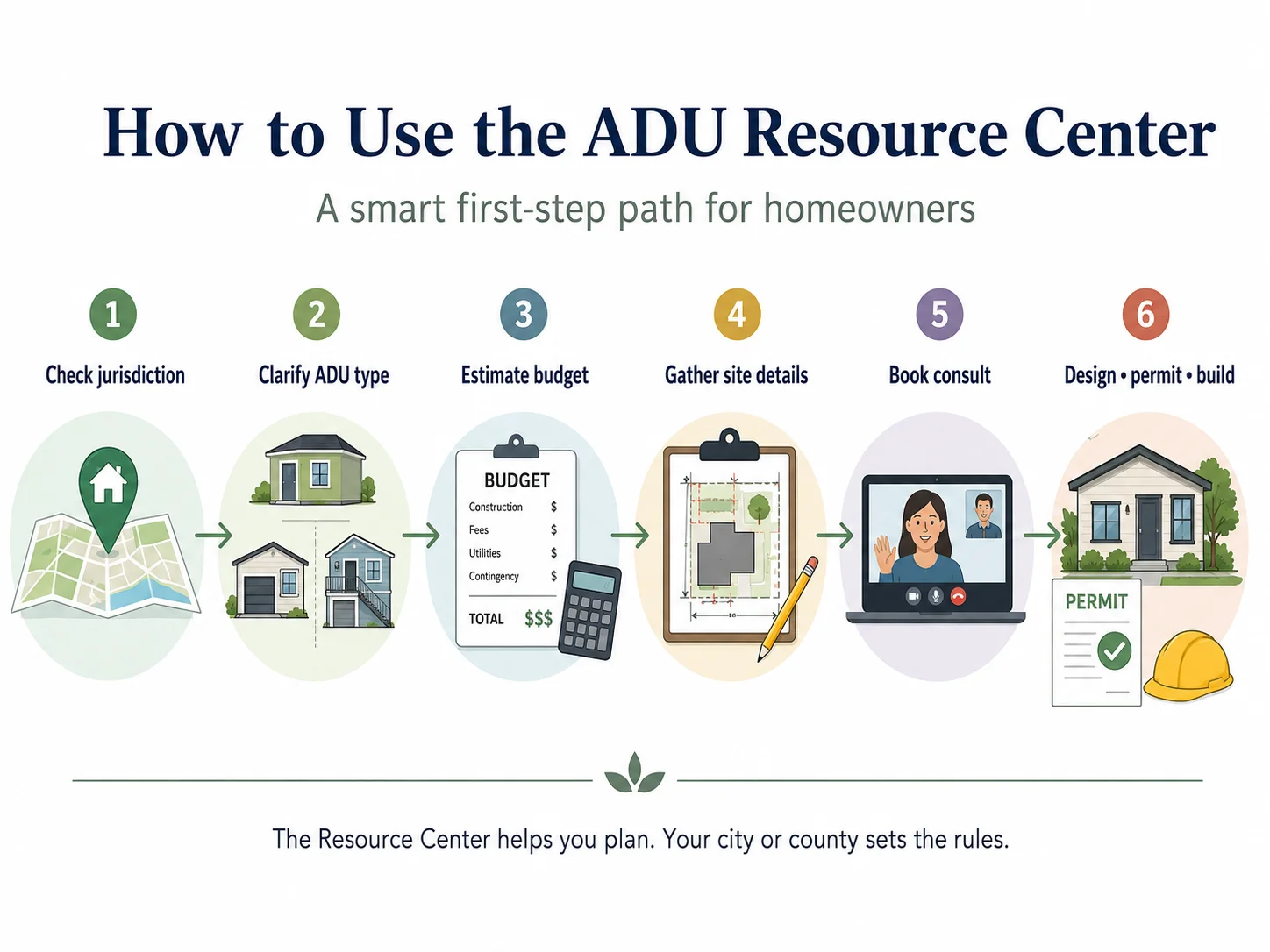
Before you book the consult or pay a designer, gather six things: your property address and APN, your jurisdiction (city vs. unincorporated county), the ADU type you’re considering, your intended use, a rough size and budget target, and your known site risks. The quality of your consult scales directly with the quality of those inputs.
| Bring this | Why it matters |
|---|---|
| Property address + APN (assessor’s parcel number) | Determines city vs. unincorporated county and parcel-specific constraints. |
| Your jurisdiction | Confirms which rulebook applies and whether you’re consult-eligible. |
| ADU type you’re considering | Detached, attached, conversion, garage conversion, JADU. |
| Intended use | Family housing, rental, caregiver, aging parent, resale. |
| Rough size target | Drives cost, setbacks, parking, and financing. |
| Budget range + financing comfort | Prevents designing something you can’t fund. |
| Site flags | Coastal zone, fire zone, hillside, septic, flood, HOA, historic, utility limits. |
| Existing structure details | Garage, basement, old foundation, any existing unpermitted unit. |
San Mateo County ADU Pre-Consult Checker
The planning tool offers state-level rules, broad cost ranges, and an illustrative equity estimate. It does not check member-jurisdiction status, identify whether the County or a city handles your parcel, or generate a parcel-specific checklist; confirm those details with the Resource Center or your local planning office.
Get My ADU Planning OverviewWhat can slow down or stop a San Mateo County ADU?
The most common deal-slowers in San Mateo County aren’t the ADU concept itself — they’re property-specific: the urban Midcoast permit cap, coastal review, septic systems, utility upgrades, parking edge cases, financing limits, and plan-check corrections.
| Risk trigger | Why it matters | What to verify |
|---|---|---|
| Urban Midcoast permit cap | New building permits for housing (including ADUs) in the urban Midcoast are effectively frozen until 2028 unless the LCP is amended. | Whether your parcel is in the capped zone; County planning. |
| Coastal zone (broader) | Any Coastal Zone parcel requires a Coastal Development Permit or documented exemption. | County/city coastal maps; planning staff. |
| Septic system | Health Department review can add months and cost. | Septic capacity, percolation requirements. |
| Utility upgrades | New meters or service upsizing add cost and time. | Water, sewer, electrical, gas, fire-flow capacity. |
| Parking | May be required unless an exemption applies. | Transit distance, conversion status, historic district. |
| Short-term rental plan | ADU/JADU rentals must generally exceed 30 days. | Local rental ordinance + state baseline. |
| JADU deed restriction | JADUs carry a deed restriction and can’t be sold separately. | Current JADU sanitation/occupancy rules. |
| Garage conversion surprises | Existing slab, walls, fire separation may need pricey upgrades. | Structural, moisture, ceiling height, utilities. |
The honest case for sequencing right
Some homeowners should not start with a builder quote. If you have coastal, septic, utility, or financing uncertainty, a quote creates false precision — a confident-looking number built on unconfirmed assumptions. We’ve watched people fall in love with a $280,000 figure that quietly became $390,000 once the geotech report and a new sewer lateral entered the picture.
But that’s an argument for sequence, not for giving up. The fix is free: confirm your jurisdiction and feasibility first, clear the site-risk unknowns, then get quotes against a real scope. People finish these projects constantly — jurisdictions across San Mateo County completed 403 ADUs in 2023, making up roughly 23% of all new housing units that year.
Sources: San Mateo County Midcoast cap; smcadu.org FAQ and permitting; Community Planning Collaborative / launch materials (2023 county ADU completions). Verified May 26, 2026.
How should you pay for a San Mateo County ADU?
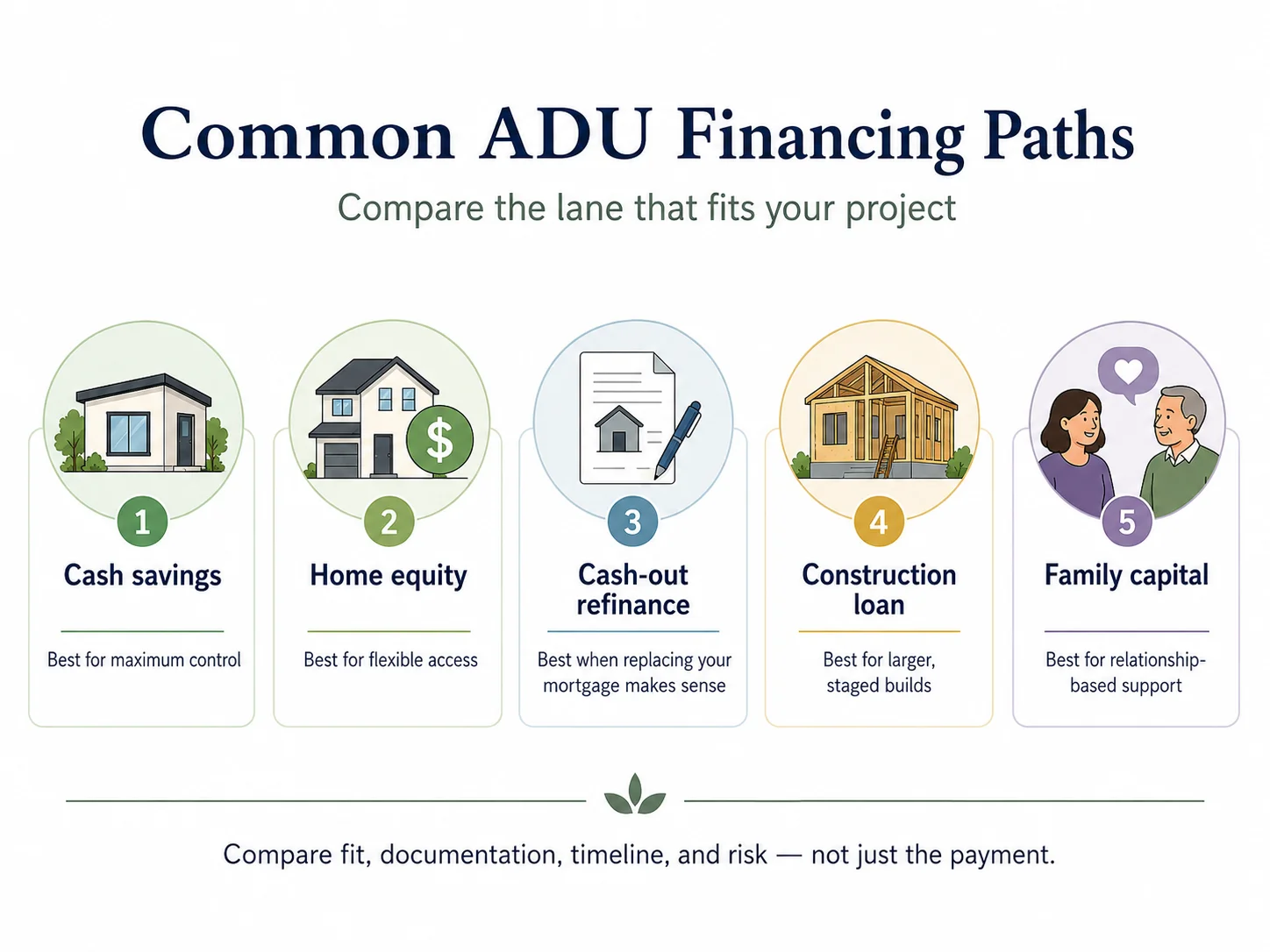
Choose ADU financing by path — not by advertised monthly payment — and know that the CalHFA $40,000 ADU grant is not currently an option: it has been fully allocated since December 2023 with no confirmed relaunch. The common paths are cash, home equity (HELOC), cash-out refinance, construction or renovation loans, and family capital.
CalHFA’s own program page states the latest round of ADU grant funding was fully allocated as of December 28, 2023, and warns that anyone promising to “get you the grant” today is running a scam. Some construction-company blogs still claim it’s “going strong in 2026” — that’s incorrect per the primary source. Do not build your budget around a $40,000 grant. (We cover this in depth on our ADU grants guide.)
Financing paths compared (lanes, not a lender ranking)
| Financing path | Better fit when… | Watch out for |
|---|---|---|
| Cash | You’ll still have reserves after construction | Opportunity cost; liquidity risk |
| HELOC (home equity line of credit) | You have equity and want draw flexibility | Variable rate/payment; requires qualification |
| Cash-out refinance | Your existing mortgage rate/equity profile makes sense | Replacing current mortgage terms can be costly |
| Construction loan | Larger project with staged draws | Documentation, appraisals, draw process |
| Renovation loan | Conversion/improvement-heavy project | Scope and contractor requirements |
| Family/private funding | Family-housing use case | Document it; tax/legal and relationship considerations |
Affiliate disclosure (repeated near comparison): The Dwelling Index is reader-supported; we may earn a commission at no extra cost to you when you use our links to explore financing. Our recommendations are independent and never influenced by compensation.
Compare ADU financing paths — explore mortgage, refinance, and construction-loan options
Educational only. See how the lanes above map to your situation.
Compare ADU Financing OptionsCompare common funding routes and their eligibility limits before contacting a lender.
For a deeper look: California ADU financing guide.
Will an ADU raise my property taxes, and can I sell it later?
Building an ADU in California does not trigger a full reassessment of your home — only the new ADU’s value is added, in what’s called a “blended assessment,” so your primary residence keeps its Proposition 13–protected tax basis. The Resource Center’s own example uses roughly 1% of the ADU’s added value as the rough annual tax impact, and your existing home’s assessment is untouched.
When your ADU is completed, the County Assessor adds only the ADU’s value (based on construction cost) to your existing assessed value. Your main house is not re-appraised at current market value — Proposition 13 protects it, capping increases at 2% per year. Confirm the actual rate and assessment with the San Mateo County Assessor or a tax professional.
On selling separately: under Gov. Code §66342, a city may adopt an ordinance allowing you to sell your ADU separately as a condominium — but it’s optional, and many cities haven’t adopted it. Verify your specific city before assuming you can sell an ADU separately. You can always rent a standard ADU on 30+ day terms (subject to local rules, deed restrictions, and unit type); selling it off separately is the rarer, opt-in scenario. Learn more about how an ADU affects property value.
Sources: California Proposition 13; smcadu.org/budgeting/ (1% example); Gov. Code §66342 (separate conveyance). Verified May 26, 2026. Tax treatment is situation-specific — consult the County Assessor or a tax professional.
What we verified for this guide
| Verified item | Source category | Verified |
|---|---|---|
| Resource Center exists, services, free consult via Hello Housing, no-commission model | Official smcadu.org (home, about, contact) | May 26, 2026 |
| Member-jurisdiction discrepancy (contact vs. about vs. launch) | smcadu.org contact + about pages; Oct 2024 launch release | May 26, 2026 |
| City vs. unincorporated-county jurisdiction split | San Mateo County Planning & Building; City of San Mateo | May 26, 2026 |
| State ADU/JADU baselines (primary code) | CA Gov. Code §§66315, 66317, 66321, 66322, 66323, 66333, 66342 | May 26, 2026 |
| Urban Midcoast building-permit cap (18 permits 2026–27; frozen to 2028) | San Mateo County Planning press release (Mar 20, 2026) | May 26, 2026 |
| City of San Mateo permit fees ($2,831.57 / $2,031.12 / $1,454.02) | cityofsanmateo.org official ADU page | May 26, 2026 |
| Cost ranges ($450–$600/sq ft; by type) | smcadu.org; Genuine Kitchen & Bath; GatherADU; statewide CA guides | May 26, 2026 |
| Timeline (12–24 mo; 60-day clock; 15-day completeness) | smcadu.org; Gov. Code §66317; County permit page | May 26, 2026 |
| CalHFA $40K grant fully allocated since Dec 2023 | CalHFA.ca.gov (primary) | May 26, 2026 |
| Property-tax blended assessment + Prop 13 (1% example) | smcadu.org budgeting; Proposition 13 | May 26, 2026 |
| Homeowner concerns / voice-of-customer | Reddit/forums — used only to understand questions, never as proof | May 26, 2026 |
Frequently asked questions
- Is the San Mateo County ADU Resource Center free?
- Yes. It offers free public tools — a guidebook, calculator, glossary, and exercises — plus a free one-hour virtual feasibility consult and Plans Gallery for residents of its member jurisdictions. It’s nonprofit-funded with no vendor-commission model.
- Is the Resource Center only for unincorporated San Mateo County?
- No. Its member jurisdictions include many incorporated cities as well as unincorporated San Mateo County. But your actual ADU rules come from your city ordinance (if you’re in a city) or the County ordinance (if you’re in unincorporated territory), within state law — not from the Center.
- Which jurisdictions are members of the San Mateo County ADU Resource Center?
- The Center’s current contact page lists Atherton, Belmont, Brisbane, Burlingame, East Palo Alto, Hillsborough, Menlo Park, Pacifica, Redwood City, San Bruno, San Carlos, City of San Mateo, unincorporated San Mateo County, South San Francisco, and Woodside. Foster City appears on the About page, and Foster City and Portola Valley appeared in the October 2024 launch materials — confirm those directly before assuming consult eligibility.
- How much does an ADU cost in San Mateo County?
- For early planning, the Center uses a rough $450–$600 per square foot range. By type, JADUs run roughly $50K–$120K, garage conversions $100K–$280K, attached ADUs $220K–$350K, and new detached ADUs $300K–$450K+. Site work, utilities, and fees move these numbers significantly.
- How long does it take to build an ADU in San Mateo County?
- Most projects take 12–24 months overall. Plan review runs on a state-mandated 60-day clock once your application is complete, with a 15-business-day completeness check; construction typically runs 6–12 months.
- Can an urban Midcoast ADU be delayed by the County’s building-permit cap?
- Yes. The County’s Local Coastal Program caps urban Midcoast housing permits (ADUs included) at an average of 40 per year, and after 102 units were permitted in 2025, only 18 building permits are available across 2026–2027. New building-permit applications for housing there cannot be accepted until 2028 unless the LCP is amended. Planning permits are still accepted, so coastside owners should file those early.
- Can I rent my San Mateo County ADU on Airbnb?
- Generally no. State law confirms ADUs and JADUs can’t be rented for terms shorter than 30 days. Model long-term rental income only, and verify your local rental ordinance.
- Do I need parking for an ADU in San Mateo County?
- Sometimes — but California law and local ordinances include broad exemptions, including proximity to transit, conversions of existing space, and historic districts. Verify your parcel’s situation.
- Will an ADU increase my property taxes in San Mateo County?
- Yes, but only on the ADU’s added value — a “blended assessment.” Your primary home keeps its Prop 13–protected basis and is not reassessed. The Resource Center’s example uses about 1% of the ADU’s added value; confirm with the County Assessor.
- Should I book the free consult before hiring a designer?
- Usually yes, if you’re in a member jurisdiction. The free consult helps confirm feasibility before you spend money. For complex or coastside sites, also confirm specifics directly with local planning/building staff.
Methodology
We researched this guide by reviewing the official San Mateo County ADU Resource Center pages (smcadu.org), San Mateo County Planning & Building materials, the City of San Mateo ADU page, California’s ADU statutes (Government Code §§66314–66342), the HCD ADU Handbook, CalHFA’s program page, and the County’s March 2026 Midcoast permit-cap announcement. We used homeowner forum discussions only to understand real questions and decision friction — never as proof for laws, costs, permits, or financing. Cost figures are planning ranges assembled from several sources, not bids. Every legal, permitting, cost, and eligibility claim is reverified on a refresh schedule: state law and grant status quarterly; the Midcoast cap and Resource Center membership monthly; per-city fees and cost ranges every six months.
Last updated: May 26, 2026. Last verified: May 26, 2026. Re-check smcadu.org, the County’s Midcoast cap page, and CalHFA before relying on this page for a live decision.
Where to go next on The Dwelling Index
- ADU grants database — CalHFA status and verified programs
- California ADU financing guide — every lane explained
- How much does an ADU cost? (ADU cost basics)
- How an ADU affects your property value
- HELOCs for ADU projects — how they work
- Garage conversion ADU financing
- How to build an ADU — the full process
Download the free ADU Starter Kit
The pre-consult checklist, a fee worksheet, and the full document list you’ll need, in one place.
Get the Free ADU Starter Kit ↓Not sure where to start?
Get a state-level ADU rules overview, broad cost ranges, and an illustrative estimate of available equity. Verify San Mateo County and parcel-specific requirements with local officials.
Get My ADU Planning Overview