
Riverside County rules guide · 6 jurisdictions compared
Riverside County ADU Requirements (2026): County and City Rules for Size, Height, Setbacks and Parking
By The Dwelling Index Editorial Team · Last updated · Last verified
Bottom line up front: There is no single set of Riverside County ADU requirements. Your address falls under a city code or, in unincorporated areas, under the County's own ordinance, and all of them sit on top of California's state ADU law (Government Code §§ 66310–66342). State law guarantees that an 800-square-foot ADU with 4-foot side and rear setbacks can be built where the zoning allows a home (on a qualifying lot, and still subject to building, fire and other health and safety requirements), and that the permitting agency must generally decide a complete application within 60 days when a home already exists on the lot. The County Board of Supervisors formally adopted a rewritten ADU ordinance on September 15, 2026, after a September 1 hearing (the County's project page lists September 1 as the adoption date), and its text sets a 1,600-square-foot cap for a detached ADU on a single-family lot. Corona and Temecula cap detached ADUs at 1,200 square feet, and Murrieta's code points straight to state law. Confirm your jurisdiction first, then check your lot.
| Jurisdiction (rulebook we read) | Detached ADU size cap | Detached ADU height | Side and rear setback | Parking |
|---|---|---|---|---|
| Unincorporated Riverside County (Ordinance No. 348.5056; Sept 1, 2026 hearing, formally adopted Sept 15, 2026) | 1,600 sq ft on a single-family lot | 16 ft; 18 ft on a multistory multifamily lot or near major transit; plus 2 ft for matching roof pitch | 4 ft; none for conversions or same-footprint rebuilds | 1 space per ADU or per bedroom, whichever is less, with exemptions |
| City of Riverside (Permit-Ready ADU Plans page) | Four pre-approved plans, 746 to 1,200 sq ft | Not tabulated here | Not tabulated here | Not tabulated here |
| Corona (Municipal Code Ch. 17.85, Ord. 3410, 2025) | 1,200 sq ft | Zone height applies; an ADU of at least 16 ft and 800 sq ft can't be prohibited | 4 ft; none for conversions | 1 space per unit or per bedroom, whichever is less, with exemptions |
| Temecula (Municipal Code Ch. 17.23, Ord. 2025-06, May 27, 2025) | 1,200 sq ft | 16 ft; 18 ft near major transit or on a multistory multifamily lot; 20 ft to match roof pitch | 4 ft; none for conversions | 1 space per ADU, with exemptions |
| Murrieta (Municipal Code § 16.44.160; Information Bulletin IB-108, May 2024) | Code points to Gov. Code § 66323; the bulletin lists 1,200 sq ft | Code points to state law | 4 ft per the bulletin | 1 space, with listed exemptions |
| Moreno Valley (Ord. 999, adopted June 20, 2023; HCD letter Dec 9, 2024) | State found local size limits out of line with state law | State found local height limits out of line with state law | 4 ft per the city's pre-approved plan handout | See city handout |
Scroll the table sideways to see every column.
Every cell above comes from the County's or city's own published document, read on November 13, 2026. The cities that rely on state law say so in their own code, and Moreno Valley's ordinance drew an 18-point findings letter from the state housing department. We explain what that means below.
The Dwelling Index is an independent research resource covering ADU financing, costs, and regulations. We wrote this page because Riverside County is not one permit office. A homeowner in Temecula, a homeowner in Moreno Valley and a homeowner on an unincorporated lot near Hemet each answer to a different rulebook, and the County rewrote its own ADU ordinance this fall. We read the County's ordinance text, the code for Corona, Temecula and Murrieta, the City of Riverside's permit-ready plan page, and the state housing department's findings letter to Moreno Valley. Each row of the table names the document it came from.
Disclosure: The Dwelling Index is reader-supported. When you use our links to request builder pricing, explore financing options, or purchase floor plans, we may earn a commission at no extra cost to you. Our editorial recommendations are based on independent research and are never influenced by compensation. This page is educational, not legal advice. Confirm every rule with your city or the County before you design or pay for anything.
What are the Riverside County ADU requirements in 2026?
Answer capsule: Riverside County ADU requirements come from three layers: California Government Code §§ 66310–66342 (the floor for every jurisdiction), the local code of your city or the County's Ordinance No. 348, and any overlay such as a homeowners association or a septic system. State law sets minimums no local agency can go below, including 800 square feet with 4-foot setbacks, a 60-day decision clock, and no impact fees for an ADU of 750 square feet or less.
Three numbers do most of the work on a typical lot. The first is the size cap. A local agency can set its own maximum for a detached ADU, but state law says it can't be lower than 850 square feet, or 1,000 square feet for a unit with more than one bedroom (Gov. Code § 66321(b)(2) (opens in a new tab)). The state's own detached figure is 1,200 square feet (§ 66314(d)(5) (opens in a new tab)). The second is the setback. No agency can ask for more than 4 feet from the side and rear lot lines for a new ADU (§ 66314(d)(7)). The third is parking: at most one space per ADU or per bedroom, whichever is less, and none in the six cases listed in § 66322 (opens in a new tab).
The catch. The floor is guaranteed, but the local page may not say so, and in Riverside County the numbers do not line up neatly. The County's new ordinance text sets 1,600 square feet for a detached ADU, which is higher than the state's 1,200 figure. Murrieta's code gives no square-foot cap of its own, while its older bulletin lists 1,200. The state housing department told Moreno Valley that 18 parts of its ordinance conflict with state law. We show how to handle each of these below.
Limits to know: the state floor is not unconditional. The 800-square-foot provisions apply to a qualifying lot (zoned to allow a home, with an existing or proposed dwelling), and agencies can still apply building, fire and other health and safety codes. Septic, well, fire hazard and site conditions can also shape what gets approved. The 60-day clock runs from a complete application and has its own exceptions. Ask your planner how these apply to your parcel.
Which ADU rulebook applies to your Riverside County address?
Answer capsule: The rulebook that applies is the one for the jurisdiction that issues building permits for your address. Incorporated cities such as the City of Riverside, Corona, Temecula, Murrieta and Moreno Valley run their own permit counters. Unincorporated areas are handled by the County of Riverside Planning Department under Ordinance No. 348.
How to tell which one you are:
- Search your address on your city's permit or zoning lookup. If no city claims it, the County is your permit office.
- Compare your mailing address with your jurisdiction. A “Riverside” or “Temecula” mailing address does not always mean the property is inside that city's limits.
- Call the planning counter. The County Planning Department lists (951) 955-3200 and planning@rivco.org. The City of Riverside's One Stop Shop lists 951-826-5800. Temecula's Planner of the Day line is 951-694-6400. Murrieta's Building and Safety Development office lists 951-461-6062.
Our property eligibility check can help you think through state-level options and broad cost ranges once you know your rulebook. It does not determine your jurisdiction or look up your address or parcel, so use the steps above to confirm which office issues your permit first.
This page covers the County and five cities. Other cities in the county, such as Palm Springs, Menifee, Hemet and Lake Elsinore, run their own rules, and we did not read them. For the statewide picture, read our California ADU laws guide. For builder comparisons, see our Riverside County ADU builders guide. This page covers rules only.
What does California law guarantee in every Riverside County jurisdiction?
Answer capsule: California's ADU statute, Government Code §§ 66310–66342, requires the County and every city in it to approve qualifying ADU permit applications ministerially, meaning without a public hearing, and to decide a complete application within 60 days (§ 66317). It also sets a floor of 800 square feet with 4-foot setbacks (§ 66321(b)(3)), height minimums of 16 to 25 feet (§ 66321(b)(4)), and a ban on impact fees for ADUs of 750 square feet or less (§ 66311.5(c)).
The statute was renumbered on March 25, 2024 (SB 477), and some sections were moved again on January 1, 2026 (SB 543). Old city pages that cite Government Code § 65852.2 are citing a section that no longer exists. Here is what the current statute does for you, decoded.
| What you want to know | What state law says | Statute |
|---|---|---|
| Does my ADU need a public hearing? | No. Approval is ministerial, without discretionary review or a hearing. | § 66317(a)(1) (opens in a new tab) |
| How fast must the agency respond? | A completeness notice within 15 business days; a decision within 60 days of a complete application when there's an existing dwelling. If the agency misses 60 days, the application is deemed approved, subject to the statute's exceptions (for example, tolling at the applicant's request, or an ADU submitted with a new primary home). | § 66317(a)(2)–(3) |
| What size is always allowed? | At least 800 sq ft of livable space with 4-ft side and rear setbacks, whatever the lot coverage, floor area ratio, open space, front setback or minimum lot size rules say. This applies on a qualifying lot, and building, fire and other health and safety requirements still apply. | § 66321(b)(3) (opens in a new tab) |
| What's the smallest cap an agency can set? | 850 sq ft, or 1,000 sq ft for an ADU with more than one bedroom. | § 66321(b)(2) |
| How tall can a detached ADU be? | An agency must allow 16 ft; 18 ft within half a mile walking distance of a major transit stop or high-quality transit corridor, or on a multistory multifamily lot; plus 2 ft to match the main roof pitch. Attached ADUs: 25 ft or the home's zoning height, whichever is lower. | § 66321(b)(4) |
| How close to the lot line? | No more than 4 ft from the side and rear lot lines for a new ADU. No setback for an existing structure converted, or rebuilt in the same place and size. | § 66314(d)(7) (opens in a new tab) |
| Is parking required? | At most one space per ADU or per bedroom, whichever is less. No parking in six cases, including within half a mile walking distance of public transit and when the ADU is inside the existing home or an accessory structure. | §§ 66314(d)(10), 66322(a) (opens in a new tab) |
| Do I owe impact fees? | None for an ADU of 750 sq ft or less. Larger ADUs pay impact fees in proportion to the main home's size. | § 66311.5(c) (opens in a new tab) |
| How many units can I build on a single-family lot? | One ADU and one JADU within existing space, plus one new detached ADU of up to 800 sq ft with 4-ft setbacks. | § 66323(a)(1)–(2) (opens in a new tab) |
Scroll the table sideways to see every column.
JADU means junior accessory dwelling unit: a unit of up to 500 square feet inside an existing or proposed single-family home. A ministerial approval means staff checks your plans against written standards and approves or denies, with no hearing.
What do the rules say jurisdiction by jurisdiction?
Answer capsule: Riverside County jurisdictions set different size, height and parking rules above the state floor. A detached ADU is capped at 1,600 square feet in the unincorporated County's ordinance text and 1,200 in Corona and Temecula. Murrieta's code defers to state law, the City of Riverside runs a four-plan permit-ready program, and Moreno Valley's ordinance drew state findings.
Unincorporated Riverside County (County Planning Department)
The County's Ordinance No. 348.5056 rewrote Article XIXj of Ordinance No. 348, which the County now calls “Additional Residential Accommodations.” The Board of Supervisors took it up at a September 1, 2026 hearing, and the Board's official records show formal adoption on September 15, 2026. The County's project page gives September 1 as the adoption date; we treat the Board record as controlling and read September 1 as the introduction hearing. The project page says the ordinance is now in effect, and the ordinance text says it takes effect 30 days after adoption, so count from the formal adoption date and confirm the effective date with the County.
For an ADU, the ordinance text sets these standards, except where state law overrides them:
- Where: lots zoned for single-family use, or any zone that allows a one-family dwelling, and multifamily lots. The owner does not have to live in either unit.
- How many on a single-family lot: one new attached or detached ADU, one conversion ADU inside the home or an accessory structure, and a JADU, in the combinations state law allows (Gov. Code §§ 66314 and 66323).
- How many on a multifamily lot: up to eight detached ADUs on a lot with an existing multifamily building, not more than the number of existing units, or two on a lot with a proposed one. Conversion ADUs can equal 25 percent of the existing units, and at least one is always allowed.
- Size: at least 150 square feet. An attached ADU can be up to 50 percent of the existing home or 1,600 square feet, whichever is less, and the percentage limit can't block an attached ADU of 1,000 square feet. A detached ADU on a single-family lot can be up to 1,600 square feet.
- Height: 16 feet for a detached ADU; 18 feet on a multistory multifamily lot, or within half a mile walking distance of a major transit stop or high-quality transit corridor; plus 2 feet to match the main roof pitch. An attached ADU can be 25 feet or the main home's height limit, whichever is less, and no more than two stories.
- Setbacks: 4 feet from the side and rear lot lines. No side or rear setback for a conversion or a same-footprint rebuild. Front setbacks follow the zone and shrink only as far as needed to fit an ADU that state law authorizes.
- Parking: one space per ADU or per bedroom, whichever is less, and it can be tandem on a driveway. No parking is required within half a mile walking distance of public transit, in a historic district, inside the home or an accessory structure, where street parking permits are required but not offered, or when the ADU is filed with a new home and meets a state exemption. A garage converted or demolished for an ADU does not have to be replaced.
- Access, rentals and sales: an attached ADU needs its own exterior entrance. An ADU can be rented separately but can't be sold separately except as state law requires.
Two cautions. First, the County's detached figure of 1,600 square feet is higher than the 1,200-square-foot figure the statute uses, so ask the planner which number applies to your lot. Second, the County's project page still lists its ADU handbook and eligibility checklists as “coming soon,” so staff may apply the ordinance before the handout catches up. The same page mentions a Permit Ready ADU Program run by the County's Building and Safety Department; we did not review its plan details.
City of Riverside
The City of Riverside's published path for most homeowners is its Permit-Ready ADU Plans program, which the city's forms call ADU Express. It offers four single-story detached plans: 746 square feet (1 bedroom, 1 bathroom), 800 square feet (2 bedrooms, 2 bathrooms), 1,020 square feet (2 bedrooms, 2 bathrooms) and 1,200 square feet (3 bedrooms, 2 bathrooms), in Craftsman, Ranch and Spanish exteriors.
To use a pre-approved plan, the page says your property must be zoned R-1, RE, RR, RC or RA-5 and developed or proposed with a single-family home, must not sit in a FEMA flood hazard area, and must not be designated or eligible for designation as a cultural resource under Title 20 of the Riverside Municipal Code. You submit through the city's Public Permit Portal with the completed T1.1 cover sheet, a hold harmless agreement, the ADU Express clearance form and a preliminary site plan. The city says the initial plan review takes 3 business days, and later reviews take 10 business days.
The city's development standards for ADUs are in Title 19 of its municipal code. The city ADU FAQ we found dates to 2022, so we don't tabulate size, height or parking for the City of Riverside here. Ask the One Stop Shop for the current numbers.
Corona
Corona's rules are in Municipal Code Chapter 17.85, as amended by Ordinance 3410 in 2025. ADUs are allowed on single-family, multifamily and residential or commercial mixed-use lots with an existing or proposed primary unit. The code lists these standards:
- Size: up to 1,200 square feet if detached, or 50 percent of the primary unit if attached. The code also says no standard can prohibit an ADU of at least 16 feet in height and 800 square feet.
- Setbacks: none for a conversion or a same-location rebuild; no more than 4 feet from the side and rear lot lines for other ADUs, including lot lines next to streets.
- Parking: one space per unit or per bedroom, whichever is less. A driveway counts if it is at least 20 feet deep. Exemptions include half a mile walking distance of public transit, a historic district, an ADU inside the existing home or an accessory building, areas where street parking permits are required but not offered, and a car-share vehicle within one block. No replacement for converted or demolished parking.
- Owner and rentals: the applicant must own the property. Either unit can be rented, but rentals under 30 days are prohibited.
- Entrance and design: a separate entrance, and the ADU must be architecturally compatible with the primary unit.
- Review: ministerial, through building plan check, with action within 60 days of a complete application.
One item to ask about: Corona's code lists three combinations for up to two ADUs or JADUs on a single-family lot, while state law (§ 66323) describes one ADU and one JADU in existing space plus one detached ADU. Ask Corona how it applies the two.
Temecula
Temecula's rules are in Municipal Code Chapter 17.23, last amended by Ordinance 2025-06 on May 27, 2025. The chapter has two tracks. A “building permit only” ADU follows Government Code § 66323: one ADU and one JADU in existing space, plus one detached new ADU of up to 800 square feet with 4-foot side and rear setbacks, at 16 feet, 18 feet near major transit or on a multistory multifamily lot, plus 2 feet to match roof pitch.
An ADU outside that track follows the § 66314 standards in the city code:
- Size: a detached ADU up to 1,200 square feet. An attached ADU up to 50 percent of the existing home, or 1,200 square feet when it comes with a new home. The code adds that no size limit can block an 850-square-foot ADU, or a 1,000-square-foot ADU with more than one bedroom.
- Height: 16 feet detached; 18 feet near major transit or on a multistory multifamily lot; 20 feet if needed to match the main roof pitch; 25 feet or the home's height limit for an attached ADU.
- Setbacks and separation: 4 feet from the side and rear lot lines, none for a conversion, and 6 feet between a detached ADU and the main home unless that would block an 800-square-foot ADU.
- Parking: one space per ADU, with the usual exemptions, and no replacement for converted garage parking.
- Rentals: Temecula's ADU page says short-term rentals are not allowed, including in ADUs and JADUs.
- Design and utilities: a detached ADU must come from the city's Permit Ready program or use the same materials and colors as the main home. For building-permit-only ADUs, the code says the city won't issue a building permit without a will-serve letter from the water and sewer provider, or local health officer approval if you use a private septic system.
- Review: a decision within 60 days of the application, tied to § 66317.
Murrieta
Murrieta's rules are in Municipal Code § 16.44.160, last amended by Ordinance 610-24 in 2024. The code allows one ADU and one JADU on a single-family lot, and two detached ADUs plus conversions on a multifamily lot. It does not print a square-foot cap, setback or height of its own for ADUs. It says size and setbacks follow Government Code § 66323, and that state law wins if the two conflict.
The city's Information Bulletin IB-108, dated May 2024, fills in numbers: a detached ADU up to 1,200 square feet, an attached ADU up to 50 percent of the main home, a JADU of up to 500 square feet, and 4-foot side and rear setbacks. The bulletin says it summarizes state ADU regulations as of January 1, 2022, so treat its numbers as a starting point, not the current rule.
The code requires one off-street space per ADU in addition to the main home's parking, with exemptions for half a mile walking distance of public transit, a historic district, areas where street parking permits are required but not offered, one block from a car-share area, ADUs inside the home or an accessory structure, and JADUs. It also requires a recorded covenant barring rentals under 30 days, a ministerial review without a hearing, and action within 60 days of a complete application.
Moreno Valley
Moreno Valley adopted ADU Ordinance No. 999 on June 20, 2023, in Municipal Code §§ 9.09.130 and 9.09.140. On December 9, 2024, the state housing department (HCD) sent the city a letter finding that the ordinance does not comply with state ADU and JADU law, and it listed 18 numbered findings. Among them:
- It cites Government Code sections that SB 477 deleted on March 25, 2024.
- It lets the city base approval on water, sewer, traffic and safety adequacy without defined criteria.
- It sets interior ADU size maximums of 850 square feet, or 1,000 for two or more bedrooms, which HCD says state law doesn't allow for units inside an existing or proposed single-family home.
- It sets multifamily ADU maximums of 800, 850 or 1,000 square feet, while state law allows a detached ADU of up to 1,200.
- It limits ADU size by bedroom count, which HCD says can create fair housing problems.
- It says JADUs may have no gas or 220-volt circuits, a limit state law removed.
- It uses subjective terms and siting rules that HCD says the city can't impose.
The letter gives the city two options: amend the ordinance or adopt it with findings explaining why it complies. We did not find an amended Moreno Valley ordinance, and a change may exist. The practical effect for you is the same as anywhere else on this page: the state floor applies even where a city page is out of date. The city's pre-approved ADU handout says side and rear setbacks are a minimum of 4 feet, and that fire sprinklers are required if your existing home has them or the ADU is more than 150 feet from the street by an approved route.
What changed in unincorporated Riverside County in 2026?
Answer capsule: After a September 1, 2026 hearing, the Riverside County Board of Supervisors formally adopted Ordinance No. 348.5056 on September 15, 2026 (the County's project page lists September 1), which rewrote the County's rules for “Additional Residential Accommodations,” added SB 9 units as a housing type, and updated the ADU and JADU standards to match state law, including laws that took effect January 1, 2026. The County says it was prompted by a review from the state housing department that found parts of its old ordinance out of date.
The new Article XIXj recognizes seven categories: ADUs, JADUs, SB 9 units, Second Units, Guest Quarters, Ranchets and Multiple Owner Group units. The last two apply only in the Eastern Coachella Valley. The County says the update requires no action or change to your property.
The label Second Unit matters. The County says a Second Unit is a one-family dwelling with a kitchen and bathroom on a lot with an existing primary home, that it is allowed on large properties zoned for one-family dwellings, and that it is “not the same as an ADU as defined by State law.” If a planner or an older document says “second unit,” ask whether they mean a state-law ADU or the County's separate category, because the standards differ.
Under the new text, every additional residential accommodation is reviewed ministerially against objective standards. For a rural lot, the review includes septic and well requirements from the County Department of Environmental Health, and proof that a public water or sewer provider can serve the unit. The ordinance also lets the owner of a structure built before January 1, 2020 apply to legalize an ADU or JADU under Government Code § 66311.7. For the longer version of that path, read our guide to legalizing an unpermitted ADU in California.
What should you do when a local rule conflicts with state law?
Answer capsule: When a local ordinance says less than state law allows, the state floor controls. HCD reviews ordinances, sends written findings under Government Code § 66326, and can notify the Attorney General of a city that doesn't comply. You still need a permit, so the practical move is to cite the statute section in writing and ask the planning counter to confirm in writing.
In this county we found three different situations:
| Situation | Where | What it means for you |
|---|---|---|
| Local ordinance drew state findings | Moreno Valley (18 findings, Dec 9, 2024) | Don't treat the city's size, height or JADU limits as final. Ask which version the city applies today. |
| Local code points to state law | Murrieta (§ 16.44.160 defers to § 66323) | The state floor is the rule. Older bulletins may show different numbers. |
| County text higher than the statute's figure | Unincorporated County (1,600 sq ft detached) | Ask which number the planner applies before you size your plans. |
Scroll the table sideways to see every column.
A short script works: “Government Code § [section] says [rule]. Does the city or County agree for my lot, and can you confirm that in writing?” Keep the answer with your plans. If the answer contradicts this page, trust the agency's current written answer and tell us through our corrections page.
Limits to know: a deemed approval after a missed 60-day deadline applies only to a complete application and has statutory exceptions, and it does not waive building code compliance. Get advice from a land-use attorney before relying on it.
Which Riverside County cities offer pre-approved ADU plans?
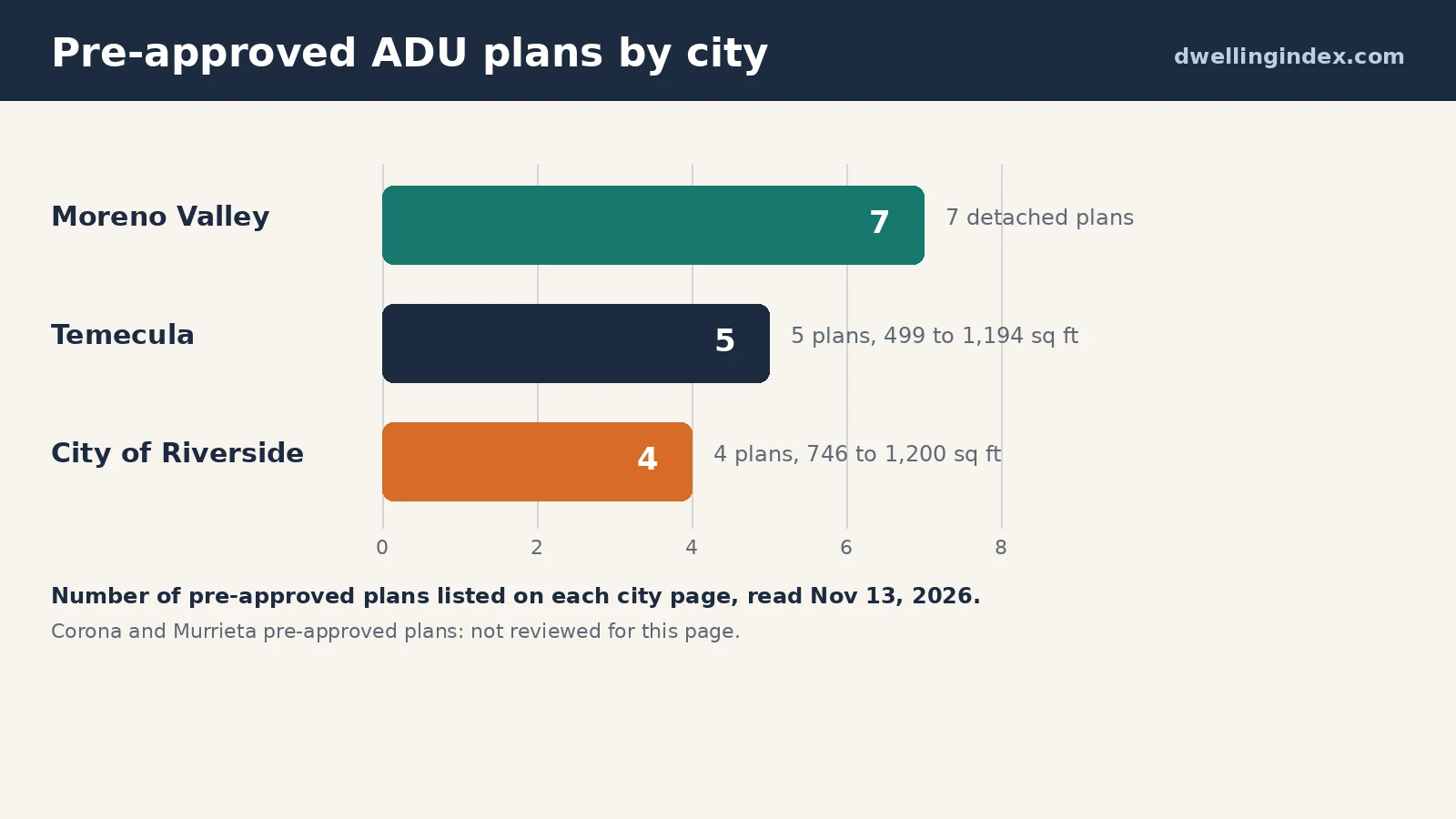
Answer capsule: Of the jurisdictions we read, Moreno Valley offers seven detached plans, Temecula offers five, and the City of Riverside offers four. The County's project page also mentions a Permit Ready ADU Program from its Building and Safety Department. Using a pre-approved plan shortens plan review but does not waive local site standards, fees or utility requirements.
| City | Plans | What the city says |
|---|---|---|
| City of Riverside | 4 single-story detached plans, 746 to 1,200 sq ft | Initial plan review in 3 business days, later reviews in 10; eligibility limits on zoning, flood hazard and cultural resources |
| Temecula | 5 plans: 499, 625, 749, 909 and 1,194 sq ft | Plans are free; submission and building fees still apply |
| Moreno Valley | 7 detached plans, from studios to 3 bedrooms | Standard permit fees apply; apply through the city's online portal, starting with an address request; sewer and water first release required |
Scroll the table sideways to see every column.
We did not review pre-approved plan pages for Corona or Murrieta. For how pre-approved plans work across the state, see our pre-approved ADU plans guide.
Can you rent a Riverside County ADU short term or sell it separately?
Answer capsule: In the places we checked, short-term rentals of ADUs are restricted: Corona prohibits rentals under 30 days, Temecula says short-term rentals are not allowed, and Murrieta requires a recorded covenant barring rentals under 30 days. The County's ordinance text lets an ADU be rented separately but not sold separately except as state law requires. State law requires ADU rental terms longer than 30 days for units approved under § 66323.
Owner occupancy is a separate question. The County's ordinance says the owner does not have to occupy either the home or the ADU. A JADU is different in Corona and Temecula, where the owner must live in the primary home or the JADU unless the owner is a government agency, land trust or housing organization. Sales follow the same pattern across the page: no separate sale of an ADU except in the narrow cases state law allows, such as a qualifying nonprofit builder under § 66341 that Temecula's code cites.
Do septic, sewer and water change your ADU plans?
Answer capsule: Yes, and they are a common reason a Riverside County permit stalls. Temecula's code says a building-permit-only ADU needs a will-serve letter from the water and sewer provider, or health officer approval for a private septic system. The County's ordinance requires septic and well compliance through Environmental Health and proof of service from a public water or sewer provider. Moreno Valley's handout requires a sewer and water first release.
The agencies differ by address. Temecula's page lists Eastern Municipal Water District and Rancho California Water District, and Riverside County Environmental Health for septic. Moreno Valley's handout lists Eastern Municipal Water District, Edgemont Community Services District and Box Springs Mutual Water District, plus Environmental Health for septic. Before you pay for plans, find your water and sewer provider, ask what an ADU connection requires, and ask whether the unit needs a new meter. Use our ADU cost calculator to see how utility work can change a budget, and read our ADU permit process guide for the order of steps.
Which Riverside County cities does Nest Tiny Homes list?
Answer capsule: Nest Tiny Homes' Riverside County service-area page lists Corona, Temecula, Murrieta and Moreno Valley, along with Menifee, Perris, Palm Springs, Beaumont, Hemet, Lake Elsinore and several other communities. The City of Riverside and the unincorporated County as a whole are not named. Nest's page text refers to San Diego, so confirm coverage for your address with Nest.
| Jurisdiction on this page | Listed on Nest's Riverside County service-area page (read Nov 13, 2026) |
|---|---|
| Corona | Yes |
| Temecula | Yes |
| Murrieta | Yes |
| Moreno Valley | Yes |
| City of Riverside | Not named |
| Unincorporated Riverside County | Not named as an area |
Scroll the table sideways to see every column.
Nest describes itself as a design-build firm for detached ADUs, attached ADUs and garage conversions. It's an option if you want one company to handle design, permits and construction in a listed city. It isn't the only option. See how builders compare in our Riverside County ADU builders guide.
What should you ask the planning counter before you pay for plans?
Answer capsule: Ask ten questions before paying a designer: which jurisdiction issues the permit, which ordinance version applies, whether a conversion plus a new detached unit is allowed together, the size, height and setback limits for your zone, any septic or utility limits, parking, fees, pre-approved plans, and the current review time.
- Which office issues the permit for my address: a city or the County?
- Which version of the ADU ordinance do you apply today, and does it reflect Government Code §§ 66310–66342 as renumbered?
- Can I build a conversion ADU, a new detached ADU and a JADU on my lot, as § 66323 describes?
- What are the maximum size, height and setbacks for a detached ADU in my zone?
- Is my lot on septic or a well, and what does Environmental Health or my water provider require?
- Is parking required at my address, or does an exemption in § 66322 apply?
- What impact fees, school fees and utility connection charges will apply at my planned square footage?
- Does a pre-approved plan fit my lot and my goals?
- Does the jurisdiction treat a garage conversion differently from a new build?
- How long does your completeness review take right now, and who is my contact?
Print this list, write the answers in the margin and put the date next to each. Then use our property eligibility check for state-level context and broad cost ranges. It does not look up your address or check what your zoning allows; the answers from the planning counter do that.
What we verified
- Verified on November 13, 2026: California Government Code §§ 66311.5, 66314, 66317, 66321, 66322 and 66323 on leginfo.legislature.ca.gov.
- Verified: County of Riverside Planning Department, “Additional Residential Accommodations (ARA)” project page, and Ordinance No. 348.5056 (Attachment A).
- Verified: City of Riverside, “Permit-Ready ADU Plans” page.
- Verified: Corona Municipal Code Chapter 17.85 (Ordinance 3410, 2025) and Temecula Municipal Code Chapter 17.23 (Ordinance 2025-06), plus Temecula's ADU and Permit Ready ADU page.
- Verified: Murrieta Municipal Code § 16.44.160 and Information Bulletin IB-108 (May 2024).
- Verified: HCD's December 9, 2024 findings letter to Moreno Valley, and Moreno Valley's pre-approved ADU handout.
- Verified: Nest Tiny Homes' Riverside County service-area page.
- Not verified: the City of Riverside's current ADU development standards, Moreno Valley's current ordinance text, the County's Permit Ready ADU Program details, pre-approved plans in Corona and Murrieta, current fee schedules, and any amendment passed after the documents we read.
Methodology
We pulled each jurisdiction's own published rule, not a third-party summary, and recorded the document name and date next to every number. State law came from the statute text on leginfo.legislature.ca.gov. Where two documents from the same jurisdiction disagree, such as Murrieta's code and its 2024 bulletin, we say so and show both. Where we could not read a current rule, we say that instead of filling the cell. We don't state dollar fees, because fee schedules change and we did not verify them. If you find a number that is out of date, tell us on our corrections page.
Sources
- California Government Code §§ 66311.5 (opens in a new tab), 66314 (opens in a new tab), 66317 (opens in a new tab), 66321 (opens in a new tab), 66322 (opens in a new tab), 66323 (opens in a new tab): leginfo.legislature.ca.gov
- County of Riverside Planning Department, “Additional Residential Accommodations (ARA)” (opens in a new tab) (lists September 1, 2026 as the adoption date) and Ordinance No. 348.5056 (opens in a new tab)
- Riverside County Board of Supervisors, September 15, 2026 meeting record (opens in a new tab) (formal adoption of Ordinance No. 348.5056)
- City of Riverside, Community and Economic Development Department, “Permit-Ready ADU Plans” (opens in a new tab)
- City of Corona, Municipal Code Chapter 17.85, Accessory Dwelling Unit development standards (opens in a new tab)
- City of Temecula, Municipal Code Chapter 17.23 (opens in a new tab) and “Accessory Dwelling Units (ADUs) & Junior Accessory Dwelling Units (JADUs)” (opens in a new tab)
- City of Murrieta, Municipal Code § 16.44.160 (opens in a new tab) and Information Bulletin IB-108, “Requirements for Accessory Dwelling Units” (May 2024) (opens in a new tab)
- California HCD, ordinance review letter to Moreno Valley (December 9, 2024) (opens in a new tab)
- City of Moreno Valley, “Handout for Pre-Approved Accessory Dwelling Unit” (opens in a new tab)
- Nest Tiny Homes, Riverside County service areas: via our tracked link Nest Tiny Homes service areas (affiliate link)
Frequently asked questions
What are the Riverside County ADU requirements?
They depend on your jurisdiction. State law (Gov. Code §§ 66310–66342) sets the floor everywhere: ministerial approval, a 60-day decision clock for complete applications, at least 800 square feet with 4-foot setbacks on qualifying lots, and no impact fees for an ADU of 750 square feet or less. Building, fire and other health and safety requirements still apply. The County's new ordinance covers unincorporated areas, and each city has its own code.
How big can an ADU be in Riverside County?
State law's detached figure is 1,200 square feet, and no agency can cap a detached ADU below 850 square feet, or 1,000 for more than one bedroom. The County's ordinance text allows a detached ADU of up to 1,600 square feet on a single-family lot. Corona and Temecula cap detached ADUs at 1,200 square feet, and Murrieta's code defers to state law.
How close to the property line can an ADU be in Riverside County?
A new ADU needs no more than 4 feet from the side and rear lot lines. A conversion or a rebuild in the same footprint needs no new setback. Front setbacks follow the base zone, except where they would block an ADU that state law authorizes.
Do I need parking for an ADU in Riverside County?
Sometimes. The County and Corona ask for one space per ADU or per bedroom, whichever is less, while Temecula and Murrieta ask for one space per ADU. All four list exemptions such as being within half a mile walking distance of public transit or building the ADU inside the existing home. A converted or demolished garage does not need to be replaced.
How long does a Riverside County ADU permit take?
State law generally gives the permitting agency 15 business days to say whether your application is complete and 60 days to approve or deny a complete one when a dwelling already exists on the lot. A missed deadline can mean the application is deemed approved, subject to statutory exceptions. The City of Riverside says initial review of a pre-approved plan takes 3 business days.
Does Riverside County have pre-approved ADU plans?
Yes, in several places. The City of Riverside offers four plans, Temecula five and Moreno Valley seven, and the County mentions a Permit Ready ADU Program. Pre-approved plans still have to meet your lot's setbacks, fees and utility rules.
Can I rent my Riverside County ADU on Airbnb?
Not for short stays in the places we checked. Corona prohibits rentals under 30 days, Temecula says short-term rentals are not allowed, and Murrieta requires a covenant barring rentals under 30 days. State law requires rental terms longer than 30 days for units approved under § 66323.
What is a Second Unit in Riverside County?
It is a separate County category. The County describes a Second Unit as a one-family dwelling with a kitchen and bathroom on a lot with an existing primary home, allowed on large one-family lots, and says it is not the same as a state-law ADU. Ask whether a document means an ADU or a Second Unit before you rely on its numbers.