
Best ADU Builders Riverside County (2026): How to Choose a Permit-Ready Contractor
Bottom line up front.
If you are searching for the best ADU builders in Riverside County in 2026, the single most important factor is jurisdiction match. Riverside County is not one permit environment. The City of Riverside, City of Corona, City of Temecula, City of Murrieta, City of Moreno Valley, City of Palm Springs, and unincorporated county areas each have separate planning departments, separate fee schedules, separate development impact fees, and separate review timelines. A builder with strong City of Riverside experience may have zero permits pulled in Temecula. The right builder is the one who understands your specific city's process, can explain the permit path for your lot and ADU type, gives you a quote that separates site work from unit construction, and has a documented track record in your jurisdiction.
No builder can guarantee permit approval or timelines. Regulations, fees, and timelines vary by jurisdiction and can change. Verify current information with your city's planning and building department before signing a contract.
Source: The Dwelling Index independent research; Riverside County jurisdiction guidance; California HCD ADU resources. Last verified: June 12, 2026.
Free, about a minute, no commitment. Returns zoning class, buildable size, and preliminary fee eligibility for your address.
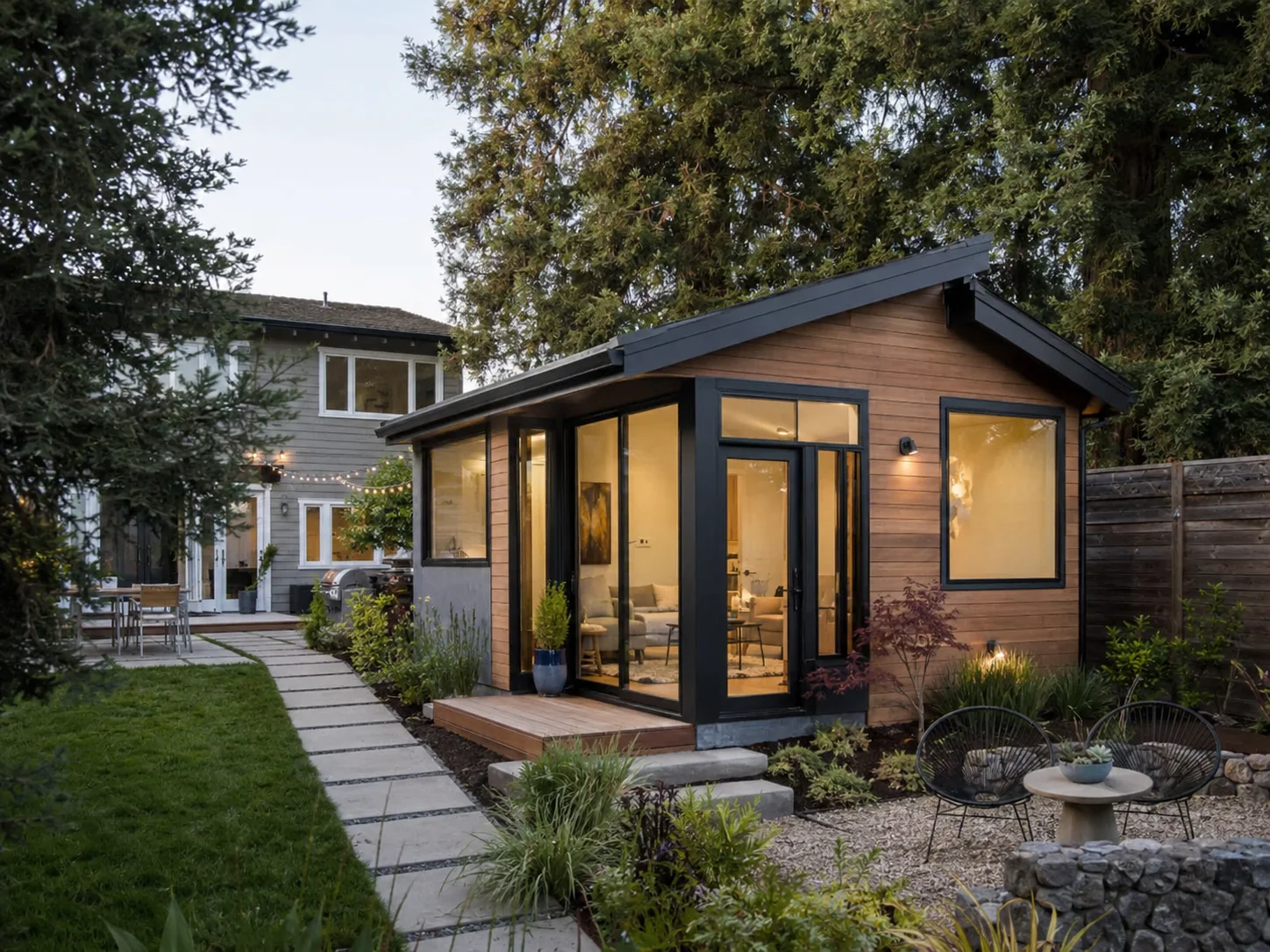
Why “Riverside County” is the wrong unit for finding the right builder
The best ADU builders Riverside County searches can obscure the most important variable: which city or unincorporated area are you building in? Riverside County contains more than two dozen incorporated cities, each with its own permit office. What works in the City of Riverside may not work in Palm Springs, where the Agua Caliente Band of Cahuilla Indians holds fee land, or in unincorporated county areas governed by the Riverside County Planning Department.
Riverside County jurisdictions and their ADU environments
Key jurisdictions and what makes each distinct:
| Jurisdiction | Key ADU program or distinction |
|---|---|
| City of Riverside | ADU Express pre-approved plan program; separate permit offices |
| City of Corona | Separate planning department; distinct fee schedule |
| City of Temecula | Specific setback and height rules; active ADU demand |
| City of Murrieta | Separate permit office; distinct development impact fees |
| City of Moreno Valley | High development impact fees in some zones; verify totals |
| City of Palm Springs | Agua Caliente leasehold land adds complexity for fee-land parcels |
| Unincorporated County | Governed by Riverside County Planning; distinct process |
The Dwelling Index scorecard for Riverside County ADU builders
| Criterion | What to look for |
|---|---|
| City-specific permit experience | Named completed ADU projects in your exact city or unincorporated area |
| Quote transparency | Site work, foundation, soft costs, permits, development impact fees, contingency broken out separately |
| ADU type match | Experience with your type: detached, JADU, garage conversion, or new construction |
| Lot-specific judgment | Builder asks about your lot — slope, utility locations, access — before giving a price |
| ADU Express eligibility guidance | Can explain whether your lot and ADU type qualify for ADU Express in City of Riverside |
| CSLB license verification | Active Class B or appropriate specialty license with current workers' comp and bond |
The City of Riverside ADU Express program
The City of Riverside offers a pre-approved ADU plan program — referred to as ADU Express — that allows qualifying homeowners to use pre-drawn plans that have already been reviewed against minimum code requirements. When a project meets the pre-approved criteria, plan check time can be reduced significantly compared to a full custom review.
Limitations to understand before relying on ADU Express:
- Not all lots qualify. Site-specific conditions — slopes, access constraints, utility conflicts, easements, setback exceptions — may require individual engineering or plan review regardless of the pre-approved plan.
- Not all ADU types are covered. Pre-approved plans typically target detached new construction within a defined size range. JADUs and garage conversions may not be covered by the same program.
- Development impact fees still apply. Pre-approved plans do not waive development impact fees, school fees, or utility connection fees.
- Builder modifications may exit the program. If a builder modifies the pre-approved plans to fit your site, the project may no longer qualify for the expedited pathway.
Confirm with the City of Riverside's Building and Safety Division whether your specific address, lot configuration, and ADU type are eligible before committing to a timeline based on ADU Express.
California state ADU law and how it applies in Riverside County
California ADU law — strengthened by AB 2221, SB 897, SB 9, and SB 477 — sets minimum statewide standards that local jurisdictions must meet or exceed. Key protections that apply across all Riverside County cities and the unincorporated county:
- Ministerial approval. ADU applications meeting objective standards must be approved ministerially — no discretionary design review, no public hearings, no neighbor opposition.
- Size minimums. Local ordinances cannot prohibit ADUs over 800 square feet for single-family lots, subject to setback and height compliance.
- ADU/JADU combination. One ADU and one JADU are permitted on any single-family residential lot, regardless of local ordinance restrictions, as long as the primary dwelling exists.
- Multifamily ADU rights. Under Government Code §66323, qualifying multifamily properties may build up to two ADUs from existing non-livable space, or up to eight detached ADUs on lots with five or more attached primary units.
- Permit timing. Local agencies must act on a complete ADU application within 60 days.
If a builder or local planner cites a local rule that appears to restrict ADUs more than state law allows, ask for the specific ordinance section and verify it against current California HCD guidance at hcd.ca.gov/policy-research/accessory-dwelling-units.
Budget in hand — now find the right financing path.
Most Riverside County ADU projects are financed with a HELOC, cash-out refinance, or construction loan. Each has different rate behavior, draw timing, and tax treatment.
Compare ADU Financing Paths →Financing-path education; we don't quote rates as guarantees.
What every Riverside County ADU quote must include
A complete Riverside County ADU quote must break out every cost category separately. A single total number is not a usable planning document.
| Cost category | What it includes |
|---|---|
| Hard construction costs | Foundation, framing, roofing, MEP (mechanical, electrical, plumbing), insulation, drywall, finishes, fixtures |
| Site work | Grading, drainage, utility trenching, driveway or access modifications |
| Utility connections | Water, sewer/septic, electrical panel capacity, gas — each may carry a separate utility company charge |
| Soft costs | Architectural design, structural engineering, soils/geotechnical reports if required |
| Permit fees | City or county plan-check fees, building permit fees, state mandated fees |
| Development impact fees | School fees, traffic mitigation fees, other impact fees — often $10,000–$30,000+ depending on jurisdiction and ADU size |
| Contingency | 10–15% for unforeseen site conditions; do not plan without it |
Development impact fees in Riverside County cities vary widely. The City of Moreno Valley and other high-growth cities have historically carried higher per-unit fees than older built-out cities. Ask any builder for a line-item fee estimate specific to your city and ADU size before finalizing your budget.
Eight questions to ask every Riverside County ADU builder
- Can you show me completed ADU permits in my specific city? Not “the Inland Empire” — your specific city. Ask for permit numbers or completed project addresses you can verify.
- Who is the contractor of record and who stamps the plans? Confirm which licensed entity pulls the permit and which licensed engineer or architect stamps the structural and architectural drawings.
- Is my lot eligible for ADU Express? If building in the City of Riverside, ask specifically whether your address, lot configuration, and ADU type qualify for the pre-approved plan pathway.
- What happens if the utility company requires a panel upgrade or new service lateral? Southern California Edison and EVMWD service upgrades can add $5,000–$20,000+. Confirm in writing who pays and how it is documented in the contract.
- Are development impact fees included in your quote? School fees, traffic impact fees, and other development impact fees must be included in your budget. Ask for a city-specific fee estimate.
- What is your payment schedule? Under California law, a home improvement down payment generally cannot exceed $1,000 or 10% of the contract price, whichever is less. Any builder asking for more upfront is a red flag.
- How do you handle change orders? Get the change order policy in writing before signing. Change orders that are not documented and signed before work begins are a leading cause of budget overruns.
- Can you provide three verified references for completed ADUs in my jurisdiction? Ask references: Was the final cost within 10% of the original scope? How many change orders were issued? How did the builder handle permit revision requests?
Download the Free ADU Starter Kit
Site evaluation checklist, permit prep guide, financing comparison, and contractor interview templates — before you call anyone.
Download the Free ADU Starter Kit →JADUs in Riverside County: what builders need to know
A Junior Accessory Dwelling Unit (JADU) is an ADU created within the existing space of a single-family residence, up to 500 square feet. California law allows one JADU per single-family lot in addition to one standard ADU.
Key JADU facts for Riverside County:
- Owner-occupancy. California law as of January 1, 2023, removed the owner-occupancy requirement for most ADUs. Verify current local ordinance requirements for JADUs specifically, as some cities maintain owner-occupancy conditions tied to JADUs.
- Separate entrance. A JADU must have an exterior entrance independent of the primary dwelling, plus an interior connecting door between the two units.
- Kitchen efficiency. JADUs are permitted to have an efficiency kitchen (small cooking appliance, counter space, storage) rather than a full kitchen.
- Deed restriction. A deed restriction prohibiting sale of the JADU separately from the primary dwelling must be recorded prior to occupancy in most jurisdictions.
- No separate utility meter required. JADUs may share the primary dwelling's utility connections without a separate meter — a meaningful cost saving.
Frequently asked questions
Is there one best ADU builder for all of Riverside County?
No. Riverside County is not a single permit jurisdiction. The City of Riverside, City of Corona, City of Temecula, City of Murrieta, City of Moreno Valley, City of Palm Springs, and unincorporated county land all have separate planning and building departments, separate fee schedules, and separate review processes. The best builder for your project is the one with documented ADU permit experience in your specific city or jurisdiction.
What is the City of Riverside's ADU Express program?
The City of Riverside's ADU Express program offers pre-approved ADU plans — typically two-dimensional drawings meeting minimum code requirements — that can reduce plan-check time for qualifying projects. Not all lot configurations qualify; site-specific conditions such as setbacks, utility connections, grading, and access may still require individual review. Ask any builder claiming to use ADU Express whether your specific lot and ADU type are eligible before relying on that timeline.
How many ADUs can I build on a multifamily lot in Riverside County?
Under California Government Code Section 66323, qualifying multifamily properties in Riverside County may be eligible to build up to two ADUs from existing non-livable space, or up to eight detached ADUs on a lot with five or more existing attached primary dwelling units. Eligibility depends on lot size, existing structures, zoning, and local ordinance. Verify current rules with the applicable city or county planning department before relying on any number.
What should a complete Riverside County ADU quote include?
A complete Riverside County ADU quote should separately itemize: hard construction costs (framing, foundation, MEP, finishes), site work (grading, utility connections, trenching), soft costs (design, engineering, plan check), permit fees (city/county fees, school fees, development impact fees), and a contingency line. A quote that gives only a total number without those breakdowns is not a usable planning document.
Does Riverside County's ADU ordinance comply with state law?
California law under AB 2221, SB 897, and SB 9 significantly expanded ADU rights statewide. Local jurisdictions — including cities within Riverside County — were required to update their ordinances to comply. If a builder or city planner cites a local rule that seems to restrict ADUs more than state law allows, ask for the specific ordinance section and verify it against current California HCD guidance.
How do I verify a Riverside County ADU builder's license?
Go to cslb.ca.gov and search by license number or business name. Confirm the license is active, the classification covers your project type (Class B General Contractor for most ADUs), workers' compensation is current, the bond is active, and no unresolved complaints are on file. Also confirm whether the salesperson who is selling you the project has a Home Improvement Salesperson (HIS) registration with the CSLB.
Editorial independence: The Dwelling Index does not accept payment for builder placement. No builder mentioned in this guide has paid for inclusion, ranking, or editorial coverage. All guidance is based on independent research. Regulations change; verify all information with your city's planning and building department before signing a contract.