
Rhode Island regulations · 2026 guide
Rhode Island ADU Laws (2026): When an ADU Is Allowed by Right Under § 45-24-73, and the Statewide Rules Every Town Must Follow
By The Dwelling Index Editorial Team · Last updated: · Last verified:
Bottom line up front: Under Rhode Island ADU laws, one accessory dwelling unit (ADU) per lot is allowed by right, through an administrative building permit only, in three cases: on a lot of 20,000 square feet or more whose primary use is residential, when the ADU fits inside the existing footprint of the house or an existing accessory structure, or on an owner-occupied property as a reasonable accommodation for family members with disabilities (R.I. Gen. Laws § 45-24-73(a) and § 45-24-37(e)). Outside those cases, your town decides how to review an ADU, but statewide rules still apply to every ADU application: towns must allow at least 900 square feet for a one-bedroom (or 60% of the house, if less), can't require more than one parking space per bedroom, can't charge application or permitting fees higher than for a new single-family home, and can't limit ADUs to one bedroom. HOA rules that conflict are void, and ADUs can't be rented for stays under 30 days.

Disclosure: This page has no affiliate links. The Dwelling Index is reader-supported.
| Rule | What R.I. Gen. Laws § 45-24-73 says (as of November 20, 2026) |
|---|---|
| By-right ADU, case 1 | Lot of 20,000 sq ft or more whose primary use is residential |
| By-right ADU, case 2 | Inside the existing footprint of the house or an existing attached or detached accessory structure, without expanding it |
| By-right ADU, case 3 | Owner-occupied property, as a reasonable accommodation for family members with disabilities |
| How many | One ADU per lot by right |
| Approval for by-right ADUs | Permitted use in all residential zoning districts; administrative building permit only (§ 45-24-37(e)) |
| Other ADUs | Town's own process, but not reviewed as a minor or major land development project just because it's an ADU |
| Minimum size a town must allow | Studio or 1-bedroom: 900 sq ft or 60% of the house, whichever is less; 2-bedroom: 1,200 sq ft or 60% of the house, whichever is less |
| Bedrooms | Town can't stop a complying ADU from having up to 2 bedrooms |
| Parking | No more than 1 off-street space per ADU bedroom |
| Fees | Can't exceed the fees for a new single-family dwelling |
| Dimensional standards | Can't exceed those for an accessory structure in the same district |
| Existing nonconforming structures | No zoning relief required for an ADU inside the existing footprint |
| Occupants | No family or age restrictions (except to meet federal subsidy terms) |
| HOA and condo rules | Conflicting private restrictions are void |
| Short-term rentals | ADUs can't be rented for tourist or transient use (under 30 consecutive days) or through a hosting platform |
| Selling the house | Town can't revoke a legal ADU on transfer of title or occupancy |
Each row comes from R.I. Gen. Laws § 45-24-73, § 45-24-37 and § 45-24-31 on the Rhode Island General Assembly's statutes site, which we read on November 20, 2026. Section 45-24-73's history ends with the 2024 amendments (P.L. 2024, ch. 284 and 285); the site shows 2026 amendments to § 45-24-37 and § 45-24-31 but none to § 45-24-73.
See What You Can Build → Get Your Free ADU Report
The Dwelling Index is an independent research resource covering ADU financing, costs, and regulations. We wrote this page because Rhode Island's ADU law is easy to misread. It's often summarized as "one ADU by right statewide," but the by-right path depends on lot size, an existing footprint or a disability accommodation. At the same time, its list of things towns can't do applies to every ADU application, including the ones that don't qualify by right. We read the statute, the related zoning sections and the short-term rental definitions, and put the rules side by side.
Disclosure: The Dwelling Index is reader-supported. When you use our links to explore financing options, request prefab pricing, or purchase floor plans, we may earn a commission at no extra cost to you. Our editorial recommendations are based on independent research and are never influenced by compensation. This page has no affiliate links. It's educational, not legal advice. Confirm every rule with your city or town's zoning or building official before you design or pay for anything.
What are Rhode Island's ADU laws in 2026?
Answer capsule: Rhode Island's ADU law is R.I. Gen. Laws § 45-24-73, with the definition in § 45-24-31 and the permitted-use rule in § 45-24-37(e). It allows one ADU per lot by right in three cases and sets statewide standards for every ADU application, covering size, bedrooms, parking, fees, dimensional rules, HOA restrictions and short-term rentals.
Three layers decide whether your project works:
- State law. § 45-24-73 for ADUs, § 45-24-37 for permitted uses, § 45-24-31 for definitions, plus the state building code and, on septic lots, Department of Environmental Management (RIDEM) onsite wastewater rules.
- Your city or town's zoning ordinance. How ADUs that don't qualify by right are reviewed, setbacks and height for accessory structures, and any maximum size within the state floor.
- The site. Septic and water capacity, coastal and wetland rules, flood zones and historic district review.
The catch. The by-right path is narrow by design. On a typical lot under 20,000 square feet, a brand-new detached ADU or an addition that grows the house's footprint isn't by right under state law unless it qualifies for the disability accommodation path. Your town may still allow it under its own ordinance, and the statewide standards still protect you during that review.
What an ADU is in Rhode Island. Section 45-24-31 defines an ADU as "a residential living unit on the same lot where the principal use is a legally established single-family dwelling unit or multi-family dwelling unit" that "provides complete independent living facilities for one or more persons." It can be a detached unit, part of an accessory structure such as a detached garage, or part of an expanded or remodeled house. Unlike some states, Rhode Island's definition covers lots with multi-family homes too.
When is an ADU allowed by right in Rhode Island?
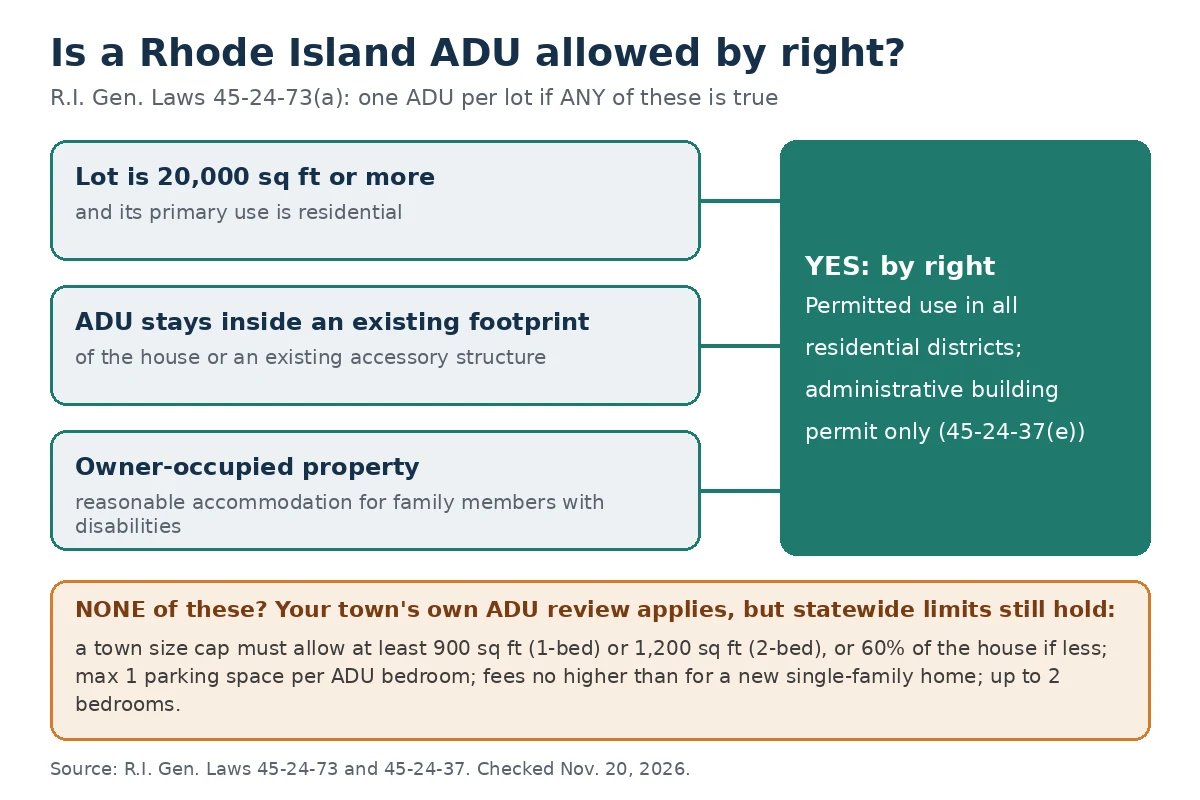
Answer capsule: One ADU per lot is allowed by right if the lot is 20,000 square feet or more and its primary use is residential, if the ADU is inside the existing footprint of the house or an existing accessory structure without expanding it, or if the property is owner-occupied and the ADU is a reasonable accommodation for family members with disabilities.
Disclosure: This page has no affiliate links. The Dwelling Index is reader-supported.
| Your situation | By right under § 45-24-73(a)? | What applies |
|---|---|---|
| Lot of 20,000 sq ft or more, residential primary use, new detached ADU | Yes ((a)(2)) | Administrative building permit only |
| Any lot size, ADU inside the house (basement, attic, existing wing) | Yes, if the footprint doesn't grow ((a)(3)) | Administrative building permit only |
| Any lot size, ADU inside an existing detached garage or barn | Yes, if the footprint doesn't grow ((a)(3)) | Administrative building permit only |
| Owner-occupied home, ADU for a family member with a disability | Yes ((a)(1)) | Administrative building permit only |
| Lot under 20,000 sq ft, new detached ADU or addition without the disability accommodation | No | Town's ADU process, with the statewide standards in § 45-24-73(b) |
Where an ADU qualifies, § 45-24-37(e) makes it "a permitted use in all residential zoning districts" that "shall be permitted through an administrative building permit process only." That means no zoning board hearing for the use itself.
Existing nonconforming structures. If the house or garage is legally nonconforming (for example, it sits closer to the lot line than today's setback), a town can't "require zoning relief for ADU applications proposed within an existing footprint" to address that existing nonconformity (§ 45-24-73(b)(2)(vii)).
What can't a Rhode Island town require for an ADU?
Answer capsule: For any ADU application, a Rhode Island town can't restrict tenants by family relationship or age, charge more than for a new single-family home, require separate utility lines or extra septic capacity unless state rules or capacity require it, set ADU standards above those for accessory structures, require extra lot area, demand more than one parking space per bedroom, ban two bedrooms, or revoke an ADU on sale.
Section 45-24-73(b)(2) says that for all ADU applications, a municipality shall not:
- Occupant rules. Restrict tenants "based on familial relationships or age," except to comply with a federal affordability subsidy.
- Higher fees. Charge application or permitting fees "that exceed those that would be charged for a new single-family dwelling."
- Utility upgrades. Require separate water or sewer lines or expanded septic capacity, unless a state agency, the building code, or capacity needed to serve the ADU requires it.
- Fair housing violations. Discriminate against protected classes.
- Stricter standards. Impose dimensional or development standards on ADUs that "exceed the requirements for an accessory structure in the same zoning district."
- More land. Require additional lot area, frontage or width "solely to accommodate an ADU" on conforming or legal nonconforming lots.
- Zoning relief for existing footprints. Require relief for an ADU within the existing footprint of a legal nonconforming structure.
- Excess parking. Require "more than one off-street parking space per bedroom of the ADU."
- Existing-house requirement. Limit ADUs to lots with existing homes or prohibit ADUs in applications for new homes or subdivisions.
- One-bedroom limits. Prohibit a complying ADU "from having up to two (2) bedrooms."
- Income limits. Require the ADU to be occupied only by a low- or moderate-income household, unless it's part of an inclusionary zoning or comprehensive permit application.
- Revocation on sale. Revoke a legally established ADU or require it to be removed "upon transfer of title or occupancy."
Two more statewide protections sit in § 45-24-73(b): an ADU application that isn't by right "shall not, by itself, be reviewed as a minor land development or major land development project," and a local cap or moratorium on residential units can't restrict ADUs on land zoned residential.
How big can an ADU be in Rhode Island?
Answer capsule: A Rhode Island town may set a maximum ADU size, but it must allow at least 900 square feet for a studio or one-bedroom ADU and 1,200 square feet for a two-bedroom ADU, or 60% of the house's floor area if that's less, subject to dimensional rules. Towns can allow larger ADUs.
Disclosure: This page has no affiliate links. The Dwelling Index is reader-supported.
| House floor area | Studio or 1-bedroom: minimum cap a town must allow | 2-bedroom: minimum cap a town must allow |
|---|---|---|
| 1,000 sq ft | 600 sq ft (60% of house) | 600 sq ft (60% of house) |
| 1,250 sq ft | 750 sq ft (60% of house) | 750 sq ft (60% of house) |
| 1,500 sq ft | 900 sq ft | 900 sq ft (60% of house) |
| 1,800 sq ft | 900 sq ft | 1,080 sq ft (60% of house) |
| 2,000 sq ft | 900 sq ft | 1,200 sq ft |
| 2,500 sq ft | 900 sq ft | 1,200 sq ft |
We calculated each row from § 45-24-73(b)(1): a town's maximum "must allow ... (i) A studio or one bedroom ADU of at least nine hundred square feet (900 sq. ft), or sixty percent (60%) of the floor area of the principal dwelling, whichever is less; and (ii) A two-bedroom (2) ADU of at least twelve hundred square feet (1,200 sq. ft.), or sixty percent (60%) of the floor area of the principal dwelling, whichever is less." These are floors on a town's size cap, not limits on you. Ask your town whether it has a cap at all and how it measures floor area.
Dimensional rules still apply. The size floor is "subject to applicable dimensional requirements," and the ADU can't be held to stricter dimensional standards than an accessory structure in the same district.
Estimate your Rhode Island ADU budget — run the free ADU cost calculator
Do you have to live on the property to have a Rhode Island ADU?
Answer capsule: Only for the disability accommodation path, which applies "on an owner-occupied property." The 20,000 square foot and existing-footprint paths don't mention owner-occupancy, and § 45-24-73 doesn't list owner-occupancy among the things towns can't require, so check your town's ordinance for any local rule.
How the three by-right paths treat occupancy:
- (a)(1) Disability accommodation. "On an owner-occupied property as a reasonable accommodation for family members with disabilities."
- (a)(2) Large lot. Lot of 20,000 square feet or more "for which the primary use is residential." No owner-occupancy language.
- (a)(3) Existing footprint. No owner-occupancy language.
The statute does bar towns from restricting tenants "based on familial relationships or age" in any ADU application.
Does a Rhode Island ADU need parking?
Answer capsule: A town can't require more than one off-street parking space per bedroom of the ADU, so at most one space for a one-bedroom and two for a two-bedroom. Ask your town how it applies the per-bedroom rule to a studio. A town may require fewer or none.
The rule is § 45-24-73(b)(2)(viii). It caps what a town can demand for the ADU; parking rules for the main house are separate.
What fees and utility rules apply to Rhode Island ADUs?
Answer capsule: Application and permit fees for an ADU can't exceed those for a new single-family home. Towns can't require separate water or sewer lines or expanded septic capacity unless a state agency, the building code or added demand requires it, and they may waive utility assessment and tie-in fees.
- Permit fees. Capped at the fees "that would be charged for a new single-family dwelling" (§ 45-24-73(b)(2)(ii)).
- Utility lines and septic. No required separate lines or expanded septic capacity "unless such improvements and/or modifications are required by an applicable state agency for compliance under state law or regulation, or to comply with building code requirements, or to address capacity or upgrades necessary to accommodate the ADU" (§ 45-24-73(b)(2)(iii)).
- Tie-in fees. Towns "may exempt ADUs from all or part of utility assessment and/or tie in fees" (§ 45-24-73(b)(5)). Ask whether yours does.
On a septic lot, the onsite wastewater system's capacity is often the deciding factor. A licensed designer can tell you whether an ADU's bedrooms fit the existing system.
Can an HOA or condo association stop a Rhode Island ADU?
Answer capsule: Generally no. Under § 45-24-73(b)(6), ADU restrictions imposed by condominium associations, homeowners associations or similar bodies that conflict with § 45-24-73 or the state ADU definition "shall be void as against public policy." Associations that already allow ADUs are deemed compliant.
For comparison, Vermont voids only restrictions added after March 1, 2021, and New Hampshire's statute doesn't address private covenants at all. If your association cites its documents against an ADU, show it § 45-24-73(b)(6) and consider asking a Rhode Island real estate attorney to review the conflict.
Can you rent out a Rhode Island ADU, including on Airbnb?
Answer capsule: You can rent an ADU long term, but not short term. Section 45-24-73(b)(8) says ADUs "shall not be offered or rented for tourist or transient use or through a hosting platform." Under § 42-63.1-2, "tourist or transient" means occupancy of less than 30 consecutive days, so nightly and weekly rentals are out.
- Long-term rentals. Allowed, and towns can't restrict tenants by family relationship or age.
- Short-term rentals. Not allowed for ADUs. "Hosting platform" covers online services that let an owner offer a unit for tourist or transient use.
- Income-restricted units. A town can't require an ADU to be low- or moderate-income only unless it's part of an inclusionary zoning or comprehensive permit application.
- Rent estimates. See our ADU rent guide and ADU rental income calculator. For short-term rental rules in other states, see our ADU for Airbnb guide.
Can you build an ADU with a new house or subdivision in Rhode Island?
Answer capsule: Yes. Towns must allow ADUs as part of applications for new homes or subdivisions and can't count those ADUs toward the project's density limit. A town also can't limit ADUs to lots that already have a house.
Section 45-24-73(b)(4) says a municipality "shall allow ADUs as part of applications for new primary dwelling units or subdivisions," and "shall not count such ADUs toward density of the proposal." Towns may use a unified development review process for any application that includes ADUs.
What does a Rhode Island ADU project look like step by step?
Answer capsule: Measure your lot and identify your by-right path, read your town's ADU ordinance for any path that isn't by right, check septic or sewer capacity, design within the size floor and bedroom rules, then apply for the building permit, which is administrative only for by-right ADUs.
- Measure the lot. Find your lot area on the tax assessor's records or a survey. Note whether it's 20,000 square feet or more.
- Pick your path. Large lot, existing footprint, disability accommodation, or your town's own ADU process.
- Read your town's ordinance. Look for any maximum ADU size, accessory structure setbacks and height, and how non-by-right ADUs are reviewed.
- Check the site. Septic or sewer, wells, coastal and wetland rules, flood zones and historic districts.
- Design. Up to two bedrooms, within the size your town allows (never capped below the state floor), with no more than one parking space per bedroom.
- Estimate. Use our ADU cost calculator and ADU cost guide.
- Apply. For a by-right ADU, an administrative building permit only. See how to build an ADU and our ADU permit fees research.
- Build and inspect. Then get your certificate of occupancy.
Before step 3, use our property eligibility check for state-level planning context and broad cost ranges. It does not determine what can be built on your lot.
Check your lot's ADU options — get your free report
How do Rhode Island ADU laws compare with nearby states?
Answer capsule: Rhode Island's by-right path is narrower than Massachusetts' or New Hampshire's, because it depends on lot size, an existing footprint or a disability accommodation. But its statewide standards are strong: generous size floors, a fee cap, void HOA restrictions and a ban on short-term ADU rentals.
Disclosure: This page has no affiliate links. The Dwelling Index is reader-supported.
| State | By-right ADU | Short-term rentals | Where to read more |
|---|---|---|---|
| Rhode Island | Lots of 20,000 sq ft or more, existing footprints, or disability accommodation | Banned for ADUs (under 30 days) | This page |
| Massachusetts | ADU by right in single-family zones | See the Massachusetts page | Massachusetts ADU laws |
| New Hampshire | One attached or detached ADU by right where single-family homes are allowed | Not addressed in the state ADU statute | New Hampshire ADU laws |
| New York | See the New York page | See the New York page | New York ADU laws |
For every state, see ADU laws by state.
What should you ask your town before you pay for plans?
Answer capsule: Ask which by-right path your lot fits, whether the town has a maximum ADU size and how it measures floor area, what setbacks and height apply to accessory structures in your district, how non-by-right ADUs are reviewed, the permit fee, and whether utility tie-in fees are waived. Write down the answers with the date.
- Does my lot qualify under the 20,000 square foot path, the existing-footprint path or the disability path?
- Does the town set a maximum ADU size, and how does it measure floor area?
- What setbacks and height apply to accessory structures in my zoning district?
- If my ADU isn't by right, what review does the town use, and how long does it take?
- What are the ADU permit fees, and are utility assessment or tie-in fees waived?
- Does my lot have septic, coastal, wetland, flood or historic district limits?
- How many parking spaces does the town require for an ADU of my size?
- Is the town's ordinance updated for the 2024 amendments to § 45-24-73?
Print the list, write the answers in the margin and date them. Then use our property eligibility check for a general planning overview; confirm parcel-specific rules with your town.
See what's possible at your address — get your free ADU report
What we verified
- Verified on November 20, 2026: R.I. Gen. Laws § 45-24-73 (history through P.L. 2024, ch. 284 and 285), § 45-24-37 (subsection (e), history through P.L. 2026, ch. 327 and 328) and § 45-24-31 (definition of ADU, history through P.L. 2026, ch. 406 and 407) on the Rhode Island General Assembly's statutes site.
- Verified: R.I. Gen. Laws § 42-63.1-2 definitions of "tourist or transient" and "hosting platform."
- Checked: 2026 bills that proposed changes to § 45-24-73, including H 7219 (introduced January 21, 2026 and referred to House Municipal Government & Housing). The statutes site shows no 2026 amendment to § 45-24-73.
- Not verified: individual city and town ordinances. We list the questions to ask instead.
Methodology
We read § 45-24-73 in full along with the related definitions and permitted-use sections, then built the by-right and size tables from the statute's own wording and numbers. To confirm the law is current, we compared each section's legislative history on the statutes site, which already lists 2026 public laws for neighboring sections. To report an error, use our corrections page.
Sources
- Rhode Island General Assembly, R.I. Gen. Laws § 45-24-73, "Design standards required for accessory dwelling units — Consistent statewide treatment of accessory dwelling units required."
- Rhode Island General Assembly, R.I. Gen. Laws § 45-24-37 (General provisions — Permitted uses), subsection (e).
- Rhode Island General Assembly, R.I. Gen. Laws § 45-24-31 (Definitions), "Accessory dwelling unit (ADU)."
- Rhode Island General Assembly, R.I. Gen. Laws § 42-63.1-2 (Definitions), "Hosting platform" and "Tourist or transient."
- Rhode Island General Assembly, 2026 H 7219 (bill text).
Frequently asked questions
What are the ADU laws in Rhode Island?
R.I. Gen. Laws § 45-24-73 allows one ADU per lot by right on lots of 20,000 square feet or more, inside an existing structure's footprint, or as a disability accommodation on an owner-occupied property, and sets statewide standards for every ADU application.
Can I build an ADU on any lot in Rhode Island?
Not by right. On a lot under 20,000 square feet, a new detached ADU or an addition is by right only if it stays inside an existing footprint or serves a family member with a disability as a reasonable accommodation on an owner-occupied property. Your town may still allow it through its own process.
How big can an ADU be in Rhode Island?
A town may cap ADU size, but it must allow at least 900 square feet for a studio or one-bedroom and 1,200 square feet for a two-bedroom, or 60% of the house's floor area if that's less, subject to applicable dimensional requirements.
Do Rhode Island ADUs need parking?
A town can't require more than one off-street space per ADU bedroom.
Can I rent my Rhode Island ADU on Airbnb?
No. ADUs can't be rented for tourist or transient use, meaning stays under 30 consecutive days, or through a hosting platform. Long-term rentals are allowed.
Can my HOA ban an ADU in Rhode Island?
Association restrictions that conflict with § 45-24-73 or the state ADU definition are void as against public policy.
Do I have to live on the property to have an ADU in Rhode Island?
State law requires owner-occupancy only for the disability accommodation path. Check your town's ordinance for any local rule on the other paths.
How much can a town charge for an ADU permit in Rhode Island?
No more than it would charge for a new single-family home. Towns may also waive utility assessment and tie-in fees.