
ADU Cost in National City, CA: 2026 Prices, Fees, Rules & Rent Math
Most National City homeowners should plan an all-in budget of roughly $180,000 to $480,000+ to build a permitted accessory dwelling unit (ADU) in 2026. A garage conversion sits at the low end. A new detached unit up to the city's 1,200-square-foot maximum sits at the high end. National City permit and plan-check fees typically run $10–$12 per square foot per SnapADU's experience across the city — but that is one slice of a fee stack that also includes Sweetwater Authority capacity charges, SDCWA charges when a new meter is installed or upsized, soils-report costs above 500 sq ft, and combined school developer fees of $4.70 per square foot from the two districts serving National City (National School District at $1.80/sf and Sweetwater Union High School District at $2.90/sf). California state law (Cal. Gov. Code § 66311.5) waives impact fees on ADUs of 750 square feet of interior livable space or less. SB 543, effective January 1, 2026, exempts ADUs of less than 500 square feet from school developer fees as a matter of statewide law.
By The Dwelling Index Editorial Team. Published May 18, 2026 · Last updated · Last verified against primary sources May 18, 2026 · Next scheduled review August 2026.
National City ADU cost snapshot — 2026
| ADU path | Realistic all-in cost band (2026) | Typical timeline (design → keys) | Best fit |
|---|---|---|---|
| Garage conversion (1- or 2-car) | $150,000 – $245,000 | 6–10 months | Existing legal garage, tight budget, family or rental |
| JADU (≤500 sq ft inside the house) | $80,000 – $160,000 | 4–8 months | Spare-bedroom suite, lowest disruption |
| Attached new (≤800 sq ft) | $200,000 – $320,000 | 9–12 months | Adding onto the side or rear of the primary home |
| Detached new — single story, ≤750 sq ft | $260,000 – $360,000 | 10–14 months | The fee-cliff sweet spot for many lots |
| Detached new — 751–1,200 sq ft | $325,000 – $480,000+ | 12–16 months | Maximum rent potential, 2BR or 3BR rentals |
| Two-story or above-garage ADU | $300,000 – $460,000+ | 12–16 months | Small lots, parking preservation, view rooms |
Sources: SnapADU 2026 cost data; California Construction Cost Index (approximately 44% rise January 2021 through December 2025); National City ADU Handbook (March 2024); cross-checks against Better Place Design & Build's 2026 San Diego ADU cost ranges. Last verified May 18, 2026.
See What You Can Build → Get Your Free National City ADU Report
Seven quick questions about your lot. Parcel-aware feasibility summary in about 60 seconds. Built to inform, not to sell.
Get Your Free National City ADU Report →What's the difference between build cost and all-in ADU cost?
A “build cost” or “vertical build” price covers the structure of the ADU — foundation, framing, MEP rough-in, drywall, and finishes inside the unit. An “all-in” or “turnkey” cost adds design, plans, engineering, permits, plan-check rounds, impact and capacity fees, sitework, utility trenching, sewer connection, electrical service work, solar (required on new detached ADUs in California per Title 24), and landscaping. The all-in number is typically 25–40% larger than the vertical-build number on a typical National City lot.
SnapADU's published plan pricing is a useful reference point because the firm builds in National City and publishes both numbers openly. Its 749-square-foot, two-bedroom, one-bath “Square” plan lists a $244,000 vertical build plus $25,000 in standard finish materials — $269,000 before plans, permits, and sitework. SnapADU's published guidance says the same plan, dropped on an ideal lot, typically lands in the mid-$300,000s all-in. The firm's 700-square-foot “Long” plan is similar: $229,000 vertical plus $25,000 in finishes ($254,000), with all-in budgets again in the mid-$300,000s when sitework, plans, and permits behave.
That gap — about $80,000–$100,000 — is where most surprise change orders live. It is also where prefab marketing pages typically end. A prefab “starting at $80,000” headline almost never includes a foundation, a sewer lateral, an electrical panel upgrade, plan check, or a Sweetwater Authority capacity fee.
One quick caveat about prefab
Prefab does not eliminate local approvals. Even a fully factory-built unit on a City of National City lot still needs a Building Permit, an Engineering review when the site triggers it, Sweetwater Authority submittal, school developer fees if the unit is 500 sq ft or larger, and the inspection sequence the National City ADU Handbook requires before occupancy. Prefab can compress construction. It does not compress permitting. Treat the prefab sticker price the same way you treat a vertical-build number — it is one slice, not the whole pie.
How to read any National City ADU quote in 60 seconds
When a builder hands you a number, ask these five questions before you write a check:
- Is this build-only, all-in, or somewhere in between?
- Are plans, engineering, Title 24 energy calcs, and plan-check rounds included?
- Are city impact fees, school developer fees, Sweetwater Authority capacity fees, and SDCWA system capacity charges included or excluded?
- What sitework allowance is included for utility trenching, sewer lateral work, and electrical service?
- Is solar (required by Title 24 on new detached ADUs) included in the price, or a separate line item?
A “yes, included” answer to all five puts you in genuine all-in pricing. A “no” or “depends” on any of them means you are looking at a vertical-build quote dressed up as a full budget.
How much are ADU permits and fees in National City?
A National City ADU project pays into five separate buckets: City permit and plan check, school developer fees from two districts, Sweetwater Authority water capacity charges, San Diego County Water Authority (SDCWA) capacity charges when a new meter is installed or an existing meter's capacity is increased, and the city's broader Development Impact Fees (DIF) — most of which are waived on ADUs of 750 sq ft or less under state law. A soils report (typically $2,500–$4,000) becomes effectively mandatory above 500 square feet.
We assembled the full stack below from primary sources: the City of National City's published fee schedules, Sweetwater Authority's January 1, 2026 Rates and Rules supplement, San Diego County Water Authority Ordinance 2025-02 for CY 2026, National School District's posted developer-fee schedule, Sweetwater Union High School District's posted developer-fee schedule, and SnapADU's National City permit-cost rule of thumb verified against multiple projects.
City of National City: Building Permit, Plan Check, and Impact Fees
National City's Building Division (619-336-4210) administers permit and plan-check fees, and its Engineering Division (619-336-4380) handles capacity-related sewer review. Per SnapADU's experience across more than 100 San Diego County ADU projects, National City building permit and plan-check fees typically come out to $10–$12 per square foot for a custom new detached ADU. On a 749-sq-ft detached build, that puts permit and plan check around $7,500–$9,000. On a 1,200-sq-ft detached build, around $12,000–$14,400.
Three important fee-document notes for transparency
- The City's Building Department Fees PDF is dated Effective July 1, 2022 on the document library page.
- The City's broader Master Fee Schedule was adopted June 3, 2025 and took effect August 2, 2025.
- The City Council adopted a new Development Impact Fee Schedule in late 2025 (the city's first DIF nexus update since 2005). Per inewsource reporting, the new DIF takes effect April 20, 2026, covering police, fire, library, parks, city administration, and multi-modal transportation categories.
- The legacy Transportation Development Impact Fee of $2,688.21 per new residential unit (effective July 1, 2022, adjusted annually for inflation per SANDAG) sits within the broader impact-fee picture.
Critical point for ADU homeowners: Regardless of the city's broader DIF updates, impact fees on ADUs of 750 sq ft of interior livable space or less remain prohibited under state law (Cal. Gov. Code § 66311.5). Only ADUs over 750 sq ft owe proportional impact fees, charged proportionally to the size of the primary dwelling. For projects above 750 sq ft, call the Building Division at 619-336-4210 with your square footage, ADU type, and construction valuation to confirm the proportional impact fee under the post-April-2026 schedule.
School developer fees: two districts, one combined rate
Most San Diego ADU guides quote San Diego Unified School District's developer fee — but National City sits in different districts. Elementary students attend National School District (K–6). Secondary students attend Sweetwater Union High School District (7–12).
The actual currently published rates:
- National School District: $1.80 per square foot of habitable space for new residential construction or additions of 500 sq ft or more. No developer fees due if construction/addition is 499 sq ft or less.
- Sweetwater Union High School District (Grades 7–12 Residential Room Additions/Conversions): $2.90 per square foot.
- Combined current rate for most National City ADUs: $4.70 per square foot.
That is substantially below the State Allocation Board's $5.38/sf statutory maximum (adopted January 28, 2026). Both districts have adopted fees below the ceiling.
The numbers that matter for your project:
- 499 sq ft ADU: $0 in school fees. SB 543 (effective January 1, 2026) also exempts ADUs under 500 sq ft from school developer fees as a matter of statewide law.
- 750 sq ft ADU: approximately $3,525 in combined school fees.
- 1,000 sq ft ADU: approximately $4,700.
- 1,200 sq ft ADU: approximately $5,640.
Verify each district's current rate at permit issuance — districts adjust their adopted fees periodically.
Sweetwater Authority: water capacity, meter, and lateral
Sweetwater Authority is the water provider for National City and the surrounding South Bay. Per Sweetwater's Capacity Fee FAQ and its January 1, 2026 Rates and Rules supplement, the Capacity Fee for an ADU is proportional to the burden of the proposed unit based on the number of plumbing fixture units, unless an exemption applies. The base Capacity Fee is $5,490 per Equivalent Dwelling Unit (EDU) for new demand on the water system. ADUs served by an existing meter that can handle the additional demand may avoid a new capacity fee entirely.
Two important Sweetwater Authority planning notes
- Submitting your application to Sweetwater Authority “takes approximately six weeks” per the National City ADU Handbook. Schedule it in parallel with your plan-check submittal so it doesn't extend the critical path.
- If construction of water service is required after fees and deposits are paid, Sweetwater's Water Service Application Process page states construction typically takes another eight weeks on top of the six-week submittal review.
- Internal fire sprinklers, when required by the local fire jurisdiction, must be supplied by a dedicated water service.
SDCWA system capacity and water treatment capacity charges
The San Diego County Water Authority is a separate agency from Sweetwater. Its system capacity charge applies when a new metered connection is established or when the capacity of an existing metered connection is increased. For Calendar Year 2026, per SDCWA Ordinance 2025-02:
- System Capacity Charge (under 1-inch meter): $6,501
- Water Treatment Capacity Charge: $182 (additional)
These charges scale with meter size. ADUs sharing the existing primary residence's meter at the same capacity generally avoid them — one of the cleanest cost-control moves on a National City ADU project under 750 sq ft.
Soils report — effectively required above 500 sq ft
Per SnapADU's National City regulations page (last updated April 2026), National City requires a soils report for ADUs of 500 sq ft or more as part of the structural review chain. Budget $2,500–$4,000 for a soils/geotechnical report on a flat, well-drained lot. Hillside sites can require deeper work that pushes this higher.
The National City ADU fee-stack summary table
| Fee bucket | ADU ≤500 sq ft | 500–750 sq ft | 751–1,200 sq ft |
|---|---|---|---|
| City building permit + plan check (SnapADU rule of thumb $10–$12/sf) | $4,500–$6,000 | $5,500–$9,000 | $7,500–$14,400 |
| Engineering review/permit (if triggered) | $0 if untriggered | Variable | $1,500–$5,000+ |
| City Development Impact Fees (new schedule eff. April 20, 2026) | $0 (SB 13 waiver) | $0 (SB 13 waiver) | Proportional to primary dwelling |
| School developer fees (NSD $1.80 + SUHSD $2.90 = $4.70/sf combined) | $0 (under 500 sq ft exempt) | $2,350–$3,525 | $3,529–$5,640 |
| Sweetwater Authority capacity fee (fixture-unit proportional; existing meter often avoids) | $0 if no new demand | Variable | Variable |
| SDCWA charges ($6,683 combined under 1″ meter) | $0 unless new/upsized meter | $0 unless new/upsized meter | $6,683 if new or upsized meter |
| Soils/geotechnical report | Not typically required | $2,500–$4,000 | $2,500–$4,000+ |
| Indicative total fees | ~$5,000–$8,000 | ~$10,000–$17,000 | ~$15,000–$30,000+ |
Sources: SnapADU National City regulations page (last updated April 2026); City of National City Transportation Development Impact Fee Schedule (effective July 1, 2022) and 2025 Development Impact Fee Schedule (effective April 20, 2026); California Government Code § 66311.5 (SB 13); SB 543 (effective Jan 1, 2026); National School District Business Services Developer Fee schedule; Sweetwater Union High School District Developer Fees page; Sweetwater Authority Rates and Rules supplement (effective Jan 1, 2026); SDCWA Ordinance 2025-02 (CY 2026); National City ADU Handbook (March 2024). Last verified May 18, 2026. Final fee math should be confirmed in writing by the Building Division at 619-336-4210 before permit submittal.
Want a parcel-specific picture before you call a builder?
Get Your Free National City ADU Report →Our free Feasibility Engine helps you identify the size bands your lot likely supports, the setbacks that apply, and which fee cliffs are in play. No phone call. No commitment.
What square-footage breakpoints change National City ADU cost?
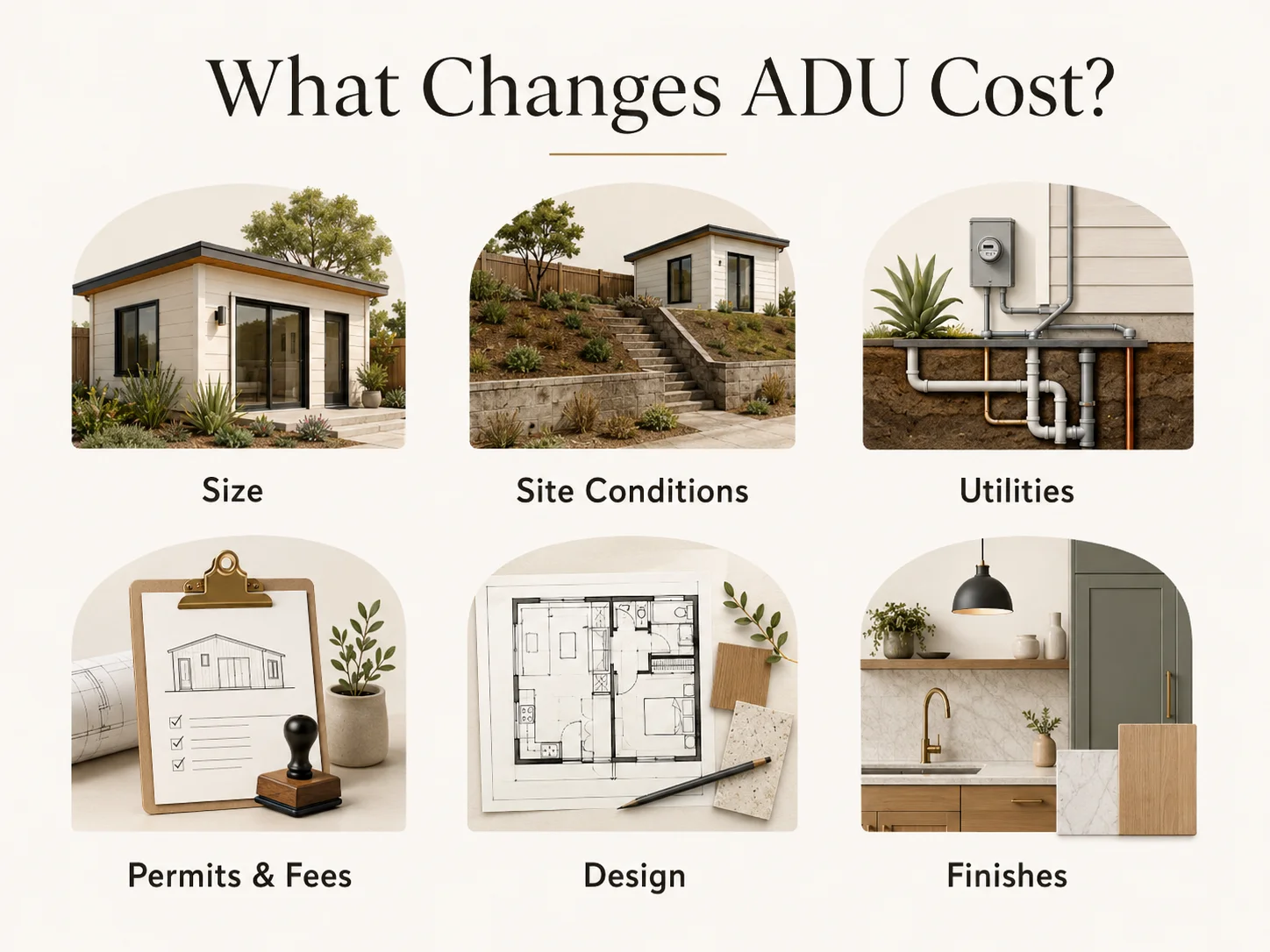
Four square-footage thresholds quietly determine whether a National City ADU stays on budget. Less than 500 sq ft, school developer fees do not apply. 750 sq ft of interior livable space or less keeps you under the SB 13 impact-fee waiver. Up to 800 sq ft, state law (Cal. Gov. Code § 66321) prevents local size, FAR, lot-coverage, open-space, or front-setback standards from being applied in a way that prevents at least one ADU of 800 sq ft with 4-ft side and rear setbacks. The state-law size backstop also prohibits local agencies from imposing a maximum smaller than 850 sq ft (or 1,000 sq ft for an ADU with more than one bedroom). Above 1,200 sq ft, no detached new-construction ADU is allowed in National City under NCMC § 18.30.380. Designing around — not above — these numbers can save $5,000–$20,000 in fees without sacrificing meaningful living area.
Less than 500 square feet — the JADU envelope
Under 500 sq ft is the Junior ADU (JADU) envelope. A JADU is a small unit contained entirely within an existing or proposed single-family residence, with its own separate exterior entrance and an efficiency kitchen. National City's handbook permits JADUs of 150 to 500 sq ft per NCMC § 18.30.390, with up to an additional 150 sq ft for ingress and egress.
What changes at the 500 sq ft boundary:
- School developer fees turn on at 500 sq ft. Per SB 543, effective January 1, 2026, an ADU under 500 sq ft is exempt from developer fees under Education Code § 17620. A 499-sq-ft JADU pays $0 in school fees. A 500-sq-ft ADU starts owing the fee on the assessable area.
- Soils report applies above 500 sq ft per the structural review chain.
A 480–499 sq ft JADU inside an existing structure is one of the most economical ADU paths available in National City. Construction costs typically land $80,000–$160,000 depending on existing systems, kitchen build, and whether you are adding a bathroom or sharing one. JADU owner-occupancy is required only when the JADU shares sanitation facilities with the primary dwelling, per AB 1154's January 1, 2026 narrowing. JADUs with separate sanitation are not subject to the owner-occupancy requirement.
500 to 750 square feet — the impact-fee waiver lane
Above 500 sq ft you owe school developer fees on the assessable area. But you still benefit from SB 13's impact-fee waiver up to 750 sq ft of interior livable space. That waiver applies to the Transportation Development Impact Fee, parks impact fees, library impact fees, and any other charge meeting the Mitigation Fee Act's definition of an “impact fee” under Government Code § 66000.
A well-designed 749 sq ft, two-bedroom, one-bath ADU is the National City sweet spot for landlords and family-housing builders. You get:
- A real second bedroom that commands two-bedroom rents in the 91950 market.
- The full state-protected setback envelope at 4 ft side/rear.
- Zero impact fees under SB 13.
- Combined school fees capped at approximately $3,525.
The 750-sf cliff risk
A builder who quietly delivers a 752 sq ft layout because the framing dimensions came out that way. Three square feet above the line costs you the entire impact-fee waiver. Make 749 sq ft a hard ceiling in your contract scope, not a target.
800 square feet — the state-protected envelope
Per Cal. Gov. Code § 66321(a)(3) and (b), state law prohibits local size, FAR, lot-coverage, open-space, front-setback, or minimum-lot-size standards from being applied in a way that prevents at least one ADU of 800 sq ft of interior livable space with 4-ft side and rear setbacks. The same statute prevents local agencies from imposing a maximum ADU size smaller than 850 sq ft, or 1,000 sq ft for ADUs with more than one bedroom.
1,200 square feet — National City's detached ADU maximum
Per NCMC § 18.30.380, National City's maximum new-construction detached ADU is 1,200 sq ft, unless the ADU is constructed entirely within the footprint of an existing dwelling or accessory structure (in which case no square-foot cap applies to the conversion).
Attached ADU sizing in National City has a known local-versus-state conflict that the city's own handbook reflects: one handbook passage describes attached ADUs as “50% of main dwelling unit or 1,200 square feet, whichever is greater,” while another passage uses conflicting “whichever is less” wording. State law overlays this with a backstop preventing local standards from blocking at least 850 sq ft (or 1,000 sq ft for an ADU with more than one bedroom). Confirm attached-ADU sizing in writing with National City Planning at 619-336-4310 before paying for plans.
The size-breakpoint decision table
| Target size | Fees that turn on/off | Why this might be your size |
|---|---|---|
| 350–499 sq ft (JADU) | School fees exempt; impact fees waived; soils report often not required | Cheapest path to a permitted second unit; in-house conversion |
| 700–749 sq ft | School fees on; impact fees waived; soils report required | Two-bedroom rental sweet spot |
| 751–800 sq ft of interior livable space | School fees on; proportional impact fees may apply just above 750; state-protected envelope at 800 | Maximum rentable area with full state protection on setbacks |
| 1,000–1,200 sq ft | All fees on; underlying-zone setbacks apply | Three-bedroom rental or large family unit; highest revenue |
Sources: NCMC § 18.30.380 and § 18.30.390; Cal. Gov. Code § 66311.5 (SB 13); SB 543 (effective Jan 1, 2026); Cal. Gov. Code § 66321; AB 1154 (effective Jan 1, 2026); SnapADU National City data; National City ADU Handbook (March 2024).
Can I build an ADU on my National City lot?
If your property is in National City and zoned residentially, you can almost certainly build at least one ADU. State law requires every California local agency to allow at least one ADU on any qualifying residential lot. National City permits detached or attached ADUs up to 1,200 sq ft, plus one JADU up to 500 sq ft, on most single-family lots; multifamily lots may add up to eight detached ADUs under SB 1211 (effective January 1, 2025), capped by existing unit count. The variables that determine what you can build are setbacks, lot dimensions, coastal-zone status, airport land-use overlays, fire access, and existing utility capacity.
The eligibility checklist before you spend on design
- Zoning: Residentially zoned lots are eligible. Verify with Planning at 619-336-4310.
- Setbacks: 15 ft front (state law preempts this for ADUs ≤800 sq ft of interior livable space), 4 ft side and rear, 5 ft building separation per NCMC § 18.30.380.
- Lot size: No minimum lot size requirement under state ADU law.
- Existing primary residence: Required (or proposed concurrently).
- Coastal zone: A portion of National City sits inside California's coastal zone — primarily west of I-5 toward San Diego Bay. AB 462 (effective October 15, 2025) now requires Coastal Development Permits for ADUs to be approved or denied within 60 days of a complete application, concurrent with ADU ministerial review, with no Coastal Commission appeal.
- Airport Influence Area (AIA): National City is inside the Airport Influence Areas for both Naval Air Station North Island (NASNI) and San Diego International Airport (SDIA) per the San Diego County Regional Airport Authority's adopted ALUCPs. Most National City parcels won't trigger significant ALUCP review for a single-family ADU, but noise, safety, airspace protection, and overflight disclosure factors apply. Check your parcel against the ALUCP mapping tool — particularly in the western parts of the city closer to NASNI.
- Fire hose pull: Max 150 ft from curb to farthest point of the ADU per NCMC and the Fire Prevention Division.
- Soils report: Required for ADUs ≥ 500 sq ft.
- Septic system: If your property is on septic rather than municipal sewer, consult the San Diego County Department of Environmental Health & Quality (858-565-5173) before designing — most National City properties are on the municipal sewer.
The HCD letter you should know about
On December 5, 2025, the California Department of Housing and Community Development (HCD) sent National City a Letter of Technical Assistance flagging that the city's 2021 ADU ordinance may no longer comply with current state law. Where the city's local ordinance is more restrictive than state law, state law controls — and that is almost always good news for homeowners. Multifamily ADU counts expanded under SB 1211. JADU owner-occupancy narrowed under AB 1154. Fee structures got friendlier on units over 750 sq ft. The completeness review now has a hard 15-business-day clock under SB 543.
For a full rule-by-rule breakdown of National City ADU regulations — including where the city's handbook conflicts with current state law — see our companion guide: National City ADU Laws (2026).
Not sure what your specific parcel allows?
Run your free ADU Feasibility check →Your address goes in, parcel-specific size bands, setback flags, and review path come out.
Is a garage conversion cheaper than a detached ADU in National City?
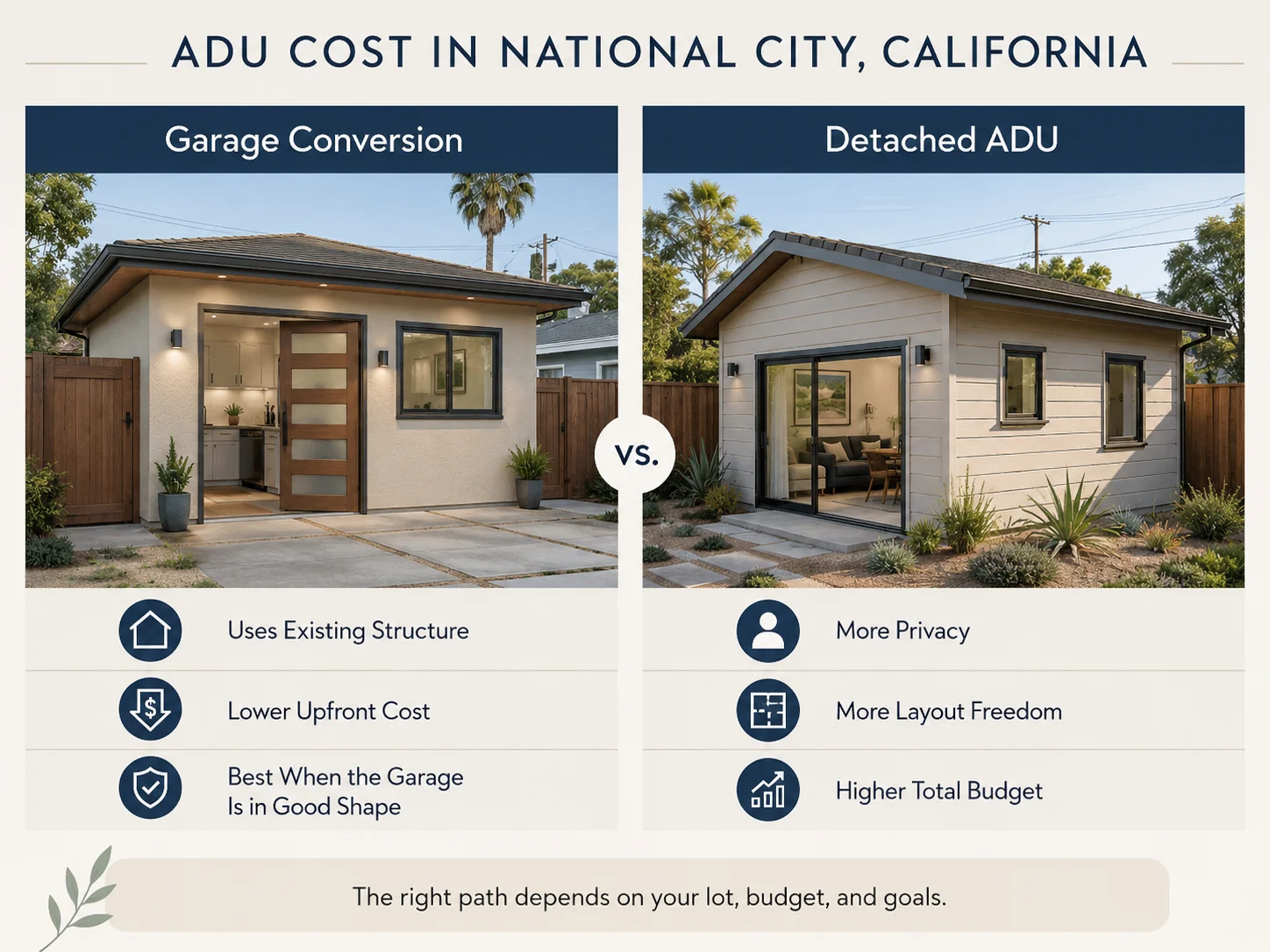
Per National City's own ADU Handbook, new construction is “typically 125% more expensive” than a conversion of an existing structure in good physical condition. A National City garage conversion typically lands $150,000–$245,000 all-in; a comparable detached new build typically lands $260,000–$480,000. The conversion savings come from reusing the foundation, framing, and roof. They evaporate fast on older garages with thin slabs, undersized headers, missing fire separation, or unpermitted prior work.
When a garage conversion is genuinely cheaper
The conversion math works when your garage:
- Has a slab thick enough to pass current residential structural review.
- Has framing that can support a new ceiling, modern insulation, and window openings without major reframing.
- Sits on a foundation that is square, level, and free of significant settlement.
- Connects easily to the primary home's sewer lateral and electrical panel without long trenching runs.
- Has no surprise unpermitted prior work that needs to be legalized or removed.
When all five are true, you can reasonably target the $150,000–$200,000 range for a well-finished, code-compliant one-bedroom garage conversion in National City. The handbook's “125% more expensive for new construction” framing is the city's published rule of thumb — not marketing language from a builder.
When a “cheaper” garage conversion stops being cheaper
When the existing garage needs a new slab, fire-rated walls (especially close to a property line), structural retrofit for a second story or extended span, or a new sewer lateral pulled across the property, the conversion budget creeps toward — and sometimes past — a comparable detached new-build budget. The conversion still wins on permit-friction terms: it usually skips the soils report, often qualifies for utility-fee exemptions when the existing service handles the new demand, and processes faster through Engineering. National City's handbook explicitly notes that conversions can use existing utility connections without supplemental permits, while new detached construction often requires new water, sewer, and electrical service work.
Detached new build — when the higher cost is worth it
Detached new construction earns its premium when:
- You want full design control over layout, ceiling heights, window placement, and exterior aesthetics.
- The primary house cannot reasonably absorb an attached addition.
- You are targeting the maximum 1,200 sq ft envelope for a three-bedroom rental.
- You want a separate metered unit for long-term rental clarity.
- The garage is structurally compromised, undersized, or already legal living space you want to keep.
A detached unit on a flat National City lot with short utility runs typically lands in the high $200,000s to mid $300,000s all-in at 600–800 sq ft. The same unit at 1,000–1,200 sq ft typically lands in the $400,000s. Above-garage and two-story builds tend to cost 10–20% more per square foot than single-story builds at the same size.
Compare your conversion math against a clean-slate detached build before you call a single builder.
How much can a National City ADU rent for in 91950?
Median rents in National City zip 91950, per Rentometer's March 2026 data compiled by SnapADU, run $1,810 for a 1-bedroom, $2,585 for a 2-bedroom, and $3,135 for a 3-bedroom. Cross-referenced against Zillow, RentCafe, Zumper, and RentHop for the same zip, those numbers are broadly consistent with the apartment market — though new-construction ADUs typically command a slight premium because the unit is new, well-insulated, and laid out for modern tenants. The illustrative math below is for planning only.
National City sits inside the San Diego rental market. Per Redfin, the median sale price was approximately $715,000 as of September 2025, with a median price per square foot of $578 (current Redfin data fluctuates monthly — confirm before relying on these specific numbers for major financial decisions).
National City zip 91950 rent table — cross-source verification
| Unit type | Rentometer (Mar 2026, via SnapADU) | RentCafe avg (apt) | Zumper avg (apt) | Planning range to use |
|---|---|---|---|---|
| Studio / 1BR | $1,810 | ~$1,549–$1,895 | ~$1,900 | $1,650–$1,900/mo |
| 2BR | $2,585 | ~$2,625 | ~$2,500–$2,700 | $2,400–$2,700/mo |
| 3BR | $3,135 | ~$3,000–$3,300 | ~$3,200–$3,800 | $2,900–$3,300/mo |
Sources: Rentometer March 2026 data as published by SnapADU's National City regulations page (last updated April 2026); RentCafe National City market trends (April 2026); Zumper National City rental data; cross-checked against Zillow and RentHop. ADU rents may run slightly above apartment-comparable rents because of newer construction and private layout. Last verified May 18, 2026.
Worked yield examples — for planning only
We modeled five representative National City ADU scenarios using mid-range all-in cost estimates and the conservative end of the planning rent ranges above. These are gross yield calculations before operating expenses, vacancy, repairs, property management, financing costs, the additional property tax on the new ADU value, and any insurance increase.
| Scenario | Mid-range all-in cost | Conservative rent | Annual gross rent | Gross yield before expenses |
|---|---|---|---|---|
| 499 sq ft JADU (in-house conversion) | $130,000 | $1,650/mo | $19,800 | ~15.2% |
| 749 sq ft detached, 1BR | $310,000 | $1,800/mo | $21,600 | ~7.0% |
| 749 sq ft detached, 2BR | $320,000 | $2,500/mo | $30,000 | ~9.4% |
| 1,000 sq ft detached, 2BR | $400,000 | $2,650/mo | $31,800 | ~8.0% |
| 1,200 sq ft detached, 3BR | $450,000 | $2,900/mo | $34,800 | ~7.7% |
After operating expenses (typically 30–45% of gross rent for a privately managed long-term rental, including vacancy reserve, repairs, insurance increases, and a modest property-tax bump on the new ADU value), most of these scenarios land at a net yield of roughly 4.5%–8% in the first year before financing cost.
Per California's Prop 13 framework, your existing land and primary structure are not reassessed when you add an ADU. The new ADU is assessed at its construction cost, typically adding 1.0%–1.25% of that cost to your annual property-tax bill — about $3,250–$4,065 per year on a $325,000 ADU. National City's ADU Handbook confirms this rule directly.
The Federal Housing Finance Agency's 2025 analysis of California purchase properties found that homes with ADUs showed higher median appraised values and stronger annualized growth than comparable properties without ADUs over 2013–2023. That doesn't translate to a certain return on any individual project. But it does point in a consistent direction: properly permitted ADUs add durable property value alongside the rental income, particularly in a constrained-supply market like National City.
Planning to rent the ADU long-term? Explore landlord setup tools for tenant screening, lease drafting, and property management before move-in day.
How long does a National City ADU take?
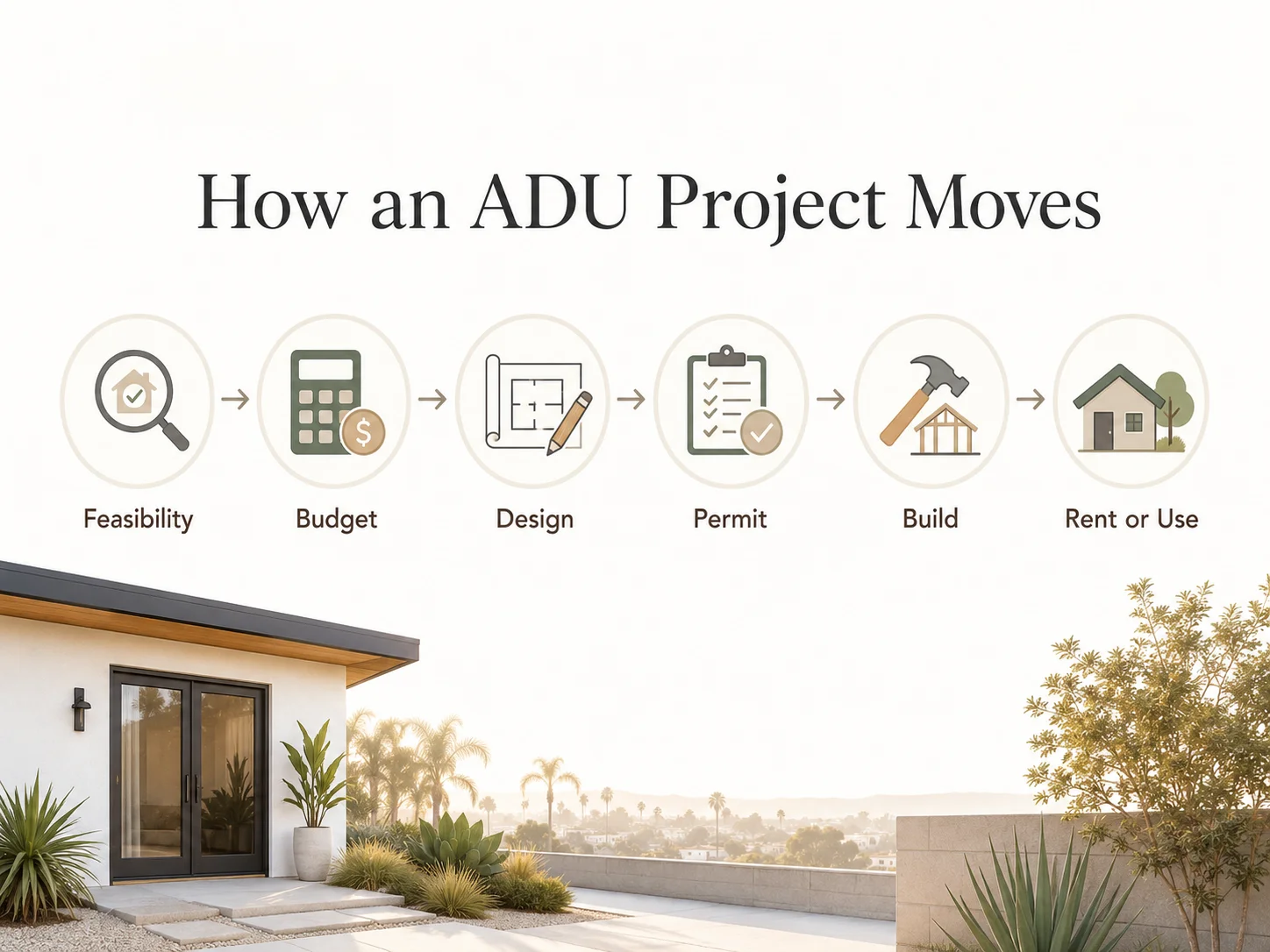
Plan for 8–14 months total for a custom detached National City ADU and 4–10 months total for a garage conversion or JADU. National City's ADU Handbook breaks the project into four phases: Pre-Application, Design, Permitting, and Construct & Occupy. Sweetwater Authority submittal “takes approximately six weeks.” SB 543, effective January 1, 2026, requires the city to determine completeness within 15 business days of submittal and to issue a permit decision within 60 days of a complete application. AB 462, effective October 15, 2025, applies the same 60-day concurrent clock to coastal-zone Coastal Development Permits.
Phase 1 — Pre-Application (1–3 weeks)
This is the most undervalued phase. National City's handbook explicitly recommends a phone or email conversation with Planning (619-336-4310) before committing to a design. Planning can confirm zoning, setbacks, JADU eligibility, and whether your parcel triggers Engineering review for drainage, slopes, foundation type, right-of-way work, or new sewer connection. Most multi-month permit delays trace back to a missing pre-application conversation.
Phase 2 — Design and Plan Preparation (4–12 weeks)
Custom design takes 6–12 weeks. Pre-approved or build-ready plans can compress this to 2–4 weeks plus the project-specific site plan and foundation plan. Under AB 1332 (effective 2024), local agencies must process complete preapproved-plan applications ministerially within 30 days when they meet local standards.
Tasks in this phase:
- Architectural and structural design.
- Title 24 energy compliance calculations.
- CalGreen compliance documentation.
- Solar PV system design for new detached ADUs.
- Site plan with utility tie-ins and setback verification.
- Soils/geotechnical report (≥500 sq ft).
- Preliminary cost estimate from your builder.
Phase 3 — Permitting (8–16 weeks)
Per SB 543, effective January 1, 2026:
- 15 business days from submittal for the Building Division to determine completeness.
- 60 days from a complete application for the city to approve or deny.
- 30 days for preapproved-plan ministerial review under AB 1332.
- 60 days concurrent Coastal Development Permit review under AB 462 (for coastal-zone parcels).
In practice, most custom National City ADU projects go through 1–3 correction cycles. SnapADU's National City regulations page reports a realistic permit timeline of 3–4 months for single-family ADU projects and 4–6 months for multifamily or complex sites. Sweetwater Authority's six-week review should run in parallel with the city's plan check, not sequentially.
Phase 4 — Construction (16–32 weeks)
- JADU (in-house conversion): 8–16 weeks.
- Garage conversion: 12–20 weeks.
- Detached single-story (749 sq ft): 16–24 weeks.
- Detached 1,000–1,200 sq ft: 20–32 weeks.
- Above-garage or two-story: 24–32+ weeks.
Inspections are required for each phase: foundation, framing, plumbing, electrical, mechanical, insulation, and final. Inspection scheduling for National City is at 619-336-4363. Final occupancy is granted only after the final inspection clears.
Full-project planning calendar — typical National City detached ADU
| Phase | Realistic duration | Critical path risk |
|---|---|---|
| Pre-application + utility verification | 1–3 weeks | Skipping the Planning conversation |
| Design + engineering + Title 24 | 6–10 weeks | Revisions, structural complexity |
| Sweetwater Authority submittal | ~6 weeks (parallel) | Late submittal; capacity-fee disputes |
| First plan-check submittal → permit issuance | 8–16 weeks | 1–3 correction cycles |
| Construction | 16–32 weeks | Change orders, panel upgrade discovery, weather |
| Final inspection + occupancy | 2–4 weeks | Correction work, scheduling lag |
| Total | 8–14 months | Coastal CDP now 60-day concurrent under AB 462 |
What National City ADU rules change cost?
Three rule sets stack on every National City ADU project. California state law (Cal. Gov. Code §§ 66310–66342) sets the floor — no local ordinance can fall below it. National City Municipal Code § 18.30.380 (ADUs) and § 18.30.390 (JADUs) implement the state framework locally. Your specific property finishes the picture — coastal overlay status, slope, Airport Influence Area exposure (National City sits inside both NASNI and San Diego International ALUCPs), HOA covenants if any, and existing utility connections.
Setbacks, height, and lot coverage
| National City rule | Cost / design impact |
|---|---|
| Front setback: 15 ft minimum | Often the binding constraint on narrow lots; state law preempts front-setback denial for at least one 800-sq-ft ADU |
| Side & rear setbacks: 4 ft minimum | The state floor; matches NCMC § 18.30.380(F)(5) |
| Building separation from primary: 5 ft minimum | Standard fire-safety/light-and-air rule |
| Detached ADU max height: 16 ft single-story | Default cap; ADUs on lots <5,000 sf or above garages can reach 25 ft |
| 18 ft height near transit | Allowed within ½ mile of a major transit stop or high-quality transit corridor |
| +2 ft roof-pitch bonus | Allowed if ADU roof pitch matches primary dwelling |
| 1,200 sq ft detached maximum | NCMC § 18.30.380(F)(4); the hard cap on new detached construction |
| State-law size backstop: at least 850 sq ft, or 1,000 sq ft for >1 bedroom | Cal. Gov. Code § 66321 prevents the city from imposing a max below these floors |
| Attached ADU sizing | Handbook contains a local-vs-state conflict; verify in writing with Planning |
| 24-inch box tree in 15 ft front setback | Required unless existing 15-ft-tall, 15-ft-wide trees satisfy; ~$300–$800 |
Parking, fire, and engineering triggers
| Rule | Cost / design impact |
|---|---|
| No parking required for ADUs | State law and NCMC; one of the cleanest cost savings in California ADU law |
| Garage demolition for ADU: no parking replacement required | Removes a former budget killer; SB 1211 confirmed this for multifamily in 2025 |
| Fire sprinklers not required unless primary requires them | Per NCMC and California Residential Code R313.2; saves ~$8,000–$15,000 if primary is exempt |
| Max fire hose pull: 150 ft from curb to ADU farthest point | Forces redesign on deep-lot projects |
| Engineering Permit triggers | Adds $1,500–$5,000+ in review and time |
Multifamily and unit-count rules
For multifamily properties, SB 1211 (effective January 1, 2025) significantly expanded what is allowed. The city's March 2024 handbook predates SB 1211 and reflects only the older two-detached-ADU rule. Under current state law:
- Interior conversions of existing non-livable space: a minimum of one ADU, or up to 25% of existing primary units, whichever is greater.
- Detached ADUs: up to eight per lot, capped by the existing primary unit count.
- No replacement parking required when uncovered parking is converted.
Where the handbook is more restrictive than current state law, state law controls. Confirm your specific multifamily-lot count with Planning before paying for design.
Owner-occupancy, separate sale, and rental rules
- Standard ADU owner-occupancy: Not required. AB 976 permanently eliminated this requirement for standard ADUs.
- JADU owner-occupancy: Required only when the JADU shares sanitation facilities with the primary unit, per AB 1154's January 1, 2026 narrowing.
- Separate sale of ADU (AB 1033): Not adopted by National City as of May 18, 2026. The handbook is explicit: “The ADU may not be sold or otherwise conveyed separate from the primary residence.”
- Short-term rentals: Not allowed. Per the handbook, “ADUs/JADUs, including those on multi-family properties, must be rented for a period exceeding 31 days.” Long-term rental only.
Property taxes after the ADU is built
Per California's Prop 13 framework and confirmed directly in the National City ADU Handbook, existing land and the primary structure are not reassessed when you add an ADU. The new ADU is assessed at its construction cost by the San Diego County Assessor. Typical annual property-tax impact is roughly 1.0%–1.25% of the ADU's assessed construction value — approximately $3,250–$4,065 per year on a $325,000 ADU.
For the full rule-by-rule breakdown of National City ADU laws — including the December 5, 2025 HCD Letter of Technical Assistance flagging the city's 2021 ordinance — see National City ADU Laws (2026).
How do National City homeowners pay for an ADU?
Most National City ADU projects are financed through one of four paths: HELOC, cash-out refinance, renovation/construction loan, or cash from savings. Each has trade-offs. None is universally “cheapest.” The right path depends on your existing primary-mortgage rate, your equity position, your timeline, your income documentation, and whether the ADU is for family housing or rental income. National City's official ADU page notes an ADU Loan Program is “coming soon” but has not published terms or a launch date as of May 18, 2026.
Lane 1 — Cash from savings or sold securities
The simplest option. No application, no underwriting, no interest cost. The trade-off is opportunity cost. If you can cover the $80,000–$160,000 JADU range or the $150,000–$245,000 conversion range from savings comfortably, this is often the cleanest path. For larger detached builds, all-cash is typically a strategy for homeowners with significant liquidity.
Lane 2 — Home Equity Line of Credit (HELOC)
The most common financing path for ADUs in California. A HELOC leaves your low-rate primary mortgage in place (critical for the roughly 77% of California homeowners with mortgages under 5% per the Legislative Analyst's Office Q4 2025 data) and lets you draw against your existing equity as construction progresses. Variable-rate HELOCs are the standard product; some lenders now offer fixed-rate options on a portion of the draw.
Lane 3 — Cash-out refinance
Best when your existing mortgage rate is already at or near current market rates, or when you need to pull a large amount of equity at once with predictable monthly payments. A cash-out refinance resets your entire primary mortgage at current rates. For homeowners with a 3.0% mortgage from 2021, this lane is generally not the right path. For homeowners with a 6.0%+ mortgage, cash-out can be efficient. Cash-out refinances may result in higher total finance charges over the life of the new loan.
Compare mortgage and refinance options through Mortgage Research Center — our broad mortgage and refinance partner. Affiliate link. Material connection: we may earn a commission if you connect with a lender through this link. No specific rate, approval, or payment is guaranteed.
Lane 4 — Renovation / construction loan
Loans that fund based on the after-completion value of the property, allowing higher LTV than current-value lending. Renovation loan products (Fannie Mae HomeStyle, Freddie Mac CHOICERenovation, FHA 203(k)) explicitly allow ADU construction as an eligible use of funds. Construction-to-permanent loans are another option for larger detached builds. The trade-off is documentation: construction loans require a builder contract, a draw schedule, and a lender that understands ADU construction.
Side note: National City's coming ADU Loan Program
National City's official ADU page lists an ADU Loan Program as “coming soon.” The program has not yet published eligibility criteria, terms, or a launch date. Treat the program as a watch item, not an available product, until the city posts application details.
Decision framework — which lane fits which homeowner?
| If your situation is… | The lane that typically fits is… |
|---|---|
| Significant cash on hand, JADU or conversion only ($80K–$245K range) | All-cash |
| Primary mortgage under 5%, want flexibility, draw as needed | HELOC |
| Primary mortgage above 6%, want fixed payments, large draw | Cash-out refinance |
| Low equity, high after-completion value, large detached build ($325K–$480K range) | Renovation/construction loan |
| Owner-occupant, income-qualifying, watching for city programs | Watch for the National City ADU Loan Program launch |
For a deeper comparison across all four lanes — qualification, draw sequencing, and how to align funding with construction — see ADU Financing: Every Option Explained.
What should I ask a National City ADU builder before paying for plans?
The single highest-leverage moment in any National City ADU project is the conversation before you sign a design contract. The 15-question checklist below separates honest all-in builders from sticker-price-only quotes. Use it on the phone or in a first site visit. A builder who answers all 15 cleanly is qualified to quote your project. A builder who waves off four or five of them is showing you their future change-order strategy.
The 15-question pre-quote checklist
Scope and pricing
- Is this a build-only, all-in, or turnkey quote? Define each term in writing before I commit to design.
- What is included in your design fee? Architectural plans, structural engineering, Title 24, CalGreen, solar design, and soils-report coordination?
- Is the soils/geotechnical report included in the project cost, or a homeowner-paid line item?
City and agency fees
- Are City of National City permit and plan-check fees included in your quote? If not, what is your estimate?
- Are school developer fees from National School District ($1.80/sf) and Sweetwater Union High School District ($2.90/sf) included or excluded for ADUs of 500 sq ft or more?
- Are Sweetwater Authority capacity charges included or excluded? Are you assuming the existing meter handles the ADU, or budgeting for a new meter?
- Are SDCWA system capacity and water treatment charges included if a new meter is required or if the existing meter capacity is increased?
Sitework, utilities, and unknowns
- What is the included sitework allowance — grading, trenching, demolition, hauling? What length of utility trenching is assumed?
- What is your electrical service assumption? Does the price assume the existing main panel can handle the ADU load, or include a 100-to-200-amp panel upgrade?
- What is your sewer lateral assumption? Have you walked the existing line or pulled a video inspection?
- Is solar PV (required by Title 24 on new detached ADUs) included or a separate line?
- How do you handle change orders? What is your typical change-order percentage on completed National City projects?
Process and references
- How many ADUs have you completed in National City specifically? May I see project photos and contact a recent homeowner reference?
- Is your CSLB B-license current? Do you carry general liability and workers' compensation insurance?
- What is your realistic design-to-occupancy timeline for my project type, and how do you build the coastal-zone or Engineering Permit risk into the schedule if either applies?
If a builder cannot give clean answers to questions 4 through 7, you are not yet looking at an all-in quote. Ask for an itemized “soft cost rider” that breaks out the city fees, school fees, utility fees, and soils report so you can model the all-in number yourself. A confident builder produces this in under a week. A reluctant builder is telling you what to expect from the change-order phase.
Affiliate disclosure (repeated near builder CTA): The Dwelling Index is reader-supported. The SnapADU referral link below is an affiliate link; we may earn a commission at no extra cost to you if you take a qualifying action. Affiliate relationships do not influence our editorial conclusions.
Want a National City-experienced ADU builder conversation?
SnapADU is our approved Greater San Diego ADU partner and serves National City directly as part of its San Diego County service area. The firm has focused on designing, permitting, and building over 100 ADUs in San Diego County since 2020, and has a completed National City project on East Plaza Boulevard — a 750-square-foot, two-bedroom, two-bath rental ADU on a property with a 1930s redwood historic home, with a homeowner testimonial from Julie & Curt Corda. Their pricing methodology — separating vertical build, finish materials, plans, permits, and sitework into named line items — matches the all-in framework this guide recommends.
Request a National City build consult with SnapADU →Affiliate link. No quote is guaranteed until your site, utilities, scope, and city requirements are reviewed.
When SnapADU may not be the best fit: budgets under $200,000, prefab-only buyers seeking HUD-manufactured units, deep gut-rehab conversions of structures with significant unpermitted prior work, or homeowners specifically wanting a particular boutique custom designer. In those cases, browse our ADU Cost Per Square Foot guide and the Best ADU Builders San Diego County comparison for alternatives.
Save this for your builder meeting
The 15-question checklist above, the fee stack, and the breakpoint math are designed to be used. Take them with you when you walk a site with a builder. We put them in a clean, printable format with a parcel checklist and a fee-verification worksheet.
Download the Free ADU Starter Kit →National City budget checklist, the 15-question builder-quote worksheet, fee verification, and the parcel questions to confirm with Planning before you sign anything.
What we verified for this guide
This page was researched from official National City sources, current California state code, and named third-party data with publication dates. Every numeric claim in the body is sourced. Items requiring direct city confirmation at submittal time are flagged in line.
Last updated:
Last verified against primary sources: May 18, 2026
Next scheduled review: August 2026
Primary sources
- National City ADU Handbook (March 2024) — official city publication covering ADU types, development standards, fees, process, costs, contacts, and FAQs. The single most authoritative local source.
- National City Municipal Code § 18.30.380 (Accessory Dwelling Units) and § 18.30.390 (Junior Accessory Dwelling Units) — codified ordinance language.
- City of National City Transportation Development Impact Fee Schedule — $2,688.21 per new residential unit, effective July 1, 2022 (waived for ADUs of 750 sq ft or less under SB 13).
- City of National City 2025 Development Impact Fee Schedule — adopted by City Council in late 2025; new fees effective April 20, 2026. ADU impact-fee waiver under SB 13 continues to apply for units of 750 sq ft or less.
- City of National City Master Fee Schedule — adopted June 3, 2025; effective August 2, 2025.
- City of National City Building Department Fees document — last posted as “Effective July 1, 2022” on the Building Division document library.
- Building Division — building@nationalcityca.gov, 619-336-4210.
- Planning Division — planning@nationalcityca.gov, 619-336-4310.
- Engineering Division — engineering@nationalcityca.gov, 619-336-4380.
- Fire Prevention Division — 619-336-4550.
- HCD Letter of Technical Assistance to National City, December 5, 2025 — flags National City's 2021 ADU ordinance as potentially non-compliant with current state law.
California statute
- California Government Code §§ 66310–66342 (state ADU framework).
- SB 13 (codified at Gov. Code § 66311.5) — impact-fee waiver for ADUs of 750 sq ft of interior livable space or less.
- SB 543 (effective January 1, 2026) — 15-business-day completeness clock; school-fee exemption for ADUs under 500 sq ft.
- SB 1211 (effective January 1, 2025) — multifamily ADU expansion to up to 8 detached units.
- AB 976 — permanent elimination of standard-ADU owner-occupancy.
- AB 1154 (effective January 1, 2026) — JADU owner-occupancy narrowing to situations of shared sanitation.
- AB 1033 — opt-in separate-sale statute; not adopted by City of National City as of May 18, 2026.
- AB 1332 — preapproved-plan ministerial 30-day review.
- AB 462 (effective October 15, 2025) — 60-day concurrent Coastal Development Permit review for ADUs; Coastal Commission appeal elimination for ADU CDPs.
- Cal. Gov. Code § 66321 — 800-sf, 850-sf, 1,000-sf state-law size backstop.
- California Coastal Act (Pub. Res. Code § 30000 et seq.) and National City Local Coastal Program.
- California Residential Code R313.2 (Part 3 of Title 24) — sprinkler requirement; National City exempts ADUs from sprinklers if primary is exempt.
- California Title 24 — solar PV requirement on new detached ADUs.
Utility, school district, and agency sources
- Sweetwater Authority Rates and Rules Supplement effective January 1, 2026 — base Capacity Fee of $5,490 per EDU.
- Sweetwater Authority Capacity Fee FAQ and Water Service Application Process page — 6-week submittal review; 8-week typical service construction after fee payment.
- Sweetwater Authority — 619-420-1413.
- San Diego County Water Authority Ordinance 2025-02 (CY 2026) — system capacity charge $6,501 (under 1-inch meter); water treatment capacity charge $182.
- National School District (K–6 in National City) — $1.80/sf residential developer fee for additions of 500 sq ft or more; $0 for 499 sq ft or less.
- Sweetwater Union High School District (7–12 in National City and South Bay) — $2.90/sf for Grades 7–12 Residential Room Additions/Conversions; combined with NSD at $4.70/sf for most National City ADUs.
- State Allocation Board fee resolution of January 28, 2026 — $5.38 per square foot statutory maximum (both districts have adopted fees below the ceiling).
- San Diego County Regional Airport Authority — NASNI ALUCP and San Diego International Airport ALUCP both include National City within their Airport Influence Areas.
- Department of Environmental Health & Quality, County of San Diego — septic system oversight, 858-565-5173.
Third-party data, named and dated
- SnapADU National City regulations page, last updated April 2026 — permit cost rule of thumb $10–$12/sf; permit timeline 3–4 months SF / 4–6 months MF; soils-report requirement; 91950 rent table sourced from Rentometer March 2026.
- SnapADU 2026 cost page — detached ADU all-in $375–$600+/sf turnkey; California Construction Cost Index (44% rise January 2021 to December 2025).
- SnapADU plan pricing pages — 749 sq ft Square plan ($244K vertical + $25K finish); 700 sq ft Long plan ($229K vertical + $25K finish).
- SnapADU completed National City project — E Plaza Boulevard, 750 sq ft 2BR/2BA L-shape rental ADU; homeowner testimonial from Julie & Curt Corda, National City.
- Better Place Design & Build — 2026 San Diego detached ADU cost benchmarks $375–$600/sf; National City service-area page.
- California Construction Cost Index — published by the California Department of General Services.
- Redfin — National City median sale price approximately $715,000 (September 2025), median price per square foot approximately $578.
- Rentometer (March 2026) — 91950 rent data via SnapADU.
- Cross-source rent verification — RentCafe, Zumper, RentHop, Zillow Rental Manager (April–May 2026).
- California Legislative Analyst's Office — Q4 2025 Housing Affordability Tracker (77% of California homeowners with mortgages under 5%).
- Federal Housing Finance Agency — 2025 analysis of California ADU property-value impacts.
- inewsource (February 23, 2026) — National City Development Impact Fee adoption with April 20, 2026 effective date.
Methodology
We built this guide by separating four kinds of evidence. Official city sources — the National City ADU Handbook (March 2024), the National City Municipal Code, and the city's published fee schedules — set the rules and the fee framework. California state statute — Government Code §§ 66310–66342 and the recent ADU bills (SB 13, SB 543, SB 1211, AB 976, AB 1154, AB 1033, AB 1332, AB 462) — set the statewide floor below which no local ordinance can fall. Named, dated third-party data — SnapADU's National City regulations page, SnapADU's 2026 cost page and plan pricing, the California Construction Cost Index, National School District and Sweetwater UHSD published developer-fee schedules, Rentometer, RentCafe, Zumper, RentHop, and Redfin — provided market benchmarks. Forum and homeowner voice-of-customer language informed tone and the questions we anticipated, but was not used as evidence for any legal, fee, or cost claim.
Where the National City handbook conflicts with current state law (notably on multifamily ADU counts, where SB 1211 expanded what is allowed after the handbook's March 2024 publication; and on coastal CDP timing, where AB 462 fundamentally changed the review framework in October 2025), current state law generally controls.
We did not publish a dollar amount without attaching it to a named source, a stated calculation, or a clearly marked planning range. Cost ranges in this guide are illustrative planning bands derived from named third-party builders publishing 2026 pricing; they are not quotes for any specific project. Rental-income examples are illustrative, not guarantees of returns. Actual results depend on local market conditions, construction costs, financing terms, regulatory approvals, vacancy, and tenant performance.
The Dwelling Index is an independent research resource covering ADU financing, costs, and regulations. We are not a builder, a lender, a broker, or a real-estate agent. We do not perform construction, originate loans, or list property. Some links on this page are affiliate links to third-party service providers we have evaluated; affiliate relationships do not influence our editorial conclusions.
Frequently asked questions
How much does an ADU cost in National City in 2026?
Most National City ADU projects fall between $180,000 and $480,000 all-in in 2026. A small JADU inside an existing house can come in around $80,000–$160,000. A garage conversion typically lands $150,000–$245,000. A new detached ADU at the 749-sq-ft fee-cliff sweet spot typically lands $260,000–$360,000. A 1,000–1,200 sq ft detached unit typically lands $325,000–$480,000+. Cost is driven by ADU type, size, utility distance, lot conditions, finish level, and whether the unit crosses the 500, 750, 800, or 1,200 sq ft thresholds.
What is the cheapest type of ADU to build in National City?
Usually a JADU inside an existing single-family home, or a garage conversion when the existing garage is structurally sound, has clean utility runs, and has no unpermitted prior work to legalize. National City's own ADU Handbook notes that new construction is “typically 125% more expensive” than a conversion when the conversion structure is in good condition. The cheapest path is always the one that uses what already exists on the specific lot.
How much are ADU permits in National City?
Per SnapADU's National City project experience, building permit and plan-check fees typically come out to $10–$12 per square foot, putting permits for a 749-sq-ft detached unit at roughly $7,500–$9,000 and a 1,200-sq-ft detached unit at roughly $12,000–$14,400. Impact fees are waived under SB 13 for ADUs of 750 sq ft of interior livable space or less. Combined school developer fees from National School District ($1.80/sf) and Sweetwater Union High School District ($2.90/sf) total $4.70/sf and apply on ADUs of 500 sq ft or more.
Is 750 square feet really the best ADU size in National City?
Around 749 sq ft is the planning sweet spot for many National City homeowners because it stays inside the SB 13 impact-fee waiver (which applies to ADUs of 750 sq ft of interior livable space or less) while still fitting a real two-bedroom layout. It is not the right size for every homeowner — a JADU under 500 sq ft is cheaper to build and exempt from school developer fees, and a 1,000–1,200 sq ft detached unit generates more rent. But for homeowners optimizing the cost-per-rented-bedroom ratio, 749 sq ft is the strongest single design target in National City. Use 749 sq ft as a hard contract ceiling, not a target, to avoid measurement disputes.
Does National City require parking for an ADU?
No. National City's ADU Handbook is explicit that off-street parking is not required for ADUs in the scenarios it lists, and state law preempts replacement-parking requirements when a garage, carport, or covered parking structure is converted to or demolished for an ADU. Per Cal. Gov. Code § 66322 and SB 1211 (effective January 1, 2025), replacement parking is not required even when uncovered parking is converted.
Can I build a 1,200-sq-ft ADU in National City?
Yes. National City Municipal Code § 18.30.380(F)(4) allows new-construction detached ADUs up to 1,200 sq ft. ADUs constructed within the footprint of an existing dwelling or accessory structure are not subject to a maximum size cap. Attached ADU sizing involves a known local-vs-state conflict — confirm in writing with Planning before paying for plans.
Can I build a two-story ADU in National City?
Yes, under specific conditions. Detached ADUs on lots smaller than 5,000 sq ft or constructed above an existing garage may reach 25 ft in height. Detached ADUs within ½ mile of a major transit stop or high-quality transit corridor may reach 18 ft, with an additional 2 ft allowed if the roof pitch matches the primary dwelling. Otherwise, the default detached single-family height limit is 16 ft.
Does National City require fire sprinklers for ADUs?
Per the National City ADU Handbook and California Residential Code R313.2 (Part 3 of Title 24), an ADU is not required to have fire sprinklers if the primary residence is not required to have them. Many older National City single-family homes were built before R313.2 sprinkler requirements applied, so most ADU projects on existing primary homes skip this expense.
What is the fire hose pull rule in National City?
Per the National City ADU Handbook, the Fire Department requires a fire hose line measurement from the edge of the curb to the farthest point of the ADU not to exceed 150 feet in length. On a deep lot, this rule can force the ADU position closer to the front of the property than the homeowner would prefer.
How fast is coastal-zone ADU permitting in National City now?
AB 462, effective October 15, 2025, requires Coastal Development Permits for ADUs to be approved or denied within 60 days of a complete application, concurrent with ADU ministerial review. Coastal Commission appeals for ADU CDPs have been eliminated. In practical terms, coastal-zone ADU permitting in National City should now run in the same 60-day window as non-coastal ADU permitting. Site-specific Local Coastal Program design conditions may still apply.
Does National City have an ADU loan program?
National City's official ADU page lists an ADU Loan Program as “coming soon” but has not published terms or a launch date as of May 18, 2026. Treat this as a watch item, not an available financing path, until the city publishes program details. Working financing paths today include HELOCs, cash-out refinances, renovation/construction loans, and cash. The state's CalHFA ADU Grant Program is fully allocated with no open application round.
Can I sell my ADU separately from my primary home in National City?
No. National City has not adopted AB 1033, the state opt-in statute that would authorize separate sale of an ADU as a condominium. The city's ADU Handbook states: “The ADU may not be sold or otherwise conveyed separate from the primary residence.”
Can I use a National City ADU as an Airbnb or short-term rental?
No. Per the National City ADU Handbook, ADUs and JADUs (including those on multi-family properties) must be rented for a period exceeding 31 days. Short-term vacation rentals are not allowed in National City ADUs. Plan for long-term tenancy.
Will my property taxes go up after I build an ADU?
Per California's Prop 13 framework and confirmed by the National City ADU Handbook, your existing land and primary structure are not reassessed when you add an ADU. The new ADU is assessed at its construction cost. Typical annual property-tax impact is roughly 1.0%–1.25% of the ADU's assessed construction value — approximately $3,250–$4,065 per year on a $325,000 ADU.
Do I need to live on the property if I build an ADU in National City?
For a standard ADU, no. AB 976 permanently eliminated the owner-occupancy requirement for standard ADUs. For a JADU, owner-occupancy is required on the property only when the JADU shares sanitation facilities with the primary unit, per AB 1154's January 1, 2026 narrowing of the older blanket requirement.
Are there grants for building an ADU in National City?
California's statewide CalHFA ADU Grant Program (up to $40,000 for pre-development soft costs) is fully allocated with no open application round and no confirmed relaunch date as of mid-2026. National City's own ADU Loan Program is listed as “coming soon” but has not launched. San Diego County and the City of San Diego operate separate subsidized financing programs for income-qualifying homeowners. See our ADU Grants 2026: Verified Programs by State guide for current verified program status.
What's the difference between an ADU and a JADU in National City?
An ADU (Accessory Dwelling Unit) is a self-contained second residence on a single-family or multifamily lot, with its own kitchen, bathroom, sleeping area, and entrance. National City allows detached or attached ADUs up to 1,200 sq ft, plus conversion ADUs within existing structures. A JADU (Junior ADU) is a smaller unit — 150 to 500 sq ft — created entirely inside an existing or proposed single-family residence, with its own separate exterior entrance and an efficiency kitchen. A JADU may share a bathroom with the primary house; a full ADU cannot.
Is my National City property in an Airport Influence Area?
Most likely yes. The San Diego County Regional Airport Authority's adopted Airport Land Use Compatibility Plans for Naval Air Station North Island and San Diego International Airport both include National City within their Airport Influence Areas. Most National City ADU projects on existing single-family lots will not trigger significant ALUCP review, but noise, safety, airspace protection, and overflight disclosure factors apply. Check your parcel against the ALUCP mapping tool — particularly in the western parts of the city closer to NASNI.
Not sure where to start?
The cleanest first step is also the cheapest. Before you call a builder, hire a designer, or order a soils report, run your specific address through our free Feasibility Engine. The report helps you identify the size bands your lot likely supports, the setbacks that apply, the coastal-overlay and Airport Influence Area triggers your project may face, and the fee cliffs that change the math for your build.
See what's possible at your address
Get your free National City ADU report in 60 seconds. No phone call. No commitment. Built to inform, not to sell you.
Get your free ADU report in 60 seconds →Last updated: . Last verified against primary sources: May 18, 2026. Next scheduled review: August 2026.
The Dwelling Index is an independent research resource covering ADU financing, costs, and regulations. This page is informational and does not constitute legal, financial, or construction advice. Verify all fees, requirements, and program statuses with the relevant city agency, state agency, lender, or licensed professional before making decisions about your specific property.