
ADU Cost in Imperial Beach: 2026 Costs, Permit Fees, and Coastal-Zone Math
By The Dwelling Index editorial team — Last updated: · Last verified: May 18, 2026
Independent research. No pay-to-play rankings. Verify final figures with the City of Imperial Beach Building Division before contracting.
Bottom line: what an ADU really costs in Imperial Beach.
In 2026, a detached new-build ADU in Imperial Beach costs roughly $300,000 to $450,000+, with 600–750 sq ft units commonly running $300,000–$400,000. A garage conversion runs $130,000–$220,000. A JADU runs $75,000–$175,000. Much of the city sits in the Coastal Zone — an ADU that triggers coastal review adds a $1,050 City Coastal Permit fee with a 30-calendar-day review clock. The City’s plan-check fee adds 65% on top of the permit fee, and there is a 750 sq ft impact-fee cliff under California Government Code §66311.5.
For Imperial Beach ADU rules and size limits, see our Imperial Beach ADU laws guide. For a national ADU cost overview, see how much does an ADU cost.
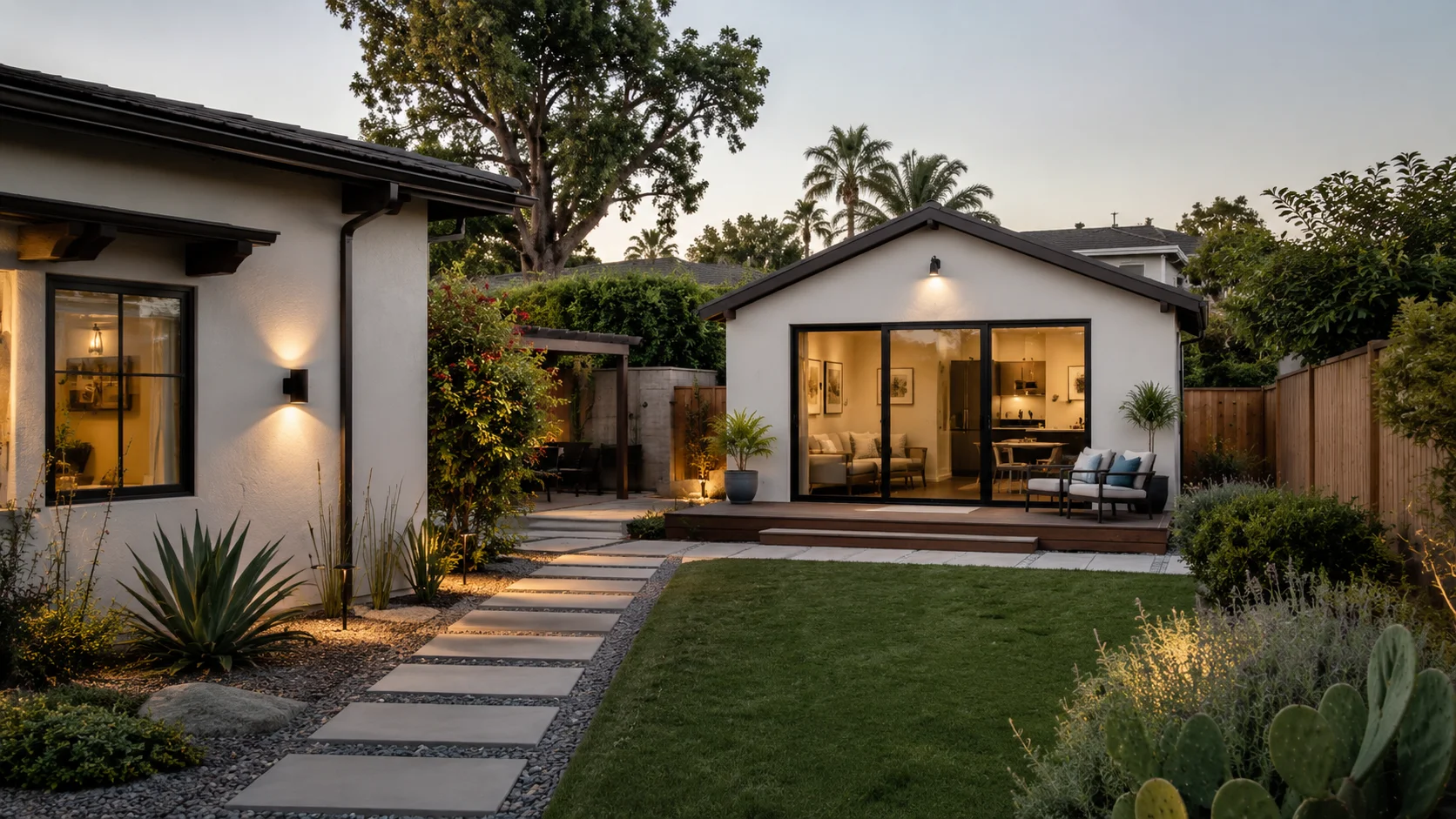
Imperial Beach ADU Cost at a Glance (2026)
| ADU Option | Realistic Planning Budget (2026) | Biggest Cost Risk | Best First Move |
|---|---|---|---|
| JADU / interior conversion (≤500 sq ft) | $75,000 – $175,000 | Code upgrades, kitchen/bath buildout, owner-occupancy rule | Confirm JADU eligibility for your home |
| Garage conversion (400–600 sq ft) | $130,000 – $220,000 | Slab, utilities, fire separation, the 499 sq ft school-fee trigger | Inspect existing garage structure |
| 600 sq ft detached (pre-approved plan path) | $300,000 – $370,000 | Site work, coastal review, utility runs | Check if City's 600 sq ft plan fits your lot |
| 749–750 sq ft detached | $330,000 – $400,000 | Utility/site work, 750 sq ft impact-fee threshold | Verify state vs. city wording on the threshold |
| 800 sq ft detached | $345,000 – $425,000 | Crosses 750 fee threshold; state-protected size | Decide whether 750 or 800 better fits your goals |
| 1,000 sq ft detached | $390,000 – $475,000 | Financing exposure, proportional impact fees | Run rent-vs-financing math |
| 1,200 sq ft detached (max) | $430,000 – $525,000+ | Total budget, coastal/site complexity | Use only if a larger use case justifies cost |
| Coastal-zone adder (if applicable) | +$1,050 City Coastal Permit + possible studies | Jurisdiction surprise (Green/Red/Blue zones) | Run the City's Parcel Viewer before you commission an architect |
Construction-cost ranges synthesized from 2026 San Diego County builder data: SnapADU April 2026 cost benchmarks; ADU Geeks 2025 cost guide; Better Place Design & Build 2026 cost guide; Fabrick Construction 2025 pricing; San Diego Housing Commission ADU Pilot Program. Coastal fee from City of Imperial Beach Coastal Permit Handout (April 15, 2026). Planning estimates, not quotes. Last verified May 18, 2026.
See What’s Possible at Your Address → Get Your Free ADU Report
Free. No login. Returns lot-fit indicator, height envelope, and coastal-zone flag for ZIP 91932 addresses.
Check My Lot →How much does an ADU cost in Imperial Beach in 2026?
Answer capsule: Most Imperial Beach homeowners building a turnkey detached ADU in 2026 should plan for $300,000–$450,000+, with the practical sweet spot — 600 to 750 sq ft — typically running $300,000–$400,000. Garage conversions usually fall $130,000–$220,000, and Junior ADUs (an attached unit ≤500 sq ft created inside the existing house) usually fall $75,000–$175,000. The number that applies to your project depends on size, finish level, site conditions, coastal review, and which fee thresholds you cross.
We built the cost stack from four directions: 2026 San Diego County builder benchmarks (SnapADU, ADU Geeks, Better Place, Fabrick Construction), the City of Imperial Beach’s published permit-fee structure, California ADU statute (Government Code §§66310–66342), and Imperial Beach rental comps from active 2026 listings. Each ADU path below carries different drivers, so the right way to plan is to find the path that matches your lot and goals — then build the budget from line items, not from a single round number.
Detached new construction (the most common ADU path)
A detached ADU is a freestanding unit on the same lot as the primary home — what most people picture when they imagine a backyard cottage. In 2026, San Diego County detached ADUs typically run $375–$600 per square foot all-in (SnapADU’s published April 2026 benchmark for detached new construction in San Diego). The reason the range is so wide: fixed costs like a kitchen, bathroom, mobilization, design, and utility hookups don’t shrink with size. A 400 sq ft studio carries roughly the same fixed-cost block as a 1,000 sq ft two-bedroom, so the per-square-foot price falls as size grows.
SnapADU’s 2026 sample matrix maps to roughly $300,000 for 500 sq ft, $350,000 for 750 sq ft, $425,000 for 1,000 sq ft, and $450,000 for 1,200 sq ft. Imperial Beach often runs modestly above those benchmarks for two reasons: coastal-grade materials carry a small premium for salt-air durability, and Imperial Beach lots are typically tighter than the inland lots most benchmarks come from.
Garage conversion
A garage conversion takes an existing attached or detached garage and converts the interior to a code-compliant living unit with its own entrance, kitchen, and bathroom. Imperial Beach allows conversion ADUs up to 1,200 sq ft, though most garages convert into 400–600 sq ft units. California Government Code §66314 prohibits cities from requiring replacement parking when a garage is converted to an ADU.
The cost ceiling for a garage conversion is significantly lower than a new build because you skip foundation, framing, and roofing — but the floor is higher than people expect. You’re still installing a kitchen, a bathroom, electrical and plumbing rough-in, insulation, fire separation, egress windows, and Title 24 energy-compliant finishes. A garage conversion that lands at $130,000 assumes the existing structure is sound, ceiling height meets the California Residential Code minimum for habitable space (verify with City plan check), the slab is level, and utilities are nearby. A garage that needs a slab replacement, ceiling raise, or major foundation work can easily push past $220,000.
Junior ADU (JADU)
A JADU is an attached unit of up to 500 sq ft created entirely within the existing primary residence’s footprint — typically from a converted bedroom, attached garage area, or basement. It must include an efficiency kitchen but can share a bathroom with the main house. JADUs are the cheapest ADU type because they reuse the main home’s foundation, roof, exterior walls, and most utilities.
Under California Government Code §66333(b), the owner-occupancy requirement applies to a JADU when it shares sanitation facilities with the existing structure — meaning when the JADU and primary home share a bathroom. If the JADU has separate sanitation facilities, owner occupancy is not required. That distinction matters at design time: shared-bath JADUs lock you into living on the property; private-bath JADUs do not. Government Code §66333(g) also requires JADUs to be rented for terms longer than 30 days — short-term rental of a JADU is not permitted under state law.
JADU budgets run $75,000–$175,000 depending on the scope of interior reconfiguration.
Why per-square-foot costs are higher for small ADUs
Counterintuitively, small ADUs cost more per square foot than large ones. SnapADU’s 2026 data shows compact units can hit $500+/sq ft, while 1,000–1,200 sq ft units run closer to $375–$450/sq ft. The arithmetic is simple: a kitchen costs roughly the same to build at 400 sq ft as at 1,000 sq ft. Design fees, permit fees, plan check, the structural engineer, the Title 24 consultant, and project supervision don’t scale down with the building. Spread those fixed costs over fewer square feet and the price per square foot climbs.
The practical implication: if your project goal is to maximize dollars per livable square foot, the 900–1,200 sq ft range usually wins. If your goal is to minimize total project budget, the 499–600 sq ft range usually wins — and the City of Imperial Beach publishes a 600 sq ft pre-approved plan that matches that goal exactly.
See what’s possible at your address → Get your free ADU report in 60 seconds.
Free. No login. Returns lot-fit indicator, height envelope, and coastal-zone flag for ZIP 91932 addresses.
Run the free Imperial Beach lot check →What makes Imperial Beach ADU costs different from inland San Diego?
Answer capsule: Imperial Beach ADU costs diverge from inland San Diego County for three reasons: most of the city sits inside a California Coastal Zone that triggers a $1,050 Coastal Permit and added review time, lot sizes are smaller and tighter than typical inland neighborhoods, and Imperial Beach is served by two school districts — South Bay Union School District (K-6) and Sweetwater Union High School District (7-12) — each with its own current rate that affects ADUs over 499 sq ft.
The Coastal Zone is the single biggest variable
A large portion of Imperial Beach — broadly the blocks west of 13th Street, the Seacoast Drive area, and parts of the bayside near the Bayshore Bikeway — sits inside California’s Coastal Zone overlay. An ADU project that triggers coastal review needs a Coastal Permit before the Building Permit application can be approved, the City’s developer fee is $1,050, and the review takes 30 calendar days from payment (Imperial Beach Coastal Permit Handout, April 15, 2026). Some addresses fall under direct California Coastal Commission jurisdiction rather than the City’s administrative process, which uses a different application path entirely.
Small lots compress the buildable envelope
Imperial Beach was platted on a tight grid. Many single-family lots are smaller than typical San Diego County inland lots. With the City’s 4-foot side and rear setbacks plus the 10-foot building separation requirement, the buildable envelope on a small lot can be surprisingly tight. A 1,200 sq ft detached ADU often won’t fit on a small Imperial Beach lot even though state law allows it; the geometry runs out before the rules do. This is the kind of friction that costs homeowners design fees when discovered late.
The two-district school-fee structure
Imperial Beach is served by South Bay Union School District (elementary, K-6) and Sweetwater Union High School District (grades 7–12). Both districts levy school facilities impact fees on residential construction over 499 sq ft, but each district’s rate and policy is different. Current verified rates appear in the fees section below.
Damaging admission
Imperial Beach is not the city for a casual “$150,000 detached ADU” assumption. If you’re comparing a national prefab starting price to a complete permitted ADU on a coastal San Diego County lot, the low number is almost certainly missing site work, utilities, permits, local review, transportation, installation, or all of the above. The California Construction Cost Index has risen 44% from January 2021 through December 2025 (per SnapADU’s published 2026 analysis citing CCCI data), so older budgets from neighbors who built four years ago aren’t reliable benchmarks either.
The good news: a simple 600–750 sq ft layout, short utility runs, a clear coastal-zone determination upfront, and discipline around fee thresholds can keep the project from drifting into the most expensive path. Most cost overruns on Imperial Beach ADU projects come from discovering the constraints late, not from the constraints themselves.
What city, coastal, school, and impact fees should you budget for?
Answer capsule: Imperial Beach building permit fees are calculated from a Building Valuation Multiplier Table applied to your declared project valuation, with plan-check fees adding 65% on top of the permit fee (City of Imperial Beach Building Permit and Development Impact Fees handout, 2026). Mechanical, electrical, and plumbing fixtures carry flat-rate fees per the Master Fee Schedule. ADUs over 499 sq ft trigger school-fee processing with South Bay Union and Sweetwater school districts. Under California Government Code §66311.5, no development impact fee may be imposed on an ADU of 750 sq ft or less of interior livable space; for larger ADUs, impact fees must be charged proportionally to the primary dwelling.
How Imperial Beach calculates building permit fees
The City uses the standard California valuation-based fee model. You declare a project valuation (the value of labor and materials), the City applies its Building Valuation Multiplier Table, and the result is your base building permit fee. The plan-check fee is then 65% of the permit fee when plans are submitted for review. MEP fixtures (water heaters, gas lines, electrical service panels, plumbing rough-in, HVAC equipment) are billed at flat rates per the City’s Master Fee Schedule.
Below is a worked example using the City’s published valuation-based fee structure. Calculated from the City fee schedule; verify with the City’s online estimator because the City notes estimates depend on permit type, square footage, valuation, and MEP entries.
| Declared Project Valuation | Est. Building Permit Fee | Plan Check (65%) | Subtotal | What’s Not Included |
|---|---|---|---|---|
| $300,000 | ~$5,255 | ~$3,416 | ~$8,671 | MEP, state/SMIP/archive, coastal, school, impact, utility capacity |
| $350,000 | ~$5,995 | ~$3,897 | ~$9,892 | Same exclusions |
| $425,000 | ~$7,105 | ~$4,618 | ~$11,723 | Same exclusions |
| $500,000 | ~$8,215 | ~$5,340 | ~$13,555 | Same exclusions |
Estimates calculated from the City of Imperial Beach Building Permit and Development Impact Fees handout (2026 Master Fee Schedule valuation methodology). Always verify with the City’s online estimator before relying on these numbers for a budget.
Plan check is the fee homeowners forget
A common surprise in Imperial Beach permit bills is plan check. Homeowners hear “permit fee” and assume one number; they discover at submittal that plan check adds another 65% on top. On a $400,000 valuation project, that’s roughly an additional $4,500 due at plan submittal — separate from the permit fee, separate from impact fees, separate from utility hookups, and separate from coastal review. Budget for plan check as its own line item.
What are the current school impact fee rates for Imperial Beach ADUs?
Both districts that serve Imperial Beach publish current per-square-foot residential rates. Imperial Beach’s School Impact Fee Handout requires the school-fee process for residential additions and ADUs over 499 sq ft, including garage conversions over 499 sq ft. The form must be completed and signed off before Building Division staff can invoice the rest of the permit fees.
| District | Current Per-Sq-Ft Rate | Notes | Contact |
|---|---|---|---|
| South Bay Union School District (K-6) | $2.27/sq ft | District policy states school fees are not required for ADUs less than 750 sq ft | (619) 628-1600 · developerfee@sbusd.org · zpina@sbusd.org |
| Sweetwater Union High School District (7-12) | $2.90/sq ft current; $3.01/sq ft eff. June 22, 2026 | Rate update scheduled mid-2026 | (619) 585-6081 · developer.fees@sweetwaterschools.org |
Source: City of Imperial Beach School Impact Fee Handout; South Bay Union School District developer fee page; Sweetwater Union High School District Finance Department developer fee page. Last verified May 18, 2026. Sweetwater rate increases to $3.01/sq ft on June 22, 2026 — projects with permits issued after that date will pay the higher rate.
Worked example, 600 sq ft ADU:
- South Bay Union: $0 (under 750 sq ft policy threshold)
- Sweetwater Union HS: 600 × $2.90 = $1,740 (current); 600 × $3.01 = $1,806 (after June 22, 2026)
Worked example, 800 sq ft ADU:
- South Bay Union: 800 × $2.27 = $1,816 (over 750 sq ft policy threshold per current SBUSD guidance)
- Sweetwater Union HS: 800 × $2.90 = $2,320 (current)
- Combined: ~$4,136 at current rates
The South Bay Union “less than 750 sq ft” exemption is district policy and should be confirmed in writing for any 749–750 sq ft project before final design.
The 750 sq ft impact-fee cliff
California Government Code §66311.5 prohibits any local agency from charging development impact fees on an ADU with 750 square feet or less of interior livable space. For ADUs over 750 sq ft, impact fees must be charged proportionally to the size of the primary dwelling — not at the full single-family rate.
The City of Imperial Beach’s permit-fee handout uses slightly different wording (“less than 750”), which creates ambiguity for a 750.0 sq ft project. State law is the controlling authority (§66311.5 says “750 square feet or less”), but if your design lands right at the line, get the City Building Division to confirm the threshold interpretation in writing before plan submittal. A one-square-foot design choice should not become a several-thousand-dollar fee discovery.
Strong Motion Instrumentation Program (SMIP) and other state fees
- SMIP fee. California requires a Strong Motion Instrumentation Program assessment on residential construction. The Imperial Beach handout calculates the residential SMIP fee as valuation × 0.00013. On a $400,000 project, that’s $52.
- State Archive fee. Small flat fee.
- MEP flat fees. Per the City’s Master Fee Schedule, individual fixtures carry flat per-fixture charges. Expect $400–$1,200 in combined MEP fees for a typical ADU.
- Title 24 / energy report. Required for all habitable buildings. Industry-typical cost: $800–$1,500.
- Stormwater management plan. Imperial Beach’s coastal proximity makes stormwater review more rigorous than inland cities. Industry-typical cost: $500–$2,000.
Utility connection costs
Imperial Beach is served by California American Water for water in much of the city and the City of Imperial Beach wastewater system for sewer. If your ADU needs a new water meter or an upsized meter, the San Diego County Water Authority (SDCWA) charges a separate capacity fee.
SDCWA 2026 capacity charges (combined System Capacity + Water Treatment Capacity):
- Less than 1-inch meter: $6,501 + $182 = $6,683
- 1-inch meter: $10,402 + $291 = $10,693
Most ADUs that share the existing primary-home water meter avoid the SDCWA capacity fee entirely, because Government Code §66311.5 provides that an ADU or JADU is not considered a new residential use for utility-connection-or-capacity-charge purposes (with specific exceptions). Verify with California American Water and the City wastewater division for your specific address.
Total utility hookup budget typically runs $5,000–$30,000 depending on whether you share the existing meter, need a new meter, need to upsize the main electrical service panel ($3,500–$8,000 industry typical), or have to trench a long utility lateral to the back of the lot.
What we still flag for verification on this section
| Item | Status | How to verify |
|---|---|---|
| IB's interpretation of '750 sq ft or less' (state) vs. 'less than 750' (city handout) | Conflict between sources | Get written confirmation from IB Building Division |
| South Bay Union 'less than 750 sq ft exemption' for a 750.0 sq ft project | Policy ambiguity at the line | Email developerfee@sbusd.org with project details |
| Online estimator output at your specific declared valuation | Project-specific | City of Imperial Beach permitting portal |
| Whether your project triggers required public improvements | Project-specific | City Engineering Division |
Not sure which fees and thresholds apply to your specific lot?
Check your address in 60 seconds — we’ll flag coastal-zone status, lot-fit, and the fee thresholds your project crosses.
Check your address in 60 seconds →Will the Coastal Zone change your ADU cost or timeline?
Answer capsule: Yes, often. ADUs in the Imperial Beach Coastal Zone require a Coastal Permit approved before the Building Permit application can be approved (concurrent processing is available). The City’s published 2026 developer fee for an ADU Coastal Permit is $1,050, the review takes 30 calendar days from payment, and additional fees may apply if multiple reviews or tasks are required (Imperial Beach Coastal Permit Handout, last updated April 15, 2026). Some parcels fall under direct California Coastal Commission jurisdiction rather than the City’s administrative process, which uses a different application path entirely.
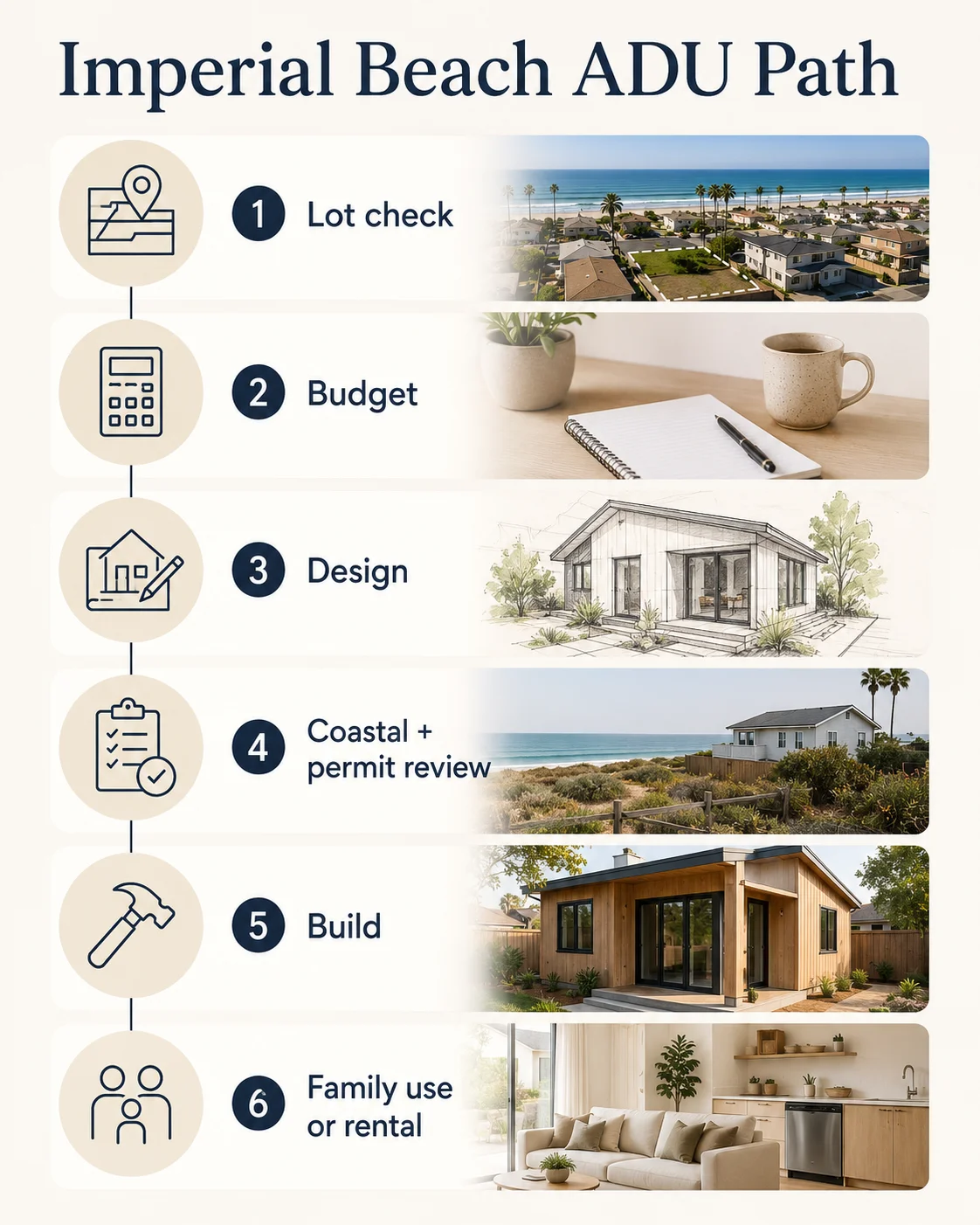
What types of ADUs trigger a Coastal Permit
Per the City’s April 2026 handout, four ADU project types trigger coastal review if the property is in the Coastal Zone:
- New construction attached ADU
- New construction detached ADU
- Conversion of existing permitted uninhabitable space (garage, storage, patio cover) into an ADU
- Conversion of a garage to a JADU
Interior conversions inside the primary residence (most non-garage JADUs) generally do not trigger coastal review.
How to determine if your property is in the Coastal Zone
The City directs applicants to the Imperial Beach Parcel Viewer (imperialbeachca.mapgeo.io/datasets/public-access). Toggle the “Coastal Zone Jurisdiction” theme. The Parcel Viewer color-codes parcels:
- Green Zone → Administrative Coastal Permit processed through the City of Imperial Beach.
- Red Zone → Administrative Coastal Permit processed through the City of Imperial Beach. Per the City handout, the California Coastal Commission can appeal the City’s decision on a project; however, see the source conflict note below.
- Blue Zone → California Coastal Commission jurisdiction. The Coastal Permit is applied for through the Coastal Commission itself, not the City.
Search by your project address or Assessor’s Parcel Number (APN) in the Parcel Viewer’s top-right search bar.
Source conflict to be aware of: Red Zone appealability for ADU coastal permits
The City’s April 2026 handout states that Coastal Commission appeal is possible for Red Zone projects. Current California Government Code §66329(c) states that local-government ADU coastal-development-permit decisions issued under §66329(a) are not subject to appeal under Public Resources Code §30603. This is a real conflict between the City’s handout and the statute as it applies specifically to ADU coastal permits.
Confirm appeal status at intake with the City Planning Division before you make decisions based on appeal exposure. Surface this with City staff in writing; do not assume one source or the other is settled until you have confirmation specific to your project.
Coastal-zone cost and timeline implications
| Parcel Status | What It Means | Budget Implication |
|---|---|---|
| Not in Coastal Zone | No ADU coastal permit triggered | Standard building/zoning review only |
| Green Zone | Administrative Coastal Permit through City | Add $1,050 Coastal Permit fee + ~4–6 weeks review |
| Red Zone | City processes; appeal exposure conflicted (see above) | Add $1,050; confirm appeal status at intake |
| Blue Zone | Coastal Commission jurisdiction | Different application process; verify directly with Coastal Commission; additional fees may apply |
| Oceanfront / sensitive condition | Additional studies may be required | Add contingency for biology, geology, or visual-resource studies |
The $1,050 vs. $1,000 fee discrepancy (and what to do about it)
Our research surfaced two slightly different ADU coastal fee figures across City documents. The April 2026 ADU-specific Coastal Permit Handout lists $1,050 as the developer fee. The City’s earlier Coastal Development Permit Submittal Checklist lists $1,000 for ADU administrative coastal approval. We’re using $1,050 as the current planning number because it appears in the more recent April 2026 ADU-specific handout. Confirm the final fee at intake — both are City documents, but the fee schedule may have updated between publications.
Concurrent processing
The City allows concurrent processing of the Coastal Permit application and the Planning/Building applications. That means you can run the Coastal Permit review in parallel with plan check rather than sequentially. The Coastal Permit approval must still issue before the Building Permit is issued. To use concurrent processing, contact City staff to coordinate timing. The City lists Arturo Ortuno at (619) 628-0858 and Ryan Pua at (619) 628-1356 as the planning contacts on the coastal handout.
What a coastal application requires
- Plans: site plan, landscaping plan, existing floor plan, proposed floor plan, exterior building elevations, roof plan
- Grant deed (from San Diego County Assessor’s office or owner records)
- Preliminary Title Report (from a title company, dated within 90 days)
- Completed Discretionary Permit Application Package
- Public Notice Package drop-off (in person, Monday–Thursday, 7:30–9:00 AM and 3:30–5:00 PM)
The 90-day Preliminary Title Report requirement is the surprise. If your title report is more than 90 days old at submittal, the application will be rejected and you’ll need to pay your title company to re-issue it.
Damaging admission on coastal review
The Coastal Permit fee itself isn’t what bites your budget — $1,050 is a rounding error against a $400,000 project. What bites is what coastal review reveals: setback conflicts on small lots, drainage requirements that didn’t show up in your initial plot plan, public-view analysis on parcels with ocean or bay sightlines, or — worst — discovering at intake that your parcel is in the Blue Zone (Coastal Commission jurisdiction) rather than the Green Zone. The fix is to run the Parcel Viewer check before you commission an architect or pay design retainer. A 15-minute check on the City’s free Parcel Viewer can save thousands in misdirected design work.
Check your coastal-zone status now — free, 60 seconds.
We’ll flag whether your address is in the Green, Red, or Blue zone and surface the next step before you spend money on plans.
Run the Imperial Beach lot check →How many ADUs can I build on my Imperial Beach lot?
Answer capsule: Imperial Beach allows different ADU combinations by zone. On single-family R-1-6000 and R-1-3800 lots, you can build one detached ADU, one attached or conversion ADU, and one JADU. On duplex/two-family zones, you can build one detached and one attached or conversion ADU. On existing multifamily lots, recent state law allows up to eight detached ADUs capped by the number of existing units, plus at least one and up to 25% internal ADUs from non-livable space.
| Lot/Zone Type | Detached ADU | Attached or Conversion ADU | JADU | Notes |
|---|---|---|---|---|
| R-1-6000 single-family | 1 | 1 | 1 | Maximum stack on a typical single-family lot |
| R-1-3800 single-family | 1 | 1 | 1 | Same allowance, tighter geometry |
| Two-family / duplex zone | 1 | 1 | — | No JADU listed for duplex lots |
| Existing multifamily | Up to 8 (capped by existing unit count) | Conversion of non-livable space, up to 25% of existing units (min 1) | — | Under SB 1211 (effective January 2025) |
| Two single-family homes on one lot | 1 ADU + 1 JADU only | — | 1 | Two SFRs on a lot do not count as multifamily |
Source: City of Imperial Beach Accessory Dwelling Units page; SnapADU Imperial Beach Regulations summary (April 2026); SB 1211 (effective January 2025). Last verified May 18, 2026.
This is the dataset most homeowners get wrong. If you have a duplex on a single lot, you have far more ADU upside than a typical single-family neighbor. If you have two single-family homes on one lot, you do not get the multifamily allowance — the City has confirmed this directly to local builders. Verify your zoning with the City Planning Division before commissioning a multi-unit project.
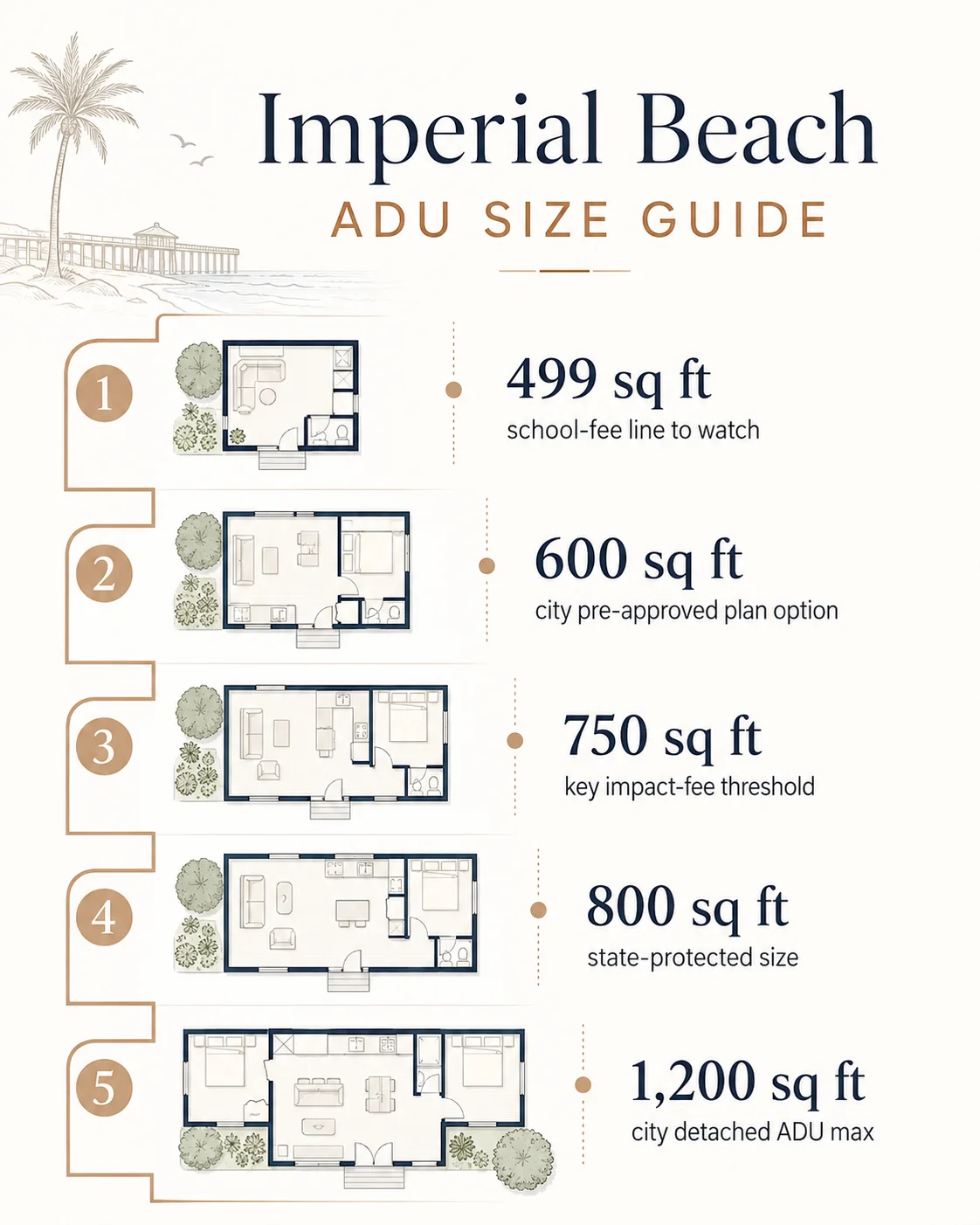
Should you build 499, 600, 750, 800, 1,000, or 1,200 sq ft?
Answer capsule: The best Imperial Beach ADU size isn’t always the largest size allowed. Each size on the spectrum carries different fee, design, and rental implications. A 499 sq ft unit avoids school-fee processing entirely. A 600 sq ft unit fits the City’s pre-approved plan path. A 749–750 sq ft unit captures the full state impact-fee exemption under Government Code §66311.5. An 800 sq ft unit has the strongest state-law design protection under Government Code §66321. A 1,000–1,200 sq ft unit usually delivers the best rental return if the lot, budget, and use case justify it.
499 sq ft — the school-fee-minimizer
Best for: Homeowners who want to keep the project tight, avoid school-impact-fee processing entirely, and build a studio or compact one-bedroom. Watch for: Fixed costs are still high; per-sq-ft cost may exceed $500. Layout discipline matters more here than at any other size.
At 499 sq ft, you stay under Imperial Beach’s school-fee processing threshold and avoid that line item entirely. Combined Sweetwater + South Bay savings at the line: typically $1,000–$3,000 depending on which districts apply.
600 sq ft — the pre-approved-plan size
Best for: Homeowners who want to use the City’s published 600 sq ft Pre-Approved ADU Plan path, which is faster to permit. Watch for: You’re past the 499 school-fee threshold, so Sweetwater school fees apply. Still well under the 750 sq ft impact-fee threshold.
Imperial Beach has published a 600 sq ft Pre-Approved ADU Plan set and an accompanying Pre-Approved ADU Plan Checklist Guidance document under California AB 1332 (Wicks, 2023), which requires every local agency to offer a pre-approved-plan program by January 1, 2025.
749–750 sq ft — the impact-fee threshold
Best for: Homeowners who want a generous one-bedroom or compact two-bedroom layout while still capturing California’s impact-fee exemption under Government Code §66311.5. Watch for: Confirm Imperial Beach’s interpretation of the threshold (state law says “750 sq ft or less,” city handout uses “less than 750”) in writing before final design.
This is the size sweet spot for most rental ADUs. You get enough livable area for a real one-bedroom or two-bedroom-lite layout, you stay under the state impact-fee cap, and SnapADU’s 2026 benchmark puts the all-in cost at roughly $350,000.
800 sq ft — the state-protected size
Best for: Homeowners who want maximum design flexibility under California law. Watch for: You’re over the 750 impact-fee threshold, so proportional impact fees apply.
California Government Code §66321(b)(3) provides that a local agency cannot impose objective standards that prevent the construction of an ADU of at least 800 sq ft with 4-foot side and rear setbacks. Government Code §66323(a)(2) separately requires ministerial approval of one detached new-construction ADU on a single-family lot, with a local agency permitted to limit that detached unit to not more than 800 sq ft. Together, these provisions effectively floor every California single-family lot at 800 sq ft of ADU rights.
1,000 sq ft — the rental-return sweet spot
Best for: Homeowners building primarily for rental income who can afford the higher total budget. Watch for: Financing exposure grows fast. A $425,000 all-in project requires substantially more equity, cash, or debt capacity than a $350,000 one.
A 1,000 sq ft two-bedroom ADU typically commands the strongest rent-per-unit return in Imperial Beach. SnapADU’s 2026 benchmark for 1,000 sq ft is approximately $425,000.
1,200 sq ft — the maximum allowed in Imperial Beach
Best for: Larger family housing, aging-parent layouts, or rental projects where the higher rent fully justifies the higher cost. Watch for: Highest total budget, highest financing exposure, most likely to run into lot-geometry problems on small Imperial Beach parcels.
Imperial Beach allows detached ADUs up to 1,200 sq ft per local rules. On a small lot with the 4-foot setbacks and 10-foot building separation, fitting 1,200 sq ft of ADU is geometrically difficult on the tightest Imperial Beach parcels.
A note on attached ADUs
Per the City’s Accessory Dwelling Units page, Imperial Beach allows new construction attached ADUs at 50% of the main residence or up to 800 sq ft. State law also provides a minimum size floor for attached ADUs under Government Code §66321 that overrides more restrictive local limits. Attached units share a wall with the primary home, which saves on framing, roofing, and one exterior wall — but they typically cost more than garage conversions because they require new foundation, new MEP runs, and full code-compliant separation. Plan attached ADUs in the $300–$450 per sq ft range.
Can Imperial Beach’s pre-approved 600 sq ft ADU plan save money?
Answer capsule: Yes — though it’s best understood as a design and plan-review simplification, not a guaranteed cheap ADU. The City of Imperial Beach has published a 600 sq ft Pre-Approved ADU Plan under California AB 1332 (effective January 1, 2025). AB 1332 requires local agencies to approve or deny complete detached-ADU applications using pre-approved plans within 30 days. The plan does not eliminate site work, foundation adaptation, utility hookups, permit fees, school fees, or coastal review.
What AB 1332 required and what Imperial Beach delivered
AB 1332 (Wicks, 2023) required every California local agency to develop a pre-approved ADU plan program by January 1, 2025. Imperial Beach has complied: the City publishes its 600 sq ft Pre-Approved ADU Plan and a Pre-Approved ADU Plan Checklist Guidance document on the Building Division Forms page. The point of contact is Ryan Pua at (619) 628-1356 (rpua@imperialbeachca.gov).
What the pre-approved plan path can help with
- Reducing custom design cost. The architectural plan set is already drawn. Industry-typical custom ADU architectural fees run $8,000–$15,000; the pre-approved plan reduces or eliminates that line item, though site adaptation, foundation engineering, and Title 24 work still cost something.
- Shortening plan-review time. Because the City has already reviewed the structural, energy, and code elements of the plan set, the plan-check phase compresses meaningfully. AB 1332 codifies a 30-day review window for complete applications using pre-approved plans.
- De-risking design decisions. You know the plan is code-compliant. You know the City will accept it.
- Apples-to-apples builder comparison. When multiple builders bid on the same pre-approved plan, you can compare quotes against an identical scope.
What the pre-approved plan path does NOT eliminate
- Site adaptation. Every site is different. Budget $3,000–$8,000 in industry-typical site adaptation engineering.
- Foundation. The plan provides the building footprint; the foundation engineering is still site-specific.
- Title 24 / energy report. Still required.
- Coastal review. If your parcel is in the Coastal Zone, the Coastal Permit is still required.
- School-fee processing. A 600 sq ft pre-approved-plan ADU is over the 499 sq ft trigger, so Sweetwater school fees still apply.
- Permit and plan-check fees. Still due. Pre-approved status reduces review time, not fee amount.
- Builder cost. The plan is free. Building the building isn’t.
When the pre-approved plan is the right call
The pre-approved plan path makes sense when (a) your project goals fit a 600 sq ft envelope, (b) your lot is straightforward (flat, utilities nearby, no major coastal complications), and (c) you value time and predictability over custom design. It does not make sense when (a) you want a larger ADU, (b) your lot has unusual constraints, or (c) your goal is maximum rental return — in which case a 900–1,000 sq ft two-bedroom usually outperforms a 600 sq ft one-bedroom.
See whether the City’s 600 sq ft pre-approved plan fits your lot.
Free lot check — no login required.
Run the free lot check →How long does an Imperial Beach ADU permit take?
Answer capsule: Standard non-coastal ADU permits in Imperial Beach take 4–6 months from application to permit issuance under typical workloads. Coastal-zone ADUs add the Coastal Permit step (30 calendar days from payment per the City handout). California Government Code §66317 requires the permitting agency to make a written complete/incomplete determination within 15 business days — if it doesn’t, the application is deemed complete. The agency must approve or deny a complete ADU application within 60 days; if it doesn’t, the application is deemed approved. Construction itself typically runs 5–9 months for a detached new build, 3–5 months for a garage conversion, and 2–4 months for a JADU.
The full Imperial Beach ADU project timeline
| Phase | Typical Duration | What Happens |
|---|---|---|
| Feasibility & intake | 2–4 weeks | Lot survey review, design concepts, fee estimates, coastal-zone determination |
| Architectural & engineering plans | 6–10 weeks | Construction drawings, structural, MEP, Title 24 energy report |
| Coastal Permit application (if applicable) | 30 calendar days from payment (concurrent processing available) | Submitted before or alongside Building Permit application |
| First plan-check submittal | 4–6 weeks | City reviews; comments returned |
| Plan revisions & resubmittal | 2–4 weeks | Architect addresses corrections |
| Permit issuance | 1–2 weeks | Final fees paid, permit issued |
| Pre-construction total | ~4–6 months (non-coastal), 5–8 months (coastal) | |
| Construction (detached new build) | 5–9 months | Foundation, framing, MEP rough-in, finish, final |
| Construction (garage conversion) | 3–5 months | Slab repair, framing, finish |
| Construction (JADU) | 2–4 months | Interior reconfiguration, MEP, finish |
| Final inspection & Certificate of Occupancy | 1–2 weeks | All inspections cleared |
The 60-day state clock — and the 15-day completeness clock
California Government Code §66317 has two clocks that matter for homeowners:
- The 15-business-day completeness clock. The City must make a written determination of completeness or incompleteness within 15 business days of submittal. If the City does not make that determination, the application is deemed complete by operation of law.
- The 60-day decision clock. The City must approve or deny a complete ADU application within 60 days of completeness. If the City does not act, the application is deemed approved.
The practical implication: if your application is languishing past these statutory windows from a complete submittal, you have leverage. Document the submittal date, the City’s completeness determination (or absence of one), and the elapsed time. Most ADU applicants never have to invoke these statutory protections — but they exist as the homeowner’s defense against indefinite delay.
Can an Imperial Beach ADU pay for itself as a rental?
Answer capsule: Possibly, but rental return depends heavily on size, finish, location within Imperial Beach (proximity to the sand earns a premium), and conservative-vs-optimistic rent assumptions. These are illustrative examples, not guarantees of returns. Actual results depend on local market conditions, construction costs, financing terms, and regulatory approvals.
Imperial Beach rental comps (May 2026)
| Source | Studio | 1-Bed | 2-Bed | 3-Bed |
|---|---|---|---|---|
| Apartments.com avg (citywide, all rental types) | ~$1,575 | ~$1,646 | ~$2,040 | ~$2,816 |
| Active Zillow/Redfin/Homes.com (single-family & detached, May 2026) | $1,800–$2,400 | $2,100–$2,800 | $2,800–$3,500 | $3,400–$4,200 |
| Furnished mid-term (30+ days, west of Palm Ave) | $2,400–$3,200 | $2,800–$3,800 | $3,800–$5,200 | $4,500–$6,500 |
Sources: Apartments.com Imperial Beach Rent Market Trends (May 2026 snapshot); active 2026 listings on Zillow, Redfin, and Homes.com for ZIP 91932 (May 2026). Detached ADU rents typically pace the single-family-comp range, not the apartment-complex average. Furnished mid-term rentals require additional management. Last verified May 18, 2026. These are illustrative for planning, not guarantees of rental income.
The 5-year payback math, conservatively
Take a mid-range scenario: an 800 sq ft detached ADU all-in at $400,000, leased long-term at $2,750/month ($33,000/year gross) — within the active-listing range for two-bedroom units in Imperial Beach. After typical operating costs (property tax adjustment from the assessment uplift, landlord insurance, maintenance reserve, vacancy allowance, and minor management) assume 7% of gross in operating cost. Net annual cash before financing: roughly $30,690. Five-year cumulative net cash before financing: roughly $153,450. Simple cash-on-cash payback ignoring financing and appreciation: roughly 13 years.
These are illustrative examples, not guarantees of returns. Actual results depend on local market conditions, construction costs, financing terms, and regulatory approvals.
Three factors usually move the math:
- Financing. If you finance the build with a HELOC or construction-to-perm loan, rental income offsets part or all of the monthly debt service depending on loan terms, taxes, vacancy, insurance, and actual rent. Verify current loan products and terms with a licensed lender.
- Property value uplift. A permitted, code-compliant ADU generally adds value to a single-family home, though the percentage uplift varies widely by market. Treat any value-uplift number you’ve read elsewhere with appropriate skepticism and run your own appraisal scenario with a licensed appraiser if value uplift is a major reason you’re building.
- Rent growth. Imperial Beach rents have shown modest growth over recent years; even a 2–3% annual growth assumption changes the 5-year math meaningfully.
- Tax position. Rental income is taxable, but depreciation, mortgage interest deductions, and operating-expense deductions can substantially reduce the taxable income from an ADU rental. Consult a CPA before underwriting the after-tax case.
Do not lead with Airbnb income
California’s ADU statute allows local agencies to require ADU rental terms of 30 days or longer (Government Code §66315). JADU rentals must be for terms longer than 30 days under Government Code §66333(g) — short-term JADU rental is barred by state law. Imperial Beach’s current short-term-rental policy should be verified directly with the City before assuming nightly-rental income. Treat any short-term-rental upside as bonus, not as the underwriting case.
The Dwelling Index may earn a commission when readers use this link.
Building for rental? Once your Imperial Beach ADU is leased, day-to-day landlord operations — tenant screening, rent collection, maintenance tickets, accounting — become the next problem. Buildium is the property-management platform we recommend for one-to-fifty-unit landlords. Approved Dwelling Index partner.
Financing an Imperial Beach ADU: the four real paths
Answer capsule: Most Imperial Beach ADU projects are funded by one of four paths: a cash-out refinance of the primary mortgage (best when current rate is high and equity is large), a HELOC (best when current first-mortgage rate is low and equity is moderate), a construction-to-permanent loan (best for new builds where the ADU’s future appraised value can be underwritten), or a renovation loan like Fannie Mae HomeStyle or FHA 203(k) (best when the ADU is part of a broader main-home remodel). Each path carries different costs, qualification standards, and timing. Rates, APRs, and product availability change frequently — verify current terms with a licensed lender before committing.
Path 1: Cash-out refinance
A cash-out refinance replaces your current primary mortgage with a new larger one, with the difference paid to you in cash to fund the ADU. Best when (a) your current mortgage rate is higher than current market rates, so you’d want to refinance anyway, and (b) you have substantial home equity. The downsides: closing costs (industry-typical 2–5% of the new loan amount), resetting your amortization clock, and the new payment may be materially higher.
Path 2: HELOC (Home Equity Line of Credit)
A HELOC adds a second-lien line of credit against your home equity without disturbing your first mortgage. Best when (a) your current first-mortgage rate is low and you don’t want to refinance it, (b) you have meaningful equity, and (c) you want flexibility to draw funds as the project needs them. Downsides: HELOC rates are typically variable, draw periods have time limits, and rates can swing during construction.
Path 3: Construction-to-permanent loan
A construction-to-permanent (CTP) loan funds the build in stages and converts to a permanent mortgage at completion. Best when (a) you don’t have enough current equity for a full cash-out refi or HELOC, (b) the ADU’s future appraised value can be underwritten into the loan, and (c) you want one closing rather than two. Downsides: more underwriting work, draw schedules tied to construction milestones, and ADU-as-collateral provisions vary by lender.
Path 4: Renovation loan (HomeStyle, 203(k))
Fannie Mae HomeStyle and FHA 203(k) renovation loans bundle the home purchase or refinance with the renovation cost into a single mortgage. Best when (a) the ADU is part of a broader main-home remodel, (b) you’re buying a property and adding the ADU during purchase, or (c) you qualify for FHA terms and want lower down-payment requirements. Downsides: strict draw schedules, eligible-improvements lists, and contractor approval requirements.
Financing path decision matrix
| Path | Best For | Typical Use | Watch Out For |
|---|---|---|---|
| Cash-out refinance | High equity, current rate higher than market | Detached new build | Resetting your loan clock; closing costs |
| HELOC | Low first-mortgage rate, moderate equity | Garage conversion, smaller detached | Variable rate; draw period limits |
| Construction-to-perm loan | New detached ADU, want one closing | Detached new build | More underwriting; ADU-as-collateral nuances |
| Renovation loan (HomeStyle, 203(k)) | Combining ADU with primary home remodel | Attached ADU; conversion | Strict draw schedules; eligible improvements list |
Editorial framework by The Dwelling Index. This is path education, not a lender ranking. Specific rates, APRs, and qualification standards vary by lender, credit profile, and current market conditions.
Which path tends to fit which Imperial Beach budget
- $75,000–$220,000 (JADU, garage conversion): A HELOC is often the cleanest fit if you have a first-mortgage rate you want to preserve. A renovation loan can also work, especially if the JADU is part of a broader main-home remodel.
- $300,000–$400,000 (600–750 sq ft detached): Cash-out refinance if your current rate is above current market rates; HELOC + small construction loan combination if your current first-mortgage rate is low; construction-to-perm loan if you want one closing.
- $425,000+ (1,000–1,200 sq ft detached): Construction-to-permanent loan most often fits, because the after-build appraised value can be underwritten. Cash-out refi works only with substantial existing equity.
CalHFA ADU Grant — current status
The California Housing Finance Agency ADU Grant Program historically provided up to $40,000 in reimbursable predevelopment funding. Per CalHFA’s official ADU Grant page, the latest round of ADU funding was fully allocated as of December 28, 2023. Do not assume availability unless CalHFA posts a new update. While CalHFA is unavailable, Imperial Beach homeowners are paying for ADUs using combinations of the four paths above — most often a HELOC for design and predevelopment, combined with a construction or cash-out loan for the vertical build.
The Dwelling Index may earn a commission when readers use this link.
Want to compare your real financing options? Mortgage Research Center publishes side-by-side ADU and renovation financing path education with current product features. We point homeowners there when they ask “what loan type fits my situation.”
Explore financing path options →Mortgage Research Center — approved Dwelling Index partner. Path education resource.
How to cut Imperial Beach ADU cost without creating a bad ADU
Answer capsule: The three highest-leverage cost reductions for Imperial Beach are using the City’s 600 sq ft Pre-Approved Plan path, converting an existing garage rather than building detached, and planning your size around the 499 and 750 sq ft fee thresholds. The four cost-cuts that don’t work are choosing the cheapest builder bid, shrinking below 400 sq ft, DIY permitting, and skipping the structural engineer.
Good cost cuts
- Simple rectangular plan. Curves, angles, and complex rooflines add cost without adding livable area.
- One-story detached unit. Two-story ADUs add stair runs, additional structural engineering, and complex flashing details.
- Compact wet wall. Stack the kitchen sink, bathroom sink, toilet, shower, and washer/dryer along a single wall when possible.
- Short utility runs. Site the ADU close to existing water, sewer, gas, and electrical service. Every 10 feet of trenching adds material cost and labor.
- Pre-approved 600 sq ft plan if it fits. Big design savings, real plan-check time savings (AB 1332’s 30-day window for complete pre-approved applications).
- 749–750 sq ft target if fee thresholds matter most. Maximum livable area under the §66311.5 impact-fee cap.
- Apples-to-apples builder comparison. Get every bidder pricing the same plan with the same exclusion list.
- 10%–15% contingency. The San Diego Housing Commission’s documented ADU Pilot Program recommended a 20% contingency reserve. 15% is the working minimum; 20% is the realistic number for a coastal project.
Bad cost cuts
- Designing before checking Coastal Zone status. Discovering coastal jurisdiction late wastes design fees and time.
- Choosing a prefab price without site-work math. The prefab module is half the project. Site work, foundation, utilities, installation, and permits are the other half.
- Skipping utility verification. Discovering mid-project that your sewer lateral needs full replacement adds thousands.
- Ignoring school/impact-fee thresholds. Building at 510 sq ft when 499 sq ft would have served the use case is a self-inflicted school-fee bill.
- Assuming rent will cover financing without a conservative model. Build your own conservative case.
- Comparing builders with different exclusion lists. The lowest number isn’t always the lowest cost.
- Picking the lowest bid. Builders who quote materially below the market typically recover the difference through change orders mid-project.
- DIY permitting. Imperial Beach’s plan-check process is geared toward licensed design professionals.
What should every Imperial Beach ADU quote include?
Answer capsule: A complete Imperial Beach ADU quote should explicitly address design, engineering, Title 24, site work, utility trenching, sewer/water connection, electrical panel assumptions, permit and plan-check handling, coastal-permit assumptions, school-fee assumptions, finish level, contingency, and what is excluded. The single most important section of any builder quote is the exclusion list — that’s where the surprise change orders live.
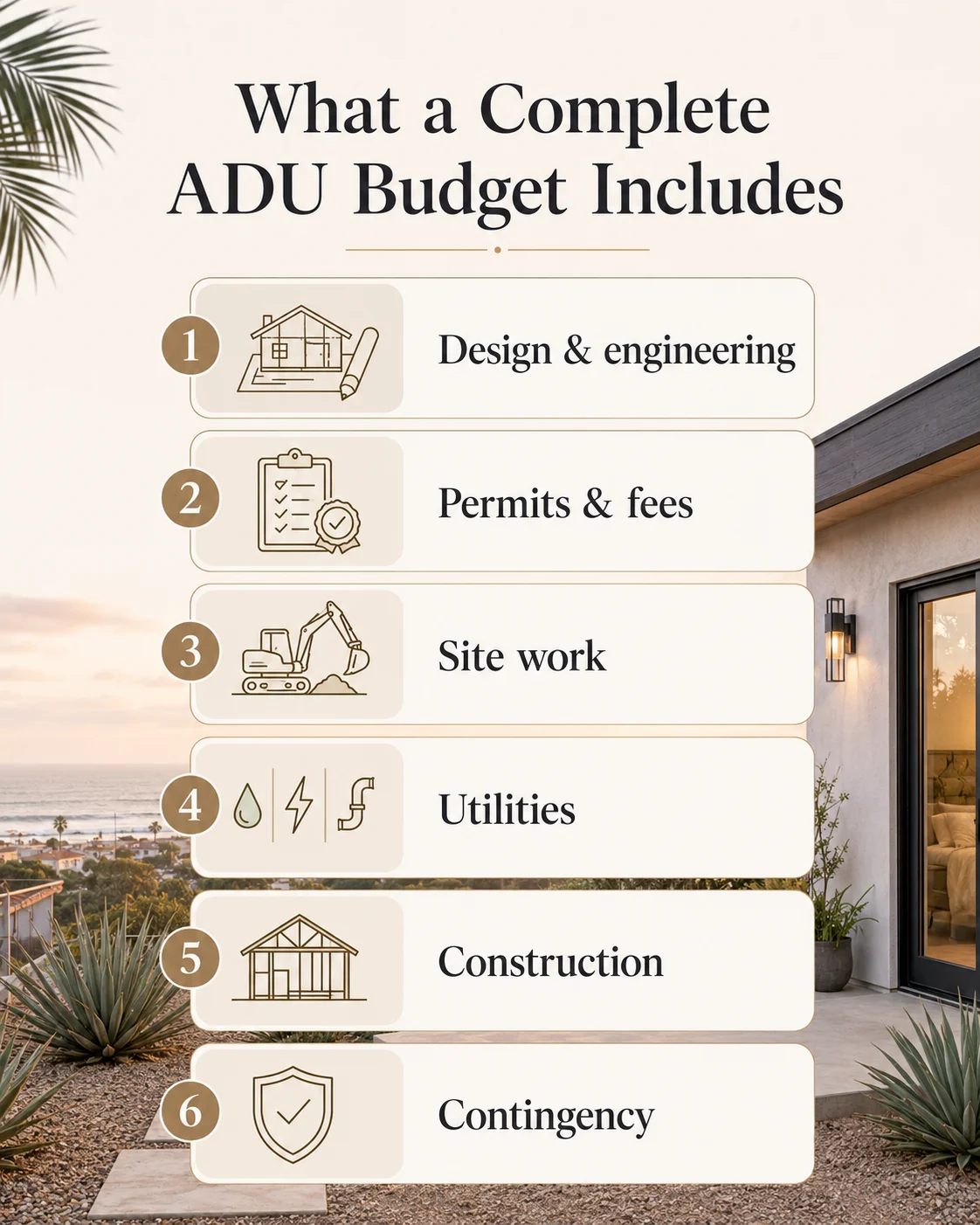
Quote completeness checklist
When you receive an Imperial Beach ADU quote, every item below should be either included or explicitly excluded with an estimate. If a line item is missing, ask:
Design and engineering
- Architectural design and construction drawings
- Structural engineering
- Title 24 energy compliance report
- Site plan / plot plan
- Survey or property line verification
- Soils / geotechnical report if needed
Site and foundation
- Site clearing, grading, and demolition
- Foundation type and depth assumption
- Drainage and stormwater management plan
Building shell
- Framing / module set (for prefab)
- Roofing
- Siding, windows, doors
- Insulation per Title 24
Mechanical, electrical, plumbing
- HVAC system (typically a mini-split for ADUs)
- Electrical rough-in and finish
- Plumbing rough-in and finish
- Water heater (tankless typical)
- Fire sprinkler assumption
Connection and infrastructure
- Electrical panel upgrade assumption
- Water connection (new meter or shared?)
- Sewer connection (lateral length assumption)
- Trenching distance from main house to ADU
- Gas connection if applicable
Permits and fees
- Building permit and plan-check fee handling
- Coastal Permit assumption (in the Coastal Zone or not?)
- School-fee assumption (over 499 sq ft? which districts?)
- Development-impact-fee assumption (over 750 sq ft?)
- City and state miscellaneous fees (SMIP, state archive, etc.)
- Utility capacity fees (SDCWA, if new meter)
Red flags in an Imperial Beach ADU quote
- “Permits not included” with no estimate. Every Imperial Beach builder knows the permit fee range. A quote that doesn’t estimate permits is hiding a meaningful line item.
- “Utilities by owner.” Translation: the builder hasn’t priced the utility hookups and you’ll discover the cost mid-project.
- No coastal-zone statement. Every Imperial Beach quote should explicitly say whether the project is in or out of the Coastal Zone and whether the Coastal Permit is included.
- No school-fee assumption. If the ADU is over 499 sq ft and the quote doesn’t mention school fees, the builder is either inexperienced or hiding the line.
- No exclusions page. The exclusions list is where surprise costs live. A quote without one is incomplete.
- No change-order policy. Ask for the hourly rate, the markup, and the approval process.
- No site-specific visit before final number. A quote produced from a phone call and a satellite image is a sales pitch, not a quote.
The Dwelling Index may earn a commission when readers use this link.
Ready for a real number for your Imperial Beach lot? SnapADU has completed 100+ ADU builds across San Diego County, explicitly serves Imperial Beach, and uses a Price Lock Guarantee that locks pricing before plans are submitted to the City — published on snapadu.com. Useful when builder pricing creep is a concern.
Request a SnapADU Imperial Beach consultation →Approved Dwelling Index partner.
How to choose an Imperial Beach ADU builder
Answer capsule: The right Imperial Beach builder has three documented traits: Coastal Zone experience (most San Diego builders work primarily inland and have never processed a Coastal Permit), a clear written pricing model — ideally a price-lock commitment before plans are submitted to the City, and in-house design, permitting, and construction teams so coordination doesn’t fragment across subcontractors. The two builder paths worth evaluating for Imperial Beach are SnapADU (active Dwelling Index partner; 100+ ADU builds across San Diego County; explicit Imperial Beach service area; published Price Lock Guarantee) and any locally licensed CSLB Class A or B general contractor with documented Imperial Beach Coastal Permit experience verified by reference checks.
What to ask every Imperial Beach builder
- How many ADUs have you built in Imperial Beach specifically? Can you provide three Imperial Beach references with addresses?
- How many of your Imperial Beach projects required Coastal Permits? What’s your average Coastal Permit approval time?
- Do you offer a price-lock guarantee? At what stage of the project?
- What’s your change-order policy? What’s the hourly rate for unplanned work?
- Is your design team in-house, or do you use outside architects?
- What’s your CSLB license number and class? (Verify on the California Contractors State License Board site before signing anything.)
- What’s the longest your Imperial Beach projects have run past schedule? What caused it?
- Can I see your last three Imperial Beach Certificates of Occupancy?
Damaging admission
We don’t claim a single best builder. The right builder for a 600 sq ft pre-approved-plan garage conversion is different from the right builder for a 1,200 sq ft two-story custom detached project on a Coastal Commission appealable parcel. We point you to SnapADU as our primary Imperial Beach partner because of documented service-area fit, scale (100+ ADU builds completed across San Diego County, per their site), and pricing transparency — not a payout. Our compensation policy is in the disclosure at the top of this page.
For a broader comparison, see our guide on how to compare San Diego County ADU builders.
The Dwelling Index may earn a commission when readers use this link.
Get a real Imperial Beach ADU quote.
Request a SnapADU consultation →Approved Dwelling Index partner. Imperial Beach service area documented.
Planning your build? Download the Free ADU Starter Kit — checklists, cost-stack worksheet, fee-cliff matrix, and the questions to ask every builder. One-time send. No spam.
Download the Starter Kit →What we verified for this page
Last verified: May 18, 2026.
| Verified Item | Source | What We Confirmed |
|---|---|---|
| Imperial Beach Coastal Permit fee for ADUs | City of Imperial Beach Coastal Permit Handout, last updated April 15, 2026 | $1,050 Developer Fee; 30 calendar days from payment; required before Building Permit approval; concurrent processing available |
| Coastal Zone jurisdiction system (Green/Red/Blue) | Same handout | Parcel Viewer color-codes parcels by City vs. Coastal Commission jurisdiction |
| Coastal Permit triggers for ADUs | Same handout | New attached, new detached, conversion of uninhabitable space, garage-to-JADU — all if in Coastal Zone |
| City Planning contacts | Same handout | Arturo Ortuno (619) 628-0858; Ryan Pua (619) 628-1356, rpua@imperialbeachca.gov |
| Source conflict: Red Zone ADU appealability | City handout vs. California Government Code §66329(c) | City handout says Coastal Commission can appeal Red Zone decisions; §66329(c) states local ADU coastal-permit decisions under §66329(a) are not subject to appeal under PRC §30603. Confirm at intake. |
| Pre-Approved 600 sq ft ADU Plan availability | City of Imperial Beach Pre-Approved ADU Plans page | City has published 600 sq ft pre-approved plan under AB 1332; 30-day review window for complete applications |
| Imperial Beach ADU size and dimensional rules | City of Imperial Beach Accessory Dwelling Units page | Detached up to 1,200 sf; attached 50% of primary or up to 800 sf; JADU 500 sf; 4-ft side/rear setbacks |
| ADU count allowances by zone | City of Imperial Beach Accessory Dwelling Units page; SnapADU IB summary | R-1 lots: 1 detached + 1 attached/conversion + 1 JADU; duplex: 1+1; multifamily: up to 8 detached |
| Building permit fee structure | City of Imperial Beach Building Permit and Development Impact Fees handout, 2026 | Valuation-based permit fees; plan check 65% of permit; MEP flat fees; SMIP valuation × 0.00013 |
| Development impact fee threshold | California Government Code §66311.5 | Zero impact fee for ADUs of 750 sq ft or less; proportional for larger |
| 800 sq ft state protected size | California Government Code §66321(b)(3) and §66323(a)(2) | Local objective standards cannot prevent 800 sq ft ADU with 4-ft setbacks; ministerial approval required for one detached new-construction ADU |
| JADU owner-occupancy nuance | California Government Code §66333(b) | Owner-occupancy applies when JADU shares sanitation facilities; not required if JADU has separate sanitation facilities |
| Rental term floors | California Government Code §66315 (ADU); §66333(g) (JADU) | Local agency may require ADU rental terms of 30+ days; JADUs must be rented for terms longer than 30 days |
| 60-day permit clock | California Government Code §66317 | 15 business days for written completeness determination; 60 days to approve or deny (deemed approved if not acted on) |
| South Bay Union School District rate | sbusd.org developer fee page | $2.27/sq ft residential; district policy: school fees not required for ADUs less than 750 sq ft |
| Sweetwater Union HS District rate | finance.sweetwaterschools.org developer fees page | $2.90/sq ft current; $3.01/sq ft effective June 22, 2026 |
| SDCWA capacity charges (CY2026) | sdcwa.org member-agency-toolkit/capacity-charges | <1": $6,501 System + $182 Treatment = $6,683; 1": $10,402 System + $291 Treatment = $10,693 |
| Imperial Beach rental comps | Apartments.com May 2026 averages; active 2026 Zillow/Redfin/Homes.com listings | Studio $1,575, 1BR $1,646, 2BR $2,040, 3BR $2,816 (Apartments.com avg); single-family comps higher |
| CalHFA ADU Grant status | calhfa.ca.gov/adu | Latest round fully allocated as of December 28, 2023 |
| Civil Code §4751 CC&R pre-emption | California Civil Code §4751 | Voids HOA/CC&R provisions prohibiting or unreasonably restricting ADUs |
| AB 1033 status | California AB 1033 (Ting, 2023) | City opt-in required; Imperial Beach status to verify directly with City |
| Garage conversion parking pre-emption | California Government Code §66314 | No replacement parking required when garage is converted to or demolished for ADU |
| SnapADU project scale and Price Lock | snapadu.com | 100+ ADU builds completed across San Diego County; Price Lock Guarantee documented on pricing page |
Flagged for ongoing refresh:
- Sweetwater Union HS District rate change to $3.01/sq ft on June 22, 2026
- Imperial Beach Building Division written interpretation of “less than 750” vs. state-law “750 sq ft or less”
- $1,050 vs. $1,000 ADU coastal fee documentation discrepancy
- Imperial Beach AB 1033 opt-in status
- CalHFA ADU Grant Program if new funding cycle opens
- Imperial Beach short-term-rental policy if rental income is part of underwriting
Methodology: how we estimated Imperial Beach ADU costs
The Dwelling Index is an independent research resource covering ADU financing, costs, and regulations. We compiled this Imperial Beach cost guide using a five-step methodology designed to produce numbers that survive scrutiny.
- Pull verified primary sources first. City of Imperial Beach Master Fee Schedule, Building Permit and Development Impact Fees handout, Pre-Approved ADU Plans page, Coastal Permit handout (last updated April 15, 2026), School Impact Fee Handout, and Imperial Beach Municipal Code.
- Layer in California statute. Government Code §§66310–66342 (state ADU code), Civil Code §4751 (HOA pre-emption), Education Code §17620 (school facilities fees), AB 1332 (pre-approved plans), AB 1033 (condo-ization), SB 1211 (multifamily ADUs).
- Cross-check construction cost benchmarks across multiple 2026 local sources. SnapADU’s April 2026 cost data, ADU Geeks’s 2025 guide, Better Place Design & Build’s 2026 update, Fabrick Construction’s 2025 data, and the San Diego Housing Commission’s documented ADU Pilot Program findings.
- Pull active Imperial Beach rental listings. Live May 2026 data from Apartments.com (citywide averages), Zillow, Redfin, and Homes.com (single-family and detached unit comps) for ZIP 91932.
- Separate verified facts from editorial judgment. Verified commercial facts (City fees, state law, current district rates, current rental data) carry source links and dates. Editorial judgments (which financing path fits which homeowner, which builder fits which project type, when to use the pre-approved plan path) are explicitly framed as editorial conclusions based on the verified facts.
Any line we could not independently verify is flagged in the verification table above. We refresh this page quarterly or whenever city/state fee documents change. The next scheduled refresh: pre-June 22, 2026 (to capture the Sweetwater rate increase), then quarterly.
Compensation disclosure: We may earn a commission when readers use our links to SnapADU, Mortgage Research Center, or Buildium. Our editorial recommendations are based on independent research and are never influenced by compensation.
Frequently asked questions
How much does it cost to build an ADU in Imperial Beach?
How much does a 600 sq ft ADU cost in Imperial Beach?
How much does a 750 sq ft ADU cost in Imperial Beach?
Do I need a coastal permit for an ADU in Imperial Beach?
How long does the Coastal Permit take in Imperial Beach?
Does the Red Coastal Zone still mean Coastal Commission appeal for ADUs?
Are Imperial Beach ADUs under 750 sq ft exempt from impact fees?
What are the current school impact fee rates in Imperial Beach?
Do ADUs over 499 sq ft trigger school-fee processing in Imperial Beach?
How big can my Imperial Beach ADU be?
Do I have to live on the property if I build an ADU?
How much rent can an Imperial Beach ADU earn?
Can I Airbnb my Imperial Beach ADU?
What's the cheapest way to build a compliant Imperial Beach ADU?
Can I build an ADU on a small Imperial Beach lot?
Who do I call at the City of Imperial Beach about ADUs?
Not sure where to start?
See what’s possible at your address — get your free ADU report in 60 seconds.
Free Imperial Beach ADU Property Check
Lot-fit indicator · height envelope · coastal-zone flag · fee threshold summary — in 60 seconds, free, no login.
Run the free Imperial Beach lot check →