
Montana regulations · 2026 guide
Montana ADU Laws (2026): What SB 528 Requires of Cities, What SB 532 Requires of Counties, and What Still Varies Locally
By The Dwelling Index Editorial Team · Last updated: · Last verified:
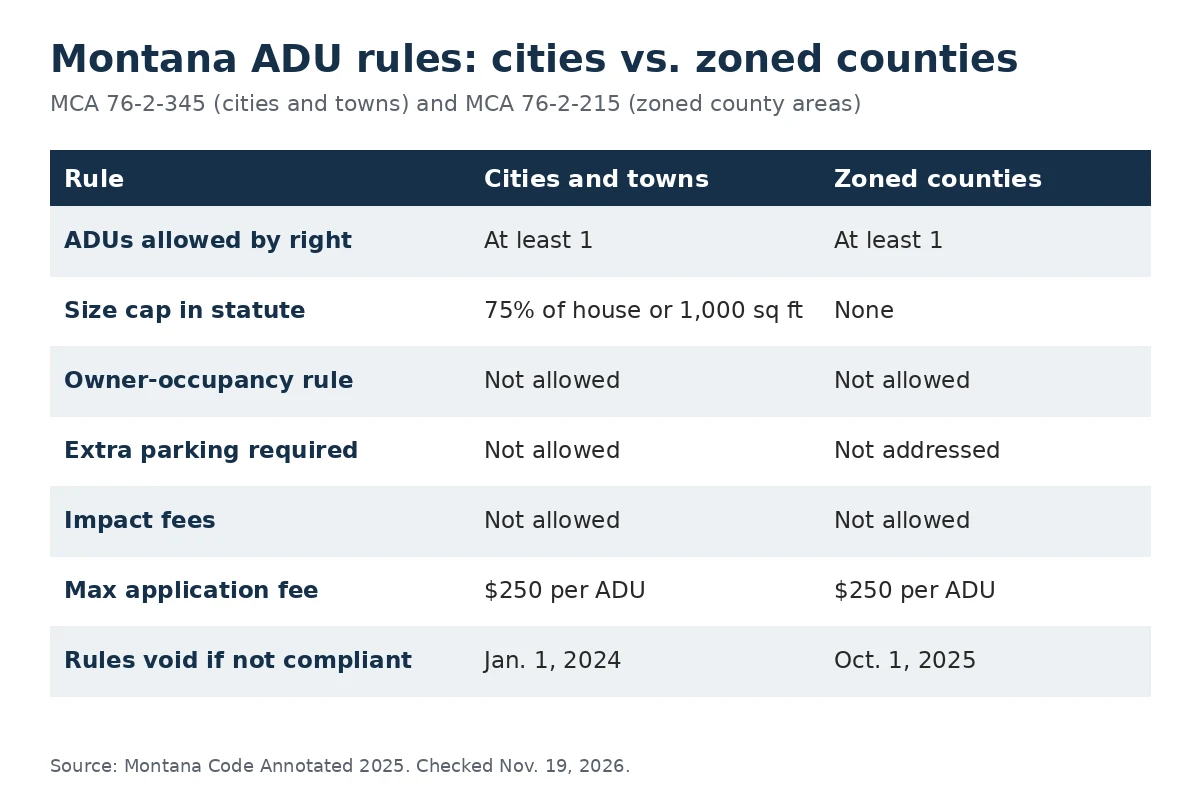
Bottom line up front: Under Montana ADU laws, every incorporated city and town that zones must allow at least one accessory dwelling unit (ADU) by right on a lot with a single-family home (MCA 76-2-345, from SB 528 of 2023). Cities can't require owner-occupancy, extra parking, matching design or impact fees, and can charge an ADU review fee of no more than $250 on top of usual building fees. An attached or detached ADU is limited to 75% of the house or 1,000 square feet, whichever is less, unless the city allows more. Since October 1, 2025, counties that have adopted zoning must also allow one ADU by right (MCA 76-2-215, from SB 532), with a similar list of limits. The Montana Supreme Court upheld the 2023 housing laws against a constitutional challenge in March 2026.
Disclosure: This page has no affiliate links. The Dwelling Index is reader-supported.
| Rule | Cities and towns (MCA 76-2-345) | Zoned county areas (MCA 76-2-215) |
|---|---|---|
| ADUs that must be allowed | At least 1 by right on a lot with a single-family home | At least 1 by right on a lot with a single-family home |
| Types | Attached, detached or internal | Attached, detached or internal |
| Size | Attached or detached ADU: no more than 75% of the house's gross floor area or 1,000 sq ft, whichever is less; city may be more permissive | No size limit in the statute |
| Owner-occupancy | Can't be required | Can't be required |
| Parking | Can't require additional parking or fees in lieu | Not addressed in the statute |
| Impact fees | Can't be assessed | Can't be assessed |
| Application fee | One-time fee up to $250 per ADU, plus usual building fees | One-time fee up to $250 per ADU, plus usual building fees |
| Height, setbacks, lot size, coverage | Can't be stricter than for the house | Can't be stricter than for the house |
| Water and sewer | City may require will-serve letters from municipal water and sewer | County may require a 15-day expedited state sanitation review (through Sept. 30, 2029) |
| Short-term rentals | City may regulate | County may regulate |
| Deadline | Noncompliant rules void as of Jan. 1, 2024 | Noncompliant rules void as of Oct. 1, 2025 |
Each cell comes from the Montana Code Annotated 2025 text of the two sections, which we read on November 19, 2026. "Not addressed" means the statute doesn't say; check your county's zoning regulations.
See What You Can Build → Get Your Free ADU Report
The Dwelling Index is an independent research resource covering ADU financing, costs, and regulations. We wrote this page because Montana's ADU rules are short, strong and easy to misread. Many guides still describe only the 2023 city law and miss the 2025 county law, and some still describe the 2023 court injunction that blocked the city law for a time. We read both statutes in the Montana Code Annotated 2025 and the court record summaries, and lay the city and county rules side by side.
Disclosure: The Dwelling Index is reader-supported. When you use our links to explore financing options, request prefab pricing, or purchase floor plans, we may earn a commission at no extra cost to you. Our editorial recommendations are based on independent research and are never influenced by compensation. This page has no affiliate links. It's educational, not legal advice. Confirm every rule with your city or county planning office before you design or pay for anything.
What are Montana's ADU laws in 2026?
Answer capsule: Montana has two ADU statutes. MCA 76-2-345 requires every municipality to allow at least one ADU by right on a lot with a single-family dwelling, effective for local rules on January 1, 2024. MCA 76-2-215 requires counties with zoning to do the same, effective October 1, 2025. Both bar owner-occupancy rules and impact fees and cap the ADU application fee at $250.
Three layers decide whether your project works:
- State law. MCA 76-2-345 for cities and towns, MCA 76-2-215 for zoned county areas, plus state building, fire and sanitation rules.
- Your city or county code. Front setbacks, height, lot coverage, design standards (within the state limits), short-term rental rules and the permit process.
- Private rules and utilities. Restrictive covenants, homeowners association rules, water and sewer capacity, and wells and septic outside city service areas.
The catch. By right means no public hearing or discretionary approval, but you still need a building permit, and your site plan must meet the zoning standards that apply to the house. A lot outside a city and outside any county zoning district isn't covered by either ADU statute.
Which Montana cities must allow ADUs?
Answer capsule: All of them that zone. MCA 76-2-345 applies to every "municipality," defined as "an incorporated city, town, or consolidated city-county that exercises zoning powers." There's no population threshold. Rules in effect on or after January 1, 2024 that don't comply are void.
Key definitions from the statute:
- ADU. "A self-contained living unit on the same parcel as a single-family dwelling of greater square footage that includes its own cooking, sleeping, and sanitation facilities" and meets building, fire and health codes. So the ADU must be smaller than the house and have its own kitchen.
- By right. Approval "without requiring a public hearing; a variance, conditional use permit, special permit, or special exception; or other discretionary zoning action other than a determination that a site plan conforms with applicable zoning regulations."
- Single-family dwelling. A building for one household "that is detached from any other dwelling unit." The statute guarantees an ADU next to a detached house, not next to a duplex.
If your city hadn't updated its code by January 1, 2024, the statute says it "shall review and permit accessory dwelling units in accordance with the requirements of this section until regulations are adopted or amended."
What can't Montana cities require for an ADU?
Answer capsule: A Montana city can't require extra parking or fees in lieu, matching design, owner-occupancy, a family or employment relationship between occupants, impact fees, street improvements, stricter height, setback, lot size or coverage rules than the house's, more onerous development standards, or a restrictive covenant.
MCA 76-2-345(2) lists nine things a municipality may not do:
- Parking. Require additional parking for the ADU or "fees in lieu of additional parking."
- Design matching. Require the ADU to match the house's exterior design, roof pitch or finishing materials.
- Owner-occupancy. Require that the house or the ADU "be occupied by the owner."
- Relationship tests. Require a "familial, marital, or employment relationship" between occupants.
- Impact fees. Assess impact fees on construction of an ADU.
- Street improvements. Require them as a condition, except repairing a street your construction disturbs.
- Stricter dimensions. Set "maximum building heights, minimum setback requirements, minimum lot sizes, maximum lot coverages, or minimum building frontages" for ADUs stricter than for the house on the lot.
- Extra standards. "Impose more onerous development standards on an accessory dwelling unit beyond those set forth in this section."
- Covenants. Require a restrictive covenant on the ADU, or condition a permit on one.
Item 8 is unusually broad. It means a city can't add ADU-only hurdles, such as a separate design review or a minimum lot size for ADUs, beyond what the statute allows.
What can Montana cities still regulate?
Answer capsule: Cities can cap an attached or detached ADU at 75% of the house or 1,000 square feet, charge a review fee of up to $250 plus usual building fees, require will-serve letters for municipal water and sewer, regulate short-term rentals, and enforce building, fire and health codes. They can also choose to be more permissive.
- Size. "If the accessory dwelling unit is detached from or attached to the single-family dwelling, it may not be more than 75% of the gross floor area of the single-family dwelling or 1,000 square feet, whichever is less." The limit applies to attached and detached ADUs. An internal ADU within the house isn't named in that sentence.
- More permissive rules. Subsection 8 says nothing prohibits a city "from adopting regulations that are more permissive," so a city can allow larger ADUs or more than one.
- Fees. A one-time ADU application fee of up to $250 per unit, plus usual building fees.
- Water and sewer. A city "may require an accessory dwelling unit to have a will-serve letter from both a municipal water system and a municipal sewer system."
- Short-term rentals. "Nothing in this section prohibits a municipality from regulating short-term rentals."
- Codes. Building codes, fire codes and public health and safety regulations still apply.
How big can an ADU be in Montana?
Answer capsule: In cities, an attached or detached ADU can be no more than 75% of the house's gross floor area or 1,000 square feet, whichever is less, unless the city allows more. "Gross floor area" means interior habitable area. The county statute sets no numeric size limit; check applicable county rules with the planning office.
How the city size rule works on a few house sizes:
Disclosure: This page has no affiliate links. The Dwelling Index is reader-supported.
| House's habitable floor area | 75% of the house | Statutory limit (lesser of 75% or 1,000 sq ft) |
|---|---|---|
| 900 sq ft | 675 sq ft | 675 sq ft |
| 1,100 sq ft | 825 sq ft | 825 sq ft |
| 1,333 sq ft | 999.75 sq ft | 999.75 sq ft |
| 1,600 sq ft | 1,200 sq ft | 1,000 sq ft |
| 2,400 sq ft | 1,800 sq ft | 1,000 sq ft |
Because both statutes define an ADU as smaller than the house, a small older home limits the ADU more than a large lot does. Ask your city whether it has adopted a larger cap under its power to be more permissive.
Estimate your Montana ADU budget — run the free ADU cost calculator
What must Montana counties allow under SB 532?
Answer capsule: MCA 76-2-215, enacted by SB 532 in 2025 (Chapter 619), requires counties that have adopted zoning regulations to allow at least one ADU by right on a lot with a single-family dwelling, in jurisdictional areas where the county has zoning. Noncompliant county rules became void on October 1, 2025.
The county rules track the city rules with some differences:
- Only zoned areas. The mandate applies "in jurisdictional areas where the board of county commissioners has established zoning regulations." Much of rural Montana has no county zoning, and the statute doesn't reach those areas.
- No size cap in the statute. The county section has no 75% or 1,000-square-foot sentence.
- No parking clause. The county list of prohibitions doesn't include the parking ban that applies to cities.
- Same core protections. No owner-occupancy rule, no relationship test, no design matching, no impact fees, no street improvements, no stricter dimensions than the house, no more onerous standards, no required covenant.
- Same fee cap. A one-time application fee of up to $250 per ADU, plus usual building fees.
- Sanitation review. A county may require an expedited sanitation review, and the Department of Environmental Quality must provide a 15-day expedited review under MCA 76-4-130 for an ADU added to a parcel with existing public water and wastewater service that has capacity. That subsection ends September 30, 2029.
Was Montana's ADU law blocked by a court?
Answer capsule: Briefly. A district court blocked SB 528 and the duplex law SB 323 on December 29, 2023, just before they took effect. The Montana Supreme Court reversed that injunction in 2024, and in March 2026 it unanimously upheld the laws against the equal protection challenge in Montanans Against Irresponsible Densification v. State.
The timeline, from the State Court Report's analysis of the case:
- December 2023. A homeowner group, Montanans Against Irresponsible Densification, sued and won a preliminary injunction halting SB 323 and SB 528.
- 2024. The Montana Supreme Court unanimously reversed the injunction, finding the group "offered only generalized fears and supposition." The laws took effect.
- March 2025. The district court upheld SB 528 and the other laws, except a part of the Land Use Planning Act, and declared the laws couldn't displace more restrictive covenants.
- March 2026. The Montana Supreme Court unanimously agreed the laws didn't violate equal protection, reversed the Land Use Planning Act ruling, and vacated the covenant declaration as an improper advisory opinion.
Older articles that say the ADU law is "on hold" are out of date.
Can an HOA or covenant stop an ADU in Montana?
Answer capsule: Yes, it can. Both statutes say the covenant clause "may not be construed to prohibit restrictive covenants concerning accessory dwelling units entered into between private parties." A city or county can't require a covenant or condition a permit on one, but an existing private covenant can still restrict or ban an ADU.
Pull your subdivision's covenants from the county clerk and recorder and read the sections on accessory buildings, guest houses, second dwellings and rentals. If you're not sure whether a covenant is still enforceable, ask a real estate attorney before you pay for plans.
Can you rent a Montana ADU, including short term?
Answer capsule: Yes, for long-term rental: no owner needs to live on site, and no relationship between occupants can be required. Short-term rentals are a local matter. Both statutes say they don't prohibit a city or county from regulating short-term rentals as defined in MCA 15-68-101.
Before you plan nightly rentals, check your city's or county's short-term rental registration, zoning and tax rules. To estimate long-term rent, use our guide to how much you can rent an ADU for and the ADU rental income calculator.
What fees can a Montana city or county charge for an ADU?
Answer capsule: A one-time ADU application fee of up to $250 per unit, plus usual building fees. Impact fees on ADU construction are banned for cities and counties. Utility connection charges aren't addressed in either statute, so ask your water and sewer provider.
Disclosure: This page has no affiliate links. The Dwelling Index is reader-supported.
| Fee | Allowed? | Source |
|---|---|---|
| ADU application or review fee | Yes, up to $250 per ADU, one time | MCA 76-2-345(4); 76-2-215(4) |
| Usual building permit fees | Yes, in addition to the application fee | Same subsections |
| Impact fees on ADU construction | No | MCA 76-2-345(2)(e); 76-2-215(2)(d) |
| Fees in lieu of parking | No (cities) | MCA 76-2-345(2)(a) |
| Water and sewer connection charges | Not addressed in the ADU statutes | Ask your utility |
For a wider look at what permits cost nationally, see our ADU permit fee research.
What does a Montana ADU project look like step by step?
Answer capsule: Confirm whether your lot is in a city, a zoned county area or unzoned land, read the local ADU rules, check covenants, size the unit against the 75% and 1,000-square-foot limit (in cities), confirm water and sewer service, and apply for a building permit.
- Confirm who regulates your lot. City limits, a county zoning district, or unzoned county land.
- Read the local ADU section. Look for front setbacks, height, coverage and any more permissive rules.
- Check covenants. A private covenant can still say no.
- Size the unit. Measure the house's habitable floor area. In cities, apply the 75% or 1,000-square-foot limit unless the city allows more.
- Confirm utilities. Ask for will-serve letters from municipal water and sewer in a city, or plan the sanitation review in a county.
- Choose a type. Internal, attached or detached, including a unit over a detached garage.
- Apply. Pay the ADU application fee (up to $250) and the usual building fees.
- Check rental rules if you plan short-term rentals.
Check your lot's ADU options — get your free report
Our property eligibility check provides state-level context and broad cost ranges; it does not determine parcel eligibility. Ask your planning office about your lot. For the full build sequence, read our guide to building an ADU, and for budget ranges see how much an ADU costs.
How do Montana ADU laws compare with neighboring states?
Answer capsule: Montana's city law sets broad limits on local control: by-right approval, no owner-occupancy, no parking, no impact fees and a $250 fee cap, in every zoning city regardless of size. Washington's law applies to fully planning cities and requires two ADUs per lot in urban growth areas.
For comparison, see our state guides for Washington, Utah, Colorado and Oregon, and the 50-state overview at ADU laws by state.
What should you ask the planning office before you pay for plans?
Answer capsule: Ask whether your lot is in a city or a zoned county area, the ADU size limit and whether the local rule is more permissive than the state's, front setback and height for your zone, the ADU application fee, utility requirements and short-term rental rules. Write down the answers with the date.
- Is my lot inside city limits, in a county zoning district, or in unzoned county land?
- Has the city or county adopted ADU rules more permissive than the state minimum?
- What size limit applies, and how is gross floor area measured?
- What are the front setback, height and lot coverage limits for the house in my zone?
- What's the ADU application fee, and what building fees apply?
- Do I need will-serve letters or a sanitation review?
- Are short-term rentals allowed, and do they need registration?
- What's the current review time for an ADU building permit?
Print the list, write the answers in the margin and date them. Then use our property eligibility check for a general planning overview; confirm parcel-specific rules with your planning office.
See what's possible at your address — get your free ADU report
What we verified
- Verified on November 19, 2026: MCA 76-2-345 (municipal ADUs; En. Sec. 1, Ch. 502, L. 2023) and MCA 76-2-215 (county ADUs; En. Sec. 1, Ch. 619, L. 2025) in the Montana Code Annotated 2025 on the Montana Legislature's site.
- Verified: the State Court Report's analysis of Montanans Against Irresponsible Densification v. State (published March 19, 2025, updated March 18, 2026), for the court history.
- Not verified: the Montana Supreme Court's 2026 opinion text, individual city and county ADU ordinances (including Missoula, Bozeman and Billings), current building fee amounts, and any amendment after the documents we read.
Methodology
We read both ADU statutes in full in the current Montana Code Annotated and compared them line by line to build the city-versus-county table. For the court history, we used a dated legal analysis that tracked the case through the March 2026 ruling. We didn't summarize individual city codes because we couldn't read them directly in time for this update, so we point you to the questions to ask instead. To report an error, use our corrections page.
Sources
- Montana Legislature, Montana Code Annotated 2025, MCA 76-2-345, "Accessory dwelling units -- regulations -- restrictions" (municipal zoning).
- Montana Legislature, Montana Code Annotated 2025, MCA 76-2-215, "Accessory dwelling units -- regulations -- restrictions" (county zoning).
- Montana Legislature, SB 528 (2023, Chapter 502) and SB 532 (2025, Chapter 619).
- Maureen E. Brady, "Montana's Housing Crisis Fix Survives Constitutional Challenge," State Court Report, March 19, 2025, updated March 18, 2026.
Frequently asked questions
What are Montana's ADU laws?
MCA 76-2-345 requires every Montana city and town that zones to allow at least one ADU by right on a lot with a single-family home. MCA 76-2-215 requires counties with zoning to do the same in their zoned areas, since October 1, 2025.
Do I have to live on the property to have an ADU in Montana?
No. Neither a city nor a county can require that the house or the ADU be occupied by the owner.
How big can an ADU be in Montana?
In cities, an attached or detached ADU can be no more than 75% of the house's habitable floor area or 1,000 square feet, whichever is less, unless the city allows more. The county statute sets no size cap.
Do Montana ADUs need parking?
Cities can't require additional parking or fees in place of parking for an ADU. The county statute doesn't address parking, so check your county's zoning.
How much does an ADU permit cost in Montana?
The ADU application fee is capped at $250 per unit, one time, plus usual building fees. Impact fees on ADU construction aren't allowed.
Does Montana's ADU law apply in the county?
Only in areas where the county has adopted zoning. Unzoned rural land isn't covered by either ADU statute.
Was Montana's ADU law struck down?
No. A December 2023 injunction was reversed by the Montana Supreme Court in 2024, and in March 2026 the court unanimously upheld the housing laws against the equal protection challenge.
Can my HOA ban an ADU in Montana?
Yes. Both statutes preserve private restrictive covenants. A city or county can't require you to record one, but an existing covenant can still restrict or prohibit an ADU.