
Los Angeles ADU Accelerator Program: 2026 Status, Eligibility, and What to Do Next
By the Dwelling Index editorial team — an independent research resource covering ADU financing, costs, and regulations.
· · Last verified: May 26, 2026
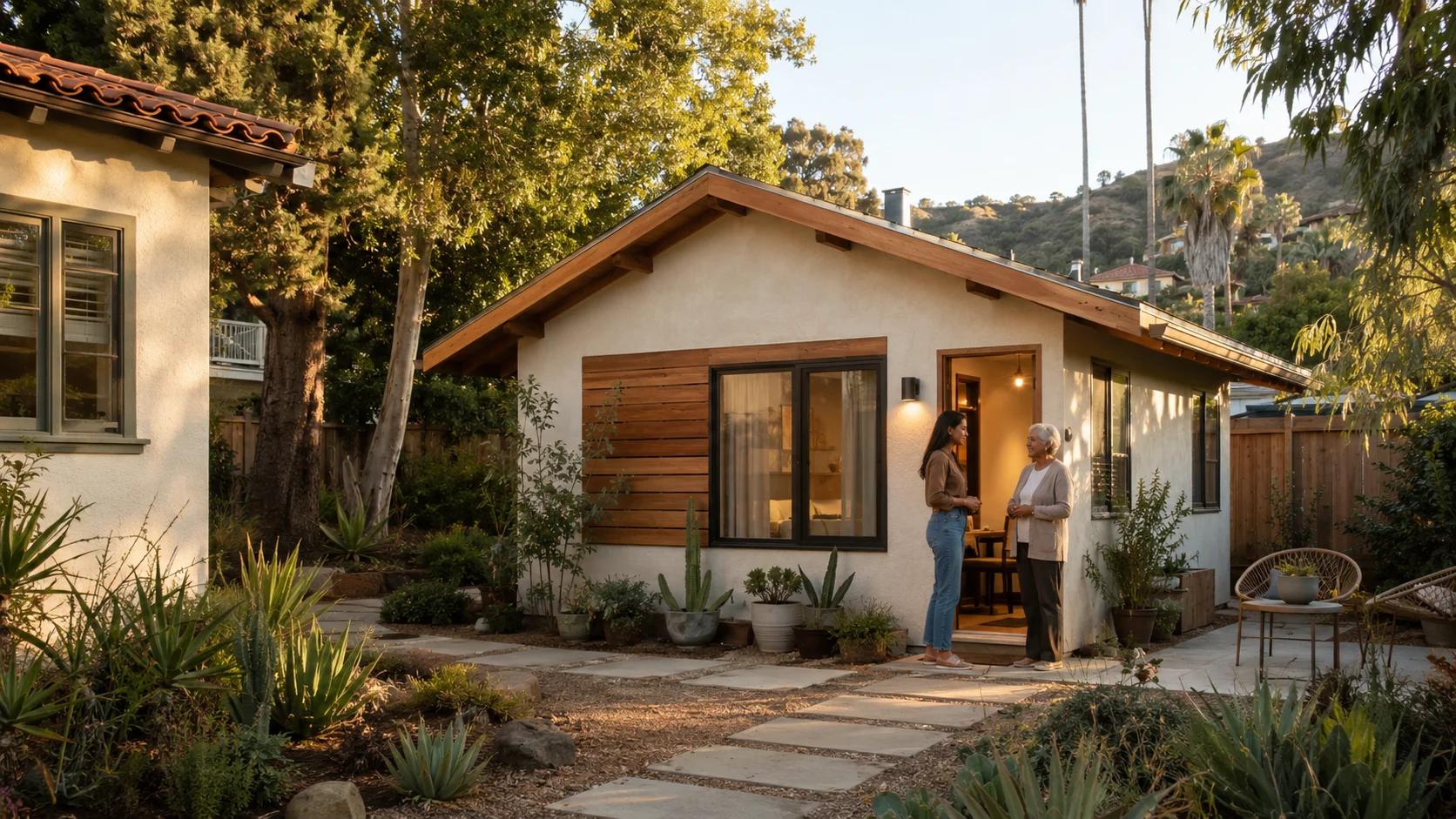
If you searched “Los Angeles ADU Accelerator Program” expecting an open application, money to build, or guaranteed rent, you’ve hit the exact problem this page exists to fix: the official program is closed, but a stack of contractor blogs from 2021 and 2022 still describe it as if you can sign up tomorrow. A few even quote dollar figures from an earlier version of the program that no longer applies. That gap — between what’s written and what’s true — is where LA homeowners lose the most time.
We pulled the current City of Los Angeles program pages, the actual City Council motions in file 25-1199, the Los Angeles Housing Department’s ADU rental rules, Brookings policy research, and CalHFA’s grant bulletins, and assembled them into one place. Below: what the program was, the verified reason it ended, who qualified, and — the part that matters most now — a clear decision matrix for what to do depending on whether you have a finished ADU, an unpermitted one, or just a plan.
At a glance: the current status
| Question | Current answer (verified May 26, 2026) | What it means for you |
|---|---|---|
| Is it accepting homeowner applications? | No. The official homeowner page says it is “currently closed and is not accepting new applications.” | Don’t budget around this program as an active income source. |
| Was it a grant to build an ADU? | No — in its operating form it was a rent-match/subsidy program for existing permitted ADUs. Earlier pilot-era materials referenced incentive/forgivable-loan terms, but those are historical. | If you need construction money, look to financing, not this program. |
| Who did it serve? | City of LA homeowners with a permitted ADU, and tenants age 62+ earning ≤30% of Area Median Income. | County and other-city addresses did not qualify. |
| What did the tenant pay? | 30% of their income; a City subsidy covered the gap up to the program’s market-rent standard. | This was a subsidy model, not free money for owners. |
| How big was it? | It housed 32 older adults in 25 ADUs (reported 2021, confirmed in later City records). | A meaningful but small pilot — never a citywide entitlement. |
| Why did it end? | A Feb 2026 City Council motion: “In October 2025, it was determined that the ADU Accelerator Program was not viable.” | “Closed” is not a temporary glitch — funding was redirected. |
| Is it reopening? | No reopening has been announced. A 2025 motion called the pilot “effectively ended”; the 2026 motion deemed it not viable. | Watch the official city page; don’t plan around a reopening. |
Sources: adu.lacity.gov/homeowners; adu.lacity.gov/tenants; LA City Clerk file 25-1199; LAHD report, City Clerk file 21-0541 (June 2023); Brookings (Aug 2024).
Find your real path in 60 seconds
The Accelerator is closed. The planning tool provides state-level rules, broad cost ranges, and an illustrative equity estimate; it does not verify Los Angeles property eligibility or local program status.
Get My ADU Planning OverviewIs the Los Angeles ADU Accelerator Program still accepting applications?
We’ll be blunt, because most pages aren’t: there is no open application path for this program right now. The official adu.lacity.gov homeowner page carries the closure notice at the top.
Why so many pages still make it look open
Applications opened in 2020. Between roughly 2020 and 2022, contractors, property managers, and design firms across Los Angeles wrote upbeat explainers — and many have never been updated. Search the program name today and several of those stale pages still rank near the top, above the official city site. A few quote an earlier incentive structure (we decode it below) that makes the program look like a construction grant. It wasn’t.
This is the single most expensive mistake we see LA homeowners make with this search: reading a 2021 blog, assuming the program is live, and planning a build or a tenant arrangement around money that isn’t available.
What “closed” does and does not mean
“Closed” means three specific things: don’t expect a new homeowner application to be accepted right now; don’t build a budget around City rent subsidies from this program; and don’t trust old per-month rent figures as current.
“Closed” does not mean ADUs are restricted in Los Angeles, that you can’t rent a legal ADU, that voucher or affordable-rental paths outside this program are unavailable, or that you can’t finance, permit, or legalize a unit through other channels. All of those remain fully open, and we map them later on this page.
Was the Los Angeles ADU Accelerator Program a grant?
The program never handed homeowners a check to construct an ADU. What it offered was a guaranteed, screened tenant and a City subsidy that topped up the rent — valuable, but a fundamentally different thing from build funding.
The confusion is understandable. Early guide materials from the program’s nonprofit partners described incentive figures — a $10,000 grant tied to a three-year affordability commitment, and a $50,000 forgivable loan tied to a longer commitment for certain in-process ADUs. Those numbers still circulate on third-party pages. Treat them as a historical artifact of an evolving pilot, not as money you can apply for.
What was the LA ADU Accelerator Program supposed to do?
The LA ADU Accelerator Program connected City of Los Angeles homeowners who had a legally permitted accessory dwelling unit (ADU) — a self-contained second home on the same lot as a primary residence, with its own kitchen, bathroom, and entrance — with older adults facing housing insecurity. The City screened and placed a tenant, the tenant paid 30% of their income, and a City subsidy covered the difference up to the program’s rent standard.
For the citywide count, see Los Angeles ADU permit totals.
The program grew out of the Bloomberg Philanthropies Mayors Challenge; the City received about $1 million in 2018 to seed it. Later, it relied on a mix of City and housing-program funds — including General City Purposes dollars and state PLHA/SB 2 housing funds. That’s seed-and-stitch funding for a pilot, not a sustained citywide subsidy — the thread that runs straight to its closure.
What each party received and committed to
| Party | What they received | What they committed to | Status now |
|---|---|---|---|
| Homeowner | Screened tenant, subsidized rent, landlord support | Provide a legal ADU; rent for the program term | New applications closed |
| Tenant (62+, ≤30% AMI) | Affordable ADU housing, case management | Meet eligibility; pay 30% of income | Verify any path through official channels |
| City of LA / LAHD | Affordable housing via existing ADUs | Fund the subsidy and provider contract | Program deemed “not viable” (Oct 2025) |
| ONEgeneration (provider) | ~$500/household/month for lease support | Run matching and case management | Funding redirected to senior services |
Sources: adu.lacity.gov/homeowners and /tenants; LAHD report, LA City Clerk file 21-0541 (June 2023); LA City Clerk file 25-1199 (Feb 2026).
Who would have qualified as a homeowner?
Homeowners needed to own residential property inside the City of Los Angeles and have an existing, legally permitted ADU with a Certificate of Occupancy — or a certificate in progress. Owner occupancy was not required. Because applications are now closed, these requirements explain the program rather than open a path to apply today.
It was a City of Los Angeles program — not Los Angeles County. A Los Angeles mailing address doesn’t mean your parcel sits inside the City of LA; it could be in unincorporated county land or a separate city (Burbank, Glendale, Santa Monica, and dozens more). The fastest way to confirm jurisdiction is ZIMAS (Zone Information and Map Access System) at the City’s planning portal or at LADBS.
It required a real, legal unit. A Certificate of Occupancy is the document confirming a building is legally approved for people to live in. The Accelerator placed tenants in existing units, so a finished or near-finished, permitted ADU was the entry ticket. If your ADU is unpermitted, the program was never your path, and your real next step is legalization (covered below).
| Homeowner fit question | Why it mattered | If you’re unsure |
|---|---|---|
| Is the property inside City of LA? | Program was City-specific | Check ZIMAS or LADBS records |
| Is there already a permitted ADU? | Program activated existing units | Pull permit history at LADBS |
| Does it have a Certificate of Occupancy? | Tenants needed a legal unit | If no, your path is permitting/legalization |
| Was the ADU vacant? | A tenant had to be placed | If occupied, the fit was different |
| Is the home subject to RSO/JCO? | Renting can trigger LA compliance | See the rental-rules section below |
Before you spend on plans, check the local rules directly
The planning tool is a general state-level overview, not a parcel or Los Angeles Accelerator eligibility check. Confirm site constraints with the appropriate planning office.
Get My ADU Planning OverviewWho qualified as a tenant?
Tenant eligibility was limited to older adults — generally age 62 or older — who lived in Los Angeles County, earned no more than 30% of Area Median Income (AMI), and could provide required income and contact documentation. The program served eligible tenants regardless of immigration status. Tenants paid 30% of their income toward rent.
| Homeowner | Tenant | |
|---|---|---|
| Location | Property inside City of LA | Resident of LA County |
| Core requirement | Existing, permitted ADU with C of O (or in progress) | Age 62+ |
| Income test | None | ≤30% of Area Median Income |
| Occupancy | Owner occupancy not required | Must occupy the ADU |
| Rent | Received subsidized rent to program standard | Paid 30% of income |
Sources: adu.lacity.gov/homeowners and /tenants; Brookings (2024).
How did rent, subsidies, and landlord support actually work?
The program was a subsidized affordable-rental model, not free rent for owners. The tenant paid 30% of their income, and a City subsidy covered the gap between that contribution and the current market rent for an equivalent unit. The City also paid the service provider approximately $500 per household per month for case management and landlord support.
| Mechanic | What official sources documented | Why we don’t treat it as current |
|---|---|---|
| Tenant payment | 30% of tenant income | Program closed; no new placements |
| City subsidy | Gap between market rent for an equivalent unit and the tenant’s 30% | Funding redirected in 2025 |
| Provider support | ~$500/household/month for lease support | Provider contract changed |
| Commitment term | Current City pages say five years; City Council/LAHD records show the pilot was reduced to a three-year structure | Terms changed across the program’s life |
Sources: adu.lacity.gov/tenants; LAHD report, LA City Clerk file 21-0541 (June 2023); LA City Clerk file 21-1375-S1 (March 2025).
A candid admission, since you deserve one. The promise here was genuinely good — a legal backyard unit, a stable senior tenant, near-market rent guaranteed by the City, and someone else handling screening and conflicts. That’s a deal worth wanting. The catch is simply that it’s not available today, and the old pages quoting specific rent numbers describe a real but discontinued program.
Affiliate disclosure: The Dwelling Index is reader-supported. When you use our links to explore financing options, request prefab pricing, or purchase floor plans, we may earn a commission at no extra cost to you. Our editorial recommendations are based on independent research and are never influenced by compensation.
What happened to the pilot? A verified timeline
This is our original contribution to the topic: no other single page we found assembles the full arc from primary City Clerk records. We built this so you can see, with sources and dates, exactly why “closed” is permanent-for-now rather than a temporary pause.
Los Angeles ADU Accelerator status tracker (2018–2026)
| Date | What changed | Why it matters | Source |
|---|---|---|---|
| 2018 | City received ~$1M from Bloomberg Philanthropies to seed the pilot | Explains the program’s small, grant-dependent scale | Brookings (2024) |
| 2020 | Homeowner/tenant applications opened | The active window began | Brookings (2024) |
| ~2021 | Pilot-era guide materials described a $10,000 grant (3-yr commitment) and a $50,000 forgivable loan for some in-process ADUs (10-yr) | Source of the “it’s a grant” confusion still circulating | LA-Más historical guide |
| 2021 | Pilot had housed 32 older adults in 25 ADUs | Verified scale — meaningful but limited | Brookings; LAHD/Council records |
| Mar 2022 | City documents authorized a ONEgeneration contract and appropriated program funds | Confirms a real, city-funded pilot | LA City Clerk file 21-1375 |
| Jun 2023 | LAHD report: subsidy covered market rent minus tenant’s 30%; ~$500/household/month provider support | Documents the actual financial mechanics | LA City Clerk file 21-0541 |
| 2024 | Brookings described the LA model as rental-match/subsidy for existing permitted ADUs (no construction subsidy), no longer accepting applications | Clarifies rental-match vs. construction grant | Brookings (Aug 2024) |
| Mar 2025 | Council motion: program originally five years, reduced to a three-year pilot; pilot had “effectively ended” | The bridge from “closed” to “why closed” | LA City Clerk file 21-1375-S1 |
| May 2025 | Council authorized transferring $400,000 to continue housing-navigation services tied to the program | Shows the City trying to sustain it | LA City Clerk file 25-1199 |
| Oct 2025 | “It was determined that the ADU Accelerator Program was not viable” | The decisive status change | LA City Clerk file 25-1199 |
| Feb 2026 | Council moved the remaining $150,000 to the Department of Aging for senior services | Confirms wind-down and fund redirection | LA City Clerk file 25-1199 |
| Current | Official homeowner page: “currently closed and is not accepting new applications” | The above-the-fold answer today | adu.lacity.gov |
Dwelling Index assembled this timeline from official City of Los Angeles program pages, LA City Clerk records (files 21-1375, 21-0541, 25-1199), an LAHD report, an LA-Más historical guide, and Brookings policy research. Historical incentive figures are shown to explain confusion, not as current offers. Last verified: May 26, 2026.
One detail adds texture: a National Council on Aging profile of ONEgeneration noted the provider was “on track to expand to 50 units until the city reduced funding.” That single line captures the whole story — a promising pilot that couldn’t scale on seed funding once the subsidy tightened.
If the LA ADU Accelerator is closed, what should homeowners do instead?
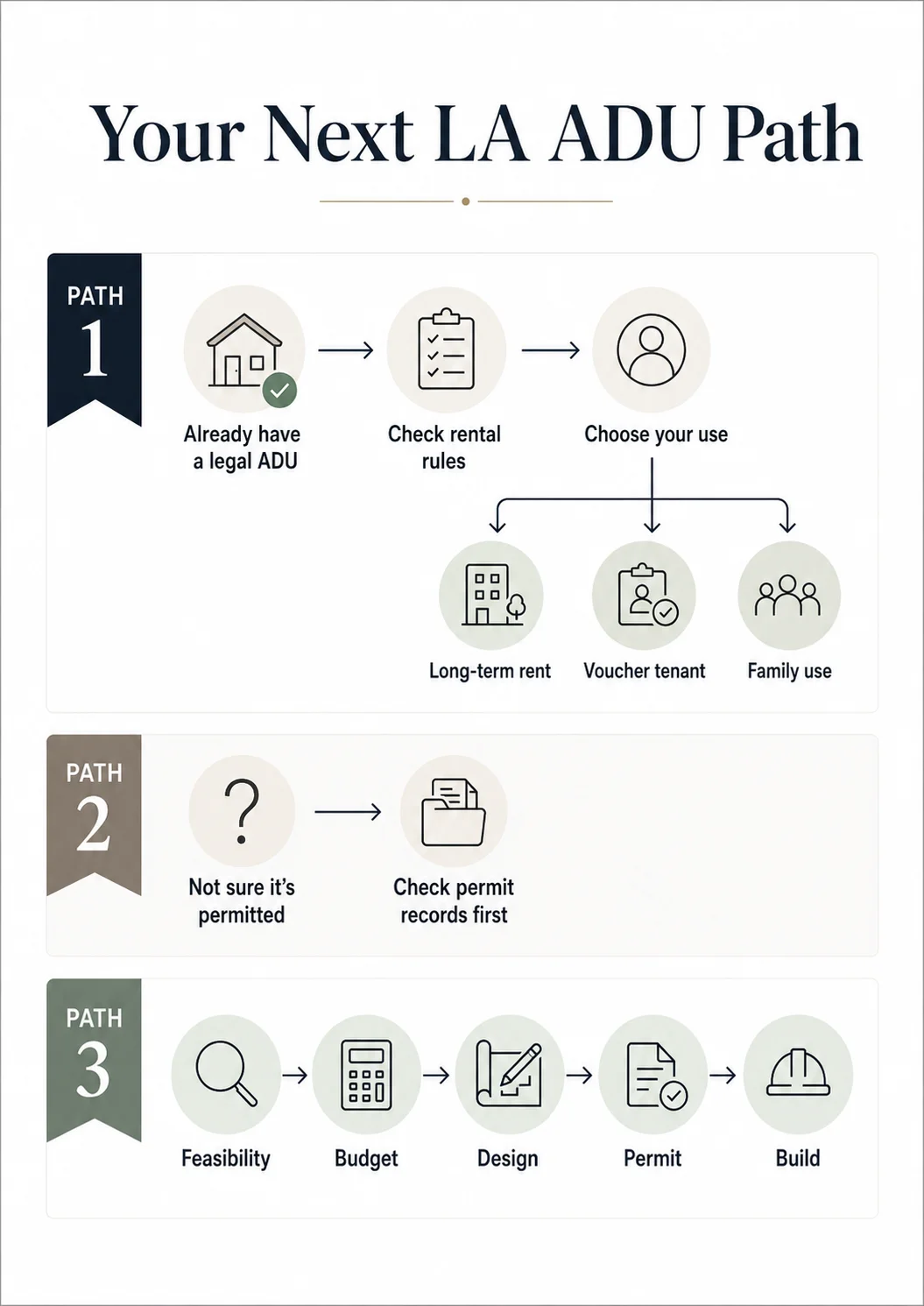
The right next step depends on what you already have. If you own a legal, vacant ADU, you can pursue market rent, a Housing Choice Voucher (Section 8) tenant, or a family arrangement. If your ADU is unpermitted, your first move is legalization, not renting. If you haven’t built yet, start with feasibility, zoning, and financing — and don’t assume any active Los Angeles or California ADU grant is available in 2026.
Next-best path matrix
| Your situation | Best next step | Why | Watch out for |
|---|---|---|---|
| Legal, vacant ADU with Certificate of Occupancy | Compare market rent, Section 8 voucher, and family-use paths | The unit is rentable today | LAHD rental rules, RSO/JCO, fair housing |
| ADU exists, permit status unclear | Verify permit + C of O at LADBS | The closed program required legal units | Don’t place a tenant in an unpermitted unit |
| ADU under construction | Finish permitting/inspection; don’t count on Accelerator funds | Program is closed | Re-check official sources before assuming grants |
| Not built yet | Start with feasibility, zoning, budget, financing | Know what’s legal before choosing a funding path | LA ADU costs and timelines vary widely |
| Want to rent affordably to a senior or voucher holder | Research HACLA/LACDA Housing Choice Voucher landlord paths | Voucher rental exists outside the Accelerator | Inspections, payment standards, and timing |
| Need money to build | Compare financing lanes (equity, refi, construction, renovation) | No active CalHFA or LA grant should be assumed | Fit varies by homeowner; financing isn’t guaranteed |
| You’re an older adult seeking housing | Use official City/LAHD/Aging resources | We don’t administer placement | Avoid third-party “application” claims |
Path 1 — You have a legal ADU and want rental income
The Accelerator’s appeal was guaranteed rent plus tenant screening. You can reconstruct most of that yourself. The closest substitute to its subsidized-senior model is the Housing Choice Voucher (Section 8) program, administered locally by HACLA (Housing Authority of the City of Los Angeles) and LACDA (Los Angeles County Development Authority). The mechanics are consistent: the owner screens and selects the tenant under applicable rules; the unit must pass a housing-quality inspection; and the housing authority pays its share of the rent — the Housing Assistance Payment — directly to the owner each month. That direct, on-time payment delivers much of the stability the Accelerator promised.
Whichever you choose, read the rental-rules section below — it’s the part that surprises LA owners most. Also see our guide on financing an ADU rental.
Path 2 — Your ADU is unpermitted or you’re unsure
A closed subsidy program is no reason to rent an unpermitted unit. Your sequence: pull your permit history and Certificate of Occupancy status at LADBS, fix any safety or code issues, and pursue legalization. California’s AB 2533, effective late 2025, strengthened the legalization pathway for unpermitted ADUs built before 2020 — cities generally can’t deny a permit absent a serious safety hazard. Only after legalization does renting make sense; renting an unsafe or unpermitted unit invites enforcement and liability that dwarf any short-term rent.
Path 3 — You haven’t built yet
This is where most people who land here actually are: they heard “city ADU program,” hoped it would defray costs, and discovered it won’t. So the real question becomes — what does building an LA ADU cost, and how do people pay? We built the next two sections for exactly that.
Stop chasing a closed program. Start with general planning context.
The tool offers state-level rules, broad cost ranges, and an illustrative equity estimate; local property and program eligibility need to be confirmed separately.
Get My ADU Planning OverviewWhat does it actually cost to build an ADU in Los Angeles in 2026?
In 2026, building a new detached ADU in Los Angeles generally runs about $200,000–$459,000, an attached ADU about $200,000–$350,000, and a garage conversion about $95,000–$245,000, depending on size, finishes, site conditions, and structural or utility upgrades. A JADU built within the existing home typically runs about $80,000–$150,000. These are builder-published 2026 estimates, not official City figures, and real quotes vary widely by project.
If one competing page hands you a single tidy number, that’s the tell it hasn’t built much. Instead of inventing an average, we assembled the actual 2026 ranges from multiple Los Angeles builders side by side.
2026 LA ADU cost ranges, by source
| Source (date) | Garage conversion | Attached ADU | Detached ADU | JADU |
|---|---|---|---|---|
| Silver Hammer Builders (Feb 2026) | $120K–$220K | $200K–$350K | $250K–$400K+ | $80K–$150K |
| CALI ADU (Apr 2026) | $140K–$245K+ | — | $219K–$459K | — |
| GreatBuildz (2026) | $100K–$150K | — | up to ~$350K–$400K | — |
| CCS Construction Consulting (Mar 2026) | $95K–$225K | — | $200K–$400K+ | — |
| LAHD official report (2023 — older baseline) | $75K–$150K | $150K–$250K | $185K–$350K | — |
Builder figures are 2026 estimates published by Los Angeles contractors; the LAHD row is the City’s older 2023 estimate, included as a baseline. Per-square-foot costs commonly fall around $250–$450. Figures are illustrative, not quotes. Verified May 26, 2026.
Two LA-specific cost drivers hit nearly every project. Title 24 is California’s building energy-efficiency standard, dictating insulation, windows, and HVAC requirements that add cost. Under the 2025 Energy Code, a newly constructed detached ADU generally must include a newly installed solar PV system unless an exception applies (excessive shading or inadequate roof area) — while attached and conversion ADUs are treated as additions to the primary home and don’t carry the same standalone PV mandate. That one distinction can swing a detached budget by several thousand dollars.
Permit and soft costs are a separate line from construction. GreatBuildz cites City permits and fees around $5,000–$20,000, while CCS cites broader soft costs — plans, engineering, and permits combined — around $15,000–$45,000. Under SB 543 (effective Jan 1, 2026), ADUs of 750 square feet or less of interior livable space are exempt from local development impact fees, and ADUs/JADUs under 500 square feet are also exempt from school impact fees; above 750 square feet, impact fees must be charged proportionally to the primary dwelling’s size rather than at full single-family rates (Gov. Code §66324).
How LA homeowners actually pay for it
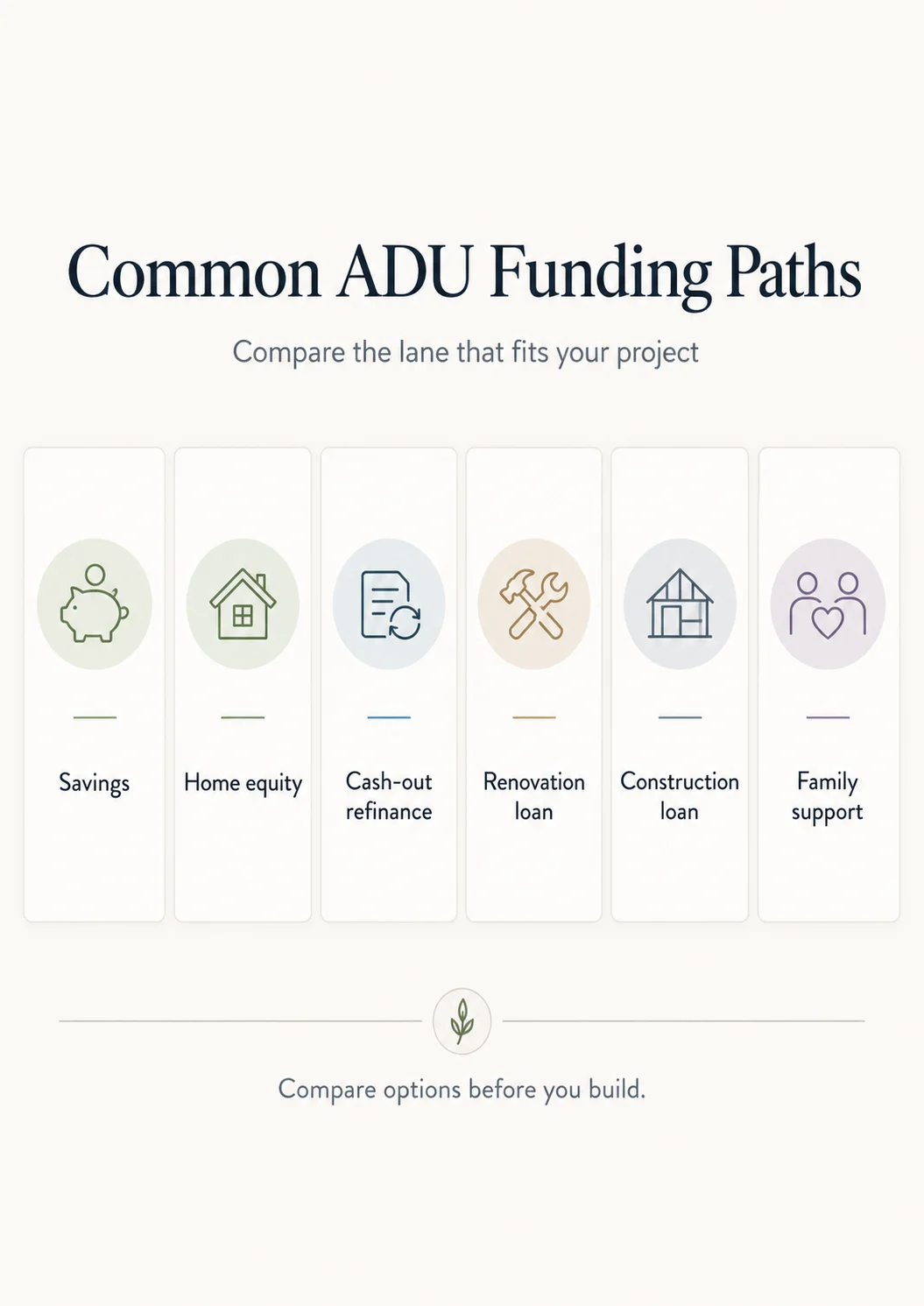
Since there’s no active grant to lean on, financing is the real question. These are lanes, not lender rankings — the right lane depends on your equity, timeline, and whether the unit exists yet. We never quote rates as promises.
| If you’re at this stage… | Lane that usually fits | Why |
|---|---|---|
| Have equity, want flexibility | HELOC or home equity loan | Borrow against equity; a HELOC lets you draw as needed |
| Rates favor refinancing your whole balance | Cash-out refinance | Replace your mortgage with a larger one and take the difference in cash |
| Ground-up detached build | Construction loan | Funds the build in milestone “draws,” often converting to a permanent mortgage |
| Limited current equity, big value lift | Renovation loan | Underwrites against the home’s after-renovation value, not today’s value |
| Garage conversion / smaller scope | HELOC or renovation loan | Smaller borrow; faster to arrange than a full construction loan |
Illustrative-results note: Any rental-income or ROI figures on this page are illustrative examples, not guarantees of returns. Actual results depend on local market conditions, construction costs, financing terms, and regulatory approvals.
You don’t need the Accelerator to make the numbers work
Most LA owners fund an ADU with equity, a cash-out refinance, or a construction loan. We explain these paths as general education, not a loan offer or approval guarantee.
Compare ADU Financing OptionsCompare common funding routes and their eligibility limits before contacting a lender.
For a deep dive on every financing option: California ADU financing guide.
What Los Angeles ADU rental rules should I check before renting?
Before renting an ADU in Los Angeles, check more than zoning. LAHD states that adding an ADU or JADU to a parcel that already has a unit brings the property within the Los Angeles Housing Code’s rental-property requirements. Whether the Rent Stabilization Ordinance (RSO) or Just Cause Ordinance (JCO) applies depends on the original building’s age and whether the ADU is detached, attached, or converted.
The Housing Code applies once you have two units
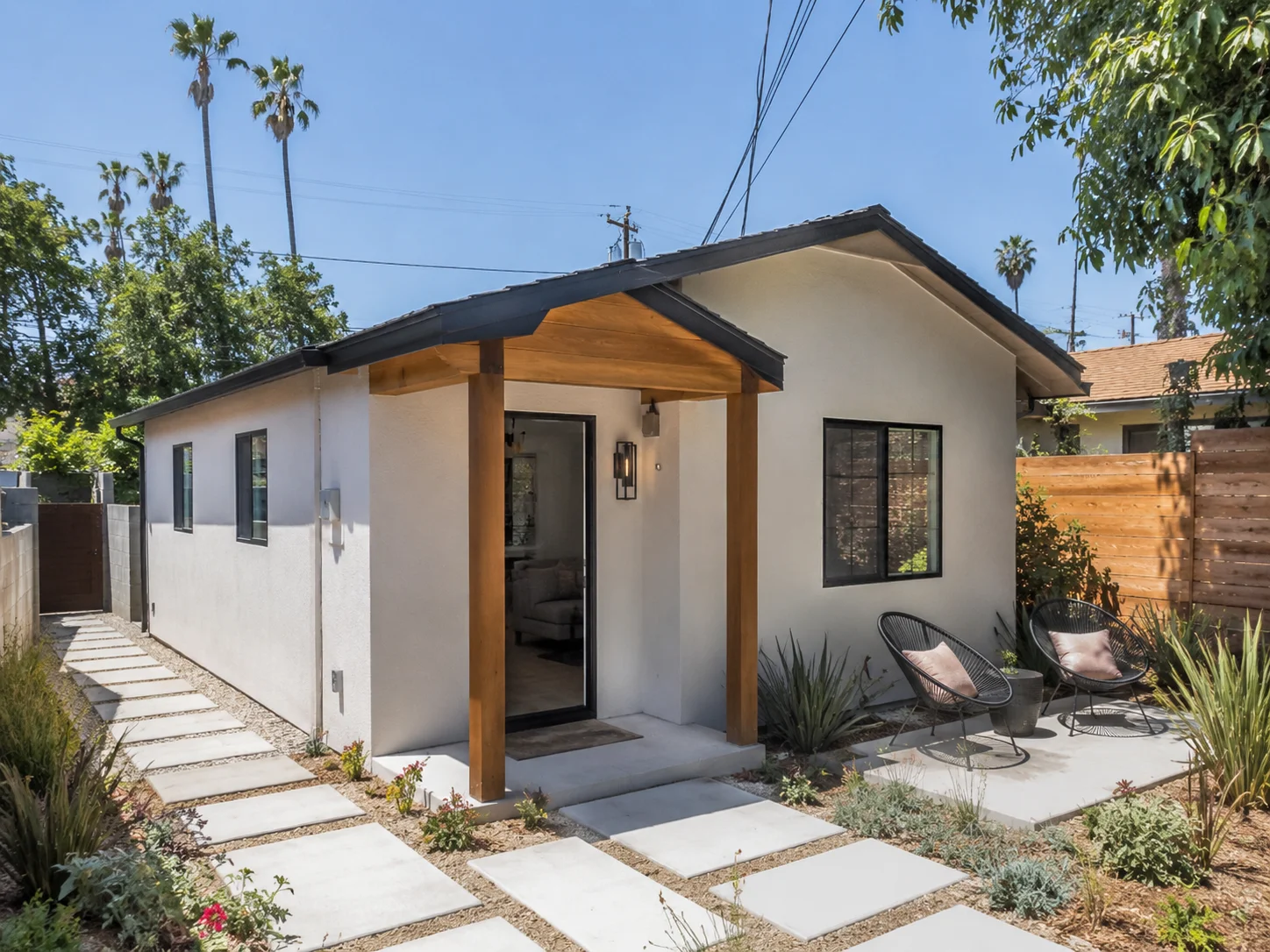
LAHD: the Los Angeles Housing Code (LAMC Article I, Chapter XVI) applies to residential rental properties with two or more units where at least one is rented. Add an ADU or JADU (junior ADU — a unit of 500 sq ft or less created within the existing home) to a lot with an existing home, and the property comes within that code — which means inspection obligations. If a property fails inspection, LAHD generally gives 30 days to fix violations; unresolved cases can be referred to the Rent Escrow Account Program (REAP) or the City Attorney.
RSO and JCO: it depends on your home’s age and ADU type
The RSO caps rent increases and regulates evictions; the JCO regulates evictions and requires registration but does not cap rent increases. Which applies turns on the October 1, 1978 construction cutoff.
| Your ADU scenario | RSO/JCO outcome (per LAHD) |
|---|---|
| Detached ADU on a lot with a pre-1978 single-family home | The detached ADU is generally not under RSO; the original pre-1978 house may become RSO-covered because a second unit now exists (unless Ellis Act replacement rules apply). |
| Attached, newly built ADU on a pre-1978 home | Only the original pre-1978 house is under RSO. The attached ADU is not under RSO (absent recent Ellis Act filings) and falls under the JCO. |
| ADU converted from habitable space of a pre-1978 home | Both units may be subject to RSO. |
| ADU converted from non-habitable space (e.g., garage) of a pre-1978 home | The new ADU is subject to JCO only, not RSO. |
Source: LAHD ADU page (housing.lacity.gov), last modified Sept 4, 2025. Verify your specific property with LAHD’s RSO Determinations Unit at (213) 928-9097.
Three more rules that catch owners off guard
- ⚠Registration fees apply. If your property becomes subject to RSO, the current registration fee is $38.75 per unit per year; for JCO units it’s $31.05 per unit per year. Temporary one-year exemptions exist for owner-occupied or year-long-vacant units, renewable by January 31 each year.
- ⚠No short-term rentals in RSO units. LAHD is explicit: home-sharing (short-term rental) isn’t allowed in units subject to the RSO. Under 2026 state law (AB 1154), JADUs can’t be used as short-term rentals at all and must be rented for terms longer than 30 days.
- ⚠Removing a tenant’s parking to build can require a rent reduction. If you take a parking space or storage that was part of an existing tenant’s tenancy to build your ADU, the RSO requires a corresponding rent reduction based on reasonable replacement cost (Rent Adjustment Commission Regulations Section 410).
The state-law backdrop (current for 2026)
Under Los Angeles City Planning’s ZA Memo 143 and state law — now renumbered into California Government Code §§ 66310–66342 (via SB 477) — ADUs are approved ministerially in residential zones where a home exists or is proposed; “ministerial” means a non-discretionary, over-the-counter-style approval without a public hearing if you meet the standards. State law protects an 800 sq ft ADU with four-foot side and rear setbacks, and as of 2026 that 800 sq ft figure refers to interior livable space. AB 976 permanently removed local authority to impose owner-occupancy requirements on standard ADUs.
Two 2026 changes worth flagging: AB 1154 (effective Jan 1, 2026) narrowed JADU owner-occupancy — it’s now required only when the JADU shares sanitation facilities with the primary home (Gov. Code §66333(b)). And under SB 543, cities must deem an ADU application complete within 15 days and approve or deny within 60 days, or the application is deemed approved. The city ADU ordinance itself is Ordinance 186,481, codified at LAMC §12.22 A.33.
Are there any ADU grants in Los Angeles or California right now?
The CalHFA ADU Grant funded pre-development soft costs — design, permits, soil tests — not construction itself, and it ran out of money. CalHFA has warned homeowners to be cautious about anyone claiming they can still access those grant funds. Track current status on our ADU grant tracker before you plan around it.
A separate point of confusion: the “ADU Accelerator Program” name is also used by an entirely different effort — the Senate District 7 ADU Accelerator, piloted by State Senator Steve Glazer, serving 15 East Bay cities (Antioch, Concord, Danville, Dublin, Lafayette, Livermore, Pleasanton, Walnut Creek, and others). It has nothing to do with Los Angeles. Most participating cities list rebates of up to $7,500 for standard ADUs and up to $15,000 for deed-restricted low-income ADUs, though local matches vary — Antioch has listed up to $30,000 for certain low-income deed-restricted units, and Walnut Creek reported all rebates claimed as of July 15, 2025 (with a backup list). If you found a page about “$7,500–$15,000 ADU Accelerator rebates,” you were reading about the East Bay program, not LA’s.
Why “grant” pages go stale so fast
Funding windows close. Pilots exhaust their money. Eligibility rules change. And third-party pages rarely update. That’s exactly how the LA Accelerator and CalHFA both ended up looking “open” long after they weren’t. Treat any grant claim without a recent verification date as a lead to confirm, not a fact to plan around.
What to compare instead of a grant
Realistic funding sources for an LA ADU today: cash savings, a HELOC or home equity loan (guide to HELOCs for ADU projects), a cash-out refinance, a renovation loan, a construction loan, family co-investment, phased construction to spread cost over time, and long-term rental income to service the debt. We go deep on these on our California ADU financing guide.
How do I check official status without getting misled?
Use primary sources first. For program status, the City of LA ADU pages; for funding decisions, LA City Clerk files; for rental compliance, LAHD; for what you can build, LA City Planning and LADBS; and for state grants, CalHFA. Treat contractor blogs, old rent figures, and social posts as clues, not proof — and always check the date.
| Source | What to verify there | Why |
|---|---|---|
| City of LA ADU homeowner page (adu.lacity.gov) | Whether applications are open or closed | The source of truth for program status |
| LA City Clerk files (e.g., 25-1199) | Council motions, funding, wind-down | Shows whether the program is funded or ended |
| LAHD ADU page (housing.lacity.gov) | RSO/JCO, Housing Code, fees | Required before you rent |
| LA City Planning / ZA Memo 143 + LADBS | Zoning, ministerial approval, permits | Required before you build |
| CalHFA bulletins | State ADU grant status | Avoids stale grant claims |
| HACLA / LACDA | Housing Choice Voucher landlord steps | If pursuing affordable/voucher rental |
Red flags that a page is out of date
- ×A page lists specific monthly rent dollar amounts with no verification date.
- ×A contractor says the program is “open” but can’t link to an official page.
- ×A financing or grant page promises approval or “free money.”
- ×A page treats Los Angeles County and the City of Los Angeles as the same thing.
- ×A page promises “guaranteed income” without mentioning tenant eligibility, the subsidy mechanism, or the closure.
Frequently asked questions
- Is the Los Angeles ADU Accelerator Program open in 2026?
- No. The official City of LA homeowner page says it’s currently closed and not accepting new applications, and a February 2026 City Council motion (file 25-1199) states the program was determined “not viable” in October 2025.
- Was the LA ADU Accelerator Program an ADU grant?
- Not in the way most people mean “grant.” In its operating form it was a rent-matching and rent-subsidy program for existing, permitted ADUs. Earlier pilot-era materials referenced a $10,000 grant and a $50,000 forgivable loan in certain cases — treat those as historical, not current, unless the City posts a new program.
- Who qualified as a homeowner for the LA ADU Accelerator?
- Owners of residential property inside the City of Los Angeles with an existing, legally permitted ADU holding a Certificate of Occupancy (or one in progress). Owner occupancy was not required. Applications are now closed.
- Who qualified as a tenant for the LA ADU Accelerator?
- Older adults — generally 62 or older — living in Los Angeles County, earning no more than 30% of Area Median Income, who could provide required documentation. The program served eligible tenants regardless of immigration status.
- How much rent did tenants pay in the LA ADU Accelerator?
- Tenants paid 30% of their income, and a City subsidy covered the gap up to the program’s market-rent standard, per the City tenant page and a 2023 LAHD report.
- Can I still rent my ADU to a Section 8 tenant in Los Angeles?
- Yes — but that’s a separate path from the closed Accelerator. A local housing authority (HACLA or LACDA) administers the voucher, you screen and select the tenant, the unit passes a housing-quality inspection, and the authority pays its share of rent directly to you. Confirm current enrollment steps and payment standards with HACLA or LACDA.
- Does adding an ADU put my LA property under rent control?
- It can affect compliance. LAHD says adding an ADU/JADU can bring a property within the Los Angeles Housing Code, and RSO/JCO treatment depends on the home’s age and ADU type. Confirm with LAHD’s RSO Determinations Unit at (213) 928-9097.
- Can I use my LA ADU as a short-term rental?
- Not if it’s subject to the RSO — LAHD prohibits home-sharing in RSO units. And under 2026 state law (AB 1154), JADUs can’t be short-term rentals at all. Verify your unit’s status and the city’s Home-Sharing Ordinance before listing.
- What should I do if my ADU is unpermitted in Los Angeles?
- Verify records at LADBS and pursue legalization before renting. California’s AB 2533 (late 2025) strengthened the legalization pathway for pre-2020 unpermitted ADUs. The closed program required legal units anyway, and renting an unpermitted unit carries real risk.
- How much does an ADU cost to build in Los Angeles in 2026?
- Roughly $95K–$245K for a garage conversion, $200K–$350K for an attached ADU, $200K–$459K for a detached ADU, and $80K–$150K for a JADU in 2026, plus permits and soft costs — varying with size, finishes, and site conditions.
What we verified
| Source category | Used for | Verification date |
|---|---|---|
| City of LA ADU pages (adu.lacity.gov, homeowners & tenants) | Program status, eligibility, rent share | May 26, 2026 |
| LA City Clerk file 25-1199 (motion, Feb 2026) | “Not viable” determination, fund redirect | May 26, 2026 |
| LA City Clerk files 21-0541, 21-1375, 21-1375-S1 | Funding history, subsidy mechanics, three-year term, provider contract | May 26, 2026 |
| LAHD ADU page (housing.lacity.gov, mod. Sept 4, 2025) | RSO/JCO scenarios, fees, home-sharing, parking | May 26, 2026 |
| LA City Planning ZA Memo 143; Gov. Code §§66310–66342; Ordinance 186,481 / LAMC 12.22 A.33 | Ministerial approval, setbacks, code numbering | May 26, 2026 |
| HCD ADU Handbook 2026 Addendum; AB 1154, SB 543, AB 976, AB 2533; CA Energy Commission | JADU owner-occupancy, impact fees, solar PV, legalization | May 26, 2026 |
| Brookings (2024) | Independent program scale and history | May 26, 2026 |
| CalHFA bulletins | State grant status | May 26, 2026 |
| LA builder cost guides (Silver Hammer, CALI ADU, GreatBuildz, CCS); LAHD 2023 baseline | 2026 cost ranges (illustrative) | May 26, 2026 |
We do not administer the LA ADU Accelerator Program, provide legal advice, or guarantee financing, rental income, approval, permits, or tenant placement.
Methodology
We treated official City of Los Angeles and LA City Clerk documents as the highest-priority sources for program status and funding history, and verified the “not viable” determination by reading the February 2026 motion in file 25-1199 directly. We used LAHD and LA City Planning materials for rental-compliance and zoning context, the HCD 2026 ADU Handbook Addendum and 2025 legislation for current state-law detail, Brookings for independent policy framing, and an LA-Más historical guide solely to explain why older pages reference grant figures. Los Angeles homeowner forum discussions informed only how people phrase the problem — never as proof of law, cost, or status. Cost ranges are synthesized from multiple 2026 Los Angeles builder guides, shown source-by-source, with the City’s older 2023 estimate as a baseline.
Last updated: May 26, 2026. Last verified: May 26, 2026. Re-check adu.lacity.gov, LAHD, LA City Clerk files, and CalHFA before relying on this page for a live decision.
Download the Free ADU Starter Kit
Save the LA status checklist, the RSO/JCO decision table, the source-by-source cost comparison, and the questions to ask before you call a builder, lender, or city office — all in one PDF.
Get the Free ADU Starter Kit ↓Where to go next on The Dwelling Index
- ADU grants database — verified programs, updated regularly
- California ADU financing guide — every lane explained
- How much does an ADU cost? (2026 ranges by type)
- HELOCs for ADU projects — how they work
- Garage conversion ADU financing
- How to finance an ADU rental
- How to finance an ADU in 2026 — all paths
- HELOC vs. cash-out refi for ADUs
Not sure where to start?
Get a state-level ADU rules overview, broad cost ranges, and an illustrative estimate of available equity. Verify Los Angeles property requirements and program terms with the relevant offices.
Get My ADU Planning Overview