
Colorado ADU Grant: Who Gets the Money, Which Cities Help, and What to Do Next
By the Dwelling Index editorial team — an independent research resource covering ADU financing, costs, and regulations.
· · Last verified: May 26, 2026
The bottom line, up front
Colorado has an “ADU grant” — but as a homeowner, you almost certainly can’t apply to the state for a check. Colorado’s Accessory Dwelling Unit Grant Program (ADUG), created by House Bill 24-1152, sends money to certified local and tribal governments — not to individual property owners. Those cities and counties then turn the money into homeowner-facing help: waived permit fees, free plan resources, technical assistance, or local incentives. The funding that can reach you directly is either a local city or county program (a handful exist right now — from a 25% construction reimbursement in Summit County to a $150,000 loan in Eagle County) or the separate CHFA ADU Finance Program (loans and interest-rate buydowns through lenders, not a grant).
- Who this applies to: Colorado homeowners wanting to build or convert an ADU.
- The one number that matters: $0 in direct state cash grants to homeowners. The state’s entire inaugural ADU grant round awarded $889,525 — to seven local governments, not to residents.
- Your real next step: Find out whether your city or county turned state money into a homeowner benefit — and whether the strings attached fit your plan — before chasing a “grant” that may not exist for you.
Here’s a snapshot of the four paths, so you know where you stand before you read another word:
| Path | A direct homeowner grant? | Who controls it | Your move |
|---|---|---|---|
| DOLA ADUG | No | State → city/county | Check what your city built with it |
| Local city/county program | Sometimes | Your city or county | Read the restrictions first |
| CHFA ADU Finance | No — it’s financing | CHFA → lenders | Verify lender availability |
| Private financing | No | Lender | Compare after a feasibility check |
We’ll be honest with you the whole way down, because the internet is full of pages implying a Colorado homeowner can grab grant cash the way Californians once could with the old $40,000 CalHFA grant — a program that, per CalHFA, fully allocated its last round of funding back on December 28, 2023. That kind of direct homeowner grant doesn’t exist in Colorado. But the search isn’t dead. Your money is just somewhere more specific than “the state.” Let’s find it.
→ See what’s possible at your address
Before you chase a grant, confirm what your lot can actually build. It provides state-level ADU rules, broad cost ranges, and an illustrative equity estimate. It does not determine grant eligibility or verify your property’s local requirements.
Get My ADU Planning Overview
Does Colorado have an ADU grant for homeowners in 2026?
Yes, Colorado has an ADU grant program — but it is not a universal, direct-to-homeowner cash grant. The state’s Department of Local Affairs (DOLA) awards Accessory Dwelling Unit Grant Program (ADUG) money to certified “ADU Supportive Jurisdictions” — local and tribal governments — which may then use it to reduce homeowner barriers through pre-approved plans, technical assistance, fee waivers, or other eligible cost support. A homeowner does not apply to DOLA for a personal grant.
Here’s the distinction that ends most of the confusion. When you type “Colorado ADU grant,” you’re picturing a single application that puts money in your pocket. Colorado instead built a pipeline: the state funds the city, the city builds a local program, and that program may — or may not — pass a benefit to you. Whether you see a dollar of it depends entirely on what your specific jurisdiction did with the money. DOLA is blunt about this on its own program page: these awards go to local governments, and residents seeking ADU financing are directed to contact CHFA.
There are really three different things people call “the Colorado ADU grant,” and conflating them is where people waste weeks:
| What people call “the grant” | What it actually is | Can a homeowner get it directly? | Who controls it |
|---|---|---|---|
| DOLA ADUG | State grant to local/tribal governments | No — cities and counties apply | Colorado DOLA / Division of Local Government |
| CHFA ADU Finance Program | Loans, credit enhancement, interest-rate buydowns through lenders | No — it’s financing, not a grant | CHFA via participating lenders |
| Local city/county ADU program | Fee waivers, reimbursements, or local loans funded partly by ADUG | Sometimes — if your jurisdiction built one | Your city or county housing/planning office |
Sources: Colorado DOLA Division of Local Government — ADUG program page; HB24-1152 (C.R.S. §§ 29-35-401–405). Verified May 26, 2026.
Is the Colorado ADU grant application open right now?
Homeowners do not apply to DOLA for the ADU grant — local governments do. The inaugural Round 1 was open to jurisdictions from August 1 to October 3, 2025, with awards announced November 19, 2025. DOLA opened a second round on February 2, 2026 (closing February 27, 2026, with the application deadline later extended). If you’re a resident, your “application” is really a phone call to your city or county to ask what they did with any funds — always verify current round timing with DOLA directly.
This is the question behind every “colorado adu grant application” search, so let’s answer it cleanly: there is no homeowner application portal at the state level, and there never was one. The DOLA grant rounds are a local-government calendar. What you can act on is whatever your jurisdiction built — which brings us to exactly who won money in the first round.
Sources: Round dates per DOLA award release, Nov 19, 2025 and DOLA Division of Local Government. Verified May 26, 2026.
Where did the first round of Colorado ADU grant money actually go?
Approximately $1.6 million was available for ADUG awards in FY2025-26, and the inaugural Round 1 awards announced November 19, 2025 totaled $889,525 across seven communities — every dollar to a local government, not to a homeowner. Knowing which jurisdictions won tells you where homeowner-facing programs are most likely to exist, so this is your local-research starting map.
First-round ADUG award watchlist
| Jurisdiction | Awarded program | Award | Homeowner benefit status |
|---|---|---|---|
| Grand Junction | ADU Production Program | $325,000 | ✅ Verified live homeowner program (see below) |
| Superior | Building Together: Encouraging ADU Development | $225,000 | Check with town — homeowner pass-through not yet verified |
| Larimer County | ADU Fee Waiver Program | $105,000 | Check with county — fee-waiver mechanics not yet verified |
| Glenwood Springs | ADU Accelerator Program | $84,000 | Check with city — homeowner benefit not yet verified |
| Fruita | ADU Fee Waiver Project | $75,000 | ⏳ Program “coming soon” (see below) |
| Brighton | ADU Supportive Jurisdiction Grant | $38,025 | Check with city — homeowner benefit not yet verified |
| Longmont | ADU Stock Plan Update | $37,500 | Check with city — pre-approved plan resource likely |
If your city is on this list and isn’t marked “verified,” that’s not a dead end — it’s your cue to call. The grant money is there; whether your jurisdiction converted it into something you can claim is the question to put to them directly, using the script further down this page.
Source: Exact award amounts and program names per DOLA award release, Nov 19, 2025. FY2025-26 available pool (~$1.6M) per DOLA ADUG program page. Verified May 26, 2026.
Who can actually apply for Colorado’s ADU Grant Program?
The state ADUG program is open only to certified ADU Supportive Jurisdictions — local or tribal governments — not to individual homeowners. Your job as a homeowner is to find out whether your local government received ADUG funding (or applied) and whether it created a fee waiver, plan resource, technical-assistance fund, or incentive you can use.
What is an “ADU Supportive Jurisdiction”?
It’s a Colorado local government that DOLA has certified — meaning it complied with HB24-1152’s ADU requirements and adopted at least one supportive strategy to encourage ADU construction or conversion. This certification is the gate that matters to you for two reasons: it’s what lets a city access ADUG grant dollars, and it’s what lets that city’s residents tap the CHFA ADU Finance Program. A “Subject Jurisdiction,” by contrast, is a local government legally required to comply (generally those in major metro areas); a jurisdiction outside those areas can opt in voluntarily.
As of October 3, 2025, 82% of the local governments subject to the ADU law were either compliant or pursuing compliance, with an additional five non-subject jurisdictions voluntarily pursuing it. That number moves monthly as certifications roll in, so your city’s status this month may differ from last.
What can the grant money pay for at the local level?
Per the ADUG program rules, certified jurisdictions can spend grant funds on activities that promote ADU construction, including offsetting the cost of developing pre-approved ADU plans, providing technical assistance, and waiving, reducing, or financially assisting with ADU-associated fees. One detail nobody tells homeowners: the program carries a 25% required local cash match, and the whole inaugural pool was about $1.6 million. This is a small, oversubscribed fund — which is exactly why your benefit shows up as a fee waiver or a plan resource, not a check.
The exact questions to ask your city (copy/paste this)
- “Has [city/county] been certified by DOLA as an ADU Supportive Jurisdiction?”
- “Did we receive ADUG grant funds, or apply in the latest round?”
- “Are there homeowner fee waivers, free plan resources, technical-assistance funds, or direct incentives available right now?”
- “What strings are attached — long-term rental, no short-term rental, income limits, owner-occupancy, or a recorded deed restriction?”
- “Do I need planning clearance, a permit application, or a contractor estimate before I apply?”
That last question matters more than it sounds — at least one Colorado program disqualifies you the moment your building permit is issued.
Sources: Eligibility, allowable uses, and 25% match per DOLA ADUG program page and ADUG FAQ; 82% figure per DOLA award release, Nov 19, 2025. Verified May 26, 2026.
→ Not sure if your city is certified? Start with your property
Use the planning tool for general state-level rules, broad cost ranges, and an illustrative equity estimate. Confirm grant certification and program eligibility through the official program sources.
Get My ADU Planning Overview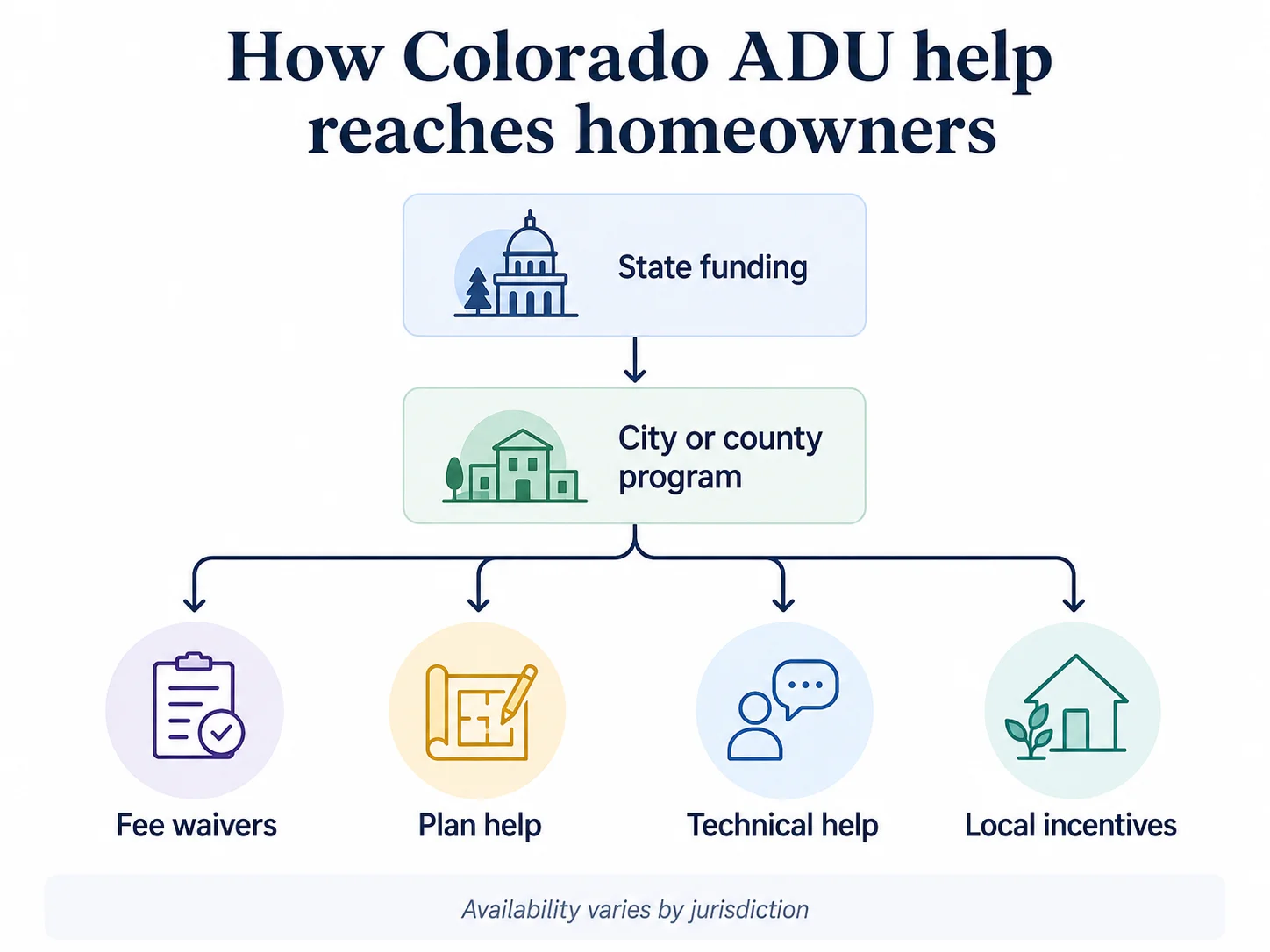
Which Colorado places have real homeowner ADU help right now?
A handful of Colorado cities and counties have genuine homeowner-facing ADU assistance — but the help varies enormously, and most of it comes with multi-year strings. The strongest verified programs as of May 2026 are Grand Junction’s ADU Production Program (city fees paid, plus up to $15,000 total for income-qualified owner-occupants), Eagle County’s Aid for ADUs (up to a $150,000 loan), and Summit County’s ADU Assistance Program (25% construction reimbursement, up to $60,000 per the county). Fruita has a fee-waiver program in development.
This is the part no single competing page assembles — and the reason this page exists. We read each program’s official page and pulled the real numbers, the real restrictions, and the real catch. Here’s the matrix.
The Colorado ADU Funding Reality Matrix
| Program | Who it’s really for | What you may get | Geography | The catch you must know | Source |
|---|---|---|---|---|---|
| DOLA ADUG | Cities/counties only | Indirect help: pre-approved plans, technical assistance, fee waivers | Certified CO local/tribal govts | Benefit depends entirely on local implementation; 25% local match; ~$1.6M FY25-26 pool, $889,525 awarded in Round 1 | DOLA DLG |
| CHFA ADU Finance | Lenders → low/moderate-income borrowers | Loans, credit enhancement, interest-rate buydowns (not a grant) | Residents of supportive jurisdictions | Income-limited; routed through lenders; borrower availability phasing in through 2026 | CHFA / OEDIT |
| Grand Junction ADU Production Program | ADU developers; Tier 2 = owner-occupants under 140% AMI | Tier 1: City impact + water/sewer fees paid. Tier 2: those fees plus a direct incentive, up to $15,000 total | City of Grand Junction | No short-term rental of the ADU or primary home during the commitment; Tier 1 = 5 yrs, Tier 2 = 7 yrs + owner lives on-site; planning clearance number required first; build within 12 months | gjcity.org (Ord. 5136) |
| Eagle County “Aid for ADUs” | Existing property owners | Up to $150,000 loan (promissory note + deed of trust) | Eagle County, where ADUs are permitted | 15-year deed restriction; rent to a household ≤100% AMI; short-term rentals strictly prohibited; first-come, first-served | housingeaglecounty.com |
| Summit County ADU Assistance | Owners/builders in unincorporated Summit County | 25% reimbursement of eligible construction cost — up to $60,000 depending on the situation (verify current cap) | Unincorporated Summit County | Deed restriction limiting occupancy to a Qualified Occupant/local worker or Relative; workforce covenant (occupant works in-county 30+ hrs/wk); 110% AMI rent cap; apply on/before permit issuance; paid at Certificate of Occupancy | summitcountyco.gov |
| Fruita ADU Fee Waiver & Assistance | Eligible homeowners (at launch) | Program page lists up to $10,000 in waived fees; a Dec 2025 city release described ~$5,000 in waived/reduced fees | City of Fruita | Coming soon (expected mid-2026); no short-term rental for at least 5 years; confirm final cap and launch with the city | fruita.org |
| Private financing | Any homeowner | HELOC, cash-out refinance, renovation loan, construction loan | Statewide, subject to underwriting | Debt; no guaranteed rate, approval, or savings | See financing section |
The verified standouts, in plain English
Grand Junction runs the most homeowner-friendly program we found. Established by Ordinance No. 5136 in March 2023, the ADU Production Program (APP) has two tiers. Tier 1 is open to anyone: the City pays your impact and water/sewer fees, you commit to keeping the ADU (and any other rental units on the lot) as long-term rentals for 5 years, and you build within 12 months of planning clearance. Tier 2 is for owners who’ll live on the property and earn under 140% of Area Median Income (AMI) — they get those fees paid plus a direct incentive, capped so the total benefit reaches up to $15,000, in exchange for a 7-year commitment. Across both tiers, the application form specifies no short-term rental of either the ADU or the primary structure during the commitment period. Grand Junction also offers free sample ADU plans (from a 384 sq ft one-bed to a 900 sq ft two-story) and a free 2026 workshop series at City Hall — though the city is clear that these sample plans are not complete construction documents and don’t guarantee permit approval. Incentives are first-come, first-served, and you must have a planning clearance number before applying.
Eagle County’s “Aid for ADUs” offers existing property owners up to $150,000 as a low-cost loan from the Eagle County Housing and Development Authority, secured by a promissory note and deed of trust. The trade: a 15-year deed restriction requiring the ADU be leased to an eligible household earning no more than 100% AMI, with short-term rentals strictly prohibited. It’s first-come, first-served — strong if you’re building a long-term workforce rental, a poor fit if you wanted flexibility.
Summit County reimburses 25% of the cost of constructing an ADU in unincorporated Summit County — covering new attached or detached units, new ADUs inside existing homes, and conversions of non-compliant ADUs. The county’s ADU page indicates reimbursement of up to $60,000 depending on the situation, and notes it may pay tap fees up front in participating water/sewer districts (verify the current cap with the county). All ADUs are subject to a deed restriction limiting occupancy to a Qualified Occupant / local worker or Relative, the covenant requires that the occupant of either the ADU or the primary home work in Summit County 30+ hours per week on average, and a 110% AMI rent cap applies (the County’s 2024 caps ran roughly $2,560 studio, $2,743 one-bed, $3,291 two-bed per month). Two procedural traps: you must apply on or before the date your building permit is issued (issued or completed permits are not eligible), and the money is paid only at Certificate of Occupancy.
Fruita’s ADU Fee Waiver Project — backed by a $75,000 Round 1 ADUG award — is coming soon, expected mid-2026. The city’s program page lists up to $10,000 in waived fees, while a December 2025 city news release described roughly $5,000 in waived or reduced fees, with a commitment to no short-term rental use for at least five years. Because those two figures differ, confirm the final cap and launch date with Fruita before counting on it.
Sources: Grand Junction terms, AMI threshold, $15,000 cap, 5/7-yr commitments, no-STR rule, sample-plan disclaimer, and workshops per gjcity.org / Ordinance No. 5136. Eagle County loan, deed restriction, AMI cap, STR prohibition per housingeaglecounty.com. Summit County 25% reimbursement, up-to-$60,000 figure, deed restriction, workforce covenant, 110% AMI cap, 2024 rent caps, and timing rules per summitcountyco.gov. Fruita figures per fruita.org and the city’s Dec 2025 release. Verified May 26, 2026.
Find your funding path
Colorado ADU Grant & Fee-Waiver Lookup → Enter your city and ADU plan to see whether to check a DOLA-funded local program, CHFA, or a private financing path first — plus the exact office to call and the restrictions to ask about. (Interactive tool — wire to current DOLA certified list when available.)
What if my city has no ADU grant or fee waiver?
If your jurisdiction has no active homeowner ADU program, your project is far from dead — it just means your funding path is private or CHFA-based rather than grant-based. Confirm the ADU is legal and buildable on your lot first, then run your local-program check, CHFA eligibility, and private-financing options in parallel rather than waiting on a grant that may never open for you.
We see people lose months here, hoping a program will materialize. So here’s a clear framework.
Waiting for a local grant probably makes sense if: your city has publicly announced a near-term launch, you’re income-eligible, the restrictions match your intended use (e.g., you genuinely want a long-term rental), and you can tolerate timing uncertainty.
Waiting probably does not make sense if: you plan to use the ADU as a short-term rental (most programs ban it), you need the unit for family soon, you’re not in a participating jurisdiction, your city has no published timeline, or the likely benefit is small relative to a six-figure build.
The honest math: for example, on an illustrative $250,000 detached ADU, a $10,000 fee waiver is 4% of the cost — real money, but not the thing that makes or breaks the project. Your financing structure usually matters more than the grant. So let’s talk about how Coloradans actually pay for these.
→ No local grant? Here’s how Coloradans actually fund ADUs
Compare home-equity, cash-out refinance, renovation, and construction-loan paths in one place. Educational only — no approval, rate, or savings guaranteed.
Explore ADU Financing Options →What is CHFA’s Colorado ADU finance program — and is it a grant?
CHFA’s ADU support is financing, not a grant. Authorized by HB24-1152 and funded with $8 million through OEDIT, the CHFA ADU Finance Programs provide loans, credit enhancement, and interest-rate buydowns to eligible lenders, who then make loans available to low- and moderate-income borrowers (and/or their tenants) in ADU Supportive Jurisdictions. You don’t get a check from CHFA — you get access to a better-structured loan through a participating lender.
Here’s the lane, decoded:
| CHFA-related support | Plain-English meaning | The homeowner caveat |
|---|---|---|
| Relending | CHFA lends to nonprofits, public housing authorities, and CDFIs, who lend to borrowers | Not always a direct consumer product; opened to lenders December 2025 |
| Credit enhancement | Helps lenders say “yes” to ADU loans for eligible borrowers | Still lender-underwritten; you still have to qualify |
| Interest-rate buydown | May lower the interest cost on an eligible loan | Availability and terms phasing in through 2026 |
On timing: OEDIT indicates relending support opened to lenders in December 2025, with interest-rate buydowns and credit enhancement reaching lenders in early 2026 and borrowers later in 2026; CHFA program notices describe the Credit Enhancement and Interest Rate Buydown programs becoming available in early 2026. The key point for budgeting: borrower-facing lender participation and terms still need direct verification with CHFA before you build around them.
Two things to keep straight: DOLA is the jurisdiction-grant lane; CHFA is the borrower-financing lane. Both are tied to ADU Supportive Jurisdiction status — so the certification question decides whether either touches you. We won’t quote you a rate, a payment, or “easy qualification,” because nobody honestly can. If you think you might be income-eligible, confirm current availability and participating lenders directly with CHFA.
Sources: $8M program size and structure per OEDIT ADU Finance Program and CHFA ADU Finance Programs; rollout timing per CHFA news (Dec 12, 2025) and OEDIT; statutory authority HB24-1152. Verified May 26, 2026.
How do Coloradans actually finance an ADU right now?
While the state programs mature, most Colorado homeowners fund ADUs through home equity, a cash-out refinance, a renovation loan, or a construction loan — not a grant. These are financing paths with different tradeoffs; the right one depends on how much equity you have, whether you want to touch your existing mortgage rate, and your timeline. We present these as lanes, not as ranked “best lenders,” and we don’t sort by anything except what fits your situation.
- Home equity line of credit (HELOC) or home equity loan. Borrow against equity you already have, leaving your first mortgage untouched. Good if you have substantial equity and a primary mortgage rate you don’t want to disturb. Use this lane when your city has no active ADU aid and you’ve built up equity. A HELOC is a revolving line; a home equity loan is a lump sum.
- Cash-out refinance. Replace your existing mortgage with a larger one and take the difference in cash. Can make sense if current rates are at or below your existing rate — much less so if refinancing would raise the rate on your whole balance.
- Renovation loan. Sized against your home’s projected after-renovation value rather than its current value — useful when you don’t yet have enough equity to cover the build. A practical bridge while you wait to confirm CHFA lender availability.
- Construction loan (or construction-to-permanent). Funds released in draws as the ADU is built, then converted to a standard mortgage. Common for ground-up detached ADUs.
One Colorado-specific caution: don’t treat CHFA as guaranteed financing until you’ve confirmed a participating lender will actually fund your project. It’s a strong option if it lands for you — but build your fallback with a conventional lane so a delay in the program doesn’t stall your project.
These are illustrative examples of how financing works, not guarantees of returns, rates, approval, or savings. Actual results depend on local market conditions, construction costs, financing terms, and regulatory approvals.
→ Compare ADU financing paths
See which lane fits your equity and timeline. Educational; terms not guaranteed.
Compare ADU Financing Options →What strings come attached to Colorado ADU help?
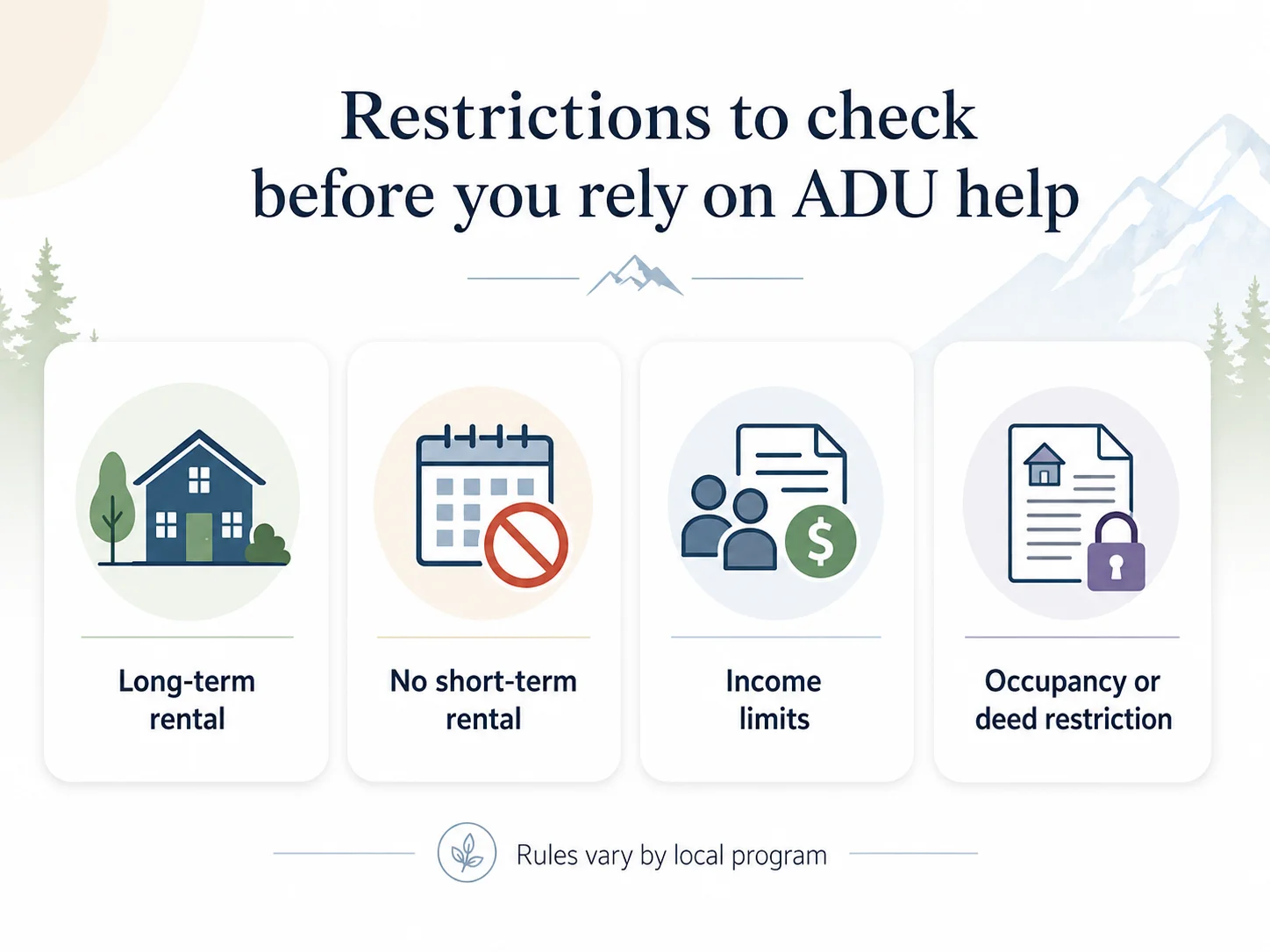
The biggest catches on Colorado ADU assistance are rental-use restrictions, no-short-term-rental rules, income/AMI caps, recorded deed restrictions, owner-occupancy requirements, and strict timing rules. The help can be genuinely valuable — but only if those restrictions match what you actually plan to do. Pursuing a program whose rules fight your goal is worse than taking no help at all.
| Restriction | What it means for you | Verified Colorado example |
|---|---|---|
| Long-term rental commitment | You can’t freely switch the unit’s use during the window | Grand Junction APP: 5 years (Tier 1) / 7 years (Tier 2) |
| No short-term rentals | Airbnb/VRBO-style use is prohibited | Eagle County: STRs strictly prohibited; Grand Junction: no STR of ADU or primary home during commitment |
| AMI income/rent cap | Tenant or owner income — or the rent you can charge — is capped | Eagle County: tenant ≤100% AMI; Summit County: 110% AMI rent cap |
| Recorded deed restriction | A restriction is recorded against your property for years | Eagle County: 15-year deed restriction; Summit County: occupancy deed restriction |
| Workforce covenant | The occupant must meet a local-employment rule | Summit County: occupant works in-county 30+ hrs/wk |
| Apply-before-permit rule | Applying too late disqualifies you entirely | Summit County: must apply on/before permit issuance |
| Reimbursement timing | You front the cost; funds arrive only at completion | Summit County: paid at Certificate of Occupancy |
Sources: All restriction details per the Grand Junction, Eagle County, and Summit County program pages cited above. Verified May 26, 2026.
Are ADUs even legal in my Colorado city — grant or no grant?
ADU legality and grant eligibility are completely separate questions. Under HB24-1152, subject jurisdictions must — generally as of June 30, 2025 — allow at least one ADU as an accessory use wherever single-unit detached homes are allowed, using an administrative (objective) approval process. But local governments can still enforce building code, fire code, utility capacity, water/sewer service, stormwater, floodplain, historic-district, and short-term-rental rules.
State-law floor vs. local details
| What state law guarantees (subject jurisdictions) | What your local government still controls |
|---|---|
| At least one ADU where single-unit detached homes are allowed | Building and fire code compliance |
| Internal, attached, and detached ADUs | Utility capacity and water/sewer “will-serve” |
| Administrative / ministerial approval (objective standards) | Stormwater, floodplain, and historic-district overlays |
| Limits on certain overly restrictive local rules | Local impact, tap, and permit fees |
| — | Short-term-rental regulation |
The most common surprise on detached ADUs is utility capacity and water/sewer “will-serve” — confirming your lot can actually be connected, and at what cost. Build code matters too: Summit County, for example, requires ADUs built to the 2018 International Residential Code.
Sources: One-ADU requirement and administrative-approval framework per HB24-1152 and DOLA ADU guidance; 2018 IRC requirement per Summit County program guidelines. Verified May 26, 2026.
How much of my ADU cost can a Colorado grant realistically cover?
Treat any Colorado ADU grant or local program as a gap-reducer, not a funding plan. Local help typically covers fees, plan resources, technical assistance, a capped incentive, or a partial reimbursement — while you remain responsible for the bulk of construction, utilities, site work, and contingency. Build your full budget first, then subtract verified assistance.
Here’s what the verified programs actually contribute — the proof that no Colorado program funds a whole build:
| Program | What it contributes |
|---|---|
| Grand Junction | City impact + water/sewer fees paid; Tier 2 up to $15,000 total |
| Fruita (coming soon) | Up to $10,000 listed on program page; ~$5,000 in city news release — verify final cap |
| Summit County | 25% reimbursement of eligible cost; up to $60,000 depending on situation |
| Eagle County | Up to $150,000 — as a loan, not a grant |
| DOLA Round 1 (statewide) | $889,525 total — awarded to seven local governments, not residents |
And here’s what assistance does and doesn’t reach on your own build:
| Cost layer | Can Colorado ADU help cover it? | Notes |
|---|---|---|
| Pre-approved / sample plans | Sometimes | E.g., Grand Junction’s free sample plans |
| Technical assistance | Sometimes | Especially via city programs and workshops |
| Permit / impact / utility fees | Sometimes | Grand Junction pays these in both tiers |
| Construction labor & materials | Sometimes, rarely fully | Summit reimburses 25%; Eagle offers a loan |
| Utility upgrades / site work | Possibly, if eligible | Often the biggest surprise line item |
| Contingency | Usually not | Budget a separate contingency regardless of any grant |
| Short-term-rental income model | Usually a poor fit | Most programs prohibit STR use |
Sources: Program contributions per the Grand Junction, Fruita, Summit County, Eagle County pages and the DOLA award release cited above. Verified May 26, 2026.
How do I apply for Colorado ADU help without wasting weeks?
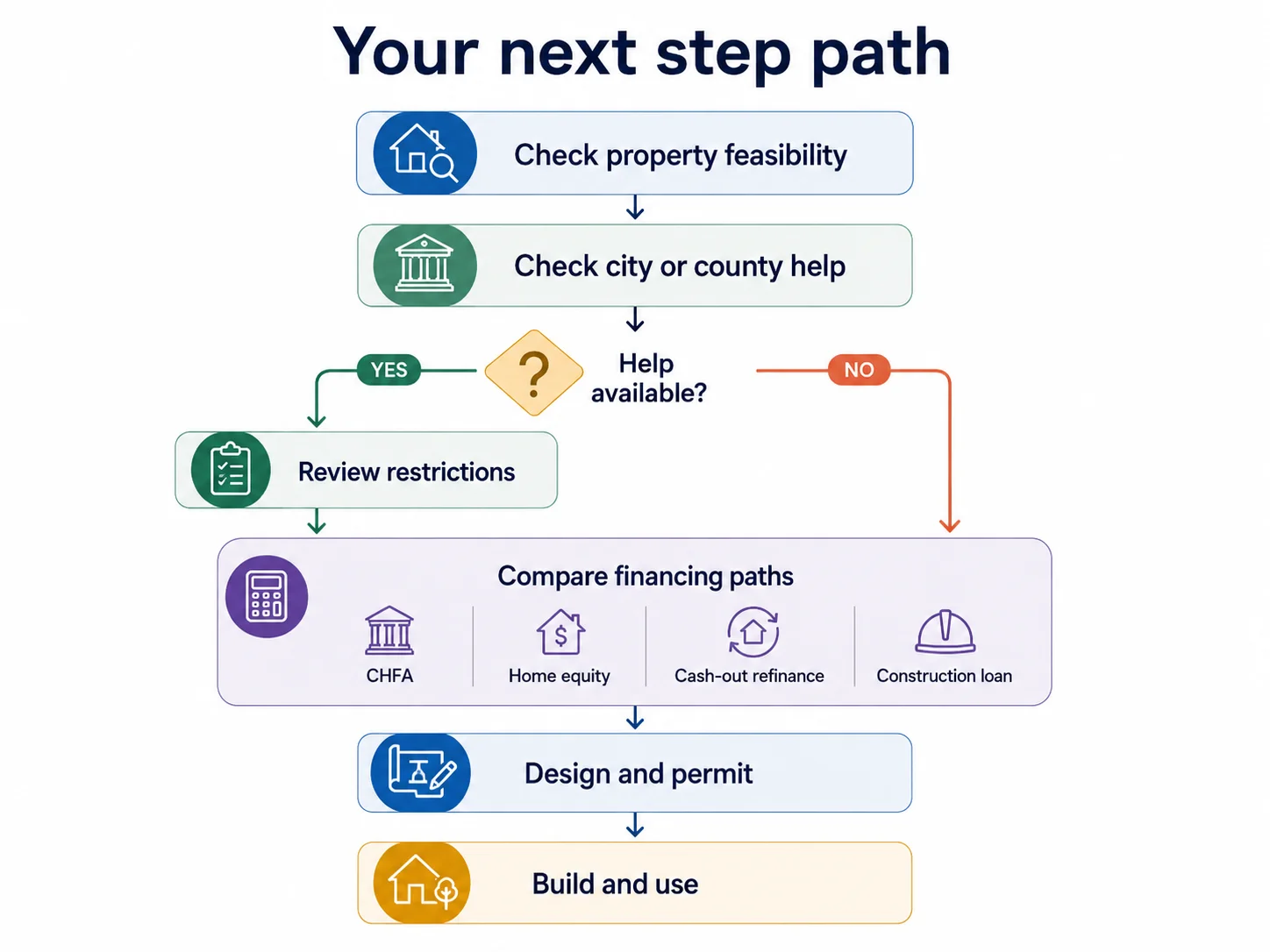
Apply from the local level outward — city/county program first, CHFA second, private financing third — and confirm your ADU is feasible before you fill out anything. Don’t start with generic “ADU grant” forms from non-government sites; Colorado’s real path runs through your specific jurisdiction.
- Confirm feasibility. Is an ADU legal and physically buildable on your lot (zoning, setbacks, utilities)? This gates everything else.
- Identify your jurisdiction. City vs. unincorporated county changes which program applies (Summit County’s reimbursement is unincorporated only).
- Confirm Supportive Jurisdiction status and whether a local homeowner program exists, using the call script above.
- Confirm program type — grant, fee waiver, loan, reimbursement, technical assistance, plan resource, or financing buydown. They are not interchangeable.
- Check the biggest restriction first (no-STR? AMI cap? deed restriction? apply-before-permit?). If a dealbreaker exists, you’ve saved yourself weeks.
- Gather documents: proof of ownership, parcel number, a preliminary ADU concept, planning clearance/zoning confirmation, a contractor estimate, income documents (if income-restricted), and financing prequalification (if required).
- Build a fallback funding plan in parallel — CHFA if eligible, private financing if not — so a “no” from one path doesn’t stall the project.
→ Start where it counts: your address
Start with general planning context, then confirm property eligibility and program terms with the appropriate local agency.
Get My ADU Planning OverviewDownload the Free Colorado ADU Funding Checklist
The call script, the restriction checklist, and the documents to gather before you apply.
Download the Free ADU Starter KitWhat we verified
Last verified: May 26, 2026. This page draws on primary Colorado government sources and official city/county program pages. We verified the following directly:
- State law & grant structure: HB24-1152 (C.R.S. §§ 29-35-401–405); DOLA ADUG program page and FAQ; DOLA award release (Nov 19, 2025) — exact award amounts ($889,525 total across seven communities), Round 2 dates, and the 82% compliance figure.
- CHFA / OEDIT financing: CHFA ADU Finance Programs; OEDIT ADU Finance Program ($8M; 2026 borrower phasing).
- Grand Junction ADU Production Program: gjcity.org (Ordinance No. 5136) — Tier 1/Tier 2 terms, 140% AMI threshold, up to $15,000 total, 5/7-year commitments, no-STR rule, sample-plan disclaimer.
- Eagle County “Aid for ADUs”: housingeaglecounty.com — up to $150,000 loan, 15-year deed restriction, 100% AMI cap, STR prohibition.
- Summit County ADU Assistance Program: summitcountyco.gov — 25% reimbursement (up to $60,000 per county page), occupancy deed restriction, workforce covenant, 110% AMI cap, apply-before-permit rule, payment at Certificate of Occupancy, 2018 IRC.
Confirm before relying on it: Fruita’s final fee cap and launch date (program page lists up to $10,000; Dec 2025 release describes ~$5,000); CHFA borrower-level terms and participating-lender list; homeowner benefits in Superior, Larimer County, Glenwood Springs, Brighton, and Longmont (these won Round 1 awards — confirm each local program directly); and the current certified-jurisdiction list (DOLA updates this on a rolling basis).
How we researched this guide
We built this from primary sources first: Colorado statute (HB24-1152) and DOLA guidance for the law and grant mechanics; CHFA and OEDIT for the financing lane; and official city and county pages for every local program figure. We used news coverage only to discover award timing and grantees, then verified each program against its official page. We used homeowner forum discussions only to understand the questions and anxieties people bring to this topic — never as evidence for law, cost, or program terms. Anything we couldn’t confirm to a primary source is flagged for verification rather than stated as fact. We don’t rank lenders by payout, we don’t quote guaranteed rates or approval odds, and we don’t invent author credentials, expert reviewers, or testimonials.
The Dwelling Index is an independent research resource covering ADU financing, costs, and regulations.
Frequently asked questions
- Does Colorado give homeowners direct ADU grants?
- Usually not through the state. Colorado’s ADUG program funds certified local and tribal governments. A homeowner benefits only if their city or county turned that funding into a local program such as a fee waiver, free plan resources, technical assistance, or a capped incentive.
- How do I apply for the Colorado ADU grant?
- Start with your city or county housing or planning office, not a state grant form. Ask whether your jurisdiction is a certified ADU Supportive Jurisdiction, whether it received or applied for ADUG funds, and whether any homeowner-facing help is currently available.
- Is the Colorado ADU grant application open right now?
- Not to homeowners — only local governments apply. Round 1 ran August 1–October 3, 2025; DOLA opened a second round February 2, 2026. Verify current round timing with DOLA.
- What is an ADU Supportive Jurisdiction?
- A Colorado local government that DOLA has certified as compliant with HB24-1152 and as having adopted at least one ADU-supportive strategy. Certification unlocks both ADUG grant eligibility (for the jurisdiction) and CHFA ADU financing eligibility (for that jurisdiction’s residents).
- Is CHFA’s ADU program a grant?
- No. CHFA’s ADU support is financing — loans, credit enhancement, and interest-rate buydowns delivered through lenders — not a cash grant. Income rules, lenders, and availability should be verified directly with CHFA.
- Which Colorado city has the best ADU assistance?
- It depends on your use case. Grand Junction offers the most accessible incentives (fees paid plus up to $15,000 for income-qualified owner-occupants). Eagle County offers the largest figure ($150,000) but as a restricted loan. Summit County reimburses 25% of construction cost (up to $60,000 per the county) in unincorporated areas. The “best” program is the one your property qualifies for and whose restrictions match your plan.
- Can I use my Colorado ADU as a short-term rental if I take assistance?
- Often no. Many programs restrict or prohibit short-term rental use — Eagle County prohibits STRs outright, and Grand Junction bars STR of the ADU or primary home during the commitment period.
- Can I stack a local fee waiver with CHFA financing?
- Possibly, but don’t assume it. Confirm stacking rules with both the local program administrator and your CHFA-participating lender before building it into your budget.
- Can an HOA stop my Colorado ADU?
- In subject and supportive jurisdictions, HB24-1152 limits an HOA’s ability to flatly prohibit ADUs in conflict with the law, but reasonable restrictions on design, placement, or size may still apply.
- Does the Colorado ADU grant cover construction?
- Rarely in full. Some programs cover fees or provide plan resources; Summit County reimburses 25% of eligible cost (up to $60,000 per the county); Eagle County offers a loan up to $150,000. None we verified function as a full construction grant.
- Should I wait for a grant before starting?
- Wait only if your city has an open or near-term program, you qualify, and the restrictions fit your use. Otherwise, verify feasibility now and pursue grant, CHFA, and private-financing paths in parallel.
Not sure where to start?
Get a state-level ADU rules overview, broad cost ranges, and an illustrative estimate of available equity. Verify local property requirements and grant terms separately.
Get My ADU Planning Overview