
Prefab ADU Floor Plans: Real Costs, Sizes & How to Pick the Right Model (2026)
By the Dwelling Index editorial team — an independent research resource covering ADU financing, costs, and regulations.
Last updated: May 31, 2026 · Last verified: May 31, 2026
Prefab ADU floor plans run from roughly 250 to 1,200 square feet — studios, one‑bedrooms, two‑bedrooms, and a few three‑bedrooms — and the best one for you is the smallest layout that fits your intended use, your buildable lot, and your jurisdiction's legal size cap. Here is the number almost every gallery page hides: the factory price you see advertised is not your finished cost. A 284‑square‑foot model listed at $56,500, or an 800‑square‑foot model at $116,000, is a materials/kit price — not a permitted, plumbed‑in, move‑in‑ready ADU. Once you add site work, foundation, utilities, permits, delivery, and installation, real‑world projects commonly land $50,000 to $150,000 or more above that headline number, and on tough lots higher still. So before you fall for a rendering, check what you can actually build on your lot — then use the tables below to match a floor plan to your goal. (An “ADU,” or accessory dwelling unit, is a second, self‑contained home — kitchen, bath, sleeping space, separate entrance — on the same lot as a main house.)
The honest one‑line verdict: The right prefab ADU floor plan is the smallest plan that (1) meets your use case, (2) fits your buildable envelope and delivery access, (3) follows a legal code path in your city, and (4) comes with a quote that separates the unit price from site work, foundation, utilities, permits, taxes, and installation. Everything below helps you confirm all four.
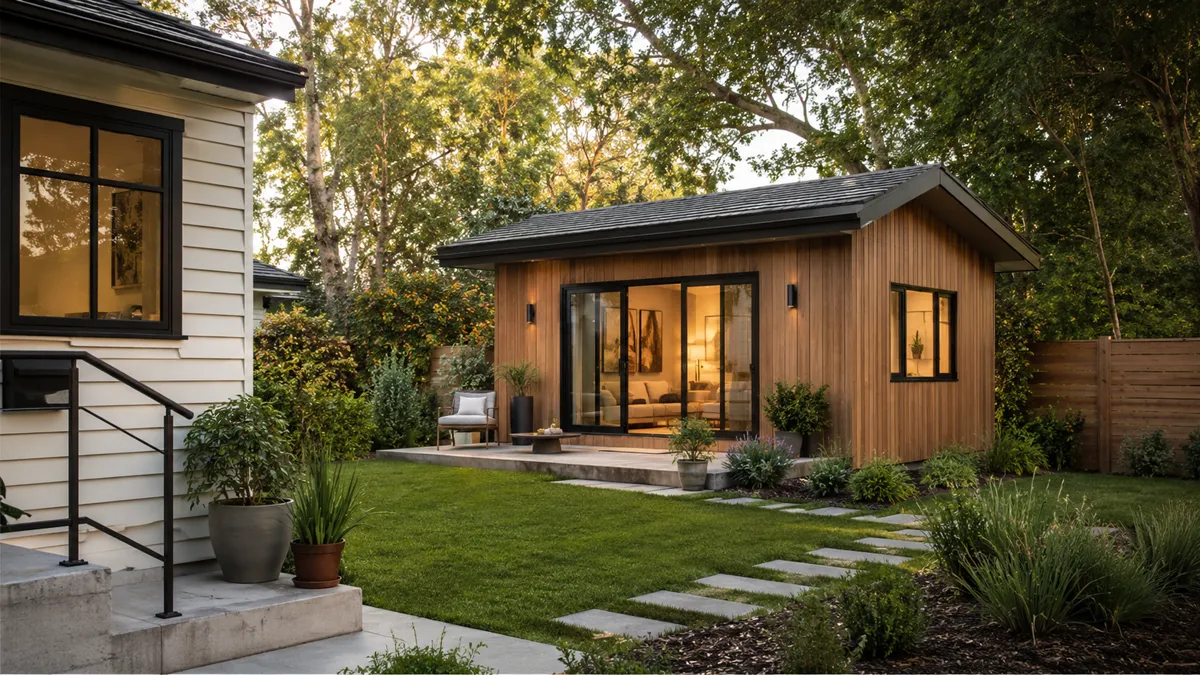
Start here: which prefab ADU floor‑plan path fits your situation?
This table is the fastest way to orient. Find the row that sounds like you, then read the section it points to.
| If you’re building for… | Start with this size | Best plan path | First thing to verify |
|---|---|---|---|
| An aging parent | 400–750 sq ft, 1 bed / 1 bath, single-story | Prefab model or a city pre-approved plan | No-step entry, accessible bath, setbacks, utility route |
| Long-term rental income | 600–1,000 sq ft, 1–2 bedrooms | Prefab/modular model or pre-approved plan | Local rental rules, parking, privacy, separate metering |
| An adult child moving back | 400–700 sq ft, studio or 1 bed | Studio or 1-bedroom model | Storage, laundry, sound separation from the main house |
| A high-rent market play | 800–1,000 sq ft, 2 bed / 2 bath | Modular/prefab with a full all-in quote | All-in cost, delivery/crane access, impact fees |
| A home office + guest space | 250–500 sq ft, studio/flex | Compact prefab or panelized kit | Whether it must legally be a full ADU (kitchen/egress) |
| A property-value play | The largest legal 2-bed your lot allows | Prefab, pre-approved, or custom | Buildable area after setbacks and FAR |
| A narrow or sloped lot | 400–800 sq ft, narrow/deep or two-story | Local plan or custom/panelized (most prefab is single-story) | Buildable envelope, fire/opening rules, crane reach |
Before you shop layouts, see what's actually buildable at your address. A beautiful plan still fails if the setbacks, delivery path, or local code path don't work — and that check is free.
See What You Can Build → Get Your Free ADU ReportWhat does “prefab ADU floor plan” actually mean — and why a floor plan is not a permit?
A “prefab ADU floor plan” can mean five different things: a modular factory home, a manufactured (HUD‑code) home, a panelized kit, a container or foldable unit, or a provider's specific model package. None of them is automatically permit‑ready. A floor plan is a layout; a permit plan set is a jurisdiction‑ready drawing package; and even a “pre‑approved” plan still needs site‑specific documents before your city will issue a permit. That distinction is where homeowners lose money — they buy a beautiful layout, then learn it needs local engineering, a different foundation, or a code path their city doesn't recognize.
Let's define the terms once, because they decide what you can legally build and what you'll actually pay.
Floor plan vs. permit plan set vs. prefab model vs. city pre‑approved plan
- Floor plan — the interior layout (where the walls, kitchen, and bath go). Useful for picturing the space. It is not what you submit for a permit.
- Permit plan set — a full construction drawing package (foundation plan, structural calcs, energy compliance, elevations, site plan) that a building department reviews during plan check (the city’s code review of your drawings before it issues a permit).
- Prefab model — a product with a fixed layout that a manufacturer builds in a factory. It still has to be permitted on your specific lot, and the factory price rarely includes the site work to get it there and connect it.
- City pre-approved plan — a layout a local government has already reviewed against its own code. It speeds plan check, but you still need site-specific drawings (drainage, utility connections, grading), and the savings are real but partial. San Diego County, for example, notes its pre-approved plans are roughly 85% complete and still require project-specific information (Source: San Diego County Planning & Development Services, snapadu.com guide, April 2026). Learn more on our pre-approved ADU plans page.
Modular vs. manufactured vs. panelized vs. container/foldable
These labels are not interchangeable, and the difference is legal, not cosmetic:
- Modular — built in sections in a factory to the same state and local residential building code as a site-built home, then assembled on a permanent foundation. A modular ADU passes the same inspections as stick-built and is treated as real property.
- Manufactured (HUD-code) — built to the federal HUD code rather than the local building code. Some jurisdictions allow a manufactured home as an ADU; others don’t. Always confirm locally.
- Panelized — walls and roof arrive as flat panels and are stood up on site. A hybrid: faster than full stick-built, more site labor than modular.
- Container / foldable — built inside or from a shipping-container frame, or folding flat for transport (the BOXABL Casita is the best-known foldable). Many are excellent; a few “prefab” units are actually RVIA-certified (built to recreational-vehicle standards, registered as RVs), which means they may not qualify as a permanent ADU in your city (Source: Zook Cabins, “Prefab vs Modular ADUs,” March 2026). If a unit’s only certification is RVIA, treat it as a tiny home or park model — not a guaranteed legal ADU — until your building department confirms otherwise.
Why it matters in plain English: Massachusetts wrote this distinction directly into its statewide ADU rule — a city may not impose requirements on a modular unit used as a protected‑use ADU that are more restrictive than the building code (Source: 760 CMR 71.03(3); Mass.gov). California treats modular and site‑built ADUs the same way. But a manufactured (HUD‑code) or RVIA unit can trip a different, slower approval path. The label on the box can change the permit.
The damaging admission, up front: Yes, a prefab ADU can be a bad buy even when the layout is gorgeous — if the unit won't clear your setbacks, the truck and crane can't reach the backyard, or the advertised price excludes the site work. We're giving you the all‑in number now, so you're never the homeowner who signs a contract and then discovers the real total. The next section is the one that protects your budget — keep reading.
Prefab ADU floor plans by size and layout (studio to three‑bedroom)
Prefab ADU floor plans cluster into four practical sizes: studios (about 250–450 sq ft), one‑bedrooms (about 480–600 sq ft), two‑bedrooms (about 650–950 sq ft), and a smaller number of three‑bedrooms (about 1,000–1,200 sq ft). Studios and one‑bedrooms dominate the prefab market; full two‑bedroom/two‑bath and three‑bedroom models exist but come from fewer makers and at a steep price step‑up. Pick the size by the job the ADU has to do, not by maximizing square footage — and because some fixed costs spread out as the unit grows, a slightly larger plan is sometimes the better value, not the worse one.
Here's what each size band is genuinely good for, and what tends to break.
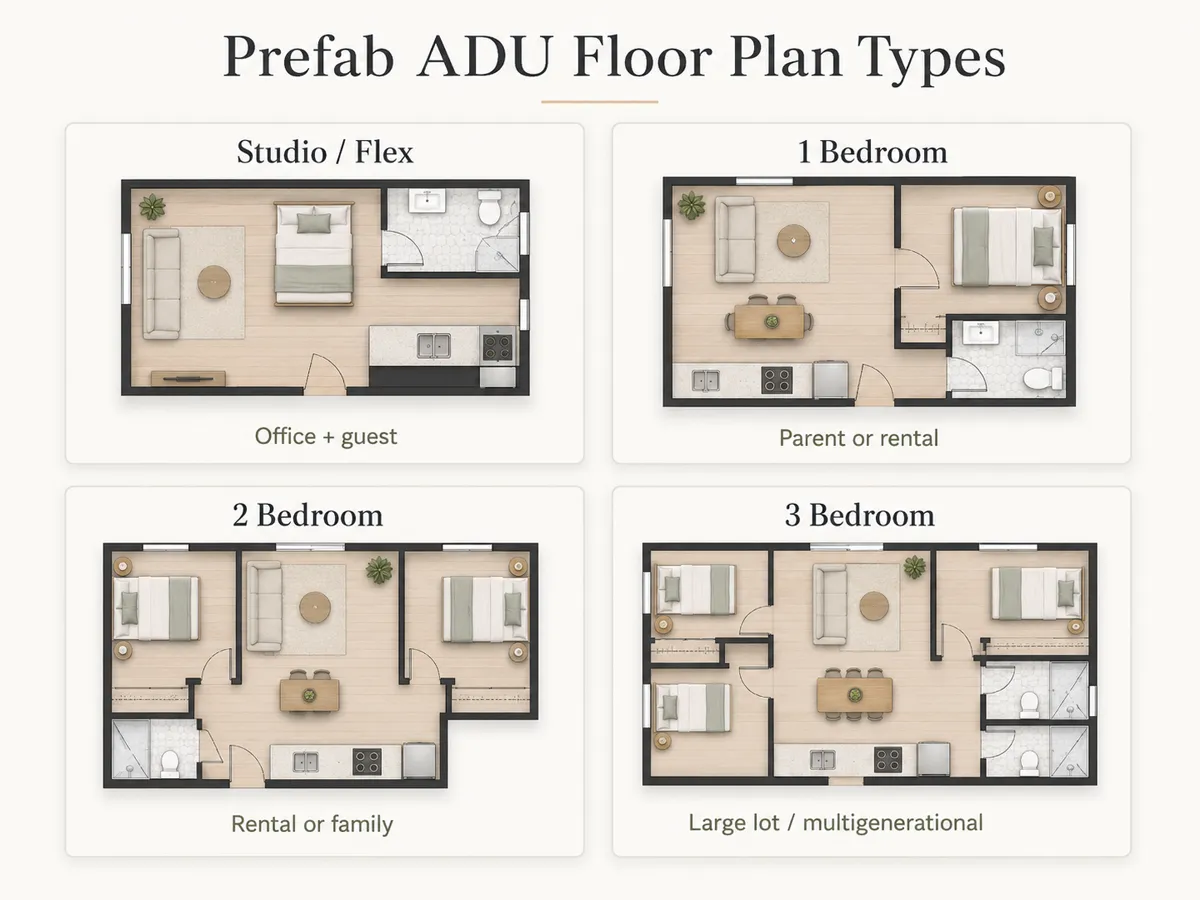
- Ultra‑compact studio, ~250–399 sq ft. Best for a home office, a guest space, an occasional‑use suite, or a very small lot. Watch‑outs: full‑time livability, storage, laundry, and whether your city's minimum dwelling standards and ADU definition even allow it. Reality check: Modular Home Direct lists a 284‑square‑foot one‑bedroom steel‑frame model at $56,500, and BOXABL's Casita is a 361‑square‑foot studio — both real, both still needing a foundation, utilities, and permits before anyone moves in.
- Studio or compact one‑bedroom, ~400–540 sq ft. Best for an aging parent with simple needs, a guest‑plus‑rental hybrid, or an office with a sleeping area. Samara prices its 420‑square‑foot Studio from $152,000 plus installation and its 540‑square‑foot One Bedroom from $170,000 plus installation (Source: samara.com/backyard/compare, verified May 2026).
- Balanced one‑bedroom or compact two‑bedroom, ~600–750 sq ft. Best for a durable long‑term rental, an adult child, or a parent who wants real living space. This band is strategically important on cost: in California, ADUs with 750 sq ft or less of interior livable space are exempt from impact fees under current law, so staying at or under 750 can save thousands.
- Two‑bedroom layouts, ~800–1,000 sq ft. Best for rental income with privacy, a small family, or multigenerational living. Modular Home Direct lists an 800‑square‑foot two‑bedroom model at $116,000 (materials price); Samara's 800‑square‑foot XL 8 starts at $249,000 plus installation; Abodu's 800‑square‑foot Two+ starts at $426,800 (base price, broader scope). Same size, three very different price structures — which is exactly the trap we decode next.
- Large family or investor layouts, ~1,000–1,200 sq ft. Best for high‑rent markets and larger lots. Modular Home Direct lists a 1,000‑square‑foot two‑bedroom/two‑bath container model at $144,250. In California, 1,200 sq ft is the common ceiling for a detached ADU — but never assume that number applies in your state.
The two‑story question, answered honestly
You'll read on some builder blogs that “prefab can't do two stories.” That's half true. The major California turnkey prefab brands — Samara, Abodu, and Villa Homes — currently build single‑story only, citing factory and transport constraints (Source: CALI ADU, April 2026). But two‑story prefab and modular ADUs do exist: Studio Shed offers a 528‑square‑foot carriage‑house design over a garage, and Atlanta‑market builders offer two‑story models such as a 749‑square‑foot unit on a 440‑square‑foot footprint (Sources: SnapADU comparison, January 2026; Atlanta ADU Co.). If your lot is narrow and you need to build up, a single‑story prefab brand isn't your only option — you'll likely move toward a modular builder with a stacked plan, a panelized kit, or a site‑built carriage house.
How much do prefab ADU floor plans really cost in 2026? (Base price vs. all‑in)
Prefab ADU floor‑plan pricing is easy to misread because “plan price,” “model price,” “materials package,” and “all‑in project cost” are four different numbers. In 2026, factory and base prices range from roughly $56,500 for a sub‑300‑square‑foot unit to over $277,000 for a premium 950‑square‑foot model — but the all‑in, move‑in‑ready total typically adds $50,000 to $150,000 or more for site work, foundation, utilities, permits, delivery, and installation. The only fair comparison is to normalize every option by what its price includes. That's what this section does, with current, dated numbers pulled directly from provider catalogs.
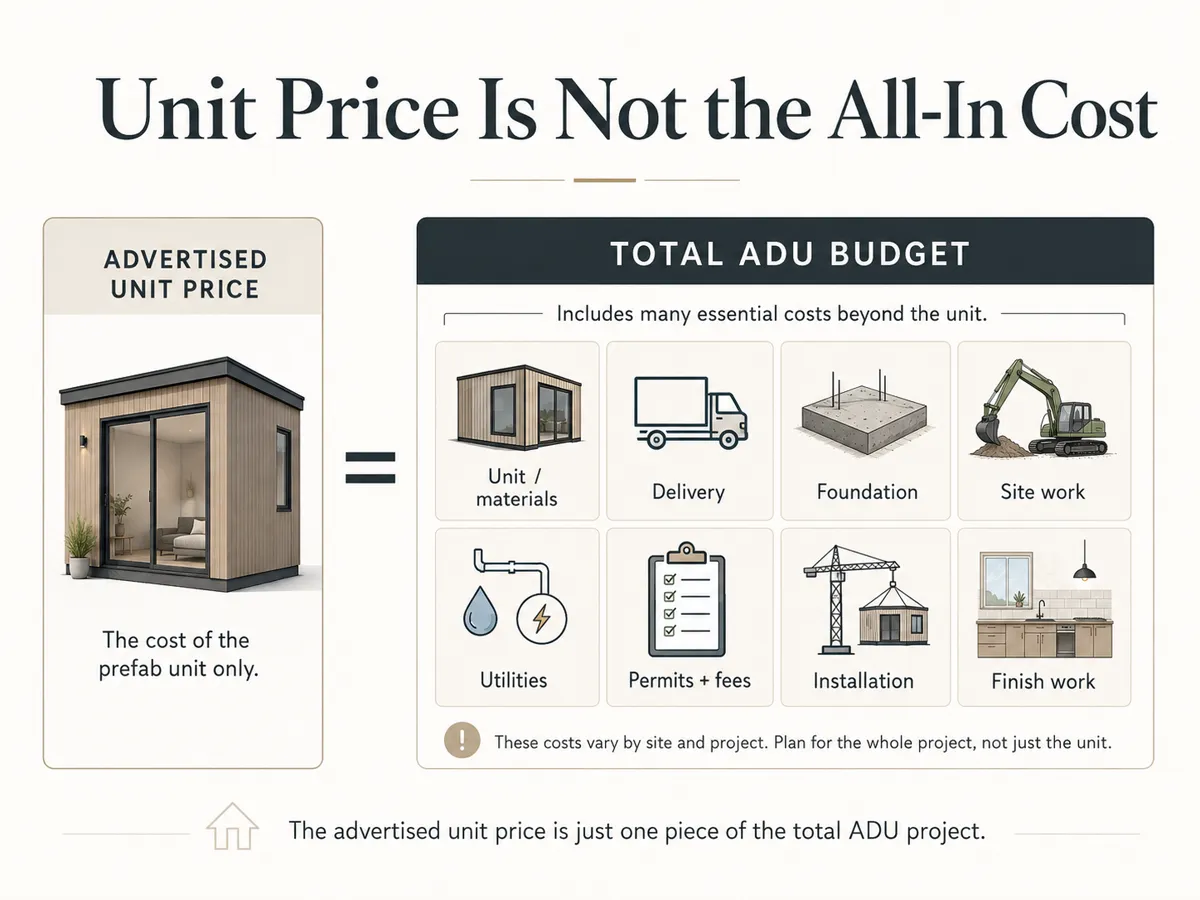
Table A — Real prefab/modular ADU models by size and price (verified May 2026)
| Model (provider) | Config | Size | Published price | What that price is | Real all-in note |
|---|---|---|---|---|---|
| 1 Bed 284 sq ft Modular Home Direct(affiliate) | 1 bed / 1 bath | 284 sq ft | $56,500 | Complete-home materials/kit; no labor/assembly | + assembly, foundation, utilities, permits |
| Studio Abodu | Studio | 340 sq ft | from $278,800 | Base price incl. foundation, permits, delivery, install, standard utility connections | Avg. customer total before permit fees/taxes: ~$300,500 (+~$17,000) |
| Casita BOXABL(affiliate) | Studio, 1 bath | ~361 sq ft | See note → | Official page shows estimated monthly payment, not a fixed all-in price | Third-party-reported installs commonly ~$90,000–$150,000+ in 2026 |
| Studio Samara | Studio | 420 sq ft | from $152,000 + installation | Unit; installation quoted separately | + foundation, utilities, permits, site work |
| 2 Bed 420 sq ft expandable Modular Home Direct(affiliate) | 2 bed / 1 bath | 420 sq ft | $66,500 | Materials/kit; no labor/assembly | + assembly, foundation, utilities, permits |
| Studio/1 Bed 476 sq ft Studio Shed | Studio/1 bed | 476 sq ft | ~$110,000 (unit+plans+ship) | Unit + plans + shipping | ~$240,000 all-in (reported) |
| 1 Bed ~480 sq ft Villa Homes | 1 bed | ~480 sq ft | ~$95,000–$195,000 base | Base unit | ~$225,000 all-in (reported) |
| 1 Bed 500 sq ft Abodu | 1 bed | 500 sq ft | from $326,800 | Base price (broader scope) | Avg. total before fees/taxes: ~$352,500 (+~$17,000) |
| 1 Bed 540 sq ft Samara | 1 bed | 540 sq ft | from $170,000 + installation | Unit; installation separate | + foundation, utilities, permits |
| 2 Bed 610 sq ft Abodu | 2 bed / 1 bath | 610 sq ft | from $360,800 | Base price (broader scope) | Avg. total before fees/taxes: ~$392,500 (+~$17,000) |
| 2 Bed 690 sq ft Samara | 2 bed | 690 sq ft | from $190,000 + installation | Unit; installation separate | + foundation, utilities, permits |
| 1 Bed 700 sq ft container Modular Home Direct(affiliate) | 1 bed / 1 bath | 700 sq ft | $103,000 | Materials/kit; no labor/assembly | + assembly, foundation, utilities, permits |
| 2 Bed 800 sq ft Modular Home Direct(affiliate) | 2 bed / 1 bath | 800 sq ft | $116,000 | Materials/kit; no labor/assembly | + assembly, foundation, utilities, permits |
| 2 Bed 2 Bath 800 sq ft (XL 8) Samara | 2 bed / 2 bath | 800 sq ft | from $249,000 + installation | Unit; installation separate | + foundation, utilities, permits |
| 2 Bed 2 Bath 800 sq ft (Two+) Abodu | 2 bed / 2 bath | 800 sq ft | from $426,800 | Base price (broader scope) | Avg. total before fees/taxes: ~$478,800 (+~$17,000) |
| 2 Bed 2 Bath 950 sq ft (XL 10) Samara | 2 bed / 2 bath | 950 sq ft | from $277,000 + installation | Unit; installation separate | + foundation, utilities, permits |
| 2 Bed 2 Bath 1,000 sq ft Modular Home Direct(affiliate) | 2 bed / 2 bath | 1,000 sq ft | $144,250 | Materials/kit; no labor/assembly | + assembly, foundation, utilities, permits |
Sources: Modular Home Direct catalog and product pages (modularhomedirect.com, verified May 2026 — base packages are “Complete Home Materials,” with no labor or assembly included); Samara compare page (samara.com, verified May 2026); Abodu pricing page (abodu.com, verified May 2026 — base prices include foundation, permit services, delivery, install, and standard utility connections, and exclude utility trenching beyond 50 ft, craning beyond 100 ft, demolition, tree removal, unique site engineering, sales tax, and permit fees; permit fees and taxes average ~$17,000 but vary by city); BOXABL Casita page (boxabl.com — model sizes and an estimated‑payment disclaimer; the $90,000–$150,000+ installed range is third‑party‑reported via thepricer.org and boxabl‑homes.com, 2026); Villa Homes and Studio Shed figures are secondary‑reported via SnapADU's cross‑provider comparison (January 2026). All prices change; re‑verify before relying on them.
The decode that resolves the #1 confusion
Read Table A again and notice three different pricing structures, not just three prices:
- Materials/kit price. Modular Home Direct publishes the price of the materials package — the company's product pages state the base package is “Complete Home Materials” with no labor or assembly included. Assembly, foundation, utility trenching, permits, and delivery are extra. That's how an $116,000 800‑square‑foot package becomes a far larger finished number.
- Unit + installation, quoted separately. Samara publishes “from $X plus installation.” The “plus” covers craning, foundation, and site connections that vary by lot.
- Broader‑scope base price. Abodu publishes a single base number that includes foundation, permit services, delivery, install, and standard utility connections — but it still excludes utility trenching beyond 50 feet, craning beyond 100 feet, demolition, tree removal, unique site engineering, sales tax, and permit fees. Abodu's own pricing page shows customers pay, on average, roughly $300,500 (Studio), $352,500 (One), $392,500 (Two), and $478,800 (Two+) before permit fees and taxes, which average about $17,000 more (Source: abodu.com, verified May 2026).
Even BOXABL is explicit: its official Casita page presents an estimated monthly payment, not a guaranteed all‑in price, and discloses that actual price and payment vary by model, location, site work, taxes, delivery, installation, credit approval, and financing terms (Source: boxabl.com). Independent write‑ups put fully installed 2026 Casita projects in the $90,000–$150,000+ range — useful as a directional benchmark, but confirm any quote against your own lot.
One more counterintuitive point: some fixed cost buckets — permits, utility hookups, appliances, design — don't shrink when the unit does, so a very small ADU can carry a high cost per square foot even when its total is low. A 200‑square‑foot unit can run around $350 per square foot, while a 1,200‑square‑foot unit can fall toward $150 per square foot (Source: SelfStorage.com ADU cost guide, April 2026, illustrative). That's why the cheapest per‑foot plan and the cheapest total plan are rarely the same layout.
Table B — What we found: the stale‑price gap
Here's an original finding from assembling this data: the prices on aggregator and listicle pages are frequently years out of date, and almost always too low. We compared the directory listings against the manufacturers' live pages.
| Model | What an aggregator still shows | What the manufacturer shows now (verified May 2026) | The gap |
|---|---|---|---|
| Abodu Studio (340 sq ft) | from $199,900 (Dwellito listing) | from $278,800 (abodu.com) | +$78,900 |
| Abodu Two | listed at 610 sq ft, lower price (older directory) | 610 sq ft, from $360,800 (abodu.com) | Six-figure jump |
| Villa Homes (price framing) | advertised as “all-in” cost (2023–24) | now advertised as a much lower base-unit-only figure (2025) | Looks ~half price, but it's base only |
Sources: aggregator listings (Dwellito) vs. abodu.com (verified May 2026); Villa pricing‑presentation shift documented by HomeWiP (September 2025). Before relying on any third‑party listing, check the manufacturer's live page for the current number.
The Villa example is the sneaky one. The company didn't necessarily get cheaper — it changed which number it advertises, from an all‑in figure to a base‑unit‑only figure. Compare an old all‑in quote to a new base‑only quote and you'll think prices dropped when they didn't. This single misreading is the most expensive mistake in the prefab market, which is why every quote in this guide is dated.
Want to compare modular and prefab builder options?
Compare ADU BuildersCheck your lot and your legal limits in minutes (Prefab ADU Floor Plan Fit Checker)
The one thing a generic answer can't give you is whether a specific floor plan is legal and physically fits on your lot. That depends on your city's size cap, your setbacks, your delivery access, and your goal — inputs no article can know in advance. Our Fit Checker takes them and returns the plan‑size range that fits, the likely code path, the red flags that move budgets, and the items to verify before you pay.
Enter your city or ZIP, lot width and depth, side‑yard access width, desired bedrooms, rough budget, and any access constraints (tight gate, overhead wires, slope). In about a minute you'll see which configurations are realistic for your property and which models to shortlist — so you stop guessing at ranges and start from what's actually buildable.
The only fair way to compare two prefab ADU floor‑plan quotes
To compare prefab quotes honestly, put every option into the same eight cost buckets — design/engineering, unit/materials, delivery, foundation, set/assembly, utilities, permits/fees/taxes, and finish/inspection — and ask the same questions of each. A quote that looks tens of thousands cheaper often just excludes three of those buckets. Copy this table, fill in two columns, and you'll see which plan is actually less expensive — and which “cheap” option is hiding the work.
| Cost bucket | Ask the provider this | Quote A | Quote B |
|---|---|---|---|
| Plan / design | Is this a conceptual layout or a permit-ready set for my city? | — | — |
| Engineering | Is local structural and energy engineering included? | — | — |
| Unit / materials | Exactly what’s in the package — appliances, finishes, fixtures? | — | — |
| Delivery | Is freight included? To the curb, or to the set location? | — | — |
| Foundation | Slab, piers, or crawlspace — and is it in the price? | — | — |
| Set / assembly | Who cranes and assembles the unit, and is craning included? | — | — |
| Utilities | How many linear feet of trenching for water, sewer, and power are included? | — | — |
| Permits / fees / taxes | Included, estimated, or excluded? Are impact fees in here? | — | — |
| Site work | Demo, grading, drainage, tree removal, access work? | — | — |
| Warranty | Does the warranty cover the unit only, or the whole project? | — | — |
A real calibration from Table A: comparing Modular Home Direct's $116,000 materials package against Abodu's broader‑scope base price for the same 800 square feet is not comparing two prices for the same thing — one is a materials kit (no labor/assembly), the other already folds in foundation, permits, delivery, and install. Normalize first, decide second.
What size prefab ADU floor plan can you legally build?
Your floor plan has to satisfy two limits at once: your jurisdiction's legal size cap and your lot's setbacks. In California, cities cannot cap an ADU below 850 sq ft of interior livable space for a studio/one‑bedroom or 1,000 sq ft for two‑plus bedrooms, and a detached ADU is commonly allowed up to 1,200 sq ft. Massachusetts now allows ADUs up to 900 sq ft (or half the main home, whichever is smaller) by right statewide. ADU law is intensely local, so the legal maximum where you live may be very different. Here are three states decoded into plain English, with the current code citations, plus how to check yours fast.
A few terms first: a setback is the minimum distance a structure must sit from your property line. FAR (floor area ratio) caps total building floor area as a share of lot size. By‑right or ministerial approval means the city must approve a compliant project without a discretionary hearing. A JADU (junior ADU) is a small ADU, up to 500 sq ft, carved out of an existing home. A DADU is simply a detached ADU.
California — the most generous and most detailed framework
California overhauled and renumbered its ADU statutes. As the state's Department of Housing and Community Development (HCD) confirms in its March 2026 ADU Handbook update, the ADU and JADU laws “were updated from 65852.2, 65852.22, 65852.23, and 65852.26 to Government Code sections 66310–66342.” SB 543 (signed October 10, 2025) further amended that framework for 2026. Decoded:
- Size floors cities can't undercut. A local agency may not set a maximum below 850 sq ft of interior livable space for an ADU with one bedroom or less, or below 1,000 sq ft for an ADU with more than one bedroom (Source: Cal. Gov. Code § 66321(b)(2); HCD ADU Handbook, March 2026).
- “Interior livable space” is the measure. SB 543 clarifies that statutory square‑footage references mean interior livable space, so exterior walls and stairs don't count against the limit (Source: Gov. Code §§ 66313(d), 66321(b)(2), as amended).
- The state‑exempt / state‑mandated ADU path. Gov. Code § 66323 sets out the categories of ADUs and JADUs a city must approve by building permit only — including a detached new‑construction ADU on the 800‑sq‑ft, 16‑foot, 4‑foot‑setback pathway — and bars objective development standards that would block them.
- Impact‑fee relief. Development impact fees may not be charged on an ADU with 750 sq ft or less of interior livable space, and an ADU or JADU with 500 sq ft or less is exempt from school impact fees (Source: Gov. Code § 66311.5, as amended by SB 543).
- Faster completeness review. SB 543 requires a permitting agency to determine whether an ADU application is complete within 15 business days; miss that deadline, and the application is deemed complete.
What this means for your floor plan: in California, a 690‑square‑foot two‑bedroom, an 800‑square‑foot two‑bed/two‑bath, or a 540‑square‑foot one‑bedroom all sit comfortably inside the legal envelope on a typical lot — and staying at or under 750 sq ft of interior livable space can save you impact fees. See our full California ADU size and setback rules.
Massachusetts — by‑right statewide, but a smaller cap
Massachusetts changed everything for ADUs with the Affordable Homes Act (St. 2024, c. 150), which amended the Zoning Act. Decoded:
- ADUs no larger than 900 sq ft, or 50% of the principal dwelling's gross floor area, whichever is smaller, are allowed by right in single‑family zoning districts statewide — Boston excepted (Source: M.G.L. c. 40A, § 3, para. 11; 760 CMR 71.02; Mass.gov). The by‑right pathway took effect February 2, 2025.
- Cities cannot require a special permit, cannot impose owner‑occupancy requirements, and cannot cap a protected‑use ADU below 900 sq ft. Modular ADUs must be allowed if they meet the state building code (Source: 760 CMR 71.03).
What this means for your floor plan: a Massachusetts homeowner with a 1,500‑square‑foot main house is capped near 750 sq ft, so a compact one‑bedroom or a sub‑800 two‑bedroom is the realistic target — not the 1,000–1,200‑square‑foot plans that work in California. Demand is real: a first‑year survey found 293 municipalities logged 1,639 ADU building‑permit applications with 1,224 permits issued (Source: The Boston Foundation, May 2026). See our Massachusetts ADU rules.
Washington — ADUs required in many cities
Washington's HB 1337 (2023), codified at RCW 36.70A.681, is unusually direct. For cities and counties planning under the Growth Management Act, within urban growth areas:
- They must allow at least two ADUs on any lot in a zoning district that permits single‑family homes.
- They may not cap an ADU's gross floor area below 1,000 sq ft (Source: RCW 36.70A.681; Washington Dept. of Commerce).
- ADU impact fees are capped at 50% of what the principal unit would be charged.
- No off‑street parking may be required for an ADU within a half‑mile of a major transit stop.
What this means for your floor plan: a Washington homeowner inside an urban growth area can treat 1,000 sq ft as a floor, not a ceiling, and a single lot can support the main house plus two ADUs. See our Washington ADU rules.
The 10‑minute approval screen (any city)
- Search "[your city] ADU ordinance."
- Confirm the detached ADU size limit.
- Confirm side and rear setbacks.
- Confirm the height limit.
- Check the parking requirement (many places have dropped it near transit).
- Check any owner-occupancy rule.
- Confirm utility, sewer, or septic requirements.
- Check for overlay zones (coastal, historic, fire/wildland-urban interface).
- Search "[your city] pre-approved ADU plans."
- Call or email the permit counter and ask whether your chosen prefab model has been permitted locally before.
Outside California, Massachusetts, and Washington? ADU size caps, setbacks, and permit rules vary by state and city. Run your address through the report below for the rules that apply where you live, then match a floor plan to your legal envelope.
Check What's Legal and What Fits on Your Lot → Get Your Free ADU ReportWill this prefab ADU floor plan actually fit your lot?
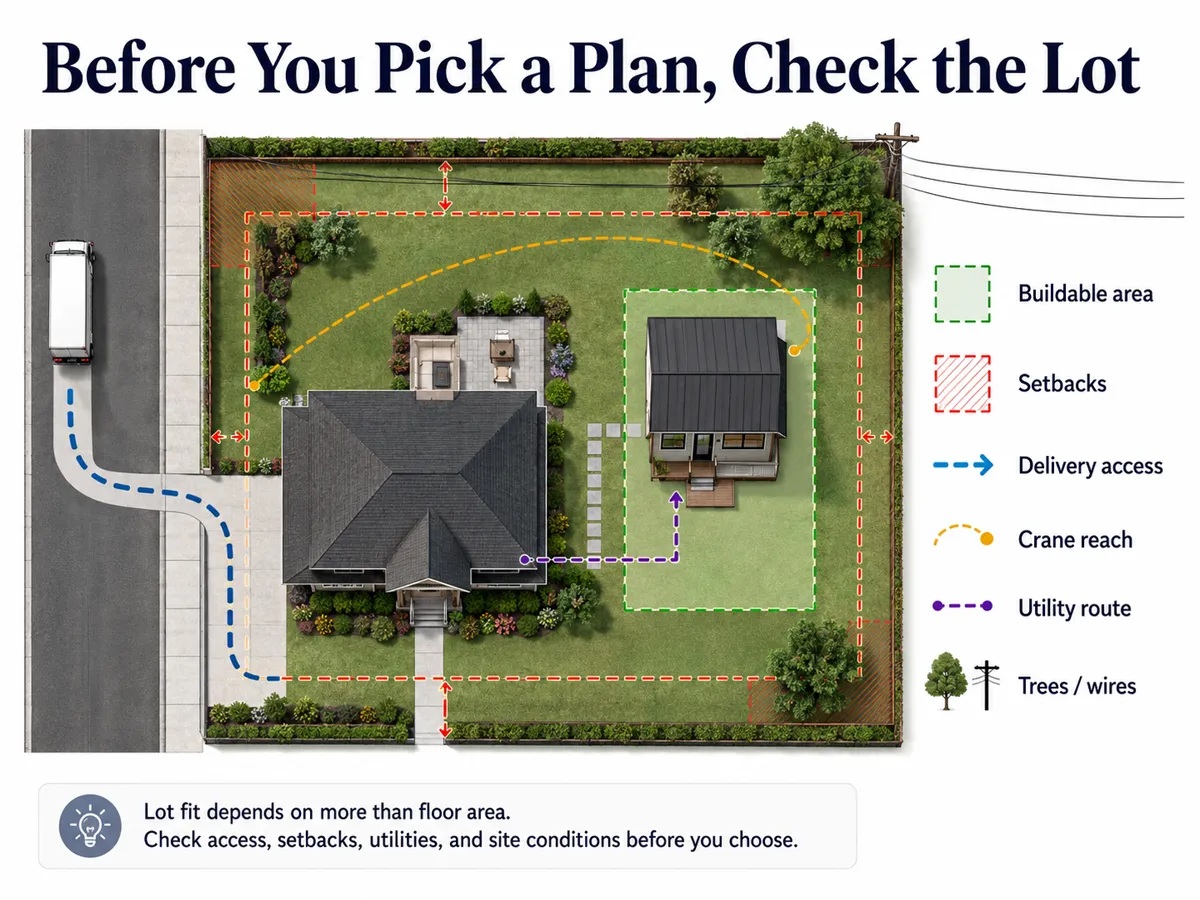
A prefab ADU floor plan fits only when the buildable envelope, delivery path, foundation, utility route, fire/opening rules, easements, slope, drainage, and trees all work together. A plan that fits on paper can still fail in the backyard — most often because the unit's required clear space is larger than its floor area, or because the delivery truck and crane can't reach the build site. Dimensions alone never tell you whether a unit fits.
Here's the proof that floor area ≠ fit: Samara's 540‑square‑foot One Bedroom has unit dimensions of 37′ W × 15′ D, but its stated space requirement is 47′ × 25′ once you account for clearances and the deck (Source: samara.com, verified May 2026). A 540‑square‑foot home can need well over a thousand square feet of clear area to set.
Run this lot‑fit checklist before you commit:
- Rear and side setbacks — and whether your city’s 4-foot reductions apply.
- Distance from the primary home — some cities require minimum separation.
- Utility route — where the utility lateral (the underground line connecting your ADU to the water, sewer, and power mains) will run, and how far. A long sewer trench is one of the biggest budget swings in any ADU project.
- Septic vs. sewer — septic systems may need capacity upgrades for a new dwelling.
- Stormwater and drainage — added roof area changes runoff.
- Fire access and openings — distance-to-property-line rules limit windows on some walls.
- Overhead wires and crane reach — a modular unit is craned in; power lines or tight access can stop the set cold.
- Truck access — can a flatbed and crane physically reach the backyard?
- Tree protection — protected trees can force a redesign.
- Slope and grading — sloped lots add foundation and retaining costs.
- Easements — utility or access easements can shrink your buildable area.
- HOA, coastal, historic, or fire overlays — private and overlay rules layer on top of zoning.
This is the single highest‑leverage check you can do, and it's free. The floor plan is one input; the lot decides the rest.
Prefab model vs. city pre‑approved plan vs. purchased plan set vs. custom
Use a prefab model when a standard design fits your lot and you want a productized, predictable path. Use a city pre‑approved plan when your jurisdiction offers one and you'll build with a local contractor. Use a purchased plan set as a starting point that a local professional will adapt — never as a guarantee of permit approval. Go custom only when your lot or goals genuinely require it. Each path trades cost, speed, and flexibility differently.
Prefab provider model
Best when the provider serves your area, the standard plan fits, and you value speed and a single point of contact. Watch‑outs: the local code path, the site‑work tail, delivery/crane access, and customization limits. Manufactured and modular plans are often the least flexible — they're engineered to be built without major modification, so moving a wall can trigger new engineering and erase the factory efficiency (Source: SnapADU, “Prefab vs Stick‑Built ADU”).
City pre‑approved / permit‑ready plan
Best when your city or county publishes a plan library and you're comfortable with a local builder or panelized route. This is a genuine national trend:
- New York City's Housing Preservation & Development (HPD) ADU plan catalog lists ready designs with cost estimates — for example, a two‑bedroom, one‑bath, 785‑square‑foot “Grand ADU” with an estimated construction cost of $160,000–$230,000 (Source: housing.hpd.nyc.gov).
- Denver's West Denver Single Family Plus ADU program offers pre‑designed plans — studios through three‑bedrooms — created with the AIA, Habitat for Humanity, and Radix Architecture (Source: Colorado Dept. of Local Affairs).
- Seattle (ADUniverse), San José, San Diego County, the City of San Diego, Los Angeles (Standard Plan Program), and counties such as El Dorado and Summit (CO) all maintain pre‑approved or standard ADU plan programs. See our pre-approved ADU plans guide.
The catch: pre‑approved is not permit‑ready for your parcel. You still need site‑specific drawings, and any change voids the pre‑approved status. SnapADU notes that altering a pre‑approved San Diego plan means a new set must be drawn — adding roughly $2,000–$4,000 — and you still need the site plan, energy (Title 24) calcs, and any structural calcs. El Dorado County's pre‑reviewed plan explicitly allows no modifications (Source: El Dorado County).
Purchased plan set / online floor plan
Best for inspiration and understanding layouts, with a local professional adapting it. Watch‑outs: it's not automatically permit‑ready, may not match local code, and may need engineering. Even free‑plan advocates warn that plans alone aren't enough to permit (Source: How‑To ADU).
Custom design
Best when your lot is unusual (narrow, steep, flag‑shaped), you want two stories, or you have specific aesthetic or accessibility needs that no stock plan meets. Most expensive and slowest, but sometimes the only path that actually fits. See our detached ADU layouts by size.
| Path | Best for | Main advantage | Main risk | Permit clarity |
|---|---|---|---|---|
| Prefab model | Standard lot, speed | Predictable product + timeline | Site-work tail, customization limits | Provider often handles, but still local review |
| City pre-approved plan | Cities that offer one | Faster plan check, lower design cost | Voided by any change; site work still needed | High for the plan; site-specific docs still required |
| Purchased plan set | Inspiration + local build | Low upfront cost | Not permit-ready; may need engineering | Low until adapted |
| Custom | Odd lots, two-story, special needs | Fits anything | Highest cost and time | Full plan check required |
Which prefab ADU floor plan fits your goal?
The right prefab ADU floor plan depends on the job it has to do. Rental income rewards privacy, durability, and a separate bedroom. Aging‑parent housing rewards single‑story accessibility. Adult‑child housing rewards separation and storage. Office or guest use often doesn't need a full one‑bedroom. Matching the layout to the goal beats maximizing square footage almost every time.
Best prefab ADU floor plan for aging parents
Prioritize a no‑step entry, a curbless or accessible bathroom, a bedroom that fits real furniture, in‑unit laundry, quiet HVAC, and low‑maintenance finishes. Avoid lofts, tight bathrooms, and awkward kitchen circulation. A 400–750‑square‑foot single‑story one‑bedroom is the sweet spot — for example, Samara's 540‑square‑foot One Bedroom (from $170,000 plus installation) or a Modular Home Direct 432–700‑square‑foot model (materials from $70,000–$103,000, plus assembly and site work). If you're in Greater San Diego, check current SnapADU availability for single‑story plans built around local code; if you're in Utah or Southern California, check current Nest Tiny Homes availability.
Best prefab ADU floor plan for rental income
Prioritize a private entrance, a separate bedroom if your market supports the rent premium, durable flooring, a full kitchen, in‑unit laundry, outdoor privacy, storage, and sound separation. A 600–1,000‑square‑foot one‑ or two‑bedroom is the workhorse here — think Samara's 690‑square‑foot Two Bedroom or Modular Home Direct's 800‑square‑foot two‑bedroom. Larger two‑bedrooms command higher rent but cost more to build, so model the all‑in cost against realistic local rent before committing. See our ADU rental income analysis for context.
These are illustrative planning considerations, not guarantees of returns. Actual rental results depend on local market conditions, construction costs, financing terms, and regulatory approvals.
Best prefab ADU floor plan for an adult child
Prioritize privacy from the main house, real storage, in‑unit laundry, a flexible living/work area, and a separate bedroom if budget allows. A 400–700‑square‑foot studio or compact one‑bedroom usually does the job — and on the budget end, a Modular Home Direct 284‑ or 420‑square‑foot package (materials from $56,500–$66,500, plus assembly and site work) keeps the unit cost low.
Best prefab ADU floor plan for office + guest use
Prioritize a studio or flex layout, a storage wall, a smart bath placement, and a convertible sleeping area. Important legal nuance: if you only need an office, you may not need a full ADU at all — and a unit without a kitchen or full egress may be classified differently (a studio shed or office structure) with a faster, cheaper permit. Confirm what your city requires before you over‑build.
Best prefab ADU floor plan for a property‑value play
Build the largest legal two‑bedroom your lot and budget allow. Two‑bedroom layouts tend to appraise and rent better than studios, and a permitted ADU can add value — one industry estimate puts the increase around 20–35% (Source: Better Place Design & Build, February 2026, industry estimate). Treat value and rent figures as illustrative, not guaranteed; actual results depend on your local market, construction costs, and approvals.
Best prefab ADU floor plan for a narrow or sloped lot
Prioritize a narrow/deep footprint, two stories only if height rules allow, careful window placement for fire/opening limits, and confirmed crane/set access. Because the major turnkey prefab brands are single‑story, narrow lots often push you toward a modular builder with a stacked plan, a panelized kit, or a site‑built carriage house. See our ADU kit homes guide for panelized options.
Picturing a foldable, fast‑setup unit? The BOXABL Casita is the best‑known option in that category.
See Current BOXABL Casita ConfigurationsAffiliate. BOXABL's page shows an estimated monthly payment, not a guaranteed all‑in price, and notes that price and payment vary by model, location, site work, taxes, delivery, installation, credit approval, and financing terms.
Prefab vs. site‑built floor plans: the honest tradeoffs
Prefab and modular floor plans win on speed, predictability, and less on‑site disruption — a factory builds your unit while your foundation goes in, and a finished modular ADU can be set in days. Site‑built (custom) plans win on full flexibility, two‑story and odd‑lot designs, and sometimes a lower modest‑finish cost. Prefab's real catches are the single‑story limit on premium brands, the delivery/crane access requirement, and the site‑work tail that the factory price hides. Neither is universally cheaper; it depends on your lot, finishes, and how much customization you need.
Here's the damaging admission, stated plainly: prefab does not eliminate local permitting, and site work can change your budget after you've signed. Permit timelines still run from a few weeks to several months — SnapADU notes design and feasibility take a few months, followed by permitting that can run 3 to 6+ months depending on the jurisdiction (Source: snapadu.com, 2026). And a long utility trench, a sloped lot, or difficult crane access can add tens of thousands you didn't see coming.
That's exactly why this guide exists. The way you protect yourself is simple: get the all‑in number first (the comparison table and quote‑normalization framework above do this), run the lot‑fit and legal screens before you pay anything, and choose a provider who either includes the site work in writing or itemizes it honestly.
- Where prefab/modular wins: speed to move‑in, factory quality control, a weather‑proof build schedule, minimal backyard disruption, and a productized, comparable price.
- Where site‑built wins: unlimited customization, two‑story and tight‑lot designs, seamless integration with the existing home, and sometimes a lower cost for a simple, modest‑finish build.
- If you need two stories or a highly custom layout, a site‑built or panelized plan will likely fit better than a single‑story prefab brand — and reaching that conclusion before you've put money down is a good outcome, not a setback. See our turnkey prefab ADU guide for providers with a broader scope.
The mistakes that make prefab ADU floor plans expensive
The most expensive mistake is comparing floor plans by the advertised unit price instead of the total path to a legal, inspected, connected ADU. The other budget‑killers: buying a plan before checking the lot, assuming prefab skips permitting, defaulting to the largest size, ignoring delivery logistics, and assuming customization is free. Each one has a simple fix.
- 1Buying the plan before checking the lot. Fix: Run feasibility, setbacks, access, and utilities first. A plan you can’t site is wasted money.
- 2Comparing a materials/base price to an all-in project price. Fix: Use the eight-bucket quote table above. Modular Home Direct’s base packages are materials only (no labor/assembly), and BOXABL’s page shows an estimated payment, not a finished price.
- 3Assuming prefab means no local permitting. Fix: Confirm who produces the local submittal set, who adapts the plans, and whether a stamped engineer’s drawing is required.
- 4Defaulting to maximum square footage. Fix: Start from the use case and the all-in cost. In California, staying at or under 750 sq ft of interior livable space can save impact fees; in Massachusetts, your cap may be half your home’s size anyway.
- 5Ignoring delivery and set logistics. Fix: Require a delivery-route review, ask about crane reach and overhead wires, and pin down who pays if access turns out to be harder than expected.
- 6Assuming customization is free. Fix: Ask which changes are standard, which trigger new engineering, and which void factory pricing. A moved window can be cheap; a moved wall rarely is.
How do homeowners pay for a prefab ADU floor plan?
Most homeowners fund a prefab ADU through one of a few financing lanes: home‑equity products (a HELOC or home‑equity loan), a cash‑out refinance, a construction or renovation loan, or a home‑equity investment (HEI). The right lane depends on your equity, your timeline, and whether you need cash for a factory deposit before the unit ships. This is path education, not a lender ranking, and no rate or approval is ever guaranteed. Because a prefab project has a large up‑front unit deposit plus a site‑work tail, the real question is “how do I fund the whole project,” not just the box.
Quick definitions: a HELOC (home equity line of credit) is a revolving credit line secured by your home; a cash‑out refinance replaces your mortgage with a larger one and hands you the difference; a construction/renovation loan funds the build in stages; and an HEI (home equity investment) gives you cash today in exchange for a share of your home's future value, with no monthly payment. HEIs and several home‑equity products have state‑by‑state availability limits, so confirm your state before counting on one.
| Financing lane | Funds the factory deposit? | Funds the site-work tail? | Needs existing equity? | Watch for |
|---|---|---|---|---|
| HELOC / home-equity loan | Yes | Yes | Yes | Variable rates (HELOC); draw period limits |
| Cash-out refinance | Yes | Yes | Yes | Resets your primary mortgage |
| Construction / renovation loan | Sometimes (timing varies) | Yes | Often less | Deposits may come due before an appraisable structure exists |
| Home-equity investment (HEI) | Yes | Yes | Yes | State availability limits; you share future appreciation |
A practical note: prefab unit deposits are often due before you have a finished, appraisable structure, which can complicate construction‑loan timing. Compare financing only after you have a quote that includes site work, permits, delivery, foundation, utilities, and installation — financing the unit price alone leaves you short for the part that makes it a home.
For a broader view of ADU financing options, including how these lanes compare in practice, see our dedicated financing guide.
Still working out how to fund the full project, not just the unit? We present financing lanes, not ranked lenders, and we never quote specific rates, payments, or approval odds. Availability and terms vary by lender and state.
Explore Your ADU Financing Options → Compare Financing PathsFinancing partner: Mortgage Research Center (affiliate). We present financing lanes, not ranked lenders; no rates/payments/approval promises.
What to verify before you pay a deposit or buy plans
Before any money changes hands, verify the plan's code path, your lot fit, the submittal package, the price scope, the payment schedule, cancellation terms, the warranty, delivery assumptions, and who's responsible for local permit corrections. A signed deposit on a plan you can't permit — or a price that excludes the site work — is the most common way ADU projects go wrong. Print this checklist and get answers in writing.
- 1.Is this a floor plan, a product model, or a permit-ready plan set?
- 2.Has this exact model been permitted as an ADU in my state and city before?
- 3.What construction code path applies (modular, manufactured/HUD, panelized, site-built)?
- 4.Who adapts the plans for my specific site?
- 5.Who pulls and submits the permits?
- 6.What is excluded from the quote?
- 7.What site assumptions are baked in (foundation type, trenching length, soil)?
- 8.What happens — and who pays — if the city requires changes?
- 9.What happens if delivery or crane access fails on the day?
- 10.Which payments are refundable, and when?
- 11.Does the warranty cover the unit only, or the whole project?
- 12.What’s the realistic timeline, and what can delay it?
Want every one of these questions in a printable checklist, plus the quote‑comparison worksheet, before your first provider call?
Download the Free ADU Starter Kit →Prefab ADU floor‑plan examples by source
Use these examples to learn the market, not to pick blindly. The same “800 sq ft” label can mean a $116,000 materials package, a $249,000‑plus‑installation premium unit, or a $426,800 broader‑scope base price. Knowing who publishes which kind of number is half the battle. All figures verified May 2026 unless marked otherwise; re‑confirm before relying on them.
- Modular Home Direct (affiliate; national; based in Salt Lake City, UT) — the broadest catalog we found, filterable by bedroom, bath, and square footage. Verified examples: a 284‑square‑foot one‑bedroom at $56,500, a 420‑square‑foot expandable two‑bedroom at $66,500, a 700‑square‑foot one‑bedroom container at $103,000, an 800‑square‑foot two‑bedroom at $116,000, and a 1,000‑square‑foot two‑bed/two‑bath container at $144,250. These are complete‑home materials/kit prices — the product pages state no labor or assembly is included (Source: modularhomedirect.com, verified May 2026).
- Samara (neutral example; California‑focused; premium turnkey, single‑story) — Studio 420 sq ft from $152,000, One Bedroom 540 sq ft from $170,000, Two Bedroom 690 sq ft from $190,000, XL 8 (800 sq ft, 2 bed/2 bath) from $249,000, XL 10 (950 sq ft, 2 bed/2 bath) from $277,000 — each plus installation. Light‑gauge steel frame, certified for California's Wildland‑Urban Interface, roughly eight weeks on site (Source: samara.com, verified May 2026).
- Abodu (neutral example; California; broader‑scope base pricing) — six floor plans, 340–1,200 sq ft. Studio 340 sq ft from $278,800; Abodu One 500 sq ft from $326,800; Abodu Two 610 sq ft from $360,800; Abodu Two+ (800 sq ft, 2 bed/2 bath) from $426,800. The base price includes foundation, permit services, delivery, install, and standard utility connections, and excludes utility trenching beyond 50 ft, craning beyond 100 ft, demolition, tree removal, unique site engineering, sales tax, and permit fees; permit fees and taxes average ~$17,000 (Source: abodu.com, verified May 2026).
- BOXABL (affiliate; compact/foldable) — the Casita, a 361‑square‑foot foldable studio with a full kitchen and bath that folds to 8.5′ × 20′ for transport. The official page presents an estimated monthly payment, not a guaranteed all‑in price, and discloses that price and payment vary by model, location, site work, taxes, delivery, installation, credit approval, and financing terms. Independent write‑ups put fully installed 2026 projects around $90,000–$150,000+ (Sources: boxabl.com; thepricer.org and boxabl‑homes.com, 2026, third‑party‑reported).
- City pre‑approved plan programs (neutral; local) — New York City (HPD catalog; e.g., a 785‑square‑foot two‑bed/one‑bath at an estimated $160,000–$230,000 construction cost), Denver (WDSF+ plans), Seattle, San José, San Diego County and City, Los Angeles, El Dorado County (CA), and Summit County (CO). These are local plan resources, not universally valid prefab approvals.
What we verified
Last updated: May 31, 2026 · Last verified: May 31, 2026 · Next scheduled review: August 2026
Verified (with source and date):
- Current model sizes and prices from Modular Home Direct (catalog and product pages, May 2026), Samara (compare page, May 2026), and Abodu (pricing page, May 2026), including each provider's stated price inclusions, exclusions, and averages.
- BOXABL Casita size and the official estimated‑payment disclaimer (boxabl.com); the $90,000–$150,000+ installed figure is third‑party‑reported and labeled as such.
- California ADU size limits and the SB 543 renumbering to Gov. Code §§ 66310–66342 (HCD ADU Handbook, March 2026; Gov. Code §§ 66311.5, 66313, 66317, 66321, 66323; SB 543, signed October 10, 2025).
- Massachusetts ADU law: the 900‑square‑foot by‑right cap, M.G.L. c. 40A § 3, regulation 760 CMR 71.00, and the May 2026 first‑year permitting data (Mass.gov; The Boston Foundation, May 2026).
- Washington ADU law: the two‑ADUs‑per‑lot mandate, no‑owner‑occupancy and 1,000‑sq‑ft‑minimum rules, the 50% impact‑fee cap, and the transit parking rule (RCW 36.70A.681; Washington Dept. of Commerce).
- The pre‑approved‑plan modification trap and 85%‑complete caveat (SnapADU; San Diego County); the stale‑price gap between aggregator listings and live manufacturer pages.
Not verified — confirm before relying:
- Whether a specific model will be approved on your property (only your building department can confirm).
- Whether any single quote is truly all‑in.
- Final tax, fee, and permit amounts for your city.
- Current financing terms (rates and approval vary by lender and state).
- Provider availability at your exact address.
- Any HOA, septic, slope, coastal, historic, or fire‑overlay restriction.
- The exact ADU rules for your specific Washington jurisdiction (statewide minimums are verified above; local height, setback, and design standards still vary).
- Villa Homes and Studio Shed figures (secondary‑reported; confirm on the provider pages before treating as current).
How we researched this guide
The Dwelling Index is an independent research resource covering ADU financing, costs, and regulations. We built this guide by pulling model sizes and prices directly from provider catalogs and pricing pages, separating materials/base pricing from broader project‑scope pricing, decoding state ADU statutes from primary and official sources (including California's HCD ADU Handbook and Massachusetts' implementing regulation), and reviewing competing floor‑plan galleries, plan marketplaces, and prefab explainers to find what they leave out. We used homeowner forums only for context — the questions and worries real people raise — never as proof for legal, cost, or code claims. We applied FTC affiliate‑disclosure rules throughout and used no fabricated reviews, ratings, testimonials, or credentials.
Frequently asked questions
- Are prefab ADU floor plans cheaper than custom ADU plans?
- Sometimes, but not always. Prefab can reduce design uncertainty and shorten the schedule, but site work, utilities, foundation, permits, delivery, and local corrections can erase the apparent savings if you compare only the model price against a full custom quote. The fair comparison normalizes both to an all-in cost.
- Are prefab ADU floor plans permit-ready?
- Not automatically. Some providers supply plan packages, and many cities publish pre-approved or permit-ready ADU plans, but every property still needs site-specific review — drainage, utility connections, grading, and often structural and energy calculations — before a permit is issued.
- Can I customize a prefab ADU floor plan?
- Usually to a point. Finish and fixture choices are typically easy; moving structural walls, changing windows, or altering factory-built dimensions can trigger new engineering and additional cost. Modular and manufactured plans are the least flexible because they’re engineered to be built without major modification.
- What is the best prefab ADU floor-plan size?
- For many homeowners, 500–750 sq ft is the practical starting range for a one-bedroom parent or rental unit, while 800–1,000 sq ft is more realistic for a livable two-bedroom. The best size depends on your use case, lot fit, local size limits, and budget — and in California, staying at or under 750 sq ft of interior livable space can avoid impact fees.
- What is the cheapest prefab ADU floor plan?
- The cheapest published model is not the cheapest legal ADU. Ultra-small units can have low base prices — Modular Home Direct lists a 284-square-foot materials package at $56,500 — but delivery, foundation, utilities, permits, assembly, and local code work still apply, commonly pushing installed totals far higher.
- Can a manufactured home be used as an ADU?
- Sometimes, depending on state law, local zoning, the building-code path, and foundation requirements. Manufactured homes are built to the federal HUD code rather than the local building code, and some jurisdictions allow them as ADUs while others don’t. Verify locally before assuming a manufactured model qualifies.
- Can I use a tiny home as an ADU?
- Sometimes, but tiny homes often run into code, foundation, size, utility, and classification issues — especially if the unit is RVIA-certified (built to recreational-vehicle standards) rather than to a residential building code. Treat a tiny-home floor plan as a concept until your jurisdiction confirms it can be permitted as a permanent ADU.
- Do I need an architect for a prefab ADU?
- Maybe. Some prefab providers include design or plan services, and city pre-approved plans reduce design work, but your city may still require site-specific drawings, structural calculations, or stamped engineering. Confirm what your building department requires before assuming the provider’s plan is enough.
- Are city pre-approved ADU plans better than prefab models?
- They can be, when your city offers them and you’ll build with a local contractor or a panelized route — they speed plan check and cut design cost. Prefab models can be better when you want a standardized product and the provider supports your local permit path. Either way, you still need site-specific documents.
- What should I ask before paying a deposit?
- Ask whether the model has been permitted locally as an ADU, what’s included and excluded, who adapts the plans, who handles permit corrections, what site assumptions are baked into the price, what happens if delivery or crane access fails, and which payments are refundable.
Not sure where to start?
See what's possible at your address — get your free ADU report in 60 seconds.
See What You Can Build →