
San Diego ADU Bonus Program: 2026 Eligibility, Unit Caps, Rent Limits, and When It’s Actually Worth It
An independent guide from Dwelling Index — an independent research resource covering ADU financing, costs, and regulations.
· · Last verified against primary sources: May 26, 2026
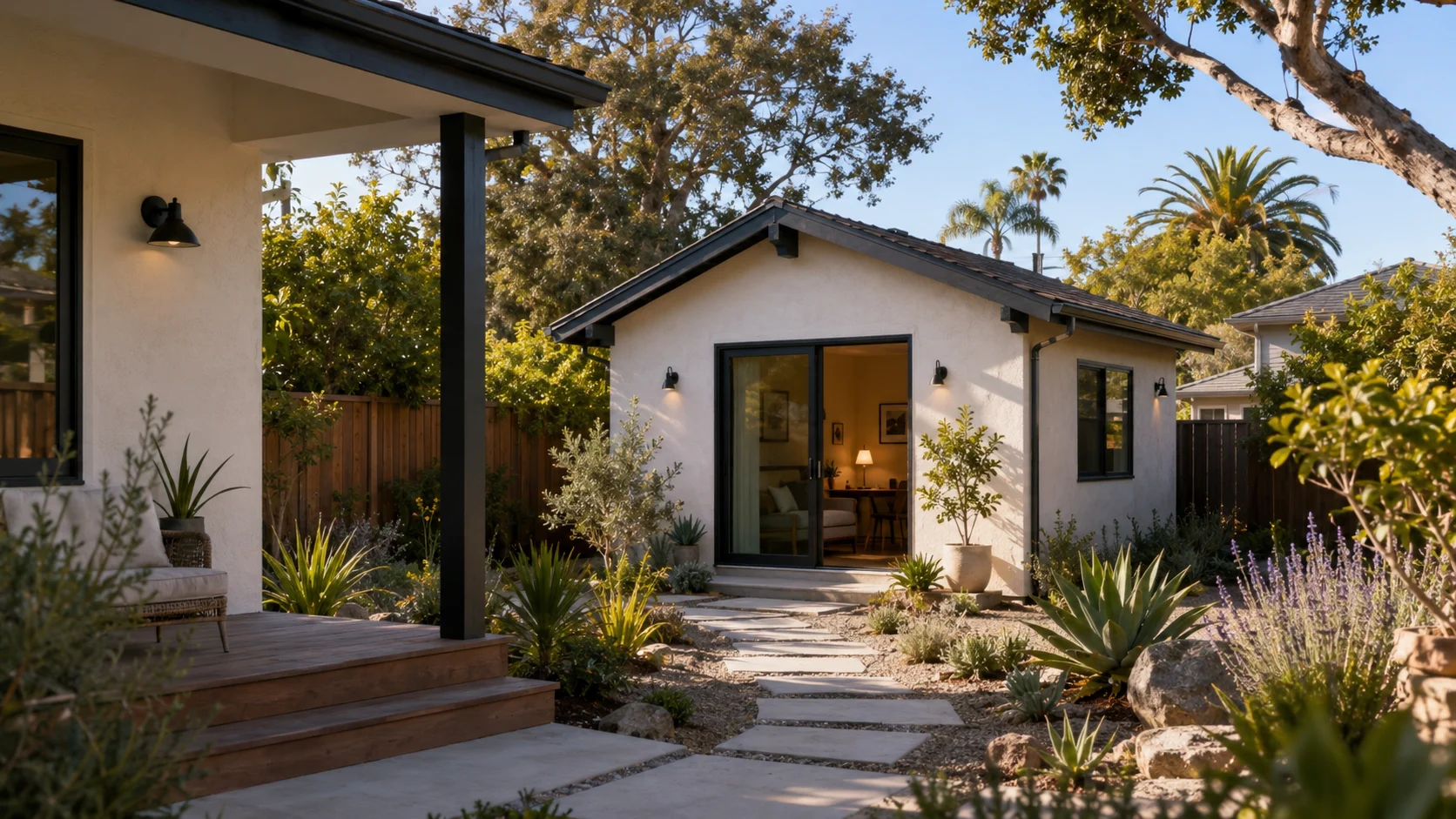
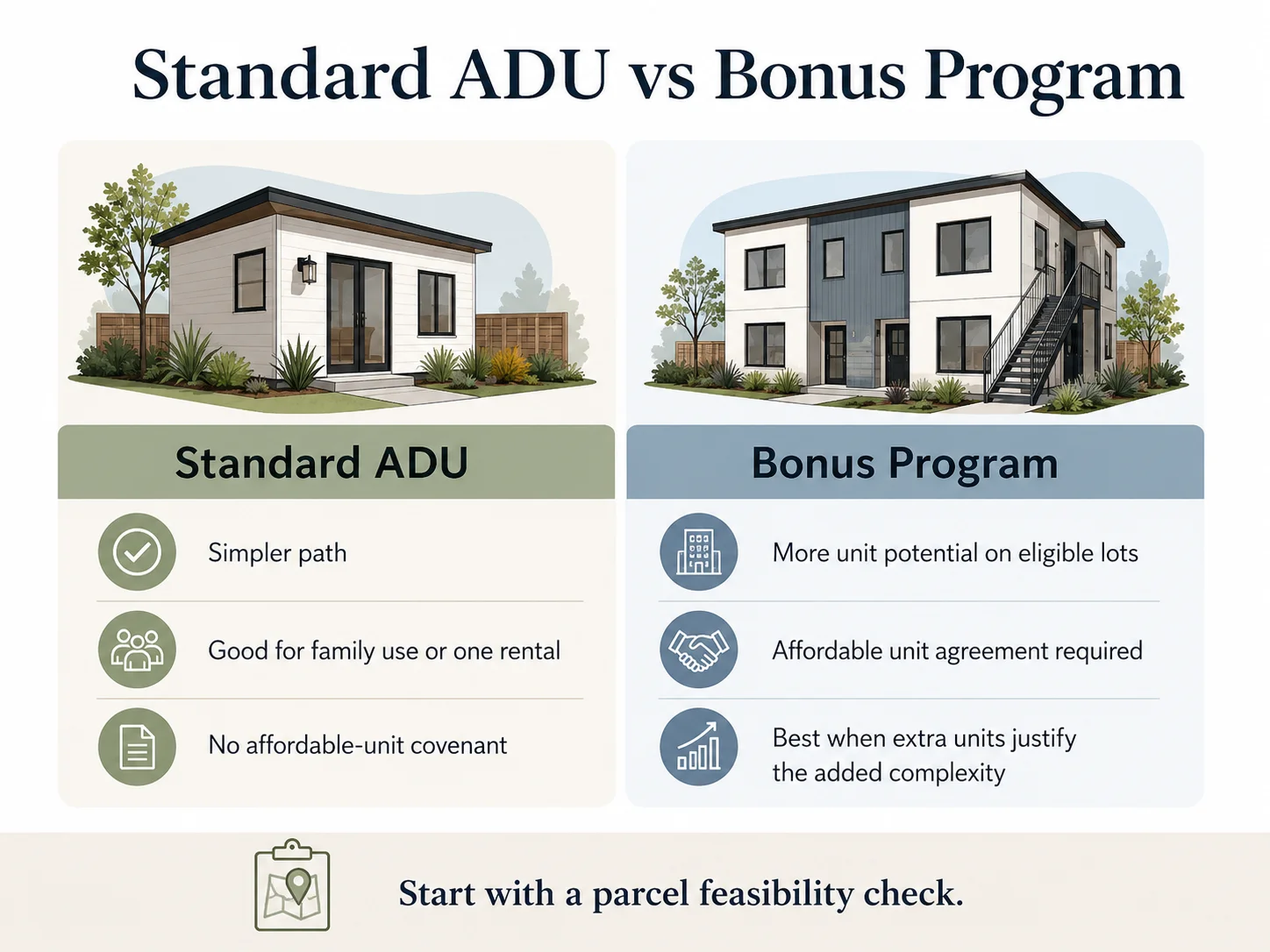
We’ll be blunt about something most pages selling ADU services won’t: for a homeowner who only wants one backyard rental or a unit for aging parents, the Bonus Program is usually the wrong tool. The deed restriction, the San Diego Housing Commission agreement recorded against your title, the mandatory sprinklers, and the multi-unit design complexity are overkill for one unit — and you generally can’t house your own family in the affordable unit anyway. The program earns its keep when an extra market-rate unit genuinely offsets the restricted one. We’ll show you exactly when that’s true.
Get a general ADU planning overview
The tool provides state-level rules, broad cost ranges, and an illustrative equity estimate. It does not determine San Diego Bonus Program eligibility, jurisdiction, zoning, overlay status, lot-size caps, unit count, or rent economics; confirm those with the relevant local agencies.
Get My ADU Planning OverviewCan you even use the San Diego ADU Bonus Program? (Fast gate check)
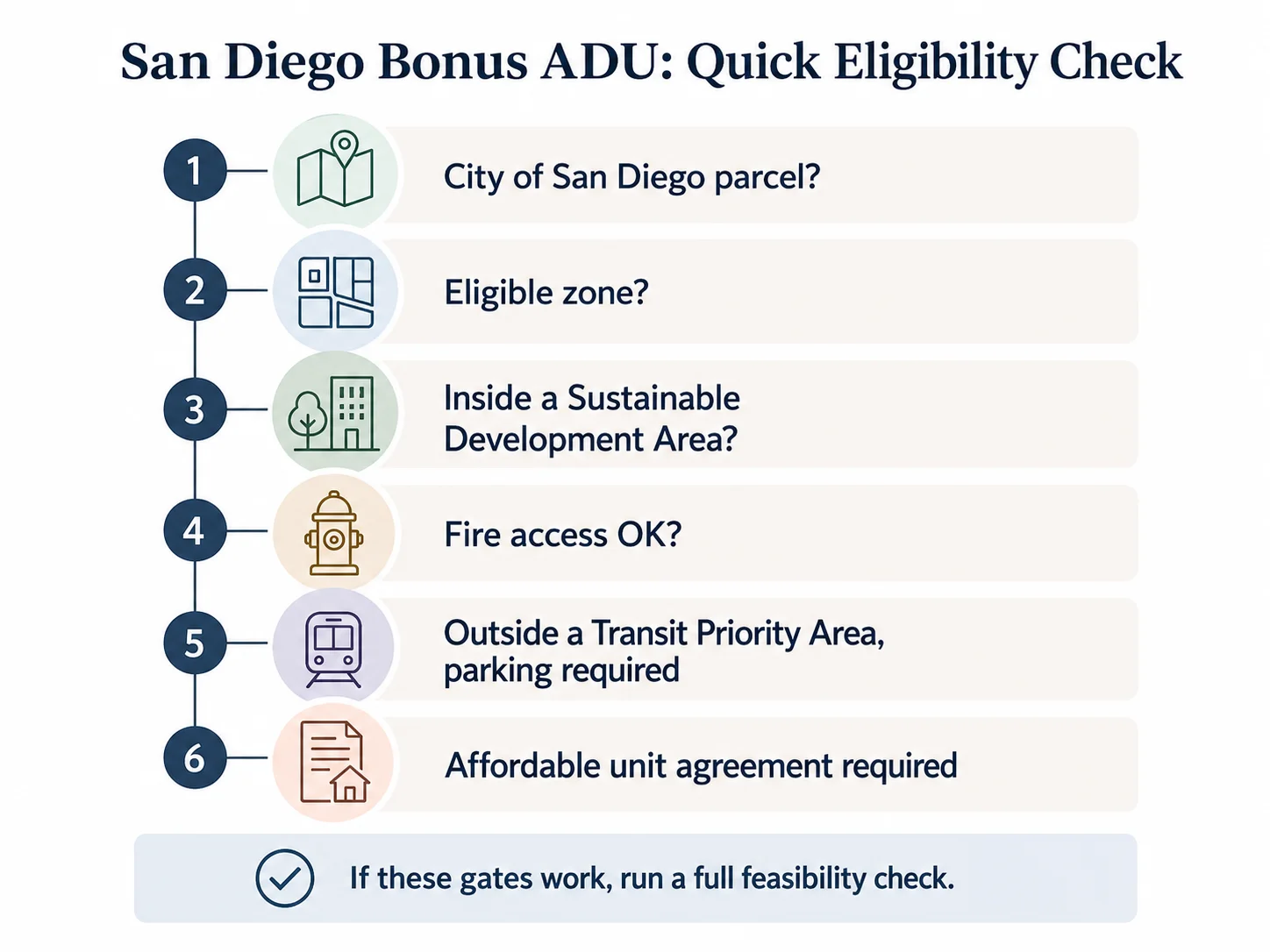
Eligibility turns on a short chain of parcel facts: the property must be in the City of San Diego, not in one of eight excluded RS-1 zones, and — if in a High or Very High Fire Hazard Severity Zone — must have adequate evacuation access. Sustainable Development Area status then determines how many bonus units you can earn, and lot size sets the hard ceiling.
If you fail any “must pass” gate, the program is off the table for that parcel — and standard by-right ADUs become your path instead.
| Gate | What you need | Why it matters | Source |
|---|---|---|---|
| Jurisdiction | Property is inside the City of San Diego | The program is a city incentive layered on top of state ADU law. A “San Diego” mailing address can still be unincorporated county or another city. | IB-400; verify in ZAPP |
| Zone | Not in RS-1-1, RS-1-2, RS-1-3, RS-1-4, RS-1-8, RS-1-9, RS-1-10, or RS-1-11 — unless the parcel is in a High/Highest Resource CTCAC Opportunity Area and is residential in the land-use plan | These eight low-density single-family zones were removed from the program in 2025 | IB-400; O-2025-136 §141.0302(d)(1) |
| Fire access | If in a High or Very High Fire Hazard Severity Zone: lot must front an improved public street with at least two evacuation routes, and must not front a cul-de-sac or have only one ingress/egress | Fire access can end eligibility before economics ever matter | O-2025-136 §141.0302(d)(2) |
| SDA status | Inside a Sustainable Development Area → one bonus ADU per affordable ADU (scalable). Outside an SDA → max one bonus + one affordable | This is the single biggest driver of how many units you can build | O-2025-136 §141.0302(d)(1)(B)–(C) |
| Lot-size cap (single-dwelling zones) | 8,000 sq ft or less → 4 units; 8,001–10,000 → 5; over 10,000 → 6 (ADUs + JADUs, including bonus units) | Hard ceiling regardless of SDA status | IB-400 lot-area table |
| Coastal Overlay | If coastal: the 2025 Bonus Program amendments are not yet effective pending Coastal Commission certification | Coastal parcels follow older rules until certification | IB-400 Editor’s Note |
| Affordability agreement | A written ADU Home Density Bonus Agreement + deed of trust with the San Diego Housing Commission, recorded before the first affordable or bonus ADU permit issues | This is a title encumbrance, not just a rent promise | IB-400 |
Source: City of San Diego Information Bulletin 400, January 2026; Ordinance O-2025-136. Verify parcel status in ZAPP. Verified May 26, 2026.
Why older guides conflict with this one
San Diego’s ADU rules changed materially in 2025, and most articles still describe the old “unlimited near transit” version. Everything here is pulled from the City’s Information Bulletin 400 dated January 2026, the underlying San Diego Municipal Code §141.0302, and the adopting ordinance O-2025-136. Where an older source conflicts, we follow IB-400 and the ordinance.
Review the Bonus Program rules before planning a project
The planning tool does not check parcel eligibility, zoning, overlays, fire-hazard status, lot-size caps, or program-specific terms. Use this guide for the program details and confirm your property’s status with the relevant local agencies.
Get My ADU Planning OverviewIs the San Diego ADU Bonus Program still available in 2026?
Yes. The City of San Diego ADU Home Density Bonus Program remains active in 2026 under San Diego Municipal Code §141.0302(d). However, 2025 reforms (Ordinance O-2025-136, effective outside the Coastal Zone on August 22, 2025) narrowed it significantly — excluding eight low-density RS-1 zones, capping total units by lot size, and adding fire, parking, sprinkler, tree, and fee requirements.
The program was created in 2020 by Ordinance O-21254, which established an incentive to promote ADUs offered at affordable rent for very-low-, low-, or moderate-income households. For a few years it was one of the most generous local infill programs in California — generous enough that the Terner Center for Housing Innovation at UC Berkeley praised it. Then it became a victim of its own success. A handful of developers found large or oddly shaped lots and stacked a dozen or more units on single-family parcels, which generated organized neighborhood opposition. The reform package drew over 1,700 public comments. The City Council adopted Ordinance O-2025-136 in 2025.
California HCD sent the City a Letter of Technical Assistance on June 13, 2025 warning the amendments may conflict with state law — which keeps further changes on the table. The current rules are in effect today regardless.
What the program is — in one plain-English sentence
The “bonus” is a trade: build an affordable, deed-restricted ADU, and the City lets you build an extra market-rate ADU you wouldn’t otherwise be allowed. A deed restriction is a legal covenant recorded against your property’s title that caps the rent on the affordable unit for a set number of years. An ADU (accessory dwelling unit) is a fully independent home — kitchen, bath, sleeping area — on a lot with an existing or proposed primary residence. A JADU (junior ADU) is a smaller unit, 150–500 sq ft, carved from the existing home or attached garage.
The old mental model vs. the 2026 reality
This table is the fastest way to spot whether something you read elsewhere is stale.
| What you may have read | The 2026 reality |
|---|---|
| “Near transit = unlimited ADUs” | SDA status controls the one-for-one bonus; TPA status only controls parking. Single-dwelling lots are capped at 4/5/6 regardless. |
| “Every San Diego single-family lot qualifies” | Eight RS-1 zones are excluded unless a High/Highest CTCAC exception applies. |
| “Fire zones are just more expensive” | Some High/Very High Fire Hazard lots are ineligible if they front a cul-de-sac or have only one way in and out. |
| “The only challenge is fitting the units” | Deed restriction, SDHC agreement, rent caps, sprinklers, parking outside TPAs, trees, and a Community Enhancement Fee all apply. |
| “It works the same everywhere in the city” | In the Coastal Overlay Zone, the 2025 amendments aren’t effective yet — coastal parcels still run on the older rules. |
All “2026 reality” rows sourced to City of San Diego IB-400, January 2026, and Ordinance O-2025-136.
What can you build before the Bonus Program even applies?
Before any bonus, California law and San Diego’s code already allow a single-dwelling lot to have one primary home plus, generally, one attached or detached ADU, one ADU converted from existing space, and one JADU. The Bonus Program is layered on top of these baseline allowances. Understanding this baseline matters because it’s the alternative — and for many owners, it’s the better deal.
On a single-dwelling lot, by right:
- •1 primary dwelling unit;
- •1 ADU within the existing/proposed home or an existing accessory structure;
- •1 attached or detached ADU; and
- •1 JADU (150–500 sq ft) inside the home or attached garage.
On a multifamily property:
- •ADUs converted from existing non-livable space (storage, boiler rooms, attics, basements, garages), up to 25% of existing units (minimum one);
- •Up to eight detached ADUs, not exceeding the number of existing units;
- •Attached ADUs are not permitted on premises with an existing or proposed multiple-dwelling structure.
Source: Ordinance O-2025-136 §141.0302(b); IB-400. None of these baseline units require a deed restriction, an SDHC agreement, or affordable rent.
That last point is the whole reason the comparison matters. See general San Diego ADU rules for the full baseline picture.
Who qualifies for the San Diego ADU Bonus Program?
Walk these four checks in order. Stop at the first failure.
Step 1 — Confirm you’re actually in the City of San Diego
Do not assume a San Diego ZIP code means City jurisdiction. Large areas with “San Diego, CA” addresses fall in unincorporated San Diego County or in separate cities like La Mesa, El Cajon, or Chula Vista — each with its own ADU rules, and none of which run this exact program. Check your parcel in the City’s Zoning and Parcel Information Portal (ZAPP) at sandiego.gov/zapp.
Step 2 — Check the eight excluded RS-1 zones
The 2025 reforms removed the Bonus Program from these base zones, which carry a 10,000 sq ft minimum lot size and were never intended for significant new density:
- ×RS-1-1
- ×RS-1-2
- ×RS-1-3
- ×RS-1-4
- ×RS-1-8
- ×RS-1-9
- ×RS-1-10
- ×RS-1-11
The escape hatch: if your parcel sits in an area mapped as a High or Highest Resource CTCAC Opportunity Area and is identified as residential in the applicable land-use plan, the exclusion doesn’t apply. The base zones RS-1-5, RS-1-6, RS-1-7, and RS-1-12 through RS-1-14 were not excluded.
Step 3 — Understand SDA vs. TPA (they are not the same thing)
This is where competitor guides most often go wrong.
| Overlay | What it controls | Practical impact |
|---|---|---|
| Sustainable Development Area (SDA) | Whether one bonus ADU is allowed for every qualifying affordable ADU | Inside an SDA, your unit yield scales (up to the lot-size cap). Outside, you’re limited to one bonus + one affordable. |
| Transit Priority Area (TPA) | Whether off-street parking is required for affordable/bonus units | Outside a TPA, one off-street space is required per affordable and per bonus ADU. Inside a TPA, no parking required. |
Source: City of San Diego IB-400, January 2026; O-2025-136 §113.0103. Check both layers in ZAPP.
Step 4 — Check fire-hazard access
A High or Very High Fire Hazard Severity Zone designation is not automatically disqualifying, but the lot must front an improved public street with at least two evacuation routes. Bonus ADUs are prohibited in these zones if the lot fronts a cul-de-sac or has only one point of ingress or egress.
This is the gate that quietly kills the most projects on paper-eligible lots. Many hillside and canyon-adjacent San Diego neighborhoods sit in these zones, and cul-de-sac lots are common in exactly those areas. If you’re on a single-access street or a cul-de-sac in a fire zone, don’t spend a dollar on design until DSD and the Fire Code Official confirm the path is open.
How many ADUs can you build under the San Diego Bonus Program?
The lot-size cap (single-dwelling zones)
This is the number that ends most “can I build eight units?” conversations.
| Lot area (excl. environmentally sensitive lands) | Max ADUs + JADUs, including bonus units |
|---|---|
| 8,000 sq ft or less | 4 |
| 8,001 to 10,000 sq ft | 5 |
| Over 10,000 sq ft | 6 |
Source: City of San Diego IB-400, January 2026.
- ⚠Environmentally sensitive lands (ESL) — steep slopes, wetlands, sensitive habitat, floodways — are subtracted from your lot area before the cap is applied. A 9,000 sq ft lot with 2,000 sq ft of canyon slope is treated as a 7,000 sq ft lot: capped at 4, not 5.
- ⚠The cap counts all ADUs and JADUs together, including ones you’d have by right under state law — not just the bonus units.
- ⚠Even inside an SDA where the bonus structure is “scalable,” you can never exceed the lot-size cap on a single-dwelling lot.
The FAR ceiling — the real limit on most lots
Beyond the unit-count cap, every bonus ADU must fit within the base zone’s floor area ratio (FAR), lot coverage, height, and setback limits. For Bonus Program purposes on single-dwelling lots, the City caps the lot area used to calculate FAR at 8,000 square feet, so very large lots don’t get proportionally more buildable floor area.
In plain terms: the lot-size table tells you how many doors you can have; FAR, coverage, height, and setbacks tell you how much square footage fits behind them — and on most lots, the envelope runs out before the unit count does.
Multifamily and RM-zoned sites
Multifamily-zoned sites are often the strongest Bonus Program candidates because the 4/5/6 lot-size cap applies to single-dwelling zones, not multifamily zones. Yield is still constrained by base-zone FAR, height, lot coverage, setbacks, fire access, and parking, so no fixed unit number applies without site-specific analysis. On a multifamily parcel inside an SDA, the one-for-one bonus structure can pencil out to a meaningful number of units — treat these as strong candidates for a professional feasibility study.
The accessible-ADU incentive (an extra unit most guides miss)
In addition to the affordable bonus, the City allows one additional market-rate accessible ADU when at least two affordable ADUs are proposed on a premises. The accessible unit must meet Chapter 11A of the California Building Code, including at least one accessible bathroom, kitchen, and bedroom on an accessible route. If you’re already building two or more affordable units, this is essentially an extra market-rate door in exchange for designing one unit to be wheelchair-accessible.
Note: this accessible-ADU incentive is among the items not yet effective in the Coastal Overlay Zone pending Coastal Commission certification.
Unit-count scenarios at a glance
| Scenario | Likely maximum path | Caveat |
|---|---|---|
| Single-dwelling lot ≤8,000 sq ft, eligible zone, inside SDA | Up to 4 ADUs/JADUs including bonus units | Must include qualifying affordable unit(s); envelope may reduce it |
| Single-dwelling lot 8,001–10,000 sq ft | Up to 5 | Same constraints |
| Single-dwelling lot >10,000 sq ft | Up to 6 | Same constraints |
| Eligible lot, outside SDA | 1 affordable + 1 bonus | Often not compelling for the complexity |
| Multifamily zone, inside SDA | Parcel-specific yield | Do not assume a fixed number — feasibility required |
| Two+ affordable units proposed | + 1 market-rate accessible ADU | Must meet CBC Chapter 11A accessibility |
What does the affordable ADU deed restriction actually require?
To unlock a bonus ADU, the owner must provide a qualifying affordable ADU and record an ADU Home Density Bonus Agreement and deed of trust with the San Diego Housing Commission before the first affordable or bonus ADU building permit is issued. The affordable unit must be comparable in bedroom mix and amenities to the bonus units — you can’t satisfy the requirement with a token studio while the bonus units are 3-bedrooms.
Lien position — verify, don’t assume
Builder summaries report that the restriction sits in second-lien position on single-family-zoned property and first-lien position on multifamily-zoned property. We could not confirm the lien-position distinction in the primary ordinance text, and it materially affects financing. Confirm lien position with SDHC and your lender before you commit — do not assume the deed of trust will be subordinate to your construction or permanent loan.
The three affordability lanes
| Lane | Minimum covenant term | Rent cap formula |
|---|---|---|
| Very low income | At least 10 years | ≤30% of 50% AMI, adjusted for household size |
| Low income | At least 10 years | ≤30% of 60% AMI, adjusted for household size |
| Moderate income | At least 15 years | ≤30% of 110% AMI, adjusted for household size |
Source: SDMC §141.0302; SDHC Income & Rent Calculations. AMI = Area Median Income, published annually for San Diego County by SDHC.
The moderate lane lets you charge meaningfully more rent but locks you in for 15 years instead of 10. For most investors running the numbers, the moderate lane is the more financeable path despite the longer covenant — the higher allowable rent is what makes the affordable unit carry its weight.
Who can — and can’t — rent your affordable unit
Per SDHC agreement terms (citing SnapADU’s summary of SDHC), Bonus Program affordable units generally cannot be leased to the owner, the owner’s relatives by blood or marriage, anyone the owner employs, or anyone connected to entities that own the property. Households that already own real property or whose liquid assets exceed a defined threshold are also generally excluded, and tenant income is verified at move-in and re-certified annually.
Do not plan to house your own kid or parent in the affordable unit unless SDHC confirms the current covenant allows it.
The damaging admission
For many homeowners, this section is exactly where the Bonus Program stops making sense. A 10- or 15-year rent covenant, a recorded SDHC deed of trust, mandatory sprinklers, parking rules, annual income re-certification, and multi-unit design complexity is a lot of machinery to bolt on if all you wanted was one rental unit or a place for family. If that’s you, the standard by-right ADU path is simpler, cheaper to permit, and carries none of these strings — and we’d rather tell you that now than after you’ve paid for plans.
Compliance carries teeth
The 2025 ordinance increased the penalty for violating the deed restriction on affordable bonus ADUs. Legal and builder summaries describe the increased penalty as a minimum of $10,000 per ADU per month for a violation, in addition to repaying excess rent and any fines in the SDHC agreement. Treat the covenant as fully binding, and budget for the annual SDHC monitoring fee on top of construction costs.
Review the tradeoffs before committing to a deed restriction
The planning tool does not model Bonus Program eligibility, lot-size caps, unit count, or affordable-versus-market rent. Confirm project eligibility and run the economics with qualified local professionals before paying for plans.
Get My ADU Planning OverviewWhat rent can you charge for the affordable ADU?
The affordable rent is set by the unit’s bedroom count and affordability lane, not by the tenant’s specific income, and is published annually by the San Diego Housing Commission. Gross rent minus a utility allowance equals the maximum cash rent you actually collect.
Affordable rent caps by Bonus Program lane (2025 SDHC chart)
50% AMI = very low (10-yr covenant); 60% AMI = low (10-yr); 110% AMI = moderate (15-yr).
| Unit size | 50% AMI (very low, 10-yr) | 60% AMI (low, 10-yr) | 110% AMI (moderate, 15-yr) |
|---|---|---|---|
| Studio | $1,448 | $1,737 | $2,519 |
| 1-bedroom | $1,654 | $1,985 | $2,878 |
| 2-bedroom | $1,861 | $2,234 | $3,238 |
| 3-bedroom | $2,068 | $2,481 | $3,598 |
| 4-bedroom | $2,234 | $2,681 | $3,885 |
Source: SDHC Income & Rent Calculations chart, 2025. Figures are gross rent; gross rent minus utility allowance = maximum cash rent. The 80% AMI tier on the SDHC chart applies to the separate SDHC ADU Finance Program, not these Bonus Program lanes. Verified May 26, 2026.
How to read these numbers
- •The utility allowance haircut. If your tenant pays their own electric and gas, SDHC requires you to subtract a utility allowance from the gross rent cap to set the maximum cash rent. The current utility-allowance schedule is published by SDHC.
- •Rents update annually. The caps move each year with SDHC’s chart. The covenant locks you to the formula, not to the dollar amount shown in today’s chart.
Illustrative-only disclaimer: These are illustrative examples, not guarantees of returns. Actual results depend on local market conditions, construction costs, financing terms, utility allowances, tenant qualification, and regulatory approvals. Dwelling Index is an independent research resource, not a lender, broker, or financial advisor.
Compare standard ADU vs. Bonus ADU economics
The planning tool does not calculate parcel-specific unit counts or rent spreads. Compare the program rules in this guide, then confirm project-specific limits and economics with the local agencies and qualified advisors.
Get My ADU Planning OverviewWhen does the Bonus Program actually pencil out?
This is an editorial conclusion, clearly labeled as such, built on the verified rules above. Use it as a starting filter, not gospel — your lot’s specifics decide.
| If you are… | Bonus Program fit | Why |
|---|---|---|
| A homeowner who wants one unit for family | Usually poor | You generally can’t rent the affordable unit to relatives; standard ADU is far simpler |
| A homeowner who wants one market rental | Poor to moderate | One extra unit rarely justifies the covenant + sprinklers + agreement |
| An owner-investor with an eligible SDA single-family lot | Potentially strong | The one-for-one bonus structure adds real rentable doors |
| A multifamily owner inside an SDA | Potentially strongest | The 4/5/6 lot-size cap doesn’t apply; envelope is the governor |
| Anyone in an excluded RS zone / fire-access-failed / coastal-uncertain lot | Often poor | More gates fail before economics matter |
What can quietly kill the deal
Before design money goes out the door, pressure-test against this list — these are Bonus-Program-specific costs, layered on top of normal ADU costs:
- ×Excluded RS zone (program unavailable)
- ×Outside an SDA (limited to one bonus unit)
- ×Outside a TPA (one off-street parking space required per affordable and bonus ADU)
- ×High/Very High Fire Hazard access failure (cul-de-sac / single ingress)
- ×Coastal Overlay timing uncertainty
- ×Mandatory fire sprinklers on every affordable and bonus unit
- ×Utility upgrades for multiple kitchens/baths
- ×Community Enhancement Fee (on affordable + bonus ADUs under 750 sq ft)
- ×The SDHC affordability agreement and annual monitoring
- ×A rent cap that lands below your underwriting need
A word on financing — paths, not pitches
We present financing lanes, not ranked lenders, and we never quote rates as promises. The most common ways San Diego owners fund a multi-unit ADU project are construction-to-permanent loans, cash-out refinances, home equity lines of credit (HELOCs), and renovation loans that underwrite to the home’s after-completed value. As a general industry benchmark, HELOCs and cash-out refinances often look for credit scores around 680+, while ground-up construction loans frequently want 700+.
There’s also a local, program-specific option worth knowing about separately: the San Diego Housing Commission’s ADU Finance Program (a distinct program from the Bonus Program) for low-income owner-occupants. Per SDHC’s program page (updated May 21, 2026):
| SDHC ADU Finance Program term | Detail |
|---|---|
| Construction loan amount | Up to $250,000 (funds one ADU; subject to SDHC and partner-lender underwriting) |
| Interest rate | 3% fixed during the construction loan |
| Maximum loan-to-value | 75% |
| Income limit | Up to 80% of San Diego AMI |
| Property | Owner-occupied detached single-family residence in the City of San Diego |
| Minimum credit score | 680 |
| Application fee | $2,500, due after SDHC approval at construction-loan closing |
| Affordability restriction | Rent must stay affordable to households up to 80% AMI for 7 years; no renting to a family member during that period |
| Technical assistance | ADU consultant provided by SDHC at no cost |
Source: SDHC ADU page, updated May 21, 2026. These are official SDHC program terms, subject to program availability and SDHC/partner-lender underwriting — not a guaranteed financing offer.
The Dwelling Index is reader-supported. When you use our links to explore financing options, request prefab pricing, or purchase floor plans, we may earn a commission at no extra cost to you. Our editorial recommendations are based on independent research and are never influenced by compensation.
Map your financing options
Explore the lanes — construction-to-perm, cash-out refi, HELOC, renovation loan, and local programs like SDHC’s — by who each one fits, with no rate promises and no lender rankings.
Compare ADU Financing OptionsCompare common funding routes and their eligibility limits before contacting a lender.
What changed after the 2025 rollback?
Ordinance O-2025-136, effective outside the Coastal Zone August 22, 2025, narrowed the program significantly. In the Coastal Overlay Zone, these changes are not yet effective pending Coastal Commission certification.
| Change | Practical impact |
|---|---|
| Eight RS-1 zones excluded | Many lower-density single-family lots no longer qualify |
| Lot-size unit caps (4/5/6) | Single-dwelling lots can no longer host “backyard apartment buildings” |
| Fire-access rules | Some High/Very High Fire Hazard lots are now ineligible |
| Parking outside TPAs | One off-street space per affordable/bonus ADU can reduce yield |
| Mandatory sprinklers | All affordable and bonus ADUs need automatic fire sprinklers |
| Trees / landscaping | Minimum one tree per premises; two trees per 5,000 sq ft of lot area |
| Community Enhancement Fee | New opt-in fee on affordable + bonus ADUs under 750 sq ft |
| Higher covenant penalties | Steeper consequences for violating the affordability agreement |
| Coastal timing | Coastal parcels still run on pre-2025 rules until CCC certification |
Source: City of San Diego IB-400, January 2026; Ordinance O-2025-136.
Can I short-term rent a bonus ADU?
No. An ADU in San Diego may not be leased for a term of less than 31 consecutive days, which rules out short-term vacation rentals. JADUs likewise must be rented for terms longer than 30 days and may not be used for Short-Term Residential Occupancy. If your plan was to run the bonus units as nightly vacation rentals, the program doesn’t allow it. Budget for long-term tenancy, and remember the affordable unit additionally carries its rent cap and tenant-eligibility rules.
Source: SDMC §141.0302(a)(8); City of San Diego IB-400, January 2026.
Do I have to live on the property?
For ADUs, the record owner is not required to live on-site under San Diego’s code. JADUs are different: the owner must reside in the primary dwelling or the JADU, with limited exceptions for government agencies, land trusts, and qualified housing organizations. Add a JADU to the mix and owner-occupancy re-enters the picture. The separate SDHC ADU Finance Program separately requires owner-occupancy.
Source: SDMC §141.0302(b)(11) and (c)(1)(E); SDHC ADU page.
For full detail on owner-occupancy rules, see San Diego ADU requirements and owner-occupancy rules.
Can you sell a bonus ADU separately?
New or existing ADUs in San Diego may be subdivided into condominiums and sold separately from the primary residence under SDMC §141.0302(f), but ADUs that received SDHC financing or are rent-restricted by law or covenant cannot be sold separately for the duration of the deed restriction or affordability covenant term.
San Diego’s January 2026 bulletin lays out a detailed condominium path: it must follow the Subdivision Map Act and the Davis-Stirling Act, every lienholder must consent in writing before recording, the ADU must pass final inspection first, and for the first 30 days after listing the unit must be offered to owner-occupant buyers.
Practically: a standard, unrestricted ADU may have a separate-sale path if all the condo, lender, and subdivision boxes are checked. A Bonus Program affordable unit is locked during its restriction period — you can’t carve it off and sell it while the covenant runs. Plan your exit around that.
Source: City of San Diego IB-400, January 2026, “Sale or Conveyance of ADUs.”
How do you check your property and apply?
The correct sequence is to confirm City jurisdiction, identify your base zone, check the excluded-zone list, verify SDA and TPA status, check Coastal and fire-hazard status, model your unit count and FAR, choose an affordability lane, compare restricted vs. market rent, estimate added costs, then apply through the City’s online permitting portal.
The step-by-step checklist
- 1Confirm City of San Diego jurisdiction Use ZAPP at sandiego.gov/zapp.
- 2Pull your base zone.
- 3Check the eight excluded RS-1 zones.
- 4Check the High/Highest CTCAC exception if your zone is excluded.
- 5Check SDA status (controls bonus count).
- 6Check TPA status (controls parking).
- 7Check Coastal Overlay status (controls which rule set applies).
- 8Check High/Very High Fire Hazard Severity Zone and evacuation routes.
- 9Confirm lot area, excluding environmentally sensitive lands.
- 10Estimate your maximum ADU/JADU count and FAR envelope.
- 11Choose a lane: very low, low, or moderate income.
- 12Compare the restricted rent cap against market-rent assumptions.
- 13Budget sprinklers, parking, utility upgrades, fees, and design.
- 14Engage a designer/builder only after the parcel clears the gates above.
- 15Prepare the SDHC agreement and assemble the permit package. San Diego accepts ADU/JADU applications digitally through its Online Permitting Account (Accela portal). Applications using preapproved plans are subject to a 30-day review. Builder-reported permit timelines run roughly 3–5 months for typical projects; Bonus Program projects can run longer.
Sources: City of San Diego IB-400 for 30-day preapproved-plan review; SnapADU for the builder-reported 3–5 month general timeline. Verify current DSD timelines before relying on them.
Start with a general ADU planning overview
This tool provides state-level rules, broad cost ranges, and an illustrative equity estimate. It does not confirm San Diego Bonus Program eligibility or parcel facts; verify those with the relevant local agencies before spending on design.
Get My ADU Planning OverviewThe Dwelling Index is reader-supported. When you use our links to request a builder quote, explore financing, or purchase floor plans, we may earn a commission at no extra cost to you. Our editorial recommendations are based on independent research and are never influenced by compensation.
Building in Greater San Diego and ready for a site plan?
Once your lot clears the gates, SnapADU is a San Diego–based ADU design-build firm (CSLB License #1075582) that has permitted Bonus Program projects in the city, including stacked, two-story configurations — useful experience for the multi-unit feasibility this program requires.
Talk to a San Diego ADU Specialist →Affiliate disclosure: we may earn a commission at no extra cost to you.
What we verified for this guide
We separate verified regulatory facts from editorial judgment. Regulatory facts below are cited to City or state sources; conclusions like “when it pencils out” are clearly labeled as our editorial analysis based on those facts.
| Item | Source | Last verified |
|---|---|---|
| Current ADU/JADU rules, excluded zones, SDA rule, lot caps, fire/parking/sprinkler/tree/fee/CAP/Mobility Choices requirements, Coastal timing, 31-day rule, owner-occupancy | City of San Diego Information Bulletin 400, January 2026 | May 26, 2026 |
| Program origin (O-21254), 2025 reform structure, three affordability lanes, FAR cap, penalty increase, Community Enhancement Fee on units under 750 sq ft, §141.0302(d) bonus structure | Ordinance O-2025-136 (clean text) | May 26, 2026 |
| Adoption/effective dates | City of San Diego single-issue LDC amendments page | May 26, 2026 |
| State legal-stability concern | California HCD Letter of Technical Assistance, June 13, 2025 | May 26, 2026 |
| Affordable rent caps by bedroom (50/60/110% AMI) | SDHC Income & Rent Calculations chart, 2025 | May 26, 2026 |
| SDHC ADU Finance Program terms ($250K, 3% fixed, 75% LTV, 80% AMI, 680 FICO, $2,500 fee, 7-yr restriction) | SDHC ADU page, updated May 21, 2026 | May 26, 2026 |
| Tenant-eligibility / lien-position summaries (secondary) | SnapADU, citing SDHC — confirm with SDHC | May 26, 2026 |
Two items to confirm for your specific project: the Community Enhancement Fee dollar amount (calculated from the City fee schedule for your unit sizes) and the exact lien position of the SDHC deed of trust relative to your financing (confirm with SDHC and your lender). Do a final SDHC rent-chart check before relying on the rent figures, as the chart updates annually.
Frequently asked questions
- Is the San Diego ADU Bonus Program gone?
- No. It still exists in 2026 under SDMC §141.0302, but the 2025 reforms (effective outside the Coastal Zone August 22, 2025) narrowed where and how it works — especially for single-dwelling lots and the eight excluded RS-1 zones.
- Is the Bonus Program the same as California ADU law?
- No. California ADU law sets the baseline ADUs every property is entitled to. The San Diego ADU Home Density Bonus Program is a local City incentive that allows additional bonus ADUs in exchange for deed-restricted affordable ADUs.
- How many ADUs can I build with the San Diego Bonus Program?
- Inside a Sustainable Development Area, one bonus ADU per affordable ADU, capped on single-dwelling lots at 4 units (≤8,000 sq ft), 5 (8,001–10,000), or 6 (>10,000), including bonus units. Outside an SDA, one affordable plus one bonus ADU.
- Which San Diego zones are excluded from the Bonus Program?
- RS-1-1, RS-1-2, RS-1-3, RS-1-4, RS-1-8, RS-1-9, RS-1-10, and RS-1-11 — unless the parcel is in a High/Highest Resource CTCAC Opportunity Area and is residential in the land-use plan.
- What’s the difference between an SDA and a TPA?
- A Sustainable Development Area (SDA) controls how many bonus ADUs you can earn. A Transit Priority Area (TPA) controls parking: outside a TPA, one off-street space is required per affordable and bonus ADU.
- Do bonus ADUs require parking?
- Only outside a Transit Priority Area. There, one off-street parking space is required for each affordable and bonus ADU.
- Do bonus ADUs require fire sprinklers?
- Yes. All affordable and bonus ADUs require an automatic fire sprinkler system, even if the primary residence has none.
- What rent can I charge for the affordable ADU?
- It depends on the affordability lane and the current SDHC chart. Under the 2025 chart, 60% AMI gross rents ran from about $1,737 (studio) to $2,681 (4BR), and 110% AMI from about $2,519 to $3,885. Gross rent minus a utility allowance equals your maximum cash rent.
- Can I rent the affordable ADU to a family member?
- Generally no. Per SDHC agreement terms, Bonus Program affordable units generally cannot be leased to the owner or the owner’s relatives. Confirm the current covenant with SDHC.
- Can I short-term rent a bonus ADU?
- No. ADUs may not be leased for terms under 31 consecutive days, and JADUs may not be used for Short-Term Residential Occupancy.
- Do I have to live on the property?
- For ADUs, no — the record owner is not required to live on-site. JADUs require the owner to reside in the primary dwelling or the JADU (with limited exceptions). The SDHC ADU Finance Program separately requires owner-occupancy.
- Can I sell a Bonus Program ADU separately?
- Rent-restricted ADUs and ADUs that received SDHC assistance cannot be sold separately during the restriction or covenant term. Unrestricted ADUs may have a condominium sale path under SDMC §141.0302(f).
- Does the Bonus Program apply in the Coastal Overlay Zone?
- Not yet, in its 2025 form. The 2025 amendments are not effective in the Coastal Overlay Zone until the California Coastal Commission certifies them; coastal parcels follow the older rules in the interim, and a Coastal Development Permit may still apply.
- Could San Diego change these rules again?
- Possibly. California HCD sent the City a Letter of Technical Assistance on June 13, 2025 warning the amendments may conflict with state law, which keeps further changes on the table. The current rules are in effect today regardless.
- Is the Bonus Program worth it for one backyard ADU?
- Usually no. For a single rental or a family unit, the standard ADU path is simpler and avoids the covenant, sprinklers, and SDHC agreement. The Bonus Program shines when an extra market-rate unit meaningfully offsets the affordable one.
Download: free San Diego Bonus ADU starter kit
Keep the homework handy — download the free San Diego ADU Starter Kit: our one-page eligibility checklist, the current lot-size cap and excluded-zone list, and the affordable-rent table, all in a printable PDF you can take to your designer or lender.
Get the Free ADU Starter Kit ↓Methodology
Dwelling Index is an independent research resource covering ADU financing, costs, and regulations. We built this guide from primary and authoritative sources: the City of San Diego’s current ADU/JADU Information Bulletin 400 (January 2026), San Diego Municipal Code §141.0302 as amended by Ordinance O-2025-136, San Diego Housing Commission rent and ADU Finance Program materials, the California HCD Letter of Technical Assistance dated June 13, 2025, and current local reporting for context. We separated legal and regulatory facts (cited to City or state sources) from editorial conclusions such as whether the program is likely worth pursuing, which are our analysis based on those verified rules plus practical cost, parking, rent, and compliance considerations. We are not a lender, broker, builder, or law firm, and this guide is not legal or financial advice.
Last updated: May 26, 2026. Last verified: May 26, 2026. Re-check the City DSD bulletin, SDHC charts, the California Coastal Commission docket, and current fee schedules before relying on this page for a live project.
Where to go next on The Dwelling Index
Not sure where to start?
Get a state-level ADU rules overview, broad cost ranges, and an illustrative estimate of available equity. This does not determine Bonus Program eligibility or verify parcel requirements.
Get My ADU Planning Overview