
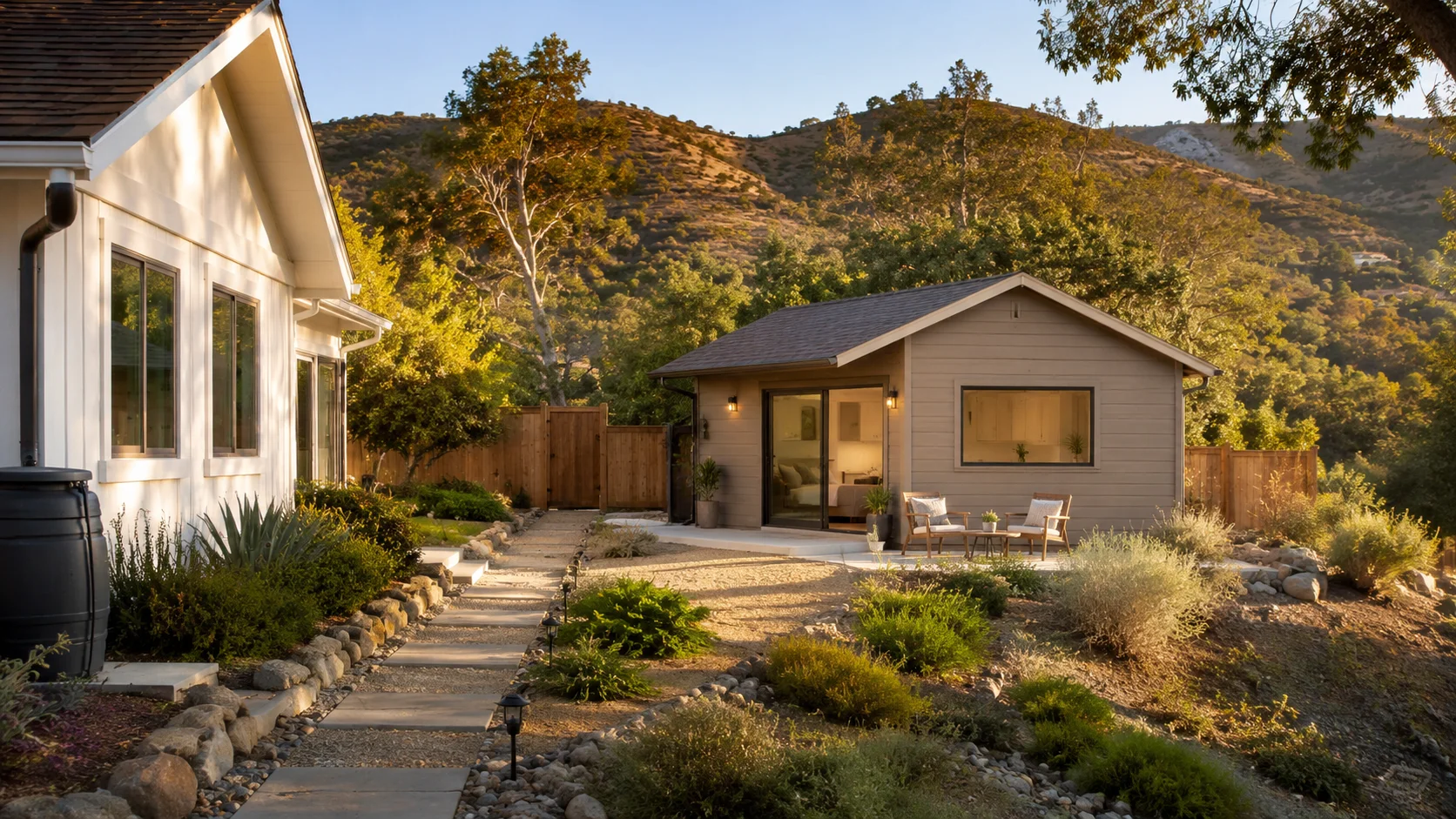
County of San Diego ADU Permit Process: 2026 Fees, Checklist & Timeline
· Last verified against County PDS and California Government Code sources: May 15, 2026
The bottom line, up front
This guide covers the ADU permit process for unincorporated San Diego County — communities like Ramona, Fallbrook, Alpine, Valley Center, Spring Valley, Bonita, Rancho Santa Fe, Jamul, Julian, Bonsall, and Lakeside. If your parcel is inside any of the 18 incorporated cities, the City of San Diego permit process or that city’s specific rules apply — not this guide.
The County’s Planning & Development Services (PDS) processes all ADU permits in unincorporated areas through an 11-step process anchored by the PDS-658 submittal checklist and the PDS-613 fee schedule. California Government Code § 66317 gives the County 15 business days to issue a completeness determination and 60 days to approve or deny a complete application. In practice, most ADU projects take several weeks for plan review on a clean first submittal; total project timelines including construction run roughly 10–18 months.
For a 600 sq ft detached ADU, County PDS base plan-review and permit fees calculate to $4,019.60 from the FY 2025–26 PDS-613 fee schedule. That figure excludes school developer fees, fire-district fees, water/sewer capacity charges, septic upgrades, and other outside-agency fees — which together routinely push all-in agency costs (before construction) into the mid four figures to low five figures, with septic, fire, and school being the most variable line items.
Three unincorporated overlays rarely mentioned on City-focused pages can materially affect your project: septic systems (DEHQ review), Wildland-Urban Interface (WUI) fire construction requirements, and grading triggers on sloped lots. Catching them early is the highest-leverage move you can make.
| Question | Fast answer | What to do next |
|---|---|---|
| Do County rules apply? | Only if your parcel is in unincorporated County — not an incorporated city. | Pull a Property Summary Report by APN via Accela. |
| Which agency processes the permit? | County Planning & Development Services (PDS), 5510 Overland Ave, Kearny Mesa. | Online: Accela Citizen Access at publicservices.sandiegocounty.gov. |
| State-law decision deadline? | 15 business days for completeness; 60 days to approve/deny complete application. | Cal. Gov. Code § 66317. Clock pauses on corrections. |
| Base permit fee (600 sq ft, standard path)? | $4,019.60 — calculated from PDS-613 FY 2025–26. | Add school, fire, septic, utility, grading separately. |
| OTC (over-the-counter) path available? | Yes — plan-review drops to $1,084 + $0.304/sf instead of standard $1,865 + $0.394/sf. | Same permit fee formula; qualifying criteria apply. |
| Impact-fee waiver still active? | No — ended January 9, 2024. | State § 66311.5 exemption still shields ADUs ≤ 750 sq ft from local impact fees. |
| School fees? | May apply when assessable space increase exceeds 500 sq ft (Education Code § 17620). | Separate threshold from the 750 sq ft impact-fee rule — verify by district. |
| Free County plan sets available? | Yes — Plans A–F, sizes 600–1,200 sq ft. ~85% complete. | Still need site-specific info: soils, Title 24, utilities, fire/septic. |
| Unincorporated overlays to check? | Septic (DEHQ), WUI / fire severity zone, grading (>200 cy or >8 ft cut/fill). | Check these before finalizing design — not after plan submittal. |
| Can I sell the ADU separately? | Yes, via condo conversion — effective April 4, 2026 (AB 1033 ordinance). | Requires Tentative Parcel Map + lienholder consent. |
| Can I legalize a pre-2020 unpermitted ADU? | Possibly — AB 2533 (2024) provides a streamlined path without enforcement penalties. | Contact PDS.ADUQuestions@sdcounty.ca.gov first. |
| Rental minimum? | 31 days or longer — short-term rentals prohibited. | County § 6156. |
| Permit validity? | 2 years to first inspection, 180-day inspection cadence, 3-year max. | County Building Permit Expiration page. |
Sources: County PDS ADU page; PDS-611; PDS-613 (FY 2025–26); PDS-441A; PDS-658; County Zoning Ordinance § 6156; Cal. Gov. Code §§ 66311.5, 66317, 66322, 66342; Cal. Educ. Code § 17620; AB 1033; AB 2533. Verified May 15, 2026.
Not sure if your parcel is in unincorporated County or an incorporated city? Run the free property check first.
Get Your Free 60-Second ADU ReportDo County of San Diego rules apply to your property?
San Diego County PDS governs ADUs only on parcels in unincorporated San Diego County — not inside any of the 19 incorporated municipalities. Communities commonly confused for incorporated cities but actually in unincorporated County include: Ramona, Fallbrook, Bonsall, Alpine, Jamul, Spring Valley, Bonita, Lakeside, Santee (some fringe parcels), Rancho Santa Fe, Julian, Valley Center, and Pauma Valley, among others.
The single most expensive mistake in San Diego ADU planning
Researching City of San Diego rules for a parcel that is actually in unincorporated County — or vice versa — is the single most common and expensive mistake we document in San Diego ADU projects. The two jurisdictions have different zoning codes, different permit forms, different fee schedules, and different review processes. City advice applied to a County parcel produces a permit denial, a redesign, and weeks of lost time.
The fix takes five minutes: pull your Assessor’s Parcel Number (APN) from your property tax bill and run it through the County’s Accela Citizen Access portal to generate a Property Summary Report. The report states your jurisdiction, zoning, and community plan area.
County PDS vs. City of San Diego — quick decoder
| County PDS (this guide) | City of San Diego | |
|---|---|---|
| Jurisdiction | Unincorporated areas (Ramona, Fallbrook, Alpine, etc.) | City limits only |
| Permit agency | Planning & Development Services (PDS) | Development Services Department (DSD) |
| Key permit form | PDS #291 (Residential Building Permit Application) | DSD forms |
| Fee schedule | PDS-613 (updated July 1 each year) | DSD Building Fee Schedule |
| Free pre-approved plans | Plans A–F (6 designs, 600–1,200 sq ft) | DSD Standard Plans (separate program) |
| Online portal | Accela Citizen Access (publicservices.sandiegocounty.gov) | DSD ePlan / Citizen Connect |
| Unique overlays | DEHQ septic, WUI fire, rural grading, ~20 fire districts | Coastal Zone (City LCP), urban fire districts |
How to confirm your jurisdiction in five minutes
- Find your APN on your property tax bill, the County Assessor portal, or your title documents.
- Go to publicservices.sandiegocounty.gov (Accela Citizen Access).
- Search your APN and pull the Property Summary Report.
- Confirm the jurisdiction field reads County of San Diego — unincorporated. If it reads any city name, stop and use that city’s permit process.
Confirm jurisdiction and see your parcel’s ADU path in one report →
Run Your APN Through the Free 60-Second Property CheckWhat can you build on a County parcel?
On an eligible single-family lot in unincorporated San Diego County, you can get ministerial (no public hearing) approval for one detached or attached ADU plus one JADU, when standards are met. California Government Code § 66323 allows a qualifying single-family lot to host one ADU created from existing space, one JADU, and one newly constructed detached ADU up to 800 sq ft. Multifamily lots have their own rules.
Five ADU types in unincorporated County
| Type | Definition | Key County rule |
|---|---|---|
| Detached ADU | New standalone structure, separate from the primary dwelling | Max 1,200 sq ft; 25 ft height; 4 ft side/rear setbacks |
| Attached ADU | New addition physically connected to the primary structure | Up to 50% of primary or 1,200 sq ft; state floors apply |
| Garage/accessory structure conversion | Converts an existing garage or outbuilding to livable ADU space | No expansion beyond current footprint to use conversion path; setbacks may be waived |
| Interior conversion | Converts existing space within the primary dwelling (not a JADU) | Must meet ADU building code; separate entrance required |
| JADU | Junior ADU — inside the existing or proposed primary dwelling | Max 500 sq ft; efficiency kitchen required; owner-occupancy if shared sanitation |
County ADU size matrix
| ADU type | Max size (County) | State floor | Height limit | Min setbacks |
|---|---|---|---|---|
| Detached ADU (local path) | 1,200 sq ft | — | 25 ft | 4 ft side/rear |
| Detached ADU (state ministerial path) | 800 sq ft | 800 sq ft | 18 ft (County) | 4 ft side/rear |
| Attached ADU | 50% of primary or 1,200 sq ft | 850 sq ft (studio/1-BR); 1,000 sq ft (2+ BR) | 25 ft | Per underlying zone |
| Garage/structure conversion | Existing footprint | 800 sq ft | Existing structure | Setbacks may be waived |
| Interior conversion | Existing space | 800 sq ft | Existing structure | Per underlying zone |
| JADU | 500 sq ft | — | Within primary | Within primary |
Sources: County PDS-611; County ADU Handbook (April 2024); Cal. Gov. Code §§ 66311.5, 66321, 66323. Verified May 15, 2026.
ADU rules at a glance — unincorporated County
| Rule | Standard | Note |
|---|---|---|
| Detached ADU max size | 1,200 sq ft | Regardless of primary dwelling size |
| Side/rear setbacks | 4 ft minimum | Fire-zone and OWTS setbacks may increase this |
| Front setback | ADUs ≤ 800 sq ft may encroach when no other location feasible | Larger ADUs must meet underlying zone front setback |
| Height (detached, local path) | 25 ft | County ministerial 800 sq ft path capped at 18 ft |
| Parking | 1 space (many exemptions) | Within ½ mi transit, conversion ADUs, and other categories fully waived |
| Owner-occupancy | Not required for ADUs | JADUs: required only if JADU shares sanitation with primary |
| Short-term rental | Prohibited — 31+ days minimum | County § 6156 |
| Solar PV | Required on newly constructed non-manufactured detached ADUs | Attached and conversion ADUs exempt; JADUs exempt |
| Fire sprinklers | Required only when required for primary residence | CRC R313.2; confirm with your fire district |
| Density count | ADUs not counted toward density under General Plan | County § 6156 |
| Permit type | Ministerial — no public hearing | No design review, no discretionary findings required when standards met |
Step-by-step: the County PDS ADU permit process
The County ADU Handbook describes a 14-step process; the 11 steps below consolidate those into the practical phases that determine timeline and outcome. The sequence is not optional — skipping or reordering steps (especially outside-agency clearances) is the primary cause of permit delays in the mid-project range.
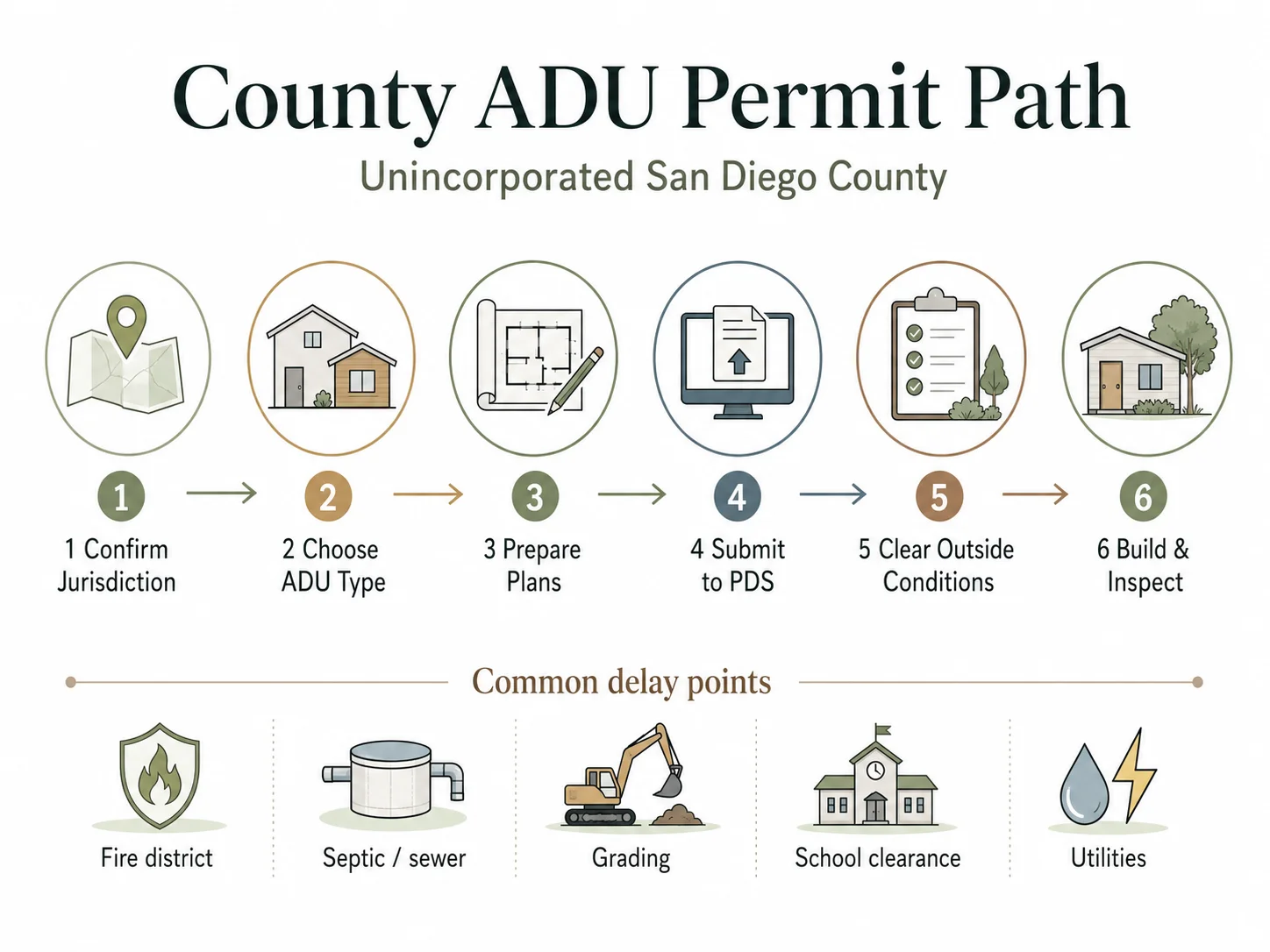
Confirm jurisdiction and pull your Property Summary Report
Before spending a dollar on plans, confirm your parcel is in unincorporated San Diego County — not inside one of the 18 incorporated cities. Pull your APN and run it through Accela Citizen Access to generate a Property Summary Report. The report lists your zoning designation, community plan area, fire-hazard severity zone, and applicable overlays.
Contact: pdszoningpermitcounter@sdcounty.ca.gov | PDSBuildingPermitCounter@sdcounty.ca.gov, (858) 694-2960
Confirm ADU type, size, and count
Decide whether you’re building a detached, attached, conversion, or JADU. Size choices have downstream fee and regulatory consequences: under 750 sq ft avoids certain local impact fees under Gov. Code § 66311.5; under 500 sq ft avoids the school-developer fee threshold under Education Code § 17620. County Plans A–F are pre-approved for 600, 800, 1,000, and 1,200 sq ft. Make size decisions knowing both thresholds, not just one.
Check your parcel's fire and environmental overlays early
Run your address through the Cal Fire FHSZ viewer to determine your fire-hazard severity zone. Identify your fire district from the PDS Fire District Contact List — districts like Rancho Santa Fe FPD impose stricter standards than the County baseline. Confirm sewer vs. septic: if on septic, contact a licensed OWTS Professional for a layout assessment before finalizing design. Estimate earthwork for grading-permit triggers (>200 cy or >8 ft cut/fill).
DEHQ contact: lwqduty.deh@sdcounty.ca.gov, (858) 694-2888
Walk the PDS-658 submittal checklist line by line
PDS-658 (Minimum Essential Plan Submittal Items) is the County’s completeness standard. Work through every line before finalizing your plan set. Required items include: plot plan, floor plan, elevations, foundation plan, structural calculations, energy compliance (Title 24), stormwater BMP documentation, and any fire-district, DEHQ, or grading documentation your parcel triggers. Missing even one item resets the 15-business-day completeness clock when you resubmit. The plans section of this guide covers PDS-658 in detail.
Engage outside agencies in parallel with plan design
Start fire-district pre-application, DEHQ OWTS layout application, school-district clearance, and water/sewer capacity confirmation during the design phase — not after you submit plans. These run on their own timelines and the County will not issue your permit until every outside-agency condition is cleared and every fee is paid. Waiting until plan-check approval to start the school-district paperwork commonly adds weeks to the post-approval timeline.
Prepare the complete plan set
Assemble every document on PDS-658, signed by licensed professionals as required. If using County Plans A–F, supplement the pre-approved architectural and structural sheets with your site-specific plot plan, foundation tied to your soils, utility connections, Title 24 re-run for your climate zone and orientation, solar PV plan (required for new detached non-manufactured ADUs), and any fire/septic/grading documentation. File PDS Form #291 (Residential Building Permit Application). The County Building Forms page has current form numbers and download links.
Submit your complete plans through Accela Citizen Access
Upload your complete plan set and application through the County’s Accela Citizen Access portal. The County must issue a completeness determination within 15 business days. If anything is missing, the County issues a correction letter and the clock resets on resubmittal. This is a binary gate — either every PDS-658 item is present, or it isn’t.
Respond to County plan-check corrections fast
The County issues correction comments and pauses the 60-day state-law decision clock until you resubmit. PDS-441A confirms more than half of all projects require two or more plan-check cycles. Turn corrections around in days, not weeks — every day your revised plans sit with your designer adds to the permit timeline. Scope changes between cycles require Conditions of Approval to be reissued, restarting review — so bank redesign decisions for after the permit, not during plan check.
Obtain outside-agency clearances and approvals
Track fire-district conditions, school-district fee certificate, water/sewer utility approvals, and DEHQ septic sign-off in parallel with County plan check. A project can sit “approved” by PDS for weeks while a school-district certificate is pending. Every outside-agency condition must be cleared before the County will issue the permit.
Pay all fees and pull the permit
Pay the County PDS plan-review fee, permit fee, $87 Land Development counter screening fee, and all applicable outside-agency fees. Once all fees are collected and outside-agency conditions cleared, the County issues the building permit. Construction may then begin.
Complete construction and pass inspections through Certificate of Occupancy
Schedule and pass all required inspections — foundation, framing, rough MEP, insulation, drywall, final — through the County’s inspection system. The permit expires if a valid inspection is not passed within two years of issuance and every 180 days thereafter, with a three-year maximum. Once all inspections pass, the County issues a Certificate of Occupancy, making the ADU legally habitable.
If navigating the 11-step County process every week matters more than DIY, SnapADU is a stick-built design-build contractor serving Greater San Diego including unincorporated communities. See our independent SnapADU review, SnapADU cost breakdown, and alternatives comparison before any sales call. Affiliate disclosure: we earn a commission when readers use our links — at no cost to you — and our recommendations are not influenced by compensation.
What to submit: the PDS-658 checklist in plain English
PDS-658 divides submittal items into always-required and conditionally-required categories. A clean first submittal means every always-required item is present and every conditional item that applies to your parcel is included — signed by the appropriate licensed professional.
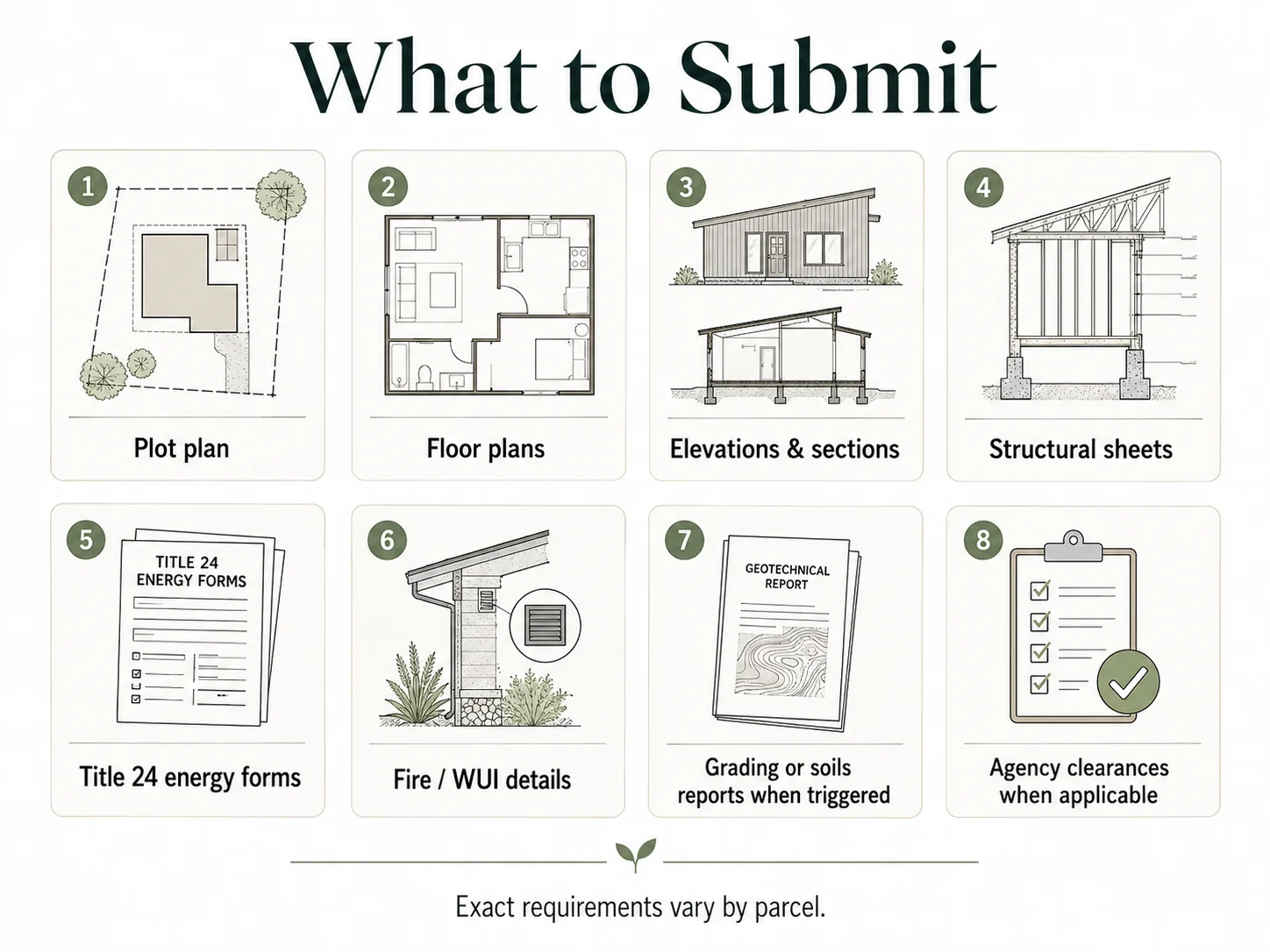
Always-required plan items
- PDS Form #291 — Residential Building Permit Application
- Plot plan (survey-grade: setbacks, easements, existing structures, utilities, driveway, drainage, north arrow, scale)
- Floor plan with room labels and dimensions
- All four exterior elevations
- Building cross-sections
- Foundation plan
- Roof framing plan
- Wall sections
- Structural calculations (engineer-stamped)
- Soils report (engineer-stamped, when triggered)
- Energy compliance — Title 24 Part 6 (CF1R, CF2R, CF3R forms re-run for your climate zone and orientation)
- Solar PV plan (new detached non-manufactured ADUs)
- Stormwater BMP documentation
Conditionally-required items — triggered by parcel
| Conditional item | When triggered |
|---|---|
| WUI construction documentation (ignition-resistant materials, defensible space plan) | Parcel in Cal Fire High or Very High Fire Hazard Severity Zone |
| Fire district plan review / conditions letter | All projects — required from your specific district |
| Grading plan + PDS Form #352 (Grading Permit Application) | Earthwork >200 cubic yards or cut/fill >8 ft vertical |
| DEHQ OWTS layout application | Property on septic, when ADU adds bedroom count or fixture load |
| Hydrology / drainage study | Steeper sites or projects creating runoff toward neighbors |
| Coastal Development Permit | Limited unincorporated portion in Unincorporated LCP Coastal Zone |
| Encroachment permit | Driveway work in County right-of-way |
| Tree-preservation documentation | Heritage trees or oak-protection ordinances in some communities |
What County Plans A–F do not replace
The County’s free Dwelling Unit Plans A–F handle the architectural and structural skeleton — but they’re explicitly approximately 85% complete per the County’s Dwelling Unit Building Plans page. You still need: site-specific plot plan, foundation design tied to your actual soils, utility connection plan, Title 24 forms re-run for your climate zone and orientation, and any WUI / fire / septic / grading documentation triggered by your parcel.
A clean first submittal includes every required item that applies, signed by the appropriate licensed professional, with the County’s plan-check template followed exactly. PDS reviewers will return a submittal as incomplete if any required item is missing — and the state-law 15-business-day completeness clock restarts when you resubmit.
Want the full PDS-658 checklist with required items, conditional triggers, and the fee-estimator spreadsheet as a single printable PDF? Download the free ADU Starter Kit — no spam, unsubscribe anytime.
How much does a County of San Diego ADU permit cost in 2026?
The County’s FY 2025–26 PDS-613 fee schedule lists ADUs with their own dedicated fee lines: standard plan review is $1,865 plus $0.394 per square foot, the permit fee is $1,596 plus $0.537 per square foot, and the OTC path lowers plan review to $1,084 plus $0.304 per square foot. For a 600 sq ft detached ADU using the standard path, that calculates to $4,019.60 in County PDS base fees — before school, fire, septic, grading, water, sewer, and utility-agency fees. The County’s trial impact-fee waiver ended January 9, 2024.
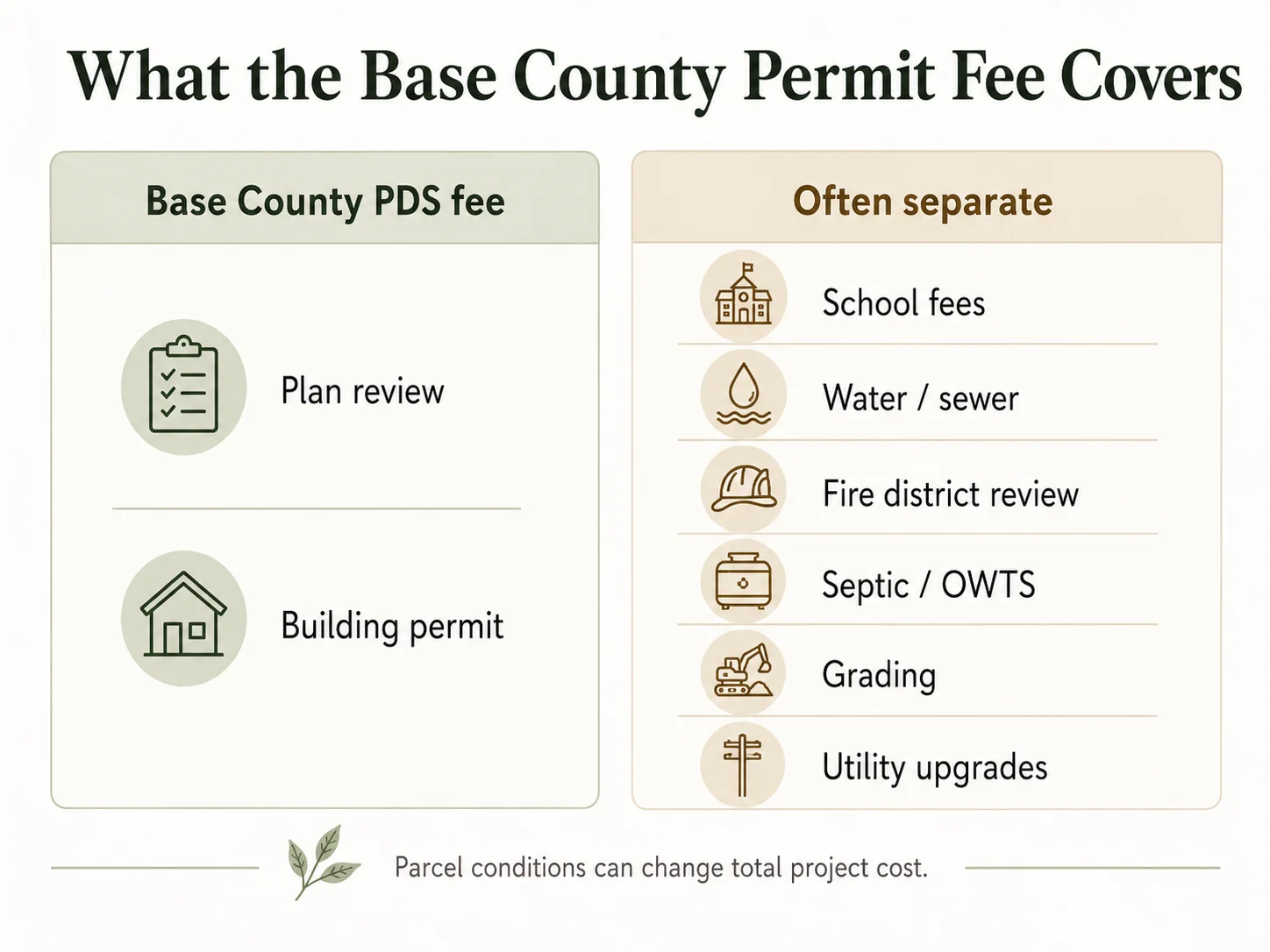
County PDS base fees by ADU size — calculated from PDS-613
| ADU size | Standard — Plan check | Standard — Permit | Standard total | OTC — Plan check | OTC total |
|---|---|---|---|---|---|
| 400 sq ft | $2,022 | $1,811 | $3,833 | $1,206 | $3,017 |
| 500 sq ft (JADU max) | $2,062 | $1,865 | $3,927 | $1,236 | $3,101 |
| 600 sq ft (Plan F) | $2,101 | $1,918 | $4,019.60 | $1,266 | $3,184.60 |
| 700 sq ft | $2,141 | $1,972 | $4,113 | $1,297 | $3,269 |
| 750 sq ft | $2,161 | $1,999 | $4,160 | $1,312 | $3,311 |
| 800 sq ft (Plan E) | $2,180 | $2,026 | $4,205.80 | $1,327 | $3,352.80 |
| 900 sq ft | $2,220 | $2,079 | $4,299 | $1,358 | $3,437 |
| 1,000 sq ft (Plan D) | $2,259 | $2,133 | $4,392 | $1,388 | $3,521 |
| 1,100 sq ft | $2,298 | $2,187 | $4,485 | $1,418 | $3,605 |
| 1,200 sq ft (Plans A, B, C) | $2,338 | $2,240 | $4,578.20 | $1,449 | $3,689.20 |
Source: County of San Diego PDS-613 Fee Schedule, FY 2025–26 (effective July 1, 2025). Standard plan-review formula: $1,865 + $0.394/sf. OTC plan-review formula: $1,084 + $0.304/sf. Permit-fee formula: $1,596 + $0.537/sf. These are PDS-only base fees. They do not include the $87 Land Development counter screening fee, resubmittal fees, or any outside-agency fees.
What state law says about ADU local impact fees
California Government Code § 66311.5 limits when local agencies, special districts, and water corporations can charge impact fees on ADUs:
- No local agency, special district, or water corporation impact fee is allowed on ADUs of 750 sq ft or smaller, or on JADUs of 500 sq ft or smaller.
- For ADUs over 750 sq ft, any local impact fee charged must be proportionate to the burden the ADU places on the agency’s services.
- Utility connection and capacity fees are treated differently than impact fees and may still apply.
School fees are handled separately. School developer fees are governed by California Education Code § 17620 — not by the 750 sq ft local impact-fee exemption above. When the resulting increase in assessable space exceeds 500 sq ft, school developer fees may apply. So an ADU of 600 sq ft is exempt from local impact fees (under 750 sq ft) but may still owe school fees because it exceeds the 500 sq ft school-fee threshold. Treat school fees and local impact fees as two separate questions with two separate thresholds.
School developer fees — verify your district
Because unincorporated County parcels fall under many different school districts, you must verify your specific school district by address or APN. As of May 2026:
| School district | Residential developer fee | Note |
|---|---|---|
| San Diego Unified School District (SDUSD) | $5.38/sq ft | Effective May 11, 2026 |
| San Dieguito Union High School District (SDUHSD) | $2.72/sq ft | 500 sq ft or less exempt |
| Vista, Ramona, Bonsall, Fallbrook Union, Valley Center–Pauma, Mountain Empire, Warner, and others | Varies | Verify by address or APN at each district |
Want a parcel-specific fee estimate that combines PDS base fees, school district, fire-district overlay, and septic risk in one report?
Get a Parcel-Specific Fee Estimate — FreeHow long does the County ADU permit process take?
California Government Code § 66317 gives the County 15 business days from submittal to issue a completeness determination, and 60 days from a complete application to approve or deny — when an existing primary dwelling is on the lot. In practice, most County ADU projects take several weeks for plan review on a clean first submittal, with full project timelines (design, permitting, construction) running roughly 10–18 months. The state-law clock pauses every time the County issues corrections and waits for your resubmittal.
Realistic timeline by path
These ranges are Dwelling Index editorial estimates based on industry observation and verified County data on plan-check cycles; they are not County-published guarantees.
| Phase | Pre-Approved Plan path | Custom-design path | What drives the range |
|---|---|---|---|
| Concept → complete plans | 2–4 weeks | 8–16 weeks | Architect/designer workload, engineer turnaround, Title 24 |
| First plan-check cycle | Faster than custom | 4–6 weeks | Completeness of submittal |
| Corrections + resubmittal | Minimal to moderate | 2–6 weeks | Clock pauses while plans are with you |
| Outside-agency clearances | 1–8 weeks (parallel) | 1–8 weeks (parallel) | Fire, school, water, sewer, septic |
| Permit issuance | 1–2 weeks | 1–2 weeks | Final fee collection |
| Construction | 4–7 months | 6–9 months | Size, site complexity, weather, materials |
| Total realistic range | Several months | Roughly 10–18 months | — |
What will delay your County ADU permit?
The most common County PDS ADU delays are: wrong-jurisdiction research that wastes weeks; incomplete plan submittals that fail the 15-business-day completeness check; outside-agency conditions (fire, septic, school, water/sewer) that lag plan check; WUI and fire-district review on rural parcels; and grading triggers that surface after design is locked. None of these are dealbreakers. All of them are avoidable when caught early.
| Delay risk | Why it matters | How to reduce it |
|---|---|---|
| Wrong jurisdiction | City advice doesn't apply to County PDS; sometimes only discovered after design starts | Pull Property Summary Report by APN first |
| Incomplete plans | Completeness clock requires every PDS-658 item; missing one resets the count | Walk PDS-658 line-by-line before submittal |
| Fire district / WUI review | Ignition-resistant construction, defensible space, district-specific requirements | Contact your fire district during design, not after plan check |
| DEHQ septic review | Bedroom-count and fixture-unit additions can require system expansion | Get an OWTS Professional layout study during design |
| Grading triggers | Change to grading at >200 cubic yards or >8 ft cut/fill triggers a separate permit | Confirm earthwork volume before final design |
| School-district clearance | Required at permit issuance; can lag weeks | Start school-district paperwork in parallel with plan check |
| Water / sewer capacity | New meter or capacity upgrade can be material | Confirm meter sizing and capacity with your utility before paying for plans |
| Scope changes mid-review | Conditions of Approval get re-issued | Avoid redesign during plan check; bank changes for after permit |
| Utility undergrounding | Some parcels require existing overhead to be undergrounded | Confirm utility infrastructure during Step 4 |
| Title issues | Boundary, easement, or legal-lot disputes block permit issuance | Resolve at title-search stage, not at permit-issuance stage |
Septic plus WUI plus slope combined can quietly add a significant premium to a rural ADU. A builder who has navigated this exact stack in Ramona, Alpine, Fallbrook, Bonsall, or Rancho Santa Fe will price these line items accurately upfront. See our SnapADU vs. Better Place Design Build comparison before signing any contract. Affiliate disclosure applies as above.
What unincorporated overlays can delay a County ADU permit?
Three constraints define unincorporated ADU permitting and rarely appear on City-focused pages: septic systems requiring DEHQ review, Wildland-Urban Interface (WUI) construction with defensible-space requirements, and grading triggers on sloped or large-earthwork projects. Each can add weeks of process and material cost. Getting ahead of these in the design phase is the single highest-leverage move a homeowner in Alpine, Ramona, Fallbrook, Bonsall, Jamul, Rancho Santa Fe, Julian, Valley Center, or any unincorporated community can make.
Septic systems and the DEHQ pathway
Many unincorporated parcels aren’t on public sewer. If your main house is on septic and you’re adding an ADU, the existing system has to accommodate the new bedroom count and fixture units. DEHQ reviews:
- Existing capacity — can the disposal field absorb the additional load?
- Tank sizing — does the existing septic tank meet the County’s standards for the new combined fixture count?
- Setbacks — where on the property does any new system or tank go?
The first step is contacting a licensed OWTS Professional (On-site Wastewater Treatment System designer) listed on the DEHQ website. They prepare an OWTS Layout Application; DEHQ performs a field inspection; if everything aligns, DEHQ provides terms of approval. Email lwqduty.deh@sdcounty.ca.gov for correspondence and document submittals.
Septic costs vary widely by parcel — from tank supplement only (lowest cost) to full system replacement or engineered systems (sometimes the largest line item outside of construction itself). These are Dwelling Index editorial estimates based on industry observation. Always get a parcel-specific quote from a licensed OWTS Professional before budgeting. Start the OWTS layout during design — not after plans are submitted.
Wildland-Urban Interface (WUI) and fire safety
Most unincorporated areas of San Diego County sit within Cal Fire–designated Fire Hazard Severity Zones, often classified as High or Very High. The County’s Building Code amendments require, for WUI projects:
- 100 ft of fuel modification around the structure (or to the property line, whichever is nearer), with the inner 50 ft cleared, irrigated, and planted with fire-resistant species
- Ignition-resistant construction including exterior walls, eaves, vents (ember-resistant), roof assemblies, and decking
- Defensible space maintained year-round
- Access for fire apparatus — driveway width, slope, turnaround, and gate clearances meeting your fire district’s standard
- Water supply — sometimes including dedicated tanks (Rancho Santa Fe FPD is particularly strict)
To check your parcel, enter your address at the Cal Fire FHSZ viewer. If you’re in a High or Very High zone, WUI-rated construction adds a meaningful premium to the build budget (Dwelling Index editorial estimate — varies by design and district).
Fire sprinklers — when they’re required (and when they’re not)
California Residential Code Section R313.2 requires automatic residential sprinkler systems in newly constructed one- and two-family dwellings, with one important ADU exception: fire sprinklers are not required in an ADU when sprinklers were not required by the building code applicable to the existing primary residence at the time it was built. A 1970s ranch home that was never required to have sprinklers can usually add an ADU without retrofitting sprinklers — unless that home was substantially altered in a way that triggered sprinkler retrofit. Always confirm with your specific fire district; some districts have local amendments that go beyond state code.
The County’s roughly 20 local fire districts
Unincorporated San Diego County is served by a patchwork of fire authorities, each with its own development-review process. Knowing your district matters because some (Rancho Santa Fe Fire Protection District is the textbook example) impose stricter standards than the County baseline. Key districts include:
- San Diego County Fire (Cal Fire)
- Alpine Fire Protection District
- Bonita-Sunnyside Fire Protection District
- Borrego Springs Fire Protection District
- Deer Springs Fire Protection District
- East County Fire Protection District
- Julian-Cuyamaca Fire Protection District
- Lakeside Fire Protection District
- North County Fire Protection District (Fallbrook/Bonsall)
- Pine Valley Fire Protection District
- Rancho Santa Fe Fire Protection District
- San Miguel Fire Protection District
- Valley Center Fire Protection District
- Vista Fire Department (limited unincorporated)
PDS publishes a current Fire District Contact List. Verify your district during Step 4 of the process.
Grading on slopes and earthwork
Per PDS-658 and the County Grading Ordinance, a grading plan and permit are typically triggered when earthwork reaches 200 cubic yards or cut/fill reaches 8 ft in vertical dimension. Steep lots (over 10% slope) increase costs significantly; the County notes that grading on slopes exceeding 25% may require additional engineering or be infeasible. If your lot has any meaningful grade, talk to the County Land Development counter at (858) 694-2055 or ldpermitcounter@sdcounty.ca.gov before paying for design.
Solar PV — Title 24 Part 6
California’s Title 24 Part 6 Building Energy Efficiency Standards require solar photovoltaic systems on newly constructed, non-manufactured, detached ADUs. Important distinctions:
- Attached ADUs are treated as additions and do not require PV.
- Conversion ADUs generally do not require PV.
- JADUs are exempt.
- Manufactured homes are not subject to the Energy Code at all.
- Factory-built housing must comply with Title 24. “Prefab” and “modular” terminology can describe either category — confirm your product’s regulatory classification before assuming exemption.
Can you use County Dwelling Unit Plans A–F?
Yes. The County of San Diego publishes a free library of six standard dwelling-unit plans (Plans A–F) usable as ADUs or single-family dwellings in unincorporated areas. They are approximately 85% complete and require you to fill in project-specific information before submittal. Used on the right lot, these plans can speed plan review and save on design costs — but they’re not a guarantee of approval and they don’t fit every site. For a deeper breakdown, see our companion piece: San Diego County Pre-Approved ADU Plans.
The Plans A–F catalog
| Plan | Size | Bedrooms / Bathrooms | Best fit |
|---|---|---|---|
| Plan A | 1,200 sq ft | 3 bed / 1 bath | Larger family or income unit |
| Plan B | 1,200 sq ft | 2 bed / 1 bath | Larger two-bedroom layout |
| Plan C | 1,200 sq ft | 2 bed / 2 bath | Two-bedroom with second bath |
| Plan D | 1,000 sq ft | 1 bed / 1.5 bath | Spacious one-bedroom |
| Plan E | 800 sq ft | 1 bed / 1 bath | Above the 500 sq ft school-fee and 750 sq ft impact-fee thresholds |
| Plan F | 600 sq ft | 1 bed / 1 bath | Below 750 sq ft impact-fee threshold; above 500 sq ft school-fee threshold |
Source: County of San Diego Dwelling Unit Building Plans page. Each plan is published at approximately 85% completion.
When pre-approved plans are the wrong choice
- Sloped or constrained lot — Plans A–F assume a relatively flat, regular building pad.
- Unique site constraints — easements, view corridors, mature trees, HOA restrictions.
- Strong design preferences — these are functional plans, not premium architecture.
- Fee threshold targeting — sometimes a custom 749 sq ft design is more livable than Plan E (800 sq ft) and avoids the 750 sq ft local impact-fee cliff entirely.
What if your ADU was already built without permits?
California’s Assembly Bill 2533 (2024) gives owners of ADUs and JADUs built before January 1, 2020 a streamlined permit path through County PDS, provided the structure can be brought up to applicable health, safety, and building standards. Under County § 6156’s AB 2533 language, the permits needed to correct the violation must be approved without penalty, and the applicant shall not be required to pay impact fees or connection/capacity charges — except when utility infrastructure is required to comply with health and safety standards. Owners may obtain a confidential third-party code inspection from a licensed contractor before submitting an application.
AB 2533 in plain English
AB 2533 doesn’t say your unpermitted ADU is automatically legal. It says you can apply for an after-the-fact permit using a less punitive process, with the requirement that the structure meet specific safety standards (electrical, plumbing, fire egress, ventilation, structural soundness).
Streamlining does mean:
- Review without enforcement penalties for unpermitted history
- No demolition required if structure can be brought to standard
- Confidential inspection by a licensed contractor allowed before filing
- No impact fees or connection/capacity charges (except for health-safety utility work)
Streamlining does not mean:
- An automatic permit
- Zero cost — PDS fees and correction costs still apply
- Avoidance of WUI / septic / grading review
- Permission to ignore current building, fire, and health code
Email PDS.ADUQuestions@sdcounty.ca.gov to start the conversation. County staff can discuss options without obligation.
Can you sell a County ADU separately under AB 1033?
Yes, as of April 4, 2026. On March 4, 2026, the San Diego County Board of Supervisors voted unanimously to adopt an Assembly Bill 1033 program allowing the separate sale of ADUs in unincorporated communities through a condominium conversion process. The ordinance took effect April 4, 2026. The County is collecting feedback May 1–31, 2026 on draft optional local implementation criteria — verify the latest program details on the County’s ADU Zoning Ordinance Amendment page before filing.
This is one of the most consequential ADU policy shifts in San Diego County in a decade. Before April 2026, owners in unincorporated communities could rent an ADU but couldn’t sell it separately from the primary house. With the AB 1033 program live, the financial calculus of building an ADU shifts: you now have an exit strategy that doesn’t require selling the main house too.
What AB 1033 lets unincorporated owners do
- Build an ADU on a lot with an existing primary dwelling per the standard County process described above
- After the ADU is built and final-inspected with a Certificate of Occupancy — or, for a pre-existing ADU, after meeting the County’s required housing-quality or code-inspection standards — apply for condominium conversion under the Davis-Stirling Common Interest Development Act
- Provide written lienholder consent from any party holding a mortgage or security interest
- Notify utility providers of the condominium creation and separate conveyance
- Comply with County review of OWTS and well items where applicable, and any fire-safety conditions
- Once converted, the ADU becomes a separately deeded condominium unit that can be sold, financed, or transferred independently
What the program does not do
- Does not bypass mapping requirements — a Tentative Parcel Map or Tentative Map is still required
- Does not waive lender consent
- Does not apply to JADUs
- Does not automatically resolve HOA restrictions or covenants — those are private agreements addressed separately
Practical implications
- Financing flexibility — an ADU you can someday sell is a different financial asset than one you can only rent
- Family transfers — adult children can purchase the ADU from parents
- Investor pathways — small-scale developers can build and sell ADUs as starter housing without the lot
- Exit liquidity — owners who want to scale back can sell the ADU and stay in the main house, or vice versa
Considering an ADU you might want to sell someday?
Get Your Free ADU Report — Flag AB 1033 EligibilityHow to finance the permit and build phase
Most homeowners fund the design, permit, and build phases through one of four lanes: a home equity line of credit (HELOC) for predictable phased draws, a cash-out refinance to convert equity into liquid construction capital, a construction-to-permanent loan that funds the build and rolls into a final mortgage, or a renovation loan that uses after-renovation value to qualify. We discuss financing as lanes, not lender rankings. We never claim a specific rate, APR, or monthly payment as a guarantee. Compare offers from licensed lenders, read every disclosure, and don’t sign anything you don’t understand.
Lane 1 — HELOC
Best fit: Owners with significant equity and a low current first-mortgage rate they don't want to disturb.
Trade-off: Variable rate during the draw period. Payment moves if benchmark rates move.
Lane 2 — Cash-out refinance
Best fit: Owners whose current first-mortgage rate is at or above current market, or who want a fixed rate on the entire balance.
Trade-off: Closing costs on the full balance. Doesn't always pencil out at current rates.
Lane 3 — Construction-to-permanent
Best fit: Larger detached ADUs, parcels with septic or unusual features, owners who want one closing.
Trade-off: More involved underwriting. Qualifying for the full anticipated cost, not just current equity.
Lane 4 — Renovation / ARV-based
Best fit: Owners with limited current equity who expect the ADU to materially increase the property's value.
Trade-off: Product availability varies. ARV-based products are tightly underwritten.
County-specific financing friction to plan for
- Septic reserve — if your ADU triggers septic upgrades, demonstrate funds for those upgrades inside your project budget at underwriting.
- WUI / fire reserve — WUI construction premiums need to be priced in upfront.
- Outside-agency fees before issuance — school, fire, water, sewer, and DEHQ fees are typically due before the County will issue your permit.
- Longer rural construction timelines — fire-district inspections and septic milestones can extend the schedule, which matters for construction-loan draw schedules.
- AB 1033 lienholder consent — if you plan to convert the ADU to a separately saleable condominium later, your current lender’s consent is required. Get that conversation started early.
Explore current construction-loan and cash-out-refi options through Mortgage Research Center — request rate quotes from multiple lenders with one form. Verify any credit-impact specifics directly with the lender at application. For deeper financing strategy, see our ADU Financing Options guide and HELOC for ADU. Affiliate disclosure: we may earn a commission when you use our links — at no cost to you. We are not a lender, broker, or financial advisor. We do not guarantee qualification, rates, or specific outcomes. Compare offers from licensed lenders.
What should you do next?
If you’re in unincorporated San Diego County and you’re serious about an ADU, the first move is verification: confirm jurisdiction, confirm zone, confirm parcel status, identify your fire district and septic situation — and only then choose between County Plans A–F, a custom architect, or a design-build firm. A clean two hours spent at the start saves four to twelve weeks downstream.
Pull your APN — from your property tax bill, the Assessor's portal, or your title documents.
Run your Property Summary Report through Accela Citizen Access. Confirm jurisdiction and zoning.
Check your fire-hazard severity zone via the Cal Fire FHSZ viewer.
Identify your fire district from the PDS Fire District Contact List.
Check your school district — different developer fees apply.
Confirm sewer vs. septic. If septic, schedule an OWTS Professional consultation early.
Pick your ADU type: detached, attached, conversion, or JADU.
Pick your size strategy. Under 750 sq ft for local impact-fee exemption; consider the 500 sq ft school-fee threshold separately.
Choose the plan path: free County Plans A–F, custom design, or design-build.
Run the PDS-658 checklist. Build your submittal around the full required-and-conditional list.
Estimate full fees: use the PDS-613 calculator for County fees; add fire-district, school, water, and utility fees for an all-in estimate.
Submit clean and complete. A perfect first submittal is the cheapest path to a permit.
Skip the spreadsheet — see what’s possible at your address.
Run the Free 60-Second ADU ReportWe assemble jurisdiction, zone, FHSZ, sewer/septic, base County fees, and likely permit path in one parcel-specific report.
Frequently asked questions
Do I need a permit for an ADU in unincorporated San Diego County?
Yes. A building permit is required for every ADU and JADU in unincorporated San Diego County. There is no scenario where an ADU is "permit-exempt" — even a garage conversion to an ADU requires a permit because the change of use, electrical, and plumbing all require code compliance.
Is County of San Diego the same as City of San Diego for ADU permits?
No. The County of San Diego (Planning & Development Services, PDS) governs ADUs on parcels in unincorporated areas only. The City of San Diego (Development Services Department, DSD) governs ADUs inside the city limits. Different addresses, different forms, different fee schedules. The 18 other incorporated cities each run their own permit processes.
How much does a County ADU permit cost?
County PDS base plan-review plus permit fees calculate from the FY 2025–26 PDS-613 fee schedule using $1,865 + $0.394/sf (plan review) and $1,596 + $0.537/sf (permit). For a 600 sq ft detached ADU using standard review, that totals $4,019.60 in County PDS fees alone — before school developer fees, fire-district fees, water/sewer capacity fees, septic upgrades, and other outside-agency fees. All-in agency costs (excluding construction) commonly land in the mid four figures to low five figures depending on parcel (Dwelling Index editorial estimate).
Are San Diego County ADU fees still waived?
No. The County's trial impact-fee waiver ran from January 9, 2019 through January 9, 2024 and has ended. State-law exemptions under Gov. Code § 66311.5 still apply to local agency impact fees on ADUs of 750 sq ft or less. School fees are handled separately under Education Code § 17620 and apply when assessable space increase exceeds 500 sq ft.
What is the maximum detached ADU size in San Diego County?
Per County PDS-611 and the County ADU Handbook, the maximum detached ADU is 1,200 sq ft, regardless of the existing main house's size.
How big can a JADU be?
A Junior Accessory Dwelling Unit (JADU) is limited to 500 sq ft and must be entirely contained within the existing or proposed single-family residence. JADUs require either the primary home or the JADU itself to be owner-occupied.
Is parking required for a County ADU?
One off-street parking space is required for a new ADU — but the requirement is fully waived under the exemptions in County § 6156 and Gov. Code § 66322: ADU within one-half mile of public transit, ADU in an architecturally and historically significant historic district, ADU created as part of a conversion, parcel in a district where on-street parking permits are required but not offered to the ADU occupant, a car-share vehicle within one block, or ADU submitted with a new single-family or multifamily dwelling. When required, the space may be tandem and located within setbacks.
Can I build an ADU in the front yard?
In some cases. PDS-611 allows ADUs of 800 sq ft or less to encroach into the front setback when no other location on the property is feasible. Larger ADUs must meet the underlying zone's front-yard setback. Fire setbacks override these in WUI areas.
Can I use County Plans A–F?
Yes, if your project is in unincorporated County and the plan fits your site. The Plans A–F catalog includes 600 sq ft (Plan F), 800 sq ft (Plan E), 1,000 sq ft (Plan D), and three 1,200 sq ft options (Plans A, B, C). They're approximately 85% complete and require project-specific information including plot plan, foundation tied to soils, utility connections, Title 24 forms re-run for your parcel, and any WUI or fire-district documentation.
How long does County ADU permit approval take?
Under California Government Code § 66317, the County must issue a completeness determination within 15 business days and approve or deny a complete application within 60 days when an existing primary dwelling is on the lot. PDS-441A notes that more than half of all projects require more than two plan-check cycles, so multi-month timelines are common in practice. Full project timelines, including design and construction, typically run 10–18 months (Dwelling Index editorial estimate). County Pre-Approved Plans A–F can shorten plan review materially.
What causes corrections or resubmittals?
The most common correction triggers: incomplete plot plan, missing structural calculations, Title 24 errors, fire setback issues, stormwater documentation gaps, energy-form mismatches, WUI compliance gaps, and septic capacity questions. The County says more than half of all projects need two or more plan-check cycles. Each correction pauses the 60-day state-law clock until you resubmit.
Do I need fire sprinklers in my ADU?
Per California Residential Code R313.2, fire sprinklers are required in a newly constructed ADU only when the primary residence is required to have sprinklers under current code. Older single-family homes built when sprinklers weren't required typically don't trigger sprinkler retrofit on a new ADU. Always confirm with your specific fire district — local amendments can be stricter than state code.
Do I need septic review?
If your property is on septic (no public sewer connection), yes. The Department of Environmental Health and Quality (DEHQ) reviews your existing system's capacity, your proposed ADU's fixture units, and whether the system needs supplementation or replacement. Start the OWTS layout application early — septic costs are often the largest single budget unknown on rural County ADU projects.
Are school fees required?
School developer fees may apply to new habitable square footage when the resulting increase in assessable space exceeds 500 sq ft, per Education Code § 17620. Rates vary by school district. San Diego Unified School District's residential developer fee is $5.38/sq ft as of May 11, 2026. San Dieguito Union High School District's is $2.72/sq ft. Other districts have their own rates. Verify by address or APN.
Can I rent the ADU as an Airbnb?
No. County § 6156 prohibits short-term rentals of ADUs and JADUs. The minimum rental term is 31 days or longer. Renting an ADU as a vacation rental violates the ADU's permit conditions.
Can I sell the ADU separately?
As of April 4, 2026 (effective date of the County's AB 1033 implementing ordinance), yes — through a condominium conversion process. The program requires final inspection / Certificate of Occupancy, lienholder consent, utility-provider notification, and County review. The program does not bypass mapping requirements. JADUs may not be sold separately.
Can I legalize an unpermitted ADU built before 2020?
Possibly. AB 2533 (2024) provides a streamlined path for ADUs and JADUs built before January 1, 2020, provided the structure can be brought up to applicable health, safety, and building standards. Per County § 6156's AB 2533 language, the permits needed to correct the violation are approved without penalty, and the applicant is not required to pay impact fees or connection/capacity charges — except when utility infrastructure is required for health and safety compliance. Contact PDS.ADUQuestions@sdcounty.ca.gov.
Do I need a soils report?
A soils or geotechnical report is not automatically required for every ADU, but is commonly triggered by hillside sites, expansive soils, complex foundation designs, or Building Official discretion. If your design includes a slab-on-grade foundation on flat, well-drained soil with no known geotechnical issues, you may not need one. Confirm during Step 4 of the process.
Are detached ADUs required to have solar in the County?
Yes, with category nuance. California Title 24 Part 6 requires solar photovoltaic systems on newly constructed, non-manufactured, detached ADUs. Attached ADUs are exempt. Conversion ADUs are generally exempt. JADUs are exempt. Manufactured homes are not subject to the Energy Code. Factory-built housing must comply with Title 24. Confirm your product's classification before assuming exemption.
How long is my County building permit valid?
A County building permit expires if work has not started and a valid inspection has not passed within two years from issuance. After work starts, progress must be demonstrated by passing a valid inspection at least every 180 days. Permits have a maximum duration of three years, per the County's permit-expiration summary.
What we verified
We compiled this guide by working from primary sources. Last verified May 15, 2026. Where a handout and the codified ordinance differ, this guide uses the current codified County ordinance or state code.
- County of San Diego ADU page — scope, eligibility, permit requirement, AB 2533 path, AB 1033 condo-conversion program, fee-waiver expiration date
- County of San Diego ADU Handbook (April 2024) — 14-step process, size matrix, ADU types, setback, height, parking, septic, WUI, solar
- County Zoning Ordinance § 6156 — codified County ADU regulations including ADU count, 31-day rental minimum, parking exemptions, AB 1033, AB 2533
- PDS-613 FY 2025–26 fee schedule (effective July 1, 2025) — plan-review and permit formulas
- PDS-441A — How to Obtain a Building Permit Summary
- PDS-658 — Minimum Essential Plan Submittal Items
- County ADU Zoning Ordinance Amendment page — AB 1033 program effective date, May 2026 feedback window
- County Dwelling Unit Building Plans page — Plans A–F catalog and ~85% complete status
- County Building Permit Expiration page — two-year expiration, 180-day inspection cadence, three-year max
- California Government Code § 66317 — 15-business-day and 60-day permit clocks
- California Government Code § 66311.5 — local impact-fee exemption for ADUs ≤ 750 sq ft
- California Education Code § 17620 — school developer fee authority and 500 sq ft threshold
- Assembly Bill 2533 (2024) — pre-2020 unpermitted ADU streamlining
- Assembly Bill 1033 (2023) — separate sale via condominium conversion
- California Residential Code R313.2 — fire sprinkler requirement and ADU exception
- California Title 24 Part 6 (CEC ADU FAQs, 2025) — solar PV requirement scope
- San Diego Unified School District developer-fee schedule — $5.38/sq ft residential, effective May 11, 2026
- San Dieguito Union High School District developer-fee schedule — $2.72/sq ft residential, with 500 sq ft exemption confirmed
Any figure, rule, or process step that materially changes between verification dates will be reflected on the next quarterly refresh. We track fee-schedule updates around July 1 (start of County FY), state-law changes around January 1, school-district fee updates throughout the spring, and the active County feedback window on AB 1033 optional criteria (May 1–31, 2026). To submit a correction, email our editorial team via the Corrections page.
Methodology
The Dwelling Index is an independent research resource covering ADU financing, costs, and regulations. We are not a lender, broker, or builder. We do not accept payment in exchange for editorial position. Our affiliate links — when present — fund this site and never alter our editorial recommendations; see our Partner Vetting Policy and Editorial Standards.
For this guide, we read every primary County PDS document published as of the verification date, pulled fee math directly from PDS-613, confirmed statute citations against the California Legislature’s LegInfo system, verified school-district fee rates against each district’s published developer-fee schedule, and confirmed the AB 1033 program adoption against the County Board of Supervisors record. Where a County handout and the codified County ordinance differed, we used the current codified ordinance. Where a number could not be verified to a primary source, we labeled it as a Dwelling Index editorial estimate based on industry observation. See our full Methodology and Corrections policies.
This page is informational and does not constitute legal, financial, tax, construction, or lending advice. Verify all fees, timelines, and code requirements with County PDS, your fire district, DEHQ, your school district, and qualified local professionals before making decisions. We do not guarantee permit approval, qualification for any financing product, or specific rates. State ADU law preempts local zoning where they conflict — but local code, building, fire, health, and water-agency requirements still apply.