
ADU Cost in Rancho Santa Fe (2026): Real Fees, Tiers & Covenant Premium
A detached ADU in Rancho Santa Fe costs $400,000–$1,580,000+ all-in in 2026 — not a typo, and not a wide range for dramatic effect. The spread maps to three real tiers: a Standard County tier ($400K–$600K) for non-Covenant sewer-served parcels, a Covenant-Compliant tier ($600K–$1M) for RSF Covenant parcels with Art Jury review and private septic, and an Estate-Grade tier ($900K–$1.58M+) for large Covenant estates with full-new-OWTS, water-tank requirements, long utility runs, and premium finishes. JADUs run $60K–$150K; garage conversions $100K–$210K+.
The cost drivers that separate RSF from the rest of San Diego County: Art Jury review ($15K–$40K in design and revision cost), RSFFPD fire requirements ($40K–$115K for sprinklers, setbacks, and potential water tank), private septic ($0–$60K+ depending on existing system condition), and estate-scale utility runs ($25K–$60K for 200–500 ft trenching). None of these appear in a standard San Diego County ADU quote.
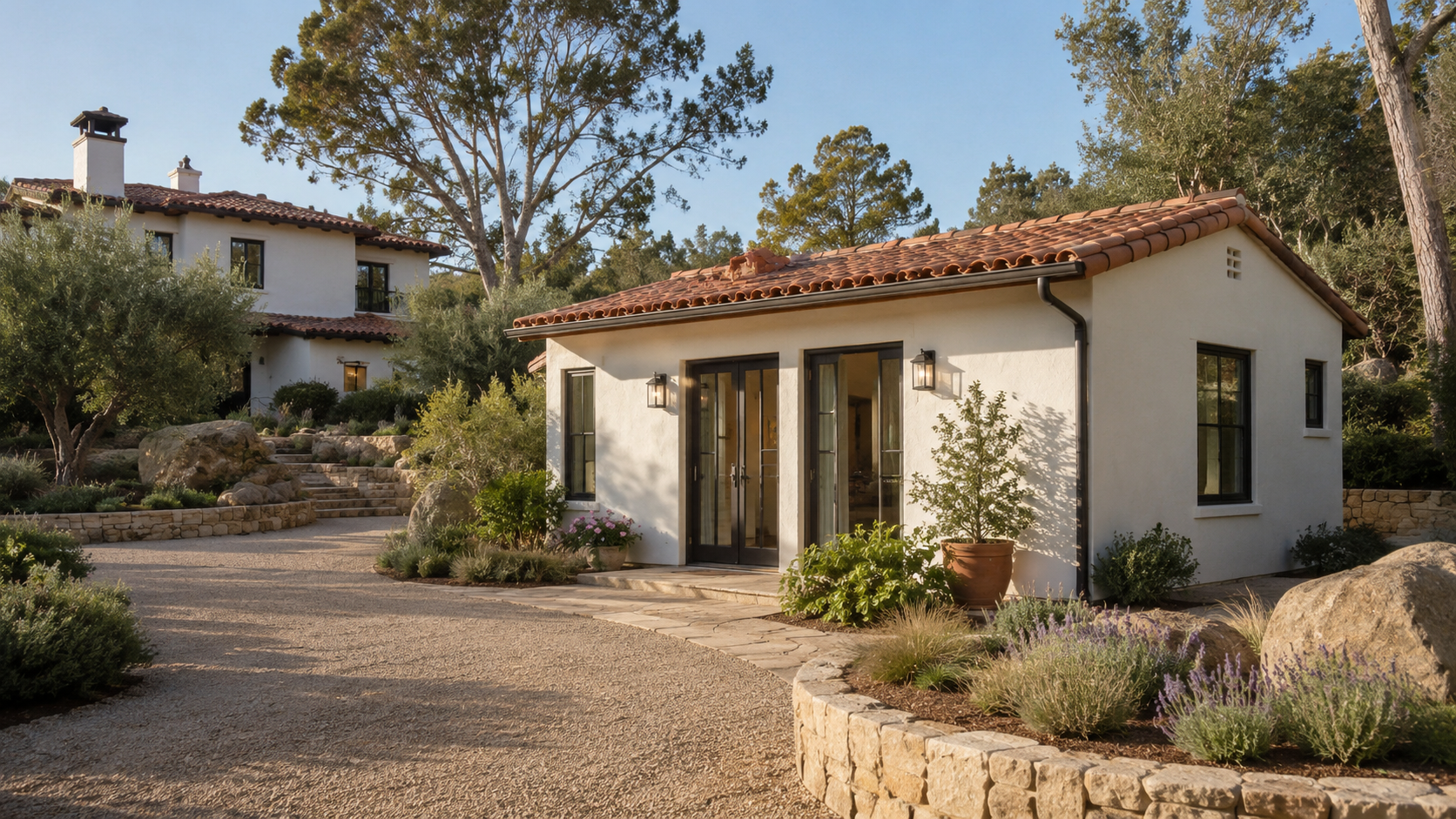
By The Dwelling Index Editorial Team. Published May 18, 2026 · Last updated · Last verified against primary sources May 18, 2026 · Next scheduled review August 2026 · 34 sources.
The Bottom Line: ADU Cost in Rancho Santa Fe for 2026
| ADU Type | Typical size | All-in cost per sq ft (2026 RSF) | Total all-in range | Best for |
|---|---|---|---|---|
| JADU (Junior ADU, interior conversion) | ≤ 500 sq ft | $150–$300 | $60,000–$150,000 | Family housing; no new meter; no Art Jury trigger |
| Garage conversion (conversion ADU) | 300–700 sq ft | $200–$360 | $100,000–$210,000+ | Cheapest detached path when garage shell is sound |
| Detached ADU — Standard County tier | 600–1,200 sq ft | $450–$600 | $400,000–$600,000 | Non-Covenant parcel, sewer-served, standard lot |
| Detached ADU — Covenant-Compliant tier | 800–1,200 sq ft | $600–$850 | $600,000–$1,000,000 | Covenant parcel, Art Jury, private septic, typical RSF project |
| Detached ADU — Estate-Grade tier | 1,000–1,200 sq ft | $850–$1,300+ | $900,000–$1,580,000+ | 3+ acre estate, full new OWTS, water tank, premium finishes |
Verified May 18, 2026. Ranges triangulated from County PDS fee formulas, RSF Association published fee schedule, RSFFPD 2024 fee schedule, SDUHSD developer fee schedule, SFID January 2026 capacity charges, and published builder pricing (SnapADU, Santa Fe Construction Group, Freeman's Construction). All-in totals include design, agency fees, construction, sitework, septic or water capacity charges, fire-protection systems, and contingency. These are planning ranges, not quotes.
See What You Can Build → Get Your Free Rancho Santa Fe ADU Feasibility Report
Your address. Your lot. Real numbers. No call required. Confirms jurisdiction, septic vs. sewer, hydrant distance, and rough budget tier in 60 seconds.
Get Your Free ADU Report →Why RSF ADUs Cost More Than the Rest of San Diego County
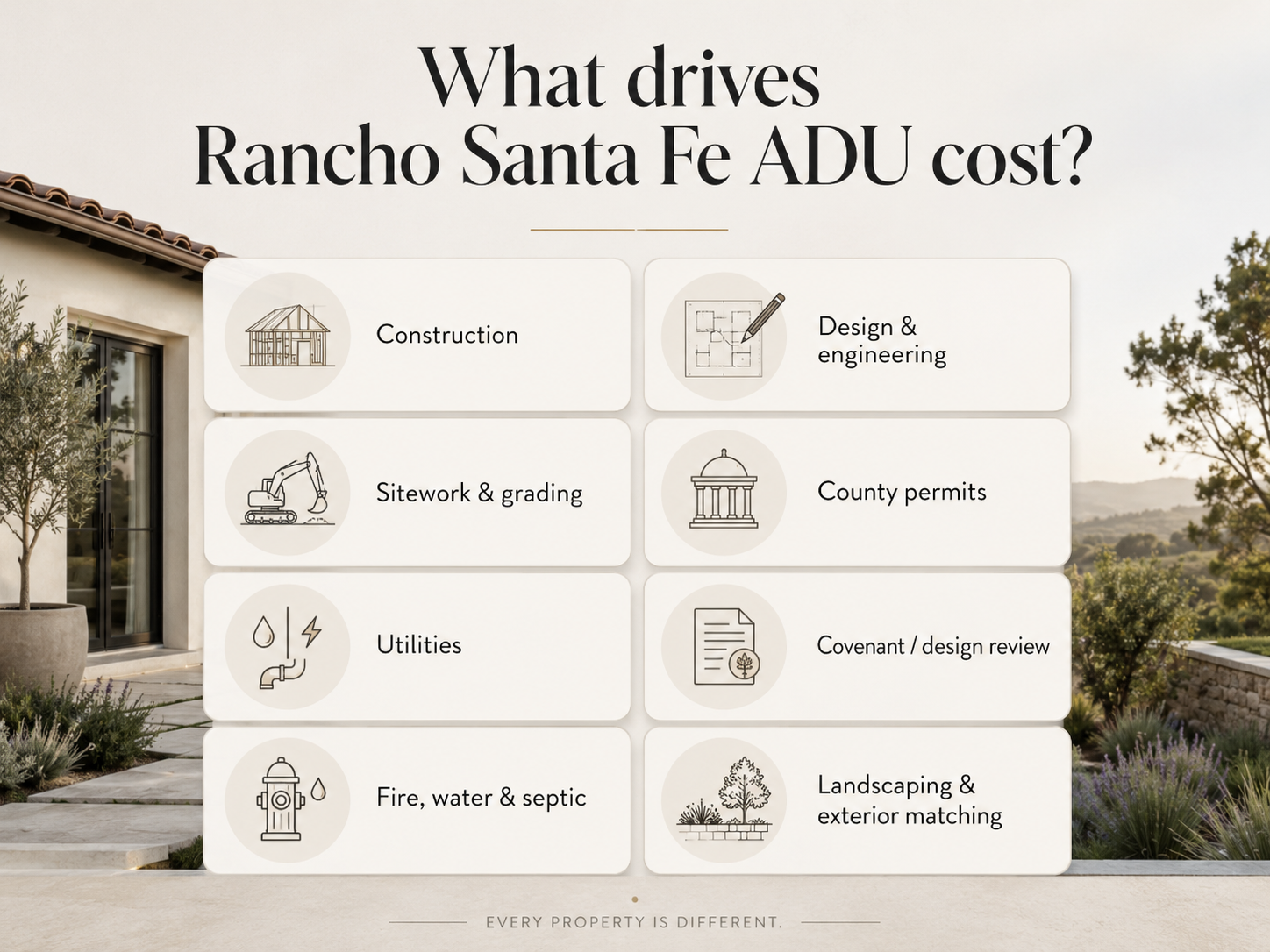
Five compounding cost drivers explain why a Rancho Santa Fe ADU costs 60–300% more than the average San Diego County ADU. They're not optional — each is a hard requirement enforced by a separate government body or private association.
1. RSF Covenant Art Jury review
For properties in the Rancho Santa Fe Covenant, every new structure — including an ADU — must pass the Art Jury's architectural review before County permits are issued. The Art Jury can require exterior redesigns, material upgrades, or massing changes through multiple revision cycles. Total cost impact: $15,000–$40,000 in architect revision time and Covenant fees (RSF Association fees: $1,000 application + $1,525 construction permit + $2/sq ft refundable deposit). Timeline impact: 60–120 days, sometimes running 3–4 revision cycles.
2. Rancho Santa Fe Fire Protection District (RSFFPD) requirements
Every parcel in RSF is within the RSFFPD's jurisdiction. New ADUs trigger NFPA 13D sprinkler review, a 30-foot fire setback from structures and property lines, WUI ignition-resistant exterior materials, Knox-switch on automatic gates, and — when the nearest public fire hydrant is more than 600 feet away (common on estate-sized lots) — either a private fire hydrant ($25K+) or a water storage tank and booster pump ($25K–$45K). Total RSFFPD cost layer: $40,000–$115,000.
3. Private septic systems (on almost every parcel outside the Village)
The vast majority of RSF parcels — everything outside the small Village core on the RSFCSD sewer system — are on private septic. County DEHQ requires an OWTS capacity review for any ADU on a septic-served parcel. DEHQ's own guidance states that “in almost every case an ADU addition would exceed the maximum capacity of the existing septic tank and disposal area.” Outcomes range from no upgrade ($2,500–$5,000 in review fees) to leach-field expansion ($15K–$30K) to full new OWTS ($30K–$60K+).
4. Long utility runs across estate-sized lots
On RSF estate lots, the ADU pad is commonly 200–500+ feet from the main residence and the existing service entrance. Trenching electric, water, and gas laterals across that distance costs $25,000–$60,000 — sometimes more if the route crosses paved areas, mature landscaping, or hardscape. Most builder quotes assume a 30–60 foot run. Confirm the actual distance before signing.
5. Covenant-grade exterior finishes
The Art Jury's standards require exterior materials that are compatible with the Covenant's Spanish-Colonial and Mediterranean character: clay roof tile, lime-washed or hand-applied stucco, wood-clad or bronze-framed windows, copper gutters, and mature landscape integration. These materials run $40,000–$120,000 more than standard San Diego County ADU finishes. The WUI exterior-material requirement (ignition-resistant roofing, siding, and venting) is a separate overlay that adds $8,000–$20,000.
The honest admission most RSF cost guides skip
If the five cost drivers above apply to your project — Covenant location, septic, long utility runs, hydrant >600 ft, Covenant-grade finishes — building an ADU in Rancho Santa Fe is unlikely to pencil purely as a rental-income investment at current market rents. The real case for an RSF ADU is usually family use (housing a parent or adult child), long-term property-value flexibility, or estate-planning optionality. We'll show you the honest ROI math below.
For the full regulatory framework behind these requirements, see our companion page on Rancho Santa Fe ADU laws and Covenant rules.
The Three RSF Cost Tiers Explained
Rancho Santa Fe is not one ADU market — it's at least three, differentiated by jurisdiction, fire-protection requirements, utility status, and finish expectations. A project in Whispering Palms (non-Covenant, no Art Jury, near sewer) can be built for half the cost of an identical-square-footage project in the Covenant proper. Understanding your tier before you hire a designer is the most important pre-design decision you can make.
| Tier | Who it applies to | Key cost drivers | All-in range (1,200 sq ft) |
|---|---|---|---|
| Standard County | Non-Covenant parcels (Whispering Palms, Cielo non-Covenant areas) with sewer access, standard lot | County PDS fees, RSFFPD (sprinklers + WUI), school fees; no Art Jury | $400K–$600K |
| Covenant-Compliant | RSF Covenant parcels with Art Jury review, private septic, typical 1–3 acre estate lot | All Standard County costs + Art Jury fees ($15K–$40K) + septic upgrade ($15K–$30K) + Covenant-grade finishes | $600K–$1M |
| Estate-Grade | 3+ acre lots in the Covenant, The Bridges, Cielo, or Fairbanks Ranch with hydrant >600 ft, full new OWTS needed, water tank required, estate-level finishes | All Covenant-Compliant costs + water tank/booster ($25K–$45K) + full OWTS ($30K–$60K) + SFID capacity charge ($33.9K+) + 600+ ft utility trenching | $900K–$1.58M+ |
Tier classification based on jurisdiction, fire-protection requirements, utility status, and finish expectations. Your specific APN may differ — verify with the free feasibility check below.
Not Sure Which Tier Your Property Falls In?
The free feasibility check confirms Covenant vs. non-Covenant jurisdiction, septic vs. sewer, hydrant distance, and water-district service area for your specific APN.
Get Your Free Rancho Santa Fe ADU Report →The Verified RSF Agency Fee Stack: PDS, RSF Association, RSFFPD, School, Water
Rancho Santa Fe ADU projects face up to five separate government bodies and private associations, each with their own fee schedules. The table below uses verified published fee sources for FY 2025–26 and assumes a 1,000 sq ft detached ADU on a Covenant parcel. Individual line items below use the same verified sources. For applicability of specific RSF Association fees to ADU projects and current RSFCSD sewer-connection fees, verify directly with the agency before relying on planning estimates.
| Agency / Fee | What it covers | Amount (1,000 sq ft ADU example) | Source |
|---|---|---|---|
| County PDS Plan Review (standard) | ADU/Guest House plan review | $2,259 | PDS-613, effective 7/1/2025 |
| County PDS Permit Fee | ADU building permit issuance | $2,133 | PDS-613, effective 7/1/2025 |
| RSF Association application fee | Project review application | $1,000 | RSFA Schedule of Fees |
| RSF Association construction permit | Construction authorization | $1,525 | RSFA Schedule of Fees |
| RSF Association refundable deposit | $2/sq ft; returned if no damage to common areas | $2,000 (refundable) | RSFA Schedule of Fees |
| RSFFPD ADU plan review | Fire plan review for new ADU ≤1,200 sf | $477 | RSFFPD 2024 Fee Schedule, eff. 10/5/2024 |
| RSFFPD 13D sprinkler plan review | Residential fire sprinkler plan review ≤1,200 sf | $464 | RSFFPD 2024 Fee Schedule, eff. 10/5/2024 |
| SDUHSD school developer fee | $2.72/sq ft; applied to ADUs >500 sq ft | $2,720 | SDUHSD Facilities Developer Fees (1,000 sq ft example) |
| Elementary school district fee | Varies by district; $2.00–$2.50/sq ft typical | ~$2,000–$2,500 | District-specific; verify before paying |
| Baseline agency fee subtotal (non-refundable, Covenant parcel, 1,000 sq ft ADU) | ~$12,578–$13,078 | Excludes septic, water capacity, utility laterals | |
The above excludes: RSFCSD sewer-connection fee (sewer-served parcels only; verify current fee with district); SFID/OMWD/SDWD water capacity charge (triggered only if a new or upsized meter is needed; $33,901–$101,702 if triggered); DEHQ septic review and upgrade costs; RSFFPD third-party sprinkler plan review ($750–$2,000); Knox switch, water tank, and private hydrant costs. All figures verified May 18, 2026.
For full County of San Diego ADU permitting details, see County of San Diego ADU laws. For how County PDS processes ADU applications, see County of San Diego ADU permit process.
See What You Can Build → Get Your Free Rancho Santa Fe ADU Feasibility Report
Your address. Your lot. Real numbers. No call required.
Get Your Free ADU Report →Art Jury / Covenant Architectural Review
The Rancho Santa Fe Association's Art Jury is a five-member, all-volunteer board with discretionary authority over the exterior design of every structure built within the Covenant. Its standards — derived from the Protective Covenant, the Art Jury Regulations, and the RSF Regulatory Code — require that new construction be “architecturally harmonious” with the existing estate and with the character of the Covenant. What this means in practice: Spanish-Colonial or Mediterranean massing, clay tile roofing, stucco or masonry exteriors in earth tones, and mature landscape integration. Modern, contemporary, or industrial design languages are rarely approved without significant modification.
Critically, the Art Jury is a private architectural review body, not a government agency. California Civil Code §4751 and HCD's March 2026 ADU Handbook prevent the Art Jury from outright prohibiting an ADU on residentially zoned property — but the Art Jury retains discretion to impose reasonable, objective design standards. In practice, the Art Jury does not block ADUs; it shapes them. An architect experienced in Covenant submissions is not optional — it's a practical necessity for avoiding multiple revision cycles. Full Art Jury process and Covenant ADU rules →
What Art Jury review costs, line by line
| Item | Typical cost | Notes |
|---|---|---|
| RSF Association application fee | $1,000 | Non-refundable; one-time per project |
| RSF Association construction permit | $1,525 | Non-refundable |
| RSF Association refundable deposit | $2/sq ft (e.g., $2,400 for 1,200 sq ft) | Refunded if common-area damage claims are settled |
| Architect time for Art Jury submissions | $8,000–$22,000 | Varies widely; depends on revision cycles |
| Design revision cycles (2–3 typical; can be more) | $5,000–$18,000 additional | Each cycle: revised drawings, materials boards, new submission |
| Materials review at framing stage | $2,000–$5,000 architect time | Art Jury may revisit exterior materials after framing is up |
| Covenant-grade exterior materials premium | $40,000–$120,000 over standard finishes | Clay tile, lime stucco, wood-clad windows, copper gutters |
| Total Art Jury cost layer | $15,000–$40,000 | Fees + architect revision time; excludes materials premium |
The RSF Art Jury's actual ADU track record
The Art Jury does not reject ADUs outright. What it does is require redesigns and material upgrades that add cost and time. An RSF Post article from April 2024 noted that the Art Jury views its role as “the backstop for Covenant standards, not the starting line,” meaning the Covenant principles come first and applicants are expected to internalize them before submitting. The most common rejection triggers: contemporary rooflines, flat roofs, metal siding, non-earth-tone exterior colors, and ADU massing that reads as “tacked on” rather than architecturally integrated with the main residence. Working with an architect who has Covenant project history materially reduces revision cycles.
See What You Can Build → Get Your Free Rancho Santa Fe ADU Feasibility Report
Your address. Your lot. Real numbers. No call required.
Get Your Free ADU Report →RSF Fire Protection District Requirements and Cost
Every parcel in Rancho Santa Fe — including non-Covenant areas — is within the jurisdiction of the Rancho Santa Fe Fire Protection District (RSFFPD). New ADUs trigger a separate RSFFPD plan review, and the district's requirements add a cost layer that most general-contractor quotes underestimate. The RSFFPD is particularly strict because RSF sits within a designated Very High Fire Hazard Severity Zone (VHFHSZ) in the State Responsibility Area, and many parcels face Wildland-Urban Interface (WUI) requirements under the California Building Code.
Sprinkler requirements (NFPA 13D and modified 13)
RSFFPD Ordinance 2023-01 requires residential fire sprinklers in new ADUs. The standard system for residential ADUs is NFPA 13D, which covers the living area with a design density adequate for two heads at once. In some cases — when the ADU is large, the water supply is marginal, or the Fire Code Official determines 13D doesn't provide adequate protection — a modified NFPA 13 system may be required, which is more expensive.
Note: California state law (Government Code §66329.5) limits local agencies' ability to require fire sprinklers as a condition of ADU approval in some circumstances. Whether a specific project qualifies for a state-law exemption requires confirmation with the RSFFPD before design. We do not confirm this on your behalf; verify directly with RSFFPD's Fire Prevention Bureau at (858) 756-5971.
Fire setback — 30 feet from structures and property lines
CFC Section 4907.4.1 requires a 30-foot fire setback clearance from the ADU to structures and property lines — all defensible space within that zone must be maintained in an ember-resistant condition. On typical RSF estate lots with generous acreage, this usually isn't a buildability constraint. On tighter infill lots or lots with existing mature trees, it can force the ADU pad to move or the landscaping plan to significantly change, adding design and sitework cost.
Water supply — when a tank or private hydrant is required
If the nearest public fire hydrant is more than 600 feet (path of travel, not straight-line distance) from the proposed ADU pad, RSFFPD requires either:
- A private fire hydrant installed and connected to a water supply adequate for fire-flow requirements (typically $25,000+), or
- A water storage tank of sufficient capacity, with a booster pump and pressure tank to deliver fire-flow pressure at the ADU ($25,000–$45,000 typical)
On larger RSF estate lots, the driveway from the road to the main house can be 600+ feet by itself, which means the ADU pad — typically behind the main house — is well beyond the hydrant threshold. Measure the actual path-of-travel from the nearest public hydrant before assuming you're under 600 feet.
WUI exterior materials
Because RSF is in a designated WUI zone, new ADUs must use ignition-resistant materials throughout the exterior envelope under California Building Code Section 703A.3. This adds cost on top of (but often overlaps with) the Covenant-grade finish requirements the Art Jury imposes. WUI requirements cover:
- Roofing — Class A fire-rated assembly. Clay tile meets this requirement, which is one reason clay tile dominates RSF Covenant ADU roofs. Adds $3–$10 per sq ft of roof area over standard.
- Siding and exterior wall finish — ignition-resistant materials, fire-rated assemblies. Adds $3–$8 per sq ft of wall area.
- Windows — dual-pane tempered glass with metal or fire-rated frames. Adds $2K–$8K vs. standard.
- Eaves, vents, and soffits — enclosed eaves, ember-resistant vents. Adds $2K–$5K.
- Decking (when applicable) — non-combustible or ignition-resistant material within 10 feet. Adds $3K–$8K.
Total WUI premium on a 1,000 sq ft ADU: $8,000–$20,000. *(Source: 2022 California Building Code Sec. 703A; California Referenced Standards Code, Part 12.)*
The total RSFFPD cost layer, summarized
| RSFFPD requirement | Typical cost | When triggered |
|---|---|---|
| NFPA 13D sprinkler system | $8K–$15K | New ADUs where sprinklers are required (verify state-law ADU exception) |
| Modified NFPA 13 sprinkler | $12K–$25K | When Fire Code Official determines 13D doesn't fit |
| Third-party sprinkler plan review | $750–$2K | All new ADU sprinkler plans |
| RSFFPD sprinkler plan-review fee (District) | $464 | All new ADU 13D systems ≤1,200 sf |
| RSFFPD ADU building plan-review fee | $477 | All new ADUs ≤1,200 sf |
| Private fire hydrant install | $25K+ | Distance to public hydrant >600 ft |
| Water tank + booster + pressure tank | $25K–$45K | Alternative to private hydrant when triggered |
| 30-ft fire setback | Design impact | All parcels (case-by-case waiver possible) |
| WUI exterior materials | $8K–$20K | Entire RSFFPD district |
| Knox switch on auto gates | $1.5K–$4K | Properties with automatic gates |
| Dual-address monument | $500–$3.5K | Properties with separate main + ADU addresses |
| Total RSFFPD cost layer | $40K–$115K | Depending on which provisions trigger; water-tank path is largest single item when it applies |
Source: RSFFPD 2024 Fee Schedule (effective 10/5/2024); RSFFPD Sprinkler Policies & Procedures 2024; RSFFPD Ordinance 2023-01; RSFFPD Residential Plan Check Form 2024. For questions on a specific property, contact RSFFPD Fire Prevention Bureau at (858) 756-5971.
See What You Can Build → Get Your Free Rancho Santa Fe ADU Feasibility Report
Your address. Your lot. Real numbers. No call required.
Get Your Free ADU Report →Septic, Water Meters, and the Capacity-Fee Cliffs Most Quotes Hide
Most parcels in Rancho Santa Fe outside the small Village business district are on private septic systems rather than public sewer. Adding an ADU triggers a County DEHQ review to confirm the existing septic system (or a new one) can handle the additional bedrooms. As DEHQ's own ADU guidance states, “in almost every case an ADU addition would exceed the maximum capacity of the existing septic tank and disposal area,” though adequately sized systems or expansion may be possible. On the water side, if a new or upsized meter is triggered, the combined SFID+SDCWA capacity charge can hit $33,901–$101,702 by itself depending on meter size.
Septic outcomes — three scenarios and what they cost
Scenario 1: Existing system is adequate, no upgrade needed
Most common when the ADU has 1 bedroom or fewer, the existing house was originally permitted for more bedrooms than it uses, the leach field is healthy, and there's documented reserve area. DEHQ review and approval: $2,500–$5,000 in fees and reports.
Scenario 2: Leach-field expansion or supplemental disposal area required
The existing tank is adequate but the disposal area needs expansion. Cost: $15,000–$30,000 including permits, engineering, and construction.
Scenario 3: Full new OWTS or major upgrade required
Often triggered by aging tanks (>30 years), poor soils, increased bedroom count, or a failed percolation test on the proposed expansion. Cost: $30,000–$60,000+ for a complete new system, sometimes more for advanced treatment systems on difficult sites.
Source: County DEHQ OWTS FAQ and ADU guidance; cost ranges from local septic contractors and builder estimates.
The SFID water capacity fee cliff (combined SFID+SDCWA)
For parcels served by Santa Fe Irrigation District (SFID) — which covers Solana Beach and portions of Rancho Santa Fe and Fairbanks Ranch — the combined SFID + San Diego County Water Authority capacity fees are substantial. Most family-use ADUs that share the existing main-house meter avoid these charges entirely. You trigger the fee only if a new meter or upsized meter is needed.
| Meter size | SFID capacity charge | SDCWA capacity charge | Combined |
|---|---|---|---|
| 0.75-inch | $27,218 | $6,683 | $33,901 |
| 1-inch | $43,548 | $10,693 | $54,241 |
| 1.5-inch | $81,653 | $20,049 | $101,702 |
Source: SFID January 2026 Miscellaneous Fees and Charges schedule. Fees are subject to Board action and annual CPI adjustment; re-verify before relying on these numbers. For parcels outside SFID's service area, check with OMWD or SDWD — their capacity fees are structured similarly but the dollar amounts differ.
See What You Can Build → Get Your Free Rancho Santa Fe ADU Feasibility Report
Your address. Your lot. Real numbers. No call required.
Get Your Free ADU Report →Which ADU Type Is Cheapest in Rancho Santa Fe?
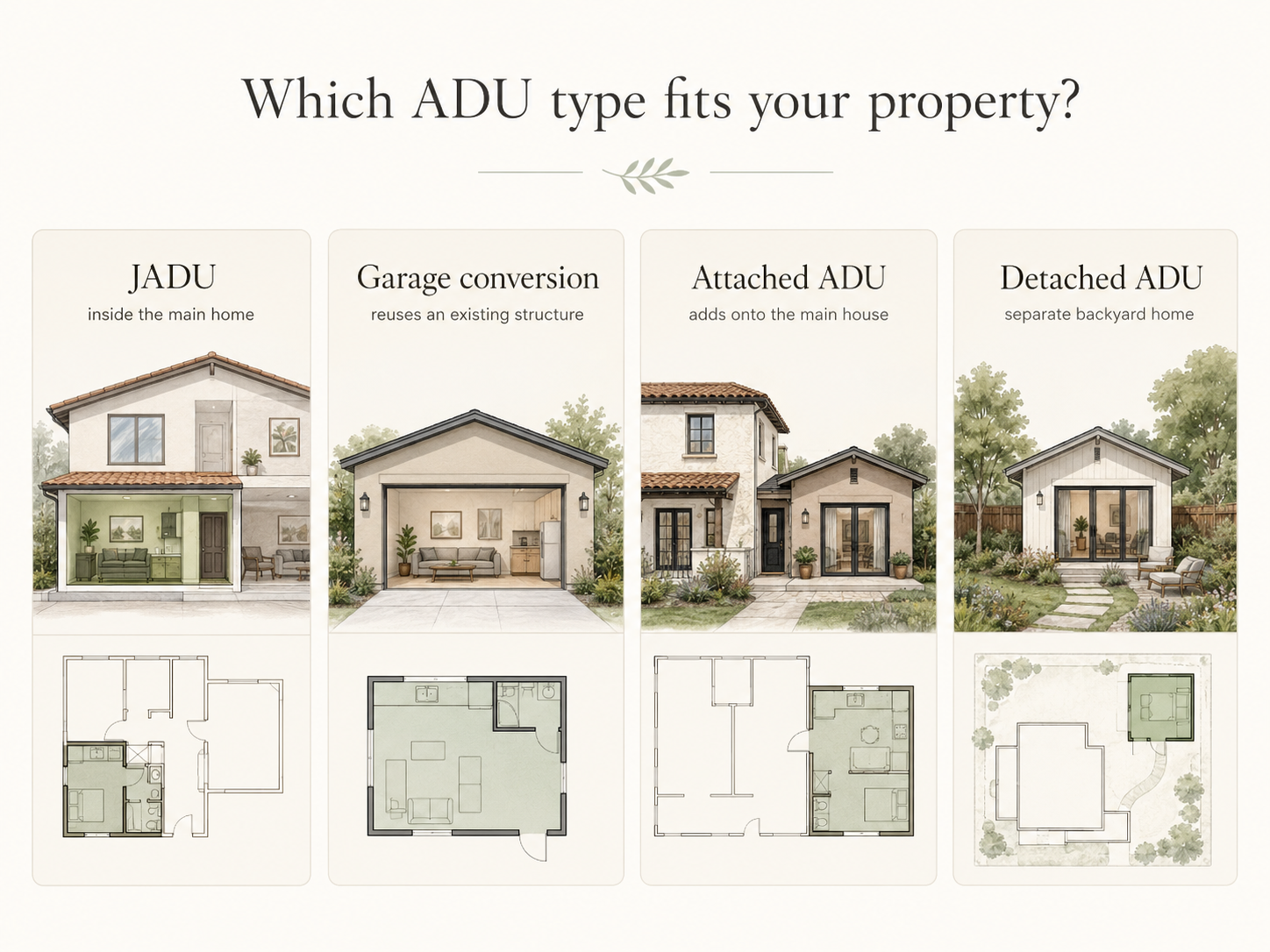
The cheapest legal ADU in Rancho Santa Fe is almost always a Junior ADU (JADU) — a self-contained unit up to 500 sq ft built within the existing footprint of the main residence. JADUs avoid most sitework, exterior changes, and Art Jury triggers; they're exempt from SDUHSD school developer fees under the 500 sq ft exemption; they share utilities with the main house (no new meter cost); and they can be built for $60,000–$150,000 when the existing home layout cooperates.
| Primary use | Cheapest legal path | Why |
|---|---|---|
| Aging parent or adult child | JADU (interior conversion) | Lowest cost; shared utilities fine for family; close to caregivers |
| Caregiver / home health worker | JADU or attached ADU | Proximity to main residence is a feature, not a bug |
| Long-term rental income | Detached ADU, 800–1,200 sq ft | Privacy commands higher rent; rentals don't require interior access |
| Guest house for visiting family | Garage conversion or small detached | Privacy + occasional use justifies separate structure |
| Long-term property flexibility | Detached ADU, 1,000–1,200 sq ft | Maximum future flexibility for rent, sale (AB 1033), or family handoff |
| Try ADU living before downsizing | Detached ADU, 1,000–1,200 sq ft | Owner moves into ADU, rents the main house |
Why JADUs sidestep RSF's biggest cost layers
- No school developer fees — SDUHSD's 500 sq ft exemption applies
- Typically no new water meter or capacity charge — JADUs share utilities with the main residence
- Limited Art Jury exterior review — interior conversions don't change building massing or exterior materials
- Minimal sitework — no foundation, no grading, no driveway extension
- Often no new septic capacity issue if the bedroom count doesn't increase significantly
- County PDS fees scale with size — smaller square footage means lower plan-review and permit fees
Three “cheap” traps that turn expensive in RSF
The “I'll just convert the garage” trap
Garage conversions look cheapest on paper, but they often require slab replacement (moisture problems on older RSF garages), HVAC addition, full insulation upgrade, electrical service upgrade, plumbing run from the main house, ceiling-height verification (California Residential Code generally requires 7 feet for habitable space), and any septic capacity review the same as a new build. The “cheap” garage conversion that started at $100K can quietly slide to $250K when the slab fails and the structure needs reframing. Pull the existing garage permit before you fall in love with the plan.
The “we'll prefab to save money” trap
Prefab shells start cheap — under $80K for a small unit — but in RSF the savings are usually eaten by sitework, foundation work, Art Jury–driven exterior modifications, fire-protection requirements, and the same septic/water reviews any other build would trigger. See the prefab section below for the detailed math.
The “I'll just legalize the existing casita” trap
Many RSF properties have unpermitted accessory structures dating back decades. California AB 2533 created a streamlined legalization pathway for ADUs built before January 1, 2020, with reduced standards as long as the structure meets health and safety code. The County of San Diego has implemented this through its Substandard Structure Checklist. But the legalization path isn't free or fast: typical costs run $40K–$150K depending on how much code-upgrade work is needed, and the structure must still meet egress, fire, and septic requirements. Get a confidential third-party code inspection before you start.
Download the Free ADU Starter Kit
Checklist, budget template, and the pre-bid questions we recommend asking every builder.
Download Free ADU Starter Kit →Does Prefab Actually Save Money in Rancho Santa Fe?
In Rancho Santa Fe, prefab usually does not save what its advertised shell price suggests. Manufactured ADUs from companies like US Modular start at around $78,000 for a 398 sq ft 1-bedroom unit delivered, but that price assumes backyard access, a level lot, sewer within 100 feet, and excludes local fees that the company itself notes “typically range from 5–15% of the quoted construction cost.” On a typical RSF Covenant parcel — sloped, septic, long-driveway, with Art Jury and RSFFPD layers — the additional sitework, foundation, fire protection, septic upgrade, and exterior modifications typically erase most of the prefab cost advantage.
What prefab quotes typically include
- The modular shell, manufactured off-site
- Transportation to the site
- A single crane day for placement
- Connection to a foundation (if it already exists)
- Basic utility hookups within ~20 feet of existing service
What prefab quotes typically don't include
- Foundation work ($15K–$45K for sloped lots)
- Sitework, grading, drainage, access road improvements
- Utility trenching beyond the immediate hookup point
- Septic design, permitting, and any upgrade or new OWTS
- RSFFPD sprinklers (some include rough-in, not supply piping)
- All local permit fees (County PDS, RSFA, RSFFPD, SDUHSD, water)
- Art Jury–driven exterior modifications
- Knox switch, dual-address monument, WUI materials
- Driveway extensions, hardscape, landscape integration
- Sales tax (often quoted separately on the manufactured portion)
When prefab can still make sense in Rancho Santa Fe
- Non-Covenant unincorporated County parcels with sewer access, a level pad, and short utility runs
- Properties where speed matters more than cost — prefab can compress the on-site construction timeline by 2–4 months
- Builders who specialize in prefab integration on premium parcels and can manage Art Jury coordination through the design phase
- Smaller units (under 600 sq ft) where the design effort to coordinate a custom site-built unit doesn't pencil
SnapADU, which has documented Covenant ADU projects — including a Spanish-style 980 sq ft 2BR/2BA in the Covenant designed to comply with RSF Covenant standards, and a custom 800 sq ft aging-parent ADU in Rancho Santa Fe — explicitly recommends stick-built for HOA-restricted, larger, or custom RSF projects. Their published San Diego ADU cost range — roughly $375–$600+ per sq ft all-in — is a useful baseline to pressure-test against any prefab quote you receive. *(Source: SnapADU project portfolio and pricing pages, accessed May 2026.)*
FTC disclosure. The SnapADU link below is an affiliate referral. We've matched them by documented service-area fit (SnapADU serves Greater San Diego including Rancho Santa Fe and the Covenant). We may earn a commission at no extra cost to you.
Compare a site-built Rancho Santa Fe ADU estimate → Talk with a San Diego County ADU specialist. SnapADU serves Greater San Diego including RSF and the Covenant, and quotes line-item budgets through their Feasibility SnapShot process.
Talk with an RSF ADU Specialist at SnapADU →Independent of our editorial recommendation. For our full coverage of Rancho Santa Fe ADU builders, see best Rancho Santa Fe ADU builders.
What Do Real Rancho Santa Fe ADU Budgets Look Like?
To make the cost stack concrete, here are three illustrative budgets covering the most common RSF situations. Each uses the verified agency fees from above plus typical construction and sitework costs triangulated from current published builder pricing. These are planning examples, not quotes — your actual costs depend on site-specific conditions, finish choices, and current market pricing.
Scenario A — Aging-parent ADU, 800 sq ft, non-Covenant unincorporated County, sewer-connected
A typical scenario: a Whispering Palms or non-Covenant Cielo parcel, on the RSFCSD sewer system, with a 1-bedroom + den layout and standard finishes for a parent moving from out of state.
| Line item | Amount |
|---|---|
| Pre-design & soils | $3,500 |
| Design & engineering | $25,000 |
| County PDS plan review + permit | $4,206 |
| RSF Association (not applicable — non-Covenant) | $0 |
| RSF Fire plan review + 13D sprinkler review | $941 |
| SDUHSD school fee | $2,176 |
| Sewer connection (verify current adopted RSFCSD fees) | Confirm with RSFCSD |
| Water meter (existing main house, no upsize) | $0 |
| Hard construction ($380/sf × 800 sf) | $304,000 |
| Sitework (level lot, short driveway) | $20,000 |
| Utility laterals (short run, 50 ft) | $8,000 |
| Septic — none, sewer-served | $0 |
| Fire sprinklers (NFPA 13D, if required) | $9,000 |
| Knox switch | $2,000 |
| WUI exterior materials premium | $8,000 |
| Dual-address monument | $1,200 |
| Landscape & screening | $10,000 |
| Construction loan carry (9 months, financed portion) | $14,000 |
| Contingency (12%) | $36,500 |
| TOTAL (excluding RSFCSD sewer fee) | ~$448,000 |
This is the bottom-quartile of RSF ADU outcomes — the closest you can get to “standard San Diego County ADU pricing” while still being in Rancho Santa Fe.
Scenario B — Covenant-compliant guest house, 1,200 sq ft, 2-acre septic estate
A typical scenario: a 2-acre lot in the Covenant proper, on private septic, with Art Jury review, NFPA 13D sprinkler review, a partial septic upgrade required, and Covenant-grade exterior finishes (clay tile, lime-washed stucco, wood-clad windows).
| Line item | Amount |
|---|---|
| Pre-design, soils, percolation testing | $8,500 |
| Design & engineering (custom, 7% of build) | $42,000 |
| County PDS plan review + permit | $4,578 |
| RSF Association app + construction permit | $2,525 |
| RSF Association refundable deposit ($2/sf × 1,200 sf) | $2,400 (refundable) |
| RSF Fire plan review + 13D sprinkler review | $941 |
| RSFFPD third-party sprinkler plan review | $1,200 |
| SDUHSD school fee | $3,264 |
| Elementary school district fee | $2,500 |
| Septic capacity review & leach-field expansion | $28,000 |
| SFID water capacity charge (no upsize triggered) | $0 |
| Hard construction ($520/sf × 1,200 sf, Covenant grade) | $624,000 |
| Sitework (modest grading, 200 ft driveway extension) | $48,000 |
| Utility laterals (200 ft trenching, no meters) | $24,000 |
| Fire sprinklers (NFPA 13D, if required) | $14,000 |
| Water tank — not needed, hydrant within 600 ft | $0 |
| Knox switch retrofit | $2,500 |
| WUI exterior materials premium | $14,000 |
| Dual-address monument | $1,800 |
| Landscape integration (mature plants, screening) | $28,000 |
| Construction loan carry (12 months, financed portion) | $32,000 |
| Contingency (15%) | $94,000 |
| TOTAL | ~$970,000 |
This is the median outcome for a Covenant ADU project — the realistic budget most prospective homeowners should plan for when they say “I want a guest house in the Covenant.”
Scenario C — Estate-grade pool house + ADU, 1,200 sq ft, 3+ acre Bridges/Cielo lot, hydrant >600 ft
A typical scenario: a 3-acre Bridges or Cielo lot, on private septic, fire hydrant at the front gate but the ADU pad is 700+ feet down the driveway, Art Jury review with multiple revision cycles, full new OWTS required, water tank needed, premium materials throughout.
| Line item | Amount |
|---|---|
| Pre-design, soils, percolation, surveys | $15,000 |
| Design & engineering (fully custom, 9% of build) | $80,000 |
| County PDS plan review + permit | $4,578 |
| RSF Association app + construction permit | $2,525 |
| RSF Association refundable deposit ($2/sf × 1,200 sf) | $2,400 (refundable) |
| Art Jury revision cycles (architect time, 2–3 cycles) | $18,000 |
| RSF Fire plan review + 13D sprinkler review | $941 |
| RSFFPD third-party sprinkler plan review (modified 13) | $1,800 |
| SDUHSD school fee | $3,264 |
| Elementary school district fee | $3,000 |
| Septic — full new OWTS with advanced treatment | $52,000 |
| SFID water capacity charge (3/4" meter, combined SFID+SDCWA) | $33,901 |
| Hard construction ($725/sf × 1,200 sf, estate grade) | $870,000 |
| Sitework (extensive grading, retaining walls, 600 ft drive) | $95,000 |
| Utility laterals (600 ft trenching + transformer) | $48,000 |
| Fire sprinklers (modified NFPA 13, when triggered) | $22,000 |
| Water tank + booster + pressure tank | $38,000 |
| Knox switch retrofit | $3,000 |
| WUI exterior materials premium | $22,000 |
| Dual-address monument | $2,500 |
| Landscape (mature, screened, irrigation upgrade) | $65,000 |
| Construction loan carry (15 months, financed portion) | $52,000 |
| Contingency (15%) | $145,000 |
| TOTAL | ~$1,580,000 |
This is the upper-quartile outcome for a fully estate-grade RSF Covenant ADU — typically a pool house, guest suite, or staff quarters serving an existing main estate residence in the $5M+ value range. All scenarios are illustrative composite budgets built from triangulated public sources; not a quote.
FTC disclosure. The SnapADU link below is an affiliate referral. We may earn a commission at no extra cost to you. We don't rank by commission; we route to a documented service-area fit.
Want a real bid on your specific property? SnapADU has completed Covenant projects and quotes line-item budgets through their Feasibility SnapShot process. Also see best Rancho Santa Fe ADU builders for our full RSF builder coverage, or SnapADU cost for their full pricing breakdown.
Get a Rancho Santa Fe ADU Estimate from SnapADU →Or — if you're not yet ready to talk to a builder — run a free property feasibility check first.
How Long Does an RSF ADU Take to Build?
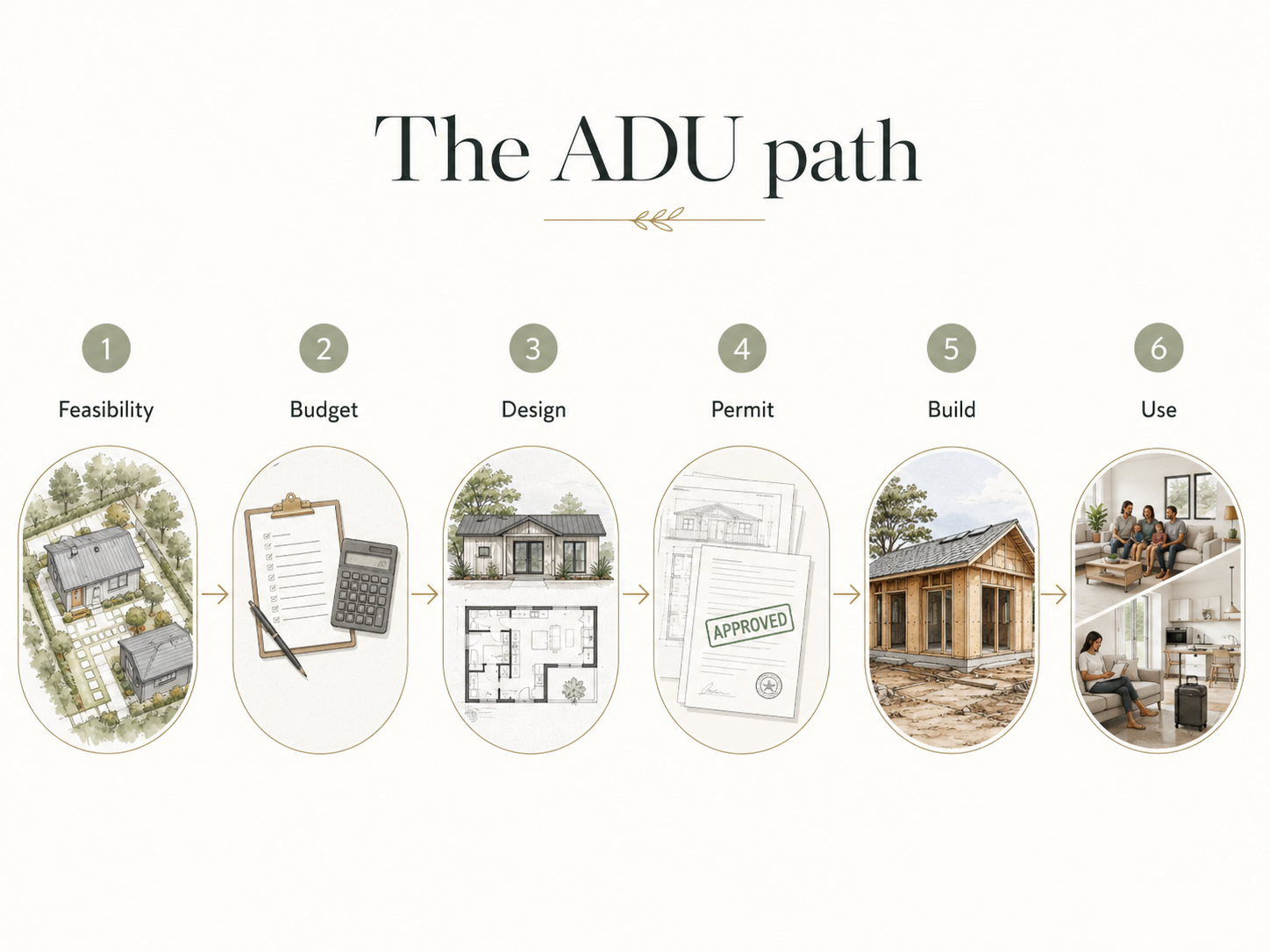
A typical Rancho Santa Fe ADU takes 9–18 months from contract signature to certificate of occupancy — meaningfully longer than non-Covenant San Diego County builds. The added time concentrates in three stages: Art Jury review (60–120 days, sometimes multiple cycles), RSFFPD third-party sprinkler plan review (30–60 days), and DEHQ septic review on septic-served parcels (45–90 days).
| Stage | Fastest realistic | Typical | Delay triggers |
|---|---|---|---|
| Pre-design, feasibility, soils, surveys | 2 weeks | 4–6 weeks | Septic uncertainty, hard-to-access lots |
| Concept design + budget | 4 weeks | 6–10 weeks | Owner indecision, design iterations |
| Art Jury / RSFA review (Covenant only) | 8 weeks | 12–20 weeks | Revision cycles, materials review at framing |
| DEHQ septic review (septic parcels) | 6 weeks | 8–12 weeks | Failed perc tests, reserve-area issues |
| County PDS plan review + permit | 6 weeks | 8–10 weeks | Plan corrections, incomplete submittal |
| RSFFPD plan review + sprinkler third-party | 4 weeks | 6–10 weeks | Sprinkler design complexity, water-supply issues |
| Construction | 6 months | 8–11 months | Weather, change orders, material lead times |
| Final inspection + CO | 2 weeks | 3–6 weeks | Punch-list items, utility commissioning |
| Total (parallel where possible) | 9 months | 12–18 months |
The 60-day state-law clock — what it actually means
California Government Code §66317 requires local agencies to determine application completeness within 15 business days of submittal and approve or deny a complete ADU application within 60 days of receipt. This applies to County PDS as the building-permit agency. It does not apply to RSF Association/Art Jury review (a private architectural-review process, not a government agency), and it doesn't compress DEHQ septic review or RSFFPD third-party sprinkler review timing.
Where parallel processing saves real time
- Start the soils report and septic percolation testing during concept design, not after Art Jury approval. The soils and septic data feed into both the County and Art Jury submissions simultaneously.
- Submit to County PDS for pre-application review while Art Jury revisions are in progress. County reviewers can flag corrections without the design being final.
- Engage the RSFFPD third-party sprinkler reviewer during construction drawings, not after. Most architects can route plans to the reviewer in parallel with County submission.
Can My RSF ADU Be Rented, Used by Family, or Sold Separately?
A Rancho Santa Fe ADU may be rented for terms longer than 30 days, but short-term rentals (30 days or fewer) are prohibited under California state law and County of San Diego ordinance. Family use — for adult children, aging parents, caregivers, or guests — is unconstrained. As of March 4, 2026, the San Diego County Board of Supervisors unanimously adopted a program implementing AB 1033, which allows ADUs in unincorporated communities (including Rancho Santa Fe) to be sold separately from the primary residence through a condominium conversion process.
Long-term rental (longer than 30 days)
Permitted for all ADU types. The County does not require owner-occupancy for ADUs (protected by California AB 976). Owner-occupancy is required for JADUs only when the JADU shares sanitation facilities with the primary residence. *(Source: HCD ADU Handbook, March 2026; Government Code §§66323, 66333.)*
Short-term rentals are prohibited
ADUs may not be rented for terms of 30 days or fewer under both California state ADU law and County ordinance. Civil and administrative penalties apply. The high Vrbo/Airbnb nightly rates you see for RSF properties should not be used for ADU ROI projections.
AB 1033 separate-sale program (adopted March 4, 2026)
The County Board of Supervisors voted unanimously to adopt a local program implementing AB 1033, allowing ADUs in unincorporated RSF to be sold separately from the primary residence through a condominium conversion process. The path requires a Tentative Parcel Map or Tentative Map application (separate from the standard ADU building permit), Title 17 condominium compliance, lender and title consent, and — for Covenant parcels — coordination with the RSFA (the Association's view on separate ADU sale is still developing). How the Protective Covenant interacts with AB 1033 separate sale is genuinely unresolved as of May 2026. *(Source: County of San Diego ADU Information page; Board of Supervisors action 3/4/2026.)*
RSF Association rental rules
The RSF Association's Regulatory Code includes some restrictions on rental terms within the Covenant. State law (Civil Code §4751) caps how restrictive HOAs can be regarding ADU rentals, but the specific RSFA implementation has nuances worth confirming. Verify current Association rental rules with the Building Department at (858) 756-1174 before relying on rental income projections.
What Does an RSF ADU Rent For — and What's the Real ROI Math?
Furnished detached casitas in Rancho Santa Fe typically rent for $3,500–$7,500 per month depending on size, finish, and Covenant location. Smaller private 1- to 2-bedroom guest units list at $1,900–$3,000/month unfurnished, while detached 2BR casitas on Covenant estates commonly command $4,000–$6,500+/month furnished. These are illustrative ranges, not guarantees of returns. Actual results depend on local market conditions, construction costs, financing terms, regulatory approvals, and tenant availability.
Sample unleveraged ROI — a $970K Covenant build at $5,000/month rent
| Line | Annual amount |
|---|---|
| Gross rent ($5,000/month × 12) | $60,000 |
| Vacancy allowance (5%) | –$3,000 |
| Property tax incremental (~0.85% × $970K addition) | –$8,245 |
| Insurance incremental | –$1,200 |
| Maintenance & repairs (1% of build) | –$9,700 |
| Property management (8% if used) | –$4,800 |
| Net operating income | ~$33,055 |
| Build cost | $970,000 |
| Unleveraged net yield on build cost | ~3.41% |
The unleveraged numbers won't pencil as a pure rental-yield investment at Covenant build cost — and that's an honest answer. We don't quote loan rates or guarantee qualification; check current options with a vetted lender.
When the family-use ROI beats the rental ROI
For many RSF homeowners, the strongest ROI case isn't rental income — it's family use. Three scenarios where the math works heavily in favor of family use over rental:
- Housing an aging parent at $5,000–$8,000/month equivalent value vs. assisted living, while keeping family connection and oversight close
- Adult child returning home during a career transition, graduate school, or first home purchase savings phase — the alternative is paying market rent elsewhere
- Estate-planning flexibility — keeping a second residence option on the property without buying new real estate, while preserving the option to rent or sell later (AB 1033 separate sale now adds a longer-term option)
When you back-of-envelope the avoided cost of alternative housing for family ($60K–$96K/year), the build cost can effectively “pay for itself” in 10–16 years even before counting any property-value uplift — and without ever generating taxable rental income.
Disclaimer
These are illustrative examples, not guarantees of returns. Actual results depend on local market conditions, construction costs, financing terms, regulatory approvals, and tenant availability. We are not a financial advisor or property manager.
How Should I Finance a Rancho Santa Fe ADU?
Most RSF homeowners fund an ADU through one of four paths: cash, home equity line of credit (HELOC), cash-out refinance, or a construction loan that converts to permanent financing. Renovation-specific loans (FHA 203(k), Fannie HomeStyle, RenoFi) are less common at RSF's typical build price points but can fit specific situations.
Grant and subsidy programs — current status
- CalHFA ADU Grant Program: Fully allocated as of December 28, 2023. Future rounds may open; check CalHFA directly.
- San Diego Housing Commission ADU Finance Program: City of San Diego properties only, not RSF. Not applicable.
- County of San Diego Impact Fee Waiver: Ended January 9, 2024. Permits not issued by that date pay all standard fees.
- State/Federal: No active broad-based ADU subsidy applies to RSF in 2026.
| Financing path | When it fits | Pros | Cons |
|---|---|---|---|
| Cash | Owners with significant liquid assets, sale of other property, inheritance | No financing cost, fastest closing, simplest paperwork | Opportunity cost on the cash; harder to deduct interest |
| HELOC | Owners with significant equity in the primary home, modest build budget | Flexible draws, lower closing costs, interest deductibility may apply | Variable rate exposure; LTV caps; some lenders limit HELOCs during construction |
| Cash-out refi | Owners with substantial equity who'd benefit from a single new first mortgage | Single payment, fixed rate available, larger draw amount | New origination costs; resets the term; rate may be higher than existing first |
| Construction-to-perm loan | Owners financing a large portion of the build, want a single closing | Lender controls draws, single closing for construction + permanent | Stricter qualification, builder vetting, interest-only during construction, typically higher rate |
FTC disclosure. The link below is an affiliate referral to our mortgage education partner. We may earn a commission at no extra cost to you. We don't quote rates or rank lenders by payout.
Explore ADU financing paths → Compare cash-out refi and HELOC options via Mortgage Research Center (nationwide).
Compare ADU Financing Options →For a deeper look at ADU financing paths, see ADU financing options and HELOC for ADU. We don't promise approval. We are not a lender or broker.
What to Verify Before Asking Builders for Bids
Before paying for full design drawings or signing a builder contract, verify these 12 items at your APN. Any missing item is a potential five-figure budget surprise.
- Jurisdiction confirmation — Is your APN in the Covenant, a non-Covenant HOA (Fairbanks Ranch, The Bridges, Cielo, etc.), or unincorporated County only? Check the Property Summary Report through the County's online portal.
- Sub-HOA membership — Even within RSF, some neighborhoods have additional sub-HOAs (Fairbanks Highlands, Stonebridge, etc.) with their own design review. Confirm your APN's HOA chain through escrow records.
- Septic vs. sewer — Pull existing septic permits through County DEHQ; confirm with RSFCSD if the parcel could plausibly connect to sewer.
- Water district and meter status — Identify whether you're served by SFID, OMWD, or SDWD; pull current meter size and capacity records.
- Fire district and hydrant distance — Confirm you're within RSFFPD's jurisdiction and measure the path-of-travel from the public hydrant to where the ADU pad will sit.
- School district(s) — Confirm which elementary district serves your APN (the elementary fee varies by district within SDUHSD's high school territory).
- Existing legal structures — If considering converting an existing garage, casita, or accessory building, pull the original permit and confirm legal status.
- Slope, grading, and drainage — Get a topographic survey if your lot has any significant slope; this drives sitework cost.
- Utility-lateral distance — Measure from existing main-house service entrance to the proposed ADU pad for electric, water, and gas.
- Use case — Family, rental, guest, or hybrid? This drives the financing path, the rental rate projection, and the floor-plan decisions.
- Budget ceiling and exit plan — Know your maximum tolerable all-in number and what happens if the project comes in 10% over. Don't start design without this.
- Builder service-area fit — Confirm your shortlisted builder has built in RSF Covenant specifically, not just elsewhere in San Diego County. The Covenant learning curve adds time and cost when a builder is new to it.
Most homeowners we work with run items 1 through 6 through the free property feasibility check before paying for any professional services. It's faster and gives you a documented basis for the next conversations.
Download the Free ADU Starter Kit
The checklist above as a printable PDF, plus a side-by-side bid comparison template and the 14 questions we recommend asking every builder before signing.
Download Free ADU Starter Kit →What We Verified for This Guide
Last verified: May 18, 2026.
| Source category | Specific document or page | Verification date |
|---|---|---|
| County ADU eligibility, size limits, county-wide rules | San Diego County PDS ADU Information page | May 2026 |
| County PDS permit fee formulas | PDS-613 Schedule of Building Construction Permit Fees, revised 6/5/2025, effective 7/1/2025 | May 2026 |
| County ADU Zoning Ordinance amendments | County of San Diego ADU Zoning Ordinance page | May 2026 |
| AB 1033 adoption in unincorporated County | County of San Diego ADU Information page; Board of Supervisors action 3/4/2026 | May 2026 |
| County DEHQ septic/OWTS requirements | DEHQ ADU FAQ (verify current edition) | May 2026 |
| State ADU statutory framework | California Government Code §§66310–66342 | May 2026 |
| State law floor and review clocks | California HCD ADU Handbook (March 2026 edition); Government Code §66317 | May 2026 |
| Owner-occupancy elimination for standard ADUs | AB 976 | May 2026 |
| Separate-sale program of ADUs | AB 1033; County of San Diego adoption March 4, 2026 | May 2026 |
| Unpermitted-ADU legalization | AB 2533; County Substandard Structure Checklist | May 2026 |
| HOA/CC&R limits on ADUs | California Civil Code §4751; HCD ADU Handbook March 2026 | May 2026 |
| RSF Association fees & deposits | RSFA Schedule of Fees & Deposits | May 2026 |
| RSF Protective Covenant | Recorded Covenant, Articles I–VII | May 2026 |
| RSF Regulatory Code | RSF Regulatory Code, amended October 2023 | May 2026 |
| Art Jury process and discretion | RSF Post 'Regulations Are the Backstop' (April 2024); MyRSF Art Jury guidance (Feb 2025) | May 2026 |
| RSFFPD fees | RSF Fire Protection District 2024 Fee Schedule, effective 10/05/2024 | May 2026 |
| RSFFPD sprinkler requirements | RSFFPD Fire Sprinkler Policies & Procedures 2024; Ordinance 2023-01 | May 2026 |
| RSFFPD plan-check requirements (WUI, setbacks, hydrants, Knox) | RSFFPD Residential Plan Check Form 2024 | May 2026 |
| WUI standards | California Building Code Sec. 703A.3; SFM 12-7A-1 through 12-7A-5 | May 2026 |
| SDUHSD developer fees | SDUHSD Facilities Developer Fees page | May 2026 |
| SFID water capacity charges | SFID January 2026 Miscellaneous Fees and Charges | May 2026 |
| CalHFA ADU Grant Program status | CalHFA ADU Grant Program page | May 2026 |
| SDHC ADU Finance Program | San Diego Housing Commission ADU page | May 2026 |
| Builder pricing benchmarks | SnapADU published pricing & RSF project portfolio | May 2026 |
| Builder pricing benchmarks | Santa Fe Construction Group published RSF pricing | May 2026 |
| Builder pricing benchmarks | Freeman's Construction RSF cost guide | May 2026 |
| Rental market data | Zumper RSF rent data (mid-2026); Apartments.com; Sabbatical Homes | May 2026 |
The figures in this guide are sourced from official agency publications, public builder pricing pages, and verified third-party data. For project-specific applicability of RSFA fees to ADU projects and for current adopted RSFCSD sewer-connection fees, verify directly with the agency before relying on planning estimates above.
Methodology
We built this guide by triangulating four data layers: (1) official agency fee schedules for County PDS, RSF Association, RSF Fire District, San Dieguito Union High School District, Santa Fe Irrigation District, and County DEHQ; (2) published builder pricing from SnapADU, Santa Fe Construction Group, Better Place Design & Build, Freeman's Construction, and US Modular; (3) published rental market data from Zumper, Apartments.com, MLS-derived sources, and direct listings; and (4) California state law as codified in Government Code §§66310–66342 and as interpreted in HCD's March 2026 ADU Handbook.
Per-tier cost ranges (Standard County, Covenant-Compliant, Estate-Grade) are computed, not quoted from any single source. We classify a project based on jurisdiction, fire-protection requirements, finish quality, and lot characteristics, then sum the line items applicable to that tier with low/typical/high bands. Per-square-foot figures derive from the documented builder pricing combined with the verified agency fee formulas above.
The Art Jury cost and timeline estimates ($15K–$40K, 60–120 days) are illustrative planning ranges synthesized from RSFA staff-report patterns and current published builder pricing, not internal first-party project data. Rental ROI math uses currently observable market rent data and standard expense-ratio assumptions (vacancy 5%, maintenance 1% of build, management 8% if used, property tax incremental at 0.85% of the build's assessed value). This is illustrative — actual results vary.
This page is updated quarterly. We re-verify County PDS fees, RSF Association fees, RSFFPD fees, SDUHSD rates, and SFID capacity charges every quarter, plus state law updates as they occur. The “Last verified” date at the top of the page reflects the most recent end-to-end re-verification.
The Dwelling Index is an independent research resource covering ADU financing, costs, and regulations. We are not a lender, broker, or builder. Our editorial recommendations are based on documented service-area fit and verifiable cost data. We may earn affiliate commissions on some links — disclosed above and at Affiliate Disclosure — and our compensation never influences which providers we recommend or how we rank them.
Frequently Asked Questions
How much does an ADU cost in Rancho Santa Fe in 2026?
A typical detached ADU in Rancho Santa Fe costs $400,000–$900,000 all-in in 2026, or roughly $450–$850 per square foot for a Covenant-grade build. Garage conversions can run $100K–$210K+, and JADUs/interior conversions run $60K–$150K when the existing home layout works. The variable that drives the spread is jurisdiction (Covenant vs. non-Covenant), water/sewer status, fire-protection requirements, and lot complexity.
Why are Rancho Santa Fe ADUs more expensive than other San Diego County ADUs?
Five compounding cost drivers: (1) RSF Covenant Art Jury review for parcels in the Covenant; (2) Rancho Santa Fe Fire Protection District requirements including sprinklers, 30-ft fire setback, and potential water-tank or private-hydrant requirements; (3) septic systems on most parcels outside the Village, requiring DEHQ capacity review; (4) long utility runs across estate-sized lots; and (5) Covenant-grade exterior finishes (clay tile, lime-washed stucco, copper gutters, mature landscape integration).
How much does a 1,200 sq ft ADU cost in Rancho Santa Fe?
A Covenant-grade 1,200 sq ft detached ADU typically runs $600K–$1M+ all-in in 2026. A non-Covenant 1,200 sq ft detached ADU on unincorporated County land runs $400K–$600K. The all-in number includes design, agency fees ($10,844 baseline + $464 if sprinkler review applies), school fees ($3,264 SDUHSD plus elementary district), construction, sitework, septic or water capacity charges, fire-protection systems, and contingency.
How much does a 500 sq ft ADU cost in Rancho Santa Fe?
A 500 sq ft detached ADU runs roughly $275K–$425K all-in in Rancho Santa Fe in 2026. The smaller size hits a few favorable thresholds: SDUHSD school fees are waived (the 500 sq ft exemption), and the per-square-foot cost is closer to $550–$850/sf because fixed costs spread over fewer square feet. A 500 sq ft JADU (interior conversion) is much cheaper at $60K–$150K.
Are San Diego County ADU fees still waived?
No. The County of San Diego's trial impact fee waiver, which ran from January 9, 2019 through January 9, 2024, has ended. Permits not issued by January 9, 2024 pay all standard fees. California state law does waive certain impact fees on ADUs of 750 sq ft or less, but that's a state-law-level waiver and applies to specific impact fees, not to all permit costs.
How much are County PDS permit fees for an ADU?
For 2025–2026 (FY 25/26), County PDS charges a Guest House/Accessory Dwelling Unit Plan Review fee of $1,865 + $0.394 per sq ft, plus a Permit Fee of $1,596 + $0.537 per sq ft. For a 1,000 sq ft ADU, that's $2,259 plan review + $2,133 permit = $4,392 total. ADUs that qualify for over-the-counter (OTC) review pay a slightly lower plan-review base of $1,084 + $0.304/sf.
Do I need Rancho Santa Fe Art Jury approval for an ADU?
Only if your APN is in the Rancho Santa Fe Covenant (RSFA). Properties in non-Covenant HOAs (Fairbanks Ranch, The Bridges, Cielo, etc.) may have their own architectural review boards. Properties in unincorporated San Diego County with no HOA do not require Art Jury approval. Even for Covenant parcels, California Civil Code §4751 and HCD's March 2026 ADU Handbook prevent the Art Jury from outright prohibiting an ADU — but the Art Jury retains discretion over reasonable, objective design standards.
Can the RSF Association stop my ADU?
Not solely because it is an ADU. California Civil Code §4751 prohibits HOAs from effectively prohibiting an ADU on residentially zoned property. The Association may impose reasonable, limited objective design restrictions, but it cannot unreasonably increase cost or influence the County's ministerial approval. Confirm specific RSFA implementation directly with the Building Department at (858) 756-1174 before submittal.
Do I need to upgrade my septic system for an ADU in Rancho Santa Fe?
Often, yes. County DEHQ's own guidance states that “in almost every case an ADU addition would exceed the maximum capacity of the existing septic tank and disposal area.” Outcomes range from no upgrade needed, to leach-field expansion ($15K–$30K), to a full new OWTS ($30K–$60K+). Confirm with a DEHQ capacity review before paying for full design.
Are school fees due on my Rancho Santa Fe ADU?
For ADUs over 500 sq ft, yes. SDUHSD charges $2.72 per sq ft of livable space, and elementary school districts within SDUHSD's territory charge additional fees that vary by district. ADUs of 500 sq ft or less are exempt from SDUHSD's developer fee under California state law.
Do SFID water capacity fees apply to ADUs in Rancho Santa Fe?
Only if your project triggers a new water meter or an upsized meter on the main residence. SFID serves Solana Beach and portions of Rancho Santa Fe and Fairbanks Ranch. The combined SFID + SDCWA capacity charges (effective January 2026): $33,901 for a 3/4″ meter, $54,241 for a 1″ meter, and $101,702 for a 1.5″ meter. Most family-use ADUs that share the existing main-house meter avoid these charges entirely.
Is prefab cheaper than site-built in Rancho Santa Fe?
Usually not. Prefab shells can start at $78K–$120K for small units, but Rancho Santa Fe's sitework, foundation, septic upgrade, fire-protection requirements, Art Jury–driven exterior modifications, and permit fees typically erase most of the prefab savings. Prefab can pencil on flat, sewer-served, non-Covenant parcels with short utility runs. For Covenant-grade projects with custom design requirements, site-built construction usually delivers better value and lower risk.
Can I rent my Rancho Santa Fe ADU short-term?
No. California state ADU law and San Diego County ordinance both require ADU rental terms longer than 30 days. Short-term vacation-rental use (30 days or fewer) is prohibited. Long-term rentals are permitted for all ADU types.
Can I sell my ADU separately from the main house?
As of March 4, 2026, yes — through a condominium conversion process under California AB 1033, which the County Board of Supervisors adopted unanimously. The path requires a Tentative Parcel Map or Tentative Map application separate from the ADU building permit, plus Title 17 condominium compliance and (for Covenant parcels) coordination with the RSFA. It's not a fast or simple path, but it's now legally possible.
How long does an ADU take to build in Rancho Santa Fe?
A typical RSF ADU takes 9–18 months from contract signature to certificate of occupancy. The added time over a non-Covenant build is concentrated in three stages: Art Jury review (60–120 days, sometimes multiple cycles), RSFFPD third-party sprinkler plan review (30–60 days), and DEHQ septic review (45–90 days). California Government Code §66317 requires County PDS to approve or deny a complete ADU application within 60 days of receipt, but that clock doesn't apply to Art Jury or other private/parallel reviews.
What's the first step before calling builders?
Run a property-specific feasibility check to confirm your APN's jurisdiction, septic vs. sewer status, fire-hydrant distance, water-district service area, and existing structure legality. This typically takes 60 seconds online and provides a documented basis for every conversation that follows. Without it, you risk paying for $25K–$45K of design work on a plan that fails septic capacity or triggers an unexpected $30K–$100K water-capacity fee.
Sources
All figures sourced from the documents listed below. Verified May 18, 2026.
- County of San Diego Planning & Development Services. Schedule of Building Construction Permit Fees (PDS-613), revised June 5, 2025; effective July 1, 2025. sandiegocounty.gov/content/dam/sdc/pds/docs/pds613.pdf
- County of San Diego PDS. ADU Information page. sandiegocounty.gov/content/sdc/pds/bldg/adu.html
- County of San Diego DEHQ. ADU/Second Dwellings FAQ.
- California HCD. ADU Handbook, March 2026 edition. hcd.ca.gov/planning-and-community-development/adu
- California Government Code. ADU statutes, §§66310–66342.
- Rancho Santa Fe Association. Schedule of Fees & Deposits; Protective Covenant; Regulatory Code (amended October 2023).
- Rancho Santa Fe Fire Protection District. 2024 Fee Schedule (effective 10/05/2024); Fire Sprinkler Policies & Procedures 2024; Ordinance 2023-01; Residential Plan Check Form 2024.
- San Dieguito Union High School District. Facilities Developer Fees page.
- Santa Fe Irrigation District. January 2026 Miscellaneous Fees and Charges schedule.
- SnapADU. Published pricing pages and RSF project portfolio, accessed May 2026. snapadu.com
- CalHFA. ADU Grant Program page, accessed May 2026. calhfa.ca.gov/adu
- San Diego County Board of Supervisors. AB 1033 Implementation Action, March 4, 2026.
- Zumper. RSF Rent Data, mid-2026 rolling 30-day inventory.
Not sure where to start?
See what's possible at your address — get your free ADU report in 60 seconds.
Get Your Free Rancho Santa Fe ADU Feasibility Report →