

ADU Builder Financing Options: 9 Checks Before You Sign
Should I use the builder's financing?
Maybe — but not before you translate the offer into the same five terms every independent loan uses (APR after any promotional period, lien position, draw schedule, total project coverage, and balloon or payoff terms) and compare it against at least one outside quote. Builder financing is sometimes convenient and occasionally competitive; it is not automatically the cheapest, the safest, or the most complete.
The fastest frame: a builder's financing offer is a product pitched by a motivated seller. That doesn't make it bad — it makes it something you owe yourself ten minutes to translate and compare.
| Your Situation | Builder Financing Likely Wins | Builder Financing Likely Loses |
|---|---|---|
| Existing first-mortgage rate | ✓ At or above today's market (~7%+) | ✗ Below 5% — preserve it with a second lien |
| Home equity | ✓ Little equity; as-completed value needed | ✗ Substantial equity; HELOC fits easily |
| Timeline urgency | ✓ Builder can close faster than a bank | ✗ You have 60–90 days; independent rates win |
| Scope clarity | ✓ Fixed-price contract; defined all-in cost | ✗ Open scope; risk of exclusions in the loan |
| Builder cooperation | ✓ Accepts lender-controlled draws | ✗ Refuses lender oversight of draws |
| Credit profile | ✓ Builder's partner has lower credit floors | ✗ Strong credit; conventional lenders compete |
Compare Before You Commit
See Independent Financing Options Side-by-Side
Before you accept a builder's offer, see what a HELOC, renovation loan, or second lien would cost at your equity level — so you're comparing on the same terms.
Explore Options →Affiliate link. We may earn a commission. Eligibility, rates, and approval depend on lender underwriting and are not guaranteed.
What does “builder financing” actually mean?
“Builder financing” is a marketing phrase, not a loan type. In practice it describes one of six different arrangements — lender referral, manufacturer-linked loan made by a third-party bank, a deferred-payment offer, a construction or renovation loan the builder has pre-negotiated, a promotion, or in-house financing from the builder itself. The arrangement determines who actually underwrites the loan, what rules apply, and who controls the draws. You need to know which one you're being offered before you can evaluate it.
| Builder Says | What It Usually Means | Who Actually Lends | Key Question |
|---|---|---|---|
| “We have financing available” | A lender referral — the builder earns a fee | Third-party lender | What's the NMLS ID? |
| “We offer 100% financing” | Manufacturer-linked loan, often capped at 85% of post-installation value | Third-party bank partner | What is the real LTV cap? |
| “No payments for 6 months” | Deferred-payment arrangement; interest may accrue | Third-party or in-house | What is the APR after the promo? |
| “We'll work with your lender” | Pre-negotiated construction or renovation loan path | Your lender, with builder approval | Does the builder accept draw inspections? |
| “Special rate promotion” | Rate buydown funded by marking up the unit price | Third-party lender | What is the all-in price vs. cash price? |
| “We finance it ourselves” | Rare; true in-house lending, often at higher rates | The builder | Are they licensed? What's the APR and lien? |
One national prefab manufacturer's financing page is a useful example to translate: it advertises “APRs as low as 6.5%,” “no payments or interest for 6 months,” and “finance up to 100% of Backyard… including installation and closing costs.” The fine print discloses: “Eligible applicants can borrow up to 85% of their post-installation property estimate” — an 85%-of-future-value cap dressed as “100%” — and “[the manufacturer] does not make loans. All loans are made by [the manufacturer]'s third party lender partners.” Every marketing claim is technically true. None of them are the full story.
How do I compare builder financing against independent options?
Reduce every offer — builder or independent — to five terms: APR after any promotional period, lien position on your home, draw schedule and who controls it, total project coverage (unit price versus all-in), and balloon or early payoff terms. A builder offer that looks cheap on the monthly payment may rank last on APR or carry a lien you didn't know about.
The CFPB recommends requesting Loan Estimates from multiple lenders and comparing them on the same standard form before choosing a mortgage product. For builder financing that doesn't fit a standard mortgage, ask for equivalent written disclosures.
| Path | Rate Type | Lien Position | First Mortgage Affected? | Best For |
|---|---|---|---|---|
| Builder financing (varies) | Varies | 1st or 2nd | Maybe | Convenience; when equity is low |
| HELOC | Variable | 2nd lien | No | Preserving low rate; flexible draws |
| Home equity loan | Fixed | 2nd lien | No | Fixed-price project; payment certainty |
| Cash-out refinance | Fixed | 1st lien (replaces) | Yes — replaces it | When existing rate ≥ today's market |
| HomeStyle Renovation | Fixed | 1st lien | Yes — replaces it | Low equity; as-completed value needed |
| CHOICERenovation | Fixed | 1st lien | Yes — replaces it | Low equity; purchase + ADU |
| FHA 203(k) | Fixed | 1st lien | Yes — replaces it | Attached ADU, garage/basement conversion |
| Construction-to-perm | Fixed | 1st lien | Yes — replaces it | Ground-up; inspected draws |
| HEI (equity sharing) | No monthly payment | 2nd or 3rd lien | No | No qualifying; share appreciation instead |

For a deeper look at HEI (home equity investment) as a no-monthly-payment alternative, see our Home Equity Investment for ADU guide. For the full seven-path comparison with rate inputs, see our ADU Financing Options overview.
Explore Independent Financing
Explore Independent Financing Before You Sign
Get a real outside quote — one Loan Estimate on the same five terms as the builder's offer. The comparison takes the guesswork out.
Explore Options →Affiliate link. We may earn a commission. Eligibility, rates, and approval depend on lender underwriting and are not guaranteed.
What payment schedule does each financing type use?
The draw and payment schedule is where builder financing most often diverges from independent products — and where homeowners are most exposed. Builder-linked financing frequently front-loads payments to the builder before significant work is inspected or completed. Independent renovation and construction loans use inspected milestone draws that protect you by releasing funds only after third-party verification of completed work.
| Product | When Funds Are Released | Who Controls Disbursement | Risk to Homeowner |
|---|---|---|---|
| Builder-linked (typical) | Large deposit at signing; balance at milestones set by builder | Builder | High — payment before inspection |
| HELOC | You draw as invoices arrive; interest only on drawn balance | Homeowner | Low — you control draws; variable rate risk |
| Home equity loan | Full amount at closing | Homeowner | Low — fixed rate; dead interest on unused funds |
| Cash-out refinance | Full amount at closing | Homeowner | Low — fixed rate; replaces first mortgage |
| HomeStyle / CHOICERenovation | Up to 50% at closing (SEL-2025-10); rest in inspected draws | Lender with inspection | Low — inspected milestones |
| FHA 203(k) Standard | Inspected draws over 12-month rehabilitation period | Lender + HUD consultant | Low — inspected milestones |
| Construction-to-perm | Inspected draws at approved milestones | Lender with inspection | Low — inspected milestones |
Free Report
Map My Builder's Payment Schedule
Run your address and project details through our free ADU report. It confirms what you can build, flags feasibility and budget gaps a builder offer often misses, and points you to the independent financing lane to compare first.
Start Your Free ADU Report →What five numbers do I need before anyone can give a real answer?
You need five numbers before any lender or builder can quote you honestly: your current home value, your current mortgage balance, the total all-in ADU cost (not the base price), your builder's payment schedule, and your current first-mortgage rate. Without those five, “best financing” is guesswork — and the most common, most expensive mistake is sizing a loan to the unit price instead of the all-in project cost.
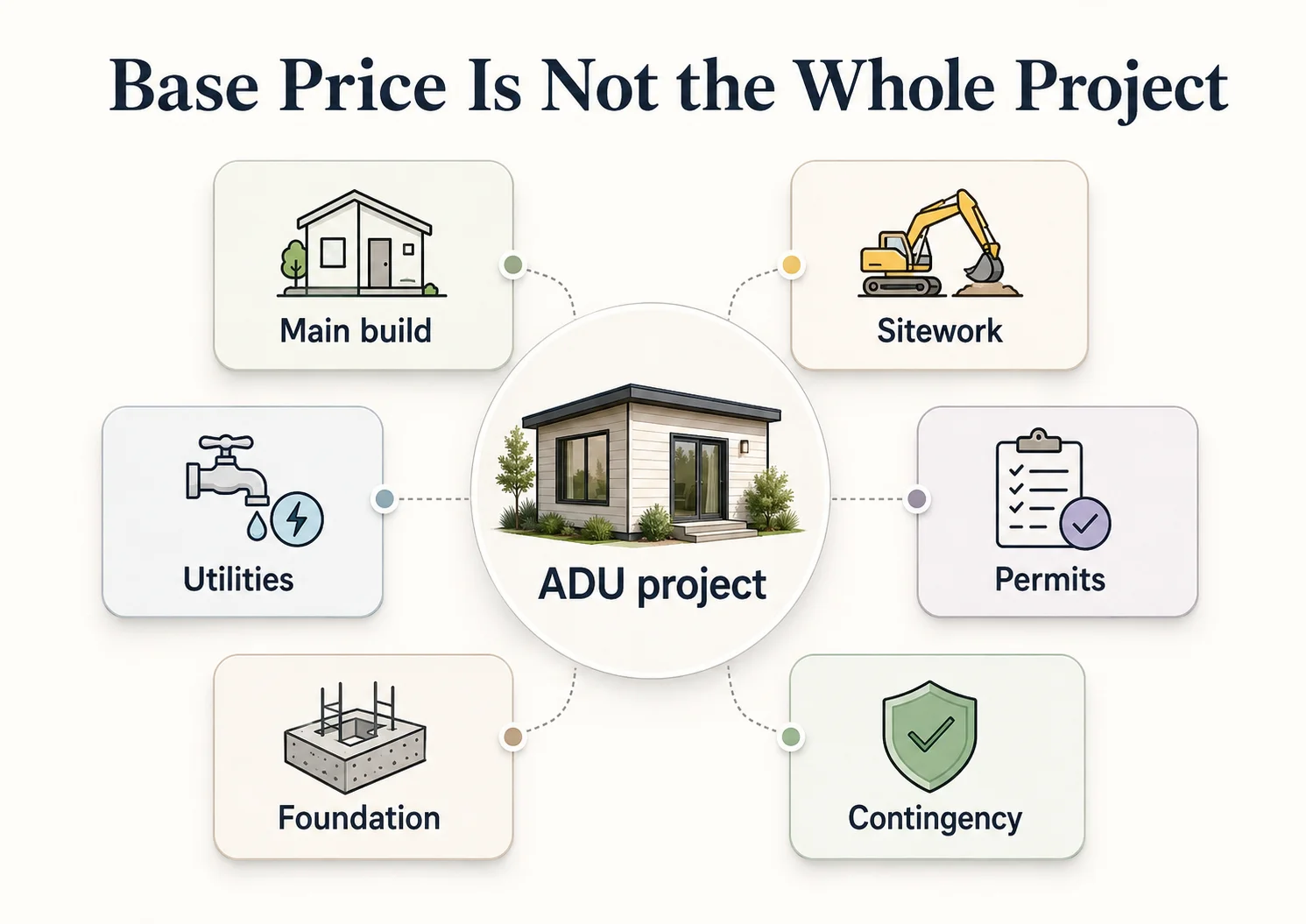
Illustrative example. A homeowner gets a $220,000 “unit” quote, lines up $220,000 of financing, and discovers at the foundation stage that grading, the sewer lateral, the electrical panel upgrade, design, permits, and impact fees push the real number past $300,000. Now the loan is short, the project is mid-trench, and the only options are expensive emergency cash or a stalled build. The five numbers exist to prevent exactly that, and the all-in figure is the one that saves projects.
- 1Current home value. Sets your borrowing ceiling on current-value products. Use recent comparable sales, not a wishful estimate.
- 2Current mortgage balance. The other half of the equity formula. Your usable second-lien room is roughly (home value × 80%) − balance.
- 3Total all-in ADU cost. Hard construction + site work + soft costs (design, permits, soils, energy reports) + utility connections + a 10–15% contingency. This is the number the loan must actually cover.
- 4Builder payment schedule. Decides whether a fast-flexible product (HELOC) or a milestone-draw product (construction/renovation) fits.
- 5Current first-mortgage rate. The hinge of the entire decision. A sub-5% rate is worth protecting with a second lien; a 7%+ rate may be worth replacing.
Document checklist before the builder or lender conversation
Bring these and your first real conversation turns from “I'm just exploring” into a serious quote:
- ✓The builder contract or draft proposal
- ✓A full line-item quote (not a single bottom-line number)
- ✓The payment/draw schedule
- ✓A written list of scope exclusions
- ✓Permit and design-fee estimates
- ✓A utility and site-work estimate
- ✓The written change-order policy
- ✓Your current mortgage statement (balance, rate, term)
- ✓A home-value estimate or recent appraisal
- ✓Property tax and insurance estimates
- ✓An estimated rent figure (if rental income matters)
- ✓Any builder financing term sheet you've been given
See What You Can Build → Get Your Free ADU Report
Confirm your ADU size, setbacks, and the financing step that fits — in 60 seconds, before you commit a dollar.
Get Your Free ADU Report →Free · 60 seconds · No commitment
How do HELOCs, home equity loans, and cash-out refis work for ADU builds?
A HELOC (home equity line of credit — a revolving credit line secured by your home) and a home equity loan (a fixed-rate lump sum, also secured by your home) both borrow against your current equity and usually leave your first mortgage untouched. A cash-out refinance replaces your entire first mortgage with a larger one and hands you the difference in cash. For builder payments, the practical difference is timing and rate exposure: a HELOC's draws flex to match invoices, a home equity loan and cash-out refi arrive as one lump sum, and a cash-out refi can be very expensive when it replaces a low pandemic-era first mortgage.
HELOC: draw as the invoices arrive
A HELOC has two phases. During the draw period (typically 10 years) you borrow up to your limit and pay interest only on what you've actually drawn. After that comes the repayment period (typically 20 years) of fully amortizing payments. HELOC rates are usually variable, tied to the prime rate plus a lender margin. The national average HELOC rate was 7.41% as of May 20, 2026, per Bankrate's survey of large home-equity lenders. The flexibility is the point for a build: you draw to match each contractor invoice and pay interest only on the outstanding balance, which mirrors how an ADU project actually spends money.
The risk is the variable rate. If you choose a HELOC, stress-test your payment at the current rate plus three percentage points. If the stressed payment would strain your budget, the HELOC isn't the right product even if today's rate looks friendly. For a deeper comparison, see our HELOC for ADU guide.
Home equity loan: a fixed lump sum for a defined budget
A home equity loan disburses one lump sum at closing at a fixed rate, repaid on a set schedule, while your first mortgage stays in place. National home equity loan rates have run somewhat higher than HELOCs in 2026. It wins when your budget is fully defined — a fixed-price prefab contract, for instance — and you value a payment that never changes. The tradeoff: interest accrues on the entire balance from day one, even on funds you haven't spent yet.
Cash-out refinance: one new, larger mortgage
A cash-out refinance replaces your first mortgage with a bigger one, capped for most borrowers around 80% of current home value, and you take the difference as cash. It can be the right move when your existing rate is already at or above today's market. It is usually the wrong move when you hold a low locked rate — and here is the math that proves it.
The blended-cost trap, worked in dollars
Consider a homeowner who needs $200,000 for an ADU, on a $700,000 home with a $400,000 first mortgage. Illustrative comparison only; assumes 30-year terms, a 6.83% cash-out refinance APR and 7.41% second-lien rate held flat for comparability, no closing costs, no prepayment. Benchmarks: Bankrate 30-year refinance APR 6.83% on May 23, 2026; Bankrate HELOC average 7.41% on May 20, 2026. Not a loan offer.
| Your Existing First-Mortgage Rate | Cash-Out Refi: Total Interest, $600K over 30 yrs | Keep First + $200K Second Lien: Total Interest | Difference |
|---|---|---|---|
| 3.25% | ~$812,500 | ~$525,700 | ~$287,000 less with second lien |
| 5.00% | ~$812,500 | ~$672,000 | ~$140,500 less with second lien |
| 7.00% | ~$812,500 | ~$857,000 | ~$44,500 less with cash-out refi |
These are illustrative examples, not guarantees. Actual costs depend on loan terms, rate changes over time, closing costs, prepayment, and tax treatment.
The homeowner sitting at 3.25% pays roughly $287,000 more in interest over 30 years by choosing the cash-out refi over keeping the first mortgage and adding a second lien — because the refinance reprices the entire $600,000 balance at the new rate, not just the $200,000 they actually needed. Around a 7% existing rate, the advantage can flip. This is why, when a builder's “easy” financing is structured as a refinance, the homeowner with a great existing rate should be the most skeptical.
When do renovation or construction loans beat builder financing?
Renovation and construction loans beat builder financing when your current equity isn't enough to cover the build, when the project will materially raise your home's appraised value, when the builder accepts lender-controlled draws, or when you need one structure that funds the work all the way through completion. They lose when permits are uncertain, when the builder refuses lender oversight, or when the timeline can't meet the program's completion rules.
Fannie Mae HomeStyle Renovation
HomeStyle Renovation lets eligible borrowers purchase or refinance a one-unit property and fund the construction or installation of a new ADU in a single loan, underwritten against as-completed value. Three rules matter when comparing against a builder timeline: the renovation work must generally be completed within 15 months of closing; renovation costs generally must not exceed 75% of the as-completed value — or 50% when the primary dwelling is a manufactured home; and Selling Guide update SEL-2025-10 increased upfront disbursement at closing to up to 50% of total renovation costs for materials, permit fees, design services, and borrower deposits — directly relevant to a builder who needs money early.
Freddie Mac CHOICERenovation
CHOICERenovation similarly lets borrowers add a new ADU or renovate an existing one, against future value. The change to flag: for applications received on or after May 4, 2026, rental income from a unit funded with CHOICERenovation proceeds cannot be used to qualify the borrower (Freddie Mac Bulletin 2026-1). If you were counting on the future ADU's rent to help you qualify, HomeStyle is now the more flexible of the two for that specific use case.
FHA 203(k)
The FHA 203(k) is best for attached ADUs, garage and basement conversions, and rehab of an existing structure — not the natural fit for a ground-up detached unit. HUD modernized the program effective November 4, 2024 (Mortgagee Letter 2024-13): the Limited 203(k) cap rose from $35,000 to $75,000, the Standard rehabilitation period was extended to 12 months, and the Limited period was extended to nine months. FHA's lower credit thresholds make it the accessible lane: minimum decision credit score of 580 for maximum financing (3.5% down) and scores of 500–579 with 10% down, subject to lender overlays (HUD Handbook 4000.1).
Construction-to-permanent loans
A construction-to-permanent loan funds the build in inspected draws, then converts automatically to a permanent mortgage at completion — saving a second closing. It's the common path for low-equity ground-up builds. The friction is real: approved plans, a licensed and insured general contractor, a detailed draw schedule, periodic inspections, and lender oversight. Owner-builders struggle to find lenders here.
Compare Renovation and Construction Loan Paths
Explore Renovation & Construction Loan Options
Useful when the builder's financing doesn't cover the full project, or when your current equity falls short of the build.
Explore Options →Affiliate link. We may earn a commission. Eligibility, rates, and approval depend on lender underwriting and are not guaranteed.
Can ADU rental income help me qualify?
Sometimes — and the rules depend on which agency underwrites the loan, whether the ADU already exists, and whether you're buying or refinancing. Fannie Mae and Freddie Mac both allow some ADU rental income toward qualifying on one-unit principal residences, generally capped at 30% of total qualifying income, but the eligible transaction types differ between agencies. Do not assume projected rent will automatically qualify you — ask your specific lender, in writing, how much rent counts under your program.
Fannie Mae (post–DU 12.1, March 21, 2026)
Since the Desktop Underwriter 12.1 release the weekend of March 21, 2026, Fannie Mae automates rental-income qualification from an existing ADU on a one-unit principal residence for purchase and limited cash-out refinance transactions (Fannie Mae Selling Guide B3-3.8-01). The calculation: 75% of gross monthly rent, then capped at 30% of total qualifying income, supported by a signed lease or Form 1007. Borrowers with under 12 months of property-management experience face an extra limit — usable rental income can't exceed the housing payment (PITIA).
Worked example (illustrative; not a guarantee of returns). A borrower with $6,000/month W-2 income and an ADU renting for $2,500/month: the 75% calculation yields $1,875; the 30% cap allows up to $2,571; the smaller wins, so $1,875 is usable, lifting qualifying income to $7,875.
Freddie Mac
ADU rental income is permitted on purchase and no-cash-out refinance transactions on one-unit principal residences, lease-supported income capped at 75% of the lease amount, total qualifying rental income capped at 30% (Freddie Mac Seller/Servicer Guide 5601.2). Note: for applications received on or after May 4, 2026, rental income from a unit funded with CHOICERenovation proceeds cannot be used to qualify the borrower (Freddie Mac Bulletin 2026-1).
FHA
Per HUD Mortgagee Letter 2023-17, FHA may use 75% of estimated rental income for an existing ADU on purchase or rate-and-term refinances, and 50% for a new ADU added via Standard 203(k); the same 30% cap applies, and ADU rental income cannot be used on FHA cash-out refinances.
The honest takeaway: ADU rental income is a real qualification tool, especially for borrowers who are close and need a debt-to-income boost — but it's documented, capped, and program-specific, not a blank check. For more, see our full guide on ADU rental income qualification rules.
What are the red flags before signing an ADU builder financing offer?
Slow down if the builder won't name the lender, won't show the APR after a promotional period, requires a large nonrefundable payment before financing is final, promises approval, hides the lien or security terms, refuses to let you compare independently, or says the financing “covers the whole ADU” while excluding site work, utilities, permits, foundation, or contingency. None of these is automatically fraud — but each one removes your ability to evaluate the deal, and that's the common thread in offers that go wrong.
Two consumer-protection facts anchor this section. First, the CFPB confirms you can verify whether a financing company is authorized in your state for free through NMLS Consumer Access (nmlsconsumeraccess.org), and check for disciplinary actions through your state regulator. Second, the FTC warns that any company promising a loan regardless of credit history while requiring an upfront fee is exhibiting a classic advance-fee loan scam pattern. Legitimate application or appraisal fees exist — the red flag is pre-approval with no underwriting paired with a fee before real underwriting.
The nine checks — your offer audit
- 1No lender name or NMLS number. If you can't identify the lender, you can't verify licensing or compare. Ask for the NMLS ID and check it yourself at nmlsconsumeraccess.org.
- 2"Approval with no underwriting." Real lenders underwrite credit, income, and collateral. Unconditional approval claims are marketing, not underwriting outcomes.
- 3An upfront fee in exchange for a promised loan. The FTC's textbook advance-fee pattern. Application/appraisal fees are normal; 'pay this and you're approved' is not.
- 4A promo rate with no disclosed post-promo APR. "No payments for six months" tells you nothing about month seven. Get the APR after the intro period in writing.
- 5A balloon payment. A large lump sum due at the end of a deferral or term can blindside an unprepared borrower. Ask if one exists and when.
- 6A prepayment penalty. If you might refinance into a cheaper product once the ADU is built and appraised, a prepayment penalty can trap you. Confirm there isn't one.
- 7The builder gets paid before work is inspected. Misaligned incentives. Inspected draws protect you; a builder paid in full up front does not.
- 8The loan covers the base price only. "Covers the whole ADU" must explicitly include site work, utilities, permits, foundation, fees, and contingency — or it doesn't cover the whole ADU.
- 9The contract binds you before financing is final. Never sign a construction agreement that locks you in before the financing terms are confirmed and you've seen one independent quote.
| Red Flag | Why It Matters | What to Ask |
|---|---|---|
| "Approval without underwriting" | Legitimate lenders underwrite | "What underwriting happens before approval?" |
| No lender / NMLS ID | You can't verify licensing | "What's the lender or broker's NMLS ID?" |
| No APR after the promo | You can't compare cost | "What is the APR after the intro period ends?" |
| Large nonrefundable deposit | You may lose cash if financing or permits fail | "Is the deposit refundable if financing or the permit falls through?" |
| Builder refuses lender draws | Construction-loan fit may fail; oversight gone | "Do you accept lender-controlled inspections and draws?" |
| Base price only financed | A six-figure all-in gap remains | "Does this include site work, utilities, permits, foundation, fees, and contingency?" |
Free Report
Audit My Builder Financing Offer
Run your address and your project details through our free ADU report. It confirms what you can build, flags the feasibility and budget gaps a builder offer often misses, and points you to the independent financing lane to compare first.
Start Your Free ADU Report →What should I ask the builder and the lender before signing?
Ask the builder about scope, deposits, draw timing, refund terms, change orders, lender coordination, and completion risk. Ask the lender about APR, lien position, fees, the payment start date, draw rules, contractor approval, inspection requirements, rental-income treatment, and what happens if permits or construction are delayed. If a loan officer can't answer most of these without checking with someone else, find a different lender.
Get the answers in writing — a quick email saying “please confirm these terms in writing” is reasonable and routine, and a legitimate party will provide them.
12 questions for the builder
- 1Is this a fixed-price or cost-plus contract?
- 2What exactly does the quote exclude? (Site work, utilities, permits, foundation, fees?)
- 3What is the full deposit and draw schedule?
- 4Is my deposit refundable if financing or the permit falls through?
- 5What is your written change-order process and is there a cap?
- 6Do you accept lender-controlled inspections and draws?
- 7Who is the financing lender, and what's their NMLS ID?
- 8What happens to the schedule if permitting is delayed?
- 9What's your timeline from contract to completion?
- 10What warranty do you provide, and for how long?
- 11Can I see your license and proof of insurance?
- 12Can I speak to two recent customers with a similar project?
12 questions for the lender
- 1What's the APR, and what is it after any promotional period?
- 2What lien position does this loan take?
- 3What are all the fees, itemized?
- 4When do payments start, and is there a balloon?
- 5Is there a prepayment penalty?
- 6Is this loan based on current value or as-completed value?
- 7What's the draw schedule, and who inspects?
- 8What contractor qualifications do you require?
- 9Can ADU rental income count toward my qualifying income, and what's the cap?
- 10What happens if the appraisal comes in below my budget?
- 11Will the rate change between application and closing?
- 12What's the earliest you can close?
6 questions for yourself
- ?Can I comfortably afford the stressed payment (current rate + 3 points)?
- ?Do I have a 10–15% contingency on top of the quote?
- ?Am I protecting a low first mortgage I shouldn't replace?
- ?Have I confirmed the lot can legally support this ADU?
- ?Have I gotten one truly independent quote?
- ?What's my exit plan — refinance, hold, or sell?
Free Download
Download the Free ADU Starter Kit
Get the builder and lender question scripts, the financing-path comparison worksheet, and the project-cost checklist in one place. No spam.
Download the Free ADU Starter Kit →What if I'm building prefab, modular, or manufactured?
Prefab and modular ADUs change the financing timing because factory deposits, transportation, crane access, foundation work, utility hookups, and final installation are often separate line items — and a loan that covers the unit may not cover the full project. Modular ADUs built to state or local building code are generally treated like site-built structures by lenders; HUD-code manufactured ADUs require a permanent foundation and real-property classification to qualify for conventional financing.
How lenders treat each type
- Modular (state/local code). Most lenders treat it like site-built. Fannie Mae HomeStyle explicitly includes modular ADUs as eligible. A HELOC or construction loan works; confirm your lender classifies your specific product as modular, not manufactured.
- Manufactured (HUD-code). Conventional financing requires a permanent foundation, legal classification as real property, and HUD Data Plate/Certification Label documentation. HomeStyle and CHOICERenovation now permit manufactured-home ADUs with these conditions met (Freddie Mac Bulletin 2025-15, effective February 9, 2026). Remember the HomeStyle 50% renovation-cost cap when the primary dwelling is itself a manufactured home.
- Manufacturer-linked financing. Useful and often well-coordinated, but the loan is made by a third-party lender, and a '100%' headline can carry an 85%-of-post-installation-value cap underneath. Get the lender's name, the real loan-to-value cap, and the APR, and compare it like any other loan.
The timing trap unique to prefab
A prefab manufacturer may require a substantial factory deposit before any site work begins. If your financing only releases against on-site construction milestones, the timing won't match, and you'll need cash or a flexible product (a HELOC) to bridge the factory deposit. Map the full sequence — factory deposit, delivery, crane/installation, foundation, utilities — against your loan's disbursement rules before you commit.
For real installed prices by size and brand, see our Prefab ADU Cost guide. If you're weighing specific manufacturers, our Best Prefab ADU Companies guide compares them on neutral criteria.
See Current Prefab Pricing & Floor Plans
Explore Modular ADU Pricing via Modular Home Direct
Comparing modular and prefab ADUs nationally? See current models, sizes, and pricing before you accept a manufacturer's financing.
Explore Options →Affiliate link. We may earn a commission. Pricing and availability are set by the provider; confirm current terms directly.
How should I model rental income and ROI without fooling myself?
Model rent conservatively and keep three numbers separate: construction cost, monthly debt service, and net operating income after vacancy, repairs, insurance, utilities, taxes, and management. The most common ROI mistake is using best-case gross rent to justify financing you can't comfortably carry — gross rent is not cash flow, and an ADU built on optimistic rent assumptions is the kind that becomes a financial strain instead of an asset.
If a builder's financing pitch leans on rental income to make the payment look comfortable, this is where you pressure-test it. The pitch uses gross rent; your reality is net.
A worked mini-model (illustrative)
Assume a $250,000 all-in detached ADU, financed with a $200,000 second lien at 7.41% over 30 years (about $1,386/month debt service) plus $50,000 cash, renting at $2,200/month.
| Line | Monthly | Notes |
|---|---|---|
| Gross rent | $2,200 | The number the pitch leads with |
| Vacancy reserve (~5%) | −$110 | Turnover and downtime between tenants |
| Maintenance reserve (~8%) | −$176 | Repairs, appliances, wear |
| Added property tax | −$210 | Illustrative; reassessment is set by your state/locality |
| Added insurance (landlord rider) | −$60 | Renting usually raises premiums |
| Utilities (if owner-paid) | −$80 | Depends on metering |
| Net before debt service | $1,564 | What's actually available to cover the loan |
| Debt service | −$1,386 | $200K second lien @ 7.41%, 30 yrs |
| Net cash flow | +$178 | A thin but positive margin |
These are illustrative examples, not guarantees of returns. Actual results depend on local market conditions, construction costs, financing terms, and regulatory approvals.
The lesson isn't that the ADU is a bad investment — it's that the honest number ($178) is a fraction of the gross ($2,200), and three line items people skip (reassessed taxes, the insurance bump, and reserves) are exactly what separate a real margin from a hope. Budget for property-tax and insurance changes from the start; reassessment rules are state- and locality-specific, so confirm the treatment with your county assessor and your insurer.
If you do plan to rent, our ADU Equity Calculator estimates added value, rent payback, and your true financing gap using current rate inputs.
Plan the Rental Side Before You Build
Explore Property-Management Tools via Buildium
If the ADU's rent is part of your plan, see how owners handle leases, screening, and rent collection.
Explore Options →Affiliate link. We may earn a commission.
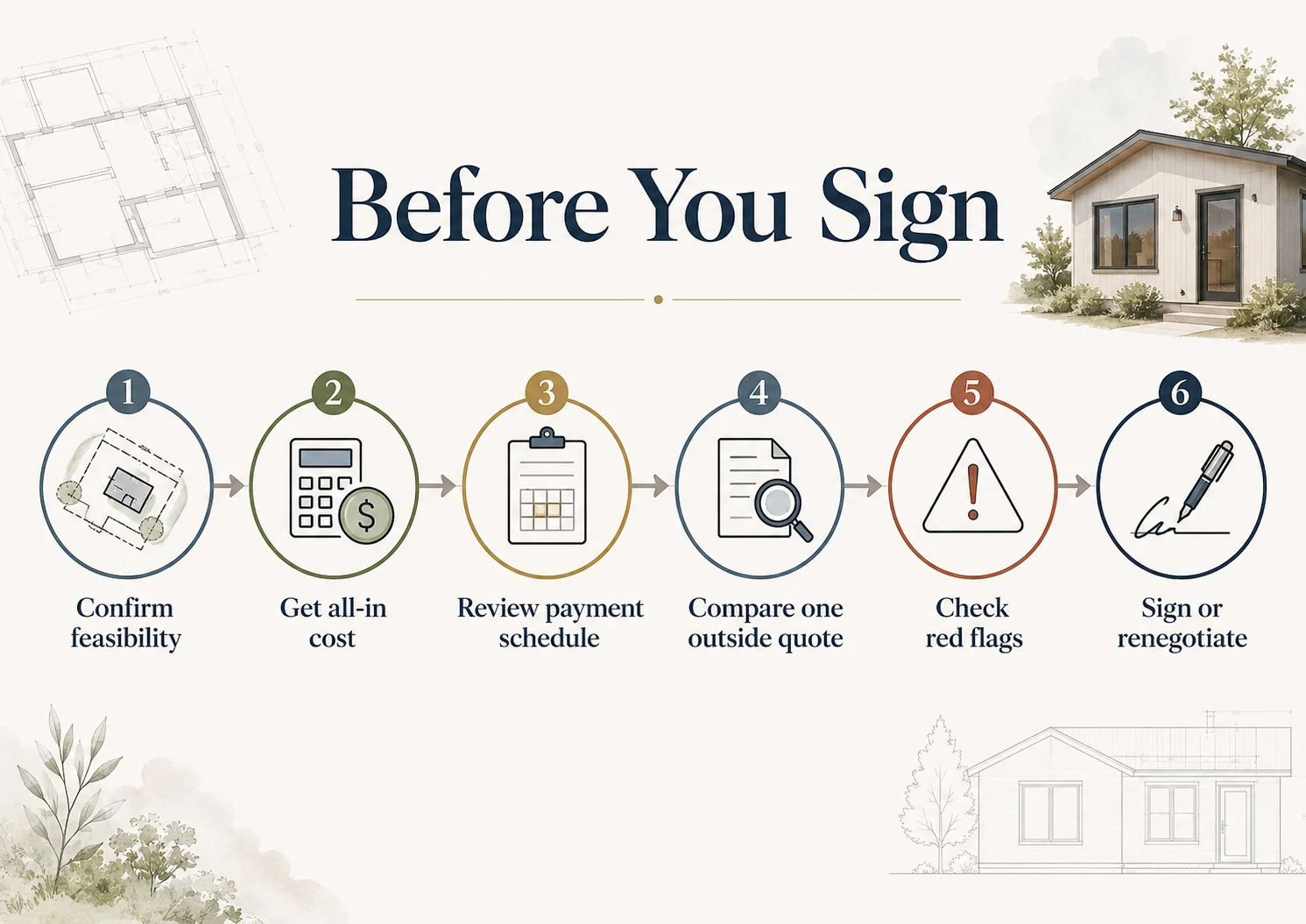
What should I do before I sign the builder contract?
Before signing, complete seven steps in order: confirm the lot is feasible, get the all-in budget (not the base price), translate the builder's financing into comparable loan terms, verify the lender through NMLS, compare against at least one independent option, check the contract's contingencies, and only then decide to accept, negotiate, or walk away. Skipping straight to signing because the monthly payment looks fine is how homeowners end up with a financing/contract combination they can't undo.
- 1Step 1 — Confirm feasibility. Lot dimensions, zoning, setbacks, and overlay districts (coastal, hillside, fire) decide what you can build before any quote matters. This is the cheapest check that saves the most money.
- 2Step 2 — Get the all-in cost. Demand a line-item quote and a written list of exclusions. Add a 10–15% contingency.
- 3Step 3 — Translate the builder's financing. Reduce the offer to its five terms: APR after promo, lien position, draw schedule, total coverage, payoff/balloon terms.
- 4Step 4 — Verify the lender. Check the NMLS ID at nmlsconsumeraccess.org and your state regulator for disciplinary actions (CFPB-recommended).
- 5Step 5 — Compare independently. Get one outside Loan Estimate or equivalent disclosure. Lay it next to the builder's offer on the same five terms.
- 6Step 6 — Check the contract. Confirm refund terms if financing or permits fall through, a written change-order process, and that you're not bound before financing is final.
- 7Step 7 — Decide. Accept the builder's offer if it wins on the merits, negotiate the terms that don't, or walk. You now have the information to do any of the three with confidence.
Fastest way to know what's possible at your address:
See What You Can Build → Get Your Free ADU Report
Free report · 60 seconds · No sales call · No commitment
Check My Property → Get Your Free ADU ReportDetailed reports currently available in CA, UT, TX, CO, and NY.
How we researched and verified this guide
The Dwelling Index is an independent research resource covering ADU financing, costs, and regulations. We are not a lender, broker, financial advisor, or builder, and we do not originate loans or sort financing options by compensation. We do earn affiliate commissions when readers use our links to explore financing or request pricing — but those payments never change which paths we list, how we order them, or what we recommend.
What we verified — May 23, 2026
- ✓An ADU manufacturer's published financing terms, the 85%-of-post-installation-value cap behind its "100%" headline, and the "third-party lender" disclosure with NMLS Consumer Access number
- ✓Fannie Mae ADU and HomeStyle Renovation guidance — the 15-month completion rule, the 75% as-completed cap (50% for manufactured homes), the SEL-2025-10 50%-at-closing disbursement, and the DU 12.1 rental-income automation (March 21, 2026)
- ✓Freddie Mac ADU and CHOICERenovation guidance, including the May 4, 2026 rental-income limitation and Feb 9, 2026 manufactured-home ADU eligibility
- ✓HUD FHA 203(k) program limits and rehab periods (Mortgagee Letter 2024-13, effective Nov 4, 2024) and FHA minimum-credit-score tiers (Handbook 4000.1)
- ✓CFPB definitions of home equity loans vs HELOCs, the NMLS Consumer Access verification path, and Loan Estimate guidance
- ✓FTC guidance on advance-fee loan scams and on home-equity borrowing risk
- ✓Benchmark HELOC (7.41%) and 30-year refinance (6.83% APR) rate context — Bankrate national surveys, May 2026
We re-verify rate context monthly (or after a major Fed action), agency rules quarterly or on any published Selling Guide or Mortgagee Letter announcement, and partner availability monthly. See our methodology, editorial standards, and affiliate disclosure.
ADU Builder Financing FAQ
Do ADU builders really offer financing?
Yes — many ADU builders and prefab manufacturers advertise financing, but it's usually a lender referral, a manufacturer-arranged loan made by a third-party lending partner, a deferred-payment offer, or a construction/renovation loan process rather than a loan the builder makes directly. For example, one manufacturer's financing page states plainly that it "does not make loans" and that all loans are made by its third-party lender partners. Always ask who the actual lender is and which disclosures apply.
Is ADU builder financing cheaper than a HELOC?
Not necessarily. Builder financing can be more convenient and is sometimes competitive, but for a homeowner with enough equity and a low existing first-mortgage rate, a HELOC is frequently cheaper because it preserves that low first mortgage. The national average HELOC rate was about 7.41% as of May 20, 2026. Compare APR, fees, lien position, draw timing, and total repayment before deciding — not just the monthly payment.
Should I finance an ADU with a cash-out refinance?
It can make sense if your current mortgage rate is already at or above today's market, or you owe relatively little. It's usually a poor choice if you hold a low locked-in first mortgage, because a cash-out refinance replaces that entire mortgage at a higher rate. In a worked example at May 2026 rates, a homeowner at a 3.25% existing rate paid roughly $287,000 more in interest over 30 years by choosing a cash-out refi over keeping the first mortgage and adding a second lien.
Can I use a construction loan for an ADU?
Yes. Construction and construction-to-permanent loans suit larger ADU projects, especially when your current equity isn't enough or when the builder's payment schedule matches lender-controlled, inspected draws. They require approved plans, a licensed insured general contractor, and lender oversight, and owner-builders often struggle to qualify.
Can I use Fannie Mae HomeStyle for an ADU?
Yes. Fannie Mae states HomeStyle Renovation can be used by eligible borrowers to purchase or refinance a one-unit property and construct or install a new ADU, underwritten against as-completed value. The renovation must generally be completed within 15 months of closing, and renovation costs generally must not exceed 75% of the as-completed value (50% when the primary dwelling is a manufactured home).
Can I use Freddie Mac CHOICERenovation for an ADU?
Yes — Freddie Mac states CHOICERenovation can be used to add a new ADU or renovate an existing one. Note the limitation effective for applications received on or after May 4, 2026: rental income from a unit funded with CHOICERenovation proceeds cannot be used to qualify the borrower.
Can I use an FHA 203(k) loan for an ADU?
Sometimes. FHA 203(k) works well for attached ADUs, garage and basement conversions, and rehab of an existing structure, but it's not the natural fit for a ground-up detached ADU. HUD raised the Limited 203(k) cap to $75,000, extended the Standard rehabilitation period to 12 months, and extended the Limited period to nine months, effective November 4, 2024.
Can ADU rental income help me qualify for financing?
Sometimes, depending on the loan program, transaction type, documentation, and lender overlays. Fannie Mae allows existing-ADU rental income on eligible one-unit principal-residence transactions — 75% of gross rent, capped at 30% of total qualifying income, automated in Desktop Underwriter 12.1 as of March 21, 2026. Freddie Mac and FHA have parallel rules with their own caps and exclusions.
What is the single biggest red flag in builder financing?
Pressure to sign the construction contract before you can see the real lender, the APR after any promotional period, the fees, the lien terms, the payment start date, and what happens if the ADU is delayed or not approved. Any offer that removes your ability to compare independently — especially "pre-approval with no underwriting" paired with an upfront fee — warrants slowing down and verifying the lender through NMLS Consumer Access.
Should I get prequalified before talking to ADU builders?
Yes — but pair financing prequalification with property feasibility. A loan approval doesn't mean your lot can legally or practically support the ADU you want, and confirming feasibility first prevents wasted credit pulls and deposits on a project that can't be permitted as imagined.
Does the builder's financing have to cover the whole project?
It should, but many offers cover only the base unit. "Covers the whole ADU" must explicitly include site work, utility connections, permits, foundation, fees, and contingency. Get the funded scope in writing, because the gap between the unit price and the all-in cost is commonly the largest single budget surprise homeowners face.
Not sure where to start?
See what's possible at your address — get your free ADU report in 60 seconds.
Get Your Free ADU Report →The Dwelling Index is an independent research resource covering ADU financing, costs, and regulations. We are not a lender, broker, or builder. This page is educational and does not constitute legal, tax, mortgage, or financial advice. Financing availability, underwriting, rates, fees, and eligibility vary by lender, borrower, property, and location. Always confirm terms with a licensed lender and verify ADU rules with your local planning and building department.