Can ADU Rental Income Help Me Qualify for a Mortgage?
What the major mortgage programs allow in 2026, how much rent actually counts, and which loan path fits your situation — including the October 2025 Fannie Mae rule that went live in Desktop Underwriter on March 21, 2026, and the March 2026 USDA proposed rule.
Can ADU rental income help me qualify for a mortgage? Yes — sometimes.
In 2026, Fannie Mae (effective for manual underwriting October 8, 2025; live in Desktop Underwriter March 21, 2026), FHA (since October 16, 2023), and Freddie Mac all let a lender count rental income from an Accessory Dwelling Unit (ADU) toward your qualifying income on a one-unit principal residence. The standard math is 75% of fair-market or lease rent (50% for proposed ADUs built through FHA Standard 203(k)), capped at 30% of total qualifying income. VA analyzes ADU rent case-by-case under general rental-income rules with no published ADU-specific rule. USDA currently treats income-producing ADUs as outside program objective; a proposed rule published March 31, 2026 would change that.
See what’s possible at your address
Your property’s zoning eligibility, estimated rental range, and qualifying-income math, in one place.
Get your free Dwelling Index ADU Feasibility & Income Report →
By The Dwelling Index editorial team · · · Fannie Mae rental-income update checked: October 3, 2026
2026 quick-answer: which mortgage programs count ADU rent?
| Program | Quick answer | First thing to ask your lender |
|---|---|---|
| Fannie Mae conventional | Yes — existing ADU on a 1-unit principal residence, purchase or limited cash-out refi, income capped at 30% of total qualifying income | “Will you underwrite to Selling Guide B3-3.8-01 (post-SEL-2025-08) ADU rental-income rules?” |
| Freddie Mac conventional | Yes — subject 1-unit principal residence, purchase or no-cash-out refi, 75% of lease, 30% cap, landlord education required | “Will the appraisal include a comp sale with an ADU and three rental comps including one with an ADU?” |
| FHA standard purchase/refi | Yes — 75% of the lesser of market rent or lease for existing ADUs, 30% Effective Income cap | “Is the ADU legally rentable per HUD’s appraisal protocol, and do I have two months of PITI reserves?” |
| FHA Standard 203(k) | Yes — 50% of projected rent for an ADU you’ll build or rehab through 203(k) | “Is my scope eligible under ML 2023-17, and is your shop set up for 203(k) draws?” |
| FHA cash-out refinance | No — ADU rental income is specifically excluded as Effective Income | “Can we restructure to a rate-and-term refi or limited cash-out?” |
| VA loan | No published ADU-specific rule — analyzed case-by-case under general rental-income standards; long-term lease and reserves typically required | “Have you closed a VA loan using ADU rental income, and how did you document it?” |
| USDA Guaranteed Loan | Generally no today — current HB-1-3555 treats income-producing ADUs as outside program objective; March 31, 2026 proposed rule would allow it | “Is this household-support ADU language, or are we relying on rental income?” |
This table reflects rules verified directly against agency primary sources on May 21, 2026. See “What we verified” for the full source list with links.
What changed in 2025–2026 and why it matters right now
Answer capsule: Between October 2023 and March 2026, the three biggest U.S. mortgage programs opened a path for ADU rental income to count toward qualifying. FHA moved first with Mortgagee Letter 2023-17 in October 2023. Freddie Mac expanded its policy in 2022 and refined it through 2025–2026 bulletins. Fannie Mae was the last to align, issuing Selling Guide announcement SEL-2025-08 on October 8, 2025, with automated eligibility deployed in Desktop Underwriter version 12.1 on March 21, 2026.
Many lenders, agents, and even loan officers are still working from pre-October 2025 information. We’ve seen lender pages published in the second half of 2025 still telling consumers that conventional financing “usually” doesn’t count ADU rental income — language that was correct before October 8, 2025 and is wrong after it.
If you’ve been told your ADU rent can’t help you qualify, two questions matter: when were you told, and which guideline was the lender using? Both answers can change today.
A short timeline of what actually shifted
- Oct 16, 2023
HUD publishes Mortgagee Letter 2023-17. FHA becomes the first major program to count 75% of existing ADU rent (and 50% of projected rent through FHA Standard 203(k)) toward Effective Income, capped at 30% of total monthly Effective Income.
- Jun 2022 onward
Freddie Mac expands ADU eligibility and allows ADU rental income for qualifying on a subject 1-unit principal residence.
- Oct 8, 2025
Fannie Mae issues Selling Guide announcement SEL-2025-08, amending the rental-income topic now published at B3-3.8-01 to allow ADU rental income on purchase and limited cash-out refinance of 1-unit principal residences. Manual underwriting eligibility is immediate.
- Nov 5, 2025
Freddie Mac Bulletin 2025-15 takes effect; the manufactured-home-ADU expansion follows on February 9, 2026.
- Mar 21, 2026
Fannie Mae deploys Desktop Underwriter (DU) version 12.1, adding automated eligibility for ADU rental income on one-unit principal residence purchase and limited cash-out transactions, including manufactured homes.
- Mar 31, 2026
USDA issues a proposed rule (docket RHS-26-SFH-0100) that would allow Single Family Housing Guaranteed Loan Program financing on homes with one or more income-producing ADUs. Comments are open through June 1, 2026.
- May 4, 2026
Freddie Mac Bulletin 2026-1 adds specificity to CHOICERenovation: rental income from any unit included in the funded renovation project cannot be used to qualify.
For homeowners and buyers who were told “no” before October 8, 2025, the answer may now be yes.
Can ADU rental income help me qualify for a mortgage, and how does it actually work?
Answer capsule: Yes, on a one-unit principal residence, under specific conditions, in 2026. Fannie Mae, Freddie Mac, and FHA each have published rules allowing ADU rental income to be added to qualifying income — typically at 75% of fair market or lease rent, capped at 30% of total qualifying income. VA analyzes it case-by-case with no ADU-specific rule. USDA currently doesn’t allow income-producing ADUs, though it proposed to change that on March 31, 2026.
The phrase “ADU rental income can help you qualify” is technically accurate but easy to misread. It does not mean the lender takes your full monthly rent and credits it against your mortgage payment. It means:
- 1.
The lender adds a portion of the rent to your qualifying income (usually 75% of the lower of fair market rent or lease).
- 2.
That extra income lowers your debt-to-income (DTI) ratio — the percentage of your monthly gross income that goes toward debt payments including the new mortgage.
- 3.
The full mortgage payment (PITIA) stays in your obligations. The rent is added to your income, not subtracted from your payment. Fannie Mae and FHA both make this point explicitly.
- 4.
The amount of ADU rent you can count is capped at 30% of your total qualifying income under Fannie Mae, Freddie Mac, and FHA.
A fast glossary
- Gross ADU rent
- What the tenant pays, or the appraiser's market-rent estimate.
- Fair market rent (FMR)
- The appraiser's supported rent estimate, documented on Form 1007 (Single-Family Comparable Rent Schedule) or Form 1025 (Small Residential Income Property Appraisal Report).
- Qualifying rental income
- Gross rent after the agency haircut (typically 75%, sometimes 50%) and program cap.
- DTI ratio
- Total monthly debt payments divided by gross monthly income. The metric most likely to make or break your approval.
- PITIA
- Principal, interest, property taxes, homeowner's insurance, and association dues. The full housing payment.
- Effective Income
- FHA's term for the income figure used in qualifying.
When a competent lender says “ADU rent can help you qualify,” what they mean in practice is: we’ll add 75% of your supported rent — up to 30% of total qualifying income — to the income side of your DTI ratio.
Which mortgage programs count ADU rent in 2026?
Answer capsule: Fannie Mae, Freddie Mac, and FHA have verified pathways in 2026. FHA Standard 203(k) is the clearest verified path for projected income from a planned ADU. USDA’s current handbook is unfavorable to income-producing ADUs, though a March 31, 2026 proposed rule would change that. VA has no published ADU-specific rule and should be treated case-by-case and lender-specific.
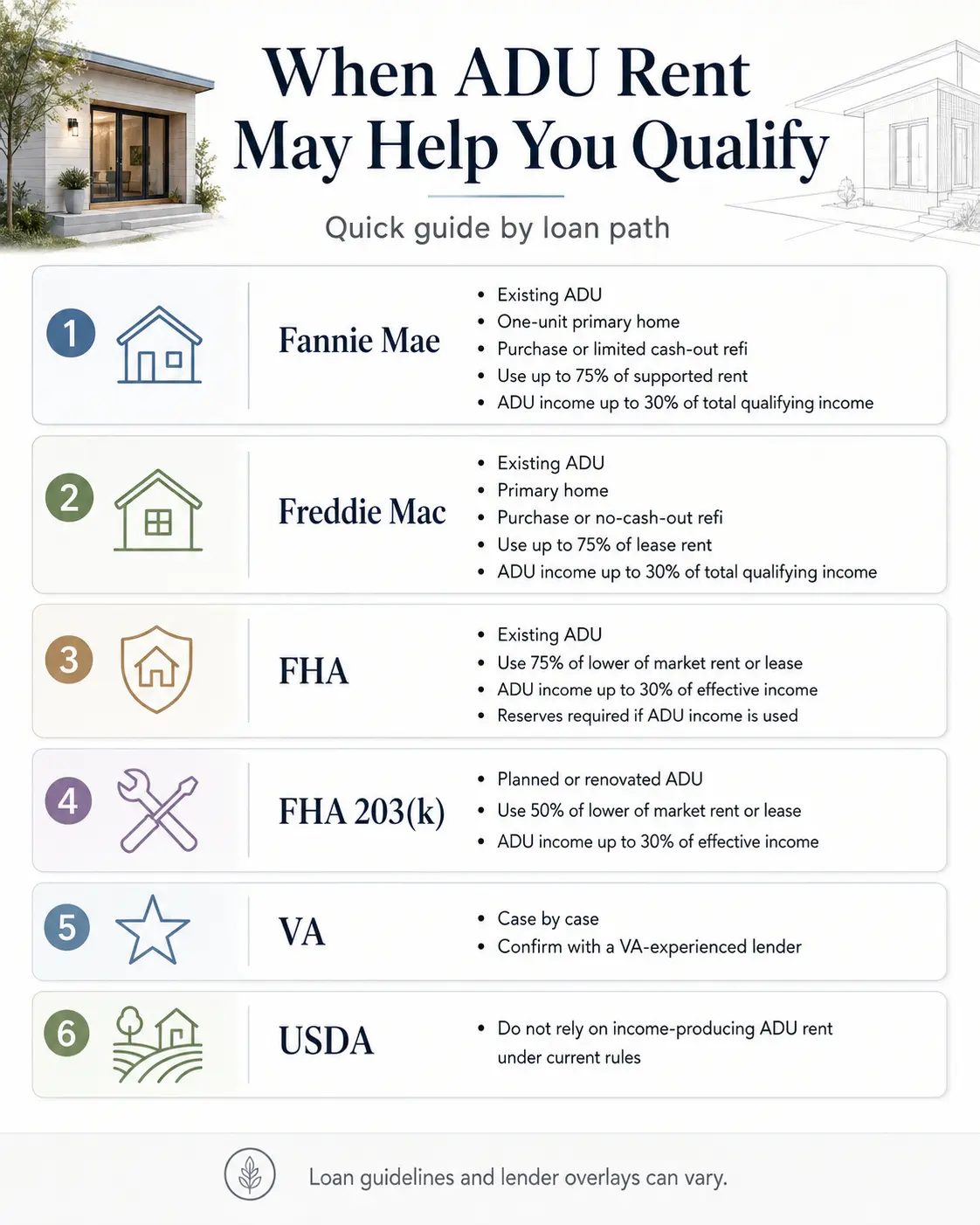
Fannie Mae conventional loans (B3-3.8-01, post–October 2025)
September 2026 rental-income update: Fannie Mae reorganized its rental-income policies and strengthened lease documentation, validation and restrictions on leases with family members or interested parties. The current announcement encourages early adoption and requires implementation for loans with application dates on or after December 1, 2026. Lenders using UAD 3.6 follow its Policy Supplement. The ADU-specific limits remain one existing ADU on a one-unit principal residence, purchase or limited cash-out refinance, and a 30% cap on total qualifying income. Ask your lender which policy version applies to your application. Sources: SEL-2026-08 and B3-3.8-02. Checked October 3, 2026.
Answer capsule: Fannie Mae allows rental income from an existing ADU to be used in qualifying when the property is a one-unit principal residence, only one ADU’s income is counted, the transaction is purchase or limited cash-out refinance, and the ADU income does not exceed 30% of total qualifying income. The borrower must have a documented current primary housing payment. The rule became effective for manual underwriting on October 8, 2025, and was added to Desktop Underwriter version 12.1 on March 21, 2026.
This is the policy change that reset the landscape. Before October 8, 2025, Fannie Mae generally would not let rental income from a principal residence be used in qualifying — the only ADU exception was the HomeReady product. The current rental-income topic, published at Selling Guide B3-3.8-01, now contains the ADU carveout for standard Fannie Mae loans.
The Fannie Mae conditions, plain English:
- ▸The subject property must be a one-unit principal residence with an existing ADU.
- ▸Income may be used from one ADU only, even if multiple ADUs exist.
- ▸Eligible transactions: purchase or limited cash-out refinance. Cash-out is not eligible.
- ▸ADU income used for qualifying is limited to 30% of total qualifying income.
- ▸The borrower must have a documented current primary housing payment. If the borrower has no current housing payment, ADU rental income from the subject property cannot be used.
- ▸If the borrower has a current housing payment but fewer than 12 months of property-management (landlord) experience, the qualifying ADU rental income cannot exceed the subject property's PITIA.
- ▸Documentation follows the standard rental-income rules in B3-3.8-01, including Form 1007 (or Form 1025 for 2–4 units) and lease documentation where applicable. The lease rent must be in U.S. dollars.
- ▸The full mortgage PITIA still counts in your debt obligations. The ADU rent is added to your income side.
Fannie Mae’s own published example, decoded:
A couple purchasing a one-unit property with an ADU above the garage has a tenant with a signed $1,400/month lease. They’ve never been landlords before. Fannie reduces the lease to 75% —$1,050/month. That $1,050 is under the 30% cap. But because the borrowers have never been landlords, the qualifying rental income cannot exceed the subject property’s PITIA. In that scenario, PITIA is $1,000/month, so the counted rental income is $1,000, not $1,050.
Even with that haircut, Fannie Mae’s worked example shows the borrower’s DTI moves from 51.66% without rental income to 44.28% with it.
Translation for a first-time landlord: if you’ve never rented out a property before and you’re using Fannie Mae, your qualifying ADU rent is the lowest of (a) 75% of supported rent, (b) 30% of qualifying income, or (c) your subject-property PITIA. Once you have at least 12 months of documented landlord experience, the PITIA ceiling falls away and you can use the 75% figure up to the 30% cap.
Source: Fannie Mae Selling Guide B3-3.8-01, Rental Income (10/08/2025); Announcement SEL-2025-08; DU v12.1 release (March 21, 2026) — verified May 21, 2026.
Freddie Mac conventional loans
Answer capsule: Freddie Mac allows ADU rental income to qualify a borrower for a purchase or no-cash-out refinance on a subject 1-unit principal residence. Up to 75% of the lease amount may count, capped at 30% of total stable monthly income. Either one year of landlord experience or a Freddie Mac–recognized landlord-education program is required for purchases, and the appraisal must include a comparable sale with an ADU.
Freddie Mac was the first of the conventional players to open this path, in mid-2022, and it requires the toughest appraisal evidence. Freddie’s distinctive requirements:
- ▸The property must be a subject 1-unit principal residence.
- ▸Eligible transactions: purchase or "no cash-out" refinance.
- ▸The ADU must comply with zoning and land-use requirements: legal, legal non-conforming, or no zoning are all acceptable. Rental income from an illegal ADU may not be used.
- ▸A full appraisal is required. The Automated Collateral Evaluation (ACE) appraisal waiver, if offered, cannot be accepted.
- ▸The appraisal must include at least one comparable sale with an ADU.
- ▸The appraiser's rental analysis must include at least three comparable rentals, and at least one of those must be a property with an ADU.
- ▸Lease-documented rent must not exceed 75% of the lease amount.
- ▸ADU rental income cannot exceed 30% of total stable monthly income.
- ▸Landlord education: for a purchase, at least one qualifying borrower must complete a landlord-education program unless they have at least one year of prior landlord experience.
Freddie Mac Bulletin 2025-15 also expanded the rule for manufactured-home properties — effective February 9, 2026, a multiwide manufactured home primary may contain an ADU. Note that single-wide manufactured homes with ADUs are not eligible for sale to Freddie Mac.
Translation: Freddie Mac is the strictest of the conventional programs on appraisal evidence. In areas where ADUs are uncommon and comparable rented ADUs are scarce, the appraisal can be the breaking point. Engage your appraiser through the lender early to confirm comps exist.
Source: Freddie Mac Single-Family Seller/Servicer Guide Section 5306.1(g); Bulletin 2025-15; Freddie Mac ADU resource page — verified May 21, 2026.
FHA loans (Mortgagee Letter 2023-17)
Answer capsule: FHA was the first major program to expand ADU rental income, in October 2023. For an existing ADU with no prior rental history, lenders use 75% of the lesser of appraiser fair-market rent or lease/rental agreement. ADU rental income cannot exceed 30% of the borrower’s total monthly Effective Income, and the borrower must have two months of full PITI in reserves after closing. Cash-out refinances are not eligible.
- ▸The property must be a one-unit single-family dwelling with one ADU, used as the borrower's primary residence.
- ▸The ADU is defined as "a single habitable living unit with means of separate ingress and egress that meets the minimum requirements for a living unit," subordinate in size to the primary residence.
- ▸A renter of an ADU is not a boarder — FHA's explicit distinction. Boarder income has separate, stricter rules.
- ▸Existing ADU, no prior history: 75% of the lesser of (a) appraiser fair market rent on Form 1007/1000, or (b) lease/rental agreement rent.
- ▸FHA Standard 203(k), proposed ADU, no prior history: 50% of the lesser of appraiser FMR or lease/rental agreement (see next section).
- ▸ADU rental income is capped at 30% of total monthly Effective Income.
- ▸Two months of full mortgage payment in reserves after closing is required when using ADU rental income.
- ▸Cash-out refinance: ADU rental income may not be used as Effective Income. This is an explicit exclusion in ML 2023-17.
- ▸Negative net rental income must be included as a recurring monthly obligation.
- ▸Commercial-space income from a mixed-use property may not be included.
The FHA appraisal is heavier than conventional. It must address ADU characteristics, legal rentability, and marketability, and include at least one comparable rental that is a single-family dwelling with a rented ADU.
Translation: FHA is the cleanest path for buyers with lower credit scores or smaller down payments who are purchasing a home with an existing legal ADU — and the cleanest path for buyers who want to build an ADU through renovation financing.
Source: HUD Mortgagee Letter 2023-17 (October 16, 2023) — verified May 21, 2026.
FHA Standard 203(k) — for ADUs you’ll build or renovate
Answer capsule: FHA Standard 203(k) is the most clearly defined path for using projected rent from a planned ADU. Under ML 2023-17, lenders may count 50% of the lesser of appraiser market rent or lease/rental agreement when there’s no prior rental history and the ADU is being created or rehabilitated through eligible 203(k) work. The 30% Effective Income cap and reserve requirements still apply.
Eligible improvements under 203(k) include:
- ▸Adding an attached ADU to a one-unit primary residence (for example, a garage conversion or basement-apartment buildout).
- ▸Renovating an existing attached or detached ADU.
- ▸Converting a one-family structure to a one-family structure with an ADU.
Not every detached ADU build qualifies under 203(k). Eligibility tracks FHA’s specific 203(k) improvement scope, not a general “any new ADU” allowance. Confirm scope with a 203(k)-experienced lender before you sign anything.
The practical reality of 203(k):
- ▸Inspections, contractor selection, draw administration, and repair escrow add weeks to closing and require a lender experienced with 203(k).
- ▸The projected-rent factor is 50%, not 75%. That conservatism is intentional — you're being underwritten on a unit that doesn't exist yet.
- ▸The 30% Effective Income cap still applies, and two months of full PITI reserves are required after closing.
Why it’s worth the complexity: for a buyer who otherwise can’t qualify because their DTI is over the line, 50% of even a modest projected ADU rent can bridge the gap. On a $1,800/month projected rent, that’s $900 added to qualifying income.
Source: HUD Mortgagee Letter 2023-17, eligible improvements section — verified May 21, 2026.
VA loans (no published ADU-specific rule; lender analysis required)
Answer capsule: VA does not have a published ADU-specific rental-income rule in the sources we verified. VA’s general rental-income standards require income to be stable and reliable. A VA-experienced lender may analyze ADU rent under those general standards or its own overlays, but do not assume VA has a verified ADU carveout.
What this means in practice for VA borrowers:
- ▸Owner-occupancy is required under VA. You must live in the main home or the ADU as your primary residence.
- ▸VA's general rental-income framework (VA Pamphlet 26-7, Chapter 4) governs how a lender may treat the income. For an existing ADU with a long-term lease, many VA lenders apply standard rental-income analysis, commonly using 75% of lease rent — but this is lender practice under general rules, not a published VA ADU rule.
- ▸Prospective rental income generally requires evidence of likelihood of landlord success and adequate reserves.
- ▸Short-term rental income (Airbnb, VRBO) is risky for qualifying. Do not rely on it for VA unless a VA-experienced lender documents how it meets VA's stable-and-reliable income standard.
- ▸Lender experience matters more here than anywhere else. Because there's no ADU-specific handbook chapter, lender analysis and overlays drive outcomes. Ask any prospective VA lender whether they've closed a VA loan using ADU rental income and how they documented it.
Translation: VA can work, but treat ADU rent as a stretch input rather than a guaranteed one. Build your numbers without the rent first, then ask the lender what it can do for your application.
Source: VA Pamphlet 26-7, Chapter 4 (Credit Underwriting); 38 CFR 36.4340. No ADU-specific public rule located. Flagged [NEEDS LENDER VERIFICATION] before relying on this income.
USDA Guaranteed Loan (current rule restrictive; March 2026 proposed rule open for comment)
Answer capsule: Under current USDA HB-1-3555 handbook language, ADUs designed to create a potential rental income stream are not consistent with the Single Family Housing Guaranteed Loan Program objective. On March 31, 2026, USDA published a proposed rule (Federal Register docket RHS-26-SFH-0100) that would amend 7 CFR Part 3555 to allow financing of properties with one or more income-producing ADUs. Public comment is open through June 1, 2026; the rule was not final as of May 21, 2026.
Today, under the current rule:
- ▸A property with an ADU intended for household support (multigenerational housing, aging in place) may be acceptable.
- ▸A property with an ADU designed to generate rental income is treated as outside program objective.
- ▸Do not plan a USDA-financed purchase or refinance assuming ADU rental income will count.
If the proposed rule becomes final:
- ▸Single-family homes with one or more income-producing ADUs would become eligible.
- ▸Properties with non-commercial features designed to accommodate home-based operations would also be clarified as eligible.
- ▸Federal Register docket: RHS-26-SFH-0100, published March 31, 2026.
We’ll update this section the moment a final rule is published.
Source: USDA HB-1-3555; Federal Register Vol. 91, No. 61 (March 31, 2026), docket RHS-26-SFH-0100 — verified May 21, 2026.
Explore mortgage options through our research partner
You’ve now seen the five paths and which ones may fit. If you’re ready to talk to a lender, the fastest filter is asking whether they’ve underwritten an ADU rental-income file recently — many loan officers are still working from pre-October 2025 information. Affiliate disclosure
Compare common funding routes and their eligibility limits before contacting a lender.Compare ADU Financing OptionsHow much ADU rent can actually count? The 75% rule, the 30% cap, and the PITIA ceiling
Answer capsule: Lenders typically count 75% of either the appraiser’s fair-market rent or the actual lease rent, whichever is lower — 50% if the ADU is proposed under FHA Standard 203(k). That counted amount can’t exceed 30% of your total qualifying income under Fannie Mae, Freddie Mac, and FHA. Fannie Mae also caps qualifying rent at the subject-property PITIA when the borrower has fewer than 12 months of landlord experience.
The math runs through three sequential filters.
Filter 1 — The 75% haircut (50% for FHA 203(k))
A 75%-of-gross-rent calculation applies when the relevant program permits lease or appraiser market-rent documentation; it is not a universal rule for tax-return rental history. FHA’s Standard 203(k) rule for a one-unit property with an ADU and no rental history uses 50% of the lesser of appraiser market rent or lease rent. When tax-return history is used, lenders analyze Schedule E and permitted adjustments rather than automatically taking 75% of the current lease.
| Loan path | Existing ADU | Proposed / new ADU |
|---|---|---|
| Fannie Mae | 75% of lease or Form 1007 market rent | Carveout is for an existing ADU; a renovation-loan path applies if the ADU doesn't exist |
| Freddie Mac | 75% of lease | CHOICERenovation can fund the build, but for applications on/after May 4, 2026, rent from a unit included in the funded renovation can't be used to qualify |
| FHA standard | No rental history: 75% of the lesser of fair market rent or lease; apply the relevant ADU cap. With history: Schedule E analysis and permitted adjustments | Existing ADU; cash-out excluded; two months’ PITI reserves when ADU income qualifies the borrower |
| FHA Standard 203(k) | With rental history: required Schedule E analysis. Without history: 50% of the lesser of fair market rent or lease for a one-unit property with an ADU | Eligible 203(k) scope and reserves apply; a new detached ADU is not eligible new-construction scope |
| VA | Lender analysis (commonly 75% of long-term lease) | Generally requires evidence of landlord likelihood of success |
| USDA | Currently not allowed for income-producing ADUs | Currently not allowed; March 2026 proposed rule open for comment |
Filter 2 — The 30% qualifying-income cap
Across Fannie Mae, Freddie Mac, and FHA, ADU rental income cannot exceed 30% of total qualifying income. This is a concentration-risk control: agencies don’t want an approval to ride too heavily on the variable income from one small rental unit. VA has no verified ADU-specific 30% cap; USDA currently doesn’t allow the income at all.
Worked example — under the cap:
Your job income is $5,000/month. The ADU rents for $2,400/month. The 75% haircut gives you $1,800. The 30% cap test: $1,800 ÷ ($5,000 + $1,800) = 26.5%. Under the cap, so all $1,800 counts. New qualifying income: $6,800.
Worked example — over the cap:
Your job income is $4,000/month, ADU rent $2,400. The 75% haircut still gives you $1,800. The 30% cap test: $1,800 ÷ ($4,000 + $1,800) = 31.0%. Over the cap. The lender reduces the counted rent so ADU income equals exactly 30% of total qualifying income: 0.30 × ($4,000 ÷ 0.70) = $1,714. New qualifying income: $5,714.
Filter 3 — Fannie Mae’s PITIA ceiling for first-time landlords
If you have fewer than 12 months of landlord experience and you’re using Fannie Mae, the qualifying ADU rent is also capped at the subject-property PITIA.
From Fannie Mae’s published example: lease is $1,400/month, 75% factor = $1,050, PITIA = $1,000. Counted rental income = $1,000, not $1,050. The extra $50 is dropped because the borrowers have no prior landlord experience. This filter goes away once you have 12+ months of documented landlord experience.
Three-filter cheat sheet — illustrative
These are illustrative examples, not guarantees of returns. Actual results depend on local market conditions, construction costs, financing terms, lender overlays, and regulatory approvals.
| Scenario | Gross rent | After haircut | 30% cap result | PITIA ceiling | Final qualifying ADU income |
|---|---|---|---|---|---|
| Fannie, existing ADU, experienced landlord, $8,000 job income | $2,000 | $1,500 (75%) | Under cap (15.8%) | N/A | $1,500 |
| Fannie, existing ADU, first-time landlord, $7,000 job income, PITIA $1,200 | $1,800 | $1,350 (75%) | Under cap (16.2%) | $1,200 ceiling | $1,200 |
| FHA, existing ADU, no history, $6,500 job income, FMR $1,800 / lease $1,700 | Lesser = $1,700 | $1,275 (75%) | Under cap (16.4%) | N/A | $1,275 (plus 2-mo reserves) |
| FHA Standard 203(k), proposed ADU, $6,500 job income, FMR $1,800 | $1,800 | $900 (50%) | Under cap (12.2%) | N/A | $900 |
| Freddie, existing ADU, landlord-education done, $5,500 job income, lease $2,000 | $2,000 | $1,500 (75%) | Under cap (21.4%) | N/A | $1,500 |
| Fannie, existing ADU, $4,000 job income, lease $2,400, experienced landlord | $2,400 | $1,800 (75%) | Over cap (31.0%) → reduced | N/A | $1,714 |
See your property’s numbers
Runs your address through local zoning rules and rent comps and shows the qualifying-income lift under each program.
Get your free Dwelling Index ADU Feasibility & Income Report →Does the ADU have to already exist, or can future rent count?
Answer capsule: Existing ADUs are far easier. Fannie Mae’s October 2025 carveout is for existing ADUs only. FHA Standard 203(k) is the cleanest verified path for projected rent from an ADU you’ll build, using 50% of the lesser of appraiser market rent or lease. Freddie Mac’s CHOICERenovation can finance an ADU build, but for applications on or after May 4, 2026, rent from a unit included in the funded renovation can’t be used to qualify. VA generally requires evidence of landlord success before counting prospective rent. USDA does not currently allow income-producing ADUs.
| Scenario | Best first lane | Why |
|---|---|---|
| Buying a home with an existing legal ADU | Fannie Mae, Freddie Mac, or FHA | Rules are cleanest when the ADU already exists and can be appraised and rent-supported |
| Buying a home and building an ADU through renovation | FHA Standard 203(k) | The verified path for 50% projected rent on a planned ADU |
| Already own the home; want to add an ADU and refinance | Fannie limited cash-out (existing ADU) or a renovation loan | If the ADU doesn't exist yet, a renovation loan funds the build — but mind the May 4, 2026 CHOICERenovation rule on qualifying rent |
| Completed the ADU; now refinancing | Fannie limited cash-out, Freddie no-cash-out, FHA non-cash-out | Lease, rent receipts, and Schedule E timing become central |
| Cash-out refi to pull equity, leaning on ADU rent | Generally not eligible | FHA explicitly excludes; Fannie and Freddie don't allow cash-out with this carveout |
A point most pages miss: “projected rent” doesn’t mean “a number you make up.” Under FHA Standard 203(k), Fannie Mae (existing-ADU carveout), and Freddie Mac, the rent figure comes from the appraiser on Form 1007 (or Form 1025/72 for 2–4 unit cases). The appraiser examines comparable rentals in the local market — including, for Freddie Mac, at least one comparable rental with an ADU. If your market has thin ADU rental comps, the appraisal can quietly become the deal-killer.
What documents make ADU rental income usable?
Answer capsule: Plan to provide a full appraisal with ADU analysis, Form 1007 (Single-Family Comparable Rent Schedule), a signed lease where applicable, proof of legal zoning status, landlord-education certificate (Freddie Mac purchases without 12+ months of landlord experience), and reserves — two months of PITI for FHA, and reserves for VA when using prospective rent.
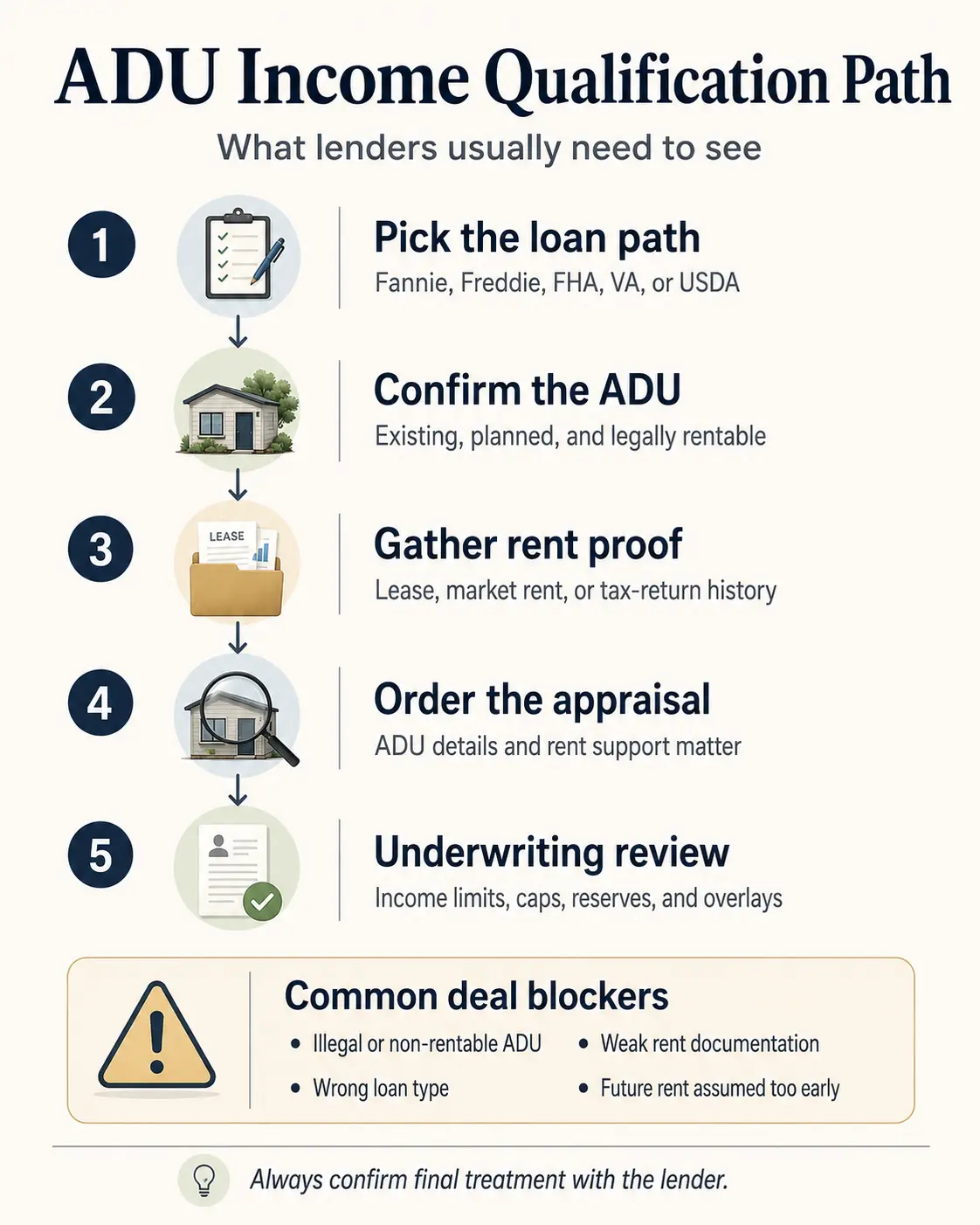
The ADU rental-income documentation matrix
What each program wants, at a glance:
| Document / requirement | Fannie Mae | Freddie Mac | FHA | FHA 203(k) | VA | USDA (current) |
|---|---|---|---|---|---|---|
| Appraisal identifying/analyzing the ADU | Yes (Form 1004/70) | Yes; no ACE waiver | Yes (Form 1004/70) | Yes | Yes | N/A — income not allowed |
| Form 1007 / 1000 (market rent) | Yes | Yes | Yes | Yes | If lender requires | — |
| Comparable sale with an ADU in appraisal | Appraiser may adjust non-ADU comps if needed | Required (≥1) | Required (≥1 rental comp w/ ADU) | Required | Lender discretion | — |
| Signed lease (U.S. dollars) | If relying on lease | If relying on lease | If relying on lease | If relying on lease | Typically required | — |
| Schedule E / tax returns (history) | If history exists | If history exists | If history exists | If history exists | If history exists | — |
| Proof ADU is legal/rentable | Yes | Yes (illegal ADU = no income) | Yes (HUD protocol) | Yes | Yes | — |
| Landlord-education certificate | Not required | Required unless 12-mo experience | Not required | Not required | Lender discretion | — |
| Reserves | Per AUS | Per program | 2 months PITI | 2 months PITI | Often required for prospective rent | — |
| Cash-out restriction | No cash-out | No cash-out | Excluded for cash-out | N/A | Lender discretion | — |
| Current housing payment required (borrower) | Yes | Per program | Per program | Per program | Per program | — |
The lender question script — copy and paste
Use this when you call a prospective lender:
“I’m buying / refinancing a one-unit primary residence with an ADU. I want to know whether ADU rental income can be used in qualifying.
- Which agency guideline will you underwrite to — Fannie Mae B3-3.8-01, Freddie Mac Chapter 5306, FHA ML 2023-17, VA Pamphlet 26-7, USDA HB-1-3555, or a portfolio/non-QM product?
- Is my transaction type eligible if I use ADU rent?
- Does the ADU need to already exist for this loan?
- Will you use lease rent, appraiser market rent on Form 1007, Schedule E, or a combination?
- What haircut and cap will apply?
- What appraisal forms and rental comparables are required, and have you closed an ADU rental-income loan recently?
- What lender overlay could still block the income even if the agency rule allows it?”
If a loan officer can’t answer questions 1, 5, and 6 cleanly, ADU rental-income underwriting isn’t yet in their book — find a lender for whom it is.
Download the Free ADU Rental Income Checklist
The documentation matrix, the five-path comparison, and the lender question script, formatted for printing.
Get the checklist by email →When ADU rental income will not help you qualify
Answer capsule: ADU rental income gets stripped from a file most often for one of five reasons: the ADU is unpermitted or illegal; the loan transaction type excludes it (especially cash-out); the appraiser can’t find supporting rental comps; the income would exceed the 30% cap; or the lender’s overlays are tighter than the agency rule.
The ADU is illegal or not legally rentable
The single most common disqualifier across every program. Freddie Mac explicitly states that rental income from an illegal ADU may not be used to qualify. FHA’s appraisal protocol under ML 2023-17 requires the appraiser to address whether the ADU can be legally rented for market-rent analysis. Fannie Mae accepts legal, legal non-conforming, or “no zoning” status — but a unit built without permits in a jurisdiction that requires them is none of those three.
Common forms of “illegal”:
- ✕The ADU was built without permits.
- ✕The ADU lacks a certificate of occupancy.
- ✕The ADU violates current setback, FAR (floor area ratio), or size rules and isn't grandfathered.
- ✕The ADU isn't subordinate to the primary dwelling as required.
- ✕A garage was converted to living space without the conversion being permitted as habitable.
The fix path:
Retroactive permitting through the local jurisdiction’s legalization or amnesty pathway, when one exists. This can take months and may not be feasible if the existing construction doesn’t meet current code. If you’re buying a property with an ADU described as “unpermitted” or “off the books,” don’t plan to rely on the rental income until permitting is resolved.
The loan transaction type excludes it
- ▸FHA cash-out refinance: ML 2023-17 explicitly says ADU rental income may not be used as Effective Income to qualify for a cash-out refinance.
- ▸Fannie Mae cash-out refinance: the carveout is for purchase and limited cash-out only. A standard cash-out refi is not eligible.
- ▸Freddie Mac cash-out refinance: subject 1-unit primary ADU income is for purchase or no-cash-out refi only.
- ▸CHOICERenovation: for applications on/after May 4, 2026, rent from a unit included in the funded renovation project can't be used to qualify.
- ▸USDA, today: generally not eligible if the ADU is designed for rental income.
The appraisal can’t support the rent
Freddie Mac’s appraisal requirements are toughest here: at least one comparable sale with an ADU, plus three comparable rentals, one of which is a property with a rented ADU. In markets where ADUs are rare, the appraisal can collapse the income claim before underwriting even reviews it. Fannie Mae is more forgiving — its appraiser may use similar non-ADU rental properties and adjust for factors affecting market rent if true ADU comps aren’t available — but the adjustments still have to be justified.
Hitting the 30% cap
The cap is a hard ceiling. Any rent above 30% of your total qualifying income is ignored — it doesn’t help your DTI. The cap doesn’t disqualify your loan; it sets the maximum useful contribution from the ADU. It bites hardest when your base income is modest relative to a strong ADU rent (common in high-cost coastal metros), or when you’re a first-time landlord on a Fannie file where the PITIA ceiling stacks on top.
Lender overlays
The agency rule is the floor, not the ceiling. Lenders apply their own overlays — additional requirements beyond the agency guideline. A lender might require 24 months of landlord history where the agency requires zero, or bank statements showing rent receipts where the agency would accept a signed lease. When your file gets stripped of ADU income, the first question is whether it’s an agency rule or a lender overlay. If it’s an overlay, you can shop the file to another lender.
Check your property before you rely on ADU rent
Verifies your lot’s ADU eligibility, surfaces legal-status concerns, and estimates qualifying-income lift before you commit to a loan path.
Get your free Dwelling Index ADU Feasibility & Income Report →Three real-world scenarios: how the math changes qualification
These are illustrative examples, not guarantees of returns. Actual results depend on local market conditions, construction costs, financing terms, lender overlays, and regulatory approvals. Approval depends on AUS findings, credit, reserves, appraisal, documentation, and lender overlays.
Scenario 1 — Buying a home with an existing legally permitted ADU (Fannie Mae)
Inputs
- Buyer base income: $7,000/month
- ADU lease rent: $1,800/month
- Landlord experience: 18 months (no PITIA ceiling)
- Total debt obligations: $4,000/month
Math
- 75% factor: $1,800 × 0.75 = $1,350
- 30% cap test: 16.2% → under cap
- New qualifying income: $8,350/month
- DTI: 57.1% → 47.9%
The counted ADU rent lowers the DTI by roughly nine points — often the difference between a file that’s over a lender’s ceiling and one that’s within range.
Scenario 2 — Buying a home and building an ADU with FHA Standard 203(k)
Inputs
- Buyer base income: $6,500/month
- Projected ADU rent (appraiser FMR): $1,600/month
- ADU does not yet exist; 203(k) scope includes buildout
Math
- 50% factor (203(k) no-history): $1,600 × 0.50 = $800
- 30% cap test: 10.9% → under cap
- New Effective Income: $7,300/month
- Required reserves: 2 months full PITI
The 50% factor is conservative, but $800/month of qualifying-income lift can move a DTI several points — meaningful when you’re near an FHA threshold.
Scenario 3 — Refinancing a home with an existing ADU (Fannie Mae limited cash-out)
Inputs
- Owner base income: $8,000/month
- ADU current lease rent: $2,000/month
- Refinance type: limited cash-out under Fannie Mae
Math
- 75% factor: $2,000 × 0.75 = $1,500
- 30% cap test: 15.8% → under cap
- New qualifying income: $9,500/month
Caveat: if this same owner had chosen a standard cash-out refinance, ADU rental income would not count under Fannie, Freddie, or FHA. The structure of the refinance, not just the property, drives eligibility.
Zoning, permits, and legal non-conforming ADUs
Answer capsule: Freddie Mac accepts ADUs that are legal, legal non-conforming, or in “no zoning” areas, and bars rental income from an illegal ADU. Fannie Mae’s rule turns on legal rentability and appraisal classification, with additional eligibility conditions when an ADU isn’t allowed under local zoning. FHA requires the ADU to comply with local zoning and meet HUD’s minimum property requirements. Unpermitted ADUs and ADUs without a certificate of occupancy generally disqualify the rental income.
| Legal status | Freddie Mac | Fannie Mae | FHA |
|---|---|---|---|
| Legal (permitted, current code, C of O) | Income allowed | Income allowed | Income allowed |
| Legal non-conforming (grandfathered) | Allowed | Allowed if legally rentable and appraisal supports it | Allowed if still legally rentable under current rules |
| No zoning (no code to violate) | Allowed | Allowed | Must still meet HUD minimum property requirements |
| Illegal / unpermitted | Income may not be used | Additional eligibility conditions; income generally unusable | Income unusable; appraisal must confirm legal rentability |
What disqualifies an ADU’s rental income across the board: no permits where permits were required; no certificate of occupancy where the jurisdiction issues one; current setback, height, or FAR violations that aren’t grandfathered; a unit that doesn’t meet the agency’s structural definition (missing separate ingress/egress, no independent kitchen or bath, not subordinate to the primary residence); or a garage conversion never permitted as habitable space.
If you’re not sure whether your existing ADU is legal, start with three questions: Was a permit ever pulled for the work? Was a certificate of occupancy ever issued? Does the current footprint comply with setbacks, height limits, and FAR for the lot today? Your local building or planning department — or the jurisdiction’s online permit portal — can confirm the records.
For ADUs you plan to build, see What Is an ADU? Definition, Types, Costs & Rules for the definitional baseline.
Common reasons ADU rental income gets denied at underwriting
Answer capsule: Five recurring reasons account for most ADU rental-income denials: an unpermitted or illegal ADU; the ADU doesn’t meet the definitional criteria; the appraisal can’t support comparable rentals with an ADU; the income would exceed the 30% cap; and lender overlays stricter than the agency rule.
The ADU doesn’t meet the definitional criteria
Each agency requires a single habitable living unit with an independent kitchen, bathroom, and sleeping space; separate ingress and egress (an exterior access point that doesn’t require passing through the primary residence); and subordinate size and appearance relative to the primary dwelling. A bedroom with an adjacent kitchenette isn’t an ADU. A finished basement with no separate exterior entrance usually isn’t either.
The appraisal comp problem
This catches Freddie Mac files most often because Freddie requires one comp sale with an ADU plus three rental comps including one ADU rental. In suburban or rural markets where ADUs are rare, the appraiser may not be able to find compliant comps. Engage the appraiser early through the lender to confirm comp availability before ordering.
Lender overlays
Some lenders haven’t updated their underwriting systems for the post–October 2025 Fannie Mae rule or never adopted the 2022 Freddie Mac expansion. If a lender tells you ADU rental income isn’t eligible and you’ve confirmed it should be under the agency rule, the lender has an overlay. Accept their position or shop the file.
How to actually use this: a decision tree
Answer capsule: Four questions narrow your loan path. Does the ADU already exist and is it legal? Are you doing a cash-out refinance? Do you have at least one year of landlord experience? Are you VA-eligible? Your answers point you to the right starting lane.
1. Is the ADU already built and legally permitted?
Yes → go to step 2.
No, but you want to build one → FHA Standard 203(k) for the cleanest projected-rent path; ask about a Fannie or Freddie renovation loan, noting the May 4, 2026 CHOICERenovation rule on units included in the funded renovation.
2. Are you doing a cash-out refinance?
Yes → ADU rental income does not qualify under FHA, Fannie Mae, or Freddie Mac. Consider a limited cash-out refi (Fannie) or no-cash-out refi (Freddie) instead.
No → go to step 3.
3. Do you have at least 12 months of documented landlord experience?
Yes → Fannie Mae, FHA, or Freddie Mac all open up cleanly, with no Fannie PITIA ceiling and no Freddie landlord-education requirement.
No → Fannie Mae and FHA still work; for Freddie Mac, complete the landlord-education program. Note Fannie Mae’s PITIA ceiling for first-time landlords.
4. Are you VA-eligible with an existing legal ADU?
Yes → a VA loan analyzing ADU rent under general rental-income rules can work, but lender experience matters more than anywhere else. Ask whether the lender has closed an ADU rental-income VA loan and how it documented the income.
Run your property through the Dwelling Index Feasibility Engine
Pulls your local zoning rules and rent comps and shows your qualifying-income lift before you call a lender.
Get your free ADU Feasibility & Income Report →What we verified
This page combines five federal underwriting frameworks and one proposed rule, verified directly against primary or official sources on May 21, 2026. Where lender treatment varies — most acutely on VA — we say so rather than imply a uniform rule. Editorial conclusions about which program may fit best are framed as editorial conclusions, not guarantees of approval.
| Claim | Status | Source |
|---|---|---|
| Fannie Mae allows existing ADU rent on 1-unit principal residences (purchase + limited cash-out) | Verified | Fannie Mae Selling Guide B3-3.8-01; SEL-2025-08 |
| Fannie Mae 75% factor; 30% cap; income from one ADU only | Verified | B3-3.8-01; SEL-2025-08 |
| Fannie Mae requires a current primary housing payment; PITIA ceiling if <12 mo landlord experience | Verified | Fannie Mae ADU rental-income fact sheet (11.14.25) |
| Fannie Mae published example: $1,400 lease → $1,050 (75%) → capped at $1,000 PITIA | Verified | Fannie Mae ADU rental-income fact sheet |
| Fannie Mae DU v12.1 added automated ADU-income eligibility March 21, 2026 | Verified | Fannie Mae DU v12.1 release (March 21, 2026) |
| Freddie Mac ADU rent on subject 1-unit principal residence; 75% of lease; 30% cap | Verified | Freddie Mac ADU resource; Section 5306.1(g) |
| Freddie Mac illegal ADU rental income may not be used | Verified | Freddie Mac ADU Fact Sheet |
| Freddie Mac appraisal: comp sale with ADU + 3 rental comps incl. one with ADU | Verified | Section 5306.1(g) |
| Freddie Mac landlord-education requirement (or 12 mo experience) | Verified | Section 5306.1(g) |
| Freddie Mac Bulletin 2025-15 (eff. Nov 5, 2025; manufactured-home ADU Feb 9, 2026) | Verified | Freddie Mac Bulletin 2025-15 |
| Freddie Mac Bulletin 2026-1: CHOICERenovation rent from a funded-renovation unit can't qualify (apps on/after May 4, 2026) | Verified | Freddie Mac Bulletin 2026-1 |
| FHA 75% of lesser of FMR or lease for existing ADU, no history; 30% cap | Verified | HUD Mortgagee Letter 2023-17 |
| FHA Standard 203(k): 50% of lesser of FMR or lease for proposed ADU, no history | Verified | HUD ML 2023-17 |
| FHA cash-out refinance excludes ADU rental income | Verified | HUD ML 2023-17 |
| FHA two-month PITI reserves required when using ADU rental income | Verified | HUD ML 2023-17 |
| FHA: a renter of an ADU is not a Boarder | Verified | HUD ML 2023-17 |
| VA general rental-income framework (stable/reliable; landlord likelihood for prospective rent) | Verified | VA Pamphlet 26-7, Ch. 4; 38 CFR 36.4340 |
| VA ADU-specific published rule | Not located | No public VA ADU-specific rule found; lender analysis required |
| USDA current rule treats income-producing ADUs as outside program objective | Verified | USDA HB-1-3555 |
| USDA March 31, 2026 proposed rule would allow income-producing ADUs; comment open through June 1, 2026 | Verified, not yet final | Federal Register, docket RHS-26-SFH-0100 (March 31, 2026) |
Refresh cadence: Quarterly hard review against all primary sources; monthly light check on Fannie Mae Selling Guide announcements and USDA rulemaking docket RHS-26-SFH-0100 until a final rule issues.
Methodology
We built this page from primary federal sources rather than secondary lender or builder blogs. The anchor documents: the Fannie Mae Selling Guide (B3-3.8-01, with the October 8, 2025 SEL-2025-08 update and the March 21, 2026 DU v12.1 deployment), HUD Mortgagee Letter 2023-17, the Freddie Mac Single-Family Seller/Servicer Guide Section 5306 plus Bulletins 2025-15 and 2026-1, VA Pamphlet 26-7 Chapter 4 and 38 CFR 36.4340, and USDA HB-1-3555 with the March 31, 2026 Federal Register proposed rule.
Where agencies use different terms for the same concept — “effective income” (FHA), “qualifying income” (Fannie), “stable monthly income” (Freddie) — we normalized the language in tables and footnoted the source terms.
We did not use Reddit, forum, or social posts as proof for laws, lending rules, zoning, or costs. We used them only to understand how homeowners describe the problem in their own words.
The 75%/50%/30% math examples are illustrative. They use representative incomes and rents to show how each filter applies in sequence. They are not predictions of qualifying, approval, or interest rate.
The Dwelling Index is an independent research resource covering ADU financing, costs, and regulations. We are not a lender, broker, builder, or financial advisor, and we do not provide mortgage, legal, tax, or investment advice.
Frequently asked questions
- Can ADU rental income help me qualify for a mortgage?
- Yes, sometimes. As of 2026, Fannie Mae, Freddie Mac, and FHA can each count ADU rental income on a one-unit principal residence. The standard math is 75% of fair-market or lease rent (50% under FHA Standard 203(k) for proposed ADUs), capped at 30% of total qualifying income. VA analyzes it case-by-case; USDA currently doesn't allow income-producing ADUs.
- Does Fannie Mae count ADU rental income?
- Yes. Fannie Mae's October 8, 2025 announcement SEL-2025-08 amended the rental-income topic at B3-3.8-01 to allow ADU rental income from an existing ADU on a one-unit principal residence, for purchase or limited cash-out refinance, capped at 30% of total qualifying income. Automated eligibility went live in Desktop Underwriter version 12.1 on March 21, 2026.
- Does FHA allow ADU rental income?
- Yes, since HUD Mortgagee Letter 2023-17 (October 16, 2023). FHA counts 75% of the lesser of appraiser fair market rent or lease for an existing ADU with no prior rental history, capped at 30% of total monthly Effective Income, with two months of full PITI in reserves required after closing.
- Can I use projected rental income from an ADU that isn't built yet?
- Yes, under FHA Standard 203(k) at 50% of the lesser of appraiser market rent or lease for proposed ADU work. Fannie Mae's existing-ADU carveout is for ADUs that already exist. Freddie Mac's CHOICERenovation can fund the build, but for applications on or after May 4, 2026, rent from a unit included in the funded renovation can't be used to qualify.
- How much rental income can be counted from an ADU?
- Typically 75% of the lower of fair market rent or lease rent (50% under FHA Standard 203(k) for proposed ADUs), capped at 30% of total qualifying income under Fannie Mae, Freddie Mac, and FHA. Fannie Mae also caps qualifying rent at the subject-property PITIA when the borrower has fewer than 12 months of landlord experience.
- Does the borrower need a current housing payment to use Fannie Mae ADU income?
- Yes. Under Fannie Mae B3-3.8-01, a borrower with no current primary housing payment cannot use subject-property ADU rental income. A borrower with a current housing payment but fewer than 12 months of property-management experience can use the income, but it cannot exceed the subject property's PITIA.
- Does the ADU need to be permitted to count?
- Yes. Freddie Mac accepts legal, legal non-conforming, or "no zoning" status and bars income from an illegal ADU. Fannie Mae turns on legal rentability and appraisal classification, with extra eligibility conditions when an ADU isn't allowed under zoning. FHA requires the ADU to comply with local zoning and HUD's minimum property requirements. Unpermitted ADUs and ADUs without a certificate of occupancy generally disqualify the income.
- Can I use ADU rental income for a cash-out refinance?
- No. HUD Mortgagee Letter 2023-17 excludes ADU rental income from FHA cash-out refinances. Fannie Mae's carveout is limited to purchase and limited cash-out. Freddie Mac's subject 1-unit primary path is purchase or no-cash-out only.
- Can Airbnb or short-term rental income from an ADU count?
- Treat it as risky. VA requires income to be stable and reliable, and short-term rental income is hard to qualify on. Don't rely on Airbnb/VRBO ADU income unless a lender documents how it meets the program's stable-income standard. For conventional and FHA, market-rent analysis focuses on long-term rent, so plan for a long-term lease structure if you need the income to count.
- Do I need a lease in hand to use ADU rental income?
- Not always. Fannie Mae, Freddie Mac, and FHA can each use the appraiser's fair market rent on Form 1007 as supporting documentation, subject to program-specific conditions. A signed lease is required when relying on actual lease rent rather than market rent.
- Will my current lender know about the October 2025 Fannie Mae rule?
- Many will, many won't. Manual-underwriting eligibility was effective October 8, 2025, and Desktop Underwriter version 12.1 added automated eligibility on March 21, 2026. The fastest filter is asking a prospective lender whether they've closed an ADU rental-income loan recently.
- Does ADU rent reduce my mortgage payment in the DTI calculation?
- No. Fannie Mae and FHA both add the rental income to the income side of the DTI calculation. The full mortgage payment (PITIA) stays in your obligations. The rent inflates your income; it doesn't offset the payment.
- Can USDA loans count ADU rental income?
- Generally not today. Under USDA HB-1-3555, ADUs designed as a rental-income stream are treated as inconsistent with the Single Family Housing Guaranteed Loan Program objective. A March 31, 2026 proposed rule (docket RHS-26-SFH-0100) would change that. Public comment is open through June 1, 2026; the rule was not yet final as of May 21, 2026.
- What if the ADU earns more rent than I need?
- The 30% qualifying-income cap is the ceiling — any rent beyond that doesn't help your DTI. The extra rent still helps your cash flow after closing, but it can't increase the loan size on the front end.
Related reading on dwellingindex.com
If you’re earlier in your research and want a definitional baseline, start with What Is an ADU? Definition, Types, Costs & Rules. If you came here from a grant search, see ADU Grants 2026: Verified Programs by State — most of what gets called a “grant” is actually a financing program, and only a few are real grants. For the broader financing landscape including HELOCs, cash-out refinance, construction loans, and renovation loans, see our ADU financing options and ADU loan requirements pages. For a side-by-side look at how Fannie Mae and Freddie Mac differ across more property types, see Fannie Mae vs Freddie Mac ADU Rules: 2026 Side-by-Side Guide.
A final note before you call a lender
The most useful thing you can do before your lender call is run your specific property through a feasibility check. The federal rules are uniform across the country, but your local zoning, your appraisable rent, and your lot’s ADU eligibility are not. Walking in with a feasibility report and an honest read on legal status puts you ahead of the conversation, not behind it.