
Arizona regulations · 2026 guide
Arizona ADU Laws (2026): What HB 2720 and HB 2928 Require, Where They Apply, and How Phoenix, Tucson and Mesa Compare
By The Dwelling Index Editorial Team · Last updated: · Last verified:
Bottom line up front: Under Arizona ADU laws, every city or town with more than 75,000 people must allow at least one attached and one detached accessory dwelling unit (ADU, often called a casita in Arizona) on any lot where a single-family home is allowed (A.R.S. § 9-461.18, from HB 2720 of 2024). Since 2025, counties must do the same on unincorporated land (A.R.S. § 11-810.01, from HB 2928). Neither can require extra parking, a family relationship with the tenant, matching design, or rear and side setbacks over 5 feet, and both must allow an ADU of at least 75% of the house or 1,000 square feet, whichever is less. A third detached ADU is possible on lots of one acre or more, tied to an affordable-rent unit. Smaller cities and towns are not covered and set their own rules.
Disclosure: This page has no affiliate links. The Dwelling Index is reader-supported.
| Jurisdiction (document we read) | ADUs per lot | Max ADU size | Side and rear setback | Parking | Short-term rental |
|---|---|---|---|---|---|
| State floor for cities over 75,000 (A.R.S. § 9-461.18) | At least 1 attached + 1 detached; a 3rd detached on 1+ acre if one unit is restricted-affordable | Must allow 75% of the house's gross floor area or 1,000 sq ft, whichever is less | City can't require more than 5 ft | City can't require extra parking or in-lieu fees | City may require the owner to live on site if an ADU built on or after Sept. 14, 2024 is used as a short-term rental (A.R.S. § 9-500.39) |
| State floor for counties (A.R.S. § 11-810.01) | At least 1 attached + 1 detached; a 3rd detached on 1+ acre (county may require one unit to be restricted-affordable) | Each ADU at least 75% of the house or 1,000 sq ft, whichever is less; county may allow larger | County can't require more than 5 ft | County can't require extra parking or in-lieu fees | County may require owner residency if the ADU's final approval was issued on or after Sept. 14, 2024 (A.R.S. § 11-269.17) |
| Phoenix (Zoning Ordinance § 706.A; city ADU guide) | 2 (1 attached, 1 detached); 3rd on 1+ acre with an affordable unit | Lots up to 10,000 sq ft: 1,000 sq ft or 75% of the house, whichever is less. Larger lots: 3,000 sq ft, 10% of net lot area or 75% of the house, whichever is less | Detached: 3 ft interior side or rear, 5 ft street side, 0 ft at a dedicated alley | Not required (state rule) | City guide says ADUs may be used as short-term rentals |
| Tucson (Unified Development Code 6.6.3.B; city casita site) | 2 on a lot with one family dwelling (1 with a duplex); 3rd on lots over 1 acre with a deed-restricted affordable unit | 75% of the house, up to 1,000 sq ft; any lot may have one up to 650 sq ft | 5 ft | Not required | Not addressed in the documents we read |
| Mesa (Zoning Ordinance § 11-31-3; city ADU page) | 1 attached + 1 detached; 3rd detached on 1+ acre with a restricted-affordable unit | 1,000 sq ft or 75% of the house's interior habitable area, whichever is less | 5 ft | Not required | Not addressed in the documents we read |
Each row comes from the statute or the city's own published code or guide. We read them on November 19, 2026. "Not addressed" means the document we read did not say, not that the city allows or bans it.
See What You Can Build → Get Your Free ADU Report
The Dwelling Index is an independent research resource covering ADU financing, costs, and regulations. We wrote this page because Arizona's ADU rules changed twice in two years, and many guides still describe only the 2024 city law. HB 2928, signed May 23, 2025, added a separate rule for counties and changed how cities and counties can treat ADUs used as short-term rentals. We read the statutes on the Arizona Legislature's site, the chaptered text of HB 2928 (Laws 2025, chapter 217), and the city documents named in the table above.
Disclosure: The Dwelling Index is reader-supported. When you use our links to explore financing options, request prefab pricing, or purchase floor plans, we may earn a commission at no extra cost to you. Our editorial recommendations are based on independent research and are never influenced by compensation. This page has no affiliate links. It's educational, not legal advice. Confirm every rule with your city, town or county planning office before you design or pay for anything.
What are Arizona's ADU laws in 2026?
Answer capsule: Arizona has two ADU statutes. A.R.S. § 9-461.18 covers cities and towns with more than 75,000 people and took effect for local codes on January 1, 2025. A.R.S. § 11-810.01 covers counties, with no population threshold, and took effect for county codes on January 1, 2026. Both require an attached and a detached ADU as a permitted use where a single-family home is allowed.
Three layers decide whether your casita project works:
- State law. A.R.S. § 9-461.18 for larger cities and towns, A.R.S. § 11-810.01 for unincorporated county land, and the short-term rental statutes, A.R.S. § 9-500.39 (cities) and § 11-269.17 (counties).
- Your city, town or county code. This is where front setbacks, height, lot coverage, kitchen rules, entrance rules and the permit process live. Phoenix, Tucson and Mesa each rewrote their ADU sections to meet the state law.
- Private rules and site limits. Homeowners association covenants, utility easements, septic capacity, airport noise zones and historic districts can stop or reshape a project even where the zoning code says yes.
The catch. State law sets a floor, not a ceiling. It tells covered cities what they must allow, and a city can allow more. Phoenix, for example, lets a casita reach 3,000 square feet on large lots, well above the state's 1,000-square-foot floor. A town under 75,000 people, on the other hand, isn't bound by § 9-461.18 at all.
Which Arizona cities must allow ADUs?
Answer capsule: A.R.S. § 9-461.18 applies to a "municipality with a population of more than seventy-five thousand persons," meaning a city or town that exercises zoning powers. A covered city had to adopt compliant rules by January 1, 2025. If it didn't, ADUs "shall be allowed on all lots or parcels zoned for residential use in the municipality without limits."
Based on 2020 Census counts, the covered list includes Phoenix, Tucson, Mesa, Chandler, Gilbert, Glendale, Scottsdale, Peoria, Tempe and Surprise, along with other fast-growing cities such as Goodyear, Buckeye, Yuma and Avondale. Population changes, so confirm your city's status with its planning department.
Three points matter for homeowners:
- "Permitted use" means no hearing. The statute defines it as approval without a public hearing, variance, conditional use permit, special permit or special exception. Staff can still check that your site plan meets the zoning code.
- It covers any lot where a single-family home is allowed. That includes zones beyond the single-family districts. Mesa's code, for example, applies its ADU rules in agricultural, residential, commercial, mixed-use and downtown districts where a single residence is allowed.
- Smaller cities and towns aren't covered. HB 2928 did not extend § 9-461.18 to towns of 75,000 or fewer. If you live in one, its own code decides whether you can build a casita and how large it can be.
What must Arizona counties allow under HB 2928?
Answer capsule: A.R.S. § 11-810.01 requires every county to allow at least one attached and one detached ADU as a permitted use on any lot where a single-family home is allowed, plus a third detached ADU on lots of one acre or more. Counties had until January 1, 2026 to adopt rules. There's no population threshold.
The county law mirrors the city law with a few differences that matter in rural areas:
- Third unit. For cities, the third detached ADU is allowed only "if at least one accessory dwelling unit on the lot or parcel is a restricted-affordable dwelling unit." For counties, the third unit is allowed on one-acre lots, and the county "may require" one unit to be restricted-affordable.
- Size. A county must allow each ADU "to be at least seventy-five percent of the gross floor area of the single-family dwelling on the same lot or parcel or one thousand square feet, whichever is less," and the statute says a county may allow larger.
- Septic. Where an ADU won't connect to sewer, or the sewer lacks capacity, a county may require the septic system serving it to be adequately sized before construction (§ 11-810.01(I)).
- More local rules survive. Counties keep their "sensitive environmental area regulations, wildfire prevention regulations, emergency vehicle access regulations, drainage and flood control regulations" (§ 11-810.01(E)).
- Shared wells. The county statute expressly preserves private "shared well agreements as provided by state law" (§ 11-810.01(D)).
If a county missed the January 1, 2026 deadline, the same default applies as for cities: ADUs are allowed on all residentially zoned lots in the county "without limits."
What can't Arizona cities and counties require for an ADU?
Answer capsule: Covered cities and all counties can't ban separate long-term rental of the house or ADU, require a family or employment relationship with the tenant, require extra parking or in-lieu fees, require matching design, set rear or side setbacks over 5 feet, impose stricter height or coverage rules than for the house, require street improvements, or require a deed covenant.
The list in § 9-461.18(B) and § 11-810.01(C) is nearly identical. A covered city or a county may not:
- Ban long-term rental. Neither the house nor the ADU can be barred from use or advertisement as "separately leased long-term rental housing." The statute defines long-term rental as a lease of 90 days or longer, or month to month.
- Require a relationship. No "familial, marital, employment or other preexisting relationship" between the owner or occupant of the house and the ADU's occupant.
- Require parking. No additional parking for the ADU, and no fees in place of parking.
- Require matching design. The ADU doesn't have to match the house's exterior design, roof pitch or finishing materials.
- Be stricter than for the house. Height, setbacks, lot size or coverage and building frontage rules for the ADU can't be more restrictive than for a single-family home in the same zone.
- Push the ADU far from the lot line. Rear and side setbacks can't exceed 5 feet from the property line.
- Make you build the street. No public street improvements as a condition, except repairing a street your construction disturbs.
- Make you record a covenant. No required restrictive covenant on the ADU. (The county version carves out the affordable-unit condition for a third ADU.)
What the law doesn't say. Neither statute mentions owner-occupancy directly. The rental and relationship bans make a live-on-site rule hard to square with the law for long-term rentals, but the short-term rental statutes let cities and counties require the owner to live on site in one case, covered below. Ask your planning office how it reads its own code.
What can Arizona cities and counties still regulate?
Answer capsule: Building codes, fire codes and health and safety rules still apply, but covered cities and counties cannot require an ADU to meet a commercial building code or contain fire sprinklers. Front setbacks, height and coverage can match the house's rules. Utility easements, airport noise zones, tribal land and some military areas are excluded or restricted.
- Building and fire codes. The statutes don't override them, "except that a municipality may not require an accessory dwelling unit to comply with a commercial building code or contain a fire sprinkler." Counties have the same limit.
- Front and street-side setbacks. The 5-foot cap covers rear and side lines only. Mesa applies the primary home's front and street-side setbacks to ADUs, and Phoenix keeps detached ADUs out of the area between the house and the front lot line unless a use permit is approved.
- Height and lot coverage. These can be as strict as for the house, not stricter. Phoenix caps a detached ADU in a required rear or side yard at 15 feet unless a use permit is granted. Tucson's casita site says casita height matches the single-family limit in the zone, generally 25 feet.
- Utility easements. An ADU "may not be built on top of a current or planned public utility easement" without written consent from any utility using or planning to use it.
- Excluded land. Neither statute applies on tribal land, on land near a military airport or ancillary military facility (including high-noise or accident-potential zones under § 28-8461), or near a commercial, general aviation or public airport where noise exceeds 65 decibels.
- Historic review. Tucson's casita site notes historic review still applies in Historic Preservation Zones and Neighborhood Preservation Zones, and Mesa's code sends ADUs in historic districts to its historic chapter.
How big can an ADU be in Arizona?
Answer capsule: Covered cities must allow an ADU of 75% of the house's gross floor area or 1,000 square feet, whichever is less. "Gross floor area" means interior habitable area. Cities can allow more. Phoenix allows up to 3,000 square feet on lots over 10,000 square feet, and Tucson allows 650 square feet on any lot regardless of the house's size.
Here's how the 75% rule works on a few house sizes, under the state floor alone:
Disclosure: This page has no affiliate links. The Dwelling Index is reader-supported.
| House's habitable floor area | 75% of the house | State floor (lesser of 75% or 1,000 sq ft) |
|---|---|---|
| 900 sq ft | 675 sq ft | 675 sq ft |
| 1,200 sq ft | 900 sq ft | 900 sq ft |
| 1,333 sq ft | 1,000 sq ft | 1,000 sq ft |
| 1,800 sq ft | 1,350 sq ft | 1,000 sq ft |
| 2,500 sq ft | 1,875 sq ft | 1,000 sq ft |
Two quirks to know:
- The ADU must be smaller than the house. Both statutes define an ADU as a unit on the same lot "as a single-family dwelling of greater square footage than the accessory dwelling unit."
- Garages may not count. Phoenix excludes "any garage, attached shade structure, or attached carport constructed as part of a detached ADU" from the ADU's floor area. Mesa counts interior habitable area and says unconditioned storage and parking space doesn't count, though attached garages and workshops face their own setback rules.
Can you build three ADUs in Arizona?
Answer capsule: Yes, on a lot of one acre or more. In a covered city, a third detached ADU is allowed if at least one ADU on the lot is a restricted-affordable unit, meaning it's rented to households earning up to 80% of area median income under a deed restriction or development agreement. In a county, the third unit is allowed on one-acre lots, and the county may require the affordable restriction.
Tucson's code adds that the affordable unit "must be deed restricted and proof must be provided as a condition of the building permit." Mesa accepts either a private deed restriction or a development agreement with the city. A deed restriction runs with the land, so it affects resale and financing. Read it with a real estate attorney before you record it.
How do Phoenix, Tucson and Mesa ADU rules compare?
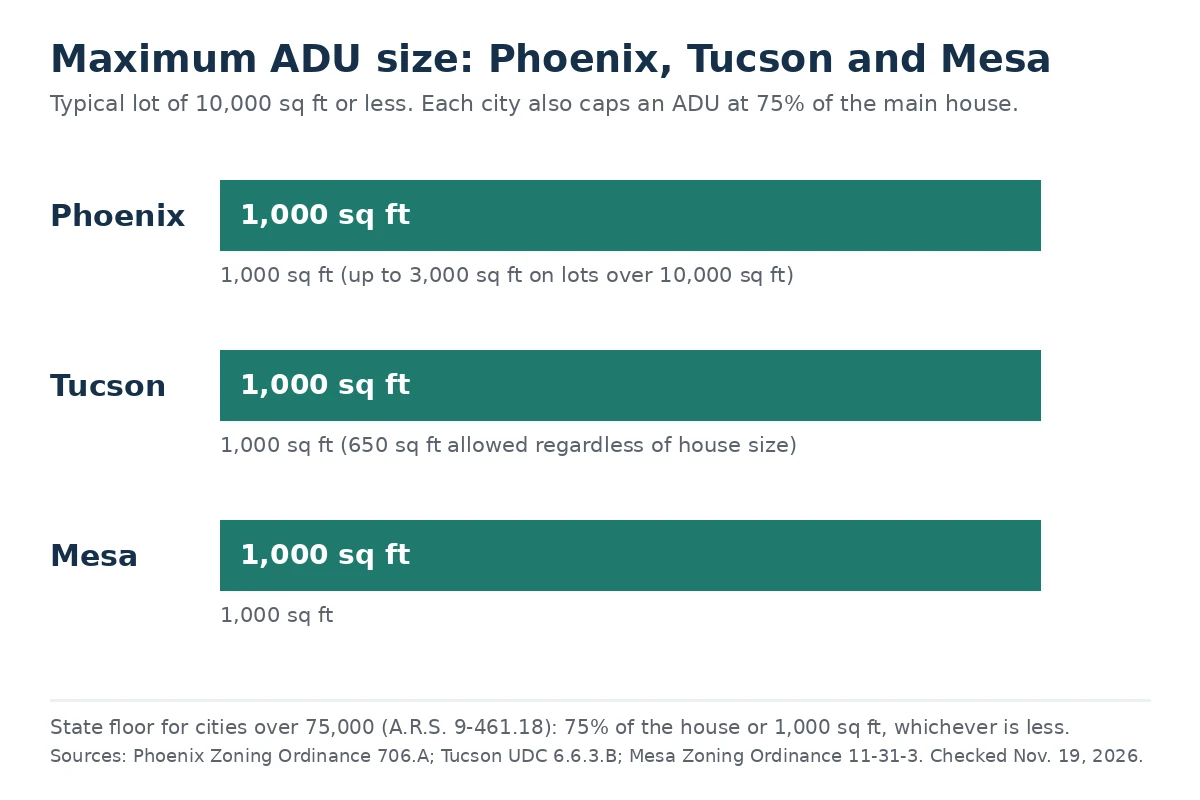
Answer capsule: All three allow an attached and a detached ADU and require no parking. Phoenix has the most generous size on large lots and the tightest setback in rear yards (3 feet). Tucson guarantees 650 square feet on any lot and requires a cool roof on new casitas. Mesa caps every ADU at 1,000 square feet and requires a separate entrance with no internal connection to the house.
Disclosure: This page has no affiliate links. The Dwelling Index is reader-supported.
| Rule | Phoenix | Tucson | Mesa |
|---|---|---|---|
| Code section | Zoning Ordinance § 706.A | UDC 6.6.3.B | Zoning Ordinance § 11-31-3 |
| ADUs per lot | 1 attached + 1 detached; 3rd on 1+ acre with affordable unit | 2 with one family dwelling; 1 with a duplex; 3rd on lots over 1 acre with deed-restricted affordable unit | 1 attached + 1 detached; 3rd detached on 1+ acre with restricted-affordable unit |
| Max size, typical lot | 1,000 sq ft or 75% of the house (lots up to 10,000 sq ft) | 75% of the house up to 1,000 sq ft; 650 sq ft allowed on any lot | 1,000 sq ft or 75% of the house's interior habitable area |
| Max size, large lot | 3,000 sq ft, 10% of net lot area or 75% of the house (lots over 10,000 sq ft) | Same as typical lot | Same as typical lot |
| Detached ADU setbacks | 3 ft interior side or rear; 5 ft street side; 0 ft at a dedicated alley | 5 ft side and rear | 5 ft side and rear; front and street side follow the zone |
| Height | 15 ft in a required rear or side yard unless a use permit is approved; otherwise same as the house | Generally 25 ft (matches the zone's single-family limit, per the city's casita site) | Follows the zoning district's height limit |
| Parking | None required | None required | None required |
| Other rules | Attached ADU should look like part of one home, not a duplex | New casitas need a cool roof (over 60 SRI); casitas get their own address from Pima County | Separate entrance, no internal connection; one kitchen max; manufactured homes, RVs and trailers can't be ADUs |
Compare Arizona casita costs with your own numbers — run the free ADU cost calculator
How do Phoenix's ADU rules work in 2026?
Answer capsule: Phoenix allows two ADUs on a single-family detached lot, one attached and one detached, and a third on lots of at least one acre when one unit is affordable housing. Lots with a duplex or triplex can't add an ADU. A detached ADU can sit in the rear yard, 3 feet from interior lot lines, up to 15 feet tall.
Phoenix's Beginner's Guide to ADUs and Zoning Ordinance § 706.A add details that change designs:
- Design guidelines. An attached ADU should be "integrated into the design of the primary dwelling unit so that it appears to be part of one single family home, rather than a duplex," though separate entry features are allowed. A detached ADU visible from the street "should have a residential appearance." These are guidelines, and state law bars a city from requiring a matching exterior design, roof pitch or materials.
- Placement. A detached ADU may sit in the required rear or side yard but not between the house and the front lot line, unless a use permit is approved.
- Connected detached units. One detached ADU may connect to the house by a porch, deck, covered patio, carport or breezeway.
- Lot coverage. Any ADU must meet the lot's coverage limit.
- Records. The guide suggests a public records request for past building permits if you're unsure how many units your lot already has.
How do Tucson's casita rules work in 2026?
Answer capsule: Tucson amended its Unified Development Code on October 22, 2024, effective November 21, 2024, to meet HB 2720. Two casitas are allowed on a lot with one family dwelling, each up to 75% of the house and 1,000 square feet, with 650 square feet allowed on any lot. Setbacks are 5 feet, no parking is required, and new casitas need a cool roof.
Before the change, Tucson allowed one ADU per residential lot, capped at 10% of lot area or 1,000 square feet, limited height to 12 feet in most cases and required a parking space unless the lot was near transit or a bike boulevard, according to the city's June 2024 memo to Mayor and Council. Older articles may still quote those rules.
Other points from the city's casita site:
- Separate address. Casitas must have their own address issued by Pima County.
- Shared meters are fine. Casitas don't need separate utility meters from the main house.
- Residential standards. On lots with an existing, occupied family dwelling, commercial standards aren't applied.
- Density. UDC 6.6.3.B.1 says ADUs aren't subject to maximum residential density standards.
How do Mesa's ADU rules work in 2026?
Answer capsule: Mesa allows one attached and one detached ADU on any lot where a single residence is allowed, including agricultural, residential, commercial, mixed-use and downtown districts. There's no minimum lot size. Each ADU is capped at 1,000 square feet or 75% of the house's interior habitable area, needs 5-foot side and rear setbacks, and must have its own entrance.
Mesa's code (§ 11-31-3) adds several rules that affect layout:
- Separate entrance, no internal door. An ADU "shall have a separate and independent entrance from the primary residence and may not have an internal connection to the primary residence."
- One kitchen. An ADU may have a partial or full kitchen, but only one.
- No manufactured homes or RVs. "Manufactured Homes, Recreational Vehicles (RV), and trailers shall not be used as an ADU."
- Conversions. An existing detached accessory building that meets accessory-building setbacks can convert to an ADU without meeting the new 5-foot ADU setback. Expansions must meet it.
- Garages and workshops attached to an ADU follow the setback rules for the zone (attached ADUs) or for detached accessory buildings (detached ADUs).
- Permit. Mesa requires a building permit with a site plan, code data sheet, architectural, structural, electrical, plumbing and mechanical plans.
Can you rent an Arizona ADU, including on Airbnb?
Answer capsule: Long-term rental can't be banned in covered cities or in counties. Short-term rentals are preempted statewide: cities and counties can't prohibit them (A.R.S. § 9-500.39 and § 11-269.17). Since HB 2928, a city or county may require the owner to live on the property if it contains an ADU built on or after September 14, 2024 that is used as a short-term rental.
The details:
- Long-term rental. A lease of 90 days or longer, or month to month. Covered cities and counties can't stop you from renting the house, the ADU or both this way.
- Short-term rental (city rule). Under § 9-500.39(B)(9), a city may require the owner to reside on the property if it "contains an accessory dwelling unit that was constructed on or after September 14, 2024 and that is being used as a vacation rental or short-term rental." The rule doesn't apply where the ADU's certificate of occupancy or similar final approval was issued on or before September 13, 2024, and the statute protects some owners who had the right to build before that date.
- Short-term rental (county rule). Under § 11-269.17(B)(9), a county may require owner residency if the ADU's certificate of occupancy, certificate of completion or similar final approval was issued by the county on or after September 14, 2024.
- Phoenix. The city's ADU guide says "ADUs are allowed to be used as Short-Term Rentals." Ask the city whether an owner-residency rule now applies to your ADU before you list it.
- Other short-term rental rules still apply. Under § 9-500.39, a city can require a local permit or license (with a fee capped at the actual cost or $250, whichever is less), emergency contact information, neighbor notification and liability insurance of at least $500,000. The county statute, § 11-269.17, has a parallel list for unincorporated areas.
To estimate long-term rent, use our guide to how much you can rent an ADU for and the ADU rental income calculator.
Can an HOA stop you from building a casita in Arizona?
Answer capsule: Yes, it can. Both statutes say they don't prohibit "restrictive covenants concerning accessory dwelling units entered into between private parties." A city or county can't make you record a covenant, but a homeowners association's existing covenants, conditions and restrictions (CC&Rs) can still limit or ban an ADU.
Before you pay for plans, pull your CC&Rs and any architectural guidelines from your HOA or the county recorder, and read the sections on accessory structures, guest houses, rentals and second units. If the documents are unclear, ask the HOA for a written answer. A city permit doesn't override a private covenant.
What building-code and utility rules apply to an Arizona ADU?
Answer capsule: An ADU follows the residential building code your city or county has adopted, not a commercial code, and covered cities and counties cannot require it to have fire sprinklers. Utilities, septic, easements and drainage still decide where it can go.
- Residential code. Mesa's code says an ADU "shall comply with all applicable building code requirements for residential dwellings." The state statutes bar requiring a commercial building code.
- Sprinklers. Neither a covered city nor a county may require an ADU to contain a fire sprinkler.
- Sewer and septic. Counties may require an adequately sized septic system where sewer isn't available or lacks capacity. In cities, ask your utility about sewer capacity and connection fees.
- Easements. Don't site an ADU over a public utility easement without written consent from the utilities. Your title report and plat show recorded easements.
- Heat. Tucson requires a cool roof on new casitas. Even where it isn't required, roof color, shading and insulation affect cooling costs in the desert.
What does an Arizona ADU project look like step by step?
Answer capsule: Confirm whether your address is in a covered city, a smaller town or unincorporated county land, read the local ADU section, check your HOA, size the casita against the 75% and 1,000-square-foot limits, check easements and septic, and apply for a building permit.
- Confirm who permits your address. A Phoenix or Tucson mailing address doesn't always mean city limits. Check your parcel on the county assessor or city zoning map.
- Check whether a state ADU law applies. City or town over 75,000, or unincorporated county land. If you're in a smaller town, read its code.
- Check excluded areas. Tribal land, military airport vicinity and high-noise airport zones are outside both statutes.
- Read the local ADU section. Phoenix § 706.A, Tucson UDC 6.6.3.B, Mesa § 11-31-3, or your own city's or county's.
- Read your CC&Rs. An HOA can still say no.
- Size the unit. Measure the house's habitable floor area and apply the local cap.
- Check the site. Easements, septic, drainage, flood zones and front setbacks.
- Decide on rental use. If you plan a short-term rental, ask whether an owner-residency rule applies to an ADU finished after September 14, 2024.
- Apply for the building permit. Mesa lists the plan set it expects. Tucson casitas also need an address from Pima County.
Check your lot's ADU options — get your free report
Our property eligibility check provides state-level context and broad cost ranges; it does not determine parcel eligibility. Ask the planning counter about your lot. For the full build sequence, read our guide to building an ADU, and for budget ranges see how much an ADU costs.
How do Arizona ADU laws compare with neighboring states?
Answer capsule: Arizona's city law is stronger than many states' on unit count (two ADUs by right) and setbacks (5-foot cap), but it covers only cities over 75,000 and counties. California's Government Code §§ 66310–66342 reaches every city and county and sets 4-foot side and rear setbacks. Utah's rules center on internal ADUs.
For comparison, we have state guides for California, Utah, Colorado and Texas, and a 50-state overview at ADU laws by state.
What should you ask the planning counter before you pay for plans?
Answer capsule: Ask whether your lot is covered by the state ADU law, which code section governs it, the size cap and how it's measured, the front setback and height for your zone, whether an owner-residency rule applies to short-term rentals, and what the permit set and review time are. Write down the answers with the date.
- Is my parcel in a city covered by A.R.S. § 9-461.18, in a smaller town, or in unincorporated county land under § 11-810.01?
- Which code section governs ADUs on my lot, and when was it last amended?
- What's the maximum ADU size, and does a garage, carport or storage room count?
- What are the front setback, height and lot coverage limits for my zone?
- Is my lot near an airport, a military facility or a historic district that changes the rules?
- Does an owner-residency rule apply if I use the ADU as a short-term rental?
- What does a complete permit set include, and what's the current review time?
- Will the ADU need a separate address, meter or sewer connection fee?
Print the list, write the answers in the margin and date them. Then use our property eligibility check for a general planning overview; confirm parcel-specific rules with your planning office.
See what's possible at your address — get your free ADU report
What we verified
- Verified on November 19, 2026: A.R.S. § 9-461.18 and § 11-810.01 on the Arizona Legislature's statute pages, and the chaptered text of HB 2928 (Laws 2025, chapter 217), including its amendments to § 9-500.39 and § 11-269.17 on short-term rentals.
- Verified: City of Phoenix Zoning Ordinance § 706.A (current through Ordinance G-7461, passed December 3, 2025) and the city's Beginner's Guide to ADUs.
- Verified: City of Tucson Unified Development Code 6.6.3.B, the city's ADU code amendment page (adopted October 22, 2024, effective November 21, 2024), its casita site, and the June 2024 Mayor and Council memorandum.
- Verified: City of Mesa ADU page and Zoning Ordinance § 11-31-3.
- Not verified: the codes of Arizona cities other than Phoenix, Tucson and Mesa, any county's implementing ordinance, current permit and impact fee amounts, current city population figures, and any amendment adopted after the documents we read.
Methodology
We started from the statutes, not from summaries. We read the full text of A.R.S. § 9-461.18 and § 11-810.01, then the chaptered HB 2928 to see exactly what changed in 2025. For cities, we read each city's own code section and its official ADU page, and we quote the code where wording matters. Where a city document didn't address a question, we say so instead of guessing. We'll update this page when a statute or one of these city codes changes. To report an error, use our corrections page.
Sources
- Arizona Legislature, A.R.S. § 9-461.18, "Accessory dwelling units; regulation; applicability; definitions."
- Arizona Legislature, A.R.S. § 11-810.01, "Accessory dwelling units; regulation; applicability; definitions."
- Arizona Legislature, Laws 2025, chapter 217 (HB 2928), chaptered text, amending §§ 9-461.18, 9-500.39, 9-500.49 and 11-269.17 and adding § 11-810.01.
- Arizona House of Representatives, news release on HB 2928, May 27, 2025.
- City of Phoenix, Zoning Ordinance § 706.A, Accessory Dwelling Units.
- City of Phoenix, "Welcome to the City of Phoenix's Accessory Dwelling Unit (ADU) Guide."
- City of Tucson, Unified Development Code 6.6.3, Residential Uses.
- City of Tucson, "Accessory Dwelling Units Code Amendment" and "Casitas in Tucson: Building a Casita."
- City of Tucson, Mayor and Council Memorandum on 2024 state housing bills, June 2024.
- City of Mesa, "Accessory Dwelling Units (ADUs)" and Zoning Ordinance § 11-31-3.
Frequently asked questions
What are Arizona's ADU laws?
A.R.S. § 9-461.18 requires cities and towns over 75,000 people to allow one attached and one detached ADU as a permitted use wherever a single-family home is allowed. A.R.S. § 11-810.01, added by HB 2928 in 2025, requires counties to do the same on unincorporated land.
Does Arizona's ADU law apply to my town?
Only if your city or town has more than 75,000 people, or your lot is in unincorporated county land. Smaller cities and towns set their own ADU rules, so read your local code.
How big can a casita be in Arizona?
Covered cities and counties must allow at least 75% of the house's habitable floor area or 1,000 square feet, whichever is less. Cities can allow more. Phoenix allows up to 3,000 square feet on lots over 10,000 square feet, and Tucson allows 650 square feet on any lot.
Do Arizona ADUs need parking?
No. Covered cities and counties can't require additional parking for an ADU or fees in place of parking.
Can I build two ADUs on my Arizona lot?
Yes, in a covered city or county: one attached and one detached. A third detached ADU is possible on a lot of one acre or more when one unit is rented as restricted-affordable housing (required in cities, optional for counties to require).
Do I have to live on the property to have an ADU in Arizona?
The ADU statutes don't require it and bar rules tying the tenant to the owner by family or employment. If you use an ADU built on or after September 14, 2024 as a short-term rental, a city or county may require you to live on the property.
Can I use my Arizona ADU as an Airbnb?
Generally yes, because Arizona preempts local short-term rental bans. Cities and counties can require a permit, insurance and neighbor notice, and may require owner residency for ADUs finished on or after September 14, 2024. Phoenix's guide says ADUs may be short-term rentals.
Can my HOA ban a casita in Arizona?
Yes. Both ADU statutes preserve private restrictive covenants. A city or county can't require you to record one, but existing HOA covenants can still limit or prohibit an ADU.