
Home Depot ADU: What You Can Actually Buy, What It Costs, and What Your City Must Approve
By the Dwelling Index editorial team
Last updated: May 31, 2026 · Last verified: May 31, 2026
A Home Depot ADU listing is a real building product — but it is not a finished, permitted home you can move into. Home Depot’s marketplace sells two very different things under the ADU label: bare steel- or wood-frame kits (the skeleton only), and a smaller number of more-complete modular prefab units. On May 31, 2026, ADU-labeled frame kits ran from about $9,250 to $72,600, and modular prefab units from about $50,000 to $105,000 — before foundation, utilities, insulation, finishes, permits, delivery, and labor. For most buyers, the true all-in cost to build a legal ADU lands near $90,000–$200,000+, the same range as a conventional ADU. The kit is real; the move-in-ready home is the part you still have to build. Your first move: confirm what your lot and your city actually allow before you buy anything.
If you want X, is Home Depot a good fit?
| If you want… | Is Home Depot a fit? | Biggest risk | First thing to check |
|---|---|---|---|
| The cheapest possible structure | Maybe | You may be buying framing, not a finished dwelling | Read the inclusions list line by line |
| A legal rental ADU | Sometimes | Your city may not approve that product as a dwelling | Ask the building department what code path applies |
| Fast or temporary housing | Usually risky | ADUs are rarely instant or temporary | Confirm the permit timeline and occupancy rules |
| A DIY owner-builder project | Possible, if experienced | You still need foundation, utilities, trades, inspections | Get contractor/trade quotes before ordering |
| A turnkey, handled-for-you ADU | Usually no | Home Depot won’t manage your design-build or permits | Compare local ADU builders or permitted prefab providers |
| A financing-backed ADU | Depends | Lenders/appraisers may require a legal, real-property unit | Confirm the property classification and loan path |
What we verified for this page
On May 31, 2026, we pulled Home Depot’s live “Tiny Home Frame Kits” category and individual product pages and recorded model numbers, listed sizes, listed prices, specifications, customer reviews, and Q&A. We confirmed the “frame kit only” scope, the made-to-order return terms, and the delivery window in the sellers’ own listing text. We cross-checked the building-code classifications against HUD’s manufactured-home standard (24 CFR Part 3280), Fannie Mae’s Selling Guide ADU definition (B2-3-04), the City of San Rafael’s official ADU FAQ, and California Government Code §§ 66321 and 66323. We assembled all-in cost ranges from current 2026 cost data (Angi, HomeGuide, SnapADU, Building an ADU). Prices, availability, and local rules change; verify with your city and the product seller before you buy. Full sources are listed at the end of this page.
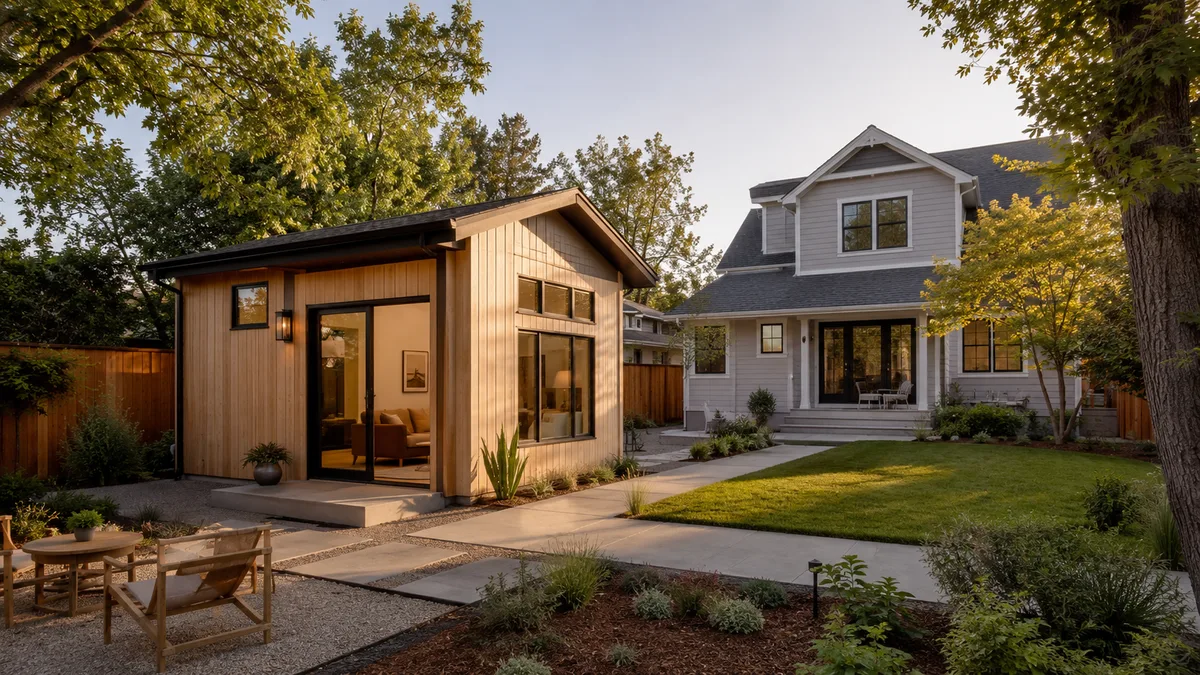
A finished backyard ADU. Home Depot listing photos show renders like this; what ships is a steel or wood frame only. The finished home is the result of foundation, MEP, insulation, finishes, permits, and labor — all separate costs.
See What You Can Build → Get Your Free ADU Report
Before you buy a single panel, confirm what your lot and your city actually allow. Get a free ADU feasibility report for your address in about 60 seconds.
Check Your Lot → Free ADU ReportDoes Home Depot actually sell ADUs, or just ADU-like kits?
Home Depot sells products labeled as ADUs, tiny homes, prefab homes, modular homes, and frame kits — but a product listing is not the same as a permitted, livable ADU. An accessory dwelling unit (ADU) is a smaller, independent home on the same lot as a main house, with its own kitchen, bathroom, sleeping area, and entrance. What makes something a legal ADU is your local zoning and building approval, not the words in a retailer’s product title.
Here’s what’s actually behind the search. Home Depot doesn’t manufacture these homes. It lists building products from third-party marketplace sellers — names like PLUS 1 Homes / Well Done 1 Kit Homes, FrameUpNow, WINNDOORS, Bedrock Building Group, Imagine Kit Homes, Ironbridge Modular, and Studio Shed — inside a category Home Depot literally calls “Tiny Home Frame Kits.” We counted roughly 50 listings in that category on May 31, 2026. They sort into four buckets, and knowing which bucket you’re looking at is the entire game.
The four Home Depot ADU product buckets
- Frame-only / structural kits. These include cold-formed-steel (CFS) framing and connection hardware, and little else. This is the largest bucket, and the cheapest — the Bedrock 300 sq ft studio kit lists at just $9,250.
- Panelized shell kits. These add pre-built (“panelized”) wall and roof sections so the structure goes up faster — but you still need a foundation, weatherproofing, insulation, windows and doors, MEP (mechanical/electrical/plumbing), interior finishes, and inspections.
- DIY studio / ADU kits. Brands like Studio Shed sell a more organized backyard-structure package with a wood frame and a defined parts list. Closer to a complete building envelope, but still not automatic permit approval, and still missing site work, utilities, and interior completion.
- Modular / prefab ADU listings. A smaller number of listings arrive much closer to a finished dwelling. These can be a cleaner path to a permitted unit — but the listing title doesn’t prove the unit carries a state modular approval, so you still verify the state insignia, delivery and crane logistics, foundation, utility hookups, local zoning, and final inspections.
The trap is that all four buckets use the same hero photo: a beautiful, finished little home. The $22,999 listing shows you a finished cottage; what ships is a steel skeleton. That’s not deception so much as a category problem — and it’s exactly the gap this page exists to close.
Why the product title doesn’t decide legality
| Listing language | Treat it as | What you actually have to verify |
|---|---|---|
| “Steel frame kit” / “frame kit” | Structure only | Foundation, stamped plans, MEP, building envelope, local code |
| “Tiny home kit” | Possible shell | Whether it’s classified as a dwelling or an accessory structure |
| “Studio kit” | Backyard structure package | Code-compliant kitchen, bath, sleeping area, egress, occupancy |
| “Modular ADU” / “prefab ADU” | Possible dwelling path | State modular insignia and local site approval |
| “No permit required” | 🚩 Red flag | Ask your city’s building department directly — never rely on a listing |
A product can be marketed as an “ADU” and still fail as a legal one if it doesn’t satisfy local zoning, building code, fire and life-safety, foundation, utility, energy, egress, and occupancy requirements. The retailer sells the parts. The city grants the dwelling.
What’s included in a Home Depot ADU kit — and what’s missing?
Most Home Depot ADU listings are building packages, not finished homes. A typical steel-frame kit includes pre-cut, pre-punched steel panels and trusses, connection hardware, and an assembly manual — and (sometimes) delivery. It does not include a foundation, plumbing, electrical, HVAC, insulation, drywall, fixtures, unloading labor, a permit-ready plan set, or local approvals. Before you buy, get a written inclusions list and compare it line-by-line against what your city requires for a legal dwelling.
We read the fine print so you don’t have to. The Rose Cottage 444 sq ft listing — one of the most-viewed in the category, with 167 buyer questions — states in the seller’s own words that this listing is for the steel frame kit only. The same listing’s Q&A confirms the rest: asked whether it includes a concrete foundation, the seller answers that it does not; asked how much assembly costs, the seller redirects buyers to “request a quote.” Unloading the steel from the flatbed truck is explicitly the buyer’s responsibility, the seller asks you to allow 6–8 weeks for delivery, and the kit is non-returnable and made-to-order once your order is confirmed (Home Depot, Rose Cottage RC2B443, verified May 31, 2026).
One more verified detail worth knowing: the same kit is often sold as two different offers. On the Rose Cottage listing, the seller presents Option 1 — frame kit plus professional installation (you buy the permit set separately and confirm your local rules first) and Option 2 — frame kit plus a permit set for self-install (delivery included; you erect the frame). Either way, the foundation, utilities, and finishes are still yours.
The seller even sells the homework separately: we found a standalone “Pre-Construction Research Report (PCRR) — Soft Costs / Permits” bundle listed near $3,669 (Home Depot, model PCRR, verified May 31, 2026). When a seller charges extra just to research your permits, that tells you how much sits outside the sticker price.
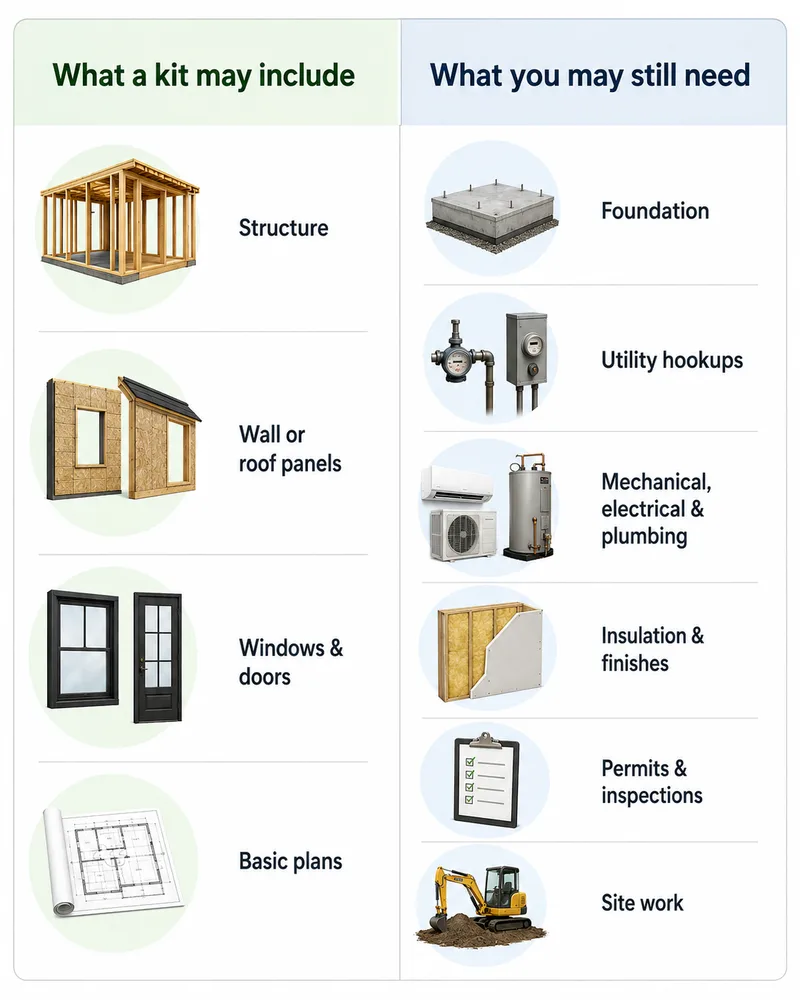
What’s actually in the box, by bucket
- Frame-only kits include framing and connectors. They typically exclude the foundation, building envelope (sheathing, windows, doors, roofing finish), MEP, insulation, interior finishes, and any local permit package.
- Panelized shell kits speed up the structure but still leave the foundation, envelope completion, interior systems, and inspections to you. Snow, wind, seismic, fire, and energy-code amendments still apply to your specific location.
- Studio-style DIY kits offer a tidier parts ecosystem, but you still arrange installation, foundation, utilities, and inspections.
- Modular/prefab listings are closer to complete — but you still confirm state modular approval, who installs it, delivery and crane access, foundation, utility hookups, local zoning, and warranty.
The questions to ask before you wire any money
| Question to the seller | Why it matters |
|---|---|
| Is this approved as a dwelling, or sold as a structure? | Decides whether it can become a legal ADU at all |
| What building code does it meet (IRC? state modular?)? | Your city’s plan check depends on the code path |
| Are stamped (signed and sealed) engineered plans included? | Many jurisdictions require them for plan check |
| Is the foundation included? | It usually isn’t |
| Are plumbing, electrical, HVAC, insulation, and finishes included? | Separates the shell price from the finished cost |
| Who installs it? | A retail purchase is not a design-build service |
| Is delivery/crane/staging included? | Large modular units can carry major logistics costs |
| Can it meet local snow / wind / seismic / fire requirements? | Critical for approval in your jurisdiction |
| Can it legally be used as a rental ADU here? | Zoning and lender/appraisal treatment both matter |
Getting these answers in writing converts a guess into a decision. If a seller can’t or won’t answer them, that’s your answer.
How much does a Home Depot ADU really cost? (Kit price vs. all-in)
The Home Depot listing price is the skeleton, not the home. Across the listings we verified on May 31, 2026, ADU-labeled frame kits ran roughly $9,250–$72,600 and modular prefab units roughly $50,000–$105,000 — but those are kit prices. Once you add a permit-ready plan set, foundation, utility connections, MEP, insulation, finishes, permits, and labor, the kit typically represents a minority of the finished cost. For a small detached ADU, the all-in total usually lands between $90,000 and $200,000+ nationally, and materially higher on the West Coast.
The Home Depot ADU Reality-Check Matrix (verified May 31, 2026)
We pulled the prices below directly from Home Depot product and category pages on May 31, 2026. We calculated price per square foot as listed price ÷ listed square footage. None of these figures include delivery, taxes, foundation, site work, utilities, permits, finishes, or labor unless the listing specifically says so.
| Listing (seller) | Listed size | Listed price | ≈ $/sq ft | Product type | Scope risk | Verify before buying |
|---|---|---|---|---|---|---|
| Bedrock Studio ADU (Bedrock Building Group) | 300 sq ft | $9,250 | $31 | Steel frame kit | Very high — frame only | Plans, foundation, MEP, envelope, occupancy classification |
| FrameUpNow Barton ADU 680 | ~680 sq ft | $19,806 | $29 | Frame kit | Very high — frame only | Foundation, plans, MEP, envelope, local approval |
| Chill Out (PLUS 1 / Well Done) | 305 sq ft | $22,999 | $75 | Frame kit | High — preassembled panels, not finished | Full inclusions, utilities, code-compliant kitchen/bath, permit set |
| Rose Cottage (Well Done 1 Kit) | 444 sq ft | $26,499 | $60 | Frame kit | High — “frame kit only” (seller) | Whether it can be approved for residential occupancy in your city |
| FrameUpNow Russett ADU 930 | ~930 sq ft | $28,464 | $31 | Frame kit | High — frame only | Engineered docs, snow/wind/seismic, local size limits |
| FrameUpNow San Diego ADU 1194 | ~1,194 sq ft | $32,305 | $27 | Frame kit | High; may exceed ADU size caps in some cities | Local maximum ADU size, setbacks, parking |
| FrameUpNow Rucker Garage Home 1127 | ~1,127 sq ft | $55,129 | $49 | Frame kit | High — frame only | Foundation, MEP, finishes, occupancy classification |
| Studio Shed Summit 800B (DIY) | 800 sq ft | $71,752 | $90 | Wood-frame DIY kit | Medium-high — known brand, still a kit | Plan review, foundation, MEP, interior completion, install |
| The Retreat (Well Done) | 1,126 sq ft | $72,597 | $64 | Frame kit | High; size may exceed local ADU caps | Setbacks, parking, design review, full finish budget |
| WINNDOORS Prefab ADU (2-bed/1-bath) | 360 sq ft | $49,999 | $139 | Marketed as modular/prefab — verify state approval | High — listing carries “no permit required”-style wording | Ask the city (not the retailer) what permit applies |
| Modern Prefab ADU (Best Seller) | 420 sq ft (listing also says 490) | $105,000 | $250 | Marketed as modular/prefab — verify state approval | Medium-high — size conflict; confirm install scope | Actual square footage, install, crane, foundation, fixtures, state approval |
Sources: Home Depot product and category listings, verified May 31, 2026. Note the Modern Prefab ADU listing shows 420 sq ft in its title/specs but describes a 490 sq ft unit in the body — confirm the actual size in writing before buying. Other listings in the same category — including an Ironbridge Modular 360 sq ft unit near $79,997 and Studio Shed Summit 476A/476B kits around $52,000–$56,000 — were not re-verified for this version; check the live listing.
The pattern nobody else points out: price per square foot cleanly separates the two product classes. Below roughly $100/sq ft, you are almost certainly looking at a frame or shell kit (the Bedrock, FrameUpNow, and Well Done kits cluster at $27–$90/sq ft). Above roughly $130/sq ft, you are looking at a more-complete unit marketed as modular (the WINNDOORS and Modern Prefab listings sit at $139–$250/sq ft). If a “$31/sq ft ADU” sounds too cheap to be a finished home, that’s because it is — it’s the steel.
What is the cheapest Home Depot ADU?
The cheapest ADU-labeled listing we verified on May 31, 2026 was the Bedrock Building Group steel-frame studio kit: 300 sq ft for $9,250, about $31 per square foot. Treat that number as a frame package, not a finished dwelling. At $31/sq ft it includes the steel structure and assembly hardware — not the foundation, utilities, insulation, finishes, permits, or labor that a legal, livable ADU requires.
The all-in cost stack: from kit to finished, legal ADU
We took the verified $26,499 Rose Cottage kit (444 sq ft) and built it out to a finished, permitted ADU using current 2026 cost benchmarks. These are illustrative ranges, not a quote — your soil, slope, utility distance, finish level, and city fees move every line.
| Line item | Realistic range | Source / status |
|---|---|---|
| Frame kit (the shell) | $26,499 | ✅ Verified Home Depot, 5/31/26 |
| Permit-ready plan set, engineered for your city | $2,000–$8,000 | Home Depot lists a separate permit/soft-cost bundle near $3,669; upper end estimated |
| Delivery + unloading / rigging (your responsibility) | $500–$3,000 | Listing: flatbed delivery, buyer unloads; labor estimated |
| Engineered foundation (slab or stem wall) | $8,000–$25,000+ | Not included (seller Q&A); estimate, site/soil dependent |
| Framing assembly labor (erect the kit) | $10,000–$30,000+ | Dwelling Index estimate; confirm with local contractors |
| Plumbing rough-in, fixtures, water/sewer connection | $8,000–$25,000+ | Estimate; depends on utility-lateral distance |
| Electrical, panel/subpanel, connection | $6,000–$20,000+ | Estimate |
| HVAC (a ductless mini-split is typical) | $4,000–$10,000 | Estimate |
| Insulation + drywall + interior finishes | ~$22,200–$33,300 | Finish materials avg $50–$75/sq ft × 444 sq ft (Levi Construction, 2024) |
| Permits + city / impact / school fees | $1,350–$11,000 | Permits $1,350–$9,000 (Angi, 2026); city fees avg $3,000–$11,000 (Levi, 2024) |
| Survey, soil report, design extras | $2,000–$10,000 | Estimate |
| General-contractor / project-management margin (if used) | 10–20% of project | GCs charge 10–20% of total (Angi, 2026) |
| Realistic all-in total (≈444 sq ft, national) | ≈ $90,000–$180,000+ | Assembled; West Coast materially higher |
| The kit as a share of the finished cost | ≈ 15–29% | In this example, $26,499 ÷ $90K–$180K |
For context, current 2026 national benchmarks put a built ADU at $150–$300 per square foot, with an average around $180,000 and most homeowners spending $40,000–$360,000 (Angi, 2026). On the West Coast the numbers jump: in San Diego, detached ADUs run $375–$600+/sq ft, roughly $300,000–$450,000+ all-in, partly because the California Construction Cost Index rose about 44% from January 2021 to December 2025 (SnapADU, updated March 2026).
When a $22,999 kit becomes a six-figure project. A cheap kit solves the structure problem — maybe 20–30% of the work. It does nothing about the foundation, the trades, the finishes, the fees, or the inspections. Building an ADU’s analysis of real detached, ground-up ADUs found an average development cost around $181,000, with a per-square-foot range of roughly $162–$682. A frame kit can shave real money off a build if you (or a contractor you trust) manage the whole project. If you expected to roll it up, plug it in, and move in, a bare kit isn’t that.
🎯 Check your exact kit and lot before you buy
Pick the Home Depot model you’re eyeing, tell us your ZIP and a few details — foundation needed? how far are your utilities? DIY or contractor? — and the Home Depot Kit Reality-Check returns your realistic all-in range, the documents to request from the seller, and the local-rule questions to ask your city.
Run the Free Reality-Check →Wondering how people cover the all-in cost?
Explore the common ADU financing paths — construction loans, cash-out refinance, renovation loans, and home equity — and how homeowners weigh them. Educational only; no rates and no approval promises.
Explore ADU Financing Options →Reader-supported link; see disclosure above. Financing and cost figures here are educational estimates, not quotes or guarantees.
How long does it take to build a Home Depot ADU?
A Home Depot ADU is not fast. The kit itself typically ships in about 6–8 weeks, but that’s the easy part. From the day you decide to the day you can legally move in, a kit-based ADU usually takes 9–18 months — front-loaded with design and permitting, then a construction phase of roughly 4–8 months.
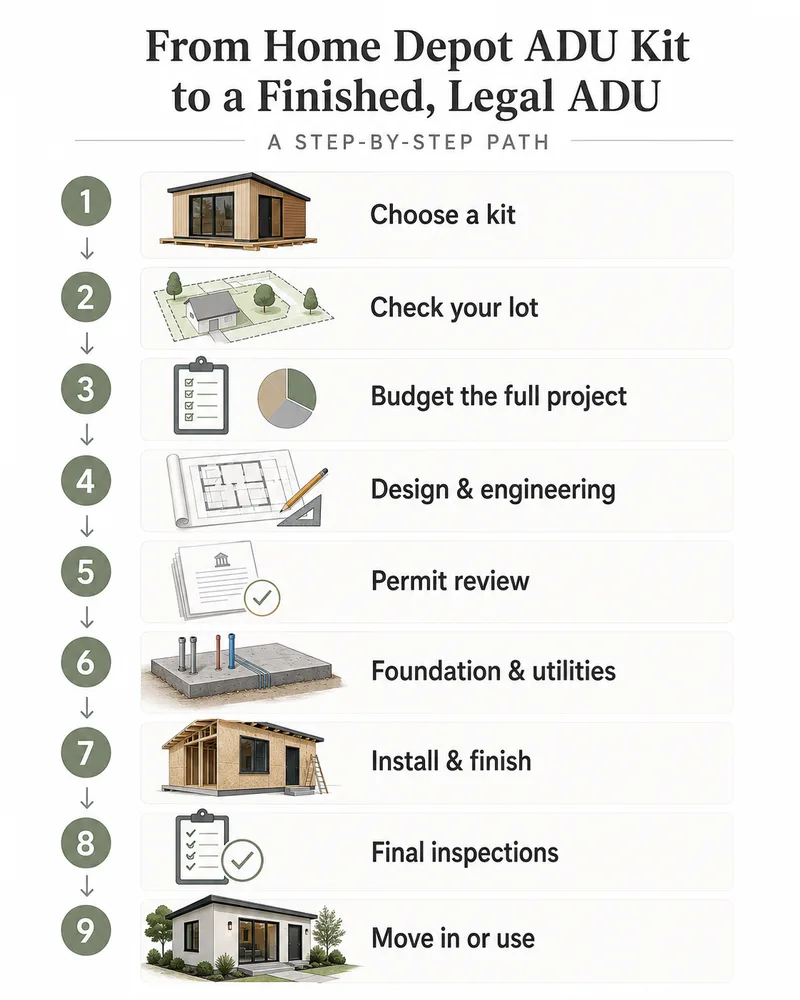
Here’s the honest sequence. The Rose Cottage listing quotes delivery at 6–8 weeks depending on kit size — and you can often run that clock in parallel with permitting. The slow parts are the bookends:
- Feasibility + design (a few weeks to a few months). Confirm what your lot allows, settle on a layout, and get the permit-ready plan set engineered for your jurisdiction.
- Plan check + permit (weeks to 6+ months — the wildcard). In ministerial states like California, qualifying ADUs are reviewed against objective standards without a discretionary hearing; in busier or more discretionary jurisdictions it can stretch for months.
- Site work + foundation (2–6 weeks). Grading, trenching, and pouring the permanent foundation before the frame can go up.
- Delivery + frame assembly (the 6–8-week kit lead time, then 1–3 weeks to erect).
- MEP + envelope + insulation + finishes (2–4 months). Mechanical, electrical, plumbing, weatherproofing, insulation, drywall, fixtures.
- Inspections + corrections + certificate of occupancy (weeks). You can’t legally occupy until the city issues the CO.
The counterintuitive part: the bare-kit path is frequently slower than buying a finished modular unit, because you’re managing a full ground-up build with multiple trades. If your trigger for searching was “I need housing now,” a kit is the wrong tool — the permit alone can outlast your deadline.
Can a Home Depot tiny home legally become an ADU?
Sometimes — but never automatically. A Home Depot kit or modular unit can become a legal ADU only if the product, your lot, the foundation, the utilities, the engineered plans, and your local zoning and building rules all line up. The single most important fact: a bare frame kit carries no federal or state pre-approval, so your city treats it as site-built construction — full permit, engineered plans stamped for your jurisdiction, a permanent foundation, and inspections at every phase.
The permit fork: four code paths
| Code path | Plain-English meaning | Buyer risk |
|---|---|---|
| Site-built (under local residential code) | Built or finished on site like a small house, to the International Residential Code (IRC) as adopted locally | Requires engineered plans, plan check, and phase inspections; the bare-kit path lands here |
| Factory-built / modular | Built off-site under a state-approved modular program, then set on site; treated as real property | Fewer plan submittals, but you still need a local site permit, foundation, utilities, and site inspections |
| HUD-code manufactured home | Built to a single national federal standard (24 CFR Part 3280) on a non-removable steel chassis | Many jurisdictions restrict or disallow these as ADUs in certain residential zones |
| Non-dwelling structure (shed / RV-style) | An accessory structure, not a dwelling | Cannot legally be lived in or rented as an ADU by itself |
The permanent-foundation-and-utilities test
A useful rule of thumb: if it will be a legal ADU, assume your city cares about a permanent foundation, permanent utility connections, a code-compliant kitchen/bath/sleeping area, energy/fire/life-safety compliance, and inspections. The City of San Rafael’s official ADU FAQ is a clean example of the norm: it states that prefab, factory-built, and tiny-home ADUs go through the same building-permit process as any other ADU, and that all ADUs must have a permanent foundation and permanent utilities.
What “ministerial approval” means (and the California numbers)
California is the country’s most ADU-friendly state, but it is not product-blind. Two numbers matter most to anyone sizing an ADU:
- Government Code § 66321(b) bars a city from setting a maximum ADU size below 850 square feet of interior livable space — or below 1,000 square feet for an ADU with more than one bedroom. It also protects your ability to build at least an 800-square-foot ADU with four-foot side and rear setbacks, even where lot-coverage or FAR rules would otherwise block it. California also caps detached-ADU height at 16 feet in the base case (18 feet near major transit).
- Government Code § 66323 requires cities to approve certain qualifying ADUs ministerially — meaning staff review the project against clear, objective standards without a discretionary public hearing.
Ministerial approval does not mean instant approval, and it does not mean any retail kit is automatically a legal dwelling. The city still reviews your plans, you still need a foundation, utilities, and inspections, and the agency acts within a defined statutory timeframe rather than over the counter.
🏡 See what you can build before you buy a single panel
Your lot, your zoning, and your city’s rules decide what’s possible — not a product listing. Get a free ADU report for your address: likely size limits, setbacks, and the local approval path, in about 60 seconds.
See What’s Possible at Your Address →Are Home Depot ADU kits legit, or a scam?
The honest answer is neither “scam” nor “turnkey home.” Most Home Depot ADU listings are legitimate building products — but a legitimate product can still be only a frame, shell, or package, not a finished, legal ADU. The right question isn’t “scam or legit?” It’s “what exactly am I buying, and what will it take to make it livable and legal?”
What’s genuinely good: cold-formed steel is strong, dimensionally stable, non-combustible, and termite-proof, and it won’t warp, rot, or mold — claims the sellers make and that are broadly true of CFS framing. For an owner-builder, a pre-cut, pre-punched panelized frame can save framing time and reduce material waste.
The review gap
We checked the customer-review tabs on these listings. The Rose Cottage — again, one of the most-engaged listings, with 167 buyer questions — had zero customer reviews on May 31, 2026 (“Do you own this product? Be the first to rate it.”). Across the category, ratings are thin: where reviews exist at all, they’re typically a handful (for example, both the Chill Out kit and the Modern Prefab ADU showed roughly 3.3 stars from 4 reviews). Hundreds of people are asking questions; almost nobody is reporting back after building. Combine that with the fact that these kits are sold by small third-party marketplace sellers, that the made-to-order ones are non-returnable, and that installation and permits are quoted separately, and the prudent move is to buy on documented facts — not on the rendering.
The “no permit required” red flag
Some listings in this space carry “no permit required”-style language. Do not rely on it. ADU legality is decided locally, by your building and zoning departments — not by a product page. San Rafael’s official guidance directly contradicts any blanket “no permit” assumption for a unit you intend to live in. If you see that phrase, treat it as a prompt to call your city — not as permission to skip the process.
How to tell a listing is “just a shell”
- The price is far below normal finished ADU cost (under ~$100/sq ft is a tell).
- The copy emphasizes “frame,” “panels,” or “steel structure.”
- The foundation is customer-provided.
- Utilities are customer-provided.
- There’s no clear code path and no permit package.
- The installation scope is vague or sold separately.
- The Q&A has unanswered questions about foundation, crane access, fixtures, or finishes.
None of these makes the product a scam. They make it a starting point — which is fine, as long as you know that’s what you bought.
Does Home Depot install ADUs or handle permits?
Do not assume Home Depot handles installation, permits, foundation, utilities, or local approval. For most listings, you’ll still need a local contractor, engineered plans, a permit application, utility trades, inspections, and a final occupancy sign-off — none of which comes in the box.
Retail purchase vs. ADU project
| A retail product purchase… | An ADU project… |
|---|---|
| Buys a kit, unit, or component | Gets a legal dwelling designed, approved, and built |
| Ships materials to your address | Requires a site plan, foundation, utilities, and inspections |
| May carry a product warranty | Still answers to local building code and occupancy approval |
| Comes from a seller who may not be local | Requires a contractor who satisfies your jurisdiction |
What a local general contractor still has to do
Site prep → foundation → utility trenching and hookups → frame or unit assembly → MEP → insulation and finishes → inspections → corrections → final occupancy. That’s a full small-build sequence, and it’s the reason a “cheap kit” and a “cheap ADU” are not the same thing.
What to ask your city before you order
Is this product type allowed as an ADU here? Is it treated as site-built, modular, manufactured, tiny home, or accessory structure? What’s the local maximum ADU size, setback, and height limit? Is owner-occupancy required? Are short-term rentals restricted? Are separate utilities or fire sprinklers required? What drawings and documents must be submitted, and what inspections are required? Five minutes with your building department here can save five figures later.
Can you finance a Home Depot ADU?
Possibly — but financing a kit is not the same as financing a completed ADU. Retail store financing typically covers only the product purchase, not the foundation, site work, utilities, trades, permits, and inspections that turn it into a home. And lenders and appraisers generally care whether the finished unit is permitted, permanently attached, classified as real property, and usable as independent living space.
For appraisal and lending purposes, Fannie Mae’s Selling Guide (B2-3-04) defines an ADU as an additional dwelling with independent living, sleeping, cooking, and bathroom facilities on the same parcel, and recognizes site-built, modular, and HUD-code manufactured units when legally classified as real property. The practical takeaway: if you want to finance the build or count future rent, the unit usually has to be a legal, real-property ADU — which loops you right back to permits and a permanent foundation.
ADU financing lanes (education, not a ranking)
We present financing as lanes, sorted by how they work — not as a “best lender” list, and never by payout. No rates, payments, or approvals are promised here.
| Lane | May fit when… | Watch out for | Plain-English definition |
|---|---|---|---|
| Cash / savings | Scope is small or partly DIY | Opportunity cost; under-budgeting | Self-funded |
| HELOC / home equity line | You have equity and want flexibility | Variable rates, draw limits | A revolving credit line secured by your home’s equity |
| Cash-out refinance | You want a larger lump sum | Resets your mortgage | Replacing your mortgage with a bigger one and taking the difference in cash |
| Renovation loan | The ADU is an eligible property improvement | Documentation and draw process | A loan that finances improvements based on the after-improvement value |
| Construction loan | Larger contractor-led build | More underwriting and inspections | Short-term financing that funds the build in stages |
| HEI (home equity investment) | You want cash without monthly payments | Availability varies by state; you share future appreciation | A lump sum in exchange for a share of your home’s future value |
| Mortgage / refi guidance | You need help mapping the path | No approval or rate guarantees | Talking to a licensed mortgage professional about options |
See how the financing paths compare before you commit to a kit.
Construction loan, cash-out refi, renovation loan, or home equity — each funds a different stage and asks for different documents.
Compare ADU Financing Paths →Reader-supported link; see disclosure above. Financing information here is educational, not a loan offer.
Home Depot vs. modular prefab vs. a local ADU builder: which path fits?
Choose your path by how much of the project you want to manage. A Home Depot frame kit has the lowest sticker and the most work — best for hands-on owner-builders on simple lots. A modular prefab unit costs more but arrives closer to finished and can have a smoother permit path. A local ADU builder costs the most but handles permits, code, utilities, and accountability end-to-end. The cheapest listing is rarely the cheapest finished ADU.
The three-path comparison (assembled from our verified data and 2026 cost ranges)
| Home Depot frame kit | Modular prefab | Local ADU builder (site-built) | |
|---|---|---|---|
| Upfront sticker | $9,250–$72,600 (shell) | $50,000–$105,000+ (unit) | Quoted all-in |
| Realistic all-in | $90K–$180K+ | $120K–$250K+ | $150K–$400K+ (region-dependent) |
| What you manage | Everything (the GC role) | Set + site work + hookups | The builder manages it |
| Speed | Slowest (full build) | Faster factory build | Slowest on-site phase |
| Permit path | Treated as site-built; full local permit, your plans, all inspections | Often sold with state modular approval (confirm the insignia) → fewer submittals, still local site permit/inspections | Full local permit, builder-handled |
| Best for | Owner-builders, simple lots, cost control, rural | Want turnkey-ish + speed, less hassle | Want it handled, complex lots, financing/appraisal ease |
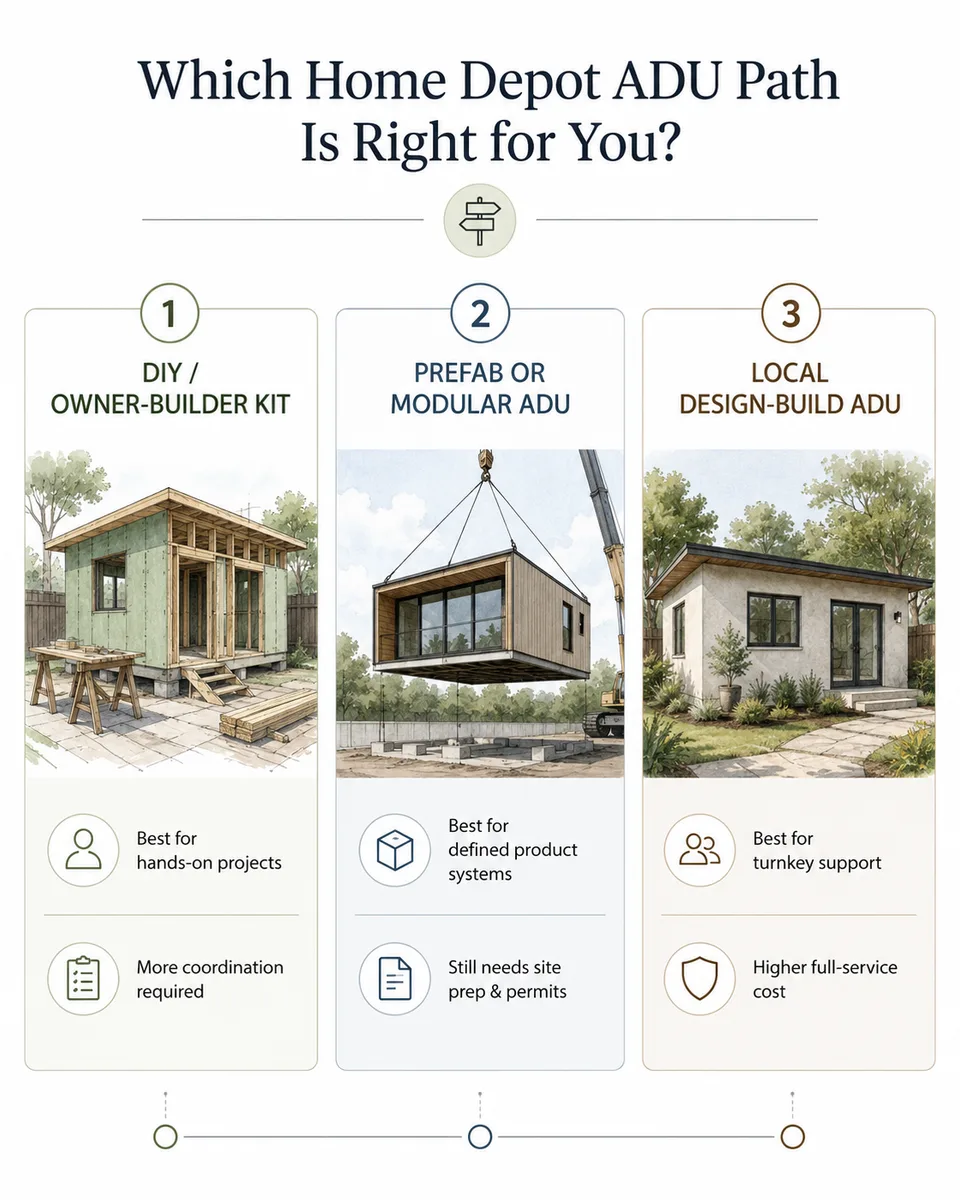
Which one is you?
- “I’m a confident owner-builder (or I have a GC I trust), on a straightforward lot, optimizing for cost.” A Home Depot kit can genuinely pencil out. Build your all-in budget first using the cost stack above, then order.
- “I want it finished fast with minimal coordination, and I’ll pay for that.” Look at modular prefab. For broad national modular, prefab, and container-home options, compare ADU builders. If you’re drawn to a compact, foldable Casita-style unit specifically, BOXABL is the brand to look at; if you’re shopping portable or expandable prefab, Home Seller USA fits that intent.
- “I want one accountable company to handle design, permits, and the build.” A local ADU builder is your path. Framework First serves California modular ADU projects roughly within 150 miles of Monterey County. SnapADU serves Greater San Diego County. Nest Tiny Homes serves Utah and Southern California (including San Diego and Imperial counties). If you’re outside those areas, search for a licensed ADU builder local to you and confirm availability.
Two more alternatives worth pricing
- Plans + a local GC. Buy a stock or custom ADU plan set and competitively bid it to local contractors. Best for customization and cost control; the tradeoff is more owner coordination.
- Garage or basement conversion. If your city allows it, converting an existing structure reuses the envelope and can lower cost. The tradeoffs are parking rules, ceiling height, fire separation, utilities, and habitability upgrades.
See current prefab pricing and floor plans
If a bare frame sounds like more project than you want, compare turnkey-style units that arrive far closer to move-in.
Reader-supported links; see disclosure above. Always confirm a provider serves your area before you commit.
Your Home Depot ADU buyer checklist
Before you buy any Home Depot ADU-like product, get three things in writing: exactly what the product includes, what code path it uses, and who is responsible for permits, foundation, utilities, installation, and inspections. The single safest first step is to confirm your lot’s ADU feasibility and local approval path before you order anything.
Product documents to request from the seller
Full inclusions/exclusions list · stamped engineered plans · code-compliance documentation · state modular approval (if applicable) · wind/snow/seismic ratings · foundation requirements · utility requirements · delivery/crane/staging requirements · warranty · return and cancellation policy · installation manual · finish schedule · fixture and appliance list · any permit package.
Questions for your city’s building/planning department
Can this product type become an ADU here? · Is it treated as site-built, modular, manufactured, tiny home, or accessory structure? · What’s the local ADU size cap, setback, and height limit? · Is owner-occupancy required? · Are short-term rentals restricted? · Are separate utilities or fire sprinklers required? · What plan documents are required? · What inspections will I need?
Questions for your contractor
Can you install this specific product? · Have you permitted this product type locally? · What’s excluded from your quote? · Who handles corrections if the city requires changes? · Who coordinates utilities? · Is crane/delivery included? · What’s the estimated timeline from permit to final inspection?
📋 Don’t run this checklist blind
Enter your ZIP, the Home Depot model or SKU, and your intended use, and the Home Depot Kit Reality-Check returns the exact documents to request, the missing-cost buckets for that model, a seller email template, and the local-rule questions to ask — so you walk into the purchase with leverage.
Want the printable version? The ADU Starter Kit includes the cost-stack worksheet, the permit-question list, and the seller email template in one PDF.
Related Dwelling Index guides
- Prefab ADU Floor Plans: Real 2026 Costs by Size & Model — compare modular prefab models vs. Home Depot kits
- Pre-Approved ADU Plans: City List, Cost & Rules — an alternative that skips much of the plan-check delay
Frequently Asked Questions
- Does Home Depot sell complete ADUs you can live in?
- Home Depot’s marketplace sells products labeled as ADUs, tiny homes, prefab homes, and frame kits, but a listing is not a permitted, livable ADU. Most are bare frame or shell kits; a few are more-complete units marketed as modular prefab. Verified May 31, 2026.
- Can a Home Depot tiny home be used as an ADU?
- Sometimes — only if your city allows that product type and the finished unit meets local zoning, building-code, foundation, utility, and occupancy requirements. A bare frame kit is treated as site-built construction and needs a full local permit.
- Do Home Depot ADUs need permits?
- Assume yes if the structure will be lived in. ADU legality is decided by local building and zoning authorities, not by a product page — and “no permit required” language on a listing should never be relied on for dwelling use.
- How much does a Home Depot ADU cost?
- The kits we verified on May 31, 2026 ran roughly $9,250–$72,600 (frame kits) and $50,000–$105,000 (modular prefab). But that’s the kit; the finished, legal ADU typically costs $90,000–$200,000+ once you add foundation, utilities, finishes, permits, and labor.
- What is the cheapest Home Depot ADU?
- The cheapest ADU-labeled listing we verified was the Bedrock steel-frame studio kit at $9,250 for 300 sq ft (about $31/sq ft). Treat it as a frame package, not a finished dwelling — foundation, utilities, finishes, and permits are all separate.
- What’s included in a Home Depot ADU kit?
- It varies by listing. Frame kits typically include only steel framing and connection hardware; the Rose Cottage listing states it is “the steel frame kit only.” Foundation, utilities, insulation, finishes, permits, and installation are generally separate. Always request a written inclusions list.
- Is the $22,999 Home Depot tiny home a complete ADU?
- No. Treat that price as a kit price until you verify foundation, utilities, insulation, finishes, code compliance, permits, and installation. In our worked example, the kit was about 15–29% of the finished cost.
- Does Home Depot install tiny homes or handle permits?
- Don’t assume so. Installation, permits, foundation, utilities, and inspections typically require a local contractor or a separate arrangement. On the Rose Cottage listing, the seller directs assembly questions to a separate quote.
- Can I rent out a Home Depot ADU?
- Only if it becomes a legal ADU under your local rules, and only within your jurisdiction’s rental regulations — many cities also restrict short-term rentals or require specific approvals. These are illustrative examples, not guarantees of returns.
- Are Home Depot ADUs legal in California?
- California is ADU-friendly — Government Code § 66321 bars local size maximums below 850 sq ft (1,000 sq ft for 2+ bedrooms) and protects an 800 sq ft ADU with four-foot setbacks, and § 66323 provides ministerial approval for qualifying ADUs — but a retail kit still has to meet state and local building rules and pass city review.
- Can I finance a Home Depot ADU?
- Possibly, but the financing path depends on the whole project, not just the kit. Lenders and appraisers generally care whether the finished unit is permitted, permanently attached, and legally usable as an ADU.
- What’s the safest next step?
- Check your property’s ADU feasibility and local approval path before ordering any kit.
How we researched this page
Dwelling Index is an independent research resource covering ADU financing, costs, and regulations. We built this page from live Home Depot product listings, official code and finance sources, and voice-of-customer research. Forum and Q&A comments are used only to understand buyer concerns — not to prove laws, costs, or code requirements.
Our method, in brief: we reviewed Home Depot’s Tiny Home Frame Kits category and individual listings relevant to ADU intent on May 31, 2026; calculated price per square foot as listed price ÷ listed square footage (listed prices exclude delivery, taxes, foundation, site work, utilities, permits, finishes, and labor unless stated); flagged listings whose title, description, and specs disagree rather than forcing a single answer; classified each product as frame kit, panelized shell, DIY studio kit, or modular/prefab; treated retail product claims as not equal to permit approval, since local authorities decide ADU legality; and kept financing guidance educational, with no promised rates, approval, returns, or eligibility. We recheck product data monthly and legal, code, and partner data quarterly or whenever a rule changes.
✅ What we verified on May 31, 2026
Home Depot product names, model numbers, listed sizes, and listed prices (including the $9,250 Bedrock studio kit and the $26,499 Rose Cottage) · the “frame kit only” scope, made-to-order/non-returnable terms, and 6–8-week delivery window in seller listing text · the zero-review state on a high-traffic listing despite heavy Q&A · a representative city policy (San Rafael) confirming prefab/tiny-home ADUs require the same building permit and a permanent foundation and utilities · California ADU statutory numbers (Gov. Code § 66321: 850/1,000/800 sq ft; § 66323 ministerial approval) · the HUD manufactured-home standard (24 CFR Part 3280) · Fannie Mae’s Selling Guide ADU definition (B2-3-04) · 2026 ADU cost ranges (Angi, HomeGuide, SnapADU, Building an ADU).
What you must still verify before buying: your city’s approval of the exact product · current price and availability · shipping, delivery, crane, and return terms · foundation and utility requirements · stamped plans and code documentation · installation responsibility · your final all-in project cost · rental legality.
Sources & verification notes
All product prices verified live on homedepot.com, May 31, 2026. Regulatory and cost sources linked below.
- Home Depot — Tiny Home Frame Kits category
- Home Depot — Bedrock Studio ADU kit (BBG-240102, 300 sq ft, $9,250)
- Home Depot — Rose Cottage (RC2B443, 444 sq ft, $26,499; “frame kit only,” 167 Q&A, 0 reviews)
- Home Depot — Chill Out (CO1B281, 305 sq ft, $22,999)
- Home Depot — The Retreat (WD1CUS1200, 1,126 sq ft, $72,597)
- Home Depot — WINNDOORS Prefab ADU (ADU-PF360-20X19-WHT, 360 sq ft, $49,999)
- Home Depot — Modern Prefab ADU (MH-ADU420-2025X1, 420/490 sq ft conflict, $105,000)
- HUD User — Single-Family Site-Built, HUD Code Manufactured, and Factory-Built Homes Brief
- eCFR — 24 CFR Part 3280 (Manufactured Home Construction and Safety Standards)
- California Government Code § 66321 (ADU size limits)
- California HCD — sample ADU ordinance-review letter (confirms 850/1,000/800 sq ft and 4-ft setbacks)
- City of San Rafael — ADU FAQ (prefab/factory-built/tiny-home ADUs; permanent foundation and utilities)
- Fannie Mae Selling Guide B2-3-04 (ADU definition and real-property treatment)
- Angi — How Much Does an ADU Cost to Build? [2026 Data]
- HomeGuide — How Much Does It Cost to Build an ADU? (2026)
- SnapADU — Cost to Build an ADU in San Diego (2026)
- Building an ADU — Calculating the Costs of Accessory Dwelling Units
- Levi Construction — ADU Cost Breakdown (finish and city-fee benchmarks)
Not sure where to start? See what’s possible at your address before ordering any kit.
Get Your Free ADU Report in 60 Seconds →