
Santa Cruz County ADU Incentives Program: 2026 Eligibility, Free Help & Real Savings
By the Dwelling Index Editorial Team · Last updated: May 27, 2026 · Last verified: May 27, 2026 · ~14 min read
Published May 27, 2026 · Last verified against County of Santa Cruz and HelloADU sources: May 27, 2026
The Bottom Line Up Front
The Santa Cruz County ADU Incentives Program is not a grant, a loan, or free construction money. It is free, county-funded feasibility and project-management help — delivered by the nonprofit Hello Housing under the brand “HelloADU” — for homeowners in the unincorporated areas of Santa Cruz County who own and live in their home, are ready to build now, and can finance the construction themselves.
We'll say the uncomfortable part out loud, because the official pages bury it: this program helps you plan, de-risk, and manage an ADU project; it does not pay for one. That single sentence saves some readers weeks of chasing the wrong thing. The upside is that “free expert guidance plus separate fee savings” is genuinely valuable — and the County's own numbers show it's working for real households. Here's everything you need to decide your next move.
| Quick question | Fast answer |
|---|---|
| Is this free construction money? | No. It's free feasibility and project-management help, not capital. |
| Who's it for? | Homeowners in unincorporated Santa Cruz County only. |
| Do I have to be ready to build? | Yes. Limited spots are prioritized for ready households. |
| Do I need my own financing? | Yes. You must be able to fund design and construction. |
| Is rent always restricted? | No — only under Option C (see below). |
| Is the old $40,000 county forgivable loan still active? | No. The County replaced it with this technical-assistance program. |
| Is the California $40,000 grant open? | No — CalHFA's funds were exhausted in December 2023. |
Program status (current public record):
Santa Cruz County's 2025 General Plan Annual Report (dated February 11, 2026) states the ADU Incentives Pilot Program is underway, administered by Hello Housing, open to new applicants on a continuing basis, with the three-year pilot ending in June 2026. Because that end date is now upon us, confirm live intake directly with HelloADU or County Planning, (831) 454-2580, before relying on a free slot.
Next step: confirm you're in unincorporated county and meet one of the three options, then apply through HelloADU. If you don't qualify — or the pilot has closed by the time you read this — you still keep the automatic county fee savings and can pick a financing path instead. Both routes are mapped below.
Not sure if your lot even qualifies — unincorporated or city, septic or sewer, coastal or not?
See what's possible at your address → get your free ADU report.
The fastest way to learn what your parcel, budget, and ADU type can support before you apply anywhere.
See What You Can Build → Get Your Free ADU Report
The Santa Cruz County ADU incentive reality-check matrix
At least seven different things get lumped together under “Santa Cruz County ADU incentives,” and only some are current. The matrix below is the thing no other page assembles in one place: what exists right now, what ended, what's cash versus cost-reduction, and the one limitation that matters for each. We built it from the County's ADU pages, the HelloADU program and FAQ pages, California statute as amended by SB 543, and CalHFA's own bulletins.
| Incentive / support | Current status | Cash or non-cash? | Who it's for | Key limitation | Source |
|---|---|---|---|---|---|
| HelloADU / County ADU Incentives Program | Active pilot, ends June 2026; open to new applicants as of 12/31/25 | Non-cash (free service) | Ready homeowners in unincorporated Santa Cruz County | Owner-occupancy + an eligible option + you fund the build | County 2025 Annual Report; HelloADU |
| Free feasibility & project-management support | Active | Non-cash | Design, permitting, construction, leasing navigation | Provides no construction capital | HelloADU FAQ |
| County fee & impact-fee waivers | Active | Cost reduction | ADUs with ≤750 sq ft interior livable space; conversions/JADUs | Varies by size, type, parking, utilities, parcel | County ADU Basic Requirements; Gov. Code §66311.5 |
| Pre-designed county ADU plans | Active (updating to 2025 code cycle) | Non-cash design resource | Projects that can use unmodified plans | Still need site plan, stormwater, possibly soils/septic | County Pre-Designed ADU Plans |
| Old County ADU Forgivable Loan | Ended / replaced | No current cash | Historical only | County replaced the low-performing loan with this TA program | County 2025 Annual Report |
| CalHFA statewide $40,000 ADU Grant | Funds exhausted Dec 2023; no open window verified | Cash when open | Income-qualified CA homeowners via approved lenders | Depleted; verify live status before planning | CalHFA.ca.gov |
| State 60-day ministerial ADU decision | Active legal protection | Process benefit | Complete ADU permit applications | Coastal, septic, or combined applications can affect timing | Gov. Code §66317 |
“Ministerial” approval means the permit is granted on objective standards without a public hearing or discretionary review — the fast lane. An “impact fee” is a one-time charge funding schools, roads, parks, or utilities to offset a new unit's demand on public services.
What we verified (source categories + date)
- Program status & funnel numbers — Santa Cruz County 2025 General Plan Annual Report (Feb 11, 2026)
- Eligibility, zones, rent rules, septic prerequisite — HelloADU application & FAQ pages (helloadu.org)
- Fee waivers, size limits, parking, short-term-rental ban, THOW-not-ADU — Santa Cruz County CDI ADU & Tiny Homes on Wheels pages
- State ADU law as amended by SB 543 (eff. Jan 1, 2026) — Gov. Code §§66310–66342; HCD ADU Handbook 2026 update
- CalHFA grant status (funds exhausted Dec 28, 2023) — calhfa.ca.gov
- Local cost orientation — County “Plan Your Financing”; County pre-designed-plan fee examples; one named local prefab example
- All facts verified May 27, 2026. Time-sensitive items (program intake, rent limits, grant status) re-verify monthly.
Is the Santa Cruz County ADU Incentives Program still open in 2026?
As of the County's most recent reporting (data through December 31, 2025), the ADU Incentives Pilot Program was open to new applicants on a continuing basis. The three-year pilot is scheduled to end in June 2026, so confirm current intake before relying on a free slot. Because the end date is now imminent, the program's status is the single most time-sensitive fact on this page — verify it directly with HelloADU or County Planning.
Here's the County's own scoreboard, and it's the most honest illustration of what this program is. As of 12/31/25, Santa Cruz County reported on its ADU Incentives Pilot:
- 373 unincorporated-area homeowners had applied
- 4 ADUs completed
- 6 under construction
- 2 in permitting
- 4 in feasibility
- Among households moving forward: 14 were low- or moderate-income, 1 was building for a family member with a developmental disability, and 1 agreed to an affordable-rent commitment
Read that funnel honestly and it tells the whole story: hundreds apply, a handful complete. That's not a knock on the program — free expert help is real and valuable — it's proof of the damaging admission up top. This is a competitive, limited pilot that helps you build; it is not a spigot of free ADU money. Knowing that now means you apply with the right expectations instead of the wrong ones.
Source: Santa Cruz County 2025 General Plan Annual Report (Feb 11, 2026); HelloADU program pages. Verified May 27, 2026.
Is the program a grant, a loan, or free project help?
It is free project help. The County funds the nonprofit Hello Housing to provide feasibility analysis and project-management services to eligible homeowners in unincorporated Santa Cruz County — not cash for construction. HelloADU's FAQ states participants must “have access to financial resources to fully finance the design and construction” of the ADU, because the program “offers free feasibility and project management services but not construction capital.”
Three different mechanisms get blurred under the word “incentives,” and confusing them is what wastes people's time.
What “incentives” actually means here:
- Free feasibility review — figuring out what your specific parcel can hold before you spend on design.
- Free project management — an owner's representative who helps you navigate design, cost estimating, contractor selection, permitting, construction, and even leasing.
- A site visit — measuring, locating utility connections, and identifying conditions that affect feasibility and cost.
- Financing navigation — help understanding which financing paths fit (not lending you the money).
What it is not:
- Not a check toward construction.
- Not the old County forgivable loan (the County replaced it — see below).
- Not the CalHFA $40,000 state grant (separate, exhausted).
- Not automatic permission to build.
- Not a substitute for septic, coastal, or building-code review.
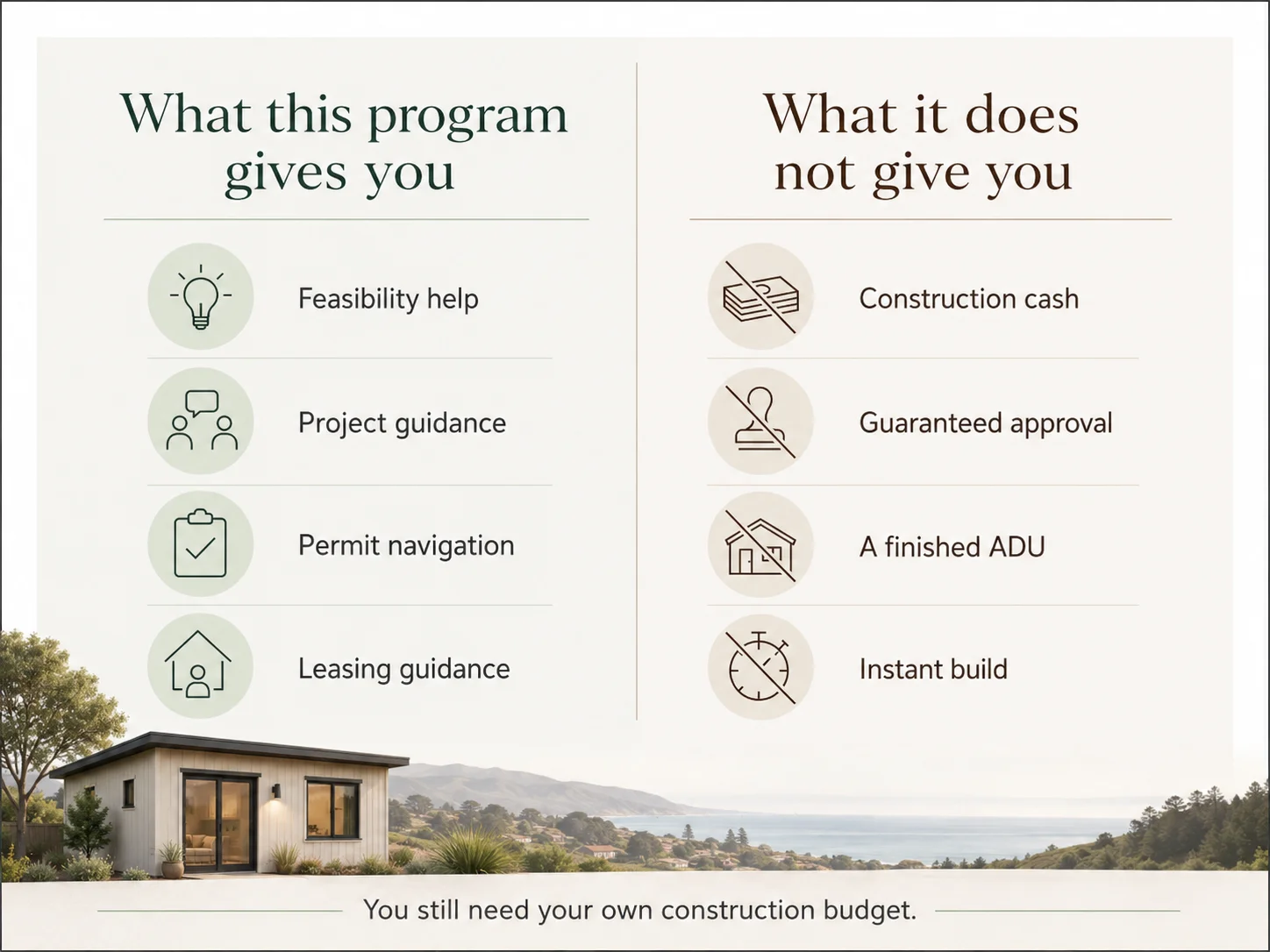
Here's the honest split between what the program carries and what you carry:
| Phase | The program may help with | You're still responsible for |
|---|---|---|
| Feasibility | Understanding what’s possible on your lot | Required site-specific studies (e.g., Environmental Health septic evaluation) |
| Design | Choosing project type and matched professionals | Paying your designer / architect / engineer |
| Permitting | Managing and navigating the process | Permit fees not waived by rule |
| Construction | Process guidance and coordination | All contractor and build costs |
| Financing | Understanding your options | Qualifying for and repaying any loan |
| Leasing | Understanding program rent rules | Tenant selection and fair-housing compliance |
The value arrives as expertise, not capital — and there's a buried, decision-changing detail an AI summary will miss: the FAQ requires a completed Environmental Health Site Evaluation before the project-management component can even begin on a septic parcel.
Source: HelloADU “How to Apply” and “FAQs.” Verified May 27, 2026.
Who qualifies for the Santa Cruz County ADU Incentives Program?
To qualify, your property must be residentially zoned (R-1, RB, RA, RR, or RM) and located in unincorporated Santa Cruz County; you must own and occupy the home as your primary residence at application and throughout construction; after completion you must live in one unit and rent the other to a bona fide tenant; and you must meet one of three eligibility options. You also must be ready to act now and have the financial resources to fund design and construction yourself.
We verified every item below against the live HelloADU FAQ. Use it as your checklist:
- ☐Property is in unincorporated Santa Cruz County (not in the cities of Santa Cruz, Capitola, Watsonville, or Scotts Valley)
- ☐Property is in a residential zone: R-1, RB, RA, RR, or RM
- ☐You own the property
- ☐You occupy it as your primary residence at application and through construction
- ☐You're ready to move forward now
- ☐You have financial resources or a plan to fund design and construction
- ☐After completion, you'll occupy one unit and rent the other to a bona fide tenant
- ☐You meet one of the three eligibility options below
The three eligibility options (and which one triggers rent limits)
This is where most pages go fuzzy. Two of the three options carry no rent or income restriction; only the third does.
| Option | What it means | Rent restriction? |
|---|---|---|
| A — Moderate-income homeowner | Your household qualifies as moderate-income (120% of Area Median Income) under current County limits | No restriction on the unit |
| B — Disabled-dependent housing | You're building the ADU/JADU for occupancy by an adult with developmental disabilities or another permanently disabled dependent | No restriction on the unit |
| C — Affordable-rent commitment | You agree to rent the ADU (or the main home, if you move into the ADU) to a moderate- or lower-income household at an affordable rent for at least the first three years | Yes — rent and income limits apply for three years |
“AMI” is Area Median Income, set annually for each county; Option C affordable-rent caps are tied to it. A “JADU” — Junior ADU — is a unit of up to 500 square feet of interior livable space created within the existing walls of the primary home.
A trust note on rent limits — read before quoting a number.
The live HelloADU FAQ currently shows two different example rent-limit sets on the same page. Its Option C description lists Studio $2,300 / 1-BR $2,700 / 2-BR $3,000, while its “What restrictions apply” answer lists Studio $2,100 / 1-BR $2,400 / 2-BR $2,700. Both are labeled current examples. Because the source contradicts itself, don't budget around either figure — confirm the current limits directly with HelloADU at application. We'd rather flag the discrepancy than guess.
How to tell if you're “unincorporated”
Your mailing address won't tell you — “Santa Cruz,” “Aptos,” “Soquel,” “Felton,” and “Boulder Creek” addresses can sit on either side of a city line. The reliable check is the County's parcel/zoning lookup by address or APN (Assessor's Parcel Number). As a rough guide, Live Oak, Soquel, Aptos, the San Lorenzo Valley communities, Bonny Doon, and Summit are largely unincorporated; the four incorporated cities are not. If you land inside a city, this program isn't yours — but the jurisdiction section below routes you correctly.
Source: HelloADU “FAQs” (eligibility, zones, owner-occupancy, rent options); County GIS parcel/zoning lookup. Verified May 27, 2026.
Confirm your fit before you invest a single hour in an application.
Check what you can build at your address → get your free ADU report.
Especially useful if you're unsure whether you're unincorporated, whether a garage conversion works, or whether septic or coastal rules change your path.
See What You Can Build → Get Your Free ADU ReportWhat does HelloADU actually do, step by step?
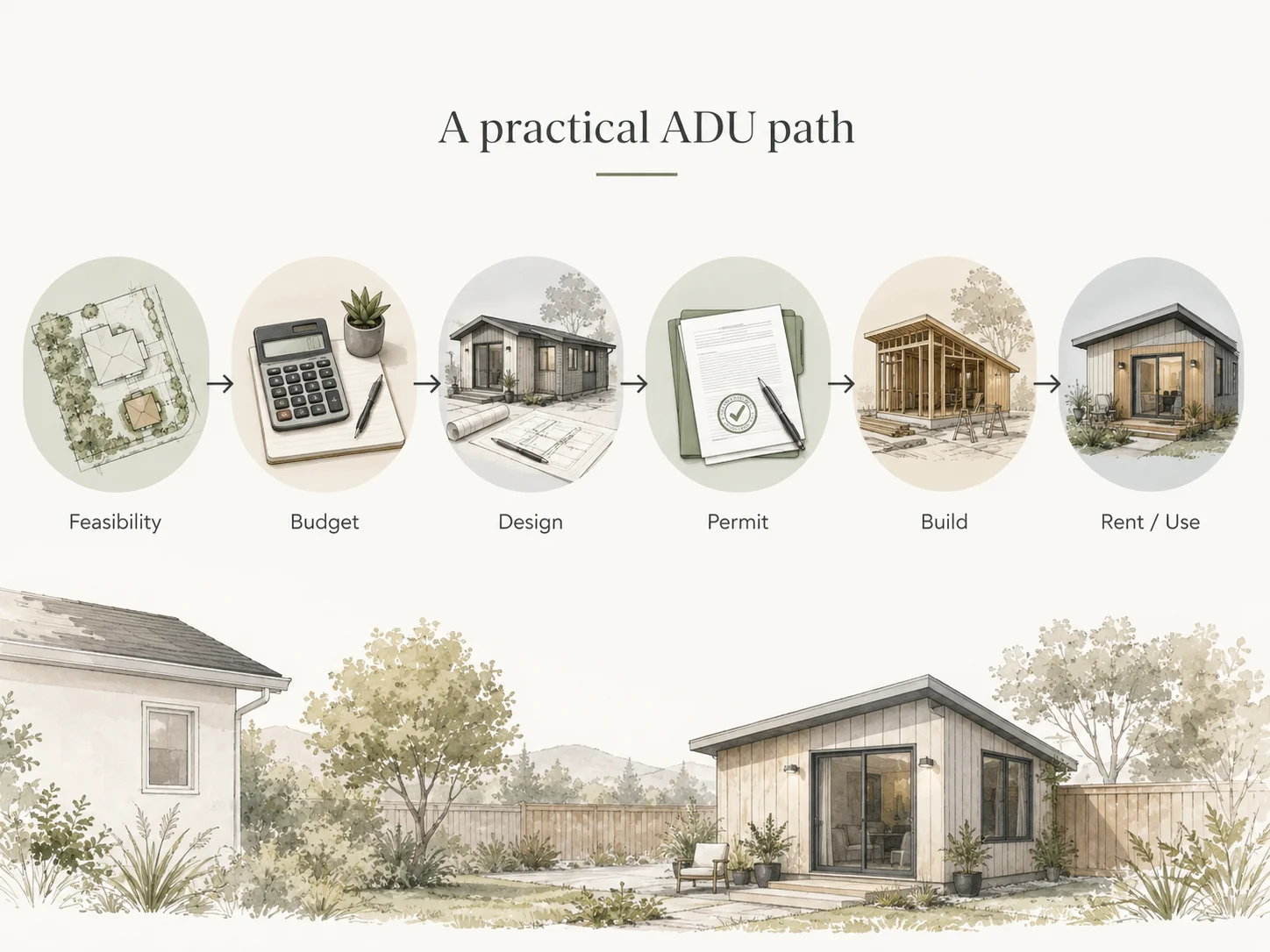
HelloADU runs a three-step process: a 15–20 minute online application, then a phone screen and in-person site visit, then a Participation Agreement for selected homeowners. Selection depends on readiness, eligibility, and a feasible project. On septic parcels, project-management support cannot formally begin until you have a completed Environmental Health Site Evaluation on file.
| Step | What happens | What they're screening for |
|---|---|---|
| 1. Online application (~15–20 min) | Determines initial eligibility, captures your ADU/JADU vision and readiness, and confirms you understand what the program can and can’t do | Do you clear the basic gates? |
| 2. Phone screen → site visit | A call about your project, costs, and timeline; then an on-site walk to take measurements, locate utilities, identify conditions affecting feasibility and cost, and weigh alternatives | Is the project buildable and a good pilot candidate? |
| 3. Participation Agreement | A formal agreement plus documents identified at the site visit — typically income verification and evidence of a financial plan to fund the unit | Are you genuinely ready to fund and start? |
Two details from the FAQ that change how you should prepare:
- The Environmental Health Site Evaluation is a prerequisite, not an afterthought. The FAQ states that to receive project-management support, “you must have a completed Environmental Health Site Evaluation,” because without it the team can't determine feasibility. On septic parcels especially, start here.
- You pick your own professionals. You choose the product type and the design/build team — from prefab/modular to panelized to traditional stick-built — and HelloADU helps you evaluate options and connect with experienced professionals.
What to gather before you apply:
| Prepare this | Why it matters |
|---|---|
| APN / address | Confirms unincorporated status and parcel rules |
| Mortgage / equity / budget picture | The program requires you to fund design and construction |
| ADU type preference | Detached, attached, conversion, or JADU |
| Tenant plan | Family, caregiver, market tenant, or an Option-C affordable commitment |
| Septic/sewer status | A major feasibility factor; Site Evaluation may be required |
| Coastal-zone uncertainty | May affect parking and review path |
| Existing structure permit history | Critical for garage or accessory-structure conversions |
Source: HelloADU “How to Apply” and “FAQs.” Verified May 27, 2026.
Do you have to rent the ADU at an affordable rent?
Not always. If you qualify under Option A (moderate-income homeowner) or Option B (housing a disabled dependent), your ADU is not subject to the program's rent or income restrictions. Only Option C — an affordable-rent commitment — requires you to rent at the program's limits for at least the first three years. You always choose your own tenant, including a relative, as long as there's a bona fide lease.
A few practical points from the FAQ:
- You select your tenant — a relative, a friend, or someone new — with a real lease and full fair-housing compliance. HelloADU offers landlord training and tenant-matchmaking referrals.
- Under Option C, a relative tenant must still meet the moderate-income limits, and your rent can't exceed program caps.
- Under Options A or B, no rent or income limits apply at all.
If you're modeling rental income, treat any numbers as scenarios: These are illustrative examples, not guarantees of returns. Actual results depend on local market conditions, construction costs, financing terms, and regulatory approvals. And remember the source's own rent figures are currently inconsistent — verify them at application rather than building a budget on a specific cap.
Source: HelloADU “FAQs” (rent options, tenant selection). Verified May 27, 2026.
What ADU incentives can actually reduce your Santa Cruz County costs?
Even with no construction grant, Santa Cruz County offers real cost reducers: Planning Department permit fees are waived for ADUs of 750 sq ft or less, state law bars impact fees on ADUs with 750 sq ft of interior livable space or less, transportation and roads fees are waived when no parking is required, the Affordable Housing Impact fee is waived for ADUs under 750 sq ft, and conversion ADUs and JADUs get reduced building-permit fees plus waived sewer/water connection fees. Together these are frequently more valuable than chasing a grant that isn't open.
This is the part that quietly matters most — and you get it whether or not you ever touch HelloADU.
| Fee type | Treatment | Condition | Authority |
|---|---|---|---|
| Planning Dept. permit fees | Waived | ADU ≤ 750 sq ft | County ADU Basic Requirements |
| Development impact fees | Waived | ADU with ≤ 750 sq ft interior livable space (proportional above) | Cal. Gov. Code §66311.5 |
| Transportation / roads fees | Waived | When no parking is required | County |
| Affordable Housing Impact fee | Waived | ADU < 750 sq ft (incl. JADU) | County |
| Sewer / water connection fees | Waived | JADUs & conversion ADUs | County |
| Building permit fees | Reduced | Conversion ADUs | County |
| School district fees | Special treatment under 500 sq ft (not 750) | ADU/JADU < 500 sq ft interior livable space | Cal. Gov. Code §66311.5; Educ. Code §17620 |
Decoded: As amended by SB 543 (effective January 1, 2026), California Government Code §66311.5 bars impact fees on an ADU with 750 square feet of interior livable space or less, and on a JADU with 500 square feet or less; fees on larger ADUs are proportional to the primary home. The same section gives special school-fee treatment only to units under 500 square feet of interior livable space — so the common “anything under 750 is school-fee exempt” claim is wrong. Santa Cruz County layers its own Planning and Affordable Housing waivers on top. School district and fire-agency review fees are billed separately and vary by district.
What the savings actually look like (county-published examples)
Rather than hand you a vague range, here are the County's own pre-designed-plan fee figures — real numbers, with the threshold effect visible:
| County pre-designed plan | Approx. county permit fees |
|---|---|
| 425 sq ft | ~$5,000 |
| 637 sq ft | ~$6,000 |
| 998 sq ft | ~$20,000 plus impact fees |
The 750-square-foot cliff
The 750-square-foot line (measured as interior livable space) is a hard threshold, not a gentle slope. Stay at or under it and the impact-fee exemption applies; cross it and impact fees return proportionally. That's why a 740-square-foot unit can pencil out very differently from an 800-square-foot one. A one-bedroom around 700–749 sq ft is a common “sweet spot” — though your actual needs, not the fee line, should drive the size.
Conversion ADUs and JADUs: the cheaper lane
Converting existing permitted space — a garage, a basement — captures reduced building-permit fees and waived sewer/water connection fees, and avoids a new foundation and shell. The catch: the structure must be legal. An unpermitted structure can be converted, but it's treated as new construction and must meet current setbacks and building standards, which can erase the savings.
Pre-designed county ADU plans
Santa Cruz County offers pre-designed ADU plans that can cut design cost and time. They're not turnkey, though: the County notes the plans can't be modified if you want to retain pre-designed status, and you may still need a site plan, stormwater information, grading/civil sheets, truss details, fire sprinklers if required, and septic/OWTS plans where applicable. The County also notes the pre-designed plans are being updated to the 2025 code cycle; before relying on them, confirm whether the updated set is available or whether redlines are needed.
“OWTS” — Onsite Wastewater Treatment System — is the regulatory term for a septic system. “Soft costs” are non-construction expenses (design, engineering, permits, surveys, financing fees). “Site work” is grading, utility trenching, and foundation prep.
The County program plans your project; it doesn't fund it — so the real question becomes how you'll pay for the build.
Explore your ADU financing options → see the paths homeowners actually use.
An independent walkthrough of construction loans, cash-out refinances, renovation loans, and home-equity lines — paths and tradeoffs, not lender rankings.
Explore ADU Financing Paths →Source: County of Santa Cruz CDI “ADU Basic Requirements” and “Pre-Designed ADU Plans”; Cal. Gov. Code §66311.5 (SB 543); Educ. Code §17620. Verified May 27, 2026.
What does an ADU cost in Santa Cruz County — and what doesn't the program cover?
Construction is the real cost, and it's all on you. The County itself flags the detached, new-build backyard cottage as the most expensive ADU type, and points homeowners toward conversions, garage conversions, remodels, and prefab as lower-cost paths. The program's free help is designed to keep you from overspending against those numbers — not to reduce them.
| ADU type | Relative cost | Why |
|---|---|---|
| JADU (≤500 sq ft, within the home) | Lowest | Uses existing walls; connection fees waived |
| Conversion (garage / basement) | Lower | Reduced permit fees; no new foundation or shell |
| Attached new build | Mid | Shares a wall; some site work avoided |
| Detached new build | Highest | New foundation, framing, roof, full utilities |
For a concrete, sourced local data point on the prefab end: Framework First, a modular ADU builder based in Monterey County serving roughly a 150-mile radius, lists a 450-square-foot model at about $227,000 for the entire project. Treat that as one builder's published example, not a countywide average — every parcel's site work, utilities, foundation, and access change the total.
These cost figures are illustrative examples, not guarantees. Actual results depend on local market conditions, construction costs, site conditions, and regulatory approvals. The Dwelling Index is an independent research resource covering ADU financing, costs, and regulations, and does not provide construction estimates.
The tool an AI can't run for you:
The County's ADU Fee Estimator takes your specific project details and returns estimated County fees, project costs, and a cash-flow projection over time — calculated against current County fee schedules (County fees only, not outside-agency or utility-district charges). Use it before finalizing your scope.
Source: County of Santa Cruz “Plan Your Financing” (cost ranking by type) and ADU Fee Estimator; Framework First published model pricing. Verified May 27, 2026.
What if you were chasing the old $40,000 county loan — or the California ADU grant?
Treat both as unavailable. Santa Cruz County replaced its low-performing ADU Forgivable Loan Program with the technical-assistance program this page covers. And the statewide CalHFA ADU Grant of up to $40,000 had its funds exhausted as of CalHFA's December 28, 2023 notice, with no open application window verified since. If a page is promising you a current $40,000 Santa Cruz forgivable loan, it's stale.
Why the confusion is so common — and how to check before you budget:
- Old pages from legitimate organizations stay indexed for years.
- Funding directories still list discontinued loan terms.
- People see “$40,000” and assume it's live.
- People conflate the County program (free help) with the CalHFA state grant (cash, when funded).
Quick verification checklist before trusting any “ADU money” page:
- Does it show a current application with an open date?
- Does it have a visible last-updated date?
- Is it on the administering agency's own site (County, CalHFA)?
- Does the County or HelloADU confirm it?
- Is it confusing the County program with the CalHFA grant?
| Claim you may see | Current treatment |
|---|---|
| “Santa Cruz County offers up to $40,000 forgivable loans” | Ended — replaced by the technical-assistance program |
| “The County has an ADU incentive” | True — but it’s free technical/project support, not cash |
| “California has a $40,000 ADU grant” | Funds exhausted Dec 2023; verify with CalHFA before relying on it |
| “Fee waivers are available” | True — but depends on size, type, fee category, and parcel |
On the CalHFA grant specifically
We verified this against CalHFA's own site: as of its December 28, 2023 notice, “the latest round of ADU funding has been fully allocated,” and CalHFA warns that anyone claiming they can secure you an ADU Grant is running a scam. The honest summary: there is no reliably open window — never build a budget on it. Verify current status at calhfa.ca.gov.
So here's the realistic path forward
While the CalHFA grant is exhausted and the County's old forgivable loan is gone, homeowners are completing ADUs in unincorporated Santa Cruz County right now — the County's own funnel proves it. The move that actually works is to combine three things: a feasibility check, fee-aware design (stay at or under 750 sq ft of interior livable space where it fits your needs), and a financing path matched to your project.
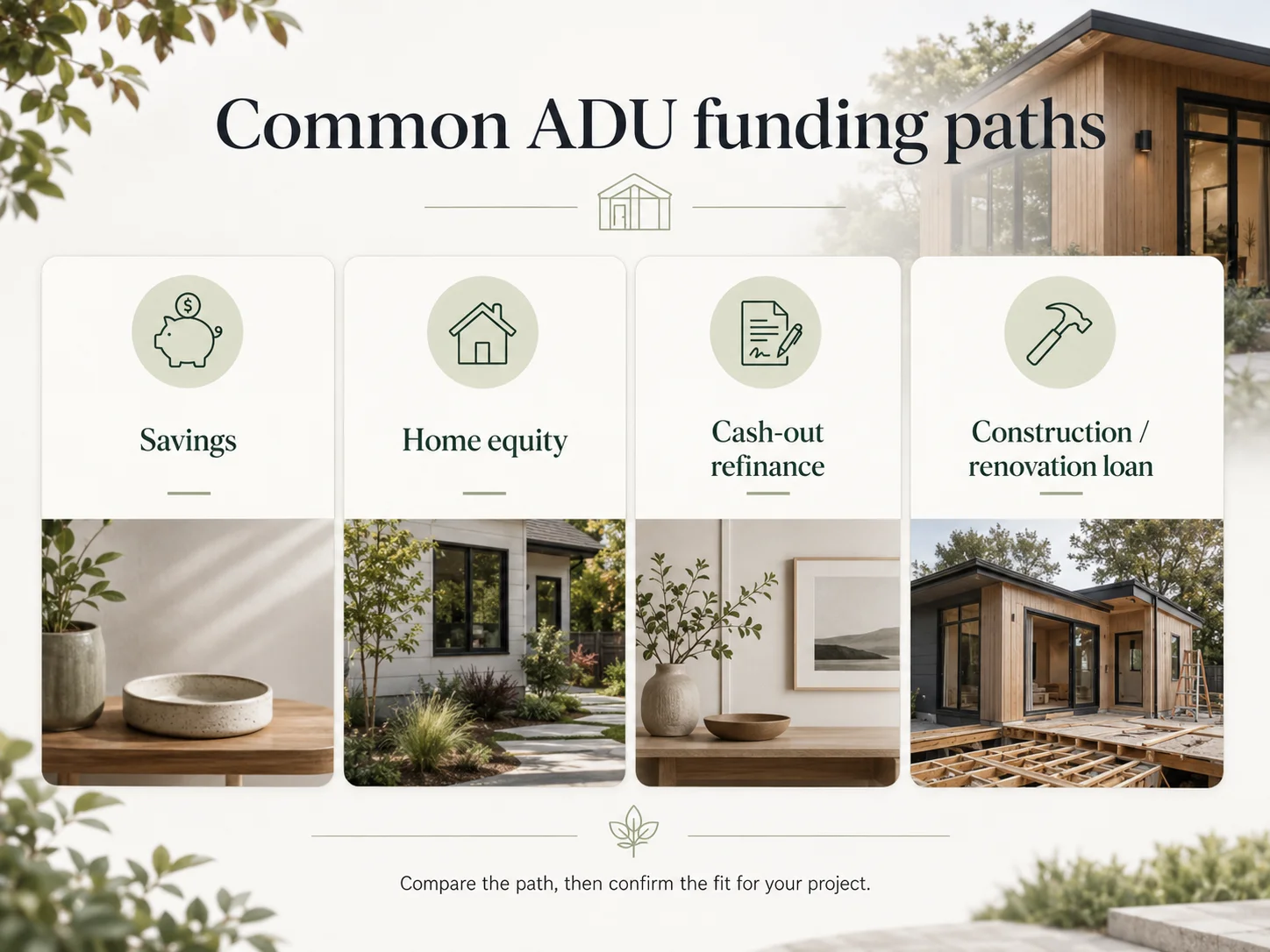
- Strong equity? Compare equity-based financing paths.
- Detached new build? Understand construction and renovation financing.
- Trying to shrink scope and cost? Evaluate a JADU, a conversion, or a sub-750-square-foot design.
- Not sure? Start with feasibility.
Don't build your plan around money that isn't there.
Compare your ADU financing paths → see your options before you apply.
Educational comparison only. The Dwelling Index is not a lender or broker and does not guarantee approval, rates, or terms.
Compare ADU Financing Paths →Source: CalHFA.ca.gov ADU Grant pages (Dec 28 2023 allocation notice + scam warning); Santa Cruz County 2025 Annual Report (forgivable-loan replacement). Verified May 27, 2026.
Which ADU types are easiest to pursue in unincorporated Santa Cruz County?
The easiest path depends on your parcel, existing structures, utilities, septic or sewer status, coastal designation, and budget. The County notes detached backyard cottages are the most expensive option, while conversion ADUs, garage conversions, and prefab can reduce cost or complexity. Match the project to your budget and goal, not to a trend.
Garage conversion ADU
A popular, lower-cost path. Conversions and JADUs generally require no new parking — except in certain coastal-designated areas where replacement parking can apply. The structure's legal permit history matters: a legal garage converts cleanly; an unpermitted one is treated as new construction.
Conversion ADU or JADU
Best for lowest cost and family housing. A JADU caps at 500 square feet of interior livable space and sits within the existing home's walls. A conversion ADU has no maximum size on the County page, though other standards apply, and it captures the sewer/water connection-fee waiver.
Detached ADU at or under 750 square feet
The fee-aware sweet spot — captures the impact-fee exemption under §66311.5. Note the distinction between the 750-square-foot fee threshold (a fee trigger) and the state-law guarantee that local rules can't block an ADU of at least 800 square feet under §66321 (a zoning floor). Different rules, different jobs.
Prefab / modular ADU
HelloADU welcomes prefab applicants and adapts its services to the builder's process. The County treats factory-built housing as acceptable when placed on a permanent foundation and connected to utilities; detached ADUs must also account for solar PV. Prefab can save time, but it doesn't remove site work, foundation, utility, or local-permitting requirements.
Tiny home on wheels (THOW) — important correction
A tiny home on wheels can no longer be approved as an ADU in Santa Cruz County. Per the County's current Tiny Homes on Wheels permit page: “Pursuant to guidance from the State Department of Housing and Community Development, Tiny Homes on Wheels (THOWs) may not be permitted as Accessory Dwelling Units (ADUs),” and the County's older THOW and ADU ordinances are “no longer current.” Older County FAQ or code language referencing §13.10.680 may still appear online — disregard it on this point. A THOW is a separate residential permit path (processed through ePlan Review, permit fees approximately $2,000, ANSI-A119.5 certification required), not an ADU Incentives Program path.
Source: County of Santa Cruz “Plan Your Financing” and “FAQs”; County Tiny Homes on Wheels permit page; HelloADU “FAQs” (prefab). Verified May 27, 2026.
What Santa Cruz County ADU rules can change your eligibility or cost?
The local rules that most change ADU feasibility are jurisdiction, zoning, unit size, parking, setbacks and height, coastal designation, septic capacity, the legal status of existing structures, and the short-term-rental ban. Santa Cruz County prohibits short-term rental of an ADU or JADU — rentals must be for terms longer than 30 days. Confirm these early, because any one can change your budget or rule out a plan.
Size limits
From County guidance, with measurements now based on interior livable space under SB 543:
- JADU: 150–500 sq ft
- Conversion ADU: minimum 150 sq ft; no maximum listed by the County
- New attached: 850 sq ft (studio/1-BR) or 1,000 sq ft (2+ BR), or 50% of the primary dwelling's habitable area, whichever is larger
- New detached: 850 / 1,000 sq ft on parcels under one acre; up to 1,200 sq ft on parcels of at least one acre
- State floor: under §66321, local standards can't prevent an ADU of at least 800 square feet
Multifamily properties
Homeowner-occupied single-family lots are the program's core, but the County's ADU rules also reach multifamily parcels: a lot with an existing multifamily dwelling may add up to eight detached ADUs (not exceeding the number of existing units), plus conversion ADUs of up to 25% of existing units. Multifamily owners should confirm specifics with County Planning.
Parking
No parking is required for conversion ADUs and JADUs, except in certain coastal-designated areas. New-construction ADUs require one space unless an exception applies and the parcel is outside those coastal areas. Specific coastal corridors (parts of Live Oak, Seacliff/Aptos/La Selva, Davenport/Swanton, Opal Cliff Drive) have stricter parking or replacement-parking rules.
Setbacks and height
A setback of no more than four feet from side and rear lot lines is required for a new detached ADU (Gov. Code §66314(d)(7)); front setbacks can't be applied to preclude an 800-square-foot ADU. Height limits vary by attached vs. detached, proximity to transit, whether it's above a garage, and special coastal or community standards.
“Setback” is the minimum distance a structure must sit from a property line.
Septic and Environmental Health
On septic parcels, the system must handle the added flow or be upgraded — and adding bedrooms or converting space increases the requirement. Consult Environmental Health Services early; the program requires a completed Environmental Health Site Evaluation before project management can proceed. Properties in the 2020 CZU fire burn area have additional pre-clearance steps.
Illegal or unpermitted structures
The County allows converting illegal structures, but treats them as new construction subject to current setbacks, building standards, and codes. Legalizing an existing unpermitted unit routes through separate state amnesty pathways — not this incentives program. HelloADU will help assess feasibility but warns it can be costly to bring an informal unit up to code.
A note on stale information
The County's own ADU guides note they're being updated to reflect newer state law, and that some older local regulations are superseded. SB 543 (effective January 1, 2026) renumbered the state ADU statutes into Government Code Chapter 13 (§§66310–66342) and shifted size and fee measurements to “interior livable space.” If you're reading an older page that cites the former §65852.2 or §66324, the framework has moved — that's exactly why we date every fact here.
Source: County of Santa Cruz CDI “ADU Basic Requirements”; Cal. Gov. Code §§66311.5, 66314, 66317, 66321, 66323 (SB 543); HCD ADU Handbook 2026 update; HelloADU “FAQs.” Verified May 27, 2026.
What if my property is in the City of Santa Cruz, Capitola, Scotts Valley, or Watsonville?
This program is only for unincorporated Santa Cruz County. If your property is inside one of the four incorporated cities — Santa Cruz, Capitola, Watsonville, or Scotts Valley — you're not eligible for HelloADU, and you should check that city's own ADU rules, fees, and any city-run programs. Each city sets its own standards under California's statewide ADU framework.
The good news: state ADU law — including the §66311.5 impact-fee exemption for units with 750 sq ft of interior livable space or less — applies everywhere, so even city homeowners keep the biggest cost reducer. You just need the right local page for size limits, parking, and any city incentives. See our guides for California ADU law in 2026 and California ADU impact fees explained.
Not sure which side of the city line you're on?
See what's possible at your address → get your free ADU report.
Tells you whether this county program is your starting point or whether you need a city-specific path.
See What You Can Build → Get Your Free ADU ReportWhat should you do before applying?
Before applying, confirm your jurisdiction, run a feasibility check, choose your ADU type, verify septic/sewer and coastal constraints, decide whether an Option C affordability commitment is acceptable, and outline how you'll finance the build. HelloADU prioritizes homeowners who are ready to move forward and have the financial resources to fund design and construction.
A clean sequence:
- 1Confirm the property is in unincorporated Santa Cruz County (parcel/zoning lookup).
- 2If you're on septic, order or confirm your Environmental Health Site Evaluation — it's a program prerequisite.
- 3Decide which ADU type fits your lot and budget.
- 4Check coastal status and parking implications.
- 5Decide if you can accept a three-year affordability restriction (only relevant for Option C).
- 6Estimate your financing capacity and run the County Fee Estimator.
- 7Gather sketches, photos, permit history, and utility information.
- 8Confirm intake is currently open, then apply through HelloADU.
Ready to see what your specific lot can hold?
Get your free ADU report → see what's possible at your address.
The best first step whether you're applying to the program or going it alone.
Get Your Free ADU Report → See What's PossibleWhat if you don't qualify?
If you don't qualify — because you're in a city, don't meet one of the three options, can't fund the build yet, or hit a septic or coastal wall — you can still build an ADU. The program is free support for a limited group of ready homeowners; it is not the only legal path to an ADU, and you keep the fee savings regardless. Your next step depends on the blocker.
| If your blocker is… | Your next move |
|---|---|
| City jurisdiction | Use your city’s ADU rules and incentives; you still keep the state fee exemption under 750 sq ft |
| Not ready to build now | Start with a feasibility report and the free Starter Kit; subscribe for program updates |
| No construction capital | Compare financing paths — construction loans, cash-out refis, renovation loans, HELOCs |
| Septic unresolved | Get the Environmental Health Site Evaluation before spending on design |
| THOW plan | A THOW is a separate residential permit path — not an ADU |
| Over 750 sq ft | Model the proportional impact fees with the County Fee Estimator before finalizing size |
We'd rather disqualify you honestly here than send you into an application you can't complete. The fee savings alone make a sub-750-square-foot ADU worth pursuing even without the free project management.
Still comparing types, costs, permits, and financing?
Download the free ADU Starter Kit
A plain-English checklist built for Santa Cruz County homeowners deciding their next move.
Get the Free ADU Starter Kit →How active is ADU building in unincorporated Santa Cruz County?
ADUs are a meaningful and growing share of new housing in unincorporated Santa Cruz County. The County reported 640 cumulative ADU building permits issued in unincorporated areas since 2010 — including 103 in 2024 and 43 in 2025 — concentrated in a handful of planning areas. They're not theoretical here; neighbors are building them across Live Oak, Aptos, and Soquel.
| Planning area | Cumulative ADU permits (since 2010) |
|---|---|
| Live Oak | 208 |
| Aptos | 91 |
| Aptos Hills | 50 |
| Carbonera | 50 |
| Pajaro Valley | 45 |
| Soquel | 39 |
| San Lorenzo Valley | 37 |
| Summit | 29 |
| Bonny Doon | 28 |
| Eureka Canyon | 26 |
| County total (all areas) | 640 |
This is the practical reality check: ADUs get built here regularly, but where you are on the map shapes everything from utilities to coastal review. It doesn't imply any individual parcel will qualify — that's what the feasibility step is for.
Source: Santa Cruz County 2025 General Plan Annual Report (Feb 11, 2026). Verified May 27, 2026.
Frequently asked questions
Is the Santa Cruz County ADU Incentives Program free money?↓
Is the program still accepting applicants in 2026?↓
Who can apply?↓
Does it apply inside the City of Santa Cruz?↓
Is the old Santa Cruz County ADU forgivable loan still available?↓
Is the California $40,000 ADU grant available in 2026?↓
Do school district fees disappear under 750 square feet?↓
Do I have to rent the ADU affordably?↓
Can I use a tiny home on wheels as my ADU?↓
Can I use the program for a prefab ADU?↓
Can I apply if I already started but got stuck?↓
Can I build on septic?↓
Are short-term rentals allowed?↓
How we researched this guide
The Dwelling Index is an independent research resource covering ADU financing, costs, and regulations. We built this guide from primary and highly authoritative sources: the County of Santa Cruz Community Development & Infrastructure department's ADU and Tiny Homes on Wheels pages, the County's 2025 General Plan Annual Report, the HelloADU / Hello Housing program and FAQ pages, California Government Code §§66310–66342 as amended by SB 543 (effective January 1, 2026), California Education Code §17620, the HCD ADU Handbook 2026 update, and CalHFA's official ADU Grant bulletins. Local cost figures come from the County's own materials and one named local prefab builder's published pricing, used for cost orientation only — never for legal or regulatory claims. Homeowner concerns referenced for context came from public discussion and are treated as anecdotal, not as evidence for any law, fee, or program rule. Time-sensitive facts — program intake, rent limits, and grant status — were verified May 27, 2026, and we re-verify them monthly. We are not affiliated with Santa Cruz County or Hello Housing, and this page is educational, not legal, tax, mortgage, or financial advice.
Not sure where to start?
See what's possible at your address — get your free ADU report.
Get Your Free ADU Report →