
San Marcos ADU Permit Process: Steps, Fees, and the CFD Trap (2026)
San Marcos offers one of the most homeowner-friendly ADU permit systems in San Diego County — a free PRADU plan library with a published 30-day approval clock — but the CFD/Mello-Roos process quietly adds months for projects above 750 sq ft. This guide covers every step, the real fee numbers from the City’s 2025 schedule, and the three clocks that govern your timeline.
Typical residential lot in north San Diego County. Photo for illustrative purposes.
Bottom line up front
San Marcos ADU permits are ministerial — no public hearing, no neighbor approval. If you use the City’s free PRADU plan set without alterations, the City promises a complete-application decision within 30 days. For custom or conversion ADUs, the 60-day state clock applies under Gov. Code § 66317, with a typical elapsed time of 4–8 months with one or two correction cycles (builder/field-sourced). City building fees are $3,750.32 flat for any City Standard ADU. Add SMUSD school fees of $5.17/sq ft when assessable area exceeds 500 sq ft. And if your ADU has more than 750 sq ft of interior livable space, plan for the CFD/Mello-Roos annexation process that can add three to four months waiting for a quarterly Council certification cycle.
San Marcos ADU permit snapshot — 2026
| Factor | San Marcos rule | Source |
|---|---|---|
| PRADU review clock | 30 days after complete application | City PRADU page / Gov. Code § 65852.27 |
| State ministerial clock (custom/conversion) | 60 days after complete application | Gov. Code § 66317 |
| Completeness determination | 15 business days; auto-complete if missed (SB 543) | SB 543 / Gov. Code § 66317 |
| City plan-review cycle (custom) | ~15 business days per cycle | City Building & Remodeling page |
| Typical elapsed time (PRADU, ≤750 sq ft) | 5–7 months design to C of O | Builder/field-sourced |
| Typical elapsed time (custom, ≤750 sq ft) | 9–13 months design to C of O | Builder/field-sourced |
| CFD add-on (over 750 sq ft interior livable) | +3–4 months quarterly certification | Builder/field-sourced; City fee schedule |
| City fees — City Standard ADU (all sizes) | $3,750.32 flat (plan check $1,166.08 + permit $2,584.24) | City Dev. Fees eff. 3/3/2025 |
| SMUSD school fees (>500 sq ft assessable area) | $5.17/sq ft on full assessable area | SMUSD Residential Dev. Fees, eff. 7/9/2024 |
| PFF impact fees (≤750 sq ft interior livable) | Exempt under Gov. Code § 66311.5 | State ADU law |
| Submittal method | Electronic, through City online permit portal | City Building Division |
| Soils report requirement | Not routine; triggered by grading or site conditions | SnapADU / City plans examiner, May 2025 |
See what you can build in San Marcos
Free San Marcos ADU feasibility report in 60 seconds — lot eligibility, size potential, fee triggers, and the right permit path for your project. No commitment, no spam.
Get Your Free ADU Report →What is the San Marcos ADU permit process? (7 steps)
The San Marcos ADU permit process is a seven-step city workflow: confirm jurisdiction and zoning, choose a permit path, assemble the submittal package, file digitally through the City’s online permit system, respond to plan-check corrections, pay all fees, then complete construction and inspections through certificate of occupancy.
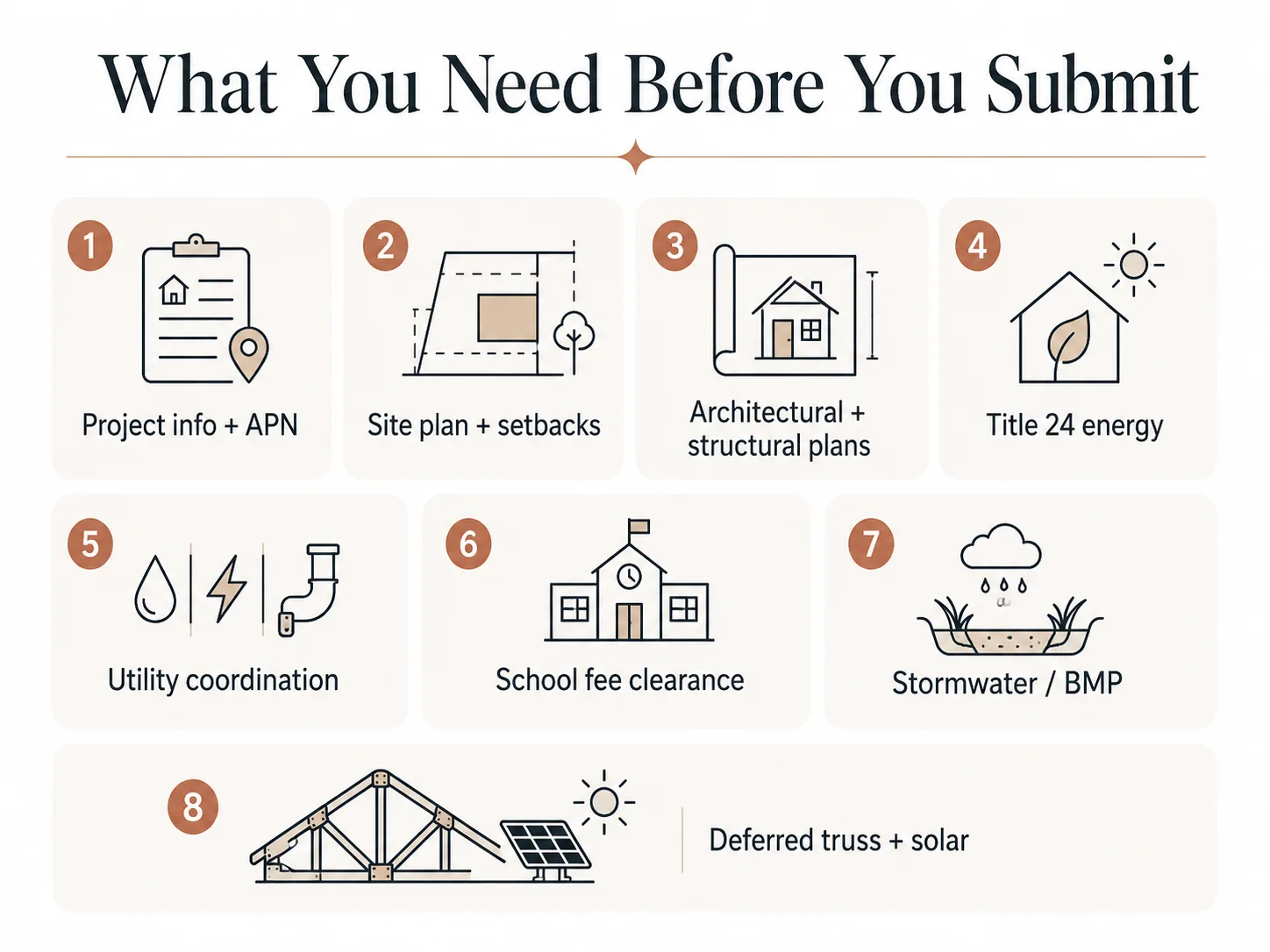
San Marcos ADU permit process — from jurisdiction check to certificate of occupancy.
- 1
Confirm your jurisdiction and zoning
Not every address with a “San Marcos” mailing address is inside the City of San Marcos. Lake San Marcos, parts of Twin Oaks, and pockets along the Vista, Escondido, and Carlsbad borders can be unincorporated San Diego County — a completely separate jurisdiction with its own ADU rules, fee schedule, and submittal portal. Pull your property up on the County Assessor map and confirm “City of San Marcos” before doing anything else.
Then check your residential zone (RR, R-1, R-2, R-3, RMF) and any overlays. Zone determines underlying front-yard setbacks, height baselines for the primary structure, and whether you’re in a transit-proximity area that unlocks the height bonus for two-story ADUs.
Trip-up: If the property is in unincorporated San Diego County, this article does not apply. County and City of San Marcos have separate ADU rules, fees, and permit portals. - 2
Choose your permit path
Six options, each tied to a different submittal track and timeline. Most homeowners fall into one of three: PRADU (fastest city-side approval, detached one-story, City plan set only), custom detached ADU (site or design doesn’t fit PRADU), or garage/interior conversion (reusing existing legal space).
The PRADU-vs-custom decision is where most homeowners stall — we’ve built a dedicated decision matrix in the section below.
- 3
Assemble the submittal package
Architectural drawings, plot/site plan with setbacks and dimensions, structural drawings, Title 24 energy calculations, a building verification survey and setback certification for detached structures, deferred submittals for roof trusses and solar, and Vallecitos Water District, SDG&E, and SMUSD coordination items. The City also requires a vicinity map, impervious/pervious surface area table, land-disturbance quantity, and a stormwater BMP/SWQMP form.
Soils report update: As of May 2025, the City no longer routinely requires a geotechnical report on most ADUs — the requirement now triggers only when grading is proposed or site conditions warrant. Confirm with the Building Division for your specific project before paying for one. - 4
Submit digitally
San Marcos handles building permits through the City’s online permitting system. Account setup needs the property’s Assessor Parcel Number (APN) and a working email. Review the City’s current plan-submittal handout for formatting and file-type requirements before uploading.
Under SB 543, the City must determine completeness within 15 business days. If the City misses that window on a project filed with an existing primary dwelling, your application may be deemed complete as a matter of law.
- 5
Respond to plan-check corrections
For a complete PRADU submittal that matches the City plan set, corrections are uncommon — that’s the entire point of the program. For custom ADUs, expect one or two correction cycles touching site plan, structural, MEP, energy compliance, and grading/drainage. Each correction cycle pauses the state’s 60-day clock. The plan reviewer issues written comments; your designer responds with revised plans; you resubmit.
Common delay: Incomplete submittals are the #1 reason permits stall. Submit complete the first time using the checklist below. - 6
Pay all fees and pull the permit
Once plans are approved, pay City permit fees, SMUSD school developer fees (if your ADU’s assessable area exceeds 500 sq ft), CFD annexation or in-lieu amounts (if your ADU has more than 750 sq ft of interior livable space), Vallecitos water and sewer capacity fees, and SDG&E new-service fees.
The City offers a Public Facility Fee (PFF) deferral program that lets you defer PFF payment until utility release in exchange for a recorded lien on the property — useful if cash flow is tight at permit pull.
- 7
Construct, inspect, and connect
Standard residential inspections: foundation, frame, MEP rough-in, insulation, drywall, final. Vallecitos Water District requires water and wastewater capacity fees paid before final inspection and utility release. SDG&E coordination is required and a separate electric meter for the ADU is typically required. Once the final inspection passes and utilities are released, the certificate of occupancy is issued.
Not sure where your project lands in these seven steps?
Get a free San Marcos-specific feasibility check — no obligation.
Get Your Free ADU Report →Should you use San Marcos PRADU plans or a custom ADU permit?
Use PRADU if you want a detached, one-story ADU and you’re willing to accept the City plan set as-is. Use custom plans if your lot, design, attached layout, garage conversion, sloped site, structural conditions, or two-story preference doesn’t fit the PRADU plan set.
The City is explicit about the no-alteration rule: “No alterations to the city-provided plan sets will be considered. If submitting a customized structure, please submit for a standard ADU building permit.” If you want a different window arrangement, a different roof pitch, a different bedroom count, or anything not already a configurable option inside the City plan set, you’re on the custom track. Full stop.
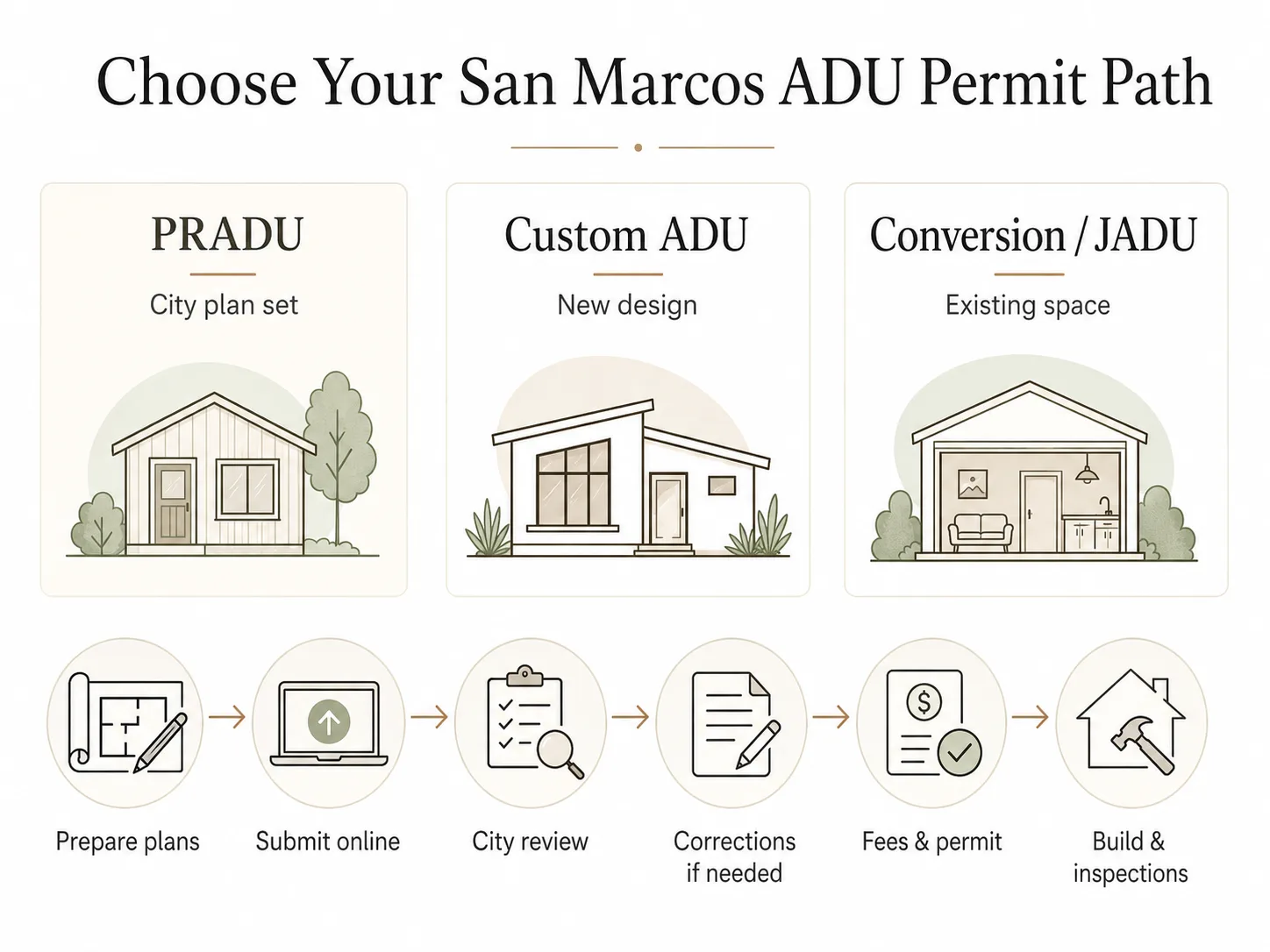
PRADU vs. custom permit path — key tradeoffs at a glance.
When PRADU is the right move
- One-story, detached ADU within available PRADU plan footprints (500–999 sq ft).
- Flat or near-flat lot with no unusual soils, slope, or drainage issues.
- No HOA architectural review that would force changes to the City plan set.
- You’re comfortable with the City’s exterior styling and floor plan and don’t need to customize.
- You want the lowest possible design cost and fastest city-side approval.
When custom is the right move
- Two-story design (only within ½ mile of a major transit stop or high-quality transit corridor, where state law allows 18 ft + 2 ft for matching roof pitch).
- Attached ADU or addition to the primary home.
- Garage or interior conversion (PRADU plans are for new detached structures only).
- Sloped or constrained lot where the PRADU footprint won’t fit between 4-ft side/rear setbacks and 10-ft eave-to-eave separation from the primary.
- HOA architectural standards that require specific materials, rooflines, or window types.
- Final size near the City cap (850 sq ft one-bedroom, 1,000 sq ft two-or-more-bedroom).
- Multifamily lot with multiple ADUs planned.
PRADU vs. custom — decision matrix
| Factor | PRADU | Custom |
|---|---|---|
| City review clock (after complete application) | 30 days | 60-day state clock; in practice 4–8 months with corrections (builder/field-sourced) |
| City plan check + permit fees | $1,166.08 + $2,584.24 = $3,750.32 flat | Valuation-based (see fee table below) |
| Design cost to homeowner | $0 for City plan set (site adaptation still needed) | ~$5,000–$12,000 (builder-sourced) |
| Plan customization | None to architectural set | Full |
| Story limit | One story | Up to 18 ft (or 18 ft + 2 ft near transit) |
| Sloped lots | Limited | Yes |
| Conversions | No (detached only) | Yes |
| Risk of correction cycles | Minimal | One to two cycles is normal |
| Current public PDF set status | May need designer refresh to current code cycle (per SnapADU) | New plans drawn to current code |
| Best for | Speed + lowest soft cost + no design opinions | Site fit, design fit, two-story, conversions |
Sources: City Standard ADU fees — City Development Fees, eff. 3/3/2025; state 60-day clock — Gov. Code § 66317. Builder/field-sourced ranges flagged as such.
The Dwelling Index is reader-supported. When you use our links, we may earn a commission at no extra cost to you. Our editorial recommendations are based on independent research and are never influenced by compensation.
Local builder match — custom ADU track
If your project leans custom and you want a builder who actually permits and constructs ADUs in San Marcos every month: SnapADU has built more than 100 ADUs across San Diego County, with San Marcos in their core service area, and was selected through the City’s bid process to design the PRADU plan library.
Skip this if your project is a JADU, you already have a designer, or your property is outside San Diego County.
How long does a San Marcos ADU permit take?
The fastest published city clock is 30 days for a complete PRADU application. For custom or conversion ADUs, California state law sets a 60-day approve-or-deny window for ministerial review after a complete application under Gov. Code § 66317, with a 15-business-day completeness notice up front. The City’s general plan-check benchmark is roughly 15 business days per review cycle, which governs correction rounds.
The three clocks, explained
The 30-day PRADU clock
The City’s commitment under Gov. Code § 65852.27 and its local implementation. From the City’s PRADU page: “The city will approve or deny an application within 30 days from the date the city receives a complete application.” The key word is complete — if the City sends missing-items notices, the clock pauses.
The 15-business-day completeness clock
Within 15 business days of receiving your ADU application, the City must either accept it as complete or send a written list of what’s missing. SB 543 (2025) tightened this to stop cities from running endless “incomplete” cycles. If the City misses the deadline on a project with an existing primary dwelling, the application may be deemed complete.
The 60-day approve-or-deny clock
Once your ADU application for a lot with an existing single-family or multifamily home is complete, the City has 60 days to approve or deny it. Denials must come with a written list of what’s defective and how to fix it. The 60 days can pause for an applicant-requested delay and can be tolled while corrections are pending.
Why “30 or 60 days” doesn’t mean “construction starts in 30 or 60 days”
| Phase | PRADU path | Custom path |
|---|---|---|
| Site-specific design adaptation (site plan, foundation, deferred submittals) | 2–4 weeks | — |
| Custom architectural design | — | 6–12 weeks |
| Pre-submittal coordination (Vallecitos, SDG&E, SMUSD, fire) | 1–2 weeks | 1–3 weeks |
| City completeness review | Up to 15 business days | Up to 15 business days |
| City plan review | Up to 30 days (PRADU) | Up to 60 days (state) |
| Correction cycles (typically 1–2 cycles, 2–4 weeks each) | 0–4 weeks | 4–12 weeks |
| CFD certification, if ADU has more than 750 sq ft of interior livable space | +3–4 months (builder-sourced) | +3–4 months (builder-sourced) |
| Pay fees and pull permit | 1–2 weeks | 1–2 weeks |
| Construction | 4–7 months | 5–9 months |
| Inspections through final and certificate of occupancy | 1–2 weeks | 1–2 weeks |
| Realistic end-to-end (≤750 sq ft, no CFD) | 5–7 months | 9–13 months |
| Realistic end-to-end (over 750 sq ft, with CFD) | 8–10 months | 12–17 months |
Builder/field-sourced ranges. CFD certification window is the single biggest San-Marcos-specific delay for ADUs over 750 sq ft.
What adds time in San Marcos specifically
- CFD certification window — if your ADU has more than 750 sq ft of interior livable space, the CFD annexation vote is certified quarterly by the City Council. Missing a cycle adds 3–4 months (builder field experience). Call the CFD Administrator at (760) 744-1050 ext. 4506 for current cycle dates.
- Incomplete site-specific PRADU submittals — the City plan set is the architecture, but you still owe a detailed site plan, foundation details, deferred truss and solar packets, BMP/SWQMP, and stormwater items. Missing any of these flips your application to “incomplete” and pauses the clock.
- Outside-agency timing — Vallecitos Water District capacity fees, SMUSD school fee letter, and SDG&E service setup are not on the City’s clock. Plan for parallel processing.
- Fire Department review — fire flow, hydrant proximity, and apparatus access review for the parcel.
- Grading or drainage triggers — adding impervious area can trigger a stormwater plan and potentially a grading permit.
How much do San Marcos ADU permit fees actually cost? The full fee stack
Plan for roughly $3,750 in City building fees for a “City Standard” ADU, plus school developer fees of $5.17 per assessable square foot when assessable area exceeds 500 sq ft, plus Vallecitos water/sewer capacity fees, plus SDG&E service-setup fees, plus — if your ADU has more than 750 sq ft of interior livable space — a CFD/Mello-Roos annexation administrative fee of $300 per CFD plus either an annual special tax or a one-time in-lieu fee. Total pre-construction outlay typically lands between $10,000 and $22,000 before CFD in-lieu is considered.
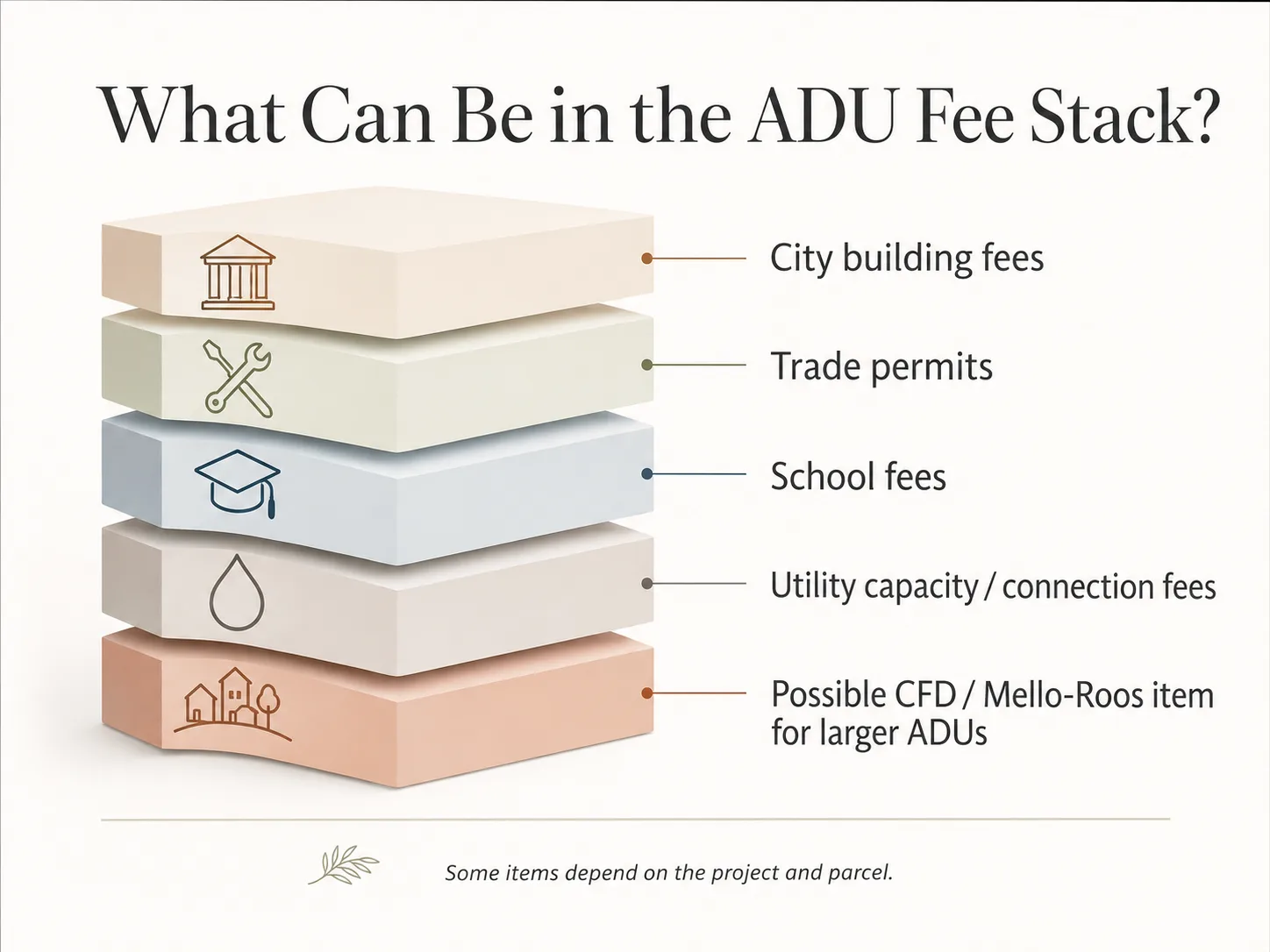
San Marcos ADU permit fee stack — pre-construction costs by project size.
City Standard ADU fees (flat rate)
| ADU City Standard category | Plan check fee | Permit fee | Total |
|---|---|---|---|
| Up to 500 sq ft | $1,166.08 | $2,584.24 | $3,750.32 |
| Up to 749 sq ft | $1,166.08 | $2,584.24 | $3,750.32 |
| Up to 1,000 sq ft | $1,166.08 | $2,584.24 | $3,750.32 |
Custom ADU fees (valuation-based)
| Valuation range | Base permit fee | Plus, per $1,000 above base |
|---|---|---|
| $1 – $9,000 | $264.72 | — |
| $9,001 – $50,000 | $292.10 | $26.80 |
| $50,001 – $100,000 | $1,390.97 | $18.55 |
| $100,001 – $250,000 | $2,318.28 | $15.46 |
| $250,001 – $500,000 | $4,636.56 | $12.98 |
| $500,001 – $1,000,000 | $7,882.15 | $8.35 |
| $1,000,001+ | $12,055.05 | $6.38 |
A $250,000-valuation custom ADU pays roughly $4,636 in permit fee alone, plus a separate plan check fee and Strong Motion Instrument Tax of $0.10 per $1,000 valuation (residential, three stories or less).
Trades permits
| Permit / item | Fee |
|---|---|
| Electrical permit issuance | $50 |
| New service single-phase | $150 |
| Subpanel | $50 |
| EV charging station (EVCS) | $50 |
| Plumbing permit issuance | $25 |
| Each plumbing fixture | $50 |
| Each sewer | $50 |
| Water heater (new or replacement) | $50 |
| Gas system (new or repair) | $80 |
| Mechanical permit issuance | $25 |
| Forced air unit (new or replacement) | $50 |
| Heat pump (new or replacement) | $50 |
| Mini-split | $50 |
| Mechanical plan review | $0.25 per sq ft |
| Strong Motion Instrument Tax (residential ≤ 3 stories) | $0.10 per $1,000 valuation |
| Re-inspection fee | $130 |
Plan on another roughly $400–$900 in trades-permit fees depending on the number of fixtures, gas lines, and mechanical units.
School developer fees (SMUSD)
The San Marcos Unified School District charges $5.17 per square foot on the assessable area of new residential construction and additions with assessable area greater than 500 sq ft (rate effective July 9, 2024). When the assessable area exceeds 500 sq ft, the fee applies to the full assessable area — not just the increment above 500.
| ADU size | SMUSD school fee at $5.17/sq ft |
|---|---|
| 500 sq ft | $0 (at or below the 500-sq-ft assessable threshold) |
| 600 sq ft | $3,102 |
| 750 sq ft | $3,878 |
| 850 sq ft | $4,395 |
| 1,000 sq ft | $5,170 |
Public Facility Fees (PFF) — City impact fees
Gov. Code § 66311.5 prohibits local agencies from imposing impact fees on ADUs with 750 sq ft of interior livable space or less. A 750-sq-ft ADU is exempt from City PFF impact fees. A 751-sq-ft ADU is not. The City offers a PFF deferral program — useful for cash-flow planning, but the bill still comes due before final inspection.
Realistic all-in pre-construction fee stack
| Fee | 500-sq-ft City Standard | 749-sq-ft City Standard | 1,000-sq-ft City Standard |
|---|---|---|---|
| City Standard ADU plan check + permit | $3,750.32 | $3,750.32 | $3,750.32 |
| Electrical/plumbing/mechanical trades permits | ~$500 | ~$700 | ~$800 |
| Strong Motion Instrument Tax | ~$15–$30 | ~$22–$45 | ~$30–$60 |
| SMUSD school developer fees | $0 | $3,878 | $5,170 |
| City PFF impact fees | $0 (exempt at ≤750 sq ft) | $0 (exempt at ≤750 sq ft) | Proportional, typically several thousand |
| Vallecitos water capacity fee | $ varies | $ varies | $ varies |
| Vallecitos sewer capacity fee | $ varies | $ varies | $ varies |
| SDG&E service setup | Per SDG&E | Per SDG&E | Per SDG&E |
| Building verification survey | $1,000–$2,500 (builder-sourced) | $1,000–$2,500 (builder-sourced) | $1,000–$2,500 (builder-sourced) |
| Soils report (if required) | ~$2,500–$5,000 | ~$2,500–$5,000 | ~$2,500–$5,000 |
| CFD annexation admin fee ($300/CFD, if >750 sq ft) | $0 | $0 | $300–$1,200 |
| Approximate pre-construction subtotal | $5,300–$6,800 | $8,400–$10,000 | $13,800–$20,000+ |
All City fees from the Development Fees schedule effective March 3, 2025, Resolution 2024-9385. Builder/field-sourced ranges flagged as such. Custom ADUs at the same size pay valuation-based fees instead of the $3,750.32 flat — typically two-to-four times that figure on a $250K–$500K-valuation project.
The Dwelling Index is reader-supported. When you use our links to explore financing options, we may earn a commission at no extra cost to you. Our editorial recommendations are based on independent research and are never influenced by compensation.
Financing path education
Most San Marcos ADUs are financed with a cash-out refinance, a HELOC, or a renovation/construction loan tied to the home’s after-renovation value. Mortgage Research Center can show you current mortgage, refinance, cash-out, and construction-loan options side by side.
Educational information only. Rates and approvals are subject to lender underwriting and are never guaranteed in this article.
The CFD/Mello-Roos trap every San Marcos ADU builder should know
If your ADU has more than 750 sq ft of interior livable space, San Marcos may require you to reconcile the project with the city’s Community Facilities Districts (CFDs), often called Mello-Roos districts. You either annex the new development into the applicable CFD (adding an annual special tax to your property tax bill, typically a few hundred to roughly $2,000 per year combined, builder-reported) or pay a one-time in-lieu fee the City calculates based on the project’s expected impact. The City Council certifies CFD annexation votes on a quarterly schedule — this is the single biggest hidden friction point in the San Marcos ADU permit process.
What a CFD actually is
A Community Facilities District is a financing tool created under the Mello-Roos Community Facilities Act of 1982. After Proposition 13 capped general property tax growth, cities needed a way to fund public services and infrastructure that new development demands. San Marcos receives one of the lowest shares of property tax revenue in San Diego County — about $7 per $100 of property taxes paid, per the City’s own CFD page. CFDs fill the gap.
Which San Marcos CFDs apply to new ADU construction
| CFD | Purpose | Residential annexation admin fee |
|---|---|---|
| CFD 98-01 IA #1 | Police services | $300 |
| CFD 98-02 | Lighting and landscaping maintenance | $300 |
| CFD 2001-01 | Fire / paramedic services | $300 |
| CFD 2011-01 | Congestion management | $300 |
The $300 per CFD is the administrative processing fee, not the annual special tax. Source: City Development Fees, eff. 3/3/2025.
Annexation vs. in-lieu
Annexation
Property owner agrees by ballot vote to add the property to the CFD. The CFD’s annual special tax appears on the next year’s property tax bill and continues annually thereafter. Builder field experience puts the annual combined obligation in the few-hundred-to-roughly-$2,000 range for the four service CFDs. Verify your parcel-specific maximum with the CFD Administrator.
In-lieu fee
A single, lump-sum charge calculated by the City based on the project’s anticipated impact. Faster than annexation since there’s no quarterly Council certification cycle, but the City still needs to calculate and invoice it. Get the City’s actual in-lieu calculation for your specific project — do not rely on published ranges.
Why CFD can add months
Once you elect annexation, the City prepares an annexation packet. You return the completed ballot plus the $300 administrative fee per CFD by the date specified. The City Council then certifies annexation votes on a quarterly schedule — and the City confirms in its fee schedule that “approval may be delayed if the annexation packet is not returned by the date indicated within the packet.” Builder field experience puts the practical add-on at three to four months when annexation timing misses a certification cycle.
How to find out if your address is already in a CFD
- Look at your current annual property tax bill. Under “Fixed Charge Assessments” you’ll see itemized special assessments. Anything labeled “CFD” tells you you’re already in one.
- Use the San Diego County property tax lookup (sdttc.com) with your APN.
- Call the City’s CFD Administrator at (760) 744-1050 ext. 4506 — they will tell you which CFDs your parcel touches and the maximum special tax rate if annexed.
San Marcos ADU rules (Chapter 20.410) in plain English
San Marcos Municipal Code Chapter 20.410 — Accessory Dwelling Units and Junior Accessory Dwelling Units — was most recently amended by Ordinance 2024-1551 on September 24, 2024.
How many ADUs you can build
| Property type | What’s allowed |
|---|---|
| Single-family lot | One detached ADU + one converted ADU (inside existing structure) + one JADU (≤ 500 sq ft inside primary) |
| Multifamily lot (2+ existing units) | Under SB 1211 (effective 2025), up to 8 detached ADUs not to exceed the number of existing units, plus conversions of non-livable space up to 25% of existing unit count |
Maximum ADU size
| ADU type | Maximum size |
|---|---|
| Detached, 1-bedroom or studio | 850 sq ft |
| Detached, 2 or more bedrooms | 1,000 sq ft |
| Attached ADU | Lesser of 50% of primary living area or size caps above — but state law prevents reducing below 850 sq ft (studio/1-BR) or 1,000 sq ft (2+ BR) |
| JADU | 500 sq ft maximum, fully inside the primary residence |
Setbacks
| Setback | Requirement |
|---|---|
| Side and rear (new detached) | 4 ft minimum |
| Side and rear (conversion of legal existing structure) | No new setback applied — keeps existing footprint |
| Front | Per underlying zone (typically larger) |
| Front yard, ADU ≤ 800 sq ft, no other feasible location | Per state SB 897 — must allow within the underlying front setback |
| Building separation: primary to detached ADU | 10 ft eave-to-eave minimum |
Height limits
| Condition | Maximum height |
|---|---|
| Detached ADU, single-family lot, not within transit corridor | 16 ft, one story (unless above a garage) |
| Detached ADU above a garage | Match the underlying zone height limit |
| Detached ADU within ½ mile of a major transit stop or high-quality transit corridor | 18 ft, plus an additional 2 ft if roof pitch matches the primary dwelling |
| Conversion of existing space | Height limits do not apply to the conversion itself |
| Attached ADU | Up to 25 ft, subject to underlying zone limits |
The transit-corridor bonus is what unlocks a two-story ADU. Cal State San Marcos and the SPRINTER rail corridor are common qualifying features — verify parcel-specific eligibility with the City’s Planning Division before designing.
Parking
| Condition | Required parking |
|---|---|
| ADU within ½ mile (walking distance) of public transit | None |
| Garage conversion or carport demolition | No replacement parking required — state law preempts |
| All other detached ADUs | Up to 1 space per ADU; may be tandem in driveway and within setbacks |
| JADU | None |
Fire sprinklers
Required for the ADU only if required for the primary residence. Building an ADU does not trigger a sprinkler retrofit of the primary dwelling.
Architectural compatibility
Chapter 20.410 requires ADUs to be architecturally compatible with the existing dwelling — similar features, materials, color, roofing, fascia, and exterior finish. Enforced through plan check, not a discretionary hearing.
Owner-occupancy
AB 976 (effective January 1, 2024) permanently removed the owner-occupancy requirement for standard ADUs. You do not have to live on the property. For JADUs: AB 1154 (effective January 1, 2026) requires owner-occupancy only if the JADU shares sanitation with the primary residence.
HOA restrictions
California Civil Code § 4751 makes HOA covenants that effectively prohibit or unreasonably restrict ADU construction void and unenforceable. HOAs can impose reasonable design standards but cannot ban ADUs outright.
What documents do you need before you submit?
A complete San Marcos ADU permit submittal includes a detailed site plan, scope of work and ownership information, vicinity map, architectural drawings, structural drawings, Title 24 energy compliance documents, MEP plans, a building verification survey and setback certification, deferred submittals for roof trusses and solar, and a stormwater BMP/SWQMP form.
Site documents
- ✓Detailed site plan with property lines, existing structures, proposed ADU footprint, all setbacks dimensioned, building separation, north arrow, scale, and APN
- ✓Vicinity map showing the property's location relative to surrounding streets and landmarks
- ✓Impervious vs. pervious area table — square footage of existing and proposed paved/covered surfaces
- ✓Land-disturbance quantity in cubic yards (cut, fill, total)
- ✓BMP / SWQMP form for stormwater best management practices
Ownership and project information
- ✓Owner's name, mailing address, contact information
- ✓Project scope description (ADU type, size, bedrooms, finishes)
- ✓APN (Assessor's Parcel Number) and current zoning
- ✓HOA disclosure, if applicable
Architectural drawings
- ✓Floor plan, roof plan, elevations (all four)
- ✓Cross sections
- ✓Door, window, and finish schedules
- ✓For PRADU: City plan set with site-specific information filled in
- ✓For custom: full architectural set
Structural and MEP drawings
- ✓Foundation plan (per soils report when one is required)
- ✓Framing plans (floor, roof, shear walls)
- ✓Mechanical plans (HVAC layout, ducts, load calculations)
- ✓Electrical plans (panel schedule, circuits, lighting, EV charging if applicable, separate ADU electrical service)
- ✓Plumbing plans (water, drain-waste-vent, gas)
Title 24 energy compliance
- ✓Prescriptive or performance compliance forms
- ✓Mandatory measures checklist
- ✓HERS rater requirements where applicable
- ✓Building energy budget
Deferred submittals (submitted after main permit approval)
- ✓Roof truss calculations and shop drawings from the truss manufacturer
- ✓Solar panel layout, structural attachment, and electrical interconnection package — required for all new ADUs under the 2022 California Energy Code
Outside-agency coordination items
- ✓Vallecitos Water District — application for water-capacity fee quote and any required service or meter changes
- ✓San Diego Gas & Electric (SDG&E) — application for service connection (separate electric meter typically required)
- ✓SMUSD — request a Certificate of Compliance once your City building permit application is ready
- ✓San Marcos Fire Department — fire flow and access review for the parcel
What can delay a San Marcos ADU permit after you think you’re ready?
The most common delays are an incomplete submittal that pauses the 60-day clock, deferred truss or solar packets that aren’t ready by issuance, an SMUSD school-fee letter that lags, Vallecitos capacity-fee timing, fire department review, the quarterly CFD certification window for ADUs over 750 sq ft, and one or two plan-check correction cycles for custom designs.
Incomplete application
The single most common delay. The City has 15 business days from receipt to send a completeness notice. If items are missing — site plan dimensions, structural calculations, energy compliance — the state's 60-day clock doesn't start. Use the checklist above before you file.
Plan-check corrections
For PRADU using an unaltered City plan set, corrections are uncommon. For custom designs, one to two correction cycles is normal (builder field experience). Common comment categories: structural calc inconsistencies between sheets, energy compliance documentation gaps, drainage and impervious-area inconsistencies, missing egress window details, and electrical service sizing. Each cycle pauses the state clock and typically takes two to four weeks to respond.
Deferred submittals lagging
Roof truss calculations and solar packages are deferred submittals — they still need approval before the related work proceeds. If your truss manufacturer is backlogged or your solar installer hasn't drawn the layout, the framing inspection can wait. Order truss design as soon as you have approved framing plans.
School-fee letter timing
You can't pull the permit until SMUSD issues the Certificate of Compliance showing fees paid. Apply for it as soon as your City building permit application is ready — SMUSD calculates the fee from the building department's permit form, so they need your application valuation and assessable area first.
Vallecitos capacity fees and SDG&E service setup
Vallecitos collects water and sewer capacity fees before final inspection. SDG&E new-service requests run on SDG&E's queue. Both should be initiated when plan check is in progress, not after permit issuance.
CFD annexation cycle (for ADUs over 750 sq ft)
The quarterly Council certification windows are the bottleneck. If your project doesn't depend on the larger size band, designing at 750 sq ft or below removes this delay entirely. Call the CFD Administrator at (760) 744-1050 ext. 4506 for current cycle dates.
Can you legalize an unpermitted ADU in San Marcos?
Possibly, yes. California state law gives narrow protections for ADUs constructed without permits before specific cutoff dates — but the protections, dates, and remedies vary, and health-and-safety corrections can still be required.
Pre-January-1-2018 unpermitted ADUs
Under longstanding state law (now in the renumbered ADU framework), the City generally cannot deny a permit for an unpermitted ADU built before January 1, 2018 solely on the basis that it violates current building standards or does not comply with state ADU law. Health-and-safety corrections under Health and Safety Code § 17920.3 still apply.
Pre-January-1-2020 unpermitted ADUs
AB 2533 (effective 2025) added separate streamlining protections for ADUs and JADUs constructed without permits before January 1, 2020, simplifying the legalization pathway for units built after the pre-2018 protected window but before the 2020 cutoff.
Before you open a code case
- Get a private inspection first. A confidential code review from a licensed contractor or third-party building inspector tells you what corrections would be needed before the City opens a permit file.
- Document the build date. Aerial imagery (Google Earth historical layer, NearMap, County Assessor records), original utility records, dated photos, and neighbor declarations establish when the structure was built. The pre-2018 vs. pre-2020 dates trigger different protections.
- Don’t keep building without a permit. The City’s Building Division warns that starting or continuing unpermitted work can result in fines, work stoppage orders, and additional fees. The AB 2533 and earlier protections are for completed work, not ongoing construction.
How do San Marcos homeowners pay for their ADU?
San Marcos ADU projects are typically financed through one of four paths: a cash-out refinance, a Home Equity Line of Credit (HELOC), a renovation/construction loan tied to after-renovation value, or savings combined with a personal loan or short-term bridge financing. California’s CalHFA ADU Grant of up to $40,000 for pre-development costs is currently fully allocated with no new applications open.
| Your project profile | Lane that often fits |
|---|---|
| Under 500 sq ft, low total budget, primary mortgage at a low rate | HELOC or personal savings |
| 500–750 sq ft, fee-controlled build (no impact fees, no CFD), primary mortgage at a low rate | HELOC or HEI |
| Over 750 sq ft, larger total budget, impact fees plus CFD in play | Cash-out refi if rate spread makes sense; otherwise renovation/construction loan |
| Custom valuation-based build, longer timeline | Renovation/construction loan with draw schedule |
These are illustrative paths, not guarantees of returns, approval, or specific rates. Actual results depend on local market conditions, construction costs, financing terms, and regulatory approvals.
After the build: renting, insurance, and managing your San Marcos ADU
Once the certificate of occupancy is issued, you can rent the ADU for any term longer than 30 days under state law. Update your homeowner’s insurance to reflect a separate dwelling unit on the property, set up the SDG&E account for any new meter, and decide whether to self-manage or hire a property manager.
Insurance
Talk to your carrier before the ADU is finished. Some policies require an endorsement; some require a separate dwelling policy. Liability coverage limits should reflect having a tenant.
Short-term rentals
State law (Gov. Code § 66323) requires ADU rentals to be longer than 30 days. You cannot use a permitted ADU for nightly short-term rental. San Marcos has separate short-term rental rules for the primary residence — verify with the City.
California rent rules
AB 1482 caps annual rent increases for most California properties and adds just-cause termination requirements. Newly built ADUs may be exempt from the rent cap if the property is properly noticed — the exemption rules are nuanced. Consult a California landlord-tenant attorney before relying on an exemption for long-term planning.
Who to contact at the City of San Marcos
| Need | Who to contact |
|---|---|
| Building permit submittal, plan-check status, inspections | City of San Marcos Building Division — (760) 744-1050 |
| Zoning, setbacks, ADU rule interpretation, transit-corridor verification | City of San Marcos Planning Division — (760) 744-1050 |
| CFD / Mello-Roos annexation, in-lieu fees, current Council certification dates | CFD Administrator — (760) 744-1050 ext. 4506 |
| PRADU plan set downloads and PRADU process | Building Division → sanmarcosca.gov/Business-Services/Building-Division/Permit-Ready-ADUs |
| Solar permits | solarpermits@san-marcos.net |
| Water and sewer service, capacity fees | Vallecitos Water District Engineering — VWDEngineering@vwd.org, (760) 744-0460 |
| New electric service | SDG&E new service application |
| School developer fees | SMUSD Facilities Planning — (760) 290-2649, schoolfees@smusd.org |
| Fire department review | San Marcos Fire Department |
General City address: 1 Civic Center Drive, San Marcos, CA 92069. The City migrated its public site between san-marcos.net and sanmarcosca.gov during 2024–2026; if a deep link returns a 404, search the current sanmarcosca.gov site.
What we verified
Verified May 13, 2026 from official sources:
- City of San Marcos PRADU program page — 30-day approve/deny clock, no-alterations rule, Gov. Code § 65852.27.
- City Development Fees schedule (Resolution 2024-9385, effective March 3, 2025) — City Standard ADU plan check and permit fees, valuation-based custom fee table, four City-administered CFDs and $300/CFD residential annexation administrative fee.
- San Marcos Unified School District Residential Developer Fees notice — $5.17 per square foot, effective July 9, 2024.
- San Marcos Municipal Code Chapter 20.410 (Ord. 2024-1551, September 24, 2024).
- California Government Code §§ 66310–66342 ADU framework (renumbered by SB 477, March 2024), including § 66311.5, § 66317, § 66321, § 66323, § 66333, § 65852.27; HCD’s 2026 ADU Handbook; SB 13, AB 68, AB 976, AB 1332, AB 1154, AB 2533, SB 1211, SB 477, SB 543.
- City CFD/Mello-Roos finance page and CFD Annexation Information Sheet inside the 2025 development fees PDF.
- Vallecitos Water District Payments of Fees and Deposits page.
- CalHFA ADU Grant Program page — funding fully allocated.
Flagged where we rely on builder/field experience rather than a City source:
The typical $1,000–$2,000 annual CFD special-tax range, the 3–4 month CFD certification delay, the 4–8 month custom-permit window, the $5,000–$12,000 design-fee range, and the $250–$600/sq ft construction-cost range are all builder-reported estimates labeled as such. The updated soils-report guidance is based on SnapADU’s May 2025 communication with a City plans examiner.
We have not been paid by any provider to recommend them in this article. SnapADU and Mortgage Research Center are affiliate partners; we may earn a commission at no cost to readers who use our links. Our editorial recommendations are based on independent research and are never influenced by compensation. If you find a number on this page that doesn’t match what the City quotes you, the City’s quote controls — contact us and we’ll update the page if a fee schedule has changed.
San Marcos ADU permit process FAQ
How long does a San Marcos ADU permit take?
The fastest published city clock is 30 days for a complete PRADU application. For custom or conversion ADUs, the state's 60-day approve-or-deny clock applies after a complete application (Gov. Code § 66317). In practice, end-to-end from design to permit-in-hand is 5–7 months for a clean PRADU build and 9–13 months for a custom ADU (builder field experience). ADUs over 750 sq ft can add 3–4 months for CFD certification.
How much does a San Marcos ADU permit cost?
City building fees are a flat $3,750.32 for any City Standard ADU using a PRADU plan set. Custom ADUs pay valuation-based fees — a $250,000-valuation custom project pays roughly $4,636 in permit fees alone. Add SMUSD school fees of $5.17/sq ft when assessable area exceeds 500 sq ft, trades permits (~$400–$900), Vallecitos capacity fees, SDG&E setup, building verification survey ($1,000–$2,500), and CFD annexation fees ($300/CFD) if your ADU exceeds 750 sq ft. Pre-construction totals range from roughly $5,300 for a 500-sq-ft City Standard ADU to $20,000+ for a 1,000-sq-ft unit.
What is the San Marcos PRADU program?
The City of San Marcos Permit-Ready ADU (PRADU) program provides free preapproved plan sets for detached, one-story ADUs under Gov. Code § 65852.27. A complete PRADU application using an unaltered City plan set must be approved or denied within 30 days. No alterations to the City architectural plan set are permitted — any change pushes the project to the standard ADU permit track with the 60-day state clock.
What is the CFD/Mello-Roos trap in San Marcos?
If your ADU has more than 750 sq ft of interior livable space, San Marcos may require annexation into one or more Community Facilities Districts (CFDs) or a one-time in-lieu fee. There are four applicable CFDs, each with a $300 administrative annexation fee. CFD Council certification happens quarterly — missing a cycle adds 3–4 months to your timeline. ADUs at 750 sq ft or under are exempt from impact fees and generally avoid the CFD process.
Does San Marcos require a soils report for an ADU?
Not routinely. Per SnapADU's May 2025 communication with a City plans examiner, San Marcos no longer requires a geotechnical report on most ADUs — the requirement triggers only when grading is proposed or site conditions warrant. Confirm with the Building Division for your specific project.
Can I build a two-story ADU in San Marcos?
Only in limited circumstances. Standard detached ADUs on single-family lots are limited to 16 ft, one story. ADUs within one-half mile of a major transit stop or high-quality transit corridor are allowed up to 18 ft, plus an additional 2 ft if the roof pitch matches the primary dwelling. Two-story eligibility is parcel-specific; verify with the Planning Division.
Do garage conversions need replacement parking in San Marcos?
No. Converting an existing garage to an ADU does not require replacement parking under state law and Chapter 20.410. SB 1211 (effective January 2025) extended this protection to demolition or conversion of any garage, carport, or covered parking structure.
Do I have to live on the property to build an ADU in San Marcos?
For a standard ADU: no. AB 976 (effective January 1, 2024) permanently removed the owner-occupancy requirement. For a JADU: owner-occupancy is required under AB 1154 (effective January 1, 2026) only if the JADU shares sanitation with the primary residence.
Can I Airbnb my San Marcos ADU?
No. State law (Gov. Code § 66323) requires ADU rentals to be longer than 30 days. Short-term rentals are not allowed for permitted ADUs.
Can my HOA stop my San Marcos ADU?
Generally no. California Civil Code § 4751 makes HOA covenants that effectively prohibit or unreasonably restrict ADU construction void and unenforceable. HOAs can impose reasonable design and material standards but cannot ban ADUs outright.
Can I sell my San Marcos ADU separately?
Not currently. AB 1033 allows local jurisdictions to opt in to separate ADU condominium sales. San Marcos has not opted in as of our verification date.
Where do I submit my San Marcos ADU permit application?
Through the City of San Marcos online building permit system as PDFs. You will need your APN and a working email to set up an account. Building Division: (760) 744-1050. CFD Administrator: (760) 744-1050 ext. 4506. General City address: 1 Civic Center Drive, San Marcos, CA 92069.
Not sure where to start?
See what’s possible at your address — get your free San Marcos ADU report in 60 seconds. Independent feasibility tool. No commitment, no spam.
Get Your Free San Marcos ADU Report →